PART 2: HOA KAREN Threatened $250-a-Day Fines Over My Solar Panels — She Never Checked Virginia Law
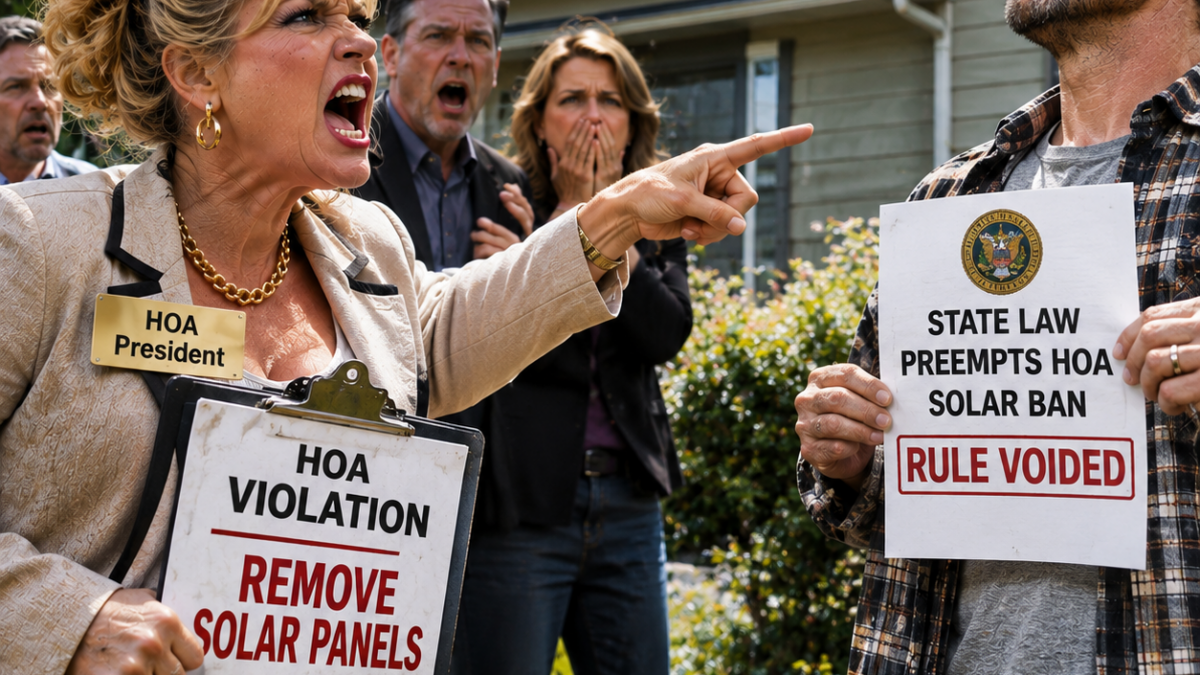
PART 2
Phyllis held the letter out between two fingers.
“Formal denial,” she said.
I took it.
“Already?”
“The board reviewed your request.”
“When?”
“Last night.”
“I didn’t know there was a meeting.”
“It was an executive architectural session.”
“Who attended?”
Her mouth tightened.
“That is board business.”
I unfolded the letter.
The language was colder than the first one.
My proposed solar installation had been denied for violating Section 4.7b.
Any further attempt to install the panels would trigger a fine of $250 per day.
I looked up.
“You understand the panels are on the back roof.”
“That is irrelevant.”
“They can’t be seen from the street.”
“Our concern is precedent.”
“What precedent?”
“Allowing homeowners to alter exterior roof surfaces without community control.”
I almost laughed.
“Phyllis, the county already approved it.”
“The county does not govern Whispering Pines architectural harmony.”
There was that word.
Harmony.
Phyllis used it constantly.
I looked over at Westbrook’s crew.
Two men stood beside the ladder.
Another was on the roof near the mounting area, waiting.
Nobody moved.
Phyllis followed my eyes.
“You should send them home.”
Westbrook had parked farther down the driveway.
He walked toward us.
“Mrs. Crowder?”
“President Crowder.”
Westbrook stopped.
I saw something in his face that looked dangerously close to amusement.
“President Crowder. We have county approval, electrical permits, engineered mounting plans, and the owner’s authorization.”
“You do not have HOA approval.”
“We don’t install anything illegal.”
“Then you won’t install today.”
Westbrook looked at me.
I shook my head slightly.
Not yet.
Phyllis saw that and smiled.
That was the smile I remembered later.
Not joy.
Confirmation.
She believed I had backed down.
Then she leaned closer.
“Mr. Marsh, ask Edna Trask what happens when people decide the rules don’t apply to them.”
My fingers tightened around the letter.
Edna was eighty-one.
Recovering from hip surgery.
Phyllis had fined her for leaving trash cans visible after the seven o’clock evening deadline.
I knew because everybody knew.
Nobody had said anything.
“What does that mean?” I asked.
“It means compliance is cheaper than resistance.”
There it was.
Not harmony.
Not property values.
Control.
She turned, climbed into the golf cart, and drove away.
I watched until she disappeared around the corner.
Westbrook came beside me.
“You want me to reschedule?”
“Yes.”
“You sure?”
“Very.”
He glanced at the letter.
“You calling a lawyer?”
“I am now.”
—
Caldwell Oaks worked from an office in Waynesboro that looked as though paper had been breeding there unsupervised for thirty years.
Legal books.
Folders.
Banker boxes.
Three coffee mugs on one desk.
A plant that might once have been alive.
He was semi-retired, white-haired, sharp-eyed, and charged me $150 an hour.
In legal terms, that felt like finding gasoline for fifty cents a gallon.
I gave him everything.
Solar contract.
County permit.
HOA letters.
CC&Rs.
My notes from the conversation with Phyllis.
He read without interrupting.
After twenty minutes, he removed his glasses.
“Your position is strong.”
“How strong?”
“I dislike percentages.”
“Pretend you’re not a lawyer.”
“Impossible.”
I waited.
He tapped Section 4.7b.
“The association can impose certain lawful restrictions depending on its governing documents and applicable Virginia law. But what they’re doing here appears to function as a blanket prohibition through an approval process.”
“Meaning?”
“Meaning they cannot simply write ‘approval required’ and then use approval as an automatic veto if state law protects the installation.”
I leaned back.
“So Phyllis is wrong.”
“Based on what I’m reading, yes.”
“Can you make her stop?”
“I can ask professionally.”
“And when that fails?”
Caldwell smiled.
“Then we ask a judge professionally.”
That was the moment I hired him.
—
His demand letter went out Wednesday morning.
Certified mail and email.
Four pages.
Statutes.
Case references.
Description of the installation.
Fourteen days for the board to rescind its denial and confirm in writing that the solar project could proceed.
I asked Caldwell whether all the legal citations were necessary.
“Belt and suspenders.”
“That a legal phrase?”
“No.”
He sealed the envelope.
“Lawyers just enjoy making one-page arguments four pages long.”
At least he admitted it.
Then we waited.
Or I did.
Phyllis apparently couldn’t.
Three days later, Crankshaft and I returned from our morning walk to find another piece of paper taped to my front door.
Not mailed.
Not in an envelope.
Taped.
Visible from the street.
I peeled it off.
The tape pulled a strip of paint from the trim.
Small.
Barely noticeable.
Still irritated me.
Formal board denial.
$250 daily fine if installation resumed.
I touched the damaged paint.
Then got my notebook.
**Door trim paint damage: estimated $11.99.**
A voice came from across the street.
“You documenting paint now?”
Garland Fitch sat on his porch.
Retired Navy chief.
Sixty-one.
Broad shoulders.
Gray beard.
The type of man who could look relaxed while somehow making everybody else feel underdressed.
“She damaged the trim.”
Garland walked over.
“You’re serious.”
“Completely.”
He read the notice.
Then looked down the street where Phyllis’s white Cadillac was disappearing.
“She did the same thing to Trask.”
“The trash cans?”
“That too.”
“What else?”
“Three houses I remember.”
We stood near my porch.
“Oyelarans had a paint dispute. Petersons fought over a shed. Another family stopped appealing because the penalties kept growing.”
“What happened?”
“Mostly they paid.”
“Why?”
Garland shrugged.
“Because one hundred seventy-five dollars is cheaper than three thousand dollars in lawyer bills.”
That sentence bothered me.
He looked at the paper.
“You leaving?”
“Leaving what?”
“Neighborhood.”
“No.”
He nodded slowly.
“Then keep receipts.”
I smiled.
“I’ve already started.”
—
Caldwell’s fourteen-day deadline came and went.
Phyllis responded personally instead of through counsel.
That surprised Caldwell.
“Either they don’t have association counsel,” he said, “or she thinks she doesn’t need any.”
Her response argued that the HOA’s aesthetic authority permitted it to review solar installations and reject anything inconsistent with architectural harmony.
She acknowledged my panels would be rear-facing.
She acknowledged they would be minimally visible.
Then she denied them anyway.
But page three contained something new.
An expert.
**Roderick Vain, Vain Property Consultants.**
According to Phyllis, Vain had concluded that solar installations could materially reduce aesthetic property values in planned communities.
I typed his name into Google.
The website looked abandoned.
A logo.
A phone number.
Two pages of vague language about “community standards optimization.”
No staff biographies.
No credentials.
No project list.
One review.
Five stars.
Reviewer:
R. Vain.
I called Caldwell.
“Found the expert.”
“That fast?”
“He has one review.”
“Good?”
“Very.”
“Who wrote it?”
“Himself, apparently.”
Caldwell went quiet.
Then laughed.
“Send me the name.”
An hour later he called back.
“Interesting.”
“Licensed appraiser?”
“No.”
“Architect?”
“No.”
“Engineer?”
“No.”
“HOA attorney?”
“No.”
“What is he?”
“Owner of an LLC registered several years ago with no professional credential I can locate that would make him an independent valuation expert.”
“Useful?”
“Potentially.”
I heard paper shifting.
“But I’m more interested in another question.”
“What?”
“Why does Phyllis know him?”
That was the first question in this story that genuinely changed direction.
—
Summer was approaching.
Every week of delay cost me energy production.
Westbrook estimated the lost offset at roughly $140 per week under expected seasonal conditions.
I started logging it.
Date.
Estimated output.
Estimated utility offset.
Delay.
I had spent my career maintaining diesel equipment.
When a truck was down, downtime had a dollar value.
This was no different.
Then I started talking to neighbors.
Not campaigning.
Not yet.
Crankshaft gave me an excuse.
We walked every evening.
I stopped when people were outside.
The first real conversation was with Mark and Sandra Oyelaran.
Garland had said they moved.
They hadn’t.
He had confused them with another family.
Their story was simpler.
Phyllis denied their request to paint shutters a color that was explicitly included on the approved palette.
They appealed.
Spent about eight hundred dollars consulting someone.
Eventually gave up.
“Why?” I asked.
Mark laughed without humor.
“We both work.”
Sandra nodded.
“We had two kids in middle school. At some point you ask whether the color blue is worth destroying your month.”
“Did Phyllis know the color was on the approved list?”
“We showed her.”
“What did she say?”
“The board retains interpretive discretion.”
I wrote that down.
Sandra noticed.
“You really are taking notes?”
“Yes.”
“Why?”
“Because people say things differently when nobody writes them down.”
That sentence became a rule for me.
—
The Birchfields lived three streets over.
Young couple.
Two children.
Priscilla Birchfield taught elementary school.
They had been fined $175 over a compost bin behind a privacy screen.
Couldn’t be seen from the road.
Barely visible from a neighbor’s second-floor window.
They paid.
“We didn’t know we had another option,” Priscilla said.
That line followed me home.
I sat at the kitchen table that night.
Crankshaft snored under my chair.
Loretta’s old mug was still in the cabinet above me.
I took it down.
I rarely used it.
Dark blue.
Tiny chip near the handle.
She used to drink tea from it while correcting me about things I had claimed to know before actually checking.
Loretta had no patience for confident ignorance.
I could almost hear her.
**Did you read it, Deacon?**
That was what she always asked.
Insurance forms.
Loan agreements.
Warranty paperwork.
Contractor bids.
Did you read it?
Most of us didn’t.
Phyllis knew that.
Her power wasn’t simply written into the rulebook.
Her power came from everybody assuming she had already read it.
I created a group text.
Garland.
Oyelarans.
Birchfields.
I named it:
**Receipts.**
Garland responded immediately.
**Finally, a group chat I respect.**
—
Caldwell filed the civil case when the demand deadline expired.
The complaint sought an order preventing the HOA from interfering with the installation.
A declaration that Section 4.7b could not be enforced in the way Phyllis was using it.
Compensatory damages tied to delay.
Legal costs.
My loss log.
And, because Caldwell apparently had a sense of humor buried beneath forty years of property law, the $11.99 in door paint.
“You actually included that?”
“Absolutely.”
“Why?”
“Because specificity is memorable.”
“It’s twelve dollars.”
“Eleven ninety-nine.”
“You’re enjoying this.”
“A little.”
We received a hearing date.
Forty-one days away.
That felt both fast and unbearably slow.
The HOA was formally served.
Garland watched the process server reach Phyllis’s house.
My phone buzzed.
**SHE GOT SERVED.**
Then:
**Cadillac still spotless.**
I wrote back:
**Focus.**
His response:
**I am focused. On the Cadillac.**
—
Phyllis responded with a community meeting.
Flyers appeared under doors.
**EMERGENCY SESSION — PROTECTING OUR COMMUNITY VALUES**
The flyer included a photograph of a house with ugly, raised solar panels on the front roof.
Not mine.
Not even similar to mine.
The message was obvious.
Solar panels were coming.
Property values were in danger.
Civilization would presumably collapse next.
I showed the flyer to Westbrook.
“That’s an old rack system,” he said.
“Mine looks nothing like that.”
“Nope.”
“Can they legally use a random photo?”
“Probably. But it tells you what she’s selling.”
“Fear.”
“Exactly.”
The clubhouse meeting started at seven.
Sixty people attended.
That was huge for Whispering Pines.
I went with Garland.
The Oyelarans came.
The Birchfields.
Edna Trask sat near the aisle with a cane.
I had never spoken to her before.
She smiled at me.
“Solar man.”
“I guess that’s me.”
“Give her hell.”
Garland coughed to hide a laugh.
—
Phyllis stood behind a folding table.
Two board members beside her.
Aldous Prentiss looked uncomfortable before anyone even spoke.
Cynthia Bowl sat straight-backed beside Phyllis, hands folded.
A projector showed the ugly solar photo.
Phyllis began.
“Whispering Pines has always been distinguished by consistency.”
Harmony.
Character.
Property values.
Standards.
She said “harmony” four times.
Not once did she mention my lawsuit.
Then she opened public comment.
My hand went up.
Her eyes found me immediately.
“Mr. Marsh.”
I stood.
“Phyllis, I think homeowners need to know the association is currently a defendant in a civil case involving Section 4.7b.”
The room changed.
Not loudly.
First silence.
Then chair legs scraping.
Then whispers.
Phyllis’s face stiffened.
“That matter is being handled appropriately by the board.”
“When is the hearing?” somebody asked.
“Are HOA funds paying a lawyer?” another voice called.
Phyllis raised a hand.
“Please. One person at a time.”
A man in the back said:
“What lawyer?”
That was when I realized she hadn’t told them.
Not about the case.
Not about the potential expense.
Nothing.
I continued.
“The hearing is in thirty-eight days.”
Phyllis cut in.
“This meeting is not the appropriate venue for litigation strategy.”
“I’m not asking for strategy.”
I looked around.
“I’m saying if community funds could be affected, the community should know.”
Aldous looked toward Phyllis.
That tiny movement mattered.
She saw it too.
Cynthia whispered something.
Then Edna Trask raised her hand.
Phyllis ignored her.
Edna raised it higher.
“Mrs. Trask.”
Edna stood slowly using her cane.
“You fined me for my trash bins.”
“This is about solar.”
“You said community rules protect property values.”
“They do.”
“I had hip replacement.”
A few people murmured.
“My daughter had to leave work to come move my trash bins because your letter said I would be charged every day.”
Phyllis’s voice softened artificially.
“We discussed your circumstances.”
“No.”
Edna shook her head.
“You sent a form letter.”
That one landed.
The meeting never recovered.
—
Questions came from everywhere.
Fence approvals.
Paint.
Sheds.
Legal fees.
Meeting minutes.
Vendor expenses.
Appeals.
By eight-thirty, Phyllis was no longer presenting.
She was defending.
People left in clusters.
In the parking lot, a woman approached me.
“Deacon Marsh?”
“Yes.”
“Ruth Ann Vickers.”
Sixty-seven.
Nineteen-year resident.
Retired paralegal.
She glanced toward the clubhouse.
“I always assumed she knew what she was doing.”
“So did most people.”
“I never checked.”
“That seems to be the neighborhood motto.”
Ruth Ann smiled.
“Not anymore.”
She joined the group text.
Three others did that night.
I renamed it:
**Community Receipts.**
—
Garland became obsessed with records.
The Navy had apparently trained him to believe no bureaucracy could survive sufficient attention.
He submitted formal requests for HOA meeting minutes.
Six years.
Phyllis delayed as long as she could within the allowed response period.
Eventually Garland received a flash drive.
He treated it like evidence in a murder investigation.
Printed selected documents.
Yellow legal pad.
Highlighter.
Coffee.
His wife told me he spent an entire Saturday reading minutes.
Sunday afternoon, my phone rang.
“Deacon.”
“What?”
“Come over.”
“Why?”
“Just come.”
I was throwing a tennis ball for Crankshaft.
“Garland, I’m in the backyard.”
“Bring the dog.”
His tone made me stop arguing.
—
He had documents spread across his dining table.
One page was marked with three yellow arrows.
Board meeting.
Thirty-one months earlier.
Consulting contract.
**Vain Property Consultants — $4,800 annually.**
I read it twice.
“No.”
“Yes.”
“The HOA pays him?”
“Apparently.”
“How long?”
“Three years.”
I sat down.
Phyllis had cited Roderick Vain as an independent community standards expert.
He wasn’t independent.
He was a vendor being paid from our dues.
“And nobody knew?”
Garland pointed at the meeting minutes.
“Technically, it’s here.”
“Buried in six years of PDFs.”
“Still here.”
“Was it voted on?”
“That’s what I’m checking.”
I called Caldwell.
He listened.
Then asked:
“How good is the documentation?”
“Board minutes. Secretary signature.”
“Original PDF?”
“Yes.”
“Preserve it.”
“What does it change?”
There was a pause.
“Potentially a lot.”
He explained carefully.
A paid vendor being described or presented as an independent expert could create serious credibility and fiduciary problems, depending on exactly who approved the relationship, what was disclosed, and how the opinion had been used.
“Fraud?” I asked.
“Do not use that word casually.”
“Phyllis did.”
“She accused you of violating architectural harmony.”
“Fair.”
“Let me investigate.”
I hated when lawyers refused to give satisfying answers.
But he was right.
Facts first.
—
The next three weeks were the busiest I had felt since leaving the freight depot.
I had structure again.
A problem.
A system.
A deadline.
Caldwell amended the complaint after confirming enough of the vendor relationship to raise additional fiduciary and misrepresentation issues.
The community group grew.
Nineteen homeowners.
Then twenty-three.
People started sending me notices.
I asked for official paperwork only.
No gossip.
No “Phyllis once glared at me at Kroger.”
Letters.
Emails.
Fine notices.
Denials.
Appeal decisions.
Thirty-seven enforcement actions eventually landed in my folder.
I organized them by year.
Homeowner.
Rule.
Fine.
Appeal.
Outcome.
What emerged was not pretty.
Newer homeowners appeared disproportionately often.
Families without long-standing connections.
People who were less likely to know the internal politics.
Households that had previously challenged Phyllis seemed to receive more attention afterward.
I did not claim I had proved discrimination.
Caldwell warned me against turning pattern into conclusion without evidence.
But it was context.
And context mattered.
—
Ruth Ann took over the political side.
“You fight in court,” she told me.
“I’m not fighting.”
“You are absolutely fighting.”
“Fine.”
“I’ll handle the board.”
She drafted a petition for a special meeting and board-removal vote.
Whispering Pines had 214 households.
We needed at least the required threshold under the governing procedure.
Twenty-two signatures would get us there.
We got thirty-one in five days.
By the end, thirty-seven.
One signature came from Edna Trask.
She signed with one hand while holding her cane in the other.
“About time,” she said.
The special meeting was scheduled for after the court date.
Deliberately.
If we lost in court, we wanted to know.
If we won, Ruth Ann wanted the judgment sitting on the table in front of every voter.
—
Westbrook prepared the solar crew.
The panels sat in Charlottesville.
Permits remained active.
Mounting plans ready.
I drove out one evening.
The warehouse was quiet except for forklifts in the distance.
Westbrook showed me the panels.
Matte black.
Clean.
Ordinary.
I touched one.
Twenty-two thousand dollars.
Months of fighting.
All because somebody could not tolerate the idea of a roof changing where she couldn’t even see it.
“Forty-eight hours,” Westbrook said.
“What?”
“If the judge clears it.”
He tapped the frame.
“I’ll have eight guys on your roof within forty-eight hours.”
“You promise?”
“I’m a contractor.”
“That is not an answer.”
He laughed.
“Yeah. I promise.”
I drove home feeling lighter.
Not because I knew we would win.
Because something was finally ready.
—
Phyllis hired a lawyer.
Percival Drummond.
General practice.
Caldwell knew him by reputation.
“Competent?”
“Competent enough.”
“That sounds insulting.”
“It isn’t.”
“What does that mean?”
“It means this case is going to be about documents, not courtroom theatrics.”
Good.
That suited me.
Then Phyllis started using the HOA communication system.
Newsletter.
Email list.
Community updates.
She framed my lawsuit as one homeowner attempting to impose personal preferences on everyone else.
No mention of Vain being paid.
No mention of the state-law issue Caldwell had raised.
No mention of Edna.
No mention of the other disputes.
Garland forwarded the email.
**SHE’S PANICKING.**
Caldwell had a different response.
**Preserve headers.**
That was lawyers for you.
—
Then a homeowner contacted Ruth Ann.
She had received a phone call after considering signing the removal petition.
According to her account, someone connected to the board suggested that recent permit applications throughout the neighborhood might receive additional review if homeowners supported the petition.
She didn’t sign.
But she documented the call.
Date.
Time.
Number.
What was said.
Ruth Ann sent it to Caldwell.
His reply came quickly.
He did not call it witness intimidation.
He did not call it retaliation.
He called it:
“Potentially relevant conduct during active litigation.”
Lawyers can turn dynamite into oatmeal with vocabulary.
Then they file the oatmeal in court.
—
Three days before the hearing, Phyllis’s attorney called Caldwell.
Settlement.
The HOA would allow my installation.
No more obstruction.
In exchange:
I would drop the additional claims.
Drop the fiduciary issues.
Drop the vendor issue.
Pay my own legal fees.
No judgment.
No broader finding.
Caldwell called me.
“You should consider it.”
“Do you think I should take it?”
“My job is to tell you the risk.”
“Tell me.”
“You could get your panels immediately. Litigation always carries uncertainty. Judges can narrow issues. Evidence can be excluded. You can win one claim and lose another.”
“And if I take the deal?”
“You get what you originally wanted.”
I looked out the kitchen window.
Crankshaft lay in the yard.
Loretta’s garden bed sat beyond him.
I thought of Sandra Oyelaran.
**At some point you ask whether blue shutters are worth destroying your month.**
I thought of Priscilla Birchfield.
**We didn’t know we had another option.**
Edna.
Trash cans.
Hip surgery.
“What happens to Phyllis?”
“Nothing formal from this case.”
“The Vain contract?”
“Unresolved.”
“The enforcement pattern?”
“Unresolved.”
“Legal fees?”
“Yours.”
I was quiet.
Caldwell did not pressure me.
Finally I said:
“No.”
“You understand the risk?”
“Yes.”
“You want to counter?”
“No.”
“Nothing?”
“Full hearing.”
Another pause.
Then Caldwell said:
“That is what I expected.”
“I want it written down.”
“What?”
“That the rule can’t be used this way.”
“Understood.”
“Not just for me.”
“I know.”
That mattered.
You can settle a private dispute.
A judgment becomes a record.
I wanted the record.
—
Two things happened before court.
First, Aldous Prentiss broke from Phyllis.
Not publicly.
Not at first.
He contacted Ruth Ann.
They met for coffee at a diner.
Ruth Ann called me afterward.
“He says he never voted on Vain.”
I stopped walking.
I was standing beside my truck.
“What?”
“He says Phyllis told him it was a routine administrative contract she could approve herself.”
“What about Cynthia?”
“He doesn’t know.”
“Will he sign something?”
“Yes.”
Caldwell spoke with him.
Aldous signed a declaration.
The Vain contract had not been properly presented to him for a board vote.
He had not understood Vain would later be characterized as an independent expert.
The HOA’s conflict policy required certain vendor disclosures.
According to Aldous, those disclosures had not occurred in the manner he expected.
That turned a suspicious document into testimony.
Phyllis had lost one of her own board members.
Then Cynthia Bowl resigned.
Email.
“Personal reasons.”
Sent to the board.
And somehow to the full HOA list.
Whether accidental or intentional, I never learned.
The community text exploded.
Garland sent twelve messages in three minutes.
Ruth Ann wrote:
**DO NOT CELEBRATE YET.**
I wrote:
**Hearing in four days. Stay focused.**
Then Crankshaft stepped on my phone and sent three random letters.
Garland replied:
**Even the dog agrees.**
—
The night before court, I walked Crankshaft after ten.
Whispering Pines was quiet.
Porch lights.
Cicadas.
Warm Virginia air.
My roof looked dark against the sky.
Waiting.
I thought about Loretta.
She would have loved the absurdity of all this.
Not the conflict.
The fact that a woman who once made me return a defective toaster because “principle is still principle at twenty-nine dollars” would have understood exactly why I refused the settlement.
Loretta used to say:
“Somebody has to be the first person willing to say the obvious thing out loud.”
I had spent months saying it.
Tomorrow, I would say it to a judge.
I stopped beneath a streetlight.
Crankshaft found something fascinating in a hedge.
“You think I’m being stupid?” I asked him.
He ignored me.
“Good talk.”
I went home.
For once, I slept.
—
Court began at 8:50 the next morning.
Garland wore a blazer.
Ruth Ann had color-coded tabs.
The Oyelarans looked nervous.
Westbrook had driven from Charlottesville.
Aldous stood away from Phyllis.
That detail mattered.
Phyllis arrived with Percival Drummond.
White Cadillac.
Pressed jacket.
Same controlled expression.
Then she saw our side of the hallway.
Not supporters.
Witnesses.
Documents.
People who had stopped being afraid.
Her expression changed slightly.
That was all.
Real life rarely gives villains dramatic faces.
Uncertainty is much smaller.
—
The hearing lasted more than three hours.
Caldwell started with the simplest question.
Could the HOA enforce Section 4.7b in the manner it had used to prohibit my installation?
He introduced the governing documents.
My plans.
County approvals.
Panel placement.
Photographs showing the panels would not meaningfully face the street.
Then the relevant Virginia solar-rights law.
Drummond argued aesthetic authority.
The judge asked questions.
Specific ones.
What restriction?
Where recorded?
What basis?
What measurable aesthetic impact?
What evidence?
Then came Roderick Vain.
Drummond initially described his report as professional community-standards analysis.
Caldwell asked:
“Who pays Mr. Vain?”
Silence.
Drummond objected to characterization.
The judge allowed Caldwell to establish the relationship.
Meeting minutes.
Annual payment.
Three years.
$4,800 annually.
Aldous’s declaration.
No normal board vote he remembered.
No disclosed relationship when Vain was cited to me as outside support.
I watched Phyllis.
Her shoulders stayed still.
But her hands changed.
Fingers interlaced.
Then separated.
Then interlaced again.
That was the first time I believed she understood she might personally lose control of the story.
—
Drummond tried to rehabilitate the Vain relationship.
Consultants were common.
The HOA president had administrative discretion.
The consultant’s paid status did not automatically invalidate his opinion.
All true enough as arguments.
Caldwell did not overreach.
He never claimed Vain’s opinion was false simply because he had been paid.
He argued disclosure.
Process.
Bad faith.
Phyllis had used a vendor already receiving association money as support for an allegedly neutral denial without transparently telling me the relationship.
That was harder to explain.
Then the newsletter came in.
The community email.
The homeowner phone call concerning the removal petition.
My loss log.
The repeated denial even after Caldwell’s demand.
By then the solar panel dispute had become a picture of how the board had behaved once challenged.
At one point Drummond argued that community aesthetics justified broader discretion.
The judge looked at him.
“Counsel, the legislature has already defined limits on that discretion.”
That sentence changed the temperature in the room.
Drummond shifted.
Phyllis looked down.
I looked at Caldwell.
He did not smile.
Good lawyers don’t celebrate until the order exists.
—
The ruling came just after noon.
Section 4.7b, as applied to block my installation, was declared unenforceable under the governing Virginia solar-rights provisions cited in the case.
The HOA was ordered not to interfere with the approved installation.
My attorney’s fees were awarded.
The judge also found serious problems with how the denial had been handled, including the undisclosed consultant relationship and the board’s conduct after litigation began.
The judge’s language was measured.
Judges usually are.
But I heard one word clearly.
“Bad faith.”
I sat very still.
Caldwell touched my shoulder.
“Deacon.”
I turned.
“We won.”
I nodded.
I couldn’t speak yet.
Not because of Phyllis.
Loretta.
That surprised me.
The first person I wanted to tell was a woman who had been dead four years.
I looked down at my hands.
Permanent grease shadows in the creases.
She used to tease me about them.
I could almost hear her.
**Did you read it?**
Yeah, Loretta.
I read it.
—
Outside the courthouse, everybody gathered near the parking lot.
Garland slapped my shoulder hard enough to move me.
Ruth Ann was already on her phone.
Westbrook pulled out his.
“Two days,” he said.
I looked at him.
He was talking to his crew foreman.
“Eight guys. Marsh address. Seven a.m.”
He hung up.
“You weren’t kidding.”
“I rarely joke about scheduling.”
Phyllis walked past us.
Nobody shouted.
Nobody taunted.
That was important.
She reached the white Cadillac.
Opened the door.
Stopped.
For half a second I thought she might turn around.
She didn’t.
She got in and drove away.
The revenge I had imagined for months should have felt bigger.
It didn’t.
The strongest feeling I had was relief.
My roof belonged to my future again.
—
Two days later, Westbrook’s trucks arrived at 6:57 a.m.
Contractors love being early when they’ve made a promise.
Crankshaft lost his mind.
Eight workers.
Ladders.
Harnesses.
Tools.
Panels.
Mounting hardware.
The first panel went up shortly after eight.
I stood in the driveway with coffee.
Garland came across the street carrying another cup.
“You charging admission?”
“No.”
“Missed opportunity.”
By nine, Ruth Ann arrived.
Then the Birchfields.
Then Edna.
I looked around.
“This is a solar installation, not a parade.”
Edna set up a folding chair.
“I’m retired.”
“So am I.”
“Then stop complaining.”
Fair.
At noon, the roof was nearly complete.
Matte-black panels.
Low profile.
From the street, you had to know where to look.
Garland stepped into the road.
“This is what almost destroyed architectural harmony?”
“Apparently.”
“I’ve seen uglier satellite dishes.”
At two, Westbrook came down.
“Ready?”
We went inside.
Inverter.
Monitoring display.
System activation.
A click.
Then numbers.
Production began.
I stared at the screen.
Westbrook smiled.
“Congratulations.”
I took a photograph.
Sent it to Community Receipts.
Replies came immediately.
Garland, standing ten feet away, sent:
**LET THERE BE LIGHT.**
I looked at him.
“You’re literally here.”
“Documentation.”
—
That evening, after everyone left, the house became quiet.
Crankshaft slept beside the couch.
Sunset light crossed the kitchen.
I opened the cabinet.
Took out Loretta’s blue mug.
Made tea.
Then sat near the window with the monitoring app open on my phone.
The day’s generation number wasn’t life-changing.
Forty-two kilowatt-hours.
Just electricity.
But it felt like something else.
For months, Phyllis had made the panels into a symbol of defiance.
To me, they had never been that.
They were math.
Retirement.
Lower bills.
A practical investment.
Now, sitting alone, I realized they had become tied to grief too.
Loretta and I had always talked about retirement as a shared project.
Trips.
Garden.
Fixing the kitchen.
Maybe solar someday.
Then cancer changed the pronouns.
“We” became “I.”
Solar was one of the first big decisions I had made for a future that belonged only to me.
That was why Phyllis’s interference had hurt more than I understood.
She wasn’t just blocking panels.
She was telling me I still needed permission to move forward.
That night, for the first time, the roof felt like mine again.
—
The board election happened three weeks later.
Sixty-eight homeowners attended.
Largest turnout anyone could remember.
Phyllis did not.
A week earlier, she had resigned citing health reasons.
I didn’t speculate publicly.
Maybe the stress affected her.
Maybe her lawyer advised her.
Maybe she knew the votes were gone.
Whatever the reason, her eleven-year presidency ended through an email.
No dramatic final speech.
No showdown.
Just absence.
Ruth Ann Vickers won a seat.
Aldous Prentiss stayed and was elected to complete the term.
Ferris Okafor, a younger homeowner who had already received two questionable notices under Phyllis, won the third position.
Their first meeting felt strange.
No Phyllis at the front.
No white Cadillac parked closest to the clubhouse door.
No one beginning with a lecture about harmony.
Ruth Ann opened with:
“We’re going to start with the finances.”
Garland whispered:
“I like her.”
“So do I.”
She heard him.
“I can also hear you.”
Garland sat straighter.
—
The new board ordered a six-year audit.
Every vendor.
Every fine.
Every enforcement decision they could reasonably reconstruct.
Nineteen actions were identified as procedurally deficient enough to reverse or refund.
Total refunds:
$6,200.
The Oyelarans got $480 back.
Priscilla Birchfield got the compost fine back.
Then Ruth Ann called me one afternoon.
“Edna got hers.”
“How much?”
“Seventy-five dollars.”
I was quiet.
“She cried,” Ruth Ann said.
That got me.
Seventy-five dollars.
Less than some people spend at dinner.
Not the money.
The acknowledgment.
For years, Edna had been treated like the problem because her trash cans remained outside while she recovered from surgery.
The refund said:
No.
You weren’t the problem.
The board was.
That mattered.
—
The audit also documented the Vain contract.
$4,800 per year.
Three years.
$14,400.
Terminated.
The report went to all 214 households.
No buried minutes.
No quiet vendor.
No “trust us.”
The new board created an online portal.
Minutes.
Financial statements.
Vendor contracts.
Enforcement notices.
Appeal procedures.
If the HOA spent money, homeowners could see it.
If the board voted, homeowners could see who voted.
If someone received a fine, there was a written process.
Boring transparency.
Best kind.
They also hired a licensed management company for routine administration.
That reduced the amount of control any one volunteer president could accumulate.
I asked Ruth Ann how she felt about giving up some authority to a management firm.
She said:
“Power should be inconvenient to concentrate.”
I wrote that down.
—
My electric bill changed almost immediately.
Summer average before solar:
Around $210.
After solar stabilized:
Roughly $31 in the months I tracked after the system had been operating.
I opened the first low bill twice because I assumed I had misread it.
Then I called Westbrook.
“Thirty-one dollars.”
“Sounds right.”
“No, I mean thirty-one.”
“I know what numbers are, Deacon.”
“You could act more impressed.”
“I install these for a living.”
I hung up on him.
He texted:
**YOU’RE WELCOME.**
Crankshaft developed a habit of lying near the inverter.
Probably because it gave off a faint sound and the utility room floor stayed cool.
I told people he monitored energy production.
Garland told people Crankshaft understood solar policy better than the previous board.
Also fair.
—
Then Ferris proposed something I didn’t expect.
At the new board’s first open community meeting, he raised the Vain money.
“Four thousand eight hundred dollars a year is no longer going to that contract.”
Someone suggested reducing dues.
Somebody else suggested landscaping.
Garland muttered:
“If anyone says decorative fountain, I’m leaving.”
Nobody did.
Ferris said:
“What about a scholarship?”
The room quieted.
Ruth Ann asked:
“What kind?”
“Local student. First-generation college preference. Education or skilled field.”
People started talking.
Not arguing.
Building.
A full membership vote eventually approved the Whispering Pines Community Scholarship Fund.
First-year contribution:
$4,800.
Exactly what Vain had been receiving annually.
That symmetry mattered.
Money that once paid for a consultant used to justify restrictions would now help somebody build a future.
The first recipient was a young woman from our local high school.
I won’t use her name.
She was heading into electrical engineering.
When Ruth Ann told me, I laughed.
“What?”
“Electrical engineering.”
“I know.”
“Solar fight creates engineering scholarship.”
“Don’t turn it into a Hallmark movie.”
“Too late.”
—
The scholarship presentation happened in the clubhouse.
Same room where Phyllis had projected the ugly solar photograph.
Same faded carpet.
Same folding chairs.
Different feeling.
The student stood beside her parents holding the check.
Her father looked like he was trying not to cry.
Her mother had already given up trying.
Ruth Ann spoke briefly.
No grand speech.
She explained where the funding came from.
A vendor contract ended.
Community vote.
Money redirected.
Then the young woman thanked everyone.
She talked about wanting to work in renewable-energy systems.
That one hit me unexpectedly.
Afterward, she approached me.
“Mr. Marsh?”
“Deacon.”
“I heard your solar case started all this.”
“People exaggerate.”
“Mrs. Vickers showed me the court order.”
“Ruth Ann does not exaggerate.”
She smiled.
“Can I see the system sometime?”
“Absolutely.”
A week later, Westbrook came too.
He showed her the inverter.
Panel layout.
Safety disconnects.
Production monitoring.
She asked better questions than I did when I bought it.
At one point she looked at the roof.
“Why would anyone object to this?”
Westbrook and I looked at each other.
“That,” I said, “is a long story.”
—
I saw Phyllis once after her resignation.
Not at a meeting.
Grocery store.
Produce section.
Apparently all former HOA dictators eventually materialize near vegetables.
She saw me before I could decide whether to avoid her.
“Deacon.”
“Phyllis.”
She looked older.
Not dramatically.
Just tired.
“How are the panels?”
“Working.”
“I heard.”
I put tomatoes into a bag.
She stood beside the cart.
“You got what you wanted.”
I looked at her.
“That sounds like you still think this was about beating you.”
“What else was it about?”
“My electric bill.”
She almost smiled.
“Come on.”
“I’m serious.”
“You took me to court.”
“You threatened me with $250 a day.”
“You refused the board process.”
“The process was being used to deny something the law protected.”
Her expression hardened.
“You always believed you were smarter than the board.”
“No.”
I tied the produce bag.
“I believed the board should have to follow the same rules it enforced.”
She looked away.
For a moment I saw something different.
Not remorse exactly.
Defensiveness without energy.
“I was trying to preserve the neighborhood.”
“From what?”
“Change.”
That answer was honest enough to surprise me.
“Phyllis, neighborhoods change whether you approve them or not.”
“You didn’t sit in that chair for eleven years.”
“No.”
“People complain about everything. One person gets an exception, twenty people demand exceptions.”
“So you stopped seeing the difference between an exception and a right.”
She looked back at me.
I hadn’t planned that sentence.
Neither had she planned her silence afterward.
Finally she said:
“You made me look dishonest.”
I shook my head.
“The documents did that.”
Her mouth tightened.
I expected another argument.
Instead she reached for her cart.
“I hope the savings were worth it.”
“They are.”
She walked away.
I watched her for a moment.
Then went back to buying tomatoes.
No victory music.
No applause.
Just produce.
Some endings are better that way.
—
Months passed.
The solar system became ordinary.
That was the greatest success.
At first I checked the production app ten times a day.
Then five.
Then once.
Eventually I forgot.
Sun rose.
Panels worked.
Bill dropped.
Crankshaft slept.
Life moved.
The HOA became ordinary too.
Board meetings got boring.
I loved them.
Budget.
Pool maintenance.
Tree trimming.
Insurance renewal.
When people argued, nobody received a fine afterward.
When the board made a mistake, Ruth Ann corrected the minutes.
Ferris insisted contracts be posted.
Aldous became surprisingly good at asking:
“Do we actually have authority to do that?”
That question alone probably saved the community thousands of dollars.
—
One Saturday, Garland came over while I was cleaning the garage.
He stood under the roofline.
“You realize you started all this because of solar panels.”
“I did not start anything.”
“You filed suit.”
“After she threatened daily fines.”
“You built the group.”
“Ruth Ann built the petition.”
“You found the law.”
“Westbrook told me where to look.”
“You really hate credit.”
“I like accurate allocation.”
He laughed.
“Navy would have fixed that.”
“Army might have made it worse.”
“Probably.”
He looked toward the panels.
“Worth twenty-two grand?”
“Ask me in fifteen years.”
“No. I mean all of it.”
I knew what he meant.
Court.
Phyllis.
Neighbors.
Meetings.
Lawyers.
Loretta’s mug.
I leaned against the workbench.
“Yes.”
Garland nodded.
Then looked down at Crankshaft.
“Dog agree?”
Crankshaft sneezed.
“Strong endorsement.”
—
The first anniversary of the court ruling passed without ceremony.
I remembered because Caldwell emailed me.
Subject:
**ONE YEAR OF ARCHITECTURAL DISHARMONY**
Inside:
One sentence.
**Hope the panels haven’t destroyed civilization.**
I wrote back:
**Civilization hanging on. Electric bill $29.**
He responded:
**Billable email. $150.**
I knew he was joking.
Probably.
—
The bigger change happened in me.
For four years after Loretta died, I treated the house like an archive.
I maintained it.
Repaired it.
Protected it.
But I didn’t change much.
Changing things felt disloyal.
She had picked the kitchen color.
She planted the roses.
She chose the curtains.
Even after the curtains faded, I kept them.
Solar was different.
It was something she had never seen.
Something I chose alone.
Then the scholarship.
Then the new board.
Then neighbors I had barely known becoming friends.
The house stopped feeling like a museum to my marriage.
It became my home again.
That distinction took me years to understand.
—
One spring afternoon, I finally went through Loretta’s gardening tools.
Most were rusting.
The gloves had holes.
I almost put them back.
Instead I kept one small hand trowel.
Donated the rest.
Then I replanted her garden.
Not exactly as she had.
Different tomatoes.
Peppers.
Herbs.
I added a small solar-powered garden light near the edge.
Garland saw it that evening.
“HOA approved?”
I stared at him.
He laughed so hard he had to lean against the fence.
—
Edna Trask became one of the scholarship fund’s most reliable donors.
Twenty-five dollars at a time.
Every few months.
Ruth Ann once told her she didn’t need to keep giving.
Edna replied:
“I know.”
That was the point.
Choice.
The opposite of a fine.
The opposite of fear.
She died two years later.
Eighty-three.
Her daughter gave the scholarship fund a small donation in her memory.
The next year, the award committee added community service as one consideration alongside first-generation college status.
Nobody named it after Edna.
She would have hated that.
But Ruth Ann placed a photograph of her at the back of the clubhouse during the scholarship ceremony.
Edna holding her cane.
Smiling.
No trash cans anywhere.
I thought that was perfect.
—
The Vain contract never returned.
Roderick Vain disappeared from our neighborhood story after the audit.
As far as I knew, no new Whispering Pines work ever came from him.
That was enough for me.
The source material in our case had portrayed his consulting role as a key conflict, but I stopped caring about him personally.
He wasn’t the real problem.
Neither was Section 4.7b.
The real problem was what happens when nobody asks:
Who approved this?
Who benefits?
Where is it written?
Can they actually do that?
Phyllis lasted eleven years because most of us were busy.
Jobs.
Children.
Illness.
Retirement.
Grief.
Nobody wakes up excited to audit an HOA.
That was the environment she understood.
Not stupidity.
Fatigue.
People pay $175 because dinner needs cooking.
They accept a denial because soccer practice starts in twenty minutes.
They leave the trash-can fine alone because their hip hurts.
Power grows inside everyone else’s exhaustion.
That was the lesson I couldn’t forget.
—
Years later, a new family moved into the house two doors down.
Young couple.
Baby.
They wanted an EV charger installed inside the garage.
Before doing anything, the husband knocked on my door.
“You’re Deacon?”
“Depends.”
He looked confused.
“People said you know HOA rules.”
I sighed.
“Who told you that?”
“Garland.”
Of course.
“What’s the problem?”
“We want a charger. I don’t know if the HOA allows it.”
“Have you checked the portal?”
“The what?”
I walked him through it.
Current rules.
Architectural process.
Board contact.
State guidance link maintained by the management company.
Everything publicly accessible.
He stared at the screen.
“That’s it?”
“That’s it.”
“I thought I’d need to fight.”
“No.”
“Really?”
“That’s the goal.”
He got approval.
Installed the charger.
Nobody threatened him.
Nobody taped letters to his door.
Nobody called an emergency meeting about neighborhood harmony.
I remember standing in my driveway looking at that charger cable and thinking:
This is what winning looks like years later.
Nothing happens.
—
Crankshaft got old.
Labs do that unfairly.
One year he was jumping into the truck.
Then he needed help.
His muzzle went gray.
He stopped chasing squirrels because watching them seemed more efficient.
But he still liked the utility room.
Still slept near the inverter.
I eventually put a dog bed there.
When people visited, they laughed.
“Solar dog?”
“Energy consultant.”
He died on a cold January morning.
I held him on the kitchen floor.
The house felt too quiet afterward.
Quiet in a way I remembered.
The same kind of quiet after Loretta.
Different grief.
Same empty space.
Garland came over that afternoon.
Didn’t say much.
Just sat.
Ruth Ann brought food.
Westbrook sent a message:
**Best solar inspector I ever met.**
That one broke me.
I printed a photograph of Crankshaft asleep under the inverter.
Put it on the shelf beside Loretta’s blue mug.
The next morning, sunlight hit the roof.
The system came online automatically.
Tiny green light.
Low electronic hum.
For years I had joked Crankshaft monitored it.
I stood there alone and listened.
Then laughed through tears.
“You missed your shift, buddy.”
—
Eventually I adopted another dog.
Smaller.
Female.
Mixed breed.
Name:
Alternator.
Garland said that was embarrassing.
I reminded him he once named a boat **Chief Complaint**.
Conversation ended.
Alternator ignored the inverter completely.
No respect for tradition.
—
The scholarship fund grew.
Not huge.
It was never supposed to.
Enough to matter to one student each year.
Sometimes two when donations were strong.
An HVAC student.
A nursing student.
An electrician apprentice.
A first-generation university student studying computer science.
Each ceremony happened in the same clubhouse.
The room became meaningful to me.
Once it had been where Phyllis displayed a distorted photograph meant to frighten people.
Now students stood in front of the same wall holding checks.
That was better revenge than humiliation.
Use the room differently.
Use the money differently.
Use the authority differently.
—
On the fifth anniversary of the solar system, Westbrook came out for an inspection.
He climbed down from the roof.
“Looks good.”
“That all?”
“That’s what you want.”
“Production?”
“Tracking well.”
“Mounts?”
“Good.”
“Wiring?”
“Good.”
I frowned.
“You could pretend something is complicated.”
“I charge extra for drama.”
We stood in the driveway.
He looked up.
“Remember when Crowder stood right there?”
“Yes.”
“She was confident.”
“Yes.”
“You were pretty calm.”
“I wasn’t.”
“No?”
“I was furious.”
“Didn’t look like it.”
“Diesel mechanic.”
“What does that mean?”
“When an engine throws a warning light, yelling doesn’t fix it.”
Westbrook smiled.
“What fixes it?”
“Find the fault.”
He pointed at the roof.
“You did.”
—
That evening, after Westbrook left, I sat on the porch.
Alternator slept near my feet.
The sun dropped behind the houses.
From that angle, I couldn’t see the panels at all.
That still made me laugh.
Months of litigation over something practically invisible from the street.
Garland came outside across from me.
Raised a glass.
I raised mine.
No conversation needed.
Whispering Pines was quiet.
Real quiet.
Not the fake harmony Phyllis used to talk about.
The ordinary kind.
Lawn mower in the distance.
Children playing somewhere behind the houses.
A car door closing.
Someone cooking dinner.
Life.
I thought about Loretta.
About the day I first ran the solar numbers.
She would have liked the savings.
She would have complained that I checked the monitoring app too often.
She would have loved Edna.
She would have distrusted Phyllis within thirty seconds.
Mostly, she would have liked what happened afterward.
People started reading.
People started showing up.
People stopped assuming someone else had checked.
That was the part that mattered.
—
I still have Phyllis’s first cease-and-desist letter.
It is in a folder in my desk.
Not framed.
Not displayed.
Just kept.
The corner is bent where I folded it into my pocket.
Underneath it is the second denial.
Then Caldwell’s demand.
Court filings.
Judgment.
Audit.
Refund list.
Scholarship announcement.
A whole neighborhood history born from a piece of paper telling me to stop.
Sometimes I open the folder.
Not often.
The most interesting thing now is how ordinary the first letter looks.
Official letterhead.
Bold heading.
Section number.
Deadline.
Threat.
If I had simply assumed it was correct, everything after it would have disappeared.
No case.
No audit.
No refunds.
No board change.
No scholarship.
Just me calling Westbrook and saying:
Take the panels back.
That possibility still bothers me.
Not because I almost lost.
Because I almost obeyed something that had never deserved obedience.
—
One summer afternoon, the newest scholarship recipient came to my house with Ruth Ann.
Young man.
First in his family heading to college.
Mechanical engineering.
He wanted to see the solar setup because Ruth Ann apparently had turned my house into an unofficial field trip.
I showed him the monitoring system.
He asked about panel efficiency.
Inverter losses.
Roof orientation.
Payback period.
Good questions.
Then he noticed the old folder on the desk.
“What’s that?”
“The reason you have a scholarship.”
He looked confused.
I handed him Phyllis’s first letter.
He read it.
Then looked at the roof.
“They actually tried to stop this?”
“Yes.”
“Why?”
I thought for a moment.
“Because they believed they could.”
“That’s it?”
“Most bad systems start there.”
He read the letter again.
“What made you fight?”
I looked toward the shelf.
Loretta’s mug.
Crankshaft’s photograph.
Then out toward the garden.
“I read the rule.”
He laughed.
“No, seriously.”
“I am serious.”
He expected something bigger.
People always do.
A dramatic revelation.
Secret courage.
Perfect strategy.
It was mostly reading.
Calling people.
Saving letters.
Showing up.
Being willing to spend time when Phyllis expected exhaustion to beat me.
That was all.
I pointed to the letter.
“She counted on that page being the last page.”
“What do you mean?”
“I made it page one.”
He smiled.
I liked that.
—
The next morning, my utility statement arrived electronically.
Thirty-three dollars.
I opened it.
Looked at the number.
Closed it.
No photograph.
No group text.
No celebration.
That was how I knew the story had finally become part of the past.
I poured coffee into Loretta’s blue mug.
Alternator scratched at the back door.
Sunlight was just reaching the roof.
A moment later, the inverter’s green light came on.
Quiet.
Automatic.
No permission required.
I stood there listening to the faint hum.
Then stepped outside.
The garden was wet with morning dew.
The neighborhood was waking.
Somewhere across the street, Garland shouted something about his newspaper.
Ruth Ann would probably post meeting minutes before lunch.
A student somewhere was getting ready for a class partly paid for with money that used to fund Roderick Vain.
Edna’s daughter still sent twenty-five dollars to the scholarship every December.
And above me, the panels Phyllis once called a threat to community harmony were doing exactly what I had paid them to do.
Nothing dramatic.
They were simply turning sunlight into power.
After everything that happened, I couldn’t think of a more satisfying ending than that.
[END OF STORY]








