PART 2: HOA Karen Swore She’d Bankrupt Me Over a Fence—Then She Learned I Owned the Bank Holding Her $850,000 Loan
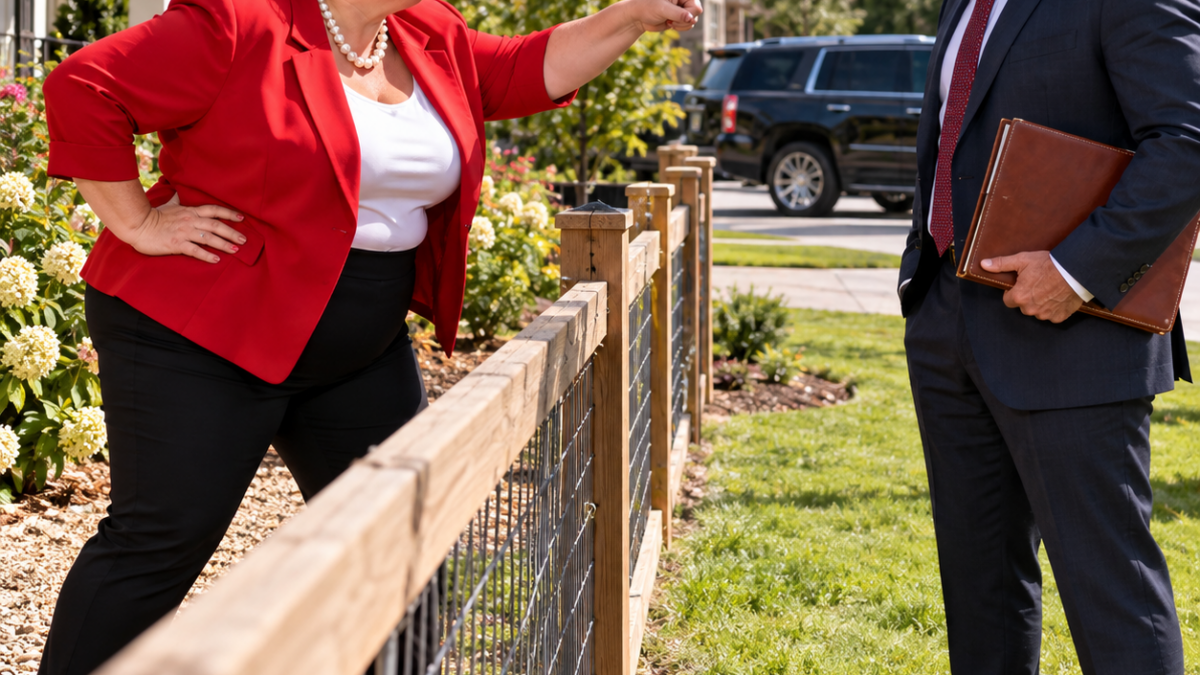
The HOA president stood on my lawn, promised to fine me until I lost my home, and smiled as she told me I would become a warning to every resident who dared challenge her.
What she didn’t know was that I had spent twenty-five years learning exactly how arrogant people destroy themselves when they believe nobody is checking the paperwork.
And before this was over, one document buried inside an $850,000 loan would turn her threat against me in a way neither of us could have imagined.
“My decision is final, Major Thorne.”
Karen Peterson hugged her clipboard against her chest and pointed toward the cedar fence running beside my workshop.
“You have seven days to remove the unauthorized structure, cease whatever commercial operation you’re running in that barn, and pay the outstanding fines.”
I stared at her.
“My fence has been here ten years.”
“Then you’ve been in violation for ten years.”
“And the workshop isn’t a business.”
She smiled.
Not a friendly smile.
The kind people use when they believe they have already won.
“I don’t care whether you were a major, a general, or the President of the United States before you moved here. In Willow Creek Estates, you answer to the association.”
Behind her, my wife Sarah stood on our porch with her arms folded tightly.
I could feel her watching me.
Twenty-five years in Army logistics had taught me how to remain calm when somebody desperately wanted a reaction.
So I kept my voice quiet.
“What exactly are you threatening?”
Karen stepped closer.
“I’ll fine you every week. I’ll add legal fees. I’ll place liens against this property. If necessary, I’ll bankrupt you until this house belongs to the association.”
There it was.
Not enforcement.
Not community standards.
A declaration of war.
Sarah later told me that was the moment she knew I wasn’t going to let it go.
She was right.
Our five acres existed before Willow Creek Estates did.
Sarah and I had bought the old homestead ten years earlier, when the surrounding land was still open field.
We demolished the crumbling farmhouse, built a modest ranch house, and turned the old barn into my workshop.
Classic cars were my retirement therapy.
A 1968 Mustang sat on jack stands inside.
Beside it was a ’69 Camaro I had spent three winters restoring.
No employees.
No customers.
No sign.
No business license.
Just me, a radio, too much coffee, and machines that made sense when people didn’t.
Then development swallowed the countryside.
A developer built Willow Creek around us and promised our original homestead would remain outside the HOA.
I foolishly accepted his handshake instead of demanding paper.
His company later failed.
New owners took over.
And somehow our property became Lot One of Willow Creek Estates.
Then came Karen.
She rose from homeowner to HOA president during a meeting hardly anyone attended.
After that, violation letters multiplied.
Trash cans visible too long.
Christmas decorations left up three days past an approved date.
Basketball hoops.
Driveway stains.
Flagpoles.
Even garden decorations.
Mrs. Gable, a widow in her seventies, had once filled her flower beds with colorful garden gnomes because her late husband loved them.
Karen called them “visually disruptive.”
The fines became so large that Mrs. Gable sold part of her husband’s coin collection to pay them.
That story stayed with me.
So after Karen left my lawn, I went inside and started reading.
Covenants.
Bylaws.
Meeting minutes.
Architectural rules.
Financial reports.
Hundreds of pages.
Two days later, I discovered something important.
Karen’s enforcement wasn’t strict.
It was selective.
Her allies received warnings.
Everyone else received fines.
Then I learned something worse.
My neighbor Miller admitted Karen had pressured him to complain about my workshop by threatening to fine him because his own fence was two inches too tall.
“She told me she could overlook mine if I cooperated,” he said, ashamed.
I wasn’t angry with him.
I understood fear.
What angered me was someone deliberately creating it.
At the next HOA meeting, Karen announced a $500 fine against me and another $500 every seven days until my “commercial operation” ended.
I stood with a binder under my arm.
“My workshop is not a business.”
Karen laughed.
“The board disagrees.”
“The complaint against me was coerced.”
Her face changed.
Then I began naming residents.
Mr. Henderson.
The Rodriguez family.
Mrs. Gable.
Selective fines.
Threats.
Exceptions for board members.
People who had spent years staring at the floor suddenly started looking at one another.
Karen saw it happening.
And panicked.
“For disrupting this meeting,” she shouted, “I am adding another $200 fine.”
The room erupted.
Then she made the mistake that changed everything.
“To defend this association against hostile residents,” she announced, “every household will also be charged a $300 emergency legal assessment.”
Mrs. Gable slowly stood.
Her voice trembled.
“You already took my husband’s collection from me.”
Karen pointed at her.
“Sit down.”
Mrs. Gable didn’t.
And neither did I.
Because at that moment, I finally understood where Karen’s real power came from.
It wasn’t the bylaws.
It wasn’t the clipboard.
It was money.
So the next morning, I stopped studying her rules.
And started following her money.
PART 2
Money leaves tracks.
That was one of the first things I learned working military logistics.
Men can lie.
Invoices can be disguised.
Meetings can be manipulated.
People can suddenly forget conversations they had six months earlier.
But money usually has to move from one place to another.
And movement leaves evidence.
The morning after that HOA meeting, I sat at my desk at 5:40 with black coffee, a yellow legal pad, and every Willow Creek financial statement I could download.
Sarah walked into my office wearing her robe.
“You sleep?”
“Enough.”
“That means no.”
She looked over my shoulder.
“What are you looking for?”
“I don’t know yet.”
“That sounds dangerous.”
“It usually is.”
She set a hand on my shoulder.
“Jack.”
I turned.
Her expression was serious.
“I know that look.”
“What look?”
“The one you had before deployments.”
“This isn’t Iraq.”
“No. It’s our home. Which means you’re going to take it even more personally.”
She knew me too well.
“I’m not looking for revenge.”
“Good.”
“I’m looking for leverage.”
“That sounds suspiciously similar when you say it.”
I smiled.
She didn’t.
“Promise me something.”
“What?”
“Don’t become like her.”
That stopped me.
Sarah wasn’t worried I would lose.
She was worried I would win badly.
There is a difference.
“I promise.”
She kissed my forehead.
“Then find the truth.”
That became my mission.
The first thing I did was submit a formal written request to inspect the HOA’s financial records.
Not summaries.
Not newsletters.
Not whatever Karen felt comfortable emailing.
I requested ledgers, bank statements, vendor contracts, insurance documents, payment authorizations, management agreements, and the current debt schedule.
The response arrived five days later.
A thin envelope.
Inside were badly formatted spreadsheets.
Some figures had descriptions.
Others did not.
The same categories changed names from month to month.
It was amateur bookkeeping at best.
Deliberate confusion at worst.
One recurring payment stood out immediately.
KP Enterprises.
$3,000.
Every month.
The description varied.
Groundskeeping.
Property administration.
Management services.
Consulting.
Thirty-six thousand dollars a year.
I had lived there a decade.
I had never seen a KP Enterprises truck.
Never met a property manager from KP.
Never seen their name on a mowing crew.
The kid who cut the common grass was Leo Ramirez.
I knew him.
His father owned Ramirez Lawn Care.
I called Leo.
“Do you work for KP Enterprises?”
Silence.
“Who?”
“That answers my question.”
He laughed nervously.
“Mr. Thorne, my dad gets checks from the HOA sometimes.”
“Directly?”
“Yeah.”
“How much?”
“I don’t know. You’d have to ask him.”
“Have you ever heard the name KP Enterprises?”
“No, sir.”
I thanked him and hung up.
Then I searched the state business registry.
KP Enterprises had been registered two years earlier.
No commercial office.
No employees listed.
The mailing address matched a post-office box.
The registered owner was Karen Peterson.
I stared at the screen.
Peterson.
Karen’s maiden name.
I verified it twice.
Then a third time.
Sarah found me fifteen minutes later.
“What happened?”
I turned the monitor toward her.
She read the screen.
“Is that her?”
“Yes.”
“And the HOA is paying this company?”
“Three thousand a month.”
“For what?”
“According to the books, management.”
Sarah gave a short, humorless laugh.
“She pays herself to fine people?”
“That’s what it looks like.”
“Is that legal?”
“I don’t know.”
That was important.
Looking corrupt and being provably illegal are different things.
I called an attorney.
Not an HOA attorney.
Not someone recommended by a neighbor.
I wanted somebody who understood corporate governance and homeowner associations but had no connection to Willow Creek.
Her name was Angela Chen.
She was in her mid-forties, sharp-eyed, direct, and clearly allergic to wasted words.
I brought her the bylaws, Karen’s notices, the financial statements, and the KP registration.
She read silently for twenty minutes.
Finally she looked up.
“Do you know whether this arrangement was disclosed?”
“Not yet.”
“Do you know whether the board approved the contract?”
“Not yet.”
“Do you know what services KP actually performed?”
“No.”
She pushed the paper back toward me.
“Then you don’t have theft.”
“I didn’t say theft.”
“Good.”
“What do I have?”
“A very large question.”
I liked her immediately.
“What’s next?”
“Ask that question publicly.”
“Karen will stonewall.”
“Probably.”
“Then?”
“Then she creates evidence of stonewalling.”
Angela leaned back.
“Mr. Thorne, angry homeowners make terrible plaintiffs because they usually want to skip from suspicion to accusation. Don’t.”
“I won’t.”
“Document.”
“I will.”
“Do not threaten her.”
“Understood.”
“Do not post online that she’s stealing.”
“Understood.”
“Do not call the police with half a spreadsheet.”
“Understood.”
She nodded.
“Then we may get somewhere.”
While Angela worked through the HOA documents, I kept examining the financials.
That was when I noticed the debt.
The clubhouse.
Beautiful building.
Pool behind it.
Tennis courts.
Community kitchen.
Meeting hall.
Karen loved hosting events there because it looked impressive in photographs.
Three years earlier, Willow Creek had borrowed heavily to build it.
Outstanding principal: roughly $850,000.
I checked the balance sheet again.
There was no lender identified.
That was unusual.
Not impossible.
Just unusual.
I knew commercial debt.
After leaving the Army, I had gone into banking.
Not because I dreamed of becoming a banker.
Because men I trusted asked me to help them build one.
Three former service members and I pooled savings, raised private capital, and opened Patriot Community Bank.
We specialized in veterans, local manufacturers, farms, contractors, and overlooked small businesses.
Over the years, it grew.
Not huge.
But healthy.
By then I was the founder and majority shareholder.
I didn’t run daily operations anymore.
Professionals did that.
I attended board meetings.
Reviewed major strategy.
Stayed out of lending decisions unless governance required my participation.
And spent most of my time restoring cars.
Which was why Karen knew none of it.
To her, I was a retired old soldier with dirty fingernails.
I called David Ross, Patriot’s chief counsel.
David had been a JAG officer before entering banking law.
He answered with, “Please tell me you’re not calling because you bought another rusted Mustang.”
“Not today.”
“That means this is worse.”
“I need you to trace a commercial mortgage.”
“For what?”
“A homeowners association.”
He laughed.
“Did you finally declare war on suburbia?”
“I need the lender on Willow Creek Estates’ clubhouse.”
“Public records?”
“I’ve checked what I can.”
“What’s the balance?”
“About eight-fifty.”
“Original lender?”
“Unknown.”
“Origination date?”
“Three years.”
He sighed.
“Give me everything you have.”
“I need it handled normally, David.”
“What does that mean?”
“It means I have a personal dispute with the HOA president. I don’t want anybody at Patriot doing anything that wouldn’t be done for another borrower.”
His tone changed.
“Good.”
“Trace only.”
“I’ll see what’s available through our records and lawful databases.”
That was that.
Then I turned to the neighbors.
Karen’s greatest weapon had always been isolation.
Every resident thought his problem was his alone.
Mrs. Gable believed she was the only person humiliated.
The Rodriguezes believed they were the only family targeted.
Miller believed cooperating would keep his own fence safe.
Mr. Henderson believed paying quietly was cheaper than resistance.
Bullies thrive when victims compare notes too late.
So Sarah and I hosted a barbecue.
Not a “revolution meeting.”
Not a secret conspiracy.
A barbecue.
Burgers.
Hot dogs.
Potato salad.
Sarah’s baked beans.
Mrs. Gable brought apple pie.
Gunny brought enough beer for a Marine reunion.
Gunny’s actual name was Robert McCall.
Retired Marine master sergeant.
Square jaw.
Silver crew cut.
Still stood as if some invisible sergeant major might inspect him.
Karen had fined him over a flagpole.
She called it “unauthorized military ornamentation.”
He had framed the violation letter.
By five o’clock, almost forty people were in our yard.
Children ran across the grass.
For the first hour, nobody talked about Karen.
That was intentional.
People needed to remember they were neighbors before becoming allies.
Finally, when the sun dropped lower, I stood on the porch.
“I want to show you something.”
Conversation faded.
I wheeled out a whiteboard.
At the top I wrote:
KP ENTERPRISES — $3,000/MONTH
“What is that?” Mr. Rodriguez asked.
“According to HOA financial records, it provides management and groundskeeping services.”
“Never heard of it.”
“You’re not alone.”
Then beneath the name I wrote:
OWNER: KAREN PETERSON.
For a second nobody reacted.
Then Miller said, “Peterson?”
“Karen’s maiden name.”
Mrs. Gable covered her mouth.
Gunny’s expression hardened.
“You’re saying she’s paying herself?”
“I’m saying HOA records show payments to a company she owns.”
“That’s the same thing.”
“No.”
Gunny frowned at me.
I continued.
“We don’t yet know what was approved, what was disclosed, or what services were performed. So nobody leaves here saying she stole thirty-six thousand dollars.”
Someone muttered, “Sounds like she did.”
“Sounds are not evidence.”
The crowd quieted.
“I’m showing you because you deserve to know what questions need answering.”
Mr. Rodriguez raised his hand.
“Will she answer?”
“I doubt it.”
“Then what?”
“We legally demand an independent audit.”
Several people exchanged nervous looks.
Miller spoke.
“She’ll fine us.”
That sentence broke my heart more than I expected.
Forty grown adults standing on my property were afraid of one woman’s stationery.
Gunny stood.
“Then she can fine me first.”
Mrs. Gable straightened beside him.
“And me.”
Mr. Henderson slowly raised his cane.
“Me too.”
Then others spoke.
One by one.
Not shouting.
Not dramatic.
Just names.
“I’m in.”
“Me too.”
“She threatened us last year.”
“We’ll sign.”
“What will it cost?”
Angela had estimated legal and audit expenses.
I told them.
Mrs. Gable opened her purse.
She took out a twenty-dollar bill.
“It isn’t much.”
I looked at her.
“You don’t need to—”
She placed it on the table.
“That woman made me sell George’s coins.”
Her voice shook.
“He collected them for forty-one years.”
Nobody moved.
“I can’t buy them back. They went to three different dealers.”
She pushed the bill toward me.
“But I can make sure she never does it to another widow.”
That was the moment the homeowners alliance became real.
Miller contributed a hundred dollars.
Gunny threw down several bills.
Mr. Rodriguez pledged more.
Within two days, we had enough to retain Angela and begin the audit process.
Three days after the barbecue, David called.
“Jack.”
Something in his voice made me sit.
“You find it?”
“I found the mortgage.”
“Who holds it?”
“You’re not going to believe me.”
“Try.”
“The loan originated at First Fidelity Regional.”
“Okay.”
“First Fidelity was acquired. Their parent company sold a portfolio of smaller commercial notes eighteen months ago.”
My pulse changed.
“Who bought the portfolio?”
“A private investment vehicle.”
“Owned by?”
“Patriot Community Bank.”
I said nothing.
David continued.
“Jack, the Willow Creek clubhouse note is ours.”
I looked through my office window at the workshop.
The Mustang sat under its lights.
Unmoving.
“Are you certain?”
“I’ve got the loan number in front of me.”
“Balance?”
“Eight hundred fifty-three thousand and change.”
I leaned back.
The irony was almost too perfect.
The woman who had stood on my grass and threatened to use debt against me belonged to an organization that owed my bank more than $850,000.
David knew what I was thinking.
“Before you say anything—”
“I know.”
“No retaliation.”
“I know.”
“You personally cannot direct servicing decisions because you’re in a dispute with the borrower’s president.”
“I know.”
“If there is a covenant breach, independent credit and counsel review it.”
“I know, David.”
“Good.”
I smiled slightly.
“What?”
“You thought I was going to foreclose tomorrow.”
“I know you.”
“No.”
“Jack.”
“I’m serious.”
I looked down at Karen’s violation letter.
“If she’s clean, Patriot leaves the loan alone.”
“And if she isn’t?”
“Then the bank enforces the contract the same way it would against anybody else.”
David exhaled.
“That I can work with.”
That evening, I told Sarah.
She stared at me.
“Our bank?”
“Yes.”
“The clubhouse?”
“Yes.”
“All of it?”
“The loan.”
She sat down.
“Oh, Jack.”
“I’m not doing anything with it.”
“Yet.”
“Not unless the borrower violates the agreement.”
She studied my face.
“Promise.”
“I already promised you.”
“I’m asking again.”
I reached across the table.
“I will not use the bank to punish Karen.”
She squeezed my hand.
“What will you use?”
“The truth.”
Angela’s reaction was less sentimental.
When I told her at our next meeting, she stared at me for several seconds.
“You’re joking.”
“No.”
“Your bank holds the note?”
“Yes.”
“And Karen doesn’t know?”
“No.”
She slowly removed her glasses.
“This creates both extraordinary leverage and extraordinary conflict.”
“I know.”
“You must be walled off from the credit decision.”
“Already done.”
“Good.”
She pointed at me.
“And if you ever tell residents, ‘Do what I say because I own your loan,’ I quit.”
“Understood.”
Gunny, who was sitting at the table, grinned.
“Can I say it?”
“No,” Angela and I answered together.
The strategy remained simple.
First, demand a forensic audit based on documented related-party payments.
Second, allow proper governance procedures to work.
Third, if fraud or material financial misconduct were confirmed, Patriot’s independent counsel could decide whether the loan covenants had been breached.
We did not need to destroy the HOA.
We needed to remove corruption without destroying innocent homeowners with it.
Angela mailed formal audit demands to every board member.
Karen responded exactly as expected.
Emergency meeting.
One agenda item:
DEFENSE OF THE ASSOCIATION AGAINST MALICIOUS LEGAL ATTACKS.
The clubhouse was packed.
This time, people didn’t stare at the floor.
Karen noticed.
She sat at the front table between Brenda and Gary.
Her gavel struck.
“Order.”
Nobody spoke.
Karen began.
“A small group of disgruntled residents has hired an aggressive attorney to attack this association and its volunteer leadership.”
Gunny leaned toward me.
“Volunteer.”
I whispered, “Behave.”
Karen continued.
“They are demanding an unnecessary forensic audit that could cost this community tens of thousands of dollars.”
Mrs. Gable called from the second row.
“How much do we pay KP Enterprises?”
Karen froze.
Then recovered.
“Mrs. Gable, you are out of order.”
“How much?”
“I said you’re out of order.”
Mr. Rodriguez stood.
“Who owns KP?”
Karen struck the gavel.
“Sit down!”
Another resident called, “Answer him!”
Then another.
“Thirty-six thousand a year?”
“What services?”
“Where’s the contract?”
Karen’s face flushed.
“This is precisely the kind of mob behavior Mr. Thorne has encouraged.”
I had not spoken.
Every head turned toward me.
Karen pointed.
“He is trying to destabilize this association because he refuses to follow rules.”
I rose slowly.
“You can end this in one sentence.”
Her eyes narrowed.
“How?”
“Tell us whether you own KP Enterprises.”
Silence.
Brenda looked at Karen.
Gary stared at his notes.
Karen swallowed.
“KP is a legitimate management provider.”
“That wasn’t my question.”
“You have no right to interrogate me.”
“Every homeowner paying that company has a right to know who owns it.”
She banged the gavel.
“Sit down.”
“Do you own KP Enterprises?”
“Sit down!”
“Karen.”
She snapped.
“Yes!”
The room went silent.
Even she looked surprised by the force of her own answer.
Then she tried to recover.
“Yes, I own it. And there is nothing improper about that. I provide valuable administrative services that this association would otherwise pay an outside management company twice as much to perform.”
Angela rose.
“Was the relationship disclosed before the contract was approved?”
Karen’s eyes flicked toward her.
“And you are?”
“Angela Chen. Counsel for the Willow Creek Homeowners Alliance.”
“I know who you are.”
“Then answer.”
Karen laughed bitterly.
“This is not a courtroom.”
“No. Which is why answering should be easy.”
Brenda whispered something.
Karen ignored her.
“The board knew.”
Angela looked at Brenda.
“Did you?”
Brenda’s face emptied.
“I—”
Karen turned sharply.
“Of course you did.”
Brenda swallowed.
Gary stared at her.
Then at Karen.
Then at the audience.
“I didn’t.”
Karen’s head snapped toward him.
“You absolutely did.”
Gary shook his head.
“I knew we paid a management company.”
“It was discussed.”
“Not with me.”
“You voted on the budget.”
“That doesn’t mean you told me you owned it.”
The room erupted.
Karen slammed the gavel until the wooden base cracked.
“ENOUGH!”
Silence fell.
Her breathing was heavy.
Then she made her next mistake.
“The board must protect itself against these attacks.”
A groan moved through the room.
She raised her chin.
“We have consulted counsel.”
Angela murmured, “Whose?”
Karen ignored her.
“Defending against this harassment will require additional funds. Therefore, we are imposing an emergency special assessment of one thousand dollars per household.”
For one second, nobody reacted.
Then Willow Creek exploded.
“One thousand?”
“Are you insane?”
“You’re charging us to defend you?”
“My mortgage went up!”
“We want an audit!”
Karen screamed over them.
“This is for your protection!”
Gunny stood.
He didn’t shout.
He didn’t have to.
“Enough.”
Something about that old Marine voice cut through everything.
People sat.
Gunny walked toward the front.
“Ma’am.”
Karen glared.
“You are not recognized.”
“I don’t need to be.”
“You absolutely do under parliamentary—”
“For two years, you’ve sent me letters because I fly the flag I served under.”
Cheers broke out.
Gunny raised one hand.
“You fined families over basketball hoops. You threatened an eighty-year-old man over a stain. You forced a widow to sell her dead husband’s coins because you didn’t like garden gnomes.”
Mrs. Gable began crying silently.
Gunny’s voice hardened.
“And tonight, after we learn that the association has been paying a company you own, you want another thousand dollars from every family so you can hire lawyers to keep us from looking at the books.”
Karen stood.
“That is slander.”
“Then open the books.”
“I will not allow a witch hunt.”
“Then resign.”
She laughed.
Actually laughed.
“You think you can remove me?”
“Yes.”
“I built this community.”
“No, ma’am.”
Gunny looked around.
“They did.”
Karen’s face twisted.
“I gave this place standards.”
Gunny pulled a folded copy of the bylaws from his pocket.
“Article Three, Section Five.”
Karen’s expression changed.
Angela had found it.
Removal of directors by membership vote after proper notice and quorum.
Gunny continued.
“I move for a vote of no confidence and removal of the current board.”
Gary whispered, “Oh God.”
Brenda looked like she might faint.
Karen pointed at Gunny.
“You don’t get to do that.”
“We do.”
“No.”
Angela calmly said, “The bylaws say otherwise.”
Karen’s restraint disappeared.
“This is my board!”
Nobody moved.
“I made this community what it is!”
Her voice cracked.
“You people were living like animals before standards were enforced. Boats in driveways. Toys everywhere. Flags. Decorations. Junk.”
Gunny’s jaw tightened.
Karen pointed toward me.
“And him. This old soldier comes in here acting like he owns everything.”
I almost smiled.
Not yet.
Karen continued.
“I will not be removed because some disrespectful mechanic doesn’t like paying fines.”
I said nothing.
That angered her more.
“Say something!”
I stood.
“What would you like me to say?”
“Admit this is about revenge.”
“It isn’t.”
“You hate me.”
“No.”
“Liar.”
“I don’t hate you, Karen.”
That stopped her.
“I think you’ve abused authority. I think the finances need independent review. And I think the homeowners should decide who represents them.”
Her voice dropped.
“You think you’re smarter than me.”
“No.”
“You think you can take this from me.”
“This was never yours.”
That did it.
Karen slammed both hands on the table.
“I will burn this entire association down before I let you people take it away from me!”
Silence.
Absolute silence.
Sarah later told me she felt the entire room change.
Karen heard her own words.
Too late.
I looked at Gunny.
“I second the motion.”
Angela reviewed the procedural requirements.
Enough members were present.
The vote moved forward.
“Those in favor of removal, stand.”
Gunny stood.
I stood.
Sarah stood.
Miller rose.
His wife rose.
The Rodriguezes.
Mr. Henderson pushed himself up with his cane.
Mrs. Gable stood slowly.
Then one entire row.
Another.
Another.
Within seconds, the room was full of standing homeowners.
Brenda remained seated.
Gary remained seated.
Karen remained seated.
Everyone else was on their feet.
Karen looked around.
Her face changed from fury to disbelief.
She had spent years convincing herself that fear was loyalty.
Now she learned the difference.
The board was removed.
An interim committee was selected.
Gunny chaired it.
The first vote of the new committee authorized an independent forensic audit.
Unanimous.
Karen stood.
“You’ll regret this.”
Gunny folded his arms.
“Take a number.”
The audit started Monday.
The firm Angela recommended specialized in nonprofit fraud examinations.
Rachel Bloom led it.
Small woman.
Glasses.
Soft voice.
Terrifying attention to detail.
Within twenty-four hours, she asked for more records than Karen had produced in two years.
Within forty-eight, she discovered duplicate expense reimbursements.
By day four, she found HOA debit-card purchases at restaurants Karen frequented.
Then spa charges.
Online retailers.
Gasoline.
Luxury household items.
Karen claimed they were association expenses.
Rachel asked for receipts.
Many were missing.
Then came phantom vendors.
Companies receiving checks with addresses linked to mailbox stores.
Invoices that used identical fonts.
Sequential invoice numbers from supposedly unrelated businesses.
A “community consulting” vendor whose phone number forwarded to Karen’s personal cell.
The deeper Rachel looked, the worse it became.
Two weeks later, she requested a private meeting.
Angela attended.
Gunny attended as interim committee chair.
I attended only because the committee asked me to help interpret the debt implications.
Rachel placed a report on the table.
“Based on the records currently available, we have identified approximately $147,000 in transactions that are unsupported, improperly authorized, personal in nature, related-party payments without adequate disclosure, or otherwise require restitution or further investigation.”
Nobody spoke.
Mrs. Gable had sold George’s coins over fines that might have amounted to a few thousand dollars across the neighborhood.
Karen had potentially diverted nearly $150,000.
Gunny’s hands curled into fists.
Angela spoke first.
“Is this report final?”
“Final enough for referral.”
“To law enforcement?”
“Yes.”
“What about the lender?”
Rachel nodded.
“The borrower’s financial representations and governance controls are materially compromised.”
I looked at her.
“You’re aware Patriot holds the note?”
“Angela told me yesterday.”
“Then anything involving the bank goes through independent counsel.”
“Agreed.”
David had already created a conflict firewall.
I received no vote.
No direction rights.
No access beyond what I would legally have as bank ownership and HOA membership where appropriate.
Patriot’s credit committee reviewed Rachel’s report.
Their conclusion came two days later.
The HOA had breached multiple loan covenants involving financial reporting, misuse of funds, and representations concerning organizational management.
The loan documents gave Patriot the right to declare default.
Whether the bank would accelerate was another decision.
David called.
“The committee authorized a notice of default.”
“Okay.”
“They’ve also authorized acceleration if the default isn’t cured.”
“How much?”
“Eight hundred fifty-three thousand, two hundred forty-one dollars and seventeen cents.”
I closed my eyes.
The number was enormous compared with Willow Creek’s reserves.
“If we accelerate immediately, homeowners get crushed.”
“I know.”
“What cure do they want?”
“Removal of responsible parties, forensic audit, restitution plan, new financial controls, verified insurance, and lender-approved governance reporting.”
“Those things are already underway.”
“Which is why I think this can be saved.”
I exhaled.
“So no foreclosure if the new board cooperates.”
“That’s ultimately credit committee’s decision. But they don’t want a clubhouse.”
“Good.”
“Jack.”
“Yes?”
“Karen will receive the default notice because she was president during the relevant period and may be personally involved in the litigation.”
“I understand.”
“She still doesn’t know your connection to Patriot.”
“No.”
“You planning to tell her?”
“Eventually.”
“Try not to enjoy it too much.”
“No promises.”
“Sarah was right about you.”
“You’ve been talking to my wife?”
“Everybody talks to your wife.”
The civil suit came first.
Angela filed on behalf of the association seeking recovery of improperly used funds.
A process server delivered the complaint.
Patriot’s formal default notice followed through ordinary legal channels.
I was not there.
I did not send anybody to humiliate Karen.
I did not need to.
Documents were enough.
But Karen called me that evening.
I almost didn’t answer.
Sarah looked at the screen.
“Her?”
“Yes.”
“Put it on speaker.”
“No.”
“Jack.”
I answered.
“Hello, Karen.”
Her breathing was audible.
“What did you do?”
“I’m not sure what you mean.”
“The bank.”
“What about it?”
“They called the loan.”
“They declared a default.”
“Eight hundred fifty-three thousand dollars!”
“I know the balance.”
Silence.
Then:
“How?”
“How what?”
“How do you know?”
I looked at Sarah.
She folded her arms.
The time had come.
“Because Patriot Community Bank holds the note.”
Karen’s voice dropped.
“What?”
“Patriot holds the clubhouse mortgage.”
“I know that, you idiot. How do you know the balance?”
“Because I founded Patriot.”
Silence.
“And I’m its majority owner.”
Nothing.
For several seconds, I thought the call had disconnected.
Then Karen whispered:
“No.”
“Yes.”
“No.”
“Karen—”
“You bought our loan?”
“No. Patriot bought a commercial portfolio eighteen months ago. Your note happened to be inside it.”
“You did this.”
“I didn’t.”
“You planned it.”
“I didn’t even know Patriot held the loan until after you fined me.”
“You expect me to believe that?”
“I don’t care what you believe.”
Her voice rose.
“You are using your bank to destroy me!”
“No.”
“Liar!”
“The bank’s independent credit committee reviewed the forensic audit. I recused myself.”
“You think that makes this clean?”
“It makes it lawful.”
“I’ll sue you.”
“Talk to your attorney.”
“You wanted revenge.”
I looked at Sarah again.
She was watching me carefully.
“No, Karen.”
“Stop pretending!”
“I wanted you removed from power. That happened by homeowner vote.”
“You ruined me.”
“The audit did that.”
“You sent the auditors.”
“The membership approved them.”
“You sent the lawsuit.”
“The new association did.”
“You called the loan.”
“The bank’s credit committee declared the default under the contract.”
She was crying now.
Angry crying.
“You stood there while they took everything.”
I answered quietly.
“You stood on my lawn and promised to bankrupt me.”
Her breathing stopped.
“You told me you’d fine me until my home belonged to the HOA.”
“I was angry.”
“So was I.”
“Then admit it!”
“Admit what?”
“That this feels good.”
I thought about Mrs. Gable selling George’s coins.
Mr. Henderson worrying over bills.
Miller being pressured into lying.
Gunny receiving violation letters over his flag.
The Rodriguezes explaining HOA fines to children who didn’t understand why their basketball hoop had disappeared.
Did part of me feel satisfaction?
Yes.
I wasn’t going to lie.
But satisfaction was not the same thing as wanting innocent neighbors to suffer.
“It feels good that you can’t threaten them anymore.”
She said nothing.
“The rest?”
I looked out toward the clubhouse lights in the distance.
“The rest feels expensive.”
I ended the call.
The next emergency homeowner meeting was the hardest.
People came frightened.
Word had spread that the clubhouse loan was in default.
Some believed the bank would seize the pool.
Others thought every homeowner would receive a $10,000 assessment.
Rumors multiplied hourly.
Karen sat in the back.
Nobody invited her.
She was still a homeowner and legally entitled to attend.
But nobody sat beside her.
She looked smaller.
Exhausted.
Human.
That made what came next harder, not easier.
Gunny opened the meeting.
Rachel summarized the audit findings.
Angela explained the civil suit.
Then David, representing Patriot, explained the loan default.
“The current balance exceeds $850,000,” he said. “Under the loan agreement, certain financial misconduct and reporting failures constitute events of default.”
A woman near the front began crying.
“My husband just lost his job.”
David held up a hand.
“Please let me finish.”
The room quieted.
“Patriot Community Bank has no desire to foreclose on community amenities if a responsible restructuring is possible.”
People exhaled.
“The bank is prepared to enter a cure and modification process with a properly elected board, subject to enhanced financial controls, full cooperation with lawful investigations, audited reporting, and a sustainable repayment schedule.”
Relief moved through the crowd.
Then Gunny looked toward me.
“Jack.”
I had not planned a dramatic speech.
But hundreds of eyes turned.
I walked to the front.
“I need to disclose something.”
I looked at David.
He nodded.
“The lender is Patriot Community Bank.”
Most people already knew the name from the default letter.
“I founded Patriot after leaving the Army.”
A few people frowned.
“I am also its majority owner.”
The room went completely silent.
Mrs. Gable whispered, “Oh my Lord.”
Gunny looked delighted.
Miller stared.
Mr. Rodriguez actually laughed.
Karen did not move.
I looked toward her.
Her face was blank.
Then I continued.
“When I discovered that connection, I immediately removed myself from decisions involving the HOA loan. The bank’s lawyers and independent credit committee handled the default review.”
A man called from the back.
“So you could foreclose on us?”
“Patriot legally could enforce its loan.”
Murmurs.
“But that is not what I want.”
I turned toward everyone.
“You are not Karen.”
The room quieted.
“You did not steal money. You did not create the reporting failures. You should not lose your clubhouse and pool because leadership failed.”
Karen stared at me.
“So here is what Patriot has authorized.”
David handed me the written term sheet.
“The bank will suspend foreclosure while the new association completes restructuring.”
Applause began.
I held up my hand.
“There are conditions.”
Silence.
“Independent financial controls. No undisclosed related-party vendors. Dual authorization on major expenditures. Annual outside reviews. Full cooperation with lawful investigators. And a repayment plan the association can actually afford.”
Someone called, “No special assessment?”
“Not for the purpose of paying Karen’s legal defense.”
Laughter erupted.
Even David smiled.
I looked at Mrs. Gable.
“And one more thing.”
Gunny glanced at me.
This part wasn’t from the bank.
It was from the interim committee.
“Every enforcement fine from Karen’s tenure will be independently reviewed.”
The room erupted again.
Mrs. Gable covered her mouth.
“We cannot promise every fine will be refunded. Some violations were legitimate. But anything imposed without proper procedure, selectively enforced, or connected to retaliation will be corrected.”
Mr. Henderson’s eyes filled.
Karen finally stood.
Everyone turned.
“This is a performance.”
Her voice was weak.
“This whole thing.”
Nobody answered.
She looked at me.
“You get to stand there like some hero because you own a bank.”
“No.”
“You planned this.”
“No.”
“You humiliated me.”
“I asked you to open the books.”
“You destroyed my life!”
Mrs. Gable rose.
Her chair scraped loudly.
She held onto its back.
Karen turned.
Mrs. Gable’s voice trembled.
“You made me sell my husband’s coins.”
Karen looked away.
“No.”
Mrs. Gable stepped into the aisle.
“You don’t get to look away.”
Karen faced her.
Mrs. Gable’s eyes were wet.
“George collected those coins before we were married.”
Nobody moved.
“He had one from the year his father came home from Korea. One from the year our daughter was born. One from the year we paid off our first house.”
Her voice broke.
“I sold them because your letters said you might put a lien on my home.”
Karen’s lips moved.
Nothing came out.
Mrs. Gable continued.
“You worried about humiliation?”
She pressed one hand to her chest.
“Try standing at a coin shop while a stranger puts prices on forty years of your husband’s memories because somebody doesn’t like garden gnomes.”
Karen lowered her eyes.
That was the first time I saw shame.
Real shame.
Not fear.
Not rage.
Shame.
Mrs. Gable sat.
Nobody applauded.
It wasn’t that kind of moment.
The meeting resumed.
A new election was scheduled.
The interim committee stayed in place until voting.
Then things became quieter.
Which was what rebuilding looked like.
The ridiculous violation notices stopped.
The legal assessment disappeared.
The $1,000 emergency assessment was formally rescinded.
The HOA hired a temporary professional manager through competitive bids.
The contract was posted online.
Every invoice could be reviewed.
Three bids were required for major projects.
Board members had to disclose conflicts.
Meetings were recorded.
Residents received forty-eight hours of online access to agenda packets before votes.
Gunny insisted on a rule prohibiting retaliation against homeowners who filed records requests.
Angela told him we should word it more professionally.
Gunny proposed:
DON’T BE A JACKASS.
Angela declined.
We used her version.
The financial review of past fines took weeks.
Mr. Henderson received a refund.
So did the Rodriguezes.
Gunny’s flagpole fines vanished.
Miller’s fence was measured correctly.
It was not two inches too high.
Karen had invented that.
When I told him, he stared at me.
“She lied?”
“Yes.”
“All this time?”
“Yes.”
His face collapsed.
“I filed that complaint against you because I thought she could fine me.”
“I know.”
“I’m sorry.”
“You already apologized.”
“I want to again.”
“Then do something useful.”
“What?”
“Run for the board.”
He looked horrified.
“Absolutely not.”
“Good talk.”
He ran anyway.
Sarah convinced him.
She was more dangerous than me.
Then came Mrs. Gable’s case.
The fines against her had been procedurally questionable.
The late fees worse.
The association voted to refund what remained recoverable under its records.
The amount did not replace George’s coin collection.
Money couldn’t.
I knew that.
So I began making calls.
The coin dealer remembered her.
“She was crying,” he told me.
“Do you remember the collection?”
“Some of it.”
“Where did it go?”
“Different buyers.”
“Can you trace them?”
“Maybe.”
That became my private project.
Not revenge.
Repair.
It took two months.
Some coins were impossible.
Others had been resold.
But three remained traceable.
One was the Korean War-era coin Mrs. Gable had described.
Another was from the year her daughter was born.
The third was an old silver half-dollar George apparently carried during their first year of marriage.
I bought them.
Personally.
Not HOA money.
Sarah found a small wooden case.
We placed the coins inside.
Then she added something I hadn’t asked for.
A garden gnome.
Tiny.
Bright red hat.
Fishing pole.
I laughed when I saw it.
“Really?”
“Absolutely.”
We drove to Mrs. Gable’s house Saturday morning.
She opened the door.
“Jack? Sarah?”
Sarah handed her the package.
“This belongs in your garden.”
Mrs. Gable opened it.
She saw the gnome first.
She laughed.
Then she saw the wooden box.
Her hands stopped.
She opened it.
Silence.
One finger touched the Korean War coin.
“No.”
She looked at me.
“Where did you get this?”
“Coin dealer helped.”
Her lips trembled.
“That’s George’s.”
“I know.”
She picked it up.
“I know this scratch.”
She began crying.
Sarah held her.
Mrs. Gable pressed the coin against her heart.
“You found it.”
“Three of them.”
“I thought they were gone.”
“Some still are.”
She shook her head.
“This one mattered.”
Then she held up the little gnome.
“And this?”
“Sarah.”
“Coward,” Sarah said.
Mrs. Gable laughed through tears.
The next morning, I saw that gnome in her flower bed.
Bright red.
Ridiculous.
Perfect.
The criminal investigation moved more slowly.
It always does.
Rachel’s audit went to the district attorney.
Bank records were subpoenaed.
Karen’s personal accounts became part of the case.
Investigators reconstructed payments.
Some transactions had innocent explanations.
Others didn’t.
KP Enterprises alone did not prove every dollar was stolen.
But undisclosed related-party payments, personal debit-card charges, false invoices, and transfers created a much larger problem.
Karen’s attorney publicly insisted that bookkeeping mistakes were being criminalized.
The prosecutor disagreed.
Eventually, charges were filed.
Theft.
Fraud-related counts.
Falsification of records.
Other financial offenses.
I did not attend Karen’s first court appearance.
Gunny did.
He called afterward.
“You should’ve seen her.”
“No.”
“You don’t want to know?”
“No.”
“Why?”
“Because it doesn’t help rebuild Willow Creek.”
He was silent.
“You’re annoyingly mature.”
“Tell Sarah.”
“She already knows.”
The civil case reached settlement before trial.
Some money was recovered through accounts and assets.
Insurance covered part of the association’s losses after lengthy disputes.
Not everything came back.
That is another thing people misunderstand about justice.
It rarely rewinds time.
It does not put every dollar where it was.
It does not erase fear.
It does not restore George Gable.
It does not return the weeks Sarah spent watching me work until midnight.
It does not erase the moment Miller betrayed me because he was scared.
It does not change that Karen became the kind of person who believed threatening somebody’s home was normal leadership.
Justice mostly does two things.
It stops damage.
And it makes repair possible.
The new board election came three months after Karen’s removal.
Gunny was nominated for president.
He refused.
“Absolutely not.”
Everyone laughed.
“You started the motion,” I said.
“That was combat.”
“And this?”
“Administration.”
Coward.
Mrs. Gable nominated me.
I tried to decline.
Then Mr. Henderson stood.
“Jack.”
I knew I was finished.
He continued.
“You keep saying this community shouldn’t be ruled by one person.”
“Correct.”
“Then help us build one that doesn’t need you.”
That was better than any argument Gunny could have made.
I accepted one term.
Only one.
Miller became treasurer.
The man Karen had frightened into filing a false complaint became responsible for publishing every monthly financial statement online.
I found that poetic.
The Rodriguezes joined the architectural committee.
Gunny accepted responsibility for the flag and common-area committee after Sarah told him the title sounded military.
It didn’t.
He fell for it anyway.
Mrs. Gable refused every official position.
“I’m retired.”
“So am I.”
“You’re bad at it.”
Fair.
Our first major vote addressed the enforcement code.
The old handbook was nearly eighty pages.
We cut it by half.
Safety.
Property maintenance.
Nuisance standards.
Drainage.
Structural approvals where genuinely necessary.
Everything else received a common-sense test.
Could a reasonable neighbor be harmed?
Could property actually be damaged?
Was there a legitimate legal or safety reason for the rule?
If not, we questioned why the HOA needed it.
The garden-gnome restriction disappeared unanimously.
Gunny insisted on making the motion.
“All in favor of whimsical freedom?”
Angela, sitting in the back, groaned.
But everyone voted yes.
Basketball hoops returned.
Flags returned.
Holiday lights became less regulated.
People still fought about things.
Of course they did.
Freedom does not make everyone agreeable.
It simply means disagreement does not come with a financial weapon controlled by one person.
Patriot restructured the clubhouse loan.
Not as charity.
The HOA still owed the money.
A bank that forgives every loan because its owner likes the borrower is just corruption wearing a friendlier shirt.
Instead, independent bank officers extended the amortization, adjusted payments to sustainable levels, waived certain default charges associated with the misconduct period, and required enhanced reporting.
I had no vote.
That mattered.
One afternoon, David met me at the clubhouse.
“You know what the funniest part is?”
“What?”
“The loan’s better now.”
“How?”
“New controls. Better reserves. Lower operating expenses. Transparent books. From a credit perspective, Willow Creek is less risky than before.”
“So Karen improved the loan?”
“By getting caught.”
I laughed.
Then I saw her.
Across the parking lot.
Karen.
Her house had gone on the market after charges were filed.
She was collecting mail.
We had not spoken since the phone call.
She saw me.
I expected her to leave.
Instead, she walked over.
David looked at me.
“You want me to stay?”
“No.”
He went inside.
Karen stopped several feet away.
She looked older.
No clipboard.
No scarf.
No authority.
“Congratulations.”
“For what?”
“You won.”
I looked toward the pool.
Children were shouting.
Gunny was arguing with a contractor about flagpole brackets.
Miller carried accounting folders into the office.
“I don’t think of it that way.”
“Of course you don’t.”
“Karen—”
“You own the bank.”
“Yes.”
“All that time.”
“Yes.”
“And you let me threaten you.”
“I tried to tell you the fines were improper.”
“You could’ve told me who you were.”
“Would it have mattered?”
She opened her mouth.
Closed it.
That answered the question.
“If I told you the first day I owned Patriot, what would you have done?”
She looked away.
“You would’ve treated me differently.”
Nothing.
“And that was the problem.”
Her eyes returned to mine.
“You think I treated people badly because I didn’t know they were important.”
“I think you treated people badly because you believed they weren’t.”
Her face tightened.
“That’s a nice line.”
“It isn’t a line.”
“You hated me.”
“No.”
“Stop saying that.”
“I disliked what you did.”
“You ruined me.”
I shook my head.
“No.”
She laughed bitterly.
“Still pretending.”
“You signed the transactions.”
Her face went still.
“You created KP.”
Silence.
“You used association money in ways you couldn’t justify.”
She looked toward the clubhouse.
“You threatened people’s homes.”
Her jaw tightened.
“You made those choices before I knew Patriot held the note.”
She said quietly, “I thought I deserved something.”
That was the first honest sentence I ever heard from Karen Peterson.
“For what?”
“For everything.”
She gestured toward Willow Creek.
“I spent years on this place. Nobody volunteered. Nobody came to meetings. Nobody thanked me. Every person complained.”
She swallowed.
“I answered emails at midnight. Found contractors. Handled disputes. Organized events.”
“Then you should have been paid openly.”
“I knew what people would say.”
“So you hid it.”
“I told myself KP was cheaper than hiring management.”
“Maybe it was.”
She looked surprised.
“That doesn’t make secret payments okay.”
“I know.”
We stood there quietly.
Then she said:
“Was it satisfying?”
“What?”
“When you found out you owned the loan.”
I thought about lying.
I didn’t.
“For about thirty seconds.”
A small sad smile touched her mouth.
“Only thirty?”
“Then I realized foreclosure would hurt everybody else.”
She nodded.
“You could have destroyed the association.”
“Yes.”
“But you didn’t.”
“No.”
“Why?”
“Because you did enough damage.”
That landed.
Karen looked away.
“My lawyer says I may go to prison.”
“I heard.”
“My husband left.”
I said nothing.
“My daughter won’t speak to me.”
I still said nothing.
“What do you want from me, Jack?”
“Nothing.”
“That’s worse.”
“Karen.”
She looked at me.
“I wanted you to stop.”
Her eyes filled.
“You stopped.”
She walked away.
I never saw her at Willow Creek again.
Her house sold the next month.
The criminal case concluded almost a year later.
Karen accepted a plea agreement on multiple financial charges.
The court imposed prison time followed by supervision and restitution obligations.
Some residents celebrated.
Gunny wanted to open champagne.
Mrs. Gable stopped him.
“No.”
He looked confused.
“She’s going to prison.”
Mrs. Gable held George’s recovered coin between two fingers.
“That’s sad.”
Gunny frowned.
“After what she did to you?”
“Yes.”
Mrs. Gable looked toward her garden.
“Someone can deserve consequences and still be a sad human being.”
That shut all of us up.
She was right.
The real victory had happened months earlier.
The day she stood in that meeting.
The day Miller admitted what Karen had forced him to do.
The day Gunny challenged the board.
The day homeowners discovered they could read their own bylaws.
The day finances went online.
The day the fear stopped.
Karen’s sentence did not create any of that.
We did.
My fence stayed exactly where it had been.
The workshop stayed open.
I finished the 1968 Mustang.
Cherry red.
Original-style wheels.
Black interior.
Beautiful machine.
The first drive was on a Saturday morning.
Sarah rode beside me.
As we rolled through Willow Creek, people waved.
Gunny saluted dramatically.
I gave him a less dignified gesture.
He laughed.
The Rodriguezes’ children were playing basketball.
Mr. Henderson was washing his car.
Miller had rebuilt the top section of his fence even though it had never been too tall.
“It bothered me psychologically,” he explained.
Fair enough.
Then we passed Mrs. Gable’s house.
The front garden looked completely different.
Gnomes everywhere.
Twenty, maybe thirty.
Fishing gnomes.
Sleeping gnomes.
A gnome holding a tiny American flag.
A gnome pushing a wheelbarrow.
A gnome sitting on a mushroom.
Right in the center stood the one Sarah and I had given her.
Bright red hat.
Fishing pole.
Beside it was a little weatherproof box.
Inside, behind glass, was a photograph of George.
Mrs. Gable stood on the porch.
I slowed the Mustang.
She waved.
Then she pointed toward her garden and shouted:
“Think I need architectural approval?”
I shouted back:
“Absolutely not!”
Sarah laughed so hard she had tears in her eyes.
We drove another mile before she looked at me.
“You know you’re happy.”
“I was happy before.”
“No, you were retired.”
“There’s a difference?”
“Apparently.”
I changed gears.
The Mustang roared.
At the edge of the neighborhood, we passed the clubhouse.
The same building Karen once treated like a palace.
Now the doors were open.
Children moved between the pool and lawn.
A birthday party had balloons tied to the railing.
The HOA financial report was posted inside.
Nobody cared.
That was the point.
Government—whether national, municipal, or just a tiny homeowners association—works best when ordinary people do not have to think about it every hour.
When the rules are predictable.
When money is visible.
When leaders understand they are temporary.
When questions are not treated as rebellion.
My one-year term ended exactly when I promised.
I did not run again.
Miller became president.
His wife laughed for three days.
Gunny remained on the board.
The Rodriguezes stayed involved.
Mrs. Gable remained happily ungovernable.
At my final meeting, Miller handed me a plaque.
I groaned.
“No.”
“You have to accept it.”
“I absolutely do not.”
Gunny blocked the aisle.
“Sit down, Major.”
“Gunny.”
“Sir.”
Everyone laughed.
Miller read the plaque.
“For service to Willow Creek Estates and for restoring transparent, accountable community governance.”
“Too many words.”
Sarah whispered, “Smile.”
I smiled.
Then Miller reached behind the podium.
“And one more thing.”
He lifted a framed piece of paper.
Karen’s first violation notice against me.
The one threatening my fence and workshop.
Across it, in giant red letters, somebody had stamped:
RESCINDED.
The room exploded in laughter.
I shook my head.
“Who did that?”
Gunny pointed at Mrs. Gable.
She looked innocent.
I took the frame home.
It hangs in my workshop now.
Not because I enjoy remembering Karen.
Because it reminds me how close I came to doing what everyone else had done.
Paying.
Complying.
Getting angry privately.
Then moving on.
Had I done that, Karen probably would have continued.
More fines.
More hidden payments.
More frightened homeowners.
More power concentrated in fewer hands.
And the bank loan?
Patriot might eventually have discovered the financial problems during routine servicing.
Maybe.
Maybe not.
But the strangest part of the whole story remains the coincidence.
Karen threatened to financially destroy me while standing on property she believed she could control.
She did not know that her HOA’s largest debt ultimately sat inside a bank I owned.
But ownership was never what defeated her.
That is the part people get wrong whenever they hear the story.
They say:
“You owned the bank. Of course you won.”
No.
If I had simply used the bank to crush the HOA because I was angry, I would have become another Karen with better paperwork.
The bank mattered because the loan contract demanded financial integrity.
The audit mattered because it provided evidence.
The homeowners mattered because they voted.
Angela mattered because she forced us to follow procedure.
Rachel mattered because numbers do not care about personalities.
Sarah mattered because she reminded me that winning without restraint can become another form of corruption.
And Mrs. Gable mattered because she showed us exactly what abuse of power costs ordinary people.
One evening, about two years after Karen first came onto my lawn, I sat on the porch with Sarah.
The Mustang was finished.
The workshop lights were off.
My fence still stood.
A breeze moved through the trees.
“You remember what she said?” Sarah asked.
“What?”
“That she’d make you a cautionary tale.”
I laughed.
“I remember.”
“She was right.”
I looked at her.
Sarah smiled.
“Just not in the way she thought.”
Across the road, a boy bounced a basketball.
Farther down, I could see Gunny’s flag moving above the roofs.
And beyond that, Mrs. Gable’s ridiculous collection of gnomes caught the last orange light of sunset.
Maybe I had become a cautionary tale.
But not for homeowners who questioned an HOA.
For anyone who believes authority belongs to them simply because nobody has challenged it yet.
For anyone who mistakes fear for respect.
For anyone who assumes quiet people are weak.
For anyone who thinks nobody will ever read the fine print.
And especially for anyone tempted to stand on another person’s lawn, threaten their home, and promise to bankrupt them without first asking one very important question.
Who exactly are you threatening?
Because Karen Peterson looked at me and saw an old veteran with a fence she didn’t like and grease on his hands.
She never bothered to see the quartermaster who understood money.
The banker who understood debt.
The neighbor who kept records.
The husband whose wife would not let anger turn him reckless.
Or the community quietly waiting for somebody to stand first.
She wanted to make me afraid of losing everything.
Instead, she gave all of us a reason to stop being afraid of her.
The next morning I walked into my workshop.
The framed violation notice hung above my workbench.
I turned on the lights.
The Mustang gleamed.
From somewhere down the road came the faint bounce of a basketball.
I opened the garage door.
Morning sunlight rolled across the concrete.
Sarah called from the porch.
“Coffee!”
“In a minute!”
“You said that twenty minutes ago!”
I smiled.
For the first time in years, the only argument happening on my property was between me and my wife over whether I had forgotten breakfast again.
No certified letters.
No orange violation stickers.
No threats of liens.
No woman with a clipboard telling me what I was allowed to build, restore, or remember.
Just home.
I wiped my hands on a rag and headed toward the porch.
As I passed the fence Karen once promised would bankrupt me, I ran my hand across the top rail.
Still solid.
Still standing.
So was I.
And so, finally, was Willow Creek.








