PART 2: HOA Karen Sued Me Over My Rooster’s Crow—Then She Learned I Was a Registered Heritage Poultry Conservationist
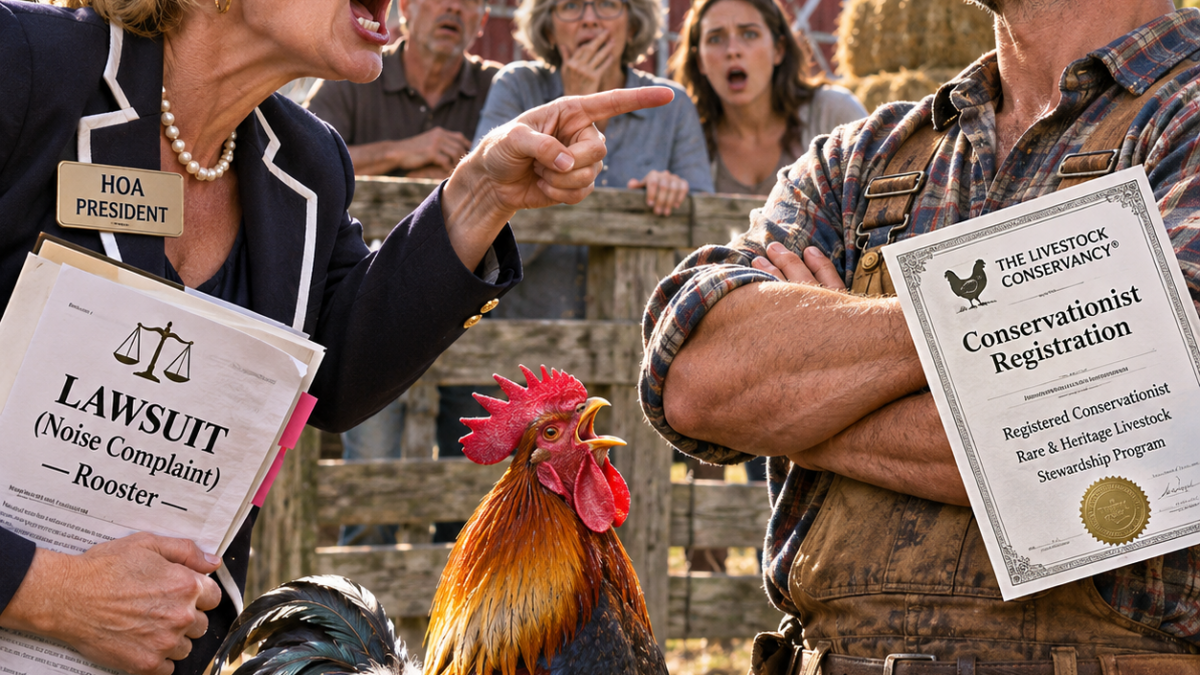
PART 2
The file cabinet in my office contained twenty years of property records and almost as much documentation on chickens as some people kept on their children. Sarah found me at my desk an hour later, surrounded by deeds, zoning maps, county permits, hatch records, breeding certificates, veterinary reports, Livestock Conservancy correspondence, and a copy of the original Oakridge Estates governing documents that the developer had given me when the subdivision first went up around my land.
She set down another cup of coffee.
“So the dragon lady has declared war on poultry.”
“She called them noise chickens.”
Sarah looked through the window at General Patton.
“Did he take it personally?”
“He appears devastated.”
The rooster scratched at the soil, found something interesting, and called two hens over.
Sarah leaned over my shoulder.
“What are you looking for?”
“Article Two.”
“Section Four?”
I looked up.
“You remember?”
“I’ve been married to you for twenty-eight years, Marcus. I have absorbed more useless regulatory language than any civilian woman should ever be forced to know.”
I found the clause and turned the document toward her.
**PRE-EXISTING CONDITIONS AND GRANDFATHERED PROPERTIES.**
The language was remarkably clear. Properties brought within the association’s jurisdiction while maintaining a verifiable continuous county land-use designation were exempt from covenants that would prohibit that established use.
I tapped the page.
“There.”
Sarah read it.
“So they can’t ban the agricultural use.”
“That is how I read it.”
“And the roosters are part of the agricultural use.”
“Yes.”
“And your conservation program predates Karen’s complaint.”
“By years.”
Sarah folded her arms.
“Then why are you worried?”
“Because being right and being left alone are different things.”
She nodded slowly.
That was the problem.
Most people imagine petty authority is defeated the moment you show someone the correct rule.
Sometimes.
Other times, the rule is simply the next obstacle they intend to ignore.
Karen’s official notice arrived two days later.
Not email.
Not ordinary mail.
A nervous teenager from the management company drove it over in an HOA golf cart.
He handed me the envelope.
“Sorry, Mr. Hayes.”
“You write it?”
“No, sir.”
“Then you don’t need to apologize.”
Inside:
**NOTICE OF VIOLATION — NUISANCE LIVESTOCK / EXCESSIVE NOISE.**
Seven days.
Then one hundred dollars per day.
Potential removal.
Recovery of association costs.
Karen’s signature was enormous.
I did exactly what I had told her I would do.
I answered in writing.
Not angry.
Not sarcastic.
Not threatening.
Facts.
Article Two, Section Four.
Agricultural zoning documentation.
County records.
State right-to-farm protections as they applied to established agricultural operations.
Business registration for Hayes Heritage Hatchery.
Documentation showing continuous poultry conservation work.
A letter from the Livestock Conservancy explaining the importance of maintaining viable breeding populations of rare heritage poultry.
I also included a basic site map showing the distance between my pens and the nearest Oakridge homes.
At the end:
**I respectfully request that the notice be rescinded and that all future communications concerning my agricultural operation be made in writing.**
Two copies.
One certified to the HOA.
One to Karen.
Return receipts.
Sarah watched me seal the second envelope.
“You’re sending it to her house?”
“I want no confusion about whether she received it.”
“You’re enjoying this slightly.”
“I am being thorough.”
“That wasn’t a denial.”
The certified receipt came back signed.
Seven days later, the first fine arrived.
Seven hundred dollars.
No legal response.
No discussion of Article Two.
No acknowledgment of agricultural zoning.
Just:
**FAILURE TO COMPLY — $700.**
I read it once.
Then filed it.
Sarah stood in the doorway.
“You’re awfully calm.”
“They ignored everything.”
“I know.”
“That doesn’t bother you?”
“It bothers me.”
“You don’t look bothered.”
“I’m documenting being bothered.”
She smiled.
“That is the most Sergeant Major sentence you have ever spoken.”
I drafted another letter.
**NOTICE OF DISPUTE AND INTENT TO SEEK LEGAL REMEDIES.**
I reiterated the grandfather clause.
Restated the zoning.
Challenged the fines.
Demanded rescission.
Certified again.
The next invoice arrived.
Fourteen hundred dollars.
Attached to it was a pink handwritten note.
Actual pink stationery.
**Laws don’t apply to you, Mr. Hayes? We’ll see about that in court.**
I sat at the kitchen table reading it.
Sarah leaned over.
“Oh, no.”
“What?”
“She wrote that herself?”
“Looks like it.”
“She should not have written that herself.”
“No.”
I peeled the note away carefully.
Plastic sleeve.
File.
New folder label:
**KAREN / HOA ENFORCEMENT.**
Sarah looked at the growing stack.
“She’s building your case.”
“Yes.”
The fines climbed.
Two thousand.
Three.
Four.
Every invoice received the same response.
Disputed.
Certified.
Copied.
Logged.
I created a spreadsheet.
Date.
Violation amount.
Response date.
Certified tracking.
Receipt.
Board communication.
No yelling.
No threats.
No angry social media posts.
That discipline frustrated Karen more than anything else.
She wanted a fight she understood.
Someone screaming at a board meeting.
Someone refusing dues.
Someone sending profanity-filled emails she could print and wave around as evidence that she was dealing with an unstable resident.
I gave her none of it.
I paid every legitimate assessment on time.
I maintained my property.
I kept the pens clean.
I logged flock care.
I even bought a calibrated sound meter.
Not because I believed I needed one.
Because Karen had accused me of excessive noise.
So I measured.
For two weeks.
Different positions.
Different times.
From my property.
From the road.
From the closest subdivision boundary.
Roosters crowed.
Dogs barked.
Garbage trucks passed.
Landscaping crews started gas-powered blowers.
Traffic moved along the county road.
I documented all of it.
The rooster calls were intermittent.
Not constant.
Not mechanically amplified.
Not some industrial nuisance.
Just roosters doing what roosters had done on that land long before Oakridge existed.
Still, I knew this would not be won with decibel numbers alone.
Karen’s real strength came from people not wanting trouble.
So I started walking the neighborhood.
The first evening, most people waved and disappeared into their homes.
I was “the chicken guy.”
The stubborn old veteran.
The person Karen had described at meetings as hostile and uncooperative.
That story had worked because nobody knew me.
My first real conversation happened with David Collins.
Mid-thirties.
Two kids.
Portable basketball hoop in the driveway.
His son was shooting.
David rebounded.
“Hey, Marcus.”
“David.”
He looked toward the hoop.
“Don’t tell Karen.”
I smiled.
“Why?”
“Apparently it has to disappear every night by eight.”
“That seems practical.”
“You know what this thing weighs?”
“Enough.”
“She sends a violation every other week.”
“What do you do?”
“Move it halfway behind the garage whenever she gets annoying.”
He laughed.
Then:
“You’re the rooster guy.”
“I have been promoted to that position.”
“I heard she’s fining you.”
“She is.”
“You going to get rid of them?”
“No.”
David looked around.
“You know she told everybody at the last meeting you’re just refusing the same rules everyone else follows.”
“Did she mention agricultural zoning?”
“No.”
“Grandfather clause?”
“No.”
“Registered conservation program?”
He blinked.
“What?”
“Exactly.”
I explained just enough.
Not a speech.
Not recruitment.
Facts.
David’s expression changed.
“She left all that out.”
“Yes.”
“Why?”
“You’ll need to ask her.”
I walked home.
Seed planted.
The next evening I met George and Eleanor Abernathy.
Their front garden was beautiful.
Flowers.
Herbs.
Three ceramic gnomes.
I pointed.
“Careful.”
George looked up.
“Why?”
“I’ve heard those are dangerous.”
Eleanor laughed.
“Karen agrees.”
George did not.
“Seventy-five dollars.”
“For what?”
“Unapproved lawn ornamentation.”
“Each?”
“Per notice.”
He adjusted his glasses.
“You’re Marcus Hayes.”
“The rooster fellow.”
“I prefer conservationist.”
“Understandable.”
Eleanor smiled.
“George was a corporate attorney.”
“Retired.”
George corrected.
“I still recognize nonsense when I see it.”
That got my attention.
We spoke for nearly an hour.
I explained the case.
He asked sharper questions than anyone else.
“Did you disclose your agricultural use when the subdivision incorporated?”
“Yes.”
“Written?”
“Yes.”
“Any interruption in use?”
“No.”
“Have you maintained business registration?”
“Yes.”
“County nuisance citations?”
“None.”
“Animal-control complaints?”
“None.”
“Recorded decibel violations?”
“None.”
“HOA grandfather clause?”
I showed him a copy.
He read it.
Then looked at me.
“You did everything correctly.”
“That is my position.”
“No.”
He handed the paper back.
“That is not merely your position.”
“This clause is unusually clear.”
“Then why are they still fining me?”
George glanced toward the HOA clubhouse.
“Because Karen does not believe rules apply to her interpretation of rules.”
Eleanor said:
“That sentence sounds exactly like her.”
George continued.
“Your paper trail is excellent.”
“Thank you.”
“But you’re firing it at somebody who isn’t afraid of paper.”
“What is she afraid of?”
“Exposure.”
That word stayed with me.
Over the next two weeks, the evening walks changed.
David introduced me to one family.
George to another.
Then people started approaching me.
Holiday decorations left up two days too long.
Trash cans.
Mailbox colors.
Vegetable beds.
Basketball hoop.
Garden ornaments.
One woman had been fined because a child’s bicycle remained visible from the street overnight.
Another because her front-door wreath was allegedly too large.
The rules were not always unreasonable.
The application was.
Karen’s friends received warnings.
Others received fines.
People who challenged her saw scrutiny increase.
People who praised her at meetings somehow lived more freely.
The pattern was obvious once enough stories sat beside each other.
I invited a few families to my place.
Backyard tables.
Iced tea.
Cookies Sarah insisted on making.
Pens farther across the pasture.
General Patton strutted around as if hosting.
David came.
George and Eleanor.
Three other families.
At first the conversation was awkward.
Then David mentioned his basketball hoop.
Another woman laughed.
“Karen hates our Christmas lights.”
Eleanor:
“She hates my gnomes.”
Someone else:
“She hates my trash cans.”
Sarah said:
“I’m beginning to think Karen may simply hate objects.”
Laughter broke the tension.
Then people talked honestly.
Fines.
Appeals ignored.
Board meetings where residents were cut off.
Letters.
Fear.
George eventually leaned forward.
“What you are describing is not vigorous covenant enforcement.”
Everyone quieted.
“It is selective enforcement used to reward compliance with one person and punish disagreement.”
A man asked:
“Is that illegal?”
George answered carefully.
“Not every unfair HOA decision is illegal.”
“But patterns matter.”
“Procedure matters.”
“Fiduciary duties matter.”
“And Marcus’s case may be exposing the association to substantial liability because Karen appears to be ignoring clear grandfathering language and statutory protections.”
David asked:
“So what do we do?”
I answered:
“Nothing reckless.”
That disappointed some of them.
“We document.”
“We compare.”
“We attend meetings.”
“We request records.”
“We stop assuming each complaint is isolated.”
The alliance started quietly.
Karen did not know.
Or underestimated it.
Then the thick envelope arrived.
Downtown law firm.
Sarah carried it into the kitchen.
“This doesn’t look like a fine.”
It wasn’t.
**OAKRIDGE ESTATES HOMEOWNERS ASSOCIATION, INC. v. MARCUS HAYES.**
Public nuisance.
Injunctive relief.
Immediate removal of the flock.
Accumulated fines above five thousand dollars.
Attorney fees.
The language described my farm as if I had established an industrial slaughterhouse in the middle of a preschool.
Constant noise.
Reduced property values.
Distress.
Loss of peaceful enjoyment.
I sat silently.
Sarah watched.
“Marcus?”
“She sued.”
“HOA sued.”
“Karen made it happen.”
She sat across from me.
“What now?”
I smiled for the first time that day.
“Now she has to prove it.”
I called George.
“She filed.”
There was a pause.
Then:
“Good.”
Sarah stared at the phone.
George continued.
“Bring me everything.”
His study looked like a law library had survived an earthquake and decided to stay.
Books.
Files.
Old desk.
Lamp.
He read the complaint.
Twenty minutes.
No interruption.
Then:
“Sloppy.”
“Good sloppy?”
“For us.”
He tapped the allegations.
“Unreasonable noise.”
“No objective readings.”
“Property-value impact.”
“No appraisal.”
“Public nuisance.”
“No county citation.”
“Removal request.”
“Despite agricultural grandfathering.”
He looked through my correspondence.
Certified receipts.
Fines.
Karen’s handwritten note.
He laughed softly.
“What?”
“She wrote ‘we’ll see about that in court.’”
“Yes.”
“Very thoughtful.”
Then he reopened the HOA covenants.
Article Two, Section Four.
“This is your shield.”
He flipped pages.
Another section.
“Here is the sword.”
Board authorization.
Legal actions undertaken on behalf of the association required a formal board vote at a properly recorded meeting.
Related spending required authorization.
George looked at me.
“Did you see any vote approving this lawsuit?”
“No.”
“I haven’t.”
“Meeting minutes?”
“Nothing.”
“Then we request them.”
He leaned back.
“If Karen filed this without proper board authorization, she may have used the association’s money to pursue a personal feud.”
Sarah asked:
“What do we do?”
George smiled.
“We stop writing letters.”
“And?”
“We litigate.”
Two days later, we sat across from Jessica Riley at Miller & Vance.
She was younger than I expected.
Late thirties.
Sharp suit.
Sharper questions.
George’s former firm.
She spent nearly an hour reading.
When she finished, she closed the binder.
“Mr. Hayes.”
“Marcus.”
“Marcus.”
She placed one hand on the file.
“Most clients bring me emotion.”
“You brought me evidence.”
“That’s useful.”
“How useful?”
“Useful enough that I’m willing to take this seriously.”
She began listing.
Agricultural zoning.
Grandfather clause.
Right-to-farm arguments.
Conservation documentation.
No objective nuisance data.
Pattern of disputed fines.
Possible lack of board authorization.
Potential selective enforcement.
Karen’s note.
Then:
“If discovery shows what George suspects, their lawsuit may become very expensive for them.”
Sarah asked:
“Countersuit?”
Jessica nodded.
“Potentially malicious prosecution, harassment-related claims, fiduciary issues, improper use of association funds, depending on what the evidence supports.”
I asked:
“Karen personally?”
“If evidence shows she acted outside legitimate board authority or engaged in intentional misconduct, we examine individual liability.”
Jessica looked directly at me.
“Do not talk to Karen.”
“Done.”
“Do not post about the case.”
“Fine.”
“Do not give documents to neighbors without asking me.”
I hesitated.
She noticed.
“Marcus.”
“I understand.”
“Good.”
Then:
“And keep doing exactly what you’ve been doing.”
“What?”
“Let her write.”
Discovery began.
Bank records.
Invoices.
Emails.
Meeting minutes.
Fine history.
Board votes.
Vendor records.
Five years.
Karen’s lawyer tried to limit it.
Jessica fought.
The judge allowed broad production tied to our defenses and counterclaims.
Thirty days.
The first document delivery looked deliberately chaotic.
Boxes.
Loose receipts.
Bank statements.
Printouts.
Duplicate documents.
Missing labels.
Jessica’s paralegals stared at the pile.
I felt almost comfortable.
“This all?”
One asked.
“For now.”
She sighed.
I rolled up my sleeves.
Inventory.
Sort.
Date.
Category.
Cross-reference.
Sarah joined on weekends.
She was better with numbers than I was.
Within days, the first serious irregularity emerged.
Prestige Lawn Care.
Large monthly payments from HOA operating funds.
I checked the covenants.
HOA responsibility included common entrances, small park areas, road verges.
The charges seemed high.
Then Sarah found an invoice.
She stopped.
“Marcus.”
“What?”
“Address.”
Prestige invoice.
Service location:
Karen’s personal residence.
High-end landscape maintenance.
Flower-bed care.
Water-feature treatment.
Pruning.
Fertilization.
The amount:
Oddly specific.
We checked the bank statement.
HOA check to Prestige.
Exact amount.
I stared.
“One month?”
Sarah flipped.
“Here’s another.”
Another.
Then another.
Over three years.
More than forty thousand dollars tied to personal landscaping charges appearing to be paid from association accounts.
Jessica reviewed everything before anyone used the word fraud.
She requested underlying contracts.
More came.
Then catering bills.
Board-meeting expenses.
Dates matched social-media photographs of Karen’s daughter’s graduation party.
That was circumstantial.
So Jessica marked it for examination.
Roofing work.
Community clubhouse.
Except the clubhouse roof was nearly new.
Contractor?
Karen’s brother-in-law.
Then emails.
That was where Karen destroyed herself.
She had written:
**We need to do something about Hayes. His arrogance is insufferable.**
Another:
**I don’t care what his zoning is. This is Oakridge, not Green Acres. Keep levying the fines. He’ll break eventually.**
I sat in the conference room reading that line.
He’ll break eventually.
Sarah looked at me.
“You okay?”
“Yes.”
“You’re doing the jaw thing.”
“I have a jaw.”
“The angry jaw thing.”
I breathed.
Jessica took the printout.
“Good for us.”
Then the lawsuit email chain.
Board member Frank had asked:
**Are we sure this is wise? Don’t we need a full board vote?**
Karen answered:
**Frank, your job is to vote yes when I tell you to. I have already retained counsel. This is happening. Do not question my authority on this again.**
No formal vote appeared in the minutes before counsel was retained.
No properly approved budget line appeared for initiating the case.
Jessica read the email twice.
Then leaned back.
“This changes things.”
“How much?”
“Substantially.”
George had been right.
Karen had taken a personal feud and used the association’s name and money as if they belonged to her.
The countersuit followed.
Carefully drafted.
No wild allegations.
Claims tied to documents.
Karen named personally where evidence supported it.
Other involved board members included where appropriate.
HOA negligence.
Fiduciary issues.
Harassment.
Improper litigation conduct.
Financial misuse.
Damages.
Attorney fees.
Repayment.
The process server caught Karen outside her house while Prestige Lawn Care was working.
There was something almost poetic about that.
He handed her the papers.
According to his affidavit, she read the caption.
Went pale.
Told him to leave.
He said:
“You’ve been served.”
Then left.
That evening, Frank called me.
He sounded terrified.
“I got served.”
“I know.”
“My wife is losing her mind.”
“I’m sorry.”
“No, you’re not.”
He was right.
Not completely.
He continued.
“I didn’t want this.”
“You were on the board.”
“I told Karen I thought the lawsuit was wrong.”
“I saw the email.”
Silence.
“You saw that?”
“Yes.”
“I tried.”
“No.”
I kept my voice calm.
“You questioned her privately.”
“Then you let her do it.”
He breathed shakily.
“What do I do?”
“Get a lawyer.”
“Marcus…”
“And tell the truth.”
“That’s your best option.”
“You think Jessica will destroy me?”
“I think your decisions have consequences.”
“I have kids.”
That hit.
I softened slightly.
“Then stop protecting Karen.”
He was quiet for several seconds.
“I’ll cooperate.”
“Tell your lawyer.”
“I will.”
The legal fight was enough.
But the neighborhood needed facts too.
Not confidential discovery dumped onto social media.
Something responsible.
David’s nephew Leo was studying journalism.
He ran a respected local news blog.
Jessica approved a narrow interview.
Public documents only.
My farm.
Conservation program.
Filed complaint.
Filed countersuit.
Grandfather clause.
No leaked privileged material.
Leo came to the property.
General Patton loved him immediately because Leo brought sunflower seeds.
The camera filmed the pens.
Healthy birds.
Clean water.
Shade.
Breeding records.
The American Crevecoeurs.
Marsh Daisies.
Rare lines maintained deliberately rather than chickens wandering chaotically across a suburban lawn.
Leo asked:
“What exactly does conservation mean here?”
I walked him to my record room.
“Hatch records.”
“Breeding pairs.”
“Lineage.”
“Health.”
“Genetic diversity.”
“If a breed becomes rare enough, every responsible breeding population matters.”
“These birds aren’t just producing eggs.”
“They’re preserving traits that could disappear.”
“Why does that matter?”
“Because once genetics are gone, you don’t rebuild them from memory.”
He liked that answer.
General Patton crowed.
Leo laughed.
“Does he always have timing like that?”
“Unfortunately.”
George explained the HOA governance issues on camera.
David discussed basketball-hoop enforcement.
Eleanor showed her gnome fines.
Leo requested comment from Karen.
She slammed the door.
Two days later:
**LOCAL VETERAN AND HERITAGE POULTRY CONSERVATIONIST SUED BY HOA AS BOARD FACES MISCONDUCT CLAIMS**
The story spread.
Town Facebook groups.
Neighborhood pages.
Local agriculture communities.
Veterans.
Backyard poultry groups.
Then television.
A local station came.
Same rules.
Public evidence.
No confidential discovery unless counsel approved.
They showed the farm.
My military photograph.
The rare birds.
General Patton.
Then Karen’s heavily landscaped house.
The visual contrast did most of the work.
Public pressure exploded.
But I was careful.
The internet loves villains too much.
I refused interviews that asked me to insult Karen personally.
One radio host said:
“So, Marcus, is she just a crazy HOA Karen?”
I answered:
“She is a board president whose decisions are being challenged in court.”
Less exciting.
More accurate.
Jessica approved.
Then came the deposition.
Karen arrived in a navy pantsuit.
Her attorney looked like he hadn’t slept.
She looked at me once.
Then away.
Court reporter.
Jessica.
Documents organized.
Exhibits numbered.
Jessica began with easy questions.
Name.
Address.
HOA role.
Years served.
Authority.
Then:
“Mrs. Henderson, did you refer to my client’s animals as ‘noise chickens’?”
Karen scoffed.
“That is what they are.”
“What does that term mean?”
“Chickens that make excessive noise.”
“Excessive by what standard?”
“The community’s.”
“Which published standard?”
Karen paused.
“Our nuisance rule.”
“Does that rule specify decibel levels?”
“No.”
“Time limits?”
“It specifies unreasonable disturbance.”
“Did you measure the sound?”
“We could hear it.”
“From where?”
“My house.”
Distance shown.
Karen’s property sat much farther from my pens than Harold’s.
Jessica moved carefully.
“Did the HOA commission a noise study?”
“No.”
“County inspection?”
“No.”
“Animal-control investigation?”
“No.”
“Property-value analysis?”
“No.”
“Any independent expert?”
“No.”
Then zoning.
“Were you aware Mr. Hayes’s property had agricultural designation predating Oakridge Estates?”
Karen said:
“That is irrelevant.”
“That was not my question.”
Her lawyer shifted.
Jessica repeated.
“Were you aware?”
“Yes.”
“Were you aware of Article Two, Section Four?”
Karen looked at the page.
“I don’t recall.”
“Please read it.”
“I don’t need to.”
Her lawyer whispered something.
Karen’s lips tightened.
She read.
Grandfathering.
Preexisting continuous land use.
Exemption from incompatible restrictions.
Jessica waited.
“Were you aware of this provision before issuing fines?”
Karen:
“I understood it differently.”
“How?”
“The HOA has authority over nuisance conditions.”
“So your testimony is that this clause does not protect established agricultural use from a later restriction?”
“That is correct.”
“Based on legal advice?”
Silence.
“Did HOA counsel provide that opinion before you began fining Mr. Hayes?”
Karen looked toward her attorney.
“I don’t remember.”
Jessica changed exhibits.
My certified letter.
Received.
Signed.
Agricultural zoning attached.
Conservation documentation.
Right-to-farm material.
“Did you receive this?”
“Yes.”
“So by this date you knew the basis of his claim.”
“He was trying to intimidate us.”
“With county zoning records?”
“He buried us in paperwork.”
I almost smiled.
Jessica did not.
Then the lawsuit.
“Who authorized filing?”
“The board.”
“Date?”
“I don’t recall.”
“Meeting?”
“I don’t recall.”
“Recorded vote?”
“I don’t recall.”
Jessica displayed Frank’s email.
“Do you recognize this?”
Karen’s color changed.
“Possibly.”
“Is that your email?”
“Yes.”
Jessica read:
**Don’t we need a full board vote?**
Then Karen’s response.
**Your job is to vote yes when I tell you to. I have already retained counsel.**
The court reporter typed.
Karen’s lawyer stared at the table.
Jessica asked:
“Had the board voted when you wrote this?”
Karen shifted.
“We had discussed it.”
“That is not my question.”
“I considered their support clear.”
“Had they voted?”
“I don’t remember.”
Jessica pulled the minutes.
No vote.
Then the financials.
Prestige Lawn Care.
Karen’s house.
Over forty thousand dollars.
Jessica slid the invoices across.
“Why did Oakridge Estates pay for landscaping at your personal residence?”
Karen stared.
“That’s incorrect.”
“The service address is yours.”
“Bookkeeping mistake.”
“One month?”
“Yes.”
Jessica produced three years of statements.
“What about these?”
Karen blinked.
“Prestige handled both common areas and my home.”
“Correct.”
“Why were your personal invoices matched by HOA checks?”
“I intended to reimburse the association.”
“Did you?”
Karen swallowed.
“I don’t recall.”
Jessica produced budgets.
No reimbursement.
No loan approval.
No disclosure.
Then catering.
Then roofing.
Then emails.
Every answer weakened.
Strong leadership.
Accounting confusion.
Treasurer error.
Misclassification.
Volunteer sacrifice.
Nobody appreciated how much she did.
Eventually Karen cried.
I did not enjoy it.
That surprised me.
For months I had imagined the moment evidence cornered her.
I thought it would feel like revenge.
Instead it felt exhausting.
Jessica asked one final sequence.
“Mrs. Henderson, did you write that Mr. Hayes would ‘break eventually’?”
Karen wiped her face.
“Yes.”
“Were the fines intended in part to pressure him into abandoning his agricultural use?”
“No.”
“Then what did ‘break’ mean?”
Silence.
Jessica waited.
Karen’s attorney whispered:
“Answer.”
“I wanted him to comply.”
“With what?”
“Our standards.”
“Even after he documented a grandfathered agricultural use?”
“I believed the HOA should control what happens inside the community.”
There it was.
Jessica leaned back.
“No further questions.”
Karen remained seated after the deposition ended.
I gathered my papers.
She looked at me.
“Marcus.”
I stopped.
Her lawyer stiffened.
“You destroyed me.”
I looked at her.
“No.”
“You filed the lawsuit.”
Then walked out.
The transcript changed everything.
The HOA’s insurer received it.
Senior counsel called Jessica.
Settlement talks.
The carrier wanted to protect the association.
Not Karen’s intentional conduct.
The offer was broad.
HOA nuisance suit withdrawn with prejudice.
My legal fees covered.
Damages.
HOA governance changes.
Karen and involved board members removed as a condition of resolving association-level claims.
Claims for intentional personal misconduct handled separately.
Jessica negotiated.
George reviewed.
I agreed.
Then Oakridge called the emergency meeting.
More than a hundred homeowners filled the clubhouse.
I had never seen that room so crowded.
Years of apathy disappeared in one week.
Karen sat at the front.
No bright tracksuit.
No swagger.
Frank chaired because the insurer and counsel had made clear leadership had to change.
His hands shook.
“Due to recent legal developments…”
Someone shouted:
“Just say it!”
Murmurs.
Frank swallowed.
“This association has been exposed to significant legal and financial risk.”
Karen leaned toward him.
“Frank.”
He ignored her.
“I move for the removal of Karen Henderson as president and director for gross misconduct and breach of fiduciary obligations.”
The room inhaled.
One board member seconded immediately.
Karen stood.
“You cannot do this.”
Frank finally looked at her.
“We can.”
“You wouldn’t have an association without me.”
A voice from the back:
“We’d have more money.”
Another:
“You stole from us!”
Another:
“You bullied everybody!”
Karen’s face twisted.
“I did not steal anything!”
George stood.
“Then the audit will clarify that.”
She pointed at me.
“This man orchestrated all of this because of chickens!”
General Patton was miles away.
Still somehow winning.
I stood.
“No.”
Everyone quieted enough.
“This started because you decided agricultural land that existed before Oakridge had to conform to your personal idea of Oakridge.”
I looked around the room.
“But it continued because people discovered the same pattern in their own lives.”
Karen said:
“You think you’re a hero?”
“No.”
“I think I kept receipts.”
A few people laughed.
That broke the spell.
Frank called the vote.
Hands rose.
Almost all.
Karen remained seated.
One hand against her purse.
Motion carried.
Removed.
She stood.
“I built this community.”
Eleanor Abernathy answered from three rows back.
“No.”
“We did.”
That was the best thing anyone said all night.
Karen left.
No dramatic final speech.
No apology.
No thunderstorm.
Just a woman walking through a room of neighbors who no longer believed she owned them.
The other implicated board members resigned soon afterward.
George Abernathy became interim president.
His first meeting was almost aggressively boring.
I loved it.
Agenda posted.
Budget printed.
Questions allowed.
Minutes taken accurately.
First major action:
Independent forensic audit.
Second:
Rescind improperly issued fines.
David’s basketball hoop.
Eleanor’s gnomes.
Holiday lights.
Trash-can penalties where rules had been selectively enforced.
My rooster fines.
Zeroed.
The nuisance action?
Gone permanently.
Then George addressed my case.
“The agricultural use of the Hayes property predates Oakridge Estates and is protected by the association’s grandfathering provisions.”
He looked at me.
“Marcus, on behalf of this association, I apologize.”
I nodded.
“Thank you.”
Everyone expected more.
I sat down.
I did not need a victory speech.
The birds had already gone to sleep.
The forensic audit took months.
It confirmed serious financial misuse.
Personal landscaping paid from association accounts.
Related-party transactions.
Unapproved expenditures.
Other irregularities.
Some funds had to be repaid.
Some matters went to outside authorities and civil recovery.
I let lawyers and accountants handle it.
My personal claims against Karen moved toward settlement.
Faced with deposition testimony, financial records, email evidence, and the prospect of trial, she agreed.
Repayment obligations.
Legal fees.
Damages.
Judgment provisions.
Assets sold.
Her house went on the market within six months.
The elaborate landscape she had maintained partly through questionable HOA spending disappeared under the new owners.
Young couple.
Two children.
They removed the koi feature.
Simplified the garden.
Put up a swing set.
A swing set.
I laughed the first time I saw it.
Sarah asked:
“What?”
“Karen would have hated that.”
“Good.”
The legal files eventually went into storage.
That was more important than it sounds.
For nearly a year, every certified envelope had created tension in my chest.
Every car slowing near the property made me wonder whether it was another notice.
Every meeting felt like preparation for war.
Then one day, there were no letters.
No fines.
No attorney calls.
No reporters.
Only feed buckets.
Fence repairs.
Hatch records.
Chickens.
The life I had wanted.
I expanded the conservation work.
Silver Appleyard ducks joined the farm.
Additional Crevecoeur lines came from two other breeders.
I exchanged hatching eggs with conservation partners.
We tracked fertility.
Hatchability.
Phenotype.
Line diversity.
Every spring, the brooders filled with tiny dark chicks.
Some would become breeders.
Others go to vetted heritage flocks.
General Patton aged.
He became heavier.
Slower.
Still arrogant.
Still crowed.
One morning David walked over with his son.
The basketball hoop remained permanently in their driveway now.
His son had grown taller.
“Can we see General Patton?”
“Sure.”
The boy followed me to the pens.
Patton stepped onto the stump.
Crowed.
David laughed.
“You know, that bird cost the HOA a fortune.”
“No.”
“Karen cost the HOA a fortune.”
“Fair.”
His son asked:
“Why are these chickens special?”
I explained heritage breeds.
How industrial agriculture favors a narrow number of high-production lines.
How rare breeds preserve genetic diversity.
Adaptation.
History.
Different traits.
The boy listened.
Then asked:
“So if all of these disappear, you can’t just make more?”
“No.”
“Not the same.”
He looked at Patton.
“That’s sad.”
“That’s why we keep them.”
He nodded seriously.
Then:
“He’s still loud.”
“Yes.”
Conservation requires honesty.
The Abernathys became close friends.
Eleanor added two more gnomes.
George pretended to object.
I gave her one shaped like a rooster.
She put it closest to the street.
George looked at me.
“You realize she’s escalating.”
“Documentation is important.”
“You’re a bad influence.”
The neighborhood changed in small ways.
Not chaos.
Not everybody doing whatever they wanted.
The new board still enforced reasonable rules.
Dangerous vehicles.
Common-area misuse.
Actual structural violations.
But enforcement became predictable.
Written standards.
Appeals.
Disclosure.
No selective punishment.
Board contracts published.
Conflict-of-interest rules.
Major expenditures required proper votes.
Legal actions required full board authorization.
Term limits.
That last one was popular.
George served a short interim term, then insisted on an election.
David joined the board.
A schoolteacher became president.
Nobody ruled.
They administered.
That difference is everything.
The biggest lesson came from Frank.
The timid former board member.
He had cooperated with discovery.
His liability resolved less severely because evidence showed he had questioned Karen and then provided information once the case escalated.
One afternoon he came to my gate.
He did not enter.
“Marcus?”
“Frank.”
“Can we talk?”
I walked over.
He looked older.
“I owe you an apology.”
“Yes.”
He winced.
“That was fast.”
“You do.”
“I should have stopped her.”
“Yes.”
“I was afraid.”
“I know.”
“She embarrassed people who disagreed with her.”
“Yes.”
“She controlled committees.”
“Yes.”
“I kept thinking somebody else would challenge her.”
I waited.
“Nobody did.”
“Until you.”
“No.”
I pointed toward Oakridge.
“Until enough people did.”
Frank looked toward the pens.
“I’m sorry.”
I believed him.
“Thank you.”
“That’s it?”
“What were you expecting?”
“I don’t know.”
“Punishment?”
“Maybe.”
“You’ve had lawyers for a year.”
He almost smiled.
“Fair.”
Then:
“Can I ask something?”
“Yes.”
“What would you have done if Karen had just dropped the fines after your first letter?”
That stopped me.
“Nothing.”
“Really?”
“Yes.”
“No audit?”
“No lawsuit?”
“No campaign?”
“No.”
“All of this happened because she kept escalating?”
“Mostly.”
Frank looked down.
“That makes it worse.”
“For her.”
“For us.”
He was right.
Karen’s downfall had not been inevitable when she first knocked on my metaphorical door.
She created it one decision at a time.
Ignore the grandfather clause.
Fine anyway.
Ignore the response.
Fine more.
Threaten court.
File suit.
Skip board authorization.
Use HOA money.
Hide transactions.
Write arrogant emails.
Each step made the next harder to retreat from.
Pride is expensive when authority gives it a budget.
I started speaking occasionally to small agricultural groups about recordkeeping.
Not HOA revenge.
Documentation.
Property history.
Zoning.
Conservation records.
Noise logs.
Neighbor relations.
I told people:
“Don’t wait until conflict to learn what your paperwork says.”
One breeder laughed.
“You sound like a lawyer.”
“No.”
“I sound like someone who paid lawyers.”
That was enough.
The conservation program gained recognition locally.
A county agriculture club invited schoolchildren.
We began hosting small educational visits.
Not huge groups.
Twenty kids at a time.
I showed them Crevecoeurs.
Marsh Daisies.
Silver Appleyards.
Explained why rare breeds matter.
One child pointed at General Patton.
“Is he the rooster from the lawsuit?”
The teacher looked horrified.
I laughed.
“Yes.”
“Did he win?”
“Technically, he was never a party.”
Blank stare.
“Then yes.”
The children loved that.
General Patton became famous against his will.
A local artist painted him.
Eleanor bought the painting.
Hung it in the clubhouse without telling me.
I walked into an HOA meeting and saw an enormous black rooster on the wall.
“What is that?”
Eleanor smiled.
“Community history.”
“Take it down.”
“No.”
George said:
“I believe it has been properly approved.”
Traitors.
The funny part was that the crowing changed in people’s minds.
Same volume.
Same bird.
Same dawn.
But once the conflict ended, complaints almost vanished.
That told me how subjective nuisance can become when resentment is involved.
Harold in Unit 7B eventually admitted his main problem wasn’t being awakened at four.
He worked nights.
Usually awake anyway.
He simply disliked seeing farm structures from his upstairs window.
One afternoon he approached me.
“I owe you an apology.”
“This neighborhood is becoming exhausting.”
“What?”
“Everybody keeps apologizing.”
He laughed nervously.
“I exaggerated.”
“I know.”
“You knew?”
“Your lights were on most mornings.”
He looked embarrassed.
“Karen asked if the rooster bothered me.”
“And?”
“I said sometimes.”
“She asked me to sign an affidavit.”
“And you did.”
“Yes.”
“Why?”
“I didn’t think it would become all this.”
That sentence.
I heard versions of it repeatedly.
I didn’t think.
I didn’t know.
I assumed.
I was just helping.
Petty tyranny rarely runs on one tyrant alone.
It runs on people lending small pieces of cooperation because each piece seems harmless.
Sign this.
Vote yes.
Don’t ask questions.
Stay home from the meeting.
Pay the fine.
Ignore your neighbor’s problem.
Then one day the machine is bigger than anyone intended.
I accepted Harold’s apology.
Not friendship.
But peace.
General Patton lived to an impressive age.
His final breeding season produced several strong sons.
One inherited his broad body.
Another his crest.
One inherited his ridiculous confidence.
The first morning Patton failed to come out of the coop, I knew.
He was old.
There had been no illness.
He had simply gone to sleep.
Sarah found me sitting beside the pen.
“You okay?”
“Yeah.”
She sat next to me.
We stayed quiet.
People who don’t keep livestock sometimes find grief around farm animals contradictory.
We understand mortality.
Breeding populations require hard decisions.
Not every bird stays forever.
But some individuals become part of your daily rhythm.
Patton had been there through the entire fight.
That mattered.
David heard.
Then George.
Then somehow the whole neighborhood.
The next afternoon, someone left flowers by my gate.
No name.
Then Eleanor arrived carrying a small plaque.
“No.”
“You don’t know what it says.”
“I don’t care.”
She showed me.
**GENERAL PATTON
HERITAGE CREVECOEUR ROOSTER
HE CROWED. PEOPLE LISTENED.**
I laughed and cried at the same time.
“Terrible.”
“I know.”
We mounted it inside the conservation building.
Not visible from the road.
I had standards.
One of Patton’s sons eventually took the stump.
First morning he crowed from that exact spot, I stood on the porch with coffee.
Same sound.
Different bird.
Sarah came beside me.
“Feels strange.”
“Yes.”
“You miss him.”
“Yes.”
The new rooster crowed again.
I looked toward Oakridge.
No Karen.
No golf cart.
No violation notice.
Just morning.
That was victory.
Not applause.
Not settlement checks.
Normal morning.
Years later, someone asked me during an interview whether I regretted “destroying” Karen financially.
I corrected the wording immediately.
“I didn’t destroy Karen.”
“But your countersuit—”
“She filed a case against me.”
“We defended.”
“Discovery exposed records.”
“Her own decisions created liability.”
“Then do you feel sorry for her?”
I thought.
“Yes and no.”
The interviewer looked surprised.
“Explain.”
“I feel sorry for anyone who reaches a point where they cannot distinguish leadership from control.”
“But consequences still matter.”
“If you misuse other people’s money, misuse authority, and hurt people, sympathy does not erase responsibility.”
That answer felt right.
I did not need Karen to be a monster.
Making her inhuman would make the story less useful.
She was a person.
A person who accumulated authority.
Stopped hearing disagreement.
Surrounded herself with agreeable people.
Turned preferences into rules.
Turned rules into weapons.
Then assumed consequences applied only downward.
That pattern is dangerous precisely because ordinary people can fall into it.
The replacement board understood.
They built systems.
Two signatures for payments above certain thresholds.
Independent annual review.
Open meeting records.
Mandatory conflict disclosures.
Rotation.
Complaint appeals.
No unilateral litigation.
The goal was not finding a nicer Karen.
It was making sure no one person could become indispensable.
That is how you fix governance.
Not personality.
Structure.
The Livestock Conservancy work continued.
My breeding records became increasingly digital.
Sarah helped me scan twenty years of pedigrees.
She complained the whole time.
“Why does this rooster have four pages?”
“He matters.”
“They all matter according to you.”
“Correct.”
“Your filing system is deranged.”
“Precise.”
“Deranged.”
We compromised on “thorough.”
One year, a university agriculture department contacted me about using genetic material from one of my Crevecoeur lines in a study on heritage poultry diversity.
I agreed.
The researcher visited.
She stood in the pasture.
“These birds are unusual.”
“That’s why they’re here.”
“How many years have you kept this line?”
“Seventeen.”
She whistled.
“You’ve done good work.”
That compliment meant more than every social-media comment during the HOA fight.
Because this was the reason I had the birds.
Not Karen.
Not court.
Not winning.
Preservation.
The conflict had temporarily turned them into evidence.
Afterward, they got to become chickens again.
That mattered.
One spring, Oakridge held a community picnic near the clubhouse.
Someone invited me.
I almost declined.
Sarah said:
“You’re going.”
“Why?”
“Because normal neighbors attend picnics.”
“I was not informed.”
We went.
Children played basketball.
David’s hoop had survived.
Eleanor had brought three gnomes and arranged them on the picnic table as decoration.
The HOA president looked at them.
“Are those approved?”
Eleanor narrowed her eyes.
Then the president laughed.
Progress.
A little girl approached me.
“Are you Mr. Chicken?”
I looked at Sarah.
She was already laughing.
“Yes.”
“My mom says you saved rare chickens.”
“I help preserve some breeds.”
“Why?”
“Because once something disappears, sometimes it doesn’t come back.”
She thought.
“Like dinosaurs?”
“Exactly.”
“Can your chickens become dinosaurs?”
“No.”
“Disappointing.”
She ran away.
Sarah said:
“Your outreach work is going well.”
“Excellent.”
The house Karen sold changed completely.
New owners.
Young family.
Simple lawn.
Plastic slide.
Bicycles sometimes left visible.
The new board did not collapse.
Property values did not crater.
Civilization survived.
That was satisfying.
I once passed the house while walking.
The koi pond was gone.
Karen’s expensive roses replaced by grass.
A small soccer net sat where landscaping crews used to trim geometric hedges.
Two children played.
I stopped briefly.
Not nostalgia.
Perspective.
A property that once represented status and control had become a home.
That was better.
I never heard from Karen for years.
Then, unexpectedly, a letter.
No lawyer.
No HOA letterhead.
Handwritten.
I almost didn’t open it.
Sarah said:
“You will stare at it for three days if you don’t.”
She was right.
Karen’s handwriting was smaller than I remembered.
She wrote that she had followed news about the conservation program.
That surprised me.
She said she had spent a long time believing she was protecting Oakridge.
Then:
**I confused protecting the community with controlling it.**
I read that twice.
She did not ask me to forgive the financial issues.
Did not deny them.
Did not explain them.
She apologized specifically for trying to remove the birds.
Then wrote:
**I once called them noise chickens. I understand now that they mattered beyond your property line.**
At the end:
**I am sorry for what I put you and Sarah through.**
I put the letter down.
Sarah asked:
“What do you think?”
“I believe she regrets some of it.”
“Are you going to answer?”
I did.
Short.
**Karen,
I received your letter. Thank you for writing. I accept your apology regarding the flock and the harassment. I hope the years ahead are peaceful for you.
Marcus**
Sarah read it.
“That’s it?”
“Yes.”
“No lecture?”
“No.”
“No General Patton reference?”
“No.”
“You’ve changed.”
“Age.”
“Probably.”
Forgiveness did not erase records.
The HOA still kept the audit.
The lawsuit still happened.
People still suffered.
But accountability and permanent hatred are different things.
I no longer needed the second.
The farm became quieter as I aged.
Not rooster quiet.
Human quiet.
Fewer projects.
Longer mornings.
More time sitting.
I began mentoring younger breeders.
One woman inherited a small family farm surrounded by development.
She called me anxious.
“Neighbors are complaining.”
“About?”
“Guineafowl.”
I laughed.
“What?”
“Nothing.”
“What do I do?”
“Start with documents.”
“Of course you’d say that.”
“Zoning.”
“Permits.”
“Property history.”
“Applicable ordinances.”
“Then talk to the neighbors before lawyers.”
“I thought you were going to tell me to fight.”
“No.”
“Fight only what needs fighting.”
She was silent.
“Did you ever try talking to Karen?”
“Yes.”
“And?”
“She wasn’t listening.”
“What if my neighbors are?”
“Then you’re luckier than I was.”
That became my advice.
Do not romanticize conflict.
Winning a legal fight is expensive even when legal fees are later recovered.
Stress is real.
Time is real.
Sleep lost is real.
Relationships bend.
If conversation works, use it.
If documentation solves it, use documentation.
If formal appeal works, appeal.
If court becomes necessary, go prepared.
The lesson was not:
**Destroy everyone who complains.**
The lesson was:
**Know your rights before someone else tells you what they are.**
One morning years after General Patton died, I walked out with coffee.
His grandson—or maybe great-grandson by then—stood on the same stump.
I had stopped naming every rooster after generals.
Sarah called that personal growth.
This one was simply Number 417 in the breeding record, though Sarah called him Colonel anyway.
He crowed.
Long.
Clean.
Rolling.
Somewhere in Oakridge a garage door opened.
A dog barked.
A school bus turned onto the main drive.
A landscaping crew started a mower.
Morning chorus.
Nothing extraordinary.
That was the miracle.
The same sound that once triggered fines, certified letters, a lawsuit, discovery, depositions, news cameras, an audit, a board collapse, and years of litigation had become ordinary again.
The bird had not changed.
The community had.
I thought about Karen standing at my boundary in that pink tracksuit.
Seven days.
One hundred dollars a day.
We’ll remove them for you.
At that moment, I thought victory meant making her admit she had no authority.
Later I thought victory meant winning in court.
Then removing her.
Then recovering money.
Then reforms.
Age changed it again.
Victory was the rooster crowing and nobody needing to care.
Freedom is sometimes remarkably boring.
That is good.
I took my coffee to the pasture fence.
The flock moved through wet grass.
Crevecoeur hens scratched beneath the oaks.
A Marsh Daisy rooster called from another enclosure.
Silver Appleyard ducks argued over a shallow tub.
Sarah came behind me.
“Thinking?”
“Yes.”
“Dangerous.”
“I’ve heard.”
She leaned against the fence.
“Would you do anything differently?”
“With Karen?”
“Yes.”
I thought for a long time.
“I would have started talking to neighbors sooner.”
“Why?”
“Because I spent too much time believing the fight was mine.”
She nodded.
“That sounds correct.”
“Thank you for your support.”
“You’re welcome.”
Then:
“And maybe I wouldn’t send her the first letter to her house.”
Sarah stared.
“That was absolutely unnecessary.”
“I was establishing receipt.”
“You were being petty.”
“A little.”
“Growth.”
We laughed.
The truth was that Karen’s greatest weapon had never been the HOA covenants.
It was isolation.
David thought the basketball-hoop problem was his.
Eleanor thought the gnomes were hers.
Families thought their trash-can fine was unique.
I thought the rooster attack was mine.
Once people compared experiences, Karen’s mythology collapsed.
No omnipotent president.
Just a board chair supported by apathy, fear, and poor oversight.
That is why George’s words stayed with me:
She isn’t afraid of your letters.
She is afraid of being exposed.
Exposure did not mean humiliation.
It meant transparency.
Show the vote.
Show the contract.
Show the rule.
Show the email.
Show the invoice.
Show the process.
Sunlight.
That was enough.
The association eventually created a publicly accessible vendor register.
Every contractor.
Ownership.
Bid comparison.
Amount.
Board vote.
Related-party disclosure.
Someone joked that we had overcorrected.
Maybe.
Then nobody complained when dues stabilized.
Transparency is boring until money disappears.
Then everyone suddenly loves it.
The heritage program also became more visible.
A regional paper wrote a feature on rare poultry.
The reporter asked to photograph the original Karen file.
I refused.
“Why?”
“That story isn’t the conservation program.”
“But it made you famous.”
“I don’t want the birds remembered because of her.”
That was important.
Karen had occupied enough of the narrative.
The Crevecoeur existed long before either of us.
The breed’s value did not depend on a lawsuit.
So the feature focused on genetic preservation.
History.
Temperament.
Breeding.
Small farms.
Good.
The article included one sentence mentioning that my agricultural operation had survived a past HOA dispute.
One sentence.
Perfect.
Over the years, some of my breeding stock went to other conservation farmers.
One trio went two states away.
Another line to a breeder whose property had been in her family for generations.
That meant even if something happened to my flock, genetics continued elsewhere.
Distributed resilience.
Same principle as good governance.
Never put the entire future in one person’s hands.
I liked that symmetry.
George died before Eleanor.
Quietly.
Heart condition.
At his memorial, Eleanor asked me to say a few words.
I hated public speaking despite what everyone assumed.
I stood anyway.
“George taught me something during the worst legal fight of my life.”
People looked up.
“He said my paper trail was excellent.”
Laughter.
“Then he said it didn’t matter if the person receiving the letters wasn’t afraid of paper.”
More laughter.
“He taught me that law is not magic.”
“Rules only work when people insist institutions follow them.”
“And he was the first neighbor who made me understand that what Karen was doing to me was connected to what she was doing to everyone else.”
I looked toward Eleanor.
“He helped turn a private fight into a community correction.”
“That mattered.”
Afterward, Eleanor handed me George’s old copy of the HOA covenants.
His notes in margins.
Pages tabbed.
Article Two, Section Four circled.
On the cover he had written:
**FOR MARCUS — IN CASE ANOTHER IDIOT NEEDS EDUCATING.**
I treasure it.
Eleanor later moved near family.
Her gnomes went with her.
The rooster gnome remained.
She left it at my gate.
A note:
**Approved lawn ornament. Do not appeal.**
I put it near the conservation building.
It looked ridiculous.
Perfect.
Another generation moved into Oakridge.
They knew little about Karen.
That was healthy.
One new resident asked why agricultural land sat inside a subdivision.
I explained history.
He said:
“Do the roosters bother people?”
“Sometimes.”
“What happens if someone complains?”
“We talk.”
“That’s it?”
“Usually.”
The HOA now had a procedure.
Noise complaint.
Verification.
Objective review.
Agricultural exemption considered.
No automatic fine.
No personal vendetta.
One resident did complain years later.
New baby.
Morning crowing.
Legitimate exhaustion.
We talked.
I changed one enclosure arrangement and added visual barriers that reduced early stimulation.
Moved one breeding rooster farther from that side during the baby’s first months.
No lawsuit.
No surrender.
Accommodation.
That experience taught me something Karen never allowed herself to learn.
Rights and consideration can coexist.
My agricultural use remained protected.
The neighbor’s sleep mattered.
We found a practical solution.
No one needed to win.
If Karen had approached me that way?
The entire story might have been three paragraphs.
“Marcus, Harold says the crowing is waking him.”
“Let’s measure.”
“Can we reduce it?”
“We’ll try.”
Done.
But control hates collaboration because collaboration requires admitting the other person also has standing.
Karen could not do that then.
The new community could.
I became less militant with age.
Not weaker.
More selective.
Sergeant majors are famous for solving problems by applying standards firmly.
Retirement taught me some problems need flexibility.
The important part is knowing which standards protect something real and which rules merely protect somebody’s ego.
That distinction became clearer every year.
My military awards gathered dust.
The rooster plaque gathered dust.
The old lawsuit boxes gathered a lot of dust.
The flock required attention every day.
That was grounding.
Animals do not care about depositions.
They care about water.
Feed.
Shelter.
Predators.
Weather.
Health.
A rooster can be famous online and still eat a beetle ten seconds later.
I respected that.
One summer afternoon, a storm knocked a tree across part of the perimeter fence.
I was older and shouldn’t have been lifting anything heavy.
David showed up before I called.
His son—grown now—came too.
Then two other neighbors.
We repaired the fence.
No HOA work order.
No committee.
Just people.
At sunset, David sat beside me.
“Remember when nobody around here talked to each other?”
“Yes.”
“Karen did one good thing.”
I looked at him.
He grinned.
“She made everyone hate her enough to become friends.”
“That is not a compliment.”
“I know.”
We laughed.
Community sometimes forms through resistance.
But it has to find a healthier reason to remain.
Oakridge did.
Picnics.
Snow help.
Pet sitting.
School carpools.
Emergency contacts.
Normal neighbor stuff.
The common enemy disappeared.
Relationships stayed.
That was another satisfying ending.
One fall, a young veteran bought a house in Oakridge.
He recognized my unit patch from an old photograph.
Knocked on the door.
“Sergeant Major Hayes?”
“Retired.”
He smiled.
“Still counts.”
We talked.
He struggled with the transition.
Job.
Purpose.
Civilian life.
I understood.
He volunteered at the farm for a while.
Cleaning pens.
Building nest boxes.
Eventually he started a small apiary.
Bees.
HOA application.
He came to me worried.
“You think they’ll deny it?”
“Read the rules.”
“We did.”
“County ordinance?”
“Compliant.”
“Neighbors?”
“Talked to both.”
“Then submit.”
He did.
Approved.
He stared at the letter.
“That easy?”
“Sometimes systems work.”
It felt good to say that.
Years earlier, I would not have believed it.
The bee hives became another conservation project.
No war.
No Karen.
Normal process.
That may have been the clearest evidence Oakridge had healed.
The old fear was gone.
People did not assume every application was a battle.
Board members did not assume every different idea was defiance.
Rules had returned to being tools.
Not weapons.
One winter morning, snow covered the pasture.
Crevecoeurs looked almost blue-black against white.
I stood with coffee.
A rooster crowed.
The sound carried farther in cold air.
Across Oakridge.
Over rooftops.
Past the clubhouse.
No complaint.
I smiled.
Sarah opened the door.
“You’re going to freeze.”
“Coming.”
“What are you smiling at?”
“Nothing.”
She followed my eyes.
“The rooster?”
“Yes.”
“You’re sentimental.”
“No.”
“You definitely are.”
Maybe.
The sound no longer meant defiance.
It meant continuity.
Generations of birds.
Generations of neighbors.
One bad board.
Then a better one.
One fight.
Then decades of peace.
That is why the final victory never became Karen losing her home.
That would be too small.
The real victory was what remained after she was gone.
Rare breeds preserved.
A neighborhood with functioning governance.
Neighbors who knew one another.
A basketball hoop still standing.
Gnomes unafraid.
A veteran who found purpose beyond war.
A rooster allowed to be a rooster.
One day, I finally opened the Karen file to thin it.
Sarah found me.
“What are you doing?”
“Archive.”
“You’ve kept everything for twenty years.”
“Not all of it is needed.”
I separated duplicates.
Extra copies.
Old envelopes.
But I kept:
The first violation.
My first response.
The pink note.
The complaint.
The grandfather clause.
Frank’s email.
The settlement.
The HOA apology.
Karen’s later handwritten apology.
One slim binder.
Enough.
Sarah held up the pink note.
**Laws don’t apply to you, Mr. Hayes. We’ll see about that in court.**
She laughed.
“That aged poorly.”
“Yes.”
“Frame it?”
“No.”
“Burn it?”
“No.”
“Then?”
“Archive.”
She slid it into the sleeve.
“There.”
I looked at the reduced binder.
Years of conflict compressed into two inches.
That felt right.
Life should eventually become larger than the file documenting the worst part of it.
Outside, the flock stirred.
A rooster called.
I closed the binder.
The sound mattered more.
That afternoon, I walked to the old stump.
Weathered now.
Patton’s descendants still used it.
I ran my hand across the top.
Wood worn smooth.
I remembered Karen pointing.
**Those noise chickens are a public nuisance, and I am having them seized.**
I remembered my anger.
The fines.
The lawsuit.
Conference room.
Deposition.
Clubhouse vote.
Then everything after.
The story people loved to tell was that Karen sued the wrong man.
That is partly true.
But I think the more important truth is that she sued the wrong facts.
She believed authority could erase history.
Could erase zoning.
Could erase a grandfather clause.
Could erase records.
Could turn a heritage conservation program into a nuisance simply by repeating the word.
Then she stepped into court.
Courts are imperfect.
Lawyers are expensive.
Systems fail.
But documentation changed the terrain.
Her opinions had to stand beside facts.
And they could not.
That is why I tell younger people:
Never confuse being quiet with being undefended.
Never confuse keeping records with paranoia.
Never confuse someone’s confidence with their authority.
And never assume an institution is following its own rules simply because its letterhead looks official.
But I also tell them something else.
Do not become addicted to fighting.
The goal of defending your rights is to return to living.
Not to remain permanently at war.
For a while, I almost forgot that.
Every day became strategy.
Evidence.
Countermove.
Then the case ended.
The flock reminded me why I had bought the land.
Peace.
Purpose.
Conservation.
Home.
General Patton never cared whether Karen resigned.
He cared about hens.
Sunlight.
Feed.
Dominating his stump.
Maybe that was wisdom.
One final spring morning, much later, I watched a group of children visit the farm.
A boy stood near the Crevecoeur pen.
Rooster crowed.
He covered his ears.
“That’s loud!”
I laughed.
“Yes.”
“Do people complain?”
“Sometimes.”
“What do you do?”
“Listen.”
He looked confused.
“To the rooster?”
“To the people.”
“And then?”
“Figure out whether there’s a real problem.”
He nodded as if this were profound.
Then asked:
“Can I feed him?”
Under supervision, yes.
He held out grain.
The rooster approached.
Pecked gently.
The boy smiled.
No lawsuits.
No bylaws.
No history.
Just a child meeting a rare bird.
That was exactly how I wanted the story to end.
Not with Karen crying.
Not with a process server.
Not with a settlement.
With the thing she tried to remove still here, still valuable, still alive, and no longer needing to prove anything.
That evening, I stood on the porch with Sarah.
Sunset turned the pasture gold.
The subdivision beyond looked softer in the light.
Different paint colors now.
More mature trees.
A few basketball hoops.
One house had solar panels.
I laughed when I noticed.
“What?”
Sarah asked.
“Nothing.”
She followed my gaze.
“Karen would hate those.”
“Probably.”
“Good.”
A rooster climbed onto Patton’s old stump.
He lifted his head.
Crowned silhouette against orange sky.
Then crowed.
Long.
Clear.
Unapologetic.
I listened until the echo faded.
Twenty years earlier, that sound had been entered into evidence as a nuisance.
Now it was simply part of Oakridge.
A morning and evening voice older than the subdivision itself.
I raised my mug.
Not in defiance.
Not anymore.
In gratitude.
Because after every threatening letter, every fine, every legal bill, every deposition, every ugly meeting, and every hard lesson, the farm remained what I had always wanted it to be.
A place where something rare could survive.
A place where history did not have to disappear just because newer houses arrived around it.
A place where rules served people instead of humiliating them.
A place where neighbors could disagree without becoming enemies.
A place where one loud rooster could still stand on a stump and announce the morning without asking permission.
Karen once believed my birds were the problem.
In the end, the roosters never changed.
The rules did.
The board did.
The neighborhood did.
And I did too.
That was enough.
The next morning, before sunrise, I woke to crowing.
Not one rooster.
Three.
Sarah groaned beside me.
“Conservation is loud.”
I smiled in the dark.
“Yes.”
“Yes, it is.”








