PART 2: HOA Karen Stole My Mail for Months — So I Wired the Mailbox and Let the Whole Street Watch Her Next Grab
PART 2
## I DIDN’T CONFRONT HER AGAIN
That surprised Darlene.
She expected me to walk across the yard.
I almost did.
The first time I saw Renata on camera opening our mailbox, every instinct in me said go knock on her door.
Thirty-one years as a lineman had not made me a patient man.
It had made me a careful one.
There is a difference.
I had worked storms where one bad decision could kill you before you finished making it.
You learn not to touch a line just because you are angry at it.
You test.
You isolate.
You verify.
Then you act.
So instead of knocking on Renata’s door, I upgraded the camera.
The first one was cheap.
Good enough to show what happened.
Not good enough for the kind of evidence I wanted.
I mounted a better unit beneath the garage eave.
Clear angle.
Cloud backup.
Time stamps.
The mailbox sat forty-two feet from my garage.
Perfect view.
Then I waited.
Wednesday.
11:07 a.m.
Renata.
She opened my mailbox.
Sorted.
Took an envelope.
Friday.
10:52.
Renata again.
Monday.
11:13.
She actually brought coffee that time.
I watched later as she opened one of my catalogs and flipped through it while standing beside the road.
Darlene leaned over my shoulder.
“She looks comfortable.”
“Too comfortable.”
“What are you going to do?”
“Keep recording.”
She turned toward me.
“That’s it?”
“For now.”
She knew me well enough not to argue.
## SEVEN INCIDENTS
By the end of the first week, I had seven.
Seven separate recordings.
Same woman.
Same mailbox.
Same casual motion.
Open.
Sort.
Pocket.
Leave.
Sometimes she returned mail later.
Sometimes she didn’t.
I started a spreadsheet.
Date.
Time.
Item missing.
Item returned.
Camera file.
Potential consequence.
I had used similar logs for line failures.
You cannot solve intermittent problems if you rely on memory.
Patterns live in records.
Darlene called it my “Renata database.”
I told her not to name it.
She named it anyway.
## THE POSTAL INSPECTOR
I filed a complaint with the United States Postal Inspection Service.
Uploaded video.
Included dates.
Missing mail.
Opened financial correspondence.
A case number came back.
A few days later, Inspector Whitfield called.
Her voice was clipped and professional.
“Mr. Winslow?”
“Yes.”
“I’m calling regarding your mail theft complaint.”
“Thank you.”
“I reviewed the files.”
“And?”
“They’re useful.”
That was not the dramatic federal response television had trained me to expect.
No sirens.
No agents jumping fences.
Just useful.
She asked whether the mailbox was dedicated to my residence.
Yes.
Whether anyone else had permission.
No.
Whether Renata lived with us.
Definitely not.
Whether I had confronted her.
“Once.”
“What happened?”
“She said HOA rules allowed inspection.”
Whitfield paused.
“Inspection of mail?”
“That’s what I asked.”
“What did she say?”
“She smiled.”
Another pause.
“Continue documenting. Do not provoke a confrontation.”
“Already doing that.”
“We may need originals.”
“I keep redundant storage.”
“You work in IT?”
“Telecommunications.”
“That explains it.”
I could almost hear the smile.
Then she said:
“Federal cases can take time.”
“I figured.”
“That doesn’t mean nothing is happening.”
“I understand.”
After we hung up, I wrote the case number on a yellow card and pinned it above my workbench.
Darlene saw it.
“Federal case?”
“Active.”
“How long?”
“No idea.”
She sighed.
“So Renata just keeps doing it?”
“Maybe.”
Darlene looked toward the street.
“I hate that.”
“So do I.”
But slow does not mean useless.
That became important later.
## RENATA PUSHED HARDER
Maybe she sensed the shift.
Maybe people like Renata always escalate when resistance is quiet.
The next HOA notice arrived three days later.
Garage door.
“Visible rust streaking inconsistent with neighborhood aesthetic requirements.”
I went outside.
Lower right panel.
One brown streak about the size of my thumb.
Probably from an old garden staple.
Seventy-five dollar fine.
Ten-day correction period.
I stood there staring at it.
Clifford Oaks walked across the street.
Retired firefighter.
Broad shoulders.
White mustache.
“What’d you do now?”
“War crime.”
He looked at the garage.
“Rust?”
“Apparently.”
He squinted.
“I’ve seen more rust on Renata’s personality.”
I laughed despite myself.
Forty minutes later, I had cleaned and touched up the panel.
I paid the fine under protest.
Not because I wanted to.
Because my lawyer later told me documentation matters more when the other side cannot claim you ignored ordinary compliance obligations.
At that point I didn’t have the lawyer yet.
But apparently I was thinking like one.
## THE SEVEN A.M. MEETING
Renata scheduled a special HOA meeting.
Email sent Friday evening.
Meeting Monday.
Seven in the morning.
Classic participation suppression.
If you wanted low attendance, you could not have picked a better time unless you scheduled it during surgery.
I went.
So did Clifford.
Pearl Ingram.
And the Brants.
Pearl was sixty-something, semi-retired contractor, gray hair cut short, work boots even at HOA meetings.
She had built or repaired half the decks in Beaumont Creek.
The Brants were younger.
Their teenage son loved basketball.
Renata hated his hoop.
We sat in the small clubhouse room.
Old coffee smell.
Fluorescent lights.
Renata at the front.
Gerald beside her.
Gerald’s primary board function appeared to be nodding.
Renata proposed a new “community mail security system.”
Large packages and certain mail would be redirected to a central receiving station near the entrance.
She would hold the master access key.
I almost laughed.
Instead, I raised my hand.
She looked annoyed.
“Mr. Winslow.”
“Who assumes liability?”
“For what?”
“Medication.”
She blinked.
“Legal correspondence.”
Silence.
“Financial records.”
She shuffled papers.
“The HOA would not assume liability for individual package contents.”
“So you want control over the mail.”
Her jaw tightened.
“That is not what I said.”
“But no responsibility for it.”
“This system improves security.”
“Whose?”
Pearl snorted.
Renata ignored her.
The vote failed.
Four to two.
Renata.
Gerald.
Against the rest of us.
She smiled when she recorded the result.
Not an embarrassed smile.
A patient one.
Like she had other ideas.
She did.
## THE CAMERA COMPLAINT
Two weeks later, I got court correspondence.
Renata alleged my mailbox camera invaded neighboring privacy.
Darlene came inside from the garden carrying rosemary.
She saw my face.
“Bad?”
“She hired a lawyer.”
“For the camera?”
“For the camera.”
Darlene set the rosemary down.
“Then you hire one.”
“I was hoping you’d say bake cookies.”
“I can do both.”
That was how I met Thaddeus Greer.
Nashville attorney.
Sixty-one.
Bow ties.
Office shelves full of books that looked older than the electrical grid.
He read everything.
Camera footage.
HOA documents.
Postal case.
Renata’s complaint.
Then he leaned back.
“This is nonsense.”
“Expensive nonsense?”
“All nonsense is expensive once lawyers touch it.”
I liked him immediately.
He believed the recording setup was lawful because it was directed toward my own property and not intentionally aimed into private areas of Renata’s home.
He filed to dismiss.
Eleven days later, the complaint was gone.
Cost me eight hundred dollars.
I wrote the check.
Winced.
Thaddeus smiled.
“Think of it as tuition.”
“For what?”
“Learning who you’re dealing with.”
Then he filed a counterclaim alleging Renata had used litigation as harassment.
“Will we win money?”
“Maybe.”
“Is that the point?”
“No.”
“What is?”
He tapped the file.
“Pattern.”
I nodded.
“Receipts.”
“That works too.”
## KAYLEE CALLED CRYING
That was the night everything became personal.
Not mailbox personal.
Family personal.
Kaylee called around nine.
Darlene answered first.
I knew something was wrong because Darlene stopped moving.
She handed me the phone.
“Your dad’s here.”
I took it.
“Kay?”
Her breathing was uneven.
“Dad, my aid got flagged.”
“What happened?”
“They sent a verification letter home.”
I looked toward the front window.
My mailbox was barely visible under the streetlight.
“When?”
“Three weeks ago.”
We never got it.
“They said I didn’t respond.”
My chest tightened.
“What does that mean?”
“My spring package could be frozen.”
“No.”
“They said if it isn’t fixed, I might have to cover the semester myself.”
“Listen to me.”
“Dad—”
“Listen.”
She went quiet.
“You are not leaving school.”
“But—”
“I will deal with it.”
“I don’t want you and Mom taking loans.”
“You are not leaving school.”
I said it again because sometimes certainty is the only thing a frightened child can hold onto.
After the call, Darlene stood beside the sink.
“That letter.”
“I know.”
“She took it.”
“We don’t know that yet.”
Darlene looked at me.
“Garrett.”
“We don’t know.”
I hated saying it.
Because I believed it.
But evidence is not belief.
That distinction had kept me alive around power lines.
It mattered here too.
I went to the workshop.
Not because I had a complete plan.
Because I needed to do something with my hands.
I pulled out graph paper.
Darlene appeared at the doorway.
“What are you making?”
“An alarm.”
She folded her arms.
“An alarm?”
“Light. Noise. Cameras.”
“Nothing that hurts her.”
I looked at her.
“No.”
“Promise me.”
“Darlene.”
“Promise.”
“I promise.”
That part mattered.
I was angry enough to imagine things that would have been stupid.
Pain makes simple revenge attractive.
But hurting Renata physically would not save Kaylee’s financial aid.
It would destroy my credibility.
Maybe my freedom.
So whatever I built would do one thing.
Expose.
Nothing else.
## KAYLEE’S AID
Before touching the mailbox project, I called the university.
I explained.
Active federal mail-theft case.
Missing verification notice.
Documentation available.
They transferred me twice.
Then to a compliance supervisor named Ms. Tarrant.
She listened.
“Can you provide the case number?”
“Yes.”
“Any supporting documentation?”
“Yes.”
“Your daughter hasn’t ignored us deliberately?”
“No.”
“Then we’ll extend the deadline.”
I closed my eyes.
“How long?”
“Thirty days.”
“Thank you.”
“We’ll flag future critical correspondence for electronic delivery as well.”
Afterward, I called Kaylee.
“You’re staying.”
She started crying again.
This time so did Darlene.
I pretended allergies.
Nobody believed me.
## WHY THE MAILBOX MATTERED
People later treated the mailbox alarm like a funny neighborhood stunt.
It was not funny while I was building it.
Every wire reminded me why.
Renata had taken paper.
Paper seems harmless.
Until that paper contains the deadline keeping your daughter in school.
A pension notice.
A bank statement.
Medical information.
Legal correspondence.
Mail is not decorative.
It carries pieces of people’s lives.
Renata treated access to mine like another HOA privilege.
That changed the way I thought about her.
She was not merely controlling.
She had become entitled to privacy that did not belong to her.
## I DECIDED TO RUN
By June, the board election was coming.
Two seats open.
I told Darlene:
“I’m running.”
She stared at me over her coffee.
“You hate meetings.”
“I do.”
“You complain about meetings before they begin.”
“Correct.”
“You once called a committee ‘organized hostage-taking.'”
“Still true.”
“So you’re running for HOA board.”
“Apparently.”
She smiled.
“Emma—”
Then stopped.
Wrong family, wrong story. She laughed at herself.
“Sorry. Long day.”
I laughed too.
Then she became serious.
“Why?”
“Because Renata controls the information.”
I explained.
Financial records.
Violations.
Meeting notices.
If nobody inside challenged her, she could keep defining reality.
Darlene reached across the table.
“Then run.”
Pearl filed for the other seat.
That improved my odds of surviving board service.
She understood buildings.
I understood systems.
Neither of us enjoyed bullies.
Good combination.
## LISTENING TO THE NEIGHBORS
We did not start with speeches.
We listened.
Pearl had received eight violations in two years.
Interesting timing.
Most arrived shortly after she disagreed with Renata publicly.
Clifford had been trying to build a wheelchair ramp for his mother after hip surgery.
Renata had tabled approval.
Again.
Again.
Again.
His mother entered through a side door because the front steps were difficult.
That made me furious.
The Brants had taken down their son’s basketball hoop after repeated notices.
Their son mostly stayed inside now.
Another family had paid fines for an old shed.
Another had removed native plants because Renata called them weeds.
Every story alone looked petty.
Together, they looked like governance by exhaustion.
I wrote everything down.
Dates.
Notices.
Fines.
Meetings.
Patterns.
## THE FINANCIAL RECORDS
I formally requested HOA financial documents.
Renata ignored me.
Two weeks.
Then incomplete records arrived.
Several expense lines redacted.
“Vendor confidential.”
I called Thaddeus.
“Is that a thing?”
“Sometimes.”
“In this context?”
“No.”
He sent a demand.
Renata’s attorney replied with a provision supposedly allowing the redactions.
Thaddeus called me.
“You sitting?”
“Yes.”
“She invented the meaning.”
“What?”
“The clause she cited doesn’t authorize this.”
“Then what does it say?”
“Something else entirely.”
“That’s bold.”
“That’s one word.”
Six days later, full records arrived.
Darlene and I spread them across the kitchen table.
Coffee.
Highlighters.
Calculator.
Then I saw it.
**HC Property Consulting Services.**
Two payments.
Total:
$4,200.
No clear contract.
No detailed scope.
No normal supporting paperwork.
I stared at the initials.
HC.
Renata Holbrook.
Her late husband’s surname had been Hargrove.
I called Thaddeus.
“You ever heard of HC Property Consulting?”
“No.”
“I think I know who owns it.”
He became very quiet.
## THE COMPANY
Secretary of State records confirmed it.
HC Property Consulting Services LLC.
Registered agent:
Renata M. Holbrook.
Created before she joined the HOA board.
Then, after becoming a board member, HOA funds were paid to the company.
No clear disclosure in the records we had.
No obvious resident approval.
Thaddeus used careful words.
“Potential self-dealing.”
“Potential breach of fiduciary duty.”
“Possibly fraud depending on facts.”
I asked:
“Can we call it stealing?”
“No.”
“Can I think it?”
“I don’t bill for thoughts.”
Good lawyer.
## THE PROJECTS
I cross-referenced the payments.
One aligned with entrance-road restriping.
One with landscaping near the neighborhood mailbox cluster.
I remembered both projects.
Cheap materials.
Unknown crew.
The budgeted costs seemed high compared with what we got.
Pearl looked at the records.
She had spent decades bidding construction.
“This is garbage pricing.”
“Meaning?”
“Either they got robbed by the contractor.”
She tapped the LLC name.
“Or the contractor was them.”
Thaddeus told us not to speculate publicly.
We didn’t.
We documented.
## THE FAKE HOUSE LISTING
Three days after our campaign flyers went out, I came home and saw a FOR SALE sign in my yard.
For a moment, I thought Darlene had finally had enough of me.
Then I saw the realtor lockbox on the front door.
“Darlene?”
She came outside.
“What?”
“You sell the house?”
She looked at the sign.
Her face changed.
“No.”
A local agency had received a listing request using false contact information.
Somebody had tried to make it look like we were leaving.
My camera caught activity around the property tied to the setup.
Thaddeus added it to the harassment file.
I removed the sign.
Darlene stood beside me.
“She’s scared.”
“Maybe.”
“No.”
She looked toward Renata’s house.
“She is.”
That was the first time I realized Renata was no longer acting from confidence.
She was acting from fear.
Fear makes controlling people unpredictable.
## OUR CAMPAIGN FLYER
Clifford designed it.
Simple.
**GARRETT WINSLOW + PEARL INGRAM**
**We live here.**
**We built here.**
**We’re running to protect what we built.**
No attacks.
No accusations.
No Renata.
We delivered them Saturday morning.
Nineteen houses on Beaumont Creek Drive.
Then other homes in the association.
By nine, Tennessee heat was already pushing through our shirts.
Clifford carried sweet tea.
Pearl walked faster than both of us.
“You two are slow.”
“I’m sixty-one.”
“I’m older.”
“You’re powered by rage.”
“Correct.”
## RENATA’S POLITICAL LETTER
Official-looking HOA letterhead arrived in several mailboxes.
Not an official board communication.
Renata’s personal argument against us.
She described me as hostile to community standards.
Pearl as financially motivated.
Suggested electing us could reduce property values.
Darlene read it.
“Hostile?”
“Apparently.”
“You brought her casserole when she moved in.”
“That was before I knew.”
“Should’ve kept the casserole.”
Thaddeus photographed everything.
Added it to the growing packet.
The packet had become thick enough to hurt somebody if dropped.
Which was the closest thing to a weapon I intended to use.
## CLIFFORD’S RAMP
Renata approached Clifford one Saturday morning.
He was carrying trash bags.
She offered to “fast-track” his mother’s wheelchair ramp.
One condition.
Stop publicly supporting us.
Clifford told me later.
We were standing in his garage.
His jaw was tight.
“She offered me my mother’s ramp.”
“Like a favor?”
“Like currency.”
“What did you say?”
“I asked if she was bribing me with something she should have approved a year ago.”
I smiled.
“What’d she say?”
“Called it resolving a backlog.”
Pearl, standing beside us, muttered something that would not survive family-friendly editing.
Clifford reported it to Thaddeus.
More documentation.
More pressure.
More neighbors learning they were not alone.
## FEAR STARTED BREAKING
That was the biggest change.
Not our campaign.
Not the financial documents.
People started talking to one another.
A violation feels personal when you believe only you got one.
Then you discover Pearl got eight.
Clifford got stalled.
The Brants lost their hoop.
Another family got fined after questioning a budget.
Suddenly the story changes.
You stop thinking:
Maybe I am difficult.
And start thinking:
Maybe the system is being used against whoever speaks.
Fear depends on isolation.
Community ruins that.
## THE MAIL THEFT NEVER STOPPED
This was the part I could barely understand.
Renata knew about my camera dispute.
Knew federal complaints existed.
Knew I had an attorney.
Still she kept reaching into the mailbox.
Not every day.
Enough.
Maybe she believed the lack of immediate arrest meant she had won.
Maybe she thought HOA authority protected her.
Maybe entitlement had become habit.
Inspector Whitfield kept receiving files.
She never promised a dramatic timeline.
Just:
Keep originals.
Keep recording.
Do not confront.
I followed instructions.
Mostly.
## BUILDING THE BOX
I rebuilt the mailbox to HOA specifications.
That detail mattered.
Approved exterior.
Approved dimensions.
Approved placement.
Nothing Renata could legitimately complain about.
Inside, I added a low-voltage evidence system.
No exposed electrical contacts.
No shock circuit.
No heat.
Nothing designed to injure.
Opening the mail door activated bright exterior warning lights, an audible alarm, and synchronized recording equipment positioned on my property and with participating neighbors.
That was all.
Darlene watched the first test from the garage.
I opened the door.
The lights flashed.
Alarm sounded.
She jumped anyway.
Then laughed.
“Garrett.”
“What?”
“This is ridiculous.”
“Effective.”
“You look way too pleased.”
“Occupational pride.”
She pointed at the mailbox.
“Nobody gets hurt?”
“No.”
“Not even a little?”
“Darlene.”
“Checking.”
She kissed my cheek.
“Then I hope it scares the lipstick off her.”
## THADDEUS REVIEWS IT
I described the system.
He made me repeat one part.
“No electrical output to the person touching it?”
“None.”
“No current through the mailbox exterior?”
“None.”
“No projectiles?”
“Thaddeus.”
“I’m a lawyer. People surprise me.”
“Lights, alarm, cameras.”
“Good.”
Then:
“Preserve everything.”
“I know.”
“Original files.”
“I know.”
“Do not edit.”
“I know.”
“You are annoying to advise.”
“Thank you.”
Inspector Whitfield was notified too.
She did not endorse the device.
She did not forbid documentation.
Her concern was chain of custody and safety.
Mine too.
## THREE CAMERAS
My garage camera.
Pearl’s upstairs camera.
Clifford’s truck camera.
Different angles.
Independent files.
Time synchronized.
That mattered more than the flashing lights.
The lights were theater.
The evidence was the point.
People later called it a trap.
Technically?
Maybe.
But Renata had one easy way to avoid triggering anything.
Leave my mail alone.
## AUGUST 13
Wednesday.
Day before the HOA election.
10:41 a.m.
I stood in the garage pretending to reorganize tools.
Darlene had gone to work.
She told me before leaving:
“Do not do anything stupid.”
“Define stupid.”
“Garrett.”
“I won’t.”
Pearl was home.
Clifford sat near his truck.
A few neighbors had found reasons to water lawns or check hedges.
Nobody crowded the street.
That would have tipped her off.
10:48.
Nothing.
10:52.
A UPS truck passed.
10:55.
Bird.
10:58.
Renata’s front door opened.
My heart rate changed.
Not much.
Enough.
She walked outside.
Light blue cardigan.
Travel mug.
Coral nails.
She passed her own mailbox.
Kept walking.
Toward mine.
I remember thinking:
Turn around.
Part of me wanted her to.
If she stopped, maybe something in her had finally registered that this was wrong.
She didn’t.
She reached for the handle.
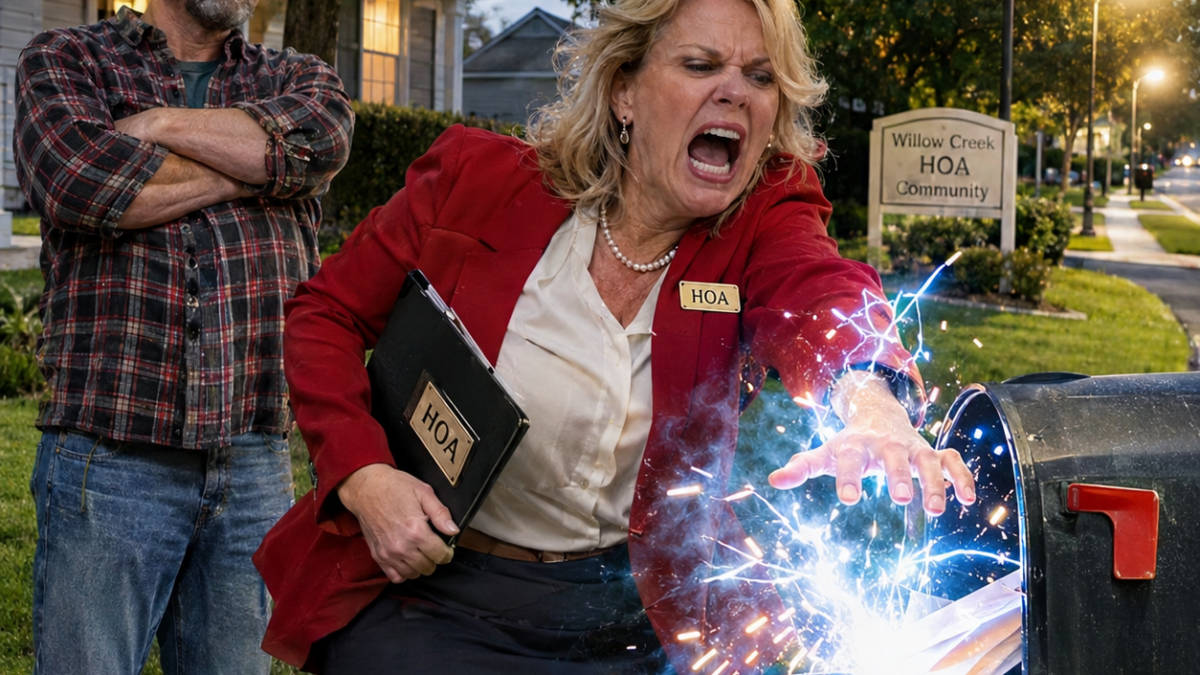
## THE STREET LIT UP
The mailbox opened.
White strobes fired outward.
The alarm screamed.
Renata jerked backward.
Coffee jumped from her mug.
She raised one arm against the light.
For one second, she looked less angry than confused.
Like the world had broken a rule she thought belonged to her.
Then she looked down.
Two envelopes were already partly in her hand.
Mine.
Across the street, Pearl’s curtain moved.
Clifford’s camera recorded.
Neighbors appeared on porches.
Renata looked left.
Right.
Back at the mailbox.
The lights continued.
Alarm continued.
Then realization arrived.
Her face changed.
Not pain.
Not fear.
Recognition.
She had been seen.
Really seen.
Not by me alone.
Not through grainy footage she could dismiss.
By people.
She shoved the envelopes back.
Slammed the mailbox.
Walked home fast.
Not running.
Too proud.
But close.
The system timed out.
Silence returned.
A mockingbird started making noise like nothing had happened.
I stood in the garage.
Hands shaking.
## I WALKED TO THE BOX
Pearl came outside first.
“Lord.”
Clifford crossed the street.
“You alive?”
“Me?”
“She looked like she saw Judgment Day.”
I opened the mailbox.
Two envelopes.
Bank statement.
Union pension administrator.
Both already opened.
Pearl’s expression hardened.
“She opened them?”
“Looks like it.”
Clifford stopped smiling.
That was the difference.
The flashing lights were funny.
The opened letters were not.
I put everything into an evidence sleeve.
Called Whitfield.
“It happened.”
Pause.
“You have recordings?”
“Three.”
“Originals preserved?”
“Yes.”
“I’ll be there.”
“How soon?”
“Two hours.”
Then I called Thaddeus.
He answered:
“Did your science project work?”
“She triggered it.”
Silence.
“Mail in hand?”
“Yes.”
“Opened?”
“Yes.”
Another silence.
Then:
“Do nothing else.”
“That’s all lawyers ever say.”
“And yet you’re still not in jail.”
Fair.
## ONE MINUTE
I went inside.
Made coffee.
Stood by the window.
Allowed myself one minute.
Exactly one.
Not celebration.
Satisfaction.
Months of being told I was difficult.
Paranoid.
Hostile.
The video did not care about any of that.
Evidence is emotionally indifferent.
That is why I love it.
Then the minute ended.
I went back to work.
The election was tomorrow.
## INSPECTOR WHITFIELD ARRIVES
She came in an unmarked car.
Plain clothes.
We reviewed files.
She inspected the mailbox system.
Asked questions.
Verified there was no injurious component.
Collected copies according to procedure.
Then watched the close camera angle.
Renata.
Door.
Envelopes.
Whitfield exhaled.
“That’s clear.”
“Clear enough?”
She looked at me.
“I don’t promise outcomes.”
“I know.”
“But this is clear evidence.”
That was enough.
Before leaving, she asked:
“Election tomorrow?”
“Yes.”
“Mind if I attend?”
“Public member meeting.”
“I may sit in the back.”
I smiled.
“Plenty of chairs.”
Turned out we needed more.
## FORTY-ONE PEOPLE
Normally six or seven attended HOA elections.
That night:
Forty-one.
Every chair in the Millhaven Public Library community room.
People standing along the wall.
Pearl brought lemon bars.
Because Pearl believed baked goods improved political revolutions.
Inspector Whitfield sat in the back.
Plain clothes.
Vera Stanton from the Millhaven Courier sat three rows up.
Notebook open.
Thaddeus wore one of his bow ties.
Renata sat at the board table.
Navy-blue HOA shirt.
Hair perfect.
Makeup perfect.
Gerald beside her.
She looked composed.
That fascinated me.
Twenty-four hours after being caught with my mail, she still opened the meeting like nothing had happened.
Call to order.
Quorum.
Minutes.
Treasurer report.
Her voice did not shake.
People like Renata can survive astonishing amounts of reality if ritual continues around them.
Then open comment began.
Thaddeus stood.
Renata immediately said:
“Resident comments only.”
He smiled.
“My name is Thaddeus Greer, counsel for resident Garrett Winslow, and I am speaking on his behalf concerning matters directly affecting association governance.”
She looked at Gerald.
Gerald examined his papers like the answer might be hidden there.
Thaddeus continued.
## HE DIDN’T PERFORM
That was what made it devastating.
No shouting.
No theatrical accusation.
Documents.
Active Postal Inspection Service case.
Video evidence.
Dates.
Times.
Opened correspondence.
Privacy litigation dismissal.
Financial-record dispute.
HC Property Consulting Services.
$4,200.
LLC registration.
Renata’s name.
Potential undisclosed conflict.
Renata stared.
One neighbor whispered:
“Her company?”
Another:
“She paid herself?”
Pearl folded her arms.
Thaddeus placed copies on the table.
Then Inspector Whitfield stood.
## THE ROOM CHANGED
She identified herself.
Postal Inspector.
Active investigation.
Evidence preserved.
Coordination with prosecutors.
She did not call Renata a criminal.
Did not grandstand.
She simply advised her to consult counsel before making statements about the matter.
That was enough.
Renata stood.
For a second, I thought she would attack.
Verbally, I mean.
She looked around.
Forty-one neighbors.
Vera’s notebook.
Thaddeus.
Whitfield.
Me.
Pearl.
Clifford.
The same people she had once treated one at a time.
Now together.
She sat.
Gerald gathered his papers.
And walked out.
Nobody stopped him.
## THE ELECTION
Ballots.
Thirty-seven cast for board candidates.
I received thirty-three votes.
Pearl received thirty-five.
Renata received two.
I never confirmed whose they were.
I had theories.
Did not matter.
When the count was announced, Pearl squeezed my arm.
“Well.”
“Well.”
“You know we actually have to serve now.”
I looked at her.
“I hadn’t considered that.”
She laughed.
Clifford came over.
Put his arm around my shoulders.
Said nothing.
Exactly right.
Outside, people stood in the parking lot eating lemon bars.
Talking.
Not whispering.
Talking.
That difference mattered.
## DARLENE
When I got home, Darlene was waiting in the kitchen.
“Thirty-three?”
“Thirty-three.”
“Pearl?”
“Thirty-five.”
She smiled.
“Beat you.”
“Unimportant.”
“Sounds important.”
I set my keys down.
Then she became serious.
“Renata?”
“Two.”
Darlene nodded.
“Good.”
Not gleeful.
Just good.
Then she hugged me.
Longer than usual.
“You scared me with this.”
“I know.”
“When Kaylee called…”
“I know.”
“I wanted to walk across the street and tear every flower out of that woman’s yard.”
I laughed into her shoulder.
“That would’ve hurt our case.”
“I know.”
She stepped back.
“Still wanted to.”
“Me too.”
## THE ARTICLE
Vera published the next morning.
The story spread farther than any HOA article had a right to.
Mail theft investigation.
Financial questions.
Board election.
Privacy lawsuit.
Harassment allegations.
No sensational headline about electric revenge.
Because there was no electric shock.
Just a mailbox alarm exposing what had been happening.
That mattered.
I did not want people copying some dangerous contraption and calling it justice.
The device had been designed to observe.
The real weapon was documentation.
## RENATA LAWYERS UP
Within a week, Renata retained criminal counsel.
She stopped attending HOA matters.
Officially, there were procedures.
Practically, she was done.
The federal investigation moved slowly.
Months.
Interviews.
Records.
Mail logs.
Financial documents.
Lawyers.
I went back to ordinary life.
Mostly.
Except I was now on the HOA board.
Which was arguably punishment enough.
## FIRST BOARD MEETING
Pearl looked at the agenda.
“We need financial controls.”
“Yes.”
“Violation appeals.”
“Yes.”
“Ramp.”
“First.”
Clifford’s mother’s wheelchair ramp had waited over a year.
We reviewed the request.
It met reasonable requirements.
Approved.
Four days.
That was how long it should have taken.
Clifford called.
“You serious?”
“Yes.”
“Approved?”
“Yes.”
Silence.
Then:
“Mom’s going to cry.”
“That’s allowed.”
Pearl volunteered to help design it.
No charge.
Saturday morning, eight neighbors showed up.
Fresh lumber.
Tools.
Cooler of drinks.
Clifford’s mother sat inside watching through the screen door.
When the ramp was finished, Clifford pushed her wheelchair down it.
She covered her mouth.
Tears.
Nobody commented.
Sometimes dignity is knowing when not to say anything.
## THE BRANTS’ BASKETBALL HOOP
Next meeting.
The Brants reapplied.
Approved.
Their son put the hoop back.
First Saturday after installation, I heard the ball.
Bounce.
Bounce.
Bounce.
Darlene looked up from the garden.
“Annoying?”
I smiled.
“Beautiful.”
## THE FINANCIAL AUDIT
We voted for a full independent review.
Not because every prior expense was fraudulent.
That would have been irresponsible to assume.
Because trust had collapsed.
The $4,200 payment to Renata’s company required explanation.
Other vendor relationships needed review.
We introduced simple controls.
Two signatures for larger payments.
Ownership disclosure.
Conflict-of-interest forms.
Competitive bids where appropriate.
Resident access to financial summaries.
None of this was revolutionary.
It was basic.
Which made it more frustrating that we had needed a federal mail investigation to get there.
## RENATA’S PLEA
Six months after the election, Thaddeus called.
“Resolution.”
I sat down.
Renata entered a plea agreement involving mail theft and fraud connected to HOA funds.
Probation.
Community service.
Restitution.
The $4,200 returned.
Legal obligations.
She resigned formally.
Even though politically she had already disappeared.
I asked:
“Jail?”
“No.”
I waited for disappointment.
It did not arrive.
That surprised me.
Months earlier, I might have wanted handcuffs.
A dramatic sentence.
Public humiliation.
Now?
I wanted the money back.
The records corrected.
The system fixed.
My daughter safe.
My mailbox untouched.
That was enough.
## KAYLEE CAME HOME
Spring break.
She stood in front of the mailbox.
“This is the famous one?”
“Unfortunately.”
She opened it.
Nothing happened.
She jumped backward anyway.
I laughed.
“Dad!”
“It’s disarmed.”
“You couldn’t tell me?”
“You would’ve ruined the test.”
She punched my arm.
Then became serious.
“I almost lost school because of her.”
“I know.”
“I still think about it.”
“So do I.”
She looked at the cedar.
“Why didn’t you just move?”
That question hurt more than I expected.
I looked down Beaumont Creek Drive.
“Because it’s our home.”
She nodded.
Then:
“Also because you’re stubborn.”
“That too.”
## THE MAILBOX
After the case, I removed the alarm components.
Kept ordinary cameras.
Rebuilt the cedar trim.
HOA compliant now.
Brass hardware.
Fresh sealant.
When the sun hits it in late afternoon, it smells like cedar and linseed oil.
Darlene runs her hand across it sometimes.
Just like the old one.
Nobody has reached into it without permission since.
## THE MONEY
The recovered HOA funds were not huge.
$4,200.
Legal reimbursements.
Other adjustments.
People expected us to return everything directly or lower dues.
We did some of that.
Then Pearl had an idea.
“Do something useful.”
“Like?”
“Scholarship.”
I looked at her.
“For what?”
“Trades.”
That got me.
Thirty-one years as a lineman.
Electricians.
Telecommunications.
HVAC.
Welding.
People who keep the physical world running while everyone else assumes it happens automatically.
We proposed the Beaumont Creek Neighborhood Fund.
Resident-controlled.
Small scholarship.
Native planting along the creek buffer.
Vote passed.
## THE FIRST SCHOLARSHIP
Marcus Hale.
Seventeen.
Millhaven High.
Electrical Technology at community college.
He wore a button-down shirt that did not fit comfortably and shoes that looked new.
Ceremony in Pearl’s backyard.
Not fancy.
Twenty people.
Sweet tea.
Cake.
I handed him the certificate.
He shook my hand.
“Mr. Winslow?”
“Garrett.”
“My dad says linemen are crazy.”
“Your dad is correct.”
He laughed.
“I want to work utilities.”
“Then remember one thing.”
“What?”
“Never trust a line because somebody told you it’s dead.”
He nodded seriously.
“Test it.”
“Exactly.”
Afterward I went behind Pearl’s shed for a minute because my eyes were doing something stupid.
Darlene found me.
“You crying?”
“Allergies.”
“Again?”
“Severe condition.”
She took my hand.
Some things work out when enough people decide fear is no longer a management strategy.
## RENATA MOVES
She sold her house that spring.
Ohio.
Back where she had come from.
Moving truck arrived early.
Darlene and I watched from the kitchen.
“Feel good?”
She asked.
I thought about it.
“No.”
“Really?”
“Relieved.”
“Different.”
“Yeah.”
Renata walked toward the Cadillac.
She saw me through the window.
I considered going outside.
For what?
Final speech?
No.
Nothing I could say would improve the ending.
She drove away.
The house sat empty for three weeks.
Then a young couple moved in.
Teacher and paramedic.
Baby.
They brought cookies to us.
Darlene laughed when they left.
“What?”
“We have become the old neighbors.”
“Speak for yourself.”
“You are sixty-two.”
“Temporary.”
## WHAT HAPPENED TO GERALD
Gerald resigned.
Quietly.
He claimed he had trusted Renata and rarely reviewed the details.
That irritated Pearl.
“It is literally a board member’s job to review details.”
She was right.
Gerald did eventually provide records and cooperate.
I did not hate him.
But passive people can help bad systems too.
Not every failure comes from a mastermind.
Some come from people who prefer not to ask uncomfortable questions.
## THE MAILBOX SUPPLIER
Remember the approved $189 mailbox?
The supplier connected to Renata’s family?
We reviewed that too.
The arrangement was terminated.
Residents could choose from several models meeting basic design requirements.
I proposed allowing custom cedar boxes if dimensions and safety standards were met.
Pearl looked at me.
“Conflict of interest.”
“How?”
“You’re emotionally invested.”
“Correct.”
The proposal passed anyway.
By the next year, six different mailbox styles appeared.
Property values did not collapse.
Civilization continued.
## CLIFFORD’S MOTHER
She used the ramp every day.
That summer, she sat on the front porch more often.
Wave.
Smile.
Watch neighbors.
One evening I walked by.
She called:
“Garrett.”
“Ma’am?”
“Come here.”
I walked up the ramp.
She patted the railing.
“Good work.”
“Pearl built most of it.”
“Your board approved it.”
“Should’ve happened sooner.”
“Yes.”
She looked down the street.
“People get addicted to making others ask permission.”
I never forgot that.
She died two years later.
The ramp remained.
Clifford kept it.
“Why remove it?”
He said.
“Maybe the next person needs it.”
That sounded like the whole lesson.
## PEARL AS VICE PRESIDENT
I made the mistake of letting Pearl become vice president.
She ran meetings like construction sites.
“Agenda item one.”
Bang.
“Decision.”
Bang.
“Next.”
Our meetings went from ninety minutes to forty-five.
Residents loved her.
One man complained we were moving too fast.
Pearl told him:
“You are welcome to volunteer.”
He never complained again.
## THE VIOLATION SYSTEM
We did not eliminate rules.
That would have been stupid.
HOAs exist partly because people do occasionally abandon refrigerators in front yards.
What changed was process.
Written evidence.
Clear rule citation.
Notice.
Reasonable cure period.
Appeal.
No one-person enforcement.
No anonymous punishment.
No violation coordinator with unchecked discretion.
Complaints fell dramatically.
Not because everyone suddenly became perfect.
Because we stopped using the system to punish disagreement.
## MY FIRST VIOLATION UNDER THE NEW BOARD
Trash can.
Left visible overnight.
I laughed when the notice arrived.
Pearl signed it.
I called.
“You enjoyed this.”
“Immensely.”
“I’m appealing.”
“On what basis?”
“Corruption.”
“Denied.”
I put the can away.
Paid no fine because it was corrected inside the grace period.
That is how sane enforcement works.
## DARLENE’S ROSEMARY
The rosemary from the day Renata’s lawyer letter arrived kept growing.
Darlene replanted some beside the porch.
Every time I smelled it, I remembered the kitchen table.
The legal complaint.
Her saying:
Then you lawyer up.
She had been steady through all of it.
I was the one building files.
She was the one making sure our home did not become a command center.
That mattered.
One night after everything ended, I told her:
“I’m sorry.”
“For what?”
“For bringing this into the house.”
She looked confused.
“Renata brought it.”
“I obsessed over it.”
“You protected us.”
“I could’ve handled parts better.”
“Probably.”
“You’re supposed to disagree.”
“I’m married to you, not employed by you.”
I laughed.
Then she said:
“You never let revenge become more important than Kaylee.”
I thought about the workshop.
The trap.
The anger.
“I almost did.”
“But you didn’t.”
That was the difference.
## THE LIGHTS BECAME A LEGEND
Kids in the neighborhood exaggerated.
By year two, the story was that my mailbox shot lightning.
It did not.
Then that it electrocuted Renata.
Absolutely not.
Then that federal agents were hiding in the bushes.
Also no.
I corrected people whenever I heard it.
“It flashed.”
“How bright?”
“Bright.”
“Shock her?”
“No.”
“Why not?”
“Because I’m not an idiot.”
That line usually ended the conversation.
## WHY I DON’T RECOMMEND REVENGE DEVICES
The mailbox worked because it was designed only to alert and document.
No injury.
No shock.
No hidden mechanical hazard.
If you build something to hurt a trespasser, you may create a bigger problem than the one you started with.
I had too much experience with electricity to confuse technical ability with permission.
The purpose was evidence.
Always.
That was what won.
Not the light.
Not the buzzer.
The footage.
## INSPECTOR WHITFIELD
Years later, I ran into her at a community safety event.
She recognized me.
“Mailbox.”
I sighed.
“That’s my name now?”
She smiled.
“One of them.”
I asked whether she remembered the case.
“Yes.”
“Why?”
“Most people either have no evidence or destroy their own case by confronting too early.”
“Meaning?”
“You waited.”
I nodded.
She added:
“And you preserved original files.”
“Telecom habit.”
“Good habit.”
Then she said something that stayed with me.
“People think law enforcement creates evidence. Usually people create evidence. Our job is figuring out whether it proves anything.”
Renata had created most of hers herself.
## VERA STANTON
Her article on the election won a regional journalism award.
She sent me a copy.
I wrote back:
**Congratulations. Please never use my mailbox photo again.**
She replied:
**No promises.**
Reporters are terrible people.
Useful.
Terrible.
## THE FAKE FACEBOOK ACCOUNT
We never conclusively proved who created it.
The one accusing me of neighborhood surveillance and threats.
Vera debunked the claims using official meeting minutes.
The account disappeared.
I learned something from that too.
Not every lie deserves your direct response.
Sometimes records can answer without you.
That preserves energy.
And dignity.
## THE HOUSE ACROSS THE STREET
After Renata moved, the new family changed the landscaping.
Kids’ chalk drawings on driveway.
Plastic dinosaur beside porch.
A bright blue bicycle dropped near the garage.
Renata would have had a stroke.
I loved it.
One Saturday the father walked over.
“Question.”
“Yeah?”
“Are we allowed to paint our front door green?”
I stared.
“What shade?”
He looked terrified.
Then I laughed.
“Check the palette.”
He laughed too.
“Seriously?”
“Yes. We’re reformed, not anarchists.”
## THE CREEK PROJECT
The second half of the Neighborhood Fund went toward the creek buffer.
Native grasses.
Wildflowers.
Erosion control.
We partnered with local conservation staff.
Pearl managed volunteers like unpaid subcontractors.
“Garrett, shovel.”
“I was board president.”
“Shovel.”
I shoveled.
Kaylee came home and helped one weekend.
She wore nursing-school sweatpants and complained about mud.
“You’re supposed to be young.”
“I’m medically opposed to dirt.”
“You grew up here.”
“I evolved.”
## KAYLEE GRADUATES
Two years later, nursing degree.
Darlene cried before the ceremony began.
I lasted longer.
Not much.
When Kaylee crossed the stage, I thought about the missing aid letter.
A single stolen envelope had almost interrupted this.
Renata probably never understood what that mail meant.
Maybe that was the problem.
People who violate privacy often think only about the object.
An envelope.
A letter.
A package.
They do not see the life connected to it.
I did.
Watching Kaylee receive her diploma, I understood exactly what we had protected.
## SHE GAVE ME A GIFT
Graduation dinner.
Kaylee handed me a small box.
Inside was a brass mailbox flag.
Engraved:
**CHECK YOUR OWN MAIL, DAD.**
I laughed until my face hurt.
Darlene had clearly helped.
I installed it.
Still there.
## WHEN I STEPPED DOWN
I served two terms.
Then I was done.
Four years.
Enough.
Pearl stayed one more.
At my final meeting, they gave me a plaque.
I hated it.
Clifford read it aloud:
**For service, transparency, and unusually aggressive mailbox security.**
I looked at Pearl.
“You did this.”
“No proof.”
“Your fingerprints are on the wording.”
Everyone laughed.
That was how I wanted to leave.
Not as the man who defeated Renata.
As one board member among others.
Healthy systems should not depend on a hero.
If everything collapses when one good person resigns, you did not fix it.
## THE NEW CONTROLS HELD
Years passed.
Different board members.
Different disagreements.
The financial controls stayed.
Vendor ownership disclosure.
Multiple approvals.
Open records.
Appeal procedures.
Accessibility requests prioritized.
No board member could personally dominate enforcement.
Not perfect.
Better.
That was the real victory.
## THE $4,200
It sounds small.
Especially compared with stories about million-dollar fraud.
But $4,200 mattered because it represented trust.
Residents paid dues believing the money served common purposes.
If an officer redirected money to an undisclosed business they controlled, even a few thousand dollars poisoned that trust.
The recovery became seed money.
Part of it eventually helped fund a kid’s trade education.
There is poetry in that.
Renata’s questionable consulting payments helping a teenager become an electrician.
I would never have planned it.
But I appreciated it.
## MARCUS, THE SCHOLARSHIP KID
He finished the program.
Joined a utility contractor.
Then one summer I saw a service truck on Beaumont Creek.
Young man in hard hat climbed out.
“Mr. Winslow.”
I stared.
“Marcus?”
He grinned.
“They sent us for a telecom line issue.”
I laughed.
“Full circle.”
He pointed at the pole.
“Want to supervise?”
“No.”
“You sure?”
“Thirty-one years. I have earned the right to stand on the ground and criticize.”
He laughed.
Before leaving, he shook my hand.
“Scholarship mattered.”
“Good.”
“My mom couldn’t have covered first semester tools.”
I swallowed.
“Good.”
Some revenge stories end with someone losing.
The better ones end with someone else gaining.
## THE OLD CAMERA FILES
I still have them.
Encrypted drive.
Backup.
Not because I watch them.
I don’t.
Evidence should become history once its job is done.
Darlene once asked:
“Why keep them?”
“Retention.”
“For how long?”
“Until I die.”
She rolled her eyes.
“Of course.”
Maybe one day I’ll delete them.
Maybe not.
Old linemen are bad at throwing away records.
## DID I FORGIVE RENATA?
People ask that.
I don’t know.
Forgiveness is not a switch.
I stopped being angry.
That is different.
I stopped wanting updates about her life.
Different too.
I hope she did better after moving.
I genuinely do.
Not because what she did was small.
Because carrying hatred keeps somebody present after they have left.
I had already given Renata enough space in my life.
She did not need more.
## THE MAILBOX AT SUNSET
Some evenings, I walk to the road.
Check mail.
Sun warms cedar.
Brass flag catches light.
I remember the August morning.
Alarm.
Strobes.
Renata holding envelopes.
Neighbors watching.
At the time, I thought that was the climax.
It wasn’t.
The climax was the next night in the library.
Forty-one residents.
People speaking.
Voting.
Choosing different leadership.
The mailbox only revealed one act.
The community had to decide what to do with the truth.
That mattered more.
## THE THING ABOUT CONTROL
Renata did not start by stealing mail.
She started with a mailbox model.
That is important.
Small control.
Then garage rust.
Meeting times.
Package rules.
Cameras.
Violation notices.
Information.
Money.
Mail.
Control expands when nobody forces it to justify itself.
Not every strict HOA officer becomes Renata.
Of course not.
But systems should never rely on the personal restraint of whoever happens to hold authority.
Rules need boundaries.
Appeals.
Transparency.
Oversight.
That protects everyone.
Even good leaders.
## PEARL’S THEORY
She said once:
“Renata didn’t think she was stealing.”
I disagreed.
“She knew.”
“Legally, sure.”
Pearl stirred her coffee.
“But in her head? She thought everything in the neighborhood was her business.”
That was probably true.
Entitlement changes vocabulary.
Your mail becomes community information.
Your driveway becomes community concern.
Your ramp becomes architectural control.
Your vote becomes disloyalty.
Your disagreement becomes hostility.
Once somebody believes the community belongs to them, boundaries feel offensive.
## CLIFFORD’S THEORY
Clifford disagreed.
“She knew.”
That was his entire analysis.
Maybe both were right.
Humans can know something is wrong and still invent a story that makes it feel justified.
That is why rules alone do not save us.
Accountability matters.
## THE LAST LETTER FROM OHIO
Years later, a Christmas card arrived.
No return name.
Inside:
**Garrett and Darlene,
I hope you are well. I have had time to reflect on Beaumont Creek. I handled many things poorly. I am sorry for the trouble caused to your family.
Renata**
Darlene read it.
“That’s something.”
“Yeah.”
“You writing back?”
I thought.
Then picked up a pen.
Wrote:
**I hope you’re well too.**
Nothing else.
Darlene nodded.
“Good.”
I mailed it.
Using my own mailbox.
Of course.
## THE STORY PEOPLE PREFER
People prefer:
Karen steals mail.
Retired lineman wires box.
BOOM.
Street lights up.
Karen exposed.
Funny.
Clean.
The real story was slower.
Months of paperwork.
Phone calls.
Legal bills.
A crying daughter.
A delayed ramp.
Financial records.
Neighbors afraid to speak.
Meetings.
An election.
Probation.
Audits.
Governance reforms.
Scholarship votes.
Planting creek grass.
Reality rarely fits a thumbnail.
But the slow parts are where change happens.
## THE MOMENT I ALMOST LOST IT
It wasn’t the mailbox theft.
It was Kaylee.
After we got her aid deadline extended, I found the original opened financial-aid envelope weeks later among mail Renata had apparently returned.
I held it.
Her future reduced to paper someone had taken because they could.
I walked toward Renata’s house.
Halfway down the driveway.
Darlene came outside.
“Garrett.”
I kept walking.
“Garrett.”
I stopped.
She came beside me.
“Where are you going?”
“To ask her.”
“Ask what?”
“Why.”
Darlene looked at the letter.
Then at me.
“Will any answer help?”
I hated her for being right.
Just for a second.
I turned around.
Went inside.
That may have been the most important decision I made.
If I had confronted Renata angry, she could have claimed threats.
Shifted the story.
Maybe damaged the federal case.
Instead, the letter went into evidence.
Anger wanted a conversation.
Strategy wanted a file.
Strategy won.
## THE BEST REVENGE
Darlene once asked me:
“What would make you feel like this is finished?”
At the time I said:
“Renata stops.”
Later I understood that was incomplete.
Because if the system stayed the same, another Renata could appear.
The finish line was not one person leaving.
It was making the next abuse harder.
Two signatures.
Disclosure.
Appeals.
Open records.
Accessible meetings.
No solitary violations coordinator.
That was revenge against the system that enabled her.
Better revenge.
## BEAUMONT CREEK TEN YEARS LATER
Children.
Older residents.
New families.
Some of us gone.
Some still there.
Clifford eventually sold his house after his mother passed.
Pearl still lived nearby.
She claimed retirement but continued repairing things for everybody.
Kaylee became a nurse.
Darlene finally retired from the school system.
I spent more time gardening badly.
The HOA still sent letters.
Sometimes legitimate ones.
Nobody feared them.
That difference is enormous.
## ONE SATURDAY
A new resident knocked.
Young guy.
Nervous.
He held a violation notice.
“Mr. Winslow?”
“Garrett.”
“They said you used to be president.”
“For my sins.”
He showed me the letter.
Fence stain.
He thought it was unfair.
I read it.
“Rule’s real.”
His face fell.
“Seriously?”
“Yeah.”
“So what do I do?”
“Fix the stain.”
“That’s it?”
“That’s it.”
He laughed.
“I thought you’d tell me how to fight.”
“Fight when they’re wrong.”
I handed the notice back.
“Otherwise you’re just becoming the other problem.”
That may be the most important lesson of all.
Accountability is not anti-rule.
It is pro-fairness.
## THE CEDAR BOX
I resealed it every autumn.
Sand lightly.
Oil.
Check hardware.
Old habits.
One year, the brass hinge finally failed.
I replaced it.
Darlene watched.
“You could buy a new mailbox.”
“I could.”
“For fifty dollars.”
“Probably.”
“Why don’t you?”
I looked at the cedar.
“History.”
She shook her head.
“You are impossible.”
“Documented.”
## MY OLD LINEMAN TOOLS
Most sit in the garage.
Insulated gloves.
Meters.
Climbers.
Belts.
Kaylee wants me to donate them to the trade program.
She’s probably right.
Marcus offered to help.
Maybe the mailbox story ends there eventually.
The tools that built the alarm helping another generation learn to work safely with electricity.
That would feel right.
## WHAT THE STREET REMEMBERS
Clifford once told me the funniest part was not the lights.
“What was?”
“Her face when she realized Pearl was filming.”
Pearl disagreed.
“The coffee.”
Renata spilled half the mug.
Darlene said:
“The best part was Garrett pretending he wasn’t excited.”
I deny that.
Vera said the important part was the election turnout.
Whitfield would probably say the evidence.
Kaylee would say financial aid.
Everyone remembers a different story because everyone had something different at stake.
That is how communities work.
## MY VERSION
I remember opening the first cedar mailbox twelve years before Renata came.
Fresh wood.
Darlene beside me.
Kaylee still young enough to ride a bicycle in circles around the driveway.
I remember thinking:
Not bad for seven-dollar brass hardware.
Then years later I watched someone try to turn that ordinary object into a point of control.
That bothered me at a level I could not explain then.
Now I can.
A mailbox is a boundary.
Small.
Almost invisible.
Outside world on one side.
Private life on the other.
Renata kept crossing it.
The alarm simply made the boundary impossible to ignore.
## THE LAST HOA MEETING I ATTENDED
I was not on the board anymore.
Just resident.
Agenda:
Budget.
Pool maintenance.
Creek landscaping.
A complaint about barking dogs.
Boring.
At the end, Pearl leaned over.
“Miss the old days?”
“No.”
“Not even a little?”
“No.”
“Good.”
We ate leftover cookies.
Went home.
Boring governance is underrated.
## IF RENATA HAD STOPPED EARLY
Sometimes I wonder.
If she had stopped after the mailbox replacement?
Nothing.
After garage rust?
Annoying memory.
After the failed package station?
Maybe we laugh about it.
After the first stolen letter?
Serious.
After Kaylee’s aid?
Unforgivable.
Every escalation made the ending worse for her.
That is common with people addicted to control.
They interpret resistance as proof they have not applied enough pressure.
So they add more.
Eventually the pressure exposes the mechanism.
## THE TWO ENVELOPES
Bank statement.
Union pension letter.
The two envelopes in her hand when the lights fired.
I kept copies.
The originals went through evidence procedures and eventually came back.
For a while I considered framing them.
Darlene stopped me.
“Absolutely not.”
“History.”
“No.”
“Evidence.”
“No.”
“Conversation piece?”
“No.”
She won.
They’re in a file.
Marriage requires compromise.
## THE DAY KAYLEE GOT HER FIRST NURSING JOB
Hospital.
Night shift.
She called.
“Dad, I got it.”
I shouted loud enough that Darlene came running.
Kaylee laughed.
That night I went to the mailbox.
There was a letter from the hospital.
Employment packet.
I carried it inside.
Something about the ordinary act of receiving important mail without fear almost made me emotional.
Trauma leaves strange little echoes.
## WHY I TELL THE STORY THIS WAY
Because if I only tell you about the lights, you learn the wrong lesson.
You learn clever revenge.
That is not what saved us.
What saved us was patience.
Documentation.
Neighbors.
A lawyer.
A federal investigator doing careful work.
A wife who stopped me from walking across the street angry.
A daughter who trusted me when I promised she would stay in school.
Pearl.
Clifford.
The Brants.
Forty-one people showing up when normally seven did.
The light was just the moment everybody could see what had been happening.
## THE FINAL MORNING
Last fall, I walked down the driveway before sunrise.
Cold Tennessee morning.
Cedar mailbox damp with dew.
I opened it.
Empty.
The street was quiet.
Renata’s old house had pumpkins on the porch.
The basketball hoop down the road stood crooked.
Clifford’s old ramp remained at his former house because the new owner had an elderly father who used it.
Creek grasses moved in the wind.
I stood there longer than necessary.
Darlene called from the porch.
“Garrett, you planning to marry the mailbox?”
“Thinking.”
“Dangerous.”
I walked back.
Coffee waiting.
Ordinary morning.
That was the ending I wanted all along.
## WHAT REVENGE BECAME
At first, revenge meant catching Renata.
Then embarrassing her.
Then making her pay.
I am not proud of every thought I had.
I wanted her to feel exposed.
Helpless.
Small.
The way Kaylee sounded on the phone.
But revenge changed as the story changed.
The best moment was not Renata flinching from the strobe.
It was Clifford’s mother using her ramp.
It was the Brants’ son shooting basketball again.
It was Marcus receiving the scholarship.
It was Kaylee graduating.
It was neighbors reading financial reports without being afraid of who might punish them.
Those things lasted.
Renata’s embarrassment lasted seconds.
## THE STREET THAT WATCHED
Twelve neighbors had some view of that August morning.
Some from windows.
Some porches.
Some directly involved.
That mattered because Renata’s power had always worked privately.
One warning at a time.
One resident at a time.
One mailbox at a time.
One closed-door decision at a time.
The morning the box lit up, the privacy around her behavior disappeared.
That is what truly changed.
Not electricity.
Visibility.
## SHE THOUGHT THE MAILBOX WAS THE TRAP
It wasn’t.
The trap was her assumption.
That nobody would compare stories.
Nobody would read records.
Nobody would request financials.
Nobody would preserve video.
Nobody would contact postal inspectors.
Nobody would challenge legal claims.
Nobody would run for office.
Nobody would wait.
She believed everyone else would eventually get tired.
For a while, she was right.
Then we got tired together.
That is different.
## MY FATHER USED TO SAY
“Never fear electricity you understand.”
He was a telephone technician before me.
Then he would add:
“Fear the fool who thinks he understands it.”
I thought about that often.
Renata believed she understood governance.
She understood rules as leverage.
Not responsibility.
She understood authority as access.
Not limits.
She understood silence as agreement.
Not exhaustion.
She understood fear.
Not community.
Those gaps brought her down more effectively than anything I could have built in my garage.
## I NEVER SHOCKED HER
I repeat that because neighborhood legend refuses to die.
No shock.
No injury.
No hidden high voltage.
No dangerous booby trap.
Light.
Alarm.
Cameras.
That is all.
If anything had hurt Renata, I would have undermined everything we were trying to prove.
She was responsible for taking my mail.
I needed to remain responsible for my own actions.
Justice gets messy when revenge starts making excuses.
## THE MAIL STILL COMES
Bills.
Junk.
Retirement statements.
Christmas cards.
Kaylee’s family photos now.
Yes, family.
She got married.
Has a little boy.
He likes opening Grandpa’s mailbox.
Under supervision.
The first time he reached inside, Darlene said:
“Careful. It bites.”
He pulled his hand back so fast I almost fell over laughing.
Kaylee glared at us.
“Do not traumatize my child with the mailbox story.”
Too late.
Family history.
## THE GRANDSON
He’s six now.
Asked:
“Grandpa, did a bad lady steal your letters?”
“Yes.”
“Why?”
“I don’t know.”
“Did you zap her?”
“No.”
“Mom says you did.”
“Your mother lies.”
Kaylee shouted from the kitchen:
“I heard that!”
He laughed.
Then:
“What did you do?”
I thought carefully.
“I made sure everybody could see.”
He accepted that.
Children sometimes understand the truth more easily than adults.
## THE NEW SCHOLARSHIP CLASS
The Neighborhood Fund is still active.
Different board.
Same purpose.
Trade education.
Native creek restoration.
Every year, a student receives help.
I attend when invited.
Not because I founded it.
Because I like meeting kids who want to build things.
Electricians.
Welders.
HVAC technicians.
Automotive students.
One girl wanted telecommunications.
I told her:
“Good choice.”
She said:
“My mom says it’s dangerous.”
“Your mom is right.”
“Why’d you do it thirty-one years?”
“Because it’s useful.”
That is a good enough reason for a career.
Maybe for a life.
## RENATA’S NAME DISAPPEARED
At first, every conversation referenced her.
“Under Renata…”
“Because Renata…”
“Before Renata…”
Then less.
Eventually new residents did not know who she was.
That felt strange.
Then healthy.
If reform becomes dependent on remembering the villain, it may not be strong enough.
The rules should work even when the story is forgotten.
## THE LAST COPY OF HER HOA LETTERHEAD
Pearl found old stationery in storage.
Boxes.
She called.
“Bonfire?”
“No.”
“Recycling?”
“Yes.”
We shredded it.
Paper strips.
Bags.
Gone.
There was something satisfying about watching official-looking letterhead become ordinary recyclable paper.
Authority is partly theater.
Ink.
Logo.
Title.
Once people stop believing the performance is more important than the rules, the paper becomes paper again.
## THE THING I WOULD CHANGE
I would have acted sooner.
Not with the alarm.
With people.
I should have talked to Pearl after the first suspicious fine.
Clifford.
The Brants.
I spent too long thinking Renata was my problem.
She was a neighborhood problem.
Isolation helped her.
If I had understood that earlier, maybe Kaylee’s letter never disappears.
I cannot know.
But it changed how I handle conflict now.
Before assuming you’re alone, ask around.
Quietly.
Respectfully.
You may discover everyone has been fighting the same battle in separate rooms.
## DARLENE RETIRES
Her last day at school, children made cards.
Speech therapy.
Years of helping kids find words.
At dinner I told her:
“You know that’s what you did for Beaumont Creek too.”
“What?”
“Helped people find words.”
She stared.
“That is the corniest thing you’ve ever said.”
“It’s true.”
“Still corny.”
She was right.
But she had.
When I was angry, Darlene translated anger into patience.
When Kaylee was scared, she made space for fear without letting it become panic.
When neighbors hesitated, she welcomed them into our kitchen.
I built the box.
She helped build everything around it.
## THE KITCHEN TABLE
That table had seen:
Court letters.
Financial records.
Camera screenshots.
Campaign flyers.
Scholarship applications.
Kaylee’s graduation photos.
Grandchild’s birthday cake.
Darlene once said:
“Maybe we should replace it.”
“No.”
“It’s scratched.”
“History.”
“There you go again.”
She’s probably right.
I keep too much.
But some furniture earns its wear.
## THE FINAL LESSON FROM RENATA
Bad power often survives because responding costs more energy than submitting.
Forty-dollar fine.
Seventy-five-dollar fine.
Another meeting.
Another letter.
Another hour.
People have jobs.
Children.
Illness.
Parents.
Bills.
Nobody wants their life to become an HOA dispute.
Renata counted on that.
The answer cannot be expecting every homeowner to become a full-time investigator.
The answer is systems that make abuse harder from the beginning.
Clear records.
Shared authority.
Appeals.
Transparency.
Participation.
That’s what Beaumont Creek finally built.
## AND THE MAILBOX?
Still there.
4412 Beaumont Creek Drive.
Cedar.
Brass.
Slightly weathered.
No flashing lights anymore.
No alarm.
No special electronics.
Just a mailbox.
Exactly what I wanted it to be.
Sometimes the happiest ending is when the object at the center of a war becomes boring again.
## ONE LAST EVENING
Darlene and I sat on the porch.
Summer.
Cicadas.
Someone grilling down the street.
Basketball bouncing.
A little wind through the creek grass.
Mail truck came.
Stopped.
Driver put envelopes in the box.
Drove away.
Darlene looked at me.
“Going to check it?”
“Later.”
She smiled.
“Growth.”
I smiled too.
Five years earlier, I would have walked down immediately.
Camera alert.
Check contents.
Verify.
Now?
Mail could sit there ten minutes.
Twenty.
An hour.
Nobody would touch it.
Trust had returned so gradually I had not noticed.
That was the final thing Renata had taken.
Not letters.
Trust.
And that was the hardest thing to rebuild.
## IF YOU ASK ME WHETHER I WON
Yes.
But not because Renata lost.
She lost office.
Money.
Reputation.
Her home in the neighborhood.
She faced legal consequences.
Those were results.
Winning was Kaylee finishing nursing school.
Winning was Clifford’s mother using her front door.
Winning was Pearl turning board meetings into boring forty-five-minute sessions.
Winning was a scholarship helping Marcus buy tools.
Winning was opening my mailbox without checking the camera first.
Winning was the neighborhood learning that rules are supposed to serve the community, not the ego of the person holding the binder.
## THE MORNING IT LIT UP
I still remember every second.
10:58.
Blue cardigan.
Travel mug.
Coral nails.
Her hand on the box.
The flash.
Alarm.
Coffee spilling.
Neighbors appearing.
Two envelopes in her hand.
For months, Renata had walked to my mailbox believing nobody could stop her.
That morning, nothing physically stopped her either.
That is important.
She opened it herself.
Reached in herself.
Pulled the mail herself.
Triggered the alarm herself.
Created the evidence herself.
All I did was make sure the truth had enough light.
## THAT IS THE PART PEOPLE MISS
They say:
“Garrett got revenge.”
Maybe.
But I did not make Renata steal.
I did not make her open my mail.
I did not make her pay her own company.
I did not make her harass Clifford.
I did not make her file the camera complaint.
I did not make her misuse letterhead.
I did not make her ignore financial requests.
I documented choices she made freely.
That distinction let me sleep at night.
## YEARS LATER
My grandson was playing in the driveway.
He ran to the mailbox.
Opened it.
Pulled out a credit-card advertisement.
“Grandpa! Mail!”
“Anything good?”
“No!”
He threw it at me.
Darlene laughed.
The box did not flash.
Did not scream.
Did not record three synchronized angles.
It simply opened.
A six-year-old stood there in sunlight holding junk mail.
I thought about how strange life is.
The same little boundary that once represented invasion now represented normal family life again.
That was worth more than watching Renata lose any election.
## I LOOKED DOWN THE STREET
Pearl’s house.
Clifford’s old house with the ramp.
The Brants’ hoop.
New families.
Old trees.
No one watching everyone else.
No golf-cart patrols.
No surprise inspections.
No person treating disagreement like rebellion.
Just a neighborhood.
Imperfect.
Occasionally annoying.
Alive.
## MY FINAL THOUGHT
Renata thought the HOA bylaws were a weapon.
For a while, they were.
Then we read them too.
She thought financial records belonged to the board.
We requested them.
She thought meeting rooms belonged to whoever held the gavel.
We filled the chairs.
She thought my mailbox was close enough to community property that she could reach inside whenever curiosity or control told her to.
I gave her one last chance to prove that belief in front of witnesses.
She did.
The street lit up.
The alarm sounded.
And for fifteen seconds, the entire neighborhood saw the difference between authority and entitlement.
But the lights were never the thing that defeated her.
They just made everyone look in the same direction at the same time.
What defeated her was everything that happened after people looked.
They talked.
Compared notes.
Read records.
Showed up.
Voted.
Changed the rules.
Helped each other.
That is why, when people ask what I wired into my mailbox, I usually smile and give them the simplest answer.
“Nothing that could hurt anybody.”
Then they ask:
“So what made it work?”
And I tell them:
“By the time she opened it, she wasn’t stealing from one quiet neighbor anymore.”
She was doing it in front of a community that had finally stopped being afraid of her.
That was the real circuit.
And once it closed, there was no resetting it.








