PART 2: HOA Karen Stole My 72-Foot Yacht for Her Niece’s 100-Guest Wedding—Then the Coast Guard Shut It Down Mid-Vow
PART 2
I spent twenty-four years in the United States Navy.
Submarine service.
For my final tour, I commanded the USS Helena, a Los Angeles-class fast-attack submarine.
Months beneath the Pacific teaches you things that transfer strangely well to ordinary life.
You learn patience.
You learn redundancy.
You learn that panic is contagious.
You learn that the person making the most noise during an emergency is rarely the person solving it.
And above everything else, you learn not to react before you understand what is happening.
Observe.
Document.
Plan.
Then act when the moment belongs to you.
Pamela Stanton never understood that about me.
To her, quiet meant weak.
The first afternoon she approached me, I had just brought the Compass Rose back from a whale-watching trip.
Six passengers.
A retired couple from Portland.
Two marine biology students.
A father and teenage son.
One woman who became seasick before we cleared the harbor and apologized to me every fifteen minutes as if she had personally offended the Pacific Ocean.
I was rinsing salt spray from the teak rail when Pamela appeared.
She wore hiking boots that had never met mud, a dark quilted vest over a silk blouse, and carried the clipboard I would eventually come to recognize from fifty yards away.
“Nate.”
“Pamela.”
“We need to discuss the commercial situation.”
I kept the hose moving along the rail.
“What commercial situation?”
“Your tours.”
“What about them?”
“Strangers coming and going.”
“They board at Orcas Landing.”
“Engine noise.”
“I leave this slip at normal marina hours.”
“Diesel fumes.”
I shut off the hose.
“Pamela, what exactly are you asking?”
Her expression softened into something carefully rehearsed.
“This is a residential waterfront community.”
“Yes.”
“The CC&Rs specify recreational use of dock facilities.”
“I store my boat here.”
“But you operate a business from the vessel.”
“My customers board at the public float.”
“That distinction is convenient.”
“It is also real.”
She glanced at the Compass Rose.
I could almost see her mentally calculating its length.
Seventy-two feet looked enormous compared with the smaller sailboats and weekend cruisers around the Harborview Bluffs marina.
She said:
“The board will review this.”
“The board can review whatever it wants.”
Her mouth tightened slightly.
“I’m trying to work with you.”
“No, Pamela.”
I coiled the hose.
“You’re trying to find a problem.”
She made a note.
Three weeks later, she found one.
NON-COMPLIANT VESSEL MARKINGS.
One hundred fifty dollars per day beginning after fourteen days.
The violation concerned the compass rose painted on the bow.
My father’s design.
Emma’s initials hidden inside it.
According to Pamela:
The artistic insignia conflicted with community waterfront aesthetics.
I read the notice at the kitchen table.
Emma was across from me eating cereal.
She saw my expression.
“What?”
“Pamela wants Grandpa’s compass removed.”
Emma stopped chewing.
“What do you mean removed?”
“Apparently it does not meet the waterfront aesthetic.”
She stared at me.
“What aesthetic?”
“I assume expensive beige.”
Emma slowly lowered her spoon.
“Dad.”
“Yeah?”
“If you sand Grandpa’s compass off that boat, I will personally roll over your foot every morning until you die.”
I smiled.
“Good to know.”
I called Pamela.
She answered warmly.
“Nate.”
“The compass stays.”
“The board believes—”
“It is part of the vessel’s documented identifying design.”
“We can find a middle ground.”
“There isn’t one.”
“You’re becoming emotional.”
I looked toward Emma.
“No.”
I said quietly.
“I’m becoming very clear.”
The fine disappeared.
No apology.
Just vanished from the next statement.
That should have been the end.
For Pamela, losing wasn’t an ending.
It was a calibration.
Her next complaint went to Washington wildlife enforcement.
She alleged my tours were harassing marine mammals.
That accusation could have damaged the business badly.
I run Callaway Marine Excursions because I love the water, but sentiment doesn’t pay for diesel, haul-outs, insurance, replacement teak, or Emma’s medical costs.
Four trips a week in season.
Fewer in winter.
Whales.
Eagles.
Sunset cruises.
Everything licensed.
Everything documented.
We follow approach restrictions religiously.
My father taught me never to build something you weren’t willing to sign your name to.
The Navy taught me the same thing differently.
A wildlife officer came aboard.
Young.
Thorough.
He reviewed permits.
AIS logs.
Tour protocols.
Distances.
Everything.
Thirty-five minutes later, he closed his notebook.
“No violations.”
“I know.”
He looked embarrassed.
“Complaint said you routinely approach protected whales inside minimum distance.”
“Did the complainant provide evidence?”
“No.”
“Name?”
He hesitated.
I didn’t push.
I requested the record properly later.
Pamela.
I saved it.
Exhibit four.
That became a habit.
Every letter.
Every complaint.
Every fine.
Every email.
Every government response.
The Navy would have called it an operating picture.
Emma called it:
“Pam’s Greatest Hits.”
Then came the money.
June HOA board meeting.
Pamela proposed a premium vessel surcharge.
Eight hundred dollars a month for any vessel exceeding forty-five feet.
There were nine boats at the marina.
Eight were under forty feet.
One was seventy-two.
Mine.
She stood beside a glass coffee table in her living room explaining how larger vessels created “enhanced infrastructure burdens.”
I raised my hand.
She hated when I did that.
“Nate.”
“This adds ninety-six hundred dollars a year to my fees.”
“It reflects your disproportionate impact.”
“What impact?”
“Dock maintenance. Aesthetic concerns.”
“The dock is individually deeded by slip allocation and maintained through existing dues.”
“That’s an oversimplification.”
“No, it’s arithmetic.”
Several people looked down.
Tom Brennan, retired marine biologist, hid a smile behind his coffee mug.
Walt Hendricks, retired Army colonel, didn’t bother hiding his.
I continued:
“This assessment requires a membership vote under the governing process Elena already reviewed.”
Pamela’s eyes narrowed.
“Elena?”
“Elena Vasquez.”
My attorney.
The room changed slightly.
People like Pamela enjoy legal language until somebody brings a lawyer who reads it.
“The board has marina authority.”
“Routine operations.”
“Nate—”
“You don’t have the votes.”
The next morning, Elena sent a formal letter.
By the end of the week, the assessment disappeared.
Again.
No apology.
Again.
Pamela recalibrated.
That was when she began touching the boat.
Two divers showed up beside my slip.
Puget Sound Marine Assessments.
They claimed they were evaluating environmental contamination.
I wasn’t aboard.
But after somebody had previously disconnected shore power and ruined more than two thousand dollars of provisions, I had installed cameras.
Including one beneath the dock.
The footage showed the divers scraping antifouling coating from my wooden hull.
Not samples.
A large section.
Methodical.
Putty knives.
Strip after strip.
Pamela stood on the dock above them.
Clipboard in hand.
Looking at her watch.
I watched the video three times.
Then drove to the boat.
When my hand touched the exposed hull, something cold moved through me.
Henry Callaway had chosen those cedar laminations himself.
I remembered him holding boards to the light.
Rejecting anything with grain he didn’t trust.
“You don’t argue with wood, Nate.”
He used to say.
“You listen to what it wants to become.”
Now someone had taken a blade to his hull because Pamela Stanton wanted leverage.
Repair cost:
$3,800.
Two weeks in dry dock in Anacortes.
Cliff Austrander, the yard manager, walked beneath the exposed area.
He had known Dad for decades.
He looked up.
“Somebody did this deliberately.”
“Yes.”
“Henry would haunt them.”
“I hope he has better things to do.”
Cliff touched the cedar.
Then looked at me.
“You reporting it?”
“Already did.”
Police report.
Civil claim.
Video.
Exhibit eleven.
Pamela denied directing damage.
The camera showed otherwise.
Still, she continued.
The ramp was next.
That one changed everything.
Dad designed Emma’s boarding ramp when she was nine.
Six feet.
Thirty-six inches wide.
Hand-shaped teak.
Stainless railings.
Non-slip rubber.
Hydraulic leveling to accommodate tidal movement.
He tested it obsessively.
Up.
Down.
Adjust.
Measure.
Again.
At one point, Emma had rolled up and down so many times she shouted:
“Grandpa, it’s perfect! Stop fussing!”
Dad stared.
“Perfect isn’t a feeling.”
“It is when my arms hurt!”
He laughed.
That ramp meant Emma could board without me lifting her.
Without asking anybody for help.
She could roll from dock to deck like any other adult arriving at her own boat.
Pamela had always hated it.
Non-standard.
Visible.
Too industrial.
On a Thursday in September, I was at the VA hospital in Seattle when Tom Brennan called.
“Nate.”
His voice was wrong.
“What?”
“They’re taking Emma’s ramp.”
I stood.
“Who?”
“Two workers.”
“Pamela?”
“Standing right there.”
“Where’s Emma?”
Pause.
“At the dock.”
My heart stopped.
“She can’t board.”
I was already moving.
Tom continued:
“June has her.”
I drove ninety-six miles in one hour and forty-one minutes.
Not proud of that.
Not recommending it.
When I arrived, Emma sat in Tom’s truck.
June had wrapped a blanket around her legs even though it wasn’t cold.
Tea in her hands.
Emma wasn’t crying.
That was worse.
Her jaw was locked.
Fingers white around the mug.
I opened the passenger door.
“Em.”
“She threw it behind the shed.”
I looked.
The ramp lay between trash bins and coils of old line.
Teak scratched.
Rail bent.
Hydraulic housing cracked.
Twelve years of tides and salt had done less damage than twenty minutes of Pamela’s authority.
Emma said:
“She said it wasn’t approved.”
I crouched.
“I’m sorry.”
“Don’t.”
“What?”
“Don’t say sorry like you did something.”
I looked at her.
“She wants me to feel like I don’t belong on Grandpa’s boat.”
“No.”
Emma’s eyes were wet now.
“She doesn’t get that.”
“No.”
“Promise.”
There are promises parents make because children need reassurance.
Then there are promises that become operating orders.
“I promise.”
That night, Emma ate dinner.
Then went to bed early.
I stayed awake until two.
Photographed everything.
Bolts.
Broken actuator.
Scrapes.
Mounting damage.
The ramp was not merely some dock accessory.
It was a documented disability accommodation.
Elena explained the legal implications carefully.
Her voice on the phone stayed calm.
Mine did too.
Mostly.
“This matters.”
She said.
“I know.”
“No, Nate.”
She paused.
“This matters beyond the HOA dispute.”
I looked toward Emma’s bedroom.
“I know.”
Pamela had handed us one of the strongest pieces of evidence in the entire case.
And still she kept going.
Another code complaint.
The Compass Rose supposedly overloaded the dock.
County inspector Dale Peterson spent ninety minutes checking pilings, hardware, shore power, cleats, construction records.
He finally closed his clipboard.
“Who built this dock?”
“Henry Callaway.”
Dale looked toward the pilings.
“The Henry Callaway?”
“Depends what story you heard.”
“He built the Friday Harbor commercial pier.”
“Yes.”
Dale shook his head.
“This dock could hold a Coast Guard cutter.”
Complaint closed.
No violations.
The anonymous letters followed.
Warnings in neighborhood mailboxes.
Callaway Marine Excursions brings unvetted strangers into your community.
Do you know who these people are?
Do you know their backgrounds?
Your children play here.
The message was obvious.
My passengers were dangerous because Pamela said they were.
Teachers.
Bird watchers.
Retired couples.
Marine biology students.
A few neighbors believed her.
One mother started pulling her children away from the dock when I returned.
That hurt more than I expected.
Tom didn’t believe her.
Neither did Walt.
Walt had his own history with Pamela.
She fined him twelve hundred dollars for a POW/MIA flag on his dock piling.
One flag was approved.
The American flag.
Only the American flag.
Walt had served two tours in Iraq.
He kept the fine letter in a plastic sleeve.
The first time he showed me, he said:
“My government sent me overseas with this emblem on my shoulder, but Pamela thinks prisoners of war are bad for property values.”
He didn’t smile.
That was when the three of us started comparing notes.
And once people compare notes, bullies become less mysterious.
Then I found Salish Luxury Events LLC.
Washington corporate filing.
Registered agent:
Pamela A. Wheaton.
Wheaton was her maiden name.
I stared at the screen.
Search led to an events page.
Then wedding sites.
Venue reviews.
Social media.
Exclusive waterfront experiences in the San Juan Islands.
Photographs.
Harborview Bluffs dock.
Pool.
Gazebo.
Then houses.
Tom’s patio.
Walt’s garden.
Dorothy Keen’s wraparound porch.
Dorothy was seventy-nine.
Spent several weeks every spring with grandchildren in Spokane.
I enlarged one photograph.
A long dinner table on Dorothy’s porch.
Candles.
Wine.
Thirty people.
Another photo showed guests inside her kitchen.
I called Tom.
“Come over.”
Twenty minutes later, he was looking at the screen.
“That’s Dorothy’s house.”
“Yes.”
“She know?”
“I doubt it.”
Tom leaned closer.
“That’s my patio.”
Garden party.
August.
Tom and June had been at a scientific conference in Monterey.
Another photograph:
Walt’s side yard.
Charity auction.
Walt had been visiting his son.
We kept searching.
Forty-seven documented events over four years.
Fourteen weddings.
Nine corporate retreats.
Eight wine tastings.
Seven cocktail receptions.
Private dinners.
So-called charity events.
Average price:
Thousands.
Estimated documented revenue:
Around $340,000.
No obvious sharing with the HOA.
No venue licensing we could find.
No event insurance tied to the community.
Then Dorothy’s house appeared four times.
Wine tasting.
Bridal shower.
Corporate retreat.
Rehearsal dinner.
Total advertised fees:
$31,000.
Dorothy had never received a dollar.
When we told her, she sat in Tom’s living room.
June held her hand.
Dorothy stared at a photograph of strangers drinking wine inside her kitchen.
“I came home after that trip.”
Her voice was thin.
“There was a glass in the dishwasher.”
Nobody spoke.
“And a scratch on the table.”
She swallowed.
“I thought I had forgotten.”
June squeezed her hand.
Dorothy looked at Pamela’s event photograph again.
“I thought I was getting old.”
That sentence made Tom close his laptop.
For a long moment, none of us spoke.
Pamela hadn’t merely exploited HOA facilities.
She had used the master-key system to access private homes while owners were gone.
Strangers had stood in Dorothy’s kitchen.
Eaten on her table.
Walked through her rooms.
Then everything was cleaned before she returned.
That is a violation that feels different when you say it slowly.
Home is the place where a person expects strangers not to be.
Pamela turned homes into inventory.
The HOA conflict suddenly made sense in a new way.
All the fines.
The complaints.
The threats.
The noise.
She kept everyone looking outward.
At my boat.
At Walt’s flag.
At Dorothy’s porch standards.
At paint colors.
At landscaping.
While behind the scenes she was monetizing the very community she claimed to protect.
Then we found the biggest upcoming event.
June 14.
Pamela’s niece Courtney.
Wedding.
One hundred guests.
Waterfront ceremony.
Venue:
Harbor View Bluffs Waterfront Estate Private Yacht Experience.
My yacht.
I read it twice.
Tom read over my shoulder.
“No.”
“Yes.”
“She wouldn’t.”
I looked at him.
Tom corrected himself.
“She absolutely would.”
The Compass Rose.
The boat Pamela had fined.
Reported.
Damaged.
Tried to make unaffordable.
The boat whose ramp she destroyed.
She was planning to use it as a wedding venue.
Without asking me.
Walt came over that evening.
We showed him.
He read the listing.
Then looked toward the marina.
“You calling the sheriff?”
“Not yet.”
He raised one eyebrow.
“Why?”
“Because if she is only planning it, we have planning.”
“And if she touches it?”
“We have action.”
Walt leaned back.
“You really were submarines.”
“Unfortunately.”
Emma came into the room.
“What?”
I tried to cover the screen.
Too late.
She rolled closer.
Read.
Silence.
Then:
“A wedding?”
“Yes.”
“On Grandpa’s boat?”
“Apparently.”
She stared at me.
“Is this woman clinically stupid?”
Walt coughed into his fist to hide a laugh.
“Emma.”
“What? That’s a legitimate diagnostic question.”
I almost laughed too.
Then she looked at the photo of the boat.
Her expression hardened.
“She’s going to cover the compass.”
I knew.
“Yes.”
“Dad.”
“She isn’t keeping the boat.”
“That isn’t what I said.”
“What?”
“Don’t let her erase Grandpa.”
That cut deeper than the yacht itself.
I called Elena.
Maritime law.
HOA law.
Trespass.
Business licensing.
She mapped everything.
Then I contacted Coast Guard Station Bellingham.
Not a dramatic report.
A notification.
I told them what I believed might happen.
Seventy-two-foot documented vessel.
Private owner.
Potential unauthorized use.
Planned passenger count:
Approximately one hundred.
No consent.
Unknown operator.
The Compass Rose was configured and inspected for a drastically smaller passenger load.
It carried fourteen life jackets aboard in its normal arrangement.
Not one hundred.
The duty officer listened.
Took information.
Vessel documentation.
My contact.
I said:
“If it happens, I’ll call.”
Then I upgraded the boat’s security.
Cameras.
Dock.
Helm.
Bow.
Stern.
Cloud recording.
GPS movement alerts.
Mooring sensors.
No booby traps.
No confrontation.
Just evidence.
I told only Tom and Elena.
Courtney’s wedding date went on my calendar.
June 14.
The invitation count reached one hundred.
Pamela planned the ceremony like a woman who had already won.
White roses.
String quartet.
Dinner.
Dance floor.
Cake.
Sunset vows.
The operator she hired was Lyle Briggs.
He advertised himself online as an experienced captain.
He possessed basic recreational boating credentials.
Not the professional license required for the role he was about to attempt.
Most of his experience came from Lake Chelan.
Lake Chelan is beautiful.
It is not the Salish Sea.
Tidal currents.
Commercial traffic.
Fog.
Cold water.
Rocks.
Marine mammal zones.
A seventy-two-foot yacht built for serious water.
Pamela had selected confidence over qualification.
Again.
On June 12, I left for a maritime safety conference in Seattle.
I did not hide the trip.
Pamela heard.
That was the point.
If I stayed home, she might delay.
I wanted her to believe the boat was unwatched.
June 13.
9:14 a.m.
My phone vibrated during a conference panel.
Motion alert.
I looked down.
Camera one:
Four workers carrying tables aboard.
Camera two:
Someone lifting Emma’s wheelchair ramp away.
Again.
Camera three:
Lyle at the helm.
His fingers running over Dad’s brass compass.
Camera four:
Pamela directing decorations.
My chest tightened.
Then I saw the paper.
The marina attendant, Carl Ridley, later described it.
HOA stationery.
Authorization to relocate Compass Rose.
Pamela’s signature.
Then:
Nathan Callaway.
My name.
Not my handwriting.
Forgery.
Carl was twenty-three.
Pamela signed his paycheck.
He asked whether he should call me.
Pamela told him everything had been arranged.
The cameras caught the crew cutting my lock.
Metal snapped.
Boarding began.
I stepped out of the conference room.
Called Elena.
“They’re on.”
“You’re sure?”
“I’m watching.”
“Signature?”
“Forged.”
“File?”
“Now.”
Then Coast Guard.
I gave them the updated information.
The vessel had been boarded without permission.
Decorated.
Prepared for a large private event.
A non-professional operator appeared to be in control.
They documented the report.
The wedding was the next day.
Clear weather.
Blue sky.
Olympics sharp on the horizon.
Guests arrived by ferry.
One hundred people dressed for photographs that would probably live online forever.
The dock transformed.
White carpet.
Flower arch.
Place cards.
Lavender sachets.
The Compass Rose disappeared beneath somebody else’s idea of elegance.
White fabric covered Dad’s rigging.
Rose garlands wrapped the observation rails where Emma watched orcas.
String lights ran through lines never designed to hold decorations.
Then I saw the dance floor.
They had fastened it to the teak.
Lag screws.
Into Dad’s deck.
I zoomed the camera.
For a moment, I stopped breathing.
Every teak plank had been laid by hand.
I remembered kneeling beside Dad years earlier.
His ALS had progressed.
He could barely hold a pencil.
He pointed at a plank.
“Wrong.”
“Dad, it’s fine.”
“No.”
“What?”
“Grain.”
I looked.
He was right.
The board had a small grain defect near the edge.
Nobody would have noticed.
Dad noticed.
I replaced it.
Now someone had driven a lag screw through those planks to support a temporary dance floor for a wedding I hadn’t authorized.
The helm was buried beneath flowers.
Dad’s compass invisible.
Emma’s initials gone under white silk.
The federal documentation number on the transom was concealed beneath a monogrammed C and T panel.
Courtney and Tyler.
At 2:45, Lyle started the engines.
The yacht moved.
That was when the situation changed again.
Until then, it was theft and trespass.
Now one hundred human beings were on a seventy-two-foot vessel underway with a dangerously unqualified operator and completely inadequate safety capacity.
From my hotel room, I watched the yacht list.
Four degrees to port.
Guests laughed.
Champagne glasses lifted.
They thought it was part of boating.
I knew what load shift looked like.
A submarine officer thinks about stability differently.
Mass.
Center of gravity.
Free surface.
Passenger movement.
Wind.
Sea state.
The Compass Rose was not built to carry a ballroom.
One hundred bodies.
Tables.
Chairs.
Food.
Flowers.
Dance floor.
Musicians.
Equipment.
Fourteen life jackets.
Water around fifty-two degrees.
This wasn’t revenge anymore.
It was life safety.
I called Station Bellingham.
“This is Nathan Callaway.”
“Yes, sir.”
“My vessel, Compass Rose, documentation number 1389472, is underway without my permission.”
The watchstander’s voice sharpened.
“Location?”
I gave GPS coordinates.
“Passengers?”
“Approximately one hundred.”
Pause.
“Say again?”
“One hundred.”
“Life jackets?”
“Fourteen aboard in current configuration.”
Another pause.
“Operator licensed?”
“Not as a Coast Guard master.”
“Are you able to verify visually?”
“I have live cameras.”
I heard keyboard clicks.
“Stand by.”
A lieutenant came on.
I repeated everything.
She said:
“Mr. Callaway, this is being treated as a life-safety incident.”
Then:
“Do not approach the vessel.”
“I’m in Seattle.”
“Good.”
She almost sounded relieved.
“We’ll handle it.”
The waiting was the hardest part.
People imagine military experience makes waiting easy.
It makes you better at hiding how much you hate it.
I opened four feeds.
The Compass Rose anchored in West Sound around 3:22.
Chairs filled the deck.
String quartet.
Pastor at the bow.
Courtney in a cathedral-length gown.
Tyler beside her.
Pamela front row.
Champagne-colored dress.
Pearls.
Lace handkerchief.
She looked happy.
That made the entire situation stranger.
Courtney looked happy too.
And that bothered me.
She may have been Pamela’s niece.
But I had no evidence Courtney knew the yacht was stolen.
The guests certainly didn’t.
Most of them thought they had been invited to an exclusive private yacht ceremony.
They were victims of Pamela’s confidence too.
The pastor began.
“Do you, Courtney—”
Then the helicopter arrived.
The sound came first.
Deep rotor beat.
Everyone turned.
The MH-65 moved over the sound.
Rotor wash hit the water.
The string quartet stopped.
One champagne flute fell.
Shattered on Dad’s teak.
Then two Coast Guard response boats appeared.
Fast.
Orange stripes.
Wake cutting outward.
The Compass Rose rocked.
Flower vases slid.
A canopy snapped.
Rose petals lifted into the air.
Courtney’s veil tore loose and caught high on the radar mast.
The scene looked unreal.
White petals.
Blue water.
Red-orange Coast Guard stripes.
A bride staring upward.
Pamela finally stopped smiling.
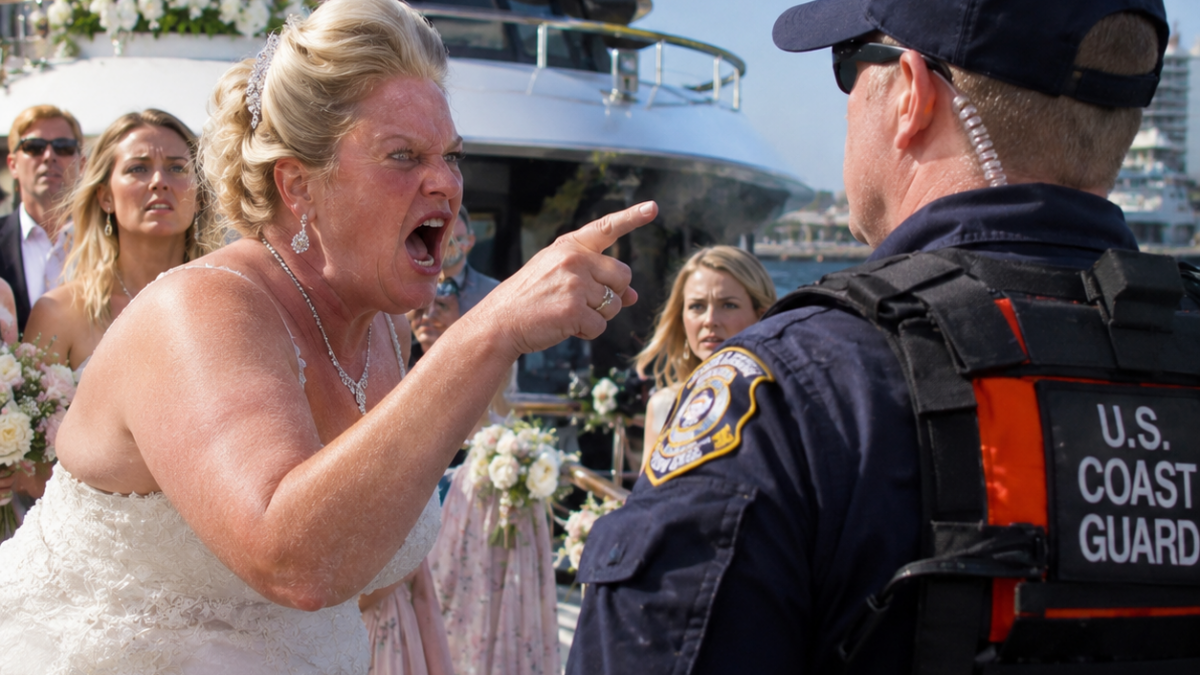
Chief Petty Officer Hawkins boarded from starboard.
His movements were calm.
Professional.
Nothing theatrical.
That made his presence more powerful.
“Good afternoon.”
Lyle stepped toward him.
Hawkins said:
“I need the vessel operator and event organizer.”
Lyle raised his hand.
“I’m captain.”
“Coast Guard master’s license?”
Lyle hesitated.
“My boating credentials are—”
“Master’s license.”
“I have a Washington boating card.”
Hawkins looked at him.
Then at the deck.
Then at Pamela.
“Event organizer?”
Pamela stepped forward.
“This is a private wedding.”
“Yes, ma’am.”
“We’re not operating commercially.”
Hawkins asked:
“Do you own this vessel?”
Pamela’s face changed.
“The HOA controls the marina.”
“That was not my question.”
“This vessel is within community facilities.”
“Do you own it?”
“No.”
“Do you have written consent from Nathan Callaway?”
Pamela looked toward Lyle.
“There is an authorization.”
Hawkins already knew.
“The signature has been disputed by the vessel owner.”
Silence.
Several guests began whispering.
Hawkins continued:
“This vessel is documented for a far smaller passenger count than is currently aboard, and the safety equipment aboard is not adequate for one hundred persons.”
Pamela said:
“This is ridiculous.”
“No, ma’am.”
“You are disrupting a wedding.”
“I am terminating an unsafe voyage.”
“You cannot just remove one hundred invited guests.”
“We can.”
He said it quietly.
“And we are.”
That was when Pamela’s confidence finally cracked.
The evacuation took thirty-seven minutes.
There is nothing elegant about transferring wedding guests from an overloaded yacht into Coast Guard response boats.
Dresses.
Dress shoes.
Elderly guests.
Children.
Confusion.
Tears.
Questions.
“What’s happening?”
“Are we arrested?”
“Is the boat sinking?”
“No.”
“Was this stolen?”
One bridesmaid started crying before she even reached the swim platform.
Tyler’s eighty-four-year-old grandmother couldn’t manage the transfer.
The Coast Guard used rescue equipment to move her safely.
She clutched her purse the entire time.
Tyler watched helplessly.
The wedding cake fell during one wake impact.
Three tiers.
White buttercream.
It hit the deck.
One bridesmaid stepped backward into the frosting and fell.
Nobody was seriously hurt.
That was the important part.
But the entire wedding had dissolved into chaos.
Courtney stood near the bow.
Her veil still trapped above.
Mascara running.
Tyler put an arm around her.
I remember looking at the live feed and feeling something I hadn’t expected.
Guilt.
Not for calling the Coast Guard.
That call was necessary.
But because this woman’s wedding had become collateral damage in Pamela’s campaign.
I called Elena.
“Courtney didn’t know.”
“We don’t know that yet.”
“I don’t think she did.”
“Nate.”
“Yes?”
“You didn’t put a hundred people on that vessel.”
“I know.”
“You didn’t forge your signature.”
“I know.”
“You didn’t hire an unlicensed operator.”
“I know.”
“You called because somebody could have died.”
I looked at the screen.
“I know.”
Sometimes knowing something and feeling it are separate tasks.
Pamela was removed after most guests.
She argued.
Demanded to call her attorney.
Told Hawkins this was private property.
Repeated her HOA title.
The same title she had used for years as if the letters themselves carried legal force over anything she wanted.
They did not.
Lyle was detained.
His white costume captain’s shirt had frosting on one gold epaulet.
I almost laughed.
Then stopped.
Real maritime officers were standing around him.
There was nothing funny about what could have happened.
From the bluff, Harborview residents watched.
Tom stood on his deck.
Walt sat in a lawn chair with coffee.
Dorothy watched from her porch.
Later, Tom told me Dorothy said:
“That’s the last party she’ll ever throw here.”
She was right.
The investigations that followed were larger than the yacht.
My vessel was the event that forced everything into daylight.
The forged signature.
Unauthorized use.
Passenger-safety violations.
Concealed vessel markings.
Then Salish Luxury Events.
Four years.
Unlicensed commercial events.
Private homes.
Community property.
Revenue.
Taxes.
Trespass.
The Coast Guard case connected to state and county investigations.
Elena coordinated the civil actions.
The homeowners finally had one advantage Pamela had never planned for.
They were talking to each other.
Eighteen families compared records.
Then more.
Charges.
Fines.
Assessments.
Keys.
Dates.
Pamela had survived for years because every homeowner thought their problem was isolated.
Walt thought his flag fine was about Walt.
Dorothy thought the glass in her dishwasher was memory.
Tom thought his patio photo was strange.
I thought Pamela hated my boat.
Once everything was laid on one table, it became a system.
And systems leave patterns.
Pamela’s attorney argued she hadn’t understood maritime requirements.
The judge was not sympathetic.
The yacht was federally documented.
The passenger load was obvious.
The forged authorization was not a technical misunderstanding.
Pamela ultimately accepted a resolution that included probation, substantial fines, community service connected to boating-safety education, and consequences tied to the unauthorized vessel operation.
There was something almost absurd about that last piece.
Pamela Stanton, who once told me my father’s seventy-two-foot yacht was an aesthetic problem, ended up spending hundreds of hours around boating-safety programs.
Walt called it:
“Government poetry.”
State consequences hit harder financially.
Investigators documented four years of event activity.
Unreported income.
Unauthorized access.
Homeowner property used for private profit.
Dorothy’s restitution alone reflected the four events hosted in her home without permission.
The day her check arrived, she called me.
“Nate.”
“Dorothy.”
“I got it.”
“How much?”
“You know.”
“I do.”
Silence.
Then:
“It doesn’t feel like money.”
“What does it feel like?”
“Proof.”
I understood.
“That I wasn’t forgetting.”
Her voice broke.
“I knew someone had been in my house.”
“You did.”
“I thought I was getting old.”
“You weren’t.”
That mattered more than the check.
Warren Stanton cooperated with financial investigators.
Months later, he filed for divorce.
I never celebrated that.
Marriages are complicated.
Pamela’s behavior was hers.
Their marriage was theirs.
But Harborview changed overnight.
Trina Wells resigned.
Phil Auster resigned too.
His note was four words:
I should have looked.
That may have been the most honest thing anyone on the old board wrote.
Emergency election.
Tom Brennan became president.
Walt:
Treasurer.
Dorothy Keen:
Secretary.
Seventy-nine years old.
Sharper than all of us.
At the first meeting, she put her reading glasses on and said:
“If anyone tries to hold a meeting in my house without asking, I will bury you in the herb garden.”
Nobody laughed at first.
Then Dorothy did.
The room followed.
Dues dropped.
Independent audit.
The audit found tens of thousands in additional questionable or phantom charges.
Financial records went online.
Board minutes became public.
Master keys were re-controlled.
Access logs established.
No event bookings without homeowner votes and legal permitting.
Walt proposed one additional rule.
“No HOA president may own a private event company.”
Tom said:
“That feels oddly specific.”
Walt replied:
“Sometimes history writes policy.”
Emma attended that meeting.
Her new temporary ramp had been installed at the dock.
Pamela’s removal crew had damaged the original beyond simple repair.
Afterward, Emma rolled beside me toward the parking area.
“Dad?”
“Yeah?”
“Tom seems okay.”
“He is.”
“Dorothy scares me.”
“She should.”
Emma smiled.
Then:
“Are we getting Grandpa’s ramp back?”
“Yes.”
“How?”
“I’m rebuilding it.”
She stopped rolling.
“Same?”
“Same dimensions.”
“Same teak?”
“I’m trying.”
“Same hydraulics?”
“Yes.”
She looked at me.
“Don’t make it better.”
“What?”
“Dad.”
“Why wouldn’t I improve it?”
“Because Grandpa already got it right.”
I almost argued.
Then remembered Henry.
Quarter inch off.
Pull it.
Emma was right.
I rebuilt it exactly.
Same dimensions.
Same leveling system.
Same handrail geometry.
Where possible, salvaged original components.
The damaged teak required replacement.
That search took me back to Anacortes.
Cliff walked me into the storage building.
Stacks of timber.
He pulled several boards from a rack near the back.
Stamped inventory tags.
He said:
“These were from Henry’s batch.”
I stared.
“You kept them twenty years?”
Cliff shrugged.
“Your dad bought more than he needed.”
“Why?”
“Because Henry Callaway thought every future problem could be solved with properly dried cedar.”
That sounded like Dad.
I ran my hand across the wood.
Same grain.
Same mill.
Same shipment family.
“Price?”
Cliff shook his head.
“Take it.”
“No.”
“Nate.”
“Cliff.”
He stared at me.
Then sighed.
“Fine. Buy me lunch.”
“Deal.”
The Compass Rose took eleven days to restore.
Every lag screw removed by hand.
Each damaged deck area inspected.
Frosting had seeped into three planks badly enough that I replaced them.
Flowers had stained varnish.
Tape residue on rails.
Minor scratches.
One broken fitting.
The decorative fabric had trapped moisture against part of the transom.
The concealed documentation plate was cleaned.
Dad’s brass compass at the helm was unharmed beneath the flowers.
When I removed the last white silk tie from the wheel, I saw Emma’s initials inside the north arrow.
I sat there.
Alone.
For several minutes.
It is strange what makes grief return.
Not the dramatic thing.
Sometimes just two letters cut into brass.
Emma arrived the day the rebuilt ramp was installed.
She rolled to the dock.
Stopped.
Looked.
“Same?”
“Same.”
“Dad.”
“What?”
“You changed the hydraulic pump.”
“It’s the current equivalent.”
“That is technically better.”
“Safety issue.”
She narrowed her eyes.
“I’ll allow it.”
I laughed.
She rolled across.
Main deck.
Then to the helm.
Her fingers touched the compass.
“Grandpa would hate those flowers.”
“Yes.”
“He would have said they blocked visibility.”
“Yes.”
“He would also say you’ve been fussing.”
“Definitely.”
Emma looked at me.
“Take me fishing.”
That was exactly what she said in the source of all this chaos.
Grandpa would want you to stop fussing and take me fishing.
So I did.
No lawyers.
No reporters.
No HOA meeting.
Just Emma and me.
We motored west.
She took the helm.
Hands on Dad’s Garry oak wheel.
The afternoon was calm.
We caught nothing.
Perfect day.
Courtney and Tyler got married three weeks after the Coast Guard stopped their yacht wedding.
San Juan County courthouse.
Small.
No string quartet.
No private yacht.
No giant cake.
A reporter caught Courtney outside.
Asked about Pamela.
Courtney said:
“My aunt promised a dream and delivered a federal investigation.”
I read the quote twice.
Then put the article down.
Emma asked:
“Feel bad?”
“For Courtney?”
“Yeah.”
“Yes.”
“Me too.”
She was quiet.
Then:
“Still glad you called?”
“Yes.”
“Good.”
She looked toward the marina.
“A bad wedding is better than a funeral.”
There are moments when your child says the exact thing you need.
That was one.
The Compass Rose Adaptive Sailing Program began with settlement money and contributions from fourteen Harborview families.
The idea started with Emma.
Of course.
We were sitting at the kitchen table.
She had a spreadsheet open.
I assumed medical appointments.
Instead:
Program costs.
Insurance.
Fuel.
Volunteers.
Accessible transportation partnerships.
“What is this?”
“Grandpa’s boat needs a job.”
“It has a job.”
“Whale tours.”
“Yes.”
“That’s your job.”
She pointed at herself.
“I mean its real job.”
“What real job?”
“Let people captain something.”
I stared at her.
She continued.
“Kids like me.”
I felt something in my chest tighten.
“Veterans too.”
“Okay.”
“People who get told water isn’t for them because docks are stupid and boats are narrow.”
“Emma.”
“What?”
“That sounds expensive.”
“You own a seventy-two-foot wooden yacht.”
“Excellent point.”
She smiled.
The program offered free maritime experiences for children and veterans with disabilities.
Accessible boarding.
Modified helm.
Support staff.
No aesthetic codes.
No gatekeeping.
The first group came from a rehabilitation center in Bellingham.
Eight children.
Parents.
Therapists.
One twelve-year-old girl named Sophie used a walker.
She had never seen the ocean.
Not the Sound.
Not a bay.
Nothing larger than a lake.
At the dock, she froze.
The Compass Rose seemed enormous beside her.
“You okay?”
She nodded.
Clearly not.
Emma rolled beside her.
“First boat?”
Sophie nodded.
“Want the secret?”
“What?”
“Everybody is scared the first time they trust something floating.”
Sophie looked at Emma’s chair.
“You go on it?”
“It’s basically mine.”
I said:
“Excuse me?”
Emma ignored me.
“Grandpa built it for me.”
Sophie looked toward the ramp.
“Can I go?”
“Yes.”
She crossed slowly.
At the helm, Emma showed her the wheel.
Dad’s oak.
The compass.
Her initials.
Sophie asked:
“You drive?”
Emma said:
“Obviously.”
I took us out.
Later, under controlled conditions, I let Sophie put her hands on the wheel with Emma beside her.
She turned a few degrees.
The bow responded.
Sophie’s entire face changed.
Not excitement exactly.
Power.
Agency.
The same thing Dad wanted Emma to feel.
Every girl deserves to captain something.
Then we found whales.
J pod.
Thirty-one orcas moving through Haro Strait.
Black fins.
White water.
Breathing.
The children went quiet.
Sophie stood as long as she could.
Then sat.
Watched for forty minutes.
On the return, she asked:
“Mr. Callaway?”
“Yes?”
“Do whales really sing?”
“Underwater, yes.”
She smiled.
At the dock, Sophie hugged Emma.
Whispered something.
Later, I asked:
“What did she say?”
Emma looked toward Dad’s compass.
“She said thank you for letting her captain something.”
I couldn’t answer.
Emma continued:
“Grandpa was right.”
“Yes.”
“He usually was.”
“Yes.”
Then she rolled away before I embarrassed her by crying.
The Adaptive Sailing Program changed Harborview more than Pamela’s prosecution did.
That surprised me.
For years, the neighborhood had defined itself by rules.
Dock colors.
Flag guidelines.
Vessel aesthetics.
Visitor concerns.
Approved plants.
Then suddenly, children in wheelchairs were rolling down the marina.
Veterans with prosthetics.
People using walkers.
Families who had never believed a yacht could be accessible.
The dock became louder.
Messier.
Better.
Tom once stood beside me watching volunteers unload adaptive equipment.
“You realize Pamela would have hated this.”
“Yes.”
“More people.”
“Yes.”
“More vehicles.”
“Yes.”
“Non-standard ramps.”
I smiled.
“Definitely.”
Tom nodded.
“Good.”
Walt expanded his flag display.
Not vindictively.
Well, maybe slightly.
American flag.
POW/MIA.
Service flag.
Tom asked:
“You checking guidelines?”
Walt stared at him until Tom walked away.
Dorothy’s house became hers again.
That sounds obvious.
It should be obvious.
After everything, she changed her locks.
Installed cameras.
Then invited the neighborhood over voluntarily.
That first dinner mattered.
Thirty people.
Same porch Pamela had secretly rented.
Dorothy cooked clam chowder.
Tom brought bread.
Walt brought beer.
Emma rolled straight through the front door.
At one point, Dorothy stood with a wine glass.
Tapped it gently.
“Attention.”
People stopped.
She looked around her porch.
“This is the first event here in years where I know everybody who was invited.”
The room went quiet.
Then applause.
Dorothy wiped her eyes.
“So.”
She continued.
“If any of you scratch my dining table, I will sue you personally.”
Laughter.
Healing sometimes looks like reclaiming the scene.
Harborview’s independent audit uncovered another sixty-two thousand dollars in questionable charges beyond the event revenue.
Some impossible to fully reconstruct.
Others traceable.
Invoices.
Phantom maintenance.
Contractor relationships.
Old board approvals that consisted mostly of Pamela telling Trina and Phil what would happen.
Phil came to see me once.
He looked exhausted.
“I should have stopped her.”
“You resigned.”
“After.”
“Yes.”
“I was on the board nine years.”
“I know.”
“I thought avoiding conflict kept things calm.”
I waited.
He continued.
“It just gave her the room.”
“Yes.”
He nodded.
“I should have looked.”
His resignation note.
Four words.
I understood them better then.
“What are you going to do now?”
“Stay out of boards forever.”
“No.”
He looked surprised.
“Why not?”
“Because the lesson isn’t that decent people should leave governance to aggressive people.”
He stared.
“Then what?”
“Look.”
I pointed toward the files on my table.
“Ask questions.”
That stuck.
Years later, Phil served on the marina maintenance committee.
Asked annoying questions.
Excellent.
Pamela’s community-service requirement became a source of endless neighborhood jokes.
Assigned boating-safety education support.
Walt called it:
“Divine chain of command.”
I never attended.
I didn’t need to see Pamela in a reflective vest.
I had no interest in extending the conflict.
For a while, reporters sent updates.
I stopped reading.
Elena noticed.
“You’re done?”
“With Pamela?”
“Yes.”
“Really?”
“No.”
She smiled.
“Better.”
It took longer than I expected.
Conflict rewires routine.
For years, every envelope felt suspicious.
Every person on the dock made me look twice.
Every unknown number could be a complaint.
Even after Pamela lost control, my body expected the next strike.
That is one thing revenge stories rarely explain.
Winning does not automatically tell your nervous system the war is finished.
Emma noticed before I did.
One afternoon, a woman I didn’t know walked down the dock toward the Compass Rose.
I stopped what I was doing.
Watched.
Emma said:
“Dad.”
“What?”
“She’s with the program.”
“I know.”
“You’re staring.”
“I’m observing.”
“You’re doing submarine face.”
“I do not have submarine face.”
“You absolutely have submarine face.”
The woman reached the boat.
Smiled.
Introduced herself as a physical therapist.
Everything fine.
Emma said later:
“You can stop defending Grandpa’s boat from everybody.”
I looked at the hull.
“I know.”
“No, you don’t.”
She was right.
Again.
So I worked at it.
The yacht returned to being a boat.
Not evidence.
Not a crime scene.
Not a battlefield.
A boat.
That was important.
The first time I ran another ordinary paid whale tour after the case, six tourists came aboard.
Nobody knew the whole story.
One recognized the vessel from the news.
“Is this the wedding boat?”
I paused.
Emma was at the helm.
She said:
“No.”
The tourist looked confused.
Emma pointed at Dad’s compass.
“This is Grandpa’s boat.”
I smiled.
Correct answer.
Henry’s boat.
Not Pamela’s scandal.
The distinction mattered.
Years passed.
The Adaptive Sailing Program grew.
Donations.
Volunteers.
Partnerships.
Emma took over scheduling and eventually most operations coordination.
She was terrifyingly efficient.
One volunteer called to cancel thirty minutes before departure.
Emma said:
“Are you bleeding?”
Pause.
“No.”
“Then you have a poor excuse.”
I intervened.
“Emma.”
She covered the phone.
“What? Grandpa would say the same thing.”
True.
Dad hated excuses.
But Dad loved Emma enough to forgive almost anything.
I sometimes wondered what he would think about what happened to the Compass Rose.
The wedding.
The flowers.
The Coast Guard.
The lawsuits.
The program.
I could hear him clearly.
First:
“Why the hell did they put lag screws in teak?”
Then:
“You let them cover my compass?”
Then, after meeting Sophie:
“That’s what the boat was for.”
That would have been the end of it.
Henry never cared much about owning beautiful things for the sake of ownership.
He cared whether they worked.
A boat should move.
A wheel should turn.
A person should be able to use what was built for them.
That was why he changed the yacht’s plans for Emma.
Not charity.
Function.
He didn’t build “special accommodations.”
He built the boat correctly for the person he loved.
That lesson shaped the program.
We did not tell disabled children:
We will help you pretend to be sailors.
We let them steer.
We showed them instruments.
Taught knots where possible.
Navigation.
Weather.
Safety.
Emma insisted.
“Don’t infantilize them.”
She said at the first volunteer training.
One volunteer asked:
“What if someone physically can’t hold the wheel?”
“Then adapt the control.”
“What if they can’t stand?”
“Why would they need to?”
“What if they can’t—”
Emma cut him off.
“Stop asking whether the person fits the boat.”
She tapped the table.
“Ask how the boat fits the person.”
Henry would have applauded.
The first veteran trip nearly broke me emotionally.
Six veterans.
Different injuries.
Different wars.
One man named Luis had lost both legs above the knee.
He sat at the modified helm.
Hands on the oak wheel.
Quiet.
We were north of Jones Island.
No whales that day.
Eagles.
Seals.
Cold sunshine.
I asked:
“Want the helm?”
He looked at me.
“Seriously?”
“Yes.”
“I haven’t driven anything in years.”
“Boat doesn’t care.”
He took the wheel.
Twenty minutes.
Then forty.
On the return, he sat beside me.
“My daughter thinks I’m afraid of everything now.”
I said nothing.
He continued:
“She’s not wrong.”
Water slid along the hull.
“What changed today?”
He stared ahead.
“For an hour, I was responsible for where something went.”
That sentence stayed with me.
Agency.
Again.
Dad understood.
Every girl deserves to captain something.
Every person, maybe.
The program eventually used the phrase on its materials:
EVERYONE DESERVES TO CAPTAIN SOMETHING.
Emma objected.
“Grandpa said every girl.”
“I know.”
“Don’t rewrite him.”
“Broader audience.”
She sighed.
“Fine.”
Then added below it:
HENRY CALLAWAY, BOATBUILDER.
That satisfied her.
Harborview itself became less obsessed with appearance.
Dues stabilized.
Meetings shortened.
Rules simplified.
Walt’s flag stayed.
Emma’s ramp became a model for future accessibility upgrades.
That pleased me more than almost anything.
The same modification Pamela called non-standard eventually influenced how the marina redesigned several access points.
Tom joked:
“Pamela improved accessibility.”
Emma said:
“No.”
Tom laughed.
“Indirectly.”
“No.”
“Accidentally?”
Emma considered.
“I’ll allow accidentally.”
Dorothy served as secretary for three years.
Then refused another term.
“I’m eighty-two.”
She said.
“I want to return to being difficult recreationally.”
She traveled.
Visited grandchildren.
This time, when she left, nobody held wine tastings in her kitchen.
She told me:
“Now when I smell wine, I know I spilled it.”
Good.
Courtney never contacted me directly.
I thought about writing.
Never did.
Her wedding had been destroyed because of her aunt’s choices.
She married Tyler anyway.
That mattered.
A ceremony can fail.
A marriage is separate.
I heard later they moved to Tacoma.
I wished them well privately.
Never publicly.
Some stories do not need another conversation.
One year after the Coast Guard intervention, June 14 came around again.
I expected something.
A memory spike.
Anger.
Instead, I was on the water with Emma and four kids.
One boy named Caleb had muscular dystrophy.
He was obsessed with navigation charts.
He sat beside me with a chart spread across the table.
“Captain Nate.”
“Yes?”
“Technically Emma is captain.”
Emma shouted from the helm:
“Finally somebody understands.”
Caleb pointed.
“What’s this?”
“Shoal.”
“This?”
“Traffic separation lane.”
“This?”
“Current arrow.”
For two hours, he asked questions.
By the time we returned, I realized I had gone the entire day without thinking about Pamela.
That was the real anniversary.
Not the wedding.
The day it stopped owning space in my head.
Cliff eventually retired from the Anacortes yard.
At his retirement party, somebody displayed old photographs.
Henry in 1988.
Henry in 1996.
Henry beside Compass Rose frames.
Henry with little Emma sitting on a workbench.
One photograph caught me.
Dad was crouched beside the unfinished hydraulic lift.
Emma, maybe five, in her tiny wheelchair.
She had one hand on his shoulder.
Dad looked exhausted.
Happy.
I took a picture of the photograph.
Sent it to Emma.
She replied:
HE LOOKS YOUNG.
I wrote:
So do you.
She replied:
YOU LOOK OLD NOW.
Children are cruel.
Accurate, but cruel.
I asked Cliff:
“Did Dad ever talk about finishing the boat?”
“All the time.”
“What did he say?”
“That he probably wouldn’t.”
I looked at him.
“He knew?”
“Before you did.”
That hurt.
Cliff continued.
“He said you’d finish it wrong.”
I laughed.
“That sounds right.”
“Then he said Emma would fix you.”
Also right.
“He was proud of you, Nate.”
I looked away.
“Before you finished it.”
That mattered.
For years, I had thought the completed Compass Rose was the proof I kept my promise.
Maybe the promise was never only about finishing.
Maybe it was about using it.
Living with it.
Letting Emma steer.
Letting Sophie steer.
Letting Luis steer.
A boat finished but never used would have disappointed Henry more than an imperfect fitting.
Pamela’s greatest mistake, looking back, was assuming ownership meant possession alone.
She saw things.
Dock.
Gazebo.
Houses.
Yacht.
Keys.
She believed access equaled permission.
Her entire business depended on that confusion.
The HOA had keys, therefore she could use houses.
She controlled the marina, therefore she could use the boat.
She signed board documents, therefore her signature could create authority.
She had done it so long that boundaries became abstractions.
Until the Coast Guard boarded.
Federal maritime law did not care who chaired the HOA.
The response boats did not care about her social position.
The helicopter did not care whether her niece’s flowers cost twenty thousand dollars.
Safety regulations are brutally democratic.
One hundred souls.
Fourteen life jackets.
Wrong.
Simple.
That clarity was why the moment hit her so hard.
She had spent years making everything negotiable.
The Coast Guard arrived with things that weren’t.
Passenger count.
Documentation.
Ownership.
Licensing.
Safety equipment.
Consent.
For someone like Pamela, nothing is more frightening than a rule she cannot personally interpret.
I learned something too.
I had spent years using documentation defensively.
Save the letters.
Record the damage.
File the complaint.
Wait.
That strategy worked.
But it also kept me alone longer than necessary.
Tom.
Walt.
Dorothy.
June.
Eighteen homeowners.
Once we shared information, the case moved faster.
Submarines taught me compartmentalization.
Civilian life taught me its limit.
Sometimes the crew needs the whole picture.
I told Emma that once.
She said:
“Congratulations on learning teamwork after commanding a submarine.”
“I knew teamwork.”
“You knew orders.”
“That’s offensive.”
“Accurate.”
Again.
The Compass Rose became known around the islands for the adaptive program.
Not the wedding.
That took several years.
At first, strangers photographed it.
Asked:
“Is that the boat?”
Eventually they asked:
“Is that the accessible sailing yacht?”
Better question.
One summer, a local magazine wanted to photograph Emma at the helm.
She agreed on one condition.
“No inspirational disability language.”
The editor looked confused.
Emma explained:
“Don’t write that I bravely overcame anything to sit in a chair on a boat my grandfather literally designed for my chair.”
I nearly choked.
The editor nodded quickly.
The article focused on design.
Access.
Maritime inclusion.
Henry.
Good.
Emma framed it.
I asked:
“Thought you hated publicity.”
“I hate stupid publicity.”
Fair.
Tom retired from HOA presidency after four years.
He claimed biology had prepared him for community governance.
“How?”
“Long-term observation of territorial mammals.”
Walt became president.
Nobody opposed him.
Meetings became shorter still.
His opening rule:
“If you have a complaint, state the rule, the evidence, and the solution in under three minutes.”
Someone tried to discuss hedge height for seven minutes.
Walt rang a little brass bell.
I don’t know where he got it.
Probably military surplus.
The neighborhood was healthier.
Not perfect.
Healthy doesn’t mean no conflict.
It means disagreement stops feeling dangerous.
That was what Pamela had destroyed.
People feared being targeted.
Afterward, people asked questions openly.
When the board proposed dock resurfacing, homeowners demanded bids.
Good.
When insurance increased, Dorothy asked why.
Good.
When Walt made a mistake in the budget, he admitted it.
Excellent.
Power should survive questions.
Pamela’s never did.
Years after the case, one of her old anonymous letters turned up in a drawer.
I read it.
UNVETTED STRANGERS.
CHILD SAFETY.
SECURITY.
I thought about Sophie.
Luis.
Caleb.
All the people Pamela would have described as outsiders if they were inconvenient to her.
Then I threw the letter away.
Not evidence anymore.
Case closed.
Some paper deserves archiving.
Some deserves recycling.
Elena Vasquez remained our attorney.
Mostly for the sailing program.
Insurance.
Waivers.
Licensing.
She once said:
“I miss Pamela.”
I stared.
“What?”
“Not personally.”
“Good.”
“She generated remarkable billable hours.”
I laughed.
Then she became serious.
“You know what saved you?”
“Cameras.”
“No.”
“Documentation?”
“No.”
“What?”
“You never gave her the reaction she expected.”
I thought.
“She expected me to explode.”
“Yes.”
“Sometimes I wanted to.”
“I know.”
“How?”
“You called me.”
True.
Elena said:
“People like Pamela rely on emotional asymmetry.”
“What does that mean?”
“They provoke you, then present your reaction as the real misconduct.”
I nodded.
“Classic.”
“Exactly.”
Then she smiled.
“You were annoyingly disciplined.”
“Navy.”
“I know. You mention it occasionally.”
Lawyers can be cruel too.
Walt eventually gave me his old POW/MIA flag when he moved closer to his grandchildren.
“Take it.”
“Why?”
“Boat needs another flag.”
“Maritime flag etiquette is complicated.”
“Nate.”
“Yes?”
“Don’t become Pamela.”
I accepted the flag.
We display it on special trips.
Within proper protocol.
Walt would appreciate that.
Dorothy died at eighty-seven.
Peacefully.
Her family held a memorial on her porch.
Voluntarily.
They invited half Harborview.
At the service, her granddaughter told the story of Dorothy’s mysterious dishwasher glass.
People laughed.
Then cried.
The granddaughter said:
“Grandma spent months thinking she was losing her memory.”
She looked toward me.
“When the truth came out, she said getting her house back mattered more than getting her money.”
I understood.
Restitution measures dollars.
Violation is harder to measure.
We named a small adaptive-program scholarship after her.
The Dorothy Keen Harbor Access Grant.
Emma’s idea.
“For older people too.”
She said.
“Not just kids and vets.”
So we expanded.
Seniors with mobility limitations.
Families needing accessible boating equipment.
The program kept growing.
Henry would have complained.
“Too many committees.”
Probably.
But he would have loved the dock.
One October morning, J pod came through Haro Strait.
Emma and I took the Compass Rose out alone.
Just us.
No program.
No guests.
Cold clear day.
She was at the helm.
We reduced speed.
Kept distance.
Watched.
Thirty minutes.
One large male surfaced.
Then two females.
A calf.
Emma whispered:
“Grandpa wanted this.”
“Yes.”
“He never got it.”
“No.”
She looked at me.
“Does that make you sad?”
“Yes.”
“Me too.”
Then:
“But he built the place we’re seeing it from.”
I looked around.
Oak wheel.
Brass compass.
Cedar.
The boat moving gently beneath us.
“Yes.”
Emma touched the initials in the north arrow.
“He’s here enough.”
That was the closest thing to closure I ever got.
Pamela eventually became a footnote.
People still told the wedding story.
It grew in retelling.
Five Coast Guard boats.
Two helicopters.
Bride airlifted.
Pamela tackled.
None of that happened.
Reality was dramatic enough.
Two boats.
One helicopter.
Orderly evacuation.
No heroic violence.
No one injured.
That last part is the one I always correct.
“Did everybody really go home crying?”
A reporter once asked.
“Some did.”
“The bride?”
“Yes.”
“The guests?”
“Many.”
“Pamela?”
“Not when I saw her.”
“Were you happy?”
“No.”
That surprised him.
“Why not?”
“Because one hundred people came close to being part of a maritime casualty because one woman wanted to prove she could take something that wasn’t hers.”
He waited.
“That’s not funny.”
The article used that quote.
Good.
Revenge stories are satisfying because consequences arrive.
But the safest version is the one where consequences arrive before tragedy.
That was what the Coast Guard did.
They did not ruin a wedding.
They prevented an unsafe voyage from continuing.
The distinction matters.
Had I waited longer for a more dramatic moment—
Had the weather changed—
Had a wake hit broadside—
Had a guest fallen overboard—
Had there been fire—
I would never have forgiven myself.
The right time to act was when risk became clear.
Not when revenge would look best.
That is another Navy lesson.
You don’t wait for the perfect story.
You respond to the threat.
The Compass Rose still carries fourteen standard life jackets in her baseline configuration, plus additional equipment when the adaptive program requires it.
Emma checks them more often than I do.
“Why?”
I once asked.
She said:
“Because Pamela taught me adults lie about safety.”
Hard sentence.
True.
Then she added:
“Grandpa didn’t.”
Better.
Henry never treated safety like something separate from craftsmanship.
A railing should be strong because somebody will trust it.
A ramp should fit because a wheelchair user will rely on it.
A deck plank should hold because a person will stand there in weather.
The details are moral when another person’s body depends on them.
That is why Pamela’s treatment of the yacht offended me so deeply.
She saw decoration.
Henry saw responsibility.
She covered the compass.
Bolted through deck.
Removed ramp.
Overloaded the hull.
Concealed markings.
Every decision said the same thing:
Appearance first.
Function later.
Henry believed the opposite.
So do I.
When I finally reduced my paid tour schedule, Emma asked whether I was retiring.
“No.”
“You’re old.”
“I am fifty-eight.”
“Exactly.”
“That’s not old.”
“Submarine years count double.”
I stared.
She grinned.
The Adaptive Sailing Program now occupies more of our season than commercial tours.
Financially, it is not the smart choice.
Emotionally, it is.
One afternoon, Sophie came back.
The twelve-year-old with the walker was nineteen.
College student.
Studying occupational therapy.
She arrived without telling us.
Emma saw her first.
“Sophie?”
They hugged.
Sophie looked toward the boat.
“Can I go aboard?”
Emma said:
“Why are you asking?”
Sophie smiled.
She walked with forearm crutches now.
Crossed the ramp.
Reached the helm.
Touched the wheel.
“I remember this being bigger.”
“You were smaller.”
“Can I steer?”
Emma said:
“Ask the captain.”
Sophie looked at me.
I pointed at Emma.
“She already answered.”
We went out.
No whales.
Didn’t matter.
Sophie steered.
Later, she said:
“That first trip changed what I thought accessibility meant.”
“How?”
“I thought access meant somebody helping you reach the thing.”
She looked around the boat.
“Then I realized the thing could be built so you didn’t need permission.”
Henry.
Again.
He kept reaching forward through wood and brass.
That may be the best thing a builder can do.
Build so someone you will never meet inherits freedom.
Pamela tried to turn that boat into a symbol of her status.
She failed.
It became something closer to what Henry intended.
A vessel.
A tool.
A place where Emma could captain.
A place where other people could discover they could too.
One day, I found the original wedding banner in the evidence storage after the cases were fully closed.
COURTNEY & TYLER
JUNE 14
Gold lettering.
I almost threw it out.
Emma stopped me.
“Wait.”
“Why?”
She looked at it.
“Give it to Courtney.”
I stared.
“You think she wants this?”
“Maybe not.”
“Then why?”
“It was her wedding.”
Fair.
I contacted her through Elena.
Asked whether she wanted any surviving personal wedding items.
Courtney replied.
She wanted the banner.
Nothing else.
I mailed it.
Weeks later, a note arrived.
Mr. Callaway,
I did not know my aunt did not own or have permission to use your boat. I am sorry for what happened to your family’s vessel and for the damage caused in our names.
Thank you for returning the banner.
Courtney Preston.
I read it.
Then handed it to Emma.
She read.
“Good.”
“That’s it?”
“What else?”
“I don’t know.”
“She apologized for her part.”
“Yes.”
“She didn’t make excuses.”
“No.”
Emma folded the note.
“Then good.”
Children become adults while you’re busy looking elsewhere.
Courtney’s note went into the file.
Not evidence.
Closure, maybe.
Tom once asked why I kept files long after everything ended.
“Habit.”
“No.”
“Legal prudence.”
“Nate.”
I sighed.
“Because paper holds things still.”
He waited.
“Memory changes them.”
That was the truth.
When Dad was dying, I remembered every mistake I made finishing the boat.
Years later, I remembered mostly his voice.
Quarter inch.
Pull it.
When Pamela’s case was active, every document felt like ammunition.
Later, it became history.
The file made sure I did not turn Pamela into a monster larger than reality or myself into a hero cleaner than truth.
She did terrible things.
I still made choices.
I waited.
I watched.
I set conditions so I could document what I believed she would do.
Some people would question that.
Fair.
I wanted an airtight case.
But when the safety threshold was crossed, I called immediately.
That distinction matters to me.
I have no interest in becoming the kind of person who risks others for the satisfaction of being right.
The Navy cured me of that.
The ocean punishes ego quickly.
Pamela learned it on a sunny afternoon without even getting wet.
At sixty, I began thinking about who would own Compass Rose after me.
Emma rolled her eyes.
“You’re not dying.”
“Planning is not dying.”
“Very Navy.”
“Very adult.”
She looked at the boat.
“You want me to take her?”
“Yes.”
“I can’t maintain a seventy-two-foot wooden yacht alone.”
“You won’t be alone.”
“Dad.”
“I mean the program.”
She thought.
“I don’t want it sold.”
“Neither do I.”
“What did Grandpa want?”
I knew.
“Use it.”
She nodded.
“Then put it in a trust.”
So we did.
A maritime access trust.
Compass Rose to remain dedicated primarily to educational, wildlife, and adaptive maritime use.
Emma as trustee with professional marine-management support.
No HOA could ever claim it.
No event company could use it without authorization.
No future owner would have to choose between selling Dad’s work and going broke maintaining it.
Elena drafted the documents.
She said:
“Your father would be proud.”
“He hated lawyers.”
“He loved good joints and permanent solutions.”
“Fair.”
The trust was probably the most submarine thing I ever did after retirement.
Redundancy.
Continuity.
Plan for failure.
Protect the mission.
Henry’s mission was simple.
Take Emma out.
We just expanded the passenger list.
The last time I saw Pamela was in Friday Harbor.
Years after her probation ended.
She was outside a pharmacy.
No clipboard.
No Range Rover.
No crowd.
We saw each other.
She stopped.
I stopped.
For years, I had imagined what I might say.
Maybe:
How’s the boating-safety program?
Petty.
Maybe:
You never understood what that boat meant.
Pointless.
Instead, Pamela said:
“Nate.”
“Pamela.”
Then nothing.
I walked away.
That surprised me.
Not because I forgave everything.
Because I no longer needed her to understand.
Henry understood.
Emma understood.
Sophie.
Luis.
Caleb.
The people who mattered understood.
Pamela’s opinion had finally become irrelevant.
That is a better ending than humiliation.
Although I won’t pretend the Coast Guard helicopter wasn’t memorable.
Emma still watches the video occasionally.
Mostly the part where Courtney’s veil catches on the radar mast.
She feels guilty for laughing.
Then laughs.
“That’s terrible.”
“Yes.”
“Play it again.”
“No.”
She plays it again.
Humans are complicated.
One winter, storms kept us in harbor for days.
I spent time below deck repairing cabinetry.
The smell of cedar came up when I sanded.
Instantly, I was seven years old in Dad’s shop.
He was bent over the Compass Rose frames.
I was sweeping.
Badly.
“Across the grain, Nate.”
“It’s sawdust.”
“It has direction.”
“Everything has direction with you.”
He looked at me.
“That’s why boats go places.”
I had forgotten that conversation until the smell brought it back.
I sat on the cabin sole.
Closed my eyes.
Dad had been gone decades.
Yet his logic still structured the boat.
That is craftsmanship.
Not simply a thing that lasts.
A decision that keeps functioning after the maker is gone.
The wide gangway.
The lift.
The helm clearance.
The wheel.
The compass.
Henry built love into dimensions.
Pamela could hide it under roses.
She could not remove it.
That is why rebuilding the ramp mattered so much.
Why restoring the deck mattered.
Why I refused to sell after everything.
Compass Rose was never just property.
But it was still my property.
Those two truths coexist.
Sentimental value does not erase legal ownership.
Legal ownership does not explain sentimental value.
Pamela understood neither.
She believed the HOA title converted proximity into control.
The law disagreed.
So did the Coast Guard.
So did the neighbors once they finally compared notes.
The final irony was that Pamela’s campaign against my commercial tours eventually created a program that brought more visitors into Harborview than Callaway Marine Excursions ever did.
Wheelchair-accessible vans.
Rehab-center shuttles.
Veterans groups.
Volunteers.
Families.
Students.
Researchers.
Pamela would have called it chaos.
Tom called it:
“Community.”
Better word.
One summer evening, after a program trip, everyone had gone.
Emma and I sat on the aft deck.
Sunset over the islands.
No wind.
She had a blanket over her legs.
I had coffee.
“Dad?”
“Yeah?”
“Why did Grandpa call it Compass Rose?”
“He liked navigation.”
“No.”
She looked at the brass emblem.
“Why really?”
I thought.
Dad had once explained.
A compass rose shows every direction.
Not just north.
Thirty-two points in the old versions.
He said:
“People think navigation is knowing where north is.”
Then:
“It’s knowing all the ways you can go.”
I told Emma.
She looked toward the horizon.
“That’s annoyingly poetic for Grandpa.”
“He had moments.”
She smiled.
“Maybe that’s why he put my initials in north.”
“Maybe.”
“So I always know where I am?”
“Maybe.”
She shook her head.
“No.”
“What?”
“So the boat knows where I am.”
I laughed.
“That’s not navigation.”
“Grandpa would’ve agreed with me.”
Probably.
We sat quietly.
A seal surfaced.
Then disappeared.
The water darkened.
I thought about the wedding.
A hundred people.
White roses.
Helicopter.
Coast Guard.
Pamela shouting.
All of it had once felt enormous.
Now it seemed like weather.
Something violent that passed.
The boat remained.
Emma remained.
The mission remained.
That is what endurance looks like.
Not untouched.
Restored.
I have replaced planks.
Rebuilt fittings.
Changed pumps.
Revarnished rails.
Compass Rose is not made of exactly the same material Dad touched decades ago.
Neither am I.
Neither is Emma.
Continuity does not require perfect preservation.
It requires purpose.
That may be the deepest thing the whole disaster taught me.
Pamela cared desperately about appearances.
Henry cared about purpose.
Pamela lost.
Henry still wins every time somebody rolls down that ramp and takes the helm.
The very first sentence Pamela ever said about the boat was:
“We need to discuss the commercial situation.”
Years later, Tom found the old meeting minutes.
We laughed.
He said:
“You know what the commercial situation turned into?”
“What?”
“A nonprofit.”
“Technically a trust-supported program.”
“Nate.”
“Yes?”
“Stop ruining jokes with accuracy.”
Navy habit.
The original fine over the compass rose hangs in the program office now.
Emma framed it.
I objected.
She said:
“History.”
Below it she placed a photograph of Sophie at the helm.
Caption:
AESTHETIC NON-COMPLIANCE.
I admit that was good.
Walt sent a photo when he saw it.
His message:
APPROVED.
Dorothy would have loved it.
At the tenth anniversary of Compass Rose’s launch, we held a small gathering.
Not a giant event.
Forty people.
Proper permits.
Correct passenger scheduling.
Shore-side gathering.
No one hundred people aboard.
Walt came back.
Tom.
June.
Cliff.
Elena.
Sophie.
Luis.
Families.
Emma gave a speech.
I expected sentiment.
Mistake.
She stood near the ramp.
“Grandpa built this boat because he was incapable of leaving well enough alone.”
Laughter.
“He designed a ramp because apparently ordinary docks offended him.”
More laughter.
“He built a helm for a little girl whose legs didn’t work because he couldn’t imagine why legs should matter to steering.”
I looked down.
Emma continued.
“Then my dad spent years finishing the boat because he has the same disease.”
“Excuse me.”
People laughed.
She smiled at me.
“Neither of them knows how to quit.”
Then her voice changed.
“So when someone tried to make this boat a symbol of exclusion—of who belongs, who doesn’t, who is acceptable, who looks right—she picked the wrong boat.”
The dock went quiet.
“Compass Rose was built around the opposite idea.”
Emma touched the handrail.
“Make room.”
That was her whole speech.
Make room.
Dad widened the gangway.
Make room.
Built the lift.
Make room.
Adjusted helm.
Make room.
The Adaptive Sailing Program.
Make room.
Harborview after Pamela.
Make room.
I cried.
Obviously.
Emma pretended not to notice.
Later, Elena said:
“She’s better at speeches than you.”
“Everyone is.”
“True.”
The Compass Rose still goes out when weather allows.
Not every trip finds whales.
That matters too.
We do not promise whales.
The sea does not owe performances.
Pamela’s entire worldview was based on making everything deliver the experience she sold.
Perfect view.
Perfect neighborhood.
Perfect wedding.
Perfect backdrop.
Real water doesn’t work that way.
Fog comes.
Whales disappear.
Wind changes.
Tides turn.
Mechanical systems fail.
People get seasick.
You respect reality or reality embarrasses you.
The wedding was the most expensive example of Pamela refusing to respect reality.
A seventy-two-foot yacht is not a ballroom because you hang roses on it.
A recreational boating card does not make someone a master.
An HOA signature does not make someone an owner.
A forged signature does not become real because nobody checks quickly enough.
A hundred guests do not become safe because they are dressed beautifully.
Dad would have understood that instantly.
Build for the load.
Operate within design.
Never lie to yourself about what wood, metal, or water can carry.
That applies beyond boats.
One afternoon, Caleb—the navigation-obsessed kid—returned as a university student.
Naval architecture.
I almost laughed when he told me.
“Your fault.”
“How?”
“You let me see stability calculations.”
“Nobody blames another person for enjoying stability calculations.”
“I do.”
He walked the boat.
Asked about modifications.
Studied Dad’s drawings.
Then found the photograph of the wedding load.
One hundred guests.
Tables.
Dance floor.
He stared.
“They took this underway?”
“Yes.”
“With that weight distribution?”
“Yes.”
He looked physically offended.
“I hate these people.”
I laughed.
“Focus on the engineering.”
He did.
Later, he helped us model improvements for adaptive seating.
Henry’s work influencing a young naval architect decades later.
Again.
Legacy.
Not the story people expect when they hear:
HOA Karen stole yacht.
But it is the story I care about.
Pamela wanted control.
Henry built access.
Those ideas collided.
Access won.
I’m older now.
Hands still steady enough.
Mostly.
Sometimes I catch a slight tremor when I work overhead.
Nothing serious.
Age.
But every time my fingers shake, I remember Dad.
ALS.
Pointing.
Quarter inch off.
Pull it.
I wonder whether he knew I would carry those moments forever.
Probably.
Fathers know some things.
Not everything.
Enough.
When I finally stop operating Compass Rose, Emma will keep the mission.
The trust will keep the vessel.
Maybe Caleb will help maintain it.
Maybe Sophie will bring patients aboard.
Maybe Luis will teach a veteran who hasn’t driven anything in years.
Maybe some little girl who hasn’t been born yet will place her hands on Dad’s oak wheel.
If she asks who built it, someone will say:
Henry Callaway.
He built boats.
Why did he build this one differently?
Because his granddaughter used a wheelchair.
Was that hard?
Probably.
Why did he do it?
Because every girl deserves to captain something.
That is the legacy.
Not Pamela.
Not the Coast Guard.
Not the wedding.
Although people will tell that story for a long time.
They’ll talk about the helicopter arriving mid-vow.
The rose petals.
The fallen cake.
The fake captain.
Pamela being escorted away while one hundred guests watched.
Those details are dramatic.
True enough.
But the best part of the story happened later.
Quietly.
A twelve-year-old girl with a walker stood at the bow.
Thirty-one orcas moved through Haro Strait.
She touched the wheel my father carved.
Then she thanked Emma for letting her captain something.
Pamela tried to use Compass Rose to prove that everything in Harborview Bluffs belonged to her if she wanted it badly enough.
Instead, she ended up proving the opposite.
Ownership mattered.
Consent mattered.
Safety mattered.
Accessibility mattered.
Records mattered.
Neighbors talking to one another mattered.
And a dead boatbuilder’s belief in his granddaughter mattered more than any HOA rule Pamela ever wrote.
The last time Emma and I returned from a late-autumn trip, the sun was nearly gone.
We approached Harborview slowly.
Marina lights ahead.
Cold air.
Emma at the helm.
I stood beside her.
“Three degrees starboard.”
“I know.”
“Current’s pushing.”
“I know.”
“Watch the piling.”
“Dad.”
“Yes?”
“I’ve been doing this for fifteen years.”
“Under supervision.”
She stared.
“Go sit down.”
I did.
A former submarine commander ordered away from the helm by his daughter.
Henry would have loved it.
Emma brought the Compass Rose into the slip.
Smooth.
No drama.
She reversed.
Corrected.
Lines ready.
Tom, older now, was on the dock.
He caught the stern line.
Emma killed the engines.
Silence settled over the marina.
I looked at the brass compass.
Thirty-two points.
Emma’s initials in north.
Years earlier, white roses had covered it while Pamela acted as though Henry’s work was nothing more than décor for a wedding.
Now it caught the dock light.
Uncovered.
Exactly where it belonged.
Tom secured the line.
Emma rolled toward the ramp.
Before crossing, she turned.
“Dad?”
“Yeah?”
“Grandpa would say you’re still fussing.”
“Grandpa isn’t here.”
She smiled.
“That’s never stopped him.”
Then she rolled ashore.
I stayed aboard for another minute.
Hands on the rail.
Cold sea air.
Cedar beneath my boots.
Somewhere beyond the harbor, an orca exhaled.
I couldn’t see it.
Just heard it.
A distant breath over black water.
Dad told me to find somewhere Emma could hear the whales.
I did.
He told me to finish the boat.
I did.
But it took me years to understand his real request.
He wasn’t asking me to preserve the Compass Rose like a museum piece.
He was asking me to finish what he believed in.
Build something worthy of carrying people forward.
Pamela nearly turned that boat into the ugliest memory of my life.
She failed.
The deck was repaired.
The ramp rebuilt.
The compass uncovered.
The yacht still sails.
And every time someone who has spent their life being told where they cannot go puts their hands on that oak wheel, Henry Callaway wins all over again.
That is the ending I choose to remember.
Not one hundred wedding guests crying as the Coast Guard escorted them off my stolen yacht.
Not Pamela Stanton losing her HOA throne.
Not the fines, investigations, restitution, or headlines.
Those were consequences.
Necessary ones.
The victory came afterward.
It came when Emma rolled across her grandfather’s rebuilt ramp without asking permission.
When Dorothy could leave town without wondering who had entered her home.
When Walt raised his flag without waiting for aesthetic approval.
When Harborview stopped treating questions as insubordination.
When Sophie stood at the bow and saw whales for the first time.
When Luis felt responsible for the direction of something again.
When the vessel Pamela tried to turn into proof of her power became a place designed around giving power back to other people.
That is what my father built.
A boat, yes.
But also a direction.
Thirty-two points on a compass.
Thirty-two possible ways forward.
And hidden inside north, Emma’s initials.
A reminder that no matter how many people tried to tell her where she did or did not belong, there would always be a heading with her name on it.
Pamela spent years trying to decide who belonged on our docks, what boats looked acceptable, which flags could fly, which ramps could stay, which strangers should be feared, and which property she could use because nobody dared challenge her.
Henry spent forty-one years building boats.
He never cared who looked acceptable.
He cared whether the hull was sound, whether the rail would hold, whether the person at the helm could steer, and whether the boat could bring them home.
Between those two ways of looking at the world, I know which one I want the Compass Rose to carry after I’m gone.
So yes.
Pamela stole my yacht for her niece’s hundred-person wedding.
The Coast Guard stopped the ceremony.
Guests cried.
The bride lost her veil.
The cake hit the deck.
A fake captain discovered very quickly that gold epaulets do not create qualifications.
And Pamela finally learned that being HOA president did not make other people’s property hers.
But if you ask me what the story was really about, I won’t tell you it was about revenge.
It was about a ramp.
A wheel.
A compass.
A father whose hands stopped working before his boat was finished.
A granddaughter whose legs never worked the way other people expected but whose hands could steer just fine.
And a vessel that survived one woman’s attempt to turn it into something it was never built to be.
The Coast Guard sent Pamela’s wedding guests home.
Time sent the scandal away.
But Henry’s boat stayed.
And so did the lesson he carved into it long before any of us knew we would need it:
Every girl deserves to captain something.








