PART 2: HOA Karen Stole My $2,800 Hand-Forged Mailbox—Then a Pawn Shop Camera Turned Her Power Trip Into a Felony Case
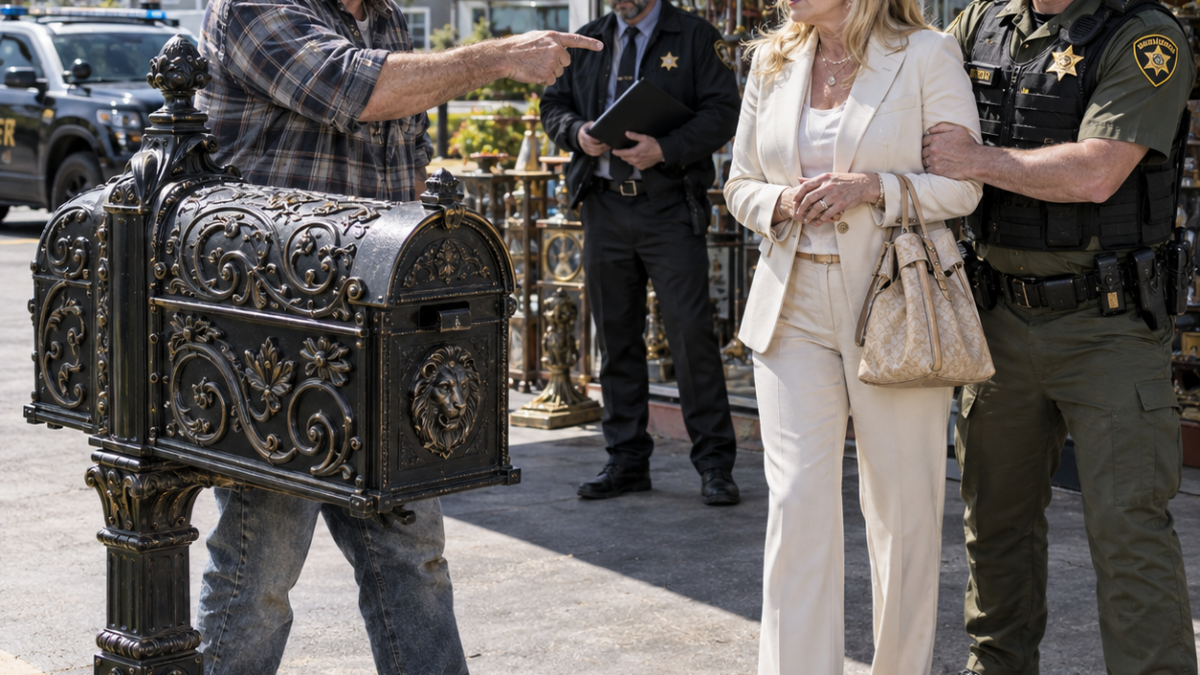
At 5:42 on Friday morning, I looked through my kitchen window and saw a jagged hole where the $2,800 mailbox I had forged with my own hands had stood the night before.
The woman who had threatened to remove it had left an HOA violation notice planted in the broken concrete like a flag of victory.
What she didn’t know was that somewhere on our quiet street, one overlooked detail had recorded far more than she ever intended anyone to see.
I stood there barefoot, one hand wrapped around a coffee mug I had forgotten to drink from.
For several seconds, my mind refused to accept what my eyes were telling me.
The mailbox was gone.
Not damaged.
Not knocked sideways.
Gone.
The concrete footing had been smashed apart. Fresh chunks lay scattered across the grass. Scrape marks ran from the curb toward the street.
And in the middle of the destruction, somebody had pushed a white HOA notice into the dirt.
I stepped outside.
Sarah came to the doorway behind me.
“Jack?”
I didn’t answer.
The morning air smelled like wet grass and broken concrete.
I crouched beside the hole and picked up the notice.
PROPERTY REMOVED FOR NONCOMPLIANCE.
My jaw tightened.
Three days earlier, Karen Miller, president of the Oak Haven Estates HOA, had stood on this exact patch of lawn and pointed at my mailbox as if it were radioactive.
“That thing is coming down,” she’d said.
I had reminded her that the previous architectural review committee had approved it unanimously.
I had the signed letter.
The drawings.
The dates.
Everything.
Karen hadn’t cared.
“That committee no longer exists.”
“The approval existed when they signed it.”
“I decide what is compliant now.”
“No, Karen. The bylaws decide.”
That was when her face changed.
She hated hearing that.
People like Karen loved rules right up until the rules limited them.
She stepped closer.
“Friday, Mr. Henderson. Remove it yourself, or the association will handle it.”
I looked her directly in the eye.
“If anyone touches that mailbox without my permission, I’m calling the sheriff.”
She gave me a thin smile.
“You really do enjoy making things difficult.”
Then she climbed into her golf cart and drove away.
Now it was Friday.
And the mailbox was gone.
It wasn’t some twenty-dollar metal box from a hardware store.
I was a blacksmith.
I had spent more than a hundred hours making that piece.
The pedestal was forged from heavy steel and textured by hand to resemble oak bark. Iron vines climbed around the post. Every leaf and acorn had been heated, hammered, shaped, and welded individually.
The postal flag was a maple leaf I had forged from steel and finished by hand.
The completed piece weighed more than two hundred pounds.
A professional appraisal valued it at $2,800.
But that number still didn’t explain what Karen had taken.
I had served twenty-two years in the Army Corps of Engineers.
After retirement, I struggled more than I admitted.
In the Army, every day had structure.
A mission.
A purpose.
Then suddenly there was silence.
My grandfather’s old forge became the place where I learned how to live inside that silence.
He had been a blacksmith.
His father had been one too.
The first time I heated a piece of steel in his old coal forge and brought a hammer down against his anvil, something in me settled.
Blacksmithing became more than work.
It became the bridge between the man I had been and the man I was trying to become.
That mailbox had been one of the finest things I had ever made.
And Karen had torn it out of the earth because she wanted to prove she could.
Sarah walked down the driveway and stopped beside me.
“Call the police.”
“I am.”
“You think she actually did this?”
I looked at the violation notice.
“She threatened to.”
Fifteen minutes later, Deputy Miller was standing beside the hole.
I handed him my appraisal, the architectural approval, photographs, and Karen’s written notices.
He studied everything.
“Do you have video?”
“My cameras don’t cover the curb.”
His expression told me what came next.
Without evidence showing who had removed it, Karen could claim this was an HOA enforcement dispute instead of theft.
He went down the street to speak with her.
I stood watching him leave.
Then I looked across the road.
At Dave’s house.
Dave worked from home in network security.
A month earlier, he’d shown me the expensive wide-angle camera system he’d installed after somebody kept damaging neighborhood Halloween decorations.
One of his cameras faced directly toward my side of the street.
I crossed the road and knocked.
Dave opened the door in sweatpants.
“What happened?”
“Someone stole my mailbox.”
His eyes widened.
“The iron one?”
“Yeah.”
I pointed toward the camera above his garage.
“I need to see what that recorded last night.”
Ten minutes later, we were sitting inside his home office.
Dave dragged the security timeline backward.
2:47 a.m.
Nothing.
3:02.
Empty street.
3:11.
Still nothing.
Then the timestamp reached 3:14 a.m.
Headlights appeared at the far edge of the screen.
Dave stopped breathing for a second.
I leaned toward the monitor.
And a large white SUV slowly rolled into view.
PART 2
The white SUV stopped directly in front of my property.
Dave froze the footage.
Neither of us spoke.
I already knew the vehicle.
There are some things your mind recognizes before you consciously admit them.
The shape.
The chrome trim.
The oversized wheels.
The distinctive rear window.
Karen Miller drove a white Cadillac Escalade.
Dave looked at me.
“Jack…”
“Keep playing it.”
He clicked the mouse.
The video moved again.
The driver’s door stayed closed.
Two men climbed from the passenger side.
Both wore dark hoodies.
One carried a sledgehammer.
The other carried a long pry bar.
Whatever tiny part of me had still hoped this might be some bizarre misunderstanding disappeared.
They walked directly toward my mailbox.
No hesitation.
No discussion.
They knew exactly where they were going.
One of them swung the sledgehammer.
Even though the camera had no useful audio from that distance, I could almost hear the impact in my head.
The concrete fractured.
He swung again.
Then again.
I had poured that footing myself.
I’d mixed the concrete, set the reinforcement, checked the depth twice.
It had been designed to last decades.
Watching two strangers deliberately smash it apart felt strangely personal.
The second man shoved the pry bar beneath the iron base.
For almost ten minutes they worked.
Hammer.
Pry.
Pull.
Hammer again.
Eventually the base shifted.
The entire structure leaned.
I gripped the edge of Dave’s desk.
They rocked it back and forth until the remaining concrete cracked.
Then the mailbox came free.
My mailbox.
Two hundred pounds of steel.
A hundred hours of work.
Years of accumulated skill.
Part of my grandfather’s legacy.
They dragged it toward the SUV.
Then the driver’s door opened.
Karen stepped out.
There was no question.
The camera wasn’t close enough for facial detail, but she didn’t need a face.
I recognized the floral housecoat.
The posture.
The short, impatient movements of her hands.
Most of all, I recognized the way she walked.
Karen hurried around the back of the Escalade and began directing the men.
She pointed.
They adjusted the mailbox.
She waved angrily.
They lifted again.
At one point one man nearly dropped the pedestal and Karen jumped backward.
Dave paused the footage.
“That’s her.”
“Yeah.”
“You’ve got her.”
I stared at the frozen image.
Karen stood beside my stolen property with one hand raised like a conductor leading an orchestra.
Three days earlier she’d told me she had the authority to remove it.
Now I had video of her personally supervising the job at 3:14 in the morning.
Not during business hours.
Not with a marked HOA contractor.
Not with a work order.
Not with notice from a legitimate removal company.
In darkness.
With hooded men.
And a private SUV.
“Copy everything,” I said.
Dave glanced at me.
“Already doing it.”
He transferred the original footage to two drives.
I asked him to keep the original system file untouched.
Years in engineering had taught me something people underestimate.
Evidence isn’t useful because you possess it.
Evidence is useful because you can establish what it is, where it came from, and whether anyone altered it.
When Deputy Miller came back from Karen’s house, he wore the tired expression of a man who thought he’d just been assigned another neighborhood argument.
“Mrs. Miller says the HOA authorized removal by a maintenance contractor.”
“Did she tell you where my property is?”
“She said it’s being held at an off-site facility.”
“What contractor?”
“She didn’t give me a name.”
“What facility?”
“She says you’ll receive that information after paying the removal and storage charges.”
I almost laughed.
Instead, I held up the flash drive.
“She’s lying.”
Miller’s expression changed slightly.
“What is that?”
“Video.”
I told him what we’d found.
This time, he didn’t sigh.
He didn’t mention civil court.
He followed me into my house, where I plugged the drive into the laptop.
Sarah stood behind us with her arms folded tightly across her chest.
We watched the entire recording.
When Karen appeared, Miller leaned forward.
“Can you send me a copy?”
“I can give you this drive.”
“I’ll need Dave’s information too. We’ll want the original footage preserved.”
“Already handled.”
He looked at me differently after that.
Not impressed exactly.
More alert.
“Do not confront her.”
“I wasn’t planning to.”
“Mr. Henderson, I mean it. If this becomes criminal, don’t give anybody a reason to turn it into a mutual dispute.”
“I understand.”
He took the drive.
At the door, he turned around.
“That appraisal really says twenty-eight hundred?”
“Yes.”
“Then depending on state thresholds and what investigators confirm, this may be well beyond a simple property complaint.”
After he left, Sarah stood silently beside the window.
The hole remained visible from the kitchen.
She touched my arm.
“Are you okay?”
“No.”
It was the truth.
I wasn’t.
Anger I could handle.
I’d lived around anger.
I’d seen what uncontrolled anger did to people.
What bothered me was the violation.
I kept picturing Karen standing in darkness while strangers smashed apart something I’d created.
The mailbox hadn’t belonged to some faceless HOA.
It hadn’t been common property.
It was mine.
She knew it.
And she’d done it anyway.
Sarah said, “You can’t let this consume you.”
“I’m not.”
She gave me the look spouses develop after enough years together—the look that says they know when you’re lying even if you technically believe yourself.
“What are you going to do?”
I stared at Karen’s violation notice on the kitchen table.
“I’m going to document everything.”
That might not have sounded dramatic.
But documentation was where Karen had made her first serious mistake.
She thought paperwork belonged to people in authority.
She didn’t understand that paperwork was also how ordinary people proved when authority was being abused.
By noon I had built an evidence binder.
Original architectural application.
Approved drawings.
Signed approval letter.
Appraisal.
Photos before the theft.
Photos after.
Karen’s violation notices.
Deputy Miller’s incident number.
A written timeline of every interaction I could remember.
I recorded dates.
Times.
Exact phrases when I could recall them.
Sarah watched me organize the tabs.
“You look like you’re preparing a mission briefing.”
“In a way, I am.”
“Against a homeowners association?”
“Against bad documentation.”
That made her smile despite herself.
For the first time that morning, I smiled too.
Then the certified mail arrived.
The envelope carried the Oak Haven Estates logo.
Inside was an invoice.
REMOVAL FEE: $500.
STORAGE AND ADMINISTRATIVE FEE: $250.
NONCOMPLIANCE PENALTY: $500.
TOTAL DUE: $1,250.
The letter claimed that my mailbox was being stored at an “authorized association facility” and would be returned once all outstanding charges were paid.
No facility address.
No contractor.
No inventory receipt.
No photograph.
No legal authority for the seizure.
Signed:
Karen Miller,
President.
I read it twice.
Then I handed it to Sarah.
She stared at the amount.
“She steals your mailbox and charges you to get it back?”
“Apparently.”
“Can they even do that?”
“I’ll find out.”
The next morning another notice arrived.
This one cited me for “failure to maintain the front easement area in an orderly condition.”
The violation?
The hole where Karen had removed my mailbox.
One hundred dollars per day until corrected.
I actually laughed this time.
Sarah didn’t.
“This isn’t funny.”
“No.”
“Then why are you laughing?”
“Because she’s panicking.”
“How can you tell?”
“She’s creating paper faster than she can think.”
I added both notices to the binder.
Then I called a lawyer.
His name was Benjamin Carter, but everyone called him Ben.
We’d met through a veterans’ business group after I started Henderson Ironworks.
Ben had served in the Army before law school, and he understood something I valued immediately: discipline.
He didn’t confuse outrage with strategy.
I spread the documents across his conference table.
He read silently for nearly twenty minutes.
Then he leaned back.
“This is unusually stupid.”
“That’s your professional analysis?”
“Initial impression.”
He picked up Karen’s storage letter.
“She’s claiming the association lawfully removed your personal property.”
“Correct.”
“But you have video of her taking it in her own vehicle in the middle of the night.”
“Correct.”
“And no contractor appears.”
“No.”
“Do you know where the mailbox is?”
“No.”
Ben tapped the paper.
“Good.”
I frowned.
“Good?”
“Good for your case. Bad for your mailbox.”
He turned serious.
“Jack, listen to me. Don’t threaten her. Don’t post the footage online. Don’t go onto her property. Don’t give her warning about exactly what you have.”
“I wasn’t going to.”
“Excellent. Let law enforcement investigate. We will deal with the civil side separately.”
“What can we do?”
“A lot, potentially. But first I want the governing documents.”
I slid the bylaws toward him.
His eyebrows rose.
“You brought the whole thing?”
“I read the whole thing last night.”
Ben grinned.
“I remember why I like working with engineers.”
For the next hour we went through the HOA rules.
Karen had presented herself as if the HOA presidency made her monarch.
It didn’t.
The president could not unilaterally eliminate the architectural committee.
Board action required votes.
Certain decisions required notice.
Fines required procedures.
Owners had hearing rights.
Major enforcement actions had to be documented.
Nothing authorized Karen to personally seize property in darkness.
Then I found the recall provision.
Twenty-five percent of homeowners could force a special meeting.
Oak Haven Estates had two hundred voting households.
Fifty signatures.
Ben marked the paragraph.
“Do not start this yet.”
“Why?”
“Because if you’re going to do it, do it correctly.”
That afternoon Detective Wallace called.
He was older than Deputy Miller and spoke carefully.
No wasted words.
“I’ve been assigned your case.”
“All right.”
“I reviewed the neighborhood footage.”
“And?”
“It is useful.”
Useful.
Investigators loved words that revealed nothing.
He continued.
“We need to identify the two men and locate the property.”
“Karen told Miller it was at an HOA facility.”
“We’re aware.”
“Do you believe her?”
“I’m not going to discuss investigative conclusions over the phone.”
Fair enough.
“What do you need from me?”
“A formal statement. Your appraisal. Original approval documents. Any photographs proving identifying details of the property.”
“I have all of it.”
“Good.”
The following morning I met him at the sheriff’s office.
Wallace spent almost two hours walking through the timeline.
He asked questions that initially seemed repetitive.
Had Karen touched the mailbox during the confrontation?
Did she explicitly say she would personally remove it?
Did she say the HOA would remove it?
Had I received any formal hearing notice?
Had any contractor contacted me?
Did the mailbox sit entirely within my parcel?
Did postal rules create any issue?
Was it fixed permanently?
Who had appraised it?
Could I prove I made it?
Did it have unique marks?
That last question made me pause.
“Yes.”
“What kind?”
I pulled up an old photo on my phone.
Near the back of every commissioned piece I forged, I stamped a small maker’s mark.
An H inside a horseshoe.
My grandfather had used a similar mark.
Mine was slightly different.
I enlarged the photograph.
“There.”
Wallace studied it.
“That helps.”
When I left, I felt better.
Not because I knew what would happen.
Because someone was finally treating what Karen had done as something more serious than an HOA disagreement.
But the mailbox was still missing.
And Oak Haven was still living under Karen.
That part became clearer when I visited George.
George Whitaker had chaired the old architectural review committee.
Retired architect.
Seventy-one.
Thin white hair.
Always wore a collared shirt, even when gardening.
He opened his door and looked immediately at the empty spot beside my driveway.
“I heard.”
“Can I talk to you?”
He brought me inside.
His wife poured coffee.
I showed him Karen’s notices.
Then the video.
George watched without speaking.
When Karen stepped from the Escalade, he whispered one word.
“Unbelievable.”
When it ended, he removed his glasses.
“She did this?”
“Looks that way.”
“Jack, she told everyone the HOA had hired a contractor.”
“I know.”
George’s hands shook slightly as he placed his glasses on the table.
“You know why the architectural committee disappeared?”
“Karen said she dissolved it.”
George laughed without humor.
“She couldn’t dissolve it.”
“That’s what the bylaws say.”
“She intimidated it.”
I waited.
George stared down at his coffee.
“After she became president, she started reversing decisions she didn’t like. I objected. She told the other members that if a homeowner sued over an approval, the association might not protect them personally.”
“Was that true?”
“No. At least not the way she presented it. But she scared them.”
“The other members resigned?”
“Within two weeks.”
“And you?”
“I refused.”
“What happened?”
“Karen announced there was no longer a functioning committee. Then she began making architectural decisions herself.”
“Would you put that in writing?”
George looked up.
“Yes.”
That was the moment my objective changed.
Until then, I wanted my mailbox back.
I wanted Karen charged if investigators concluded she’d stolen it.
I wanted the fines withdrawn.
But George’s story made me realize the mailbox wasn’t an isolated act.
It was an escalation.
Karen had been accumulating power because nobody wanted the headache of fighting her.
One resident gave up.
Then another.
Then another.
Eventually Karen stopped distinguishing between authority and personal preference.
I asked George one more question.
“Who else has she done this to?”
He gave me a sad smile.
“How much time do you have?”
The first person he sent me to was Melissa Grant.
Young mother.
Two children.
Her violation notice concerned sidewalk chalk.
I thought George was exaggerating.
He wasn’t.
Melissa showed me the letter.
Her children had drawn flowers, stars, and a giant blue whale on the sidewalk in front of their home.
Karen classified it as “unauthorized exterior markings visible from common areas.”
Fifty-dollar fine.
Melissa had washed the drawings away.
“My daughter cried,” she said.
“How old?”
“Seven.”
“Did you challenge the fine?”
“I tried. Karen told me the board had more important things to do than hold hearings for every homeowner who didn’t like the rules.”
The bylaws guaranteed a hearing.
I wrote it down.
Next came Robert Ellis.
Seventy-eight.
Widower.
Fixed income.
Karen had threatened a lien over repeated fines related to his front-door mat.
Dark green instead of “approved earth tone.”
I stared at the notice.
“Green isn’t an earth tone?”
Robert shrugged.
“Apparently not Karen’s shade of earth.”
Then the Parkers.
They had been ordered to remove twelve mature rose bushes because the variety wasn’t on the landscaping schedule.
The roses had been planted by Mrs. Parker’s mother before she died.
They complied because hiring a lawyer cost more than replacing the plants.
At every house, I heard a different story.
Trash cans visible for forty minutes too long.
Basketball hoop allegedly three inches outside the approved setback.
Holiday lights removed one day late.
A child’s bicycle beside a garage.
A flagpole one inch taller than the stated maximum.
That last one belonged to Marcus Reed.
Retired Marine Master Sergeant.
Marcus had the kind of presence that made people unconsciously stand straighter.
He listened while I explained what happened.
I laid the binder on his dining room table.
He opened it.
Read.
Watched the video.
Then he sat back.
“How many signatures?”
I hadn’t mentioned the recall yet.
I smiled.
“You’ve read the bylaws.”
“I read everything before I sign it.”
“Fifty.”
“How many do you have?”
“None yet.”
Marcus folded his arms.
“Then why are you sitting here?”
Because Ben told me not to move until the petition language was correct.
That night Ben finalized it.
The petition wasn’t emotional.
That mattered.
We didn’t call Karen a tyrant.
We didn’t call her corrupt.
We didn’t mention crimes that hadn’t yet resulted in charges.
We cited specific governance failures.
Improper dissolution of the ARC.
Denial of required homeowner hearings.
Unauthorized enforcement actions.
Excessive unilateral control.
Conduct that exposed the association to legal risk.
The next morning Marcus and I started collecting signatures.
We needed fifty.
By dinner, we had thirty-seven.
At 8:14 p.m., Marcus called.
“Check your porch.”
I opened the door.
A folder sat on the mat.
Inside were twenty-three additional signatures.
I called him back.
“Where did these come from?”
“People talk.”
“We only needed thirteen more.”
“I know.”
“You got twenty-three.”
“You complaining?”
“No.”
“Good. Get some sleep.”
I didn’t.
One question kept bothering me.
Where was the mailbox?
Karen claimed it was in storage.
Wallace wasn’t telling me what investigators had found.
Maybe they hadn’t found anything.
I kept imagining my work sitting outside in the rain.
Or dumped behind a warehouse.
Or already cut into scrap.
That possibility hurt more than I expected.
Sarah found me in the workshop after midnight.
I was sitting beside my grandfather’s anvil.
The forge was cold.
She leaned against the door.
“You haven’t made anything since it happened.”
“I’ve been busy.”
“That’s not why.”
She was right.
I looked around the barn.
Finished railing sections leaned against one wall.
A gate commission waited on another bench.
Tools hung in their places.
Everything was exactly where it belonged.
But I hadn’t lit the forge.
“What if she destroyed it?”
Sarah walked closer.
“It’s metal.”
“It’s not just metal.”
“I know.”
“No, I mean…”
My voice caught unexpectedly.
I stared at my hands.
“I made that after Dad’s anniversary.”
She sat beside me.
I hadn’t talked about that.
Not even with her.
The mailbox wasn’t originally intended for our house.
A client had commissioned a large decorative installation, then canceled after the first phase.
I kept working anyway.
That week marked ten years since my grandfather had died.
So I turned the design into something for us.
I used some of his old techniques.
His hammer.
His leaf pattern.
His way of tapering the iron.
Every strike felt like a conversation I hadn’t been able to have while he was alive.
Sarah put her hand over mine.
“If it’s gone, what she did doesn’t erase what it meant.”
“I know.”
“But you want it back.”
“Yes.”
“Then find it.”
That was Sarah.
No speeches.
Just the next step.
The following morning I made a list.
Pawn shops.
Scrap yards.
Metal recyclers.
Antique stores.
Architectural salvage businesses.
Anyone within fifty miles who might encounter a two-hundred-pound piece of decorative iron.
I called almost one hundred businesses.
By early afternoon, I was sick of hearing my own description.
“Custom wrought-iron mailbox, oak leaves, acorns, heavy pedestal, maker’s mark…”
No.
No.
No.
Never seen it.
One scrap yard manager told me he’d remember a piece that unusual.
Another said their intake cameras would have caught it.
Nothing.
By the end of the day Sarah found me staring at the phone.
“How many?”
“Ninety-two.”
“And?”
“Nothing.”
“Then you’ve done what you can.”
“Not yet.”
“Jack.”
“People don’t pay attention on phone calls.”
“What are you saying?”
“I’m going in person.”
She rubbed her forehead.
“Of course you are.”
I printed a large color photograph.
The next morning I drove.
First shop.
Nothing.
Second.
Nothing.
Third.
A teenager behind the counter glanced at the picture for half a second.
“Nope.”
Fourth.
Fifth.
Sixth.
At the eleventh shop I nearly stopped.
My back hurt.
My coffee was cold.
I was angry all over again.
Then I drove to one more location on the far side of the county.
Cash Converters sat between a discount mattress store and a tax preparation office.
The bell above the door gave a tired jingle when I walked inside.
Glass cases displayed watches, tools, game consoles, guitars, jewelry.
Behind the counter sat a man in his late sixties wearing a magnifying loupe around his neck.
I placed the photograph in front of him.
“I’m looking for this.”
He barely glanced at me.
“When?”
“Last Friday.”
He picked up the photograph.
His eyes narrowed.
“Who made it?”
“I did.”
“Good work.”
“Thank you.”
He studied the leaf pattern.
Then he looked up.
“Was the top still attached?”
My entire body went still.
“What?”
“The box part.”
I stepped closer.
“Why are you asking?”
He pointed to the picture.
“Had a woman bring in something like this.”
My heartbeat thudded against my ribs.
“When?”
“Friday.”
“What time?”
“Late morning. Maybe eleven.”
“What did she look like?”
He described Karen before I said a word.
Heavyset.
Sixties.
Short blond-gray hair.
Expensive purse.
Loud jewelry.
Drove a white SUV.
My throat went dry.
“What did she bring?”
“Decorative iron base. Leaves. Acorns. Looked like this.”
He tapped the photograph.
“But she’d cut the mailbox off.”
For a second I couldn’t speak.
“Cut it?”
“Fresh grinder marks.”
The room seemed smaller.
I pictured sparks.
A cutting wheel biting through steel I’d shaped by hand.
The pawnbroker continued.
“She called it a garden sculpture.”
“Did you buy it?”
He barked out a laugh.
“No.”
“Why?”
“Because I’m old, not stupid.”
He leaned against the counter.
“First problem, she wanted three thousand dollars. Second problem, nobody inherits a garden sculpture with fresh grinding marks and concrete dust stuck to the bottom.”
“What did you offer?”
“Two hundred.”
“For scrap?”
“Pretty much.”
“How’d she react?”
“Called me a thief.”
Despite everything, I almost laughed.
“Of course she did.”
“Your woman?”
“HOA president.”
He blinked.
“That’s new.”
I showed him Detective Wallace’s card.
“I’m working with the sheriff’s department. Is there surveillance video?”
He pointed upward.
Black camera dome.
“State regulations require us to record. Counter has audio too.”
My pulse jumped.
“Can I get a copy?”
“No.”
My disappointment must have shown.
He held up a hand.
“I can’t give it to you. Police can request it.”
“How long do you keep recordings?”
“Thirty days.”
“Can you preserve Friday around eleven?”
He studied Wallace’s card.
Then me.
“I don’t like people bringing stolen property into my store.”
“So that’s a yes?”
“Tell your detective I’ll have it ready.”
I called Wallace from the parking lot.
He answered on the third ring.
“Wallace.”
“I found the mailbox.”
“Where?”
“Not physically. But I found where Karen tried to sell it.”
Silence.
“Start from the beginning.”
I told him everything.
When I reached the part about recorded audio and video, Wallace interrupted.
“Do not go back inside.”
“I’m already outside.”
“Good. Don’t contact Miller. Don’t tell anyone publicly.”
“I understand.”
“What’s the business?”
I gave him the name and address.
“We’ll handle it.”
“Detective…”
“Yes?”
“She cut the top off.”
Another pause.
“I’m sorry.”
That was the first moment Wallace sounded less like an investigator and more like a person.
“I want it back.”
“We’ll do what we can.”
Two days later he called again.
“Mr. Henderson, I can’t discuss everything, but I can tell you the video is excellent.”
“Excellent how?”
“Clear face. Clear audio. Clear view of the property.”
“What does she say?”
“You’ll hear it eventually.”
“Detective.”
He exhaled.
“She claims it’s an inherited garden sculpture. She asks three thousand dollars. The owner questions the fresh cuts. She gets angry and leaves.”
“So now what?”
“Now we keep working.”
The recall meeting was scheduled for two weeks later.
Karen received the petition on a Monday.
By Tuesday morning, every homeowner in Oak Haven received a mass email.
The subject line read:
DEFENDING OUR COMMUNITY FROM HARASSMENT.
Karen portrayed herself as a dedicated volunteer being targeted by “a small faction of hostile residents.”
She claimed some homeowners were angry because she refused to grant them “special privileges.”
She never named me directly.
She didn’t need to.
Everyone knew.
She described my mailbox as “an unapproved exterior fixture.”
That lie irritated me more than the insults.
She had the approval in her own records.
Then came the phrase that changed public opinion faster than anything I could have written.
“We must not allow intimidation by aggressive individuals to undermine neighborhood harmony.”
Aggressive individuals.
Marcus called me.
“You see the email?”
“Yes.”
“Don’t answer.”
“I wasn’t going to.”
“Good.”
Five minutes later Melissa texted.
Then George.
Then Robert.
Then people I barely knew.
Karen’s email had done what our petition hadn’t.
It made residents angry.
Not because she attacked me.
Because they recognized themselves in her description of troublemakers.
Every person who had ever questioned a fine was suddenly part of “a hostile faction.”
That Saturday more than forty residents gathered at Marcus’s house.
We didn’t plan a rally.
They simply came.
Some brought notices.
Some brought photographs.
One woman brought a binder thicker than mine.
She’d spent four years documenting inconsistent HOA enforcement.
Her neighbor received permission for a shed identical to the one Karen had denied her.
A man named Luis showed us emails where Karen ordered him to repaint his garage before his appeal deadline expired.
Another homeowner had paid hundreds of dollars in fines because he didn’t understand he had the right to challenge them.
The meeting became something bigger.
Not revenge.
Recognition.
People who had believed they were individually powerless discovered they had all been dealing with the same pattern.
I stood near Marcus’s fireplace listening.
Sarah came beside me.
“You started something.”
“No.”
“You did.”
“Karen started it.”
Sarah smiled.
“That’s probably more accurate.”
The day before the special meeting, Ben came to our house.
He carried a yellow legal pad.
“Police update?”
“Wallace isn’t telling me much.”
“That’s normal.”
“Pawn footage is confirmed.”
“Good.”
Ben flipped a page.
“Here’s what happens tomorrow. You present governance issues. Facts only.”
“I want to show the videos.”
He looked at me.
“Do you have permission?”
“Dave gave me permission for his footage.”
“The pawn footage?”
I hesitated.
“Wallace sent me a copy yesterday marked for evidentiary preservation. He said he couldn’t advise me what to do with it.”
Ben rubbed his chin.
“Then I can advise you.”
“And?”
“Do not jeopardize an investigation for theater.”
That disappointed me.
Ben saw it.
“Jack, your goal is accountability, not applause.”
“You’re right.”
“I usually am. Ask my wife.”
“So I don’t show the pawn video.”
“Not unless we’re confident it’s appropriate.”
“What about Dave’s?”
“That one belongs to a private homeowner who authorized use. Different issue.”
Ben paused.
“Although…”
“What?”
He checked his phone.
“Call Wallace.”
I frowned.
“Now?”
“Now.”
Wallace answered.
Ben identified himself.
The conversation lasted less than two minutes.
Ben listened more than he spoke.
Then he ended the call.
“What?”
His expression had changed.
“Interesting timing.”
“Ben.”
“The prosecutor authorized law enforcement to proceed with an arrest warrant.”
My stomach tightened.
“When?”
“Wallace wouldn’t say.”
“Tomorrow?”
“He wouldn’t say.”
I looked at him.
Ben smiled slightly.
“But he asked what time the HOA meeting starts.”
Tuesday evening, the Oak Haven clubhouse was packed.
Every folding chair was occupied.
Residents stood against the walls.
Cars lined both sides of the road outside.
Karen sat at the board table wearing a navy blazer and pearls.
She looked composed.
Almost cheerful.
Barry, the HOA secretary, sat beside her looking as though he wanted to disappear into the carpet.
The third board member, Linda, kept rearranging papers.
Marcus sat to my right.
George to my left.
Sarah behind me.
Ben sat farther back.
Karen struck the table with the gavel.
“Let’s come to order.”
The room gradually quieted.
She began with a twenty-minute speech.
Community standards.
Volunteer sacrifice.
Respect.
Civility.
Property values.
Shared responsibility.
It would have sounded reasonable if you didn’t know the woman giving it had supervised the destruction of private property at three in the morning.
Finally, she said, “We have been forced to hold this meeting due to a petition submitted by certain residents.”
Murmurs.
Karen smiled tightly.
“Before the recall vote, I will generously allow the primary complainant an opportunity to speak.”
Generously.
I stood.
She gestured toward the front.
“Mr. Henderson.”
I carried my laptop to the podium.
Karen watched me plug it into the projector.
Her confidence flickered.
Just once.
Then returned.
I faced the room.
“My name is Jack Henderson. Most of you know why we’re here.”
Someone shouted, “Because we’re tired of Karen!”
Laughter rolled through the room.
I waited.
“This isn’t about personalities.”
Karen smirked.
I continued.
“It’s about whether our association follows its own rules.”
The smirk faded.
I walked through the evidence.
The original ARC.
My application.
The unanimous approval.
Karen’s unilateral attempt to void it.
George stood and confirmed how the ARC members had been pressured.
Melissa described the sidewalk chalk fine.
Robert described the welcome mat.
The Parkers described the roses.
Each person spoke briefly.
No shouting.
No exaggeration.
Just documents.
Karen interrupted constantly.
“That is out of context.”
“That homeowner was warned.”
“Completely false.”
“The board has discretion.”
Each interruption made things worse.
Because each time Ben quietly pointed to the relevant bylaw.
Eventually Karen snapped.
“This meeting is about Mr. Henderson’s vendetta, not every petty complaint people have collected for years.”
The room went quiet.
I looked at her.
“Fine.”
I clicked the laptop.
A photograph of my mailbox filled the screen.
“You told residents my mailbox was never approved.”
“It did not conform.”
“That’s not what I asked.”
“I determine compliance.”
“No. The governing documents determine compliance.”
She grabbed the gavel.
“Mr. Henderson—”
I put the approval letter on the screen.
Three signatures.
Date.
Design attached.
“This was the valid approval.”
Karen’s face reddened.
“The former committee was incompetent.”
“That’s your opinion.”
“It was dissolved.”
“Improperly.”
“By board authority.”
“Show us the vote.”
Silence.
“Show us the minutes authorizing dissolution.”
More silence.
“Show us any document.”
Karen slammed the gavel.
“You do not interrogate the president.”
A voice from the back answered.
“We’re about to vote whether you are the president.”
Applause broke out.
Karen’s face tightened.
I raised one hand.
The room settled.
“Karen also told the sheriff’s department and this community that my mailbox was removed by an authorized maintenance contractor.”
“Correct.”
“So I’m going to show everyone what actually happened.”
I played Dave’s video.
3:14 a.m.
White Escalade.
Two hooded men.
Sledgehammer.
Pry bar.
The room became utterly silent.
No coughing.
No whispers.
Nothing.
On the screen, the two men attacked the concrete.
One strike.
Two.
Three.
Then the pedestal moved.
The crowd watched them wrestle my mailbox toward the SUV.
Karen’s real-life face lost color.
Then the driver’s door opened on-screen.
Her recorded figure emerged.
A woman near the aisle gasped.
“Oh my God.”
Someone else whispered, “That’s Karen.”
The video continued.
Karen pointed.
Directed.
Supervised.
Then climbed back behind the wheel.
The Escalade drove away.
When the footage ended, nobody spoke for several seconds.
I faced Karen.
“Where is my mailbox?”
Her mouth opened.
Closed.
Then opened again.
“That video proves nothing.”
People erupted.
“That’s your car!”
“We can see you!”
“You lied!”
Karen struck the gavel repeatedly.
“Order! Order!”
She pointed at me.
“This is manipulated footage!”
Dave stood near the back.
“No, it isn’t.”
Karen looked toward him.
Dave raised one hand.
“That’s my security system. Original footage is preserved. Sheriff’s department has it.”
Karen stared.
Her breathing became visibly faster.
“This is harassment.”
I said, “Where is my mailbox?”
“You were given written notice.”
“Where is it?”
“At a storage facility.”
“What facility?”
“That information is administrative.”
“You charged me seven hundred fifty dollars for removal and storage. What company performed the work?”
Karen stood.
“I’m not going to be cross-examined by a disgruntled homeowner.”
“Then answer one simple question.”
She glared.
“Where is the mailbox?”
The room waited.
She couldn’t answer.
Because by then I knew the truth.
She hadn’t stored it.
She’d altered it.
And tried to sell it.
I looked toward Ben.
He gave me the smallest nod.
I opened another file.
Karen saw the new image before anyone else did.
Her knees seemed to soften.
The screen displayed a still frame from the pawn shop.
There she was.
Clear daylight.
Clear face.
And beside her sat the mutilated base of my mailbox.
Gasps rolled through the clubhouse.
Karen grabbed the edge of the table.
I didn’t play the audio.
I didn’t need to.
I simply said, “Later that morning, this image was recorded at a pawn shop across the county.”
“No.”
Karen’s voice barely carried.
I looked at her.
“The shop owner identified you.”
“He’s lying.”
“The surveillance has audio.”
Her eyes snapped toward me.
“He recorded the entire conversation.”
For the first time since I’d met Karen Miller, she had nothing to say.
No bylaw.
No insult.
No threat.
No fine.
No speech about property values.
Nothing.
Just fear.
Then the clubhouse doors opened.
Every head turned.
Detective Wallace entered with Deputy Miller.
No dramatic rush.
No shouting.
They simply walked down the center aisle.
Karen backed away from the table.
Wallace stopped in front of her.
“Karen Miller?”
She looked around as though someone else might answer.
“Yes?”
“I’m Detective Wallace with the County Sheriff’s Department.”
He held a folded document.
“We have a warrant for your arrest in connection with the theft and destruction of Mr. Henderson’s property and the attempted disposition of that property.”
Karen shook her head.
“No.”
“Please stand and place your hands behind your back.”
“This is ridiculous.”
“Ma’am.”
“I’m the president of this association.”
No one laughed.
That somehow made the moment harder.
Wallace repeated himself.
“Turn around and place your hands behind your back.”
Karen looked at Barry.
“Do something.”
Barry stared at his papers.
She looked at Linda.
Linda moved her chair farther away.
Then Karen looked at me.
For one instant, everything else disappeared.
The residents.
The officers.
The screen.
The noise.
Just Karen and me.
Her expression contained fury, disbelief, and something deeper.
Humiliation.
“You did this,” she whispered.
I shook my head.
“No, Karen.”
I pointed toward the frozen pawn-shop image.
“You did.”
The handcuffs closed around her wrists.
The sound was quieter than I expected.
A few metallic clicks.
That was all.
After everything—the threats, the fines, the shattered concrete, the forged letters, the late-night theft—the end of Karen’s power sounded like three small clicks.
Deputy Miller began reading her rights.
Karen started crying.
Not quietly.
Not gracefully.
She sobbed and protested as they walked her toward the doors.
“This is a misunderstanding!”
Nobody responded.
“The association authorized everything!”
Barry finally looked up.
“No, we didn’t.”
Karen stopped.
The room went still again.
She turned toward him.
“What?”
Barry swallowed.
“The board never voted to remove that mailbox.”
Karen’s face changed.
“You signed the notice.”
“You told me it had been approved.”
“You knew.”
“No. I didn’t.”
“You coward.”
Wallace gently redirected her toward the exit.
Karen shouted over her shoulder.
“You’re all going to regret this!”
The doors closed.
Silence.
Then Robert Ellis—the seventy-eight-year-old man she’d threatened over a welcome mat—started clapping.
One slow clap.
Then another.
Melissa joined.
Then George.
Then Marcus.
Within seconds the entire clubhouse erupted.
People stood.
Some cheered.
Some hugged.
A few cried.
I didn’t.
I sat beside Sarah and felt something inside me finally loosen.
She took my hand.
“You okay?”
“Ask me tomorrow.”
Marcus stepped to the front.
“We still have business.”
That brought people back.
Karen’s arrest didn’t automatically resolve the HOA governance problem.
Barry, now technically presiding, shakily called for the recall vote.
The petition met every requirement.
Ballots were distributed.
Collected.
Counted twice.
The result was announced.
One hundred thirty-seven votes to remove Karen.
Zero against.
Three abstentions.
Someone asked who the abstentions were.
Barry looked embarrassed.
“I was one.”
The room laughed.
The tension finally broke.
Then came the question none of us had planned.
Who would serve as interim president?
George stood.
“I nominate Jack Henderson.”
I turned so fast my chair scraped the floor.
“No.”
People laughed again.
George ignored me.
“I am serious.”
“George—”
“He read the bylaws when the board wouldn’t. He gathered evidence when the board wouldn’t. He listened to residents when the board wouldn’t.”
I stood.
“I didn’t do this because I wanted the job.”
“Exactly.”
Marcus folded his arms.
“That’s why you should take it.”
I looked at Sarah.
She raised one eyebrow.
That meant I was on my own.
“I run a business.”
“So do half the people here,” Marcus said.
“I’ve never served on an HOA board.”
Robert called from the back.
“Neither had Karen, apparently.”
More laughter.
I tried one last time.
“There has to be somebody more qualified.”
George shook his head.
“Maybe. But right now we need somebody people trust.”
That word stopped me.
Trust.
I’d spent weeks thinking about rules.
Evidence.
Authority.
Procedure.
But rules only worked when people trusted those responsible for applying them.
I looked around.
Neighbors who had barely spoken to one another a month earlier were sitting together.
People who had paid fines in silence were comparing paperwork.
Families who had believed they were isolated now understood they weren’t.
I didn’t want power.
But perhaps power wasn’t the point.
Responsibility was.
“I’ll do it temporarily.”
The room applauded.
“Until we hold a proper election.”
More applause.
Marcus leaned over.
“Congratulations, Mr. President.”
“I hate you.”
“I’ve heard worse.”
My first official action happened twenty minutes later.
I proposed freezing every outstanding violation fine for thirty days while an independent review occurred.
Unanimous.
Second action.
Restore the architectural review committee with five members instead of three, no president allowed to serve as sole reviewer.
Unanimous.
Third.
Commission an independent financial audit.
That vote took longer.
Barry looked nervous.
I noticed.
“So,” I said, “any reason not to audit?”
“No.”
“Barry?”
He adjusted his collar.
“No. It’s just… expensive.”
Ben spoke from the back.
“Potentially less expensive than not auditing.”
Barry nodded quickly.
The measure passed.
As people began leaving, Wallace approached.
“Mr. President.”
“Don’t.”
He smiled.
“Thought you’d like an update.”
That erased my annoyance.
“The mailbox?”
“We recovered it.”
I stared at him.
“Where?”
“Back of her Escalade.”
“You’re serious?”
“Under a tarp in the rear cargo area.”
“She still had it?”
“Apparently the pawn shop was her first attempt to sell it.”
I closed my eyes.
For the first time, I knew it hadn’t been melted down.
Wallace continued.
“The top has been cut away, as you already know. But most of the base is intact.”
“When can I have it?”
“After evidence release.”
“How long?”
“Could be months.”
I nodded.
That hurt, but at least it existed.
“We also identified the two men.”
“Who?”
“Her brother-in-law and his adult son.”
“Did they know they were stealing it?”
“They claim Karen told them it was HOA property being removed under board authorization.”
“Do you believe them?”
Wallace gave me a look.
“I’m not answering that.”
“Right.”
“They’re cooperating.”
“Against her?”
“They gave statements.”
He paused.
“One more thing. The pawn shop footage helped substantially. Without it, her defense could have been that she believed she was carrying out some type of association enforcement. Trying to sell the altered property made that argument considerably harder.”
“So that camera made the difference.”
“It made a big difference.”
I remembered the pawnbroker telling me he didn’t like thieves.
One camera.
One recorded conversation.
One decision to preserve the footage.
Sometimes justice didn’t arrive like thunder.
Sometimes it sat quietly in the corner of a pawn shop recording everything.
The next month changed Oak Haven more than the previous five years.
We reviewed every open violation.
Most disappeared.
Some were legitimate.
I made sure those stayed.
That surprised people.
A neighbor whose fence violated a drainage easement expected me to waive it because he’d signed the recall petition.
I didn’t.
He was angry.
I showed him the survey.
“The rule is valid.”
“But Karen used rules against everyone.”
“Then we apply them correctly.”
“So you’re taking her side?”
“No. I’m taking the document’s side.”
He stared at me.
Then sighed.
“Fair enough.”
That mattered.
If I used the presidency to reward allies and punish enemies, I’d become a cleaner version of Karen.
That wasn’t reform.
That was succession.
We created written appeal procedures.
Published meeting minutes.
Posted financial statements.
Required board votes for enforcement changes.
Recorded architectural decisions.
No secret rules.
No verbal exceptions.
No disappearing committees.
People began attending meetings even when nothing dramatic happened.
Children drew chalk animals on the sidewalks again.
Melissa sent me a photo of her daughter kneeling beside a giant purple dragon.
Caption:
AUTHORIZED BY THE NEW TYRANT.
I laughed so hard Sarah came into the room.
“What?”
I showed her.
“Careful,” she said. “Power’s going to your head.”
Then the audit results arrived.
The accountant called an emergency meeting.
Ben attended.
So did Wallace.
That told me immediately this wasn’t ordinary bookkeeping sloppiness.
We gathered around a conference table in the clubhouse.
The auditor laid out several binders.
“Your former president appears to have used association funds for non-association expenses.”
“How much?”
“We’re still reconciling.”
“Ballpark.”
He hesitated.
“Tens of thousands.”
Barry went white.
The records showed salon charges.
Restaurant tabs.
Online purchases.
Clothing.
Fuel.
Hotel expenses.
Karen had categorized some as “community relations.”
Others as “office operations.”
Then came the worse part.
Fine payments had not always entered the main HOA operating account.
Some had been deposited into a separate account.
I stared at the ledger.
“Whose account?”
“We’re determining ownership.”
Wallace leaned forward.
“Send everything through counsel.”
Ben nodded.
The investigation expanded.
The mailbox had opened a door no one knew existed.
Had Karen left it alone, she might have remained HOA president for years.
The audit might never have happened.
The separate account might never have been examined.
Residents might have kept paying bogus fines.
Her mistake wasn’t simply stealing from the wrong homeowner.
Her mistake was believing small abuses stayed small if the person committing them held a title.
They don’t.
They accumulate.
Every shortcut creates a document.
Every lie requires another lie.
Every unauthorized action leaves some footprint.
Eventually the weight becomes too much.
Karen’s criminal attorney tried to negotiate.
I wasn’t involved in those discussions.
Nor did I want to be.
This wasn’t my prosecution.
The state handled that.
My civil case was separate.
Ben filed claims related to the property damage, harassment, and unauthorized enforcement actions.
The HOA’s insurer immediately began asking questions.
I had an uncomfortable moment when I realized that as interim president I was now technically helping administer an association being sued by me.
Ben solved that problem quickly.
I recused myself from every discussion involving my claim.
The remaining board hired independent counsel.
Everything went into the minutes.
Transparency wasn’t convenient.
That was exactly why it mattered.
Three months after Karen’s arrest, the insurer proposed settlement.
Ben called me.
“They’ll pay the appraised value.”
“Twenty-eight hundred?”
“Yes.”
“What about the original piece?”
“You retain ownership when evidence releases.”
“So they’re paying for the damage.”
“Correct. Plus legal expenses and additional compensation related to the improper enforcement campaign.”
I was quiet.
Ben asked, “Problem?”
“It feels strange.”
“What does?”
“Winning money from an HOA I’m currently running.”
“You’re not receiving money from your neighbors as a favor. You’re resolving an insured claim arising from prior conduct.”
“I understand that.”
“Then don’t sabotage your own legitimate claim because the optics make you uncomfortable.”
“Wasn’t planning to.”
“Good.”
The settlement also required the association to formally acknowledge that the original architectural approval had been valid.
That sentence meant more to me than the check.
Karen had spent weeks trying to rewrite history.
The settlement put the truth permanently into the record.
Six months after the theft, her case went to trial.
By then, financial charges had been added based on the audit.
I attended only when requested.
The courtroom felt surprisingly ordinary.
Wood benches.
Fluorescent lights.
Papers shuffling.
A bailiff whispering instructions.
Nothing like the dramatic courtrooms people see on television.
Karen looked smaller.
That was the first thing I noticed.
No HOA table.
No gavel.
No audience she controlled.
No golf cart.
No stack of violation notices.
Just a defendant beside her attorney.
The pawn shop owner testified.
He described Karen arriving with the iron base.
He identified her.
The prosecutor played the video.
I finally heard the entire conversation.
Karen’s voice came through the courtroom speakers.
“It’s an antique garden sculpture.”
The owner asked where it came from.
“My family.”
“What’s it made of?”
“Wrought iron.”
“Why’s the top freshly cut?”
“It was damaged.”
“How much you want?”
“Three thousand.”
He laughed.
Karen became offended.
“You don’t know what this is worth.”
“I know exactly what iron is worth.”
“It’s art.”
“Then take it to an art dealer.”
“I came here because I need this handled quickly.”
That phrase seemed to settle over the courtroom.
Handled quickly.
The prosecutor replayed it.
Then came Dave’s footage.
3:14 a.m.
The Escalade.
The sledgehammer.
The removal.
Karen directing everything.
Her brother-in-law testified next.
He said Karen told them the HOA owned the mailbox and that she had legal authority to remove it.
Then the prosecutor asked:
“If you believed it was HOA property, why was it loaded into Mrs. Miller’s personal vehicle?”
He hesitated.
“She said she’d handle storage.”
“And why did she ask you to help cut the top off?”
The courtroom shifted.
Karen’s attorney objected.
Overruled.
The witness stared at his hands.
“She said it would be easier to sell.”
I watched Karen.
She didn’t look at him.
The verdict came after less than an hour of deliberation.
Guilty on the principal property counts.
The financial charges were supported by the audit and related evidence.
At sentencing, the judge spoke longer than I expected.
He discussed abuse of trust.
Repeated dishonesty.
Attempts to disguise conduct as legitimate authority.
Lack of remorse.
He sentenced Karen to prison time along with restitution and other conditions imposed by the court.
I didn’t celebrate.
That surprised me.
For months I had imagined the moment she would finally face consequences.
I thought I would feel victorious.
Instead, I mostly felt tired.
Outside the courthouse Sarah stood beside me.
“How do you feel?”
“I don’t know.”
“Relieved?”
“Yes.”
“Happy?”
I considered it.
“No.”
She slipped her hand into mine.
“Maybe that’s okay.”
It was.
Justice wasn’t supposed to make me happy about someone else’s ruined life.
It was supposed to stop the harm.
Karen had choices.
She made them.
The consequences belonged to those choices.
A few weeks later, Detective Wallace called.
“Come get your mailbox.”
I was at the sheriff’s evidence facility within an hour.
An employee rolled out a heavy cart.
There it was.
For a moment I couldn’t move.
The lower pedestal remained mostly intact.
Oak leaves.
Acorns.
Vines.
My maker’s mark.
But the upper section had been butchered.
The mailbox body was gone.
Ragged grinder scars cut across the steel.
Concrete still clung to the bottom.
I touched one leaf.
Cold iron.
Sarah stood beside me.
“I’m sorry.”
“So am I.”
Wallace had come down to the evidence area.
“At least most of it survived.”
“Yeah.”
“You going to repair it?”
I didn’t answer.
For several days the damaged piece sat in my workshop.
Every morning I walked past it.
Every evening I looked at it.
I could repair the damage.
Technically.
Cut clean edges.
Forge replacement pieces.
Weld everything.
Grind the seams.
Refinish the surface.
When I was younger, I might have done exactly that.
Restoration as defiance.
But the more I looked at the scars, the less I wanted that piece back at the road.
It had changed.
So had I.
One Saturday morning, I lit the forge.
Sarah heard the blower from the house.
She appeared in the barn doorway carrying coffee.
“You’re working.”
“Yeah.”
“On that?”
“No.”
I pointed toward a stack of new steel.
“I’m making another one.”
She smiled.
“Different?”
“Better.”
For the next six weeks, I built the second mailbox.
I kept the oak theme.
But this time I changed the design.
The original had been about heritage.
The new one would be about survival.
The central post became an oak trunk splitting upward into heavy branches.
I forged individual leaves from steel and copper.
Dozens of them.
Each slightly different.
For the postal flag, I drew something I’d never forged before.
A phoenix.
At first Sarah laughed.
“A phoenix?”
“Too much?”
“Extremely.”
“I like it.”
“I figured.”
The bird became the hardest part.
Wings spread.
Tail feathers curling downward.
Head lifted.
I ruined the first version.
Second looked like an angry chicken.
Sarah walked into the shop, studied it, and tried very hard not to laugh.
“You can say it.”
“It looks…”
“Like a chicken.”
“A heroic chicken.”
I threw a shop rag at her.
The third one worked.
Graceful enough to recognize.
Strong enough to survive weather.
The copper wings caught light differently from the dark iron beneath them.
George came by while I was finishing the mounting plate.
He ran his hand near the leaves without touching.
“This one is better.”
“Don’t let the old mailbox hear you.”
“I’m serious.”
“I know.”
He pointed toward the scarred original.
“What are you doing with that?”
“Not sure.”
“Don’t throw it away.”
“I won’t.”
Installation day became an event without anyone officially organizing it.
Marcus arrived first.
Then George.
Melissa and her children.
Robert.
Dave.
The Parkers.
People brought food.
Someone brought folding chairs.
A cooler appeared.
Sarah accused Marcus.
He denied responsibility badly.
The kids covered the sidewalk with chalk.
Flowers.
Dogs.
Spaceships.
A giant purple dragon.
Nobody fined them.
I dug the footing deeper this time.
Dave stood nearby.
“Expecting another theft?”
“No.”
“Then why so much concrete?”
“I’m an engineer.”
“Fair.”
When we lifted the new mailbox into position, six people helped steady it.
I checked the level.
Adjusted.
Checked again.
Marcus groaned.
“Jack, it’s a mailbox, not a missile silo.”
“Two degrees off becomes noticeable.”
“To who?”
“Me.”
He muttered something about Army people.
I ignored him.
Finally everything was right.
I stepped back.
The phoenix caught the afternoon sunlight.
Copper flashed against black iron.
For the first time in months, the end of my driveway looked complete.
Melissa’s daughter pointed at the bird.
“Why’s it on fire?”
“It’s a phoenix.”
“What’s that?”
“A bird that starts again.”
“After what?”
I looked at the old broken concrete scars still faintly visible near the curb.
“After something bad happens.”
She considered this.
Then nodded seriously.
“Like when I drop my ice cream?”
Marcus nearly choked on his drink.
“Exactly,” I said.
She ran back to her chalk dragon.
Later that evening, after everyone left, I sat on the porch with Sarah.
The street was quiet.
New mailbox at the curb.
Workshop door open in the distance.
She rested her head against my shoulder.
“So what happens now, Mr. President?”
“Election next month.”
“You running?”
“I don’t know.”
She lifted her head.
“Really?”
“I said temporary.”
“You’ve said that for seven months.”
“I have a business.”
“You also redesigned the entire appeal system.”
“That was necessary.”
“And created financial reporting standards.”
“Also necessary.”
“And somehow you enjoy meetings now.”
“That’s defamatory.”
She laughed.
I watched a couple walk past the driveway.
They stopped to admire the mailbox.
The man pointed toward the phoenix.
Then they continued.
“I don’t want to become one of those people who starts thinking the neighborhood belongs to them.”
“Then don’t.”
“Sounds easy when you say it.”
“Power didn’t make Karen who she was.”
I looked at Sarah.
“It revealed what she was willing to do.”
That stayed with me.
I ran in the election.
Not because I wanted the title.
Because I wanted to finish what we’d started.
Three people ran.
I won.
My first full-year budget meeting lasted four hours.
I hated every minute.
That reassured me.
Oak Haven changed slowly.
Not perfectly.
Neighbors still argued.
People still complained about parking.
Someone accused the landscaping committee of favoring hydrangeas.
Two residents nearly declared war over a shared fence.
An HOA couldn’t eliminate disagreement.
It wasn’t supposed to.
Its job was to manage limited shared responsibilities without forgetting that the homes belonged to the people living inside them.
We rewrote sections of the bylaws.
Clear language.
Objective standards.
Written appeals.
Conflict-of-interest disclosures.
No president could sit alone as architectural authority.
Financial statements were posted monthly.
Any major enforcement action required review.
Residents could inspect records.
Meetings had agendas.
Votes were recorded.
Boring?
Absolutely.
Good government usually is.
One evening Robert approached me after a meeting.
He carried something behind his back.
“I brought you a gift.”
“What is it?”
He revealed a welcome mat.
Bright neon green.
Across it, in enormous letters:
APPROVED EARTH TONE.
I laughed until my ribs hurt.
“You putting that at your door?”
“Already ordered another one.”
“Robert.”
“What?”
“Don’t make me send you a violation.”
He narrowed his eyes.
“You wouldn’t dare.”
“Try me.”
He grinned.
For all the serious changes, moments like that mattered most.
Fear had disappeared.
People could disagree with the board without believing retaliation would follow.
That was the culture we’d been trying to build.
But I still hadn’t decided what to do with the original mailbox.
It remained in the corner of the barn.
Scarred.
Incomplete.
One spring morning, Sarah found me looking at it.
“Seven months.”
“What?”
“You’ve been staring at that thing for seven months.”
“I’m thinking.”
“You’ve done enough thinking.”
“What do you suggest?”
“Make it useful.”
That afternoon I dragged the pedestal outside.
Behind our house, near the garden, stood a stone base my grandfather had built years earlier for a hand pump that no longer worked.
The dimensions were almost perfect.
I anchored the old mailbox pedestal there.
Not as a mailbox.
As a trellis.
Sarah planted climbing roses around it.
At first the bare scarred iron looked strange.
Then the vines took hold.
Weeks passed.
Green stems wrapped around the damaged metal.
Leaves covered the grinder scars.
By early summer, the first roses opened.
Deep red.
One morning I stood beside the trellis drinking coffee.
Sarah came outside.
“Looks good.”
“Yeah.”
She touched one of the flowers.
“You know what I like?”
“What?”
“You didn’t hide the scars.”
I looked closer.
She was right.
Some remained visible between the vines.
“I almost ground them out.”
“I’m glad you didn’t.”
“Why?”
“Because that’s what happened.”
Simple.
True.
The scars didn’t need to disappear for the object to become beautiful again.
Maybe people worked the same way.
Maybe communities did too.
We didn’t erase what Karen had done.
We built safeguards because it happened.
We didn’t pretend people hadn’t been intimidated.
We gave them a voice because they had.
We didn’t destroy every HOA rule because rules had been abused.
We made the rules clearer so abuse became harder.
That was the difference between revenge and repair.
Revenge would have been making Karen feel powerless because she’d made us feel powerless.
Repair meant ensuring nobody else—friend or enemy—could easily misuse that office again.
One year after the theft, Oak Haven held its spring picnic.
Children ran through the park.
George argued with Marcus about grilling technique.
Melissa’s daughter had upgraded from sidewalk dragons to sidewalk castles.
Robert wore a shirt the same neon green as his infamous welcome mat.
Dave had installed two new cameras and insisted they were “for weather monitoring.”
Nobody believed him.
I stood beside Sarah watching everything.
“Do you ever think about how ridiculous this started?” she asked.
“A mailbox.”
“A mailbox.”
“A very expensive mailbox.”
“Of course.”
She smiled.
Across the street, the phoenix at the end of our driveway caught the late sun.
It had weathered a year of rain, heat, ice, lawn sprinklers, delivery trucks, and one teenager on a bicycle who clipped the base and apologized three separate times.
The copper wings had begun developing the first hints of green patina.
New growth.
That was what I’d wanted.
Not a monument to Karen.
Not a trophy.
Not a permanent reminder that I’d beaten someone.
Something better.
A reminder that pressure doesn’t always destroy.
Sometimes it shapes.
That’s the lesson a forge teaches.
Raw iron doesn’t become strong because life is gentle with it.
It becomes useful through controlled heat.
Hammering.
Patience.
The skill to know when to strike and when to stop.
Karen had believed power meant she could force people into whatever shape she wanted.
She never understood the other half of that lesson.
Hit the wrong material the wrong way, and eventually something breaks.
Sometimes it’s the object.
Sometimes it’s the hammer.
A year earlier, she had stood on my lawn and told me that my handmade mailbox threatened the harmony of the neighborhood.
Then she had returned in darkness and stolen it.
She expected me to pay the fine.
She expected my neighbors to stay quiet.
She expected her title to transform wrongdoing into authority.
Instead, a neighbor’s security camera showed her taking it.
A pawn shop camera showed her trying to sell what remained.
Those recordings helped turn what she wanted dismissed as an HOA dispute into evidence investigators could use.
But the cameras weren’t really what defeated her.
Karen defeated herself long before anyone pressed play.
She did it every time she confused fear with respect.
Every time she treated a resident’s silence as consent.
Every time she believed nobody would compare notes.
Every time she assumed rules applied downward but never upward.
Every time she thought authority meant never having to answer a question.
The mailbox was simply the moment all those choices finally became impossible to ignore.
Sometimes people ask whether I wish none of it had happened.
I know the sensible answer.
Of course.
I wish my original work hadn’t been destroyed.
I wish George hadn’t been intimidated.
I wish Melissa’s daughter hadn’t watched her chalk drawings washed away because adults turned community rules into weapons.
I wish Robert had never worried about a lien.
I wish neighbors had met one another at picnics instead of through violation letters.
But I also know Oak Haven is stronger now.
Not because conflict made us better automatically.
Conflict can destroy people just as easily.
We became stronger because enough people chose to respond differently.
George spoke up.
Dave preserved the footage.
Marcus organized neighbors.
Melissa told her story.
Robert refused to be embarrassed by his.
Ben kept me from turning anger into bad strategy.
Wallace and Miller followed evidence instead of assumptions.
The pawnbroker protected footage that wasn’t his problem.
Sarah reminded me what mattered when I started confusing the object with what it represented.
Everybody held one piece.
Together those pieces mattered.
That’s what Karen never understood about communities.
A community isn’t the board.
It isn’t the president.
It isn’t a clubhouse or a rulebook.
It’s the people who decide whether they will stand alone or beside one another.
The following spring, I was in the forge working on a gate when I heard a car stop outside.
A man I’d never met stepped into the barn.
“Mr. Henderson?”
“That’s me.”
He introduced himself.
He lived in another development two counties away.
Someone had sent him an article about our case.
He wanted a mailbox.
“Something like the phoenix?”
I wiped my hands.
“You want the same design?”
“No.”
He looked toward the old rose-covered pedestal visible through the barn door.
“I want something that means the same thing.”
I understood.
We spent an hour sketching.
His wife had survived cancer.
They wanted a tree with leaves returning after winter.
No phoenix.
No flames.
Just branches.
Buds.
New leaves.
When he left, I stood beside the anvil looking at the drawing.
My grandfather would have liked it.
Not because it was complicated.
Because it told the truth about what good ironwork was supposed to do.
Carry meaning.
The night I finished that commission, Sarah brought coffee into the barn the way she had during the months when I built the original mailbox.
She watched me quench the final hinge.
Steam curled upward.
“You seem happy.”
“I am.”
“Even with another mailbox?”
“Especially with another mailbox.”
She smiled.
Outside, the rose vines had climbed higher around the scarred iron pedestal.
At the curb, the phoenix waited beneath the porch light.
Two pieces.
Same story.
One showed what had been damaged.
The other showed what came afterward.
I no longer needed to choose between them.
Karen had tried to reduce my work to scrap.
Instead, one broken piece became a garden trellis.
Another became a symbol for an entire neighborhood.
And my forge was busier than it had ever been.
The strangest part was that the $2,800 figure—the number that had once seemed so important—eventually became almost irrelevant.
Yes, the appraisal helped establish value.
Yes, it mattered to investigators and lawyers.
Yes, I was compensated.
But you can’t put a useful price on one hundred hours of your life.
You can’t appraise the memory of your grandfather’s hammer in your hand.
You can’t assign a dollar figure to discovering your neighbors will stand beside you.
And you can’t buy the feeling of walking down your driveway on a quiet morning knowing the person who once believed she could bully an entire neighborhood no longer controlled anything there.
I still retrieve the mail myself most mornings.
Old habits.
The walk is short.
Past the workshop.
Past the oak tree.
Down toward the road.
Sometimes my hand brushes the phoenix flag.
The copper is cooler before sunrise.
If the light is right, you can see where I hammered every feather.
None are identical.
That is deliberate.
Hand-forged work isn’t supposed to look machine-perfect.
Its small variations prove somebody stood before a fire and shaped it.
The same is true of what happened to us.
Oak Haven didn’t emerge perfect.
Neither did I.
We just came through altered.
Stronger in some places.
Scarred in others.
More aware of what happens when decent people decide a problem belongs to somebody else.
That may be the greatest mistake we made before Karen stole my mailbox.
We kept thinking someone else would deal with her.
Someone else would challenge the bogus fine.
Someone else would read the bylaws.
Someone else would ask where the money went.
Someone else would tell her no.
Then one Friday morning, I looked out my kitchen window and saw an empty hole in the ground.
That hole forced me to stop waiting for someone else.
By the end, the mailbox came home damaged.
Karen lost the authority she had abused.
The neighborhood rebuilt its rules.
And the scars she left behind became the foundation for something better.
The original iron pedestal still stands in our backyard beneath the roses.
The new phoenix still stands at the curb.
One reminds me what was taken.
The other reminds me what we made from it.
And every time the morning sunlight catches those copper wings, I remember the lesson Karen never learned:
You can steal somebody’s property.
You can damage something they built.
You can even convince yourself that a title gives you the right to do it.
But if the truth has been documented, if people finally decide to stand together, and if one camera somewhere happens to be watching when you think nobody is—
you may discover far too late that the thing you tried to tear down was the very thing that taught everyone around you how to stand up.
# HOA Karen Stole My $2,800 Hand-Forged Mailbox—Then a Pawn Shop Camera Turned Her Power Trip Into a Felony Case
[FACEBOOK CAPTION — 700–800 WORDS]
At 5:42 on Friday morning, I looked through my kitchen window and saw a jagged hole where the $2,800 mailbox I had forged with my own hands had stood the night before.
The woman who had threatened to remove it had left an HOA violation notice planted in the broken concrete like a flag of victory.
What she didn’t know was that somewhere on our quiet street, one overlooked detail had recorded far more than she ever intended anyone to see.
I stood there barefoot, one hand wrapped around a coffee mug I had forgotten to drink from.
For several seconds, my mind refused to accept what my eyes were telling me.
The mailbox was gone.
Not damaged.
Not knocked sideways.
Gone.
The concrete footing had been smashed apart. Fresh chunks lay scattered across the grass. Scrape marks ran from the curb toward the street.
And in the middle of the destruction, somebody had pushed a white HOA notice into the dirt.
I stepped outside.
Sarah came to the doorway behind me.
“Jack?”
I didn’t answer.
The morning air smelled like wet grass and broken concrete.
I crouched beside the hole and picked up the notice.
PROPERTY REMOVED FOR NONCOMPLIANCE.
My jaw tightened.
Three days earlier, Karen Miller, president of the Oak Haven Estates HOA, had stood on this exact patch of lawn and pointed at my mailbox as if it were radioactive.
“That thing is coming down,” she’d said.
I had reminded her that the previous architectural review committee had approved it unanimously.
I had the signed letter.
The drawings.
The dates.
Everything.
Karen hadn’t cared.
“That committee no longer exists.”
“The approval existed when they signed it.”
“I decide what is compliant now.”
“No, Karen. The bylaws decide.”
That was when her face changed.
She hated hearing that.
People like Karen loved rules right up until the rules limited them.
She stepped closer.
“Friday, Mr. Henderson. Remove it yourself, or the association will handle it.”
I looked her directly in the eye.
“If anyone touches that mailbox without my permission, I’m calling the sheriff.”
She gave me a thin smile.
“You really do enjoy making things difficult.”
Then she climbed into her golf cart and drove away.
Now it was Friday.
And the mailbox was gone.
It wasn’t some twenty-dollar metal box from a hardware store.
I was a blacksmith.
I had spent more than a hundred hours making that piece.
The pedestal was forged from heavy steel and textured by hand to resemble oak bark. Iron vines climbed around the post. Every leaf and acorn had been heated, hammered, shaped, and welded individually.
The postal flag was a maple leaf I had forged from steel and finished by hand.
The completed piece weighed more than two hundred pounds.
A professional appraisal valued it at $2,800.
But that number still didn’t explain what Karen had taken.
I had served twenty-two years in the Army Corps of Engineers.
After retirement, I struggled more than I admitted.
In the Army, every day had structure.
A mission.
A purpose.
Then suddenly there was silence.
My grandfather’s old forge became the place where I learned how to live inside that silence.
He had been a blacksmith.
His father had been one too.
The first time I heated a piece of steel in his old coal forge and brought a hammer down against his anvil, something in me settled.
Blacksmithing became more than work.
It became the bridge between the man I had been and the man I was trying to become.
That mailbox had been one of the finest things I had ever made.
And Karen had torn it out of the earth because she wanted to prove she could.
Sarah walked down the driveway and stopped beside me.
“Call the police.”
“I am.”
“You think she actually did this?”
I looked at the violation notice.
“She threatened to.”
Fifteen minutes later, Deputy Miller was standing beside the hole.
I handed him my appraisal, the architectural approval, photographs, and Karen’s written notices.
He studied everything.
“Do you have video?”
“My cameras don’t cover the curb.”
His expression told me what came next.
Without evidence showing who had removed it, Karen could claim this was an HOA enforcement dispute instead of theft.
He went down the street to speak with her.
I stood watching him leave.
Then I looked across the road.
At Dave’s house.
Dave worked from home in network security.
A month earlier, he’d shown me the expensive wide-angle camera system he’d installed after somebody kept damaging neighborhood Halloween decorations.
One of his cameras faced directly toward my side of the street.
I crossed the road and knocked.
Dave opened the door in sweatpants.
“What happened?”
“Someone stole my mailbox.”
His eyes widened.
“The iron one?”
“Yeah.”
I pointed toward the camera above his garage.
“I need to see what that recorded last night.”
Ten minutes later, we were sitting inside his home office.
Dave dragged the security timeline backward.
2:47 a.m.
Nothing.
3:02.
Empty street.
3:11.
Still nothing.
Then the timestamp reached 3:14 a.m.
Headlights appeared at the far edge of the screen.
Dave stopped breathing for a second.
I leaned toward the monitor.
And a large white SUV slowly rolled into view.
[END OF FACEBOOK CAPTION]
[FIRST COMMENT / FULL STORY CONTINUATION]
The white SUV stopped directly in front of my property.
Dave froze the footage.
Neither of us spoke.
I already knew the vehicle.
There are some things your mind recognizes before you consciously admit them.
The shape.
The chrome trim.
The oversized wheels.
The distinctive rear window.
Karen Miller drove a white Cadillac Escalade.
Dave looked at me.
“Jack…”
“Keep playing it.”
He clicked the mouse.
The video moved again.
The driver’s door stayed closed.
Two men climbed from the passenger side.
Both wore dark hoodies.
One carried a sledgehammer.
The other carried a long pry bar.
Whatever tiny part of me had still hoped this might be some bizarre misunderstanding disappeared.
They walked directly toward my mailbox.
No hesitation.
No discussion.
They knew exactly where they were going.
One of them swung the sledgehammer.
Even though the camera had no useful audio from that distance, I could almost hear the impact in my head.
The concrete fractured.
He swung again.
Then again.
I had poured that footing myself.
I’d mixed the concrete, set the reinforcement, checked the depth twice.
It had been designed to last decades.
Watching two strangers deliberately smash it apart felt strangely personal.
The second man shoved the pry bar beneath the iron base.
For almost ten minutes they worked.
Hammer.
Pry.
Pull.
Hammer again.
Eventually the base shifted.
The entire structure leaned.
I gripped the edge of Dave’s desk.
They rocked it back and forth until the remaining concrete cracked.
Then the mailbox came free.
My mailbox.
Two hundred pounds of steel.
A hundred hours of work.
Years of accumulated skill.
Part of my grandfather’s legacy.
They dragged it toward the SUV.
Then the driver’s door opened.
Karen stepped out.
There was no question.
The camera wasn’t close enough for facial detail, but she didn’t need a face.
I recognized the floral housecoat.
The posture.
The short, impatient movements of her hands.
Most of all, I recognized the way she walked.
Karen hurried around the back of the Escalade and began directing the men.
She pointed.
They adjusted the mailbox.
She waved angrily.
They lifted again.
At one point one man nearly dropped the pedestal and Karen jumped backward.
Dave paused the footage.
“That’s her.”
“Yeah.”
“You’ve got her.”
I stared at the frozen image.
Karen stood beside my stolen property with one hand raised like a conductor leading an orchestra.
Three days earlier she’d told me she had the authority to remove it.
Now I had video of her personally supervising the job at 3:14 in the morning.
Not during business hours.
Not with a marked HOA contractor.
Not with a work order.
Not with notice from a legitimate removal company.
In darkness.
With hooded men.
And a private SUV.
“Copy everything,” I said.
Dave glanced at me.
“Already doing it.”
He transferred the original footage to two drives.
I asked him to keep the original system file untouched.
Years in engineering had taught me something people underestimate.
Evidence isn’t useful because you possess it.
Evidence is useful because you can establish what it is, where it came from, and whether anyone altered it.
When Deputy Miller came back from Karen’s house, he wore the tired expression of a man who thought he’d just been assigned another neighborhood argument.
“Mrs. Miller says the HOA authorized removal by a maintenance contractor.”
“Did she tell you where my property is?”
“She said it’s being held at an off-site facility.”
“What contractor?”
“She didn’t give me a name.”
“What facility?”
“She says you’ll receive that information after paying the removal and storage charges.”
I almost laughed.
Instead, I held up the flash drive.
“She’s lying.”
Miller’s expression changed slightly.
“What is that?”
“Video.”
I told him what we’d found.
This time, he didn’t sigh.
He didn’t mention civil court.
He followed me into my house, where I plugged the drive into the laptop.
Sarah stood behind us with her arms folded tightly across her chest.
We watched the entire recording.
When Karen appeared, Miller leaned forward.
“Can you send me a copy?”
“I can give you this drive.”
“I’ll need Dave’s information too. We’ll want the original footage preserved.”
“Already handled.”
He looked at me differently after that.
Not impressed exactly.
More alert.
“Do not confront her.”
“I wasn’t planning to.”
“Mr. Henderson, I mean it. If this becomes criminal, don’t give anybody a reason to turn it into a mutual dispute.”
“I understand.”
He took the drive.
At the door, he turned around.
“That appraisal really says twenty-eight hundred?”
“Yes.”
“Then depending on state thresholds and what investigators confirm, this may be well beyond a simple property complaint.”
After he left, Sarah stood silently beside the window.
The hole remained visible from the kitchen.
She touched my arm.
“Are you okay?”
“No.”
It was the truth.
I wasn’t.
Anger I could handle.
I’d lived around anger.
I’d seen what uncontrolled anger did to people.
What bothered me was the violation.
I kept picturing Karen standing in darkness while strangers smashed apart something I’d created.
The mailbox hadn’t belonged to some faceless HOA.
It hadn’t been common property.
It was mine.
She knew it.
And she’d done it anyway.
Sarah said, “You can’t let this consume you.”
“I’m not.”
She gave me the look spouses develop after enough years together—the look that says they know when you’re lying even if you technically believe yourself.
“What are you going to do?”
I stared at Karen’s violation notice on the kitchen table.
“I’m going to document everything.”
That might not have sounded dramatic.
But documentation was where Karen had made her first serious mistake.
She thought paperwork belonged to people in authority.
She didn’t understand that paperwork was also how ordinary people proved when authority was being abused.
By noon I had built an evidence binder.
Original architectural application.
Approved drawings.
Signed approval letter.
Appraisal.
Photos before the theft.
Photos after.
Karen’s violation notices.
Deputy Miller’s incident number.
A written timeline of every interaction I could remember.
I recorded dates.
Times.
Exact phrases when I could recall them.
Sarah watched me organize the tabs.
“You look like you’re preparing a mission briefing.”
“In a way, I am.”
“Against a homeowners association?”
“Against bad documentation.”
That made her smile despite herself.
For the first time that morning, I smiled too.
Then the certified mail arrived.
The envelope carried the Oak Haven Estates logo.
Inside was an invoice.
REMOVAL FEE: $500.
STORAGE AND ADMINISTRATIVE FEE: $250.
NONCOMPLIANCE PENALTY: $500.
TOTAL DUE: $1,250.
The letter claimed that my mailbox was being stored at an “authorized association facility” and would be returned once all outstanding charges were paid.
No facility address.
No contractor.
No inventory receipt.
No photograph.
No legal authority for the seizure.
Signed:
Karen Miller,
President.
I read it twice.
Then I handed it to Sarah.
She stared at the amount.
“She steals your mailbox and charges you to get it back?”
“Apparently.”
“Can they even do that?”
“I’ll find out.”
The next morning another notice arrived.
This one cited me for “failure to maintain the front easement area in an orderly condition.”
The violation?
The hole where Karen had removed my mailbox.
One hundred dollars per day until corrected.
I actually laughed this time.
Sarah didn’t.
“This isn’t funny.”
“No.”
“Then why are you laughing?”
“Because she’s panicking.”
“How can you tell?”
“She’s creating paper faster than she can think.”
I added both notices to the binder.
Then I called a lawyer.
His name was Benjamin Carter, but everyone called him Ben.
We’d met through a veterans’ business group after I started Henderson Ironworks.
Ben had served in the Army before law school, and he understood something I valued immediately: discipline.
He didn’t confuse outrage with strategy.
I spread the documents across his conference table.
He read silently for nearly twenty minutes.
Then he leaned back.
“This is unusually stupid.”
“That’s your professional analysis?”
“Initial impression.”
He picked up Karen’s storage letter.
“She’s claiming the association lawfully removed your personal property.”
“Correct.”
“But you have video of her taking it in her own vehicle in the middle of the night.”
“Correct.”
“And no contractor appears.”
“No.”
“Do you know where the mailbox is?”
“No.”
Ben tapped the paper.
“Good.”
I frowned.
“Good?”
“Good for your case. Bad for your mailbox.”
He turned serious.
“Jack, listen to me. Don’t threaten her. Don’t post the footage online. Don’t go onto her property. Don’t give her warning about exactly what you have.”
“I wasn’t going to.”
“Excellent. Let law enforcement investigate. We will deal with the civil side separately.”
“What can we do?”
“A lot, potentially. But first I want the governing documents.”
I slid the bylaws toward him.
His eyebrows rose.
“You brought the whole thing?”
“I read the whole thing last night.”
Ben grinned.
“I remember why I like working with engineers.”
For the next hour we went through the HOA rules.
Karen had presented herself as if the HOA presidency made her monarch.
It didn’t.
The president could not unilaterally eliminate the architectural committee.
Board action required votes.
Certain decisions required notice.
Fines required procedures.
Owners had hearing rights.
Major enforcement actions had to be documented.
Nothing authorized Karen to personally seize property in darkness.
Then I found the recall provision.
Twenty-five percent of homeowners could force a special meeting.
Oak Haven Estates had two hundred voting households.
Fifty signatures.
Ben marked the paragraph.
“Do not start this yet.”
“Why?”
“Because if you’re going to do it, do it correctly.”
That afternoon Detective Wallace called.
He was older than Deputy Miller and spoke carefully.
No wasted words.
“I’ve been assigned your case.”
“All right.”
“I reviewed the neighborhood footage.”
“And?”
“It is useful.”
Useful.
Investigators loved words that revealed nothing.
He continued.
“We need to identify the two men and locate the property.”
“Karen told Miller it was at an HOA facility.”
“We’re aware.”
“Do you believe her?”
“I’m not going to discuss investigative conclusions over the phone.”
Fair enough.
“What do you need from me?”
“A formal statement. Your appraisal. Original approval documents. Any photographs proving identifying details of the property.”
“I have all of it.”
“Good.”
The following morning I met him at the sheriff’s office.
Wallace spent almost two hours walking through the timeline.
He asked questions that initially seemed repetitive.
Had Karen touched the mailbox during the confrontation?
Did she explicitly say she would personally remove it?
Did she say the HOA would remove it?
Had I received any formal hearing notice?
Had any contractor contacted me?
Did the mailbox sit entirely within my parcel?
Did postal rules create any issue?
Was it fixed permanently?
Who had appraised it?
Could I prove I made it?
Did it have unique marks?
That last question made me pause.
“Yes.”
“What kind?”
I pulled up an old photo on my phone.
Near the back of every commissioned piece I forged, I stamped a small maker’s mark.
An H inside a horseshoe.
My grandfather had used a similar mark.
Mine was slightly different.
I enlarged the photograph.
“There.”
Wallace studied it.
“That helps.”
When I left, I felt better.
Not because I knew what would happen.
Because someone was finally treating what Karen had done as something more serious than an HOA disagreement.
But the mailbox was still missing.
And Oak Haven was still living under Karen.
That part became clearer when I visited George.
George Whitaker had chaired the old architectural review committee.
Retired architect.
Seventy-one.
Thin white hair.
Always wore a collared shirt, even when gardening.
He opened his door and looked immediately at the empty spot beside my driveway.
“I heard.”
“Can I talk to you?”
He brought me inside.
His wife poured coffee.
I showed him Karen’s notices.
Then the video.
George watched without speaking.
When Karen stepped from the Escalade, he whispered one word.
“Unbelievable.”
When it ended, he removed his glasses.
“She did this?”
“Looks that way.”
“Jack, she told everyone the HOA had hired a contractor.”
“I know.”
George’s hands shook slightly as he placed his glasses on the table.
“You know why the architectural committee disappeared?”
“Karen said she dissolved it.”
George laughed without humor.
“She couldn’t dissolve it.”
“That’s what the bylaws say.”
“She intimidated it.”
I waited.
George stared down at his coffee.
“After she became president, she started reversing decisions she didn’t like. I objected. She told the other members that if a homeowner sued over an approval, the association might not protect them personally.”
“Was that true?”
“No. At least not the way she presented it. But she scared them.”
“The other members resigned?”
“Within two weeks.”
“And you?”
“I refused.”
“What happened?”
“Karen announced there was no longer a functioning committee. Then she began making architectural decisions herself.”
“Would you put that in writing?”
George looked up.
“Yes.”
That was the moment my objective changed.
Until then, I wanted my mailbox back.
I wanted Karen charged if investigators concluded she’d stolen it.
I wanted the fines withdrawn.
But George’s story made me realize the mailbox wasn’t an isolated act.
It was an escalation.
Karen had been accumulating power because nobody wanted the headache of fighting her.
One resident gave up.
Then another.
Then another.
Eventually Karen stopped distinguishing between authority and personal preference.
I asked George one more question.
“Who else has she done this to?”
He gave me a sad smile.
“How much time do you have?”
The first person he sent me to was Melissa Grant.
Young mother.
Two children.
Her violation notice concerned sidewalk chalk.
I thought George was exaggerating.
He wasn’t.
Melissa showed me the letter.
Her children had drawn flowers, stars, and a giant blue whale on the sidewalk in front of their home.
Karen classified it as “unauthorized exterior markings visible from common areas.”
Fifty-dollar fine.
Melissa had washed the drawings away.
“My daughter cried,” she said.
“How old?”
“Seven.”
“Did you challenge the fine?”
“I tried. Karen told me the board had more important things to do than hold hearings for every homeowner who didn’t like the rules.”
The bylaws guaranteed a hearing.
I wrote it down.
Next came Robert Ellis.
Seventy-eight.
Widower.
Fixed income.
Karen had threatened a lien over repeated fines related to his front-door mat.
Dark green instead of “approved earth tone.”
I stared at the notice.
“Green isn’t an earth tone?”
Robert shrugged.
“Apparently not Karen’s shade of earth.”
Then the Parkers.
They had been ordered to remove twelve mature rose bushes because the variety wasn’t on the landscaping schedule.
The roses had been planted by Mrs. Parker’s mother before she died.
They complied because hiring a lawyer cost more than replacing the plants.
At every house, I heard a different story.
Trash cans visible for forty minutes too long.
Basketball hoop allegedly three inches outside the approved setback.
Holiday lights removed one day late.
A child’s bicycle beside a garage.
A flagpole one inch taller than the stated maximum.
That last one belonged to Marcus Reed.
Retired Marine Master Sergeant.
Marcus had the kind of presence that made people unconsciously stand straighter.
He listened while I explained what happened.
I laid the binder on his dining room table.
He opened it.
Read.
Watched the video.
Then he sat back.
“How many signatures?”
I hadn’t mentioned the recall yet.
I smiled.
“You’ve read the bylaws.”
“I read everything before I sign it.”
“Fifty.”
“How many do you have?”
“None yet.”
Marcus folded his arms.
“Then why are you sitting here?”
Because Ben told me not to move until the petition language was correct.
That night Ben finalized it.
The petition wasn’t emotional.
That mattered.
We didn’t call Karen a tyrant.
We didn’t call her corrupt.
We didn’t mention crimes that hadn’t yet resulted in charges.
We cited specific governance failures.
Improper dissolution of the ARC.
Denial of required homeowner hearings.
Unauthorized enforcement actions.
Excessive unilateral control.
Conduct that exposed the association to legal risk.
The next morning Marcus and I started collecting signatures.
We needed fifty.
By dinner, we had thirty-seven.
At 8:14 p.m., Marcus called.
“Check your porch.”
I opened the door.
A folder sat on the mat.
Inside were twenty-three additional signatures.
I called him back.
“Where did these come from?”
“People talk.”
“We only needed thirteen more.”
“I know.”
“You got twenty-three.”
“You complaining?”
“No.”
“Good. Get some sleep.”
I didn’t.
One question kept bothering me.
Where was the mailbox?
Karen claimed it was in storage.
Wallace wasn’t telling me what investigators had found.
Maybe they hadn’t found anything.
I kept imagining my work sitting outside in the rain.
Or dumped behind a warehouse.
Or already cut into scrap.
That possibility hurt more than I expected.
Sarah found me in the workshop after midnight.
I was sitting beside my grandfather’s anvil.
The forge was cold.
She leaned against the door.
“You haven’t made anything since it happened.”
“I’ve been busy.”
“That’s not why.”
She was right.
I looked around the barn.
Finished railing sections leaned against one wall.
A gate commission waited on another bench.
Tools hung in their places.
Everything was exactly where it belonged.
But I hadn’t lit the forge.
“What if she destroyed it?”
Sarah walked closer.
“It’s metal.”
“It’s not just metal.”
“I know.”
“No, I mean…”
My voice caught unexpectedly.
I stared at my hands.
“I made that after Dad’s anniversary.”
She sat beside me.
I hadn’t talked about that.
Not even with her.
The mailbox wasn’t originally intended for our house.
A client had commissioned a large decorative installation, then canceled after the first phase.
I kept working anyway.
That week marked ten years since my grandfather had died.
So I turned the design into something for us.
I used some of his old techniques.
His hammer.
His leaf pattern.
His way of tapering the iron.
Every strike felt like a conversation I hadn’t been able to have while he was alive.
Sarah put her hand over mine.
“If it’s gone, what she did doesn’t erase what it meant.”
“I know.”
“But you want it back.”
“Yes.”
“Then find it.”
That was Sarah.
No speeches.
Just the next step.
The following morning I made a list.
Pawn shops.
Scrap yards.
Metal recyclers.
Antique stores.
Architectural salvage businesses.
Anyone within fifty miles who might encounter a two-hundred-pound piece of decorative iron.
I called almost one hundred businesses.
By early afternoon, I was sick of hearing my own description.
“Custom wrought-iron mailbox, oak leaves, acorns, heavy pedestal, maker’s mark…”
No.
No.
No.
Never seen it.
One scrap yard manager told me he’d remember a piece that unusual.
Another said their intake cameras would have caught it.
Nothing.
By the end of the day Sarah found me staring at the phone.
“How many?”
“Ninety-two.”
“And?”
“Nothing.”
“Then you’ve done what you can.”
“Not yet.”
“Jack.”
“People don’t pay attention on phone calls.”
“What are you saying?”
“I’m going in person.”
She rubbed her forehead.
“Of course you are.”
I printed a large color photograph.
The next morning I drove.
First shop.
Nothing.
Second.
Nothing.
Third.
A teenager behind the counter glanced at the picture for half a second.
“Nope.”
Fourth.
Fifth.
Sixth.
At the eleventh shop I nearly stopped.
My back hurt.
My coffee was cold.
I was angry all over again.
Then I drove to one more location on the far side of the county.
Cash Converters sat between a discount mattress store and a tax preparation office.
The bell above the door gave a tired jingle when I walked inside.
Glass cases displayed watches, tools, game consoles, guitars, jewelry.
Behind the counter sat a man in his late sixties wearing a magnifying loupe around his neck.
I placed the photograph in front of him.
“I’m looking for this.”
He barely glanced at me.
“When?”
“Last Friday.”
He picked up the photograph.
His eyes narrowed.
“Who made it?”
“I did.”
“Good work.”
“Thank you.”
He studied the leaf pattern.
Then he looked up.
“Was the top still attached?”
My entire body went still.
“What?”
“The box part.”
I stepped closer.
“Why are you asking?”
He pointed to the picture.
“Had a woman bring in something like this.”
My heartbeat thudded against my ribs.
“When?”
“Friday.”
“What time?”
“Late morning. Maybe eleven.”
“What did she look like?”
He described Karen before I said a word.
Heavyset.
Sixties.
Short blond-gray hair.
Expensive purse.
Loud jewelry.
Drove a white SUV.
My throat went dry.
“What did she bring?”
“Decorative iron base. Leaves. Acorns. Looked like this.”
He tapped the photograph.
“But she’d cut the mailbox off.”
For a second I couldn’t speak.
“Cut it?”
“Fresh grinder marks.”
The room seemed smaller.
I pictured sparks.
A cutting wheel biting through steel I’d shaped by hand.
The pawnbroker continued.
“She called it a garden sculpture.”
“Did you buy it?”
He barked out a laugh.
“No.”
“Why?”
“Because I’m old, not stupid.”
He leaned against the counter.
“First problem, she wanted three thousand dollars. Second problem, nobody inherits a garden sculpture with fresh grinding marks and concrete dust stuck to the bottom.”
“What did you offer?”
“Two hundred.”
“For scrap?”
“Pretty much.”
“How’d she react?”
“Called me a thief.”
Despite everything, I almost laughed.
“Of course she did.”
“Your woman?”
“HOA president.”
He blinked.
“That’s new.”
I showed him Detective Wallace’s card.
“I’m working with the sheriff’s department. Is there surveillance video?”
He pointed upward.
Black camera dome.
“State regulations require us to record. Counter has audio too.”
My pulse jumped.
“Can I get a copy?”
“No.”
My disappointment must have shown.
He held up a hand.
“I can’t give it to you. Police can request it.”
“How long do you keep recordings?”
“Thirty days.”
“Can you preserve Friday around eleven?”
He studied Wallace’s card.
Then me.
“I don’t like people bringing stolen property into my store.”
“So that’s a yes?”
“Tell your detective I’ll have it ready.”
I called Wallace from the parking lot.
He answered on the third ring.
“Wallace.”
“I found the mailbox.”
“Where?”
“Not physically. But I found where Karen tried to sell it.”
Silence.
“Start from the beginning.”
I told him everything.
When I reached the part about recorded audio and video, Wallace interrupted.
“Do not go back inside.”
“I’m already outside.”
“Good. Don’t contact Miller. Don’t tell anyone publicly.”
“I understand.”
“What’s the business?”
I gave him the name and address.
“We’ll handle it.”
“Detective…”
“Yes?”
“She cut the top off.”
Another pause.
“I’m sorry.”
That was the first moment Wallace sounded less like an investigator and more like a person.
“I want it back.”
“We’ll do what we can.”
Two days later he called again.
“Mr. Henderson, I can’t discuss everything, but I can tell you the video is excellent.”
“Excellent how?”
“Clear face. Clear audio. Clear view of the property.”
“What does she say?”
“You’ll hear it eventually.”
“Detective.”
He exhaled.
“She claims it’s an inherited garden sculpture. She asks three thousand dollars. The owner questions the fresh cuts. She gets angry and leaves.”
“So now what?”
“Now we keep working.”
The recall meeting was scheduled for two weeks later.
Karen received the petition on a Monday.
By Tuesday morning, every homeowner in Oak Haven received a mass email.
The subject line read:
DEFENDING OUR COMMUNITY FROM HARASSMENT.
Karen portrayed herself as a dedicated volunteer being targeted by “a small faction of hostile residents.”
She claimed some homeowners were angry because she refused to grant them “special privileges.”
She never named me directly.
She didn’t need to.
Everyone knew.
She described my mailbox as “an unapproved exterior fixture.”
That lie irritated me more than the insults.
She had the approval in her own records.
Then came the phrase that changed public opinion faster than anything I could have written.
“We must not allow intimidation by aggressive individuals to undermine neighborhood harmony.”
Aggressive individuals.
Marcus called me.
“You see the email?”
“Yes.”
“Don’t answer.”
“I wasn’t going to.”
“Good.”
Five minutes later Melissa texted.
Then George.
Then Robert.
Then people I barely knew.
Karen’s email had done what our petition hadn’t.
It made residents angry.
Not because she attacked me.
Because they recognized themselves in her description of troublemakers.
Every person who had ever questioned a fine was suddenly part of “a hostile faction.”
That Saturday more than forty residents gathered at Marcus’s house.
We didn’t plan a rally.
They simply came.
Some brought notices.
Some brought photographs.
One woman brought a binder thicker than mine.
She’d spent four years documenting inconsistent HOA enforcement.
Her neighbor received permission for a shed identical to the one Karen had denied her.
A man named Luis showed us emails where Karen ordered him to repaint his garage before his appeal deadline expired.
Another homeowner had paid hundreds of dollars in fines because he didn’t understand he had the right to challenge them.
The meeting became something bigger.
Not revenge.
Recognition.
People who had believed they were individually powerless discovered they had all been dealing with the same pattern.
I stood near Marcus’s fireplace listening.
Sarah came beside me.
“You started something.”
“No.”
“You did.”
“Karen started it.”
Sarah smiled.
“That’s probably more accurate.”
The day before the special meeting, Ben came to our house.
He carried a yellow legal pad.
“Police update?”
“Wallace isn’t telling me much.”
“That’s normal.”
“Pawn footage is confirmed.”
“Good.”
Ben flipped a page.
“Here’s what happens tomorrow. You present governance issues. Facts only.”
“I want to show the videos.”
He looked at me.
“Do you have permission?”
“Dave gave me permission for his footage.”
“The pawn footage?”
I hesitated.
“Wallace sent me a copy yesterday marked for evidentiary preservation. He said he couldn’t advise me what to do with it.”
Ben rubbed his chin.
“Then I can advise you.”
“And?”
“Do not jeopardize an investigation for theater.”
That disappointed me.
Ben saw it.
“Jack, your goal is accountability, not applause.”
“You’re right.”
“I usually am. Ask my wife.”
“So I don’t show the pawn video.”
“Not unless we’re confident it’s appropriate.”
“What about Dave’s?”
“That one belongs to a private homeowner who authorized use. Different issue.”
Ben paused.
“Although…”
“What?”
He checked his phone.
“Call Wallace.”
I frowned.
“Now?”
“Now.”
Wallace answered.
Ben identified himself.
The conversation lasted less than two minutes.
Ben listened more than he spoke.
Then he ended the call.
“What?”
His expression had changed.
“Interesting timing.”
“Ben.”
“The prosecutor authorized law enforcement to proceed with an arrest warrant.”
My stomach tightened.
“When?”
“Wallace wouldn’t say.”
“Tomorrow?”
“He wouldn’t say.”
I looked at him.
Ben smiled slightly.
“But he asked what time the HOA meeting starts.”
Tuesday evening, the Oak Haven clubhouse was packed.
Every folding chair was occupied.
Residents stood against the walls.
Cars lined both sides of the road outside.
Karen sat at the board table wearing a navy blazer and pearls.
She looked composed.
Almost cheerful.
Barry, the HOA secretary, sat beside her looking as though he wanted to disappear into the carpet.
The third board member, Linda, kept rearranging papers.
Marcus sat to my right.
George to my left.
Sarah behind me.
Ben sat farther back.
Karen struck the table with the gavel.
“Let’s come to order.”
The room gradually quieted.
She began with a twenty-minute speech.
Community standards.
Volunteer sacrifice.
Respect.
Civility.
Property values.
Shared responsibility.
It would have sounded reasonable if you didn’t know the woman giving it had supervised the destruction of private property at three in the morning.
Finally, she said, “We have been forced to hold this meeting due to a petition submitted by certain residents.”
Murmurs.
Karen smiled tightly.
“Before the recall vote, I will generously allow the primary complainant an opportunity to speak.”
Generously.
I stood.
She gestured toward the front.
“Mr. Henderson.”
I carried my laptop to the podium.
Karen watched me plug it into the projector.
Her confidence flickered.
Just once.
Then returned.
I faced the room.
“My name is Jack Henderson. Most of you know why we’re here.”
Someone shouted, “Because we’re tired of Karen!”
Laughter rolled through the room.
I waited.
“This isn’t about personalities.”
Karen smirked.
I continued.
“It’s about whether our association follows its own rules.”
The smirk faded.
I walked through the evidence.
The original ARC.
My application.
The unanimous approval.
Karen’s unilateral attempt to void it.
George stood and confirmed how the ARC members had been pressured.
Melissa described the sidewalk chalk fine.
Robert described the welcome mat.
The Parkers described the roses.
Each person spoke briefly.
No shouting.
No exaggeration.
Just documents.
Karen interrupted constantly.
“That is out of context.”
“That homeowner was warned.”
“Completely false.”
“The board has discretion.”
Each interruption made things worse.
Because each time Ben quietly pointed to the relevant bylaw.
Eventually Karen snapped.
“This meeting is about Mr. Henderson’s vendetta, not every petty complaint people have collected for years.”
The room went quiet.
I looked at her.
“Fine.”
I clicked the laptop.
A photograph of my mailbox filled the screen.
“You told residents my mailbox was never approved.”
“It did not conform.”
“That’s not what I asked.”
“I determine compliance.”
“No. The governing documents determine compliance.”
She grabbed the gavel.
“Mr. Henderson—”
I put the approval letter on the screen.
Three signatures.
Date.
Design attached.
“This was the valid approval.”
Karen’s face reddened.
“The former committee was incompetent.”
“That’s your opinion.”
“It was dissolved.”
“Improperly.”
“By board authority.”
“Show us the vote.”
Silence.
“Show us the minutes authorizing dissolution.”
More silence.
“Show us any document.”
Karen slammed the gavel.
“You do not interrogate the president.”
A voice from the back answered.
“We’re about to vote whether you are the president.”
Applause broke out.
Karen’s face tightened.
I raised one hand.
The room settled.
“Karen also told the sheriff’s department and this community that my mailbox was removed by an authorized maintenance contractor.”
“Correct.”
“So I’m going to show everyone what actually happened.”
I played Dave’s video.
3:14 a.m.
White Escalade.
Two hooded men.
Sledgehammer.
Pry bar.
The room became utterly silent.
No coughing.
No whispers.
Nothing.
On the screen, the two men attacked the concrete.
One strike.
Two.
Three.
Then the pedestal moved.
The crowd watched them wrestle my mailbox toward the SUV.
Karen’s real-life face lost color.
Then the driver’s door opened on-screen.
Her recorded figure emerged.
A woman near the aisle gasped.
“Oh my God.”
Someone else whispered, “That’s Karen.”
The video continued.
Karen pointed.
Directed.
Supervised.
Then climbed back behind the wheel.
The Escalade drove away.
When the footage ended, nobody spoke for several seconds.
I faced Karen.
“Where is my mailbox?”
Her mouth opened.
Closed.
Then opened again.
“That video proves nothing.”
People erupted.
“That’s your car!”
“We can see you!”
“You lied!”
Karen struck the gavel repeatedly.
“Order! Order!”
She pointed at me.
“This is manipulated footage!”
Dave stood near the back.
“No, it isn’t.”
Karen looked toward him.
Dave raised one hand.
“That’s my security system. Original footage is preserved. Sheriff’s department has it.”
Karen stared.
Her breathing became visibly faster.
“This is harassment.”
I said, “Where is my mailbox?”
“You were given written notice.”
“Where is it?”
“At a storage facility.”
“What facility?”
“That information is administrative.”
“You charged me seven hundred fifty dollars for removal and storage. What company performed the work?”
Karen stood.
“I’m not going to be cross-examined by a disgruntled homeowner.”
“Then answer one simple question.”
She glared.
“Where is the mailbox?”
The room waited.
She couldn’t answer.
Because by then I knew the truth.
She hadn’t stored it.
She’d altered it.
And tried to sell it.
I looked toward Ben.
He gave me the smallest nod.
I opened another file.
Karen saw the new image before anyone else did.
Her knees seemed to soften.
The screen displayed a still frame from the pawn shop.
There she was.
Clear daylight.
Clear face.
And beside her sat the mutilated base of my mailbox.
Gasps rolled through the clubhouse.
Karen grabbed the edge of the table.
I didn’t play the audio.
I didn’t need to.
I simply said, “Later that morning, this image was recorded at a pawn shop across the county.”
“No.”
Karen’s voice barely carried.
I looked at her.
“The shop owner identified you.”
“He’s lying.”
“The surveillance has audio.”
Her eyes snapped toward me.
“He recorded the entire conversation.”
For the first time since I’d met Karen Miller, she had nothing to say.
No bylaw.
No insult.
No threat.
No fine.
No speech about property values.
Nothing.
Just fear.
Then the clubhouse doors opened.
Every head turned.
Detective Wallace entered with Deputy Miller.
No dramatic rush.
No shouting.
They simply walked down the center aisle.
Karen backed away from the table.
Wallace stopped in front of her.
“Karen Miller?”
She looked around as though someone else might answer.
“Yes?”
“I’m Detective Wallace with the County Sheriff’s Department.”
He held a folded document.
“We have a warrant for your arrest in connection with the theft and destruction of Mr. Henderson’s property and the attempted disposition of that property.”
Karen shook her head.
“No.”
“Please stand and place your hands behind your back.”
“This is ridiculous.”
“Ma’am.”
“I’m the president of this association.”
No one laughed.
That somehow made the moment harder.
Wallace repeated himself.
“Turn around and place your hands behind your back.”
Karen looked at Barry.
“Do something.”
Barry stared at his papers.
She looked at Linda.
Linda moved her chair farther away.
Then Karen looked at me.
For one instant, everything else disappeared.
The residents.
The officers.
The screen.
The noise.
Just Karen and me.
Her expression contained fury, disbelief, and something deeper.
Humiliation.
“You did this,” she whispered.
I shook my head.
“No, Karen.”
I pointed toward the frozen pawn-shop image.
“You did.”
The handcuffs closed around her wrists.
The sound was quieter than I expected.
A few metallic clicks.
That was all.
After everything—the threats, the fines, the shattered concrete, the forged letters, the late-night theft—the end of Karen’s power sounded like three small clicks.
Deputy Miller began reading her rights.
Karen started crying.
Not quietly.
Not gracefully.
She sobbed and protested as they walked her toward the doors.
“This is a misunderstanding!”
Nobody responded.
“The association authorized everything!”
Barry finally looked up.
“No, we didn’t.”
Karen stopped.
The room went still again.
She turned toward him.
“What?”
Barry swallowed.
“The board never voted to remove that mailbox.”
Karen’s face changed.
“You signed the notice.”
“You told me it had been approved.”
“You knew.”
“No. I didn’t.”
“You coward.”
Wallace gently redirected her toward the exit.
Karen shouted over her shoulder.
“You’re all going to regret this!”
The doors closed.
Silence.
Then Robert Ellis—the seventy-eight-year-old man she’d threatened over a welcome mat—started clapping.
One slow clap.
Then another.
Melissa joined.
Then George.
Then Marcus.
Within seconds the entire clubhouse erupted.
People stood.
Some cheered.
Some hugged.
A few cried.
I didn’t.
I sat beside Sarah and felt something inside me finally loosen.
She took my hand.
“You okay?”
“Ask me tomorrow.”
Marcus stepped to the front.
“We still have business.”
That brought people back.
Karen’s arrest didn’t automatically resolve the HOA governance problem.
Barry, now technically presiding, shakily called for the recall vote.
The petition met every requirement.
Ballots were distributed.
Collected.
Counted twice.
The result was announced.
One hundred thirty-seven votes to remove Karen.
Zero against.
Three abstentions.
Someone asked who the abstentions were.
Barry looked embarrassed.
“I was one.”
The room laughed.
The tension finally broke.
Then came the question none of us had planned.
Who would serve as interim president?
George stood.
“I nominate Jack Henderson.”
I turned so fast my chair scraped the floor.
“No.”
People laughed again.
George ignored me.
“I am serious.”
“George—”
“He read the bylaws when the board wouldn’t. He gathered evidence when the board wouldn’t. He listened to residents when the board wouldn’t.”
I stood.
“I didn’t do this because I wanted the job.”
“Exactly.”
Marcus folded his arms.
“That’s why you should take it.”
I looked at Sarah.
She raised one eyebrow.
That meant I was on my own.
“I run a business.”
“So do half the people here,” Marcus said.
“I’ve never served on an HOA board.”
Robert called from the back.
“Neither had Karen, apparently.”
More laughter.
I tried one last time.
“There has to be somebody more qualified.”
George shook his head.
“Maybe. But right now we need somebody people trust.”
That word stopped me.
Trust.
I’d spent weeks thinking about rules.
Evidence.
Authority.
Procedure.
But rules only worked when people trusted those responsible for applying them.
I looked around.
Neighbors who had barely spoken to one another a month earlier were sitting together.
People who had paid fines in silence were comparing paperwork.
Families who had believed they were isolated now understood they weren’t.
I didn’t want power.
But perhaps power wasn’t the point.
Responsibility was.
“I’ll do it temporarily.”
The room applauded.
“Until we hold a proper election.”
More applause.
Marcus leaned over.
“Congratulations, Mr. President.”
“I hate you.”
“I’ve heard worse.”
My first official action happened twenty minutes later.
I proposed freezing every outstanding violation fine for thirty days while an independent review occurred.
Unanimous.
Second action.
Restore the architectural review committee with five members instead of three, no president allowed to serve as sole reviewer.
Unanimous.
Third.
Commission an independent financial audit.
That vote took longer.
Barry looked nervous.
I noticed.
“So,” I said, “any reason not to audit?”
“No.”
“Barry?”
He adjusted his collar.
“No. It’s just… expensive.”
Ben spoke from the back.
“Potentially less expensive than not auditing.”
Barry nodded quickly.
The measure passed.
As people began leaving, Wallace approached.
“Mr. President.”
“Don’t.”
He smiled.
“Thought you’d like an update.”
That erased my annoyance.
“The mailbox?”
“We recovered it.”
I stared at him.
“Where?”
“Back of her Escalade.”
“You’re serious?”
“Under a tarp in the rear cargo area.”
“She still had it?”
“Apparently the pawn shop was her first attempt to sell it.”
I closed my eyes.
For the first time, I knew it hadn’t been melted down.
Wallace continued.
“The top has been cut away, as you already know. But most of the base is intact.”
“When can I have it?”
“After evidence release.”
“How long?”
“Could be months.”
I nodded.
That hurt, but at least it existed.
“We also identified the two men.”
“Who?”
“Her brother-in-law and his adult son.”
“Did they know they were stealing it?”
“They claim Karen told them it was HOA property being removed under board authorization.”
“Do you believe them?”
Wallace gave me a look.
“I’m not answering that.”
“Right.”
“They’re cooperating.”
“Against her?”
“They gave statements.”
He paused.
“One more thing. The pawn shop footage helped substantially. Without it, her defense could have been that she believed she was carrying out some type of association enforcement. Trying to sell the altered property made that argument considerably harder.”
“So that camera made the difference.”
“It made a big difference.”
I remembered the pawnbroker telling me he didn’t like thieves.
One camera.
One recorded conversation.
One decision to preserve the footage.
Sometimes justice didn’t arrive like thunder.
Sometimes it sat quietly in the corner of a pawn shop recording everything.
The next month changed Oak Haven more than the previous five years.
We reviewed every open violation.
Most disappeared.
Some were legitimate.
I made sure those stayed.
That surprised people.
A neighbor whose fence violated a drainage easement expected me to waive it because he’d signed the recall petition.
I didn’t.
He was angry.
I showed him the survey.
“The rule is valid.”
“But Karen used rules against everyone.”
“Then we apply them correctly.”
“So you’re taking her side?”
“No. I’m taking the document’s side.”
He stared at me.
Then sighed.
“Fair enough.”
That mattered.
If I used the presidency to reward allies and punish enemies, I’d become a cleaner version of Karen.
That wasn’t reform.
That was succession.
We created written appeal procedures.
Published meeting minutes.
Posted financial statements.
Required board votes for enforcement changes.
Recorded architectural decisions.
No secret rules.
No verbal exceptions.
No disappearing committees.
People began attending meetings even when nothing dramatic happened.
Children drew chalk animals on the sidewalks again.
Melissa sent me a photo of her daughter kneeling beside a giant purple dragon.
Caption:
AUTHORIZED BY THE NEW TYRANT.
I laughed so hard Sarah came into the room.
“What?”
I showed her.
“Careful,” she said. “Power’s going to your head.”
Then the audit results arrived.
The accountant called an emergency meeting.
Ben attended.
So did Wallace.
That told me immediately this wasn’t ordinary bookkeeping sloppiness.
We gathered around a conference table in the clubhouse.
The auditor laid out several binders.
“Your former president appears to have used association funds for non-association expenses.”
“How much?”
“We’re still reconciling.”
“Ballpark.”
He hesitated.
“Tens of thousands.”
Barry went white.
The records showed salon charges.
Restaurant tabs.
Online purchases.
Clothing.
Fuel.
Hotel expenses.
Karen had categorized some as “community relations.”
Others as “office operations.”
Then came the worse part.
Fine payments had not always entered the main HOA operating account.
Some had been deposited into a separate account.
I stared at the ledger.
“Whose account?”
“We’re determining ownership.”
Wallace leaned forward.
“Send everything through counsel.”
Ben nodded.
The investigation expanded.
The mailbox had opened a door no one knew existed.
Had Karen left it alone, she might have remained HOA president for years.
The audit might never have happened.
The separate account might never have been examined.
Residents might have kept paying bogus fines.
Her mistake wasn’t simply stealing from the wrong homeowner.
Her mistake was believing small abuses stayed small if the person committing them held a title.
They don’t.
They accumulate.
Every shortcut creates a document.
Every lie requires another lie.
Every unauthorized action leaves some footprint.
Eventually the weight becomes too much.
Karen’s criminal attorney tried to negotiate.
I wasn’t involved in those discussions.
Nor did I want to be.
This wasn’t my prosecution.
The state handled that.
My civil case was separate.
Ben filed claims related to the property damage, harassment, and unauthorized enforcement actions.
The HOA’s insurer immediately began asking questions.
I had an uncomfortable moment when I realized that as interim president I was now technically helping administer an association being sued by me.
Ben solved that problem quickly.
I recused myself from every discussion involving my claim.
The remaining board hired independent counsel.
Everything went into the minutes.
Transparency wasn’t convenient.
That was exactly why it mattered.
Three months after Karen’s arrest, the insurer proposed settlement.
Ben called me.
“They’ll pay the appraised value.”
“Twenty-eight hundred?”
“Yes.”
“What about the original piece?”
“You retain ownership when evidence releases.”
“So they’re paying for the damage.”
“Correct. Plus legal expenses and additional compensation related to the improper enforcement campaign.”
I was quiet.
Ben asked, “Problem?”
“It feels strange.”
“What does?”
“Winning money from an HOA I’m currently running.”
“You’re not receiving money from your neighbors as a favor. You’re resolving an insured claim arising from prior conduct.”
“I understand that.”
“Then don’t sabotage your own legitimate claim because the optics make you uncomfortable.”
“Wasn’t planning to.”
“Good.”
The settlement also required the association to formally acknowledge that the original architectural approval had been valid.
That sentence meant more to me than the check.
Karen had spent weeks trying to rewrite history.
The settlement put the truth permanently into the record.
Six months after the theft, her case went to trial.
By then, financial charges had been added based on the audit.
I attended only when requested.
The courtroom felt surprisingly ordinary.
Wood benches.
Fluorescent lights.
Papers shuffling.
A bailiff whispering instructions.
Nothing like the dramatic courtrooms people see on television.
Karen looked smaller.
That was the first thing I noticed.
No HOA table.
No gavel.
No audience she controlled.
No golf cart.
No stack of violation notices.
Just a defendant beside her attorney.
The pawn shop owner testified.
He described Karen arriving with the iron base.
He identified her.
The prosecutor played the video.
I finally heard the entire conversation.
Karen’s voice came through the courtroom speakers.
“It’s an antique garden sculpture.”
The owner asked where it came from.
“My family.”
“What’s it made of?”
“Wrought iron.”
“Why’s the top freshly cut?”
“It was damaged.”
“How much you want?”
“Three thousand.”
He laughed.
Karen became offended.
“You don’t know what this is worth.”
“I know exactly what iron is worth.”
“It’s art.”
“Then take it to an art dealer.”
“I came here because I need this handled quickly.”
That phrase seemed to settle over the courtroom.
Handled quickly.
The prosecutor replayed it.
Then came Dave’s footage.
3:14 a.m.
The Escalade.
The sledgehammer.
The removal.
Karen directing everything.
Her brother-in-law testified next.
He said Karen told them the HOA owned the mailbox and that she had legal authority to remove it.
Then the prosecutor asked:
“If you believed it was HOA property, why was it loaded into Mrs. Miller’s personal vehicle?”
He hesitated.
“She said she’d handle storage.”
“And why did she ask you to help cut the top off?”
The courtroom shifted.
Karen’s attorney objected.
Overruled.
The witness stared at his hands.
“She said it would be easier to sell.”
I watched Karen.
She didn’t look at him.
The verdict came after less than an hour of deliberation.
Guilty on the principal property counts.
The financial charges were supported by the audit and related evidence.
At sentencing, the judge spoke longer than I expected.
He discussed abuse of trust.
Repeated dishonesty.
Attempts to disguise conduct as legitimate authority.
Lack of remorse.
He sentenced Karen to prison time along with restitution and other conditions imposed by the court.
I didn’t celebrate.
That surprised me.
For months I had imagined the moment she would finally face consequences.
I thought I would feel victorious.
Instead, I mostly felt tired.
Outside the courthouse Sarah stood beside me.
“How do you feel?”
“I don’t know.”
“Relieved?”
“Yes.”
“Happy?”
I considered it.
“No.”
She slipped her hand into mine.
“Maybe that’s okay.”
It was.
Justice wasn’t supposed to make me happy about someone else’s ruined life.
It was supposed to stop the harm.
Karen had choices.
She made them.
The consequences belonged to those choices.
A few weeks later, Detective Wallace called.
“Come get your mailbox.”
I was at the sheriff’s evidence facility within an hour.
An employee rolled out a heavy cart.
There it was.
For a moment I couldn’t move.
The lower pedestal remained mostly intact.
Oak leaves.
Acorns.
Vines.
My maker’s mark.
But the upper section had been butchered.
The mailbox body was gone.
Ragged grinder scars cut across the steel.
Concrete still clung to the bottom.
I touched one leaf.
Cold iron.
Sarah stood beside me.
“I’m sorry.”
“So am I.”
Wallace had come down to the evidence area.
“At least most of it survived.”
“Yeah.”
“You going to repair it?”
I didn’t answer.
For several days the damaged piece sat in my workshop.
Every morning I walked past it.
Every evening I looked at it.
I could repair the damage.
Technically.
Cut clean edges.
Forge replacement pieces.
Weld everything.
Grind the seams.
Refinish the surface.
When I was younger, I might have done exactly that.
Restoration as defiance.
But the more I looked at the scars, the less I wanted that piece back at the road.
It had changed.
So had I.
One Saturday morning, I lit the forge.
Sarah heard the blower from the house.
She appeared in the barn doorway carrying coffee.
“You’re working.”
“Yeah.”
“On that?”
“No.”
I pointed toward a stack of new steel.
“I’m making another one.”
She smiled.
“Different?”
“Better.”
For the next six weeks, I built the second mailbox.
I kept the oak theme.
But this time I changed the design.
The original had been about heritage.
The new one would be about survival.
The central post became an oak trunk splitting upward into heavy branches.
I forged individual leaves from steel and copper.
Dozens of them.
Each slightly different.
For the postal flag, I drew something I’d never forged before.
A phoenix.
At first Sarah laughed.
“A phoenix?”
“Too much?”
“Extremely.”
“I like it.”
“I figured.”
The bird became the hardest part.
Wings spread.
Tail feathers curling downward.
Head lifted.
I ruined the first version.
Second looked like an angry chicken.
Sarah walked into the shop, studied it, and tried very hard not to laugh.
“You can say it.”
“It looks…”
“Like a chicken.”
“A heroic chicken.”
I threw a shop rag at her.
The third one worked.
Graceful enough to recognize.
Strong enough to survive weather.
The copper wings caught light differently from the dark iron beneath them.
George came by while I was finishing the mounting plate.
He ran his hand near the leaves without touching.
“This one is better.”
“Don’t let the old mailbox hear you.”
“I’m serious.”
“I know.”
He pointed toward the scarred original.
“What are you doing with that?”
“Not sure.”
“Don’t throw it away.”
“I won’t.”
Installation day became an event without anyone officially organizing it.
Marcus arrived first.
Then George.
Melissa and her children.
Robert.
Dave.
The Parkers.
People brought food.
Someone brought folding chairs.
A cooler appeared.
Sarah accused Marcus.
He denied responsibility badly.
The kids covered the sidewalk with chalk.
Flowers.
Dogs.
Spaceships.
A giant purple dragon.
Nobody fined them.
I dug the footing deeper this time.
Dave stood nearby.
“Expecting another theft?”
“No.”
“Then why so much concrete?”
“I’m an engineer.”
“Fair.”
When we lifted the new mailbox into position, six people helped steady it.
I checked the level.
Adjusted.
Checked again.
Marcus groaned.
“Jack, it’s a mailbox, not a missile silo.”
“Two degrees off becomes noticeable.”
“To who?”
“Me.”
He muttered something about Army people.
I ignored him.
Finally everything was right.
I stepped back.
The phoenix caught the afternoon sunlight.
Copper flashed against black iron.
For the first time in months, the end of my driveway looked complete.
Melissa’s daughter pointed at the bird.
“Why’s it on fire?”
“It’s a phoenix.”
“What’s that?”
“A bird that starts again.”
“After what?”
I looked at the old broken concrete scars still faintly visible near the curb.
“After something bad happens.”
She considered this.
Then nodded seriously.
“Like when I drop my ice cream?”
Marcus nearly choked on his drink.
“Exactly,” I said.
She ran back to her chalk dragon.
Later that evening, after everyone left, I sat on the porch with Sarah.
The street was quiet.
New mailbox at the curb.
Workshop door open in the distance.
She rested her head against my shoulder.
“So what happens now, Mr. President?”
“Election next month.”
“You running?”
“I don’t know.”
She lifted her head.
“Really?”
“I said temporary.”
“You’ve said that for seven months.”
“I have a business.”
“You also redesigned the entire appeal system.”
“That was necessary.”
“And created financial reporting standards.”
“Also necessary.”
“And somehow you enjoy meetings now.”
“That’s defamatory.”
She laughed.
I watched a couple walk past the driveway.
They stopped to admire the mailbox.
The man pointed toward the phoenix.
Then they continued.
“I don’t want to become one of those people who starts thinking the neighborhood belongs to them.”
“Then don’t.”
“Sounds easy when you say it.”
“Power didn’t make Karen who she was.”
I looked at Sarah.
“It revealed what she was willing to do.”
That stayed with me.
I ran in the election.
Not because I wanted the title.
Because I wanted to finish what we’d started.
Three people ran.
I won.
My first full-year budget meeting lasted four hours.
I hated every minute.
That reassured me.
Oak Haven changed slowly.
Not perfectly.
Neighbors still argued.
People still complained about parking.
Someone accused the landscaping committee of favoring hydrangeas.
Two residents nearly declared war over a shared fence.
An HOA couldn’t eliminate disagreement.
It wasn’t supposed to.
Its job was to manage limited shared responsibilities without forgetting that the homes belonged to the people living inside them.
We rewrote sections of the bylaws.
Clear language.
Objective standards.
Written appeals.
Conflict-of-interest disclosures.
No president could sit alone as architectural authority.
Financial statements were posted monthly.
Any major enforcement action required review.
Residents could inspect records.
Meetings had agendas.
Votes were recorded.
Boring?
Absolutely.
Good government usually is.
One evening Robert approached me after a meeting.
He carried something behind his back.
“I brought you a gift.”
“What is it?”
He revealed a welcome mat.
Bright neon green.
Across it, in enormous letters:
APPROVED EARTH TONE.
I laughed until my ribs hurt.
“You putting that at your door?”
“Already ordered another one.”
“Robert.”
“What?”
“Don’t make me send you a violation.”
He narrowed his eyes.
“You wouldn’t dare.”
“Try me.”
He grinned.
For all the serious changes, moments like that mattered most.
Fear had disappeared.
People could disagree with the board without believing retaliation would follow.
That was the culture we’d been trying to build.
But I still hadn’t decided what to do with the original mailbox.
It remained in the corner of the barn.
Scarred.
Incomplete.
One spring morning, Sarah found me looking at it.
“Seven months.”
“What?”
“You’ve been staring at that thing for seven months.”
“I’m thinking.”
“You’ve done enough thinking.”
“What do you suggest?”
“Make it useful.”
That afternoon I dragged the pedestal outside.
Behind our house, near the garden, stood a stone base my grandfather had built years earlier for a hand pump that no longer worked.
The dimensions were almost perfect.
I anchored the old mailbox pedestal there.
Not as a mailbox.
As a trellis.
Sarah planted climbing roses around it.
At first the bare scarred iron looked strange.
Then the vines took hold.
Weeks passed.
Green stems wrapped around the damaged metal.
Leaves covered the grinder scars.
By early summer, the first roses opened.
Deep red.
One morning I stood beside the trellis drinking coffee.
Sarah came outside.
“Looks good.”
“Yeah.”
She touched one of the flowers.
“You know what I like?”
“What?”
“You didn’t hide the scars.”
I looked closer.
She was right.
Some remained visible between the vines.
“I almost ground them out.”
“I’m glad you didn’t.”
“Why?”
“Because that’s what happened.”
Simple.
True.
The scars didn’t need to disappear for the object to become beautiful again.
Maybe people worked the same way.
Maybe communities did too.
We didn’t erase what Karen had done.
We built safeguards because it happened.
We didn’t pretend people hadn’t been intimidated.
We gave them a voice because they had.
We didn’t destroy every HOA rule because rules had been abused.
We made the rules clearer so abuse became harder.
That was the difference between revenge and repair.
Revenge would have been making Karen feel powerless because she’d made us feel powerless.
Repair meant ensuring nobody else—friend or enemy—could easily misuse that office again.
One year after the theft, Oak Haven held its spring picnic.
Children ran through the park.
George argued with Marcus about grilling technique.
Melissa’s daughter had upgraded from sidewalk dragons to sidewalk castles.
Robert wore a shirt the same neon green as his infamous welcome mat.
Dave had installed two new cameras and insisted they were “for weather monitoring.”
Nobody believed him.
I stood beside Sarah watching everything.
“Do you ever think about how ridiculous this started?” she asked.
“A mailbox.”
“A mailbox.”
“A very expensive mailbox.”
“Of course.”
She smiled.
Across the street, the phoenix at the end of our driveway caught the late sun.
It had weathered a year of rain, heat, ice, lawn sprinklers, delivery trucks, and one teenager on a bicycle who clipped the base and apologized three separate times.
The copper wings had begun developing the first hints of green patina.
New growth.
That was what I’d wanted.
Not a monument to Karen.
Not a trophy.
Not a permanent reminder that I’d beaten someone.
Something better.
A reminder that pressure doesn’t always destroy.
Sometimes it shapes.
That’s the lesson a forge teaches.
Raw iron doesn’t become strong because life is gentle with it.
It becomes useful through controlled heat.
Hammering.
Patience.
The skill to know when to strike and when to stop.
Karen had believed power meant she could force people into whatever shape she wanted.
She never understood the other half of that lesson.
Hit the wrong material the wrong way, and eventually something breaks.
Sometimes it’s the object.
Sometimes it’s the hammer.
A year earlier, she had stood on my lawn and told me that my handmade mailbox threatened the harmony of the neighborhood.
Then she had returned in darkness and stolen it.
She expected me to pay the fine.
She expected my neighbors to stay quiet.
She expected her title to transform wrongdoing into authority.
Instead, a neighbor’s security camera showed her taking it.
A pawn shop camera showed her trying to sell what remained.
Those recordings helped turn what she wanted dismissed as an HOA dispute into evidence investigators could use.
But the cameras weren’t really what defeated her.
Karen defeated herself long before anyone pressed play.
She did it every time she confused fear with respect.
Every time she treated a resident’s silence as consent.
Every time she believed nobody would compare notes.
Every time she assumed rules applied downward but never upward.
Every time she thought authority meant never having to answer a question.
The mailbox was simply the moment all those choices finally became impossible to ignore.
Sometimes people ask whether I wish none of it had happened.
I know the sensible answer.
Of course.
I wish my original work hadn’t been destroyed.
I wish George hadn’t been intimidated.
I wish Melissa’s daughter hadn’t watched her chalk drawings washed away because adults turned community rules into weapons.
I wish Robert had never worried about a lien.
I wish neighbors had met one another at picnics instead of through violation letters.
But I also know Oak Haven is stronger now.
Not because conflict made us better automatically.
Conflict can destroy people just as easily.
We became stronger because enough people chose to respond differently.
George spoke up.
Dave preserved the footage.
Marcus organized neighbors.
Melissa told her story.
Robert refused to be embarrassed by his.
Ben kept me from turning anger into bad strategy.
Wallace and Miller followed evidence instead of assumptions.
The pawnbroker protected footage that wasn’t his problem.
Sarah reminded me what mattered when I started confusing the object with what it represented.
Everybody held one piece.
Together those pieces mattered.
That’s what Karen never understood about communities.
A community isn’t the board.
It isn’t the president.
It isn’t a clubhouse or a rulebook.
It’s the people who decide whether they will stand alone or beside one another.
The following spring, I was in the forge working on a gate when I heard a car stop outside.
A man I’d never met stepped into the barn.
“Mr. Henderson?”
“That’s me.”
He introduced himself.
He lived in another development two counties away.
Someone had sent him an article about our case.
He wanted a mailbox.
“Something like the phoenix?”
I wiped my hands.
“You want the same design?”
“No.”
He looked toward the old rose-covered pedestal visible through the barn door.
“I want something that means the same thing.”
I understood.
We spent an hour sketching.
His wife had survived cancer.
They wanted a tree with leaves returning after winter.
No phoenix.
No flames.
Just branches.
Buds.
New leaves.
When he left, I stood beside the anvil looking at the drawing.
My grandfather would have liked it.
Not because it was complicated.
Because it told the truth about what good ironwork was supposed to do.
Carry meaning.
The night I finished that commission, Sarah brought coffee into the barn the way she had during the months when I built the original mailbox.
She watched me quench the final hinge.
Steam curled upward.
“You seem happy.”
“I am.”
“Even with another mailbox?”
“Especially with another mailbox.”
She smiled.
Outside, the rose vines had climbed higher around the scarred iron pedestal.
At the curb, the phoenix waited beneath the porch light.
Two pieces.
Same story.
One showed what had been damaged.
The other showed what came afterward.
I no longer needed to choose between them.
Karen had tried to reduce my work to scrap.
Instead, one broken piece became a garden trellis.
Another became a symbol for an entire neighborhood.
And my forge was busier than it had ever been.
The strangest part was that the $2,800 figure—the number that had once seemed so important—eventually became almost irrelevant.
Yes, the appraisal helped establish value.
Yes, it mattered to investigators and lawyers.
Yes, I was compensated.
But you can’t put a useful price on one hundred hours of your life.
You can’t appraise the memory of your grandfather’s hammer in your hand.
You can’t assign a dollar figure to discovering your neighbors will stand beside you.
And you can’t buy the feeling of walking down your driveway on a quiet morning knowing the person who once believed she could bully an entire neighborhood no longer controlled anything there.
I still retrieve the mail myself most mornings.
Old habits.
The walk is short.
Past the workshop.
Past the oak tree.
Down toward the road.
Sometimes my hand brushes the phoenix flag.
The copper is cooler before sunrise.
If the light is right, you can see where I hammered every feather.
None are identical.
That is deliberate.
Hand-forged work isn’t supposed to look machine-perfect.
Its small variations prove somebody stood before a fire and shaped it.
The same is true of what happened to us.
Oak Haven didn’t emerge perfect.
Neither did I.
We just came through altered.
Stronger in some places.
Scarred in others.
More aware of what happens when decent people decide a problem belongs to somebody else.
That may be the greatest mistake we made before Karen stole my mailbox.
We kept thinking someone else would deal with her.
Someone else would challenge the bogus fine.
Someone else would read the bylaws.
Someone else would ask where the money went.
Someone else would tell her no.
Then one Friday morning, I looked out my kitchen window and saw an empty hole in the ground.
That hole forced me to stop waiting for someone else.
By the end, the mailbox came home damaged.
Karen lost the authority she had abused.
The neighborhood rebuilt its rules.
And the scars she left behind became the foundation for something better.
The original iron pedestal still stands in our backyard beneath the roses.
The new phoenix still stands at the curb.
One reminds me what was taken.
The other reminds me what we made from it.
And every time the morning sunlight catches those copper wings, I remember the lesson Karen never learned:
You can steal somebody’s property.
You can damage something they built.
You can even convince yourself that a title gives you the right to do it.
But if the truth has been documented, if people finally decide to stand together, and if one camera somewhere happens to be watching when you think nobody is—
you may discover far too late that the thing you tried to tear down was the very thing that taught everyone around you how to stand up.








