PART 2: HOA Karen Stole 48 Snow Guards From My Roof for Her Christmas Show—Then Ice Crushed Her $420,000 Canopy
PART 2
I did not climb onto the roof.
That is important.
My first instinct was to go up there.
Anyone who has ever had something stolen from their home understands that urge.
You want to touch the damage.
Count what is missing.
Get as close as possible.
But I had spent years as a maintenance manager on mountain construction projects.
Steep metal.
Fresh snow.
Broken anchors.
Ice.
That combination kills people.
So I stayed on the ground.
I got my zoom camera.
Started photographing.
Empty mounting points.
Broken seals.
Anchor holes.
Scratches.
Fresh tool marks.
One base location looked torn rather than properly unbolted.
Another had exposed the waterproofing beneath the roof panel.
Whatever crew had done this had been working fast.
Then I opened the security footage.
4:40 a.m.
Truck entering behind the lodge.
Wyatt Calder’s company logo.
Two workers.
Ladders.
Harnesses.
Bolt extractors.
I watched them climb.
One guard disappeared.
Then another.
Then another.
Forty-eight times.
By 6:30, wooden crates were being loaded beneath tarps.
The truck drove downhill.
Toward Silverpine Ridge.
I sat at my desk staring at the screen.
Not because I could not believe someone had stolen from me.
Because I could not believe Celeste had stolen the exact equipment I had warned her about.
I called the sheriff’s office.
Deputy Gideon Vance arrived within the hour.
Forty-two.
Quiet.
Patient.
The kind of deputy who took notes before offering opinions.
He watched the footage.
Then looked at the roof.
“All forty-eight?”
“Yes.”
“You can identify them?”
I opened a restoration binder.
Invoices.
Supplier records.
Installation photographs.
Engineering diagrams.
Then I showed him something else.
During the restoration, I had marked every casting underneath its base.
Unique inventory numbers.
RCL-SG-01.
RCL-SG-02.
All the way through forty-eight.
Gideon looked at me.
“You marked snow guards?”
“I mark everything expensive.”
“That seems excessive.”
“Today?”
He looked at the empty roof.
“Today it seems smart.”
He logged the footage.
Took photographs.
Contacted the HOA.
Celeste told him the contractor had valid authorization and that this was a civil disagreement concerning old fixtures.
I heard part of the phone conversation.
Gideon said:
“Do you have authorization signed by Mr. Callaway?”
Apparently, Celeste said yes.
That surprised me.
I had signed nothing.
After the call, Gideon said:
“She claims the contractor has a property-owner release.”
“Then somebody forged it.”
“You’re certain?”
“Yes.”
“That’s a strong statement.”
“I know what I signed.”
He nodded.
“Get me samples of your signature from around the relevant date.”
“I will.”
Then I called Avery Hollis.
She arrived that afternoon with a laser measure, snow probe, and the expression of someone who already knew she would not enjoy what she was about to see.
She stood below the roof.
“Where are the guards?”
“Silverpine Ridge.”
She looked at me.
“What?”
“They took them.”
“Why?”
“Decoration.”
She stared for several seconds.
“No.”
“Yes.”
“Please tell me you’re joking.”
“No.”
Avery closed her eyes.
Then got to work.
Measured snow depth.
Roof pitch.
Temperature.
Accumulation.
Forecast.
She looked at the weather models.
Short warm spell.
Then rapid freeze.
Exactly the combination she hated.
She explained it while drawing on a pad.
“When the upper layer warms, moisture moves down.”
She drew another line.
“Then temperature drops.”
Another.
“You can get a bonded slab.”
“How bad?”
“Depends on depth, water content, and adhesion.”
“Can you predict when it will release?”
“No.”
“Can you predict whether it might?”
“Yes.”
She looked toward the plaza.
“Where is the pavilion?”
I pointed.
She walked to the edge of my property.
Looked down.
Then back at the roof.
Her expression changed.
“Oh, no.”
“What?”
“That’s inside the slide path.”
“I saw the site plan.”
“It’s worse from here.”
She opened her measuring equipment again.
We spent another hour confirming distances.
Then Avery drew the hazard fan.
Dead center:
Winter Crown Pavilion.
“Can I reinstall the guards?”
“Not safely.”
“What if I get them back today?”
She shook her head.
“Your roof is already loaded.”
“So what do we do?”
“Keep people out of the impact zone until the roof is treated properly.”
I called Laurel Whitaker.
My attorney.
Forty-four.
Property disputes.
Construction liability.
Not easily impressed by threats.
She listened.
Then said:
“Send me everything.”
“Already sending.”
“You have the original engineering report?”
“Yes.”
“Security footage?”
“Yes.”
“Inventory records?”
“Yes.”
“HOA correspondence?”
“Yes.”
“Good.”
“Why do you sound pleased?”
“I am not pleased.”
“You sound pleased.”
“I appreciate clients who save documents.”
She drafted an emergency notice.
Return all forty-eight guards.
Stop activity in the hazard zone.
Do not admit guests beneath the canopy.
Preserve permits.
Preserve contractor messages.
Preserve video.
Preserve work orders.
Preserve every record connected to removal.
The board received it.
Celeste responded publicly.
Not legally.
Publicly.
She circulated a letter accusing me of trying to sabotage Christmas.
According to her, my lodge was unsafe.
My roof was neglected.
My complaints were retaliation because I hated community development.
People started looking at me differently.
At the grocery store, one resident whispered to another when I walked past.
I heard my name.
Did not stop.
At the coffee shop, an older man said:
“Why don’t you just clear your roof?”
I turned.
“Because the snow-retention system was stolen.”
He frowned.
“What?”
“Ask Celeste.”
Then I left.
Laurel called.
“Do not get into public fights.”
“I didn’t.”
“You’re angry.”
“Yes.”
“Good. Stay angry privately.”
I laughed.
“Great legal advice.”
“It is excellent legal advice.”
Two days later, a repair technician working near the plaza sent me a photo.
He knew my lodge.
His message:
**Aren’t these yours?**
I opened the photo.
Winter Crown Pavilion almost finished.
Silver lights.
Wreaths.
Decorative arches.
And along those arches:
Pine cones.
Iron.
Forty-eight of them.
Some had been painted silver.
I zoomed.
One casting turned slightly.
Underside visible.
RCL-SG-17.
My number.
I sent it to Gideon.
Then Laurel.
Then Avery.
Laurel replied:
**Do not touch anything.**
I wrote:
**I know.**
She replied:
**I know you know. I am saying it anyway.**
On December 21, Laurel, Avery, and I went to the plaza.
We stayed in the public guest area.
The pavilion was impressive.
I will give Celeste that.
Transparent panels.
Steel ribs.
Thousands of lights.
Massive wreaths.
A stage beneath the center.
And my stolen guards mounted along the arches.
Seeing them there made my stomach twist.
They had been stripped off a working roof and reduced to decoration.
Celeste appeared wearing a cream wool coat.
She looked at me.
Then smiled.
“You came to admire them.”
“They’re mine.”
“You never appreciated them.”
“I appreciated what they did.”
“I gave them a better purpose.”
That sentence nearly broke my restraint.
Laurel stepped forward.
“Mrs. Winthrop, we are formally requesting documentation showing how your organization acquired these castings.”
Celeste shrugged.
“Purchased through a vendor.”
“Invoice?”
“Talk to the festival office.”
“Transfer document?”
“Talk to our attorneys.”
“Salvage source?”
“Again, our attorneys.”
I pointed toward SG-17.
“That number is in my inventory file.”
Her eyes flicked toward it.
Just once.
Then she called security.
“Escort them out.”
I did not resist.
As we reached the edge of the plaza, Avery stopped.
She was looking up.
Not at the decorations.
At my roof.
The snow had compressed.
A darker band ran across the southern face.
She pulled out binoculars.
Then her rangefinder.
“What?”
She did not answer immediately.
Finally:
“The load is consolidating.”
“Meaning?”
“Exactly what we didn’t want.”
She took another measurement.
The pavilion was almost directly beneath the highest-energy part of the potential slide path.
Not near it.
Inside it.
Celeste came after us.
“Nobody is shutting down this festival.”
Avery turned.
“I am telling you that if this roof releases, material can reach this structure.”
Celeste laughed.
“You engineers see danger in everything.”
“I see measurements.”
“My permits are approved.”
“Then the approved plan should match the actual location.”
“It does.”
Avery looked toward the pavilion.
“No.”
Celeste’s smile disappeared.
“What?”
Avery opened her field map.
“Your canopy is too close.”
“It is exactly where approved.”
“No. It isn’t.”
That started the second half of the disaster.
Avery went to the county building office the next morning.
Permit file.
Approved site plan.
The pavilion was supposed to sit more than thirty feet away from my eave.
Actual distance?
Eleven and a half feet.
Avery called the engineer whose name appeared on the temporary structure certification.
He was shocked.
His approval applied to the original position.
Not this one.
Then he compared the submitted drawing to his own file.
Appendix page swapped.
Safety distance changed.
Someone had modified the layout after engineering review.
Laurel called me.
“You need to hear this.”
I listened.
Then asked:
“Why would Celeste move it?”
Avery answered.
“The original location interfered with the VIP walkway.”
“That’s it?”
“And the farther position did not frame your lodge behind the pavilion.”
I laughed once.
Not because it was funny.
She moved a $420,000 canopy into a snow-slide zone because the photographs looked better.
I confronted Celeste later that day.
Not alone.
Laurel present.
Avery present.
Public area.
I asked:
“Why is the pavilion eleven feet from my eave when the approved plan shows more than thirty?”
She folded her arms.
“You’re reading temporary construction documents without context.”
“Avery measured it.”
“Avery works for you.”
“The engineer says his approved layout was changed.”
“That’s between engineers.”
“No.”
I stepped closer.
“You put hundreds of people under my roof after taking the equipment that keeps snow from sliding off it.”
Her expression hardened.
“You people see danger everywhere.”
Then she looked toward the glowing canopy.
“I see opportunity.”
That sentence ended any doubt I had about her judgment.
Laurel filed for emergency relief.
Fire Marshal Harlan Price got Avery’s report.
Building officials opened a review.
Celeste hired a PR firm.
The press release said every permit was valid.
That same day, the permit office was reviewing the altered drawing.
December 22.
Warm air rolled over the ridge.
Snow softened.
Heavy.
Wet.
Then night came.
Temperature plunged.
Everything froze.
Avery sent me monitoring data.
“Reed.”
“Yes?”
“Close everything below that roof.”
“We’re already keeping our side clear.”
“I mean the plaza.”
“I can’t control the plaza.”
“Then tell everyone who can.”
Laurel.
Board.
Fire marshal.
Building department.
Emergency warning.
Written.
Timestamped.
Celeste’s answer?
Move the preview earlier.
December 23.
VIP sponsors.
Photography.
Champagne.
Her plan was simple.
Get people under the lights.
Get photos.
Create momentum.
Make officials too embarrassed to shut her down.
It was the same mistake arrogant people always make.
They confuse public spectacle with legal protection.
Late that night, Laurel called again.
“This keeps getting worse.”
“What now?”
“Evergreen Crown Events.”
“Who?”
“Festival contractor receiving a large share of the decoration money.”
“And?”
“Possible financial connection to Celeste.”
I sat up.
“Personal?”
“Indirect. We need records.”
Daphne Rusk, HOA treasurer, had concerns too.
She met Laurel.
Payments split into smaller contracts.
Below thresholds for deeper board review.
Advance payments.
Decoration acquisition.
Event consulting.
Site enhancement.
One line jumped out:
**Acquisition and restoration of antique metalwork for winter décor.**
My stolen snow guards.
The HOA had apparently paid someone to “acquire” property taken off my roof for free.
Then came the amount.
$310,000 in advance payments tied to Evergreen Crown and related event work.
Not all necessarily improper.
Some real work had been done.
But documentation was incomplete.
And Celeste had never disclosed her financial connection.
Then Wyatt Calder called.
The contractor.
His voice sounded terrible.
“Mr. Callaway?”
“Yes.”
“I need to talk to you.”
“About my roof?”
“Yes.”
“Go ahead.”
“We had an authorization.”
“You had a forged authorization.”
Silence.
“I didn’t know.”
“I believe you didn’t know at first.”
He swallowed.
“Celeste gave me the release.”
“My signature?”
“Yes.”
“I never signed it.”
“I understand that now.”
“Why did you come at 4:40 in the morning?”
“She wanted it done before you noticed.”
That answer mattered.
“What exactly did she tell you?”
“That the fixtures were HOA-controlled architectural elements.”
“On my roof?”
“Yes.”
“And you believed that?”
“I saw the paperwork.”
“You asked about safety?”
Long silence.
“Yes.”
“What did she say?”
Wyatt hesitated.
Then:
“She said the festival schedule came first.”
My jaw tightened.
“Do you have that in writing?”
“Some of it.”
“Give everything to investigators.”
“I already contacted my attorney.”
“Good.”
He turned over texts.
Work order.
Authorization.
Messages.
One from Celeste:
**Take every one of those pieces. I’m responsible for the right to use them.**
Another exchange showed Wyatt asking whether removing the roof hardware presented risk.
Celeste told him to proceed.
Now we had:
Theft evidence.
Ownership.
Forged authorization.
Engineering warnings.
Altered site plan.
Financial conflict.
Contractor messages.
But none of that mattered more than the ice.
A massive frozen slab still sat above a public event.
Harlan Price inspected the plaza.
He agreed with Avery.
Hazard zone closed.
Formal order.
Celeste received it.
Then switched on the lights anyway.
December 23.
9:46 p.m.
Winter Crown Pavilion glowed like a jewel.
Thousands of lights reflected in transparent panels.
Sponsors stood underneath.
Organizers held champagne.
My stolen snow guards—painted silver—glittered across the decorative arches.
Celeste walked onto the stage in a floor-length gown.
I stood far outside the hazard area with Avery.
She was not watching Celeste.
She watched my roof.
She had small reference markers in place.
“Movement,” she said.
“How much?”
“Enough.”
Music played.
Celeste raised the microphone.
“Tonight, Silverpine Ridge proves once again—”
Avery grabbed my sleeve.
“Look.”
A thin line had appeared across the snowpack.
Not deep.
Dark.
Horizontal.
At 9:53, we heard a crack.
Small.
Sharp.
Snow granules pattered off the eave.
Nobody under the pavilion noticed.
Music covered everything.
At 9:57, Harlan arrived with his team.
He ordered the program stopped.
Sound cut.
Celeste’s face changed.
“What are you doing?”
“Hazard-zone closure.”
“You cannot shut down this event!”
“Ma’am, clear the pavilion.”
“This is Reed Callaway’s stunt.”
Guests looked around.
Staff hesitated.
Harlan raised his voice.
“Everybody out from underneath the structure.”
Emergency staff began moving people.
I stayed out of Celeste’s argument.
I showed one safety officer Avery’s impact diagram.
“Keep people beyond this line.”
Guests moved.
Some complained.
Some laughed nervously.
Some pulled out phones.
At 10:05, almost everyone was clear.
Celeste remained near the stage.
An assistant begged her.
“Celeste, please.”
“No.”
“You need to move.”
“I am not abandoning a $1.6 million festival because that man has a maintenance issue.”
Harlan stepped closer.
“Ma’am.”
She pointed toward me.
“If anything falls from that roof, Reed Callaway will pay every last cent.”
Then came the sound.
Not a crack.
A long, deep tearing noise.
Like something enormous ripping loose inside the mountain.
Avery screamed.
“MOVE!”
The snowpack shifted.
One giant slab.
It accelerated down the steep metal roof.
Nothing stopped it.
No rows of snow guards.
No retention.
It slid faster.
Hit the eave.
Launched.
Deputy Gideon Vance grabbed Celeste by the arm and pulled her behind the barrier.
She stumbled.
Turned.
And saw the ice come down.
10:12 p.m.
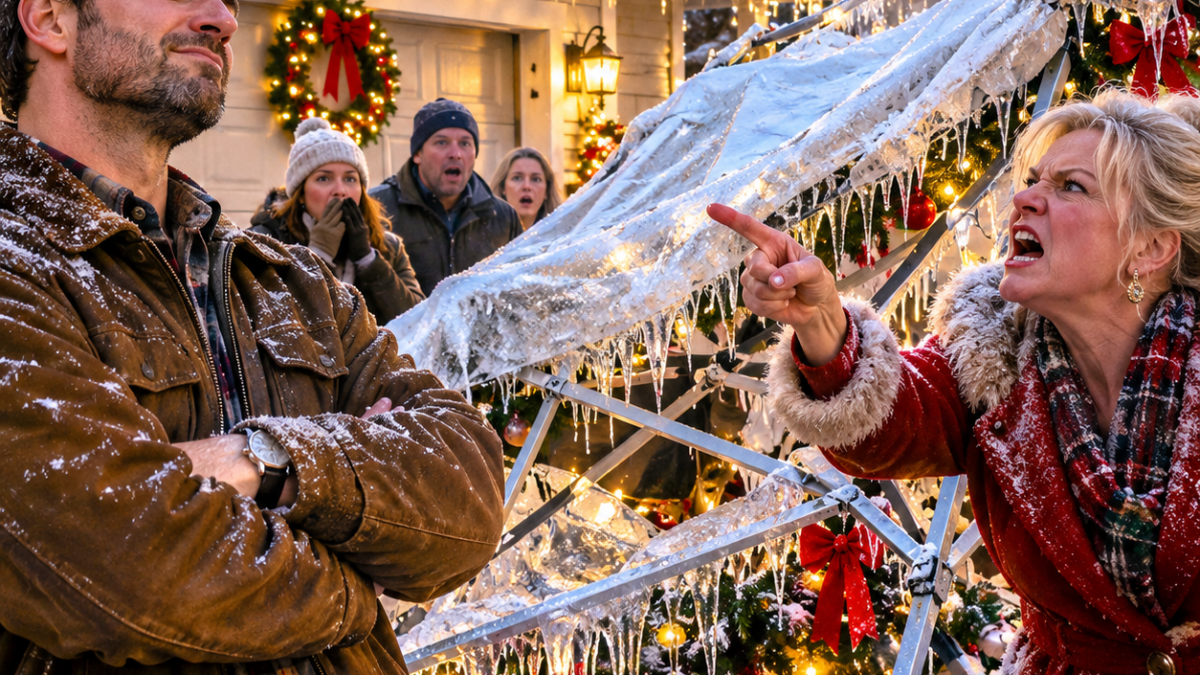
The slab hit the Winter Crown Pavilion.
The sound was enormous.
Steel buckled.
Transparent roof panels shattered.
One support frame bent inward.
Then another.
Lights snapped.
The main canopy section collapsed onto the stage.
Wreaths disappeared beneath snow.
Decorative arches twisted.
Iron pine cones flew through the air.
One struck the stage floor.
Another disappeared into a pile of ice.
The entire pavilion folded.
Then darkness.
Only emergency lights remained.
For several seconds, nobody spoke.
The $420,000 centerpiece Celeste had built for photographs was now twisted steel under tons of frozen snow.
And nobody was hurt.
That is the most important sentence.
Nobody.
Safety officials had cleared them.
Every guest.
Every worker.
Every vendor.
No injuries.
I looked at Avery.
“That’s exactly what you said would happen.”
She nodded.
Pale.
Celeste turned toward me.
“You!”
I said nothing.
“You caused this!”
Still nothing.
“That snow came from your roof!”
I walked toward Gideon.
Handed him Avery’s report.
My warning emails.
The closure request.
The theft report.
Then a responder called:
“Deputy.”
Gideon walked toward the wreckage.
Wedged inside a snapped steel beam was a cast-iron pine cone.
Silver paint scratched away.
He turned it with his flashlight.
Inventory mark.
RCL-SG-22.
My stolen snow guard.
Lying in the wreckage of the structure destroyed because the guards had been removed from the roof.
I did not need to say anything.
The evidence said enough.
Christmas Eve morning, the plaza looked like a disaster zone.
Yellow tape.
Broken steel.
Crushed booths.
Snow piled over lighting equipment.
Vendors photographing losses.
Sponsors demanding answers.
HOA board emergency meeting that afternoon.
Celeste arrived prepared.
Her story:
My roof failed.
I neglected snow removal.
Falling ice was an unpredictable act of nature.
The HOA should sue me.
Laurel let her finish.
Then stood.
She displayed one photograph.
My roof before December 19.
Forty-eight guards.
Then security footage.
Wyatt’s truck.
Workers climbing.
Removing each piece.
Then ownership records.
Invoices.
Inventory marks.
Then festival photographs.
Same guards mounted on pavilion.
Then Avery’s impact-zone map.
Then the altered site plan.
Then my warning email.
Then Celeste’s reply.
The room became colder than the weather outside.
One board member finally asked:
“You knew those were safety equipment?”
Celeste shook her head.
“Decorations.”
Avery stood.
“No.”
She explained the system.
Load distribution.
Retention layout.
Anchor design.
Sliding mass.
Risk zone.
Celeste interrupted.
“Snow falls from roofs.”
Avery answered:
“Yes.”
Then calmly:
“That is why engineered retention systems exist.”
Silence.
Celeste tried again.
“This was an act of nature.”
Avery looked at her.
“No one could predict the exact minute of release.”
Pause.
“But the hazard itself was identified, documented, and reported before your event.”
That sentence destroyed Celeste’s defense.
Then Daphne stood.
Financial records.
Evergreen Crown Events.
Advance payments.
Conflict of interest.
Antique metalwork line item.
$310,000.
Board members stared at Celeste.
She went from defending a festival accident to answering why HOA money had flowed through a company connected to her.
Wyatt’s forged authorization became another issue.
Insurance carrier opened review.
Possible coverage limitations.
Vendors filed claims.
I filed mine.
Roof damage.
Waterproofing.
Anchor repair.
Replacement system.
Legal costs where recoverable.
Property theft.
I also demanded preservation of every record.
Celeste had spent weeks acting like I was the problem.
Now every preserved document pointed back toward her decisions.
January brought the removal meeting.
Eighty-six voting members participated.
Celeste stood at the podium.
Talked about Christmas spirit.
Her years of leadership.
Property values.
Community pride.
Then Daphne projected the collapsed canopy.
Next slide:
The original approved site location.
Next:
Actual location.
Next:
Avery’s hazard report.
Next:
Payments.
Next:
My email warning everyone before the event.
Then Celeste’s rejection.
A homeowner stood.
“You took safety equipment off somebody else’s roof to decorate a party.”
He looked around.
“And now you want us to pay for the collapse?”
Celeste said nothing.
Vote.
Seventy-nine to remove.
Seven against.
Celeste Winthrop was no longer HOA president.
New board froze questionable spending.
Ordered independent audit.
Authorized recovery actions.
Cooperated with authorities.
Celeste gathered her coat.
Walked toward the door.
I had not planned to speak.
But I stood.
She looked at me.
I said:
“You thought you were taking a few decorations.”
The room was silent.
“What you took was the system keeping the snow off your own canopy.”
No applause.
I did not want applause.
Celeste left.
Outside, workers were taking down the billboard showing the perfect Winter Crown Pavilion.
Behind it sat the real one.
Collapsed.
Spring came slowly.
The snow melted.
Legal cases did not.
The audit continued.
Payments traced.
Conflict disclosed.
Theft investigation.
Forged authorization.
Insurance review.
Civil claims.
The damage to my roof was worse than it first appeared.
Multiple anchor points destroyed.
Membrane punctured.
Panels damaged.
Several antique guards cut or welded during pavilion installation.
They could not simply go back.
Avery designed a new system.
Modern retention rails integrated with restored antique-style elements where safe.
Qualified crew.
Permit.
Inspection.
Certification.
No shortcuts.
The HOA sued to recover certain improperly paid money after the audit.
Evergreen Crown contract terminated.
Vendors fought over invoices.
Celeste faced personal exposure for conduct outside any legitimate board authority.
On the separate criminal track, authorities pursued issues connected to the stolen guards and invalid authorization.
I did not pretend every allegation was automatically proven.
That is not how law works.
But Celeste could no longer say nobody warned her.
Every warning existed in writing.
At my civil hearing, Laurel placed two photographs side by side.
My roof with all forty-eight guards.
Then the collapsed pavilion with one of the guards lying in the wreckage.
Celeste’s lawyer argued:
“Snow is natural.”
Laurel answered:
“We are not suing snow.”
Then she turned toward the court.
“We are seeking accountability for removing a functioning protective system from private property, damaging that property, placing a temporary structure inside a documented hazard zone, and proceeding after repeated written warnings.”
That was the case.
Not revenge.
Not weather.
Choices.
The court accepted proven damages attributable to responsible parties and ordered compensation and corrective action according to the findings and agreements reached.
Celeste’s personal financial problems deepened.
The festival she wanted as her legacy had cost roughly $1.6 million across the larger program.
The $420,000 pavilion was a total loss.
Insurance disputes continued.
Vendor claims continued.
The HOA sought recovery.
Her private legal bills grew.
I was offered confidentiality more than once.
My answer was always the same.
“I’ll settle legitimate damages.”
“But?”
“No agreement pretending nobody knows what happened.”
I wanted the new safety procedures public.
The new board agreed.
No temporary event structure inside mapped roof-fall zones.
Independent professional review for snow hazards.
No alteration of approved site plans without engineer signoff.
No HOA entry onto non-HOA property without documented owner permission or lawful authority.
No officer could approve payments to a connected business without full conflict disclosure and independent board review.
Simple rules.
Expensive lesson.
By early summer, my roof was finished.
The new guards stood in clean rows.
Inspected.
Certified.
I stood on the porch while Avery completed the final documentation.
She handed me the report.
“Keep this.”
“You know I will.”
“I know.”
I looked down at the plaza.
The event area had been moved.
Farther away.
Outside the slide zone.
No enormous canopy.
No theatrical crystal roof.
Just an open courtyard.
Safe.
Avery said:
“You miss the pine cones?”
“Some.”
“They were beautiful.”
“They were.”
“You could reproduce the decorative shape.”
“Maybe.”
She smiled.
“Just don’t let an HOA borrow them.”
I laughed.
That was one of the first times I could laugh about it.
Daphne stayed on the board during the transition.
She did not want the presidency.
“Absolutely not.”
That was her answer when nominated.
I liked her more immediately.
One afternoon, she came to the lodge.
She stayed outside the gate until I opened it.
That small act mattered.
“Can I come in?”
“Yes.”
We sat on the porch.
She looked at the new roof.
“Those are the replacements?”
“Yes.”
“Not as pretty.”
“Safer.”
“Apparently that matters.”
“It usually does.”
She smiled sadly.
“I should have asked more questions.”
“When?”
“The festival budget.”
“You were treasurer.”
“I know.”
“You did ask questions eventually.”
“Too late.”
“Late is different from never.”
She looked toward the plaza.
“Celeste always made everything sound urgent.”
“That’s how people avoid scrutiny.”
“If we questioned her, we were anti-community.”
“Familiar.”
“She said sponsors would leave.”
“Did they?”
“Some.”
“Community survive?”
“Yes.”
“Then maybe urgency was exaggerated.”
Daphne laughed.
“Maybe.”
She apologized for the HOA’s conduct.
Not with a giant speech.
A simple apology.
I accepted.
I never hated the residents.
Some defended Celeste.
Some believed her lies.
Some blamed me.
But they had not climbed my roof.
Leadership can misuse community identity.
Celeste kept saying:
**We need this.**
**The community wants this.**
**The neighborhood deserves this.**
Eventually “the community” became a weapon she used to justify whatever she personally wanted.
A prettier pavilion.
A better photograph.
A contract tied to her own financial interests.
The members paid the price for that confusion.
So did I.
Months later, Wyatt came to see me.
He called first.
“I’d like to apologize.”
“Okay.”
We met at the gate.
He looked up at the roof.
“I should have known.”
“Which part?”
“The bases.”
“What about them?”
“Too heavy.”
He shook his head.
“Those were not decorations.”
“You asked Celeste.”
“I did.”
“And she lied.”
“Yes.”
“You still climbed the roof.”
“My crew did.”
“Under your direction.”
“Yes.”
He did not argue.
I respected that.
“I relied on authorization.”
“A forged authorization.”
“Yes.”
“Did you verify with me?”
“No.”
“That was the mistake.”
“I know.”
He looked toward the ground.
“My company nearly folded.”
“I didn’t know.”
“Insurance. Legal fees. Contract disputes.”
I said nothing.
He continued.
“I changed procedure.”
“How?”
“No property removal without direct owner confirmation when work involves privately owned buildings.”
“Seems obvious.”
“It does now.”
That is how painful lessons work.
Before disaster, they seem unnecessary.
After disaster, they become policy.
Wyatt offered to help source replacement antique castings.
I declined.
Not out of anger.
The new system did not need them.
He understood.
Before leaving, he said:
“I saw SG-22 in the wreckage.”
“So did I.”
“I’ll never forget it.”
“Neither will I.”
That image became central to the case.
Iron pine cone.
Silver paint.
Broken beam.
Ice.
Inventory mark.
A piece stolen because somebody thought it was decorative sitting inside the ruins it had once been designed to prevent.
You could not invent a cleaner symbol.
But I kept reminding people:
The snow guard did not “cause” or “prevent” everything by itself.
The system mattered.
All forty-eight mattered.
Placement mattered.
Roof conditions mattered.
The hazard zone mattered.
The canopy location mattered.
The warnings mattered.
The evacuation mattered most.
Stories love one magic object.
Real safety rarely works like that.
It works in layers.
Celeste removed one layer.
Ignored another.
Altered another.
Then dismissed the final warnings.
The collapse was not one mistake.
It was a chain.
That became Avery’s favorite phrase.
“Failure chain.”
She used it during a community safety presentation.
She drew boxes.
Snow-retention removal.
Hazardous canopy location.
Altered plan.
Weather conditions.
Ignored engineering warning.
Event proceeds.
Every box connected.
Then she circled one.
Evacuation.
“This broke the chain before people got hurt.”
That mattered.
People sometimes told me:
“You were lucky.”
Yes.
We were.
But safety crews also did their jobs.
Harlan shut the area down.
Gideon physically moved Celeste.
Staff cleared guests.
Luck matters.
Preparation matters too.
Celeste hated that version of the story.
She preferred:
Unpredictable snowstorm destroys festival.
Nature.
Tragedy.
Nobody responsible.
Except the records did not support it.
The weather had been forecast.
The hazard had been documented.
The equipment had been removed knowingly.
The structure had been shifted.
Warnings had been delivered.
The word “unpredictable” became difficult to defend.
Not the exact second.
That was unpredictable.
The general danger?
No.
Avery had described it before it happened.
One winter later, Silverpine Ridge held another Christmas event.
Smaller.
No enormous pavilion.
Event grounds farther away.
I received a letter asking whether I wanted complimentary tickets.
I laughed.
Then went.
Not because I suddenly loved HOA events.
Because Daphne asked.
The plaza looked different.
Open tents.
Heaters.
Music.
Safe setbacks.
A printed safety map near the entrance.
Emergency routes.
Snow-fall exclusion zone clearly marked below my lodge.
I stood looking at it.
A teenager asked:
“Why is that area blocked?”
His father said:
“Snow can come off the roof.”
Simple.
No drama.
No argument.
Just respect for physics.
I bought hot cider.
Daphne found me.
“Well?”
“Well what?”
“Better?”
“Cheaper.”
She laughed.
“Much.”
“No crystal canopy.”
“Never again.”
“No antique metalwork.”
“Definitely never again.”
We looked up at the lodge.
Snow guards visible.
She said:
“They actually look good.”
“Careful.”
“What?”
“That is how this started.”
She laughed so hard she spilled cider.
Life moved on.
Celeste did too, though not easily.
Her legal cases took time.
Some claims settled.
Some responsibilities were disputed.
Some findings became established through formal proceedings.
What mattered to me was that she could no longer use the HOA as her personal shield.
No board title.
No unchecked budget.
No maintenance crews.
No contracts.
No authority over anyone’s roof.
The association’s recovery action against her continued.
Her financial connection to Evergreen Crown became impossible to hide.
The forged authorization became part of a separate legal process.
I did not attend everything.
I had a lodge to run.
That surprised people.
They assumed I would obsess over her downfall.
I didn’t.
I wanted my roof restored.
My costs covered.
My name cleared.
My property respected.
Once those things were happening, Celeste became someone else’s case file.
Revenge is exhausting.
Accountability has an end point.
That distinction saved me.
The lodge itself required work beyond the roof.
Water had entered through damaged anchor holes during freeze-thaw cycles.
One interior ceiling developed staining.
A timber near the southern wall needed moisture treatment.
The final restoration took months.
Every repair reminded me how much damage forty-eight “decorations” could cause when removed from the wrong place.
One evening, I found one of the original guards that had survived.
SG-04.
Bent at the base.
Silver paint along one side.
Released back to me after evidence processing.
I held it.
Heavy.
Cold.
Pine cone detail still beautiful.
I considered repairing it.
Avery said:
“Don’t reinstall it.”
“I know.”
“Metal fatigue.”
“I know.”
“It can be decorative now.”
I laughed.
“That feels wrong.”
She smiled.
“After everything?”
“Yes.”
I kept it in my workshop.
Not on the roof.
Not as a trophy.
On a shelf.
Underneath it, I put a small card:
**SG-04 — RETIRED**
People asked.
I told the story.
Usually shorter.
HOA president stole snow guards.
Built Christmas canopy underneath.
Ice came down.
Canopy lost.
People laughed at the irony.
Then I added:
“Nobody was hurt because officials evacuated the zone.”
That was always the most important part.
One afternoon, Harlan Price stopped by.
I thanked him.
“For what?”
“For shutting it down.”
“That’s my job.”
“You got yelled at.”
“Also my job.”
“You probably saved someone.”
He looked uncomfortable.
“We all did.”
Fair.
He looked at the new roof.
“Certified?”
“Yes.”
“Good.”
“Want paperwork?”
He smiled.
“You really are the paperwork guy.”
“Yes.”
“Keep it.”
Then he said:
“You know the strange part?”
“What?”
“If Celeste had left the guards alone, the pavilion still should not have been placed where she put it.”
“Exactly.”
“People simplify the story too much.”
“I know.”
“It wasn’t only the guards.”
“No.”
“It was everything.”
That was why I wanted the public record clear.
Not because I wanted to humiliate Celeste forever.
Because future boards needed the actual lesson.
Do not steal safety equipment.
Obviously.
But also:
Do not alter engineering drawings.
Do not ignore hazard zones.
Do not create undisclosed financial conflicts.
Do not treat safety warnings as personal attacks.
Do not confuse a successful event with a safe event.
And most of all:
Do not believe authority changes physics.
Celeste had controlled meetings.
Budgets.
Contractors.
Sponsors.
Press releases.
She could not control snow.
That was the one thing she never understood.
The mountain did not care who was HOA president.
Years later, tourists still photographed the lodge.
The antique architecture.
Snow on the roof.
My new retention system.
Sometimes people called the guards “cute.”
I smiled.
Did not correct them.
They could be both.
Beautiful and functional.
That was another lesson Celeste missed.
Safety and beauty were not enemies.
A good design could do both.
She simply did not want to accept anything she had not personally chosen.
Her problem was never that the snow guards were ugly.
Her problem was that they belonged to me.
She had asked.
I said no.
That was the part she could not tolerate.
Everything after that came from refusing to accept a boundary.
My roof.
My equipment.
My decision.
Simple.
Once someone decides “no” is merely an obstacle to be engineered around, bad things follow.
Forged authorization.
Predawn removal.
Altered plans.
Public smear.
Eventually a crushed pavilion.
The disaster began long before the snow moved.
It began when Celeste decided my answer did not matter.
I framed her original HOA notice.
Laurel laughed when she saw it.
“You people love framing bad paperwork.”
“You’re a lawyer.”
“Exactly. We file it.”
I hung it in the workshop.
It said my snow guards detracted from the approved festival visual design.
I kept it because the wording captured the whole absurdity.
A safety system became a “visual problem.”
Then when the visual problem disappeared, the actual problem arrived.
Winter.
One December, a heavy storm hit.
Almost as bad as the year of the pavilion.
I stayed up late.
Snow piled high.
Temperature rose during the afternoon.
Then dropped.
I checked the roof from the ground.
New system held.
Snow remained distributed.
Some released gradually through designed areas.
No dramatic slab.
No crash.
Nothing happened.
That night felt more satisfying than watching Celeste lose her presidency.
Nothing.
That is what good safety often produces.
No headline.
No viral clip.
No collapsed steel.
No sirens.
Just a roof doing what it was designed to do.
I stood on the porch in the cold.
Looked down at the plaza.
Empty hazard zone.
New event area farther away.
Everything quiet.
That was success.
I eventually received final compensation for my documented losses under the applicable settlements and rulings.
Roof restoration.
Property damage.
Certain legal and professional costs.
Other proven damages.
I will not pretend money erased the experience.
It didn’t.
For months, I checked security cameras every morning.
Every truck near the road made me look twice.
Violation of property does that.
It makes you feel watched even after the people leave.
Time helped.
New cameras helped.
A better gate helped.
The new board sent written confirmation acknowledging that my lodge stood outside HOA jurisdiction.
That helped too.
One clause made me smile.
**Silverpine Ridge HOA claims no architectural authority over the Callaway parcel.**
I showed Laurel.
“Should I frame this?”
She rolled her eyes.
“No.”
“I think I will.”
“You need hobbies.”
“This is my hobby now.”
She laughed.
The new board eventually requested a formal boundary meeting.
I attended.
Surveyor.
HOA counsel.
Board representatives.
No Celeste.
We walked the property line.
Marked it.
Documented it.
Everyone signed the acknowledgment.
At the end, the new president said:
“This should have been done years ago.”
“No.”
He looked surprised.
“The boundary was already recorded.”
He nodded.
“You’re right.”
“The problem wasn’t that nobody knew where the line was.”
“What was it?”
“Someone decided the line didn’t apply to her.”
He looked toward the plaza.
“Fair.”
That is the heart of every HOA story I ever tell.
Rules matter only when people accept that their authority has limits.
Celeste knew the HOA controlled the plaza.
Then she looked uphill and emotionally annexed my lodge because it affected her view.
That is how abuse starts.
Not always with evil.
Sometimes with convenience.
**It would look better if…**
Then:
**Surely we have the right…**
Then:
**Do it now and fix paperwork later.**
The progression is dangerous.
By the time people realize what happened, they are standing beneath a collapsed canopy asking who approved the plan.
Daphne sent me the final audit summary months later.
I read only the parts involving my case.
Then called.
“You okay?”
She laughed tiredly.
“I hate festivals.”
“Understandable.”
“Do you know how many invoices a Christmas festival creates?”
“No.”
“Too many.”
“Good audit?”
“Painful.”
“Useful?”
“Yes.”
“Then worth it.”
She told me the HOA recovered some funds and restructured financial controls.
Dual signatures.
Conflict disclosures.
Board review thresholds.
Vendor verification.
No splitting contracts to avoid scrutiny.
Again.
Basic rules.
Expensive lesson.
Celeste’s downfall was not one dramatic moment.
The canopy collapse made people look.
But what destroyed her power was documentation.
Security video.
Engineering report.
Permit drawing.
Changed appendix.
Ownership records.
Inventory numbers.
Emails.
Payment ledgers.
Conflict records.
Wyatt’s messages.
Her own signature.
She had spent years mastering appearances.
Paper defeated appearance.
That irony pleased me more than the collapse.
The collapse was dangerous.
Paper was clean.
One winter evening years later, I was sitting at the lodge when someone knocked.
Leah? No.
Different story.
It was a young HOA board member named Marcus.
He held a folder.
“Can I ask you something?”
“Yes.”
“We’re planning a small winter market.”
“Okay.”
“Not under your roof.”
“Good start.”
He laughed nervously.
“We hired an engineer.”
“Excellent.”
“He says we need a twenty-eight-foot setback from one building.”
“Then use twenty-eight.”
“The design committee wants twenty.”
I stared at him.
He nodded.
“Yeah.”
“You already know the answer.”
“I wanted to hear you say it.”
“Twenty-eight.”
He smiled.
“Thank you.”
“Why are you thanking me?”
“Because I’m about to tell twelve people no.”
“Good practice.”
He left.
I sat there smiling.
Maybe that was Celeste’s accidental legacy.
A board member asking the safety question before building.
Not after.
The market happened.
Twenty-eight feet.
No problems.
No headlines.
Perfect.
Over time, Silverpine Ridge stopped treating me like an enemy.
Some residents never apologized.
That was fine.
Others did.
One woman told me:
“I believed Celeste when she said you were trying to ruin Christmas.”
“You weren’t the only one.”
“I repeated it.”
“Okay.”
“I’m sorry.”
“Thank you.”
She looked toward the roof.
“I didn’t know those things did anything.”
“Most people don’t.”
“They really look decorative.”
“They can be decorative and functional.”
She laughed.
“So everybody was partly right.”
“Not Celeste.”
That made her laugh harder.
Humor returned.
That was how I knew the worst part was over.
One day I found SG-22—the guard recovered from the wreckage—displayed in an evidence photograph in the public case record.
I stared at it.
Silver paint.
Snow.
Twisted steel.
Inventory mark.
That single image told the whole story.
But there was another image I preferred.
Taken the following summer.
My restored roof.
New retention system.
Clear sky.
No pavilion below.
No crowds.
No Celeste.
That was the image of victory.
People think victory should show the other person losing.
I disagree.
Victory is seeing your own life functioning again.
My roof safe.
My lodge dry.
My property respected.
That was enough.
The last time I saw Celeste was outside a courthouse.
She looked older.
Not dramatically.
Just tired.
No entourage.
No clipboard.
No HOA jacket.
She saw me.
Stopped.
I expected anger.
Instead:
“Are you happy?”
I thought about the question.
“No.”
She seemed surprised.
“You got what you wanted.”
“What do you think I wanted?”
“To destroy me.”
“No.”
She laughed bitterly.
“Please.”
“I wanted you off my roof.”
Silence.
“I wanted my equipment back.”
Silence.
“I wanted people out from under the slide path.”
She looked away.
“You made me look like a criminal.”
“I showed the video.”
“You could have handled it privately.”
“I tried.”
“That’s not true.”
“I told you no.”
She looked at me.
“You always think saying no makes you right.”
“No.”
I shook my head.
“I think owning the roof makes it my decision.”
She had no answer.
Then she said:
“You enjoyed watching that canopy fall.”
I thought about the sound.
The ice.
Steel crushing.
People running.
Avery’s face.
“No.”
She looked skeptical.
“I was terrified somebody was still under it.”
That was true.
Her expression changed slightly.
Maybe she believed me.
Maybe not.
Then I added:
“What I enjoyed was watching everyone walk away alive.”
She looked down.
For the first time, I saw something close to shame.
Not enough to fix anything.
But something.
She left.
I never saw her again.
Some endings do not need reconciliation.
Accountability is enough.
Years after, the lodge became known locally for the story.
Visitors asked:
“Is this the roof?”
“Yes.”
“The Christmas canopy roof?”
“Yes.”
“Can we see the guards?”
“They’re above you.”
They looked up.
People often expected something dramatic.
Instead, rows of snow-retention hardware.
Functional.
Quiet.
One man said:
“That’s it?”
“That’s it.”
“Those caused all that?”
“No.”
I corrected him every time.
“Removing the old system was one part of what caused it.”
That distinction mattered.
Because I did not want the story reduced to magic.
Safety is not magic.
It is planning.
Redundancy.
Engineering.
Respect.
Celeste removed one piece because she did not understand its purpose.
Then ignored people who did.
That is the lesson.
On the fifth anniversary, Avery came by for another inspection.
Same calm expression.
More gray in her hair.
She finished.
“Still good.”
“Everything?”
“Everything.”
We stood on the porch.
Snow beginning lightly.
She looked down toward the plaza.
“Do you ever think about that night?”
“Every big storm.”
“Me too.”
“I still hear the crack sometimes.”
She nodded.
“I remember thinking the evacuation was too slow.”
“It wasn’t.”
“It felt slow.”
“Everything feels slow when a roof is moving.”
She laughed.
Then pointed at the new event grounds.
“Look.”
Kids were skating.
Lights.
Families.
Far outside the hazard zone.
No one afraid.
She smiled.
“That’s the real ending.”
“Yes.”
We stood there quietly.
Snow settled on the lodge.
Caught behind the guards.
Held where it belonged.
No drama.
No falling slab.
No twisted steel.
Just winter.
That evening, I went into my workshop.
SG-04 sat on the shelf.
The framed nuisance notice hung nearby.
I read the old language again.
**Obsolete decorative roof fixtures.**
I laughed.
Celeste had seen pine cones.
I saw anchors.
She saw decoration.
Avery saw load paths.
She saw an opportunity to make her canopy prettier.
I saw the thing keeping winter from falling onto the people below.
That difference cost millions.
Not because I was smarter.
Because I respected expertise.
Celeste believed being president made her judgment superior to engineers, contractors, owners, safety officials, and even the weather.
Power does that to some people.
They stop hearing warnings as information.
They hear them as disobedience.
Avery warned her.
Sabotage.
Laurel warned her.
Threat.
I warned her.
Jealousy.
Fire marshal warned her.
Overreaction.
Every warning became an attack because accepting one would mean admitting she did not control everything.
Then the snow moved.
Nature is indifferent to authority.
That is why engineering exists.
You do not command a mountain.
You prepare for it.
Celeste never learned that until the mountain answered for itself.
I turned off the workshop lights.
Outside, snow kept falling.
Before bed, I checked the security camera.
Old habit.
The roof was white.
Rows of guards visible beneath the accumulation.
Everything exactly where it belonged.
I thought back to the morning I stepped onto the porch and found them gone.
That feeling.
Violation.
Fear.
Anger.
Then the days that followed.
Evidence.
Warnings.
Threats.
Collapse.
Courtrooms.
Audits.
Repairs.
And finally quiet.
If someone asks whether I got revenge, I say no.
The ice did not take revenge.
The court did not take revenge.
The board vote was not revenge.
The audit was not revenge.
Those were consequences.
My part was simpler.
I said no.
I documented what happened when Celeste ignored it.
I warned people before someone got hurt.
And when she tried to blame me afterward, I brought the receipts.
That was enough.
The most satisfying moment did not happen when the canopy collapsed.
It happened the following winter.
A new HOA maintenance manager came to my gate.
He stayed outside.
Waited.
When I walked down, he said:
“Mr. Callaway, we need to inspect a drainage inlet near the boundary. It’s on HOA land, but the safest access route passes close to your driveway.”
I waited.
Then he asked:
“May we come through?”
I smiled.
“Yes.”
He looked relieved.
“Thank you.”
That was it.
Permission.
The word Celeste could never accept.
The new crew finished the inspection.
Left.
Closed the gate.
No conflict.
No lawyers.
No cameras.
That simple interaction proved Silverpine Ridge had learned more from the disaster than any speech could teach.
Ask.
Wait for the answer.
Respect it.
I watched the truck drive away.
Then looked up at the roof.
The guards cast tiny shadows across the snow.
Still functional.
Still visible.
Still mine.
And nobody called them decorations anymore.
Celeste had wanted my snow guards because she thought they would make her Christmas festival beautiful.
She had them removed before dawn.
Mounted them above a stage.
Painted them silver.
Ignored every person who told her why they belonged on the roof.
Then she stood beneath her perfect canopy believing momentum, money, and reputation could protect her from consequences.
At 10:12 on December 23, the mountain gave her a different answer.
The ice came down.
The canopy folded.
Her stolen decorations landed inside the wreckage.
No one died.
No one was injured.
And that was the only part of the night I ever considered lucky.
Everything else had been warned about.
Everything else had been documented.
Everything else followed from choices.
By summer, my roof was restored.
By winter, the HOA had new leadership.
By the next festival, the crowds stood far outside the danger zone.
The pavilion was gone.
Celeste was gone.
The safety rules stayed.
I still live in the same lodge.
Same view.
Same winter storms.
And every December, when snow begins gathering on the southern roof, I look up at the retention system and think about those forty-eight old cast-iron pine cones.
People saw decoration.
Celeste saw something she could take.
But they had never been there to make winter beautiful.
They were there to keep winter from falling.
She discovered that truth exactly twelve minutes after ten on a freezing December night.
And by then, her $420,000 Christmas crown was already lying in pieces beneath the snow.








