PART 2: HOA Karen Spent $14M Building 26 Cabins on My Private Island—Then My Father’s Deed Changed Who Owned Every One
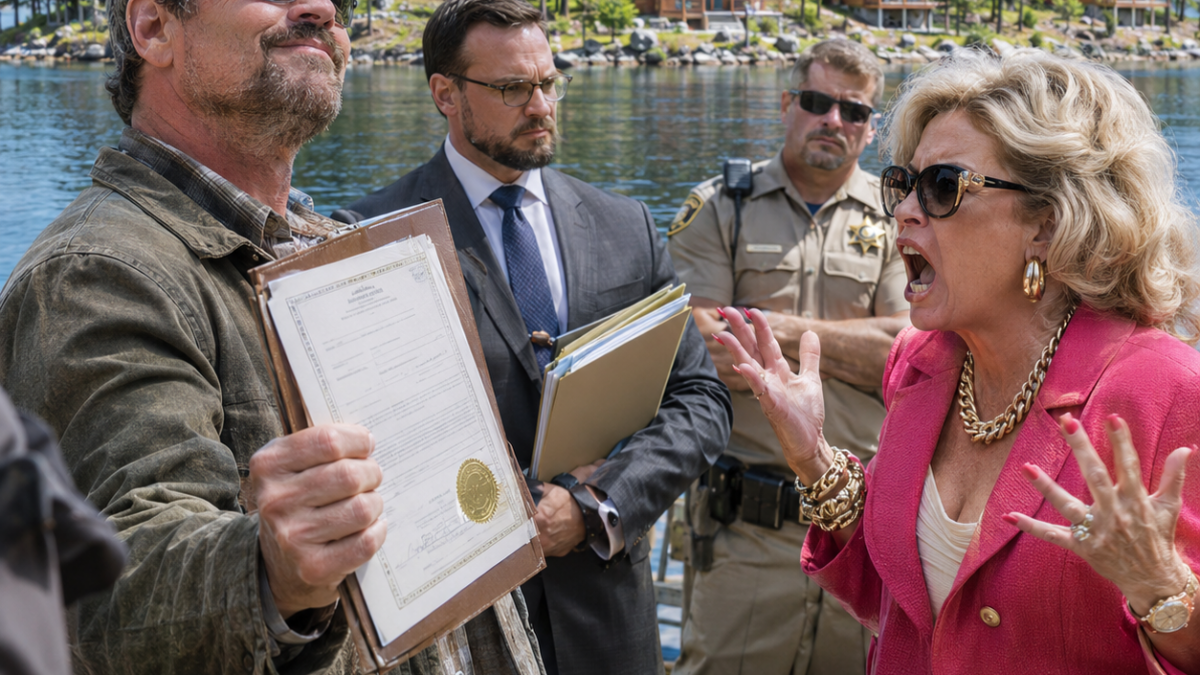
PART 2
Deputy Harris.
Broad shoulders.
Early forties.
I knew him enough to recognize the truck, but not enough to expect him to solve a title dispute beside a lake.
He looked at the machinery.
Then the floating pieces of my dock.
Then Vanessa.
“What happened?”
“They’re building on my island.”
Vanessa opened her folder before I finished.
“This parcel is part of the Silver Pines master development. We have recorded title, county permits, access authorization, planning approval, and environmental clearance.”
Harris looked at me.
“You have ownership documents?”
“Yes.”
“Here?”
“No.”
Vanessa gave a quiet laugh.
“Then perhaps Mr. Mercer should retrieve them rather than disrupting permitted construction.”
I pointed at the water.
“They destroyed my dock.”
Harris walked to the shoreline.
“Did you order that?”
Vanessa answered without hesitation.
“It was an unpermitted structure inside an approved construction footprint.”
“It was mine.”
She looked at me.
“You keep saying that.”
Harris exhaled.
Then he said something I did not want to hear but needed to.
“This is looking like a civil title dispute.”
Vanessa crossed her arms.
“Exactly.”
He turned sharply toward her.
“That does not mean you’re right.”
Her expression changed slightly.
Then he faced me.
“Daniel, get certified copies from the recorder. Assessor. Tax office. Call a lawyer. Do not move equipment yourself.”
I looked toward the bulldozer.
Every part of me wanted to climb into it and park it in the lake.
Instead, I nodded.
Vanessa smiled.
She thought restraint meant surrender.
That mistake followed her through everything that came next.
I drove directly to the county offices.
The recorder’s office sat on the first floor of an old brick annex.
A clerk named Linda pulled my parcel history.
Grandfather.
1949 purchase.
1953 corrective deed.
Then my father.
Then me.
No sale.
No transfer to Silver Pines.
No HOA ownership.
No development agreement.
Nothing.
She printed certified copies.
Stamped them.
I felt my shoulders loosen for the first time all morning.
Then Linda frowned.
“What?”
“There’s another filing.”
“What kind?”
“Quitclaim deed.”
The relief vanished.
She turned the screen.
According to county records, in March 2019 I had transferred Black Pine Island to something called Black Pine Land Trust.
Three months later, that trust transferred it to Crowley Lake Development LLC.
Trevor Crowley’s company.
Vanessa’s husband.
I stared.
“I never signed that.”
“It’s recorded.”
“That doesn’t make it real.”
“No.”
She looked uncomfortable.
“But until a court resolves it, it clouds title.”
She printed the deed.
My signature appeared at the bottom.
Not something similar.
Mine.
The downward stroke of the M.
The tight D.
The slight lean from an old hand injury.
For a second, I wondered whether grief had destroyed my memory.
Then I saw the date.
March 14, 2019.
I knew exactly where I was that week.
St. Catherine’s Hospital.
Rebecca had undergone her second major cancer surgery.
I barely left her room.
I was not signing away our island.
The document claimed I appeared before a notary named Helen Price.
Never heard of her.
I went upstairs to the assessor.
Their records still listed me.
Twenty years of tax payments.
No delinquency.
No tax sale.
No transfer.
Then another problem appeared.
A second parcel number had been created.
It overlapped almost exactly with my island.
Original parcel:
Daniel Mercer.
Eleven acres.
Black Pine Island.
Second parcel:
Silver Pines Recreational Parcel.
Almost identical acreage.
Mailing address:
Crowley Lake Development.
Two parcel numbers.
Two supposed owners.
One island.
The assessor’s clerk shook her head.
“That should not happen.”
“Who created the second one?”
She checked.
Administrative boundary correction.
Approved by:
Ray Caldwell.
Same county official whose signature appeared on Vanessa’s development permits.
I walked to planning and zoning.
Ray was unavailable.
His assistant provided the application.
Trevor submitted it.
Miles Denton—the HOA’s attorney—listed as legal contact.
And attached?
Another form carrying my signature.
I had never seen it.
By sunset, I held three documents I never signed.
Quitclaim deed.
Boundary adjustment.
Parcel consent.
Each document supported the next.
The deed justified the parcel.
The parcel justified the permits.
The permits justified construction.
This was not one error.
It was a chain.
I returned to the island.
Vanessa stood beside the construction trailer.
I held up my certified deed.
“This is the ownership chain.”
She glanced.
“My family has owned this island since 1949.”
She removed her quitclaim deed.
“Ours is more recent.”
“It’s forged.”
“Prove it.”
“I was in the hospital with my wife.”
“That sounds emotional, Daniel.”
I stared at her.
“Courts prefer documents,” she added.
Deputy Harris approached.
Read both deeds.
Then the tax records.
“This definitely needs a judge.”
Vanessa nodded toward the bulldozer.
“Which means construction continues.”
Harris looked at her.
“It means you continue at your own risk.”
For the first time, something moved behind her eyes.
Only for a second.
Then she smiled.
“Risk is part of development.”
The next morning, the island looked like a prison.
Ten-foot chain-link fencing blocked the causeway.
Signs every twenty feet.
PRIVATE CONSTRUCTION SITE
AUTHORIZED PERSONNEL ONLY
VIOLATORS WILL BE PROSECUTED
One sign included my name.
DANIEL MERCER IS NOT AUTHORIZED TO ENTER
There is something especially infuriating about seeing your own name printed on a sign telling you that you cannot enter land you own.
A white envelope was taped to my mailbox.
Trespass warning.
$750 fine for delaying construction.
Charge for demolition of my own dock.
And a written accusation that I had threatened workers with violence.
That was when I called Mara Ellison.
Title disputes.
Forged conveyances.
Land-development fraud.
She answered immediately.
“Tell me exactly what happened.”
I did.
When I mentioned the quitclaim deed, she interrupted.
“Do not confront Vanessa again until I review everything.”
“They’re tearing up the island.”
“I understand.”
“No, you don’t.”
Silence.
Then her voice softened.
“You’re right. I don’t know what the island means to you.”
I looked across the lake.
Workers near Rebecca’s garden.
“But I know what Vanessa wants.”
“What?”
“She wants you angry, loud, and close enough to one of her cameras that she can make you the danger.”
I watched an excavator move near the trees.
“What do I do?”
“Document.”
“They’re destroying things.”
“Preserve evidence.”
“They’re on my land.”
“I know.”
“Mara—”
“Do not give them the one thing they cannot manufacture.”
“What?”
“A real crime committed by you.”
An hour later, I watched Rebecca’s stone bench tilt beneath an excavator bucket.
I lost control.
Not physically.
Almost.
I got into my boat.
Crossed.
Security met me.
Vanessa was waiting.
So was a camera.
Then another.
I said:
“I’m here to retrieve personal property from my wife’s memorial garden.”
A guard blocked me.
Vanessa stepped forward.
“There is no memorial garden on the approved plan.”
“It existed before your plan.”
“So did overgrowth.”
Behind her, the excavator pulled wildflowers from the soil.
Purple coneflowers.
Black-eyed Susans.
Lupine.
Rebecca planted them during the last spring she could still kneel.
Then I saw the bench.
Broken in two.
The inscription split.
REBECCA MERCER
A SAFE HARBOR IN EVERY STORM
I stepped forward.
The guard’s hand went toward his cuffs.
Vanessa spoke softly.
“Go ahead, Daniel.”
I looked at her.
“Show everyone what kind of man you really are.”
Then I saw the second camera hidden inside the construction trailer.
They had staged the angle.
No broken bench.
No excavator.
No destroyed flowers.
Just angry man.
HOA president.
Security.
I opened my fists.
Stepped backward.
Vanessa’s smile faded.
I looked directly into the camera.
“I think everyone can already see what kind of man I am.”
Then I looked at her.
“I’m the man who called his lawyer before you called your cameraman.”
One guard almost smiled.
Vanessa didn’t.
I turned toward the boat.
Then saw a small metal box half buried in mud.
Rebecca’s anniversary box.
I recognized it.
“That belongs to me.”
“Construction debris.”
I raised my phone.
“This is a personal container removed from my wife’s memorial garden. I am requesting it in front of witnesses.”
Vanessa looked at the cameras.
She understood.
“Give it to him.”
I took it home.
Cleaned mud and diesel from the lid.
Inside were photographs.
A dried flower.
Three letters Rebecca had written.
Two destroyed by water.
The third protected in plastic.
Near the end she had written:
One day, when you are ready, make this island a place where people who carried too much can finally set some of it down.
I sat alone for a long time.
Then Mara called.
“I found the notary.”
“Helen Price?”
“Yes.”
“Can we interview her?”
“No.”
“Why?”
“She died eight months before she supposedly notarized your deed.”
I looked at Rebecca’s letter.
“So we have them.”
“We have strong evidence.”
“She was dead.”
“Yes.”
“What more do you need?”
“The whole manufactured chain.”
The deed.
The parcel.
The permits.
The signatures.
Everything.
Mara filed an emergency injunction.
The hearing came three days later.
Three days while construction accelerated.
Night shifts.
Floodlights.
Concrete after dark.
Vanessa knew we were coming.
Mara explained why speed mattered.
“People hesitate to undo expensive things.”
The hearing was packed.
Judge Nathan Aldridge listened.
Mara showed my deed.
Taxes.
Duplicate parcel.
Dead notary.
Vanessa’s attorney, Miles Denton, called the date discrepancy a digitization issue.
He argued that stopping a $14 million project would destroy jobs.
Contractors.
Financing.
Community investment.
Then Ray Caldwell testified.
He admitted he had approved the duplicate parcel without personally contacting me.
Still, Judge Aldridge refused to decide title in an emergency hearing.
My stomach dropped.
“The request to halt construction is denied.”
Vanessa exhaled.
Then the judge raised one finger.
“I’m not finished.”
Everyone froze.
“If defendants continue construction, they do so entirely at their own risk.”
No cabin could be sold.
Transferred.
Occupied.
Or used as collateral before title trial.
And the HOA plus Crowley Lake Development had to place:
$1.5 million into court-controlled escrow.
Vanessa’s head turned toward Miles.
Fear.
Real fear.
Judge Aldridge said:
“This bond is not permission to build. It is security in case you are wrong.”
Outside, Vanessa called it a victory.
She told reporters construction would continue.
She omitted the escrow.
Omitted the sales freeze.
Omitted the judge’s warning.
Two days later every Silver Pines homeowner received a $4,000 special assessment.
Clubhouse roof repairs canceled.
Waterline replacement postponed.
Maintenance accounts drained.
Construction doubled.
I watched walls rise at night.
“I tried to stop them,” I told Mara.
“You did.”
“And they’re still building.”
“They were warned.”
I watched another concrete truck cross.
Mara said:
“From now on, every dollar they spend is evidence of a deliberate choice.”
That was the moment my thinking changed.
Vanessa believed finished cabins would become politically impossible to remove.
She believed money could harden into ownership.
I told Mara:
“Then let them finish.”
Not because I had never tried to stop them.
I had.
Sheriff.
County.
Court.
Certified notices.
Everything.
But the judge had drawn the line.
Build if you choose.
At your risk.
So while Vanessa built cabins, I built a case.
I photographed the island from the same locations every day.
Dates.
Times.
Foundation progress.
Walls.
Roofs.
Utilities.
Roads.
Tree removal.
Mara sent certified notice to every company involved.
General contractor.
Concrete company.
Electrical subcontractor.
Plumber.
Lender.
Architect.
Investment firm.
Wall manufacturer.
Every letter said the same thing.
Title disputed.
Quitclaim alleged forged.
Court warned construction was at defendants’ risk.
Continue and you may face claims.
We kept every delivery confirmation.
Nobody could later say:
We didn’t know.
Then Mara hired Ethan Cole.
Licensed surveyor.
Former combat engineer.
“I don’t care who is angry,” he said. “Show me the legal description.”
I liked him immediately.
We found old boundary pins.
First.
Second.
Third.
All matched my deed.
Fourth?
Gone.
Hole still visible.
Fresh scraping in granite.
Concrete dumped over the location.
Ethan crouched.
“Removed with equipment.”
That pin marked the southeast area closest to the densest cabin cluster.
Fortunately, one old wildlife camera survived.
Mounted high inside a split pine.
Memory card showed a Crowley Lake Development truck arriving at 2:13 a.m.
Three weeks before construction officially started.
Two men.
One map.
Hydraulic extraction tool.
At 2:56, they left with a long dark object in the truck bed.
They had removed the marker.
Before construction.
They knew.
Ethan completed the certified survey.
All twenty-six cabins sat inside my boundary.
Not partially.
Entirely.
Nearest structure:
Eighty-seven feet inside.
Farthest:
Almost four hundred feet.
Clubhouse.
Utilities.
Roads.
Septic trenches.
Marina.
Everything.
There was no genuine boundary dispute.
Mara placed both hands on the map.
“All twenty-six?”
Ethan nodded.
“Every square foot.”
Across the lake another roof rose.
Vanessa wasn’t building a stronger claim.
She was building a larger damages claim.
Then we dug into county administration.
Internal files revealed a duplicate-parcel warning had appeared when Silver Pines’ parcel was created.
Potential duplicate legal description. Review required.
Someone overrode it.
Ray Caldwell.
He marked verification steps complete.
Recorder review.
Assessor review.
But no review notes existed.
He had submitted the correction.
Approved the overlap.
Then certified that other departments approved it.
The duplicate parcel was valued initially at just $12,000.
My island’s real assessment exceeded $800,000.
The cheap classification:
Undeveloped common recreational land.
It made the parcel look like HOA property.
Made taxes tiny.
Made lenders comfortable.
Everybody saw something official-looking and assumed somebody else had checked.
Nobody had.
We sent the signatures to Dr. Samuel Voss.
Forensic document examiner.
He overlaid my signature from the quitclaim deed with the signature from the boundary consent.
Perfect match.
Not similar.
Perfect.
Human beings do not sign their names identically twice.
Then digital metadata.
Editable text layers.
Different typeface.
Incorrect notary identification.
And the new surveyor seal?
Belonged to Arthur Bell.
Dead three years before the printed survey date.
Dead notary.
Dead surveyor.
Copied signature.
Fake parcel.
The pattern kept tightening.
Meanwhile Silver Pines finances began collapsing.
Residents had been told reserves exceeded $3 million.
An internal balance sheet anonymously sent to Mara showed:
Less than $200,000.
Transfers:
Almost $2.8 million.
One recipient:
TC Community Consulting.
Trevor Crowley.
Then someone asked to meet.
Emily Park.
Assistant treasurer.
Bookkeeper.
Terrified.
She brought the complete 1976 recreational agreement.
The one Miles relied upon in court.
Silver Pines had shown three pages.
Emily had four.
The missing final page said everything.
Recreational access only.
Twice-yearly community picnics.
Non-commercial.
Non-transferable.
No permanent structures.
No rental activity.
No easement.
And the agreement terminated when my father died unless I renewed it.
I never had.
Mara asked:
“Who removed page four?”
Emily answered:
“I watched Vanessa scan only the first three.”
“Miles knew?”
“He said the final page created unnecessary ambiguity.”
I nearly laughed.
It didn’t create ambiguity.
It ended their claim.
Emily also brought bank records.
The HOA once had more than $3 million.
Transfers to entities tied to Trevor drained almost $2.8 million.
When Judge Aldridge required $1.5 million escrow, Vanessa didn’t have it.
She emptied maintenance accounts.
Borrowed against future dues.
Delayed contractors.
Postponed water infrastructure.
Imposed the $4,000 assessment.
Why keep building?
Emily placed a financing agreement on the table.
Northstar Leisure Capital.
Up to $14 million.
Once cabins were completed, furnished, permitted and ready for occupancy, Northstar planned to acquire the resort operation.
That money would refill everything.
Loans.
Reserves.
Contractors.
Escrow.
And development fees.
The project wasn’t just Vanessa’s dream.
It was the hole she needed to cover the previous hole.
The Northstar agreement required clean title.
Certificates of occupancy.
And buyer commitments.
The judge banned cabin sales.
So Vanessa renamed deposits.
Membership reservation fees.
Twenty-one families had already paid between $25,000 and $60,000.
Then Emily played a recording.
Trevor:
“We cannot pause now.”
Miles:
“The court did not enjoin construction.”
A board member:
“What happens if Mercer finds the original deed?”
Silence.
Then Vanessa’s voice.
“Mercer’s deed is probably in the old bank archive. Finish the cabins before he finds it.”
Nobody at our table moved.
She knew.
Not suspected.
Knew.
Then emails.
We do not need clean title before construction. We need completed units before financing review.
Another:
Ignore the Mercer boundary until after the next hearing.
Trevor:
The pin is a problem. Handle it before site photos.
Miles:
Do not put details in email.
That sentence may have hurt him more than anything else.
Emily also found an old safe-deposit record.
Black Pine Community Bank.
My father.
Box number.
The bank closed eighteen years earlier.
Records transferred through mergers.
The box may still exist.
Miles had searched for it before construction.
Never found it.
Mara secured authorization.
My son Luke drove me eighty-seven miles to the successor bank.
After probate checks, identification, court authorization, and almost two hours of waiting, a bank employee placed a long faded metal box in front of us.
Label:
MERCER, THOMAS E.
My father.
I rested my hand on it.
Luke said:
“Open it.”
Inside:
Yellow envelopes.
Old survey.
Notebook.
Documents tied with cotton string.
First:
Original 1949 warranty deed.
My grandfather.
Eleven acres.
Four iron monuments.
Then 1953 corrective deed.
Causeway included.
Original survey.
Probate order to my father.
Probate order from my father to me.
Title policy.
Continuation endorsement protecting against forged instruments.
Complete chain.
No land trust.
No Crowley Lake Development.
No transfer.
No gap.
Luke exhaled.
“That’s it.”
Mara noticed another provision.
Any permanent structures placed on the land without written owner permission could, depending on the court’s ruling, become fixtures attached to the real property.
The cabins were not trailers.
Concrete foundations.
Buried utilities.
Roads.
Septic.
Marina.
Mara said:
“If title is confirmed, you may have choices.”
“Demolition?”
“Yes.”
“What else?”
“Damages.”
“And?”
“You may be able to argue the cabins became fixtures.”
I looked at the deed.
“You mean they could become mine.”
“I mean the judge may let you choose.”
I closed the box.
Across the lake, Vanessa’s crews were almost finished.
“She’s not building her resort anymore.”
Luke looked at me.
“She’s finishing my evidence.”
The grand opening came.
White tent.
Red ribbon.
Northstar representatives.
Reporters.
Vanessa stood before twenty-six completed cabins and said:
“All title issues have been fully resolved.”
Mara recorded it.
Three nights later, water and electrical service at the resort were sabotaged.
Vanessa blamed me.
A photograph showed a man in a dark jacket near the shore.
Face invisible.
She obtained an emergency restraining order keeping me five hundred feet away.
Then, before I had even been served, one of her security people called.
“We found your trail camera. Ms. Crowley authorized you to retrieve it before six.”
I took the boat.
From hundreds of feet away I saw:
Camera on table.
Deputies.
Vanessa.
Tripod recording.
My phone rang.
Mara.
“Where are you?”
“Lake.”
“How close?”
“Six hundred feet.”
“Turn around.”
She explained the order.
I shut off the engine.
Vanessa shouted from shore.
“Daniel! Your camera is here!”
She wanted me inside five hundred feet.
Before service.
In front of deputies.
On video.
I turned the boat around.
All she got was footage of me leaving.
Mara attacked the restraining order immediately.
The sabotage happened around 9:20 the previous morning.
At that exact time Luke and I were eighty-seven miles away.
Truck navigation.
Gas-station footage.
Bank security logs.
Bank appointment affidavit.
Then contractor records showed the electrical fault had been created from inside a locked distribution panel.
The water line was cut with a tool signed out to Trevor’s maintenance supervisor.
Security footage showed a Crowley Lake Development truck leaving the island at 2:17 a.m.
And Emily forwarded:
We need Mercer restricted before trial. He cannot be allowed near the island or contractors.
Trevor:
Utility incident is handled. File first thing.
At the hearing, Cole Barrett testified.
The court dissolved the restraining order.
Judge Aldridge’s voice was cold.
“Protective orders are not litigation weapons.”
The affidavit was preserved for sanctions and criminal review.
The title trial began the next morning.
Storm.
Flooded roads.
Fallen trees.
Luke drove.
My father’s leather briefcase sat against my chest.
At 8:41 we were still nineteen miles away.
Court started at nine.
Mara called.
“Miles wants them to proceed without the original.”
“We’re coming.”
At 9:07, Luke stopped at the curb.
I ran.
At fifty-eight, running courthouse steps in rain with a leather briefcase is not elegant.
Security deputy recognized me.
“What’s in there?”
“Seventy years.”
Courtroom door opened.
Miles was already speaking.
Every seat filled.
Homeowners.
Contractors.
Cabin buyers.
Reporters.
Northstar attorneys.
Emily.
Cole.
County officials.
Vanessa turned.
Then saw the briefcase.
Her face changed.
Judge Aldridge checked the clock.
“Mr. Mercer, three minutes to spare.”
I sat beside Mara.
The trial became exactly what Vanessa never wanted.
Not emotion.
Documents.
Miles argued that I watched them spend $14 million.
That I waited.
That I wanted a completed resort.
Mara let him finish.
Then she displayed the 1976 agreement.
Three pages.
Then four.
The missing page.
Emily testified Vanessa deliberately stopped scanning before page four.
And Miles said the final page created “unnecessary ambiguity.”
Then Mara played the recording.
Vanessa’s voice filled the courtroom.
“Mercer’s deed is probably in the old bank archive. Finish the cabins before he finds it.”
Silence.
Nora Bennett testified about the duplicate parcel.
The system warning.
Ray Caldwell’s override.
Then Ray took the stand.
Once questions reached his communications with Trevor and Miles, his attorney stood.
Ray invoked his right against self-incrimination.
The room changed.
Dr. Voss testified.
Copied signatures.
Dead notary.
Dead surveyor.
Editable digital text.
Cole testified.
He identified Vanessa’s message:
Mercer line ignore. Foundations must be locked before next hearing.
Mara asked what he understood it to mean.
“Build across Mercer’s boundary before the court stopped us.”
Then the staged utility incident.
Then me.
“Did you sign the 2019 quitclaim deed?”
“No.”
“Did you authorize the Silver Pines parcel?”
“No.”
“Did you allow twenty-six cabins?”
“No.”
“Did you try to stop construction?”
“Yes.”
I listed everything.
Sheriff.
Recorder.
Assessor.
Lawyer.
Injunction.
Survey.
Certified notices.
Lender warning.
Investor warning.
Contractor warning.
Mara held up the earlier court order.
“What did Judge Aldridge tell defendants?”
“They were building entirely at their own risk.”
“Why didn’t you physically stop them?”
“Because I wasn’t willing to commit a crime to prevent theirs.”
Then she asked:
“Do you have the original ownership records?”
I opened Dad’s briefcase.
The hinges creaked.
1949 deed.
1953 corrective deed.
Survey.
Probate.
Probate.
Title insurance.
Continuation endorsement.
One by one.
Judge Aldridge held the original deed beneath the courtroom light.
Miles cross-examined me.
“You understood millions were being invested?”
“Yes.”
“You knew the cabins were gaining value?”
“Yes.”
“And you allowed construction.”
“No.”
“You stood by.”
“I obeyed the court.”
“You could have done more.”
“I called the sheriff. I checked the recorder. I checked the assessor. I served your clients. I warned the lender. I warned contractors. I requested an injunction. I hired a surveyor. I came to court.”
I leaned closer to the microphone.
“What exactly should I have done, Mr. Denton? Drive a bulldozer into their workers?”
He had no answer.
I looked toward Vanessa.
“They did not build because I was silent.”
The room stayed quiet.
“They built because they believed finishing first would make the truth too expensive to matter.”
Vanessa shot to her feet.
“He let us finish!”
Her chair hit the wall.
“This was a trap!”
Judge Aldridge struck the bench.
“Sit down.”
“He wants the cabins!”
The judge looked at her.
“Mr. Mercer sought an injunction.”
Silence.
“He notified your board.”
Silence.
“Your attorney.”
Silence.
“Your lender.”
Silence.
“Your contractors.”
Silence.
“Your investors.”
Silence.
“This court warned you.”
Vanessa finally sat.
Judge Aldridge’s voice lowered.
“That was not a trap, Ms. Crowley.”
He looked directly at her.
“Those were exits.”
Then:
“You ignored every one.”
Twenty minutes later, the ruling began.
2019 quitclaim deed not executed by me.
Boundary consent created using duplicated signature.
Silver Pines parcel created through invalid process based on fraudulent instruments.
Quitclaim void from inception.
Boundary adjustment vacated.
Duplicate parcel ordered removed.
Then the sentence I had waited six months to hear.
“Title to Black Pine Island is vested solely in Daniel Mercer.”
I closed my eyes.
Rebecca.
The dock.
The flowers.
Her broken bench.
The letter.
For six months Vanessa had turned all of it into paperwork.
Now the court turned the paperwork back into truth.
All cabin transfers frozen.
Reservations frozen.
Financing frozen.
Accounts locked.
$1.5 million escrow stayed under court control.
Vanessa.
Trevor.
Crowley Lake Development.
Silver Pines HOA.
No island access without written authorization.
Evidence referred to:
District attorney.
Attorney general.
State bar.
County ethics office.
Notary commission.
Survey licensing board.
Then Judge Aldridge looked at the completed resort.
“The court has determined who owns the land.”
Everybody waited.
“We have not yet determined what happens to the twenty-six structures unlawfully attached to it.”
Miles stood.
“Your Honor, those improvements represent more than fourteen million dollars.”
Judge Aldridge looked at him.
“Yes.”
Then at Vanessa.
“That is why defendants were repeatedly warned.”
The next hearing came three weeks later.
By then Silver Pines was unraveling.
Northstar withdrew.
Sued Crowley Lake Development.
Cabin buyers demanded deposits.
Contractors filed liens.
Residents demanded audits.
Vanessa no longer entered through the front courthouse doors.
She used a side entrance.
No cheering supporters.
No cameras she controlled.
Mara presented damages.
Rebecca’s dock.
Memorial garden.
Trees.
Shoreline.
Environmental remediation.
Legal fees.
Surveys.
Forensic work.
Title restoration.
Emergency motions.
Staged restraining order.
False accusations.
Then intent.
Actual notice.
Court warning.
Written notices.
Internal warnings.
They built anyway.
Judge Aldridge found willful trespass.
Fraudulent conveyance.
Forgery-related civil misconduct.
Slander of title.
Property destruction.
Abuse of process.
Civil conspiracy.
Fraudulent misrepresentation.
Misuse of HOA funds.
False court submissions.
Then came the cabins.
Miles argued Crowley Lake Development paid for them.
Therefore Crowley owned them.
Mara argued fixtures.
Permanent foundations.
Buried utilities.
Roads.
Septic.
Marina.
Structures attached to my real property after written warnings.
Judge Aldridge looked at me.
“Mr. Mercer.”
“Yes, Your Honor.”
“You have options.”
Remove all twenty-six cabins and require restoration.
Court-supervised sale.
Or accept the structures as fixtures attached to my property while continuing to pursue damages.
For weeks I had imagined bulldozers tearing them down.
The first dock.
The garden.
The bench.
I wanted Vanessa to watch walls fall.
But anger lasts minutes.
Debris lasts years.
And Rebecca’s letter stayed in my desk.
Make this island a place where people who carried too much can finally set some of it down.
I stood.
“I’ll keep them.”
A murmur ran through the room.
Miles rose immediately.
“Your Honor—”
Judge Aldridge raised one hand.
“You had the opportunity to advise your clients before construction.”
Miles sat.
The $1.5 million escrow went toward restoration, legal costs and partial repayment of deposits.
Additional judgments followed against responsible parties.
Criminal investigations continued separately.
Vanessa was later charged with fraud, embezzlement, conspiracy and submitting false evidence.
Trevor’s company entered receivership.
Ray Caldwell accepted a plea agreement.
He admitted overriding county safeguards in exchange for payments disguised as consulting fees.
Miles Denton faced disciplinary proceedings and was suspended while the state bar investigated his role involving the forged documents and omitted agreement page.
Emily received whistleblower protection.
Cole remained licensed and became an important witness.
Silver Pines removed its entire board.
The HOA survived.
It had to.
Roads still needed maintenance.
Water still needed management.
Common areas still existed.
But the rules changed.
No major project approved by one president.
Large expenditures required community votes.
Independent reserve audits.
No related-party contracts without disclosure.
Outside title review before any future property acquisition.
George Miller became treasurer.
His first report opened with:
Every homeowner has the right to know where every dollar goes.
Vanessa would have hated that sentence.
The island needed almost a year of repairs.
The cabins were rushed.
Some foundations required reinforcement.
Septic design had problems.
Utilities needed correction.
Shoreline stabilization.
Environmental work.
I asked Cole Barrett to supervise the repairs.
He hesitated.
“I helped build this mess.”
“You also told the truth.”
“That doesn’t erase it.”
“No.”
I looked across the island.
“But fixing it is a good place to start.”
He accepted.
We rebuilt Rebecca’s Garden.
Wild lupine.
Black-eyed Susans.
Purple coneflowers.
Luke found a stoneworker.
The broken bench could not be made invisible.
The crack remained.
I chose to leave it.
The inscription was restored.
REBECCA MERCER
A SAFE HARBOR IN EVERY STORM
Luke ran his hand across the repaired stone.
“Mom would complain.”
“About what?”
“You left the crack.”
“She liked imperfect things.”
“She married you.”
I looked at him.
He smiled.
I laughed harder than I had in months.
The dock was rebuilt too.
Not bigger.
Not luxury.
Wood.
Simple.
Like the one Rebecca and I built.
Then I decided what to do with the twenty-six cabins.
Twelve became ordinary lake rentals.
Their income would pay:
Maintenance.
Insurance.
Repairs.
Staff.
Taxes.
Ten cabins?
Reserved for veterans and their families.
Free.
Two cabins?
Counselors specializing in trauma and family recovery.
One became a common building.
The final cabin sat close to Rebecca’s Garden.
I filled it with photographs.
Letters.
Our story.
Her promise.
I named the place:
Rebecca’s Harbor.
We opened almost one year after the first bulldozer arrived.
No ribbon.
No giant scissors.
No politician.
No investor speeches.
The first guests were four military families.
Families who had not taken a vacation together in years.
One little boy ran down the path toward the dock.
He stopped.
Looked at his father.
“Can I fish?”
His father looked at me.
I nodded.
“As long as he throws back anything too small.”
The boy smiled.
Ran for his fishing rod.
That sound—the kid running down the dock—did something no court ruling had done.
It made the island feel ours again.
Not because I possessed it.
Because it had purpose again.
That evening Luke and I sat at the end of the dock with coffee.
Cabin lights reflected across the lake.
Families sat around a fire near the community building.
Someone laughed from Rebecca’s Garden.
Luke looked at me.
“Do you regret letting them finish?”
I watched the water.
“I didn’t let them build.”
He waited.
“I called the sheriff.”
“I know.”
“I went to the recorder.”
“I know.”
“Assessor.”
“I know.”
“I served notices.”
“Yeah.”
“I asked the judge to stop them.”
Luke smiled slightly.
“But after they ignored everything…”
I looked across the island.
“Every nail became evidence.”
He laughed.
“Mom would have liked that.”
“She would have said I worried too much about perfection.”
“She did say that.”
We sat quietly.
For six months, Vanessa believed the twenty-six cabins would save her.
Each roof.
Each wall.
Each foundation.
Every dollar spent.
She thought they made her stronger.
What they really did was make her choice harder to deny.
There is a difference between making a mistake and being warned.
A mistake ends when you learn the truth.
Vanessa learned the truth before the first cabins were finished.
Then she accelerated.
She removed a boundary marker.
Used my copied signature.
Relied on dead professionals.
Omitted the page that destroyed her claim.
Drained HOA reserves.
Charged homeowners $4,000.
Rushed contractors.
Misled investors.
Accepted cabin deposits.
And tried to frame me for sabotaging her own utilities.
Why?
Because she believed completion would become morality.
If twenty-six beautiful cabins existed, surely nobody would tear them down.
Surely ownership could be negotiated later.
Surely a court would decide that too much money had already been spent.
That way of thinking is dangerous.
It means a person with enough money can take whatever they want as long as they improve it quickly enough.
Pour concrete first.
Ask permission later.
The law rejected that.
So did I.
But there was another truth I had to accept.
Twenty-six cabins did not commit fraud.
People did.
Cabins were wood.
Stone.
Wiring.
Plumbing.
Roofs.
Tearing them down would not bring Rebecca back.
It would not rebuild our original dock.
It would not restore the flowers Vanessa’s excavator destroyed.
It would only create another wound on the island.
Rebecca had wanted something useful.
So I took the thing Vanessa built for greed and redirected it toward the purpose Rebecca imagined from love.
I think that was the first moment I stopped thinking of the ending as revenge.
Vanessa’s criminal case continued.
I followed only what I needed to.
People expected me to attend every hearing.
I didn’t.
I testified when required.
Provided documents.
Answered questions.
Then returned to the island.
Let prosecutors prosecute.
Let regulators regulate.
Let courts decide.
For months, Vanessa had occupied too much space inside my head.
I was not giving her the rest of my retirement.
The Silver Pines residents had their own reckoning.
Many had believed her.
Some had repeated that I was unstable.
Some called me greedy.
Some voted for assessments because Vanessa told them the cabins would make the community wealthy.
Now they saw the internal records.
A few apologized.
The first was George Miller.
He came across the lake one afternoon.
Not in a suit.
Just jeans and a windbreaker.
“I owe you something.”
“What?”
“An apology.”
I waited.
“My wife and I believed Vanessa.”
“A lot of people did.”
“I told someone at the marina that you were trying to extort the HOA.”
“I heard.”
He winced.
“Of course you did.”
“Small lake.”
He looked toward the cabins.
“We thought you waited on purpose.”
“I know.”
“Then I read your certified notices.”
I said nothing.
“She had copies.”
“Yes.”
“Before half these cabins were framed.”
“Yes.”
He looked embarrassed.
“So did the contractors.”
“Yes.”
“Northstar.”
“Yes.”
“Lender.”
“Yes.”
“And the court warned her.”
“Yes.”
He nodded slowly.
“That changed it.”
“It should.”
George looked toward Rebecca’s Garden.
“Why veterans?”
I told him about Rebecca.
He listened.
Then said:
“She would have been proud.”
That sentence caught me harder than expected.
I looked away.
“Maybe.”
“No.”
He shook his head.
“She would.”
I thanked him.
After that, apologies came occasionally.
Not everyone.
I didn’t need everyone.
One woman who had put down $40,000 for a cabin arrived furious.
Not at me.
At herself.
“I wanted to believe it.”
“That happens.”
“She said private island ownership.”
“I know.”
“She said title was clean.”
“I know.”
“I brought my husband here and told him this would be our retirement.”
I looked at her.
“I’m sorry.”
She blinked.
“Why are you apologizing?”
“Because you lost something you thought was real.”
She sat on the dock.
Eventually she received much of her deposit back through the court-controlled process.
Not immediately.
Nothing in a financial collapse happens immediately.
But I never treated buyers as enemies.
They were customers sold a lie.
That distinction mattered.
The hardest conversation came with Luke.
Months after Rebecca’s Harbor opened, we were repairing a railing.
He asked:
“Did you ever want to sell?”
“The island?”
“Before Mom died.”
“No.”
“Never?”
“Maybe when taxes were bad.”
He laughed.
“Seriously?”
“I thought about everything.”
“Why didn’t you?”
“Your mother.”
“She made you promise.”
“Before that.”
I tightened a bolt.
“She loved this place before I understood why.”
Luke looked toward the cabins.
“She would have liked what it became.”
“I hope.”
He leaned against the rail.
“She would hate Vanessa.”
I laughed.
“Your mother rarely hated anybody.”
“She would make an exception.”
“Maybe.”
Then he became serious.
“Dad.”
“Yeah?”
“You keep saying you didn’t let them build.”
“I didn’t.”
“I know.”
“But?”
“You stopped trying to physically stop it after the first hearing.”
“The judge told them the risk was theirs.”
“I know.”
“You think that was wrong?”
“No.”
Pause.
“I think part of you wanted Vanessa to keep going.”
I looked at him.
He wasn’t accusing.
Just honest.
“Maybe.”
That was hard to admit.
“Once the warnings were clear,” I said, “I stopped being afraid of what she was building.”
Luke waited.
“And maybe I wanted her to learn what it meant.”
“By spending fourteen million dollars?”
“She chose that.”
“I know.”
“But?”
I looked at the lake.
“But there was anger in me.”
Luke nodded.
“Of course there was.”
“I don’t want to pretend otherwise.”
“Mom wouldn’t expect you to.”
That helped.
Justice stories get cleaner when retold.
Real anger is messy.
I was disciplined.
I followed the law.
I protected evidence.
But yes, when Vanessa doubled night shifts after the judge’s warning, part of me thought:
Keep going.
Keep making the evidence bigger.
I am not ashamed of recognizing the feeling.
I am glad I never let that feeling make decisions for me.
The court made the decisions.
That distinction protected everything.
Mara reminded me constantly.
One afternoon after the final civil judgment, she visited the island.
No files.
No legal pad.
I gave her coffee.
She looked around.
“Better use of the cabins.”
“Than demolishing?”
“Yes.”
“I thought lawyers liked destruction.”
“Only billable destruction.”
I laughed.
Then she noticed the repaired bench.
Read Rebecca’s name.
“She was the reason.”
“Yes.”
“For keeping them?”
“For everything.”
Mara sat.
“You know what your strongest evidence was?”
“The deed.”
“No.”
“The recording?”
“No.”
“Copied signature?”
“No.”
I gave up.
“Your behavior.”
I frowned.
“That isn’t evidence.”
“It was to the judge.”
“What do you mean?”
“Every time they tried to provoke you, you documented.”
I thought about the cameras.
The destroyed garden.
The fake restraining order.
“You asked the court to stop construction.”
“Yes.”
“You warned everyone.”
“Yes.”
“You obeyed every order.”
“Yes.”
“So when Miles said you trapped them, the record contradicted him before I opened my mouth.”
That stayed with me.
Restraint is invisible while you practice it.
Later it becomes credibility.
Vanessa understood optics.
She did not understand credibility.
They are not the same.
Optics can be staged.
Credibility accumulates.
Quietly.
One choice at a time.
Silver Pines spent years recovering financially.
The new HOA board audited everything.
The $2.8 million transfers.
Special assessment.
Loans.
Deferred infrastructure.
Some funds were recovered.
Some were not.
Insurance covered certain losses.
Others became litigation.
Residents had to absorb part of what bad governance cost them.
That was painful.
There is no honest ending where every innocent homeowner gets every dollar back instantly.
But the system changed.
George became treasurer.
He published every major expense.
People complained at first.
Too much information.
Then they remembered what too little information cost.
The old waterline finally got replaced.
The clubhouse roof repaired.
Road maintenance resumed.
People stopped using the phrase “community investment” as though it automatically justified anything.
Good.
Words should earn trust too.
Ray Caldwell’s plea damaged the county.
The assessor’s office and planning department implemented stronger review requirements.
Duplicate legal descriptions triggered mandatory cross-department verification.
Boundary adjustments required direct notice to recorded owners.
Electronic audit logs were preserved longer.
Outside review for suspicious transfers.
Nora Bennett later sent me a note.
At least something useful came from the mess.
I wrote back:
Make the warning harder to override next time.
She did.
Dr. Voss used portions of the case in professional training.
Not my name.
Just patterns.
Dead notary.
Dead surveyor.
Identical signatures.
People laughed when he told me.
“Dead professionals are useful to forgers.”
He had said that from the beginning.
It sounded dark.
It was true.
The island itself healed slowly.
Construction had compacted soil.
Cut trees.
Damaged shoreline.
Changed runoff.
The environmental engineers gave me a restoration plan.
Not glamorous.
Native plants.
Slope stabilization.
Drainage.
Erosion control.
Tree replacement.
Monitoring.
The sort of work nobody photographs for luxury brochures.
But it mattered.
Rebecca’s wildflowers spread.
Exactly as she would have wanted.
The first summer after reopening, black-eyed Susans pushed beyond the garden border.
Cole apologized.
“They’re spreading into the path.”
I smiled.
“Leave them.”
“You sure?”
“Rebecca hated formal gardens.”
He looked at the flowers.
“Then I’m staying out of it.”
Good choice.
Cole became one of the people I respected most.
Not because he was innocent.
He wasn’t.
He kept building after warnings.
He admitted that.
But he eventually stopped pretending.
That matters.
One evening we were repairing drainage near Cabin Nine.
He said:
“I should’ve walked when I got your first notice.”
“Yes.”
He looked at me.
“That’s it?”
“What do you want?”
“I don’t know.”
“You want me to tell you it wasn’t your responsibility?”
“No.”
“Good.”
He leaned on the shovel.
“Vanessa threatened to sue my company if I stopped.”
“I know.”
“I had payroll.”
“I know.”
“Forty-two employees.”
“I know.”
“Doesn’t change it.”
“No.”
He nodded.
“That’s why I’m here.”
He spent two years helping repair what his crews built too fast.
That is what accountability can look like when prison is not the answer.
Not humiliation.
Repair.
The criminal proceedings against Vanessa took longer.
Fraud cases do.
Bank records.
Emails.
Expert witnesses.
Multiple defendants.
I heard pieces.
Enough.
Her confidence in public disappeared.
No more podium.
No more blue blazer beside bulldozers.
No more declaring land hers because a map said so.
I did not celebrate that.
Not publicly.
Not privately much either.
By then Rebecca’s Harbor had become busier.
The veterans’ cabins filled during summer.
Counselors organized weekend retreats.
A group of firefighters who had responded to a major industrial accident spent four days there.
One man barely spoke the first two days.
On the fourth morning, I saw him fishing alone.
He sat beside me later.
“Your wife designed this?”
“In a way.”
“How?”
“She made me promise.”
He looked around.
“She knew.”
“Knew what?”
“That some people need somewhere nobody expects them to perform.”
I looked at him.
“That sounds like her.”
He stayed quiet.
Then said:
“Thank you.”
That thank-you meant more than any judgment.
I started understanding Rebecca’s vision.
She wasn’t imagining a charity brochure.
She was imagining quiet.
No pressure.
No ceremony.
Cabins.
Lake.
Space.
Vanessa accidentally built the infrastructure.
Rebecca supplied the purpose.
That irony never stopped feeling strange.
One day a reporter asked whether I considered the cabins compensation.
“No.”
“Why?”
“Compensation suggests the cabins replace what was destroyed.”
“Don’t they?”
“No.”
“Fourteen million dollars of construction?”
I looked toward the repaired memorial.
“They don’t replace my wife’s dock.”
The reporter went quiet.
I continued.
“They don’t replace the flowers she planted.”
“No.”
“They don’t replace six months of having strangers call me a trespasser.”
“No.”
“They are just structures.”
“What are they now?”
“Useful.”
That answer made the article headline.
I didn’t mind.
Useful is a good word.
Vanessa cared about valuable.
Rebecca cared about useful.
There’s a difference.
Years later, the cabins had wear.
Deck boards replaced.
Roofs repaired.
Paint weathered.
Perfect.
Buildings become human when people use them.
Vanessa’s architectural renderings had shown spotless decks and empty chairs.
Rebecca’s Harbor had muddy footprints.
Fishing rods.
Kids’ bicycles.
Coffee mugs.
Veterans sitting quietly at sunrise.
That was better.
The cabin closest to the memorial remained my favorite.
I kept Rebecca’s surviving letter there in a protected display case.
Not the original.
A copy.
Original stayed secure.
The sentence at the bottom:
Make this island a place where people who carried too much can finally set some of it down.
Visitors sometimes asked who she was.
I told them.
Not about cancer in detail.
Not every private thing belongs to strangers.
Just enough.
She loved this island.
She wanted it shared carefully.
She believed quiet could help.
That was enough.
My father’s original deed also stayed secure.
No frame.
No wall.
Bank vault.
Some documents are too important to decorate with.
Luke teased me.
“You ran through a storm with it once.”
“Exactly why it’s in a vault.”
“You called it seventy years.”
“It was.”
“Now it’s older.”
“Don’t remind me.”
We eventually created digital copies in multiple secure locations.
Mara insisted.
I did not argue.
The old leather briefcase stayed in my house.
Empty.
Mostly.
Sometimes I opened it and smelled old leather.
Thought about Dad.
He believed paper more than promises.
Steel more than paper.
I finally understood.
The deed did not save the island by itself.
People did.
Linda.
Nora.
Mara.
Ethan.
Emily.
Cole.
Luke.
Judge Aldridge.
Dr. Voss.
Even Deputy Harris, who refused to pretend he could decide title in the field but told Vanessa she was proceeding at risk.
Systems work because individuals decide to perform their roles honestly.
Vanessa’s scheme worked because enough people initially assumed somebody else had already checked.
The permits looked official.
So contractors relied on them.
Parcel number looked official.
So lenders relied on it.
Deed was recorded.
So sheriff couldn’t ignore it.
Map had county formatting.
So buyers believed.
Fraud loves inherited trust.
Every layer says:
Someone before me must have verified this.
Sometimes nobody did.
That was the real danger.
Not one forged deed.
A chain of people who treated an official-looking document as truth without following it back to the beginning.
The deed in Dad’s box was the beginning.
It had survived seventy years.
Vanessa’s paperwork survived barely two.
Money moves fast.
Truth can be slow.
But slow doesn’t mean weak.
I learned that the hard way.
There were nights during those six months when I doubted everything.
I’d sit on the mainland porch after construction lights came on across the lake.
Twenty-six roofs glowing.
Noise until two in the morning.
I would imagine losing.
What if Judge Aldridge believed the recorded quitclaim deed?
What if original documents never appeared?
What if forged signatures were treated as clerical errors?
What if Northstar closed?
What if cabins were occupied before title resolved?
I thought about Rebecca telling me not to sell.
I had promised.
Then someone stole the land without even paying.
Failure felt personal.
Those nights were hard.
I never told Luke all of that.
Parents hide fear badly.
He knew anyway.
One night he brought dinner.
We ate on the porch.
He asked:
“Do you think we’re going to win?”
“I think the deed is ours.”
“That’s not what I asked.”
I looked across the lake.
“No.”
He waited.
“I don’t know.”
He nodded.
“Good.”
“Good?”
“I was worried you were pretending.”
I laughed.
“What do you want me to do?”
“Keep going.”
Simple.
That was enough.
Maybe courage isn’t confidence.
Maybe it’s admitting the outcome is uncertain and still doing the next correct thing.
Mara did that.
Never promised victory.
She said:
“We prove what we can.”
Ethan said:
“Show me the legal description.”
Dr. Voss said:
“One anomaly may be error. Patterns matter.”
Nobody gave me inspirational speeches.
Good.
I didn’t need inspiration.
I needed competence.
Rebecca had always said I trusted competent people more than charming people.
Vanessa proved why.
Charm is useful at ribbon cuttings.
Competence survives cross-examination.
The first anniversary of Rebecca’s Harbor came quietly.
No official ceremony.
I walked the island before sunrise.
Cabin lights still dark.
Mist on lake.
I stopped at the repaired dock.
Same kind of morning when bulldozers first arrived.
But no engines.
Birds.
Water.
Then footsteps.
A veteran named Marcus came down holding coffee.
“Couldn’t sleep?”
“I could ask you the same.”
He smiled.
We sat.
After a while he said:
“My daughter slept through the night.”
“That good?”
“First time on a trip since the accident.”
I didn’t ask what accident.
He didn’t explain.
We watched the lake.
That was Rebecca’s answer.
Not to Vanessa.
To me.
Why preserve the island?
For moments nobody puts in a court filing.
A child sleeping.
A father breathing.
A family spending one morning without whatever followed them from home.
No deed can explain that.
But a deed can protect the place where it happens.
That is why property rights mattered to me in the end.
Not because I wanted an island nobody else could touch.
Because ownership let me decide what the island served.
Vanessa wanted luxury resort profit.
Rebecca wanted refuge.
Same land.
Different purpose.
Ownership is the authority to choose.
Vanessa tried to steal that choice.
That was the real theft.
People sometimes asked whether I would have sold if Silver Pines offered enough money.
“No.”
“Twenty million?”
“No.”
“Fifty?”
I laughed.
“Everybody has a number.”
“Maybe.”
“What’s yours?”
“I promised my wife.”
Some people understood.
Others didn’t.
That’s fine.
Not everything meaningful is economically rational.
Vanessa believed it was.
Her internal models treated the island as asset.
Cabin revenue.
Membership deposits.
Acquisition value.
Development fee.
She could not imagine that a man would choose flowers, memories, and veterans’ retreats over millions.
That blind spot made her underestimate me.
But it also made her misunderstand ownership.
Some things are valuable because you refuse to monetize them.
Later, I monetized twelve cabins—but to sustain the rest.
That was different.
Revenue served purpose.
Purpose didn’t serve revenue.
Rebecca would have understood.
Luke eventually took over more management.
He created a reservation system.
Transparent.
Simple.
No luxury language.
No “exclusive island lifestyle.”
Just:
Rebecca’s Harbor
Lake stays.
Family retreats.
Veteran support.
Counseling availability.
I reviewed the website.
Too many photos.
Luke disagreed.
“People need to see it.”
“Rebecca wouldn’t.”
“Mom also thought answering machines were intrusive.”
Fair.
We kept the photos.
One picture showed the repaired bench.
Crack visible.
I almost asked him to remove it.
Then didn’t.
The crack belonged.
Repair doesn’t mean pretending damage never happened.
The island carried scars.
So did I.
So did Silver Pines.
That was okay.
Another anniversary came.
George invited me to Silver Pines’ annual meeting.
I refused.
He called again.
“We’re honoring Emily.”
I went.
She had rebuilt her career after whistleblower protections and testimony.
Residents applauded.
Not loudly.
Respectfully.
George presented her with a simple plaque.
FOR CHOOSING THE TRUTH WHEN SILENCE WAS EASIER.
Emily cried.
So did half the room.
Afterward she came to me.
“You know I almost didn’t go to Mara.”
“I know.”
“I waited too long.”
“Maybe.”
She smiled through tears.
“You still do that.”
“What?”
“Never rescue people from their own accountability.”
I shrugged.
“You came.”
“Yes.”
“That matters.”
She looked toward the residents.
“I thought Vanessa would destroy my career.”
“She tried.”
“Yes.”
“What changed your mind?”
Emily thought.
“I realized she was going to blame me either way.”
That pattern again.
Abusive leaders demand loyalty but keep scapegoats ready.
Once Emily saw that, fear changed sides.
The entire case turned on people eventually refusing to remain useful to Vanessa.
Emily.
Cole.
Nora.
George.
Even Ray when prosecutors confronted him.
Power looks permanent until participants stop feeding it.
Then it collapses quickly.
Vanessa thought money created control.
Actually, cooperation created control.
Once cooperation ended, she had paperwork and a title.
Both worthless.
Mara retired from private litigation years later.
At her dinner, someone asked about her most memorable case.
She looked at me.
I shook my head.
She ignored me.
“Private island.”
People laughed.
Then she said:
“The fascinating part wasn’t the deed.”
I already knew what she would say.
“The fascinating part was watching defendants receive more than a dozen opportunities to stop harming themselves.”
She listed:
First warning.
Sheriff.
Certified deed.
Emergency injunction.
Judge’s warning.
Escrow bond.
Certified notices.
Survey.
Lender notice.
Investor notice.
Internal contractor warning.
Then title trial.
“Most catastrophic cases,” she said, “are not one bad decision. They are a ladder.”
That was good.
Vanessa climbed every rung.
I never learned whether she ultimately understood that.
I stopped caring.
At some point, closure means no longer requiring the person who harmed you to agree with your version of reality.
The court agreed.
Records agreed.
I knew.
Enough.
One autumn, a young developer asked to meet.
He wanted to build a small retreat center on mainland acreage near the lake.
He brought:
Survey.
Title report.
Engineering plan.
Environmental review.
Access easement proposal.
Before explaining his vision, he said:
“I know your history.”
“Then you know why you brought all that paper.”
He laughed nervously.
“Yes.”
His plan didn’t touch my island.
Didn’t interfere with shoreline.
He wanted limited utility coordination.
We negotiated.
No war.
No cameras.
No forged signatures.
Project built.
Successful.
That encounter reminded me development itself was never the enemy.
Vanessa was not wrong because she wanted cabins.
She was wrong because she decided my answer didn’t matter.
The distinction is important.
When people turn stories like mine into “evil HOA versus heroic landowner,” they miss something.
Organizations are tools.
Contracts are tools.
Development is a tool.
Courts are tools.
Tools depend on people.
Silver Pines under Vanessa became predatory.
Silver Pines under the later board became boring.
Boring was good.
Roads maintained.
Budgets published.
Waterline replaced.
No islands stolen.
Success.
The island changed with seasons.
Pines grew.
Shoreline stabilized.
Wildflowers spread.
The cabin roofs weathered from new to normal.
Kids carved initials into one picnic table despite signs asking them not to.
Luke wanted to sand them out.
I said:
“Leave it.”
He stared.
“You?”
“People live here now.”
He laughed.
“Mom would be proud.”
Probably.
She understood imperfect places.
One spring, a family staying in Cabin Eight planted a small wildflower patch without asking.
Technically against the grounds plan.
Cole came to tell me.
“What do you want?”
I looked.
Purple coneflowers.
Black-eyed Susans.
Lupine.
I smiled.
“Leave them.”
Of course.
Eventually wildflowers appeared outside three cabins.
Then five.
Rebecca’s garden spreading again.
Exactly what she said flowers should do.
Not be afraid of life.
Vanessa’s site plan once divided the island into numbered lots.
Straight lines.
Perfect geometry.
The flowers ignored every line.
I found that satisfying.
Not revenge.
Just nature.
The last piece of Vanessa’s construction branding disappeared years later.
A metal sign behind a maintenance shed.
SILVER PINES PRIVATE ISLAND RESORT
We had kept it as evidence during litigation.
Legal finally cleared disposal.
Luke asked:
“Keep it?”
“No.”
“Trophy?”
“No.”
“Hang it upside down?”
“No.”
“What do we do?”
“Recycle it.”
“That’s boring.”
“Good.”
We hauled it away.
No ceremony.
I didn’t want Vanessa’s name permanently attached to Rebecca’s island.
That was the point.
History can be remembered without becoming identity.
Black Pine Island remained the legal name.
Rebecca’s Harbor became the operating name.
Silver Pines Resort?
Gone.
One evening, an older veteran named Walter sat near the fire.
He asked:
“Why Harbor?”
I told him.
Rebecca.
Her phrase:
Safe harbor.
Her promise.
Walter nodded.
“My wife was my harbor.”
“She still with you?”
“No.”
We sat quietly.
No need for more.
Grief recognizes grief.
That conversation brought me back to the courtroom.
Vanessa’s attorney called me sophisticated.
Former engineer.
Calculated.
He meant it as accusation.
Maybe I was calculated.
Engineering teaches you to plan loads.
Forces.
Failure points.
But grief changes calculations.
Rebecca’s death taught me that some structures cannot be rebuilt.
A dock can.
A bench can be repaired.
A garden replanted.
A marriage?
No.
A person?
No.
That is why I refused to let anger decide what happened to the cabins.
Destroying them would not restore Rebecca.
Using them might honor her.
That was the calculation that mattered.
I sometimes imagine what she would have said at the damages hearing.
Judge:
“Mr. Mercer, you may keep the twenty-six cabins.”
Rebecca would lean toward me.
“Don’t you dare turn them into some expensive men’s club.”
I smile every time.
She would have been right.
The place needed families.
Children.
Noise.
Quiet.
Both.
Not exclusivity.
The first time somebody called Rebecca’s Harbor “luxury,” I asked them to remove it from the brochure.
“Why?” Luke asked.
“Because luxury is not the point.”
“The cabins are nice.”
“Fine.”
“Lake views.”
“Fine.”
“Private island.”
“Still not luxury?”
“No.”
“What word?”
“Comfortable.”
He rolled his eyes.
We compromised on “peaceful.”
Rebecca would approve.
The island eventually hosted more than veterans.
Emergency workers.
Bereaved families.
Occasional counseling groups.
We maintained the original commitment first.
But healing doesn’t respect job categories.
People carry heavy things everywhere.
Rebecca knew.
The income cabins paid the bills.
Nobody got rich.
That pleased me.
A property Vanessa expected to become a high-end resort became financially sustainable without becoming what she wanted.
Profit enough to preserve purpose.
That balance took years.
Not every season worked.
Repairs were expensive.
Insurance on an island is terrible.
Boats break.
Septic systems complain.
Guests do strange things.
One family tried to grill on a wooden porch under an overhang.
We added more signs.
Mara said:
“People do not read signs.”
I laughed.
After everything?
Yes.
People do not read signs.
But unlike Vanessa, most stop when you explain.
That’s enough.
My father’s briefcase sits on a shelf in my study now.
Empty except for a photograph of him.
The leather has cracked further.
Luke offered to restore it.
I said no.
Some scars should remain.
Same as Rebecca’s bench.
Same as me.
The case changed my view of official authority.
Before, I trusted stamped papers almost automatically.
Army Corps life does that.
Specifications.
Permits.
Records.
After Vanessa, I learned stamps can be manipulated.
Still, I did not become cynical about systems.
The same county that allowed Ray to override safeguards later exposed his activity log.
The same court that initially denied my injunction later protected my title.
The same public records system that contained a forged deed also preserved the real chain long enough to reveal the fraud.
Systems fail.
Then other parts of systems can correct them.
That is worth remembering.
The emergency injunction denial had felt like defeat.
It ended up becoming one of the most important moments.
Judge Aldridge warned them.
At their own risk.
Without that order, Vanessa might have argued reliance more convincingly.
Instead, she had judicial notice.
And built anyway.
Sometimes a partial loss becomes evidence.
You don’t know while living it.
That is why patience matters.
I was not naturally patient.
Rebecca made me better at it.
Mara enforced it.
Vanessa tested it.
The lake rewarded it.
Water has its own pace.
Maybe that sounds sentimental.
I’m old enough not to care.
The final criminal matters concluded long after civil title was settled.
I won’t pretend every participant received some perfect punishment.
Real cases involve pleas.
Separate charges.
Professional discipline.
Financial recovery.
Some losses unrecoverable.
What mattered was that Vanessa’s private version of reality could no longer operate.
The island was mine.
The fake parcel gone.
The deed voided.
The reserve scheme exposed.
Her control ended.
The rest belonged to prosecutors.
People love prison endings because they feel complete.
Life rarely is.
My complete ending was different.
It happened one winter morning.
Snow—not much, just enough to whiten the roofs.
Rebecca’s Harbor was almost empty.
I walked to Cabin Twenty-Six.
The one near the garden.
Inside, a family had left a thank-you card.
Their son had served overseas.
Came home.
Struggled.
They spent four days together there.
The mother wrote:
We heard him laugh twice. We had almost forgotten what that sounded like.
I sat down.
Read it again.
That was the moment.
Not deed.
Not gavel.
Not Vanessa’s face.
That card.
Rebecca’s dream was real.
Vanessa spent fourteen million dollars trying to steal an island.
Instead, through arrogance and greed, she financed the physical framework for the place my wife had wanted me to build all along.
I would never call that fate.
Too neat.
Too comforting.
People made choices.
Bad ones.
Good ones.
Consequences followed.
But I can say this:
You do not always control what people do to you.
You control what you build from what remains.
Vanessa left twenty-six cabins.
She expected them to prove I had lost.
I turned them into proof that I hadn’t.
The following spring, Luke and I replaced another section of dock.
He bent a nail.
I laughed.
“What?”
“Your mother.”
“Because I bent one nail?”
“She bent every third.”
“I’m better than Mom.”
“Don’t let her hear you.”
He looked at the lake.
“Think she can?”
“I hope not. I’ve said worse.”
We laughed.
Then sat on the unfinished edge.
Across the island, children ran between cabins.
Wildflowers moved in wind.
The cracked memorial bench stood beneath the pine.
Everything imperfect.
Everything alive.
Luke asked:
“What do you think Vanessa saw when she looked at this island?”
“Money.”
“What did Mom see?”
I thought.
“A place people could put something down.”
“And you?”
That took longer.
“At first?”
“Yeah.”
“Property.”
“And now?”
I looked around.
“Responsibility.”
That was the final lesson.
Ownership isn’t just the right to keep people out.
Sometimes it is the right to decide who gets welcomed in.
Vanessa misunderstood that completely.
She wanted control because control made money.
Rebecca wanted control preserved so it could eventually become generosity.
I spent six months fighting to keep the first kind from destroying the possibility of the second.
That is why the deed mattered.
The deed was not sentimental.
Old paper.
Legal description.
County seal.
But behind it stood seventy years of decisions.
Grandfather buying.
Father preserving.
Rebecca dreaming.
Me promising.
Luke continuing.
Legal ownership gave those choices continuity.
Without it, whoever had more money could simply rewrite purpose.
That was exactly what Vanessa attempted.
She was not stopped by my anger.
She was stopped by evidence.
Old deed.
Dead notary.
Dead surveyor.
Identical signatures.
Missing page.
Audit logs.
Survey pins.
Emails.
Audio.
Bank records.
Certified notices.
Court warning.
Her own words.
One piece might be explained.
All of them?
No.
Truth became structural.
Like a bridge.
Enough independent members carrying the same load.
That’s an engineer’s way of seeing it.
Rebecca would call it worrying about perfection again.
Maybe.
I still prefer structures that stand.
Years after everything, one of the former Silver Pines cabin buyers returned.
She had received her refund.
She asked to rent one of the cabins for a weekend.
“Which one?”
She gave me the number.
Same cabin she once thought she was buying.
I looked at her.
“You sure?”
She smiled sadly.
“I want to see it without Vanessa’s promises attached.”
We rented it to her.
Normal rate.
She stayed three nights.
Before leaving, she said:
“It’s better this way.”
“Why?”
“I thought owning something here would make me feel important.”
“And?”
“Turns out being here was enough.”
Rebecca would have loved her.
That conversation summed up the whole disaster better than any lawyer.
Vanessa sold ownership she didn’t have.
People thought exclusivity was the value.
In the end, the island became more valuable by being shared carefully.
No fake deeds needed.
I still paid property taxes.
Every year.
On time.
The first bill after the duplicate parcel was removed made me laugh.
One island.
One parcel.
One owner.
I mailed the check.
Luke said:
“You’re happy to pay taxes now?”
“Temporarily.”
“Miracles happen.”
The assessor eventually upgraded their systems.
No duplicate overlap without multi-party review.
Good.
I hoped nobody else ever had to feel what I felt seeing two official records claim the same land.
That is a special kind of unreality.
You begin questioning yourself.
Did I miss something?
Did Dad sign something?
Did grief erase a memory?
Fraud works partly by making truth-holders doubt themselves.
That was Vanessa’s strongest weapon.
Not money.
Certainty.
She acted like the answer was already decided.
Her map.
Her permits.
Her security.
Her fence.
Her fines.
Her signs with my name.
For a few days, I felt like the unreasonable one.
Then original records reminded me:
Confidence is not title.
A fence is not title.
A permit is not title.
Twenty-six cabins are not title.
A $14 million investment is not title.
Ownership does not become somebody else’s because their story looks more expensive.
That lesson stayed.
So did another.
If someone warns you clearly, do not confuse their patience with consent.
Vanessa did.
She saw me on my porch.
Coffee.
Camera.
No screaming.
She thought I had accepted defeat.
I had simply learned there was nothing useful left to say to her.
Once a dispute reaches evidence, argument becomes noise.
That is a peaceful thing to realize.
You do not have to convince the person harming you.
You have to preserve reality long enough for the right forum to see it.
Mara taught me that.
Rebecca taught me patience.
Dad taught me documents.
Vanessa taught me what happens when arrogance meets all three.
On the tenth anniversary of Rebecca’s death, I spent the day alone on the island.
No official memorial.
Just walked.
Started at the garden.
Then dock.
Then Cabin Twenty-Six.
Then the old one-room cabin Dad built.
We kept that too.
Vanessa’s site plan originally marked it for demolition.
Cole somehow delayed that work.
Lucky.
I sat inside.
Dad’s rough walls.
Old nails.
Wood smell.
Three generations in one small room.
Outside stood twenty-six newer cabins.
Different eras.
Same land.
I imagined my grandfather arriving after the war.
Eleven acres.
No luxury development.
No HOA.
Probably mosquitoes and too many pines.
He could not have imagined any of this.
But his deed survived.
That felt almost sacred.
Not because paper deserves worship.
Because continuity does.
A decision made in 1949 still protected people generations later.
That is powerful.
At sunset, I went to the dock.
Lights appeared one by one.
A veteran and his daughter were fishing.
She caught something small.
He helped unhook it.
They released it.
The fish disappeared beneath the surface.
Rebecca’s promise fulfilled itself in little scenes like that.
No ribbon cutting.
No headlines.
No court cameras.
Just people.
That was enough.
If you ask me today whether I let the HOA finish twenty-six cabins so I could take them, the answer is no.
That makes a better headline.
But it isn’t true.
I tried to stop them.
Again.
And again.
And again.
They had sheriff reports.
Certified deeds.
Court filings.
Survey notices.
Lender notices.
Investor notices.
Contractor notices.
A judge’s warning.
They kept building.
What I eventually stopped doing was protecting Vanessa from the consequences of choices she made with full knowledge.
There is a difference.
She thought every new wall made her safer.
Every finished roof made a judge less likely to act.
Every dollar became leverage.
But spending money does not purify fraud.
It magnifies it.
Concrete does not erase title.
It becomes something sitting on somebody else’s land.
That is the irony.
Vanessa spent six months turning her own argument against herself.
By the time we reached court, she was not saying:
We made a mistake.
She was saying:
We spent too much for you to correct us.
Judge Aldridge rejected that.
He should have.
Otherwise property rights would belong to whoever could build fastest.
The wealthy would never need permission.
Only speed.
That is not ownership.
That is conquest with contractors.
My father’s deed stopped it.
But Rebecca’s letter decided what happened afterward.
That distinction matters most to me.
Dad’s paperwork got the island back.
Rebecca’s words told me what to do with what was left.
The court gave me options.
Demolish.
Sell.
Keep.
I chose keep.
Not because I wanted a $14 million windfall.
Because I finally understood the promise I had made beside a hospital bed.
Rebecca had asked me to preserve the island.
For years, I interpreted that as:
Don’t sell.
After Vanessa, I understood something deeper.
Preservation is not freezing a place in time.
It is protecting its purpose.
The island could change.
Cabins could exist.
Roads.
Utilities.
Families.
What mattered was why.
Vanessa’s why was money and control.
Rebecca’s was refuge.
I chose Rebecca.
That is the only revenge in the story I still care about.
Vanessa wanted her name attached to the most exclusive private island resort on Black Pine Lake.
Her name is nowhere on it now.
Rebecca’s is.
Vanessa wanted twenty-six cabins to prove she could take something from me.
Ten of those cabins now shelter veterans and their families for free.
Vanessa tried to erase Rebecca’s garden.
It grows wider every year.
She broke Rebecca’s bench.
We repaired it and left the scar visible.
She destroyed our dock.
Children now fish from the rebuilt one.
She created a fake parcel.
The county deleted it.
She copied my signature.
The original deed survived.
She tried to keep me out of court.
I arrived carrying seventy years in my father’s briefcase.
And when the judge asked what I had to prove the island belonged to me, I finally understood why my father had kept those papers all those years.
He wasn’t guarding paper.
He was guarding choice.
Our family’s right to decide what happened here after we were gone.
I stand on the dock sometimes before sunrise.
Coffee.
Mist.
No bulldozers.
No floodlights.
No security guards.
Birds.
Water.
Same silence from before.
But now there are cabin roofs between the pines.
At first I thought they would always remind me of Vanessa.
They don’t.
They remind me of families.
Of the boy asking whether he could fish.
Of the mother who heard her son laugh again.
Of Luke bending a nail.
Of wildflowers spreading where Vanessa’s equipment once tore them out.
The structures changed meaning because we changed what they served.
That is something Vanessa never understood.
Ownership is not just possession.
It is responsibility for meaning.
One morning Luke joined me.
He handed me coffee.
Looked across the island.
“You know people are still telling the story.”
“I know.”
“They say you let her build everything intentionally.”
“I know.”
“You going to correct them?”
“No.”
“Why?”
“Long story.”
He laughed.
Then looked toward Cabin Twenty-Six.
“Mom would correct them.”
“She absolutely would.”
“What would she say?”
I smiled.
“She’d say I worried too much about what people think.”
Luke nodded.
“Sounds like Mom.”
We watched sunrise.
After a while, he asked:
“Was it worth it?”
“What?”
“All of it.”
I knew what he meant.
The fight.
The money.
The months.
The anger.
The fear.
I looked toward Rebecca’s Garden.
Then the cabins.
Then the dock.
“No.”
He looked surprised.
“No?”
“No one should have had to go through it.”
Then I took a drink.
“But since it happened?”
He waited.
“I’m glad this is what we made from it.”
That is the most accurate ending I can give.
I did not beat Vanessa because I was more ruthless.
I beat her because she kept choosing shortcuts while I kept choosing records.
She had developers.
I had a deed.
She had permits.
I had the chain of title.
She had a county official.
I had audit logs.
She had a lawyer willing to omit a page.
I had the page.
She had twenty-six cabins.
I had twenty-six certified notices showing everyone had been warned.
She had $14 million.
I had my father’s briefcase.
For a while, her side looked stronger.
Much stronger.
That is the danger of expensive lies.
They look permanent.
They are not.
Eventually a judge asked one simple question.
Who owns the island?
No amount of luxury finishes could answer for her.
The deed did.
And once the truth caught up, every foundation she poured, every cabin she completed, every dollar she spent, and every warning she ignored stopped being proof of her power.
They became proof of her choice.
Today the court case is closed.
The fake parcel is gone.
Silver Pines has new leadership.
The island is healthy.
Rebecca’s Harbor is full most summers.
The original deed is locked away safely.
Dad’s leather briefcase sits on my shelf.
And Vanessa’s $14 million resort?
It still stands.
Just not for her.
She believed finishing those twenty-six cabins would make the island hers.
Instead, she finished the place my wife had dreamed about before Vanessa ever knew my name.
Sometimes justice tears something down.
Sometimes it gives you the right to rebuild.
And sometimes—if arrogance has already done all the construction for you—it simply hands you the deed and asks what you want to do next.
I chose Rebecca.
I would choose her again.








