PART 2: HOA Karen Sold 800 Tickets to My Private Waterfall — I Moved Her VIP Bridge Off My Property
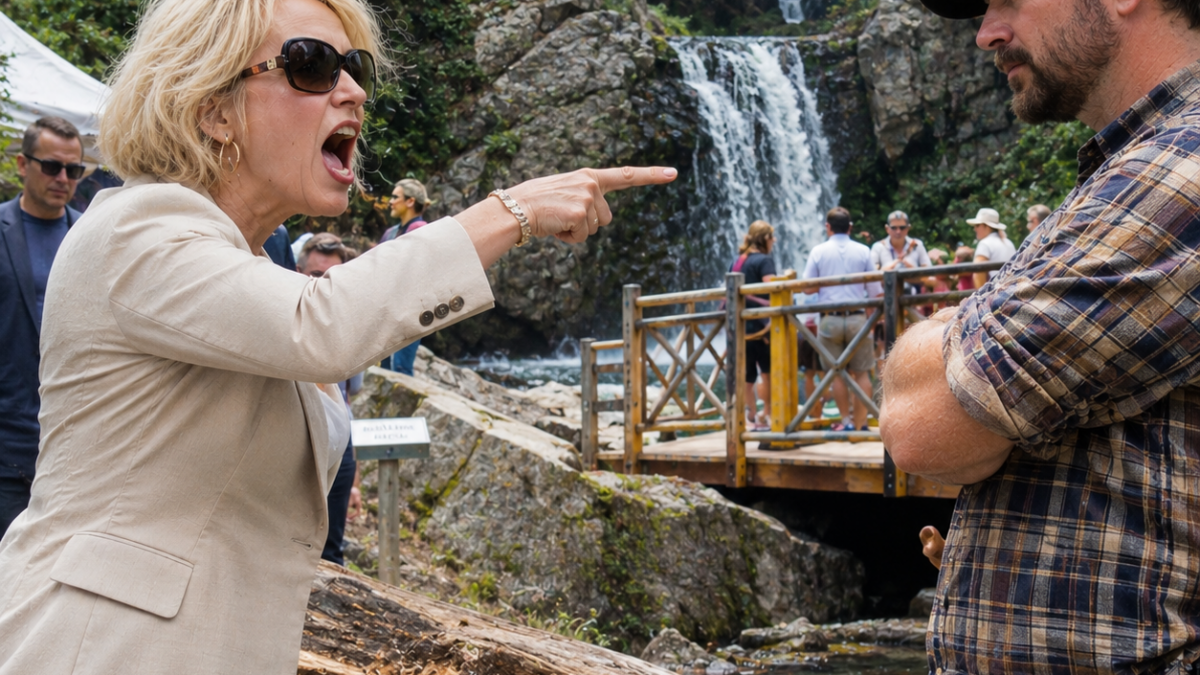
PART 2
I barely slept that night.
Every time I closed my eyes, I pictured hundreds of people walking down my maintenance road while Claudette stood somewhere near the front collecting congratulations for an attraction she did not own.
The waterfall itself was never the only thing bothering me.
I kept thinking about the phrase the ticketing representative had used.
**Signed site-access authorization.**
I knew every meaningful document I had signed involving Rookwood Hollow.
Purchase papers.
Insurance forms.
A forestry agreement.
A limited drainage inspection permission for county utility workers several years earlier.
Nothing remotely connected to Juniper Bluffs.
Nothing involving tourism.
Nothing involving a bridge.
Nothing involving commercial access.
Yet somebody apparently had a piece of paper with my name on it.
That changed the nature of the problem.
An arrogant neighbor could be dealt with.
A forged or altered document could follow the property for years if nobody challenged it properly.
I had spent twenty years around large infrastructure contracts. I had seen one badly worded clause turn a simple disagreement into six months of lawyers arguing over what two men meant during a ten-minute meeting. I had also learned something else: when trouble starts, people suddenly remember conversations differently.
So I stopped relying on memory.
I created a folder.
Every email.
Every screenshot.
Every photograph.
Every ticket price.
Every promise in Claudette’s marketing.
Every date.
Every company name.
I printed the flyer.
I printed the ticket page.
I took screenshots showing the SOLD OUT banner.
I saved the event description promising “exclusive private bridge access.”
Then I went through the route map carefully.
That was when I realized how deliberately it had been designed.
Juniper Bluffs owned a roughly three-acre common parcel near the edge of the subdivision. The check-in tents, parking arrows, portable restrooms, sponsor banners, and hospitality reception were drawn inside that parcel.
Nothing obviously illegal there.
But from the common parcel, a wide gold line flowed toward Rookwood Hollow without any visible break at the boundary. It continued down my maintenance lane toward the gorge, then split into three labeled attractions:
**VIP BRIDGE**
**PRIVATE FALLS OVERLOOK**
**PREMIUM PHOTO TERRACE**
All three were on my land.
The map did not say that.
The boundary was not drawn.
If I had been a ticket buyer, I would have assumed Juniper Bluffs owned the whole thing.
That made me angrier than Claudette’s insult at the HOA office.
She had not just made a mistake.
Someone had created a visual story designed to make eight hundred customers believe there was no ownership problem at all.
The following morning, I walked my maintenance road toward the northern edge of Rookwood Hollow.
About halfway down, I heard metal striking earth.
Three workers were setting orange survey flags.
A lanky foreman with a clipboard looked up when I approached.
“Morning.”
“What are you marking?”
“Bridge installation.”
He said it casually.
As if bridges appearing in private forests were normal.
“Where exactly?”
He pointed toward the gorge.
“Temporary span. Abutment here, opposite side over there.”
“You know whose property you’re on?”
“Juniper Bluffs event site.”
“No.”
He looked confused.
I showed him the parcel map on my phone.
Then walked him to a survey monument near the tree line.
The brass cap had been there long before either of us.
“This line is the boundary. You’re inside Rookwood Hollow.”
He looked back toward his workers.
“We were told landowner consent was already handled.”
“It wasn’t.”
“Did you sign anything with the HOA?”
“No.”
He turned to the crew.
“Stop setting markers.”
One worker straightened.
The other pulled his mallet out of the ground.
I photographed every flag.
Not because I planned to accuse the workers of anything.
Because documentation protects honest people too.
If Claudette later claimed the contractors had independently chosen a location, those photographs would show exactly when they had been warned.
The foreman gave me his company name.
I gave him mine.
He was polite.
Uneasy.
He told me they would not continue until someone produced written authority.
Twenty minutes later, I heard tires coming fast up the access lane.
Claudette’s white SUV stopped hard enough to throw gravel.
She got out with a rolled map under one arm.
“What are you doing?”
“Preventing unauthorized construction.”
“These workers have permission.”
“Not from me.”
She walked to the hood of her SUV and spread out the map.
A dashed route crossed from Juniper Bluffs toward the waterfall.
She tapped it with one manicured finger.
“This is our scenic access easement.”
I leaned over the map.
I recognized the corridor.
Years earlier, county workers had used a narrow strip near the property line to inspect and repair an old drainage line.
The easement was real.
The use she was claiming was not.
“That is utility maintenance access.”
“It is a recorded access corridor.”
“For drainage work.”
“It crosses your property.”
“So would a power-line easement. That doesn’t mean you can sell picnic tickets underneath it.”
Her mouth tightened.
“The community has used this area historically.”
“Which community?”
“Juniper Bluffs.”
“For what?”
She did not answer directly.
Instead, she tapped the dashed line again.
“The easement exists.”
“So does the wording.”
The foreman was still standing nearby.
Listening.
Claudette turned toward him.
“Continue.”
He shook his head.
“Not until ownership is clarified.”
“I am telling you it is clarified.”
“With respect, Ms. Huxley, you’re not the landowner.”
Her head snapped toward him.
“I hired your company.”
“That doesn’t change who owns the site.”
For the first time since I had met her, someone she was paying had told her no.
She did not handle it well.
“You are under contract.”
“And our contract requires lawful access.”
“Then call your office.”
“I already did.”
Her cheeks flushed.
Then another car pulled behind us.
Daphne Colter stepped out.
I knew her only by reputation.
Juniper Bluffs treasurer.
Quiet.
Careful.
Not one of the people who enjoyed microphones.
She stared at the orange flags.
“What are these?”
“Bridge markers,” Claudette said.
Daphne looked surprised.
“Bridge?”
“For Saturday.”
“When did the board approve construction?”
“All relevant approvals have been handled.”
“I don’t remember a construction vote.”
“It falls under event operations.”
“I’d like to see the contract.”
Claudette’s tone changed immediately.
“Daphne, this is not within the scope of your responsibilities.”
Daphne stared at her.
“I’m the treasurer.”
“This is site logistics.”
“Site logistics cost money.”
“I said it has been handled.”
There was a long pause.
Daphne nodded slowly.
Not agreement.
More like she had stored the answer somewhere.
Claudette saw it too.
“Go back to the office. I’ll brief the board later.”
Daphne did not argue.
She got back into her car.
But before she drove away, she looked at me.
That look said something had changed.
I went home and searched the event receipts again.
That was when the merchant name jumped out.
**SUMMIT CREST EVENT PARTNERS LLC**
Not Juniper Bluffs.
I searched the North Carolina business registry.
Claudette Huxley.
Managing member.
I sat at my kitchen table, staring at the screen.
The HOA president had used the association’s name and logo to sell a community event.
But the money was flowing through a private company she controlled.
Maybe there was an innocent explanation.
Event management companies exist.
HOAs contract with outside vendors all the time.
But when the president owns the vendor and the treasurer is asking why she has not seen contracts, the word innocent starts needing evidence.
Then an automated delivery confirmation landed in my inbox because one vendor had apparently included my property address on the shipping route.
Bridge delivery:
Friday.
Grand opening:
Saturday, 8:00 a.m.
I looked at the calendar.
Days.
That was all I had.
The expanded board meeting came two nights later.
Claudette packed the community center.
A projector displayed enormous images of Silvervale Falls.
Sponsors.
Revenue estimates.
Tourism numbers.
A slide in gold letters:
**SOLD OUT IN 21 DAYS**
Several residents applauded.
I understood the excitement.
Juniper Bluffs was a nice development, but nobody outside the county cared much about it. Claudette was promising attention, visitors, local press, maybe higher prestige.
One man raised his hand.
“My sister is coming from Virginia. Hotel is already booked.”
A woman near him said, “My parents bought VIP tickets.”
Another resident said cancellation would make the neighborhood look ridiculous.
Claudette let the comments build.
Then she pointed toward the revenue slide.
“This proves demand.”
I sat in the back row until she finished.
Then I stood.
“Which recorded document gives this association permission to sell access to my property?”
The room went quiet.
Claudette smiled as if she had expected the question.
“Juniper Bluffs possesses historical use rights over certain adjacent natural amenities.”
“Which recorded document?”
She held up a photocopy.
An old subdivision planning map.
There was a faded footpath drawn near the property line.
I walked forward.
“That is a planning map.”
“It documents historical access.”
“It transfers nothing.”
“It shows the path.”
“The path hasn’t been maintained in years.”
“That does not automatically erase historical use.”
“And the actual recorded corridor is for drainage maintenance.”
Claudette turned away from me and faced the crowd.
“This is exactly the problem we face when one person places personal preference above community progress.”
There it was.
She could not prove permission.
So she made refusal sound immoral.
I had seen the tactic in construction disputes.
If the contract is weak, talk about urgency.
If the right is weak, talk about fairness.
If the facts are bad, change the question.
I stayed standing.
“Did the board authorize the sale of access to Rookwood Hollow?”
She ignored me.
Instead she said, “If this event is cancelled through deliberate obstruction, Juniper Bluffs could face serious losses.”
Several people looked at me.
“Ticket holders may have claims.”
I almost smiled.
“Against whom?”
Claudette’s eyes narrowed.
“The person responsible.”
“I didn’t sell them anything.”
“You are preventing fulfillment.”
“I never promised fulfillment.”
“You knew the waterfall was visible from the community.”
“That is not a contract.”
“You are causing financial damage.”
“No.”
I pointed at the ticket graphic on the screen.
“Whoever sold that is responsible for what they promised.”
In the third row, Daphne opened a notebook and started writing.
Claudette noticed.
The meeting ended badly.
Not with shouting.
Worse for her.
Questions.
Residents asking to see the permit.
Asking who signed the access agreement.
Asking whether the board had voted.
Claudette announced she would circulate documents later.
She didn’t.
The next morning, I met Russell Grant in Asheville.
Civil attorney.
Quiet voice.
Sharp mind.
The kind of man who read every footnote.
I laid everything across his conference table.
Flyer.
Ticket page.
Survey.
Photographs.
HOA map.
Summit Crest registration.
Contractor details.
He read without speaking for nearly twenty minutes.
Then he looked at me.
“You never authorized commercial access?”
“No.”
“Any recreational easement?”
“No.”
“Any agreement with Juniper Bluffs?”
“No.”
“Any bridge permission?”
“No.”
“Any ticket revenue?”
“No.”
He nodded.
“Good.”
“Good?”
“Simple facts are good.”
By afternoon, cease-and-desist letters were moving.
To Claudette.
The HOA.
Summit Crest.
Ticket platform.
Bridge rental company.
Contractors.
The language was firm without theatrics.
Rookwood Hollow was private.
No commercial access had been granted.
No right existed to install or operate a bridge.
No public recreational easement existed.
No paying guests had permission.
Vendors were instructed to verify authority before continuing.
Russell also insisted we emphasize safety.
That mattered to me.
I did not want to create the impression that I would open the gate if somebody waved enough money.
The gorge was not prepared for eight hundred guests.
My maintenance road was one lane in sections.
The slope near the falls had erosion.
There was no emergency crowd plan.
No public barriers.
No designed evacuation route.
I began preparing for the possibility that hundreds of people would arrive anyway.
Directional signs.
Private-property notices.
Contact with the ticket platform.
A safe place for cars to turn around.
The worst possible outcome would be eight hundred angry people piled onto a mountain road with nowhere to go.
Claudette responded the same night.
Resident email blast.
Printed notices in the clubhouse.
Headline:
**PRIVATE LANDOWNER ATTEMPTS TO SABOTAGE SOLD-OUT COMMUNITY CELEBRATION**
My phone rang until almost midnight.
“Why are you doing this?”
“It’s one day.”
“People already paid.”
“You’re embarrassing the neighborhood.”
One voicemail called me a miserable old man.
I wasn’t old enough to enjoy that one.
Then notes appeared in my mailbox.
**STOP BEING SELFISH.**
**WE ALL ENJOY THE FALLS.**
**THE VIEW DOESN’T BELONG TO YOU.**
The last one was technically true.
The view did not belong to me.
But the trail, gorge edge, bridge location, and overlook did.
Meanwhile, something interesting happened inside Juniper Bluffs.
Residents asked Claudette to email the access documents.
She didn’t.
People who pressed too hard stopped receiving event updates.
Daphne noticed.
So did several board members.
Thursday morning, Fiona Greaves arrived at Rookwood Hollow with a tripod, GPS receiver, county records, and the personality of someone who considered “close enough” a personal insult.
She walked the boundary for three hours.
Checked monuments.
Coordinates.
Deed calls.
Proposed bridge locations.
Viewing area.
Utility corridor.
Then we sat at my kitchen table.
“Your boundary is clean.”
“Bridge?”
“Both abutments are inside your parcel.”
“Terrace?”
“Inside.”
“Access?”
“No public right.”
I handed her Claudette’s map.
She studied it.
Then opened her own folder.
The original recorded plat.
She laid both side by side.
“See this?”
Near the margin of the original was a line of small capital letters.
**UTILITY MAINTENANCE ACCESS ONLY — NO PUBLIC RECREATIONAL RIGHTS**
I compared it to Claudette’s copy.
That entire edge had been cut off.
“She cropped it.”
“The copy being distributed excludes the restriction.”
“Could that happen accidentally?”
Fiona looked at me.
“Anything can happen accidentally.”
Then she tapped the exact missing sentence.
“That would be a remarkably convenient accident.”
She verified everything again.
No public recreational easement.
No commercial access.
No bridge rights.
No right to charge admission.
She prepared a stamped boundary exhibit for every relevant party.
That evening, Joan Whitaker from the bridge rental company called.
Her voice was friendly but careful.
“We need to discuss the access dispute.”
“Good.”
“Our file includes a site-use consent form bearing your signature.”
“I didn’t sign one.”
She paused.
“It appears to be your signature.”
“Send it.”
The PDF arrived five minutes later.
I opened it.
My blood went cold.
It was my signature.
Not similar.
Mine.
Then memory hit.
Several years earlier, county utility workers needed access to inspect the drainage structure.
I had signed a one-time permission form.
I found it in an old property file.
Put both documents side by side.
The signatures matched perfectly.
Every curve.
Every loop.
Every tiny irregularity.
Then I saw the dust speck.
A tiny black scanner mark beside the last letter of my surname.
On both documents.
Same location.
Same shape.
People do not sign their names identically twice down to scanner debris.
The old document authorized county workers to inspect one drainage pipe during one limited period.
The new document claimed I had approved a tourist event, commercial guests, and installation of a temporary pedestrian bridge.
Same signature image.
Different words.
Different date.
Different purpose.
I called Russell.
Then Fiona.
Then Joan.
Then the county.
I was careful with the language.
I could show that the signature image appeared identical to the older scan.
I could show I had not knowingly signed the new document.
A forensic conclusion belonged to experts.
But nobody needed to be an expert to understand why the page demanded investigation.
Then I called Claudette.
“You used my signature.”
“You signed the authorization.”
“When?”
She gave me a date.
I checked my calendar.
Charlotte engineering conference.
Three days.
Hotel receipt.
Registration badge still in a drawer.
Credit-card charges.
“You’re saying I signed it here?”
“Yes.”
“I was in Charlotte.”
Silence.
“Who witnessed it?”
“The authorization came through property management.”
“That’s not what you just said.”
“I’m not required to explain internal processing to you.”
“Do you have the original ink document?”
Another pause.
“The authorization is valid.”
“Where’s the original?”
Click.
She hung up.
I wrote the conversation down immediately.
Across Juniper Bluffs, Daphne was doing her own audit.
Two years of board minutes.
Nothing authorizing commercial ticket sales to Silvervale Falls.
Nothing authorizing a contract with me.
Nothing authorizing a bridge.
Then she found an $8,000 transfer from the HOA operating fund to Summit Crest Event Partners.
Memo:
**COMMUNITY INFRASTRUCTURE PREPARATION**
No board vote attached.
No contract in the packet.
No disclosure that the company belonged to Claudette.
Daphne called me that evening.
Her voice was low.
“I think this is bigger than the event.”
“I’m starting to agree.”
“I don’t want my name used publicly yet.”
“Understood.”
“I’m going to keep reviewing records I’m authorized to access.”
“Good.”
She paused.
“I feel stupid.”
“Why?”
“I’m the treasurer.”
“And?”
“I should’ve noticed.”
“You can’t notice what people keep outside the normal process.”
“I should’ve asked earlier.”
“Ask now.”
She went quiet.
Then:
“I will.”
The next morning, county building inspector Mabel Dorsett appeared at the HOA office.
Fifty-seven.
Three decades of rejecting paperwork that looked official until somebody actually read it.
She requested everything associated with the bridge and event site.
Claudette handed her an activity registration.
Mabel read it once.
“This is for your community center.”
“It covers the event.”
“No.”
“It is all one event.”
“It is one event in multiple locations. This approval covers one location.”
She placed it down.
“Where is the authorization for Silvervale Falls?”
Claudette shifted.
“Our access rights are documented separately.”
“Then provide them.”
Mabel also requested structural plans.
Bridge load limits.
Emergency access.
Crowd plan.
Evacuation route.
Protective measures near the gorge.
That brought Wyatt Kearns into the story.
Structural engineer.
Direct enough to make nervous people more nervous.
He reviewed the fifty-four-foot modular aluminum bridge.
The equipment itself was legitimate.
Designed to rest on portable abutments with counterweight blocks.
Properly assembled on suitable ground and used within certified limits, there was nothing inherently wrong with it.
Then he walked the installation locations.
His expression changed.
He pushed a soil probe into one area.
Moved a few feet.
Tried again.
“How old are these drawings?”
I looked at the contractor.
“Why?”
“The ground condition shown here is not what’s here.”
Claudette’s plan treated both abutment zones as stable.
One sat uncomfortably close to an eroded band near the gorge lip.
Then Wyatt examined the advertised VIP gathering area.
Too small.
Crowd circulation inadequate.
Then load.
Claudette had marketed all 120 VIP ticket holders as having bridge access during one “exclusive” period.
The rental company’s preliminary engineering allowed approximately twenty-four people on the span simultaneously, pending final inspection.
There was no rotation schedule.
No queue plan.
No crowd-control staffing.
No timed bridge groups.
Nothing.
Wyatt stood near the maintenance road and looked uphill.
“How many total attendees?”
“Eight hundred.”
He stared at me.
“Here?”
“Yes.”
“How many exits?”
“One practical route.”
He looked back toward the gorge.
“The bridge capacity isn’t my biggest concern.”
“What is?”
“The people waiting for the bridge.”
A surge near the viewpoint could be more dangerous than the structure itself.
That scared me.
I had spent years on construction sites where the public was kept behind barriers for a reason.
People imagine risk comes from spectacular failures.
Often it comes from ordinary confusion.
Too many people.
Wrong direction.
No room.
One person falls.
Everybody behind them keeps moving.
That evening, Claudette called.
Her voice was almost friendly.
“I want to make you an offer.”
“No.”
“You haven’t heard it.”
“I know what you want.”
“Ten thousand dollars.”
“For?”
“One day of access.”
“No.”
“Fifteen.”
“No.”
“Benton, you can earn fifteen thousand dollars by doing absolutely nothing.”
“I’m already doing something.”
“What?”
“Protecting my property.”
Her voice sharpened.
“You are holding out for a bigger number.”
“No.”
“Everybody has a number.”
“Not for this.”
“That’s ridiculous.”
“No. What’s ridiculous is selling eight hundred tickets first and negotiating with the owner afterward.”
“You’re enjoying this.”
That actually made me angry.
“You think I enjoy spending my week on lawyers, inspectors, surveyors, and angry emails because you sold something that wasn’t yours?”
“You’re making it harder than necessary.”
“I said no before the bridge arrived.”
“You don’t understand what’s already invested.”
“That is not my responsibility.”
She hung up.
Preparations continued anyway.
Bright gold VIP signs appeared.
Portable fencing.
Hospitality supplies.
Sponsor banners.
Traffic cones.
The parking area was nowhere near large enough for eight hundred guests arriving in separate vehicles.
I documented everything.
Every contractor received the survey.
The cease-and-desist letter.
County notices.
Most reacted the same way.
Confusion first.
Then caution.
They were working from Claudette’s version.
Once shown mine, they became much less willing to take risks.
Wednesday, Mabel issued a formal notice.
No bridge use until Claudette provided lawful site authority, verified installation plans, crowd controls, emergency access, and safety measures.
Claudette responded that this was merely a private community gathering.
Mabel opened the guest roster.
Eight hundred names.
“Eight hundred paying customers is not a neighborhood walk.”
That line traveled quickly.
Wednesday night, I made my decision.
If the event collapsed, people would blame me.
Fine.
I would rather have strangers angry from a safe parking lot than injured in my gorge.
I started coordinating with the ticket platform.
Asked them to notify buyers that access was disputed.
I posted signs at the public road where I had permission.
**PRIVATE PROPERTY AHEAD**
**NO EVENT ACCESS TO WATERFALL**
**FOLLOW PUBLIC PARKING DIRECTIONS**
I worked with people inside Juniper Bluffs to plan a safe turnaround.
I wanted no one trapped.
No confrontation at my gate.
No one wandering down the steep road looking for a shortcut.
At nine Thursday night, Claudette sent a recorded video message to all ticket holders.
She stood in front of the clubhouse smiling.
“The Silvervale Falls Exclusive Experience is proceeding exactly as scheduled.”
Banner underneath:
**EVENT STILL ON — NO REFUNDS NECESSARY**
Within an hour, buyers reported the self-service refund option was no longer available.
The next morning, her newsletter included a photograph of me standing beside my gate.
Low angle.
Arms crossed.
Caption:
**ONE SELFISH PROPERTY OWNER IS RUINING A WONDERFUL COMMUNITY EVENT**
The angry emails became uglier.
“I’m driving six hours.”
“My daughter has been looking forward to this.”
“You can’t close a natural landmark.”
“You’re greedy.”
“What kind of person does this?”
One message simply said:
**OPEN THE DAMN GATE.**
I never answered anger with anger.
Russell advised me not to.
More importantly, I didn’t want eight hundred disappointed customers turned into enemies when most of them had simply trusted a seller.
I released a short statement.
I did not sell tickets.
I did not authorize the event.
I received no ticket money.
Silvervale Falls was private land.
Buyers should contact the ticket platform and organizer.
Then an email came from Beatrice Langley.
Nurse from Knoxville.
Thirty-eight.
She had paid $349 for the VIP package.
She attached her confirmation.
The promises were outrageous when I saw them in a customer’s actual receipt.
Guaranteed bridge crossing.
Premium waterfall view.
Private photography area closed to general admission.
Unlimited access to the overlook during her scheduled window.
She wrote:
**Mr. Rookwood, I’m angry because I spent a lot of money and booked a hotel. But I need to know whether what you’re saying is true. Do all these places belong to you?**
I replied personally.
Yes.
I explained the boundaries.
The bridge dispute.
The lack of consent.
I gave her the ticketing contact.
She responded later.
**I read your email twice. I believe you. I’m asking Claudette for the permit.**
Two days later, Beatrice drove two hours to a Juniper Bluffs meeting.
She stood in the middle of the room.
“If you have permission, why won’t you show us the original agreement?”
Claudette smiled.
“It contains confidential provisions.”
Daphne stood from the board table.
“Which board meeting approved that agreement?”
Claudette immediately moved to parking.
“We need to focus on Saturday logistics.”
Beatrice stayed standing.
“Who received my $349?”
The room changed.
People stopped looking at me.
They looked at Claudette.
That question was simple enough that every person understood it.
Who got the money?
Claudette tried to explain that Summit Crest provided event administration.
Daphne asked why the board had never received a contract.
Claudette called the question inappropriate.
A man near the back shouted:
“It’s our HOA name on the tickets.”
Someone else:
“Is the money going to the HOA or not?”
Claudette adjourned early.
But doubt was already moving faster than her emails.
That night, reporter Taryn Elwood started receiving calls from buyers.
Regional paper.
Thirty-five.
Known for following documents rather than arguments.
She contacted me.
I provided the survey.
My objections.
The utility-easement restriction.
The ticket-company contact.
The disputed authorization information, carefully described as under review.
I gave her no buyer names.
Claudette declined to answer questions about Summit Crest.
Meanwhile, I asked Joan to walk me through the bridge rental agreement line by line.
That was when she found the clause.
The bridge had not been purchased.
It remained property of the rental company at all times.
The renter—Claudette’s organization—had warranted that lawful authority existed for the installation site.
If that authority could not be established, the equipment owner had contractual rights to recover its property.
I read it again.
Then again.
I looked at Joan.
“So I don’t need to touch the bridge.”
“No.”
“I don’t need to claim it.”
“No.”
“You own it.”
“Our company does.”
“And if site authorization fails?”
“We can retrieve our equipment.”
That was the first moment all week I felt something resembling relief.
I did not want to seize Claudette’s property.
I did not want another dispute about who had rights to what.
The bridge had a clear owner.
And that owner wanted it off a disputed site.
Joan’s office demanded verification from Claudette.
She insisted my signature was valid.
She instructed crews to continue.
The rental company formally suspended all bridge use.
Friday afternoon, the bridge components arrived according to the original schedule.
They were placed across temporary supports.
Not certified.
Not inspected for operation.
Mabel’s prohibition notice went directly onto the nearest truss.
Claudette stood beside the structure telling staff:
“That bridge opens tomorrow with or without Benton.”
Maybe she believed it.
Maybe she simply needed everyone else to believe she believed it.
Friday evening, Joan’s operations director and Otis Vail met me at the gorge.
Otis was the rigging chief.
Fifty-one.
Hands like he had spent his entire life tightening steel.
He studied the span.
“We can get it out.”
“Without damaging it?”
“Yes.”
“Without damaging the property?”
“If everyone follows the plan.”
“Where do you put it after lifting?”
He pointed toward the access lane.
“We need firm staging pavement.”
Juniper Bluffs had a perfect staging lot.
Wide.
Paved.
Truck access.
Exactly where Claudette had stockpiled event equipment.
But it was HOA property.
I refused to use it without permission.
Otis looked at me.
“You’re serious?”
“Completely.”
“You know they put this on your land without permission.”
“Yes.”
“And you’re worried about using their parking lot?”
“Yes.”
He nodded slowly.
“Fair enough.”
Daphne called an emergency board meeting.
Friday night.
The room was tense before we entered.
Daphne laid out the facts.
Property right unresolved in Claudette’s favor.
County had prohibited bridge use.
Rental company wanted its equipment back.
Eight hundred customers faced cancellation.
The association needed to reduce exposure.
We requested temporary permission for the bridge owner to use the paved common staging lot solely for equipment recovery.
Claudette exploded.
“This is exactly what he wanted.”
I stared at her.
“What?”
“To destroy the event publicly.”
“No.”
“You have been undermining us from the beginning.”
“I told you to cancel twelve days ago.”
“Because you wanted control.”
“It’s my land.”
“That is exactly the attitude I’m talking about.”
One board member interrupted.
“Claudette, where is his original consent?”
“We have the authorization.”
“We’ve seen a scan.”
“It’s valid.”
“Where is the original?”
She stared at him.
Another board member:
“Did we approve Summit Crest?”
“This meeting is about bridge recovery.”
“No. I’m asking a financial question.”
Daphne took over.
“The bridge company needs an answer tonight.”
Vote.
Four in favor.
One against.
Claudette.
Temporary use of the staging lot approved.
The rental company could place the recovered bridge there before transporting it back to its yard.
Claudette left without speaking.
Late that night, Wyatt and Otis walked the gorge with flashlights.
They mapped every lift point.
Exclusion zone.
Crane position.
Rigging angle.
Flatbed path.
No improvising.
I stood near the falls listening to water hit granite.
“No shortcuts.”
Otis nodded.
“No damage.”
“That’s the goal.”
“I want every piece accounted for.”
“It will be.”
Near midnight, Claudette emailed ticket holders again.
**FINAL PREPARATIONS UNDERWAY. EVENT PROCEEDING.**
Some guests probably went to sleep believing the bridge would open in eight hours.
We sent corrections.
Ticketing platform.
Rental company.
Board majority.
No waterfall access.
No bridge.
Do not enter private road.
Refund information would follow.
Then Claudette somehow learned the crane schedule.
She called me.
Her voice shook with rage.
“You touch that bridge and I will make sure every person arriving tomorrow knows what you did.”
“The company that owns it is removing it.”
“You arranged this.”
“You signed the rental agreement.”
“That bridge is the centerpiece of my event.”
“It is on my property without valid authorization.”
“You are going to regret this.”
“No.”
I looked at Fiona’s survey on my table.
“I think tomorrow everyone finally sees what you sold them.”
She hung up.
I did not sleep much.
At 5:15 Saturday morning, I was outside.
Mist over the trees.
Cold coffee.
Crew trucks arrived one at a time.
At 6:40, the crane came up the controlled lane.
Otis walked the lift plan again.
Every person knew their role.
I signed authorization allowing the recovery company to work on my property.
That signature mattered.
Real permission.
Correct purpose.
Correct date.
Correct owner.
I looked at it before signing.
Funny how much meaning ink can gain after someone misuses it.
Headlights appeared far below.
Ticket holders.
The first few cars.
Then more.
Traffic volunteers directed them toward public parking and the overflow lot approved by the HOA majority.
By 7:12, hundreds of guests were gathered beyond my locked gate.
Some angry.
Some confused.
Some holding printed tickets.
Several VIP guests wore wristbands.
A few had professional cameras around their necks.
Children were asking parents when the waterfall opened.
That part hurt.
They had no idea.
Otis radioed the crane operator.
The rigging tightened.
The fifty-four-foot bridge gave a low metallic groan.
Then it lifted.
Slowly.
One foot.
Three.
Five.
Above the temporary supports.
Above the gorge.
Nobody cheered.
I did not want cheering.
This was not demolition.
It was recovery.
Then a woman screamed.
“STOP!”
Claudette came running.
Cream blazer.
Pearls.
The outfit she had planned to wear for the opening.
A folder in one hand.
“STOP THAT CRANE!”
Otis immediately paused the lift.
The bridge hovered safely.
Claudette reached the work zone boundary.
“That is my VIP bridge!”
I walked toward her.
“No. It belongs to the rental company.”
“I have authorization.”
She raised the folder.
“HOA permit. Landowner consent. Everything.”
Mabel Dorsett stepped forward.
“May I see it?”
Claudette looked at the crowd.
Too many witnesses.
She handed over the folder.
Mabel opened the permit.
Read it.
“This covers an activity at the Juniper Bluffs community center.”
“It covers the overall event.”
“It does not authorize this site.”
“It is incorporated.”
“Show me where.”
Claudette pointed vaguely.
Mabel continued.
“Landowner consent?”
“There.”
I handed Mabel two documents.
Original drainage form.
Event authorization.
Fiona stood beside us.
I pointed at the signature image.
Same loops.
Same slant.
Same scanner speck.
Then the date.
“I was in Charlotte.”
Claudette snapped:
“He signed it.”
Mabel looked at her.
“Authenticity will require formal review.”
“He’s lying.”
“A disputed document does not authorize public operation today.”
Claudette’s voice rose.
“This event has eight hundred customers.”
“That does not change the site requirement.”
“The bridge is safe.”
“Safety is not the only deficiency.”
“Everything can be fixed.”
“Not at 7:12 in the morning with guests already arriving.”
The people nearest the gate heard every word.
Whispers spread backward.
I turned toward Claudette.
“You sold eight hundred tickets to land you don’t own using a bridge you don’t own.”
Beatrice’s voice came from the front of the guest area.
“Then what exactly did we pay for?”
The crowd erupted.
“Where’s the permit?”
“Did he sign?”
“Where is our money?”
“Can we get refunds?”
“Why is the bridge leaving?”
“Who owns Summit Crest?”
Claudette raised both hands.
“Everyone remain calm. We are resolving an administrative disagreement.”
Beatrice shouted:
“I drove two hours for an administrative disagreement?”
Someone laughed bitterly.
Another guest held up his VIP pass.
“Three hundred forty-nine dollars!”
Taryn filmed from the public roadside.
Once Otis confirmed the work zone was secure, he radioed:
“Continue.”
The crane moved.
Claudette stared upward.
The bridge swung clear of the gorge.
Past the trees.
Off my land.
For the first time in days, the view opened again.
Water.
Mist.
Granite.
Nothing artificial crossing it.
The span was lowered to the flatbed.
Then hauled slowly toward the Juniper Bluffs staging lot.
Hundreds of people watched.
Claudette followed on foot.
Still talking.
Still insisting the event could be salvaged.
Otis’s crew lowered the bridge onto heavy-duty cradles in the center of the paved lot.
There it sat.
Fifty-four feet of aluminum.
No waterfall.
No gorge.
No private overlook.
Just asphalt.
Orange cones.
Portable toilets in the distance.
Beatrice walked toward it.
Looked at the bridge.
Then Claudette.
“You charged me $349 to see a waterfall.”
She gestured around.
“Are we supposed to stare at the parking lot?”
A ripple of laughter moved through the guests.
Not happy laughter.
The kind people use when anger becomes absurdity.
Then everyone started demanding refunds.
Daphne climbed onto the back of a pickup.
“Please listen.”
People quieted gradually.
“The Juniper Bluffs board never approved the sale of commercial access to Silvervale Falls.”
Several homeowners gasped.
Daphne continued.
“We are working with the ticketing platform and vendors to protect customers and determine what happened to event funds.”
Claudette marched toward her.
“You have no authority to make that statement.”
“I’m the treasurer.”
“You are creating liability.”
“No.”
Daphne held up a folder.
“I think we already have liability.”
Claudette turned toward me.
“You ruined my event.”
I looked at her.
“No.”
“You planned this.”
“You sold something that was never yours.”
Her face went red.
“You could have cooperated.”
“You could have asked.”
For once, she had nothing immediate to say.
Then Daphne stepped down from the pickup.
“We need to talk about the $129,600.”
Claudette’s anger disappeared for half a second.
Fear replaced it.
That was the moment I knew the bridge was no longer her biggest problem.
Monday’s emergency session packed the clubhouse beyond capacity.
Residents stood along walls.
Ticket buyers sat in the back.
Beatrice attended with a group of nearly forty customers who had connected after Saturday.
Fiona came.
Mabel.
Joan.
Russell.
Several vendors.
Taryn stayed outside until the public portion began.
Daphne stood at the front with financial records.
“No valid board resolution authorized ticket sales to Rookwood Hollow.”
Claudette interrupted.
“The event fell within presidential authority.”
Daphne continued.
“No contract with Mr. Rookwood appears in our approved records.”
Claudette:
“We relied on site authorization.”
Daphne:
“Which is under review.”
Then the money.
Ticket revenue processed through Summit Crest Event Partners.
Company controlled by Claudette.
Not Juniper Bluffs HOA.
Claudette stood.
“It was an administrative vehicle.”
Daphne looked at her.
“Why wasn’t the board told?”
“Because event logistics required speed.”
“Why was HOA branding used?”
“Because Juniper Bluffs sponsored the event.”
“Where is the sponsorship agreement?”
Silence.
Daphne continued.
“Why did the HOA operating account send eight thousand dollars to Summit Crest?”
“Startup costs.”
“Who approved it?”
“I did.”
“The board did not.”
“I had spending authority.”
“Not for an undisclosed related-party company.”
Claudette’s face hardened.
“You are not qualified to interpret governance law.”
Daphne almost smiled.
“I don’t need to interpret anything to tell homeowners where their money went.”
A resident shouted:
“Exactly.”
Another:
“Why didn’t we know you owned Summit Crest?”
Claudette said:
“It was public information.”
Daphne answered:
“So public that nobody on the board was told.”
That got a murmur.
Then she laid out the three core problems.
First:
Claudette had advertised commercial access to property the HOA did not own.
Second:
The land authorization bore a signature image that appeared identical to an older limited drainage form and was under formal review.
Third:
A private company she controlled had processed the event revenue while the HOA’s name, logo, and operating funds supported the venture.
Beatrice stood.
“How can you sell premium access to private land without the owner’s permission?”
Claudette sighed.
“This entire matter began as a misunderstanding of historic access rights.”
Fiona stood.
Projected the survey.
Boundary line.
Utility corridor.
Then enlarged the original plat.
**UTILITY MAINTENANCE ACCESS ONLY — NO PUBLIC RECREATIONAL RIGHTS**
She placed Claudette’s cropped version beside it.
The missing sentence was obvious.
Nobody spoke for several seconds.
Mabel followed.
She listed the permit deficiencies.
No site authorization.
No crowd plan sufficient for the advertised attendance.
No approved bridge operation.
No adequate emergency arrangement for the gorge.
Wyatt explained the capacity issue.
Approximately twenty-four people on the bridge at one time under preliminary conditions.
One hundred twenty VIP guests marketed for the same premium period.
No queue strategy.
No grouping plan.
No adequate staging space.
Joan confirmed Claudette had rented, not purchased, the bridge.
The equipment owner had suspended use because lawful site authority could not be verified.
Then somebody in the room asked the question everyone cared about.
“What happens to our money?”
A ticket-platform representative joined by phone.
Most buyer funds were still within settlement processes and had not all been fully released to the organizer.
Because the advertised event was not delivered, refund procedures were beginning under the platform’s contract.
Phones started buzzing.
One after another.
General admission:
$129 refund processing.
VIP:
$349 refund processing.
Beatrice looked at her screen.
Then closed her eyes.
“Finally.”
Claudette stood.
“This is premature.”
People stared at her.
“Customers were denied entry because Benton blocked access.”
I answered from my seat.
“I never sold access.”
“You prevented performance.”
“I never contracted to perform anything.”
Russell leaned toward his microphone.
“Mr. Rookwood’s position has been consistent since before bridge installation: no consent was granted.”
Claudette looked around the room.
For the first time, I think she realized no one was waiting for her to explain reality anymore.
Reality had documents.
Russell prepared my claim for reasonable costs.
Survey.
Legal work.
Restoration.
Coordination costs I had advanced for safe bridge recovery.
No ridiculous punitive number.
No attempt to become wealthy.
I wanted to be made whole.
Nothing more.
Daphne asked the board to review Claudette’s personal responsibility for unauthorized expenditures.
Claudette tried to separate herself from Summit Crest.
But the company registration named her.
The rental agreement carried her signature.
Vendor emails came from her address.
Marketing approvals had her name.
That evening, Taryn’s article went online.
Front page the next morning.
Cancelled private-waterfall event.
Disputed access document.
HOA governance questions.
Refunds.
When Taryn called me, she asked:
“Do you want revenge?”
“No.”
“Nothing?”
“I wanted my property protected.”
“What about the customers?”
“I wanted them protected too.”
“And Claudette?”
I looked toward the waterfall through my kitchen window.
“Everything else belongs in the proper process.”
That quote made the paper.
The membership meeting came later.
This time, every procedure mattered.
Notice.
Quorum.
Ballots.
Rules.
Independent tally.
Claudette could not adjourn because she disliked a question.
She could not remove people from an email chain and pretend disagreement had disappeared.
Daphne presented the financial review.
Homeowners asked about Summit Crest.
The $8,000.
Hidden contracts.
Event money.
Use of the HOA logo.
The bridge.
The access document.
Claudette stood to defend herself.
“My goal was to put Juniper Bluffs on the map.”
A retired schoolteacher in the second row stood.
“You cannot build our community’s reputation by selling someone else’s property.”
Nobody applauded Claudette.
The silence was worse.
The vote was counted.
Claudette Huxley was removed as president.
No dramatic shouting.
No police dragging her away.
Just a title disappearing because the people who had given it to her no longer trusted her with it.
The new board ordered an independent audit.
Questions about the signature and false statements went to proper authorities.
My civil claim continued separately.
There was no magical overnight verdict.
Real life is slower.
Investigators investigate.
Lawyers argue.
Records are reviewed.
That was fine.
I already had the outcome that mattered most.
The bridge was gone.
The event was cancelled.
The customers were entering the refund process.
Nobody was injured.
My property remained private.
Later that week, Otis and his crew completed the bridge recovery.
Every truss inspected.
Every connector documented.
Photographs.
Handoff records.
The entire span went onto a flatbed bound for the rental company’s yard in Tennessee.
I never claimed it.
Never held it for ransom.
Never tried to keep a piece as a trophy.
It did not belong to me.
I had spent nearly two weeks demanding that ownership mean something.
I wasn’t going to stop respecting ownership when it became convenient.
A restoration crew came next.
Orange stakes removed.
Temporary markings pulled.
Trampled creek-bank areas replanted.
Maintenance road repaired.
Boundary markers cleared.
Native vegetation returned.
Within weeks, the gorge started looking normal.
Within months, you had to know exactly where the temporary supports had been to see any trace.
Silvervale Falls kept pouring over the granite.
No VIP bridge.
No premium photography zone.
No catering tent.
No wristbands.
No event schedule.
One evening, Beatrice called.
“My refund cleared.”
“Good.”
“I wanted to thank you.”
“You don’t need to.”
“You sent people the correct refund information even when some of us were angry at you.”
“You were angry because somebody took your money.”
“I blamed the wrong person at first.”
“That happens.”
She was quiet.
Then:
“I’m sorry you had to fight so hard just to keep what was already yours.”
That sentence hit me harder than I expected.
“Thank you.”
“What mattered most to you?”
I thought about $129,600.
The bridge.
Claudette losing office.
Then Wyatt standing near the gorge telling me the crowd itself was the danger.
“That nobody got hurt.”
Because that was the truth.
After the conflict ended, I kept imagining what might have happened if I had taken Claudette’s $15,000.
Eight hundred guests.
One narrow maintenance road.
A bridge not fully approved.
A steep gorge.
Poor crowd staging.
A premium group five times larger than the preliminary simultaneous bridge capacity.
Maybe nothing would have happened.
Maybe the day would have gone perfectly.
But that is not how responsible decisions are made.
You do not test whether a dangerous plan works by putting hundreds of people inside it.
Money could be refunded.
A broken leg could heal.
Some injuries do not.
I was grateful the only thing people lost that morning was an event they should never have been sold.
Months later, I saw Claudette’s SUV heading out of Juniper Bluffs.
She passed the turnoff to Rookwood Hollow.
At my gate was a new sign.
**PRIVATE PROPERTY — NO PUBLIC ACCESS**
Below it:
**NO COMMERCIAL EVENTS OR PAID TOURS AUTHORIZED**
She did not slow down.
No microphone.
No ribbon.
No crowd.
No title turning her voice into an order.
I watched her disappear down the mountain.
I did not feel triumph.
Mostly relief.
That afternoon, I walked the private trail.
Golden light through the pines.
Mist rising from Silvervale Falls.
The place looked almost untouched.
I stopped near the point where one bridge abutment had been planned.
Fresh vegetation had already begun reclaiming the ground.
That was the ending I wanted.
Not a monument.
No plaque saying:
**BENTON ROOKWOOD DEFEATED THE HOA HERE.**
Just restoration.
People sometimes called what I did revenge.
I disagreed.
Revenge would have been destroying the bridge.
I protected it.
Revenge would have been trapping customers and enjoying their anger.
I helped them find the refund process.
Revenge would have been dumping rented equipment onto HOA land without permission.
I demanded a board vote first.
Revenge would have been suing every Juniper Bluffs homeowner because a few had insulted me.
I didn’t.
What I did was enforce a boundary.
There is a difference.
The most powerful word in the story was not “lawsuit.”
It was not “survey.”
Not “refund.”
Not even “removed.”
It was:
**No.**
No, you cannot sell my land.
No, you cannot turn a drainage easement into a tourist trail.
No, you cannot put my signature under words I never approved.
No, eight hundred customers do not create rights.
No, money already collected does not create consent.
No.
Claudette’s entire strategy depended on that word eventually becoming too expensive for me to keep saying.
She believed if enough people had booked hotels, if enough vendors had been paid, if enough equipment arrived, if the bridge was physically sitting over the gorge, I would surrender because stopping the event would feel socially impossible.
She had mistaken momentum for authority.
Momentum creates pressure.
Not rights.
The new Juniper Bluffs board changed a lot.
Conflict-of-interest disclosures.
Large-contract review.
Clear votes.
Outside companies linked to board members disclosed.
Neighboring property rights verified before planning.
Boring procedures.
Good procedures.
Daphne stayed on temporarily to help rebuild the books.
One afternoon, a Juniper Bluffs resident approached me at Hank’s hardware store.
He was one of the men who had worried publicly about the embarrassment of cancellation.
“Benton.”
“Yeah?”
“I owe you an apology.”
I waited.
“I thought you were being unreasonable.”
“I was difficult.”
“That’s not what I mean.”
“I know.”
“We trusted Claudette.”
“I know.”
“She told us everything was approved.”
“I know.”
“We should have asked to see it.”
“Yes.”
He laughed nervously.
“You’re not making this easy.”
“I don’t know what you want me to say.”
He held out his hand.
I shook it.
“Thank you.”
That was enough.
I did not need him to hate himself.
He had been wrong.
Evidence changed his mind.
People should be allowed to become better informed without being punished forever for what they believed before.
That distinction helped me stop seeing Juniper Bluffs as one giant enemy.
Claudette wanted that.
She wanted residents to think I hated the whole community.
She wanted me to think the entire neighborhood stood behind her.
That made her stronger.
In reality, many residents had never seen the contracts.
Some board members had never voted on the event.
Vendors had been told I had consented.
Ticket buyers had been told the HOA controlled access.
The rental company had been handed an authorization.
Everyone had a different story.
Claudette controlled the gaps.
Once those people started speaking directly to one another, the gaps disappeared.
That was what really defeated her.
Not me.
Information.
Daphne showed the board the money.
Fiona showed everyone the boundary.
Mabel showed the permit limits.
Wyatt showed the safety problem.
Joan showed the rental clause.
Beatrice showed what customers had actually been promised.
Taryn followed the story.
Once all those pieces sat in the same room, Claudette’s confidence could no longer substitute for evidence.
The following year, Juniper Bluffs needed temporary access across a small corner of Rookwood Hollow for legitimate drainage work.
The new president called.
Six weeks before the project.
“Benton, we may need temporary access.”
“What for?”
She explained.
Sent engineering drawings.
Insurance certificate.
Dates.
Exact location.
Restoration terms.
Written request.
I reviewed it.
Russell reviewed it.
I signed.
The crew entered.
Completed the repair.
Restored the ground.
Left.
No reporter.
No argument.
No angry emails.
No crane.
The new president called afterward.
“That was much easier than expected.”
I laughed.
“It usually is when you ask before selling tickets.”
She laughed too.
That ordinary project meant more to me than people might understand.
It proved boundaries had not destroyed the relationship.
They repaired it.
Honest cooperation requires the ability to say no.
Otherwise it is not cooperation.
Years passed.
Silvervale Falls became quiet in my mind again.
For months after the event, unfamiliar engines made me look toward the gate.
Every email notification made my shoulders tense.
Eventually that faded.
Nature helped.
Water does not care about HOA elections.
Trees do not read newspaper stories.
Granite does not remember arguments.
The waterfall kept falling.
That stability put my conflict back into perspective.
One autumn morning, Hank visited.
We stood near the safe upper overlook.
He grinned.
“You know I almost bought a VIP ticket.”
“You’ve been here.”
“Not on a bridge.”
“You never will be.”
“Three forty-nine seemed expensive.”
“First intelligent financial decision you’ve made.”
He laughed.
Then looked toward the falls.
“Did you ever find out who took the aerial photograph?”
“Marketing contractor.”
“Good picture.”
I stared at him.
“You completely missed the lesson.”
“I can appreciate composition and property rights at the same time.”
That was Hank.
Then he became serious.
“Glad I emailed you.”
“So am I.”
I had thought about that.
If Hank had assumed I knew about the event, I might have discovered it Saturday morning.
Eight hundred people arriving.
Bridge already installed.
No Fiona.
No Russell.
No Mabel.
No time.
That one email gave me twelve days.
Sometimes the difference between disaster and control is one person asking a simple question.
**Is this yours?**
Fiona returned months later to check a boundary marker.
We stood near the spot where the first contractor had placed an orange stake.
She looked toward the gorge.
“Still angry about the cropped map?”
“Yes.”
“Good.”
“That healthy?”
“Probably not.”
She pointed toward the boundary.
“You know why that sentence mattered?”
“Because it said no recreational rights.”
“Because it was inconvenient.”
I looked at her.
She continued.
“People read documents looking for the language that helps them. The language that restricts them is usually where the real risk is.”
I remembered that.
The signature issue stayed with me longest.
Long after the bridge was gone.
Long after refunds.
Long after Claudette lost office.
My name had been used to say yes.
That bothered me deeply.
A signature is not decoration.
It is your voice in ink.
Someone had taken a signature I placed on a limited drainage permission and apparently reused the image beneath words I had never agreed to.
That felt like someone had borrowed my identity for one specific sentence:
**Benton Rookwood agrees.**
I didn’t.
The formal review belonged to investigators and document experts.
I stayed careful publicly.
I could prove the image looked identical.
I could prove the alleged date conflicted with my Charlotte trip.
I could prove I had never knowingly signed the new agreement.
The final legal conclusions were not mine to invent.
That restraint mattered.
Claudette had manipulated certainty.
I was not going to answer with my own unsupported certainty.
But privately, the experience changed how I handled documents.
Future access agreements became detailed.
Exact date.
Exact party.
Exact use.
No public rights.
No commercial use unless specifically stated.
No transferable permission.
Russell read one later.
“You know this is a little excessive.”
“Is it?”
He looked at me.
“After your bridge story?”
“Exactly.”
“Fine.”
Even county officials became more careful about site-verification procedures for temporary structures.
If our mess prevented one similar incident, good.
I never wanted Silvervale Falls famous.
That was one of the strangest parts.
Claudette had wanted publicity.
She got it.
Unfortunately, so did I.
For several weeks, cars slowed near the entrance.
A few people stopped and asked whether they could see the falls.
I said no.
Most respected it.
One couple climbed the gate.
I found them halfway down the trail with cameras.
They looked embarrassed.
“We saw the story.”
“That doesn’t create access.”
“We’re sorry.”
I walked them back.
No screaming.
No police.
But it taught me something else.
Even a story about protecting privacy can attract attention that threatens privacy.
Eventually the internet moved on.
Another scandal.
Another outrage.
Another headline.
Rookwood Hollow became boring again.
I loved it.
Winter came.
Snow covered the ground where the bridge had been.
I stood near the gorge one morning.
Water moving beneath ice.
No footsteps.
No banners.
It was almost difficult to believe hundreds of people had once been gathered below my gate.
Land is good at shrinking human ego.
We think our conflicts are permanent.
Mountains watch them disappear.
That helped me release some anger.
For a long time, I wanted Claudette to admit it.
Admit she knew the access was limited.
Admit the map was cropped.
Admit Summit Crest was hers.
Admit she had no right to sell the event.
Eventually I stopped needing any confession.
Facts are not less true because the person responsible refuses to say them aloud.
The bridge left.
Customers got refunds.
The board removed her.
My boundary remained.
The waterfall stayed private.
That was enough.
One afternoon, I found the original flyer in a drawer.
Gold letters.
Perfect photograph.
General admission $129.
VIP $349.
SOLD OUT.
I almost threw it away.
Instead, I cut out one phrase:
**PRIVATE VIP BRIDGE ACCESS**
I framed it above a photograph of the empty gorge after the bridge was removed.
Hank saw it.
“That’s petty.”
“Art.”
“That is petty art.”
“Thank you.”
Sometimes healing means forgiveness.
Sometimes it means framing something ridiculous so you can laugh at it later.
Russell eventually closed the main civil file after the remaining cost and restoration issues were resolved.
He gave me an archive box.
“Keep this.”
“Why?”
“Because you might not own Rookwood Hollow forever.”
I knew he was right.
Inside:
Deed.
Survey.
Utility easement.
Original language.
Final HOA acknowledgement.
Boundary exhibits.
Correspondence.
I labeled the box:
**ROOKWOOD HOLLOW — ACCESS RIGHTS**
Then added underneath:
**READ BEFORE ALLOWING ANY BRIDGES**
Russell stared at the label.
“I’m not asking you to change it.”
“Good.”
Years later, my niece brought her children to visit.
Her son was nine.
We walked the private trail.
Stopped well back from the safe overlook.
He looked toward the gorge.
“Was there really a bridge here?”
“Yes.”
“Did people walk on it?”
“No.”
“Why not?”
“It wasn’t supposed to be here.”
“Who put it here?”
“People who thought they had permission.”
“Did they?”
“No.”
He thought about that.
“Did they say sorry?”
“Some people did.”
“The lady?”
“No.”
“Why?”
“I smiled.
“I don’t know.”
He shrugged.
“What’s for lunch?”
Children know when to move on.
Adults could learn something.
Juniper Bluffs eventually invited me to speak at a meeting about property access.
I refused.
They asked again.
I refused again.
Then Daphne called.
“Please.”
“I’m not giving an HOA seminar.”
“You lived the seminar.”
“That is exactly why I don’t want to.”
“There will be pie.”
Manipulation.
I went.
My entire speech lasted about five minutes.
Know the actual boundary.
Read the actual easement.
A planning map is not a deed.
Never sign on behalf of someone else.
And if your event requires your neighbor’s property, ask before selling eight hundred tickets.
That was it.
People applauded.
Hank later said I should charge $349.
I threatened to move his hardware store.
He asked whether I had a recorded easement.
Fair point.
Over time, the story became local folklore.
People introduced me as “the waterfall guy.”
I hated it.
Then someone called me “the bridge guy.”
Worse.
But people reduce complicated stories to objects.
Fence.
Tollbooth.
Bridge.
The bridge was never the real issue.
Consent was.
That was why Claudette’s own rental contract became so poetic.
She signed a contract promising lawful site authority.
When lawful authority could not be established, the bridge owner had a right to recover its property.
She created the mechanism that physically removed the centerpiece of her event.
She tried to use paperwork to overpower me.
Her paperwork removed her bridge.
She used my copied signature image to claim consent.
That triggered deeper scrutiny.
She used a private company to process event money.
That created financial questions.
She used the HOA logo to create trust.
That sent angry homeowners straight back to the board once the truth came out.
Every shortcut became another trail leading toward accountability.
I did not have to invent revenge.
I simply stopped helping her avoid consequences.
One late summer evening, I stood above Silvervale Falls while mist caught the sunset.
No guests.
No sponsors.
No bridge.
I wondered whether an honest version of Claudette’s idea could ever have worked.
Not eight hundred people.
Never.
Maybe a conservation group.
A few geology students.
Researchers.
Twenty people with proper insurance, planning, and permission.
Maybe.
The conflict had not made me hate sharing the place.
It made me understand how much I valued choosing when to share it.
Choice was the point.
Claudette viewed consent as an obstacle to efficiency.
Ask first?
Slow.
Verify easement?
Slow.
Obtain permit?
Slow.
Get an authentic signature?
Apparently too slow.
Selling first felt efficient.
Right up until every shortcut arrived at the same moment.
Crane.
Crowd.
Inspector.
Survey.
Refunds.
Reporter.
Board questions.
Ignoring consent only looks efficient before consequences appear.
People still ask whether I won.
I never know exactly how to answer.
Did Claudette lose office?
Yes.
Did the bridge leave?
Yes.
Did customers get refunds through the ticket platform?
Yes.
Did Juniper Bluffs formally acknowledge that it had no public recreation right over Rookwood Hollow?
Yes.
Did the disputed document go through proper review?
Yes.
Did I “get my waterfall back”?
No.
Because I never lost it.
That was the heart of the story.
Claudette sold the illusion of control.
Eight hundred transactions did not transfer ownership.
A map did not create an easement.
A temporary bridge did not create a public right.
Reality remained stable underneath all of it.
Saturday morning merely made reality visible.
That is why the crane scene stayed with people.
Claudette’s version:
VIP bridge opens at eight.
Reality:
Bridge owner removes it at 7:12.
Claudette’s version:
Valid permit.
Reality:
Permit covers the community center.
Claudette’s version:
Landowner consent.
Reality:
Disputed authorization using a signature image matching an older drainage form.
Claudette’s version:
Community fundraising event.
Reality:
Ticket revenue processed through a private company she controlled.
Once those versions were visible side by side, she could not talk fast enough to close the gap.
The bridge rose.
Her story collapsed.
I remember her face as the span cleared my tree line.
Not just anger.
Disbelief.
She had spent years, apparently, pushing people until the path in front of her opened.
That morning, nobody rearranged themselves around her certainty.
Otis followed the equipment owner.
Mabel followed the permit.
Fiona followed the boundary.
Daphne followed the money.
Beatrice followed the promise she had purchased.
I followed my deed.
Nobody had to follow Claudette.
That was when her power ended.
The membership vote came later.
The vote merely documented what had already happened.
The last time I saw the bridge, it was strapped onto a flatbed.
No banners.
No VIP decorations.
Just rented equipment going home.
Otis stopped near my driveway.
“Everything accounted for.”
“Any damage?”
“Nothing beyond normal handling.”
“Good.”
He looked toward the open gorge.
“Bridges are supposed to connect things.”
I stared at him.
“That sounded philosophical.”
“I’m tired.”
“Go home.”
He laughed.
Then the flatbed disappeared down the road.
The empty space over the gorge looked correct.
That mattered more than any headline.
Restoration crews came.
Then rain.
Then new growth.
Within a year, almost nobody could tell a bridge had ever touched the site.
That was the real revenge, if someone insists on that word.
Not a ruined Claudette.
An unruined Rookwood Hollow.
My gate became boring again.
One delivery driver stopped years later.
Read the signs.
“Something happen here?”
“You could say that.”
He gave me a package.
Drove away.
Perfect.
The less dramatic my property became, the happier I was.
The most emotional moment came long after everyone else stopped talking about the story.
I was cleaning old files when I found a notebook from the year I bought Rookwood Hollow.
On the first page, I had written why I wanted the land.
Not a business plan.
Not investment math.
Just four things.
**Quiet.**
**Water.**
**Trees.**
**A place nobody schedules for me.**
I sat at my desk looking at those words.
That was what Claudette had actually invaded.
She had put a timetable onto the reason I bought the property.
8:00 opening.
VIP period.
Photography session.
Bridge crossing.
Hospitality.
She turned my quiet into a product schedule without asking.
Maybe that was why $15,000 never tempted me.
Money was not even in the same category as what she was trying to take.
I had spent twenty years living inside project schedules.
Rookwood Hollow was the place nobody scheduled for me.
Its value was emotional long before it was financial.
Claudette could not see that because her spreadsheet had no row for peace.
But peace has value.
Sometimes you only understand exactly how much when someone else starts selling it.
The waterfall stayed private.
But I invited people sometimes.
That word became important to me.
Invite.
Family.
Friends.
Daphne once.
Researchers on legitimate projects.
County workers with correct written permission.
The difference was never that no other human being could enter.
The difference was that I got to choose.
Taryn once asked whether she could photograph the falls for a follow-up feature.
I said no.
She answered:
“Fair.”
No argument.
That one word meant more than she probably knew.
The public did not need access to my waterfall to understand the story.
Privacy survived publicity.
Eventually new families moved into Juniper Bluffs who had never met Claudette.
Some only knew there had once been “a weird bridge fight.”
That was good.
Communities should not orbit their worst leaders forever.
Daphne eventually retired from the board.
She texted me:
**I AM FINALLY FREE OF MEETING MINUTES.**
I replied:
**DON’T START AN EVENT COMPANY.**
Her response was not polite.
Beatrice still emailed once in a while.
One year:
**Still private?**
I wrote:
**Very.**
She answered:
**Good.**
The woman who once bought premium access became one of the people most respectful of never having it.
Because once she understood the truth, she knew the difference between disappointment and entitlement.
That difference saved Saturday morning.
If eight hundred people had decided my refusal obligated me to fulfill Claudette’s promise, we might have had chaos.
Instead, once the facts spread, most understood.
I saw people who had driven hours.
Parents with children.
Couples celebrating anniversaries.
Photographers.
People with expensive cameras.
They were disappointed.
Some were furious.
They were still victims of the seller’s promise.
Protecting my property did not require enjoying their pain.
I could say:
“I’m sorry you were deceived.”
And still say:
“You may not enter.”
Those ideas are not contradictory.
Compassion is not surrender.
The photograph of the bridge hanging over the gorge circulated for years.
Crane boom.
Aluminum span.
Mist.
Trees.
Claudette below in her cream blazer.
Someone captioned it:
**WHEN AN HOA FINALLY MEETS A DEED**
I laughed harder than I should have.
But the most important detail was what the photograph did not contain.
People.
Nobody ever walked that bridge.
Nobody got hurt.
That made the whole conflict worth it.
Wyatt visited months later while working another mountain job.
We walked the former abutment area.
Native plants had returned.
I asked:
“Would the bridge have failed?”
He gave me the expression engineers reserve for bad questions.
“I cannot answer that.”
“Could it have been used safely?”
“Not under the plan presented.”
“Why?”
He counted on his fingers.
“Ground condition mismatch. Insufficient crowd staging. No adequate bridge rotation strategy. Constrained evacuation route. Advertised behavior inconsistent with preliminary load assumptions.”
“English?”
He pointed toward the gorge.
“You were right not to use eight hundred customers as the field test.”
That sentence disturbed me.
Field test.
Exactly.
Claudette had treated every unresolved problem as something to fix after opening.
Site authority?
Later.
Permit?
Later.
Crowd plan?
Later.
Bridge certification?
Later.
Owner says no?
Pressure him.
Refunds?
Disable them.
That mindset frightens anyone who has spent years around infrastructure.
Disasters rarely come from one spectacular bad decision.
They come from several small shortcuts stacked until nothing remains between people and failure.
I eventually built a small safe overlook for family.
Nothing commercial.
No bridge.
Proper setback.
Simple railing where needed.
Hank visited.
He stood there looking at Silvervale Falls.
“VIP?”
“Extremely.”
“How much?”
“Twenty thousand.”
“Friend rate?”
“Leave.”
He laughed.
That was the kind of tourism I could handle.
One annoying visitor.
Free.
The gorge became personal again instead of inventory.
Land does not have to earn money every day to be valuable.
Claudette looked at a sixty-two-foot waterfall and immediately saw tiers.
General.
VIP.
Photography.
Hospitality.
I saw quiet.
Neither worldview is automatically wrong in the abstract.
People build attractions.
They operate parks.
They sell experiences.
But you cannot impose your business model onto someone else’s land.
That was the line.
Juniper Bluffs eventually hosted legitimate events again.
Holiday market.
Food collection.
Craft fair.
All on their own property.
One year, the new president saw me near the community center.
“Want to inspect our permits?”
“Absolutely.”
She laughed.
Then handed me the folder.
“You’re serious?”
“So are we.”
I looked.
Everything normal.
I handed it back.
“Proceed.”
She saluted.
Humor meant the wound was closing.
The community had learned to treat procedure as protection instead of inconvenience.
Their governance changed.
More contested elections.
More residents reading financial statements.
More disclosures.
Fewer assumptions.
Nobody wanted another president who could move money and sign contracts because everyone else assumed somebody else was watching.
That taught me one of the less dramatic lessons.
Bad leadership is often helped by tired good people.
People have jobs.
Children.
Aging parents.
Mortgages.
Wednesday night board packets are boring.
Most people would rather trust someone.
Usually that works.
Sometimes the wrong person learns that nobody is checking.
Daphne blamed herself.
“I should’ve caught it earlier.”
“You didn’t have all the information.”
“I had questions.”
“Hindsight makes everyone brave.”
“You weren’t afraid.”
I laughed.
“I was scared the entire time.”
She looked surprised.
“You didn’t look scared.”
“That’s not the same thing.”
Saturday morning, I had hundreds of disappointed people below my gate.
A crane.
Workers.
Inspectors.
A reporter.
An angry HOA president.
One person climbing the fence could have changed everything.
One crew member taking a bad instruction.
One guest entering the exclusion zone.
I was terrified of a situation I could no longer control.
Courage is not the absence of fear.
It is deciding fear does not make the decision for you.
Daphne was afraid of Claudette.
She opened the records anyway.
Beatrice was angry.
She asked for proof anyway.
The foreman risked losing a client.
He pulled the stakes anyway.
Joan’s company risked a customer dispute.
They suspended the bridge anyway.
Small refusals accumulated.
By the time Claudette ran toward the crane, she was surrounded by hundreds of people yet had almost no meaningful authority left.
That is how false power disappears.
One verified fact at a time.
Years later, Juniper Bluffs asked me to approve another drainage project.
The young board member handling it sent everything correctly.
He joked:
“We triple-checked the signature line.”
“Good.”
“Should we notarize your lunch order too?”
“Probably.”
We laughed.
That was a better relationship.
Not one without boundaries.
One built because boundaries were clear.
The original 54-foot bridge story eventually appeared in a county training discussion about site authorization.
I only learned because Mabel told me.
“Your mess is educational.”
“Wonderful.”
“Contractors remember stories better than regulations.”
“Did you use my name?”
“No.”
“Good.”
“Everybody knew.”
Of course.
I still kept the old drainage form.
The one containing the signature image.
Not because I liked seeing it.
Because it was a reminder.
Ordinary documents can become important years later.
Keep records.
My old infrastructure career had taught me that.
Rookwood Hollow proved it.
The original plat mattered.
The old access wording mattered.
My Charlotte hotel receipt mattered.
A scanner speck mattered.
Tiny facts can become the strongest things in a room full of loud people.
The mountain became peaceful again.
On summer evenings, the falls turned gold.
In winter, ice formed along the granite.
Spring storms made the gorge roar.
I started noticing those things instead of imagining Claudette every time I walked past the old bridge location.
That was how I knew I was moving on.
Anger had turned the property into evidence for a while.
Every tree became a boundary marker.
Every path became a disputed route.
Eventually it became home again.
That mattered more than any legal result.
The last conversation I ever had with Claudette happened unexpectedly outside a county office months after she lost the presidency.
She saw me crossing the parking lot.
“Benton.”
I stopped.
She looked tired.
No pearls.
No audience.
“What?”
“Was it worth it?”
I knew what she meant.
The fight.
The publicity.
The lost event.
“Was what worth it?”
“You know.”
I looked at her.
“My property is exactly where it was before you sold tickets to it.”
She sighed.
“You could have made money.”
“That was never the point.”
“You could have negotiated.”
“I tried to talk to you before the bridge arrived.”
“You said cancel.”
“Yes.”
“That isn’t negotiation.”
“Neither is selling first and asking afterward.”
She looked away.
“We could have built something important.”
“Maybe.”
That surprised her.
I continued.
“If you had asked honestly, maybe we could have discussed something smaller. Something safe. Maybe not. But you never gave me the choice.”
She was quiet.
Then said:
“The community would have benefited.”
“Then the community deserved the truth.”
She looked at me.
I don’t know whether she understood.
Maybe she never did.
I did not need her to.
“Good luck, Claudette.”
I walked away.
That was closure.
Not an apology.
Not a confession.
Just realizing I could leave the conversation without needing anything from her.
One spring, a university geology team requested access.
Six people.
Study of local granite formations.
They sent a real proposal.
Insurance.
Dates.
Safety plan.
No commercial use.
I approved.
One student stood near the safe overlook.
“Hard to believe somebody tried to put a VIP bridge here.”
I smiled.
“Believe it.”
“Why?”
“Money.”
“That’s all?”
I thought about Claudette refusing to stop even after the problems became obvious.
“No.”
“What else?”
“Ego.”
That was more accurate.
Money explained why the event existed.
Ego explained why it kept going after any reasonable person would have cancelled.
There had been so many exits.
After my first visit.
After the contractor stopped.
After Daphne asked questions.
After the survey.
After the copied signature was discovered.
After Mabel’s safety notice.
After the rental company suspended use.
At any point, Claudette could have said:
“We were wrong.”
Refunded people.
Taken the embarrassment.
Learned.
Instead, every step became more expensive because stopping meant admitting someone else had authority she did not.
Ego can turn a repairable mistake into a collapse.
Daphne later said at a board meeting, according to Hank:
“The most expensive sentence in Juniper Bluffs history was ‘We’ve already come too far to stop.’”
Good line.
Sunk cost becomes dangerous when people start treating it as authority.
Claudette had spent money.
Therefore event must happen.
Bridge delivered.
Therefore bridge must open.
People booked hotels.
Therefore owner must surrender.
No.
The cost of correcting a mistake does not make the mistake legitimate.
Sometimes the responsible thing gets more painful every hour you delay it.
The crane did physically what Claudette had refused to do emotionally.
It stopped.
Years later, I happened to stand at the gate at 7:12 one morning.
I checked my watch.
Same time.
No crowd.
No crane.
No Claudette.
Fog.
Birds.
A normal Saturday.
I opened the gate.
Drove through.
Closed it behind me.
My key.
My road.
My decision.
Such a simple act.
That simplicity was everything I had been fighting for.
Ownership does not mean unlimited power.
I still obey environmental rules.
Safety rules.
Easements.
Tax obligations.
County requirements.
But within those boundaries, the decision about whether eight hundred paying strangers walk down my private trail belongs to me.
The title “HOA president” did not transfer that choice.
Neither did $129,600.
Neither did a glossy flyer.
Neither did a bridge.
The legal and financial consequences around Claudette eventually faded from my daily life.
I heard bits.
Audit findings.
Claims.
Review of the authorization.
Financial responsibility questions.
I stopped following every development.
That was deliberate.
Accountability belongs to proper systems.
Obsession belongs to you.
I did not want to spend years letting Claudette occupy mental space inside property she had failed to occupy physically.
Rookwood Hollow was mine.
I wanted my mind back too.
One afternoon, I opened my old notebook again.
Four lines:
Quiet.
Water.
Trees.
A place nobody schedules for me.
I added a fifth.
**Permission still means permission.**
Then closed it.
The sun was lowering.
I walked outside.
Silvervale Falls caught the light.
No ticket holder waited at my gate.
No VIP pass.
No bridge.
No one selling a view.
Just water.
That was worth more than the ticket revenue.
Worth more than Claudette’s $15,000 offer.
Worth more than whatever reputation she thought the event would create.
Peace is difficult to price until someone tries to sell yours.
Claudette sold eight hundred tickets to a waterfall she never owned.
She promised access across land she could not control.
She relied on a cropped map.
A disputed signature.
A bridge she rented.
Money processed through a company she controlled.
And she believed the number of people who had already paid would eventually become stronger than my right to say no.
It didn’t.
At 7:12 Saturday morning, while hundreds of those guests watched, the rental company tightened the crane cables.
The fifty-four-foot span rose.
Claudette screamed.
The inspector read her paperwork.
The surveyor stood beside the real boundary.
The crowd demanded answers.
And the bridge kept moving.
Up.
Across the trees.
Off Rookwood Hollow.
Onto the flatbed.
Then into the one place Claudette had actual permission to put it.
A paved HOA parking lot.
No waterfall.
No premium view.
No private photography terrace.
Just asphalt.
Orange cones.
And hundreds of people finally asking the question her entire plan had been designed to prevent.
**What exactly had she sold them?**
The answer was simple.
A promise she never owned.
That was why I never needed to destroy her bridge.
Never needed to scream louder.
Never needed to humiliate eight hundred innocent customers.
Never needed to become the villain she had described in her newsletters.
I stood on my land.
I showed the records.
I kept the gate closed.
I let the people who actually owned the equipment recover it.
And then I let consequences travel in the direction they belonged.
Claudette wanted to put Juniper Bluffs on the map.
Instead, she gave the community a lesson no one there ever forgot.
Never promise what you do not own.
Never confuse a title with permission.
Never assume money creates rights.
And never believe that because you have already sold eight hundred tickets, the person whose name is on the deed has somehow lost the right to say no.
Years later, Silvervale Falls still pours over the same granite.
The forest still closes around the trail.
The creek still rises after storms.
My maintenance road still belongs to maintenance.
The utility corridor still says exactly what it said before Claudette cropped it:
**NO PUBLIC RECREATIONAL RIGHTS.**
Nothing dramatic remains at the bridge site.
That is perfect.
Because the most satisfying ending was never watching Claudette lose her presidency.
It was watching Rookwood Hollow become quiet enough that eventually, if you did not know the story, you would never guess anyone had once tried to sell it.
And sometimes that is the best kind of victory.
Not proving you can take more from the person who wronged you.
Making sure they failed to take what mattered from you.








