PART 2: HOA KAREN Shut Off My Propane with My 72-Year-Old Mother Inside—Then the Prosecutor Opened a Criminal Case
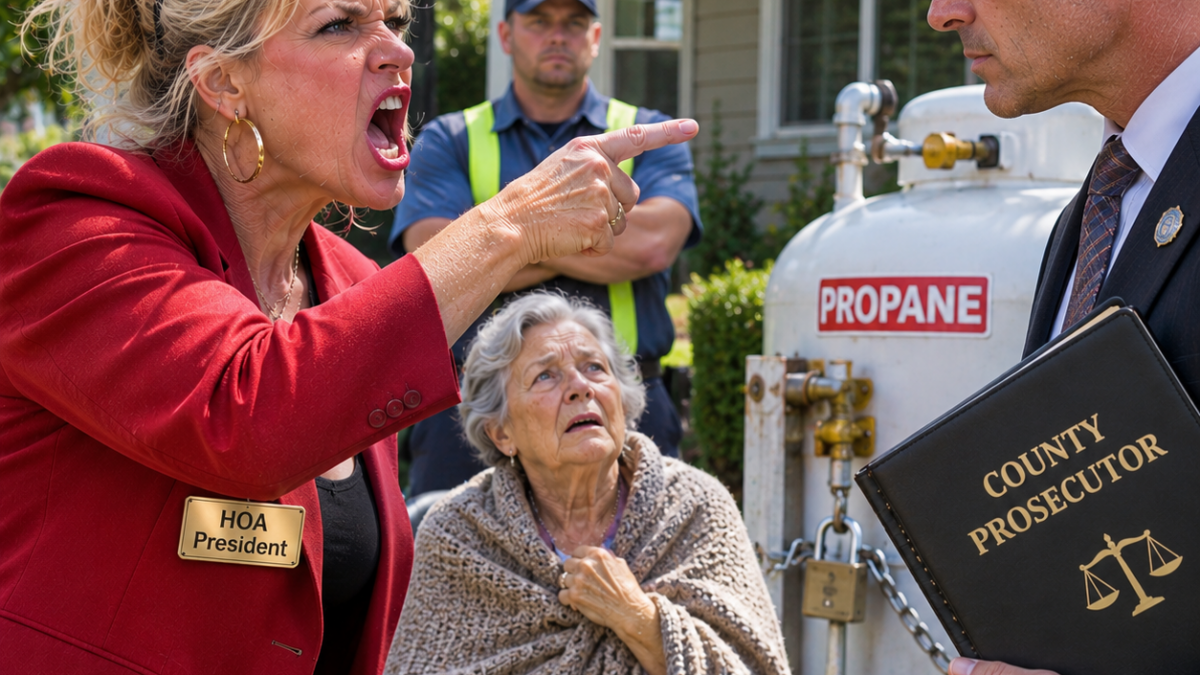
PART 2
Karen took two steps backward when she saw my phone.
“You cannot record me without permission.”
“I can document what is happening on my property.”
“This is harassment.”
“You are standing beside my disconnected propane line holding the wrench you used.”
She glanced down.
For one second, she looked as though she had forgotten the wrench was still in her hand.
Then she dropped it into the grass.
Not threw it.
Dropped it.
Metal landed with a dull thud.
I filmed that too.
“You received notice,” she said.
“No, I didn’t.”
“You did.”
“Certified?”
She hesitated.
“Our procedures were followed.”
“Show me the paperwork.”
“That isn’t my responsibility.”
“It became your responsibility when you touched my gas system.”
Her face hardened.
“You have seven days to remove this tank or install an approved screened enclosure.”
“Karen, leave.”
“You’ll also be charged a remediation fee.”
I stared at her.
“For what?”
“My time and the contractor consultation involved in correcting this violation.”
Something almost broke inside me.
Not because of the money.
Because my mother was inside.
Karen could have chosen a hundred petty battles.
Grass.
Paint.
Garbage cans.
She had chosen heat.
I pointed toward the sidewalk.
“Off my property.”
She opened her mouth.
I didn’t raise my voice.
“Now.”
That finally worked.
Karen picked up her clipboard and walked away.
She left the wrench.
I didn’t touch it.
Evidence.
The First Call
I called Heritage Propane.
Mike answered.
“Heritage.”
“Mike, it’s Mark Davies.”
“Hey, Mark. What’s up?”
“Somebody disconnected my tank.”
Silence.
“What?”
“My HOA president.”
Another silence.
Then:
“Say that again.”
“She shut the valve and disconnected the copper supply.”
“Did she know what she was doing?”
“No.”
“Did she use a wrench?”
“Yes.”
“Mark, don’t touch anything.”
“I wasn’t planning to.”
“Do you smell gas?”
“Faintly.”
His voice changed instantly.
“No switches near the tank. No flames. No starting equipment near it. Get everybody away.”
“My mother is inside.”
“Get her out.”
“The furnace is off.”
“That isn’t the only problem.”
“What?”
“If she damaged a fitting or released vapor, propane settles low. It’s heavier than air.”
I knew that.
But hearing Mike say it while looking at my house made it different.
“Any ignition source,” he continued, “and you’re not dealing with an HOA argument anymore.”
I stared at the brick ranch.
For a moment, the entire property looked fragile.
Mike said:
“I’m sending Bill.”
“How long?”
“Twenty minutes if he drives like he usually does.”
“Send him.”
Then Mike added:
“Mark?”
“Yeah?”
“Whoever touched that line is an idiot.”
“That much I already knew.”
Mom
I walked inside.
The furnace had stopped.
The house wasn’t cold yet.
Mom was sitting in her recliner with a blanket across her knees and a paperback in her hands.
She looked up.
“What’s going on?”
“Little propane problem.”
“Why is Karen outside?”
That woman missed nothing.
“She’s part of the propane problem.”
Mom closed the book.
“Did she turn something off?”
“Yes.”
Her face changed.
“Is it dangerous?”
I didn’t want to lie.
“Potentially.”
I helped her into her winter coat.
Sarah wasn’t home from work yet.
I grabbed Mom’s portable oxygen.
Medication bag.
Phone.
Then settled her into my truck with the heater running.
Mom watched me walk around the hood.
“Mark.”
“Yeah?”
“You have that look.”
“What look?”
“The one you used to get before you went somewhere you weren’t telling me about.”
“I’m not deploying.”
“You know what I mean.”
I did.
“Just stay warm.”
She squeezed my hand.
“I am not the one you should be worried about being cold.”
Even at seventy-two, she could still sound like my mother instead of someone I was caring for.
I shut the door gently.
The Sheriff
My second call was the sheriff’s office.
I chose my words carefully.
Not:
“My crazy HOA president did something stupid.”
Instead:
“An individual entered my property without permission, deliberately disconnected a residential propane supply, and left an elderly medically vulnerable occupant without heat while creating a potential gas hazard.”
The dispatcher paused.
“Is this an HOA dispute?”
“No.”
“Sir—”
“The individual happens to be HOA president. That doesn’t make a gas line a civil matter.”
Another pause.
“We’ll send someone when available.”
Not encouraging.
But I needed the record.
Bill Jensen
Heritage Propane’s service truck came down the road about eighteen minutes later.
Bill Jensen stepped out.
Big guy.
Fifty-something.
Weathered face.
The kind of man who moved slowly because he already knew what he was doing.
He approached the tank.
Stopped.
“Jesus.”
“That good?”
“No.”
He took out a handheld detector.
The device began chirping low near the tank.
Bill crouched.
Moved the sensor.
“Residual vapor.”
He examined the fitting.
Then swore softly.
“What?”
“She chewed the brass.”
He pointed.
Tool marks.
Deep.
“She put too much force on it.”
“Can you reconnect?”
“No.”
“Why?”
“Compromised fitting.”
He stood.
“And because the system was opened, I’m not just replacing this connection.”
“What else?”
“Pressure test. Full leak check. Appliances.”
“Everything?”
“Everything.”
He looked toward my truck where Mom sat.
“Furnace, water heater, stove. Whole system.”
“How long?”
“Hours.”
“How much?”
“Not cheap.”
“Do it.”
Bill nodded.
Then looked at Karen’s wrench lying in the grass.
“That hers?”
“Yes.”
“Don’t touch it.”
“Wasn’t going to.”
He smiled faintly.
“You military?”
“Army Corps.”
“Thought so.”
What Could Have Happened
While Bill worked, he explained the risk.
Not dramatically.
Professionally.
That made it worse.
Propane released into cold air can remain low.
A damaged fitting can leak.
A spark from a vehicle, switch, static source, or nearby equipment can ignite the correct fuel-air mixture.
Was our house seconds from exploding?
Nobody could honestly say that.
But Karen had created a hazard without the slightest idea what she was doing.
That mattered.
Bill looked at me.
“This isn’t like shutting off a garden hose.”
“I know.”
“She could’ve hurt herself too.”
“I know.”
“People think valves make utilities simple.”
He shook his head.
“They don’t understand the system behind them.”
That sentence stayed with me.
Karen never understood systems.
Only switches she believed she had permission to flip.
Deputy Cole
The deputy arrived nearly an hour after my call.
Young.
Maybe twenty-seven.
He listened.
Watched the video.
Looked at the wrench.
Talked to Bill.
Then:
“So she’s HOA president?”
“Yes.”
He sighed.
I already knew what was coming.
“These HOA disputes get messy.”
“This is not a dispute about a mailbox.”
“I understand.”
“Do you?”
He shifted.
“Sir, I’m trying to help.”
“Then treat the conduct, not her title.”
Bill glanced over.
The deputy continued.
“I’ll document everything.”
“Good.”
“But prosecutors generally want evidence of criminal intent in something like this.”
I pointed at the tank.
“She disconnected a gas line intentionally.”
“Intent to disconnect isn’t necessarily intent to endanger.”
Bill spoke from several feet away.
“Deputy?”
“Yes?”
“I’ve been working propane twenty-five years.”
“Okay.”
“What she did was reckless enough that if my employee did it, he’d be fired before sunset.”
The deputy nodded.
“I’ll put that in the report.”
“Please do.”
He went across the street to Karen’s.
Fifteen minutes later, he returned.
“What did she say?”
The deputy hesitated.
“She says the tank violated HOA rules.”
“Anything about a leak?”
“No.”
That detail would matter later.
At the time, I simply wrote it down.
$842.50
Bill didn’t finish until after dark.
The damaged pigtail assembly was replaced.
System pressure-tested.
Every appliance inspected.
No continuing leak.
Heat restored.
Total emergency bill:
$842.50.
Bill handed me the paperwork.
“I’ll have Mike send the formal safety report tomorrow.”
“I need it detailed.”
“It will be.”
“Include the damage to the fitting.”
“Yes.”
“Potential release.”
“Yes.”
“Explosion risk.”
“Yes.”
He studied me.
“You planning to sue?”
“I don’t know yet.”
“That means yes.”
“No.”
I looked across the street.
“It means I’m planning to make sure nobody ever thinks doing this again is worth the risk.”
Bill nodded.
“Better answer.”
Mom Comes Home
By the time I helped Mom back inside, the house was warm.
She paused at the ramp.
The ramp Karen had fined me for.
Her hand rested on the railing.
“You built this too well.”
“That’s the point.”
“You know what I mean.”
“No.”
“You’re going to fight her.”
I looked toward Karen’s dark house.
“Yes.”
Mom sighed.
“Your father would’ve said not to lose your temper.”
“Dad lost his temper constantly.”
“He would’ve said it anyway.”
True.
She squeezed my arm.
“Don’t become ugly because somebody else is.”
That advice became harder to follow than any legal strategy.
Karen’s Counterattack
Next morning:
Certified mail.
Red violation notice taped to my door too.
Karen apparently believed redundancy increased legitimacy.
Three documents.
The first:
$1,000.
Unauthorized propane tank — violation of Aesthetic Guideline 14C.
I opened the bylaws.
No 14C.
The aesthetic section stopped at twelve.
Second:
$500.
Failure to cure after thirty-day warning.
I had never received a warning.
The document claimed one had been issued January 15.
Third:
$300.
Board-authorized remediation service fee.
I sat at the dining table staring.
Sarah had come home late the previous night and heard everything.
Now she picked up the third sheet.
“She charged us three hundred dollars?”
“Yes.”
“For shutting off our heat?”
“Yes.”
“While your mother was inside?”
“Yes.”
“Can I hit her?”
“No.”
“I work in healthcare. I know where not to leave marks.”
“Sarah.”
“Fine.”
I almost laughed.
Almost.
The Technician’s Report
Bill’s report arrived that afternoon.
Four pages.
Detailed.
Technical.
Devastating.
It documented unauthorized manipulation.
Damage to the brass fitting.
Potential gas release.
Required replacement.
Mandatory testing.
Safety hazards.
Code concerns.
Then the sentence I wanted:
Untrained civilian manipulation of this equipment created an unacceptable risk of fire, explosion, fuel release, and interruption of essential residential heating service.
I placed it beside Karen’s fabricated guideline.
Then Mom’s pulmonologist letter.
Dr. Samuel Hart.
He wrote plainly.
Eleanor Davies suffered from chronic obstructive pulmonary disease.
Cold temperatures could exacerbate respiratory symptoms.
Prolonged loss of heat during winter could increase risk of severe respiratory distress, infection, hospitalization, and potentially life-threatening complications.
Now the dining room table held:
Karen’s video.
Wrench photographs.
Propane report.
$842.50 bill.
Sheriff incident number.
Medical letter.
Fake bylaw.
Backdated notice.
$300 service invoice.
Sarah looked at the spread.
“This is insane.”
“No.”
“What?”
“This is organized.”
“That wasn’t a compliment.”
Colonel David Miller
I called Dave.
Retired JAG.
We had served together years earlier.
He answered:
“Davies, you ancient bastard.”
“Good to hear you too.”
“You finally need a criminal-defense lawyer?”
“HOA.”
He groaned.
“Worse.”
I told him everything.
The ramp.
Fines.
Tank.
Karen.
Mom.
Fake guideline.
Backdated notice.
He didn’t interrupt.
When I finished, the joking tone disappeared.
“She backdated a notice?”
“Yes.”
“After the gas incident?”
“It appears so.”
“Do you have original electronic copies?”
“PDF.”
“Preserve them.”
“Done.”
“Propane company report?”
“Yes.”
“Medical documentation?”
“Yes.”
“Video?”
“Yes.”
“Witnesses?”
“Bill, Mom, deputy, me.”
Dave exhaled.
“Mark, stop thinking like this is a neighbor dispute.”
“I already did.”
“Good.”
“This woman may have created criminal exposure.”
“I know.”
“No, I don’t think you do.”
Pay the Fine
Dave gave me advice I hated.
“Pay the HOA amounts.”
I stared at the phone.
“Absolutely not.”
“Listen.”
“Dave.”
“Listen.”
I did.
“Pay under protest. Cashier’s check. Keep copies.”
“Why reward her?”
“You aren’t rewarding her.”
“Then what?”
“You become a clearly documented financially injured party.”
“I already am.”
“Yes, but this creates a cleaner record.”
He continued.
“Then demand reimbursement formally.”
“That sounds ridiculous.”
“Law is frequently ridiculous.”
True.
“You’re going to put the full board on notice.”
“Not just Karen?”
“Especially not just Karen.”
He explained why.
Karen survived because other board members could hide behind ignorance.
Once every member received evidence, that changed.
Three Letters
First:
Board.
Dispute fines.
Paid under protest.
Demand reimbursement.
Attach propane bill.
Document criminal report.
Second:
HOA insurer.
Directors and officers liability.
Notice of potentially willful conduct.
Property damage.
Personal injury exposure.
Board mismanagement.
Third:
County prosecutor.
Not patrol.
Not general complaints.
Economic crimes.
Dave told me:
“Package it.”
“What?”
“Don’t walk in ranting.”
“I don’t rant.”
He laughed.
“Sure.”
“Dave.”
“Build it like engineering.”
Facts.
Timeline.
Exhibits.
Witnesses.
Legal concerns.
“Make a prosecutor’s job easier,” he said, “and they’ll at least read it.”
Reconnaissance
Before filing, I needed to know whether Karen’s conduct against me was isolated.
I already suspected the answer.
Saturday morning, I walked Willow Creek.
First stop:
The Millers.
Eighty-something.
Thirty-five-year residents.
Their garden was immaculate.
Mr. Miller tended roses.
Mrs. Miller collected garden gnomes.
Karen hated the gnomes.
Not because they violated a real rule.
Because she considered them tacky.
Fine:
$200.
Then threat of increasing weekly penalties.
Then lien language.
Mrs. Miller’s eyes filled as she handed me the notice.
“We bought those with our grandchildren.”
I looked at a faded little ceramic fisherman.
It wasn’t worth twenty dollars.
It was priceless to her.
“Can I copy this?”
“Yes.”
“Would you write down exactly what happened?”
“Why?”
“Because you’re not the only one.”
The Millers looked at each other.
Something changed.
Hope often begins when people realize shame was never theirs to carry.
Carlos Rodriguez
Next:
Basketball hoop.
Portable.
Stored beside garage.
Karen claimed it attracted non-residents.
Threatened fines.
Carlos hired a lawyer for six hundred dollars.
Karen backed off.
Then started timing his garage door.
One hour open:
$50 violation.
He showed me photographs Karen had taken.
Timestamped.
“It’s creepy.”
“Yes.”
“Can you actually stop her?”
“I don’t know.”
He frowned.
“Then why do this?”
“Because whether we win or not, the record should exist.”
He nodded.
“I can live with that.”
He signed a statement.
The Pattern
Four hours.
Seven written accounts.
Fifteen notices.
Playset visible above fence.
Wrong seasonal wreath.
Work van.
Garden décor.
Garage doors.
Trash cans.
Every incident alone looked petty.
Together they looked systematic.
Karen identified preferences.
Invented authority.
Escalated quickly.
Threatened financial consequences.
Then used fear of liens to force compliance.
I spread the notices across the table.
Mom walked in.
“Looks like your father doing taxes.”
“Less dangerous.”
She picked up the gnome letter.
“What kind of person threatens old people over garden decorations?”
“The kind we’re dealing with.”
Mom looked at me.
“Then don’t let anger make you sloppy.”
She knew me too well.
Building the Complaint
Thirty pages.
I worked two days.
Executive summary.
Timeline.
Propane incident.
Video stills.
Bill’s report.
Medical letter.
Fabricated guideline.
Backdated notice.
Invoice.
Proof of payment under protest.
Other homeowners.
Appendix A.
Pattern of enforcement.
Potential fraud and extortion.
I used cautious language.
I didn’t declare crimes proven.
I identified facts and possible offenses for prosecutors to evaluate.
Dave reviewed it.
He called.
“Annoyingly good.”
“Thank you.”
“Tone down ‘criminal enterprise’ in paragraph four.”
“You told me—”
“I said frame the pattern. Don’t sound like you’re auditioning for television.”
I changed it.
Good lawyers protect you from your favorite sentences.
Assistant District Attorney Chen
Monday morning.
County courthouse.
Economic Crimes Unit.
Receptionist looked skeptical when I asked to report potential systematic fraud tied to an HOA.
Then she saw the binder.
A few minutes later, a man named Daniel Chen came out.
Late thirties.
Dark suit.
Quiet.
“What do you have?”
I handed him the complaint.
He read the cover.
Then the executive summary.
His posture changed.
“Come with me.”
That was the first time anyone in law enforcement treated the situation like something more than neighborhood drama.
The Debrief
Chen read.
Slowly.
Bill’s report twice.
Medical letter.
Video transcript.
Then the backdated notice.
“When was this file sent?”
“February eighteenth.”
“It claims January fifteenth.”
“Yes.”
“Do you have the original digital file?”
“Yes.”
“Don’t modify it.”
“I haven’t.”
He examined Karen’s invoice.
“She charged you for the shutdown?”
“Yes.”
He looked at me.
“That’s unusual.”
“That’s one word.”
Then the neighbor statements.
Gnomes.
Basketball hoop.
Garage.
Work van.
He made notes.
Finally:
“Individually, most of these other incidents are probably civil governance issues.”
“I understand.”
“But they may help establish a pattern.”
“That’s why they’re there.”
He closed the folder.
“What do you want from us?”
That question mattered.
“An investigation.”
“Not an arrest?”
“If the evidence supports one, that’s your decision.”
He studied me.
Good answer.
I meant it.
The Case Stops Being Mine
Chen leaned forward.
“If the office opens a case, you don’t direct it.”
“Understood.”
“You don’t threaten Ms. Bishop with prosecution.”
“I won’t.”
“You don’t tell witnesses what to say.”
“I won’t.”
“You don’t publicly speculate about charges.”
“I won’t.”
“This could take time.”
“I spent twenty years waiting for government logistics.”
For the first time, he smiled.
Then:
“I’ll recommend a formal review.”
As I left, something shifted inside me.
The burden felt smaller.
Not gone.
But no longer mine alone.
Detective Miller
A week later:
“Mr. Davies? Detective Laura Miller, Economic Crimes.”
No relation to Dave.
She came to the house.
Forties.
Sharp.
No wasted motion.
She photographed the tank.
Valve.
New fitting.
Distances.
Ramp.
Exterior.
Then recorded my statement.
Dates.
Times.
Exact words.
She interviewed Sarah.
Then Mom.
Mom sat upright in the living room.
Oxygen concentrator nearby.
Detective Miller asked:
“How did you feel when you learned the heat had been shut off?”
Mom thought.
“Frightened.”
“Why?”
“My breathing gets worse when I’m cold.”
“Did Ms. Bishop speak to you before shutting off the gas?”
“No.”
“Did you consent?”
“No.”
“Did anyone tell you there was a gas leak before the system was disconnected?”
“No.”
Then Mom said:
“It felt cruel.”
Detective Miller wrote the word.
Cruel.
I saw something in her face change.
The Board Starts Panicking
Detective interviews followed.
Bill.
Mike.
Millers.
Carlos.
Other residents.
Then HOA board members.
George, the treasurer, called me.
Voice trembling.
“Mark?”
“Yes?”
“There’s a detective asking questions.”
“I know.”
“Karen said this was just your personal vendetta.”
“Did she tell you she disconnected my gas?”
“She said there was a leak.”
I became still.
“What?”
“She said she smelled gas and shut it off to protect the neighborhood.”
There it was.
New story.
Not aesthetics.
Emergency safety.
“George.”
“Yeah?”
“I have video of her explaining why she shut it off.”
Silence.
“What does she say?”
“That the tank was an unauthorized alteration.”
Long silence.
“She lied to us.”
“I think you need to talk to counsel.”
“Mark—”
“And read every document yourself.”
“What happens now?”
“That’s up to you.”
Karen’s Biggest Mistake
She called an emergency HOA meeting.
Purpose:
Defend community leadership from malicious accusations.
Classic Karen.
When pressure increased, she didn’t retreat.
She created an audience.
This time, Mom insisted on coming.
“No.”
“Mark.”
“You don’t need this stress.”
“She turned off my heat.”
“Exactly.”
“I am seventy-two, not dead.”
“Mom.”
“I want to see.”
Sarah looked at me.
I knew I had lost.
The Clubhouse
Packed.
Karen wore a bright red blazer.
George sat on the board looking ill.
Two other members avoided eye contact.
Dave Miller stood near the rear wall.
Not representing me formally that night.
Just watching.
Mom sat beside Mrs. Miller.
Oxygen nearby.
Karen struck the gavel.
Then spent ten minutes describing me as:
Difficult.
Noncompliant.
Hostile.
Vindictive.
She said I had wasted county resources because I disliked HOA standards.
She never mentioned propane.
Finally I stood.
“Will residents be allowed to respond?”
Karen snapped:
“This is not a debate.”
Then George surprised everyone.
“Our bylaws allow member comment.”
Karen turned.
“George.”
He looked terrified.
But didn’t fold.
“Mark has the floor.”
The mutiny had begun.
The Photograph
I walked to the front.
Not the lectern.
I faced the room.
“Karen is correct about one thing.”
People waited.
“I contacted outside authorities.”
I held up a large photograph.
Propane tank.
Disconnected line.
“This is why.”
The room became silent.
“On February seventeenth, Karen Bishop entered my property and disconnected the fuel supply to my home.”
Murmurs.
“Temperature: thirty-eight degrees.”
Then:
“My seventy-two-year-old mother was inside.”
Several people turned toward Mom.
She sat quietly.
“Mom has COPD.”
Karen interrupted.
“This is manipulative.”
I ignored her.
“She was never notified.”
I held up Karen’s notice.
“Karen says this happened because my propane tank violates Aesthetic Guideline 14C.”
Next document.
Actual bylaws.
“There is no 14C.”
People began talking.
The Backdated Notice
I held up the next page.
“This document claims I was warned thirty days before the shutdown.”
Karen shouted:
“You were!”
“I received no such notice.”
“You’re lying.”
I looked toward Dave.
Then back to the room.
“The original electronic document has been preserved for investigators.”
Karen’s face changed.
Tiny.
But visible.
“Metadata can establish when files were created.”
She knew.
That was when I became certain the date wasn’t a simple clerical error.
The $300 Bill
Then I held up her invoice.
“She charged me three hundred dollars for disconnecting the propane.”
People laughed at first.
Then stopped.
Because there was nothing funny about it.
The Other Residents
“Mr. and Mrs. Miller?”
They stood.
I told the gnome story.
Carlos stood.
Basketball hoop.
Garage door.
Others.
One by one.
Karen’s story about one angry retired soldier collapsed.
This wasn’t one man.
It was a neighborhood.
Bill’s Report
Final document.
Four pages.
“Heritage Propane inspected the system.”
I read only the essential conclusion.
Untrained tampering.
Damaged fitting.
Risk of release.
Fire.
Explosion.
Loss of essential heat.
Karen’s supporters stopped looking at her.
Then I said:
“That is why the county prosecutor’s office opened an investigation.”
The room erupted.
Karen shouted:
“Lies!”
“No.”
I looked directly at her.
“They’re investigating you.”
Her face emptied.
Mom
I returned to my seat.
Mom took my hand.
“You did fine.”
“Fine?”
“You talked too long.”
I laughed despite everything.
Then she said:
“Your father would’ve been proud.”
That nearly broke me.
More than Karen ever could.
Board Suspension
The next morning, George called.
Karen had been suspended from all HOA leadership duties pending investigation.
All disputed fines issued under her committees would be reviewed.
My money:
Refunded.
Propane bill:
Reimbursed.
Ramp fine:
Also reopened.
The board hired outside counsel.
Karen’s private kingdom was shrinking fast.
The Arrest
Two days later, lights.
Two sheriff vehicles.
Karen’s house.
Detective Miller.
Another officer.
Neighbors came outside.
Nobody cheered.
Karen opened the door.
At first she argued.
Even from across the road, I could tell.
Hands moving.
Pointing.
Then Detective Miller showed her the warrant.
Karen froze.
For the first time since I’d known her, she had no committee to appeal to.
No gavel.
No fine.
No threat.
Just law.
She was placed under arrest.
As she passed the driveway, she looked toward me.
I didn’t smile.
Mom stood behind me in the doorway.
Karen saw her too.
Then looked away.
The Charges
The local report described charges involving reckless endangerment, fraud-related conduct, and extortion-related allegations.
The exact legal process belonged to prosecutors now.
I stayed out of it publicly.
Dave advised:
“Do not celebrate.”
“I wasn’t planning to.”
“Good.”
“Why?”
“Because trials are messy.”
He was right.
Discovery
Investigators obtained HOA records.
Digital files.
Board emails.
Karen’s computer records through lawful process.
The January fifteenth notice became especially important.
Digital metadata indicated it had been created after the propane incident.
Hours after.
Not thirty days before.
The prosecution theory was simple.
Karen acted first.
Then manufactured documentation to create the appearance of prior authority.
That changed the case.
A stupid mistake can be defended as stupidity.
A cover story suggests consciousness.
More Financial Problems
Once the board opened Karen-controlled accounts, they found irregularities.
Fine revenue routed strangely.
A separate beautification account.
Poor documentation.
Projects approved but never completed.
Not every odd transaction was criminal.
But enough required further investigation.
Karen’s actions had pulled a thread.
The entire sweater began coming apart.
Before Trial
Dave called.
“You’re going to testify.”
“I figured.”
“Defense will attack your motives.”
“They can.”
“They’ll bring up the ramp.”
“Good.”
“Why good?”
“Because the ramp was for Mom.”
He laughed.
“Fair point.”
“Anything else?”
“Answer what you’re asked.”
“I know.”
“Don’t teach a class.”
“I know.”
“Don’t argue.”
“I know.”
“Mark.”
“What?”
“You enjoy correcting people.”
“I do not.”
“You once corrected a colonel’s bridge-load calculation during his promotion dinner.”
“He was wrong.”
“Exactly.”
Mom Fixes My Tie
Trial morning.
Dark suit.
Tie.
Mom stood behind me.
Fixed the knot.
“You look important.”
“That’s the suit.”
“You nervous?”
“Yes.”
She smiled.
“Good.”
“Why?”
“Means you’re not stupid.”
Then:
“Tell the truth.”
“I will.”
“That’s all you need.”
The Courtroom
Karen looked different.
Smaller.
No clipboard.
No red blazer.
Defense counsel beside her.
ADA Chen at prosecution table.
Binders aligned.
Calm.
Judge Albright presiding.
Jury.
This wasn’t an HOA meeting.
Nobody cared who controlled the Architectural Review Committee.
My Testimony
Chen led me through the timeline.
House.
Mom.
Ramp.
Harassment.
February seventeenth.
Photographs.
Video.
He played it.
Karen’s own voice filled the courtroom:
The tank was unauthorized.
Board enforcement.
Fines.
The jury watched.
I watched them watching her.
Then the prosecutor showed the disconnected fitting.
Propane report.
Medical letter.
Backdated notice.
Invoice.
“Mr. Davies, what did you do after the incident?”
“I documented it.”
“Why?”
“Because memories change. Records don’t as easily.”
Cross-Examination
Defense attorney Sloan approached.
“Mr. Davies, you dislike Ms. Bishop.”
“I dislike what she did.”
“That’s not my question.”
“Then yes, by the time of the incident, I did not like her.”
A few jurors shifted.
Sloan smiled.
“So you had a grudge.”
“I had prior disagreements.”
“You knowingly violated the HOA’s rules when you constructed a ramp.”
“I constructed an accessibility ramp for my mother.”
“Without approval.”
“I notified the board and provided medical documentation.”
“But you were fined.”
“Yes.”
“So there was already bad blood.”
“Yes.”
“Meaning you had motive to retaliate.”
I looked at him.
“My motive in reporting the propane incident was that somebody disconnected a pressurized fuel system while my mother was inside the house.”
“Your feelings toward Karen are irrelevant?”
“To whether she disconnected the line? Yes.”
He didn’t like that answer.
Bill Takes the Stand
Bill Jensen wore his best work shirt.
Still looked like he’d rather repair propane regulators than testify.
Chen asked:
“Is shutting a propane system off inherently dangerous?”
“No.”
“Can it be done safely?”
“Of course.”
“What made this incident unsafe?”
“Untrained person. Wrong tool technique. Damaged fitting. System opened without proper procedure.”
“What risk did that create?”
“Fuel release.”
“Fire?”
“Yes.”
“Explosion?”
“Potentially.”
“Was an explosion inevitable?”
“No.”
I respected that answer.
No exaggeration.
“What is your professional assessment?”
Bill looked toward the jury.
“In twenty-five years, it was among the most reckless civilian tampering situations I’ve seen.”
That was enough.
Dr. Hart
Mom’s pulmonologist testified next.
COPD.
Cold stress.
Airway constriction.
Risk.
He didn’t say Karen would certainly have killed Mom.
Science rarely works like that.
He said loss of heat created a medically significant danger for someone with her condition.
That precision made him credible.
George
Then George.
Former treasurer.
Nervous.
Chen handed him the HOA bylaws.
“Aesthetic Guideline 14C?”
George flipped.
“No.”
“Does it exist?”
“No.”
“Did the board vote to authorize Karen Bishop to disable Mr. Davies’s propane?”
“No.”
“Would you have approved that?”
“No.”
Then:
“What did Ms. Bishop tell you happened?”
George swallowed.
“She said she found a leak.”
The courtroom became very quiet.
“Did she mention aesthetics?”
“No.”
“Did she mention an unapproved tank?”
“Not at first.”
“What did she say?”
“That she smelled propane and acted for safety.”
Chen looked at the jury.
Then returned to the table.
Karen Testifies
I almost couldn’t believe her lawyer allowed it.
Maybe he couldn’t stop her.
Karen took the stand.
She presented herself as a dedicated volunteer.
Overworked.
Unappreciated.
She said Willow Creek had declined before her presidency.
She restored standards.
She protected property values.
Then came the propane.
“I smelled gas.”
There it was.
She claimed she believed she was preventing a hazard.
Chen approached on cross.
“You smelled gas before touching the system?”
“Yes.”
“Where?”
“Near the tank.”
“You believed there was a leak?”
“Yes.”
“You shut it off to protect the neighborhood?”
“Yes.”
Chen nodded.
Then played my video.
Karen’s voice:
The tank is an unauthorized alteration. I am ensuring compliance.
Nobody moved.
Chen asked:
“Where in this recording do you mention a leak?”
Karen’s face reddened.
“I was flustered.”
“Where do you tell Mr. Davies you are acting for safety?”
“I don’t remember.”
“You tell him he’s being fined, correct?”
“I—”
“Yes or no?”
“Yes.”
The Metadata
Then the January notice.
Chen displayed the document.
“Dated January fifteenth.”
“Yes.”
“You testified it was prepared and sent that day?”
“Yes.”
Then digital evidence.
Original file creation:
February seventeenth.
After the propane shutdown.
Karen stared.
Chen asked:
“Can you explain why a notice allegedly written in January was created on your computer in February?”
She didn’t answer.
“Ms. Bishop?”
“I may have recreated it.”
“Why?”
“For records.”
“Where is the original?”
Silence.
“Postal receipt?”
Silence.
“Email?”
Silence.
“Board minutes?”
Nothing.
Then Chen asked:
“Did you create this document after Mr. Davies confronted you?”
Karen looked toward her lawyer.
The judge said:
“Answer.”
“I don’t recall.”
That was the moment her defense died.
Not with drama.
With four words.
Closing Arguments
Sloan argued neighbor feud.
HOA confusion.
Poor judgment.
No intent to harm.
Chen didn’t yell.
He walked through the chain.
Karen targeted Mark.
Karen entered the property.
Karen disconnected the propane.
Karen explained her actual motive on video.
Karen later told the board a different story.
Karen produced a notice with a date inconsistent with the underlying file.
Karen demanded money.
Pattern mattered.
Power mattered.
But evidence mattered more.
Chen finished:
“This case is not about whether homeowners associations should have rules.”
Pause.
“It is about whether a person holding a small amount of authority may knowingly put another human being at risk and manufacture paperwork afterward because she believes her title will protect her.”
He looked toward Karen.
“It does not.”
The Verdict
The jury deliberated less than an hour in the source story.
I remember every minute anyway.
Mom sat beside me.
Sarah on my other side.
Nobody spoke much.
Then we returned.
Foreperson stood.
Reckless endangerment involving a vulnerable adult:
Guilty.
Fraud:
Guilty.
Extortion-related count:
Guilty.
Karen collapsed into her chair.
No screaming.
No argument.
Her lawyer touched her shoulder.
She shook him off.
For years, Karen had controlled rooms by being the person most willing to escalate.
The courtroom did not care.
Outside
The Millers waited in the hallway.
Carlos too.
Others.
Nobody celebrated.
Mr. Miller touched my shoulder.
“It’s done.”
“Sentencing.”
“You know what I mean.”
I did.
The truth had been formally recognized.
That mattered.
Sentencing
Two weeks later.
Karen wore jail-issued clothing.
No costume of authority left.
Her lawyer asked for leniency.
Overzealous volunteer.
Poor judgment.
Public humiliation.
Probation.
Community service.
Chen stood.
His argument wasn’t revenge.
It was accountability.
Mistakes deserve one kind of response.
Patterns deserve another.
Karen had endangered Mom.
Then lied.
Then created false documentation.
Then showed little remorse.
Judge Albright asked Karen if she wished to speak.
Karen said she was sorry for the “misunderstanding.”
The judge’s face hardened.
Two Years
The sentence in the source:
Two years on the felony endangerment count with at least one year mandatory.
Additional shorter sentences concurrent.
Karen cried.
For the first time, I felt something close to pity.
Not enough to wish the verdict away.
Enough to remember she was human.
Mom leaned toward me.
“Don’t feel sorry for her yet.”
I whispered:
“I do a little.”
“That means I raised you right.”
The HOA’s Second Disaster
Karen’s conviction triggered a deeper audit.
The board had already found suspicious accounts.
Fine revenues.
Beautification funds.
Transactions Karen controlled.
The financial investigation continued.
Eventually restitution followed.
More than fifty thousand dollars was ordered returned to residents in the story’s final financial chapter.
But by then, my interest had changed.
I wasn’t thinking about Karen’s punishment.
I was thinking about Willow Creek.
Because someone had to fix the system that let her happen.
The Nomination
Community meeting.
George acting president.
New board needed.
Mrs. Miller stood.
“I nominate Mark Davies.”
I looked at Sarah.
She covered her mouth to hide a smile.
“No.”
Mrs. Miller continued:
“Second?”
Carlos:
“Second.”
“Absolutely not.”
Someone laughed.
Vote called.
Unanimous.
I stood.
“You people are making a serious mistake.”
Arthur from three rows back shouted:
“Put it in the bylaws.”
More laughter.
And somehow, after months of fighting an HOA president, I became one.
The irony was painful.
My First Motion
Dissolve Karen’s Architectural Review Board and Covenants Compliance Committee.
Not because architectural review never has value.
Because Karen had turned two overlapping bodies she controlled into enforcement weapons.
Legitimate responsibilities returned to the elected board.
Transparent.
Recorded.
Appealable.
Passed unanimously.
My Second Motion
Review every bylaw.
Remove vague language.
No fines for subjective concepts unless clear objective standards existed.
No “conduct unbecoming.”
No invented rules.
No enforcement based on unwritten preferences.
Residents joined the review committee.
Teachers.
Accountants.
Lawyers.
Retirees.
Parents.
People who had never attended a meeting before.
It was messy.
Slow.
Sometimes ridiculous.
Exactly how shared governance is supposed to look.
The Ramp
One spring afternoon, I was outside staining Mom’s ramp.
She sat nearby.
Blanket across her knees.
Breathing easy.
Propane tank behind us.
Still there.
Exactly where it had always been.
I built a simple lattice screen around part of it.
Not because Karen had been right.
Because Mom wanted climbing roses.
Fire-code clearances maintained.
Service access open.
Safe.
Mom watched.
“You know Karen would’ve approved of the screen.”
I stopped brushing stain.
“Take that back.”
She laughed.
The sound filled the yard.
That was worth everything.
The Tank Becomes Boring Again
One of the best parts of the ending was that the propane tank became boring.
No evidence tag.
No photographs.
No inspection controversy.
Heritage filled it.
Furnace burned fuel.
Water heated.
Stove worked.
That’s what utilities should do.
Their greatest success is invisibility.
Mom’s Health
Eleanor stayed with us.
Her COPD didn’t disappear.
Some days were harder.
But the propane incident didn’t become the tragedy it could have.
No pneumonia.
No explosion.
No hospitalization from that night.
That fact mattered more than any verdict.
Sometimes the difference between a cautionary story and a funeral is simply luck.
I never forgot that.
My Anger
For months after the trial, I still woke angry sometimes.
Not at Karen exactly.
At the image.
Her hand on the wrench.
My mother inside.
I would replay it.
What if I’d come home later?
What if she had damaged the fitting worse?
What if propane accumulated?
What if the temperature dropped?
Sarah noticed.
“You’re still fighting.”
“No.”
“Yes.”
“The case is over.”
“Your body doesn’t know.”
She was right.
War doesn’t always end when orders say it does.
Neither do personal battles.
Dave’s Advice
Dave and I had lunch.
“You look terrible.”
“Thanks.”
“Case is over.”
“I know.”
“Then why are you carrying it?”
I looked at him.
“You sound like Sarah.”
“Smart woman.”
He continued.
“You built the case because you needed accountability.”
“Yes.”
“You got it.”
“Yes.”
“So stop asking the past for a different outcome.”
I hated that sentence.
Because it was useful.
The Millers Bring Back the Gnomes
Karen’s garden-gnome fines were rescinded.
The Millers celebrated by putting every gnome back outside.
All fourteen.
One held a fishing rod.
One pushed a wheelbarrow.
One was inexplicably dressed like a cowboy.
I stood at their gate.
“That’s a lot.”
Mrs. Miller smiled.
“Would you like to issue a violation?”
“Don’t tempt me.”
The Basketball Hoop
Carlos’s kids started playing again.
I drove by one evening.
Ball bounced into the street.
One kid ran after it.
Carlos saw me.
“President Davies!”
I groaned.
“Violation?”
“Only if he dents my truck.”
The boy laughed.
A normal childhood sound.
That was the difference.
The Work Van
Another resident asked whether his work van could remain in the driveway.
I checked local ordinances.
Clean vehicle.
No commercial nuisance.
No HOA rule with legitimate reason to prohibit it.
“Park it.”
He stared.
“That’s it?”
“That’s it.”
“What form?”
“None.”
“Application?”
“No.”
“Are you sure you’re president?”
I wasn’t.
Transparency
George and I rebuilt the financial system.
Every fine recorded.
Every expenditure visible.
No secret accounts.
No president-only control.
Two signatures for significant spending.
Conflict disclosures.
Monthly reports.
It wasn’t glamorous.
Good governance rarely is.
The Fine Problem
We discovered Karen had used fines as revenue.
That was dangerous.
Enforcement should not become a business model.
So we changed the budget.
Operating expenses could not rely on anticipated penalty revenue.
Fines became corrective tools, not income targets.
Warnings first where appropriate.
Opportunity to cure.
Appeals.
Human conversation.
The number of violations collapsed.
The neighborhood did not collapse with them.
Lawns remained lawns.
Homes retained value.
Civilization survived gnomes.
The Insurance Company
The HOA’s insurer eventually thanked the new board for reforms.
That made me laugh.
A company thanking us for becoming less likely to generate lawsuits.
Fair.
Premiums stabilized.
Outside counsel developed an enforcement policy requiring actual legal review before any board member touched homeowner property.
Especially utilities.
That section was probably unnecessary.
But I insisted.
Detective Miller Visits
Months later, Detective Miller stopped by.
Not officially.
She was nearby.
Mom recognized her.
“You’re the detective.”
“Yes, ma’am.”
“You were nice to me.”
“I try.”
Mom offered coffee.
Detective accepted.
We sat.
She said:
“Cases like yours usually don’t arrive packaged.”
“Dave taught me.”
“You made our job easier.”
“I was angry.”
“That can make people sloppy.”
“I know.”
“You weren’t.”
I thought of Mom’s advice.
Don’t let anger make you sloppy.
Maybe she had built the case more than anyone.
Chen
I sent ADA Chen a thank-you note.
Short.
No drama.
His reply:
You provided evidence. The witnesses told the truth. The system did the rest.
Exactly.
That’s how it should be.
The Article
Dave texted me months later.
News article.
Karen ordered to pay significant restitution to victimized residents.
I showed Mom.
She put on her glasses.
Read.
Then:
“Good.”
One word.
I laughed.
“That’s it?”
“Bullies should pay for what they break.”
She handed the phone back.
Then pointed toward the lattice.
“Your stain is uneven.”
Justice from Mom was always followed by quality control.
The Quiet Saturday
Sun.
Warm.
Mom outside.
Sarah gardening.
Children laughing somewhere down the street.
Lawn mower.
Dog barking.
No gavel.
No certified letters.
No deputies.
No prosecutors.
I stood with a brush in my hand.
For years, I thought justice was something formal.
Courts.
Orders.
Verdicts.
Maybe sometimes it is.
But that afternoon, justice felt like heat coming through our vents without anybody thinking about it.
Mom breathing comfortably.
Neighbors unafraid.
A ramp nobody questioned.
A propane tank nobody cared about.
Peace restored to things that should have been ordinary all along.
What Karen Actually Took From Us
Not propane.
Not for long.
She took security.
For weeks, every strange car made Sarah look outside.
Mom apologized for “causing trouble” because the ramp and her medical needs had become targets.
That broke my heart.
“You didn’t cause anything.”
“I moved in.”
“Mom.”
“If I weren’t here—”
“No.”
I knelt beside her chair.
“You living here is not the problem.”
She looked at me.
“Promise?”
“Yes.”
The cruelest thing Karen did wasn’t the fine.
It was making an elderly woman wonder whether needing help made her a burden.
That I will never forgive easily.
The Thing I Regret
I regret paying the original ramp fine.
Not because of the money.
Because Karen learned the wrong lesson.
I paid to preserve peace.
She interpreted payment as surrender.
Could I have known?
Maybe.
Maybe not.
But bullies often mistake restraint for weakness.
That doesn’t mean restraint is wrong.
It means boundaries eventually need enforcement.
The Thing I Don’t Regret
I never threatened Karen.
Never touched her property.
Never turned off her utilities.
Never sabotaged anything.
Never fabricated evidence.
Never publicly lied.
Every step we took could survive sunlight.
That matters.
Because the moment you decide your enemy’s behavior gives you permission to abandon your own standards, they’ve changed you.
Mom warned me about that.
She was right.
Karen’s Empty House
Her house eventually changed hands.
New family.
Young couple with a daughter.
The first thing they did was install a small play structure.
Visible from the road.
Under Karen, probably three violations.
Under us:
None.
Sarah and I brought them cookies.
I almost laughed at the symmetry.
The New Owners Ask About Propane
They used natural gas.
One afternoon, the husband asked:
“Are you the guy from the propane story?”
“I hate that question.”
“So yes?”
“Yes.”
“Is it true she came over with a wrench?”
“Yes.”
He stared at Karen’s former house.
“From there?”
“Yes.”
He shook his head.
“People are insane.”
“Sometimes.”
Then he asked:
“Were you scared?”
That question surprised me.
“Not at first.”
“When?”
“When the propane technician told me what could’ve happened.”
He nodded.
That’s the truth.
Anger came first.
Fear later.
Mom’s Roses
The climbing roses around the lattice eventually took off.
Pink.
Fragrant.
Mom loved them.
One morning she said:
“See?”
“What?”
“Propane tank looks better.”
I stared.
“Karen would say—”
“Mom.”
She laughed so hard she started coughing.
I immediately stopped joking.
She waved me off.
“Worth it.”
My Presidency Ends
I served two terms.
Then stepped down.
People asked me to stay.
No.
The best test of a system is whether it survives the person who repaired it.
George became president after me.
Then another resident.
Rules stayed transparent.
Finances stayed open.
No one rebuilt Karen’s committees.
Good.
Why I Didn’t Stay
Power is seductive even when you earn it for good reasons.
People began saying:
“Mark knows what to do.”
Dangerous sentence.
One person should never become the shortcut for a community’s judgment.
Karen had been the shortcut before.
I refused to become the nicer version.
Mom Watches My Last Meeting
Eleanor came.
Sat near the front.
At the end, residents applauded.
I hated it.
Mom loved it.
In the parking lot she said:
“You did good.”
“I survived.”
“Same thing sometimes.”
Then she added:
“Now stop volunteering.”
Sarah, beside us:
“Yes.”
I was outnumbered.
The Neighborhood Years Later
Willow Creek is still imperfect.
Someone complains about dogs.
Somebody hates leaf blowers.
People argue about pool hours.
One year, residents nearly started a civil war over whether holiday lights could remain through January fifteenth.
Normal.
The difference is disagreement no longer becomes punishment because one person holds a title.
The Most Important Rule
Our revised enforcement policy begins with a simple principle:
No HOA action may endanger health, safety, essential utilities, accessibility, or lawful occupancy.
That language came directly from what happened.
I hope nobody ever needs it.
The Wrench
The wrench Karen dropped was eventually released after the case.
Investigators asked whether I wanted it back.
It wasn’t mine.
I declined.
For a while I imagined mounting it on the clubhouse wall.
Bad idea.
You don’t need trophies from people at their worst.
The Ramp Is Still There
Years later, Mom’s ramp remains.
A little weathered.
Re-stained several times.
Solid.
I occasionally tighten hardware.
No architectural application.
No two-hundred-dollar fee.
No debate.
Just a ramp.
Doing the thing it was built to do.
Helping a person get home safely.
The Propane Tank Is Still There Too
Same tank.
Inspected.
Maintained.
Screened safely with roses.
Every winter Heritage checks the system.
Bill retired eventually.
His replacement knows the story.
“Don’t worry,” he told me once. “I brought a wrench, but I’m licensed.”
Very funny.
What Revenge Would Have Looked Like
I could have made Karen’s life miserable outside the legal process.
Follow her.
Photograph everything.
File petty complaints.
Humiliate her husband.
Attack her home.
No.
That’s Karen’s language.
My revenge—if you insist on calling it revenge—was different.
She invented a rule.
The rule was exposed.
She backdated a notice.
The metadata exposed it.
She threatened my home with fines.
Her own conduct cost her freedom and money.
She used HOA power to frighten elderly neighbors.
Those neighbors later voted on the rules.
She treated my mother’s medical needs as inconvenience.
The community eventually wrote protections for people like Mom into its governance.
She wanted my ramp controlled.
It remains.
She wanted the propane tank gone.
It’s covered in roses.
She wanted me to learn who was in charge.
In the end, Willow Creek learned that nobody should be in charge the way Karen wanted to be.
That’s enough revenge.
Mom’s Question
One evening, years after trial, Mom asked:
“Do you hate her?”
I thought.
“No.”
“You sure?”
“Yes.”
“What do you feel?”
“Nothing useful.”
She nodded.
“Good.”
“Why?”
“Hate is a lot of work.”
At seventy-something, she was still better at strategy than I was.
The Prosecutor’s Role
People who hear the story sometimes imagine I somehow ordered the prosecutor to act.
No.
I couldn’t.
Shouldn’t.
I built a package.
Reported facts.
The prosecutor evaluated them.
Detectives investigated.
Witnesses testified.
A judge ruled on evidence.
A jury decided guilt.
That’s the system working the way it is supposed to work.
Slowly.
Independently.
Not as anybody’s personal revenge machine.
That distinction matters.
The First Deputy
I eventually saw the young deputy who initially called it an HOA dispute.
He recognized me.
“Mr. Davies.”
“Deputy.”
He looked embarrassed.
“I saw how that case turned out.”
“Yeah.”
“I underestimated it.”
“Yes.”
I could’ve made him squirm.
Didn’t.
He said:
“I’ve handled two utility-tampering calls differently since.”
That was enough.
People can learn.
Bill’s Lesson
The propane company added a customer notice:
Only licensed technicians or authorized utility personnel should manipulate system connections.
Obvious.
But obvious lessons are often written in somebody’s blood.
Ours didn’t get that far.
I remain grateful.
Cold Weather
Every first cold snap, I think about that afternoon.
Thirty-eight degrees.
Mom inside.
Karen with the wrench.
Then I hear the furnace start.
Normal sound.
Beautiful sound.
I never appreciated it before.
The Difference Between Rules and Safety
Karen believed compliance created safety.
Sometimes it does.
But she confused the appearance of order with actual order.
A propane tank behind a house looked ugly to her.
A ramp violated architectural symmetry.
A basketball hoop disrupted aesthetics.
Garden gnomes offended harmony.
Those things felt dangerous to her because she could see them.
She couldn’t see gas pressure.
COPD.
Legal rights.
Fraud metadata.
Human dignity.
The invisible things were what destroyed her.
Mom Gets Older
Time passed.
Eleanor became more fragile.
That’s life.
Her breathing required more attention.
She moved more slowly.
But she remained sharp.
One day I found her outside inspecting the propane roses.
“What are you doing?”
“Quality control.”
“You’re not licensed.”
“I’m your mother.”
Higher authority.
Sarah’s Peace
Sarah once told me the best part of the whole outcome wasn’t Karen’s conviction.
It was Mom no longer apologizing for the ramp.
I hadn’t noticed.
Then I realized.
Mom used to say:
“Sorry you had to build this.”
After the case, she stopped.
She just used it.
Exactly as she should.
That’s what dignity looks like.
Not gratitude for necessary accommodation.
Normal access.
The Final HOA Letter
Years after the fight, I received a certified HOA letter.
My stomach tightened automatically.
Old conditioning.
I opened it.
Notification of annual meeting.
Nothing else.
I laughed.
Sarah asked:
“What?”
“Trauma response to meeting notice.”
She shook her head.
“Retired Major defeated by envelope.”
“Never underestimate paper.”
The Last Time I Thought About Karen Seriously
A reporter called on the anniversary of the case.
Wanted a follow-up.
I declined.
“Why?”
“There’s nothing left to say.”
“What about Karen?”
“She served her sentence.”
“What about the neighborhood?”
“Doing fine.”
“Don’t you want people to remember?”
“No.”
“Why not?”
“Because the best outcome is that someday nobody here needs to.”
The fight should become history.
Not identity.
Justice
I used to think justice meant matching harm with consequence.
Still partly true.
But the older I get, the more I think justice includes restoration.
Money returned.
Rules corrected.
Health protected.
Trust rebuilt.
A vulnerable person no longer feeling like a burden.
A community no longer afraid of its own board.
Prison was one consequence.
Peace was the outcome.
The Saturday Afternoon
The image I keep isn’t Karen in handcuffs.
It isn’t the jury.
It isn’t Judge Albright.
It’s Mom sitting outside on a warm afternoon.
Blanket across her knees.
The ramp under her feet.
Roses climbing beside the propane tank.
Sarah working in the garden.
Children somewhere laughing.
I was staining wood.
My phone buzzed.
Dave.
News article.
Karen ordered to pay more restitution.
I showed Mom.
She read the headline.
“Good.”
Then handed it back.
“Bullies should pay.”
I put the phone away.
No celebration.
No speech.
Just work.
Sun on my back.
That was enough.
The Ending
Karen Bishop believed her biggest mistake was getting caught.
I think her real mistake came much earlier.
She stopped seeing people.
She saw violations.
My mother wasn’t Eleanor.
She was the reason an unauthorized ramp existed.
Carlos’s children weren’t kids playing basketball.
They were the source of an unapproved hoop.
The Millers weren’t an elderly couple preserving memories of their grandchildren.
They were owners of lawn clutter.
And I wasn’t a retired soldier caring for his mother.
I was a difficult homeowner with an unapproved propane tank.
Once you reduce people to obstacles, cruelty becomes much easier to justify.
That’s how Karen reached the point where she could stand in freezing weather with a wrench on someone else’s propane system and genuinely believe she was the responsible person in the situation.
She had a title.
She had a clipboard.
She had committees.
She had rules—some real, some exaggerated, some apparently invented.
And none of it gave her the right to do what she did.
She learned that too late.
The afternoon she shut off our propane, she believed the conflict was about whether I would obey her.
By nightfall, it was about safety.
By the next morning, it was about falsified paperwork.
Within weeks, it became about a pattern affecting an entire neighborhood.
Then the prosecutor saw it.
Then detectives.
Then a jury.
One act opened the door to everything she had spent years convincing people to tolerate alone.
That was her undoing.
Not me.
Not Dave.
Not Chen.
Not Detective Miller.
Karen’s own habit of escalation.
Every time she had a chance to stop, she pushed harder.
She could have left the ramp alone.
She fined me.
She could have left the propane tank alone.
She disconnected it.
She could have admitted she had made a dangerous mistake.
She created a different story.
She could have withdrawn the fines.
She backdated paperwork.
She could have listened when her board became nervous.
She called a meeting to publicly attack me.
She could have shown remorse in court.
She blamed everyone else.
The consequences grew because she kept feeding them.
People call what happened revenge.
There was some satisfaction in seeing her authority disappear.
I won’t pretend otherwise.
But the ending I wanted wasn’t prison.
It was normal life.
Mom warm.
Sarah relaxed.
The propane system safe.
The ramp legal and unquestioned.
Neighbors talking to one another.
Board records open.
Fines rare.
Rules clear.
Nobody measuring lawns with a ruler because they enjoy frightening people.
That’s what we got.
And that’s why, when I think back to Karen standing beside that tank with a pipe wrench in her hand and telling me she was “ensuring compliance,” I don’t remember feeling victorious.
I remember being terrified of what she could have caused without understanding it.
That fear became anger.
The anger became evidence.
The evidence became a case.
The case became accountability.
And accountability eventually became peace.
Years later, the propane tank is still beside the house.
Same place.
It never needed Karen’s approval.
The lattice around it is covered in roses now.
Mom chose them herself.
Every winter, when the furnace starts and warm air moves through the house, I sometimes stop for a second and listen.
It’s an ordinary sound.
That’s why I love it.
Because after everything Karen tried to turn into a battle, ordinary became the thing worth protecting most.
She wanted to prove that her HOA had power over my home.
Instead, she proved exactly where that power ended.
At my property line.
At my mother’s health.
At the law.
And at the moment a man who had spent most of his life following legitimate orders finally decided that one woman’s invented authority was not an order he was ever going to obey.
Karen shut off my propane because she thought a title made her untouchable.
The prosecutor taught her that titles don’t erase consequences.
And while she spent years believing she had been defeated by one stubborn homeowner, the truth was simpler.
I never destroyed Karen Bishop.
I only documented what she did.
Then I stepped aside.
Her own choices did the rest.








