PART 2: HOA Karen Shut Off My Heat at -15°F — I Used Her Own Propane System Against the Board
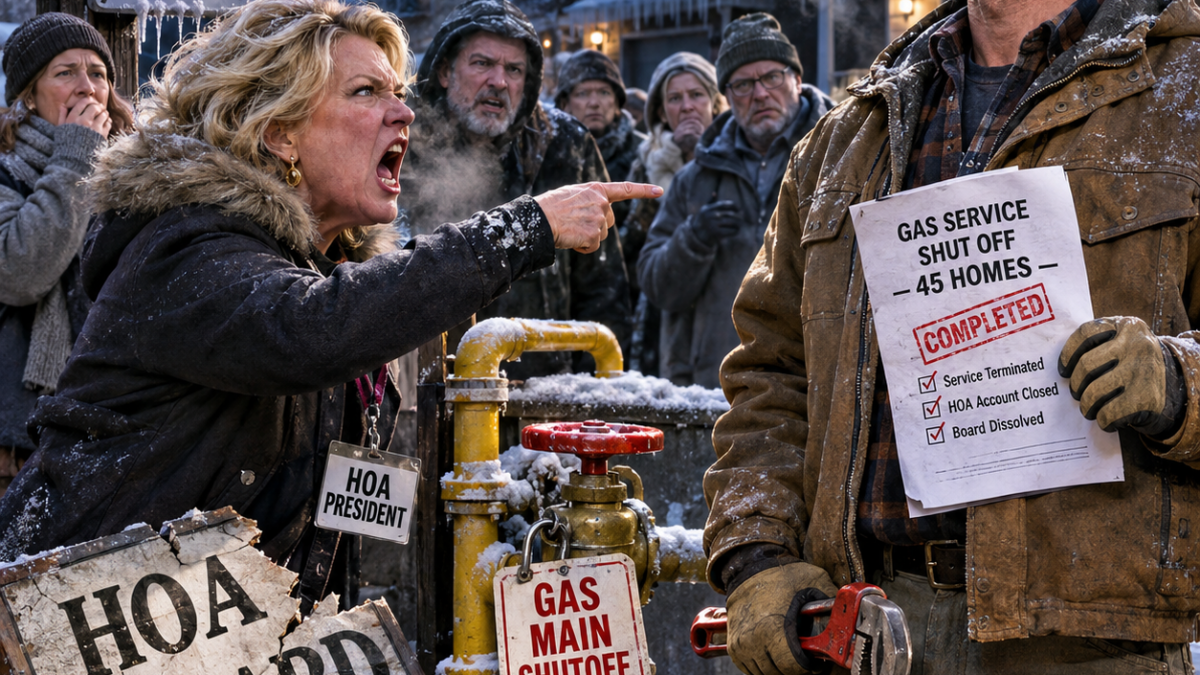
—
The accountant’s name was Walt Brubaker.
I found him through a professional association directory. He was a CPA who had spent years auditing planned communities and condominium associations, which sounded like a punishment someone might receive in the afterlife.
Walt disagreed.
“I like numbers,” he told me when I called. “Numbers don’t get offended when you ask where they came from.”
“I’ve got numbers that don’t know where they came from.”
“That’s usually more interesting.”
He agreed to conduct a preliminary review for four hundred dollars.
Petra and I split it.
Then I called Allegheny Valley Propane.
I kept the question narrow.
No accusations.
No speech about Dolores.
I simply asked whether the master account for Maple Crest Estates was currently operating under a discounted negotiated rate or standard commercial pricing.
The woman placed me on hold.
Three minutes later she returned.
“Standard commercial rate.”
“Since when?”
She checked.
“2019.”
I wrote the date down.
“You’re sure?”
“Yes, sir.”
“Thank you.”
I ended the call.
Then stared at the wall.
The HOA financial statements were charging residents as though a different pricing structure still applied.
The gap wasn’t proof of theft.
Not yet.
But it was proof that something needed explaining.
I drove to AVP’s office later that week to request records I was entitled to receive as a homeowner paying through the master arrangement.
I sat in my truck afterward with the heater running.
Dry snow skated across the parking lot.
Renata used to complain that I always assumed mechanical problems had mechanical answers.
“You can’t fix people with a wrench, Garrett.”
She had been right.
But you could still diagnose a system.
Input.
Output.
Pressure.
Loss.
Something inside Maple Crest was leaking.
And I was starting to think the leak had a name.
—
Dolores must have learned I was asking questions.
A week later, certified mail arrived.
My workshop was now supposedly in violation of a “secondary structure energy compliance addendum.”
According to the notice, detached structures above a certain size were required to connect to the shared propane system.
That meant my workshop—the place I had built to escape noise, grief, and everybody else’s rules—would suddenly fall under the same fuel arrangement Dolores controlled.
I called Petra.
“Come over.”
Twenty minutes later, she was at my kitchen table.
I slid the addendum toward her.
She read it.
Then turned to the back.
“No adoption certificate.”
“What?”
“If this amended the covenants, there should be a record showing how it was approved.”
“There isn’t?”
“Not attached.”
We dug through the county copies.
Eventually we found the meeting minutes.
Three board members.
Dolores.
Prescott Lund.
Mary Beth Hollander.
Vote:
Three to zero.
No membership ballot.
No record of broader owner approval.
Petra looked at me.
“This may not have been properly adopted.”
“May?”
“I’m retired, Garrett. I’m not giving you legal advice over coffee.”
“Useful distinction.”
“But I would absolutely show this to an attorney.”
I put it into a new binder.
Petra watched me label the tab.
**WORKSHOP ADDENDUM.**
“You know what’s happening?”
“What?”
“You’re becoming her.”
I looked at my growing stack of binders.
“Mine are cheaper.”
“Still.”
We both laughed.
It was the last easy laugh I had for a while.
—
The January weather arrived hard.
Western Pennsylvania has cold.
Then it has the kind of cold that feels personal.
A week before everything broke open, Dolores made three moves almost at once.
First, she called an emergency HOA meeting and proposed raising dues ninety dollars a month for “unexpected infrastructure costs.”
No itemized explanation.
Just ninety dollars.
Second, Clarion County code enforcement contacted me about an anonymous complaint alleging unsafe electrical work in my workshop.
The inspector came out.
He spent twelve minutes inside.
Looked at my permits.
Looked at the panel.
Looked at me.
“This was inspected when built?”
“Yes.”
“I can see that.”
“Problem?”
“No.”
He hesitated.
“Whoever complained was very specific.”
“How specific?”
“They claimed exposed conductors near the north wall.”
I pointed.
Finished wall.
No exposed anything.
The inspector shook his head.
“I’ll close it.”
“Can I get that in writing?”
He smiled.
“You expecting more complaints?”
“Yes.”
“Then yes.”
Third, Dolores contacted AVP about my backup propane tank.
It was a small legally installed tank serving my standby generator.
Nothing to do with the HOA’s shared system.
AVP sent an inspector after being told there might be a safety issue.
While the paperwork was reviewed, the backup tank was temporarily placed out of service.
That irritated me.
What happened next frightened me.
Sunday.
January 12.
9:47 p.m.
The furnace stopped.
At first, I assumed mechanical failure.
Thirty-one years in pipe fitting means you don’t blame conspiracy when a valve or burner can explain something.
I checked the furnace.
Power.
Thermostat.
Ignition.
Everything looked normal.
Then I checked my fuel pressure.
Zero.
I stared at the gauge.
No pressure.
I called AVP’s emergency line.
Seventeen minutes on hold.
I remember because I watched every one of them pass on the microwave clock while the house got colder.
Finally a representative answered.
I gave my address.
He typed.
Then became quiet.
“Sir, service to that address is marked interrupted at the request of the master account holder.”
I gripped the phone harder.
“Who is the master account holder?”
“Maple Crest Estates Homeowners Association.”
“When was the request made?”
“This afternoon.”
“Who requested it?”
“I can’t release an individual name.”
I didn’t need one.
“Was there a safety issue?”
“Not according to this notation.”
“A delinquent account?”
“I don’t see one.”
“Then why was it shut off?”
“I can only tell you it was requested through the master account.”
I looked toward the kitchen window.
Black glass.
Snow beyond it.
“What’s the outside temperature supposed to hit tonight?”
“I don’t know, sir.”
I did.
Dangerously below zero.
I thanked him.
Hung up.
Then called Dolores.
Straight to voicemail.
I left one message.
“My heat is off. AVP says the HOA requested it. Call me.”
Nothing.
At 10:30, I called Petra.
She answered immediately.
“She did it,” I said.
Petra didn’t ask who.
“I saw an AVP truck this afternoon.”
I closed my eyes.
The living room was already cold enough that the furniture felt different when I touched it.
I put on my work coat.
“What exactly does the HOA own in the propane system?”
Petra was silent.
“Garrett…”
“I’m asking about ownership.”
“The system sits in common area.”
“Meaning?”
“Every lot owner has an undivided interest in the common property under the original covenants.”
“So Dolores doesn’t personally control it.”
“Correct.”
I looked toward the dark window again.
For one ugly minute, I thought about the master infrastructure.
About how easy it would be for a person with my background to understand where the system could be interrupted.
I pictured Dolores waking up cold.
Prescott.
Mary Beth.
Every house.
I wanted them to feel it.
That thought scared me more than I expected.
Petra must have heard something in my silence.
“Garrett.”
“Yeah.”
“Don’t touch anything.”
“I didn’t say I would.”
“I know you.”
“No, you don’t.”
“I know enough.”
I sat down.
She was right.
Whatever Dolores had done, I wasn’t going to answer by putting forty-five uninvolved households in danger.
“I need Walt’s audit.”
“It’s almost done.”
“And I need an attorney.”
“I already have a name.”
Of course she did.
“Send it.”
Then she said quietly, “Where are you sleeping?”
I looked around the room.
The temperature was still dropping.
“My truck.”
“Absolutely not.”
“It has heat.”
“You’re fifty-eight.”
“I spent winters on industrial sites.”
“That doesn’t make this smart.”
“I’ll keep it running.”
“Come here.”
“No.”
“Garrett.”
“I’m not leaving the property.”
Silence.
She understood why.
This was my house.
After Renata died, leaving the old one had felt like surrender.
I wasn’t being driven out of this one by Dolores Whitcraft.
“I’ll call you in the morning,” I said.
“You’d better.”
I spent the night in the truck.
Old hunting sleeping bag.
Engine running in intervals.
Classic rock low on the radio.
Snow blowing through the headlight beams.
Around midnight, I could see my breath every time I opened the door to check the house.
I kept thinking about Renata.
She would have been furious.
Not frightened.
Furious.
She hated bullies.
She also hated when I became stubborn enough to confuse suffering with principle.
At two in the morning, sitting alone in the driveway, I could almost hear her.
**Being right doesn’t mean you have to be stupid about it.**
“Yeah,” I said aloud.
The empty passenger seat offered no reply.
—
AVP restored my service the following morning after Clifton Ashby contacted them.
Clifton was the attorney Petra had found.
Real estate.
Community associations.
Pittsburgh.
His first instruction was simple.
“Do not touch the shared propane infrastructure yourself.”
“I wasn’t going to.”
“You thought about it.”
I paused.
“How do you know?”
“Because you were a pipe fitter for thirty-one years and somebody just froze you out of your house.”
Fair.
“Can the board legally order an individual shutoff?”
“That is one of several questions I’m now asking.”
“What are the others?”
“Whether this HOA has been properly exercising the authority it claims for the last few years.”
That sentence turned out to matter.
A lot.
Walt finished his audit seven days after the frozen night.
He came to Petra’s house in person.
Gray suit.
Black briefcase.
No drama.
That made the number feel worse.
We sat around Petra’s dining table.
Walt opened a folder.
“I’m going to distinguish what I can prove from what I can’t.”
“Good,” Petra said.
He slid a one-page summary toward us.
“The unexplained difference between amounts collected from homeowners and documented association costs over the review period is approximately thirty-one thousand four hundred dollars.”
I stared at the figure.
$31,400.
Walt continued.
“The money is spread across administrative services, consulting costs, fuel-system reserves, and infrastructure categories.”
“Receipts?” I asked.
“Not enough.”
“Approvals?”
“Not enough.”
“Who authorized disbursements?”
Walt turned a page.
“Most were signed by the treasurer.”
Petra’s eyes met mine.
Dolores.
I leaned back.
“That’s bad.”
“Yes.”
Walt did not smile.
“But there’s something else.”
He took out another sheet.
“The association’s organizational history has a problem.”
“What kind?”
“I cannot locate a completed nonprofit incorporation filing from 1991.”
Petra went completely still.
Walt continued carefully.
“The original development documents anticipated a formal association entity. I found the covenants. I found board records. I found tax-related material. I did not find the state filing that should have established the nonprofit corporation.”
“What does that mean?” I asked.
“It means you need Clifton.”
“You’re the accountant.”
“Exactly.”
He closed the folder.
“I tell you what the books say. Your lawyer tells you what happens when the entity collecting money may not have been organized the way everyone assumed.”
I called Clifton from Petra’s kitchen.
He listened.
Asked Walt two questions.
Then went quiet.
“Garrett.”
“Yeah?”
“Do not discuss this with Dolores.”
“I wasn’t planning to.”
“I mean it. No victory lap. No threatening letter from you. Nothing.”
“What do we have?”
“Potentially personal board exposure. Potential claims over improperly collected charges. Questions about contracts. Questions about the fuel shutoff.”
“How long in court?”
“If they fight? A long time.”
I looked at Petra.
She was already writing something on a legal pad.
“What’s the faster option?”
“Owners.”
“What?”
“The owners remove the board.”
That was the first moment I understood what this might become.
Not Garrett versus Dolores.
Not one frozen house.
Forty-six property owners deciding whether they still trusted the people speaking in their name.
“What do we need?”
“A majority, properly obtained, and a special meeting conducted exactly according to the governing documents and applicable law.”
“How many?”
“At least twenty-four lots. I’d want more.”
“How fast?”
“Before Dolores knows you’re organizing.”
Petra tore the page off her pad.
She had written all forty-six addresses from memory.
I stared at her.
“How do you know everyone’s address?”
“I was a paralegal.”
“That explains nothing.”
“It explains enough.”
She split the list in half.
“East side is mine.”
“You’ve already decided?”
“Yes.”
I looked at the page.
Then at Walt’s audit.
Then at the propane correspondence.
For the first time since my furnace went silent, I felt warm.
Not physically.
Strategically.
“All right,” I said.
“We do it.”
—
We had ten days.
No Facebook campaign.
No flyers.
No dramatic speeches.
Petra and I called people.
“Can we come by and talk about the proposed dues increase?”
That was the question.
Almost everyone said yes.
We sat at kitchen tables.
Living rooms.
One garage.
A basement where a man named Don had enough fishing gear to equip a small navy.
We carried three documents.
First:
Walt’s one-page audit summary.
Homeowners studied the $31,400 figure.
Faces changed.
A retired nurse named Evelyn took off her glasses.
“Are you saying they took thirty-one thousand dollars?”
“No,” I said. “I’m saying the association collected thirty-one thousand four hundred dollars more than Walt can match to documented costs.”
“What’s the difference?”
“The difference is I’m not accusing anybody of something we haven’t proved.”
She looked at Petra.
Petra nodded.
“That’s the right distinction.”
Second:
Clifton’s plain-language explanation of the organizational problem.
We did not tell people every fine was definitely void.
We said the legal authority behind years of fines and contracts was under serious review.
That was enough.
A man named Samuel walked into his home office and returned with a folder.
“Two hundred dollars,” he said.
“What?”
“Mailbox and siding fines.”
Another woman had paid a thermostat surcharge.
Another had an “administrative inspection fee.”
The numbers multiplied.
Then we presented the third document.
The petition.
“This is not a lawsuit,” I told people. “It’s a request for a special meeting where owners vote on whether the current board stays.”
“What happens if they go?” Evelyn asked.
“We elect another one.”
“Who?”
“Us.”
She laughed.
“I don’t want the job.”
“Neither do I.”
Petra smiled.
“That may be the best qualification available.”
By day three, we had eighteen signatures.
Day five:
Twenty-six.
Day seven:
Thirty-one.
Thirty-one of forty-six lots.
More than enough.
One thing surprised me.
People weren’t signing because of my heat.
That opened the door.
But everyone had something.
A fine.
A letter.
A meeting where they weren’t allowed to speak.
A charge they didn’t understand.
A neighbor afraid to run for the board.
A seventy-five-dollar thermostat surcharge.
The problem had never been that Dolores had targeted me.
The problem was that everybody thought she was targeting them alone.
—
While we gathered signatures, Clifton went after the propane arrangement.
He sent a formal notice to Allegheny Valley Propane explaining that the board’s authority was disputed, that multiple owners were challenging the association’s governance, and that my January shutoff had been ordered without any demonstrated safety or payment basis.
AVP responded fast.
Their lawyers wanted no part of an internal HOA power fight.
Until ownership authority was clarified, the company would no longer honor unilateral requests from Dolores or any individual board member to disconnect a specific residence.
Any extraordinary service instruction would require documented authorization consistent with the master contract and owner rights.
I read the email twice.
Then handed it to Petra.
She smiled.
“Her favorite weapon just disappeared.”
“Yes.”
“Feel better?”
“A little.”
“Only a little?”
“I wanted her to feel what I felt.”
Petra’s smile faded.
“There it is.”
“What?”
“The dangerous part.”
I looked at her.
She continued.
“You want justice until you’re cold enough. Then you want revenge.”
I didn’t answer.
Because she was right.
“I thought about shutting the whole system down that night.”
“I know.”
“I could have.”
“I know that too.”
“But I didn’t.”
“That matters.”
She pushed the AVP letter back toward me.
“This is better.”
“Why?”
“Because nobody innocent has to freeze for Dolores to lose control.”
I folded the letter.
Renata would have liked Petra.
That annoyed me.
Mostly because I knew it was true.
—
The petition was filed.
Special meeting:
February 3.
Ten in the morning.
Maple Crest community room.
Dolores found out four days before.
After that, she panicked.
Her first move was almost impressive.
Three board members held an emergency session.
No meaningful advance notice.
No membership vote.
They announced an amendment supposedly raising the number required for removal from a majority to seventy-five percent.
Prescott Lund personally brought me a copy.
He stood on my porch holding the page like he wished it would disappear.
“The board adopted this last night.”
I read it.
“Did the owners vote?”
“No.”
“Was there notice?”
“It was an emergency.”
“What emergency?”
He looked at me.
I waited.
Finally he said, “The petition.”
I almost admired the honesty.
“So the emergency was that homeowners were using the existing rules?”
Prescott’s face reddened.
“I’m just delivering this.”
“Thank you.”
I closed the door.
Called Clifton.
He reviewed it.
“Garrett?”
“Yeah.”
“This is nonsense.”
“Technical legal term?”
“Very technical.”
“So it changes nothing?”
“Nothing.”
“Can we tell them?”
“Yes.”
I looked at the amendment.
“No.”
Clifton paused.
“You want them to rely on it.”
“I want Dolores to walk into that meeting believing she has seventy-five percent protection.”
Another silence.
Then Clifton said, “You are becoming alarmingly strategic.”
“Retirement hobby.”
—
The smear campaign appeared Tuesday.
Anonymous flyer.
Petra and I were supposedly orchestrating a “hostile takeover.”
We were accused of colluding with outside lawyers.
Of attempting to seize community assets.
Of destabilizing Maple Crest.
I read the flyer at the mailbox kiosk.
Then looked at Petra.
“Seize what?”
“The lavender bushes, apparently.”
“Those are ours?”
“I hope not.”
Three petition signers called that day.
None withdrew.
All three asked whether we needed help.
That was when I knew Dolores had lost the neighborhood.
She just didn’t know it yet.
Wednesday evening, Mary Beth Hollander came to my door.
No binder.
No board clothes.
Sweatshirt.
Jeans.
She looked exhausted.
“Can we talk?”
I stepped aside.
We sat at the kitchen table.
She kept looking at the floor.
“I didn’t know about your heat.”
“I believe you.”
Her head came up.
“You do?”
“Yes.”
“Why?”
“Because if you’d known, you wouldn’t be sitting here.”
She swallowed.
“The financial report. Is it real?”
“Walt signed it.”
“I’ve approved expense reports for years.”
My expression must have changed because she immediately added:
“I didn’t write the checks.”
“But you approved reports.”
“Yes.”
“Did you read them?”
Her eyes filled.
That answer hurt more than if she’d said no.
“I trusted Dolores.”
I leaned back.
Mary Beth wiped at one eye angrily.
“I thought she knew what she was doing.”
“Maybe she did.”
“That’s worse.”
“Yes.”
She sat silently.
Then asked, “Am I in trouble?”
“I don’t know.”
I meant it.
“Talk to your own attorney before Saturday.”
“Why would you tell me that?”
“Because I’m not trying to ruin you.”
“You’re trying to remove me.”
“I’m trying to remove the board.”
“That includes me.”
“Yes.”
She looked at me for a long time.
“Fair.”
Then she stood.
At the door, she stopped.
“I should’ve asked more questions.”
I thought about the thirty-one homeowners who had signed.
“That’s going around.”
—
Friday evening, I was in my workshop sharpening chisels.
The room still wasn’t connected to the HOA propane system.
It never would be if I had anything to say about it.
Fresh oak sat stacked along one wall.
I had been building a small writing desk based on a sketch Renata made years earlier.
She had wanted it for the upstairs bedroom in Youngstown.
I never built it while she was alive.
Too busy.
Always another shutdown job.
Another overtime weekend.
Another excuse.
Now I was making it for nobody.
Maybe myself.
Maybe her.
I ran the sharpening stone across steel.
Slow.
Controlled.
Petra appeared at the open workshop door.
“You ready?”
“For tomorrow?”
“Yes.”
“No.”
“Good.”
“Why does everybody keep saying that?”
“Because people who aren’t nervous usually don’t understand the stakes.”
I wiped the chisel.
“Thirty-one signatures still firm?”
“Thirty-one.”
“Any word from Dolores?”
“She requested another infrastructure inspection.”
I stopped.
“AVP?”
“Sent someone.”
“And?”
“System’s fine.”
I laughed once.
Petra stepped closer.
“You know what she’s doing?”
“Trying everything.”
“No.”
Petra leaned against the workbench.
“She’s looking for one authority that still says yes.”
That was exactly it.
County inspector?
No.
AVP?
Not anymore.
Homeowners?
Thirty-one no.
Her own board?
Cracking.
All Dolores had left was procedure.
And Saturday, we were bringing more procedure than she had.
—
February 3 arrived brutally cold.
Nine degrees at eight in the morning.
Bright sunlight.
Snow packed along the curbs.
The kind of winter day that looks beautiful through glass and becomes insulting the moment you step outside.
The meeting was scheduled for ten.
At 8:30, I got a call from Clifton.
“Everything ready?”
“Yes.”
“Walt?”
“Coming.”
“Petra?”
“Already threatening the coffee machine.”
“Signers?”
“Confirmed.”
Then he asked, “Garrett, any chance you’re planning something I haven’t approved?”
I smiled.
“No valves.”
“Good.”
“You really don’t trust pipe fitters.”
“I trust you around pipes. That’s the problem.”
The gas stayed on.
Every house warm.
That mattered.
What Dolores had done to me would not become what I did to everybody else.
But the board’s control over the propane account was effectively frozen.
For the first time in years, they could not threaten one house with the system and expect AVP to obey without questions.
That was enough.
Petra texted at 9:15.
**She’s here.**
Dolores arrived with Prescott and a lawyer.
Dark blazer.
Reading glasses.
Leather binder.
She set up at the front table facing the chairs.
Exactly where she always sat.
Then people started arriving.
Ten.
Twenty.
Thirty-one petitioners.
Then spouses.
Adult children.
Neighbors who had refused to sign but wanted to hear.
By 9:50, sixty-two people were packed into a room designed for forty.
Somebody had borrowed chairs from Saint Anthony’s parish hall.
Coffee brewed in a metal percolator.
People stood against the walls.
The room sounded alive in a way HOA meetings usually didn’t.
Dolores kept arranging papers.
I watched her notice each new face.
Her expression never broke.
But she stopped rearranging the binder.
Ten-oh-four.
She called the meeting to order.
“Before we begin,” she said, “I need to address a procedural defect.”
Of course.
She held up the emergency amendment.
“The petition initiating this gathering fails to satisfy the association’s amended seventy-five-percent threshold.”
Murmurs.
Dolores continued.
“Accordingly, any removal vote taken today would be invalid.”
She looked directly at me.
There it was.
The moment she thought she had won.
I stood.
“Are you finished?”
Her mouth tightened.
“You may speak when recognized.”
Petra said from the second row, “He’s recognized by thirty-one petitioners.”
A few people laughed.
Dolores struck the table lightly with her pen.
“This is exactly the disorder the board has been attempting to prevent.”
I looked at Clifton.
He stood.
Carried one folder to the front.
Placed it on the table.
Then faced the room.
“My name is Clifton Ashby. I represent several Maple Crest property owners in matters related to association governance.”
Dolores’s lawyer sat straighter.
Clifton continued.
“I’m going to address five subjects.”
He held up one finger.
“First, the amendment Ms. Whitcraft just cited.”
He distributed copies.
“The original governing documents and applicable statutory procedure do not permit three directors, at an unannounced emergency session, to alter member voting thresholds merely because a valid petition has already been submitted.”
Dolores’s lawyer leaned toward her.
This time she let him whisper.
Clifton moved on.
“Second.”
The incorporation problem.
He did not say the HOA had never existed.
He was too careful for that.
He explained that records showed a serious defect in the association’s formal organizational history and that the defect called years of enforcement actions into question.
People shifted in their chairs.
A man behind me whispered, “You’ve got to be kidding.”
“Third.”
Walt stood.
Clifton introduced him.
The $31,400 figure went onto an easel.
Actual contract costs.
Amounts collected.
Unexplained categories.
No speech.
Numbers.
Walt said, “I am not making a criminal accusation. I am saying these funds require an accounting.”
That sentence was devastating because it was restrained.
Dolores interrupted.
“These figures are incomplete.”
Walt looked at her.
“I requested supporting receipts.”
“You were not authorized by the board.”
“I was retained by owners.”
“You had no right to our internal—”
Clifton raised a hand.
“Ms. Whitcraft.”
She stopped.
“Financial access rights are the fourth subject.”
He presented the written requests.
The incomplete responses.
The fuel account.
Then he reached the January shutoff.
My name.
My address.
Service interruption.
Dangerous cold.
No payment delinquency.
No safety emergency documented.
Authorized through the master account.
The room went completely silent.
Mary Beth stared at the table.
Prescott looked at Dolores.
Dolores’s lawyer turned a page slowly.
Clifton said, “Allegheny Valley Propane has since confirmed that no individual board officer will be permitted to order another household-specific interruption under the disputed authority.”
A woman near the back said, “Good.”
Someone else said, “About time.”
Dolores raised her voice.
“The shutoff was a safety measure.”
I stood.
“What safety issue?”
She looked at me.
I waited.
“What issue?”
“The backup system on your property had been red-tagged.”
“My generator tank.”
“Yes.”
“That was not the fuel supply to my furnace.”
Silence.
“You knew that?”
Dolores’s expression changed.
Just enough.
I felt the anger return.
“You knew my house had no backup heat.”
Her lawyer touched her arm.
“Dolores.”
She pulled away.
“You refused every efficiency requirement this community established.”
“Efficiency?”
My voice rose.
For the first time all morning, I let it.
“It was below zero.”
The room held still.
“I slept in my truck.”
Nobody moved.
“You want to fine my shutters? Fine my shutters. You want to send me a letter about my workshop? Send ten.”
I pointed toward the propane records.
“But you used forty-six families’ heating system to punish one homeowner.”
Dolores stared at me.
“You don’t get to call that efficiency.”
Clifton quietly said my name.
That was enough.
I sat.
He continued.
“Fifth.”
The removal procedure.
Thirty-one valid petitioner signatures.
Owner identities verified.
Meeting properly demanded.
Vote permissible.
Dolores’s lawyer whispered something.
Longer this time.
Her face hardened.
Then something unexpected happened.
Prescott raised his hand.
Everyone turned.
He cleared his throat.
“I would like the record to reflect that I am recusing myself from further board action concerning these matters.”
Dolores snapped toward him.
“Prescott.”
He did not look at her.
“I’ve retained separate counsel.”
That landed.
Mary Beth stood.
Her chair scraped loudly against the floor.
“I resign.”
Dolores looked at her next.
Mary Beth’s hands shook.
But her voice didn’t.
“Effective immediately.”
A pause.
Then:
“I’m sorry.”
She looked at the homeowners, not Dolores.
“I should have asked questions years ago.”
Nobody applauded.
That made the moment stronger.
Mary Beth sat in an empty chair along the wall.
No longer behind the board table.
Petra stood.
“Call the vote.”
Dolores’s lawyer spoke quietly.
“My client objects to the procedure.”
Clifton answered.
“Your objection is preserved.”
Petra looked around.
“All lot-owner ballots previously verified?”
“Yes,” someone answered.
The vote began.
I thought it would feel exciting.
It didn’t.
It felt heavy.
One household at a time.
Names checked.
Ballots marked.
Folded.
Box.
Count.
Recount.
The coffee machine clicked in the corner.
Dolores remained seated.
Her leather binder was closed now.
Finally Petra received the tally.
Thirty-one votes for removal.
Two against.
Others present abstained or did not hold voting authority.
Petra looked toward the front table.
“Dolores Whitcraft is removed from the board.”
Nothing happened for maybe two seconds.
Dolores sat completely still.
Then she gathered her papers.
She did not look at me.
She did not look at Petra.
Her attorney collected his briefcase.
Prescott stayed seated but away from the table.
Mary Beth was crying quietly along the wall.
Dolores picked up the leather binder.
At the door, she finally turned.
I expected anger.
A threat.
Something.
Instead she looked tired.
Older than she had that morning.
“This neighborhood will regret this,” she said.
Petra answered before anyone else.
“Then we’ll regret it together.”
Dolores left.
The door closed.
Nobody cheered.
Then Evelyn—the retired nurse—started clapping.
Slowly.
Someone joined.
Then another.
Within seconds, sixty people were on their feet.
I stayed seated.
Petra leaned down.
“You okay?”
I nodded.
But I wasn’t thinking about Dolores.
I was thinking about a truck cab at two in the morning.
An empty passenger seat.
Renata telling me not to confuse stubbornness with strength.
For the first time since the frozen night, I felt like I could finally go home.
—
The aftermath was not quick.
Stories usually make consequences sound immediate.
They aren’t.
Records take time.
Lawyers take time.
Audits take time.
Government filings take time.
But the direction changed immediately.
By March, Maple Crest had begun reorganizing the association properly, with legal review and resident participation.
Five board seats.
Eleven candidates.
Eleven.
For years, Dolores’s board had struggled to get anyone to run.
Now people wanted in because they finally believed participation mattered.
Petra won a seat by the largest margin.
Nobody was surprised.
She took over the finance committee.
Her first rule was that monthly financial reports would be available to every homeowner.
Her second was that nobody should need a law degree to understand them.
Walt helped redesign the reports.
Fuel costs.
Administrative expenses.
Reserve contributions.
Vendor contracts.
Actual numbers.
No fog.
The $31,400 discrepancy became part of a civil recovery process.
Several homeowners separately sought refunds for fines and fees they believed had been improperly collected.
Some disputes settled.
Some took longer.
Questions about personal responsibility among former board officers went to attorneys, not neighborhood gossip.
That mattered.
I did not want Maple Crest becoming a revenge club.
I wanted it becoming boring.
Transparent.
Predictable.
The propane contract was renegotiated.
Properly.
With owners informed.
The new terms saved the average household roughly three hundred forty dollars a year.
For some people in Maple Crest, that was grocery money.
Prescription money.
Heating money.
Real money.
Evelyn stopped me at the mailbox one afternoon.
“You know what three hundred forty dollars is to me?”
I shook my head.
“Two months of one of my medications.”
That hit harder than the board vote.
This whole thing had started with Dolores claiming she was protecting community efficiency.
In the end, transparency did more for efficiency than control ever had.
—
My workshop survived.
Of course it did.
County-approved.
Permitted.
No forced connection to the shared propane system.
I finished the inside that April.
Pegboard.
Cabinets.
Workbench.
Chisels.
Hand planes.
The whole room smelled like fresh oak and sawdust.
The writing desk based on Renata’s old sketch took me another three weeks.
I messed up one drawer.
Built it again.
She would have mocked me for that.
“Thirty-one years fitting pipe and you can’t square a drawer?”
I could hear her voice perfectly.
When it was finished, I carried the desk into the spare bedroom.
Set it beneath the window.
Then placed her blue coffee mug on top.
I stood there for a while.
There are victories that feel loud.
That one didn’t.
It felt like grief finally moving one inch to the side and making room for something else.
—
Mary Beth came by in May.
I was sanding a chair.
She stood at the workshop entrance.
“Can I come in?”
“Sure.”
She looked around.
“This is nice.”
“Apparently it meets code.”
She laughed nervously.
Then became serious.
“I talked to an attorney.”
“Good.”
“I’m cooperating with the accounting review.”
“Also good.”
She stared at the floor.
“Dolores called me.”
I stopped sanding.
“When?”
“Last week.”
“What did she want?”
“Wanted me to sign a statement saying the board collectively approved your shutoff.”
I set the sandpaper down.
“Did you?”
Mary Beth looked at me.
“No.”
“Why not?”
“Because we didn’t.”
Simple.
She continued.
“She said I was betraying her.”
“What did you say?”
Mary Beth took a breath.
“I told her I already betrayed forty-six homeowners by signing things I didn’t read.”
That was the first time I saw real change in her.
Not because she joined my side.
Because she stopped pretending not knowing was the same as not being responsible.
“I’m sorry, Garrett.”
“You already said that.”
“I know.”
“Then do better.”
She nodded.
“I’m trying.”
That was enough.
—
Prescott resigned permanently a few weeks later.
No dramatic statement.
No speech.
He sent a letter.
He had spent years agreeing with Dolores because disagreement was uncomfortable.
Once attorneys became involved, discomfort changed shape.
I didn’t hate him.
That surprised me.
I had spent most of my working life around men who would nod in meetings, complain in parking lots, then sign whatever the boss put in front of them.
Cowardice isn’t always dramatic.
Sometimes it is just convenience practiced long enough to become character.
Prescott eventually apologized privately.
I accepted.
We never became friends.
Not every story needs that.
—
Dolores remained in Maple Crest for a while.
Her Buick still gleamed.
Her grass remained exactly the approved height.
But she no longer had a board title.
The first time I saw her after the removal vote, I was getting mail.
She walked toward the kiosk.
We were alone.
I considered leaving.
Then stayed.
She opened her box.
I opened mine.
For a moment there was only paper moving.
Then she said, “You enjoyed it.”
I looked at her.
“What?”
“The meeting.”
“No.”
She scoffed.
“Please.”
“I enjoyed you losing the ability to shut off my heat.”
Her mouth tightened.
“That action was never intended to endanger you.”
“What did you think happens to a house without heat below zero?”
She looked away.
That was answer enough.
“You forced my hand,” she said.
“No.”
She turned back.
“You undermined every board initiative.”
“I asked for authority.”
“You refused cooperation.”
“I asked questions.”
“You made everything adversarial.”
I stared at her.
Then understood something.
Dolores genuinely believed it.
In her mind, cooperation meant compliance.
Questions were hostility.
Limits were attacks.
She hadn’t built a decade of control by waking every morning and choosing cruelty.
She had built it by slowly deciding that whatever she thought was best for Maple Crest justified whatever power she used to get it.
That did not excuse her.
But it explained why no amount of documentation had ever persuaded her.
Facts were not the issue.
Control was.
“You should have let the heat stay on,” I said.
She said nothing.
I closed the mailbox.
Walked away.
That was our last real conversation.
—
Spring brought something I hadn’t expected.
Community Day.
Petra hated the name.
“Sounds like a bank-sponsored picnic.”
“What would you call it?”
“Anything else.”
Nobody listened to her.
Folding tables went up in the cul-de-sac.
Kids rode bikes.
Somebody’s uncle played acoustic guitar with enormous enthusiasm and limited technical skill.
People brought chili, casseroles, cookies, potato salad, grilled chicken.
I brought a workbench demonstration because somebody decided the retired pipe fitter should entertain children by showing them how to make wooden birdhouses.
I ended up with twelve kids around the table.
One little boy named Connor held a hammer by the head.
“Other end,” I told him.
He flipped it.
“Like this?”
“Perfect.”
Petra walked by carrying lemonade.
“You’re smiling.”
“I do that.”
“Not often.”
“Go audit something.”
She laughed.
Later, the new board announced that if recovered funds permitted it, Maple Crest would establish a small scholarship for local students pursuing trades, technical programs, or community-service careers.
Pipe fitting.
Electrical.
Construction.
Public administration.
I looked across the crowd.
At houses.
Neighbors.
The service road beyond them.
The whole shared system.
For years, money had disappeared into vague categories nobody questioned.
Now people were talking about using recovered money to teach kids how to build things.
Renata would have loved that.
She believed deeply in apprenticeships.
When our son told us he wanted college instead of the trades, she spent three months reminding me not to take it personally.
“Your job is to give him options,” she said. “Not replicas.”
Standing at Community Day, I understood something similar.
Winning was not rebuilding Maple Crest in my image.
It was making sure nobody got to rebuild it in one person’s image ever again.
—
The new HOA retained the shared propane system.
Replacing it would have cost a fortune.
The hardware had never been the problem.
The governance was.
That became one of the stranger lessons of the whole mess.
People like to blame systems.
Sometimes they should.
But sometimes the pipe works exactly as designed.
The valve works.
The contract works.
The problem is who has their hand on the authority.
Under the new structure, no individual board member could order a household shutoff for a governance dispute.
Safety emergencies remained with the provider.
Billing issues followed documented procedures.
Major policy changes required proper notice.
Nothing revolutionary.
Just guardrails.
The first winter after Dolores left, the temperature dropped below zero again.
Not fifteen below.
Still cold.
I woke around two one morning.
Old men do that.
I lay in bed listening.
The furnace cycled.
Warm air moved through the duct.
Normal sound.
I got up.
Walked into the kitchen.
Made coffee.
Then stood by the window.
Snow.
Dark street.
A few porch lights.
No drama.
No letters.
No AVP truck.
The furnace came on again.
For most of my life, heat had been invisible.
You only thought about it when it failed.
That winter, every time the furnace started, I noticed.
Not forever.
Eventually I stopped.
That was healing too.
When safety becomes ordinary again, your body slowly forgets to wait for the next threat.
—
Walt continued assisting the finance committee for another year.
Petra loved him because he could make spreadsheets understandable without making people feel stupid.
I liked him because he never turned uncertainty into accusation.
One evening after a meeting, the three of us were the last people in the community room.
Walt packed his laptop.
Petra stacked papers.
I poured out the terrible remaining coffee.
“You know what bothers me?” I asked.
Petra looked up.
“Only one thing?”
“The money.”
Walt zipped his case.
“What about it?”
“How did nobody notice?”
He leaned against the table.
“Because the individual numbers weren’t dramatic.”
I waited.
“Thirty dollars here. Fifty there. Fuel allocation adjustment. Administrative reserve. Nobody feels a thirty-dollar discrepancy strongly enough to spend Saturday reading contracts.”
Petra nodded.
“And everybody assumes somebody else already did.”
“Exactly,” Walt said.
“So the whole thing works because nobody looks?”
He shrugged.
“A lot of bad accounting survives because the numbers are boring.”
That sentence stayed with me.
Dolores had not needed a secret vault.
She needed categories no one wanted to read.
That was all.
—
The scholarship eventually launched.
Not huge.
The first award was modest.
But when the announcement went out, I printed it and put it in the workshop.
One recipient wanted to study electrical technology.
The other planned to enter a construction-management program.
Petra came over and found me staring at the paper.
“You know them?”
“No.”
“Then why are you staring?”
“Thinking.”
“Dangerous.”
I ignored her.
“Thirty-one thousand four hundred dollars.”
She nodded.
“That number again.”
“For months I thought about it as missing money.”
“And?”
“Now I think about what it could become.”
Petra looked at the scholarship notice.
“Better.”
“Yeah.”
She tapped the page.
“Much better.”
—
I finally finished Renata’s desk.
Technically, it had been finished for months.
But woodworking is dangerous for perfectionists.
There is always another sanding pass.
Another coat.
Another tiny flaw nobody else can see.
One Sunday afternoon, my daughter came to visit.
She walked into the spare room.
Stopped.
“Oh.”
The desk sat beneath the window.
Renata’s mug on top.
My daughter ran one hand across the wood.
“Was this Mom’s drawing?”
“Yeah.”
“You kept that?”
“Of course.”
She laughed softly.
“She would’ve complained you took too long.”
“She complained while alive.”
“She was consistent.”
We stood together.
Then my daughter looked at me.
“You okay here now?”
I knew exactly what she meant.
Maple Crest.
The house.
Life alone.
I thought about the winter night in the truck.
Dolores.
The vote.
The workshop.
Community Day.
The furnace.
“Yes.”
She studied me.
“You sure?”
“No.”
That made her smile.
“Better answer.”
I looked around the room.
“But I’m getting there.”
She hugged me.
The desk stayed.
So did I.
—
People later told the story differently.
Some said I “took down” the HOA.
I didn’t.
The HOA still exists.
It should.
Shared roads need maintenance.
Shared propane requires contracts.
Common spaces need money.
What we ended was one board’s assumption that the organization belonged to them rather than the owners.
Others said I defeated Dolores by finding the money.
Not exactly.
Walt found the accounting gap.
Petra found the people.
Clifton found the process.
Thirty-one households found their courage.
I was just cold enough to stop assuming someone else would fix it.
That is less heroic.
Also more accurate.
The part people liked most was the idea that I had spent thirty-one years understanding fuel systems and eventually used that knowledge against the woman who shut off my heat.
There is truth in that.
Just not the way people imagine.
My trade taught me that pressure follows paths.
Close one route, it looks for another.
Restriction creates consequences somewhere else.
A system fails where the weak point is.
Dolores thought the weak point was me.
One homeowner.
Widower.
Retired.
Newer to Maple Crest.
Easy to isolate.
She was wrong.
The weak point was trust.
Once homeowners stopped trusting her, every other part of her control depended on pressure she no longer had.
The propane company questioned her authority.
Mary Beth stopped signing.
Prescott sought his own lawyer.
Homeowners signed.
The board cracked.
No wrench required.
—
I still have the coat I wore that frozen night.
Brown canvas.
Grease stain on the sleeve.
One torn cuff.
I should throw it out.
I don’t.
Every January it hangs by the mudroom door.
Not as a trophy.
I’m not sentimental about suffering.
Mostly I keep it because it’s a good coat.
But once in a while, when the weather gets bad, I put my hand in the right pocket and feel the folded edge of an old AVP service receipt I forgot to remove.
Then I remember the truck.
Radio.
Snow.
Empty passenger seat.
The thought I had about making everybody else cold because I was cold.
That part matters.
If I had done it, maybe Dolores still would have lost.
Maybe the board still would have fallen.
But I would have become part of the danger.
That would have changed the story.
Instead, we took the system away from unilateral control without putting forty-five neighbors through what I went through.
That was slower.
Less cinematic.
Better.
Petra was right.
Justice and revenge can stand very close together.
Cold makes the line hard to see.
—
A few years after the board change, Maple Crest held another Community Day.
The scholarship recipients from the first year came back.
One of them, Lucas, was now an apprentice electrician.
He looked at my workshop panel and said:
“Who wired this?”
I stared at him.
“Licensed electrician.”
He nodded.
“Good.”
“Why?”
“Just checking.”
I looked at Petra.
She nearly spilled her coffee laughing.
“Kid’s been trained,” she said.
Lucas grinned.
Then asked if I could show him the writing desk I had built.
We walked inside.
He ran his fingers along one joint.
“That’s clean.”
“Thanks.”
“How long?”
I thought about Renata’s sketch.
Years, really.
“Too long.”
He nodded toward the workshop.
“You ever teach classes?”
“No.”
“You should.”
That became another thing.
Saturday mornings.
Basic tool safety.
Woodworking.
Home-maintenance skills.
Nothing formal.
Five people first time.
Nine the next.
Petra called it “Garrett’s Retirement Failure.”
I told her she could leave.
She never did.
—
Dolores eventually sold her house.
I learned from a For Sale sign.
No announcement.
No goodbye.
A moving truck arrived.
The white Buick disappeared a day later.
I watched from the workshop window.
For a moment I expected satisfaction.
Instead, I felt almost nothing.
That surprised me.
This woman had made me sleep in a truck during dangerous cold.
She had sent letters.
Threatened my workshop.
Charged residents money nobody could properly explain.
She had spent months occupying too much of my thoughts.
Then one morning she was simply gone.
Petra came by later.
“You saw?”
“Yeah.”
“You happy?”
“I don’t know.”
“You want to lie and say you wish her well?”
“No.”
“Good.”
I looked toward the empty house.
“I wish I’d never needed to know her that well.”
Petra nodded.
“That’s probably honest enough.”
The new owners moved in three weeks later.
Young couple.
Baby.
The husband introduced himself while struggling with a snowblower.
I helped him start it.
He had no idea who Dolores was.
That felt right.
Neighborhoods should eventually outlive their worst arguments.
—
The propane tank farm still sits at the back of Maple Crest.
I pass the service road when I walk in the mornings.
I don’t inspect valves.
I don’t carry covenants in my pocket.
I don’t think about control.
There’s a new metal sign near the access gate listing AVP’s emergency number and the names of authorized association contacts.
Three names.
Not one.
Petra insisted.
“Redundancy,” she said.
“That’s a pipe-fitting concept.”
“It’s also a democracy concept.”
“Don’t get dramatic.”
“You started a neighborhood revolt.”
“I filed paperwork.”
“Same thing with worse coffee.”
She had a point.
—
One January evening, years after the original shutoff, snow started just before dark.
I was in the workshop.
Fresh-cut oak.
Radio low.
I had a cabinet door clamped to the bench.
The furnace in the house kicked on.
I could hear the faint vibration through the wall.
Warm.
Ordinary.
I stopped working.
For no reason, I thought about that first night in Maple Crest after I moved in.
Renata had been gone less than a year.
The house still felt strange.
I had unpacked one coffee mug.
One plate.
One skillet.
I sat on the floor because my furniture hadn’t arrived.
I remember thinking:
**I don’t know how to start over at fifty-six.**
Turns out you don’t.
Not all at once.
You build a workshop.
Meet Petra.
Fight over shutters.
Read contracts.
Get too cold.
Get angry.
Get organized.
Learn your neighbors’ names.
Build a desk.
Teach a kid how to hold a hammer.
One piece at a time.
The furnace shut off after reaching temperature.
The workshop went quiet.
I ran my hand across the cabinet door.
Outside, snow covered Maple Crest.
Forty-six houses.
Forty-six families.
Lights glowing behind windows.
Heat running where people needed it.
Nobody using the fuel system as leverage.
Nobody waking up wondering whether disagreement would cost them warmth.
That was the part I cared about in the end.
Not Dolores losing her chair.
Not the audit.
Not even the recovered money.
Just the fact that no one person had their hand on everyone else’s comfort anymore.
I turned off the workshop lights and walked back toward the house.
The cold caught my face as soon as I stepped outside.
Sharp.
Clean.
Real Pennsylvania winter.
I pulled my coat tighter.
Then opened my front door.
Warm air met me.
I stood there for half a second, feeling it against my face.
After everything, I still noticed.
Maybe I always would.
Then I stepped inside and closed the door.
[END OF STORY]








