PART 2: HOA Karen Sent Her Son to Take My Groceries — Then Called the Cops Without Knowing I Was the Police Chief
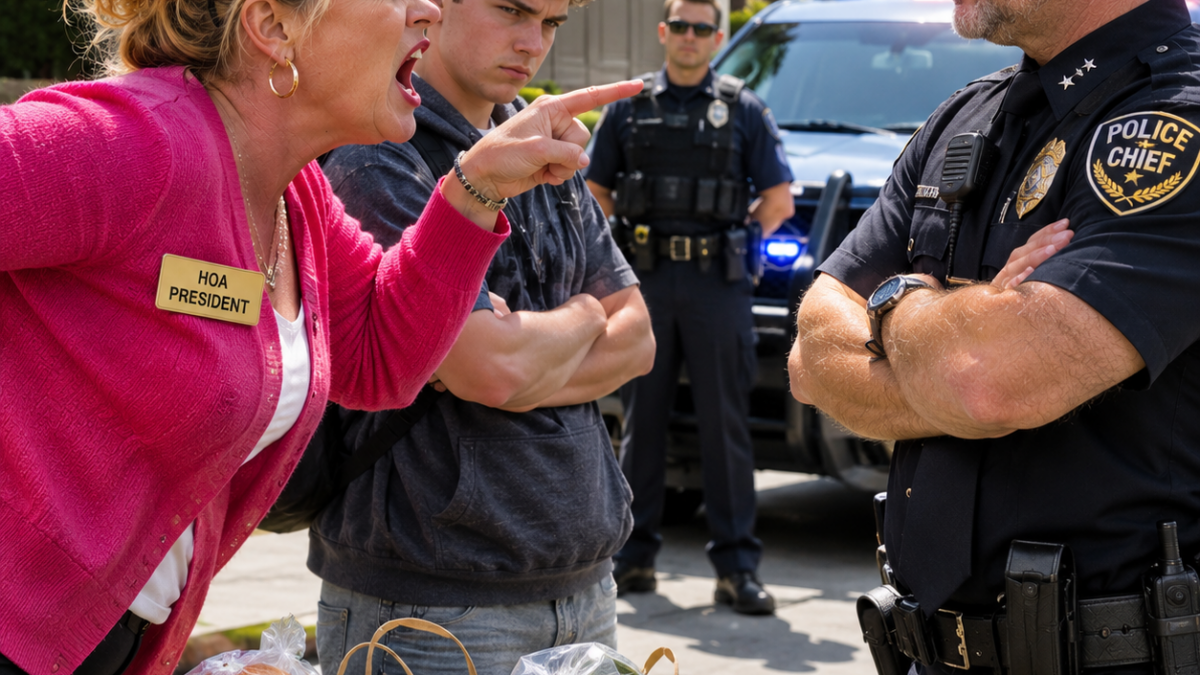
PART 2
## THE THING I DIDN’T TELL THE NEIGHBORHOOD
I was the chief of police in Ridgecroft.
Eight months before moving into Meadowlark Estates, I had been appointed after twenty-two years in the department.
Patrol officer.
Detective.
Lieutenant.
Deputy chief.
Then chief.
I had not hidden it because I was ashamed of the job.
I hid it because I wanted somewhere in my life where the badge did not walk into the room before I did.
My therapist had actually encouraged the move.
For three years I had lived in an apartment above a parking structure not far from headquarters.
Convenient.
Also terrible.
Sirens.
Shift changes.
Phone calls.
The psychological effect of never really leaving work.
My therapist, Dr. Reynolds, had looked at me over her glasses one afternoon and said:
“Darnell, you need a place where you are not the chief.”
“I’m not the chief at home.”
“You live six minutes from your office.”
“Five with green lights.”
“That is not helping your argument.”
So I bought the house.
I imagined myself becoming boring.
I underestimated Bettina.
## TUESDAY NOTICES
After the mailbox came the gutters.
A notice arrived claiming debris buildup violated maintenance standards.
I had cleaned them the Saturday before.
I climbed a ladder again.
Nothing.
Three leaves.
Maybe four.
I took photographs.
Then came the recycling bins.
Three inches too close to the property line.
The notice actually included the phrase “approximately three inches.”
I stood at the curb reading it.
Then looked across the street.
Bettina’s own trash container was still visible beside her garage.
It had been there since the previous evening.
I almost laughed.
Instead, I photographed mine.
Then hers.
Then saved both.
The decorative stones around my dogwood came next.
“Unauthorized hardscape modification.”
The stones had been installed years before I purchased the property.
My home inspection showed them clearly.
So I wrote my first formal response.
Polite.
Short.
Inspection report attached.
Date visible.
Photograph visible.
I dropped it at the HOA management office.
For one beautiful evening, I believed evidence would end the matter.
Friday afternoon, somebody knocked.
I opened the door.
Cody stood there.
Jeans.
Hoodie.
One hand against my door frame.
Golf cart sitting crooked in my driveway.
“My mom says your letter is wrong.”
I waited.
He continued:
“You’ve got a leak under your driveway expansion joint.”
“Do I?”
“Yeah.”
“Interesting.”
“She says it violates stormwater code.”
“What code?”
He blinked.
“The stormwater one.”
“What section?”
“I don’t know.”
“Then have your mother send the citation in writing.”
His expression changed.
“She’s going to report you to the county.”
“Great.”
That threw him.
“Great?”
“I’d love a county inspector to look at it.”
“But—”
“If something is wrong, I’ll fix it.”
He stared.
“If nothing is wrong, then we’ll have a record saying so.”
That wasn’t the script he had expected.
He shifted.
“My mom runs the HOA.”
“I know.”
“She knows the rules.”
“Then she’ll have no problem providing the section number.”
I closed the door.
Through the window, I watched Cody sit in his golf cart for almost a minute.
Then he drove home.
I remember thinking:
This kid has never been told no in the right tone before.
Not angry.
Not apologetic.
Just no.
## THE WHISPER CAMPAIGN
Within ten days, people began telling me Bettina was talking.
Nothing dramatic.
That would have been easier.
She was too careful.
Marcus Donovan at Number 12 mentioned that Bettina had “expressed concern” about whether I understood community expectations.
The Kowalczyks at Number 8 heard that I had “multiple unresolved code issues.”
Everett Simms, my seventy-one-year-old neighbor, heard that I was “difficult.”
All vague enough to deny.
Specific enough to spread.
I recognized it immediately.
Isolation.
You define somebody before they can define themselves.
Then, when the real fight starts, everyone has already been taught what to think.
It was an old tactic.
I had seen witnesses do it.
Suspects.
Workplace bullies.
Political operators.
Bettina wasn’t the most sophisticated manipulator I had ever encountered.
She was just very comfortable doing it in a place where nobody usually challenged her.
So I started a notebook.
Date.
Time.
Violation.
Rule cited.
Actual rule text.
Evidence.
Witnesses.
Response.
My first years as a detective had taught me something simple:
Memory feels strong until somebody asks for details six months later.
Paper survives confidence.
So I wrote everything.
Then I did something Bettina clearly did not expect.
I became a good neighbor.
Not strategically at first.
Just intentionally.
Marcus Donovan and I refinished my deck one Saturday.
He was six-foot-three, broad-shouldered, former union steward.
He brought a belt sander.
His wife brought coffee strong enough to strip paint.
Everett helped me trim the hedge between our properties.
I helped the Kowalczyks find a plumber for a problem under their front walk.
The Donovans invited me to a cookout.
I learned their oldest daughter had been accepted into a pre-med program at the University of Tennessee.
I learned Millicent Vance, a retired teacher three streets over, had been warned about wind chimes.
Wind chimes.
She had removed them because she didn’t want trouble.
That bothered me.
More residents told me similar stories.
Small fines.
Selective warnings.
Threats of inspections.
Nothing dramatic enough alone to justify war.
But together?
A pattern.
Bettina had spent six years teaching everyone that peace meant compliance.
I had seen systems like that before.
They work beautifully.
Right up until people start comparing notes.
## THE NOVEMBER MEETING
The clubhouse smelled like dry-erase markers and reheated casserole.
Twenty-seven residents attended.
Bettina sat behind a folding table at the front with a small wooden gavel.
I remember the gavel because there was absolutely no reason an HOA meeting needed one.
But Bettina enjoyed symbols.
She called the meeting to order.
Read minutes.
Reviewed landscaping.
Discussed the pool cover.
Then:
“New business.”
She proposed a mandatory property audit for any resident receiving three or more violations in a calendar year.
The audit would include an on-site inspection by an HOA-designated representative.
Guess who?
Bettina.
I had received three notices.
Mailbox.
Bins.
Decorative stones.
I sat in the back and watched.
She never looked directly at me while presenting it.
That was almost impressive.
The board approved the proposal.
Afterward, I approached Philip Greer, the representative from the HOA management company.
Philip always looked tired.
Not physically.
Institutionally.
Like his soul had been placed on hold with elevator music.
“Quick question.”
“Sure.”
“That rule takes effect immediately?”
He shook his head.
“Thirty-day comment period.”
“So earliest enforcement?”
He checked.
“January fifteenth.”
I smiled.
“Thank you.”
He looked at me.
“For what?”
“The date.”
I went home and wrote:
**JANUARY 15 — AUDIT**
That date would eventually matter more than Bettina could imagine.
## THE FIRST GROCERY INCIDENT
Two days later, I went to Ridgecroft Fresh Market.
Produce.
Milk.
Coffee.
Eggs.
A rotisserie chicken.
I had four bags.
Cold afternoon.
I opened the trunk in my driveway.
Cody appeared.
No golf cart sound.
No warning.
Just suddenly there.
“Hey.”
“Hey.”
He pointed.
“We need those.”
I looked at the bags.
“What?”
“Those.”
“My groceries?”
He nodded like I was slow.
“My mom said to come get them.”
For a few seconds I genuinely wondered whether I had misunderstood.
“Why?”
“Because of what you owe.”
“What do I owe?”
“The HOA stuff.”
“How does that become groceries?”
He frowned.
“Just give me the bags.”
I put one bag down.
“Cody.”
“What?”
“You need to go home.”
“My mom said—”
“I heard you.”
“She said you owe money.”
“Then your mother can send me a lawful invoice.”
“She said you don’t respect her.”
“That is not a debt.”
He crossed his arms.
“You’re making this a bigger thing than it is.”
“No.”
I picked up the bags.
“You showed up on another man’s driveway demanding his food. That’s the thing.”
He flushed.
“You gonna call the cops?”
I looked at him.
“No.”
He smirked.
Mistake.
I continued:
“I’m giving you an opportunity to make a better decision before somebody has to.”
The smirk faded.
“What does that mean?”
“It means go home.”
He stared.
Then walked away.
I went inside.
Eleven minutes later, Bettina knocked.
HOA fleece.
Clipboard.
Anger.
I invited her in.
That confused her.
People prepared for confrontation do not like hospitality.
I made coffee.
She sat at my kitchen table.
For twenty-two minutes, she explained that I had been disrespectful.
That Cody had been trying to resolve outstanding obligations informally.
That my attitude was damaging community harmony.
I listened.
Then asked:
“Did you instruct your son to take groceries from my driveway?”
“I told him you owed the association.”
“That isn’t what I asked.”
She stiffened.
“I think we’re losing sight of the larger issue.”
“Did you tell him to take my groceries?”
“He misunderstood.”
“So the answer is no?”
Her jaw tightened.
“You are being intentionally difficult.”
I nodded.
“Thank you.”
“For what?”
“Clarifying.”
She left believing she had won.
I called my attorney the next morning.
## CECILY FARR
Cecily Farr practiced municipal and property law.
Fourteen years.
Cheerful voice.
Extremely dangerous attention to detail.
I handed her everything.
Violation notices.
HOA bylaws.
Meeting amendment.
Photos.
The grocery incident.
She read.
Then spent a weekend with the governing documents.
Monday morning, she called before eight.
“I found three things.”
“Good morning to you too.”
“The audit amendment is defective.”
“How?”
“No meaningful appeal process before enforcement.”
I leaned against the kitchen counter.
“Meaning?”
“Meaning they may have created an enforcement mechanism without required due process protections under the governing structure and applicable law.”
“Can Bettina still come inspect?”
“She can ask.”
“Can she force entry?”
“No.”
“Good.”
“Second.”
She sounded happier.
“The fine schedule.”
“What about it?”
“The original declaration requires member ratification.”
“Was it ratified?”
“No record.”
“So the forty-dollar mailbox fine?”
“Potentially unenforceable.”
“How many fines have they issued?”
“Enough that somebody should care.”
“Third?”
Cecily paused.
That pause was different.
“The annual financial disclosure lists just over nine thousand dollars in administrative services.”
“Okay.”
“The vendor is Whitmore Property Management Solutions.”
I stopped.
“Whitmore.”
“Yes.”
“Bettina?”
“Registered owner.”
I sat down.
“She paid herself?”
“Looks like it.”
“Disclosed?”
“Not in what I have.”
“Board approval?”
“Not clearly documented.”
I stared out the kitchen window.
Across the street, Cody drove past in the golf cart.
Slow.
“I want everything.”
“You want evidence.”
“Same thing.”
“No.”
Cecily laughed.
“Evidence first.”
She was right.
## THE MONEY
Nine thousand dollars was not a fortune.
That mattered.
If Bettina had stolen half a million dollars, everybody would immediately understand.
Nine thousand in “administrative services” could hide in boredom.
That was exactly why it worked.
Invoices.
Management consulting.
Administrative support.
Small checks.
No obvious scandal.
But the company receiving the money belonged to the HOA president.
Without transparent approval.
Cecily explained fiduciary duty.
Conflict disclosure.
Board responsibility.
I listened.
Then asked:
“How strong?”
“Strong enough that the management company and other board members should become nervous once notified.”
“Good.”
“No.”
“What?”
“Useful.”
She corrected me.
“Not good.”
Fair.
## BETTINA STARTS TAKING PICTURES
She became more obvious.
Phone raised toward my yard.
Photographs of gutters.
Driveway.
Dogwood.
Mailbox.
Once, I walked outside while she was photographing my deck.
“Morning.”
She lowered the phone.
“Routine documentation.”
“From the street?”
“Yes.”
“Enjoy.”
I went back inside.
People like Bettina expect anger.
Anger justifies them.
Silence makes them wonder what you know.
Everett came over later.
“She’s nervous.”
“You think?”
“I’ve watched her six years.”
He looked across the street.
“She gets more organized when she’s scared.”
I liked Everett.
He had the patience of weather.
## THE ORIGINAL DOCUMENTS
January came gray and wet.
I drove downtown to the county recorder.
Two hours.
Original subdivision plat.
Recorded declaration.
CC&Rs.
Amendments.
Not the HOA’s convenient digital summary.
The originals.
On Page 14, buried inside enforcement language, I found a clause.
If the association initiated an enforcement action without documented evidence of an actual violation, the association could be liable for the affected member’s reasonable legal and administrative costs subject to the formula stated in the declaration.
I read it twice.
Then again.
My mailbox fine.
No real evidence.
Gutters.
Photographs showed compliance.
Stones.
Preexisting.
Bins.
Questionable.
Driveway.
No defect.
I had eleven notices by then.
Eleven.
I sat in my car while rain tapped the windshield.
On the passenger seat:
Original CC&R copy.
Cecily’s memo.
Financial disclosures.
My notebook.
I had entered the courthouse as a homeowner annoyed by an HOA president.
I left with a structure.
That mattered.
## THE CERTIFICATE
Months earlier, before the situation became serious, I had requested a county compliance inspection.
It cost me sixty dollars and forty-five minutes.
The county inspected the property.
No relevant violations.
Certificate issued.
At the time, it felt excessive.
By January, it felt brilliant.
Bettina could send whatever private inspector she wanted.
I had an official government record showing the property complied with applicable codes as of the inspection.
That did not magically defeat every possible HOA complaint.
But it destroyed the narrative that my home was some uncontrolled violation zone.
## THE PETITION
I started talking to neighbors.
Not campaigning.
Listening.
Nine households agreed to provide written statements describing enforcement they believed had been retaliatory or arbitrary.
Millicent showed me the wind-chime warning.
The Osay family showed me two years of fines over a storage shed built before the current HOA enforcement regime.
Another resident had been threatened with inspection over landscaping that matched five nearby houses.
I collected documents.
Cecily reviewed everything.
Then I gathered signatures for a special membership meeting.
Eighteen required.
I got twenty-three.
Filed January 12.
Meeting required within the governing timeline.
Now Bettina had several problems moving toward her at once.
Legal notice.
Accounting demand.
Member petition.
January 15 audit.
She knew some of it.
Not all.
## THE LETTERS GO OUT
January 8.
Certified mail.
One letter to the HOA management company.
The proposed audit rule was challenged.
Fine schedule validity questioned.
Citations attached.
Another demand went to the other board members.
Gerald Fitch.
Diana Pruitt.
The payments to Bettina’s company needed explanation.
Full accounting requested.
The letters reached their homes.
Suddenly Bettina’s comfortable board became less comfortable.
Gerald called Cecily.
Nervous.
Polite.
Wanted to know how to resolve things.
Diana began avoiding meetings.
Philip Greer told Bettina his company could not ignore formal legal notice just because she wanted them to.
For the first time, Bettina’s title was not enough.
Then she hired an inspector.
## TERENCE BOYLE
January 13.
A private property inspector came to Briarwood Court.
Professional.
Careful.
Stayed on public areas.
Photographed my house.
Took notes.
I watched through the window.
I did not confront him.
He did his job.
Whatever Bettina wanted him to find, the county certificate already existed.
The next morning, Bettina hand-delivered a letter.
Not typed.
Handwritten.
That told me more than the content.
She accused me of harassment.
Demanded withdrawal of the membership petition by five that afternoon.
Threatened to contact law enforcement if I continued my “obstructive behavior.”
I photographed it.
Sent it to Cecily.
Then went for a walk.
Five o’clock passed.
Nothing.
5:23.
Blocked-number text.
**LAST CHANCE**
Screenshot.
Saved.
Forwarded.
Document everything.
## THE SECOND GROCERY INCIDENT
That evening I stopped at the market again.
This time I bought more than usual.
Coffee.
Chicken.
Vegetables.
Cereal.
A box of cookies I did not need.
When I pulled into my driveway, Cody’s golf cart rolled over.
Slowly.
He stopped behind my vehicle.
I opened the trunk.
“Cody.”
“My mom says you still owe us.”
I looked at him.
“Your mother has an attorney now.”
“She said that doesn’t matter.”
“It matters.”
He stepped closer.
“Hand over the bags.”
There it was.
The sentence people would remember later.
“Hand over the bags.”
He was sixteen.
Still a kid.
But old enough to understand taking property from somebody after they told you no.
I set the bags down.
“Son.”
“What?”
“Think very carefully about what you just said.”
He rolled his eyes.
“Or what?”
I said nothing.
He smiled.
“What, are you going to call the cops?”
I looked at him for three seconds.
“No.”
His smile widened.
Then I said:
“I don’t think I’ll need to.”
He didn’t understand.
Not yet.
I carried my groceries inside.
Four minutes later, Bettina appeared.
Not eleven this time.
Four.
Phone in hand.
Already recording.
“You threatened my son.”
“No.”
“He says you intimidated him.”
“I told him not to take my groceries.”
“He was collecting what you owe this association.”
“Groceries are not HOA currency.”
“This is exactly the attitude I’ve been documenting.”
“Good.”
She blinked.
“Good?”
“Keep documenting.”
Her mouth tightened.
“I’m calling the police.”
I picked up the last bag.
“Make the call.”
She stared.
“Do you have any idea who I am in this neighborhood?”
“Yes.”
“You will regret this.”
“Call.”
She did.
Then dispatch asked her questions.
She described a hostile homeowner.
Threatening behavior.
Interference with official HOA business.
She sounded satisfied when she hung up.
I carried the groceries inside.
That was not yet the final confrontation.
But it told me exactly how January 15 would go.
Bettina believed police were the last weapon in the drawer.
I decided to let her reach for it.
## MY SERGEANT
Two days before the scheduled audit, I called the department’s non-emergency line.
Asked for Sergeant Antoinette Webb.
Twenty years in law enforcement.
Six years working directly under me.
One of the calmest human beings I knew.
“Chief?”
“I’m calling as a resident.”
“That sounds ominous.”
I explained enough.
Expected HOA confrontation.
Possible police call.
Unauthorized inspection attempt.
Civil dispute.
“I don’t want a rookie walking into it blind.”
“Understood.”
“If a call comes from Briarwood Court, I want you notified.”
“Done.”
“And Antoinette?”
“Yeah?”
“Treat me like anybody else there.”
She laughed.
“You’re usually the one reminding us of that.”
“Just saying.”
“I know.”
## THE REPORTER
I called Joellen Pask.
Ridgecroft Courier.
Municipal affairs.
We had known each other professionally for years.
Not friends exactly.
Mutual respect.
I told her:
“There may be something worth observing January fifteenth.”
“Crime?”
“HOA.”
“That can be worse.”
I laughed.
She asked for an address.
I gave it.
She promised to stay off my property unless invited.
That mattered.
Everything needed to remain clean.
No ambush that could be described as manufactured.
No using my office.
No directing officers.
No retaliation.
Bettina had to own every decision herself.
## JANUARY 14
The lights in the Whitmore house stayed on late.
Everett noticed.
He noticed everything.
Cody knocked on neighbors’ doors warning that people who signed the petition might face “legal consequences.”
He made it to Marcus Donovan’s porch.
Marcus listened.
Then said:
“Son, you’re sixteen.”
Cody tried to continue.
Marcus pointed toward the street.
“Go home.”
That ended that.
Bettina called an emergency board session with only Gerald willing to attend.
She tried to reaffirm the inspection.
The quorum problem was obvious.
Still, paper was produced.
Gerald later told me Bettina brought cookies.
Homemade.
At almost midnight.
I’m not sure why that detail stayed with me.
Maybe because power collapsing rarely looks dramatic at first.
Sometimes it looks like a woman baking cookies at midnight trying to keep one nervous board member loyal.
## JANUARY 15
I woke at six.
Coffee.
Shower.
Sweater.
Jeans.
No uniform.
No badge displayed.
On my kitchen table:
County certificate.
CC&Rs.
Cecily’s memo.
Financial documents.
Petition.
Violation notices.
At 7:15, Joellen parked two houses down.
At 7:30, Cecily arrived.
“Coffee?”
“Yes.”
“You nervous?”
“No.”
“Liar.”
“Not enough to matter.”
She smiled.
At 8:43, I heard the golf cart.
Cody came first.
Then Bettina.
HOA fleece.
Clipboard.
Measuring tape clipped to her belt.
She had dressed for the role.
She rang.
I opened the door.
“Mr. Okafor.”
“Morning.”
“The board is here to conduct your mandatory compliance audit.”
“Who is the board?”
She ignored that.
“I require access to the rear yard, deck, utility area, and exterior drainage points.”
“No.”
Her eyes narrowed.
“If you obstruct the inspection, I will call law enforcement.”
“You are welcome to.”
“I am giving you one final opportunity.”
“No.”
She pulled out the phone.
Dialed.
## THE CALL
I could hear parts.
“Combative homeowner.”
“Official HOA inspection.”
“Possible escalation.”
“Refusing lawful access.”
Dispatch placed her on hold.
She looked at me.
For thirty seconds, neither of us spoke.
My phone buzzed.
Antoinette.
**ON OUR WAY.**
I put it away.
“They’re coming,” I said.
Bettina’s shoulders relaxed.
That was the saddest part.
She genuinely believed this was vindication.
## 9:04 A.M.
The cruiser turned onto Briarwood.
Sergeant Webb stepped out.
Standard uniform.
No rush.
No lights.
No drama.
She walked up the driveway.
Bettina immediately moved toward her.
“Officer, thank you. This gentleman is refusing to comply with an authorized HOA inspection, and he has been increasingly hostile—”
“Ma’am.”
Webb’s voice was not loud.
It stopped Bettina anyway.
“I have some background on the call.”
Bettina straightened.
“Good.”
“Your name?”
“Bettina Whitmore. HOA president.”
Webb wrote.
Then looked at me.
“And you, sir?”
“Darnell Okafor.”
There was the smallest pause.
Then Webb nodded.
Nothing theatrical.
Just professional acknowledgment.
Bettina noticed.
“What?”
Nobody answered.
I said:
“The audit amendment is formally disputed and was passed without the procedural safeguards required by the governing framework. My attorney is present.”
Cecily appeared in the doorway.
Folder in hand.
“Good morning.”
Bettina’s clipboard lowered.
Cecily continued:
“The HOA management company received notice January eighth. There is no consent for entry.”
“That is not your decision.”
Cecily opened the folder.
“Then there is also the question of the fine schedule that was never properly ratified.”
Bettina looked at Webb.
“This is a civil matter.”
Webb nodded.
“Yes.”
Bettina almost smiled.
Then Webb added:
“Which means I’m not here to force a homeowner to submit to a private inspection.”
The smile died.
## THE MONEY COMES OUT
Cecily turned a page.
“And there is an outstanding accounting request concerning approximately nine thousand dollars in payments to Whitmore Property Management Solutions.”
Bettina froze.
Webb looked at her.
Cody went still.
Cecily continued:
“The company registered to you.”
“This is inappropriate.”
“What is?”
“Discussing private association business in front of police.”
I finally spoke.
“The police are here because you called them.”
Silence.
Across the street, Everett stepped onto his porch.
Robe.
Slippers.
Coffee.
Of course he did.
Then Joellen began walking toward us.
Notepad.
Bettina saw her.
Everything changed in her face.
## “WHO ARE YOU?”
Bettina looked at Webb.
Then at me.
“Why does she keep looking at you like that?”
Webb said nothing.
I had not planned the line.
It simply became necessary.
“I’m the police chief of Ridgecroft.”
Nothing moved.
Not Bettina.
Not Cody.
Not even the clipboard.
For eight months, I had been Darnell.
City employee.
Quiet man.
Problem neighbor.
The person she could threaten with law enforcement.
Now the category changed.
Not because being chief gave me greater property rights.
It didn’t.
That was important.
I said:
“I have lived here since July. I deliberately kept my profession private because I wanted to live here as a resident, not as the chief.”
Bettina stared.
“I have not used my office against you.”
Her mouth opened.
Closed.
“I have not directed officers to enforce HOA matters.”
No answer.
“I have documented your notices, researched the recorded governing documents, retained private counsel, requested lawful records, obtained a county certificate of compliance, and signed a membership petition.”
Cody looked at his mother.
I continued:
“Those are rights every homeowner has.”
That mattered more than the title.
## JOELLEN ARRIVES
“Ms. Whitmore?”
Bettina turned.
Joellen identified herself.
“Ridgecroft Courier. Could I ask for comment regarding the petition for a special membership meeting and the payments to Whitmore Property Management Solutions?”
Bettina’s face changed slowly.
Confidence did not explode.
It drained.
That was more powerful.
She looked down at the HOA logo on her fleece.
Then at her clipboard.
Then toward the street.
“I have no comment.”
She walked away.
Cody backed the golf cart out.
He almost hit a mailbox.
Corrected.
Then followed her.
Everett raised his coffee mug.
I raised mine.
Sergeant Webb completed the report.
No crime.
No forced access.
Civil dispute documented.
Then she looked at me.
“Chief.”
“Sergeant.”
“You have weird days off.”
“You have no idea.”
She smiled.
Then left.
## AFTER THE CRUISER
Cecily stood in my driveway.
Joellen was taking notes.
Neighbors had started appearing.
Marcus came over.
“What the hell just happened?”
“I had an HOA audit.”
He laughed.
“No, seriously.”
“I’m serious.”
“You’re police chief?”
“Yes.”
He stared.
“Man, I spent three hours helping you sand a deck.”
“Yes.”
“You could have mentioned that.”
“Why?”
He thought.
Then laughed again.
“Fair.”
Everett crossed the street.
“I knew.”
I looked at him.
“You did?”
“No.”
He smiled.
“But I’m old. We like pretending.”
## THE ARTICLE
Joellen did not write a humiliation piece.
I respected that.
She checked documents.
Called the management company.
Called Cecily.
Requested comment from Bettina.
Reviewed public corporate records.
The story ran four days before the special membership meeting.
Headline focused on HOA governance.
Questioned fine schedules.
Self-dealing concerns.
Member petition.
Audit dispute.
My position appeared, but the article did not make my job the point.
That was important.
This was not:
Police Chief Crushes HOA Karen.
It was:
Homeowners Discover Their Rules May Not Be What They Were Told.
The effect was stronger.
People could dismiss a personality fight.
Documents were harder.
## THE CLUBHOUSE FILLS
February 7.
112 of 174 homes represented.
I had never seen the clubhouse that full.
People stood along walls.
Folded chairs filled.
Coffee everywhere.
Bettina did not attend.
That surprised me.
Part of me expected her at the front.
Gavel.
Binder.
Last defense.
She stayed home.
Gerald had resigned two days earlier.
Diana never really returned to active participation.
The management company representative opened the meeting.
The agenda:
Board governance.
Financial disclosures.
Fine schedule review.
Officer removal.
Residents spoke.
Millicent brought the wind-chime letter.
She held it up.
“I took these down because I was afraid of a fine.”
Her voice trembled.
“I’m seventy-four years old.”
People listened.
“My husband bought those chimes before he died.”
The room became very quiet.
“I let somebody make me afraid to hear them.”
That hit harder than anything I could have said.
## THE OSAYS
Mr. Osay stood next.
He brought photographs.
His storage shed.
Built before much of the current enforcement regime.
He had paid fines for two years.
“I kept asking where the rule was.”
He looked around.
“They kept telling me it was in the rules.”
“Did you get the citation?” somebody asked.
“No.”
He shook his head.
“I thought they knew better than me.”
That sentence summarized half the room.
I thought they knew better than me.
Authority lives on that sentence.
## MARCUS
Marcus Donovan spoke.
He had no fine to complain about.
No money at stake.
He simply said:
“I signed the petition because nobody should be scared of asking where the rules come from.”
Then:
“If a board is right, it should survive questions.”
Applause.
Short.
Simple.
True.
## MY TURN
I hadn’t planned to speak.
The moderator asked.
I stood.
“My issue started with forty dollars.”
A few people laughed.
“Mailbox color.”
More laughter.
“I paid it.”
I looked around.
“That part matters.”
The room quieted.
“I paid because I was tired. I didn’t have time to argue.”
I thought of Dad? No—this was my story. I thought of myself carrying work home mentally every night.
“I assumed forty dollars was cheaper than conflict.”
I looked toward Millicent.
“But every time somebody pays something they know is wrong because challenging it feels harder, the person issuing the wrong demand learns a lesson.”
Silence.
“They learn that process can be used as pressure.”
I held up the original CC&R copy.
“The answer isn’t rebellion.”
I shook it slightly.
“It’s reading.”
A few people smiled.
“Ask for the rule. Ask for the vote. Ask for the invoice. Ask for the appeal process.”
Then I said:
“And when somebody tells you they have authority over you, ask them to show you exactly where it begins and where it ends.”
I sat.
## THE VOTE
Removal of Bettina Whitmore as HOA president.
Secret ballot.
Counted publicly.
104 in favor.
8 against.
The room breathed out.
Nobody cheered immediately.
Then applause started.
Not wild.
Relief.
The eight votes opposed were later rumored to be relatives and close allies.
I never verified it.
Didn’t care.
Bettina was out.
Six years of control ended on a folding table with paper ballots.
No police.
No handcuffs.
No dramatic removal.
Just members voting.
That was better.
## THE MANAGEMENT COMPANY LEAVES
Within a week, Philip Greer’s company terminated its contract with Meadowlark.
Liability review.
Conflict concerns.
Procedural problems.
Philip emailed me.
Short.
Professional.
He thanked me for keeping communications documented and civil.
Then wrote:
**For what it’s worth, I should have asked more questions earlier.**
I respected that.
People rarely admit institutional laziness.
## THE MONEY COMES BACK
Cecily pursued the administrative payments.
Bettina retained her own lawyer.
Three months of letters.
Accounting.
Negotiation.
Eventually a settlement.
Approximately seventy-five percent of the questioned payments repaid.
Around $6,800.
Not criminal.
Not dramatic.
Civil.
Binding.
The money returned to the HOA operating fund.
Some residents wanted more.
I understood.
But justice is not always maximum punishment.
Sometimes it is documentation plus repayment plus removal of access.
Bettina no longer had control over the account.
That mattered.
## THE FINES
Twenty-three residents submitted claims based on the protections inside the original governing documents.
The new board reviewed them.
Nearly $4,000 in refunds and contractual reimbursements.
The reserve fund could handle it.
Marcus was elected to the board.
I warned him:
“You complained about the HOA and now you are the HOA.”
“I know.”
“Tragic.”
“Shut up.”
He laughed.
The new board adopted an appeal procedure.
Published rule citations.
Posted financial summaries.
Required conflict disclosures.
Revisited enforcement standards.
Nothing glamorous.
Boring governance.
My favorite kind.
## MILLICENT’S WIND CHIMES
The new board used $3,000 from recovered funds to create a small hardship assistance program for homeowners facing legitimate HOA-covered maintenance issues.
Millicent received the first grant.
She repainted her porch.
Then she rehung the wind chimes.
I remember the first evening I heard them.
Soft metal.
Wind.
Not loud.
Not offensive.
Just music.
I stood on my deck listening.
Everett called from next door:
“Dangerous.”
“Clearly.”
“Neighborhood’s collapsing.”
“Any minute.”
He laughed.
The chimes kept moving.
Sometimes freedom is embarrassingly small.
That does not make it less real.
## THE DOGWOOD TREE
Spring came.
The dogwood I thought had been ruined by overtrimming came back.
White flowers.
Thicker than the year before.
A little wild.
Everett stood beside me.
“That’s a good tree.”
“It is.”
“Trees don’t care about HOA presidents.”
“Lucky.”
He looked at me.
“You okay?”
I knew what he meant.
Months of preparation.
Conflict.
Public attention.
Work stress layered on top.
“I’m getting there.”
He nodded.
“All weather passes.”
Everett said things like that.
He had earned the right.
## CODY AT THE MARKET
About a month after everything settled, I saw Cody at Ridgecroft Fresh Market.
No golf cart.
Just a teenager.
Loading grocery bags into a car.
The irony was obvious enough that I almost smiled.
He saw me.
Froze.
I kept walking.
Then he said:
“Hey.”
I stopped.
“Hey.”
Silence.
He looked at the bags.
Then at me.
“I was kind of a jerk.”
There are moments when adults decide whether a teenager’s mistake becomes an identity.
I remembered myself at sixteen.
Different mistakes.
Same unfinished brain.
“You were following your mother’s script.”
He looked uncomfortable.
“Yeah.”
“That doesn’t remove your responsibility.”
“I know.”
“But you’re sixteen.”
He nodded.
I said:
“Write a better script.”
That was all.
I didn’t need an apology speech.
He didn’t need public humiliation.
He needed to grow up.
## WHAT I NEVER DID
I never used department resources to investigate Bettina.
I never asked officers to search her records.
I never threatened arrest.
I never pulled strings.
That distinction mattered deeply to me.
The easiest version of this story would have been:
HOA woman messes with police chief and gets destroyed.
That would have been satisfying for about thirty seconds.
It also would have been wrong.
My job did not give me better HOA rights than Millicent.
Or Everett.
Or the Osays.
If the system only protected me because I wore a badge, then the system was still broken.
The victory mattered because we used the same tools any organized homeowner should be able to use.
Recorded documents.
Legal counsel.
Member petitions.
Financial disclosure.
Votes.
Documentation.
The badge made Bettina’s phone call ironic.
It did not make her wrong.
Her conduct did that.
## THE SECOND BOARD MEETING
Marcus called me before his first meeting.
“I hate you.”
“Why?”
“I have a binder.”
I laughed.
“Color coded?”
“Don’t push me.”
The meeting lasted three hours.
People argued about landscaping.
Parking.
Pool hours.
A fence.
Normal stuff.
Then a resident challenged a violation.
The board read the actual rule aloud.
Looked at the evidence.
Dismissed the notice.
Five minutes.
No humiliation.
No retaliation.
No whisper campaign.
That was when I knew Meadowlark had changed.
Not because conflict disappeared.
Because conflict had rules.
## MY JOB BECAME PUBLIC
After Joellen’s article, everyone knew.
The neighborhood changed around me for a few weeks.
People became overly polite.
One man apologized for rolling through a stop sign three months earlier.
I told him:
“Please don’t make me regret letting people know.”
Another neighbor asked whether I could “look into” speeding on the main road.
I gave him the department’s public traffic complaint number.
Eventually things normalized.
Marcus still borrowed tools without returning them.
Everett still complained about squirrels.
Millicent still overwatered flowers.
That was what I wanted.
## THERAPY
Dr. Reynolds listened to the entire story.
Then said:
“You moved somewhere quiet.”
“I tried.”
“And how did that go?”
“Poorly.”
She smiled.
“Did you ever consider revealing your job earlier?”
“Yes.”
“Why didn’t you?”
“Because I didn’t want authority to solve a private problem.”
She nodded.
“And what did solve it?”
I thought.
“Community.”
“Not documents?”
“Documents helped.”
“Lawyer?”
“Also helped.”
“Your role?”
“Mostly made the ending funny.”
She laughed.
Then asked:
“What did you learn?”
I hated that question.
Therapists enjoy it.
Finally:
“That I was willing to tolerate things when they only affected me.”
She waited.
“When I saw other people were afraid, I stopped tolerating them.”
That was true.
## THE REAL COST
Bettina’s damage was never primarily financial.
Forty dollars.
A hundred dollars.
A warning letter.
Those numbers sound small.
The real cost was behavioral.
Millicent removed the wind chimes her late husband bought.
Everett carefully managed who he associated with.
Families avoided improvements because approval felt dangerous.
People skipped meetings because speaking created attention.
That is the currency of low-level intimidation.
Not money.
Space.
You make people occupy less of their own lives.
That was what Bettina had built.
The new board had to build the opposite.
## THE ASSISTANCE FUND
The hardship fund became permanent.
Small.
Never more than a few thousand dollars.
One resident used it for required exterior repairs after losing his job.
Another elderly homeowner used it to repair a porch rail.
No drama.
No public shaming.
Applications reviewed confidentially.
Marcus told me:
“You realize this is what the HOA should have been doing.”
“What?”
“Helping people meet standards instead of enjoying catching them failing.”
That was exactly right.
Rules can be tools.
Or traps.
Intent matters.
Process matters more.
## EVERETT
Everett died two years later.
Quietly.
His daughter came from Nashville.
We helped clear the house.
In his garage, I found a box.
Inside were old Meadowlark newsletters.
Years.
Board minutes.
Violation notices.
He had kept everything.
On top sat a yellow sticky note:
**Darnell was right. Keep the paperwork.**
I laughed.
Then cried.
Everett had spent eighteen years watching bad weather pass.
He never got loud.
But when it mattered, he signed the petition.
Sometimes courage looks like that.
A signature.
## MARCUS AS PRESIDENT
Eventually Marcus became HOA president.
I enjoyed that far too much.
“You have become what you hated.”
“I’m resigning.”
“No, you’re not.”
He was actually good.
He hated procedure enough to keep it simple.
Meetings published in advance.
Financial records open.
Violations reviewed by more than one person.
No president inspecting houses alone.
No family members delivering enforcement notices.
Cody’s golf-cart monarchy was not replicated.
## CODY GROWS UP
Cody went to college.
I heard through neighbors.
No dramatic reconciliation.
Years later, he visited his mother during Christmas.
I saw him walking.
No golf cart.
He waved.
I waved back.
That was enough.
I did not need him carrying guilt forever because of something stupid he did at sixteen.
Responsibility should teach.
Not freeze people in their worst moment.
That lesson took me years in law enforcement to fully understand.
## BETTINA MOVES
Bettina eventually sold the house.
Not immediately.
About eighteen months later.
Moving truck.
Boxes.
No crowd.
No celebration.
I watched from my kitchen.
At one point she stood in her driveway alone.
Looked across the street.
Saw me.
Neither of us waved.
She got into her car.
Left.
I expected satisfaction.
Instead, I felt tired.
Conflict consumes a surprising amount of space.
When the person leaves, you suddenly realize how much of your attention they had occupied.
The next morning, I drank coffee on my deck.
No Bettina.
No Cody.
No golf cart.
Wind chimes down the street.
Birds.
That felt better than revenge.
## THE NEW FAMILY
A young family bought the Whitmore house.
Two kids.
Dog.
They introduced themselves.
The father asked:
“Anything we should know about the neighborhood?”
I looked across the street.
“People care a lot about mulch.”
He laughed.
“I’m serious.”
Then I said:
“It’s a good neighborhood.”
And for the first time, that was fully true.
## THE MAILBOX
I eventually repainted my mailbox.
Not antique linen.
Not white.
The board had updated the palette to include several neutral colors.
I chose dark gray.
Marcus saw it.
“You know this is how revolutions end.”
“What?”
“People getting to choose gray.”
“Beautiful.”
He shook his head.
I kept the original forty-dollar notice.
It sits in my desk.
Not framed.
Just there.
A reminder.
The whole story began because I paid something I knew was ridiculous because I was too busy to fight.
I don’t regret paying.
It taught me something.
Small abuses survive because normal people are busy.
Work.
Children.
Health.
Bills.
Life.
Bullies with administrative power often have more time than their targets.
That asymmetry is real.
The answer is not that everyone must fight every forty-dollar notice.
The answer is systems where one tired person saying nothing does not become permission for escalating abuse.
## THE BADGE
A reporter later asked:
“Did you enjoy the moment she learned you were police chief?”
I said:
“Less than people imagine.”
He seemed disappointed.
So I explained.
If I had wanted the badge to win the argument, I could have identified myself months earlier.
That would have been easy.
But imagine Bettina had backed off only because I was chief.
What about Millicent?
What about the Osays?
Everett?
The next quiet homeowner?
Nothing would have changed.
She needed to lose power because residents learned their rights.
Not because she accidentally bullied somebody with a bigger title.
That is a much better ending.
## A YOUNG OFFICER ASKS ME
One of my patrol officers heard the story and asked:
“Chief, why didn’t you arrest the kid when he tried to take your groceries?”
“Because he didn’t take them.”
“He demanded them.”
“Yes.”
“You weren’t mad?”
“Very.”
“Then?”
“Being angry doesn’t create a charge.”
He nodded.
I continued:
“The law is not a vending machine for your emotions.”
He wrote that down.
I laughed.
“Don’t quote me.”
Too late.
It became something officers repeated around the department.
Probably the most useful thing Bettina’s grocery incident produced professionally.
## THE LINE BETWEEN POWER AND AUTHORITY
Bettina had power.
For years.
People listened.
She set agendas.
Signed notices.
Controlled information.
She believed that meant authority had no edge.
But legitimate authority has boundaries.
Written boundaries.
Procedural boundaries.
Ethical boundaries.
Legal boundaries.
She crossed them because nobody stopped her early.
Then she confused resistance with disrespect.
That is dangerous.
Especially in public service.
I thought about that constantly as chief.
A badge is much more powerful than an HOA fleece.
That means the obligation to respect limits is much greater.
In a strange way, Bettina made me a better chief.
She reminded me how authority feels from the other side when the person holding it seems convinced they cannot be questioned.
## THE DEPARTMENT
After the story became public, I held a command meeting.
Not about Bettina specifically.
About discretionary authority.
I told supervisors:
“If a citizen asks why we’re doing something, ‘because I said so’ is almost never enough.”
Someone said:
“Chief, you get that from the HOA?”
“Maybe.”
A few laughed.
I didn’t.
“People deserve to know the basis for authority.”
That is true in policing.
HOAs.
Government.
Workplaces.
Anywhere rules touch people’s lives.
## THE DOGWOOD IN FULL BLOOM
Every April, the dogwood blooms.
White flowers.
Wild shape.
No approved symmetry.
No Bettina measuring branches.
One spring, Millicent walked by.
Her wind chimes could be heard faintly behind her.
She pointed.
“Tree looks good.”
“Everett used to say that.”
“He was right.”
She smiled.
“You ever miss the excitement?”
“No.”
She laughed.
“Me neither.”
We stood there looking at the tree.
Peace is easy to underestimate when you have it.
After conflict, you notice.
## THE OLD HOA FLEECE
Years later, Marcus found an old box in the clubhouse storage room.
Inside:
Meadowlark HOA fleeces.
Bettina’s era.
Logo embroidered.
He held one up at a meeting.
“What do we do with these?”
Someone said donate them.
Someone else said burn them.
I said:
“Keep one.”
“Why?”
“History.”
Marcus looked at me.
“You want the measuring tape too?”
“Absolutely.”
They eventually put one fleece, one old notice form, and a copy of the revised governance policy into a small archive box.
Not a monument.
Just memory.
Institutions forget easily.
Records help.
## CECILY’S FINAL BILL
Cecily mailed my last invoice.
I called.
“This hurts.”
“You’re welcome.”
“How do lawyers sleep?”
“On high thread-count sheets funded by clients like you.”
I laughed.
Then said:
“Thank you.”
She became serious.
“You did the hard part.”
“Reading?”
“Waiting.”
That surprised me.
She continued:
“Most people ruin good cases because they need emotional relief before the evidence is ready.”
I thought about Bettina.
Every escalation came when she felt control slipping.
The grocery demands.
Threatening letters.
Calling police.
She acted to relieve anxiety.
Each action created evidence.
Maybe Cecily was right.
Patience is not passive.
Sometimes it is strategy.
## THE QUESTION EVERYONE ASKS
“What would have happened if Bettina never called the police?”
Good question.
The petition still existed.
The financial issue still existed.
Fine schedule challenge still existed.
The special meeting still would have happened.
Maybe the ending would have been quieter.
Maybe she could have negotiated.
Resigned.
Repaid money.
Saved some dignity.
Instead, she made the confrontation public.
Not because I forced her.
Because calling law enforcement was the strongest symbol of authority she could imagine.
She believed police would arrive and validate her.
Instead, the officers correctly treated it as what it was:
A civil property dispute.
The chief part just made the irony unforgettable.
## THE GROCERIES
People focus on them.
“Why did Cody want groceries?”
There was never a rational answer.
Bettina had convinced herself I owed fines.
Cody understood that as debt.
Somewhere in that household, the line between collecting money and taking property blurred.
That is what entitlement does.
It makes absurd actions feel logical to the person performing them.
The groceries were never valuable enough to matter financially.
But symbolically?
They mattered.
Because Cody did not ask.
He demanded.
On my property.
For his mother.
As if ownership could be overwritten by confidence.
That was Bettina’s entire problem in miniature.
## THE MARKET YEARS LATER
I still shop at Ridgecroft Fresh Market.
Same rotisserie chicken.
Still overpriced.
Sometimes I remember Cody standing behind my car.
I can see the exact expression.
Sixteen.
Arms crossed.
Certain.
Then I remember him years later.
Older.
Waving.
People can change.
That is another reason I never wanted revenge against him.
He was not the system.
He was a kid trained by it.
## BETTINA’S LEGACY
I doubt she would enjoy this answer.
But Bettina did leave a legacy.
Better rules.
Transparent accounting.
Formal appeals.
Conflict disclosures.
Residents who actually read documents.
A board that understood its own limits.
She created the conditions for reform by abusing the old system so aggressively that everyone finally paid attention.
That does not excuse her.
It is simply what happened.
Sometimes a bad leader teaches governance by negative example.
## THE 104–8 VOTE
People still mention the number.
104 to 8.
It sounds decisive.
It was.
But the important number was twenty-three.
The petition signatures.
Before the meeting.
Before the article.
Before people knew how it would end.
Twenty-three households put their names on paper while Bettina still had power.
That required more courage than voting after everything became public.
I remember those names.
The people who sign early matter.
## MILLICENT DIES
Years later, Millicent passed away.
Her daughter asked if I wanted the wind chimes.
I said no.
“Keep them in the family.”
She hung them at her own house.
Different neighborhood.
On windy evenings, she said they still sounded the same.
That made me happy.
Bettina’s warning letter probably still exists somewhere.
Paper saying the chimes were unacceptable.
The chimes outlived the rule.
I like that.
## THE NEW CHIEF
Eventually I retired.
Twenty-eight years total.
At my retirement reception, Sergeant Webb—by then captain—gave a speech.
She mentioned major cases.
Department reforms.
Training.
Community programs.
Then:
“And of course, there was the most dangerous operation of Chief Okafor’s career.”
I knew immediately.
The room laughed.
She continued:
“The Meadowlark HOA inspection.”
More laughter.
I shook my head.
She held up a grocery bag.
I nearly walked out.
Inside was a rotisserie chicken.
Bettina would have hated it.
## RETIREMENT
I stayed in Meadowlark.
That surprised some people.
“Too many memories?”
Good memories eventually outnumbered bad ones.
Marcus still lived nearby.
The new family across the street became friends.
The dogwood kept blooming.
My deck needed refinishing again.
Apparently decks do not respect retirement.
I had finally found the quiet place Dr. Reynolds wanted me to have.
It just took a constitutional crisis over mailbox paint to get there.
## THE FINAL HOA NOTICE I EVER RECEIVED
Years after Bettina left, a letter arrived.
I opened it cautiously.
Tree trimming.
My dogwood branches had begun interfering with sidewalk clearance.
I walked outside.
They were.
Clearly.
I laughed.
Trimmed them.
Sent a photograph.
Notice closed.
That was how it should work.
A valid rule.
Actual condition.
Reasonable correction.
No humiliation.
No retaliation.
No personal war.
I kept that notice too.
Beside Bettina’s mailbox fine.
Two pieces of paper.
Same organization.
Completely different governance.
## WHAT JUSTICE LOOKED LIKE
Bettina repaid money.
Lost the presidency.
Moved eventually.
The board changed.
People received refunds.
Those were consequences.
But justice, to me, was hearing Millicent’s wind chimes.
Seeing the Osays stop paying a bogus fine.
Watching residents speak at meetings without calculating whether the president would punish them next week.
Watching Marcus argue openly with another board member and then go have coffee with him afterward.
That was the repair.
Punishment is only half a solution.
Systems need to become safer afterward.
## THE LAST CONVERSATION WITH CECILY
Years later, I ran into her at a courthouse event.
She said:
“You still have the original CC&Rs?”
“Yes.”
“Of course you do.”
“In a fireproof cabinet.”
“You were made for bureaucracy.”
“I was a detective.”
“Same disease.”
I asked whether she still told clients my story.
“Sometimes.”
“What part?”
“Pull the recorded documents.”
Not the police-chief reveal.
Not groceries.
Not Bettina.
The boring part.
The county recorder.
That made sense.
The boring part won.
## IF I COULD GO BACK TO THE FIRST MAILBOX FINE
Would I refuse to pay?
Maybe.
Maybe not.
I had seven serious cases on my desk that week.
A budget hearing.
Officer staffing problems.
Life.
Forty dollars was nothing.
But I would do one thing differently.
I would document the objection even if I paid.
A short letter.
“I dispute the basis but am paying to avoid escalation.”
Why?
Because silence can be misread.
Bettina read mine as permission.
Never assume a bully understands restraint.
Sometimes restraint needs a paper trail too.
## THE PERSON I WAS TRYING TO PROTECT
At first I thought I was protecting myself.
My house.
My privacy.
Then neighbors spoke.
The mission changed.
I was protecting the idea that Millicent could hear her wind chimes.
Everett could help me trim a hedge without political consequences.
The Osays could own a shed without paying forever.
Marcus could question a president.
The next quiet resident could say:
“Show me the rule.”
Without fear.
That mattered more than defeating Bettina.
## WHAT THE BADGE DIDN’T DO
It did not erase the fines.
It did not automatically remove Bettina.
It did not recover HOA money.
It did not invalidate the amendment.
It did not create the petition.
It did not vote 104 to 8.
My neighbors did those things.
Documents did those things.
Process did those things.
The badge gave the driveway scene a twist.
That is all.
And I am glad.
Because if the story required me to be police chief to have a fair ending, it would be a terrible story.
## WHAT THE BADGE DID DO
It made Bettina confront something.
She had assumed authority moved only one direction.
Down.
From her.
To everyone else.
Then she discovered the quiet man she had spent months patronizing held more formal authority than she did and had deliberately chosen not to use it against her.
That contrast exposed something.
Real authority does not need constant demonstration.
It survives restraint.
Fake authority often needs performance.
Fleeces.
Gavels.
Measuring tapes.
Threats.
Phone calls.
That was Bettina’s problem.
She performed power until she forgot to verify it.
## THE LAST SATURDAY ON THE DECK
I was retired by then.
Marcus came over.
Everett gone.
Millicent gone.
Different generation moving in.
We sat with coffee.
A new teenager drove a golf cart past.
Marcus looked at me.
“Trauma?”
“Deep.”
The kid waved.
I waved.
Marcus laughed.
“You know what I still think about?”
“What?”
“Her calling the police on the police chief.”
I groaned.
“That’s all anyone remembers.”
“Because it’s objectively funny.”
“It wasn’t funny then.”
“It was a little funny.”
I looked across the street at the house Bettina once owned.
New family.
Bikes in driveway.
Dog barking.
No HOA president watching from the window.
“Maybe.”
## THE REAL REVENGE
People expect me to say the revenge was watching Bettina’s face when Sergeant Webb called me “the chief.”
It wasn’t.
That was a moment.
Moments fade.
The revenge was longevity.
She built six years of control.
It disappeared.
The reforms stayed.
The wind chimes stayed.
The appeals process stayed.
The financial disclosures stayed.
The resident-assistance fund stayed.
My dogwood stayed.
I stayed.
That is much harder for a controlling person to defeat.
## THE DOGWOOD AGAIN
Every spring, white blossoms fill the branches.
The tree had been badly cut before I bought the house.
For a while, I assumed it would never look right.
It recovered by growing unevenly.
Not perfectly.
Beautifully.
There is probably a metaphor there.
I try not to force it.
But sometimes I stand beneath it and remember January 15.
Bettina.
Clipboard.
Cody.
Sergeant Webb.
Cecily.
Joellen.
Everett in his robe.
A ridiculous morning.
Then I look at the tree.
And think:
Some things survive bad pruning.
## THE STORY CODY PROBABLY TELLS
I sometimes wonder.
Probably:
“My mom got into an HOA fight with a guy who turned out to be police chief.”
Hopefully he leaves out the groceries.
Probably not.
Maybe that embarrassing memory helped him.
Every teenager should eventually discover his parents are not always right.
Cody’s lesson was simply more public than most.
## THE STORY BETTINA PROBABLY TELLS
I don’t know.
Maybe she believes she was betrayed.
Maybe she thinks residents became ungrateful.
Maybe I manipulated everything.
Maybe she eventually understood.
I stopped needing to know.
There is freedom in not requiring the person who hurt you to agree with your version of reality.
The records exist.
The vote happened.
The money was repaid.
That is enough.
## THE STORY I TELL
A woman had too much unchecked authority in a small organization.
A tired man paid a stupid fine.
She mistook exhaustion for submission.
She escalated.
He started reading.
Neighbors started talking.
Documents started accumulating.
The woman reached for bigger threats.
Eventually she called the police.
The police arrived.
Nothing illegal had occurred.
The homeowners voted.
The system corrected itself.
That is the story.
The chief part?
Decoration.
A very funny decoration.
But decoration.
## THE POLICE REPORT
I eventually read Sergeant Webb’s report.
Dry.
Professional.
No drama.
It essentially said:
Civil HOA dispute.
No criminal offense observed.
Property owner declined consent for inspection.
Parties advised regarding civil remedies.
That was perfect.
No mention of Bettina’s face.
No mention of Cody almost reversing into the mailbox.
No mention of Everett’s robe.
No mention of my job beyond identification.
Just facts.
That report might be my favorite document from the entire mess.
Because good authority is boring.
## THE HOA’S NEW MOTTO
Marcus joked that the board needed a motto.
I suggested:
**SHOW ME THE RULE.**
He actually printed it inside the board-training binder.
Not on signs.
Just the first page.
Every new board member sees it.
Show me the rule.
Show me the vote.
Show me the authority.
Show me the evidence.
Simple questions.
Dangerous to bad governance.
Healthy for good governance.
## THE LAST GROCERIES
At my retirement party, Captain Webb’s rotisserie chicken joke became department legend.
A year later, someone left groceries on my porch.
Anonymous.
Inside:
Coffee.
Chicken.
Cookies.
A note:
**PAID IN FULL — MEADOWLARK HOA**
Marcus denied involvement.
He was lying.
I ate the chicken anyway.
## WHAT I HOPE PEOPLE REMEMBER
Not that I was chief.
Not Bettina’s humiliation.
Not Cody’s demand.
Remember the first forty-dollar notice.
That is where these situations usually begin.
Not with a dramatic crime.
A small demand.
An amount too annoying to challenge but too small to justify spending time.
A vague rule.
A person thinking:
Fine, I’ll just pay.
Then another.
Then another.
Bad systems depend on fatigue.
The strongest response is not always anger.
Sometimes it is organization.
## ONE LAST MORNING
I walked outside with coffee.
Same porch.
Same cul-de-sac.
Dogwood moving in a light breeze.
Someone mowing.
Wind chimes somewhere.
A golf cart in the distance.
I looked toward the driveway where Cody had once stood between me and my house demanding my grocery bags.
For years, that memory irritated me.
Now it almost made me smile.
Not because a teenager embarrassed himself.
Because of what came after.
That demand was absurd enough to wake me up.
Until then, Bettina’s campaign had been paperwork.
Annoying.
Petty.
Manageable.
The groceries made the entitlement visible.
She believed something belonging to me could become hers simply because she declared I owed her.
That was the entire conflict in one moment.
Mailbox.
Property inspection.
Money.
Privacy.
Groceries.
She believed her authority expanded whenever she wanted something.
It did not.
## THE FINAL LESSON
I spent nearly three decades wearing a badge.
The greatest lesson that badge ever taught me was not how to exercise authority.
It was when not to.
Power is not proven by how often you use it.
It is proven by whether you can stay inside its boundaries when stepping outside them would be easier.
Bettina could not.
She treated every disagreement as a challenge to her identity.
Every question became disrespect.
Every refusal became obstruction.
Every boundary became something to overcome.
So she escalated until she finally reached an institution larger than her HOA.
Not because I secretly commanded it against her.
Because she called it herself.
That remains the irony.
She made the call.
She described the emergency.
She summoned the officers.
She stood in my driveway waiting for authority to arrive and validate her version of the world.
Authority arrived.
Looked at the facts.
And told her no.
That was the moment everything changed.
Not because I was police chief.
Because for the first time in years, someone Bettina could not bully into submission calmly refused to pretend her title meant more than it did.
After that, everyone else realized they could do the same.
Millicent.
Marcus.
The Osays.
Everett.
Gerald.
The quiet homeowners who had sat through meetings for years.
One after another, they stopped asking:
“What will Bettina do if I speak?”
And started asking:
“What rule gives Bettina the right to do this?”
That question ended her presidency.
Not me.
## THE ENDING
Bettina lost the office she had controlled for six years.
The questionable administrative payments were largely repaid.
Residents challenged improper fines.
The board changed.
The rules changed.
The neighborhood changed.
Cody grew up.
I retired.
The dogwood bloomed.
Millicent’s wind chimes rang until the end of her life.
And Meadowlark Estates became something it had never quite been while Bettina ran it:
A neighborhood instead of a hierarchy.
Sometimes, on a quiet afternoon, I think about my father telling me as a kid that a badge does not make a man important.
I used to think he was trying to keep me humble.
Maybe he was.
But after Bettina, I understood something deeper.
Titles only matter when people agree to respect the responsibility attached to them.
Police Chief.
HOA President.
Board Member.
Homeowner.
None of those titles makes a person right.
Evidence matters.
Process matters.
Boundaries matter.
Character matters.
Bettina had a title.
I had one too.
She spent months waving hers around.
I spent months trying not to need mine.
In the end, the title that mattered least was the one everyone remembers.
Yes.
She called the police on me.
Yes.
She had no idea I was the police chief.
Yes.
Watching that realization cross her face was unforgettable.
But the part that satisfied me most happened weeks later.
No cruiser.
No reporter.
No attorney.
No confrontation.
I was sitting on my refinished deck after sunset.
The neighborhood was quiet.
Then the wind moved through the trees.
Somewhere down the street, Millicent’s wind chimes began to ring.
A soft, irregular sound.
Metal against metal.
Nothing special.
Nothing dramatic.
Nobody measured it.
Nobody wrote it down.
Nobody sent her a notice.
The sound drifted through the dark for maybe thirty seconds.
Then stopped.
I sat there smiling.
That was when I knew we had really won.
Not when Bettina discovered who I was.
Not when the police drove away.
Not when the residents voted 104 to 8.
We won when people stopped being afraid to make ordinary sounds inside their own homes.
That was the revenge.
That was the justice.
And that was the peace I had moved to Meadowlark Estates hoping to find in the first place.








