PART 2: HOA Karen Sent Five Luxury SUVs Across My Private Ranch—Then Every One of Them Sank Before the Sheriff Arrived
PART 2
My first answer was a gate.
Nothing dramatic.
Nothing illegal.
Nothing designed to hurt anybody.
Just a sixteen-foot steel ranch gate installed across a private road on private land.
I bought heavy posts, proper hardware, chain, and a serious lock.
It cost me more than I wanted to spend.
But after paying veterinary bills for cattle injured by people who had no business driving through the pasture, I considered the gate cheap.
I spent most of Saturday installing it.
Dad’s old welder still worked.
Barely.
The machine popped and hissed while orange sparks jumped against the late-afternoon light.
For a moment, I could almost hear Dad telling me my bead was uneven.
He had opinions about welding.
And tractors.
And fences.
And weather.
And nearly everything else.
By Sunday evening, the gate stood solid.
Chain locked.
Private-property sign bolted to the center.
Then I mounted a trail camera on my side of the fence.
Motion activated.
Timestamped.
Not because I was expecting trouble.
Because experience had taught me something.
People behave differently when they think nobody is watching.
Tammy proved that forty-seven hours later.
Tuesday afternoon, my phone buzzed.
Motion alert.
I was standing in the kitchen.
I opened the camera feed.
Tammy stood beside my gate.
Cream blazer.
White Tahoe behind her.
Two men beside a work truck.
One of them pulled a grinder from the bed.
I stopped breathing.
Tammy pointed.
“Cut it off.”
Clear audio.
Clear face.
Clear command.
The worker knelt.
The grinder screamed.
Sparks flew.
Within minutes, the gate dropped into the dirt.
Fourteen hundred dollars of steel and labor lying sideways in the pasture.
Tammy stepped over it.
Didn’t even inspect the damage.
She climbed into her Tahoe.
Then drove across my ranch.
Like the gate had been trash somebody left in her way.
I replayed the footage.
Once.
Twice.
Third time, I froze the video on the workers’ truck.
Logo on the door.
**PRESCOTT & HARGROVE DEVELOPMENT LLC**
Wade’s company.
That detail mattered.
A lot.
I saved the original footage.
Copied it.
Stored it in three places.
Then drove to Tammy’s house the next morning.
Her neighborhood was everything my ranch wasn’t.
Matching mailboxes.
Perfect lawns.
Decorative stone.
I rang the bell.
Tammy opened the door barefoot.
She held a glass of something green.
“Oh.”
She smiled.
“Mr. Ellison.”
“Your husband’s crew destroyed my gate.”
Her expression didn’t change.
“I have it on video.”
Still nothing.
“That gate was blocking community access.”
“It was blocking trespassers.”
“We disagree.”
“It’s my land.”
“We’ll let the county decide.”
Then she closed the door.
Slowly.
Not angry.
Not embarrassed.
Certain.
That was what bothered me.
Tammy believed consequences were something that happened to people without connections.
I sat in my truck afterward.
Hands on the steering wheel.
I thought about calling the sheriff immediately.
I almost did.
Then stopped.
Not because I wanted revenge.
Because one destroyed gate could still be framed as confusion over a disputed road.
I wanted the larger picture.
Engineering taught me to distrust single data points.
Patterns matter.
And something told me Tammy Prescott was going to give me a pattern.
I didn’t wait long.
Two weeks later, an envelope arrived.
Heavy paper.
Gold HOA logo.
Three pages.
According to Tammy, Ellison Ranch sat inside something she called the **Extended Aesthetic Zone** of The Ridges at Copper Creek.
I read that phrase twice.
Extended Aesthetic Zone.
Apparently, Tammy had invented an invisible kingdom around her subdivision.
My ranch was allegedly violating community standards because residents could see:
Cattle.
Agricultural equipment.
Barbed-wire fencing.
Feed storage.
And what the letter called “odor-producing livestock activity.”
I stared at Biscuit through the kitchen window.
Biscuit was one of Dad’s oldest cows.
Gentle.
Slow.
Had the personality of a sofa.
“Aesthetic violation,” I told her.
She continued chewing.
The next ten days became a parade of government vehicles.
First, county environmental health.
Water-quality complaint.
Inspector checked stock tanks.
Well.
Runoff.
Passed.
Then livestock containment.
Fence tension.
Pens.
Chute.
Passed.
Then agricultural chemical storage.
Passed.
Every inspector arrived because somebody had filed a complaint.
None would officially say Tammy.
None needed to.
The third inspector, Doug, had gray hair, sunburned arms, and the exhausted expression of a man who had spent thirty years dealing with other people’s feuds.
Before leaving, he leaned against his truck.
“Mr. Ellison?”
“Yeah?”
“Everything here checks out.”
“Appreciate it.”
He looked toward Copper Creek.
“I’m getting an awful lot of paperwork with your address on it.”
“I noticed.”
“Same language.”
I waited.
Doug lowered his voice.
“I can’t tell you who filed it.”
“Don’t need you to.”
He smiled faintly.
“Keep your records.”
That became everyone’s advice.
Keep records.
Good.
I was excellent at records.
Tammy escalated to the county commission.
She wanted a full environmental assessment claiming my cattle polluted Copper Creek.
County technicians sampled the stream.
Upstream.
Beside my ranch.
Downstream.
Clean.
No meaningful contamination attributable to my cattle.
Tammy had spent weeks trying to prove my ranch was dangerous.
Instead, every government employee she sent out created another official document stating the opposite.
I began building a file.
**PRESCOTT / COPPER CREEK**
Gate footage.
Photos.
Repair estimates.
Veterinary bills.
Inspection reports.
HOA letters.
Complaint dates.
Property surveys.
By the end of the month, the file no longer fit in one binder.
Then Tammy hired attorneys.
Whitmore & Keene.
Austin.
Their letter claimed Copper Creek residents had used the ranch road openly and continuously for more than ten years and threatened to seek a prescriptive easement.
That was the first serious legal threat.
A prescriptive easement could potentially create permanent rights across someone else’s land under certain circumstances.
The letter wanted me to restore “unimpeded community access” within thirty days.
I read it slowly.
Then again.
Something bothered me.
Ten years.
Continuous use.
I remembered Dad talking about closing the back road.
Not recently.
Years earlier.
Calving season.
I went into his office.
The room still smelled faintly like him.
Old leather.
Coffee.
Dust.
His desk drawers were filled with receipts that should have been thrown away twenty years earlier.
I opened his old laptop.
It took forever to boot.
I searched photographs.
2016.
April.
There it was.
The back road.
Temporary gate.
Heavy chain.
Then another photo.
May.
Gate still closed.
June.
Still closed.
Dad had completely interrupted public access for almost three months.
That mattered.
Then I searched the county property records.
I wanted the original 2012 sale contract between Dad and Clint Hargrove.
Article Four.
Paragraph Nine.
I leaned toward the screen.
Read it.
Then read it again.
The deed transfer expressly granted **no public or private easement across the remaining Ellison property**.
None.
Not express.
Not implied.
Not by necessity.
Hargrove had signed it.
Dad had signed it.
Recorded.
Stamped.
Public.
Tammy’s lawyers had either missed it or assumed I would.
I started smiling.
Then I kept digging.
That smile disappeared.
Copper Creek had been approved under a stormwater permit.
One hundred twenty-seven houses.
Roads.
Driveways.
Roofs.
All producing runoff.
The development plans required retention facilities and vegetated drainage features along the western edge.
I pulled completion records.
Then construction plans.
Then inspections.
The required stormwater infrastructure wasn’t there.
Not substantially.
On paper:
Built.
On the ground:
Missing.
For twelve years, runoff had been leaving the subdivision and moving downhill onto Ellison Ranch.
Suddenly, dozens of things made sense.
The consistently soft soil near the ranch road.
The erosion channel.
The stock tanks filling too quickly.
Fence posts leaning after storms.
That wasn’t only natural drainage.
It was subdivision runoff.
Then I saw the signatures on the permit.
Clint Hargrove.
And Wade Prescott.
Tammy’s husband.
Project manager.
I sat back.
The room went silent except for the air conditioner.
Tammy had spent weeks screaming that my ranch threatened her subdivision.
Meanwhile, her husband had helped build a neighborhood whose required drainage infrastructure apparently existed more clearly in records than in reality.
I walked outside.
Night sky.
Crickets.
Copper Creek subdivision lights glowing on the ridge.
Dad’s words came back.
**The land doesn’t fight back, son. But the man who knows the land can.**
I finally understood.
Fighting didn’t mean destroying something.
It meant knowing what everybody else ignored.
Property lines.
Water.
Records.
History.
I needed a lawyer.
Hank Overstreet was sixty-one.
Land-use attorney.
Office full of paper.
The kind of man who read first and reacted second.
I placed everything on his desk.
He spent twenty minutes reading.
No jokes.
No commentary.
Finally, he removed his glasses.
“Garrett.”
“Yeah?”
“You have more than a road dispute.”
“I figured.”
“Destroyed gate. Trespass. Livestock damages.”
He pointed toward the permit.
“And potentially a very ugly stormwater problem.”
“What do we do?”
He leaned back.
“Layers.”
That word I liked.
Layer one:
Property.
Prove the road was private.
Layer two:
Civil damages.
Gate.
Fencing.
Cattle.
Pasture.
Layer three:
Environmental.
Let the proper regulators investigate the stormwater discrepancy.
Layer four:
Preserve everything Tammy did publicly.
Letters.
Petitions.
Complaints.
Social media.
I asked:
“When do we sue?”
“Soon.”
“How soon?”
Hank looked at me.
“Let her make one more mistake.”
That worried me.
Tammy specialized in mistakes.
While Hank prepared the case, I dealt with the pasture.
Years of concentrated runoff had created low, wet sections where the old road crossed grazing land.
I needed better water management anyway.
So I did what I had been trained to do.
I redesigned that section of the ranch for agricultural drainage and stock-water management.
Legitimate improvements.
On my land.
For my cattle.
Professionally planned.
No hidden spikes.
No barriers designed to damage vehicles.
No booby traps.
Just stock ponds, drainage features, and pasture restoration in places that needed them.
I filed what needed filing.
Checked the rules.
Documented the agricultural purpose.
Then brought in equipment.
Tammy noticed almost immediately.
She parked on County Road 114 one afternoon.
Took photographs.
Ten minutes.
I waved.
She didn’t.
Two days later, an environmental inspector arrived.
Anonymous complaint.
Illegal excavation.
Construction waste.
Groundwater contamination.
Sandra Polk stepped from the state truck carrying sampling equipment.
“Mr. Ellison?”
“That’s me.”
“We received a report.”
“Let me guess.”
She smiled politely.
“I can’t identify the caller.”
“Wouldn’t dream of asking.”
I showed her everything.
The pasture work.
Stock-water features.
Drainage improvements.
No waste.
No contamination.
No illegal dumping.
Sandra sampled water.
Soil.
Checked my paperwork.
Then stood with hands on hips looking across the property.
“These are well-designed.”
“Thank you.”
“You have an engineering background?”
“Army Corps. Eighteen years.”
“That explains a lot.”
She started toward her truck.
Then stopped.
“Your property sits downhill from Copper Creek.”
“Yes.”
“You have runoff problems?”
I had been waiting for that.
“For twelve years.”
I gave her the subdivision permit.
Original drainage plan.
Completion records.
She read.
Her expression changed.
“Where did you get this?”
“County records.”
She turned another page.
“Are those retention facilities present?”
“Not where the plans say.”
Sandra looked toward the subdivision.
Then back at me.
“We’ll take a look.”
Tammy had called an environmental agency on me.
The inspection cleared my work.
And pointed the inspector directly toward Wade’s development records.
I watched Sandra’s truck disappear.
For the first time, I laughed.
Not because the investigation guaranteed anything.
Because Tammy had opened that door herself.
Then she went online.
**ALERT: LOCAL RANCHER SABOTAGING COMMUNITY ACCESS**
She claimed I had excavated “traps.”
Claimed children were endangered.
Claimed I was attacking Copper Creek families.
Comments exploded.
Some supported Tammy.
Others finally asked:
**Is that actually a public road?**
Nolan Briggs answered.
Nolan was a retired electrician living in Copper Creek.
Two years in the subdivision.
Enough common sense to remain suspicious of anybody using the phrase “mandatory community unity.”
He posted:
**I checked the county map. There is no recorded easement. The road appears to be on Ellison property. Maybe we shouldn’t drive through somebody else’s ranch.**
Tammy deleted his comment.
Then removed him from the neighborhood group.
That told me everything.
If your argument survives only by deleting questions, the argument is already dying.
The next morning, Nolan forwarded me an email.
From Tammy.
Subject:
**COMMUNITY ACCESS DRIVE — SUNDAY 8:00 A.M.**
The message called residents to reclaim “our road.”
Five vehicles minimum.
Drive across the pasture.
Photograph everything.
Park at the far side.
Create proof of continuous community use for litigation.
I stared at the screen.
Tammy was documenting a planned trespass.
In writing.
I called Hank.
“She’s organizing a convoy.”
“How many?”
“Five.”
“Onto your posted property?”
“Yes.”
“Do not touch them.”
“Wasn’t planning to.”
“Do not confront anyone.”
“I know.”
“Call the sheriff before they enter.”
“I know.”
“Cameras?”
“Already there.”
Pause.
“Garrett?”
“Yeah?”
“This may be the mistake.”
Saturday evening, rain moved in.
Normal Hill Country storm.
Nothing biblical.
But steady.
The kind of rain that darkens limestone and turns clay heavy.
I stood beneath the equipment-shed roof watching water move across the newly improved pasture.
Exactly where it should.
Into agricultural storage.
Through drainage paths.
Away from vulnerable sections.
I had spent eighteen years studying what water does after people stop pretending they can order it around.
By ten, the rain ended.
I checked the cattle.
Moved the herd away from the area Tammy planned to cross.
Not because I wanted to protect her.
Because I wanted to protect them.
Dad’s cow Biscuit followed slowly.
She stopped once and looked back.
“Don’t worry,” I told her.
“You’re the smartest thing involved tomorrow.”
Sunday morning came cool.
Wet.
The air smelled like cedar and rain.
At 7:45, I saw them.
White Tahoe.
White Range Rover.
Silver Escalade.
Black Yukon.
Champagne-colored Navigator.
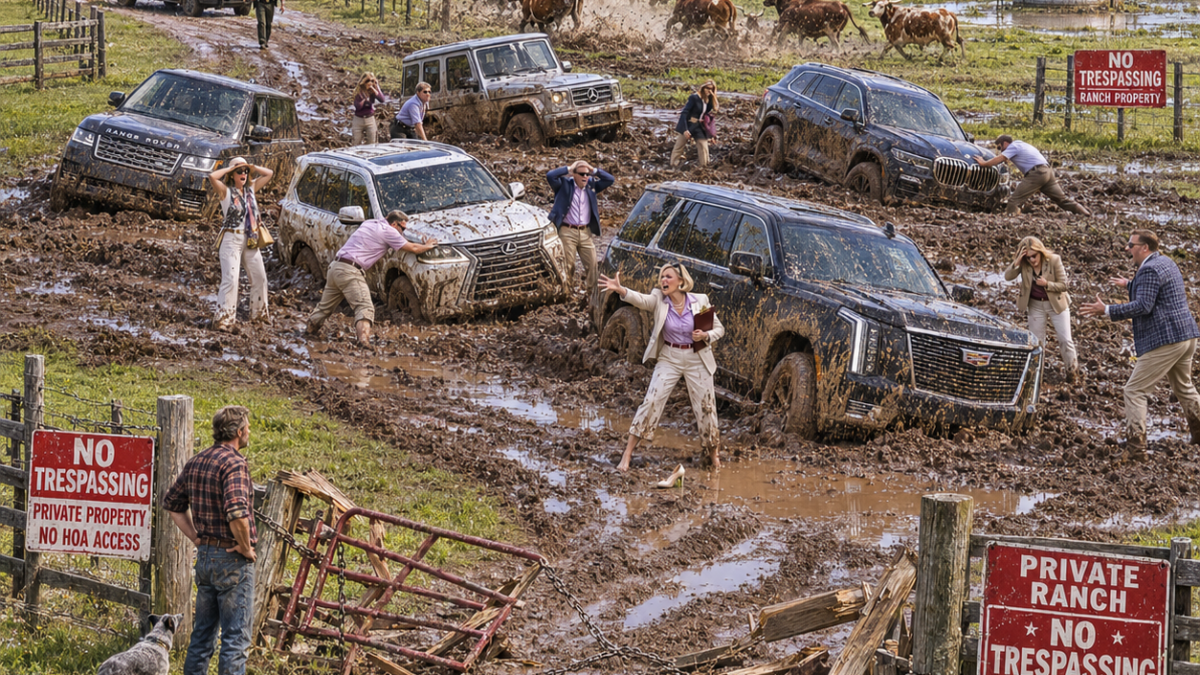
Five luxury SUVs lined up along County Road 114.
More money in vehicles than Dad had ever spent on equipment.
Tammy stepped out first.
Cream blazer.
White pants.
Sunglasses.
Clipboard.
Because of course she had a clipboard.
The other women gathered around her.
Denise Waverly.
Brenda Faulkner.
Sheila Colton.
Pam Rutherford.
Tammy pointed toward the ranch.
Single file.
Old path.
Straight through.
I was too far away to hear everything.
Then wind carried Denise’s voice.
“What if he calls the police?”
Tammy answered loudly.
“Let him.”
Then:
“We have forty-seven signatures saying it’s a community road.”
I picked up my phone.
Called the sheriff.
“County Sheriff’s Office.”
“This is Garrett Ellison on County Road 114.”
“What’s happening?”
“I have five vehicles preparing to enter posted private property.”
Pause.
“Are they on it yet?”
“About to.”
Sheriff Dale Compton came on.
“I’m fifteen minutes out.”
“Thanks.”
I hung up.
Then watched.
Tammy climbed into the Tahoe.
Engine started.
She drove past the first sign.
**PRIVATE PROPERTY.**
Past the second.
**NO TRESPASSING.**
Then across the boundary.
The four others followed.
That moment mattered more than what happened next.
Nobody was confused.
Nobody accidentally turned onto the wrong road.
Nobody missed the signs.
They had organized the event.
Discussed it.
Named it.
Then entered anyway.
Tammy drove confidently across the wet pasture.
For several seconds, everything looked normal.
Then the Tahoe’s front end dropped.
Not dramatically.
Just enough.
She accelerated.
The tires spun.
The vehicle stopped.
Mud climbed around the tires.
The Tahoe rocked.
Engine revved again.
Bad idea.
More spinning.
Less movement.
Behind her, Denise pulled the Range Rover sideways to go around.
The ground there was saturated too.
Her vehicle leaned.
Stopped.
Brenda’s Escalade braked too late.
Slid toward a drainage low point.
Stopped awkwardly.
Sheila reversed.
Spun the Yukon’s tires.
The vehicle settled lower.
Pam tried turning the Navigator around.
Made half the turn.
Then the front wheels sank.
Five vehicles.
Five drivers.
No movement.
For several seconds, the pasture was strangely quiet.
Then doors opened.
Tammy stepped down.
Her right foot disappeared into mud.
She yanked it free.
One shoe stayed behind.
I had never seen a human being become angrier so quickly.
Even from a distance.
She pointed toward my house.
Started shouting.
I couldn’t hear words.
Didn’t need to.
A minute later, my phone rang.
Unknown number.
I answered.
“You did this!”
Tammy.
“Good morning.”
“You trapped us!”
“You drove onto my pasture.”
“You dug holes in the road!”
“There is no public road.”
“You knew we were coming!”
“You emailed half the neighborhood.”
“I want these filled in immediately!”
“They’re agricultural water features.”
“You are insane!”
I looked toward the pasture.
“Tammy, I suggest you stop spinning the tires.”
“What?”
“You’ll make recovery harder.”
“DON’T TELL ME WHAT TO—”
I moved the phone away from my ear.
She continued.
Then hung up.
Sheriff Dale arrived a few minutes later.
He parked on firm ground.
Looked toward the five SUVs.
Then at me.
Then back at the SUVs.
“Garrett.”
“Morning.”
He stared.
“Anything you want to tell me?”
“They came through the posted boundary.”
“Knowingly?”
I handed him Tammy’s email.
He read.
Then I gave him the deed.
Survey.
Property records.
Documents showing no recorded easement.
Photos of the signs.
Camera stills.
Agricultural documentation.
Dale read slowly.
Then looked across the field again.
Tammy was walking toward us.
Barefoot now.
White pants brown to the knees.
One hand holding the remaining shoe.
“SHERIFF!”
Dale sighed.
I almost felt bad for him.
Almost.
Tammy arrived breathing hard.
“Arrest him.”
Dale looked at her.
“For what?”
“He built traps.”
Dale turned toward me.
“Are those stock ponds and drainage features?”
“Yes.”
“On his property,” Tammy snapped.
“That is not the issue.”
Dale looked back at her.
“That appears to be a very important part of the issue.”
“This is a community road!”
“Do you have an easement?”
“Forty-seven homeowners signed a petition.”
“That’s not an easement.”
“Our attorney—”
“Do you have a recorded easement?”
She hesitated.
“No.”
Dale lifted one of the photographs.
“These signs were present when you entered?”
“They’re illegal.”
“Why?”
“They interfere with established access.”
Dale’s voice became slower.
“Mrs. Prescott.”
She stopped.
“I’m looking at a deed.”
He held it up.
“A survey.”
Another document.
“And photographs showing five vehicles driving past clearly posted no-trespassing notices onto property where you apparently have no recorded access rights.”
“You don’t understand.”
“I understand enough.”
Then Dale reached into his vehicle.
Citation pad.
Tammy’s face changed.
“You cannot be serious.”
“Very.”
One citation.
Then another.
Then another.
Five drivers.
Five trespass citations.
Tammy looked at me as though I had personally rewritten state law.
Then a pickup arrived.
Copper Creek County Tribune.
Reporter Luan Caldwell.
Camera already raised.
Tammy saw her.
“No!”
Click.
Five SUVs sunk in pasture.
Five women in mud.
Sheriff.
Signs.
Me standing several yards away.
Tammy marched toward Luan.
“You cannot publish that.”
Luan lowered the camera.
“Why?”
“This is private property.”
Luan glanced at me.
Then Tammy.
“Yes, ma’am.”
Pause.
“That appears to be the story.”
Even Dale laughed.
Quietly.
The recovery took hours.
No dramatic destruction.
No vehicles swallowed whole.
Just expensive machines requiring professional towing from wet ranch ground they had no right to enter.
Each driver paid.
Each citation remained documented.
Each tow created another record.
Most importantly, every second had been captured by my cameras.
The newspaper ran the photo the next morning.
Front page.
**FIVE SUVs STUCK AFTER HOA-LED TRESPASS ON PRIVATE RANCH**
Tammy’s Tahoe sat at the center.
Mud everywhere.
Her expression visible in the background.
I bought three copies.
One for my file.
One for Hank.
One for Dad.
I placed Dad’s copy beside his photograph.
“Land didn’t fight back,” I said.
“But you were right about the rest.”
The fallout started immediately.
Copper Creek residents demanded an emergency HOA meeting.
Tammy tried delaying it.
Couldn’t.
Nearly one hundred people attended.
Nolan later told me the mood had changed before she entered.
For years, Tammy controlled the neighborhood because people feared being singled out.
Nobody wanted their fence inspected.
Nobody wanted landscaping violations.
Nobody wanted architectural-review problems.
Nobody wanted to become the next target.
Then the newspaper showed five residents what happened when Tammy’s confidence collided with an actual boundary.
Fear changed.
Not into courage immediately.
First into embarrassment.
Then anger.
Nolan stood during the meeting.
“Did you know there was no easement?”
Tammy replied:
“Our attorneys dispute that interpretation.”
“That’s not my question.”
People murmured.
Another resident stood.
“You told us this road belonged to the community.”
“It does through established use.”
“Then why did the sheriff cite you?”
“Because Garrett manipulated the situation.”
A man in the second row raised his hand.
“He didn’t force you to drive through six signs.”
Someone laughed.
Then more.
Tammy lost control.
She banged the gavel.
“This meeting will remain orderly.”
Nolan said:
“Maybe we should vote on whether you remain president.”
Silence.
Then applause.
Eight years.
No contested elections.
No serious challenge.
Gone in one night.
Final vote:
Ninety-four to seven.
Tammy Prescott was removed.
Nolan told me she didn’t make a speech.
She packed her folder.
Walked across the clubhouse parking lot.
Gray sweatshirt.
No blazer.
Reached her freshly cleaned Tahoe.
Nolan happened to be near the door.
He said quietly:
“Should’ve used the main exit, Tammy.”
She didn’t answer.
She drove home through Copper Creek’s actual public road.
The route everyone else had been using perfectly well.
The environmental investigation became more serious afterward.
Sandra Polk’s inspection had raised questions.
TCEQ pulled development records.
Compared approved plans with what existed on the ground.
The required stormwater features had not been built as represented.
Inspectors documented runoff issues.
Wade’s signature became relevant.
So did Hargrove Development.
The penalties eventually reached serious money.
More important to me:
They had to fix it.
Real retention.
Real drainage.
Real engineering.
Not twelve years of letting Ellison Ranch absorb the consequences.
For the first time since coming home, I watched crews working near the subdivision and felt relief instead of suspicion.
One engineer walked over to my fence.
“Garrett Ellison?”
“Yeah.”
“Mark Jensen.”
He introduced himself.
Stormwater consultant.
“I’ve reviewed your notes.”
“My condolences.”
He laughed.
“Your observations were accurate.”
“That’s nicer.”
“We’re rebuilding the western drainage system.”
“Properly?”
“That’s the plan.”
I looked at him.
He raised both hands.
“Professionally designed.”
“Better.”
The work took months.
During the first big storm after completion, I stood outside.
Watched water.
Less concentrated runoff entered the ranch.
The erosion channel remained stable.
Stock-water features held.
The pasture drained better.
That felt better than Tammy’s removal.
Engineering people understand this.
Being right is satisfying.
Watching the problem actually get fixed is better.
The civil lawsuit took longer.
Hank filed for trespass.
Property damage.
Gate destruction.
Veterinary expenses.
Pasture impacts.
Other documented losses.
Tammy’s attorney initially claimed she acted under a good-faith belief that the road was public.
Then Hank played the gate video.
Tammy:
**Cut it off.**
Hard to call that confusion.
Then the convoy email.
**We are taking back our road.**
Then six cameras showing posted signs.
Good faith became difficult to sell.
The case settled.
Forty-seven thousand dollars combined.
Tammy paid the largest share.
I could have used that money on the ranch.
New fencing.
Roof.
Truck.
Equipment.
Dad would probably have voted tractor.
Instead, I created the **Ellison Agricultural Youth Fund**.
Scholarships for rural students studying agriculture, environmental science, land management, or water resources.
Hank thought I was joking at first.
“You’re giving the settlement away?”
“Not all at once.”
“Still.”
“I didn’t plan on getting it.”
“That doesn’t mean you can’t enjoy it.”
“I am.”
“How?”
“By making Tammy accidentally fund future land managers.”
Hank stared at me.
Then smiled.
“That is incredibly petty.”
“Thank you.”
“And generous.”
“Don’t ruin it.”
The county agricultural board agreed to match part of the funding.
The first ceremony happened on the back pasture.
Right where the SUVs got stuck.
Not because I wanted to humiliate Tammy.
Although I will admit the symbolism didn’t bother me.
FFA students came from several high schools.
County officials.
Neighbors.
Nolan.
Luan from the Tribune.
Even Sandra Polk came.
Forty people stood beneath a temporary shade structure.
Biscuit wandered nearby.
I stepped onto a small platform.
Prepared speech in my pocket.
Didn’t use it.
I looked at the students.
Then the pasture.
“My dad taught me two things about this land.”
The crowd quieted.
“He told me land doesn’t fight back.”
Pause.
“And he told me the man who knows the land can.”
I pointed toward the pasture.
“I used to think he meant being tougher than whoever challenged you.”
I shook my head.
“That wasn’t it.”
I looked toward the water features.
“He meant knowledge matters.”
“Know where your boundaries are.”
“Know where your water goes.”
“Know what you signed.”
“Know what you inherited.”
“Know what you’re responsible for.”
“And know when somebody is trying to turn your kindness into their right.”
I could feel my throat tightening.
I continued.
“My father protected this ranch for most of his life.”
“I got here late.”
That sentence hurt.
“But I got here.”
I looked at the scholarship students.
“This fund exists because I want people your age to understand that agriculture isn’t just cattle and tractors.”
“It’s engineering.”
“Biology.”
“Soil.”
“Water.”
“Law.”
“Economics.”
“History.”
“And responsibility.”
Applause started slowly.
Then grew.
Biscuit wandered through a temporary opening.
Walked toward the nearest student.
The girl laughed.
Biscuit pushed her head under the girl’s hand.
I sighed.
“That cow has no respect for ceremony.”
Everyone laughed.
Afterward, Dad’s old friend Billy Morgan approached me.
He had known Dad since high school.
“Ray would’ve liked that.”
“The scholarship?”
“The cattle interrupting.”
I laughed.
“That too.”
Billy looked toward the pasture.
“He worried about you.”
“I know.”
“No.”
Billy shook his head.
“He worried you’d never come back.”
I stared at him.
“He never said.”
“Ray didn’t say anything that might sound emotional.”
“True.”
Billy kicked at the dirt.
“When he got sick, he told me you’d come.”
“Did he believe that?”
“Never doubted it.”
That hurt worse than doubt would have.
“I should’ve come earlier.”
“Probably.”
I looked at him.
“Thanks.”
“You want me to lie?”
“No.”
Billy continued.
“But you came when it mattered.”
I looked toward Dad’s cattle.
“Barely.”
“Barely counts.”
Those words stayed with me.
**Barely counts.**
Life doesn’t always give us the graceful version.
Sometimes you apologize too late.
Return late.
Understand your parents late.
Realize what mattered late.
But late and never are not the same thing.
That became one of the ranch’s lessons.
Copper Creek changed too.
Not overnight.
Tammy had controlled the HOA for eight years.
Habits remained.
Some residents still treated the ranch like an inconvenience.
But the new board was different.
Nolan became president after everyone else refused.
His first official letter to me began:
**Mr. Ellison, we respectfully request permission…**
I called him.
“Nolan.”
“Yeah?”
“Did you write ‘request permission’?”
“Seemed appropriate.”
“I’m framing it.”
“Please don’t.”
They wanted temporary access for engineers working on the stormwater improvements.
Not permanent.
Not assumed.
Temporary.
Defined.
Insured.
Written.
I signed.
Cooperation returned once entitlement left.
Funny how that works.
The new board also stopped sending complaints about cattle odors.
I was disappointed.
I had enjoyed showing inspectors Biscuit.
Wade Prescott’s professional life deteriorated.
The environmental enforcement action named him because of his role in the original development.
County contracts disappeared.
Companies became less interested in doing business with a contractor associated with missing drainage infrastructure and public controversy.
Clint Hargrove blamed subcontractors.
Wade blamed Hargrove.
Hargrove blamed permitting confusion.
Everybody suddenly remembered somebody else had been responsible.
Hank called it:
“The traditional dance of men who signed documents they hoped nobody would read.”
The ranch recovered.
Pasture damage healed.
Vehicle ruts faded.
Grass returned.
The old road stopped looking like a road.
That part mattered.
For decades, tire tracks created the visual illusion that a public path existed.
Without unauthorized vehicles, grass reclaimed it.
A year later, a stranger could walk through the back pasture and never realize suburban SUVs once crossed daily.
The stock ponds remained.
Because they had never been fake.
Cattle used them.
Wildlife used them.
They improved water distribution.
One evening, a group of whitetail deer drank from the largest while sunset reflected orange across the surface.
I took a photograph.
Sent it to Hank.
Caption:
**Dangerous trap still operational.**
He replied:
**Those deer need counsel.**
I laughed harder than I should have.
Tammy remained in Copper Creek.
That surprised people.
They expected her to sell.
Disappear.
Move to Florida.
She didn’t.
But her world became smaller.
No HOA title.
No meetings to control.
No clipboard authority.
I occasionally saw her Tahoe at the grocery store.
The vanity plate eventually disappeared.
Standard Texas plate.
That might have been the most symbolic detail of all.
One Saturday, almost two years after the mud incident, Tammy came to my ranch.
Main entrance.
Public road.
She stopped outside the gate.
Did not enter.
That mattered.
I walked over.
She rolled down her window.
No sunglasses.
No blazer.
Hair pulled back.
“Garrett.”
“Tammy.”
“This is awkward.”
“That’s one word.”
She almost smiled.
“I need to ask you something.”
“Okay.”
“My nephew is applying for the scholarship.”
I blinked.
“Ellison Agricultural Youth Fund?”
“Yes.”
“What does he want to study?”
“Environmental engineering.”
Of course.
I looked away so she wouldn’t see me smile.
“He submits through the committee.”
“I know.”
“I’m not selecting winners alone.”
“I know.”
“Your history with me doesn’t affect him.”
Her face changed.
Relief.
Maybe shame.
“I appreciate that.”
I nodded.
She remained in the Tahoe.
Then:
“I was wrong about the road.”
There it was.
Two years late.
But there.
“Yes.”
“I thought if enough people used it…”
“You could make it yours.”
She looked down at the steering wheel.
“Yes.”
“Why?”
She was quiet.
I waited.
“When Wade and Clint developed Copper Creek, they told everyone the ranch road was part of the access plan.”
“That contract says the opposite.”
“I know that now.”
“You knew before the convoy?”
Pause.
“I knew there were questions.”
Not good enough.
I said nothing.
She looked toward the pasture.
“I thought your father had basically abandoned that part of the ranch.”
“He was dying.”
“I know.”
“He let neighbors through because he was kind.”
“I know.”
“You turned that into ownership.”
“Yes.”
For once, Tammy didn’t argue.
Wind moved dust across the county road.
She said:
“I was afraid if residents realized we didn’t have access, they’d start asking what else Wade and Clint had promised that wasn’t true.”
That surprised me.
“The drainage?”
“I didn’t know about the missing ponds.”
I studied her.
“Maybe.”
“You don’t believe me.”
“I don’t know what to believe about that.”
Fair.
She nodded.
“Wade lost almost everything.”
“That wasn’t because of me.”
“He says it was.”
“Wade signed the plans.”
“I know.”
She looked older.
Power does that when it leaves.
Not age.
Scale.
People look different after they stop expecting the world to move for them.
Tammy asked:
“Do you hate me?”
I thought about the destroyed gate.
Dad’s final words.
Injured cattle.
Inspectors.
Threats.
Convoy.
Mud.
Then the scholarship.
The repaired drainage.
The restored pasture.
“No.”
She looked surprised.
“I did for a while.”
“That sounds more honest.”
“Hate is expensive.”
“What does that mean?”
“It keeps charging interest after the case is over.”
She looked toward the stock ponds.
“I still think you knew those vehicles would get stuck.”
I smiled.
“Tammy.”
“What?”
“You sent five road vehicles into a wet cattle pasture after a hard rain.”
“So yes.”
“I’m an engineer.”
“That is not an answer.”
“It’s the answer you’re getting.”
For the first time since I met her, Tammy laughed.
Small.
Embarrassed.
Human.
Then she became serious.
“I’m sorry about your father.”
My chest tightened.
“You didn’t know him.”
“No.”
“But I should have respected what he built.”
I looked toward Dad’s barn.
“Yes.”
She put the Tahoe in drive.
Before leaving:
“My nephew’s name is Ethan.”
“I’ll remember it.”
“You said the committee—”
“I know.”
She smiled.
Then drove away.
Ethan won a scholarship the following year.
Not because of Tammy.
His application was excellent.
Top grades.
FFA.
Water-quality project.
Essay about stormwater failures in fast-growing rural communities.
When I saw his name among the finalists, I laughed until my eyes watered.
Hank asked:
“Problem?”
“You remember Tammy’s nephew?”
“Oh, no.”
“Oh, yes.”
“You can recuse.”
“I already did.”
The committee selected him anyway.
At the ceremony, Ethan shook my hand.
“Mr. Ellison.”
“Garrett.”
“My aunt says you hate Mr. Ellison.”
“Your aunt is occasionally correct.”
He looked nervous.
“I know about what happened.”
“Most of Texas seems to.”
“I’m not like—”
I stopped him.
“You don’t need to explain somebody else’s mistakes.”
His shoulders relaxed.
“I want to work on rural drainage.”
“Why?”
He smiled awkwardly.
“Family history?”
I laughed.
“Good answer.”
Tammy stood near the back.
No special seat.
No speech.
When Ethan received the award, she cried.
Quietly.
I pretended not to notice.
Dad would have appreciated the irony.
Maybe more than the irony.
He believed land should teach people.
He never said that in those words.
But every lesson he gave me came from somewhere physical.
Fence fails because tension has to go somewhere.
Cattle go where pressure is easiest.
Water always searches for the low point.
People are not so different.
We follow convenience.
Avoid resistance.
Create habits.
Then call those habits rights.
Tammy’s biggest mistake wasn’t driving through my pasture.
It was assuming repetition erased ownership.
Her SUVs did not get stuck because I built some cartoon trap.
They got stuck because she refused to understand the land she was claiming.
Wet clay does not care about signatures.
Water does not care about HOA votes.
A deed does not become meaningless because forty-seven people sign a petition.
Nature and law have something in common.
Both are unpleasant when you rely on confidence instead of facts.
I started volunteering at local FFA programs.
At first, just scholarship presentations.
Then water-management workshops.
Students asked about the famous SUV story every single time.
One boy raised his hand.
“Did you actually design the ponds to catch the cars?”
Every adult in the room looked at me.
I smiled.
“No.”
Disappointment.
Another boy:
“But you knew.”
“I knew the pasture conditions.”
“So you knew.”
“I knew driving a heavy SUV across saturated ranch ground was unwise.”
A girl in the front row laughed.
“Engineer answer.”
“Correct.”
Then I became serious.
“The important lesson isn’t how to get somebody’s vehicle stuck.”
That quieted them.
“The lesson is boundaries.”
“Property boundaries.”
“Water boundaries.”
“Professional boundaries.”
“Personal boundaries.”
“If somebody ignores six signs and drives where they were told not to drive, you don’t need to become more reckless than they are.”
“Let records, law, and consequences do the work.”
One student asked:
“So revenge is bad?”
Teenagers.
Never easy.
“Revenge feels good for about five minutes.”
“What’s better?”
“Getting your life back.”
I meant it.
For months, Tammy consumed my thoughts.
Every engine sound made me look toward the pasture.
Every envelope raised my blood pressure.
Every county truck meant another complaint.
I woke thinking about her.
Went to sleep thinking about strategy.
Then the case ended.
Road closed.
Pasture quiet.
Tammy removed.
Drainage fixed.
And I discovered peace feels almost boring after conflict.
That is a compliment.
One evening, I sat on Dad’s porch.
No legal files.
No phone calls.
No camera alerts.
Just cattle moving under the live oaks.
Biscuit stood near the fence.
Sunset turned the hills copper.
I realized I had gone an entire day without thinking about Tammy.
That was victory.
Not the front-page photograph.
Not citations.
Not settlement money.
Not watching five luxury SUVs get towed.
Silence.
Peace.
Routine.
The ranch returning to being a ranch instead of evidence.
That was the thing Dad had really asked me to protect.
Not acreage alone.
A way of life.
Years passed.
Biscuit got older.
So did I.
She lived to fourteen.
Old for a Hereford.
One winter morning, she stopped eating.
Vet came.
Nothing dramatic.
Just age.
I sat beside her in the barn.
Dad had named her.
That alone made saying goodbye harder than it should have.
I kept one of her old ear tags.
Put it beside Dad’s photograph.
People preserve strange things when they miss someone.
My collection included:
Dad’s pocketknife.
Biscuit’s tag.
The bent padlock from Tammy’s gate destruction.
A clipping of the five SUVs in mud.
And the first scholarship announcement.
Evidence of loss.
Evidence of absurdity.
Evidence something good came after.
Nolan remained HOA president for three terms.
Then stepped down voluntarily.
“Why?” I asked.
“Because normal people shouldn’t want this job forever.”
“Best HOA policy I’ve ever heard.”
Copper Creek adopted term limits after him.
They also changed their complaint process.
No anonymous nuisance complaints without supporting evidence.
Professional review for agricultural or environmental allegations.
Mandatory conflict disclosure.
And perhaps my favorite:
The board formally acknowledged Ellison Ranch as separate private property outside HOA jurisdiction.
They sent me a certified copy.
I framed that too.
Hank came by.
“You’re running out of wall.”
“I have another barn.”
He shook his head.
“You’ve become a paperwork museum.”
Dad would have agreed.
Eventually, Hargrove Development completed the required remediation.
Real retention areas.
Vegetated drainage.
Stormwater slowed before leaving the subdivision.
Afterward, something unexpected happened.
Copper Creek looked better.
Native plants around the new drainage areas.
Birds.
Less erosion.
Children used a walking path near one of the retention basins.
Ethan, Tammy’s nephew, came home from college one summer and helped organize a water-quality monitoring project.
He walked over to the ranch.
“Can we sample Copper Creek from your side?”
He asked.
Asked.
I almost hugged him.
“Absolutely.”
Three students came.
We tested upstream and downstream.
Clean.
Ethan smiled.
“Improved.”
“Significantly.”
“My professor wants to use Copper Creek as a case study.”
“Title?”
“Consequences of Deferred Residential Stormwater Infrastructure.”
I nodded.
“Needs more drama.”
He laughed.
“My aunt suggested ‘The Mud Incident.’”
I stared.
“She did not.”
“She did.”
I laughed so loudly one cow looked up from grazing.
Maybe people change.
Not completely.
But enough.
On the tenth anniversary of Dad’s death, I visited the cemetery before sunrise.
I don’t go often.
Dad wasn’t sentimental about graves.
“If you want to talk to me after I’m dead,” he once said, “go fix something I built.”
Still, that morning I went.
Sat beside the headstone.
Told him about the ranch.
Scholarship.
Stormwater.
Ethan.
Tammy apologizing.
Biscuit.
Then I said:
“I kept it.”
Those words broke me.
I had waited ten years to say them.
“I kept the land.”
Wind moved through the grass.
Nothing supernatural happened.
No sign.
No voice.
Just morning.
That was enough.
When I returned to the ranch, I walked the back pasture.
The old unauthorized road was completely gone beneath grass.
Only the property map remembered it.
Stock ponds reflected the sky.
Cattle drank.
A blue heron stood near the far bank.
I thought about the five SUVs.
People still told the story like the vehicles were the ending.
They weren’t.
The SUVs were the loudest scene.
The ending took years.
The ending was Wade’s missing stormwater system finally being built correctly.
The ending was the scholarship.
The ending was Ethan choosing environmental engineering.
The ending was residents using the real subdivision entrance without thinking about my pasture.
The ending was a morning when I no longer needed to check trail cameras before coffee.
That was the part I wished Dad could see.
Not that I defeated Tammy.
That I stopped needing an enemy.
Another few years passed.
I began planning for the future of Ellison Ranch.
I had no son waiting to inherit it the way Dad had me.
My sister’s daughter, Emma, loved agriculture.
She had been visiting since childhood.
One afternoon, she stood beside the stock pond while we repaired a water line.
“Uncle Garrett?”
“Yeah?”
“What happens to this place when you’re gone?”
“Cheerful topic.”
“I’m serious.”
“So am I.”
She looked across the pasture.
“You going to sell?”
“No.”
“Then?”
I had been thinking about that.
“I’m creating a conservation and agricultural trust.”
Her eyes widened.
“What does that mean?”
“Means nobody turns it into 127 houses after I’m dead.”
She laughed.
“Fair.”
“Working ranch stays working.”
“And who runs it?”
I looked at her.
She understood.
“Me?”
“If you want.”
Her face changed.
“What if I screw it up?”
“You will.”
“Great.”
“Everybody does.”
“What if I don’t want it later?”
“Then tell me.”
“That easy?”
“It needs to be.”
Dad’s last words had been a promise.
**Don’t let anybody take this land.**
For years, I interpreted them literally.
Never sell.
Never change.
Never surrender an inch.
Then I understood something deeper.
Dad didn’t ask me to become a prisoner of the ranch.
He asked me not to let somebody else take the choice away.
Tammy tried.
That was the difference.
Choice.
Consent.
Ownership.
Emma could choose ranching.
Could choose something else.
The land could be protected either way.
That felt right.
The Ellison Land & Water Trust came into existence the following year.
Scholarship fund under the same umbrella.
Agricultural education days.
Water-management workshops.
FFA partnerships.
Limited research access for universities.
Copper Creek contributed financially.
The HOA.
The same HOA.
When Nolan told me the board had approved an annual donation, I said:
“Dad is either laughing or rolling over.”
“Probably both.”
We built a small outdoor classroom near the barn.
Nothing fancy.
Metal roof.
Benches.
Whiteboard.
One wall displayed a large aerial map.
Students could see the ranch.
Copper Creek.
Natural drainage.
New retention facilities.
Property boundaries.
The old road.
I called the lesson:
**WHAT THE LAND REMEMBERS**
The first session, thirty students attended.
I showed them the map.
“Everybody wants to talk about the SUVs.”
They laughed.
“They’re not the important part.”
More laughter.
“I’m serious.”
I pointed to Copper Creek.
“Why were sections of my pasture always wet?”
Hands rose.
One student:
“Runoff.”
“Why?”
“Missing drainage.”
“Good.”
Another:
“Development changed the watershed.”
“Exactly.”
Then the ranch road.
“Why did the HOA think this was theirs?”
A girl said:
“People kept using it.”
“Correct.”
“Does use create ownership?”
She hesitated.
“Sometimes?”
“Now we’re learning.”
We talked easements.
Land records.
Permission.
Prescriptive rights.
Documentation.
Then cameras.
Not as a revenge trick.
As evidence.
Then engineering.
Then ethics.
I ended with Dad’s words.
“The land doesn’t fight back.”
Pause.
“But the man—or woman—who knows the land can.”
The students applauded.
Emma stood in the back.
Afterward:
“You realize that sounds dramatic.”
“It is dramatic.”
“You rehearsed the pause.”
“Maybe.”
“You’re becoming Tammy.”
I stared at her.
“Leave my property.”
She laughed.
The following spring, Tammy attended one workshop.
I did not invite her personally.
It was public.
She sat near the back beside Ethan.
When I reached the slide showing the famous newspaper photo, the entire class laughed.
Tammy covered her face.
I stopped.
For one second, old Garrett might have enjoyed that.
Instead, I changed slides.
No joke.
No humiliation.
Afterward, she approached.
“Thank you.”
“For what?”
“Not lingering on that photograph.”
“I’ve lingered enough.”
She nodded.
“Me too.”
We walked outside.
The Tahoe had been replaced by a smaller SUV.
No vanity plate.
She looked toward the pasture.
“You know, I hated those ponds.”
“I suspected.”
“I thought you built them entirely because of me.”
“I was fixing drainage.”
“You also knew.”
“Tammy.”
She smiled.
“Engineer answer.”
“You’ve learned.”
We stood quietly.
Then she said:
“Ethan got an internship with a water-resource firm.”
“He told me.”
“He says you recommended him.”
“I did.”
“Why?”
“Because he earned it.”
She looked down.
“You didn’t have to.”
“I know.”
That sentence meant more than she realized.
For years, she had confused “can” with “should.”
She could remove signs.
So she did.
Could call inspectors.
So she did.
Could organize neighbors.
Could send lawyers.
Could order workers to cut a gate.
Could drive into the pasture.
Power without restraint becomes stupidity.
Sometimes cruelty.
The fact that I could punish somebody connected to her didn’t mean I should.
That was the boundary I wanted to keep.
She left.
No dramatic goodbye.
We had run out of reasons to fight.
That’s a good ending for enemies.
Not friendship.
Irrelevance.
One August afternoon, a storm hit hard.
Three inches.
Fast.
Years earlier, that would have poured off Copper Creek and hammered my pasture.
This time, the subdivision’s retention system filled.
Vegetated channels slowed the flow.
Water reached my boundary gradually.
The stock ponds handled what they were supposed to.
No erosion.
No flooded road.
No crisis.
I stood under the porch.
Emma beside me.
“Pretty boring.”
“Perfect.”
“You miss the drama?”
“No.”
“Not even a little?”
Thunder rolled.
I thought about Tammy barefoot in mud.
Sheriff Dale holding citations.
The front-page photograph.
Then Dad dying in the hospital.
Gate destroyed.
Cattle injured.
Months of paperwork.
“No.”
I meant it.
Peace is underrated by people who haven’t had enough conflict.
The rain eased.
Sunlight broke through.
Water on the pasture turned silver.
Emma pointed.
“Rainbow.”
I looked.
A faint arc stretched over Copper Creek.
“That’s disgustingly sentimental,” I said.
She laughed.
“You’re impossible.”
Maybe.
That evening I opened Dad’s old office.
The original Prescott file still sat on the shelf.
Thick.
I took it down.
Gate video.
Complaint letters.
Inspection reports.
Easement documents.
Stormwater permit.
Photos.
Convoy email.
Trespass citations.
Settlement.
Newspaper.
I had saved everything because for years it felt important.
Then I carried the binder to the trust archive.
Placed it in a box.
Labeled:
**ELLISON / COPPER CREEK ACCESS DISPUTE**
Archive.
Not office.
That mattered.
Some battles should become history before they become personality.
I kept only three things at home.
Dad’s photograph.
His pocketknife.
And a copy of the scholarship charter.
Not Tammy’s letters.
Not the mud photo.
Not citations.
Those belonged to the past.
The next morning I woke before sunrise.
Made coffee.
Walked outside.
Herefords crossed the south pasture.
Young calves behind them.
The air smelled like cedar and wet earth.
Emma’s truck was parked near the barn.
She had arrived early to work cattle.
I looked toward the east.
Copper Creek rooftops caught the first light.
No vehicles crossing my land.
No signs missing.
No gate cut.
No complaint waiting.
Just neighbors.
Separate property.
Shared watershed.
Clear boundary.
I thought about Dad.
**Don’t let anybody take this land, son.**
“I didn’t,” I said.
Then corrected myself.
“We didn’t.”
Because eventually I understood no ranch survives because of one stubborn man.
Grandpa built.
Dad maintained.
I returned.
Hank fought the case.
Inspectors did their jobs.
Nolan challenged Tammy.
Sheriff Dale enforced the line.
Engineers fixed Copper Creek.
Students carried lessons forward.
Emma would eventually take her turn.
Land outlives ego.
That might be the most important thing Tammy ever taught me.
She believed the old road belonged to whoever used it most loudly.
She believed forty-seven signatures could outweigh a deed.
She believed public confidence could become private ownership.
She believed her title made her authority extend beyond the property line.
For a while, everybody around her acted as though she was right.
Then the land reminded her.
Not with revenge.
With reality.
Private property remained private.
Wet ground remained wet.
Missing stormwater infrastructure still created runoff.
A destroyed gate remained evidence.
An email organizing trespass remained an email organizing trespass.
Five SUVs remained five SUVs.
And when Sheriff Dale arrived, the truth was sitting there in the pasture for everyone to see.
Tammy once told me:
“We’ll let the county decide.”
In the end, she got exactly what she asked for.
The county decided.
The environmental agency decided.
The civil case decided.
Her own HOA decided.
And every one of those decisions went the same direction.
Away from entitlement.
Back toward responsibility.
The last time I saw Tammy, years later, we were at Ethan’s graduation.
Environmental engineering.
He found me outside after the ceremony.
Cap in hand.
“Garrett.”
“Congratulations.”
“Couldn’t have done it without the scholarship.”
“You could.”
“Maybe.”
His family gathered behind him.
Tammy too.
Ethan said:
“I took a job.”
“Where?”
“County water resources.”
I laughed.
“What?”
“Nothing.”
“Why is that funny?”
I glanced at Tammy.
She knew.
Her mouth twitched.
“Because,” I said, “your family has come a long way around the watershed.”
Ethan groaned.
“That is terrible.”
“I’m old. I’m allowed.”
Tammy approached afterward.
“His grandfather would hate this.”
“Wade?”
She nodded.
Wade and Tammy had separated several years earlier.
I didn’t ask details.
“He still thinks engineers caused all his problems.”
I shrugged.
“Plans with signatures tend to be judgmental.”
She laughed.
Then said:
“Ray would be proud of you.”
I stiffened.
She caught herself.
“Sorry.”
“No.”
I looked at Ethan.
Then toward Emma talking with his family.
“Maybe he would.”
That was the first time I let myself say it without qualification.
Dad would be proud.
Not because Tammy lost.
Because I came home.
Because the ranch survived.
Because the mess became something useful.
Because his last words didn’t become a burden.
They became direction.
When I returned that evening, I parked near the barn.
Walked alone to the back pasture.
Sunset reflected in the ponds.
The same water features people online once called traps.
Cattle drank quietly.
Dragonflies moved above the surface.
A pair of deer stood near the tree line.
No trace remained of tire ruts from the Tahoe.
No Range Rover scar.
No Escalade ditch.
No Yukon tracks.
No Navigator.
Grass erased all of it.
That made me smile.
People think land holds grudges.
It doesn’t.
Land holds evidence for a while.
Then, if you take care of it, it heals.
We are usually slower.
I sat beneath an oak.
Thought about Sunday morning.
If I could go back, would I do anything differently?
I would have called Hank earlier.
Called the sheriff after the gate.
Maybe saved myself weeks of harassment.
Maybe prevented the convoy.
But I also know something now I didn’t know then.
Consequences have timing.
Tammy needed to keep choosing.
Remove signs.
Destroy gate.
File complaints.
Push the easement.
Ignore records.
Organize the drive.
Each choice removed another excuse.
By Sunday morning, nobody could claim misunderstanding.
That was why Sheriff Dale’s decision looked simple.
Because I had spent months making the truth simple.
Documented boundaries.
Documents.
Cameras.
Permits.
Warnings.
Signs.
Patience.
That is the kind of revenge Dad would have respected.
Not rage.
Preparation.
Knowing your land so well that when somebody lies about it, you don’t have to shout.
You just open the file.
These days, when young ranchers ask me what to do about neighbors crossing property, my answer is boring.
Know your deed.
Know your boundaries.
Talk first.
Put agreements in writing.
Use legitimate legal channels.
Document damage.
Call professionals when necessary.
Never build your life around trying to punish somebody.
Because the best outcome isn’t watching their SUV sink.
It’s reaching the day when nobody tries driving through your pasture at all.
The sun disappeared.
I stood.
Walked toward the house.
Past Dad’s barn.
Past the gate I eventually replaced.
That gate still stands.
Different from the first.
Simple black steel.
Beside it is one sign.
Not six.
**ELLISON RANCH
PRIVATE PROPERTY
PLEASE USE MAIN ENTRANCE**
Underneath, a smaller sign added years later:
**EDUCATIONAL VISITS BY APPOINTMENT**
Emma suggested that.
A boundary and a welcome.
Both.
That feels right.
Dad believed protecting land meant holding the line.
He was right.
I eventually learned holding the line doesn’t mean shutting everybody out.
It means making sure entry happens with permission.
That was Tammy’s entire mistake.
She thought asking weakened her.
She preferred taking.
Taking a shortcut.
Taking down signs.
Taking access.
Taking authority.
Until the morning she drove five vehicles onto land that had never been hers.
The mud stopped the SUVs.
But the mud wasn’t what defeated her.
Her own certainty did.
She became so convinced that nobody could tell her no that she turned trespass into a scheduled community event and put the evidence in an email.
All I really had to do was let her finish making the decision.
Dad would have liked that.
He always said cattle reveal the quality of a fence by testing it.
People do too.
Tammy tested the boundary.
It held.
Years later, I stood at Dad’s grave again.
Not anniversary.
No reason.
I had been in Fredericksburg and took the turn.
Grass around the stone needed trimming.
I knelt.
Cleared it.
Then sat.
“Emma’s taking over more now.”
Silence.
“Scholarship’s doing well.”
Wind.
“Wade’s drainage mess got fixed.”
I smiled.
“You would’ve enjoyed that.”
Then:
“I think I understand what you meant.”
My throat tightened.
“It wasn’t about owning dirt.”
I looked at his name in the stone.
“It was about not letting somebody else decide what our home was worth.”
That was it.
Tammy had called the ranch ugly.
Aesthetic violation.
Rural hazard.
Cattle smell.
Old fencing.
She saw land only through property value.
Dad saw memory.
Work.
Responsibility.
I finally learned to see both land and future.
The ranch wasn’t valuable because nobody else could touch it.
It was valuable because we could choose what happened there.
Cattle.
Water.
Scholarships.
Education.
Family.
That choice survived.
So did the ranch.
I stood.
Brushed grass from my jeans.
Before leaving, I touched the headstone.
“I kept it.”
Then I drove home.
Not back to the ranch.
Home.
That word had changed.
For years, home was where Dad lived.
Then where Dad died.
Then where I had obligations.
Now it was mine.
Not because he left me a deed.
Because I had chosen it too.
That Sunday morning with five SUVs in the mud became the story everybody liked to tell.
I understand why.
It has everything.
An arrogant HOA president.
Luxury vehicles.
Texas mud.
A sheriff.
Citations.
A front-page photograph.
It is funny now.
But when I tell the story, I always remember something that never made the newspaper.
Right after the tow trucks left, I walked into the pasture alone.
Mud everywhere.
Tire tracks.
Footprints.
Churned grass.
I found one of Tammy’s shoes buried near the first pond.
Expensive white designer shoe.
Ruined.
I picked it up.
Looked toward Copper Creek.
For one second, I thought about keeping it.
A trophy.
Then I laughed at myself.
I threw it into the tow operator’s recovery bin with the other belongings.
I didn’t need a trophy.
The land was still mine.
That was enough.
The next morning, sunlight came through the live oaks.
Cattle moved across the field.
Biscuit drank from the pond.
The ranch didn’t know anything historic had happened.
No celebration.
No judgment.
Just another day.
I think that is what Dad meant when he talked about land.
It doesn’t fight back.
It doesn’t take revenge.
It simply remains what it is.
People are the ones who decide whether to respect it.
Tammy finally learned.
So did Copper Creek.
And, in a different way, so did I.
The five SUVs eventually came out of the mud.
Tammy eventually lost her title.
Wade eventually faced the consequences of the drainage system he helped ignore.
The lawyers closed their files.
The newspaper moved on.
The internet found another outrage.
Grass covered the tire marks.
Rain filled the ponds.
Students received scholarships.
Engineers rebuilt the drainage.
Emma began learning the ranch.
And every evening, when the Texas sun settles behind the cedar and the cattle turn into dark shapes against the pasture, I look across the land Dad asked me to protect and understand something I didn’t understand beside his hospital bed.
Keeping the ranch never meant freezing it in time.
It meant protecting its right to have a future.
Tammy tried to take that choice away.
She failed.
The ranch stayed.
And in the end, that was the only victory I ever needed.