PART 2: HOA Karen Sent a Fake Inspection Crew Into My Barn—She Had No Idea the Sheriff Was Waiting Inside
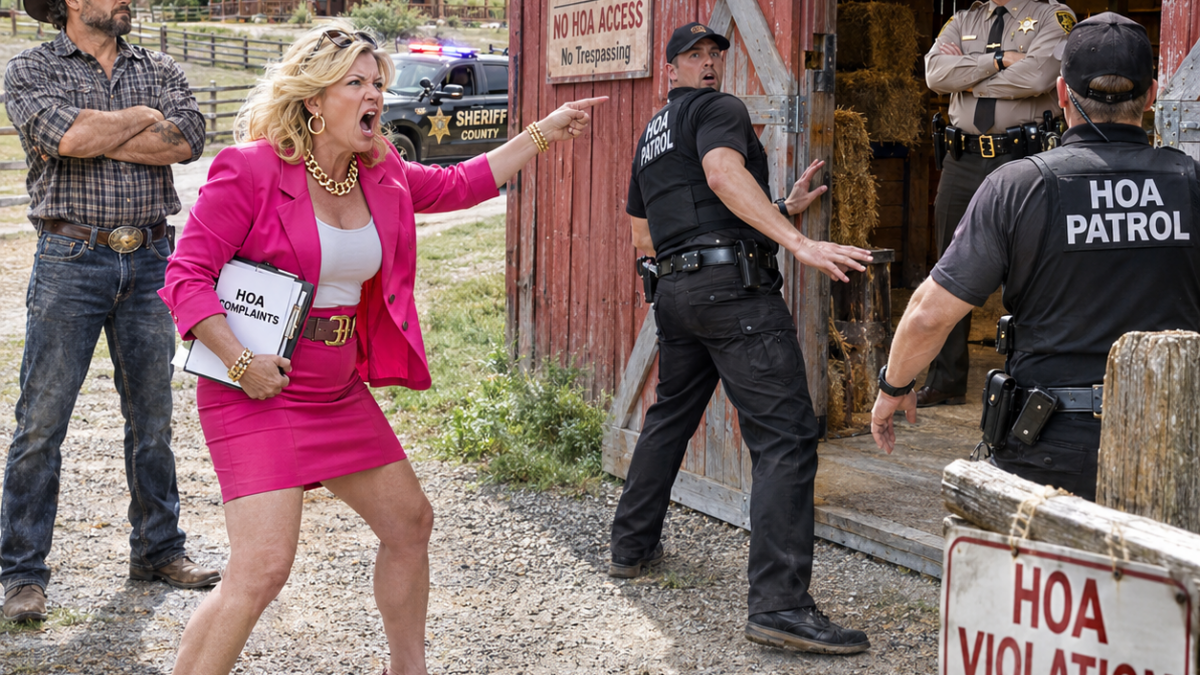
PART 2
The deputy’s name was Hendricks.
He spent almost three hours at my kitchen table that first afternoon, going through violation notices one by one.
Most people think law enforcement walks into a situation, takes one look, and instantly knows who the villain is.
Real life is slower.
Hendricks asked dates.
Times.
How each notice arrived.
Whether Delilah had personally delivered anything.
Whether anyone had threatened me directly.
Whether I had damaged HOA property.
Whether I had ever signed a document agreeing to Millbrook Estates rules.
“No.”
“Ever paid them dues?”
“No.”
“Attended their board meeting as a member?”
“No.”
“Signed anything when Mountain Vista bought the surrounding land?”
“No.”
He looked at the stack again.
“That helps.”
I leaned back.
“Can you make them stop?”
His expression told me the answer before he spoke.
“Not because they send stupid letters.”
“Even fake fines?”
“If they’re knowingly trying to obtain money they aren’t entitled to, that becomes more interesting. But we need intent.”
“So I wait?”
“You document.”
“That sounds suspiciously like waiting.”
“It is smarter waiting.”
He slid the papers back toward me.
“People who believe intimidation is working usually escalate.”
“And then?”
“We see what they do.”
I hated that answer.
Later, I would appreciate it.
At the time, all I could think about was the fact that Delilah went home every night while I sat in my grandfather’s kitchen with a legal pad recording what she had done that day.
Sarah Martinez told me almost the same thing.
“Don’t give her anything.”
“What does that mean?”
“No threats. No angry emails. No midnight posts in the Facebook group.”
“I don’t make midnight posts.”
“You’re a recently divorced man with an internet connection. I’m protecting you from yourself.”
I almost smiled.
Sarah didn’t.
“Ezra, listen to me. She wants you emotional.”
“Why?”
“Because angry people make mistakes.”
She pointed toward my property file.
“Right now, she has an invented enforcement theory and you have a recorded deed.”
Then she tapped the mineral-rights language.
“And possibly something much bigger.”
I did what they told me.
I installed cameras.
Good ones.
The kind that uploaded recordings remotely.
One covered the driveway.
Another the barn.
Two more watched the orchard and eastern property line.
I added a cellular backup because years as an electrician had taught me that a security system relying on one power source or one internet cable was not a security system.
For about a week, Delilah did nothing.
Then a new notice appeared.
**MANDATORY FIRE SAFETY INSPECTION.**
It carried what looked like an official county seal.
The barn had allegedly been reported as an immediate hazard to surrounding homes.
The letter said I had forty-eight hours to permit access or face county-ordered demolition.
That one did not go into a folder first.
I called the Jefferson County Fire Marshal.
A dispatcher searched my address.
Then searched again.
“Mr. Blackwood?”
“Yes.”
“We have no inspection scheduled.”
“What about a complaint?”
“Nothing under your address.”
“I have a letter with your seal.”
There was a pause.
“Can you email us a copy?”
I did.
Ten minutes later, she called back.
“That didn’t come from us.”
I stared at the paper.
“You’re sure?”
“Our office does not use that format, and we certainly don’t threaten emergency demolition through a mailed forty-eight-hour notice.”
“What should I do?”
“Keep the original.”
That sentence was becoming popular.
Margaret Chen was at my house when I printed a second copy.
She lived in Millbrook Estates.
Retired teacher.
Small woman.
Sharp eyes.
The first time we met, she came over with an apology.
“I commented on one of Delilah’s posts.”
“Which one?”
“The barn.”
“That narrows it down.”
She winced.
“I said something about maintaining standards.”
“And now?”
“Now I think I was an idiot.”
“You’re probably not.”
“I taught high school for thirty-one years. I recognize manipulation when I see it. Apparently, I needed retirement before I recognized it in adults.”
I handed her the fake fire notice.
She adjusted her glasses.
Then held it close.
“This seal looks terrible.”
“That’s your professional opinion?”
“My professional opinion is that whoever made this has the graphic-design skills of a seventh grader.”
She pointed.
“Look at the edges.”
Pixelation.
I hadn’t noticed it.
Sarah later examined the electronic copy.
The file metadata led back to a computer associated with D. Wainwright Real Estate Services.
That was the moment our case changed.
Before that, Delilah could pretend she misunderstood HOA jurisdiction.
Now somebody using equipment linked to her business had produced a document that appeared to impersonate a county agency.
Sarah stared at the metadata report.
“This is extremely stupid.”
“I was hoping you’d use a more technical legal term.”
“That is the technical legal term.”
Hendricks came back.
He bagged the original notice.
Photographed it.
Called the fire marshal himself.
Then he looked at me.
“You understand this is no longer just an HOA dispute.”
“I’ve been saying that.”
“You were saying it before we had evidence.”
“Minor detail.”
He pointed at me.
“That attitude is why your lawyer told me to keep an eye on you.”
I liked him after that.
The real fire marshal inspected the barn two days later.
Deputy Fire Marshal Rodriguez walked through every corner of the shop.
Electrical panels.
Dust collection.
Ventilation.
Extinguishers.
Chemical storage.
Sprinkler lines.
When he finished, he looked around.
“You did the electrical?”
“Most of it.”
“Shows.”
“Good or bad?”
“Good.”
He wrote that the barn met or exceeded applicable safety requirements.
I framed a copy.
Not because I needed it on the wall.
Because by then spite had become one of my minor hobbies.
That same week, I finally discovered why Delilah cared so much about my property.
Her brother was Marcus Wainwright.
President of Vista Commercial Properties.
The company had been buying agricultural land around Jefferson County for commercial development.
Delilah appeared in corporate paperwork as a community development liaison.
I remember sitting at my computer at eleven at night with the Secretary of State records open.
Marcus Wainwright.
Vista Commercial Properties.
Delilah Wainwright.
The names sat there together.
I called Sarah the next morning.
“You awake?”
“It’s seven.”
“So yes.”
“What did you find?”
I told her.
She became very quiet.
“Send it.”
Twenty minutes later she called back.
“This matters.”
“I assumed.”
“Do not post anything yet.”
“I wasn’t going to.”
“You were absolutely going to.”
“I was considering it.”
“Ezra.”
“Fine.”
We spent two days verifying the relationship.
Then Sarah gave me permission to disclose only what was publicly documented.
So I posted one message in the Millbrook Estates Facebook group.
No insults.
No accusations.
Just records.
I wrote that Vista Commercial Properties, owned by Delilah’s brother, had acquired agricultural parcels nearby and that public corporate filings identified Delilah as a community liaison.
Then I asked one question:
**Given the continuing pressure for me to surrender or alter my property, should Millbrook residents be informed of this potential conflict?**
The group detonated.
Margaret called me within twenty minutes.
“Have you seen the comments?”
“I’m trying not to.”
“Too late. I printed some.”
“Why?”
“I’m a teacher. We archive evidence.”
By afternoon, hundreds of comments filled the thread.
Some defended Delilah.
Others demanded disclosure.
One resident asked whether the board had ever voted on enforcement actions against me.
Another wanted copies of legal bills.
Bobby Kowalski appeared in the discussion like a man who had been waiting years for an excuse.
Bobby was a veteran who lived three streets inside Millbrook.
He had never met me.
His first comment read:
**If Ezra isn’t legally part of the HOA, why are HOA funds being spent targeting him?**
Simple question.
No one from the board answered.
Margaret organized a petition.
Three board members resigned.
Delilah responded by escalating.
Anonymous complaints hit county offices.
Commercial activity.
Zoning.
Taxes.
Unsafe woodworking.
Unlicensed contracting.
My clients started getting phone calls.
One customer, a restaurant owner named Pete, called me on a Wednesday afternoon.
“Ezra, somebody says you don’t carry insurance.”
“I do.”
“I know.”
“They say you’re operating an illegal shop.”
“I’m not.”
“I know.”
“Then why are you calling?”
“Because they called my wife too.”
That made me sit down.
“What did they say?”
“That if we let you work on the restaurant and somebody gets hurt, we could lose everything.”
I felt something hot move through my chest.
“Pete, I’m sorry.”
“Don’t apologize. I’m telling you because somebody wants me to fire you.”
“Are you?”
He laughed.
“You built my bar. It survived my brother-in-law falling off it during the Super Bowl. I trust your work.”
That helped.
Not everyone stayed.
Two clients canceled.
One said he didn’t want trouble.
I understood.
Still hurt.
That was when this stopped being a property dispute in my mind.
Delilah was reaching into the life I had rebuilt after my divorce.
The barn had been the one place that still made sense.
Measure.
Cut.
Sand.
Fit.
Wood did not care who won arguments.
Now every time the phone rang, I wondered whether another client had received a threat.
One night I sat alone in the shop until almost midnight.
The smell of cedar usually calmed me.
That night it didn’t.
I looked around at unfinished cabinets, clamps, old hand tools inherited from my father.
For the first time since moving back, I wondered whether refusing to sell had been pride rather than principle.
Maybe I could take the money.
Move somewhere quiet.
Start over again.
Then headlights appeared in the driveway.
Margaret.
She walked into the barn carrying an apple pie.
“What happened?”
“Nothing.”
“Men who say ‘nothing’ while sitting alone in barns at midnight are always doing wonderfully.”
I laughed.
She put the pie down.
“Bobby says you lost clients.”
“Two.”
“Delilah?”
“Probably.”
“Can you prove it?”
“Not yet.”
She looked around.
“You thinking about leaving?”
I didn’t answer.
“That’s what she wants.”
“It might also be smart.”
Margaret studied me.
“Your grandfather build this?”
“Yes.”
“How long was he here?”
“Most of his life.”
“Then don’t make a decision because somebody has been loud for six months.”
That was it.
Not a speech.
Not some heroic declaration.
Just a retired teacher telling me not to confuse exhaustion with surrender.
I stayed.
Then came the law-firm letter.
Heavy paper.
Expensive letterhead.
Brennan, Walsh and Associates.
It demanded demolition of the barn within thirty days.
Claimed half a million dollars in neighboring property damages.
Cited county regulations.
Included photographs.
Surveys.
Measurements.
It looked real enough that my stomach dropped.
Sarah studied it.
Then pointed at the survey.
“Something’s wrong.”
“What?”
She put my recorded survey beside it.
Eastern boundary.
Off by 15.7 feet.
That difference made the barn appear much closer to the subdivision.
We called Brennan, Walsh and Associates.
The receptionist searched their system.
Then searched again.
“Mr. Blackwood, we have no file under that matter.”
“What about Harrison Brennan?”
A pause.
“Mr. Brennan retired three years ago.”
I looked at Sarah.
She closed her eyes.
“You have got to be kidding me.”
The forged attorney letter went to Hendricks.
Then to investigators.
Sarah formally entered the case with a five-thousand-dollar retainer that made me physically ill to write.
“You have title insurance?” she asked.
“Yes.”
“Call them.”
I did.
Parts of the defense costs could potentially be covered under the policy depending on the property claims.
That saved me from having to choose between legal representation and draining what remained of my divorce settlement.
Then Sarah dug deeper into the mineral rights.
What I had first thought covered only my fifteen acres was more complicated.
Grandfather had retained rights from the original parcel.
The paper trail was old.
Dense.
But potentially enormous.
Active leasing had increased dramatically nearby.
Sarah brought in a mineral-rights specialist.
We sat in her Boulder office with geological maps spread across a conference table.
The specialist pointed to formations south of Millbrook.
“Interest is real.”
“How real?”
“Potentially very.”
Sarah looked at me.
“Your rights may be worth substantially more than we initially estimated.”
“How much?”
“Millions over time, depending on lease terms and actual production.”
I sat back.
Delilah had been demanding I demolish a barn that sat over assets she apparently had reason to care about.
Then Sarah found Vista Commercial’s exploration activity.
That was when coincidence stopped being a comfortable explanation.
Vista had filed preliminary material connected to subsurface exploration in the same general section.
Marcus’s company knew there was value under the land.
And if their plans required control over my property rights, then Delilah’s eight months of harassment suddenly had a motive worth far more than aesthetics.
Sarah warned me not to jump beyond the documents.
“Do we know she was trying to steal mineral rights?”
“We know her brother’s company had an interest.”
“We know she wanted me gone.”
“Yes.”
“We know forged documents were used.”
“Yes.”
“So?”
“So we keep digging.”
Hendricks agreed.
The federal side entered quietly after the mail and wire evidence grew.
Special Agent Rebecca Torres came to my farmhouse.
Nothing about her looked impressed by drama.
That was reassuring.
She spent three hours asking questions.
Then another hour checking details I had already answered.
“Why keep all the violation notices?”
“Hendricks told me to.”
“Why cameras?”
“Harassment.”
“Did you ever alter footage?”
“No.”
“Any clips edited before posting online?”
“No.”
“Original files available?”
“Yes.”
“Cloud timestamps?”
“Yes.”
She nodded.
“You’ve made my life easier.”
“I aim to please.”
“Don’t.”
I shut up.
The case moved from “crazy HOA dispute” into suspected organized fraud.
Sarah filed civil claims.
Investigators followed financial links.
The neighborhood changed with every new disclosure.
People who had mocked my barn started showing up at my gate.
Some apologized.
Some just wanted information.
One man stood on my porch and stared at his shoes.
“I called your place an eyesore.”
“I remember.”
“My wife told me not to post that.”
“Smart woman.”
He nodded.
“I’m sorry.”
I believed him.
Not because he cried or gave some beautiful speech.
Because apologizing to somebody you publicly mocked is uncomfortable, and he did it anyway.
The Save-the-Barn fundraiser grew out of those conversations.
I never intended it to become a spectacle.
Margaret did.
She booked the VFW hall.
Bobby organized veterans.
Someone found a bluegrass group.
People brought barbecue.
County officials attended.
Reporters showed up.
Sarah presented the document evidence.
Forgery.
Fake county correspondence.
False surveys.
Potential conflict with Vista Commercial.
Then she explained the mineral rights.
Not as a promise that we would drill under people’s homes.
Quite the opposite.
We had started exploring ways to structure any future lease so ordinary surface owners would not become collateral damage.
That mattered to me.
Millbrook residents were not Delilah.
Most were people who had bought homes believing the paperwork was legitimate.
Destroying their lives to punish her would have made me exactly what I accused her of being.
So when somebody shouted:
“Make the whole HOA pay!”
I stepped to the microphone.
“No.”
The room quieted.
“I’m fighting the people who did this.”
I looked around at families sitting at folding tables.
“Not everyone who bought a house near mine.”
That changed something.
Afterward, Bobby found me outside.
“Good answer.”
“I meant it.”
“I know.”
“What would you have done?”
He smiled.
“Depends how angry you caught me.”
The Denver Post story broke five days later.
Then everything accelerated.
Delilah’s real-estate license came under investigation.
Vista Commercial lost business.
Marcus issued a statement distancing himself from his sister.
The statement said Delilah had acted independently.
Sarah read it in my kitchen.
“Interesting.”
“What?”
“He’s throwing her away.”
“Good.”
“No.”
She looked at me.
“It means he’s scared.”
The next morning, my mailbox was smashed.
Two cameras had been spray-painted.
Tire tracks cut through my lawn.
The word MOVE appeared in torn grass.
For the first time, I called Hendricks before I called Sarah.
He stood beside the damaged mailbox.
“This is escalating.”
“Your favorite phrase.”
“I’m serious.”
“So am I.”
“We can increase patrols.”
“Do it.”
He looked toward the barn.
“You sleeping?”
“Enough.”
“That means no.”
“I’m fine.”
He gave me the same look Margaret did when I lied badly.
“You’re not required to be brave every minute.”
“I’m not trying to be.”
“Good. Brave people get stupid.”
The orchard poisoning happened later.
That one nearly broke me.
Grandfather had planted some of those trees.
My father had replaced others.
I had pruned them every spring since returning.
I walked outside one morning and smelled chemicals.
Leaves curling.
Brown edges.
Grass beneath several trunks yellowing unnaturally.
I called the county extension office.
Then Torres.
Then Sarah.
Evidence samples were collected.
I spent that evening sitting beneath one of the damaged trees.
Margaret eventually found me.
She did not bring pie.
That was how I knew she understood.
“I can replace a mailbox,” I said.
She sat beside me.
“I know.”
“Cameras.”
“I know.”
“Clients.”
She waited.
“My grandfather planted this one.”
I touched the bark.
“I know.”
That was all she said.
Some grief doesn’t need advice.
A week later, I found the deed attachment that changed the scale of everything.
The full 1923 document.
Page seven.
Faded blue ink.
The retained mineral rights described a much larger tract than I had understood.
Roughly 640 acres from the original Blackwood holding.
I read the paragraph four times.
Then called Sarah.
She was at my house within an hour.
She read it standing at my kitchen counter.
“Ezra.”
“What?”
“This is much bigger.”
“How much bigger?”
She put the paper down.
“Potentially every lot in Millbrook.”
I laughed once.
Not because it was funny.
Because eight months earlier Delilah had told me my barn didn’t belong beside her subdivision.
Now I was learning my family still held subsurface rights under much of the place.
Then the Vista Commercial application surfaced.
Exploration plans.
Estimated lease values.
Geological studies.
And references to a “property acquisition phase.”
That phrase stayed with me.
Property acquisition.
Clean.
Corporate.
Two words that could hide a campaign of forged documents, fake fines, intimidation, and poisoned apple trees.
The federal investigators received everything.
Torres studied the emails connecting Vista to geological consultants.
“This helps motive.”
Sarah said:
“And conspiracy.”
Torres gave her a look.
“It helps us investigate conspiracy.”
Sarah smiled.
“Agent language.”
“Lawyer language gets people sued.”
Bobby began documenting suspicious vehicles around Millbrook.
Margaret organized coffee meetings where residents learned what HOA authority actually meant.
I watched a neighborhood that had once mocked me start educating itself.
The strangest part was that Delilah disappeared from public meetings.
No Facebook tirades.
No porch visits.
No letters under her own name.
For almost two weeks, she vanished.
Torres did not like that.
“Pressure changes behavior.”
“What kind?”
“Sometimes surrender.”
“And sometimes?”
She looked at me.
“Desperation.”
Desperation arrived in the form of sabotage.
My barn’s primary internet line was cut.
Whoever did it apparently did not know about the cellular backup.
The backup camera caught a man at 3:17 in the morning.
Marcus Wainwright.
Face visible.
Bolt cutters.
Vehicle visible.
License plate visible.
I watched the clip twice.
Then once more.
Sarah came over.
I played it.
She whispered:
“Oh, Marcus.”
The audio caught pieces of a phone conversation.
Enough to hear Delilah’s voice.
Enough to hear Marcus say:
“We keep pressure until he sells.”
Enough to make Torres very interested.
I gave investigators the original footage.
Never posted it publicly until advised it would not compromise the case.
The court issued temporary protective restrictions after the growing harassment evidence.
Then came another neighborhood meeting.
People watched Marcus cutting the cable.
They heard the conversation.
A woman behind me gasped when Delilah’s voice played.
Margaret stood.
“This is our community.”
Her hands shook.
“Not their private business plan.”
People applauded.
Not everybody.
A few just sat there looking sick.
That was the night I realized Delilah’s greatest power had never been the HOA bylaws.
It was certainty.
She acted certain.
So everyone assumed she knew more than they did.
Once people saw her uncertainty hidden behind forged paperwork, that spell broke.
The next morning, the barn doors were covered in red paint.
MOVE OR ELSE.
The apple trees were hit again.
Torres stood in my driveway looking at the graffiti.
“Do not clean that yet.”
“I know.”
“You’ve done this too long.”
“Unfortunately.”
She glanced toward the house.
“We’re getting close.”
“To arrests?”
“To enough.”
“How long?”
“I’m not promising dates.”
“I hate that answer.”
“Everyone does.”
Then September came.
The fake health-inspection notice arrived on official-looking county letterhead.
Hazardous chemicals.
Groundwater threat.
Immediate inspection.
Six in the morning.
Property seizure if I refused.
I almost admired the consistency.
They kept using the same playbook because it had worked on other people.
Urgency.
Authority.
Fear.
Only now we knew what the endgame was.
The fake inspection crew would enter the barn.
They expected to “find” hazardous materials.
Investigators believed there was evidence they intended to plant those materials and create grounds for condemnation or forced transfer.
My trail cameras caught surveillance runs.
Vehicles slowing past the property.
Marcus.
Trevor Ash.
Delilah.
Practicing routes.
Watching my schedule.
One recording captured planning inside a vehicle near my property line.
Enough to justify preparation.
Torres contacted Hendricks.
Hendricks called me.
“You still have coffee in that barn?”
“Always.”
“Good.”
“Why?”
“I might need some.”
That was when the final plan began.
Not my plan alone.
That distinction matters.
Law enforcement controlled the operation.
Torres controlled the federal side.
The sheriff’s office controlled local enforcement.
I was the property owner and witness.
Sarah handled emergency civil filings.
No movie nonsense.
No vigilante ambush.
No hidden pit.
No booby traps.
Just cameras, warrants where required, officers in position, and three people who believed fake badges would still work.
The evening before the scheduled inspection, I sat on the porch.
The orchard smelled faintly of fresh soil from replacement plantings.
Some trees would survive.
Some wouldn’t.
The barn stood below the house.
Red paint faded.
One door still bore a faint shadow where the graffiti had been removed.
Bobby came over.
“You nervous?”
“Yes.”
“Good.”
“Why is everybody pleased when I admit fear?”
“Because you’re annoying when you pretend you don’t feel it.”
He sat beside me.
“Think they’ll come?”
“Yes.”
“You sound sure.”
“They’ve invested eight months in this.”
“What if Delilah stays home?”
“Then law enforcement still has what it has.”
Bobby nodded.
“You want her there.”
I stared at the barn.
“I want it finished.”
“That wasn’t my question.”
I looked at him.
“Yes.”
I did want her there.
Not because I wanted to see her humiliated.
At least that’s what I told myself.
I wanted her unable to say she didn’t know.
Unable to blame Marcus.
Unable to describe herself as an innocent HOA president who had merely cared too much about neighborhood standards.
I wanted her standing inside the lie she had built.
Bobby seemed to understand.
He stood.
“Get some sleep.”
“I won’t.”
“Me neither.”
At 4:30 the next morning, I made coffee.
At 4:45, Hendricks arrived quietly.
By then, he had become one of the most recognizable faces in the case.
He walked into my barn carrying a thermos.
“You brought your own?”
“I’ve had yours.”
“Fair.”
Federal agents positioned nearby in unmarked vehicles.
Torres checked communications.
Sarah stayed away from the property until after the law-enforcement phase.
No neighbors were allowed inside the perimeter despite Bobby’s desire to “observe history.”
“Absolutely not,” Torres told him.
“I’m a veteran.”
“Congratulations.”
“I know how to stay out of the way.”
“Prove it from your house.”
Margaret found that hilarious.
I stayed in the farmhouse.
5:20.
Dark.
5:31.
A vehicle moved slowly down the road.
5:38.
Headlights off.
My camera feed showed three figures.
Matching windbreakers.
Marcus carried a clipboard.
Trevor carried a bag.
Delilah walked behind them.
For one strange second, I almost felt sorry for her.
Eight months earlier, she had stood on my porch talking about rustic aesthetics.
Now she was crossing frozen ground before sunrise in a fake county jacket to help enter the same barn.
Pride can take people remarkable distances.
5:44.
They reached the door.
Marcus tested the lock.
Then I heard metal.
Bolt cutters.
The padlock snapped.
I looked at the clock.
5:47.
The door moved.
Marcus stepped inside.
Then stopped.
Hendricks sat on a hay bale holding a coffee mug.
His badge visible.
The camera captured his expression.
Calm.
Almost bored.
“Morning.”
Marcus dropped the clipboard.
Trevor froze behind him.
Delilah leaned around the doorway.
Her face changed so fast I will remember it forever.
Confidence.
Confusion.
Recognition.
Fear.
Hendricks set down the coffee.
“I’m assuming one of you has an actual county inspection order.”
Nobody answered.
Trevor’s bag slipped off his shoulder.
Partially open.
Containers visible inside.
Hendricks stood.
“Don’t touch that.”
Trevor raised both hands.
Marcus stepped backward.
Torres entered from the side with federal agents.
“Stay where you are.”
Delilah looked at me then.
I had walked down from the farmhouse only after law enforcement signaled the scene was secure.
For eight months she had always looked at me as though I were an inconvenience.
Now she looked at me as though she finally understood I had never been the person controlling her downfall.
She had.
She whispered:
“You set me up.”
I stopped several feet away.
“No.”
Her face twisted.
“You knew we were coming.”
“You sent the notice.”
“You put police in there.”
“You cut my lock.”
Marcus snapped:
“Delilah, stop talking.”
She turned on him.
“This was your idea.”
He stared at her.
There it was.
The first crack.
Trevor looked between them.
“I was told this was legitimate.”
Marcus swore at him.
Torres stepped closer.
“Everyone stop talking.”
Hendricks began placing Marcus under arrest.
Trevor followed.
Then Delilah.
She stared at the cuffs.
For some reason, that tiny moment hit harder than every fake letter.
This woman had spent eight months manufacturing authority.
Now she was facing the real thing.
No HOA seal.
No copied county logo.
No fake law-firm letterhead.
Just an officer reading rights she could not rewrite.
Evidence teams processed the barn.
The containers in Trevor’s bag became part of the case.
Fake badges.
Inspection papers.
Bolt cutters.
Communications.
Vehicles.
The entire act existed in physical form.
By seven, reporters were gathering beyond the controlled area.
I hated that part.
The case had become public enough that news crews knew something was happening.
Sarah arrived later.
Not with some dramatic speech.
With folders.
Lots of them.
“Morning.”
“You look too happy.”
“I slept beautifully.”
“Monster.”
She handed me a document.
Emergency civil filings.
Asset-preservation requests.
Additional claims tied to the latest incident.
“You okay?” she asked.
I looked toward the barn.
“I think so.”
“You don’t look happy.”
“I thought I would.”
“About seeing people arrested?”
“About it ending.”
Sarah nodded.
“Those aren’t the same thing.”
That was exactly it.
Delilah in cuffs did not resurrect dead apple trees.
It did not refund the months of attorney bills.
It did not erase the nights I had walked the property checking cameras.
It did not give back the clients I lost.
But it stopped the next forged notice.
That mattered.
The criminal cases moved slowly after the dramatic morning.
That was another thing television gets wrong.
Arrest feels like an ending.
Usually it is the beginning of paperwork.
Discovery.
Hearings.
Motions.
Negotiations.
Financial tracing.
Expert reports.
Trevor Ash cooperated.
His cooperation connected parts of the fake-inspection plan to Marcus.
Marcus’s communications connected back to Delilah.
Corporate material tied the pressure campaign to Vista Commercial’s interest in acquiring control necessary for its development and mineral plans.
The exact charges changed as prosecutors refined the case.
Mail and wire fraud theories.
Conspiracy.
Forgery-related offenses.
Trespass.
Evidence-tampering allegations.
Other financial offenses.
Sarah kept warning me:
“Do not build your peace around a sentence.”
“What does that mean?”
“It means criminal cases are unpredictable.”
“They’re guilty.”
“That is not how sentencing calculations work.”
“I know.”
“Do you?”
“No.”
She smiled.
“Better.”
The HOA collapsed internally before the court cases ended.
Residents forced an emergency vote.
Delilah was out.
The board lost legitimacy.
Some members claimed they had known nothing.
That was probably true for some.
Others had signed checks without asking enough questions.
The community ultimately replaced the old structure with a voluntary neighborhood organization focused on shared services rather than enforcement theater.
Margaret became one of its loudest voices.
To everyone’s horror.
“You created this,” Bobby told me.
“I did not.”
“You empowered a retired teacher.”
“God help us.”
Margaret heard us.
“First meeting Saturday at nine.”
Bobby whispered:
“We’ve made a terrible mistake.”
The mineral-rights issue took longer.
Much longer.
Sarah negotiated carefully.
The recorded rights were real, but exercising them against a developed subdivision involved complex surface protections, access questions, and economics.
I had no interest in tearing through neighborhoods.
What emerged was a long-term leasing structure designed to preserve surface use while recognizing the value of the rights.
The eventual deal was worth millions over time.
Not overnight lottery money.
A managed asset.
Something my grandfather had preserved without knowing exactly what future generations would do with it.
I created the Blackwood Community Foundation with part of the proceeds.
That decision confused some people.
“After what Millbrook did to you?” one reporter asked.
“Millbrook didn’t do this.”
“Residents supported Delilah.”
“Some did.”
“And you’re giving money back?”
“I’m investing where I live.”
That answer was enough.
Scholarships came first.
Then trade-school support for veterans after Bobby suggested it.
Then grants to the volunteer fire department.
Margaret’s granddaughter eventually received scholarship support for environmental-law studies.
Margaret cried.
Then denied it.
“Dust.”
“You and Hendricks use the same excuse.”
“Respect your elders.”
The orchard had to be partly replanted.
That hurt.
I kept as many old trees as the arborist thought could recover.
The rest came out.
For each one removed, I cut a small section of trunk.
I stored them in the barn.
Months later, I used the wood to make benches for the community garden.
Bobby helped.
He held one plank while I sanded.
“You realize Delilah would hate this.”
“What?”
“Her poison turning into benches.”
I looked at him.
“That’s annoyingly poetic.”
“I contain multitudes.”
“You contain beer and bad opinions.”
“Also true.”
The barn changed too.
The woodworking shop remained mine, but we added cooperative hours.
Veterans.
Neighbors.
Teenagers learning carpentry.
People built shelves, tables, repair projects.
The building Delilah had called an eyesore became one of the busiest places on the property.
The first annual Barn Festival happened almost by accident.
Music.
Food.
Craft booths.
Property-rights information.
Scholarship fundraising.
More than a thousand people came.
The second year was larger.
I stood behind the barn watching children run between apple trees when Sarah found me.
“You hiding?”
“Yes.”
“You’re the host.”
“Poor planning.”
She handed me coffee.
“Remember when you wanted to sell?”
I looked at her.
“I never said that.”
“You heavily implied it while looking miserable.”
“That is protected attorney-client misery.”
“Pretty sure that’s not a privilege.”
We watched Bobby argue with a food vendor about electrical cords.
Margaret lectured someone near the information tent.
I laughed.
“I just wanted quiet.”
Sarah smiled.
“Life’s funny.”
“Don’t turn sentimental.”
“I bill extra for sentiment.”
The criminal cases eventually resolved.
Delilah received a federal sentence and years of supervision afterward for offenses tied to the fraud conspiracy.
Marcus received a longer prison term and substantial restitution obligations tied to the broader financial conduct.
Trevor’s cooperation earned him dramatically reduced consequences, including community-service obligations.
I did not celebrate the numbers.
By then, prison sentences felt almost abstract.
The real consequences had already happened.
Delilah lost her real-estate career.
Marcus’s development company collapsed.
Contracts vanished.
Assets were tied up.
Their names became permanently associated with the scheme they had tried to hide behind HOA enforcement.
They had spent years building credibility.
Eight months destroyed it.
One afternoon, months after sentencing, Hendricks came by the barn.
By then he had won election as county sheriff.
I handed him coffee.
He took one sip.
“Still terrible.”
“You keep coming back.”
“For evidence.”
“Case is over.”
“Habit.”
He looked around the workshop.
A group of veterans were building picnic tables in the back section.
“So this is what became of the crime scene.”
“Improvement?”
“Definitely smells better.”
I pointed toward the hay bale.
“You sat right there.”
“I remember.”
“You looked way too comfortable.”
“I was drinking coffee at five in the morning inside a freezing barn.”
“You smiled.”
“I knew what was about to happen.”
I leaned against the workbench.
“Did you?”
“Enough.”
He became serious.
“You did this right, Ezra.”
“Meaning?”
“You documented.”
“Because you told me.”
“You let us handle the arrest.”
“Barely.”
He smiled.
“That’s what I mean.”
Then he looked toward the old doors.
“You know how many property disputes turn ugly because somebody decides being right means they can do anything?”
“Too many?”
“Too many.”
He lifted the cup.
“You gave us evidence instead.”
I looked at the barn floor.
“Didn’t feel satisfying while I was doing it.”
“It rarely does.”
That conversation stayed with me.
People later called my response revenge.
Maybe some of it was.
I enjoyed seeing Delilah’s forged documents exposed.
I enjoyed watching residents realize the truth.
I enjoyed the irony that mineral rights she wanted became the funding source for things the community actually needed.
But revenge alone would have burned out quickly.
What lasted was repair.
Replanting the orchard.
Building scholarships.
Teaching teenagers how to square a cabinet frame.
Watching neighbors who once insulted me help restore the barn.
Those things had weight.
Delilah eventually disappeared from my daily thoughts.
That surprised me most.
For nearly a year, she had occupied some portion of my brain every morning.
What letter today?
What complaint?
What vehicle at the property line?
What did the cameras catch?
Then one Tuesday I realized I had gone three days without thinking about her.
A month later, an entire week.
The cameras stayed.
But I stopped checking them before bed.
The barn doors stayed locked.
But I stopped touching the lock twice before walking away.
Peace returned gradually.
Not dramatically.
One habit at a time.
I kept the first fake HOA notice in a drawer.
Not framed.
Not displayed.
Just saved.
Beside it sits the forged fire inspection.
The fake law-firm demand.
The fake health inspection.
Sarah once asked why I kept them after the cases ended.
“To remember.”
“What?”
“How ridiculous this looked at first.”
She nodded.
That was important.
The first letter was almost funny.
Weathered barn.
Community standards.
One hundred fifty dollars a day.
I could have ignored it forever.
But harassment rarely arrives announcing the final plan.
It arrives small enough that reacting feels excessive.
Then slightly larger.
Then larger again.
By the time the real motive becomes obvious, the target is supposed to be exhausted.
Delilah’s mistake was giving me time.
Time to document.
Time to find allies.
Time to read the deed.
Time to uncover what my grandfather had preserved.
The land is still in the family.
I eventually placed conservation protections around the portions I wanted preserved.
The farmhouse remains.
The orchard is growing again.
Some of the replacement trees are still too young to produce much.
Every spring I walk through them looking for blossoms.
The first year after replanting, one young tree produced three apples.
Three.
I carried them into the barn like trophies.
Margaret happened to be there.
“You going to eat those?”
“No.”
“Then why are you holding them?”
“Principle.”
She rolled her eyes.
“Men.”
I gave her one.
She bit into it.
“Sour.”
“Give it back.”
“No.”
The scholarship foundation grew.
The veterans’ program expanded.
Saturday property-rights coffee meetings continued mostly because Margaret refused to stop them.
Local families began calling me occasionally when developers or associations sent suspicious documents.
I always gave the same answer.
“Get a lawyer.”
Usually they wanted something more inspiring.
They rarely got it.
Once, a rancher from Texas called.
He had a subdivision pressing against his property line.
Threatening letters.
Claims about easements.
He had read about my case.
“What did you do first?” he asked.
I thought about it.
“Stopped throwing letters away.”
He laughed.
“I’m serious.”
“So am I.”
I told him to preserve everything.
Get the deed.
Get the full chain of title.
Verify every government document directly.
Do not assume official-looking means official.
Do not threaten anybody.
Do not trespass back.
Do not destroy evidence.
And do not let pride keep you from asking for help.
That last one had taken me the longest to learn.
I had wanted to handle Delilah myself because the land was mine.
The barn was mine.
The problem felt personal.
But I did not beat that conspiracy alone.
Margaret noticed the bad seal.
Bobby documented vehicles.
Sarah dismantled the legal lies.
Hendricks preserved evidence.
Torres built the federal case.
Neighbors finally chose facts over fear.
My grandfather’s deed gave us leverage none of them expected.
Community turned out to be the thing Delilah talked about constantly and understood least.
Years earlier, my grandfather once told me something while we repaired a fence.
I was maybe sixteen.
A post had rotted through.
I wanted to replace only the broken section.
He made me walk the entire line.
“Why?”
“Because one rotten post might be bad luck.”
“And two?”
“A pattern.”
At sixteen, I thought he was talking about fences.
Maybe he was.
Maybe old men know their lessons travel farther than they do.
Every morning, I still take coffee onto the porch.
Highway 36 hums in the distance.
Meadowlarks cross the field.
Some Saturdays I can hear saws from the barn before eight because Bobby has apparently declared sleep unconstitutional.
Children occasionally run through the orchard.
People stop by the cooperative.
The old barn still needs paint.
I refuse to repaint the whole thing.
Margaret complains.
“Red paint would protect the wood.”
“It has protected itself for a century.”
“That is not how paint works.”
“Sounds like HOA talk.”
She glares at me every time.
Then she brings pie.
One September morning, exactly a few years after the fake inspection, I walked down to the barn before sunrise.
The festival started later that day.
Tables were stacked.
Banners rolled.
Tools put away.
For a few minutes, the building was quiet.
I stood in the doorway where Delilah had stood at 5:47 that morning.
I could still remember the broken padlock hitting the floor.
Marcus stepping inside.
Hendricks lifting his coffee.
Delilah’s face when she realized the authority she had been pretending to possess had finally met the real thing.
For a long time, I thought that was the best moment in the story.
It wasn’t.
I walked farther inside.
A row of workbenches filled the space now.
One had been built by veterans in Bobby’s program.
Another by high-school students.
Against the far wall hung a scholarship-board photograph showing the first group of students the foundation had helped.
Near the side door stood a bench made from one of the apple trees Delilah’s people had destroyed.
I ran my hand across the grain.
That was the better ending.
Not watching Delilah lose.
Watching everything she tried to destroy become useful again.
Outside, the first sunlight touched the barn’s weathered red boards.
I carried my coffee to the doorway.
The barn was still standing.
The land was still ours.
And for the first time in a long time, nobody was coming to take either one.
[END OF STORY]








