PART 2: HOA Karen Sent 12 Guards to Seize My Mountain Cabin—They Kicked In My Door and Found the Sheriff Waiting Inside
PART 2
Twenty-two days earlier, nobody was breaking doors.
Nobody was carrying bolt cutters.
Nobody was talking about eviction.
My life was quiet.
Exactly how I liked it.
I had spent most of my career working as a civil engineering surveyor.
Road projects.
Boundary work.
Construction staking.
Infrastructure layouts.
I had stood in mud beside lawyers who did not understand plats and contractors who did not understand easements.
By the time I bought my place on Pinebrook Mountain, I knew enough about land records to be obsessive.
My deed went into a fireproof cabinet.
So did my tax records.
Survey.
Old plats.
Road maintenance receipts.
Utility bills.
Anything affecting ownership stayed organized.
The cabin itself was more than forty years old.
Nothing luxurious.
Timber walls.
Stone fireplace.
Wide porch.
Old oak floors that creaked near the kitchen.
But it was mine.
From my porch, I could see nearly the entire valley.
I had spent years fixing the place slowly.
New roof.
Insulation.
Window frames.
Drainage.
I rebuilt the rear deck with my own hands.
When people called it an old cabin, I never felt insulted.
Old things can matter.
Crest Pine Heights came later.
Eighty-four homes built on the neighboring slope.
I never joined the HOA.
Never signed its covenants.
Never used its clubhouse.
Never paid dues.
There was no reason for conflict.
I helped plow snow off the county road during bad storms.
I waved at residents.
A few became friends.
My only rule was simple.
My private road and my land were not theirs to use unless they asked.
For years, everyone understood that.
Then Darlene Thorne became HOA president.
She first came to my cabin on a Wednesday afternoon.
Black luxury SUV.
Designer suit.
Two board members behind her.
The two men barely spoke.
Darlene did enough talking for everyone.
She unrolled a glossy site plan across the hood of her SUV.
“We’re developing Crest Pine Summit Lodge.”
I looked at the rendering.
Conference center.
Restaurant.
Glass observation deck.
Stone terraces.
Parking.
Very impressive.
“What does that have to do with me?”
“We need access.”
She pointed.
A proposed road cut across my property.
Then directly through my cabin.
I stared.
“You’re joking.”
“No.”
She tapped the map.
“This alignment is the most efficient.”
“My house is there.”
“Your cabin.”
“My home.”
She smiled.
“The association is prepared to compensate you.”
“How much?”
“Eighty thousand dollars.”
I looked at her.
Then at thirty-seven acres.
Then my cabin.
Then back at her.
“No.”
She seemed genuinely surprised.
“I don’t think you understand the opportunity.”
“I understand.”
“Eighty thousand is generous.”
“For what?”
“The necessary strip.”
“The strip contains my home.”
“The structure is old.”
“Still my home.”
She sighed.
“Mr. Greer, this is a multi-million-dollar project.”
“Congratulations.”
“It will improve values across the mountain.”
“Good.”
“Your refusal could delay it.”
“That sounds like a planning problem.”
Her smile disappeared.
“You’re willing to hold up an entire community over an old wooden cabin?”
I rolled the map toward her.
“It’s my cabin.”
Then I looked directly at her.
“That makes it my decision.”
One board member glanced at the other.
Darlene rolled the plan tightly.
She said nothing else.
But when her SUV drove away, one of the board members looked back.
The expression stayed with me.
It was not disappointment.
It looked like worry.
Four days later, I learned why.
Certified letter.
Crest Pine Heights letterhead.
According to the letter, my cabin had been brought under HOA “management authority.”
Attached map.
I spread it across my kitchen table.
Then pulled my recorded subdivision plat.
The HOA boundary on Darlene’s version had somehow expanded westward.
It swallowed my cabin.
My meadow.
Part of my private road.
Almost everything they needed for Summit Lodge.
I checked county records online.
Nothing.
No annexation.
No deed.
No easement.
No consent agreement.
No land transfer.
That is not how property changes hands.
You cannot redraw a line and call it ownership.
So I called Fletcher Rowe.
Fifty-four.
Licensed surveyor.
Thirty years working mountain boundaries.
Fletcher came out the next morning.
He located original monuments.
Ran bearings.
Checked county control.
Compared recorded plats.
Two days later, he handed me a report.
“Thirty-seven acres.”
“All mine?”
“All yours.”
“Cabin?”
“Outside HOA.”
“Road rights?”
“None granted to Crest Pine.”
I nodded.
Fletcher tapped Darlene’s map.
“This bothers me.”
“Why?”
“It isn’t sloppy.”
“What do you mean?”
“If someone accidentally shifted a line, you’d expect bad geometry.”
He pointed.
“This line is deliberate.”
“Why?”
“Could be marketing.”
“Or?”
“Permitting.”
I looked at him.
“If someone wants a project approved, sometimes land gets represented in ways that make the project look easier than it really is.”
“You think they may file this?”
“I think you should watch.”
The next morning, I carried Fletcher’s report to the HOA office.
Darlene sat behind a polished walnut desk.
I placed the report in front of her.
She did not open it.
“A licensed survey confirms my parcel has never been inside Crest Pine.”
“The board has already addressed the matter.”
“A board cannot transfer my property.”
“Our counsel believes the project can proceed.”
“Then your counsel should read the county plat.”
Her face tightened.
“Mr. Greer, you paid for that survey.”
“Yes.”
“So obviously it says what you wanted.”
I nearly laughed.
“Survey monuments don’t care who paid the invoice.”
She pressed a button.
Two security guards entered.
“I think we’re finished.”
I picked up my folder.
At the doorway, Darlene came close.
Her voice dropped.
“You have no idea what twelve determined men can accomplish in one morning.”
I turned.
“What is that supposed to mean?”
She smiled.
“You’ll find out.”
I drove home wondering whether it was a bluff.
Three days later, the fines began.
First notice:
$25,000.
Architectural violation.
On property outside the HOA.
Then driveway violation.
Fence violation.
Landscaping violation.
Unpaid maintenance dues.
Failure to cooperate with community planning.
Three notices some days.
Thirty-seven total.
Amount claimed:
$74,500.
I paid zero.
But I kept every envelope.
Dated them.
Scanned them.
Filed them.
People asked why.
Because harassment becomes easier to prove when the harasser puts it on letterhead.
Then came the road blockade.
I was returning from town when I found a steel barricade across my private road.
Troy Maddox leaned against it.
Four guards behind him.
His company badge on the vehicles.
He held up a clipboard.
“Road is under HOA control.”
“No.”
“You have outstanding association fines.”
“I’m not in the association.”
“You’ll need to resolve that before we allow access.”
“To my home?”
“Yes.”
I stepped out.
Pulled my road documents from the truck.
“Troy, remove the barricade.”
He laughed.
“You gonna make us?”
“No.”
I took photographs.
Vehicle plates.
Company logo.
Barricade position.
Then called the sheriff.
A deputy arrived twenty minutes later.
Read the records.
Looked at Troy.
“Move it.”
Troy protested.
Deputy repeated:
“Move the barricade.”
They dragged it aside.
As I drove past, Troy leaned toward my window.
“Next time we won’t be asking.”
The deputy heard him.
“What did you say?”
Troy backed away.
Too late.
The deputy wrote the sentence into his report.
At the time, I thought it was intimidation.
Later, it became something much more useful.
Two days after that, the heavy envelope arrived.
**EMERGENCY EVICTION AND PROPERTY CLEARANCE ORDER**
Forty-eight hours to vacate.
County court seal.
Judge’s signature.
Authority granted to HOA security personnel to take possession.
I read the first page.
Then second.
Then final paragraph.
Something felt wrong.
Courts do not generally give private security companies magical eviction powers because an HOA wants a mountain cabin.
So I called the courthouse.
Mabel Atwood answered.
Sixty-one.
Nearly thirty years working court records.
I gave her the case number.
Silence.
“Repeat that.”
I did.
Keyboard.
More silence.
“Mr. Greer?”
“Yes.”
“There is no case.”
“You’re sure?”
“I’m looking directly at the system.”
“What about the judge?”
“No order.”
“Seal?”
“Can you email me a scan?”
I did.
She called back twenty minutes later.
Her voice had changed.
“That seal did not come from us.”
I stood in my kitchen.
“And the signature?”
“Not from an order in this court.”
“What do I do?”
“I’m preparing a certification.”
“For?”
“That no case exists and no order was issued.”
Pause.
“Take the original to law enforcement.”
That was the first moment I felt genuine fear.
Not for the land.
For what Darlene might actually do.
I called her.
She answered immediately.
“Got my order?”
“The courthouse says it’s fake.”
She laughed.
I still remember that laugh.
Not nervous.
Not confused.
Amused.
“By Friday morning, you won’t be standing in that cabin.”
“You don’t have a court order.”
“I don’t need you to agree.”
“You have no right to enter.”
“I’m sending twelve men.”
There it was.
The same number.
Twelve.
“You can argue with them.”
Then she said:
“I don’t need you to agree, Orson. I just need you out of the way.”
Click.
I drove directly to Sheriff Harvey Larkin’s office.
Harvey had been sheriff for years.
Not theatrical.
Not easily excited.
He read slowly.
Deed.
Fletcher survey.
Thirty-seven HOA notices.
Road blockade report.
Troy’s threat.
Fake eviction order.
Mabel’s certification.
He read the last page twice.
“What?”
He pointed.
Small print.
**STRUCTURAL REMOVAL AUTHORIZED TO BEGIN 8:00 A.M.**
My stomach tightened.
“They’re planning demolition.”
“That’s what this says.”
I sat back.
Harvey looked at me.
“Listen carefully.”
I waited.
“You do not meet force with force.”
“I wasn’t planning to.”
“No firearm confrontation.”
“Understood.”
“No traps.”
“Obviously.”
“No standing in front of machinery.”
“Okay.”
“If they come, you call us.”
I nodded.
“You have already documented ownership and denied access. That matters.”
He gathered the documents.
“The prosecutor’s investigators need to see this.”
Then we discussed Friday morning.
Harvey wanted deputies nearby.
Close enough to intervene.
Far enough that the security crew would not see six patrol cars and turn around before revealing what they intended to do.
I made a suggestion.
“Sit inside.”
He looked at me.
“What?”
“My cabin.”
“You want the sheriff in your living room?”
“You’d be there with my permission.”
He thought.
“If they knock and leave, we do nothing.”
“Fine.”
“If they try to force entry?”
“You see it yourself.”
He nodded slowly.
“All right.”
That evening, another call came.
Unknown number.
“Elise Sutton.”
Crest Pine treasurer.
Her voice was low.
“I need to talk.”
“About?”
“The security contract.”
We met at a diner with one sheriff’s investigator.
Elise carried a folder.
$28,800 payment.
Description:
**Emergency Resident Transition**
Recipient:
Troy Maddox’s security company.
“No board vote?” I asked.
“Not one authorizing this.”
She showed us the contract schedule.
6:00 a.m. entry.
Cabin possession by 7:00.
Demolition contractor at 8:00.
I stared.
“This is planned to the minute.”
Elise nodded.
Her hands were shaking.
“I signed HOA checks for six years.”
“You signed this?”
“No. Darlene pushed it through emergency authority.”
She looked at the investigator.
“I’m only giving records I have lawful access to as treasurer.”
He nodded.
“That’s exactly what you should do.”
Elise looked at me.
“I’m sorry.”
“For what?”
“I should have asked questions sooner.”
“You’re asking now.”
“She punishes people.”
“Then let the records talk.”
She swallowed.
“I don’t want my name tied to breaking into someone’s home.”
Neither did I.
The night before enforcement, I changed nothing.
No furniture moved.
No suitcases.
No weapon waiting beside the chair.
No trap at the gate.
I wanted the cameras to record exactly what happened.
Gate.
Porch.
Back.
Shed.
Harvey placed deputies down the access road.
At 5:52 a.m., he knocked.
I opened the door.
“Coffee?”
“Yes.”
We sat.
Neither of us talked much.
At 6:14, headlights appeared.
Three SUVs.
Twelve guards.
Troy.
Bolt cutters.
Harvey watched the tablet.
“Now we find out whether they’re here to deliver paper…”
The chain snapped.
“…or commit a crime.”
Less than four minutes later, Troy kicked my door open.
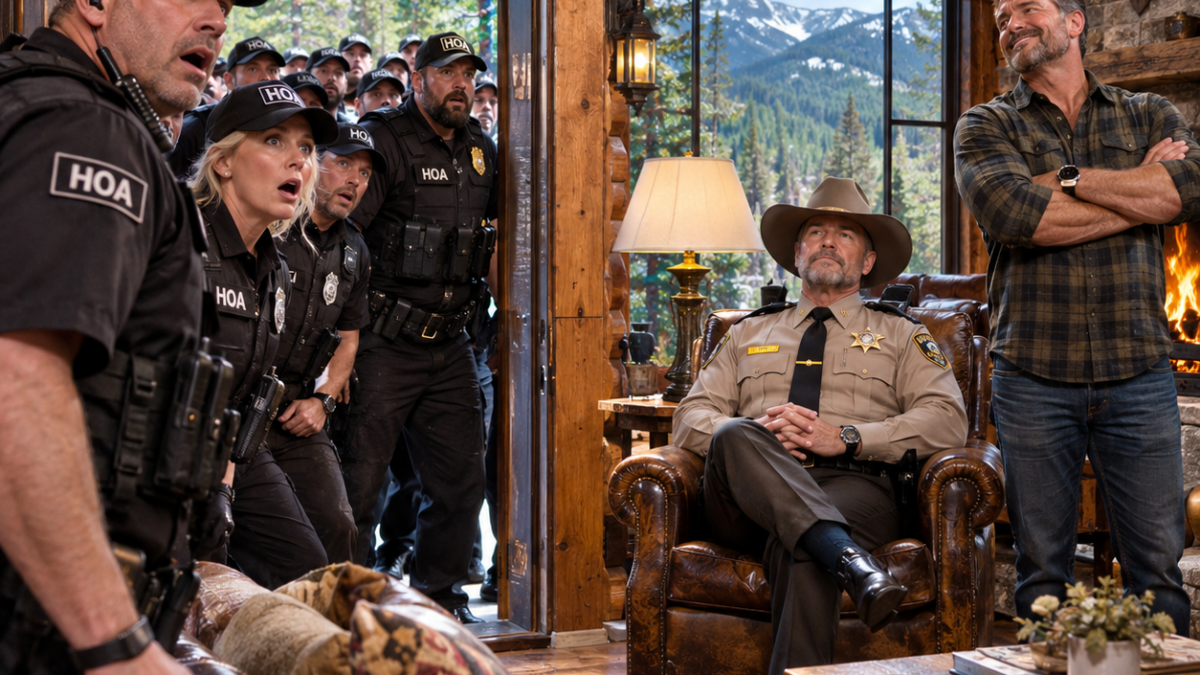
Which brings us back to my living room.
Troy stood on the rug staring at Sheriff Harvey Larkin.
Behind him, four guards.
Outside, deputies moving into position.
Harvey held out his hand.
“Give me the order.”
Troy hesitated.
“I am executing lawful HOA enforcement.”
“Then you should have no problem giving me the paperwork.”
Troy surrendered it.
Harvey placed it beside Mabel’s certification.
“Read the case number.”
Troy did.
Harvey tapped the certification.
“No case under that number exists.”
“That’s impossible.”
“The clerk checked.”
“I have a signed order.”
“No.”
Harvey pointed.
“You have a document carrying a signature.”
Troy flushed.
“President Thorne authorized this.”
“An HOA president cannot authorize eviction from somebody else’s house.”
Troy turned toward me.
“You think you can fight Crest Pine? You’ll lose everything you own.”
Harvey’s voice hardened.
“Stop threatening the homeowner.”
Troy looked back.
At that moment, I saw movement on the tablet.
One guard behind the cabin was still at my shed.
Bolt cutters on the padlock.
I turned the tablet toward Harvey.
He keyed his radio.
“Rear team. Shed.”
Two deputies appeared around the corner.
“Drop the cutters.”
The guard immediately dropped them.
Troy moved suddenly.
He reached toward the table.
For the documents.
A deputy caught his wrist.
Troy yanked away.
Shoved forward.
That ended his options.
He was turned.
Controlled.
Handcuffed.
Not because he wore a security uniform.
Not because Darlene hired him.
Because deputies had personally witnessed forced entry, refusal to comply, threats, and interference.
He sat on my living-room floor breathing hard.
His eleven men were separated outside.
Some looked shocked.
One kept saying:
“We were told there was a court order.”
Harvey did not treat them all the same.
That mattered to me.
Some had been deceived.
Others had received written instructions to cut locks and prepare my cabin for removal even without a court officer.
Evidence determined what happened next.
Not anger.
Then Troy’s radio crackled.
Darlene.
“Troy, why aren’t you answering?”
Nobody touched the radio.
“I’m ten minutes out.”
Harvey raised one finger.
Everybody stayed quiet.
“Have the trailer loaded. I want the road clear before the equipment gets there.”
Harvey looked at me.
Then at Troy.
Then the radio.
“We have the men she sent.”
He stood.
“Now I want the woman who sent them.”
Minutes later, Darlene’s white SUV appeared.
She stepped out in a long white wool coat.
Construction drawings under her arm.
Then stopped.
Six patrol vehicles.
Her guards separated.
Deputies.
Troy in the back seat of a cruiser.
She marched toward the porch.
“What is going on?”
Harvey walked down.
“You Darlene Thorne?”
“You know exactly who I am.”
“I want to hear it from you.”
“Yes.”
“Did you authorize these men to enter Mr. Greer’s residence?”
“Yes.”
“Did you tell them to remove him?”
“Of course.”
“What court authorized that?”
Silence.
She pointed at the document.
“That order.”
“Which court?”
No answer.
“Which judge?”
Her jaw tightened.
“You are interfering with HOA enforcement.”
Harvey held up the certification.
“There is no court case.”
Then Darlene saw me.
My broken doorway.
My home still mine.
“You ruined a three-million-dollar development over a worthless cabin!”
I looked at her.
“I didn’t send twelve men to kick down someone else’s door.”
An investigator handed Harvey another document.
Security contract.
Cabin seizure.
Lock changes.
Possession delivered to Darlene’s representative.
Her signature.
Then payment trail.
Radio commands.
Her admissions.
Harvey explained that based on what officers had witnessed, the documents already verified, and the evidence linking her to the operation, she was being arrested in connection with the attempted seizure and suspected forged court paperwork, with final charging decisions to be made by prosecutors.
Darlene exploded.
“I am the president of Crest Pine Heights!”
Harvey waited.
“Do you understand how much this association is worth?”
No response.
“I’ll sue this entire department!”
Harvey let her finish.
Then deputies followed procedure.
Rights explained.
No unnecessary force.
No performance.
As she was taken toward the cruiser, she looked back.
That was the image I remembered longest.
She had planned for me to be standing outside my home before 7:00.
Instead, I was standing in my doorway.
She was leaving in a patrol car.
Then a flatbed carrying an excavator appeared below.
A deputy stopped it.
Inside Troy’s paperwork, investigators found the demolition site plan.
**CREST PINE SUMMIT LODGE**
One thick red line crossed my cabin.
Beside it:
**REQUIRED EMERGENCY ACCESS — FINAL APPROVAL PENDING**
Harvey handed it to me.
“That cabin is blocking their approval.”
I stared at the red line.
Suddenly the entire campaign made sense.
The $80,000 offer.
Fake HOA boundary.
Fines.
Road blockade.
Eviction.
Demolition.
Darlene did not hate my cabin because it was ugly.
She needed it gone.
The investigation confirmed why.
Summit Lodge had been marketed as the future of Crest Pine Heights.
Conference hall.
Fine dining.
Observation deck.
Luxury mountain events.
Announced project cost:
$3.6 million.
Construction loan already drawn:
$1.9 million.
But the county required an emergency route for fire apparatus.
Steep mountain development.
Limited access.
No final certificate of occupancy without a lawful emergency route.
The easiest alignment crossed my property.
Directly through my cabin.
Darlene never obtained consent.
Never bought the land.
Never secured an easement.
Without that access, Summit Lodge might be built but never lawfully opened.
And every month meant loan interest.
Delay.
Questions.
Homeowner anger.
Lender pressure.
Darlene had promised none of that would happen.
So instead of redesigning the project, she redesigned reality.
Fletcher reviewed the permit files.
My homesite had been labeled:
**HOA COMMON AREA**
My occupied cabin:
**TEMPORARY ABANDONED STRUCTURE**
I laughed when Fletcher showed me.
Then stopped.
Because it wasn’t funny.
Tax bills.
Electric service.
Internet.
Mailing address.
Years of occupancy.
Everything proved I lived there.
Calling my home abandoned did not make it abandoned.
It made demolition easier to describe.
Elise produced more board records.
Months earlier, one board member had written:
**Emergency alignment appears to cross privately owned Greer parcel. Legal access must be resolved prior to reliance on route.**
Darlene ordered that warning excluded from official minutes.
That erased her last innocent explanation.
She knew.
Then came the money.
$28,800 security operation.
Another $68,000 in legal and site-clearance services without proper approval.
Some invoices flowed through a service company with financial ties to Darlene.
Auditors took over.
The lender file was worse.
Crest Pine had represented emergency access as effectively secured.
No easement existed.
No deed.
No written permission.
No option agreement.
Nothing.
The county froze final approval.
The lender froze undisbursed construction funds.
Suddenly, eighty-four homeowners received notices explaining that their expensive resort project faced serious financial risk.
Guess whose signature appeared on the documents causing it.
Darlene’s.
Residents called a special meeting.
Clubhouse packed.
I almost did not go.
Elise called.
“You should.”
“I’m not a member.”
“They need to hear what actually happened.”
I agreed.
The room felt different from every HOA meeting I had ever imagined.
Angry.
Embarrassed.
Scared.
Elise stood at the projector.
She went line by line.
$28,800.
Security.
$68,000.
Questionable service expenses.
Loan representations.
Permit problems.
Then, with my permission and after checking what could lawfully be shown, she played footage.
My gate chain being cut.
Troy kicking my door.
Men entering.
Darlene arriving.
Sheriff.
Cruiser.
No dramatic music.
None needed.
Walter Briggs, an older resident, stood.
He looked toward the empty president’s chair.
“We paid you to protect our community.”
Silence.
“Why did our money send twelve men into somebody else’s house?”
Nobody answered.
I was asked to speak.
I walked forward.
No notes.
I placed my deed on the table.
Then Fletcher’s survey.
Then the recorded plat.
“I never joined your HOA.”
People listened.
“I never transferred one acre.”
Quiet.
“I never granted Crest Pine a road easement.”
A woman in front lowered her head.
“I did not attack your neighborhood.”
I looked across the room.
“Your president attacked my home.”
That was all I needed to say.
Darlene had tried to turn homeowners against me.
But those homeowners had never asked twelve guards to kick down my door.
She had.
They were beginning to understand that.
Sixty-eight owners had signed the petition forcing the meeting.
Seventy-five valid ballots were eventually cast.
Sixty-nine voted to remove Darlene.
Six opposed.
Nobody cheered.
The room exhaled.
That reaction stayed with me.
People were not celebrating destruction.
They were exhausted.
New board withdrew all thirty-seven violation notices.
Every one.
Ordered independent audit.
Terminated unauthorized contracts.
Blocked Darlene from association funds and security control.
Most importantly:
They abandoned every Summit Lodge plan requiring my property.
The criminal investigation continued separately.
The board could not vote it away.
My attorney, Grant Whitfield, filed the civil case.
Grant was the kind of lawyer who never used three words when one would do.
He asked what I wanted.
I said:
“My land.”
“You already own it.”
“I want the court to say the HOA has nothing.”
“Good.”
“No trespassing.”
“Injunction.”
“Broken door.”
“Damages.”
“Gate.”
“Damages.”
“Fence.”
“Damages.”
“Legal costs where recoverable.”
He nodded.
“Anything else?”
“No.”
“Punitive fantasy?”
“No.”
“Excellent.”
Court confirmed:
Crest Pine Heights held no ownership interest in my cabin.
No enforcement authority.
No control over one acre of my property.
Permanent injunction issued.
Anyone acting for the HOA who entered to exercise those false claims would violate a direct court order.
That mattered.
The property line had always existed.
Now the injunction put teeth behind it.
Months passed.
The criminal investigation moved more slowly.
As it should.
Investigators collected:
Fake court order.
Security contract.
Darlene’s signed instructions.
Troy’s work documents.
Camera footage.
Sheriff body camera.
Radio transmissions.
Payment records.
Lender representations.
Court certification.
Witness statements.
For Troy, the evidence showed that he continued after warnings and participated directly in forced entry and resistance.
For Darlene, evidence showed something worse.
She was not merely following someone’s plan.
She had built it.
Eventually, Darlene accepted a plea agreement on charges tied to the forged documents and the property-seizure scheme.
Sentence:
Thirty months in prison.
Fines.
Restitution.
That was the legal outcome.
Not something I invented.
Not something an HOA board declared.
A judge.
Troy faced separate consequences for his role in the break-in and defying lawful orders.
The other guards were treated according to what each had actually known and done.
I appreciated that.
Eleven uniforms did not mean eleven identical minds.
Some had been lied to.
Accountability should be precise.
Civil settlement came later.
Total:
$214,000.
Damages.
Loss of use.
Restoration.
Negotiated resolution of remaining claims.
People heard that number and said:
“You got rich.”
No.
Lawyers cost money.
Surveyors cost money.
Repairs cost money.
Lost work costs money.
Replacing a door is easy.
Restoring the feeling that your home is safe takes longer.
Money does not fix that neatly.
Summit Lodge never opened.
Without lawful emergency access, the project could not be rescued.
Financing deteriorated.
Lender exercised its rights.
Unfinished building and project assets entered liquidation arrangements.
The giant Summit Lodge sign came down.
I watched a truck carrying it along the county road one afternoon.
Did not celebrate.
It was waste.
Millions spent because one person could not accept “no.”
That is not satisfying when you think about the eighty-four households dragged into the mess.
The new board tried to protect them from the worst losses.
Recovered misused funds where possible.
Restructured obligations.
Cut expenses.
Returned focus to things an HOA should have been doing all along.
Cracked sidewalks.
Aging clubhouse roof.
Snow removal.
Normal problems.
Nine months after my door was kicked in, Grant sent me an envelope.
Inside:
Recorded release.
Every claim Crest Pine Heights had asserted over my land canceled.
I read it twice.
Then placed it on my table.
For months, paper had felt like a weapon.
Now paper felt like peace.
Autumn arrived.
I repaired the last fence section.
Installed a new front door.
Solid oak.
Heavier than the old one.
I rebuilt the damaged frame myself.
My neighbor Martin helped hold it in place.
He said:
“You could hire someone.”
“I know.”
“You got a settlement.”
“I know.”
“Then why are we doing this?”
“Because it’s my door.”
He nodded.
Fair enough.
When the hinges were set, I opened and closed it five times.
Solid.
No crack.
No loose latch.
It felt good.
At the gate, I hung a wooden sign.
**GREER PRIVATE PROPERTY**
Below:
**NO HOA AUTHORITY**
Not:
TRESPASSERS WILL BE SHOT.
Not:
DARLENE LOST.
Not:
SHERIFF WINS.
Just fact.
The new Crest Pine board sent a formal apology.
No claim to my property.
No enforcement jurisdiction.
No access rights.
I kept that letter too.
Elise visited one afternoon.
No folder.
No fear.
She sat on my porch.
“They’re recovering some of the money.”
“Good.”
“Slowly.”
“Usually is.”
“Summit Lodge is finished.”
“I heard.”
She looked toward the valley.
“I feel responsible.”
“For what?”
“I was treasurer.”
“You found the payment.”
“After it happened.”
“Before they demolished my home.”
She looked at me.
“That’s a low standard.”
“Still important.”
She laughed weakly.
Then:
“I almost stayed quiet.”
“Why didn’t you?”
She thought.
“Because I imagined those men standing in someone’s living room.”
I nodded.
“That’ll do it.”
She became important in the new board’s cleanup.
Not president.
She refused that position.
Smart woman.
A week later, Harvey drove up.
No patrol cars.
No lights.
Just his truck.
We sat in the living room.
Same chairs.
Same fireplace.
New door.
He looked at the oak frame.
“Better.”
“Last time you were here, twelve men kicked the old one apart.”
He lifted his coffee.
“Memorable morning.”
“Understatement.”
For a while we sat quietly.
Then I asked:
“Did you know they’d actually come through the door?”
“No.”
“You expected them to turn around?”
“I hoped.”
“Were you surprised?”
“When the chain got cut, less surprised.”
I laughed.
He looked around.
“Ever think about leaving?”
“Selling?”
“Yes.”
“No.”
“After all this?”
“Especially after all this.”
He smiled.
“Why?”
I looked toward the window.
Pines.
Meadow.
Mountain.
“Because they wanted me to believe home only mattered until somebody richer needed the land.”
Harvey nodded.
“That’s a good reason to stay.”
We drank coffee.
That might have been the emotional ending.
But life kept giving the story quieter ones.
That winter, the first major storm hit.
I woke at 4:30.
Old habit.
Checked camera.
Nothing.
No black SUVs.
No guards.
Just snow.
I went outside.
Plowed my private road.
Reached the county road.
A Crest Pine resident had slid halfway into a snowbank.
I stopped.
Helped pull him out.
He recognized me.
“You’re Greer.”
“Yes.”
He looked embarrassed.
“I voted for Darlene for president.”
I hooked the tow strap.
“Then I’m charging double.”
His eyes widened.
I laughed.
“Kidding.”
He smiled.
Afterward, he said:
“I’m sorry.”
“For voting?”
“For believing what she said about you.”
I leaned against my truck.
“What did she say?”
“That you were trying to extort the HOA.”
“Did I?”
“No.”
“That you were blocking emergency safety.”
“Did I?”
“No.”
“That you’d abandoned the cabin.”
He looked at my snow-covered home up the hill.
“Clearly not.”
I smiled.
“People believe official people.”
“I should’ve asked for proof.”
“Yes.”
No sugarcoating.
He appreciated that.
“Thanks for pulling me out.”
“You’re welcome.”
He drove home.
That was the first time I realized I did not hate Crest Pine Heights.
I hated what Darlene used it to do.
There is a difference.
Eighty-four households were not twelve guards.
They were families.
Retirees.
Kids.
People with mortgages.
Many had been lied to.
Darlene kept saying:
**The community needs this.**
That phrase covered everything.
Her development.
Her access road.
Her enforcement.
Her spending.
Eventually, “community” stopped meaning eighty-four households.
It meant whatever Darlene wanted.
That is dangerous.
A leader who claims to embody an institution starts treating disagreement like betrayal.
My “no” was not a property decision to her.
It was rebellion.
That is why the response escalated.
$80,000 offer.
Fake boundary.
Violation notices.
Road barricade.
Fake court order.
Twelve men.
Demolition.
Each step made sense only if she believed my property rights were less important than her project.
They were not.
One spring morning, Fletcher came back.
We walked the boundary.
Not because it needed surveying.
Because I wanted permanent markers improved.
He installed new witness posts near the old iron monuments.
Bright enough to find.
Protected.
Documented.
He said:
“Little paranoid?”
“Yes.”
“Good.”
We laughed.
Then he looked toward Crest Pine.
“You know what bothered me most?”
“What?”
“The abandoned structure label.”
“Why?”
“Because it was designed for somebody who would never visit.”
“What do you mean?”
“Permit reviewer sees a map.”
He pointed toward my cabin.
“They don’t see you drinking coffee.”
I nodded.
“They see ‘temporary abandoned structure.’”
“Exactly.”
“So they approve a road removal around something they think is empty.”
“Maybe.”
That was the sophisticated part.
Darlene did not need every official to be corrupt.
She needed them to be misinformed.
A false label can move through bureaucracy farther than a shouting lie.
I started telling people:
“Check the nouns.”
They asked what I meant.
If a document calls your home a “structure,” ask why.
If it calls a private road “community access,” ask why.
If it calls ownership a “management area,” ask why.
Language can be used to make taking something sound administrative.
Darlene understood that.
The fake eviction order used exactly that kind of language.
**PROPERTY CLEARANCE**
Not:
Break into Orson’s home.
**RESIDENT TRANSITION**
Not:
Pay twelve guards $28,800 to remove him.
**STRUCTURAL REMOVAL**
Not:
Bulldoze the cabin.
Words can hide violence.
Video cannot.
That was why the camera footage mattered.
When residents saw a boot hit my door, every soft phrase disappeared.
No more “transition.”
They saw forced entry.
Simple.
One afternoon, Troy’s former employer contacted me through counsel.
They wanted to discuss procedures.
I refused a private meeting until Grant was present.
Then agreed.
Company owner.
Compliance manager.
Attorney.
They apologized.
Said Troy had exceeded company policy.
Grant asked:
“What due diligence did you perform before accepting an eviction operation from an HOA?”
Silence.
That question mattered.
They had accepted a red-stamped document.
Did not verify with court.
Did not require sheriff presence.
Did not independently confirm possession authority.
They learned too.
Policy changed.
No property-removal job based solely on client-provided court papers.
Court verification required.
Licensed law enforcement coordination required where appropriate.
Good.
A bad event should at least create better systems.
I did not want other homeowners waking to twelve guards because someone printed an official-looking seal.
The strongest revenge is sometimes making the method impossible to repeat.
Harvey agreed.
He used parts of the incident in training.
Not my name.
Scenario.
Private security claiming court authority.
Officers verify source.
Never assume paperwork is valid because it looks formal.
Body cameras.
Scene control.
Separate witnesses.
Evidence preservation.
Again:
Boring procedures.
Powerful outcome.
I asked him later:
“What would’ve happened if I had met them with a shotgun?”
He looked at me for a long time.
“You know the answer.”
“I do.”
“Everyone would remember the gun.”
“Not the fake order.”
“Exactly.”
That hit me.
Darlene’s plan depended on making me look unreasonable.
If I reacted violently, the story becomes:
Armed mountain man confronts security over HOA dispute.
Perfect for her.
Instead:
Homeowner sits with sheriff.
Security kicks door.
Entire narrative flips.
Restraint was not passive.
It was tactical.
I had to remind myself of that.
Because the night before, I was angry.
I walked through my cabin touching things.
Table my father helped build.
Fireplace.
Old photographs.
Door frame.
The idea that strangers planned to carry my belongings into a trailer made my hands shake.
There was a moment when I wanted to park my excavator across the road.
Harvey told me:
“No.”
I wanted to chain the gate with industrial cable.
“No.”
I wanted to wait outside.
“No.”
“Why?”
“Because I want them to make their own choices.”
He was right.
We did not need to manufacture obstruction.
They brought bolt cutters.
They brought trailers.
They brought fake papers.
They chose the door.
That purity of evidence became everything.
Years later, a law student contacted me.
She was writing about private security and property enforcement.
She asked:
“What saved you?”
I could have said Sheriff Larkin.
He absolutely mattered.
I said:
“Records.”
She looked surprised.
“Not police?”
“Police enforced what records established.”
“What records?”
“Deed. Plat. survey. court certification. trespass reports. video. payment records.”
“Anything else?”
“Patience.”
She wrote that down.
I laughed.
“You don’t have to write that.”
“No, that’s probably the point.”
Maybe.
Darlene had speed.
I had patience.
She sent thirty-seven notices.
I filed thirty-seven notices.
She sent fake order.
I verified it.
She sent twelve guards.
I let cameras run.
Her urgency created mistakes.
My patience preserved them.
That became the lesson I carried into every later dispute.
Slow down.
Verify.
Save everything.
Do not let someone else’s deadline become your panic.
The Summit Lodge site sat unfinished for a while.
Steel frame.
Partial walls.
Weather wrap flapping.
You could see it from the county road.
Some people called it Darlene’s monument.
I did not.
Too much taxpayer-adjacent and homeowner money had been lost to make jokes.
Eventually, liquidation crews removed equipment.
Assets sold.
Parts dismantled.
Site stabilized.
The land was later used for something smaller.
A simple community overlook.
No resort.
No restaurant.
No emergency route through my home.
The overlook was nice.
One evening Elise invited me.
I almost declined.
Then went.
Residents stood watching sunset.
A kid ran past carrying hot chocolate.
Nothing extravagant.
Elise said:
“Turns out we didn’t need a $3.6 million lodge.”
“Who knew?”
She laughed.
“Darlene would hate this.”
“That’s not why it’s good.”
She nodded.
Correct.
I did not want my happiness tied forever to her misery.
That is another trap revenge creates.
If your satisfaction depends on someone else suffering, they still control part of your life.
I wanted my property.
My peace.
My coffee going cold because I was fixing equipment.
Normal.
The first morning I forgot to check the cameras was a milestone.
I woke.
Made coffee.
Worked in the shed.
At noon, I realized:
I had not looked at the gate feed once.
I smiled.
That meant safety was returning.
Fear makes you monitor.
Peace lets you forget.
My new oak door developed a small scratch that summer.
Moving lumber.
I stared.
Then laughed.
For months, I had treated it like sacred evidence.
It was a door.
Doors get scratched.
Good.
Home was becoming home again instead of a crime scene.
The $214,000 settlement mostly went boring places.
Attorney.
Repairs.
Survey expenses.
Lost business.
Taxes.
Improved security.
Fence work.
I bought one thing purely for myself.
A better coffee maker.
Harvey laughed when he saw it.
“All that money and this is the splurge?”
“Coffee was central to the case.”
“True.”
We sat in the same chairs.
That became a joke.
Whenever he visited:
“Any guards coming?”
“Not today.”
“Shame.”
“Coffee?”
“Yes.”
After Darlene began serving her sentence, reporters occasionally contacted me.
I declined most interviews.
One asked:
“Do you feel vindicated?”
I said:
“My cabin is still standing.”
“Is that a yes?”
“That’s enough.”
“What would you say to Darlene?”
“Nothing.”
They seemed disappointed.
But what was left?
She knew.
The judge knew.
Residents knew.
I did not need a final speech.
The most dangerous people sometimes feed on confrontation.
Silence after accountability is more final.
Still, one sentence remained with me.
She had said:
“I don’t need you to agree. I just need you out of the way.”
That was her worldview.
Consent was an obstacle.
Owners were obstacles.
Rules were obstacles.
Board members were obstacles.
Eventually, law became an obstacle.
Once someone thinks like that, every boundary feels illegitimate.
My cabin was just the place where that philosophy finally hit something stronger.
Not me.
The record.
That distinction mattered.
I was not stronger than Darlene’s money.
Not richer than an HOA.
Not more influential.
But ownership did not depend on those things.
A deed does not become weaker because the other side hires more guards.
That is why the title of president never impressed me.
Authority is specific.
An HOA president can have real authority within association governance.
Budgets.
Common areas.
Rules lawfully applicable to members.
Darlene made the fatal leap from:
**I have authority here**
to:
**I have authority everywhere I need it.**
No.
Every form of authority has edges.
Good leaders know them.
Bad leaders discover them in court.
The new Crest Pine board understood.
They invited an outside attorney to explain boundaries of HOA power.
I attended only because Elise asked.
The lawyer said:
“An association’s governing documents do not create jurisdiction over nonmember parcels merely because those parcels affect association planning.”
I whispered:
“Could’ve used that lecture last year.”
Elise elbowed me.
The lawyer continued:
“Board votes cannot replace deeds.”
I whispered:
“Put it on a T-shirt.”
Elise nearly laughed aloud.
Afterward, several homeowners approached.
One said:
“I honestly believed Darlene when she said your land was annexed.”
“I know.”
“She showed us a map.”
“I know.”
“It looked official.”
“That was the point.”
Another said:
“I’m embarrassed.”
“Don’t be embarrassed. Verify next time.”
That became my attitude.
I could spend years resenting people for believing her.
Or hope they learned.
Learning is more useful.
One man apologized for posting online that I was a “greedy mountain squatter.”
I stared.
“You called me that?”
He reddened.
“You didn’t see it?”
“No.”
“Oh.”
I laughed.
“Now I’m offended retroactively.”
He laughed too.
“Sorry.”
“Accepted.”
We moved on.
That was healthy.
Darlene’s reputation eventually became synonymous with the scandal, but I avoided adding rumors.
People invented stories.
Secret accounts.
Other properties.
Bribes.
I shut those down when they reached me.
“Is it in the record?”
If no:
“Then don’t say it.”
Someone asked why I defended her from rumors.
“I’m not defending her.”
“Sounds like it.”
“No. I’m defending truth.”
If you win with evidence, do not contaminate the victory with gossip.
Darlene’s proven actions were bad enough.
No embellishment needed.
That principle is why people trusted me later.
When I said something happened, it had happened.
When I did not know, I said I did not know.
Precision is credibility.
My career taught me that.
A survey line either closes or it doesn’t.
You do not improve a bad traverse by telling a better story.
One fall, I went through the fireproof cabinet.
Decided what to keep.
Thirty-seven HOA notices?
Kept.
Fake eviction order?
Kept.
Mabel’s certification?
Absolutely.
Settlement?
Kept.
Release?
Kept.
Photographs?
Digital archive.
The broken old door latch?
I almost threw it away.
Then put it in a drawer.
Not as a trophy.
A reminder.
Metal can break.
Paper can be forged.
But a record that gets independently verified is harder to defeat.
Maybe that is sentimental.
I’m allowed one drawer.
Harvey retired eventually.
Crest Pine residents invited him to a community dinner.
He joked:
“I’m not your HOA sheriff.”
They laughed.
I went too.
Someone asked us to tell the cabin story.
Harvey said:
“Short version?”
Everyone nodded.
“Twelve men entered a house they shouldn’t have entered.”
Pause.
“I happened to be having coffee there.”
Laughter.
I added:
“He makes himself sound accidental.”
Harvey shrugged.
“I like the mysterious version.”
Then a teenager asked:
“Were you scared?”
That quieted the table.
Harvey looked at me.
I answered.
“Yes.”
People seemed surprised.
“You looked calm on the video.”
“Calm and scared can exist at the same time.”
That was important.
Courage is not feeling nothing.
It is deciding what not to do while afraid.
I was afraid they might hurt Harvey.
Afraid a guard might panic.
Afraid somebody had a weapon.
Afraid deputies moving in through fog might be misunderstood.
Afraid my cabin would become a place where someone died.
That is why I followed Harvey’s plan.
No weapons.
No confrontation.
No heroic nonsense.
Nobody died.
That was the real success of that morning.
One man got arrested inside.
Darlene later.
But everyone went home alive.
Property can be repaired.
Lives cannot.
I wish more revenge stories ended with that lesson.
Years later, a storm knocked a tree across my private road.
I was cutting it when a Crest Pine maintenance truck stopped at the boundary.
Driver rolled down the window.
“Need help?”
I looked.
Two workers.
Chainsaws.
“Sure.”
They parked on county side.
Walked over only after I waved them in.
We cut the tree.
Dragged it aside.
One worker said:
“We were told never to cross your line without permission.”
“Good policy.”
He smiled.
“Legendary policy.”
I laughed.
That small moment made me happier than Darlene’s sentence.
The institution had learned.
Not fear.
Respect.
There is a difference.
Fear asks:
What will Orson do if we cross?
Respect asks:
Do we have permission?
The second is healthier.
I wanted that.
One afternoon, Grant called years after the case.
“You still have the cabin?”
“Yes.”
“You planning to sell?”
“No.”
“You know values have climbed.”
“I know.”
“You could make a fortune.”
“I know.”
“Then why?”
I walked onto the porch.
Looked at the meadow.
“You’re asking the wrong guy.”
He laughed.
“Fair.”
Money was what started the dispute.
Darlene thought $80,000 should overcome attachment.
Then millions made refusal seem irrational.
But value is personal.
A developer can calculate land per acre.
Cannot calculate memory.
The stain on my workshop bench.
The porch post I replaced with my brother.
The view where my father once stood.
The quiet after snow.
Property law protects more than market value.
It protects choice.
Maybe someday I sell.
Maybe not.
The important word is:
I.
My decision.
That was what Darlene could never accept.
The permanent injunction remained on record even after the HOA apologized.
Grant once asked whether I wanted to modify it because relations improved.
“No.”
“Why?”
“Boards change.”
He smiled.
“You’ve learned.”
“Always knew.”
Written protection outlives goodwill.
Goodwill is great.
Records are better.
Fletcher would approve.
I added a note to the property file for any future owner:
**Crest Pine Heights holds no access or enforcement rights over this parcel. See recorded injunction and release.**
Future owner may never need it.
Good.
Protection is best when unused.
Sometimes I wonder what would have happened if Darlene had accepted my first “no.”
Probably Summit Lodge redesigned.
Maybe smaller.
Maybe other access bought.
Maybe delayed.
She would still be president.
Homeowners would still have their money.
Troy would not have a criminal case.
I would never have met Elise.
Harvey would have drunk coffee somewhere else.
One word.
No.
That word did not destroy her project.
Her refusal to respect it did.
That is the lesson people miss when they call me stubborn.
Stubbornness can be foolish.
But boundaries are not stubborn merely because someone else finds them inconvenient.
Darlene framed my refusal as sabotage.
It wasn’t.
I did not interfere with land she owned.
I did not block construction on HOA property.
I did not file false complaints.
I did not cut utilities.
I did not harass residents.
I simply refused to give up mine.
She needed my property for her plan.
That gave her a negotiation problem.
Not ownership.
The moment she treated negotiation as optional, she created everything that followed.
The old Summit Lodge rendering still exists online somewhere.
Someone sent it to me.
Beautiful glass deck.
Lights.
Mountain view.
A red access line hidden behind landscaping graphics.
I looked at it once.
Deleted it.
I did not need to keep her dream.
I had mine.
Smaller.
Older.
Still standing.
One autumn evening, I sat on the porch while fog rolled through the valley.
Almost exactly like the morning of the raid.
For a second, black shapes on the county road looked like SUVs.
My body reacted before my brain did.
Chest tight.
I stood.
Then headlights passed.
Delivery van.
Nothing.
Trauma is annoying that way.
It remembers before you decide to.
I went inside.
Made coffee.
Sat in the leather chair.
Same chair.
Looked toward Harvey’s old spot by the fireplace.
Empty.
I smiled.
No sheriff needed anymore.
That was progress.
Darlene had tried to make the cabin unlivable through fear even before demolition.
Thirty-seven fines.
Guards.
Barricade.
Threats.
Those tactics were meant to exhaust me into agreeing.
That works on people.
Legal victories often belong to whoever can endure process.
I was lucky.
I had records.
Experience.
Resources to hire help.
That made me think about people who do not.
An elderly homeowner.
Someone without money for a surveyor.
Someone afraid of official letters.
Would they have paid?
Moved?
Signed?
Maybe.
That realization bothered me.
So after everything, I agreed to help the county legal-aid clinic with one workshop.
Just one.
Property records.
How to verify court orders.
How to search case numbers.
How to document trespass.
I told them:
“If somebody sends you a court paper, call the court using a number you independently find.”
Not the number on the paper.
Verify.
That single step might have stopped Darlene’s plan for anyone less prepared.
A woman at the workshop asked:
“What if the HOA says we have twenty-four hours?”
“Deadlines can be real.”
“Then?”
“Verify faster.”
People laughed.
I was serious.
Urgency should increase verification, not eliminate it.
That became one of my rules.
The fake order worked because it looked urgent.
Bright red.
Emergency.
Forty-eight hours.
Authority.
The design was psychological.
You see deadline and seal.
You panic.
You obey.
I saw inconsistencies because of my background.
Others might not.
Mabel Atwood became a friend too.
I sent her a Christmas card the next year.
**Thanks for confirming I still owned my house.**
She replied:
**You’re welcome. Please stop making my job exciting.**
I framed that card.
Yes.
Apparently, I do frame paperwork now.
Do not tell Grant.
Mabel retired.
At her retirement gathering, she told the story of the fake order without names.
She said:
“Court seals are not magic. Verify the docket.”
Perfect summary.
Systems are strong when ordinary people know how to use them.
That is what saved me.
Not secret influence.
Public records.
Public clerk.
Public sheriff.
Court.
The institutions Darlene tried to imitate with fake authority were the institutions that stopped her.
That irony never got old.
One day a young Crest Pine resident asked:
“Why didn’t you just take the $80,000?”
I said:
“For your house?”
He laughed.
“No.”
“If I offered you eighty thousand today and said I’m bulldozing your kitchen tomorrow, would you take it?”
“Obviously not.”
“Why?”
“My home’s worth more.”
“Exactly.”
“But your cabin was old.”
I stared.
He realized it.
“Sorry.”
I laughed.
“You’re learning.”
Market value was never the only issue.
Even if Darlene offered fair market value, I could say no.
That is ownership.
People misunderstand eminent domain and private development.
An HOA does not become government because its project feels important.
It cannot simply decide public purpose and seize.
Darlene acted as if community benefit gave her condemnation power.
It did not.
The fake court order tried to manufacture what she lacked.
Once residents understood that, their anger shifted completely.
They had thought I was blocking progress.
Then they saw their dues funding a private seizure.
Nobody wants that precedent.
Because if an HOA can redraw my boundary today, whose boundary tomorrow?
That was what Walter Briggs said after the removal vote.
He found me outside.
“I spent months thinking you were the problem.”
“I know.”
“Then I watched them kick your door.”
I nodded.
He said:
“If she could do that to you, she could do it to any one of us.”
Exactly.
Abuse rarely stays neatly aimed at outsiders.
Once a leader believes rules are optional, members eventually become targets too.
That understanding helped the community reform.
New board adopted spending controls.
No emergency contract above certain thresholds without multi-member approval.
Independent counsel review for property-right claims.
Conflict disclosures.
Security companies could not be used for eviction-type enforcement without confirmed lawful authority.
Good rules.
Not exciting.
Useful.
Elise later joked:
“Darlene finally accomplished one community improvement.”
“What?”
“She made our bylaws better.”
Dark humor.
I appreciated it.
Troy’s story was sadder than people think.
He was not stupid.
He was overconfident.
He had spent years working private security.
Darlene handed him something resembling a court order.
Paid well.
Told him county authorities approved.
But there were warning signs.
No sheriff scheduled.
No court officer.
No verified case number.
Instructions to cut locks.
Demolition immediately after removal.
He pushed past those warning signs.
Then inside my living room, when the sheriff showed him proof, he doubled down.
That was his real downfall.
There is often a moment when a person can stop.
He had one.
He chose ego.
I thought about that whenever people asked whether I felt sorry for him.
Some.
Not enough to erase responsibility.
Compassion and accountability can coexist.
Same with Darlene.
Prison is serious.
Thirty months is not a punch line.
I took no joy imagining anyone behind bars.
But I also remembered my broken door.
The demolition plan.
Her voice:
“I just need you out of the way.”
There are consequences for turning that attitude into action.
The court decided them.
Not me.
That distance helped me sleep.
I did not sentence her.
I preserved evidence.
That is all.
The civil settlement also included practical repairs beyond my door.
Gate.
Fence.
Security upgrades.
Lost work.
I installed better cameras.
Not hidden.
Visible.
A sign:
**VIDEO RECORDING IN USE**
That prevented more problems than any threat could.
One delivery driver joked:
“Expecting another army?”
“No.”
“Then why so many cameras?”
“Memory.”
He nodded like he understood.
Maybe he did.
Years after the case, I finally repainted the living room.
The wall near the door had a dent from the forced entry.
I had left it.
Not intentionally.
Just never got around to fixing it.
One morning, I patched it.
Sanded.
Painted.
When the spot disappeared, I felt unexpectedly emotional.
The physical scar was gone.
I stood there longer than necessary.
Then realized I was ready.
Some evidence belongs in files.
You do not need to live inside it forever.
That became my final lesson.
Preserve the record.
Then let your home be a home again.
Harvey visited after retirement and noticed immediately.
“You fixed the wall.”
“Yes.”
“Took you long enough.”
“I was busy.”
“For five years?”
“Very busy.”
He laughed.
We drank coffee.
He asked:
“Still have the body-camera copy?”
“Lawyer does.”
“Good.”
“You sentimental too?”
“No.”
“Sure.”
He smiled.
Outside, wind moved through pines.
Nothing else.
I thought about that first morning.
The men entering so confident.
Troy holding papers.
Harvey standing.
The transformation on their faces.
People often tell that moment like some clever trap I set.
It wasn’t.
It was a safeguard.
We hoped they would turn around.
I would have preferred it.
If Troy had seen the court certification at the gate and left, no dramatic story.
Good.
No broken door.
Better.
Darlene could have canceled the operation.
Better.
Nobody forced them into the trap.
There was no trap.
There was only a boundary.
They crossed it.
That distinction matters.
I never invited them to break the law.
I invited the sheriff to witness whether they would.
They decided the rest.
At the end of the entire case, Grant asked me one final question.
“Any interest in suing additional parties?”
“No.”
“There may be theories.”
“No.”
“You sure?”
“Yes.”
“Why?”
“Because I’m done.”
He looked at me.
Then smiled.
“That’s the healthiest answer you’ve given in two years.”
Closure requires deciding when enough is enough.
The wrong is acknowledged.
Damage compensated.
Property protected.
Responsible people face process.
Continuing simply to hurt others would turn accountability into vengeance.
I wanted peace more than another check.
That was when the fight truly ended.
The HOA’s recorded release arrived.
I put it in the drawer.
For months, I had kept documents by the front door.
Deed.
Survey.
Order.
Certification.
Ready.
After the release, I moved them back to the fireproof cabinet.
I did not need to greet every visitor with proof of ownership.
The cabin knew whose it was.
I knew.
County knew.
That was enough.
One afternoon, Harvey stood at the gate before leaving.
“Ever think you’ll sell?”
I looked toward the cabin.
Stone chimney.
Oak door.
Pines.
“Not a chance.”
He nodded.
“Figured.”
His truck disappeared down the road.
I closed the gate.
Locked it.
Then walked slowly back uphill.
The mountain was quiet.
No black SUVs.
No red stamps.
No violation notices.
No Summit Lodge.
Just my cabin.
It had never moved.
Not one foot.
Darlene had redrawn maps.
She could not move it.
She had issued fines.
They could not move it.
She had paid security.
They could not move it.
She had created an eviction order.
It could not move it.
She had scheduled a demolition crew.
They never touched it.
Her project disappeared before my home did.
That was the irony.
But the deeper ending was not about whose building survived.
It was about what power actually means.
Darlene believed power meant twelve uniforms outside a door.
A red stamp.
A board title.
Money.
A project worth millions.
People afraid to challenge her.
I learned that morning that real power can look much quieter.
A county clerk saying:
“There is no such case.”
A survey monument in the soil.
A deed in a cabinet.
A sheriff setting down a coffee cup.
A homeowner refusing to hit anyone.
A camera continuing to record.
A judge reading the evidence later.
Those things moved slowly.
But they did not need to shout.
At 6:14 a.m., twelve guards came to take my cabin.
By 6:18, they had broken my gate and kicked in my door.
They thought speed would defeat the truth.
Instead, speed gave the cameras everything.
Darlene thought I would be terrified by twelve men.
I was.
I just did not let fear make my decisions.
She thought the sheriff would arrive too late.
He was already inside.
She thought a fake court order would overpower a real deed.
It didn’t.
She thought demolition could turn her lie into permanent reality before anybody stopped her.
The excavator never crossed my gate.
And she thought that once I was out, Crest Pine Summit Lodge would finally rise where my home had stood.
It never opened.
Today, the only resort view from my porch is the same one I had before Darlene arrived.
Pines.
Valley.
Mountain light.
The old leather chair is still near the window.
The pine table is still in front of it.
When friends visit, nobody knows exactly where Troy stood unless I point.
Usually I don’t.
I would rather talk about weather.
Or equipment.
Or whether the deer ate my garden again.
Normal things.
That is the ending people do not put in dramatic titles.
Normal life returning.
But it is the best ending.
One final winter morning, years after everything, I woke before dawn.
Fog outside.
For a moment, the view looked exactly like the morning of the raid.
I made coffee.
Sat in the same chair.
Looked at the gate camera.
Empty road.
I turned the tablet off.
That was something I never could have done during the case.
I sat in silence.
Then looked toward the fireplace chair where Harvey had waited.
I could almost hear him again.
“Gentlemen, you’ve just forced your way into a private residence.”
I smiled.
Not because twelve men had been humiliated.
Because they had been stopped.
No demolition.
No bloodshed.
No desperate fight.
The system worked because we gave it evidence to work with.
That is what I remember.
Darlene sent twelve guards to remove me from my own cabin before sunrise.
She had already arranged the trailer.
The demolition crew.
The false paperwork.
She had calculated that by the time anyone understood what happened, my home would be gone and the emergency road would already exist.
She was wrong.
She lost her presidency.
Her project collapsed.
Her financial misconduct came into the open.
She faced criminal consequences and served the sentence imposed by the court.
The responsible parties paid for the damage they caused.
Crest Pine formally abandoned every claim to my land.
And I never moved.
Not for the guards.
Not for the fines.
Not for the forged order.
Not for the bulldozer.
That morning, Darlene believed twelve hired men were enough to turn a lie into ownership.
But when they kicked my door open, the first thing they saw was not a frightened homeowner packing his belongings.
They saw Sheriff Harvey Larkin sitting beside my fireplace with a cup of coffee and a county certification proving their court order had never existed.
And that was the moment the entire plan began to collapse.
They had come to remove me from my home.
Instead, the sheriff removed their authority from the room.
My cabin stayed exactly where it had always been.
And so did I.








