PART 2: HOA Karen Secretly Charged Her $100K Tesla From My Solar—Then Her Illegal Power Tap Burned Everything Down
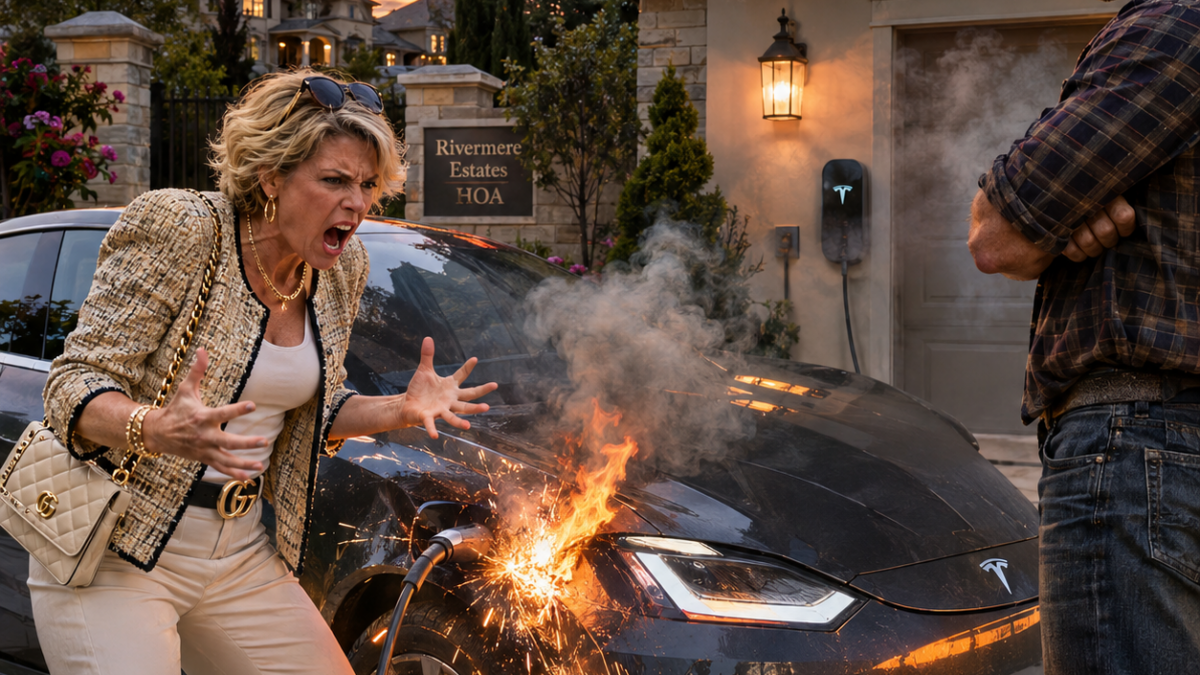
PART 2
I tracked my electrical production obsessively.
That wasn’t paranoia.
It was habit.
An electrician looks at numbers the way a mechanic listens to an engine.
My array was performing almost exactly as designed, but far less surplus electricity was reaching the grid than it should have.
At first, I assumed a monitoring error.
Then I checked the inverter.
Nothing.
I checked the breakers.
Nothing.
I checked the meter.
Nothing.
The system was producing power.
My home wasn’t consuming it.
Yet something was.
One Saturday morning in late June, I decided to trace every accessible section of the installation by hand.
By eight in the morning, the Arizona heat had already turned the gravel beside my house into an oven.
I followed the conduit from the roofline down toward the junction area along the east side of my house.
I opened the enclosure.
Then I stopped.
Someone had tapped into my electrical system.
A separate line had been attached without my permission and routed away from the house.
It disappeared along the fence separating my property from Tammy’s.
For several seconds, I simply stared at it.
I knew every legitimate wire in that installation because I had installed them myself.
That line wasn’t mine.
It hadn’t been inspected.
It hadn’t been permitted.
And whoever installed it had done the kind of sloppy work that makes every professional electrician’s stomach tighten.
I followed the route.
The conduit disappeared beneath landscaping gravel, crossed toward Tammy’s property, and emerged near her garage.
I could see where it ended.
An EV charging outlet.
And connected to it was the same white Tesla Model X she had parked in my driveway the day she introduced herself.
The charging indicator was glowing.
Green.
I stood there in the heat listening to the low hum from the equipment.
For one furious second, every instinct in me said to disconnect it immediately.
Tammy had fined me for producing my own electricity while she was stealing it.
She had stood on my porch talking about community standards while secretly tapping into my property.
I imagined walking over, pulling the connection, dropping the cable on her driveway, and waiting for her to come outside.
Then I thought about Colton.
About Elena.
About twenty-two years of learning that anger around electrical systems is a dangerous combination.
So I did nothing impulsive.
I went inside.
I poured a glass of water.
Then I took out a notebook.
June 28.
8:17 a.m.
Unauthorized connection discovered.
I wrote down everything I could observe.
Then I photographed it.
The connection.
The route.
The outlet.
The Tesla.
The surrounding property.
I backed up the photographs.
Only after that did I walk next door.
Tammy answered wearing a silk robe and holding a coffee mug that read:
QUEEN OF EVERYTHING.
I almost laughed.
Instead, I said, “We need to talk about the electrical line running from my property into your garage.”
Her expression didn’t change.
“What line?”
“The one charging your Tesla.”
She lifted her mug and took a slow sip.
“Oh. That.”
That.
Not surprise.
Not confusion.
Not even denial.
“Tammy, you’re drawing electricity from my system without authorization.”
“The HOA has utility easement rights.”
“No, it doesn’t.”
“It absolutely does.”
“You’re confusing access easements with ownership of private electrical equipment.”
She sighed.
“Garrett, I don’t have time for one of your technical lectures.”
“It’s not a lecture. Disconnect it.”
Her eyes hardened.
“The solar infrastructure feeds into the neighborhood electrical network.”
“My system connects to my service and the utility grid. It does not belong to Desert Bluff Estates.”
“Well, my understanding is different.”
“Then your understanding is wrong.”
She gave me a tiny smile.
“Are you threatening the HOA president?”
“I’m telling my neighbor to stop taking electricity from my house.”
She stepped backward.
“Careful.”
“With what?”
“With your attitude.”
I stared at her.
She continued.
“You already owe the association eight hundred dollars in outstanding violations.”
“The fines are unlawful.”
“And now I’m adding another five hundred.”
I actually laughed then.
She looked offended.
“You’re stealing from me,” I said, “and your response is to fine me?”
“Have a blessed day, Garrett.”
She closed the door.
The deadbolt clicked.
I stood there for another second.
Then I walked home and wrote down every word of the conversation.
That became my routine.
Tammy threatened me.
I documented it.
Tammy sent a letter.
I filed it.
Tammy entered my property.
I recorded it.
I had no idea then how valuable that discipline would become.
The Woman Who Believed Rules Were for Everyone Else
Over the next six weeks, Tammy escalated.
My fines increased.
Then my routine solar permit paperwork suddenly stalled with the county.
A renewal that normally should have been simple sat “under review” for weeks.
When I called, a clerk sounded uncomfortable.
“Your application has been flagged for additional planning review.”
“Why?”
“I can’t give you more information.”
The words planning review immediately caught my attention.
Tammy’s husband, Darren Bridgewater, served on a county planning commission.
He wasn’t powerful enough to rewrite laws.
But he was connected enough to make paperwork unpleasant.
I couldn’t prove he was involved.
So I didn’t accuse him.
I wrote it down.
A few days later, I came home from a job in Tempe and found two men standing beside my house.
They wore tan polo shirts and carried clipboards.
One was photographing my electrical equipment.
The other had opened an enclosure.
I put my tool bag down.
“Can I help you?”
The taller one turned.
“We’re conducting an HOA infrastructure inspection.”
“On my property?”
“Ms. Bridgewater authorized it.”
I looked at the laminated badge clipped to his belt.
It said:
DESERT BLUFF ESTATES COMPLIANCE INSPECTOR.
No government seal.
No electrical license.
No county identification.
Nothing.
“Did I authorize you to enter?”
“We have access rights under the CC&Rs.”
“I’ve read them.”
He hesitated.
“So have we.”
“Then you know the provision you’re talking about applies to common areas. My side yard isn’t a common area.”
The shorter man stepped forward.
“Sir, we’re just doing our job.”
“So am I.”
I raised my phone.
“I’m recording now. I am directing both of you to leave my property.”
The shorter one scoffed.
“You’re being difficult.”
“No. I’m being clear.”
They eventually left.
As they reached the sidewalk, I heard one of them mutter, “She warned us about this guy.”
That night, after Colton went to bed, I opened my solar monitoring dashboard.
The theft had gotten worse.
Much worse.
There were repeated heavy draws throughout the day.
One around dawn.
Another around noon.
Another late at night.
I stared at the data.
One Tesla should not have been producing all of those charging patterns.
Just before midnight, I went outside.
The desert was finally cooling.
From Tammy’s garage, I could hear more than one charger operating.
I looked through a gap near the fence.
There were two electric vehicles inside.
Tammy’s white Model X.
And a red Tesla Model 3.
Above the charging outlet, someone had taped a handwritten sign to the wall.
EV CHARGING — DBE RESIDENTS WELCOME. SEE TAMMY B.
I felt something inside me go still.
She wasn’t merely stealing electricity for herself.
She was giving my electricity away.
I took photographs.
Then I returned to my kitchen table.
At the top of a fresh page, I wrote:
Pattern of Unauthorized Use.
Underneath it, I wrote one sentence.
How far does she think she can go?
I would soon discover the answer.
Farther than anyone in Desert Bluff imagined.
The Petition
By September, Tammy had moved from targeting me privately to turning the neighborhood against me publicly.
A petition began circulating.
PROTECT DESERT BLUFF’S VISUAL INTEGRITY.
It claimed rooftop solar damaged property values.
It described solar arrays as possible fire hazards.
It warned of electrical risks.
Forty-three homeowners signed it.
Some probably believed every word.
Others probably signed because Tammy stood in their doorway with a clipboard and made saying no feel like confessing to a crime.
A copy appeared on my porch.
Tammy had attached a yellow sticky note.
Thought you should see this. The neighborhood has spoken.
I added the note to my file.
Then I examined the petition more carefully.
The language was too polished for Tammy.
At the bottom, in small print, was the name of a law firm.
Three days later, a cease-and-desist letter arrived from that same firm.
Remove the solar panels.
Decommission the system.
Comply within fourteen days.
Or face legal action.
I sat at the kitchen table reading it while Colton ate cereal across from me.
He watched my face.
“Is it her again?”
“Yeah.”
“Are we in trouble?”
That question hurt more than Tammy’s letter.
I folded the paper.
“No.”
He looked unconvinced.
“Then why does she keep sending stuff?”
“Because sometimes people send scary-looking papers hoping you won’t check whether they’re right.”
He stared into his bowl.
“Mom hated bullies.”
I smiled faintly.
“She really did.”
“What are you going to do?”
“Check whether they’re right.”
That night, I researched the law firm.
Something didn’t fit.
Its main office was outside Arizona.
The attorney whose name appeared on the correspondence had an unusual licensing history.
Whatever authority Tammy believed the letter gave her was far weaker than she wanted me to believe.
I printed everything.
Added it to the binder.
Then Tammy called an emergency HOA meeting.
The clubhouse was packed.
She stood at the front beneath a projection screen wearing a navy blazer.
Behind her was a presentation titled:
INFRASTRUCTURE SAFETY CONCERNS.
My house appeared on slide three.
My solar panels on slide four.
My electrical equipment on slide five.
Some photographs looked suspiciously like the ones taken by the two men I had ordered off my property.
Tammy clicked forward.
“Based on our consultants’ concerns,” she announced, “Mr. Holloway’s unauthorized solar infrastructure may be affecting the electrical safety of the entire community.”
People murmured.
I stayed seated.
She continued.
“For that reason, the board is proposing a special assessment of fifteen hundred dollars per household to fund community electrical upgrades.”
That got everyone’s attention.
A man behind me whispered, “Fifteen hundred?”
A woman across the aisle turned and glared at me.
As if I had personally sent her the bill.
I wanted to stand up.
I wanted to tell everyone that the only unauthorized wiring I had found ran directly into Tammy’s garage.
But I didn’t yet know who in the room would believe me.
And I had learned something important about Tammy.
She loved public confrontations because she believed she controlled the room.
So I refused to give her one.
I took notes.
After the meeting, an older man approached me in the parking lot.
His name was Ward Pemberton.
He had served on the HOA board for three years.
“I’ve been asking to see the association’s financial records,” he said quietly.
“And?”
“She keeps delaying.”
“Why?”
Ward glanced toward the clubhouse doors.
“Because I think there’s something in them she doesn’t want anyone to see.”
I studied him.
“You think this is bigger than my solar panels?”
He nodded.
“I think your solar panels are just the first thing that made someone push back.”
That sentence changed everything.
The Banker’s Box
I filed a formal request to inspect the HOA’s financial records.
Tammy delayed.
Then delayed again.
Finally, a cardboard banker’s box appeared on my porch.
No letter.
No explanation.
Just three years of statements, invoices, board minutes, budgets, and account reconciliations.
I carried it inside.
Made coffee.
Started reading.
Six hours later, the coffee was cold and I had stopped thinking about solar panels entirely.
One budget category appeared repeatedly:
Community Utility Infrastructure Fund — Phase Two.
More than fifty thousand dollars had been transferred into that category over three years.
But there were no matching contractor invoices.
No completed project.
No equipment purchases.
No engineering reports.
Nothing.
I followed the transfers through the statements.
They left the HOA accounts.
Then disappeared into another account.
I searched deeper.
On an old reconciliation sheet, someone had handwritten a note beside one transfer.
Per T. Bridgewater — personal reimbursement.
I read it again.
Then again.
Fifty-two thousand dollars.
Homeowners had paid dues believing the money funded their neighborhood.
Pools.
Roads.
Landscaping.
Repairs.
Instead, a large amount of money appeared to have been routed through a fake infrastructure category and into an account associated with “personal reimbursement.”
I called Ward.
He answered immediately.
“I found something.”
“How bad?”
“Worse than the electricity.”
There was silence.
Then he said, “I’m coming over.”
Ward arrived twenty minutes later.
We spent the evening going through the box together.
That was when we found the emails.
Tammy had exchanged messages with a commercial developer named Clayton Mercer.
He wanted approval for a mixed-use project on land near Desert Bluff.
The project required favorable zoning treatment.
The emails discussed a twenty-five-thousand-dollar “community partnership contribution.”
In return, Tammy promised to help build support and manage resistance from homeowners.
I searched the planning commission vote.
The project had passed narrowly.
One of the approving votes belonged to Darren Bridgewater.
Tammy’s husband.
Ward sat back.
“Jesus.”
I didn’t answer.
“This isn’t HOA nonsense anymore,” he said.
“No.”
“This is criminal.”
“Potentially.”
“Garrett, what are you going to do?”
I looked at the growing piles of documents.
The electrical theft.
The fake inspections.
The fines.
The financial transfers.
The developer emails.
For months, Tammy had treated my restraint like weakness.
She thought because I didn’t scream, I didn’t fight.
Because I didn’t threaten, I was afraid.
She had misunderstood me completely.
“I’m going to stop dealing with Tammy,” I said.
Ward frowned.
“What does that mean?”
“It means I’m done trying to convince her.”
I tapped the documents.
“From now on, I’m talking to people who can do something about this.”
I Built a Case Instead of a Revenge Plan
This is where people later misunderstood what happened.
They heard about the fire.
They heard about the Tesla.
They heard I had expanded my solar array.
And they decided I must have planned to destroy her car.
I didn’t.
I had spent my career around electricity.
I knew better than to intentionally create an electrical failure near a house where people might be sleeping.
Especially with my son next door.
My retaliation wasn’t electrical.
It was documentation.
I upgraded my solar array because I had already planned the expansion.
I obtained the permits.
I submitted the engineering information.
I had the work reviewed.
And because I knew Tammy’s unauthorized connection was still there, I sent her a certified written warning.
The letter was simple.
My system had been modified under permit.
Any unauthorized connection to it needed to be removed immediately.
Improvised electrical work could overheat under sustained demand.
It could damage equipment.
It could cause a fire.
She needed to disconnect.
I kept proof that the letter was delivered.
Then I filed a complaint regarding the unauthorized electrical work.
I sent copies of the suspicious HOA records and developer communications to the proper authorities.
I contacted a local reporter named Shelly Caldwell who had covered HOA disputes and municipal corruption.
When she called me back, she sounded skeptical.
That was exactly what I wanted.
“I need documentation,” she said.
“I have it.”
“How much?”
“How much time do you have?”
There was a pause.
“Send me what you can substantiate.”
I did.
I also installed additional security cameras around my property.
Not aimed into anyone’s windows.
Not invading anyone’s privacy.
Only protecting the areas around my equipment, fence, driveway, and mailbox.
Then I waited.
Not for revenge.
For Tammy to make another mistake.
She didn’t make one.
She made several.
The Fire Complaint That Backfired
Three days after I completed the permitted solar expansion, Tammy appeared at the end of my driveway.
“You added more panels.”
“I did.”
“You didn’t receive HOA authorization.”
“I received the approvals required by law.”
She held up her phone and photographed the roof.
“You’re violating community rules.”
“Tammy.”
“What?”
“Did you remove the electrical connection?”
Her face changed.
Just slightly.
“I have no idea what you’re talking about.”
“You signed for my letter.”
“I receive a lot of correspondence.”
“It warned you that the unauthorized connection was dangerous.”
She smiled.
“Are you admitting your system is dangerous?”
“No. I’m saying your wiring is.”
She turned away.
“You should probably get your story straight.”
Three days later, a fire official arrived at my home.
He introduced himself as Lieutenant Dale Swanson.
“I’m here regarding a complaint about a potentially unsafe residential solar installation.”
I almost admired Tammy’s persistence.
Almost.
“Come in.”
I gave him access to everything.
Roof.
Electrical panels.
Conduit.
Disconnects.
Documentation.
Permits.
Inspection reports.
He spent a long time checking the installation.
When he finished, he sat on my porch and accepted a glass of water.
“Mr. Holloway, your installation is clean.”
“Thank you.”
“I’m not finding what was described in the complaint.”
I nodded toward the east side of the property.
“Did you notice anything else?”
He looked at me for several seconds.
“The line running toward the neighboring garage?”
“Yes.”
“That’s not part of your permitted installation.”
“No.”
“Who installed it?”
“I don’t know.”
“You know where it goes?”
“Yes.”
“Where?”
I pointed.
“HOA president’s garage.”
Lieutenant Swanson slowly put down the glass.
“You’re serious.”
“I have six months of documentation.”
He stood again.
This time, he inspected the unauthorized line carefully.
When he returned, his tone was different.
“That connection is a problem.”
“I know.”
“It needs to be removed.”
“I’ve demanded that in writing.”
“Do you have proof?”
I went inside.
Brought him a copy of the certified letter.
He read it.
Then looked at me.
“You’ve been dealing with this for six months?”
“Yes.”
“And she called us about your panels?”
“Yes.”
He shook his head.
“People make my job interesting.”
His written report cleared my solar installation.
It also documented the unsafe unauthorized connection.
The complaint Tammy had filed to embarrass me had just created an official government record describing the actual hazard as a line leading toward her property.
That should have been the moment she stopped.
It wasn’t.
The Vote
Tammy called another emergency HOA meeting.
This time she proposed a $4,500 special assessment targeting homes with solar installations.
Only three homes in the neighborhood had solar.
Everyone knew exactly who she was aiming at.
Nearly seventy homeowners packed the clubhouse.
Tammy stood at the podium.
“Community safety must come before individual convenience.”
She clicked to another slide.
“Until all privately installed energy systems can be independently evaluated—”
Ward stood.
“Tammy?”
She stopped.
“Comments are at the end.”
“This is relevant now.”
“Sit down, Ward.”
He didn’t.
“Can you explain why the fire department report says Garrett’s system is compliant?”
The room shifted.
Tammy tightened her grip on the podium.
“We are reviewing all available information.”
Ward continued.
“Can you also explain the unauthorized electrical connection documented along the east side of his property?”
Silence.
A woman near the front turned to Tammy.
“What connection?”
Tammy forced a smile.
“That is a separate private matter.”
“Private?” Ward said. “You called a meeting about community electrical safety.”
She snapped, “Mr. Pemberton, you are out of order.”
He sat down.
But the damage was done.
For the first time, people weren’t looking at me.
They were looking at her.
The assessment failed.
Thirty-one to twenty-nine.
Afterward, Tammy passed me in the parking lot.
She didn’t stop.
She didn’t look at me.
But as she walked by, she whispered:
“You have no idea what I’m willing to do.”
I believed her.
What she didn’t know was that my fear had changed shape.
At the beginning, I had been afraid she could make our new home unbearable.
Now I was afraid she might hurt someone because she refused to accept limits.
That was worse.
The Bribe
Three days later, my phone rang.
A county electrical inspector named Ray Ontiveros was on the other end.
I had met him before.
He wasn’t dramatic.
That made what he told me more disturbing.
“Mr. Holloway, I need to make you aware of something.”
“Okay.”
“Someone contacted our office regarding your solar permit.”
“What about it?”
“They wanted it flagged for revocation.”
“That doesn’t surprise me.”
“This part might.”
His voice lowered.
“The caller suggested there could be financial benefit for me if I made the permit disappear.”
I went quiet.
“Financial benefit?”
“They referenced my daughter’s college expenses.”
My hand tightened around the phone.
“Who called?”
“I can’t give you everything officially right now. I’ve reported it through the proper channels.”
“Ray.”
“Yes?”
“Was it connected to Desert Bluff?”
A pause.
“The call came from the association office.”
That was enough.
Tammy had spent months behaving like someone who believed every institution was just another HOA committee she could manipulate.
The county.
Inspectors.
Lawyers.
Residents.
If she couldn’t order you around, she tried to pressure you.
If pressure didn’t work, she tried money.
I documented the conversation.
Then I called Ward.
He listened quietly.
When I finished, he said, “She’s losing her mind.”
“No.”
“What?”
“I think she’s showing us how she’s always operated. She’s just finally desperate enough to do it where people can see.”
My Mailbox
The following week, I came home and discovered my mailbox lying in an oleander bush.
The wooden post had snapped near the ground.
The metal box was crushed.
Colton stared at it.
“What happened?”
“I don’t know yet.”
He looked toward Tammy’s house.
I didn’t.
Not until I checked the cameras.
At 2:17 a.m., a white Tesla Model X pulled toward the curb.
It stopped.
Then drove directly through the mailbox.
The license plate was visible.
So was a distinctive dent on the vehicle.
Colton stood behind me while I watched the footage.
“Was that her?”
“Go finish your homework.”
“Dad.”
“Colton.”
“Was it?”
I paused the video.
“Yes.”
His face changed.
“Why does she hate us?”
The question hit me harder than anger ever could.
I turned in the chair.
“She doesn’t hate us.”
“She keeps doing things to us.”
“She hates not getting her way.”
“That sounds like hate.”
I considered that.
“You may be right.”
“Can we move?”
I stared at him.
The same kid who had already lost his mother.
Already lost his childhood home.
Already packed his life into boxes because staying in Flagstaff hurt too much.
Now he was asking whether one woman with a title could chase us away again.
“No.”
He looked surprised.
“We’re not moving because Tammy Bridgewater wants us gone.”
“What if she keeps doing stuff?”
“Then we deal with it.”
“What if it gets worse?”
I put my hand on his shoulder.
“Then we deal with worse.”
He swallowed.
“Mom wouldn’t move.”
“No.”
He gave a small smile.
“She’d probably yell at Tammy.”
I laughed.
“Your mother absolutely would have yelled at Tammy.”
That night, I reported the property damage and preserved the video.
Tammy still hadn’t removed the electrical connection.
In fact, the power use had increased.
One evening I walked near the fence and saw why.
Her garage door was open.
Four electric vehicles were plugged into a makeshift charging setup.
Tesla Model X.
Tesla Model 3.
Tesla Model Y.
A Rivian truck.
Above them hung a printed sign.
DESERT BLUFF GREEN ENERGY CO-OP
POWERED BY COMMUNITY SOLAR
Below it was a payment QR code.
I stared through the fence.
She was charging people money.
For my electricity.
After accusing my solar panels of threatening the community.
After fining me.
After sending inspectors.
After trying to have my permits interfered with.
After receiving a written warning that the unauthorized connection could be dangerous.
She had turned the theft into a business.
I took photographs.
Video.
Dates.
Times.
Vehicle details.
The payment information visible on the sign.
Then I sent updated documentation to the investigator handling my complaint and to Shelly Caldwell.
Shelly called five minutes later.
“Is this current?”
“Tonight.”
“She’s collecting money?”
“Apparently.”
There was a long silence.
Then Shelly said, “Garrett, do not touch that wiring.”
“I haven’t.”
“Good.”
“I’m not trying to damage anything.”
“I know. I’m saying this because once this story publishes, every decision you made is going to be examined.”
“I understand.”
“Stay clean.”
“I intend to.”
I looked through my kitchen window toward Tammy’s house.
Bright garage lights spilled across her driveway.
Four expensive vehicles sat connected to a system she had been repeatedly told to disconnect.
I thought about Elena.
She used to tell me that patience wasn’t passive.
“Patience,” she once said, “is knowing the difference between waiting because you’re afraid and waiting because the right moment hasn’t arrived yet.”
I finally understood what she meant.
The Night Everything Burned
The fire started on a Friday evening in October.
Colton and I were sitting on the back patio.
He had a science worksheet spread across the table.
I was pretending not to help him.
“You literally work with electricity,” he complained.
“That doesn’t mean I’m doing your homework.”
“It’s one question.”
“It’s twelve questions.”
“Eleven now.”
I shook my head.
Then I heard it.
A sharp pop.
I stopped.
Colton looked up.
“What was that?”
Another pop.
Louder.
Then came the smell.
Burning electrical insulation has a distinctive odor.
Once you know it, you never mistake it.
I stood.
Smoke began pushing from Tammy’s garage.
“Inside,” I told Colton.
“Dad—”
“Now.”
He ran.
An alarm began screaming next door.
I grabbed my phone and called 911.
“Garage fire,” I told the dispatcher. “Possible electrical origin. Multiple electric vehicles may be inside.”
I gave the address.
Then I moved toward the fence—but not over it.
Not into the garage.
Not toward energized equipment.
Smoke thickened.
Someone shouted from the street.
Tammy’s garage door began opening, then stopped halfway.
Dark smoke rolled beneath it.
Tammy ran outside in slippers.
“My car!”
She started toward the garage.
I shouted, “Stay out!”
“My Tesla!”
“Tammy, stay out of the garage!”
She ignored me.
A neighbor grabbed her arm before she crossed the driveway.
A flash lit the interior.
Tammy screamed.
Not in pain.
In disbelief.
“My car! Somebody do something!”
Sirens approached.
I stood on my side of the property with my heart hammering.
This wasn’t satisfying.
People imagine revenge as a moment where the villain suffers and the hero feels victorious.
That wasn’t what I felt.
I felt terrified.
Because fire doesn’t care who deserves what.
It doesn’t stop at property lines.
My son was inside my house.
Neighbors were gathering in the street.
Batteries and charging equipment were involved.
If the fire spread, someone could die.
Firefighters arrived quickly.
They pushed everyone back.
Crews worked the garage.
More emergency vehicles arrived.
For what felt like forever, all we could do was stand behind the perimeter and watch.
Eventually, the smoke thinned.
The garage was blackened.
The charging equipment was destroyed.
Tammy’s white Model X had suffered catastrophic damage.
The vehicle she had proudly parked in my driveway on the first day we met—the symbol of everything she seemed to think made her untouchable—was now scorched and ruined.
She stood barefoot on the sidewalk wrapped in a blanket.
For once, she had nothing to say.
She looked at me.
I looked back.
Then she whispered:
“You did this.”
Several people turned toward us.
I felt the accusation land.
“No.”
“You changed your solar system.”
“I warned you in writing to remove your connection.”
“You knew!”
“Yes.”
“You knew this could happen!”
“I knew your unauthorized wiring was unsafe. That’s why I told you to remove it.”
“You overloaded my car!”
“No.”
“You wanted this!”
I stepped closer, but remained outside the emergency perimeter.
“I wanted you to stop stealing electricity.”
Her face twisted.
“You destroyed a hundred-thousand-dollar vehicle!”
“Tammy, I never installed your wiring.”
“You knew—”
“I never connected your garage to my property.”
She froze.
“I never charged four vehicles from an unpermitted outlet.”
People were listening now.
“And I never ignored a certified warning telling me the setup could cause a fire.”
Her eyes widened.
That was the moment she realized the argument she was making was more dangerous to her than silence.
A firefighter walked toward us.
“Ma’am, sir, I need both of you to step back.”
I did.
Tammy didn’t.
“He caused this!”
The firefighter looked exhausted.
“Fire investigators will determine the cause.”
For the first time that night, I felt something loosen inside my chest.
Because that was all I had ever wanted.
Let someone else determine it.
Someone with no HOA position.
No personal grudge.
No reason to believe either of us.
Just evidence.
The Investigation
The next morning, a fire investigator named Captain Luis Fuentes knocked on my door.
“Mr. Holloway?”
“Yes.”
“I need to speak with you about yesterday’s fire.”
“Come in.”
He asked whether I knew about the electrical connection.
“Yes.”
“When did you discover it?”
“About six months ago.”
His eyebrows rose.
“You reported it?”
“I have documentation.”
I brought out the binder.
Photographs.
Dates.
Letters.
My complaint.
The fire department’s earlier inspection.
The certified warning.
Proof of delivery.
Monitoring records.
Captain Fuentes spent nearly twenty minutes reading silently.
Finally he looked up.
“You kept all of this?”
“Yes.”
“Why?”
“Because I knew eventually somebody would ask me exactly what you’re asking.”
He continued reading.
“Did you alter the unauthorized connection?”
“No.”
“Did you install it?”
“No.”
“Did you give permission for it?”
“No.”
“Did you know the neighboring property was charging multiple vehicles?”
“Yes. I documented that too.”
I showed him the photographs.
His expression hardened.
“This was still being used after your warning?”
“Yes.”
He closed the binder.
“Okay.”
That afternoon, investigators traced the fire origin to the unauthorized charging connection and its associated wiring.
The problem was not my permitted solar equipment.
The dangerous part was the improvised line leading away from it and the sustained demand placed on that illegal setup.
That distinction mattered.
A lot.
Tammy had spent months telling everyone my panels were a fire hazard.
Now an official investigation pointed to the connection she had used to steal power.
Her complaint had backfired.
Her fines had backfired.
Her charging business had backfired.
And eventually, literally, her wiring had too.
But the fire was only the beginning of the end.
Three days later, Desert Bluff held its annual homeowners meeting.
One hundred forty-two residents showed up.
The clubhouse couldn’t hold them comfortably.
People stood along the walls.
Others crowded near the doors.
Everyone had heard about the fire.
Everyone had heard rumors.
Some believed Tammy’s version.
Some believed mine.
Most simply wanted the truth.
Tammy stood at the podium.
Black blazer.
No pearls.
No confident smile.
She unfolded a prepared statement.
“Last Friday’s unfortunate incident appears to have resulted from defects within shared neighborhood electrical infrastructure—”
I stood.
“Point of order.”
Her eyes snapped toward me.
“No.”
The room stirred.
I continued.
“I have documentation directly relevant to that statement.”
“You will have an opportunity during homeowner comments.”
Ward stood beside the projector.
“Garrett has the floor.”
“I am the presiding officer.”
Ward looked around the room.
“Does anyone object to seeing the fire report?”
No one raised a hand.
Someone shouted, “Let him talk.”
Another person said, “We’ve paid enough money. I want answers.”
Tammy stared at the crowd.
Something changed in her face.
For nine years, she had controlled these meetings by controlling information.
That control was disappearing.
I walked to the front carrying a binder.
Ward connected my laptop to the projector.
The first slide appeared.
A photograph of my solar panels.
“Seven months ago,” I began, “Tammy Bridgewater fined me for installing a permitted solar array.”
Second slide.
County inspection approval.
Third slide.
HOA fine letters.
Fourth slide.
State solar protections.
“I disputed those fines.”
Fifth slide.
A photograph of the unauthorized connection.
The room reacted immediately.
“What is that?”
“Where does it go?”
I pointed.
“This line was connected to my electrical system without my permission.”
Next slide.
A photograph showing the route toward Tammy’s garage.
Next.
Her Tesla charging.
Murmurs became voices.
Tammy stepped toward me.
“This is an invasion of privacy.”
I ignored her.
Next slide.
Monitoring records.
Next.
The photograph of the sign offering neighborhood EV charging.
A man in the crowd stood.
“I used that!”
The room went silent.
He looked embarrassed.
“Tammy told me the HOA had a solar agreement.”
Another voice.
“She told us the same thing.”
I clicked forward.
The printed Green Energy Co-op sign appeared.
Then the payment QR code.
Someone near the back cursed.
Tammy raised her voice.
“This presentation is defamatory!”
I turned toward her.
“Then you’ll appreciate the next slide.”
Certified warning letter.
Proof of delivery.
I read only the relevant portion.
Unauthorized connection.
Unsafe condition.
Demand to remove it.
Tammy’s face lost color.
Next slide.
The first fire inspection report.
My system: compliant.
Unauthorized connection: unsafe.
Next.
The post-fire investigation findings.
The room was completely silent now.
No one interrupted.
No one whispered.
I continued.
“This is not everything.”
Tammy grabbed the podium.
“Enough.”
Ward stepped between us.
“Sit down, Tammy.”
“I am president!”
“Not for much longer.”
The room erupted.
I raised my hand.
“Please.”
People quieted.
Next slide.
The fake HOA inspection incident.
Next.
Photographs of the men on my property.
Next.
The suspicious financial records.
I explained the utility infrastructure fund.
The missing vendor invoices.
The transfers.
The notation describing personal reimbursement.
People began shouting.
“Fifty-two thousand?”
“Where’s the money?”
“My dues went up last year!”
Tammy shouted over them.
“These records are being intentionally misrepresented!”
I clicked again.
The emails regarding Clayton Mercer’s development project appeared.
The twenty-five-thousand-dollar contribution.
The zoning discussions.
Darren Bridgewater’s vote.
By then, Tammy wasn’t looking angry.
She was looking toward the exits.
I clicked again.
A summary of the reported attempt to influence a county inspector.
Then the video still of her Tesla near my mailbox at 2:17 a.m.
Someone laughed in disbelief.
The laughter spread.
Not because vandalism was funny.
Because the sheer accumulation had become absurd.
Seven months of intimidation reduced to one ridiculous slideshow.
Fine after fine.
Lie after lie.
Every time Tammy had tried to hide one action, she had created evidence of another.
She grabbed her purse.
I stopped talking.
Everyone watched her walk toward the rear doors.
Then she stopped.
Two sheriff’s deputies were standing outside.
Beside them was an investigator connected to the county case.
And behind them stood Shelly Caldwell, reporter’s notebook in hand.
Tammy turned slowly.
Her eyes found mine across the room.
For a second, I saw the woman who had stood on my porch months earlier calling me sweetheart.
The woman who had believed the title HOA President made her untouchable.
She looked smaller now.
Not physically.
Just ordinary.
One deputy stepped forward.
“Tammy Bridgewater?”
She didn’t answer.
“Ma’am, we need you to come with us.”
“What is this?”
“We have a warrant.”
“You cannot arrest me during an HOA meeting.”
The deputy actually blinked.
Then he said, “Ma’am, an HOA meeting doesn’t create immunity from arrest.”
Someone snorted.
Tammy looked around the room.
“Ward!”
He said nothing.
“Garrett!”
I said nothing.
“You did this.”
I finally answered.
“No.”
Her eyes burned.
“You did.”
I looked at the binder in my hands.
“You did all of it.”
She stared at me.
“I just kept the receipts.”
The deputies escorted her out.
Her portfolio slipped from under her arm and struck the floor.
The sound echoed through the clubhouse.
No one moved at first.
Then someone in the middle of the room began clapping.
One person.
Then another.
Soon half the room was applauding.
I didn’t.
Neither did Ward.
For me, that moment wasn’t victory.
It was relief.
The woman who had spent months making my son wonder whether we had to abandon another home could no longer knock on my door pretending she represented everyone.
That was enough.
What Happened to Tammy
The case unfolded over the following months.
Tammy faced multiple charges connected to the utility theft, HOA money, attempted influence of a public official, and property damage.
Her attorney—an actual Arizona attorney this time—eventually negotiated an agreement that required restitution, probation, community service, and restrictions preventing her from returning to HOA leadership.
The missing HOA money had to be repaid.
Darren resigned from his planning position.
The development approval tied to his vote came under renewed scrutiny.
Their influence in Desert Bluff disappeared almost overnight.
The Bridgewaters eventually listed the house.
A retired teacher bought it.
The first week she moved in, she came over carrying banana bread.
“Hi,” she said. “I’m Susan.”
I looked suspiciously at the loaf.
She laughed.
“I’ve heard about the neighborhood.”
“I’m sure you have.”
“I promise I don’t care what’s on your roof.”
“That’s the nicest thing a neighbor has said to me in a year.”
She laughed again.
Colton ate half the banana bread before dinner.
Tammy’s Tesla was declared a total loss.
The insurance dispute became another painful consequence of the unauthorized electrical modifications.
People expected that detail to make me happy.
It didn’t.
By then, the car seemed almost irrelevant.
A machine could be replaced.
What mattered was what had happened to our street.
For years, Tammy had trained people to fear the HOA.
A letter arrived, and they paid.
A rule appeared, and they obeyed.
Nobody asked where the money went.
Nobody questioned why one person had so much control.
Because questioning her was exhausting.
And eventually, people learn to pay almost any price to avoid exhaustion.
That was the real damage.
What We Built Afterward
Ward became interim HOA president.
His first major act was reviewing outstanding homeowner penalties.
Many of Tammy’s questionable fines were withdrawn.
Then he asked me something I hadn’t expected.
We were sitting on my porch one Sunday morning.
“What should we do now?”
“With what?”
“The board.”
“You’re asking me?”
“You spent seven months reading our rules more carefully than most board members.”
“That was self-defense.”
“Still counts.”
I looked across the street.
A few months earlier, Tammy’s white Tesla would have been sitting there.
Now Susan was watering two pots of flowers near her garage.
“What do people want?”
Ward shrugged.
“Lower bills. Fewer fights. Maybe something useful for once.”
I looked up at my roof.
Then I smiled.
“I have an idea.”
The following month, we began developing a legitimate community solar program.
Not Tammy’s imaginary version.
A real one.
Transparent accounting.
Professional design.
Permits.
Inspections.
Homeowner votes.
People who wanted to participate could contribute toward a shared installation.
Surplus benefits would go back into reducing common-area utility costs.
Every dollar would be visible to residents.
Ward insisted on that.
“So no one ever finds another mystery fifty-two thousand,” he said.
“Good rule.”
We also started quarterly electrical safety workshops at the clubhouse.
The first one drew twelve people.
The second drew nineteen.
The third drew thirty-one.
I taught basic home electrical safety.
How to recognize suspicious work.
When to call a professional.
Why improvised wiring isn’t clever just because it works temporarily.
How to protect yourself if someone tampers with your property.
At the end of one workshop, an older woman brought homemade cookies.
Chocolate chip.
Elena’s favorite.
I stood alone near the folding tables after everyone left, holding one in my hand.
For a second, grief came back so sharply that I had to sit down.
Not because I felt broken.
Because I could see exactly what Elena would have done.
She would have rearranged the chairs before anyone arrived.
She would have introduced herself to every person in the room.
She would have brought too much food.
And afterward, she would have said, “See? People are usually better once somebody gives them permission to act like neighbors.”
I closed my eyes.
“Yeah,” I whispered.
“I finally get it.”
“Dad?”
I opened my eyes.
Colton stood near the doorway holding a coil of extension cord.
“You okay?”
“Yeah.”
He glanced at the cookie.
“Mom?”
I nodded.
He sat beside me.
For a while, neither of us spoke.
Then he broke the cookie in half and took a piece.
“Mom would’ve made better ones.”
I laughed.
“She absolutely would have.”
Home
One evening months later, Colton and I were outside cleaning up after working on a small electronics project in the garage.
The sun was dropping behind the rooftops.
My solar panels reflected a thin orange line.
He was taller now.
Not by much.
But enough that I noticed.
“Dad?”
“Yeah?”
“Are we ever moving?”
The question caught me off guard.
“Why?”
“I was just thinking about it.”
I put down the screwdriver.
“You want to?”
“No.”
“Neither do I.”
He looked at our house.
“This is home now?”
There had been a time when I thought home meant Elena.
Then I thought losing her meant losing the place itself.
That was why I had fled Flagstaff.
But maybe home wasn’t something that survived unchanged.
Maybe you rebuilt it.
Piece by piece.
A kitchen table where you kept fighting instead of giving up.
A roof where a father and son installed panels together.
A porch where neighbors eventually learned each other’s names.
A mailbox you replaced after someone tried to break it.
A clubhouse where people stopped being afraid to ask questions.
A street where grief slowly became memory instead of an open wound.
I looked at Colton.
“Yeah.”
He smiled.
Not the careful smile he had worn during the months after Elena died.
A real one.
“Good.”
Then he returned to putting tools away.
I watched him for a moment.
And strangely, for the first time since his mother died, seeing him happy didn’t make me immediately think about everything she was missing.
It made me think about everything he still had ahead of him.
That realization felt like permission to live.
The Last Time I Thought About Tammy
About a year after the fire, I was driving home from a job when I passed a white Tesla Model X at an intersection.
For half a second, my stomach tightened.
Then the light changed.
The Tesla turned left.
I went straight.
And that was it.
I realized Tammy no longer occupied space in my life.
For months, she had been the first thing I thought about when I opened my mailbox.
The reason I checked cameras.
The reason I saved letters.
The reason Colton asked whether we had to leave.
Now she was simply someone who had lived across the street once.
Someone who had mistaken authority for ownership.
Someone who believed patience was weakness.
Someone who thought my refusal to scream meant I wasn’t fighting back.
She had been wrong about all of it.
People sometimes ask whether I regret not cutting off that illegal electrical connection the first day I discovered it.
The answer is complicated.
From a safety standpoint, I wish the dangerous installation had disappeared immediately.
I wish there had never been a fire.
I wish Colton had never watched smoke rise from the house next door.
But I don’t regret refusing to turn the conflict into an angry confrontation.
Because Tammy wanted a fight she could control.
She wanted yelling.
Threats.
A dramatic scene where she could point at me and say, “See? This man is dangerous.”
Instead, I gave her dates.
Photographs.
Reports.
Certified letters.
Permits.
Bank records.
Video.
Witnesses.
Seven months of facts.
My revenge wasn’t destroying her Tesla.
She destroyed that herself when she ignored every warning and kept pushing an unsafe, unauthorized setup beyond reason.
My revenge was making sure that when the truth finally arrived, it had nowhere left to hide.
The fire destroyed a car.
The evidence destroyed the lie.
And there is a difference.
A big one.
The Real Ending
The following spring, Ward organized a neighborhood cookout.
No emergency meeting.
No fines.
No podium.
Just folding tables, burgers, kids running around, and people who had lived twenty yards apart for years finally talking to one another.
I was standing beside the community solar display when Susan—the retired teacher who bought Tammy’s house—walked over.
“I have a complaint,” she said.
I stiffened automatically.
She smiled.
“Your son keeps helping my grandson with science homework.”
I blinked.
“And?”
“He’s making the rest of us look bad.”
I laughed.
Across the courtyard, Colton was showing three younger kids how a small solar-powered fan worked.
He had the same serious expression Elena used to get when explaining something she cared about.
Ward handed me a drink.
“Look at this place.”
“Yeah.”
“Hard to believe what it was like a year ago.”
I watched the families around us.
Tammy had tried to convince everyone that my solar panels were destroying the neighborhood.
In the end, those panels helped bring it together.
Ward glanced toward the clubhouse roof where the new shared array had been installed.
“You know what the funniest part is?”
“What?”
“She wanted those things gone.”
I smiled.
“Now there are more.”
“A lot more.”
“Maybe we should send her a picture.”
Ward laughed.
I shook my head.
“No.”
“No?”
“She doesn’t get any more of my time.”
That was the final victory.
Not the arrest.
Not the ruined Tesla.
Not the restitution check.
Not even watching her lose the position she had abused for nine years.
It was being able to stand in the middle of the neighborhood she once controlled and realize I no longer cared where she was.
Colton ran over.
“Dad, can I show them the battery setup?”
“Did you check the connections?”
He rolled his eyes.
“Yes.”
“Polarity?”
“Yes.”
“Fuse?”
“Yes, Dad.”
Ward laughed.
“He sounds like you.”
“Poor kid.”
Colton started walking away, then turned.
“Oh, and Susan brought cookies again.”
“What kind?”
“Chocolate chip.”
I looked toward the table.
For just a second, I pictured Elena standing there.
Not sick.
Not in a hospital.
Not as she looked during those final months.
I saw her the way she had been before cancer entered our lives.
Hair pulled back.
Laughing.
Holding a tray.
Telling strangers to eat more because she had made too much.
The image hurt.
But it was a gentle hurt now.
One I could carry.
Colton noticed I had stopped walking.
“You coming?”
“Yeah.”
I followed him.
As we crossed the courtyard, the late Arizona sun hit the solar panels above the clubhouse and reflected across the windows.
A year earlier, I had believed starting over meant leaving everything behind.
I had been wrong.
You don’t leave everything behind.
You carry the people you loved into whatever you build next.
Elena was in the patience I had shown my son.
In the house we refused to abandon.
In every neighbor who had finally learned to stand up for another neighbor.
In every system I designed to make the community safer.
In the fact that Colton could smile again without immediately looking guilty.
Tammy had tried to take our electricity.
Then our peace.
Then our reputation.
Eventually, she tried to make us feel like strangers inside our own home.
She failed.
Because in the end, the most powerful thing I built in Desert Bluff wasn’t a solar array.
It wasn’t an electrical case.
It wasn’t even the mountain of evidence that finally brought her down.
It was a reason for my son to stop asking when we were leaving.
That evening, after the cookout ended, Colton and I walked home beneath a sky turning purple over the desert.
Our house came into view.
Solar panels on the roof.
New reinforced mailbox near the curb.
Porch light glowing.
Colton walked a few steps ahead of me.
Then he stopped.
“Dad?”
“Yeah?”
“I think Mom would like it here.”
My throat tightened.
I looked at the house.
At the neighborhood.
At everything we had almost allowed one angry woman to ruin.
“I think so too.”
He smiled and continued toward the door.
I followed him home.
And this time, neither of us looked back.








