PART 2: HOA Karen Secretly Buried a Drain Pipe to Flood My Basement—So I Found It, Stopped the Water, and Let Her Own System Turn Against Her
PART 2
The violation notice was printed on pale-blue paper.
Cascade Ridge logo at the top.
Formal language.
Official-looking signature.
LOT 47 — NOTICE OF NON-COMPLIANCE.
UNAPPROVED LANDSCAPING MODIFICATIONS.
I read it twice.
Then walked outside.
Same shrubs.
Same grass.
Same gravel border.
Same maple tree.
I hadn’t owned the house long enough to know where the sprinkler control was, much less redesign the landscaping.
The notice was signed:
Pamela J. Whitfield
HOA President.
I put it in the kitchen drawer.
At that point, I wasn’t thinking about evidence.
I just didn’t want to look at it.
Eleven days later, the second storm arrived.
This time I stayed awake.
Emma went to bed around nine.
At midnight, I carried a flashlight, sandbags, painter’s tape, towels, a moisture meter, and a temporary sump pump into the basement.
The basement still smelled faintly wrong.
Concrete.
Damp wood.
That sour smell moisture leaves behind after it gets somewhere it never belonged.
The damaged wedding album was upstairs drying beneath weights.
Sarah’s journal sat in a plastic preservation box.
The scarf had gone to a cleaner.
Every time I looked at that empty section of the basement floor, I saw water.
I sat on the stairs.
Waited.
The rain intensified.
At 1:15 a.m., a wet line appeared along the north wall.
Then another.
Then water pushed through the seam at the base of the foundation.
The sump pump started humming.
I crouched near the concrete.
Groundwater doesn’t usually behave politely.
It seeps.
Spreads.
Finds weak spots.
What I was watching was different.
Three entry points.
All within about four feet.
All beginning within minutes of each other.
All on the uphill side.
I marked each location with blue tape.
Then pressed my palm flat against the wall.
Cold concrete.
Behind it, faint but unmistakable, was pressure.
Not random dampness.
Flow.
I had spent twelve years designing stormwater systems.
Commercial developments.
Residential projects.
Road runoff.
Hillside drainage.
Retention systems.
I knew what water did when gravity made the decisions.
This water felt like somebody else had made the decision first.
Two days later, another HOA envelope appeared.
DRAINAGE COMPLIANCE ASSESSMENT FEE.
$200.
Article 12, Section 4.
I opened the governing documents on my laptop.
Article 12 had three sections.
Not four.
I checked the amendments.
Nothing.
I searched the entire file for “drainage compliance.”
Nothing.
The fee did not exist.
The rule did not exist.
The cited section did not exist.
But the form looked completely legitimate.
Logo.
Reference number.
Payment instructions.
Signature.
I held it up toward the kitchen light.
It looked like counterfeit money.
A lie designed carefully enough that most people would pay before checking.
Friday brought another.
Then Tuesday.
Six hundred dollars total.
For a fictional violation under a fictional rule.
At the Cascade Ridge block party that weekend, Pam stood near the dessert table drinking rosé.
She wore a white summer dress.
Wedge sandals.
Phone in hand.
Two board members laughed beside her.
Her social media story from an hour earlier read:
BLOCK PARTY SEASON! NOTHING BETTER THAN NEIGHBORS WHO SHOW UP FOR EACH OTHER.
I watched Emma join a group of children painting pumpkins.
Then walked over.
“Pam.”
She turned.
“Tyler!”
Warm smile.
“How’s the new house?”
“Wet.”
The smile twitched.
I took the notices from my pocket.
“Quick question.”
“Of course.”
“I’ve been reading the CC&Rs.”
Her smile remained.
“I can’t find Article 12, Section 4.”
She tilted her head.
“Regarding?”
“Drainage compliance.”
“Oh.”
A soft laugh.
“The board has discretionary authority over shared community infrastructure.”
“That may be true.”
I tapped the paper.
“But this cites a section that doesn’t exist.”
Pam took a sip of rosé.
“Tyler, governance language can be nuanced.”
“I understand.”
“You’d probably need a background in municipal administration to appreciate how the provisions interact.”
I stared at her.
“I’m a licensed civil engineer.”
Her smile stayed.
Her eyes changed.
“Twelve years in stormwater management.”
A pause.
“I read municipal code for a living.”
The smile hardened.
Then softened again.
“Well.”
She handed the notices back.
“I’m sure you’ll figure it out.”
She turned away.
Rosé never spilling.
That was the first time I saw the mask slip.
Only briefly.
But once you see a crack, you start noticing the wall.
Three days later, another violation arrived.
My garage door was allegedly two shades outside the approved palette.
It was the same garage door the previous owners had installed years before.
Then another.
WORK VEHICLE VISIBLE FROM PUBLIC RIGHT OF WAY.
The work vehicle was my Ford F-150.
Parked in my driveway.
Pam posted that evening:
COMMUNITY COMPLIANCE ISN’T HARASSMENT. IT’S CARING.
I saved the screenshot.
Not because I knew I would need it.
Because something in me had begun building a record without asking permission.
The basement flooded again.
The temporary pump reduced the damage.
But the water still came through the same section.
Emma stopped going downstairs alone.
One evening, I found her sitting on the top stair.
Lights off below.
“What are you doing?”
“Listening.”
“To what?”
“The water.”
“It’s not raining.”
“I know.”
She stared into the darkness.
“Mom’s things are down there.”
“I know.”
“Is her book okay?”
Sarah’s journal.
“I’m going to save it.”
“Promise?”
That word.
Again.
I nodded.
“Promise.”
The following week, I called a waterproofing contractor from Everett.
Twenty years in the business.
Good reviews.
The lead inspector spent four hours at my house.
Moisture readings.
Exterior grade.
Drain tile.
Foundation joints.
Soil.
Downspouts.
When he finished, he sat at my kitchen table.
“The problem isn’t your waterproofing.”
“What is it?”
“Water is being concentrated.”
“From uphill?”
“Yes.”
“Natural groundwater?”
He shook his head.
“Groundwater usually arrives diffusely.”
He drew a rough diagram.
“You’re getting directional pressure along one short section.”
“Routed?”
“That’s my guess.”
“Pipe?”
“Could be.”
“French drain?”
“Could be.”
“Modified grade?”
“Could be.”
“Deliberate?”
He looked at me.
“I can tell you somebody or something changed how water reaches this side of the house.”
That was enough.
I began a narrow exploratory trench along the north foundation.
Three feet deep.
Four feet long.
Basic diagnostic work.
Two days later, a law firm sent me a cease-and-desist.
Henderson, Moore & Callaway.
Thick cream paper.
Embossed letterhead.
The opening sentence accused me of unauthorized excavation and interference with “community drainage infrastructure.”
Then came the phrase:
CASCADE RIDGE COMMUNITY DRAINAGE EASEMENT.
I searched county records that night.
Original plat.
Amended plat.
CC&Rs.
Utilities.
Drainage easements.
Road easements.
Shared maintenance agreements.
Nothing.
No Cascade Ridge Community Drainage Easement.
It simply did not exist.
Pam’s fake drainage rule had grown into a fake property right.
The letter came from the same law firm that represented Garrett Whitfield’s father, Douglas, one of the developers involved in the original subdivision.
Garrett was Pam’s husband.
He owned Whitfield Grading LLC.
I sat at the kitchen table surrounded by printed records.
Sarah’s photograph sat on the shelf across from me.
She was holding newborn Emma.
Laughing at something outside the frame.
I picked up the law firm letter.
“All right,” I said.
“We’re doing paperwork.”
Pam went live on social media two days later.
I watched from the kitchen.
She sat inside her Porsche.
Soft lighting.
AirPods.
Perfect hair.
“Some new residents don’t understand what living in a planned community means.”
No name.
She didn’t need one.
“We don’t get to dig up community infrastructure because we feel like it.”
She gave the camera a sympathetic smile.
“I’ve been doing this for seven years.”
Pause.
“I know the rules.”
Then she looked directly into the lens.
“And I will enforce them.”
A beat.
“That’s not a threat.”
Another beat.
“That’s a promise.”
I saved the recording.
Three days later, Walt Henderson knocked on my door.
He was in his sixties.
Old Mariners cap.
Two bottles of IPA.
“Tyler?”
“Yes.”
“You got a minute?”
We sat on the back deck.
Fir trees dripping.
Walt handed me a beer.
“I’ve lived here eighteen years.”
I nodded.
“The Greers lived in your house before the people you bought from.”
“I know the name.”
“Phil and Lisa.”
“What happened?”
Walt took a drink.
“Flooding.”
My fingers tightened around the bottle.
“When?”
“Started about three years before they left.”
“How long had they lived here?”
“Eleven years.”
“Flooding before that?”
“Never.”
“What changed?”
Walt looked uphill.
“The Whitfields did some grading.”
“Pam and Garrett?”
“Yes.”
“What kind?”
“Garrett brought a backhoe up there.”
“When?”
“Three or four years ago.”
Exactly when the Greers’ problems began.
“Permits?”
Walt laughed.
“Not that I saw.”
“What did Pam say?”
“Community benefit.”
I almost smiled.
Same language.
“What happened to the Greers?”
“Spent a fortune trying to waterproof.”
“Did it work?”
“No.”
“Then?”
“Sold.”
“At market?”
Walt shook his head.
“Took about a forty-thousand-dollar hit.”
That night, I searched every grading permit associated with the Whitfields.
Nothing.
No grading permit on their lot.
No drainage permit.
No approved work on adjacent property.
No legal record of whatever Garrett did with that backhoe.
Monday morning, Pam called code enforcement.
I knew because she announced it online first.
Sometimes leadership means making difficult calls.
#IntegrityFirst.
The inspector arrived two hours later.
Ed Tolman.
Wire-frame glasses.
Navy polo.
Calm expression.
He explained the complaint.
Unauthorized excavation.
Potential interference with drainage infrastructure.
“I’ll show you everything.”
I handed him my business card.
He read it.
“Professional engineer?”
“Yes.”
“Stormwater?”
“Twelve years.”
He nodded.
We walked to the trench.
I explained the flow pattern.
Pressure.
Location.
Slope.
Natural watershed direction.
Ed crouched.
Touched the exposed concrete.
Looked uphill.
Then pulled out his phone.
“The natural grade runs southwest.”
“Yes.”
“Your water is entering from due north.”
“Yes.”
“That’s about ninety degrees off.”
“Exactly.”
He photographed the wall.
The trench.
The grade.
Then asked:
“Any grading uphill?”
I told him about Walt.
Garrett’s backhoe.
No permits.
The Greers’ timeline.
Ed said almost nothing.
But he took more photographs.
We were finishing when Pam appeared.
Cream-colored jogger set.
Designer sunglasses.
Iced latte.
Metal straw.
“Ed!”
She walked over smiling.
“So glad you’re here.”
He looked at her.
“Mrs. Whitfield.”
“I just want to make sure our community is properly protected.”
Ed glanced toward me.
“That’s why I’m here.”
Pam nodded enthusiastically.
“Exactly.”
He added:
“And Mr. Brooks is part of the community.”
The smile froze.
Pam lifted her drink.
Took a slow sip.
Then walked away.
Twenty minutes later, she sent a message to every household.
INSPECTOR TOLMAN CONFIRMED CODE COMPLIANCE ISSUES AT LOT 47 TODAY.
I read it twice.
A complete lie.
Ed had confirmed nothing of the sort.
I saved the message.
Timestamp.
Screenshot.
Backup.
The evidence folder grew.
A couple I didn’t know saw me at the mailbox cluster that evening.
The woman looked away.
Her husband whispered:
“That’s the guy Pam was talking about.”
For one second, anger rose.
I wanted to turn around.
Explain.
Correct.
But Pam had seven years of confidence.
I had three months of residency and a trench in my yard.
Truth takes longer than gossip.
That night Emma came into the kitchen.
Documents covered the table.
“Dad?”
“Yeah?”
“Are we in trouble?”
“No.”
“Then why does Pam say we are?”
I looked at her.
“She wants people to think something.”
“Why?”
“Because people who control the story can sometimes control what happens next.”
“Did you break a rule?”
“No.”
“Then why doesn’t everyone know?”
I almost laughed.
Not because it was funny.
Because nine-year-olds have a talent for asking questions society has spent centuries making complicated.
“Because truth takes longer.”
Emma looked at the papers.
Then hugged me.
“Mom would believe you.”
I closed my eyes.
“I know.”
The breakthrough came with tracer dye.
A major storm was forecast.
I needed volume.
And I needed proof.
I used a fluorescent stormwater tracer routinely employed to identify hidden flow paths.
I introduced it into the upstream public drainage system under controlled conditions.
Then waited.
I put Emma to bed.
Read two chapters of a horse story.
Went downstairs.
UV flashlight.
Coffee.
Notebook.
Four hours and seventeen minutes later, I saw the first line.
Faint pink.
At the base of the north wall.
Then another.
Then another.
I shut off the overhead light.
Turned on the UV.
Three glowing lines appeared through the concrete.
Bright.
Parallel.
Pulsing with the storm.
The same locations I had marked months earlier.
I crouched.
Pressed my hand to the wall.
Pressure.
The basement glowed pink in the reflected light.
It should have felt dramatic.
Instead, I felt calm.
Because uncertainty had finally become direction.
The next morning, I rented inspection equipment.
Using the moisture path and boundary measurements, I traced the source.
Eighteen inches below the ground.
Beneath sod.
Beneath topsoil.
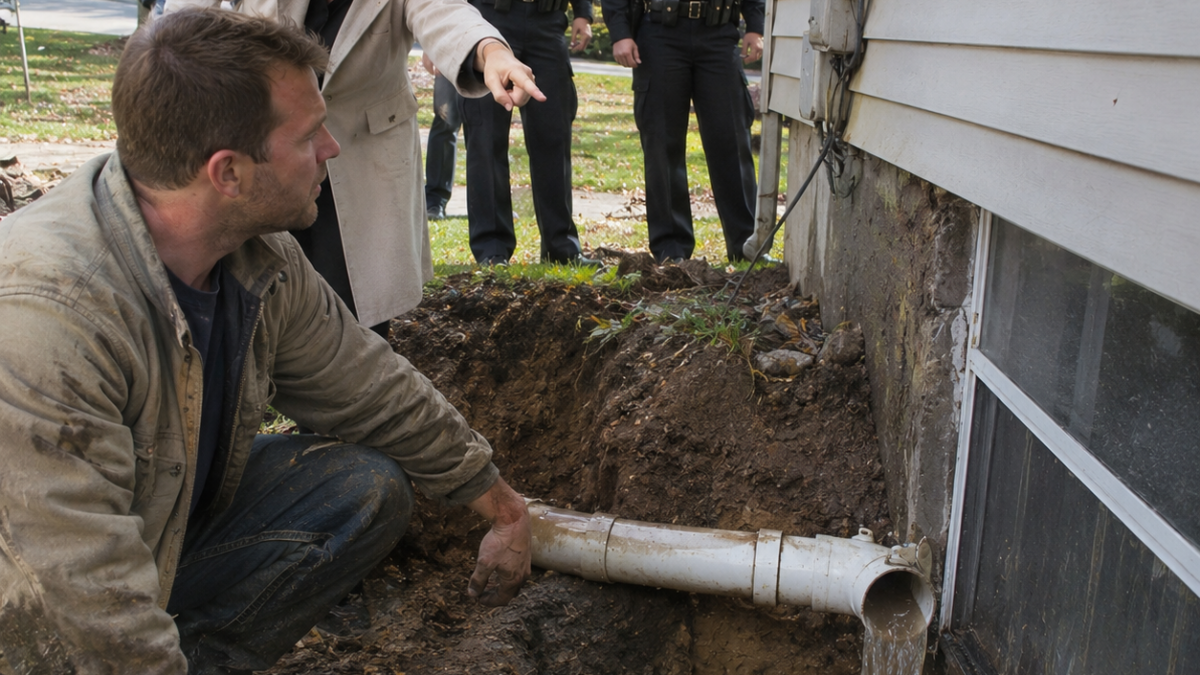
White PVC.
Six-inch Schedule 40.
Buried in gravel.
Running toward my foundation.
I followed it.
Coupling after coupling.
Section after section.
The pipe crossed onto my property.
No easement.
No marker.
No recorded access right.
On the upstream side, it connected to a collection manifold gathering runoff from multiple lots.
I sat beside the trench.
Mud on my knees.
Water dripping from the trees.
My pulse hammered.
Somebody had taken stormwater from three uphill areas and given it one destination.
My basement.
This wasn’t a grading mistake.
It wasn’t careless runoff.
It was engineered.
Then I noticed the purple primer around each coupling.
Whitfield Grading used the same recognizable product on its public job photos.
Again, not enough by itself.
But another piece.
I documented everything.
Pipe diameter.
Depth.
Coordinates.
Direction.
Couplings.
Primer.
Property markers.
Video.
Photographs.
I climbed out of the trench.
Sat on the deck.
Pam’s house stood uphill.
Lights on.
Through the sliding door behind me, Sarah’s photograph rested on the shelf.
Sarah holding newborn Emma.
Laughing.
For months, grief had felt like weight.
Now it became something sharper.
I knew what happened.
Now I needed to prove ownership, trespass, grade modification, and history.
So I called a surveyor.
Jim Paulson.
Thirty-one years in the field.
Gray beard.
Steel-toe boots.
GPS equipment.
Transit level that looked older than Emma.
He spent five hours measuring.
When he finished, he rolled the plat map and said:
“That pipe crosses fourteen feet onto your parcel.”
“No easement?”
“No.”
“Utility right?”
“No.”
“Drainage agreement?”
“No.”
He looked at me.
“Unauthorized encroachment.”
Then he showed me the elevation work.
The Whitfield property’s natural drainage had been altered.
Fill material.
Forty-foot section.
New slope.
Water redirected north toward the illegal pipe.
“How old?”
“Three or four years.”
The Greers.
Walt.
The backhoe.
Everything aligned.
I installed non-invasive flow monitoring.
Rain event after rain event.
Moderate storm.
Hundreds of gallons.
Heavy storm.
Far more.
Same relationship.
Rain uphill.
Pipe flow.
Foundation infiltration.
Basement water.
I documented seventeen events.
Then I called Phil Greer.
Former owner.
He answered on the third ring.
“Hello?”
“Mr. Greer?”
“Yes?”
“My name is Tyler Brooks.”
Silence.
“I own your old Cascade Ridge house.”
Long pause.
“The basement?”
That one question told me everything.
“Yes.”
He sighed.
“It still floods?”
“Yes.”
I took a breath.
“Mr. Greer, when did it start for you?”
“Three years before we sold.”
“Before that?”
“Dry for eleven years.”
“What changed?”
“The Whitfields did something uphill.”
“Backhoe?”
Silence.
“Yes.”
“How much did you spend trying to fix the house?”
“Twenty-two thousand.”
“Did anything work?”
“No.”
His voice became tight.
“We replaced drains.”
Pause.
“Sealed walls.”
Pause.
“Excavated.”
Another pause.
“My wife thought we’d bought a defective house.”
“You didn’t.”
Phil stopped breathing for a second.
“What?”
“I found a pipe.”
Silence.
“Six-inch PVC.”
Nothing.
“Runs from the uphill collection area across my property.”
Still nothing.
“Discharges runoff toward the north foundation.”
Phil finally spoke.
Very quietly.
“We weren’t crazy.”
“No.”
“We lost forty thousand on that house.”
“I know.”
“Lisa cried for a week.”
“I’m sorry.”
“You can prove this?”
“Yes.”
Another long pause.
“What do you need?”
That call changed the case.
Until then, I had been protecting my family.
Now I was looking at harm that started years before I arrived.
The Greers had been flooded.
They spent money.
Failed.
Blamed themselves.
Then sold at a loss.
The pipe remained.
Waiting for the next family.
Mine.
I hired Nora Kessler.
Drainage and water-rights attorney.
Seattle.
Fourteen years.
I sent her everything.
Survey.
Flow data.
Inspection video.
Tracer results.
Phil’s statement.
Pam’s fake fees.
The fake bylaw section.
The law-firm letter citing the nonexistent easement.
Ed Tolman’s inspection.
Pam’s public lies.
Months of documentation.
Seventeen tabs.
Nora called within two hours.
“Tyler?”
“Yes.”
“You may have the cleanest drainage case I’ve seen in years.”
“That good?”
“For you.”
“What do we do?”
“First, tell me what you want.”
I had already decided.
“The pipe removed.”
“Yes.”
“Pam out as president.”
A pause.
“Possible.”
“I want the Greers compensated.”
Another pause.
“And?”
“Everything they cost me.”
“Anything else?”
“I don’t want a quiet settlement where everyone signs confidentiality agreements and Pam tells the neighborhood she won.”
Nora was silent.
Then:
“Then we do this slowly.”
I hated that answer.
But she was right.
“We document.”
“Yes.”
“We preserve.”
“Yes.”
“We stop the damage legally.”
“Yes.”
That night, after Emma went to bed, I opened a clean engineering pad.
I started designing.
Not a retaliatory drain.
Not a secret pipe.
A legal interception system.
The Whitfields’ line was delivering concentrated water to my foundation.
I would capture the water at my boundary and route it through a fully permitted connection into the municipal stormwater system where runoff from that hillside should have gone in the first place.
Simple.
Legal.
Inspectable.
Documented.
I filed every permit.
Stormwater review.
Building approval.
Utility connection.
Eleven days.
Every fee paid.
Every drawing stamped.
Every inspection scheduled.
I wanted Pam to have nothing legitimate to say.
When the system was ready, rain had already begun.
Friday.
4:12 p.m.
I stood beside the control.
Flipped the switch.
The pump hummed.
Water entered the collection basin.
Moved through the discharge line.
Then into the public storm system.
Twenty minutes later, I went downstairs.
Touched the north wall.
Dry.
I stayed there.
Waiting.
Nothing.
No seepage.
No trickle.
No pressure.
For the first time in nine months, rain was falling and Sarah’s basement was dry.
I sat on the bottom stair.
Exactly where I had sat holding her ruined journal.
My eyes burned.
I didn’t cry.
Not yet.
Then physics began telling the rest of the story.
The Whitfields’ unpermitted network had one convenient downstream outlet.
My foundation area.
Now their concentrated runoff was no longer allowed to use my house as a pressure release.
Their system began backing up into the areas it had been designed to drain away from.
First:
A wet patch in Pam’s rose garden.
Then:
Standing water near their retaining wall.
By Sunday morning, after steady rain, their lower terrace was saturated.
Pam’s social media went silent.
For eight months she had posted everything.
Coffee.
Yoga.
Sunsets.
Compliance quotes.
Community reminders.
Now:
Nothing.
Monday evening Garrett appeared at the property line.
Whitfield Grading polo.
Mud-covered boots.
Arms crossed.
I walked outside carrying coffee.
“Garrett.”
“You need to turn that pump off.”
“It’s permitted.”
“You’re flooding my yard.”
“No.”
His jaw tightened.
“Don’t play games.”
“I’m not.”
“You know exactly what you’re doing.”
“I know exactly what my system does.”
I placed the coffee on the railing.
“It intercepts water arriving illegally on my property and routes it into the public storm system.”
Garrett stepped closer.
“You have no idea what you’re playing with.”
I looked at him.
“I found your pipe.”
His face barely moved.
But his eyes did.
“One hundred forty feet.”
Silence.
“Six-inch PVC.”
Nothing.
“Fourteen feet inside my boundary.”
His jaw tightened.
“Surveyed.”
He stared.
“Documented.”
His eyes dropped.
“And my attorney has everything.”
Garrett said nothing.
Turned.
Walked uphill.
That silence was more useful than any argument.
Three nights later, my north-side camera triggered at 2:47 a.m.
A man in dark clothing entered my property.
Flashlight.
Pipe wrench.
Garrett.
He went directly to my permitted discharge system.
Crouched.
Began loosening a coupling.
Then turned toward the camera.
Infrared captured his face.
Clear.
I saved the video.
Local drive.
Cloud.
Nora.
The next morning, she filed a trespass complaint.
Garrett was served with a formal warning at one of his job sites.
In front of his crew.
Pam stayed offline for nine days.
On day ten, she posted a candle.
No words.
I laughed once.
Then closed the app.
The emergency HOA meeting came next.
SPECIAL SESSION — COMMUNITY INFRASTRUCTURE AND COMPLIANCE REVIEW.
Pam wanted the membership to approve a five-thousand-dollar fine against me.
And force removal of my permitted system.
She needed public legitimacy.
I brought my binder.
Thirty-one homeowners attended.
Walt sat beside me.
Old Mariners cap.
Pam sat at the front.
Charcoal blazer.
Cream blouse.
Pearl earrings.
Perfect posture.
Treasurer on one side.
Secretary on the other.
She stood.
“Thank you for coming.”
Then spent six minutes talking about me without using my name.
Unauthorized modifications.
Shared infrastructure.
Community integrity.
Responsibility.
Standards.
She used “responsibility” four times.
Then called for sanctions.
Five thousand dollars.
Mandatory removal.
The room went quiet.
I started to rise.
Cheryl Dawson stood first.
Lot Twenty-Two.
Retired school principal.
Silver hair.
Reading glasses.
“Pam?”
Pam smiled.
“Yes, Cheryl?”
“Before the vote, I have a question.”
“Of course.”
Cheryl adjusted her glasses.
“I want to ask about the pipe.”
Pam’s smile changed.
“Mr. Brooks’s system?”
“No.”
Cheryl’s voice remained calm.
“The buried six-inch PVC pipe crossing Lot Forty-Seven without permit, easement, or owner approval.”
Heads turned.
The treasurer looked at Pam.
Pam said:
“I’m not familiar with what you mean.”
Cheryl nodded.
“I spoke to the county.”
Silence.
“And Inspector Tolman.”
Pam’s fingers tightened.
“He confirmed he found no code violations on Tyler’s property.”
Someone in the third row raised his hand.
Tom Fielding.
“I have a question too.”
Pam’s voice sharpened.
“Yes?”
“You fined me under Article Twelve, Section Four last year.”
He held up papers.
“It doesn’t exist.”
A woman near the aisle:
“Same thing happened to us.”
Another voice:
“Where did those drainage fees go?”
Pam lifted her hands.
“One at a time.”
Another:
“Was that program ever approved?”
Pam’s face flushed.
“The board has discretionary authority—”
Cheryl interrupted.
“That’s not the question.”
Pam stared at her.
Cheryl had spent decades dealing with parents who thought volume was evidence.
She didn’t flinch.
“Where did the money go?”
The treasurer looked down.
Pam changed direction.
“This meeting concerns Lot Forty-Seven.”
Cheryl shook her head.
“No.”
The room went quiet.
“You called a community meeting.”
Her voice was almost gentle.
“So let’s discuss the community.”
The sanction vote failed.
Twenty-three against.
Six in favor.
Two abstentions.
Pam stared at the result.
Then someone in the back said:
“We should vote on her.”
Pam gathered her papers.
Her hands trembled.
For the first time, I saw fear.
She left without another word.
The door closed.
Walt leaned toward me.
“Her kingdom just sprung a leak.”
I almost laughed.
But the real hearing was still coming.
December twelfth.
Snohomish County Administrative Hearing Room B.
Gray carpet.
Fluorescent lights.
Government furniture.
Stale coffee smell.
Nora and I arrived early.
Seventeen-tab binder on the table.
Pam and Garrett entered with an attorney from Henderson, Moore & Callaway.
Pam wore black.
No sunglasses.
No latte.
No phone.
Garrett wore a button-down shirt that looked new.
The hearing officer, Patricia Sung, took her seat.
Mid-fifties.
Controlled.
No-nonsense.
She opened with one sentence that changed the entire tone.
“This hearing concerns an unauthorized stormwater conveyance structure installed on Lot Forty-Seven without permit, easement, or owner consent.”
Across the room, Pam looked down.
Nora began.
Timeline.
First flood.
Second flood.
Directional entry.
Tracer test.
Inspection video.
Certified survey.
Pipe alignment.
Grade alteration.
Rain-event monitoring.
Prior-owner history.
Fake HOA citations.
Nonexistent easement.
County inspection.
She displayed the pipe footage on the monitor.
White PVC.
Purple primer.
Gravel bedding.
The hearing officer watched closely.
Then Ed Tolman testified.
Natural grade:
Southwest.
Observed infiltration:
North.
Permits:
None.
Grading permits:
None.
Violations at my house:
None.
Nora showed him Pam’s message.
INSPECTOR TOLMAN CONFIRMED CODE COMPLIANCE ISSUES AT LOT 47.
“Did you confirm code compliance issues at Lot Forty-Seven?”
“No.”
“Did you tell Mrs. Whitfield there were violations?”
“No.”
“What did you document?”
“Concerns regarding altered drainage uphill.”
Pam’s attorney objected.
Overruled.
Garrett’s jaw tightened.
Then Nora produced the document I hadn’t seen.
Insurance claim.
Eighteen months earlier.
Pam and Garrett.
Water damage to their lower recreation room.
Cause listed:
NATURAL GROUNDWATER INFILTRATION DUE TO SEASONAL PRECIPITATION.
Payment:
$34,000.
Nora placed it in evidence.
“The Whitfields received insurance proceeds for water damage they attributed to groundwater while operating an unpermitted drainage configuration that redirected runoff away from their property and toward Lot Forty-Seven.”
Silence.
Garrett stared at the table.
Pam’s hands locked together.
Nora continued.
“The same system that reduced water pressure at their lower terrace by sending concentrated runoff toward the neighboring foundation.”
Their attorney requested recess.
Denied.
I sat there listening.
And finally understood the whole thing.
Their property had a water problem.
They built a solution.
But instead of paying to connect properly to the public drainage network, they had pushed the water downhill.
Onto the Greers.
Then onto me.
And when I started asking questions, Pam used the HOA like camouflage.
Fake fines.
Fake provisions.
Fake easements.
Fake inspector statements.
It wasn’t random.
It was concealment.
Four days later, the ruling arrived.
The illegal pipe had to be removed.
At the Whitfields’ expense.
The altered grade had to be restored.
The county made formal findings concerning unauthorized redirection of stormwater.
And the insurance claim was referred for investigation.
Eleven days later, Cascade Ridge held a special election.
Pam lost.
Overwhelmingly.
Only Pam and Garrett supported keeping her.
That night, her final social post appeared.
A sunset.
No selfie.
Caption:
EVERY SEASON TEACHES YOU SOMETHING. GRATEFUL FOR GROWTH.
No likes.
No comments.
No shares.
For months, I had archived everything.
That one I didn’t save.
Some things deserve to become evidence.
Others deserve to vanish.
In January, the illegal pipe came out.
County-approved excavation crew.
Three days.
Cold rain.
Mud.
One section at a time.
White PVC slid out of the hillside.
Purple primer still visible.
Twelve couplings.
Collection manifold.
Approximately one hundred forty feet of buried pipe.
I watched from the deck with coffee.
Each section landed on the flatbed with a hollow plastic sound.
For nearly a year, that pipe had controlled my sleep.
My daughter’s fear.
My grief.
My finances.
My attention.
Above ground, it looked almost pathetic.
Just dirty plastic.
Garrett later faced charges connected to the insurance investigation.
The civil case settled in April.
One hundred eighty-five thousand dollars.
Enough to repair my foundation.
Replace damaged materials.
Cover legal fees.
Finish waterproofing.
And compensate part of the Greers’ loss.
Phil received forty thousand dollars.
The exact amount he had lost when he sold the house.
He called me.
For a moment, neither of us spoke.
Then:
“Lisa cried.”
“Good cry?”
“The first good one about that house.”
I sat at the kitchen table.
“She keeps saying we weren’t crazy.”
“You weren’t.”
“We thought we failed.”
“No.”
“We thought we missed something.”
“You didn’t.”
Silence.
“Thank you.”
I looked toward the basement door.
“Take care of each other.”
Pam and Garrett listed their house in May.
The listing described:
Prestigious hillside living.
Cascade views.
Terraced landscaping.
Luxury community.
It did not mention the illegal pipe.
The insurance investigation.
The HOA removal.
The hearing.
They sold at a loss.
I never asked how much.
By then, revenge had started feeling small.
Cheryl Dawson became the new HOA president.
Unopposed.
Her first action was a seven-year audit.
She found eleven thousand dollars in unexplained funds.
Some connected to fake compliance fees.
Some deposited into an account labeled:
COMMUNITY ENHANCEMENT FUND.
Her second action was to abolish the “drainage compliance assessment program.”
Because it had never legally existed.
At her first open meeting, she stood behind the clubhouse table.
“We’re going to do something radical.”
Everyone waited.
“We’re going to follow the actual CC&Rs.”
The room laughed.
Even me.
Part of the settlement repaired the house.
Part went into savings.
Part went somewhere Sarah would have liked.
Sarah loved books.
Even during chemotherapy, she read to Emma.
Some nights she could manage thirty pages.
Others, three.
But she always tried.
So I created the Sarah Brooks Memorial Reading Scholarship at Emma’s school.
Small.
Five hundred dollars.
One student every year.
Books.
Reading program.
Educational supplies.
Whatever helped a child keep loving stories.
The principal asked:
“Plaque?”
“No.”
“Press release?”
“No.”
“Assembly?”
“Only if Emma wants to go.”
“What would Sarah want?”
“Books.”
So we bought books.
I used another part of the settlement to buy professional drainage assessment equipment.
That spring, I offered free evaluations to every homeowner in Cascade Ridge.
Fourteen called.
I crawled under houses.
Checked grade lines.
Ran tests.
Measured runoff.
Three homes had minor drainage problems.
Ordinary ones.
Clogged systems.
Poor downspout placement.
Settling.
I repaired what I could for cost.
Nobody sent me a violation.
Nobody called code enforcement.
Nobody posted inspirational quotes while I lay in mud beneath a deck.
Walt brought beer after I checked his property.
We sat outside.
Fir trees dripping.
He raised his bottle.
“Justice.”
I tapped mine against his.
“Dry basements.”
He smiled.
“Better.”
The thing I cared about most was downstairs.
Sarah’s journal went to a book conservator in Bellingham.
Three weeks.
Page separation.
Ink stabilization.
Binding repair.
When I picked it up, the conservator placed it carefully on a cloth.
“The damage won’t disappear.”
“I know.”
“But it’s readable.”
She opened the first page.
Faded.
Blurred in places.
But still there.
_When you can read this, sweetheart…_
I closed it.
“Thank you.”
Sarah’s scarf was cleaned too.
No mildew.
No sour smell.
Faint cedar.
I rebuilt the basement.
Slowly.
New membrane.
Sealed floor.
Drywall.
Dehumidifier.
Oak shelves.
I sanded every board by hand.
Three coats of polyurethane.
On the highest shelf:
Sarah’s journal.
Beside it:
Her scarf.
One evening, I was tightening the final bracket when Emma appeared at the bottom of the stairs.
Barefoot.
Book against her chest.
She looked around.
Dry walls.
Warm light.
No pumps.
No sandbags.
No fans.
No wet concrete.
Outside, rain tapped the window.
Emma listened.
“Dad?”
“Yeah?”
“Is the water lady gone?”
That almost broke me.
Not HOA president.
Not Pam.
The water lady.
The woman my daughter associated with storms.
“Yes.”
“Forever?”
“As far as we’re concerned.”
“Can the basement flood again?”
“Any house can have problems.”
Her face tightened.
I smiled.
“But nobody is secretly sending water here anymore.”
She looked at the shelf.
“Is that Mom’s journal?”
“Yes.”
“Can I read it?”
Sarah had written it for her.
Not me.
“When you’re ready.”
“I’m ready.”
I took it down.
Held it.
Then placed it in Emma’s hands.
She sat on the rug.
Opened the cover.
Read silently.
I turned away.
After several minutes:
“Dad?”
“Yeah?”
“Mom said you snore.”
I laughed.
“She was lying.”
“She said you make pancakes too thick.”
“That is a matter of opinion.”
“She said if I’m sad I should make you tell me about your first date.”
I froze.
Sarah.
Always planning.
Emma looked up.
“What happened?”
“That is a long story.”
“I have time.”
So I told her.
I was twenty-three.
Restaurant too expensive.
Spilled water.
Forgot what I ordered.
Sarah laughed.
I thought I had ruined everything.
Later, she told me that was when she decided she liked me.
Emma laughed too.
Then went back to the journal.
Outside, rain grew harder.
My body reacted automatically.
Basement wall.
Pump.
Water level.
Check.
I stayed sitting.
Emma noticed.
“You’re listening.”
“To the rain.”
“Are you scared?”
I thought about lying.
Then didn’t.
“A little.”
“Why?”
“Because for a while, rain meant something bad was coming.”
She closed the journal.
Looked around.
“But the basement is dry.”
“Yes.”
“You fixed it.”
“Yes.”
“The water lady is gone.”
“Yes.”
She shrugged.
“So maybe rain can just be rain.”
Nine years old.
And somehow ahead of me.
I put my arm around her.
“Maybe.”
That should have been the end.
But consequences echo.
A few months later Cheryl called.
“I found something.”
“What?”
“Old Whitfield Grading invoices.”
“For HOA work?”
“Yes.”
“Approved?”
“Some.”
“Some?”
“Others have no clear vote.”
I closed my eyes.
“How much?”
“Enough to send to the accountant.”
“Need me?”
“Yes.”
“No.”
She sounded surprised.
“No?”
“I’ll provide my records.”
“But you’re done?”
I looked through the window.
Emma sat on the deck doing homework.
“Yes.”
“Why?”
“Because at some point, winning means returning to your life.”
Cheryl laughed softly.
“That is annoyingly healthy.”
“I’ve had professional help.”
The board handled the rest.
I returned to engineering.
School pickups.
Grocery runs.
Emma’s homework.
Bad pancakes.
Ordinary life.
Neighbors gradually apologized.
The couple who avoided me at the mailboxes came over.
The husband looked miserable.
“We believed Pam.”
“I know.”
“We shouldn’t have.”
“You didn’t know me.”
“That doesn’t make it right.”
“No.”
His wife said:
“We’re sorry.”
I believed them.
“Okay.”
They looked surprised.
“That’s it?”
“What else do you need?”
The husband laughed awkwardly.
“I don’t know.”
“Then okay is enough.”
They became good neighbors.
That mattered too.
Pam had spent years dividing people into:
Compliant.
Difficult.
Useful.
Problematic.
Once she was gone, I didn’t want to keep doing that for her.
Garrett’s legal problems continued.
I did not attend every hearing.
Nora updated me when necessary.
There were financial penalties.
Restitution.
Professional consequences.
I expected satisfaction.
Instead, mostly I felt distance.
The revenge I had imagined was dramatic.
Pam’s rose garden flooding.
Garrett being served at work.
The failed HOA vote.
The county ruling.
The pipe coming out.
But when it was over, the moments that mattered were quieter.
Phil receiving forty thousand dollars.
Emma reading Sarah’s journal.
Sarah’s scarf clean.
The basement dry.
That wasn’t revenge.
That was restoration.
One summer Saturday, Phil and Lisa Greer came to visit.
Lisa stood in the basement doorway.
For almost a minute, she said nothing.
“You changed it.”
“Yes.”
She touched the wall.
“This corner used to have our shop vac.”
Phil laughed.
“We owned three.”
“Four.”
He looked at her.
“Four.”
Lisa’s smile disappeared.
“You know what I hated?”
“What?”
“Every time it rained, I thought I’d failed.”
I understood.
“Failed what?”
“The house.”
Her eyes filled.
“I thought maybe I should’ve inspected better.”
Phil touched her shoulder.
“Maybe I didn’t maintain something.”
She wiped her face.
“Maybe I was stupid.”
“You weren’t.”
“When you called and said there was a pipe…”
She laughed through tears.
“I was furious.”
“I’m sorry.”
“No.”
She looked at me.
“Relieved.”
That surprised me.
“Why?”
“Because it meant I wasn’t imagining it.”
I nodded.
Truth can hurt.
But sometimes the truth heals because it proves the pain had an external cause.
Before leaving, Lisa looked at Sarah’s journal.
“Your wife?”
“Yes.”
“I’m sorry.”
“Thank you.”
She looked around.
“Maybe both our families get the room back.”
That sentence stayed with me.
Get the room back.
The basement had stopped being a room.
It had become a flood.
A problem.
A threat.
A place Emma feared.
Now it was a room again.
That summer, Emma finally created the reading corner Sarah had imagined.
Yellow floor cushions.
Fairy lights.
Bookcase.
Lamp.
She taped a handwritten sign to the wall.
EMMA’S LIBRARY.
Then below it:
NO WATER ALLOWED.
I laughed.
She crossed her arms.
“It’s a rule.”
“HOA rule?”
“Dad.”
“Sorry.”
“No fake rules.”
“Good.”
“Only real ones.”
“What’s the penalty?”
“You buy me books.”
“That sounds corrupt.”
“Pay up.”
I did.
The first Sarah Brooks Memorial Reading Scholarship went to a sixth-grade girl named Maya.
She loved fantasy novels.
Her mother worked two jobs.
The school invited me to the assembly.
I almost declined.
Emma asked to go.
So we sat in the second row.
The principal said Sarah’s name.
My chest tightened.
Then Maya walked onto the stage.
Small.
Nervous.
Book held against her chest.
The principal explained the scholarship honored a mother who believed books could make difficult days feel larger than pain.
Emma took my hand.
I squeezed it.
Maya’s mother cried.
So did I.
Afterward, Maya came over.
“Mr. Brooks?”
“Yes?”
“Thank you.”
“You’re welcome.”
“What was Sarah’s favorite book?”
I thought.
Emma answered first.
“Anne of Green Gables.”
I turned.
“How do you know?”
“Journal.”
Of course.
Maya smiled.
“I’ll read it.”
That night, I sat alone downstairs.
Rain outside.
Sarah’s journal on the shelf.
Scarf beside it.
I thought about 2:17 a.m.
Cold water.
Wedding photographs.
Blue ink bleeding.
I had blamed the house.
That was one of the hardest things to admit.
At my worst, I believed keeping Sarah’s promise had been a mistake.
Maybe grief made me buy the wrong place.
Maybe I dragged Emma into another disaster.
Maybe the house itself had betrayed us.
But the house had been attacked too.
Somebody else had changed the water.
Somebody else had buried the pipe.
That distinction mattered.
Pam believed she was flooding a basement.
She was flooding a family still learning how to live without Sarah.
Every gallon hit grief.
Every fake fine landed on exhaustion.
Every neighborhood lie made Sarah’s dream feel less safe.
That was why I couldn’t walk away.
Not property value.
Not pride.
Sarah had said:
This is our house.
Promise me.
I had promised.
Keeping that promise didn’t mean nothing bad could happen there.
It meant nobody else got to decide the house was no longer ours.
Pam tried.
Through paper.
Pressure.
Fear.
Water.
She failed.
Not because I shouted louder.
Because eventually evidence weighed more than confidence.
That is the weakness of fake authority.
It survives until somebody checks.
A fake rule survives until someone opens the real bylaws.
A fake easement survives until someone searches county records.
A false inspector claim survives until the inspector testifies.
A buried pipe survives until somebody digs.
Pam’s power existed because nobody challenged the documents behind it.
Once we did, there was very little underneath.
Cheryl eventually asked me to speak at an HOA meeting.
I refused.
Twice.
The third time she said:
“Not about Pam.”
“What then?”
“How not to become Pam.”
That convinced me.
The clubhouse filled.
I stood at the same front table where she had tried to fine me.
No suit.
No dramatic presentation.
Just notes.
“An HOA is not automatically bad.”
Walt raised his eyebrows.
“Neither are rules.”
He muttered:
“Debatable.”
People laughed.
I continued.
“The problem starts when responsibility becomes confused with ownership.”
Quiet.
“The board has responsibilities.”
I looked toward Cheryl.
“Common property. Budgets. Maintenance. Rules actually written in the documents.”
Then the room.
“But the board doesn’t own your house.”
Nods.
“The president is not a mayor.”
More nods.
“A violation letter is not a court order.”
Walt whispered loudly:
“Pam would disagree.”
Laughter.
I waited.
“Most importantly, when a homeowner asks where a rule comes from, show them.”
The room quieted again.
“Questions are not disobedience.”
I thought about Pam at the block party.
Nuanced governance language.
“You should want people to read the documents.”
I paused.
“If your authority is legitimate, proof strengthens it.”
Another pause.
“If somebody asking for proof threatens your power, your power is probably the problem.”
Months later, I discovered the board put that sentence in its training handbook.
No name attached.
Good.
I didn’t need one.
Time moved.
Emma turned ten.
Then eleven.
The phrase “water lady” disappeared.
Rain became weather.
The basement became Emma’s favorite room.
She read Sarah’s journal slowly.
Sometimes she asked questions.
“Dad?”
“Yeah?”
“Mom said you wanted to name me Riley.”
“That was a strong name.”
“She said it was terrible.”
“Your mother had questionable judgment.”
“She married you.”
I stared.
She grinned.
Exactly Sarah.
Another night:
“Mom said you cried at the ultrasound.”
“Allergies.”
“It was February.”
“Winter allergies.”
She laughed.
The journal gave Sarah back in fragments.
Not literally.
Nothing does.
But stories restored dimensions cancer had flattened.
Sarah stopped being only the woman who died.
She became the woman who mocked my pancakes.
The woman who loved books.
The woman who hated the name Riley.
The woman who planned a house from a hospital bed.
One entry mentioned Cascade Ridge.
Emma read it aloud.
“If you’re reading this in our Cascade house, look out the kitchen window for me.”
Emma stopped.
Looked at me.
“Did she know we’d get it?”
“She hoped.”
Emma ran upstairs.
I followed.
She stood at the kitchen window.
Mountains.
Fir trees.
Clouds.
“What am I looking for?”
“I don’t know.”
She smiled sadly.
“Maybe nothing.”
“Maybe.”
Then sunlight broke through the clouds.
Nothing supernatural.
Just weather.
Emma whispered:
“Hi, Mom.”
I said nothing.
Years after the case, I saw Pam again.
Grocery store in Everett.
Produce section.
I was holding coffee.
She stood near apples.
Older.
Still well dressed.
No phone.
No crowd.
No board.
We recognized each other.
I had imagined this moment.
You flooded Sarah’s journal.
You scared my daughter.
You lied.
You hurt the Greers.
You lost.
Standing there, none of it mattered.
Pam looked away.
I kept walking.
That was all.
I paid.
Drove home.
Halfway back to Cascade Ridge, I realized my hands had not shaken.
My heart hadn’t raced.
I didn’t need to defeat her again.
That was how I knew her power was finally gone.
The Whitfield house was eventually bought by a young couple with two sons.
At a barbecue, the husband approached me nervously.
“We heard about the drainage system.”
“I assumed.”
“We had inspections.”
“Good.”
“County restoration looks solid.”
“It is.”
He hesitated.
“Would you mind looking at the grade sometime?”
I laughed.
“Sure.”
I checked.
Normal.
No illegal pipe.
No hidden manifold.
Their rose garden grew.
Children left bikes near the retaining wall.
The hill stopped feeling hostile.
That mattered.
Land isn’t guilty.
Neither is a neighborhood forever.
Walt eventually moved to Arizona.
Bad knees.
Wanted one story.
Before leaving, he brought a six-pack.
We sat on the deck.
Same place he told me about the backhoe.
“You staying?”
“Yes.”
“Good.”
“You’re really moving somewhere with no rain?”
“Exactly.”
“You’ll complain about the heat.”
“I complain professionally.”
Then he handed me his Mariners cap.
“No.”
“Take it.”
“Why?”
“You’ll need old-man credibility.”
“I’m younger than you.”
“Temporarily.”
I kept it.
Cheryl served three years.
Then stepped down voluntarily.
That alone proved the HOA had changed.
Her replacement, Luis, had three children and a habit of opening the CC&Rs before answering any question.
At his first meeting, somebody asked about fence rules.
Luis opened the book.
Read the provision aloud.
Explained the amendment process.
Suggested a vote.
I texted Walt.
You wouldn’t recognize this place.
He replied:
BORING?
I wrote:
EXTREMELY.
His answer:
JUSTICE.
Sarah’s scholarship grew.
Five hundred became a thousand.
Then two thousand after a bookstore contributed.
Every year, one child received help with books or education.
No giant foundation.
No press.
Just Sarah.
The drainage equipment I bought kept getting used too.
Neighbors.
Friends.
Friends of friends.
Most problems were normal.
Downspouts.
Clogs.
Settling.
One man called convinced his neighbor was secretly flooding his garage.
I inspected.
“No.”
He looked disappointed.
“What is it?”
“Your gutter.”
“My gutter?”
“It contains approximately one forest.”
He laughed.
We cleaned it.
Problem solved.
That taught me something too.
Pam trained me to look for intent.
Engineering reminded me to check physics first.
Not every bad drainage situation has a villain.
Sometimes leaves are just leaves.
When Emma was fourteen, she came downstairs while I was organizing tools.
Sarah’s scarf was still on the upper shelf.
Emma took it down.
“Can I wear this?”
I froze.
Not because I didn’t want her to.
Because for years, Sarah’s things had become museum pieces.
Preserve.
Protect.
Don’t touch.
“What?”
“Can I wear Mom’s scarf?”
“Of course.”
She wrapped it around her neck.
Looked in the mirror.
“She wore this?”
“All the time.”
“It smells like cedar.”
“Better than mildew.”
Emma looked at me.
“You okay?”
“Yes.”
She narrowed her eyes.
“No.”
I laughed.
“Maybe not.”
She stepped closer.
“Dad.”
“Yeah?”
“It won’t disappear because I wear it.”
Fourteen.
Still ahead of me.
“I know.”
“No, you don’t.”
Fair.
She wore it to school.
It came home.
Eventually, it stopped living permanently on the shelf.
Sarah’s journal moved to Emma’s bedroom too.
I noticed one day.
Said nothing.
Grief was changing.
Objects were becoming objects again.
Not relics.
That mattered.
The flood had nearly destroyed Sarah’s belongings physically.
My fear of losing them almost trapped them emotionally.
Emma saved them twice.
Years later, I opened the evidence binder.
Seventeen tabs.
Fake fee.
Fake Article 12 Section 4.
Fake drainage easement.
Screenshots.
Survey.
Tracer results.
Pipe footage.
Meeting vote.
County ruling.
At the back:
Photo of Sarah’s journal after the first flood.
Swollen.
Ink bleeding.
I stared.
Then looked toward the shelf.
Empty.
Because Emma had the journal upstairs.
For years, that photograph meant what Pam did to us.
Now it meant:
What survived.
I closed the binder.
Put it into a cabinet.
Not destroyed.
Evidence matters.
But I no longer needed it in sight.
One winter night, a major storm rolled through.
Wind.
Heavy rain.
Alerts.
The kind of storm that once would have kept me awake all night.
At 2:14 a.m., I opened my eyes.
Rain hammered the roof.
Old instinct.
Basement.
I sat up.
Listened.
Nothing.
No pump alarms.
No trickle.
I went downstairs anyway.
Habit.
The basement was warm.
Dry.
Emma’s reading lights off.
Books lined the shelves.
Blanket on the couch.
No water.
I stood in the center of the room.
Closed my eyes.
Rain above.
Nothing behind the concrete.
Footsteps.
Emma appeared.
Older now.
Sleepy.
“Dad?”
“Sorry.”
“Checking?”
I smiled.
“A little.”
She looked around.
“Dry.”
“Dry.”
She sat.
I sat beside her.
We listened.
Then she leaned against my shoulder.
“Dad?”
“Yeah?”
“Rain can just be rain.”
I remembered.
I laughed softly.
“Yes.”
It finally could.
People still describe the story as:
I reversed Pam’s pipe and flooded her yard.
That is not exactly what happened.
I did not pump water onto Pam’s property.
I never sabotaged her home.
I never buried a retaliatory line.
I did something simpler.
I stopped allowing their illegal drainage network to use my basement as its outlet.
I captured incoming water legally.
Routed it to the public system.
Protected my house.
Their own design then failed upstream because it no longer had a neighbor’s foundation to sacrifice.
There is a difference.
Revenge would have been pointing a pipe toward Pam’s basement.
I didn’t.
I protected mine.
Then let physics expose hers.
That was better.
Pam spent months claiming I was irresponsible.
Fined me under fake rules.
Used a fake easement.
Misrepresented an inspector.
Turned neighbors away.
Garrett trespassed at night.
Through all of it, they depended on one thing.
That I would get tired first.
The Greers had.
Not because they were weak.
Because they lacked information.
That distinction mattered.
I had engineering training.
Records knowledge.
Enough money to hire a surveyor.
A lawyer.
Time to document.
They hadn’t.
That was why Phil’s settlement mattered.
Forty thousand dollars could not return three years.
It could not give Lisa back every storm she spent blaming herself.
But it said:
You were right.
Someone did this.
Sometimes the legal system can’t restore time.
It can only balance a piece of the ledger.
Pam once said compliance was caring.
She was wrong.
Control is not care.
Fear is not harmony.
Uniformity is not community.
Community is Walt showing up with beer because something doesn’t smell right.
Cheryl standing up because a question deserves an answer.
Phil telling the truth years later.
Neighbors apologizing.
A new HOA president opening the rulebook instead of inventing rules.
A child hearing rain without fear.
That is community.
Years later, the north wall looks normal.
Grass grew back.
Trench disappeared.
The permitted drainage system is mostly invisible.
The Whitfield property looks normal too.
New family.
New roses.
Kids.
No sign of the old system.
That feels right.
Not every wound needs a monument.
Some should heal.
Sarah’s scholarship is the only public thing I wanted to last.
Her name.
Not Pam’s.
Not Garrett’s.
Sarah’s.
One spring, another student received it.
A boy named Lucas.
He loved history.
After the ceremony he asked:
“Who was Sarah Brooks?”
Emma answered.
“My mom.”
Lucas looked surprised.
“She started the scholarship?”
Emma smiled.
“Sort of.”
He looked at me.
“What did she do?”
I thought.
Sarah had been so many things.
Mother.
Reader.
Wife.
Woman who found houses on Zillow while dying.
Woman who made promises sound like plans.
“She loved stories.”
Lucas smiled.
“Me too.”
“That’s why you’re here.”
Driving home, Emma stared out the window.
Then:
“Dad?”
“Yeah?”
“I like that people know Mom because of books.”
“So do I.”
“Not cancer.”
I tightened my hands on the wheel.
“So do I.”
That might have been the biggest victory.
For years, cancer had been the last word in Sarah’s story.
Chemo.
Hospital.
Funeral.
But Sarah was not the way she died.
The scholarship gave her another ending.
Books.
Kids.
Possibility.
The house did too.
She chose it.
Barely lived there.
But changed what it became.
Every time Emma sat in the basement reading corner, Sarah’s plan existed.
Every dry storm kept my promise.
I found the original Zillow screenshot one day.
Sarah had circled the kitchen window.
Typed:
LOOK AT THAT VIEW!!!
Three exclamation points.
I printed it.
Framed it.
Put it in the kitchen.
Years later, when Emma prepared for college, we packed boxes downstairs.
Cardboard boxes.
On the floor.
I stared at them.
“Put those on shelves.”
Emma looked at me.
“Dad.”
“Just in case.”
“Drainage is fine.”
“I know.”
“Foundation is sealed.”
“I know.”
“Forecast is clear.”
“I know.”
“You’re impossible.”
“Genetics.”
“Mom’s journal says she was normal.”
“That journal contains propaganda.”
She laughed.
Then lifted the boxes anyway.
For me.
That night, I stood in the doorway.
College clothes.
Books.
Sarah’s scarf on one suitcase.
I remembered Emma at nine.
Barefoot.
Is the water lady gone?
Now she was leaving.
Voluntarily.
Toward a life.
That is what homes are supposed to do.
Protect people until they are ready to go.
Not chase them out.
Not exhaust them.
Not make them afraid.
Sarah knew that.
Pam never did.
After Emma left, the house became too quiet.
I spent more time in the basement.
Read some of her books.
One rainy afternoon, I finally read Sarah’s journal from beginning to end.
Emma had already read it.
She told me I could.
The last entry was written weeks before Sarah died.
Handwriting weak.
Still clear.
She wrote about Emma.
About Cascade Ridge.
About me.
Then one line stopped me.
_I hope Tyler doesn’t confuse keeping us with keeping everything exactly the same._
I read it three times.
Then laughed while crying.
Even dead, Sarah was correcting me.
She knew me.
I had spent years preserving.
Objects.
Rooms.
Pain.
Promises.
But the cabin—our house—was supposed to change.
Emma was supposed to grow.
Scarves were supposed to be worn.
Basements repaired.
Books moved.
Grief transformed.
That night, I changed the reading corner.
New rug.
New chair.
Different lamp.
For ten minutes, it felt wrong.
Then it felt alive.
I sent Emma a photo.
She replied:
FINALLY.
Then:
MOM WOULD APPROVE.
She was right.
People ask whether I enjoyed watching Pam lose.
Yes.
At first.
When the first water appeared near her roses?
Yes.
When the sanction vote failed?
Yes.
When forty-five votes removed her?
Yes.
When the pipe came out?
Absolutely.
I’m human.
But those moments faded.
The thing that stayed was peace.
That is where revenge stories usually end too early.
They end with the bully defeated.
Court order.
Removal.
Charge.
Bank account.
Humiliation.
The real ending happens later.
When you sleep through the storm.
When your daughter uses the room again.
When the journal is readable.
When the former owner gets his money back.
When you see the person who hurt you at the grocery store and realize your body no longer reacts.
When the story stops controlling the weather inside your head.
That took years.
But it happened.
Ten years after Sarah first showed me the Zillow listing from her hospital bed, I stood at the kitchen window.
Cascade foothills.
Fir trees.
Rain moving across the valley.
The exact view she had circled.
I made coffee.
No violation letters on the counter.
No binder open.
No attorney calling.
No pump alarms.
Just home.
I touched the frame around Sarah’s screenshot.
“This is our house, Tyler.”
Her voice still lived there.
Not:
This is your battle.
Not:
Never let anything change.
Our house.
Meaning:
A place where life keeps going.
Emma called that evening.
“How’s the rain?”
“Ordinary.”
“Basement?”
“Dry.”
“Are you checking every ten minutes?”
“Absolutely not.”
“Dad.”
“Maybe every thirty.”
She laughed.
“Progress.”
“Thank you.”
“Scholarship check sent?”
“Yes.”
“Signed?”
“Yes.”
“Correct envelope?”
“Your confidence is inspiring.”
“I know you.”
She did.
After the call, I went downstairs.
Oak.
Books.
Warm light.
Walt’s Mariners cap on one shelf.
Sarah and Emma’s photograph on another.
Evidence binder closed inside the cabinet.
I didn’t open it.
Outside, rain kept falling.
No trickle.
No pressure.
No hidden pipe.
Just water on glass.
I remembered one of Pam’s earliest remarks after I confronted her near the property line.
“Your basement flooded? That’s not my problem.”
She had laughed.
Told me people like us didn’t belong in neighborhoods like hers.
Told me to stop blaming others.
Threatened me if I touched anything near the line.
She believed she understood the ending.
Widower.
Young daughter.
Flooding house.
HOA pressure.
Fake fines.
Legal threats.
Exhaustion.
Maybe I’d sell.
Maybe someone connected to the Whitfields would buy cheap.
Maybe the pipe would remain.
Waiting for another family.
But buried things eventually surface.
Pipes.
Lies.
Records.
Grief.
Pressure always finds an outlet.
Pam chose mine.
I followed it backward.
Not by becoming crueler.
By becoming more precise.
Survey.
Data.
Witnesses.
Permits.
Documents.
Truth.
She sent water downhill believing gravity was on her side.
I followed the water to the source.
Then I let the law follow it too.
And when it ended, I didn’t need her apology.
I never got one.
I didn’t need Garrett’s.
I didn’t need every neighbor to admit they had believed the wrong person.
I needed my daughter safe.
My house dry.
Sarah’s things restored.
The Greers heard.
The pipe gone.
Everything else was noise.
I turned off the basement light.
Walked upstairs.
Before closing the door, I looked back.
Dry floor.
Oak shelves.
Warm room.
A place Emma once feared.
A place Sarah had imagined before she died.
A place that survived someone else’s attempt to make us leave.
Then I closed the door.
In the kitchen, rain tapped softly against the window.
I made coffee.
Stood in front of Sarah’s view.
And watched water travel down the hill exactly where it was supposed to go.
For the first time in years, I didn’t think about Pam.
I thought about Sarah.
And that was how I knew I had finally won.








