PART 2: HOA Karen Ripped Off the Solar Panels Keeping My Wife Alive—Then Her Own Board Saw the $340,000 Bill
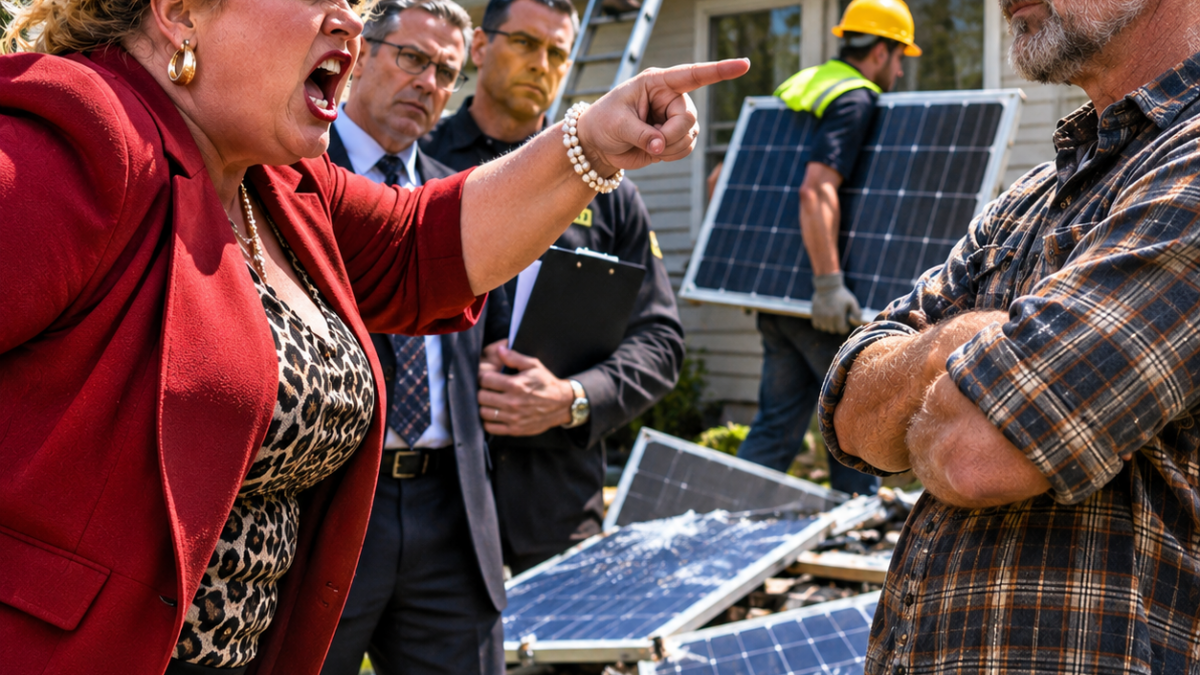
PART 2
Deputy Miller arrived about thirty minutes later.
He was young—young enough that for a second I wondered whether he had recently graduated from the academy—but his expression told me he had already handled enough neighborhood disputes to hate the sight of an HOA clipboard.
He parked beside my farmhouse and stepped out.
Karen appeared almost immediately.
I wasn’t surprised.
She must have been watching from her house.
She hurried across the road carrying the same clipboard, suddenly looking less like someone who had ordered the destruction and more like someone preparing to report a dangerous neighbor.
“Thank goodness you’re here, officer,” she said before Miller had even reached the barn. “This homeowner has been extremely hostile since we were forced to correct an unauthorized alteration.”
I looked at the deputy.
“Before she says anything else, I’d like you to see the property.”
I walked him around the barn.
From the ground, the damage looked bad.
From directly underneath the roofline, it looked worse.
The removal crew hadn’t carefully disconnected the system.
They had attacked it.
Several pieces of racking had been pried away instead of unbolted. Wiring had been cut. Metal roof panels were scratched deeply enough that I could see bare material beneath the protective coating.
“What was up there?” Miller asked.
“A thirty-kilowatt solar array.”
“Value?”
“Installation was over a hundred thousand dollars. I don’t know the total replacement cost yet.”
Karen stepped closer.
“It was unapproved.”
Miller turned toward her.
“Ma’am, did you hire the people who removed this equipment?”
“Yes.”
She said it without hesitation.
“As president of the homeowners association.”
I almost couldn’t believe my luck.
She was giving him the admission herself.
“Did the homeowner give you permission to enter the property?”
“He didn’t need to. The property is subject to our covenants.”
“That’s not an answer,” I said.
Karen glared at me.
Miller raised one hand.
“Sir, let me handle it.”
Then he looked back at her.
“Did the association issue a written order?”
“Of course.”
“Do you have it?”
Karen opened the clipboard.
For the next minute, she flipped through highlighted copies of HOA rules.
No order appeared.
No certified notice.
No hearing record.
No board authorization.
Eventually she pulled out a printout of an email I had sent months earlier when I submitted the solar project.
“This proves he knew approval was required.”
“It proves I submitted the plans,” I said.
Miller looked at me.
“Did they approve them?”
“They never rejected them.”
Karen made a disgusted noise.
“That is not the same thing.”
“Under your bylaws, it is.”
I knew the provision nearly word for word.
“Applications not formally rejected within ninety days are deemed approved. They had my application for more than ninety days.”
Miller’s face showed exactly what I feared.
Uncertainty.
Not uncertainty about what had happened.
That was obvious.
Uncertainty about whether he wanted to be the person who decided what it legally meant.
Finally he sighed.
“This sounds like it may be a civil matter.”
Karen’s mouth curled into a small smile.
I stared at him.
“A civil matter?”
“Sir—”
“If I walked across that road tomorrow, hired a crew and ripped the garage door off her house because I didn’t like the color, would you call it a civil matter?”
“That’s different.”
“Why?”
“Because there’s an HOA agreement involved here.”
“So a contract gives someone immunity from vandalism?”
“I’m not saying that.”
“Then what are you saying?”
He shifted his weight.
“I’m saying she’s claiming authority under the association’s governing documents. A court may need to determine whether that authority existed.”
I could feel anger climbing through my chest, but I kept my voice controlled.
“You’re looking at more than one hundred thousand dollars in intentionally destroyed property.”
“I understand.”
“No, Deputy. I don’t think you do.”
Karen interrupted.
“He’s being melodramatic. We were enforcing community standards.”
I turned toward her.
“My wife’s medical equipment depends on the backup power system you just damaged.”
For the first time, she hesitated.
Not with guilt.
With annoyance.
As though Sarah’s health were an inconvenient fact complicating her victory.
“The association is not responsible for personal medical arrangements.”
That sentence erased whatever tiny doubt I still had about how far I was prepared to take this.
Miller gave me an incident number.
He promised to document Karen’s admission in his report.
But he wasn’t arresting anyone.
Not that day.
After his cruiser disappeared, Karen walked back toward her house.
She looked satisfied.
She believed the badge leaving my driveway without her in handcuffs meant she had been proven right.
That was her mistake.
She thought authority came from making other people back down.
I knew authority also came from paper.
Evidence.
Procedure.
Money.
Insurance.
Contracts.
Recorded statements.
And people who were finally tired of being afraid.
I spent the next four hours documenting the scene.
I photographed the roof with a telephoto lens.
I used my small drone to record the entire damaged array from above.
I photographed the contractor’s tire tracks.
I even found a discarded coffee cup near the barn carrying the roofing company’s logo.
Then I called Tom, the solar installer who had designed the system with me.
He answered cheerfully.
“Jack, how’s the new array treating you?”
“Not well.”
Something in my voice made him stop.
“What happened?”
“I’m sending you pictures.”
I forwarded them.
For almost a minute, he said nothing.
Then:
“What the hell am I looking at?”
“The HOA president hired a contractor to remove it.”
“Remove it?”
“That’s what she calls it.”
“Jack, they didn’t remove this.”
His voice became sharper.
“They destroyed it.”
“I know.”
“No, I mean—look at the microinverter connections. Those were cut. The mounting hardware is bent. They pried against the roof.”
“Can it be repaired?”
There was another silence.
“Not properly.”
I closed my eyes.
“Give me the number.”
“I need to inspect it.”
“Come tomorrow.”
He did.
By nine the next morning, Tom was standing beside me looking at the roof through binoculars.
After twenty minutes, he lowered them.
“You’re going to hate this.”
“Try me.”
“The panels are gone. Obviously. Most of the racking can’t be reused. Several microinverters are destroyed. Wiring has been cut too short to certify a repair.”
He pointed upward.
“But the biggest problem isn’t the solar equipment.”
“The roof.”
“Exactly.”
My barn had received a standing-seam Galvalume roof only the previous year.
It was built to last decades.
The removal crew had gouged several full-length metal sheets.
“You can’t just dab sealant on those scratches and call it good,” Tom said. “They compromised the protective layer. Water gets in, corrosion starts, eventually you’ve got problems all the way down.”
“So replace the damaged sheets.”
“That’s what I’d recommend.”
“Do it.”
He looked at me.
“Jack, this is going to get expensive.”
“Good.”
He frowned.
“Good?”
“I want the real cost, Tom. Every penny. I don’t want favors. I don’t want discounts that make their mistake look smaller than it was.”
Understanding slowly appeared on his face.
“Insurance.”
“Among other things.”
I told him what I needed.
Full replacement of the destroyed solar system.
Replacement of every damaged roof panel.
Labor.
Disposal.
Permits.
Rush charges.
Temporary power expenses.
Lost generation.
Battery degradation.
Project management.
Anything directly attributable to what Karen had ordered.
“I want it itemized.”
Tom exhaled.
“All right.”
“And I need it on company letterhead.”
“You planning to sue?”
“I’m planning to make sure everyone understands what she actually did.”
That evening his estimate arrived.
I opened it at the kitchen table.
Sarah sat across from me.
The first number was bad enough.
Complete solar and roof replacement:
**$215,000.**
The second assessment calculated consequential losses.
Diesel for continuous generator operation.
Reduced battery life.
Lost electricity production.
Temporary backup arrangements.
Engineering and project management.
Additional costs caused by an estimated six-month disruption.
**$125,000.**
Total:
**$340,000.**
Sarah stared at the screen.
“Three hundred and forty thousand dollars?”
“That’s the documented estimate.”
She looked pale.
Not because we intended to pay it.
Because the number made what had happened feel real.
Karen hadn’t knocked over a fence.
She hadn’t sent an irritating fine.
She had created a financial catastrophe.
Sarah reached for my hand.
“What happens if they refuse?”
“Then we make them answer for it.”
She studied me.
Sarah had worked as a paralegal before her health forced her to stop.
She knew that expression.
“You’ve switched into campaign mode.”
“I’ve switched into documentation mode.”
“Same thing with you.”
Despite everything, I almost smiled.
Then she looked toward the room where her equipment hummed.
The generator outside had already kicked on twice that day.
“Jack…”
I squeezed her hand.
“I know.”
That was the part Karen would never understand.
The money mattered.
But the money wasn’t why I was angry.
I had built that system because I had spent too much of my life in places where control could disappear in an instant.
Power.
Water.
Communication.
Safety.
I wanted Sarah to live somewhere none of those things depended on luck.
The solar project wasn’t some vanity improvement.
It was peace of mind turned into steel, glass, batteries, and wire.
And Karen had ripped it apart because she didn’t like how it looked from a road she barely used.
That night Sarah and I began reading the HOA documents.
Every page.
Every amendment.
Every ugly legal paragraph.
Karen had spent years throwing sections and subsections at homeowners because she knew most people would never read the complete document.
We did.
On the second night Sarah stopped me.
“Go back.”
I looked up.
“What?”
“Page seventy-eight.”
I turned back.
She tapped a paragraph.
“Read that.”
The section described enforcement.
Not Karen’s summary of enforcement.
Not her interpretation.
The actual procedure.
First, written notice by certified mail.
Then at least thirty days for the homeowner to correct the problem or request a hearing.
If a hearing was requested, it had to be held before the board.
After that, the board could vote on penalties.
Then came the paragraph that changed the case.
Any enforcement action involving the physical alteration or removal of private property required approval by a majority of the board at a properly called meeting.
After that vote, the homeowner had to receive a final fourteen-day notice.
I read it again.
Then a third time.
Sarah leaned back.
“She did none of this.”
“No certified notice.”
“No hearing.”
“No board vote.”
“No fourteen-day notice.”
I looked at her.
“Nothing.”
Sarah’s eyes sharpened.
“Then her entire defense is the bylaws, and the bylaws are the thing that proves she had no authority.”
Exactly.
Karen had walked onto my land carrying a shield made of paper.
We had just discovered the paper had a hole straight through the middle.
The next question was whether the other four directors knew what she had done.
I doubted it.
Karen enjoyed power too much to share it.
So I didn’t contact her.
I contacted Marcus Thorne, the HOA treasurer.
My email was deliberately boring.
No threats.
No anger.
No mention of lawsuits.
I simply invoked the records-access provision and requested minutes from the previous three board meetings along with the resolution authorizing the expenditure and action used to remove property from my barn.
If there had been a vote, he could provide it.
If there hadn’t been one, he would have to start asking questions.
The next morning he responded.
“Mr. Garrison, I am looking into the matter.”
That told me everything.
If a resolution had existed, he would have attached it.
He didn’t.
Karen had acted alone.
Now I needed to know whether what she’d done to me was an isolated escalation or part of a broader pattern.
So I started walking the neighborhood.
Not campaigning.
Listening.
The first person I visited was Dave Kowalski, a retired Air Force pilot.
He was cleaning his truck when I approached.
He recognized me.
“You’re the guy with the farm.”
“That’s me.”
He set down the cloth in his hand.
“Heard Karen came after you.”
“She had my solar array torn off the barn.”
Dave stared.
“You’re kidding.”
“No.”
“She actually sent people onto your property?”
“Yes.”
“Without you there?”
“Yes.”
He shook his head.
“That woman has lost her mind.”
Then he laughed without humor.
“Although I guess we already knew that.”
“What did she do to you?”
Dave leaned against the truck.
“Five hundred dollars because my trash can could be seen from the road.”
“For how long?”
“About two hours.”
I thought he was joking.
He wasn’t.
“My son put up a basketball hoop,” he continued. “She said the finish was the wrong shade. We repainted it. Then apparently the brown we used was too dark. Painted it again.”
“What happened?”
“I got tired of fighting. Took it down.”
There it was.
Karen’s real source of power.
Not the bylaws.
Exhaustion.
People worked.
Raised children.
Cared for parents.
Paid mortgages.
They didn’t have time to study 150 pages of covenants because someone didn’t like a basketball hoop.
So they paid.
Complied.
Stayed quiet.
Karen interpreted their exhaustion as obedience.
“Would you be willing to document what happened?” I asked.
Dave straightened.
“What are you doing, Jack?”
“I’m building a record.”
“To sue her?”
“To stop her.”
He looked at me for several seconds.
Then he held out his hand.
“What do you need?”
Dave sent me to Mrs. Gable.
She was an elderly widow with a beautiful rose garden.
When I arrived, she was kneeling beside an azalea.
I noticed a painted garden gnome tucked almost completely behind it.
Dave had mentioned the gnomes.
I introduced myself.
When I said Karen’s name, her face changed.
“That woman.”
“What happened?”
Mrs. Gable pointed toward the hidden decoration.
“My husband gave me that one.”
The gnome held a tiny fishing rod.
“George loved fishing. He bought it almost thirty years ago.”
She swallowed.
“Karen said garden figurines lowered neighborhood standards.”
“So you hid it?”
“I move it when I know she’s coming.”
The sentence hit me harder than I expected.
A woman in her own home was hiding a gift from her dead husband because an HOA president might see it.
“Mrs. Gable, I’m challenging her.”
Her eyes lifted.
“What do you mean?”
I explained what had happened at the barn.
Her hand flew to her mouth.
“She destroyed all of it?”
“Yes.”
“Why?”
“Because she believed nobody would stop her.”
Mrs. Gable looked toward her hidden gnome.
Then back at me.
“Maybe somebody should.”
She wrote a statement.
So did the Miller family.
Karen had forced them to replace a swing set because it was pine instead of cedar.
After they replaced it, she complained it sat six inches too close to the property line.
They moved it.
Then she rejected the canopy color.
Eventually they sold the swing set rather than keep fighting.
Their six-year-old daughter still asked when it was coming back.
By the end of two days, I had five signed statements.
Different houses.
Different violations.
Same pattern.
Arbitrary rules.
Inconsistent enforcement.
Constant intimidation.
One homeowner at a time, Karen had taught the neighborhood that resistance cost more than surrender.
That changed when she reached my barn.
Five days after the destruction, I drove downtown to meet Eleanor Albright.
I’d researched property attorneys until nearly two in the morning.
Her firm wasn’t the biggest.
I didn’t want the biggest.
I wanted the one other lawyers didn’t enjoy seeing on the opposite side.
Her office overlooked the city from the twentieth floor.
When I entered, she pointed at a chair.
“Mr. Garrison. You have thirty minutes.”
No small talk.
Perfect.
I opened my binder.
“Five days ago, the president of my HOA hired a private contractor to enter my property and destroy a permitted solar installation.”
I placed the first photograph on her desk.
“Original value exceeded one hundred thousand dollars.”
Second photograph.
“Contractor damaged the standing-seam roof during removal.”
Third document.
“Professional replacement and consequential-loss estimate: three hundred forty thousand dollars.”
Fourth.
“Video admission from the HOA president.”
Fifth.
“CC&R enforcement section showing no physical removal can occur without certified notices, hearing rights, board authorization, and final notice.”
Sixth.
“Evidence none of those procedures occurred.”
Then I placed the witness statements on top.
“And these?”
“Other homeowners describing a pattern of arbitrary enforcement.”
Albright didn’t answer.
She read.
For almost ten minutes, the only sound in the room was paper turning.
Then she watched the video.
Karen appeared on the tablet.
Smug.
Certain.
Proud.
Albright played it twice.
When she finally looked at me, her expression had changed.
“Did she seriously admit this on camera?”
“Yes.”
“Did the board vote?”
“According to the treasurer, he is ‘looking into it.'”
She almost smiled.
“Meaning no.”
“That’s my interpretation.”
“It’s mine too.”
She leaned back.
“Your HOA president didn’t merely make a bad decision. If your documents are complete, she ignored the association’s mandatory enforcement process and caused substantial property damage while acting under color of an authority she did not possess.”
“So we sue?”
“Oh, we’re going to do more than file a complaint and hope somebody gets nervous.”
She tapped the $340,000 estimate.
“We notify their insurer immediately.”
“Why?”
“Because insurance companies dislike unauthorized intentional conduct even more than homeowners do.”
Then she picked up the witness statements.
“And these create another problem.”
“For Karen?”
“For everybody.”
She explained.
The board had a fiduciary obligation to act in the association’s interests.
If Karen had knowingly bypassed the governing documents and exposed the HOA to hundreds of thousands of dollars in liability, then the other directors had a decision to make.
Stand beside her.
Or protect themselves.
“Your advantage,” Albright said, “is that they probably don’t know what she did.”
“That’s what I think.”
“Then we make sure they know.”
Her retainer was ten thousand dollars.
I wrote the check.
Three days later, five certified letters landed in five different mailboxes.
One for Karen.
One for Marcus.
One for the vice president.
One for the secretary.
One for the member at large.
Each letter laid out the same facts.
The trespass.
The destruction.
The missing authorization.
The damaged roof.
The lost power generation.
The consequential expenses.
And the demand:
**$340,000.**
Not including legal fees.
The letters also warned that if resolution wasn’t reached, litigation could name both the HOA and individual directors where legally appropriate.
Another package went to the association’s insurance carrier.
That package contained everything.
Photos.
Video.
Bylaws.
Estimates.
Witness statements.
Karen’s pattern of behavior.
We also filed the appropriate state complaint regarding the association’s governance practices.
Then we waited.
It didn’t take long.
Marcus emailed me first.
His previous message had been cautious.
This one was different.
“Mr. Garrison, I have received extremely concerning legal correspondence. I was not aware that any physical removal had occurred without board authorization. The board did not vote to approve the action at your property. Please call me as soon as possible.”
I forwarded it to Albright.
Her response came almost immediately.
“Do not call.”
I wanted to.
Part of me wanted to hear his explanation.
But she was right.
This wasn’t a misunderstanding anymore.
Our attorney would communicate with them.
That same afternoon, a beige sedan parked outside my property.
A man in a suit spent nearly an hour photographing the barn from the road.
Then he drove to Karen’s house.
Insurance adjuster.
The next call came from Dave.
“You’ve set off a bomb.”
“What happened?”
“Karen’s telling everyone you’re trying to bankrupt the neighborhood.”
“Of course she is.”
“She says the lawsuit could force a special assessment.”
“Maybe she should have thought about that before destroying somebody’s property.”
“She’s called an emergency community meeting.”
“When?”
“Tuesday night.”
“Purpose?”
“According to the email, ‘community solidarity regarding pending litigation.'”
I laughed.
Dave paused.
“Why does that sound like you’re happy?”
“Because she wants an audience.”
“That’s good?”
“It is when you have evidence.”
There was a silence.
“Jack?”
“Yes?”
“The auditorium has a projector.”
I smiled.
“Even better.”
Sarah and I spent the weekend building the simplest presentation I had ever made.
No dramatic graphics.
No insults.
No accusations we couldn’t prove.
Slide one:
A drone photo of the solar array before Karen’s crew arrived.
Clean.
Straight.
Professional.
Slide two:
The same roof afterward.
Destroyed panels.
Twisted racking.
Cut wires.
Slide three:
The itemized $340,000 assessment.
Slide four:
The HOA enforcement procedure.
Certified notice.
Thirty-day cure period.
Hearing.
Board vote.
Final notice.
Slide five contained one question.
**DID THE BOARD AUTHORIZE THIS?**
Slide six was the video.
Sarah watched the finished presentation from the kitchen table.
“Don’t argue with her,” she said.
“I won’t.”
“She’s going to provoke you.”
“I know.”
“She’s going to make this personal.”
“I know.”
She reached across the table and put her hand over mine.
“Then don’t give her what she wants.”
I nodded.
The Tuesday-night meeting was packed.
At least 150 homeowners filled the high school auditorium.
Karen sat at the center of the stage.
The rest of the board sat beside her.
Marcus looked sick.
I sat three rows back with Dave and Tom Miller.
Mrs. Gable sat behind us.
The meeting started at seven.
Karen walked to the microphone.
“Thank you for coming.”
Her voice was calm.
Polished.
Practiced.
“There has been a great deal of misinformation circulating regarding recent enforcement activity and a threatened lawsuit against our community.”
For the next ten minutes, she told her story.
I had built an industrial eyesore.
I had refused to cooperate.
I believed rules didn’t apply to me.
She had tried repeatedly to resolve the matter.
Then she said it.
“After multiple warnings and a formal stop-work order were ignored, the association was forced to remedy the violation.”
I felt Dave move beside me.
I whispered:
“Wait.”
Karen continued.
“Unfortunately, Mr. Garrison has now chosen to punish every family in this neighborhood by demanding an outrageous three hundred forty thousand dollars.”
The crowd stirred.
That number frightened them.
Exactly as she intended.
“If this frivolous demand succeeds,” she said, “every homeowner may face a substantial special assessment.”
People turned toward me.
I could see the suspicion forming.
Karen felt it too.
Her confidence grew.
“This is not about solar panels,” she said. “This is about whether one homeowner is more important than the entire community.”
I stood.
“That isn’t true.”
Her face snapped toward me.
“Mr. Garrison, you are out of order.”
“You just accused me publicly of ignoring a stop-work order.”
“This is not a debate.”
“Then produce the order.”
Her expression tightened.
“Sit down.”
“Show everybody the letter.”
“You will sit down or you will be removed.”
Dave stood beside me.
“He has a right to answer.”
Karen pointed toward him.
“You are also out of order.”
Tom Miller stood.
“Let him speak.”
Then another homeowner stood.
And another.
Within seconds, people throughout the auditorium were calling:
“Let him answer!”
“Give him the microphone!”
“Let’s hear both sides!”
Karen tried to regain control.
Marcus leaned toward her and whispered something.
She turned on him so sharply that even from the third row I could see the fury in her face.
Finally she returned to the microphone.
“Two minutes.”
I walked toward the stage carrying my laptop.
“I won’t need long.”
An AV student helped connect the presentation.
Karen saw the screen light up behind her.
“What is this?”
“The facts.”
The first photograph filled the auditorium wall.
My solar array before the destruction.
People began whispering.
“This was my barn before October fifth.”
I clicked.
The wreckage appeared.
The room went quiet.
“This was my barn a few hours later.”
Someone behind me said:
“Jesus.”
I clicked again.
The estimate appeared.
“The current professional estimate to replace the destroyed system, repair the roof, and cover documented consequential losses is three hundred forty thousand dollars.”
Karen jumped in.
“Because he deliberately selected the most expensive—”
I raised my hand.
“I’m not asking anyone to take my word for anything.”
That stopped her.
I clicked again.
The enforcement section appeared.
“Mrs. Miller has repeatedly told you that the HOA followed its rules.”
I pointed toward the screen.
“These are the rules.”
I read them.
Certified notice.
Thirty days.
Hearing rights.
Formal board authorization.
Fourteen-day final notice before physical action.
Then I turned toward Marcus.
“Mr. Thorne, you’re the treasurer.”
He looked as though he wanted the floor to open beneath him.
“Was there a board meeting where the directors voted to authorize removal of my solar equipment?”
Karen turned toward him.
He didn’t answer.
I repeated the question.
“Was there a vote?”
His shoulders fell.
“No.”
The word barely reached the microphone.
The auditorium erupted in murmurs.
I continued.
“Are there minutes showing authorization?”
“No.”
“Did you personally know she had hired a contractor to remove my equipment?”
Marcus looked at Karen.
Then at the crowd.
“No.”
That was the moment everything changed.
People weren’t looking at me anymore.
They were looking at Karen.
She sprang from her chair.
“This is completely misleading! The president has independent enforcement authority—”
“Then show us the rule,” someone shouted.
Another voice:
“Where’s the stop-work order?”
Someone else:
“You said the board approved it!”
Karen raised her voice.
“I said the board supported enforcement!”
Marcus shook his head.
“We did not authorize this.”
She spun on him.
“Marcus, you need to be very careful right now.”
That sentence was almost as damaging as the video.
The entire room heard it for what it was.
A threat.
I turned back toward the screen.
“There’s one more thing.”
The final slide loaded.
Karen’s face appeared twenty feet tall behind her.
Then the recording played.
Her own voice filled the auditorium.
“Maybe this will teach you not to ignore a stop-work order, Mr. Garrison. Some of us actually care about property values.”
The clip continued long enough to capture her admission that she had ordered the removal.
Then it stopped.
Silence.
Not whispering.
Not coughing.
Nothing.
Karen stood below an enormous frozen image of her own face.
Five seconds passed.
Maybe six.
Then a man near the back shouted:
“Resign!”
Another person repeated it.
“Resign!”
A third joined.
Then twenty.
Then fifty.
Within seconds, the auditorium was shaking with one word.
“RESIGN!”
“RESIGN!”
“RESIGN!”
Karen stood at the microphone.
Her face had gone crimson.
“This meeting is adjourned!”
Nobody cared.
“RESIGN!”
She struck the gavel.
“Meeting adjourned!”
“RESIGN!”
Then she grabbed her papers and walked off the stage.
The remaining directors didn’t follow her.
That was when I knew it was over.
Not the lawsuit.
Not the money.
Karen’s power.
That part was finished.
The next morning, Marcus called.
This time, after clearing it with Albright, I answered with Sarah listening.
“Jack,” he said.
No “Mr. Garrison.”
Just Jack.
“We didn’t know.”
I said nothing.
“Karen told us you were refusing to cooperate. She said everything had been handled through normal enforcement procedures.”
“Did you ever ask?”
Marcus hesitated.
That was the answer.
“I should have.”
“Yes.”
“We all should have.”
“Yes.”
His voice dropped.
“The insurance carrier contacted us.”
I waited.
“They’ve issued a reservation-of-rights notice.”
That mattered.
A lot.
The insurer was willing to defend the claim for the moment but was reserving the ability to deny coverage if Karen’s actions fell under exclusions for intentional or unauthorized conduct.
“How much does the association have in reserves?” I asked.
Another pause.
“A little over one hundred thousand.”
“So you can’t pay the claim from reserves.”
“No.”
“And if insurance denies coverage?”
“We’d need financing or an assessment.”
“How large?”
“We’re estimating several thousand dollars per household.”
His voice cracked.
“The community would destroy us.”
“No, Marcus.”
I kept my voice flat.
“Karen’s decision created the liability. Your board’s failure to supervise her allowed it.”
“I understand.”
“Do you?”
“Yes.”
He sounded exhausted.
“We’re holding an emergency executive session tonight.”
“Without Karen?”
“She was notified, but the other four directors are united.”
“About what?”
“Removing her as president.”
I glanced at Sarah.
She didn’t smile.
Neither did I.
“That’s your board’s decision.”
“We want to settle.”
“Then call my attorney.”
“Jack, please.”
The desperation in his voice almost made me feel sorry for him.
Almost.
“We’re prepared to remove her. We’re prepared to acknowledge she acted without authorization. We want this resolved.”
I thought about my barn.
About Sarah listening to the generator start in the middle of the night.
About Mrs. Gable hiding George’s gnome.
About the Miller children asking why their swing set had disappeared.
Then I gave him the only answer that mattered.
“Talk to Ms. Albright.”
The settlement negotiations lasted several days.
Our demands were straightforward.
The HOA would pay the full documented amount of **$340,000**, subject to final settlement terms.
It would cover agreed legal expenses.
The board would formally acknowledge that Karen’s unilateral removal had not been properly authorized.
The community would receive an accurate explanation.
And Karen would no longer hold power over the association.
The new board also agreed to reform the architectural enforcement process.
The old committee—the mechanism Karen had used for years to obsess over paint colors, decorations, playground equipment, and every harmless expression of individuality—would be dismantled and replaced by a far narrower system focused on genuine safety, structural, and legally enforceable covenant issues.
That night, the directors met.
Dave stood outside the clubhouse with several neighbors.
Later he told me they could hear Karen shouting through the walls.
She apparently accused Marcus of betrayal.
Then she accused the secretary.
Then the vice president.
Then the entire neighborhood.
She insisted nobody could remove her.
She threatened lawsuits.
She threatened recall petitions.
At one point she reportedly tried to push through the meeting room door after being asked to leave.
It didn’t matter.
The vote was unanimous.
Karen Miller was removed from the presidency.
Her authority was gone.
The next afternoon, Albright received the signed resolution and settlement documents.
When she called me, I was repairing a fence.
“It’s done.”
I rested one hand on the fence post.
“Everything?”
“Executed.”
“The full amount?”
“Yes.”
I looked toward the barn.
For weeks I had imagined that moment.
I thought I would feel triumph.
Instead, I felt tired.
“Jack?”
“I’m here.”
“Congratulations.”
“Thanks.”
“You won.”
I looked through the kitchen window.
Sarah was sitting inside reading.
Her medical equipment was running beside her.
“No,” I said quietly.
“We’re getting our life back.”
Karen’s problems didn’t end with losing the presidency.
The HOA now faced a significant financial obligation because of something she had done without board approval.
The new directors had to decide whether homeowners should absorb all of that cost or whether they should pursue the person whose conduct had created it.
Under pressure from residents, they pursued Karen personally to recover as much of the association’s loss as legally possible.
There was something almost poetic about it.
For years, Karen had used the threat of HOA enforcement to frighten people into submission.
Now she received certified letters.
Legal notices.
Deadlines.
Demand after demand.
The machinery she loved suddenly felt very different when she was standing on the other side of it.
A few weeks later, a FOR SALE sign appeared outside her house.
I didn’t celebrate.
I didn’t take a picture.
I didn’t send it to Dave.
One afternoon I was checking the mailbox when a moving truck pulled into Karen’s driveway.
Workers carried boxes out.
Furniture.
Lamps.
Framed pictures.
The artifacts of an ordinary life that had somehow become wrapped around an extraordinary need for control.
Karen came outside wearing gray sweatpants and a sweatshirt.
No clipboard.
No folder.
No HOA badge.
For a second we looked at each other across the road.
I wondered if she would say something.
Apologize.
Blame me.
Threaten me.
Anything.
She didn’t.
Neither did I.
I didn’t want an apology forced by defeat.
I didn’t need the last word.
She looked away first and climbed into her car.
That was the last time I saw Karen Miller.
The neighborhood changed almost immediately.
It was strange how quickly fear disappeared once people realized the person they feared no longer had authority.
Mrs. Gable brought her gnomes back.
Not one or two.
All of them.
The first time I walked past afterward, there must have been fifteen scattered through the rose garden.
Fishing gnomes.
Sleeping gnomes.
One pushing a tiny wheelbarrow.
George’s gnome stood right in the center.
Mrs. Gable saw me looking.
“What do you think?” she called.
“I think George would approve.”
She smiled.
“I think so too.”
The Miller family bought another swing set.
This time it had a bright green canopy.
Nobody asked permission.
Their kids were outside before the assembly instructions had even been thrown away.
I could hear them laughing from the sidewalk.
Dave became vice president on the reorganized board.
The irony was not lost on either of us.
“Never thought I’d join an HOA board,” he told me.
“Never thought I’d hire a lawyer because somebody hated solar panels.”
“Life’s funny.”
“Sometimes.”
Marcus stayed on as treasurer.
At first, I wasn’t sure how I felt about that.
He had failed.
There was no polite way to describe it.
Karen’s power had grown partly because the other directors had allowed her to make decisions without meaningful oversight.
But Marcus didn’t pretend otherwise.
At the next community meeting, he stood in front of the residents without a table or raised platform between them.
“I failed in my duty,” he said.
The room went quiet.
“I allowed the presidency to operate with more independence than our governing documents intended. I accepted representations without verifying them. And our community is paying for that failure.”
Nobody enjoys admitting that publicly.
Marcus did.
He explained the financial plan.
The HOA would use available reserves plus financing to satisfy its obligations without hitting every homeowner with the catastrophic one-time assessment they had feared.
There would be a temporary dues increase.
But far smaller than the original worst-case scenario.
Meanwhile, the association would continue pursuing recovery from Karen, and anything recovered would be used to repay the financing and rebuild reserves.
A few people complained.
Most didn’t.
Because for the first time in years, somebody was speaking to them like adults.
No threats.
No intimidation.
No invented emergencies over trash cans and paint colors.
Just facts.
Months later, Karen settled the association’s claim.
The sale of her house reportedly covered a substantial part of what the HOA sought from her.
It didn’t erase every cost.
Real life rarely ends that neatly.
But it shifted a meaningful portion of the burden back toward the person whose decision had created it.
By then, I was focused on something else.
Rebuilding.
Tom’s crew arrived early on a Monday.
They started with the roof.
Every damaged standing-seam panel was removed carefully.
Underneath, the old barn timbers were still solid.
That mattered to me more than I expected.
The barn had stood for nearly a century.
Storms had hit it.
Wind.
Rain.
Heat.
Cold.
People had changed.
Owners had changed.
The land around it had gone from open countryside to suburban streets.
And still those beams remained.
The crew installed new Galvalume panels one by one.
Perfectly straight.
Perfectly sealed.
Then the new racking arrived.
Heavier than the old system.
Rated for extreme wind.
The replacement solar panels were newer, more efficient models.
Black on black.
Sleek.
Clean.
Tom climbed down from the roof one afternoon and stood beside me.
“Want to see something?”
He opened the monitoring application on his phone.
The first string had just gone live.
Numbers started climbing.
Five kilowatts.
Nine.
Fourteen.
Eighteen.
“That’s only part of the array,” he said.
I watched the graph.
It felt ridiculous to be emotional over a line on a screen.
But I was.
Every watt represented something Karen had tried to take from us.
Not money.
Security.
The ability to sleep during a thunderstorm without wondering whether the grid would fail.
The ability for Sarah to sit in our home without hearing me test the generator every few hours.
The ability to look at my own barn and know nobody else controlled it.
By the end of the week, the entire new array was operational.
Tom walked through the final inspection with me.
Roof.
Racking.
Inverters.
Disconnects.
Battery interface.
Monitoring.
Everything.
When we reached the last page, he handed me the paperwork.
“She’s better than before.”
I looked up at the roof.
He was right.
The new panels seemed to belong there.
“You know,” Tom said, “most people would’ve taken the check and installed something cheaper.”
“I didn’t want cheaper.”
“I noticed.”
“I wanted the system I should’ve had if nobody had touched it.”
He nodded.
“Then that’s what you got.”
That evening I shut down the generator.
For months it had been a constant presence.
A low mechanical rumble.
Diesel fumes.
Maintenance.
Fuel deliveries.
Noise.
I switched it off.
Silence settled over the farm.
Real silence.
I stood there longer than necessary.
Sarah found me outside.
“Is something wrong?”
“No.”
I listened.
“That’s the point.”
She understood immediately.
The next evening we sat on the back porch.
Autumn had arrived.
The fields beyond the barn were turning gold beneath the setting sun.
The new array reflected the last light of the day.
Inside, Sarah’s equipment ran quietly from stored solar power.
No generator.
No fumes.
No uncertainty.
She reached over and took my hand.
“You brought it back.”
I looked at her.
“What?”
“The peace.”
For a while I didn’t answer.
My entire adult life had taught me to identify threats.
Assess terrain.
Build redundancy.
Plan for failure.
Anticipate what other people might do.
I thought retirement would mean leaving that part of myself behind.
Then a woman with a clipboard had walked onto my land and reminded me that conflict doesn’t always arrive wearing a uniform.
Sometimes it arrives carrying bylaws.
Sometimes it calls destruction “enforcement.”
Sometimes it believes nobody will resist because nobody has resisted before.
I had fought Karen using everything she believed belonged exclusively to her.
Rules.
Documentation.
Procedure.
Meetings.
Letters.
Authority.
The difference was that I had actually followed them.
And in the end, the most important victory wasn’t the settlement.
It wasn’t watching Karen lose the presidency.
It wasn’t seeing a moving truck outside her house.
It wasn’t even the $340,000.
The victory was Mrs. Gable no longer hiding a gift from her dead husband.
It was the Miller children playing in their own backyard.
It was Dave helping run a board that finally understood the difference between protecting a neighborhood and controlling one.
It was Marcus standing in front of his neighbors and admitting he had failed them.
It was Sarah sitting beside me without the roar of a diesel generator outside.
It was my barn roof whole again.
The batteries full.
The lights on.
The house quiet.
Sarah squeezed my hand.
“You did it.”
I shook my head.
“We did.”
Above the barn, the last edge of sunlight disappeared.
The panels stopped producing for the day.
The batteries took over without hesitation.
Inside our farmhouse, every light remained steady.
So did the soft hum of the equipment Sarah depended on.
There was no dramatic sound.
No cheering.
No courtroom gavel.
No angry HOA president.
Just power flowing exactly where it was supposed to go.
Quietly.
Reliably.
Ours.
Karen had believed power meant having the authority to tell other people what they could do.
She was wrong.
Real power was knowing your rights.
Keeping records.
Standing your ground.
And refusing to let someone else’s arrogance convince you that resistance was impossible.
She tore the solar panels off my barn because she thought I would look at the damage, look at the HOA letterhead, look at her title, and surrender.
Instead, I looked at the wreckage and started taking pictures.
That decision cost her the presidency.
It exposed years of abuse.
It forced an entire board to change.
And it turned a six-figure act of destruction into a **$340,000 lesson** Oak Ridge Estates would never forget.
But when I think back on everything that happened, that’s still not the image I remember most.
I remember Sarah beside me on the porch.
I remember the sunset behind the restored barn.
I remember her medical equipment humming softly inside.
And I remember realizing that after months of lawyers, meetings, insurance adjusters, contractors, accusations, and fear, I could finally hear the crickets again.
That was what I had wanted when we bought the last ten acres at the edge of Oak Ridge.
Not revenge.
Not control.
Not victory.
Just peace.
And this time, nobody with a clipboard was ever going to take it from us again.
The first thing I noticed wasn’t the broken glass.
It was the silence.
For months, whenever I stepped outside the farmhouse in the middle of the day, I could hear a faint electrical hum coming from the inverter mounted inside the barn. It was barely noticeable unless you knew to listen for it, but to me it had become part of the farm—the same way the wind through the maples, the creak of the old barn doors, and the distant rattle of my well pump had become part of the place.
That morning, the hum was gone.
In its place came the sound of a white work van rolling away down my gravel driveway.
I stopped beside the pasture fence and stared at the barn.
For a moment, my mind refused to understand what I was seeing.
Yesterday, thirty kilowatts of agricultural-grade solar panels had covered the south-facing half of that roof in clean, dark rows.
Now the roof looked like someone had attacked it with construction equipment.
Several aluminum rails stuck upward at crooked angles.
Electrical cables had been cut and left hanging.
Pieces of shattered photovoltaic glass lay in the grass.
Some of the mounting brackets were still attached to the standing-seam roof, but others had been ripped free hard enough to leave deep gouges behind.
I started walking faster.
By the time I reached the barn, I was almost running.
Then I saw Karen.
She stood near the corner of the building wearing a floral blouse, tan pants, and the smug expression I’d learned to associate with every HOA violation notice that had appeared in somebody’s mailbox since she’d become president.
Her clipboard was tucked under one arm.
She looked at the roof.
Then at me.
A satisfied smile appeared.
“That’ll teach you to ignore a stop-work order, Mr. Garrison.”
I stopped.
My boots sank slightly into the damp ground.
“What?”
She tilted her head.
“I said maybe next time you’ll think twice before ignoring official HOA instructions.”
I looked back at the roof.
Something inside me went cold.
Twenty years in the Marine Corps had taught me a lot about anger.
Anger could be useful.
It could keep you moving when you were exhausted.
It could sharpen your attention.
But uncontrolled anger was stupid.
It made people rush.
It made them miss details.
It made them say things they couldn’t take back.
So I didn’t yell.
I didn’t threaten her.
I didn’t even move toward her.
I looked at the damage.
I breathed.
Then I asked, “Where is the stop-work order?”
Karen gave a small laugh.
“It was properly posted.”
“Where?”
“The community bulletin board.”
I slowly turned toward her.
“The bulletin board beside the pool?”
“Yes.”
“The pool that’s almost a mile from my property?”
“All homeowners are responsible for reviewing official community notices.”
“Karen.”
My voice was quiet.
“I submitted the complete solar project to the architectural review committee months ago.”
“And it was never approved.”
“It was never denied.”
“That does not mean approval.”
“According to your own bylaws, it does.”
Her smile tightened.
I had read those bylaws more carefully than she realized.
An architectural application that wasn’t formally rejected within ninety days was automatically considered approved.
My application had sat unanswered for longer than that.
I had followed up twice.
No denial.
No hearing.
No written objection.
Nothing.
I had county permits.
Electrical permits.
Engineering approval.
Everything.
Karen had known that.
“You did this?” I asked.
“I enforced the rules.”
“No.”
I pointed toward the roof.
“Did you personally hire the crew that did that?”
Her expression changed.
Only slightly.
But I noticed.
“What difference does that make?”
“A lot.”
She squared her shoulders.
“The association has the authority to remedy violations.”
“That isn’t what I asked.”
I pulled out my phone.
She looked at it.
“What are you doing?”
“Making a record.”
Her eyes narrowed.
I started recording.
“Did you hire the contractor who entered my property and removed those solar panels?”
Karen stepped backward.
“I am not participating in your little performance.”
“Then I’ll document that.”
“You are the person in violation here.”
“I’ll document that too.”
Her irritation overcame her caution.
“The architectural review committee found your industrial solar installation inconsistent with the aesthetic character of Oak Ridge Estates. You ignored our authority. I had the violation corrected.”
There it was.
Not a complete confession.
But enough.
I kept recording.
“So you authorized the removal.”
“I authorized enforcement.”
“Without telling me.”
“You were notified.”
“Without a letter.”
“The bulletin board constitutes notice.”
“Without a hearing.”
“You had months to cooperate.”
“Without a board vote.”
That one landed.
Her eyes flicked away.
I noticed.
“Was there a board vote, Karen?”
“I don’t have to explain internal board procedures to you.”
“I think eventually you will.”
She scoffed.
“You always do this.”
“Do what?”
“Act as though the rules don’t apply to you.”
I actually laughed.
Not because anything was funny.
Because the accusation was so absurd.
“I spent six months making sure every rule did apply.”
“You built this monstrosity anyway.”
“My barn is on agricultural property.”
“Inside Oak Ridge Estates.”
“Grandfathered agricultural property.”
“Still subject to covenants.”
“Not every covenant.”
Her face flushed.
“You veterans always think—”
She stopped.
I stared at her.
“Go ahead.”
Karen looked away.
“Never mind.”
“No. Finish the sentence.”
She didn’t.
Instead, she adjusted the clipboard beneath her arm.
“You’ll receive an invoice.”
I thought I’d misheard.
“For what?”
“For today’s removal.”
I stared at her.
She continued, apparently mistaking my silence for weakness.
“The association shouldn’t have to absorb contractor expenses caused by your refusal to comply.”
“You’re billing me?”
“Yes.”
“For destroying my property.”
“For correcting a violation.”
“How much?”
“I don’t know yet.”
She glanced at the clipboard.
“And there will also be a two-thousand-dollar fine.”
I looked at the destroyed roof.
Then back at her.
The solar system had cost me more than one hundred thousand dollars.
But that wasn’t what hit me hardest.
Inside the farmhouse, my wife Sarah’s medical equipment depended on reliable electricity.
Our grid service wasn’t reliable.
Every thunderstorm, every ice event, every windstorm brought the possibility of an outage.
The entire solar installation had been designed around redundancy.
Solar.
Battery storage.
Grid connection.
Generator backup.
If one failed, another took over.
Karen knew that because I had included the information in my architectural submission.
I had written that the system supported critical medical equipment.
She had read it.
Or at least she’d had access to it.
And she’d ordered workers to destroy the system anyway.
“Did you tell the crew there were live electrical components?”
I asked.
Her forehead creased.
“They’re professionals.”
“Did you tell them the system included battery backup?”
“They handled the roof.”
“Did you tell them this power system supports medical equipment?”
Karen gave an impatient sigh.
“Your personal arrangements are not the association’s responsibility.”
That sentence stayed with me.
More than the insults.
More than the fine.
More than the ruined roof.
Your personal arrangements are not the association’s responsibility.
I put my phone away.
“Okay.”
She blinked.
“Okay?”
“Yes.”
Apparently she’d expected an argument.
“Good. I’m glad you’re finally being reasonable.”
I looked at her.
“You should go home.”
Her smile returned.
“That’s probably best.”
She walked away across my pasture.
I watched her go.
Then I turned toward the barn.
For thirty seconds, maybe longer, I just stood there.
I could feel the rage in me.
But it wasn’t hot anymore.
It had become something heavier.
More controlled.
More useful.
I called Sarah first.
She answered from inside the house.
“Where are you?”
“By the barn.”
“Is something wrong?”
I hesitated.
“Don’t come outside yet.”
That frightened her immediately.
“Jack?”
“I’m okay.”
“What happened?”
“The solar array is down.”
There was silence.
“What do you mean down?”
“Karen had it removed.”
Another silence.
Then, “She what?”
“I’m calling the sheriff.”
“Jack…”
“I know.”
“What about the batteries?”
“They still have charge. Generator is available.”
“My equipment?”
“Fine.”
“Are you sure?”
“Yes.”
I’d already checked the monitoring application on my phone.
The solar input was gone.
Battery reserve sat at seventy-eight percent.
The house remained on grid power for the moment.
If the grid failed, the generator would automatically engage.
Sarah exhaled.
“Okay.”
“I need you to stay inside.”
“Because you’re worried about me?”
“Because I’m about to spend the next few hours documenting this and I don’t want you standing out here getting upset.”
“I’m already upset.”
“I know.”
“Are you?”
I looked at the roof.
“Yes.”
“How upset?”
“Very.”
“That’s not what I asked.”
Sarah knew me too well.
“I’m controlled.”
“That’s what worries me.”
Despite everything, I smiled.
“I’ll be inside soon.”
I called the sheriff’s department.
Deputy Miller arrived about thirty minutes later.
His cruiser came slowly down the gravel drive, suspension bouncing over the ruts.
I met him near the barn.
He looked young.
Not inexperienced exactly.
Just young enough that I immediately suspected he’d rather be dealing with almost anything besides an HOA dispute.
“Mr. Garrison?”
“Yes.”
“I’m Deputy Miller.”
We shook hands.
“I understand you’re reporting property damage.”
I pointed.
His head tilted upward.
“That’s substantial.”
“Yesterday there was a complete solar array on that roof.”
“And today?”
“HOA president hired people to remove it.”
As though summoned by the words, Karen appeared near the driveway.
I almost laughed.
She had obviously been watching from her house across the road.
“Officer!”
She hurried toward us.
“Thank goodness.”
Miller looked between us.
Karen immediately began talking.
“This gentleman has been extremely confrontational since the association was forced to remedy an unauthorized construction project.”
Miller lifted one hand.
“Ma’am, one person at a time.”
“He’ll give you a completely distorted version.”
“I said one person at a time.”
That surprised her.
Miller turned toward me.
“Can you walk me through it?”
I did.
I showed him the cut cables.
The bent rails.
The scratches in the roof.
The damaged junction equipment.
Then I played part of my video recording.
Karen’s voice came clearly through the phone.
“I authorized enforcement.”
Miller looked at her.
“Ma’am, did you contract with the company that removed this system?”
Karen folded her arms.
“As president of the association.”
“That wasn’t my question.”
She hesitated.
“Yes.”
“Did Mr. Garrison authorize access to the property?”
“He didn’t need to.”
Miller looked at me.
I shook my head.
“I gave nobody permission.”
Karen opened her clipboard.
“He’s subject to binding covenants.”
She pulled out several pages.
Miller accepted them.
Most were highlighted sections from the HOA rules.
He read silently.
I watched his face.
This was the moment I had feared.
Not because the evidence was weak.
Because HOA disputes have a way of making authorities retreat into the phrase civil matter.
Miller eventually asked, “Was a stop-work order issued?”
“Yes,” Karen said.
“Can I see it?”
She flipped through her pages.
“The notice was posted publicly.”
“I asked whether you have the actual order.”
“It was announced in accordance with our procedures.”
“Do you have a copy?”
She kept flipping.
Nothing.
I said, “Because there isn’t one.”
Karen snapped, “You were aware the project was under review.”
“I was aware you’d failed to make a decision within ninety days.”
Miller looked at me.
“What does that mean?”
“Our covenants state applications not rejected within ninety days are deemed approved.”
Karen shook her head.
“He’s twisting the language.”
“I have the bylaws in the house.”
Miller sighed.
He looked back at the roof.
“Any idea on value?”
“Original installation was over a hundred thousand.”
His eyebrows rose.
“And the roof damage could push replacement much higher.”
Karen interrupted.
“He’s exaggerating.”
I stared at her.
“You don’t know what these components cost.”
“I know what a solar panel costs.”
“No. You know what you think a solar panel costs.”
Miller stepped between the conversation before it became an argument.
“Here’s the issue.”
I knew what was coming.
“There’s an association asserting contractual enforcement authority.”
“And?”
“And that makes the criminal side complicated.”
“How?”
“If she reasonably believed she had authority under the agreement—”
“Deputy.”
I kept my voice calm.
“If I reasonably believe her garage door violates my personal aesthetic standards and I hire three men to rip it off tomorrow, am I protected because I believed I had authority?”
“That’s not the same.”
“Why?”
“You’re not acting for an HOA.”
“So being HOA president changes criminal law?”
“I’m not saying that.”
“Then explain what you are saying.”
Miller looked uncomfortable.
“I’m saying a prosecutor may look at this and determine the dispute belongs in civil court because the underlying question is whether the association had contractual authority.”
“She had no authority.”
“That’s what you believe.”
“No.”
I pointed toward Karen’s clipboard.
“That’s what the written procedure says.”
Karen laughed.
“See? This is exactly what I mean. He thinks he’s a lawyer.”
I turned toward Miller.
“Write down that she admitted hiring the contractor.”
“I will.”
“Write down that she cannot produce the alleged stop-work order.”
“I’ll note it.”
“Write down that I am alleging trespass and intentional destruction of property exceeding one hundred thousand dollars.”
“I can document your complaint.”
“Good.”
Miller eventually gave me an incident number.
He didn’t arrest Karen.
I hadn’t realistically expected him to.
But watching his cruiser leave still felt like a failure.
Karen stood at the end of my driveway.
Her expression said she’d won.
“Maybe now you’ll listen.”
I looked at her.
“No.”
“What?”
“Nothing.”
She walked away.
I waited until she reached the asphalt before turning toward the barn.
Then I began working.
Evidence first.
I photographed every panel fragment.
Every damaged roof seam.
Every tool mark.
Every cut conductor.
Every remaining bracket.
I took wide shots.
Medium shots.
Close-ups.
I used measuring tape beside several scratches so scale would be obvious.
I photographed the muddy tire tracks left by the contractor.
Near the barn door I found a paper coffee cup carrying the logo of a local roofing company.
I photographed that too.
Then I flew my drone.
From above, the damage looked worse.
The array hadn’t been carefully dismantled.
It had been butchered.
Rows of mounting points were irregular.
Some remained intact.
Others were torn.
I recorded the entire roof in 4K.
Then I backed up the footage.
Laptop.
External drive.
Cloud storage.
Thumb drive.
Sarah came into the kitchen while I was copying the files.
She looked pale.
“Can I see?”
“You don’t need to.”
“Jack.”
I turned the laptop around.
She watched the drone video.
Her fingers tightened around the back of the chair.
“She did all that?”
“Yes.”
“How long?”
“What?”
“How long were they here?”
“I don’t know.”
“You didn’t hear them?”
“I was down by the lower field fixing the irrigation line.”
She looked toward the window.
“That means they were here while I was inside.”
I hadn’t thought about that.
The realization hit me like a physical blow.
Workers had crossed our land.
Climbed onto our barn.
Cut power equipment.
And Sarah had been inside the farmhouse alone.
“Did anybody come to the door?” I asked.
“No.”
“Did you see anyone?”
“No.”
“Did the dogs bark?”
“They bark at the delivery driver. I thought it was something like that.”
I closed my eyes.
Sarah put a hand on my arm.
“Don’t.”
“Don’t what?”
“Blame yourself.”
“I should have—”
“You were working on our property. You shouldn’t have to stand guard over the barn.”
I looked at her.
“She knew you were here.”
“Probably.”
“She still did it.”
“Yes.”
I picked up the phone.
“Who are you calling?”
“Tom.”
Our solar installer answered after three rings.
“Jack.”
“Hey, Tom.”
“How’s the system running?”
“Not running.”
He paused.
“Problem?”
“I’m sending photos.”
I texted them while we were on the phone.
Silence.
Then another silence.
Finally:
“What the hell happened?”
“The HOA president had a contractor remove the array.”
“Remove?”
“That’s the word she used.”
“Jack, this isn’t removal.”
“I know.”
“They cut the conductors.”
“I know.”
“They pried the rails.”
“Yes.”
“Those microinverters…”
“Destroyed?”
“From the pictures? Probably.”
He swore under his breath.
“What contractor did this?”
“Roofing company. I think.”
“They didn’t call me?”
“No.”
“Nobody called the manufacturer?”
“No.”
“Nobody isolated the system correctly?”
“Apparently not.”
Tom took another long breath.
“I need to see it.”
“Tomorrow?”
“I’ll be there at eight.”
He arrived at seven forty.
That’s Tom.
Always early.
He spent nearly two hours inspecting the barn.
At one point he climbed down the ladder and simply stood there.
“Bad?”
“Worse than I expected.”
He pointed upward.
“The panels themselves are obviously gone. Maybe a few survived physically, but I wouldn’t reinstall any of them after handling like this.”
“Okay.”
“Racking is mostly finished.”
“Okay.”
“Several microinverters are damaged. Wiring harnesses need replacement. Disconnect equipment needs testing.”
He paused.
“But that’s not what scares me.”
“The roof.”
He nodded.
My standing-seam metal roof had been installed the previous year.
It wasn’t decorative.
That barn protected equipment, feed, tools, and part of my workshop.
Tom took me around the building.
“See that?”
He pointed at a long gouge.
“Protective coating is gone.”
Another mark.
“Same there.”
Another.
“And there.”
“What happens if we leave them?”
“Maybe nothing next week.”
“Long term?”
“Corrosion risk. Water intrusion risk if seams were distorted.”
“Can you patch it?”
“I can make it look patched.”
“That’s not what I asked.”
“No. I wouldn’t accept a patch if this were my roof.”
I nodded.
“Replacement panels.”
“At least the damaged runs.”
“How many?”
“Probably twelve full-length sheets.”
I whistled.
“Those aren’t short.”
“No.”
The barn roof panels ran from ridge to eave.
Large custom lengths.
Expensive to remove.
Expensive to replace.
Expensive to work around.
Tom studied me.
“You’re going after them.”
“Yes.”
“Then don’t ask me for a cheap estimate.”
“I wasn’t planning to.”
“I mean it.”
“I want the correct estimate.”
“Full restoration?”
“Better.”
He raised an eyebrow.
“Better?”
“If equivalent equipment isn’t available, quote current-generation replacements. No downgrades.”
Tom nodded slowly.
“That’s reasonable.”
“I want panels.”
“Yes.”
“Inverters.”
“Yes.”
“Racking.”
“Yes.”
“All damaged wiring.”
“Yes.”
“Roof sheets.”
“Yes.”
“Labor.”
“Obviously.”
“Disposal.”
“Yes.”
“Permits.”
“Yes.”
“Engineering inspection.”
“Yes.”
“Rush costs.”
He looked at me.
“That’s going to be expensive.”
“Karen already made it expensive.”
“What about downtime?”
“Document it.”
“Generator fuel?”
“Document it.”
“Battery degradation?”
“Document it.”
“Lost generation?”
“Document it.”
He gave me a long look.
“You really were a Sergeant Major.”
“Unfortunately.”
Tom laughed once.
Then his expression became serious.
“Jack, I’m sorry.”
I looked back at the barn.
“Get me the numbers.”
The estimate arrived that evening.
Sarah and I sat at the kitchen table.
I opened the first attachment.
Full replacement of the array.
Upgraded current-generation agricultural panels.
Heavy-duty racking.
Microinverters.
Wiring.
Disconnect components.
Testing.
Engineering.
Roof panel replacement.
Labor.
Disposal.
Permit work.
Rush scheduling.
Total:
$215,000.
Sarah whispered, “Oh my God.”
I opened the second document.
Consequential loss assessment.
Projected electricity generation lost during replacement.
Generator diesel.
Service intervals.
Wear.
Battery cycling.
Expected premature replacement of several deep-cycle units.
Temporary electrical work.
Consultation.
Project management.
Contingency for extended outage.
Total:
$125,000.
Grand total:
$340,000.
Sarah leaned back.
“Three hundred forty thousand dollars.”
“Yes.”
“She did that in one morning.”
“Yes.”
“For what?”
“Because she didn’t like the panels.”
“No.”
I looked at her.
Sarah shook her head.
“This isn’t about the panels.”
“I know.”
“She needed you to obey.”
I closed the laptop.
Sarah had always been better at reading people than I was.
Maybe it came from years of paralegal work.
Maybe it was simply her.
“She could’ve rejected the application.”
“She didn’t.”
“She could’ve requested screening.”
“She didn’t.”
“She could’ve asked for another board review.”
“She didn’t.”
“She waited until it was finished.”
“Almost.”
“And then destroyed it.”
I nodded.
Sarah stared toward the living room.
Her oxygen concentrator hummed quietly.
“You built that system for me.”
“For us.”
“For me.”
“For the farm.”
“Jack.”
I looked at her.
“You built the batteries larger because of me.”
“Yes.”
“You added generator redundancy because of me.”
“Yes.”
“You designed the whole thing around keeping this equipment running.”
“Yes.”
Her eyes filled.
“Then don’t let this become about revenge.”
I frowned.
“Sarah—”
“Promise me.”
“I want accountability.”
“I know.”
“I’m not going to do anything stupid.”
“That’s not what I mean.”
She reached across the table.
“You’re good at war.”
I looked away.
“You spent twenty years becoming good at it.”
“That was different.”
“Not inside you.”
I didn’t answer.
She squeezed my hand.
“Fight if you have to. Just remember what you’re fighting for.”
I looked at the medical equipment.
Then at the estimate.
“Home.”
“Exactly.”
That night, our kitchen became a command center.
Not because I wanted another war.
Because Karen had chosen the one battlefield where Sarah and I were unusually well equipped.
Paperwork.
Sarah had been a paralegal for almost seventeen years before her illness forced her to stop working.
She could read contracts faster than most people could read a restaurant menu.
I had spent two decades learning logistics, planning, documentation, and chain of command.
Between us, Karen’s beloved HOA bylaws didn’t stand a chance.
We printed the complete governing documents.
One hundred fifty pages.
Declarations.
Covenants.
Rules.
Amendments.
Architectural procedures.
Board powers.
Meeting requirements.
Enforcement policies.
Sarah worked with yellow sticky notes.
I used colored tabs.
At midnight, coffee mugs surrounded the binder.
At one in the morning, we were still reading.
At 1:37, Sarah suddenly said, “Stop.”
I looked up.
She pointed at the page.
“Read this.”
Section 19.4.
Enforcement and remedies for non-compliance.
I read the first paragraph.
Written notice.
Not just any notice.
Certified mail.
Specific violation.
Specific covenant cited.
Minimum thirty-day cure period.
Then hearing rights.
Then board review.
Then formal vote.
I kept reading.
Halfway down the page I stopped.
Sarah said, “Keep going.”
Any enforcement action involving physical alteration, removal, entry, or remediation of property required majority approval of the board at a duly noticed meeting.
After authorization, the owner had to receive an additional fourteen-day notice before any physical action could occur.
I read it again.
Then again.
Sarah leaned back.
“Did you receive certified mail?”
“No.”
“Thirty-day cure letter?”
“No.”
“Hearing?”
“No.”
“Board vote notice?”
“No.”
“Fourteen-day final notice?”
“No.”
“Then what exactly did she rely on?”
“The bulletin board.”
Sarah laughed.
Not happily.
“She’s finished.”
“Maybe.”
“Jack.”
She tapped the page.
“She didn’t bend procedure. She ignored the entire thing.”
I highlighted the section.
“Business judgment rule?”
Sarah nodded.
“Boards usually get deference when they make decisions in good faith and within their authority.”
“But acting outside mandatory procedures?”
“Much weaker protection.”
“And personally?”
“Depends on state law and governing documents, but intentional unauthorized conduct is a very different situation from a normal board decision.”
I looked at her.
“You miss this.”
“What?”
“Legal work.”
She gave me a small smile.
“Sometimes.”
Then her expression hardened again.
“Mostly I miss getting paid for reading nonsense this boring.”
We kept digging.
The architectural section gave us another weapon.
Ninety-day automatic approval.
There it was.
Exactly where I remembered.
I printed the application submission email.
Date.
Then the committee’s only response.
“Pending review.”
Date.
Then my follow-up.
Date.
Then my second follow-up.
No response.
Installation began after ninety days.
Sarah lined everything up.
“Even if they dispute automatic approval—”
“They still didn’t have authority to destroy anything.”
“Exactly.”
At three in the morning, we finally went to bed.
I slept for maybe four hours.
By eight, I was back at the table.
I wanted board meeting minutes.
There were five directors.
Karen.
Marcus Thorne, treasurer.
Brenda Shaw, secretary.
Alan Reeves, vice president.
Patricia Lowe, member at large.
I’d met them casually.
They weren’t monsters.
At least I didn’t think so.
Marcus was a retired accountant.
Brenda had two teenage sons.
Alan sold insurance.
Patricia taught middle school.
My instinct told me they hadn’t authorized the destruction.
Karen liked being the center of information.
She didn’t consult if she could command.
So I emailed Marcus.
Not Karen.
Dear Mr. Thorne,
Pursuant to the homeowner records-access provision of the governing documents, I request copies of the minutes from the previous three board meetings and any resolution authorizing entry onto and removal of property from my parcel at 1250 Old Farm Road.
Please also provide records of any board vote authorizing payment to the contractor involved.
Thank you.
Jack Garrison.
Sarah read it.
“Perfect.”
“No accusation.”
“No threat.”
“No dollar amount.”
“Not yet.”
She smiled.
“You really are enjoying this.”
“I’m enjoying clarity.”
“That’s a very Sergeant Major answer.”
Marcus responded the next morning.
Mr. Garrison,
I am in receipt of your request and am currently looking into the matter. I will respond in due course.
I read it twice.
Sarah looked over my shoulder.
“There was no vote.”
“You think?”
“If there were, he’d attach the minutes.”
“Exactly.”
The first crack had appeared.
Now I needed to know whether Karen’s behavior was limited to me.
I already suspected the answer.
For months I’d heard neighbors complain.
Trash cans.
Paint shades.
Mailbox styles.
Flags.
Outdoor furniture.
Flowerpots.
But complaints over coffee aren’t evidence.
So I started walking.
Dave Kowalski lived three streets over.
Retired Air Force.
Late fifties.
Tall.
Lean.
Always kept his pickup immaculate.
I found him polishing the chrome.
He looked up.
“Jack Garrison.”
“You know me?”
“You’re hard to miss. Guy with ten acres surrounded by suburbia.”
“Fair.”
He put down the rag.
“Heard you and Queen Karen had a disagreement.”
“You could call it that.”
“What happened?”
“She had my solar array removed.”
Dave froze.
“Removed?”
“Destroyed.”
“You’re kidding.”
“No.”
“From the barn?”
“Yes.”
He stared toward the direction of my property.
“She sent people onto your land?”
“Yes.”
“Without permission?”
“Yes.”
“Jesus.”
“Deputy called it a civil matter.”
Dave laughed.
“Of course.”
“You sound familiar with the experience.”
He leaned against the truck.
“Two years ago my son put up a basketball hoop.”
I waited.
“Wrong color.”
“What color?”
“Black.”
“She objected to black?”
“HOA approved finish was apparently dark bronze.”
“Seriously?”
“We painted it.”
“Problem solved?”
“Wrong shade.”
I stared.
“We painted it again.”
“And?”
“Then she decided the backboard trim was reflective.”
“What happened?”
“I took the whole thing down.”
“Why?”
Dave looked toward his house.
“Because my wife was sick of the letters.”
That sentence sounded familiar.
He continued.
“Trash can fine was worse.”
“What happened?”
“Pickup day. I brought it in late.”
“How late?”
“Maybe two hours.”
“Fine?”
“Five hundred bucks.”
“For two hours?”
“Accumulated penalties.”
“Did you appeal?”
“Tried.”
“And?”
“Karen chaired the hearing.”
Of course she did.
“What do you want, Jack?”
There it was.
Direct.
Military.
I appreciated it.
“I’m building a record.”
“Against her?”
“Against what she’s been doing.”
“You suing?”
“Probably.”
“Probably?”
“I haven’t met the lawyer yet.”
Dave studied me.
“What do you need?”
“A written statement.”
“About the basketball hoop?”
“And trash can.”
“Anything else?”
“Names.”
He laughed.
“How much paper do you have?”
Mrs. Gable came next.
Her house sat behind one of the most beautiful rose gardens in Oak Ridge.
She was in her seventies.
Tiny woman.
White hair.
Back bent slightly with age.
Hands steady as she pruned.
I introduced myself.
When I mentioned Dave, she smiled.
“Good man.”
“He said you’d had HOA trouble.”
The smile disappeared.
“That woman.”
“Karen?”
She pointed toward a large azalea.
I looked.
Behind it was a garden gnome holding a fishing pole.
“I have seven.”
“Gnomes?”
“My husband gave them to me.”
She touched the leaves beside the hidden one.
“George bought this on our twenty-fifth anniversary because we spent our honeymoon at a fishing cabin.”
“Why is it hidden?”
“You know why.”
I did.
But I wanted her to say it.
“Karen?”
“She called them tacky.”
My jaw tightened.
“She fined you?”
“One hundred dollars.”
“For garden decorations.”
“She said they detracted from neighborhood aesthetics.”
Mrs. Gable’s voice became quieter.
“After George died, I put all seven around the roses.”
I said nothing.
“Then the notices came.”
She looked embarrassed.
That made me angrier than anything.
She was embarrassed.
Not Karen.
Not the board.
Mrs. Gable.
“I started moving them into the garage whenever I thought Karen was coming.”
“You shouldn’t have to hide them.”
“I know.”
“Would you be willing to put this in writing?”
She looked at me carefully.
“Why?”
I told her about the barn.
Not every detail.
Enough.
Her expression changed from sadness to disbelief.
“She destroyed your solar panels?”
“Yes.”
“Those big black ones?”
“Yes.”
“I thought they looked nice.”
I smiled.
“Apparently you’re not qualified for the architectural committee.”
She laughed.
Then her eyes watered.
“Will writing something help?”
“I think so.”
“Will it make her stop?”
“I can’t promise.”
She looked at George’s gnome.
“I’ll write it.”
The Millers were next.
No relation to Karen.
Tom Miller and his wife Rachel had two children.
Their backyard looked strangely empty.
Dave had already told me why.
Swing set.
Tom came outside while I was walking up.
“Jack?”
“Dave called?”
“Yeah.”
He shut off the mower.
“Heard about your barn.”
“Then you know why I’m here.”
Tom nodded toward the porch.
We sat.
He told me the story.
First notice: swing set material didn’t match architectural standards.
It was pine.
Rules allegedly preferred cedar.
They bought another set.
Then location violation.
Six inches too close to the side boundary.
They moved it.
Then canopy color.
Forest green.
Karen insisted “muted earth tone.”
Rachel had cried.
Not because of the canopy.
Because every solution created another problem.
Finally they sold the swing set online.
“What did you tell your kids?” I asked.
Tom looked down.
“That it broke.”
His jaw tightened.
“My daughter still asks if we’re getting another.”
“Write it down.”
He looked at me.
“Everything?”
“Dates if you remember them.”
“I saved the letters.”
Even better.
By the end of two days, five homeowners had given me statements.
Dave.
Mrs. Gable.
Tom and Rachel.
A couple fined over a small free-library box.
Another resident ordered to remove a memorial flag display.
All different.
All petty.
All exhausting.
All connected by one thing.
Karen acted as though the HOA existed to give her permission to control people.
I hadn’t realized how effective she’d been until I started listening.
Nobody liked her.
But everyone feared the hassle.
That was her real authority.
Not law.
Not covenants.
Fatigue.
She made resistance more exhausting than surrender.
I wasn’t willing to surrender.
The following morning I drove downtown.
Eleanor Albright’s office occupied the twentieth floor of a glass building that looked as though nobody inside had ever stepped in mud.
I felt out of place in boots and a collared shirt.
The receptionist offered coffee.
I declined.
At exactly ten, Eleanor entered.
Late forties.
Dark suit.
Sharp eyes.
No wasted motion.
“Mr. Garrison.”
“Ms. Albright.”
She shook my hand once.
“You have thirty minutes.”
“That’s enough.”
One eyebrow lifted.
We entered her office.
I put the binder on her desk.
She sat.
“What happened?”
I gave her the two-minute version.
HOA president.
Solar installation.
No rejection.
No stop-work order.
No hearing.
No vote.
Contractor.
Destruction.
$340,000 estimate.
She stopped me.
“Three hundred forty?”
“Documented.”
“Show me.”
I handed over Tom’s assessment.
She read silently.
“Original system?”
“Over one hundred thousand.”
“Why is replacement so much higher?”
“Roof damage. Current equipment. Complete labor. Electrical reconstruction. Downtime. Generator costs. Battery degradation.”
“Medical equipment?”
“My wife.”
Her eyes lifted.
“HOA knew?”
“I included it in the project submission.”
“Do you have proof?”
“Copy of the letter.”
I handed it over.
She read.
“Good.”
Not “good” that Sarah was sick.
Good evidence.
I understood.
“Admission?”
“Video.”
I played it.
Karen’s face appeared.
Her words.
Her confidence.
Her claim of authority.
Her invoice threat.
Eleanor watched once.
Then again.
“Send me the original file.”
“I have three backups.”
She glanced at me.
“Military?”
“Twenty years.”
“I can tell.”
She picked up the bylaws.
“Show me procedure.”
I opened the tabs.
Certified notice.
Thirty days.
Hearing.
Board vote.
Fourteen-day notice.
She read.
“None?”
“None.”
“Board minutes?”
“Treasurer is ‘looking into it.'”
She smiled for the first time.
“No vote.”
“That’s my assumption.”
“Reasonable assumption.”
I handed her the homeowner statements.
She read those too.
Then she leaned back.
“Mr. Garrison, people usually walk into my office with emotion.”
“I have plenty.”
“But you brought evidence.”
“I prefer evidence.”
“Good.”
She tapped the binder.
“Because emotion doesn’t frighten an insurance company.”
“What does?”
“This.”
She picked up the estimate.
“And this.”
The video.
“And especially this.”
The procedural section.
“What do you think?”
“I think Karen made several catastrophic mistakes.”
“Personally?”
“Potentially.”
She chose her words carefully.
“The exact scope depends on applicable state law, corporate protections, indemnification provisions, and the association’s insurance policy. But officers are safest when they’re acting within authority and in good faith.”
“She wasn’t.”
“That’s our argument.”
“And HOA?”
“Likely facing substantial exposure if she was acting as its apparent agent.”
“Even without a vote?”
“That’s where it becomes interesting.”
She folded her hands.
“If the association wants to defend her, it owns the consequences. If it says she acted without authority, it weakens her protection.”
“So either way there’s pressure.”
“Exactly.”
I liked her.
“What do we do first?”
“Notice.”
“To Karen?”
“Everyone.”
She explained the strategy.
Every director would receive the same packet.
Not through Karen.
Personally.
Certified.
That way nobody could claim ignorance.
Then the insurer.
Then any appropriate regulatory complaint.
Then, if necessary, litigation.
“We don’t need to scream,” Eleanor said.
“We simply make risk visible.”
“How much?”
“For what?”
“Retainer.”
“Ten thousand.”
I took out my checkbook.
She almost laughed.
“You came prepared.”
“I wasn’t planning to leave without representation.”
“Then let’s make some people uncomfortable.”
The letters went out Monday.
Each one contained a factual timeline.
My submission.
The lack of rejection.
Installation.
Karen’s unauthorized intervention.
Property damage.
Video admission.
Procedural violations.
Professional damages assessment.
Demand:
$340,000.
Potential additional legal costs.
Possible claims against the association and, where appropriate, individual actors.
The package to the insurer was even thicker.
Witness statements.
Photographs.
Drone footage.
Application paperwork.
Medical-power explanation.
Police report number.
Contractor identification.
Everything.
Then we waited.
Wednesday morning, Marcus emailed.
Mr. Garrison,
I have received correspondence from your attorney that raises serious concerns. I was not aware of the specific action taken at your property and can confirm that the board did not formally vote to authorize removal of the solar equipment.
Please call me as soon as possible.
I showed Sarah.
She said, “There.”
“Yep.”
“You were right.”
“Unfortunately.”
I forwarded it to Eleanor.
Her response:
Do not call him.
I called her instead.
“Why?”
“Because right now he’s frightened.”
“I could explain.”
“He doesn’t need explanation.”
“He sounds like he wants to fix it.”
“He wants reassurance.”
“Difference?”
“Enormous.”
She paused.
“Jack, if you reassure him, you reduce pressure. Pressure is why he’s finally paying attention.”
“I don’t like treating people like targets.”
“Then don’t think of him as one. Think of him as a fiduciary who ignored his responsibilities until liability arrived by certified mail.”
I looked toward Sarah.
She nodded.
Eleanor continued.
“Let counsel speak to counsel.”
“Understood.”
Thursday afternoon, I noticed the beige sedan.
A man parked on the public road.
Took photographs of the barn.
Used binoculars.
Wrote notes.
Then drove directly to Karen’s house.
Insurance adjuster.
Good.
Friday morning, Dave called.
“You kicked the anthill.”
“How bad?”
“She’s going door to door.”
“Karen?”
“Who else?”
“Saying what?”
“You’re extorting the HOA.”
I almost smiled.
“Expected.”
“She says everybody’s going to get a five-thousand-dollar assessment.”
“Possible if insurance denies coverage.”
“Jack.”
“What?”
“People are scared.”
“I know.”
“Some are blaming you.”
“I know.”
“You don’t sound worried.”
“I’m not the one who caused the damage.”
“Facts aren’t always the first thing people hear.”
That was true.
“What else?”
“Emergency community meeting Tuesday.”
“Purpose?”
“Pending litigation and community solidarity.”
I stared at the barn through the kitchen window.
“She’s going public.”
“Looks like it.”
“Good.”
Dave was silent.
“Good?”
“Does the high school auditorium still have a projector?”
He started laughing.
“Oh, hell.”
“What?”
“I know that tone.”
“Ask about the projector.”
“It does.”
“Screen?”
“Huge.”
“Excellent.”
Sarah and I built the presentation together.
I wanted it simple.
Karen would use emotion.
I would use chronology.
Slide one.
Before.
The drone photograph showed the solar array intact.
Clean geometry.
Dark panels.
Old barn underneath.
Slide two.
After.
Broken rails.
Damaged roof.
Wires.
Slide three.
$340,000.
Not just the number.
Breakdown.
$215,000 restoration.
$125,000 consequential losses.
Slide four.
Procedure.
We copied the exact bylaw section.
No commentary.
Just highlighted requirements.
Slide five.
One sentence.
WAS THERE A BOARD VOTE?
Slide six.
Video.
Sarah watched the rehearsal.
“You sound angry.”
“I am angry.”
“Don’t.”
“What?”
“Sound angry.”
I frowned.
“Karen will.”
“Exactly.”
Sarah pointed at the laptop.
“You’re strongest when you’re calm.”
“You’ve been watching too many courtroom shows.”
“I worked for lawyers for seventeen years.”
“Same thing.”
She ignored me.
“If she screams and you don’t, people will see it.”
“I don’t care how people see me.”
“You should.”
“Why?”
“Because Tuesday isn’t court.”
That stopped me.
“You’re not convincing a judge.”
She continued.
“You’re convincing neighbors.”
I sat down.
She was right.
“In court, evidence gets rules.”
“Yes.”
“At a community meeting, whoever controls the story controls the room.”
“Exactly.”
“So what’s my story?”
Sarah thought.
“Don’t tell them Karen attacked you.”
“She did.”
“I know.”
“But?”
“Tell them Karen exposed them.”
I understood.
Not revenge.
Risk.
The audience didn’t need to love me.
They needed to understand that Karen’s unilateral behavior could cost every family money.
Tuesday arrived.
By six thirty, cars filled the high school parking lot.
When Sarah saw how many people were there, she decided to stay home.
“I don’t want you worrying about me.”
“I always worry about you.”
“Then worry from the auditorium.”
I kissed her.
Dave met me near the entrance.
“You weren’t kidding.”
“What?”
“The whole neighborhood is here.”
Inside, at least 150 chairs were occupied.
Maybe more.
Karen sat at the center of the stage.
Marcus to her right.
Brenda.
Alan.
Patricia.
Marcus looked terrible.
Karen looked magnificent.
Perfect hair.
Red blazer.
Pearl necklace.
The costume of authority.
I sat in the third row.
Dave beside me.
Tom Miller on the other side.
Mrs. Gable sat behind us.
At seven sharp, Karen tapped the microphone.
“Thank you for attending.”
Her voice was warm.
Concerned.
Almost maternal.
“I understand there has been significant anxiety regarding certain legal threats directed toward our community.”
Certain legal threats.
Nice.
She continued.
“I believe it’s important that homeowners hear the facts rather than rumors.”
For ten minutes, she rebuilt reality.
My solar array became an industrial installation.
My application became defiance.
Her lack of response became repeated warnings.
My lawful permits became irrelevant.
Her unilateral action became board enforcement.
Then she lied.
“Despite multiple notices and a formal stop-work order, Mr. Garrison proceeded.”
I heard Dave inhale.
I touched his arm.
Wait.
Karen continued.
“We had no choice but to act.”
Another lie.
Then came the real strategy.
“Now Mr. Garrison is demanding three hundred forty thousand dollars from your association.”
People murmured.
Karen slowed.
“He is threatening the financial security of every household in Oak Ridge.”
Heads turned toward me.
I expected it.
“Depending on legal and insurance outcomes, residents could face significant special assessments.”
More murmuring.
“This is what happens,” Karen said, “when one individual decides community rules apply to everyone except him.”
I stood.
“That’s false.”
Her face snapped toward me.
“Mr. Garrison, sit down.”
“You stated publicly that I ignored a formal stop-work order.”
“This is not a debate.”
“Then show it.”
“Sit down.”
“Produce the order.”
“You are out of order.”
“Show the neighborhood.”
Her voice sharpened.
“You will be removed.”
Dave stood.
“He gets to answer.”
Karen pointed.
“Mr. Kowalski, sit down.”
“No.”
Tom stood.
“Let Jack speak.”
Someone behind us said, “Yeah.”
Another voice.
“Let him answer.”
Karen struck the gavel.
“This meeting will remain orderly.”
Then Mrs. Gable stood.
That changed the room more than Dave or Tom.
Small.
White-haired.
Quiet Mrs. Gable.
“Let him speak, Karen.”
Karen stared.
Within seconds, more people stood.
“Let him talk.”
“Two minutes.”
“Give him the microphone.”
“What are you hiding?”
Karen turned toward Marcus.
They whispered.
Actually, Karen whispered.
Marcus listened.
Then shook his head.
Karen’s face darkened.
She turned back.
“Fine.”
The word came through clenched teeth.
“Two minutes.”
I picked up my laptop bag.
“I won’t need much longer.”
I walked toward the stage.
Karen saw the USB drive in my hand.
“No.”
I looked at her.
“No what?”
“Presentations are not on the agenda.”
“Neither was accusing me of extortion.”
“I will not allow—”
One of the students running the AV booth called out, “I can put it up.”
A few people laughed.
Karen glared at him.
Too late.
The first image appeared.
My intact barn.
Thirty kilowatts of solar.
The room murmured.
“This,” I said, “was my barn on October fourth.”
Click.
Destroyed array.
“This was my barn October fifth.”
The room changed.
The damage was impossible to soften when it covered a twenty-foot screen.
Somebody whispered, “Oh my God.”
Another person said, “They did that?”
I continued.
“This system was permitted by the county. It powered my farm and provided backup support for medical equipment in my home.”
Karen interrupted.
“It was not approved by the architectural—”
I raised one hand.
“I’ll get to that.”
The audience actually told her to let me continue.
That surprised us both.
I clicked.
$340,000.
“This is the current professional assessment.”
I explained the breakdown.
Not dramatically.
Just numbers.
Roof.
Panels.
Racking.
Electrical.
Generators.
Batteries.
Downtime.
Karen interrupted again.
“This is an intentionally inflated estimate.”
I turned toward her.
“Do you have a competing professional estimate?”
She opened her mouth.
Nothing.
I turned back.
“Karen has repeatedly claimed she followed HOA procedure.”
Next slide.
Section 19.4.
I read each requirement.
Certified notice.
Thirty days.
Hearing.
Board authorization.
Fourteen-day final notice.
Then I turned toward Marcus.
“Mr. Thorne.”
He looked at me.
“As treasurer and board member, was there a duly called meeting where the board voted to authorize entry onto my property and removal of the solar array?”
Silence.
Karen whispered, “Marcus.”
I waited.
“Mr. Thorne?”
His microphone was in front of him.
He leaned toward it.
“No.”
You could feel the room inhale.
I asked, “No vote?”
“No formal vote.”
“Any minutes approving the action?”
“No.”
Karen grabbed her microphone.
“The president has independent enforcement authority—”
Marcus spoke louder.
“Not for physical removal.”
That was the moment Karen lost control.
She turned toward him.
“What are you doing?”
He looked down.
Karen continued.
“You know perfectly well—”
“I know what the bylaws say.”
People started talking.
I asked one more question.
“Did you know the contractor was going to enter my property?”
Marcus swallowed.
“No.”
“Did the other directors?”
Brenda spoke quietly.
“I didn’t.”
Alan shook his head.
Patricia shook hers too.
Karen slammed her hand against the table.
“This is ridiculous!”
I turned toward the audience.
“So the board did not authorize what happened.”
Karen stood.
“I authorized it as president.”
“Thank you.”
She froze.
I clicked the final slide.
Her recorded face appeared.
Then her voice filled the auditorium.
“That’ll teach you to ignore a stop-work order, Mr. Garrison.”
The recording continued.
Enough to hear her admit ordering enforcement.
Enough to hear her say I’d be charged for removal.
Enough to hear her dismiss the importance of the medical power system.
Then it stopped.
No one spoke.
Karen stood beneath a frozen image of herself.
Five seconds.
Maybe six.
A man in the back shouted:
“Resign.”
Karen stared toward him.
Another voice joined.
“Resign.”
Then another.
Soon twenty people were saying it.
Then fifty.
“RESIGN!”
The noise rolled through the auditorium.
Karen struck the gavel.
“Order!”
“RESIGN!”
“This meeting is adjourned!”
“RESIGN!”
She hit the gavel again.
Nobody cared.
Marcus sat motionless.
Brenda was crying.
Alan had both hands over his face.
Patricia stared at Karen as though she’d never seen her before.
Karen gathered her papers.
Several fell to the floor.
She didn’t pick them up.
She walked offstage.
The chant followed her until the auditorium door slammed.
I didn’t celebrate.
I unplugged the USB drive.
Dave met me at the steps.
“Jack.”
I looked at him.
“Holy hell.”
“Sarah was right.”
“About what?”
“Calm works better.”
Mrs. Gable came over.
She took my hand.
“Thank you.”
“We’re not finished.”
“No.”
Her eyes moved toward the door Karen had used.
“But she’s not ten feet tall anymore.”
That stayed with me.
Fear had made Karen larger than she was.
Public truth had shrunk her back to human size.
The next morning Marcus called.
I checked with Eleanor first.
She allowed the call on speaker with Sarah taking notes.
“Jack.”
Marcus sounded exhausted.
“Morning.”
“We need to talk.”
“I’m listening.”
“We didn’t know.”
I waited.
“Karen told us she was handling an enforcement matter.”
“Did you ask what enforcement?”
“No.”
“Did you review the file?”
“No.”
“Did you authorize spending HOA funds on a contractor?”
“I didn’t know she had committed the expenditure until afterward.”
“You’re treasurer.”
“I know.”
“You approve payments.”
“Normally.”
“Normally?”
“Karen used an emergency authorization.”
“Emergency?”
“That’s how she coded it.”
I almost laughed.
“My solar panels were an emergency.”
“Jack, I’m not defending it.”
“Good.”
He breathed deeply.
“The insurance carrier contacted us.”
Sarah started writing.
“What did they say?”
“They issued a reservation-of-rights letter.”
Eleanor had predicted that.
“They’re investigating whether Karen’s conduct falls under intentional-act exclusions and whether she acted outside the scope of authorized board duties.”
“Meaning they may deny coverage.”
“Yes.”
“How much money does the HOA have?”
“Just over a hundred thousand in reserves.”
“So not enough.”
“No.”
“And my legal fees are increasing.”
“I know.”
“And if the insurer denies?”
Silence.
“We would need financing or an assessment.”
“How much assessment?”
“We’re running scenarios.”
“Marcus.”
“Possibly more than five thousand per home.”
Sarah stopped writing.
Even I’d known the number might be large.
Hearing it still hit.
Marcus continued.
“People will lose their minds.”
“They should be angry.”
“At us.”
“Yes.”
“We didn’t do this.”
I leaned toward the phone.
“You allowed Karen to operate without oversight.”
“Jack—”
“She didn’t become this powerful yesterday.”
He said nothing.
“Dave paid five hundred dollars over a trash can.”
Nothing.
“Mrs. Gable hid gifts from her dead husband.”
Silence.
“The Millers sold their children’s swing set.”
“I didn’t know.”
“Exactly.”
That hurt him more than yelling could have.
Finally he said, “We’re removing her.”
I looked at Sarah.
“When?”
“Emergency board meeting tonight.”
“As president?”
“President and director if the removal provisions allow it.”
“Do they?”
“We’ve retained independent counsel.”
“Good.”
“We want to settle.”
“Talk to Eleanor.”
“Please.”
“Marcus.”
“I know you don’t trust me.”
“This isn’t about trust.”
“It is for me.”
His voice cracked.
“I spent thirty-eight years as an accountant. I thought I understood fiduciary responsibility. Then I joined this board because nobody else wanted to do it. Karen handled everything. I signed what she put in front of me.”
“That’s the problem.”
“I know.”
He sounded older than he had a week earlier.
“We want to make this right.”
“Then do the work.”
“What does that mean?”
“Remove Karen if your rules allow it.”
“Yes.”
“Stop hiding information.”
“Yes.”
“Provide my attorney every requested record.”
“Yes.”
“Negotiate the settlement.”
“Yes.”
“And fix the enforcement system that allowed this.”
There was a pause.
“What do you want changed?”
I looked toward Sarah.
She nodded.
“The architectural committee.”
“What about it?”
“End it.”
Marcus sounded shocked.
“Completely?”
“As it currently exists, yes.”
“We still need some enforcement.”
“For safety.”
“Yes.”
“Structural issues.”
“Yes.”
“Actual covenant obligations.”
“Of course.”
“But no more paint shade tribunals.”
He almost laughed.
“No.”
“No gnome patrol.”
“Understood.”
“No swing-set canopy nonsense.”
“I agree.”
“Then prove it.”
The emergency meeting happened that night.
I didn’t attend.
Neither did Sarah.
Dave went to the clubhouse but stayed outside.
He called afterward.
“She’s out.”
“Unanimous?”
“Four-zero.”
“How’d she take it?”
“How do you think?”
“Badly.”
“She screamed loud enough that I heard half the meeting through brick.”
“What did she say?”
“Called them traitors.”
“Expected.”
“Threatened to sue everyone.”
“Also expected.”
“Then tried to go back inside after they asked her to leave.”
I sighed.
“Anybody hurt?”
“No.”
“Good.”
“Jack?”
“Yeah?”
“When they announced the vote, people outside cheered.”
I looked at Sarah.
She heard him through the speaker.
“Don’t get comfortable,” I said. “Settlement isn’t done.”
But something had changed.
For the first time since I found the barn destroyed, I believed the worst might be behind us.
Negotiations took almost a week.
Eleanor was relentless.
The HOA’s attorney wanted reductions.
Eleanor refused.
They questioned the battery-loss calculation.
Tom provided technical support.
They questioned roof replacement.
A roofing engineer confirmed the damaged sheets should be replaced.
They questioned generator projections.
We provided fuel records and medical-load calculations.
They questioned legal fees.
Eleanor sent an updated invoice.
That ended that conversation.
Eventually the agreement came together.
Full $340,000 documented settlement.
Legal fees addressed separately under negotiated terms.
Formal acknowledgment that the physical removal had not received required board authorization.
Public correction.
Governance reforms.
Karen out.
Claims against the remaining directors limited as part of the settlement, subject to compliance.
When Eleanor called, I was fixing a gate hinge.
“It’s signed.”
I stopped working.
“All of it?”
“All of it.”
“Payment?”
“Structured, but secured.”
“How long?”
“First payment within thirty days. Remainder according to settlement schedule.”
I leaned against the gate.
“You sound disappointed.”
“I’m not.”
“You should sound happier.”
I looked across the pasture.
“Maybe I’m tired.”
“That’s normal.”
“I expected something.”
“Trumpets?”
“Relief.”
“It’ll come.”
She paused.
“You won, Jack.”
I thought about that.
“No.”
“No?”
“We stopped losing.”
Eleanor laughed softly.
“That’s the most military answer you’ve given me.”
The public apology appeared on the HOA website two days later.
It was carefully written.
Lawyerly.
No dramatic language.
But it said what mattered.
The association acknowledged that the removal of equipment from my property occurred without the full board approval required under the governing documents.
It acknowledged resulting damage.
It announced governance reforms.
It confirmed Karen was no longer president.
The neighborhood reaction was immediate.
People started talking openly.
Not whispering at mailboxes.
Talking.
Someone organized a meeting about covenant reform.
Dave volunteered for the board.
To everyone’s surprise, including his own, he won.
Mrs. Gable placed one gnome at the edge of her flower bed.
Then another.
Then another.
Within a week, all seven were outside.
I walked past one afternoon.
She waved.
“What do you think?”
George’s fishing gnome sat in the center.
“I think you’re violating at least seventeen aesthetic standards.”
Her mouth dropped open.
Then she saw my smile.
She laughed so hard she had to lean against the porch rail.
“Don’t you start.”
“Wouldn’t dream of it.”
The Miller children got another swing set.
Tom invited me over when he assembled it.
“Forest-green canopy,” he said.
“Bold choice.”
“Dangerous.”
“Reckless.”
His daughter ran past us.
“Dad! Push me!”
Tom looked toward her.
His expression softened.
“Best violation I’ve ever committed.”
The neighborhood was healing.
My barn wasn’t.
Not yet.
For weeks, the destroyed roof remained visible.
Every time I looked at it, anger returned.
Not as intensely.
But enough.
Then the first settlement payment cleared.
I called Tom.
“Go.”
“You’re sure?”
“Start ordering.”
He didn’t waste time.
The first delivery arrived the following week.
Long Galvalume roof sheets.
Heavy crates of racking.
Electrical components.
Pallets of new panels.
The replacement modules were better than the originals.
Higher efficiency.
Black-on-black.
More durable.
The new racking was rated for winds far beyond anything we normally experienced.
Tom joked that the barn would leave the ground before the solar array did.
I told him not to tempt the weather.
The roof came first.
Watching the damaged sheets come off was strangely emotional.
Each one carried scars from the crew Karen had hired.
Deep gouges.
Distorted seams.
Tool marks.
Proof of something that should never have happened.
Tom stood beside me while workers lowered one particularly damaged panel.
“Want to keep a piece?”
“Why?”
“I don’t know. Souvenir.”
I looked at the scratched metal.
“No.”
“You sure?”
“Very.”
He nodded.
“Good answer.”
The new sheets went up.
Straight.
Bright.
Clean.
Then rails.
Then wiring.
Then panels.
Row after row.
Sarah came outside on the third day.
She wore a light jacket and carried her portable oxygen unit.
I immediately walked toward her.
“You should be resting.”
“I’ve been resting for six months.”
“You’re exaggerating.”
“Runs in the family.”
I took her arm.
She looked up at the roof.
“They’re beautiful.”
“They’re solar panels.”
“They’re beautiful solar panels.”
“Fair.”
One of the installers waved.
Sarah waved back.
“Do they know?”
“Know what?”
“Why we’re rebuilding?”
“Everyone knows.”
She looked embarrassed.
“I hate that.”
“Why?”
“I don’t want to be the sick wife in everybody’s story.”
I understood.
“You’re not.”
“Jack.”
“You’re the terrifying former paralegal who found section nineteen point four.”
That got a laugh.
“Better.”
We stood there together.
She watched the crew.
“Remember when we bought this place?”
“Unfortunately.”
She elbowed me.
“You hated the kitchen.”
“It had orange countertops.”
“They were vintage.”
“They were orange.”
“We had no money to replace them.”
“We replaced them.”
“Four years later.”
I smiled.
“We did.”
Sarah looked toward the fields.
“When we first came here, I thought ten acres would feel lonely.”
“And?”
“Now the neighborhood feels different.”
“Less lonely?”
“More like neighbors.”
That surprised me.
Karen’s reign had isolated people.
Not physically.
Emotionally.
Everyone worried somebody would report somebody else.
A trash can.
A garden decoration.
A paint color.
The atmosphere encouraged suspicion.
After Karen left, that changed.
People talked.
Borrowed tools.
Shared information.
Watched each other’s kids.
The things neighborhoods are supposed to do.
A week later, the new system was ready.
Tom stood beside the electrical cabinet.
“You want the honor?”
“Absolutely.”
He pointed to the disconnect.
I switched it.
The inverter displays woke.
Numbers appeared.
One string.
Then another.
Then another.
Production climbed.
Five kilowatts.
Nine.
Fourteen.
Twenty.
Twenty-seven.
Tom grinned.
“Sun’s not even ideal.”
“What’s peak?”
“We’ll see.”
The monitoring graph continued climbing.
Thirty-one.
Thirty-three.
Thirty-five.
I stared.
“That’s higher than rated.”
“New panel efficiency. Cooler temperature. Good conditions.”
Sarah stood behind us.
“Is that good?”
Tom turned.
“That’s very good.”
She smiled.
“What happens now?”
“Now your batteries charge.”
“And when they’re full?”
“You run the farm.”
“And when that’s covered?”
“You export power.”
She looked at me.
“So after everything, we’re selling electricity.”
“Apparently.”
She laughed.
That sound mattered more than any settlement.
That evening, we shut down the temporary generator.
It had run so often over the previous months that I’d almost stopped hearing it.
When it went silent, the farm changed.
Birds.
Wind.
A tractor far away.
Crickets beginning in the grass.
No diesel engine.
No vibration.
Sarah stood beside me.
“I forgot what quiet sounded like.”
“So did I.”
The association’s lawsuit against Karen continued.
I wasn’t directly involved beyond occasional document requests.
The new board had decided they couldn’t ask the entire neighborhood to absorb the consequences of an action one officer had taken outside authority without at least trying to recover money from her.
Karen hired her own attorney.
Her defense was predictable.
She’d been protecting property values.
She believed she had authority.
The board had implicitly supported strong enforcement.
Everybody had benefited from her leadership.
But the evidence was brutal.
No vote.
No notice.
No hearing.
No proper authorization.
Video.
Witnesses.
Her own fellow directors denying knowledge.
The case dragged on.
Months.
Motions.
Letters.
Depositions.
Then the FOR SALE sign appeared outside Karen’s house.
I saw it while getting the mail.
For a second, I just stood there.
Dave drove by and stopped.
“You see it?”
“Yes.”
“Think she actually sells?”
“Probably.”
“Part of settlement?”
“Don’t know.”
He leaned across the passenger seat.
“You going to miss her?”
“Terribly.”
“Same.”
He drove away laughing.
Karen’s house sold several weeks later.
The moving truck arrived on a gray morning.
I was repairing fencing near the road.
Workers carried furniture out.
Boxes.
Lamps.
A dining table.
Karen appeared near the truck.
No blazer.
No pearls.
No clipboard.
Gray sweatshirt.
Hair pulled back.
For the first time since I’d known her, she looked ordinary.
Small, even.
She saw me.
We looked at each other across the road.
I expected anger.
Instead she looked tired.
I wondered whether she would come over.
Part of me hoped she wouldn’t.
Another part wanted to hear what she had to say.
Eventually she crossed the road.
I set down the fence tool.
She stopped ten feet away.
“Happy?”
I considered the question.
“No.”
She seemed surprised.
“You got everything you wanted.”
“No.”
“You got your money.”
“Settlement.”
“You got your precious solar panels.”
“Yes.”
“You got me removed.”
“Your board removed you.”
“Because of you.”
“Because of what you did.”
Her mouth tightened.
“You destroyed my life.”
I felt something shift inside me.
For months I’d imagined that if she ever said something like that, I’d be furious.
Instead I felt tired.
“Karen.”
“What?”
“I didn’t hire the crew.”
She looked away.
“I didn’t enter your property.”
Nothing.
“I didn’t destroy anything you owned.”
She crossed her arms.
“You knew what would happen when you hired that lawyer.”
“I knew what might happen if I didn’t.”
“You could’ve settled quietly.”
“We tried.”
“You humiliated me in front of everyone.”
“You lied about me in front of everyone.”
Her eyes filled with anger.
“I was protecting this neighborhood.”
“From what?”
She didn’t answer.
“My roof?”
Silence.
“Mrs. Gable’s gnomes?”
Her jaw tightened.
“A child’s swing set?”
“Standards matter.”
“Safety standards matter.”
“Property values matter.”
“People matter.”
That silenced her.
I continued.
“You were president of a neighborhood, Karen. Not commander of an occupation.”
“You think you’re better than me.”
“No.”
“You always did.”
“No.”
“Because you were military.”
“This has nothing to do with the military.”
“You walked around acting like everybody else was stupid.”
“I stayed on my farm.”
“You challenged me.”
“I asked you to follow your own rules.”
She stared.
I saw something then.
Not remorse exactly.
But maybe realization.
Karen had spent so long equating compliance with respect that disagreement felt like attack.
“You could’ve talked to me,” she said.
“I did.”
“No, before you installed it.”
“I submitted a complete application.”
“You knew I didn’t like it.”
“There.”
“What?”
“That’s the problem.”
She looked confused.
“It didn’t matter whether you liked it.”
Her face hardened.
“It affected the community.”
“It was on my barn.”
“Visible from the road.”
“Half the neighborhood can’t see my barn.”
“That’s not the point.”
“Then what is?”
She had no answer that didn’t sound like what it was.
Control.
Finally, she said quietly, “I didn’t think it would cost that much.”
I believed her.
Maybe that was the closest thing to an apology I would ever receive.
“You shouldn’t have needed a $340,000 estimate to know it wasn’t yours to destroy.”
She looked toward the barn.
The new panels gleamed beneath the cloudy sky.
“They look different.”
“New generation.”
“Better?”
“Yes.”
A strange little smile appeared on her face.
“Of course.”
Then it disappeared.
“I’m leaving this afternoon.”
“I know.”
“The HOA is still coming after me.”
“I know.”
“I settled.”
“I heard.”
She looked toward her house.
“The sale covers most of it.”
I said nothing.
“You really don’t feel bad?”
There was no good answer.
So I told the truth.
“I feel bad that any of this happened.”
“That’s not what I asked.”
“I know.”
She looked at me.
“I don’t hate you, Karen.”
That surprised her.
“I was angry.”
“Was?”
“Still am sometimes.”
“But you don’t hate me?”
“No.”
“Why?”
“Because hating you would mean you’re still controlling part of my life.”
For once, Karen had nothing to say.
A mover called her name.
She turned.
Then she looked back.
“You won.”
I shook my head.
“This was never supposed to be a contest.”
She stared for a second.
Then crossed the road.
I watched her get into her car later that afternoon.
No dramatic goodbye.
No revenge speech.
No police.
No courtroom.
Just a vehicle pulling away from a suburban house.
She didn’t look back.
The neighborhood breathed differently after she left.
I don’t know how else to describe it.
Nobody announced freedom.
Nobody held a celebration.
But little things changed.
Trash cans occasionally stayed near the road until evening.
Nobody panicked.
A blue front door appeared two streets over.
Actual blue.
Not approved beige.
Dave sent me a picture like somebody had discovered an exotic animal.
The Miller swing set acquired a red plastic slide.
Mrs. Gable added two new gnomes.
“Reinforcements,” she told me.
The architectural committee was formally dissolved.
In its place, the board adopted a narrow property standards process focused on safety, structural concerns, and genuinely enforceable covenants.
Written notice.
Clear timelines.
Independent hearing procedures.
No president acting alone.
Board votes documented.
Records available.
Marcus became obsessive about minutes.
Every meeting.
Every motion.
Every vote.
At first people teased him.
I didn’t.
He had learned what undocumented authority could cost.
At the first annual meeting after Karen left, Marcus stood in front of everyone.
No stage.
No raised table.
Just a microphone at floor level.
“I owe this community an apology.”
The room quieted.
“I was treasurer during a period when our governance failed.”
He didn’t blame Karen alone.
That impressed me.
“I allowed one officer too much unchecked control because it was easier than asking difficult questions.”
Some people looked down.
They understood.
A lot of residents had done the same thing.
Not because they were weak.
Because confrontation takes energy.
Marcus continued.
“That failure created financial damage.”
He explained the settlement.
The financing.
The temporary dues increase.
The association’s recovery from Karen.
The plan to rebuild reserves.
No spin.
No euphemisms.
When he finished, nobody shouted.
Then Mrs. Gable started clapping.
Others joined.
Eventually most of the room did.
Not because they liked paying higher dues.
Because someone had finally told them the truth.
Dave became vice president.
He called me the night after the election.
“You realize this is your fault.”
“What?”
“I’m on the HOA board.”
“You volunteered.”
“Under emotional duress.”
“Nobody forced you.”
“Mrs. Gable asked me.”
“That’s basically force.”
“Exactly.”
Sarah’s health stabilized.
That was the part of the story nobody else fully understood.
During the months without normal solar operation, every outage had carried an extra layer of fear.
Yes, we had generator backup.
Yes, we had batteries.
But redundancy doesn’t eliminate anxiety when you’ve watched one layer of your safety system be deliberately destroyed.
The first storm after the new array came online arrived in early November.
Wind.
Rain.
Lightning.
At 9:17 p.m., grid power failed.
The lights flickered once.
Battery backup engaged.
Sarah looked up from the couch.
I checked the monitoring screen.
Perfect transfer.
Battery at ninety-four percent.
The storm continued.
No generator.
No interruption.
Her equipment never stopped.
Twenty minutes later, Sarah caught me staring at the display.
“Jack.”
“What?”
“Sit down.”
“I’m monitoring.”
“It’s working.”
“I know.”
“Then sit.”
I sat beside her.
Thunder rolled outside.
She took my hand.
“You’re waiting for something to fail.”
Maybe I was.
“It’s habit.”
“No.”
She looked at me.
“It’s fear.”
That wasn’t a word I’d expected.
“I don’t think—”
“Jack.”
I stopped.
She squeezed my hand.
“You don’t have to be ready every second.”
I looked at the dark window.
Rain ran across the glass.
For decades I’d lived by readiness.
Check.
Recheck.
Plan.
Backup plan.
Contingency.
When Sarah got sick, that instinct became even stronger.
What if the grid failed?
What if the generator didn’t start?
What if batteries were low?
What if the oxygen concentrator stopped?
The solar project had been my answer.
Then Karen had destroyed it.
Maybe that was why my reaction had gone so far beyond money.
She hadn’t just broken equipment.
She had broken a promise I’d made to myself.
That home would be safe.
“I know,” Sarah said.
I looked at her.
“You know what?”
“Why it hurt.”
I didn’t answer.
“You think you failed me.”
“No.”
“Yes.”
“I wasn’t even at the barn.”
“Exactly.”
“I should have been.”
“You can’t guard solar panels every day.”
“I could’ve—”
“No.”
Her voice was firm.
“You built the system. You got permits. You followed the rules. Someone else chose to destroy it.”
I stared at our hands.
Sarah continued.
“You fixed what you could fix.”
“We fixed it.”
“Yes.”
Outside, lightning flashed.
The house remained lit.
No generator.
No interruption.
Sarah smiled.
“See?”
“See what?”
“Home is still here.”
That night, I finally stopped checking the monitoring application every five minutes.
Months later, Tom called me.
“Got something funny.”
“How funny?”
“Your annual generation numbers.”
“Already?”
“Enough data to project.”
“And?”
“New system’s outperforming the old one.”
“By how much?”
“Roughly eighteen percent depending on season.”
I laughed.
“What?”
“Nothing.”
“Something.”
“If Karen hadn’t destroyed the old one, I probably would’ve run it another twenty years.”
“True.”
“So in the most expensive possible way, she upgraded my solar system.”
Tom laughed.
“Do not put that in writing.”
“Why?”
“She’ll demand a commission.”
The lawsuit between the association and Karen eventually settled.
I didn’t attend the mediation.
I didn’t ask for every detail.
I knew enough.
A substantial part of the association’s loss was recovered.
Not all.
Legal costs consumed money.
Loans had interest.
Damage has consequences even when someone ultimately pays.
That was another lesson people often miss.
“Winning” doesn’t reset time.
Sarah and I never got back the months of stress.
The neighborhood never recovered every dollar.
Karen didn’t recover her reputation.
The board didn’t recover the trust it had lost overnight.
Justice isn’t a rewind button.
It’s an accounting.
Sometimes imperfect.
Sometimes late.
But necessary.
The following spring, I stood on the barn roof with Tom during the annual inspection.
The fields were green.
From up there, Oak Ridge looked different.
Rows of houses.
Trees.
Roofs.
Backyards.
The pool.
The infamous bulletin board.
Tom pointed.
“That the board?”
“Yep.”
“The one with the stop-work order?”
“The legendary invisible stop-work order.”
He laughed.
“Think they still use it?”
“Dave says they removed it.”
“No bulletin board?”
“Still there.”
“What changed?”
“No official enforcement notice can be served only by posting there.”
“Imagine that.”
“Revolutionary concept.”
We checked the array.
Everything looked perfect.
Tom climbed down first.
I stayed for a moment.
From the barn roof, I could see Mrs. Gable’s yard.
Tiny figures dotted the flower beds.
Gnomes.
I could see the Miller swing set.
Green canopy.
Red slide.
I could see Karen’s old house.
New owners.
Young couple.
They had painted the front door yellow.
Bright yellow.
I laughed.
Sarah called from below.
“What’s funny?”
“Nothing.”
“You’re standing on a roof laughing alone.”
“Yellow door.”
“What?”
“Karen’s old house.”
Sarah walked far enough into the yard to see.
“Oh.”
She smiled.
“I like it.”
“Of course you do.”
“You hate color.”
“I don’t hate color.”
“You bought three gray shirts last month.”
“They’re different shades.”
“Karen would be proud.”
“Too far.”
She laughed.
I climbed down.
That afternoon we sat on the porch.
Sarah brought iced tea.
The inverter hummed.
Quiet.
Steady.
Familiar.
For the first time in a long time, that sound didn’t make me think about Karen.
It didn’t make me think about lawyers.
Or $340,000.
Or board meetings.
Or insurance exclusions.
It was just the sound of the farm working.
Sarah leaned back.
“You know what I’ve been thinking?”
“Usually dangerous.”
“I mean it.”
“Go ahead.”
“You didn’t actually win when Karen left.”
I looked at her.
“When did I win?”
She pointed toward the road.
Mrs. Gable was walking past with a little wagon of flowers.
Behind her came Tom Miller’s children on bicycles.
Dave followed in his pickup, slowed, waved, and kept going.
Sarah said, “This.”
“What?”
“Nobody’s afraid of each other anymore.”
I thought about it.
Before everything happened, Oak Ridge had been orderly.
Perfect lawns.
Matching mailboxes.
Neutral paint.
Clean sidewalks.
But beneath that order was tension.
People watched each other.
Not as neighbors.
As potential reporters.
After Karen, the neighborhood looked slightly messier.
A toy left outside.
A trash can visible.
Different doors.
Garden decorations.
Life.
“I wanted peace when we moved here,” I said.
“I know.”
“I thought peace meant nobody bothering us.”
“And?”
“Maybe it means knowing who’ll show up when somebody does.”
Sarah smiled.
“Look at you getting philosophical.”
“Don’t tell Dave.”
“Your secret’s safe.”
That summer, the new board organized a neighborhood picnic.
I almost didn’t go.
Sarah insisted.
“You fought an HOA and now you’re refusing free barbecue?”
“It’s probably overcooked.”
“You’re impossible.”
We went.
Mrs. Gable had brought cookies shaped like gnomes.
Dave wore a shirt that said ASK ME ABOUT BYLAWS.
Tom Miller put his children’s swing set company sticker on the cooler like it was a political statement.
Marcus grilled hamburgers.
At some point, he found me standing near the edge of the crowd.
“Jack.”
“Marcus.”
“Can I ask you something?”
“Sure.”
“Do you still hate the HOA?”
I looked around.
Children running.
Adults talking.
No clipboard.
“No.”
He looked surprised.
“I hated what it became.”
“Difference?”
“Huge.”
He nodded.
“I almost resigned.”
“When?”
“After the lawsuit.”
“Why didn’t you?”
“Dave talked me out of it.”
“Dave?”
“Said leaving would be easy.”
“Sounds like him.”
Marcus looked toward the crowd.
“I thought leadership meant avoiding conflict.”
“No.”
“I know that now.”
“What do you think it means?”
He considered.
“Taking responsibility before somebody forces you.”
I smiled.
“Better answer than most politicians.”
He laughed.
Then his expression became serious.
“I’m sorry.”
“You already apologized.”
“Publicly.”
“And privately.”
“Not really.”
He looked me in the eye.
“I should’ve stopped her.”
“You didn’t know.”
“I should have.”
I didn’t argue.
Because part of accountability is allowing someone to own what they did without immediately comforting them out of it.
Finally I said, “Then don’t let it happen again.”
“I won’t.”
That was enough.
Late in the afternoon, Sarah became tired.
We walked home slowly.
The sun was lowering behind the trees.
The barn panels caught the light.
Sarah stopped.
“Still beautiful.”
“Still solar panels.”
“Stubborn man.”
“Correct.”
She slipped her hand into mine.
“What would you do differently?”
I thought.
“About what?”
“All of it.”
“Nothing important.”
“Really?”
“I might’ve called Eleanor sooner.”
“Of course.”
“Maybe installed a security camera at the barn.”
“Already did.”
“Exactly.”
She smiled.
“What else?”
I thought longer.
“I would’ve listened to the neighbors earlier.”
“What do you mean?”
“I knew people complained about Karen.”
“Everyone knew.”
“I dismissed it.”
“As petty HOA drama.”
“Yes.”
“And?”
“Petty isn’t always harmless.”
Sarah nodded.
That was another lesson.
Karen didn’t wake up one morning and suddenly decide to destroy $100,000 worth of solar equipment.
There had been a progression.
A trash can.
A basketball hoop.
A garden gnome.
A swing set.
A mailbox.
A paint shade.
Each success taught her something.
Push.
Threaten.
Fine.
People comply.
No consequences.
So push harder.
Power rarely becomes abusive in one dramatic leap.
Usually it expands one small surrender at a time.
By the time she reached my barn, Karen had spent years learning the wrong lesson from everyone around her.
She mistook exhaustion for consent.
Silence for approval.
Position for authority.
And fear for respect.
My solar panels finally created a consequence too large to ignore.
The $340,000 number mattered because it turned invisible abuse into visible risk.
Suddenly Marcus cared.
Insurance cared.
Lawyers cared.
Neighbors cared.
But the truth was that Karen had been harming people long before she touched my barn.
The harm just hadn’t been expensive enough to make institutions pay attention.
That bothered me.
It still does.
Months later, Deputy Miller returned.
Not because of another dispute.
He was responding to a minor traffic accident near the entrance.
I happened to be walking the dog.
He recognized me.
“Mr. Garrison.”
“Deputy.”
He looked toward the barn.
“Solar’s back.”
“Better than before.”
“I heard.”
“I imagine everyone heard.”
He looked embarrassed.
“I’ve thought about that day.”
I waited.
“The report.”
“What about it?”
“I should’ve handled it differently.”
I didn’t expect that.
“You documented the complaint.”
“I called it civil too quickly.”
“You weren’t the only one.”
“No.”
He shifted his weight.
“But I was standing there.”
I knew what he meant.
Karen’s title had influenced him.
The clipboard.
The bylaws.
The confidence.
Authority has costumes.
Uniforms.
Letterheads.
Titles.
People instinctively defer.
“Would you arrest her now?” I asked.
He smiled awkwardly.
“I can’t answer hypotheticals.”
“Good deputy answer.”
“But I would call a supervisor.”
“Better.”
He laughed.
Then he became serious.
“Your lawyer sent our department a copy of the settlement.”
“I didn’t know that.”
“Training issue.”
“What kind?”
“Property disputes involving associations.”
That surprised me.
“Because of this?”
“Partly.”
He looked toward the road.
“Turns out you’re not the only case where somebody says ‘HOA’ and deputies assume civil.”
That meant something.
Maybe small.
But real.
“Good.”
Miller nodded.
“Take care, Mr. Garrison.”
“You too.”
He walked away.
I stood there thinking about consequences.
Karen wanted to enforce standards.
In the end, she’d created a better one.
Not the standard she intended.
But perhaps the one we needed.
Document authority.
Follow procedure.
Don’t confuse a private contract with unlimited power.
Don’t assume a title excuses conduct.
Don’t assume someone won’t fight because they haven’t fought before.
The solar array entered its second year without a single significant issue.
Production exceeded projections.
Battery health remained excellent.
Generator runtime dropped almost to nothing.
Our electric bills became credits during high-production months.
One afternoon I opened a statement and laughed.
Sarah called from the living room.
“What?”
“Utility owes us money.”
“How much?”
“Forty-three dollars.”
“We’re rich.”
“Retirement secured.”
“Buy something extravagant.”
“New fence posts.”
She groaned.
“You’re impossible.”
I framed the first credit statement.
Sarah thought I was joking until she saw it hanging in the workshop.
Underneath, I’d written:
AUTHORIZED AESTHETIC MODIFICATION.
When Dave saw it, he laughed for five minutes.
“Can I get a copy?”
“No.”
“HOA office needs one.”
“Absolutely not.”
“We’ll put it beside the bylaws.”
“Then Karen wins.”
“Fair.”
Life eventually stopped orbiting what happened.
That’s how I knew we’d actually recovered.
There was a time when every conversation somehow led back to Karen.
Every unexpected car made me look toward the barn.
Every HOA email tightened my shoulders.
Every power fluctuation sent me toward the electrical panel.
Then one day it didn’t.
Weeks passed without thinking about her.
Then months.
The new owners of her house planted sunflowers along the driveway.
Technically, under the old rules, they probably would’ve been too tall.
Nobody cared.
Mrs. Gable’s roses won a county garden prize.
The photo in the local paper included three gnomes.
She mailed me a copy with a note.
PROPERTY VALUES SURVIVED.
I kept that.
The Millers’ daughter learned to pump herself on the swing.
Tom sent me a video.
“You realize you’re sending me videos of playground equipment now.”
“It’s symbolic.”
“It’s a swing.”
“Symbolic swing.”
“Okay.”
Dave eventually became board president.
That terrified everyone, especially Dave.
He came to my porch the evening after the vote.
“I need advice.”
“No.”
“I haven’t asked yet.”
“My advice is resign.”
“Helpful.”
Sarah brought us coffee.
“What does he want?”
“He made a terrible life decision.”
“I became president.”
Sarah looked delighted.
“Oh, this is wonderful.”
“No, it’s not.”
“It is for me.”
Dave pointed at me.
“Your husband created this problem.”
“I usually blame him too.”
I ignored them.
“What advice?”
Dave became serious.
“How do I avoid becoming her?”
I leaned back.
The question deserved a real answer.
“Assume you’re wrong.”
“What?”
“Every time somebody disagrees with you, start by assuming there’s something you don’t know.”
He nodded slowly.
“Anything else?”
“Never let one person control information.”
“Okay.”
“Put dissent in the minutes.”
“Even if it makes us look bad?”
“Especially then.”
“More?”
“If you wouldn’t do something while every homeowner watches, don’t do it privately.”
He smiled.
“That’s good.”
“And if Mrs. Gable wants another gnome, approve it.”
“I thought we abolished gnome approval.”
“Exactly.”
Dave finished his coffee.
Before leaving, he stood.
“Jack?”
“Yeah?”
“You know Karen would’ve hated this.”
“What?”
“You giving HOA governance advice.”
I smiled.
“Then don’t tell her.”
Years earlier, when Sarah and I bought the farm, I imagined retirement as withdrawal.
Ten acres.
Barn.
Garden.
Workshop.
Quiet.
I’d spent enough years responsible for other people.
I didn’t want committees.
Didn’t want meetings.
Didn’t want politics.
Then Karen forced me into exactly those things.
For a while I resented that.
Eventually I realized something.
Community isn’t the absence of responsibility.
It’s shared responsibility.
Karen’s mistake wasn’t caring about Oak Ridge.
It was believing caring gave her ownership over everyone else.
The difference is enormous.
The new board still enforced rules.
Unsafe structures got notices.
Abandoned vehicles had to be addressed.
Serious drainage violations were corrected.
But now people received real notices.
Clear explanations.
Time.
Hearings.
Votes.
Records.
Appeals.
Boring procedure.
Wonderful, boring procedure.
Because procedure is what separates authority from impulse.
One evening, years after the original fight, Sarah and I sat on the porch during another sunset.
The barn roof glowed orange.
The panels had become so ordinary that I barely noticed them anymore.
That was exactly what I’d wanted.
Sarah rested her head against my shoulder.
“Remember the first night after she tore them off?”
“Unfortunately.”
“You didn’t sleep.”
“Neither did you.”
“I pretended.”
“So did I.”
She smiled.
“You kept checking the batteries.”
“Responsible system monitoring.”
“Every seven minutes.”
“Conditions were dynamic.”
“At three in the morning?”
“Especially then.”
She laughed.
Then we fell quiet.
The inverter hummed.
A mower ran somewhere far away.
Children shouted.
A dog barked.
Normal sounds.
“You know what the strangest part is?” Sarah asked.
“What?”
“If she had just sent a rejection letter, none of this would’ve happened.”
“Probably.”
“You would’ve appealed.”
“Definitely.”
“Maybe compromised.”
“Possibly.”
“Maybe changed the panel layout.”
“If there were a legitimate reason.”
“But she couldn’t stand you continuing without her permission.”
I nodded.
“She wanted obedience.”
“And got resistance.”
“Eventually.”
Sarah looked at me.
“Do you regret fighting?”
“No.”
“Not even a little?”
“I regret that fighting was necessary.”
“Different answer.”
“More accurate.”
She squeezed my hand.
I thought about Karen sometimes.
Not often.
I wondered where she moved.
Whether she joined another HOA.
Whether she told people what happened.
Whether in her version I was still the villain.
Probably.
Everyone is the hero of their own account.
Maybe Karen truly believed she’d been protecting Oak Ridge.
Maybe she still did.
That doesn’t change what happened.
Intent matters.
But so do actions.
And consequences.
She ordered private property destroyed without following the very rules she claimed gave her authority.
She caused $340,000 in documented replacement costs and damages.
She exposed neighbors to financial risk.
She lied publicly about board approval.
When challenged, she tried to use fear to protect herself.
Those weren’t misunderstandings.
They were choices.
And choices create outcomes.
The outcome wasn’t just my rebuilt solar system.
It was a community learning that titles don’t eliminate limits.
It was a board learning that passivity is also a decision.
It was neighbors learning that individual complaints become patterns when people compare notes.
It was a deputy reconsidering assumptions about private associations.
It was Sarah reminding me that fighting isn’t the same as hating.
That last lesson may have been the most important.
For a while, I wanted Karen punished.
Not held accountable.
Punished.
There’s a difference.
Accountability asks for restoration.
Punishment asks for pain.
Sarah saw that before I did.
She never told me to stop.
Never told me to forgive.
Never told me what Karen did wasn’t serious.
She simply kept asking what I wanted at the end.
My answer was always the same.
Our home back.
Eventually, that’s what we got.
Not the old home exactly.
Something stronger.
New roof.
Better solar.
Stronger batteries.
Better neighbors.
Better rules.
Better boundaries.
Peace earned through conflict has a different texture than peace you’ve never had to defend.
It’s quieter.
More deliberate.
You notice it.
The final financial reconciliation arrived nearly two years after the original destruction.
A letter from Eleanor.
Settlement obligations completed.
Association recovery actions concluded.
My case closed.
No outstanding claims.
I read it at the kitchen table.
Sarah sat across from me.
“That’s it?”
“That’s it.”
She held out her hand.
“Let me see.”
I passed her the letter.
She read.
Then folded it carefully.
“What should we do with it?”
“File it.”
“Of course.”
“Fireproof safe.”
“Naturally.”
“Three digital backups.”
She laughed.
“Of course.”
I smiled.
Then I did something that surprised both of us.
I tore up the photocopy.
Sarah stared.
“What are you doing?”
“We have the original.”
“You just destroyed a document.”
“A copy.”
“You?”
“Yes.”
She put a hand to her chest.
“Should I call someone?”
“Very funny.”
I tossed the pieces into recycling.
“I’m done.”
Sarah looked at me.
“Really?”
I looked out the window.
Barn.
Panels.
Fields.
Sunlight.
“Really.”
That evening, we walked the perimeter of the property.
Something we used to do often before her health worsened.
Slowly.
No destination.
We passed the barn.
The well house.
Garden.
Lower field.
Fence line.
When we reached the spot where I’d stood the morning I discovered the destruction, I stopped.
Sarah noticed.
“This is where she was?”
“Right there.”
I pointed.
“Clipboard?”
“Of course.”
“Floral blouse?”
“Unfortunately memorable.”
Sarah smiled.
“What were you thinking?”
“When?”
“When she told you she was billing you.”
I considered.
“I thought she was insane.”
“No.”
“What?”
“Really.”
I looked at the barn.
“I thought about you.”
Her expression softened.
“Because of the equipment?”
“Yes.”
I took a breath.
“I thought I’d promised you we’d never be helpless during an outage.”
“You didn’t promise that.”
“I did to myself.”
“Jack.”
“I know.”
She stepped closer.
“You cannot promise the world won’t break things.”
“I know.”
“You can only promise what you’ll do afterward.”
I looked at her.
“That’s annoyingly wise.”
“I practiced.”
We kept walking.
At the road, Mrs. Gable waved from her porch.
Nine gnomes now.
Apparently the population had increased.
One wore a tiny solar panel on its hat.
I stared.
Sarah started laughing.
“Is that new?”
“She did that intentionally.”
“Of course.”
Mrs. Gable called, “Mr. Garrison!”
“Yes?”
“Do you like my newest one?”
I raised my voice.
“Architectural committee denied it.”
She put both hands on her hips.
“Come take it!”
Sarah nearly doubled over laughing.
I called back, “I’ll send a contractor!”
Mrs. Gable pointed a gardening trowel at me.
“Don’t you dare!”
That was Oak Ridge now.
Not perfect.
Better.
Human.
A few days later, I installed a bench near the barn.
Sarah asked why.
“View.”
“Of solar panels?”
“Fields.”
“Sure.”
We sat there often.
Sometimes at sunset.
Sometimes morning.
The panels eventually collected dust.
Pollen.
Leaves.
Ordinary dirt.
I loved that.
They weren’t monuments anymore.
They were equipment.
Exactly as they’d always been intended.
One autumn morning, a young couple walked down the road and stopped near my fence.
I recognized them as the new owners of Karen’s old house.
The man waved.
“Mr. Garrison?”
“Jack.”
“I’m Ethan.”
His wife introduced herself as Maya.
“We wanted to ask you something.”
I braced instinctively.
Old habit.
“We’re thinking about solar.”
I stared.
“On Karen’s old house?”
They looked confused.
“Karen?”
“Previous owner.”
“Oh.”
Maya smiled.
“Yeah. Roof gets great southern exposure.”
I tried not to laugh.
“What’s funny?”
“Nothing.”
Ethan looked toward my barn.
“We heard yours works really well.”
“It does.”
“Any installer you recommend?”
I gave them Tom’s number.
Two months later, black solar panels appeared on Karen’s former roof.
Perfectly visible from the street.
No one complained.
Dave texted me a photograph.
I replied with one word.
Beautiful.
Sarah framed that photo too.
For years afterward, whenever someone asked what happened with the HOA, I usually gave them the short version.
“The president had my solar system torn off without authorization. It caused $340,000 in replacement costs and damages. We documented everything, got a lawyer, exposed the lack of board approval, and the HOA settled.”
That’s accurate.
But incomplete.
Because stories like this aren’t really about numbers.
Three hundred forty thousand dollars makes a good headline.
It’s shocking.
Easy to understand.
But money was never the heart of it.
The heart was Sarah sitting in the kitchen asking whether her equipment would stay powered.
Mrs. Gable hiding her husband’s gnome.
Tom Miller lying to his daughter because explaining HOA bureaucracy to a six-year-old was worse.
Marcus discovering that not asking questions had made him responsible anyway.
Deputy Miller realizing a clipboard had influenced how he viewed destroyed property.
Dave standing up in an auditorium because someone had to be first.
The audience realizing Karen’s power existed partly because they’d all believed it did.
And me learning that sometimes preserving peace requires confronting the person disturbing it.
The most important moment wasn’t when the settlement was signed.
It wasn’t when Karen resigned.
It wasn’t even when the new panels began generating power.
It was probably the moment I took out my phone instead of yelling.
Documentation instead of rage.
That decision shaped everything afterward.
If I’d threatened Karen, she’d have used it.
If I’d touched the contractor equipment, she’d have used it.
If I’d lost control at the community meeting, she’d have used it.
Instead, every time she escalated, we recorded.
Every time she lied, we produced paper.
Every time she cited authority, we opened the bylaws.
Every time she tried to make things emotional, we returned to evidence.
That was why she lost.
Not because I was tougher.
Not because I had military experience.
Not because Eleanor was ruthless.
Not because neighbors suddenly became brave.
Karen lost because her power depended on nobody examining it closely.
Once we did, there wasn’t much underneath.
A title.
A clipboard.
A pattern of intimidation.
And a community that had forgotten it could say no.
Years later, Oak Ridge is still imperfect.
There are arguments.
Parking.
Dogs.
Noise.
Landscaping.
Normal neighbor things.
Dave once called me at seven in the morning.
“Emergency.”
“What?”
“Someone painted their mailbox purple.”
I hung up.
He called again.
“I’m serious.”
“Then resign.”
He laughed.
“I wanted to see if you had PTSD.”
“From mailboxes?”
“From architectural enforcement.”
“I’m blocking your number.”
He still brings it up.
Marcus eventually left the board voluntarily.
At his final meeting, residents gave him a plaque.
Not because he had been perfect.
Because after failing badly, he stayed and repaired what he could.
I respected that.
Mrs. Gable passed away several years later.
Her niece inherited George’s fishing gnome.
Before moving, she brought one of the newer gnomes to our house.
“This one’s for you.”
It held a tiny solar panel.
I stared at it.
Sarah looked delighted.
“Absolutely.”
“No.”
“Jack.”
“No gnomes.”
“It’s symbolic.”
“That’s what Tom Miller said about his swing.”
She put the gnome in our garden.
It remains there.
I pretend not to like it.
Nobody believes me.
Tom’s children grew older.
The swing set eventually came down because they outgrew it.
That time, it was their choice.
That’s a small detail.
But it mattered to me.
Things should leave your life because you’re done with them.
Not because someone else needs control.
Sarah and I grew older too.
Her medical needs changed.
Technology improved.
The equipment became smaller.
More efficient.
The solar system kept working.
One afternoon I realized the batteries had been replaced once since the fight.
Normal lifespan.
Normal maintenance.
No crisis.
No lawyers.
I liked that.
Ordinary expenses are underrated.
There’s something comforting about paying for something because it wore out naturally rather than because someone destroyed it.
I kept every major document from the case.
Not because I expected another fight.
Because habits die hard.
The binder eventually moved from the kitchen to my office.
Then to a cabinet.
Then to a shelf in the workshop.
Dust collected.
Once every few years I opened it.
Photos.
Letters.
Estimates.
Karen’s notices.
Eleanor’s demand.
Settlement.
The original application.
The medical explanation.
The board resolution.
A complete history of a conflict that had once consumed our lives.
One day Sarah saw me holding it.
“What are you doing?”
“Thinking about throwing it away.”
She looked shocked.
“You?”
“I know.”
“Who are you and what have you done with my husband?”
“Funny.”
She sat beside me.
“Are you ready?”
I looked through the pages.
“Maybe.”
“You don’t have to.”
“I know.”
“Keeping evidence isn’t the same as holding a grudge.”
“I know.”
I closed the binder.
“Still.”
We compromised.
I scanned the important legal records.
Kept originals required for long-term retention.
Destroyed duplicates.
Hundreds of pages went through the shredder.
The sound was incredibly satisfying.
When we finished, Sarah held up Karen’s original $2,000 fine notice.
“This?”
I looked at it.
The document that had once made me so angry I couldn’t sleep.
Now it looked ridiculous.
Cheap paper.
HOA letterhead.
Karen’s signature.
I took it.
Then fed it into the shredder.
Sarah smiled.
“That felt good.”
“Very.”
We went outside afterward.
Late afternoon.
The solar array was generating twenty-six kilowatts.
Battery full.
Farm operating.
Excess going to grid.
Mrs. Gable’s little solar gnome stood in our garden.
Yellow door across the road.
Children somewhere laughing.
A dog barking.
Someone’s trash can still by the curb three hours after pickup.
Nobody cared.
I sat beside Sarah on the porch.
For a long time we didn’t speak.
We didn’t need to.
There are victories that announce themselves with applause.
And there are victories that sound like nothing.
No generator.
No angry voices.
No gavel.
No contractor ripping metal from a roof.
Just quiet.
The kind of quiet I’d been looking for when we bought those ten acres.
I used to think peace was something you found.
A remote property.
A long driveway.
A barn.
Enough distance between yourself and everybody else.
I don’t believe that anymore.
Peace isn’t isolation.
It’s boundaries respected.
Rules applied honestly.
Neighbors willing to stand beside each other.
Institutions willing to admit mistakes.
And the knowledge that when somebody crosses a line, you don’t have to become like them to stop them.
Karen taught me that without meaning to.
She thought power was being able to order someone else’s property removed.
She thought authority meant people had to comply.
She thought winning meant nobody challenged her.
But power without limits is just abuse with paperwork.
Real authority survives scrutiny.
Real leadership accepts disagreement.
And real strength doesn’t need to destroy somebody else to prove it exists.
The afternoon sun lowered behind the barn.
The panels reflected a thin orange line.
Sarah rested her head against my shoulder.
“You checking the batteries?”
“No.”
“Really?”
“Really.”
“How full?”
“Ninety-eight percent.”
She laughed.
“You checked.”
“Earlier.”
“Of course.”
A few minutes passed.
“Jack?”
“Yeah?”
“Do you think we’ll ever move?”
I looked across the fields.
“No.”
“Even after everything?”
“Especially after everything.”
“Why?”
I thought about the question.
Because we’d fought for it.
Because we’d rebuilt it.
Because memories lived here.
Bad ones.
Good ones.
Because the land had become more than property.
It was proof.
Proof that something broken could be restored without pretending it had never broken.
Proof that peace returned differently after you’ve had to defend it.
I squeezed her hand.
“Because we’re home.”
She smiled.
The sun disappeared.
Automatically, the system shifted.
Solar production fell.
Battery power took over.
Inside, the lights remained steady.
Sarah’s equipment continued humming.
No interruption.
No drama.
No fear.
Somewhere down the street, Dave was probably reading meeting minutes.
The Miller kids were older now and probably didn’t care about swing sets.
The new owners of Karen’s house were producing their own solar power.
A tiny solar gnome stood among our flowers.
And the old barn, nearly a century into its life, remained exactly where it had always been.
Stronger roof.
Better panels.
Same bones underneath.
Maybe that was us too.
Karen had damaged something.
She hadn’t destroyed it.
Not the barn.
Not the community.
Not Sarah and me.
The final number had been $340,000.
People remember numbers.
But when I remember that period, I don’t see the invoice first.
I see Sarah sitting across from me at the kitchen table, surrounded by highlighters and HOA bylaws.
I see Dave standing in the auditorium.
I see Mrs. Gable rising behind me.
I hear Marcus say, “No, there was no vote.”
I hear Karen’s own recorded voice filling the room.
I hear a hundred neighbors shouting for her resignation.
Then I hear something else.
Something better.
The generator shutting off.
The quiet returning.
The new inverter beginning its soft hum.
Sarah saying:
“You brought the peace back.”
For a long time I corrected her.
“We brought it back.”
I still believe that.
Because I didn’t do it alone.
Sarah found the clause that broke Karen’s defense.
Tom documented the damage.
Eleanor turned evidence into leverage.
Dave stood first.
Mrs. Gable stood next.
The Millers told their story.
Marcus eventually told the truth.
The community stopped being afraid.
Even Deputy Miller learned something.
That’s how abusive power actually ends.
Not because one heroic person destroys it.
Because enough people stop cooperating with the illusion.
Karen believed she was stronger than all of us because she had a title.
She wasn’t.
No one person was.
But together, with documents, patience, evidence, law, and the willingness to finally say enough, we were stronger than the system she’d built around herself.
And when it was over, we didn’t replace her with another tyrant.
That mattered.
We replaced fear with procedure.
Control with limits.
Suspicion with conversation.
It wasn’t dramatic.
It was better.
Years after the fight, there are nights when Sarah and I still sit outside after sunset.
The batteries quietly carry the house through the dark hours.
Sometimes the sky is completely clear.
Sometimes storms gather beyond the hills.
Either way, the lights stay on.
I no longer watch them.
That’s how I know I’m finally at peace.
Because the greatest luxury isn’t knowing your backup system works.
It’s forgetting you need to worry about it.
Sarah sometimes reaches for my hand.
Neither of us says anything.
We don’t need to.
The barn is there.
The house is there.
We’re there.
The last acre still belongs to us.
And nobody with a clipboard gets to decide otherwise.








