PART 2: HOA Karen Rigged My $14,750 Mediation—Then I Played Her Secret Recording for the Entire Neighborhood
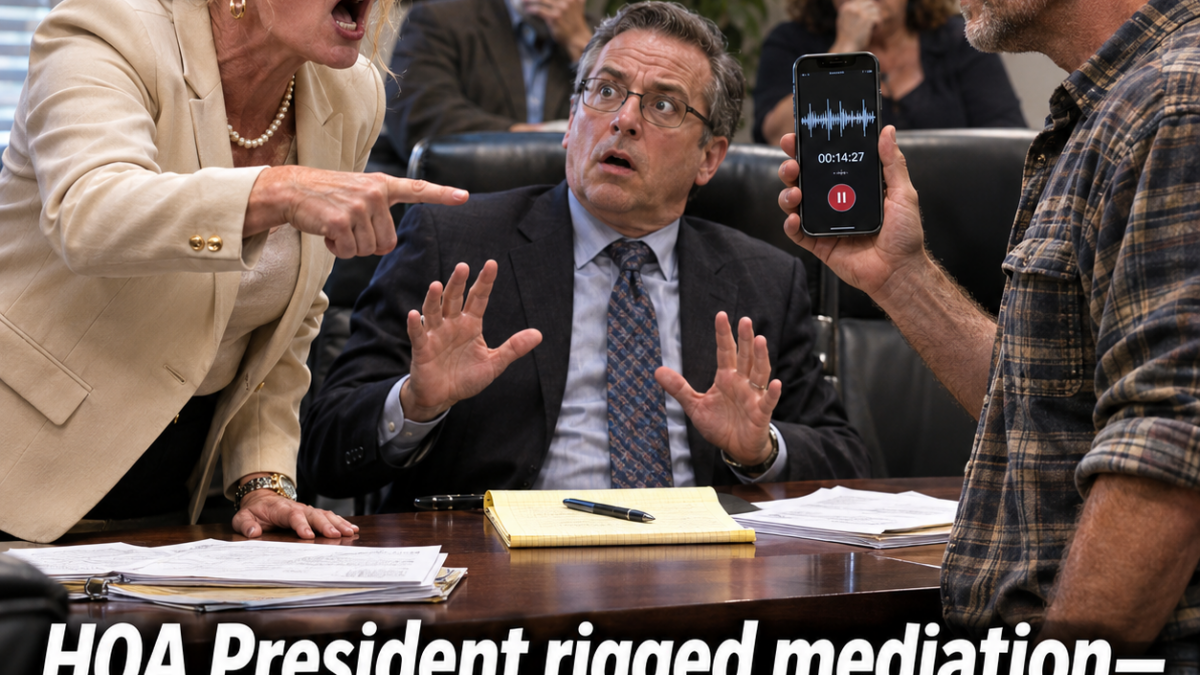
PART 2
Six months earlier, I didn’t know who Karen Miller was.
That sounds impossible considering how much space she would eventually occupy in our lives.
But when Sarah and I bought the house in Willow Creek Estates, Karen was just a name printed at the bottom of HOA emails.
**Karen Miller, President.**
Nothing more.
After twenty-two years in the Army Signal Corps, I had one ambition for retirement.
Peace.
Not excitement.
Not another mission.
Not leadership.
Not recognition.
Peace.
Sarah wanted the same thing.
Military life had been harder on her than she ever admitted.
Every few years, another move.
Another house.
Another set of neighbors.
Another doctor.
Another garden she would build, love, and eventually leave behind.
Then her MS became worse.
The disease had been manageable for years.
Manageable is a strange word.
It doesn’t mean easy.
It means you adapt often enough that outsiders stop seeing what has been lost.
First she stopped jogging.
Then long walks became difficult.
Then stairs became something we discussed before choosing restaurants or hotels.
Some mornings her legs felt almost normal.
Other mornings they felt, in her words, “like somebody replaced the bones with wet sand.”
When I retired, she deserved permanence.
We found Willow Creek Estates outside a quiet suburban town.
The house was a single-story ranch.
Wide doorways.
Minimal steps.
Level driveway.
Large backyard.
A covered patio.
The neighborhood looked almost painfully orderly.
Trim lawns.
Matching mailboxes.
Trees planted at mathematically satisfying intervals.
When our realtor handed me the HOA packet, I read everything.
I had spent a career dealing with communication systems where one unclear sentence could have consequences far beyond inconvenience.
I don’t sign documents casually.
The rules were tedious but not insane.
Exterior paint approval.
Fence standards.
Parking restrictions.
Landscaping modifications.
Nothing we couldn’t live with.
Sarah stood in the empty backyard during our second viewing.
“What do you think?”
I knew what she meant.
“Garden?”
She nodded.
The yard was flat.
Mostly lawn.
I looked at her walker.
Then at the back corner.
“Raised beds.”
Her face changed.
“Really?”
“Waist height.”
“Mark—”
“Wide paths.”
“Don’t make promises yet.”
“Too late.”
I could already see it.
Cedar beds.
Accessible paths.
A small bench.
Drip irrigation.
Enough room for tomatoes, herbs, flowers.
A place Sarah could work without kneeling.
She looked toward the blank lawn.
For the first time during the house hunt, she smiled like she could picture living there rather than merely managing there.
We bought the house.
Before I purchased one board, I filed the HOA application.
The Architectural Control Committee packet was absurdly long.
Ten pages.
Measurements.
Materials.
Colors.
Site plan.
Setbacks.
Drainage.
Visibility from neighboring lots.
I completed every section.
Attached drawings.
A three-dimensional rendering.
Material specifications.
Photographs of the proposed cedar.
Pathway measurements.
Then I wrote a letter.
I explained that the beds were intended as an accessibility accommodation for my wife, whose mobility limitations made conventional gardening increasingly difficult.
I deliberately avoided sounding emotional.
Facts.
Purpose.
Design.
Impact.
I hand-delivered the packet to the HOA drop box.
Photographed it with my phone.
Timestamped.
Then we waited.
Day ten.
Nothing.
Day twenty.
Nothing.
The bylaws gave the committee thirty days.
On day twenty-nine, the email arrived.
Subject:
**ACC REQUEST — APPROVED**
One word in the message.
**APPROVED.**
Attached was my original form.
Stamped.
Signed.
Karen Miller.
I printed everything.
Filed it.
Then I showed Sarah.
She covered her mouth.
“They said yes?”
“They said yes.”
“You’re sure?”
I held up the paperwork.
“Signed by the president.”
She hugged me.
That weekend I bought cedar.
The project took two full weekends.
I enjoyed every minute.
Measure twice.
Cut once.
Level every corner.
Secure every brace.
I built the beds sturdy enough to survive decades.
Sarah watched from the kitchen.
Sometimes from the patio.
When I finished the first bed, she ran one hand across the smooth cedar.
“Too nice for dirt.”
“That’s unfortunate.”
“Why?”
“I bought dirt.”
She laughed.
When all four beds were complete, we filled them.
Topsoil.
Compost.
Peat.
Organic amendment.
Sarah came out with her walker.
She pressed both hands into the soil.
Then she cried.
Quietly.
Not sad tears.
Relief.
“It feels normal.”
I knew exactly what she meant.
A garden wasn’t going to cure anything.
But it gave her something MS couldn’t define.
She started with tomatoes.
Lavender.
Basil.
Rosemary.
Thyme.
Mint in a pot because I’d learned from previous disasters.
For two weeks, she was outside every day.
Then Karen arrived.
No knock.
No introduction.
I was tightening part of the irrigation line when I heard her voice.
“What is that?”
I turned.
Karen stood at the edge of the backyard.
Pink tracksuit.
Arms crossed.
Face twisted with disapproval.
I walked toward her.
“Hi. I’m Mark Evans.”
“I know who you are.”
Not the response I’d expected.
She pointed toward the beds.
“What is that?”
“My wife’s garden.”
“That’s an unapproved structure.”
“No.”
She blinked.
“No?”
“It was approved.”
“I approve ACC applications.”
“Yes.”
“And I approved no such thing.”
I studied her.
“Would you like to see the form?”
Her expression hardened.
“I know what I’ve approved.”
“So do I.”
She pointed again.
“Section seven, paragraph four-B. Permanent structural landscaping and modifications to grade require approval.”
“I applied.”
“You did not receive valid approval.”
“I have your signature.”
That stopped her.
Only briefly.
Then she scoffed.
“You’ll receive a violation notice.”
Sarah was sitting at one of the beds.
Karen never looked at her.
“You have ten days to remove all of it.”
Sarah’s shoulders sank.
Something inside me tightened.
“Karen.”
She turned.
“Would you like to see the approval before threatening enforcement?”
“No.”
Then she walked away.
Sarah waited until she was gone.
“Mark?”
“Yeah?”
“What if she’s right?”
“She isn’t.”
“What if the approval was a mistake?”
“Then they made the mistake.”
She looked at the tomatoes.
“Maybe we should just—”
“No.”
I said it faster and harder than I intended.
Sarah looked at me.
I softened my voice.
“We followed their rules.”
“I don’t want this becoming a war.”
“Neither do I.”
That was true.
At the time.
I went inside.
Pulled out the HOA folder.
There it was.
Application.
Approval email.
Stamped form.
Karen’s signature.
I wrote a response.
Polite.
Professional.
I referenced the approval date.
The thirty-day review requirement.
The signed form.
Attached copies.
Delivered it.
Photographed delivery.
Two days later, I received certified mail.
Violation.
One hundred dollars.
Additional twenty-five dollars per day.
No acknowledgement of my response.
No explanation of the signature.
Nothing.
That’s when I understood.
This wasn’t confusion.
Karen had decided the garden would be removed.
The documents were now obstacles.
And Karen handled obstacles by pretending they didn’t exist.
I read every HOA document again.
CC&Rs.
Bylaws.
Architectural rules.
Enforcement procedure.
Fine schedule.
Appeal provisions.
I built a timeline.
Sarah watched me working at the dining room table.
“You’re doing the Army thing.”
“What Army thing?”
“The binders.”
“I always use binders.”
“Exactly.”
She sat opposite me.
“Mark, I meant what I said.”
“I know.”
“If tearing it down makes this stop…”
“No.”
She looked frustrated.
“This isn’t worth making yourself sick.”
“It isn’t about the garden anymore.”
“That’s exactly what worries me.”
I closed the binder.
“What would you have me do?”
She hesitated.
“I don’t know.”
“Karen signed the approval.”
“I know.”
“We spent money based on that approval.”
“I know.”
“You used the garden for two weeks.”
“I know.”
“And because Karen changed her mind, you lose it?”
Sarah stared at the table.
“I’m tired.”
That took the anger out of me.
I reached across.
She took my hand.
“So am I.”
Her voice dropped.
“I just wanted tomatoes.”
I almost laughed.
Instead, my eyes burned.
“You’re keeping the tomatoes.”
That night, I walked the neighborhood.
Not angry.
Analytical.
I wanted to understand enforcement.
Karen’s own property was a perfect starting point.
Three-tier fountain.
Decorative lawn ornaments.
Nonstandard lighting.
A political sign outside the permitted period.
All violations under rules she’d cited elsewhere.
I took photographs.
Not to report them.
To establish selective enforcement.
Then I walked other streets.
A basketball hoop.
Visible trash cans.
Overgrown shrubs.
Decorations.
Plenty of minor violations.
Yet from conversations and public board records, enforcement clustered around certain homeowners.
Newer residents.
People who challenged Karen.
People outside her social group.
Her friends received warnings.
Others received fines.
The pattern became clearer.
The letters kept coming.
Two hundred dollars.
Five hundred.
A thousand.
Then daily accumulation.
Sarah stopped going outside.
That hurt more than the money.
The garden she’d cried over now became something she avoided looking at.
One evening, I found her standing at the kitchen window.
“You didn’t go out today.”
“No.”
“Why?”
She shrugged.
“Didn’t feel like it.”
I knew she was lying.
“Sarah.”
She looked away.
“Every time I’m out there, I feel like I’m doing something wrong.”
That sentence settled inside me like concrete.
Karen had managed to turn a lawful, approved garden into a source of shame.
For my wife.
In her own backyard.
I stood beside Sarah.
“You did nothing wrong.”
“I know.”
“Then go out.”
“I can’t.”
I didn’t push.
Instead, I opened the binder again.
My first public challenge came at the monthly HOA meeting.
I prepared carefully.
Three-minute statement.
Signed approval.
Timeline.
Violation notices.
Evidence of selective enforcement.
I thought facts would matter if enough people heard them.
That was naive.
The clubhouse was sterile.
Beige.
Cheap folding chairs.
Board table at the front.
Karen sat center.
Brenda, the nervous secretary, beside her.
A large man named Tom Reeves sat on the other side, permanent scowl.
Two more directors rarely spoke.
About twenty residents attended.
Dave, who lived three houses down, was there.
He had complimented the garden while I built it.
When Karen opened homeowner comments, she looked directly at me.
“Two minutes per speaker.”
I stood.
“My name is Mark Evans, 124 Willow Lane.”
I held up the approval.
“I’m here regarding fines assessed for a garden project approved in writing by the Architectural Control Committee.”
Karen interrupted immediately.
“This is not the appropriate forum for personal violation appeals.”
“I have used the written appeal process.”
“Then you must wait for the board’s determination.”
“My letters haven’t been answered.”
“Your letters were received.”
“Then why hasn’t anyone addressed the approval?”
Her face tightened.
“The approval was a clerical error.”
That was new.
I stared at her.
“Your signature was a clerical error?”
A few people murmured.
Karen continued smoothly.
“The application was mistakenly processed without full review.”
“On day twenty-nine?”
“Mr. Evans.”
“After the committee had the application for almost a month?”
She grabbed the gavel.
“You are becoming argumentative.”
“I am asking a question.”
“You were granted two minutes for comments, not cross-examination.”
I looked toward the audience.
“This project was designed so my wife, who has multiple sclerosis, can continue gardening.”
Karen’s expression changed into fake sympathy.
“We are aware of your circumstances.”
Circumstances.
Not Sarah.
Circumstances.
“But personal circumstances do not permit homeowners to disregard community standards.”
“I didn’t disregard them. I applied.”
“Your time is almost finished.”
I pulled out the photographs.
“I’d also like to address selective enforcement.”
Karen saw the first picture.
Her fountain.
“That’s enough.”
“I have twenty-eight seconds.”
“Your comments have become disruptive.”
“These are properties with—”
The gavel hit.
“Sit down.”
I looked at Dave.
He dropped his eyes.
Nobody spoke.
Karen pointed toward my chair.
“If you refuse to maintain civility, I will have you removed.”
I could feel heat rising into my face.
Military discipline saved me from giving her exactly what she wanted.
I returned to my chair.
Humiliated.
Angry.
More isolated than when I arrived.
Karen moved to the next agenda item.
Community picnic.
That absurd transition almost broke me.
Afterward, residents left quickly.
I was packing my folder when an older man stopped beside me.
Gray hair.
Glasses.
Slight limp.
“Don’t let her get inside your head.”
I looked up.
He lowered his voice.
“She did the same thing to the Garcias.”
“What happened?”
“Deck dispute.”
“And?”
“They sold.”
He squeezed my shoulder.
“She’s done this before.”
Then he walked away.
I didn’t even know his name.
But he gave me something important.
Pattern.
Predators repeat successful behavior.
If Karen had pushed one family out, there were probably others.
The fines climbed.
Five thousand.
Seven.
Ten.
Then more.
The letters began mentioning liens.
Legal action.
Potential foreclosure remedies.
Sarah’s anxiety worsened.
One night she said:
“Please tear it down.”
I looked at her.
She was crying.
“Please.”
That almost ended the fight.
I would have dismantled every board that night if doing it could erase the fear from her face.
Instead, I sat beside her.
“I can.”
She looked at me.
“If that’s what you truly want, I can take it down tomorrow.”
She wiped her eyes.
“But?”
“No but.”
She stared at the dark backyard.
“Would she stop?”
I didn’t answer.
Sarah understood.
The garden was one target.
If we surrendered, Karen would learn pressure worked.
Next time it might be something else.
Ramp.
Mailbox.
Wheelchair-access modification.
Anything.
Sarah whispered:
“I hate her.”
It was the first time she’d said that.
I put my arm around her.
“Don’t let her take that much from you.”
Sarah laughed bitterly.
“She took my garden.”
“No.”
I looked outside.
“It’s still there.”
A week later, Karen offered mediation.
The letter was perfect.
Reasonable language.
Community harmony.
Avoid costly litigation.
Neutral third-party mediator.
Binding process.
Shared cost.
Sarah felt hope immediately.
“Maybe this is good.”
I didn’t.
“Mark.”
“I know.”
“You think it’s a trap?”
“Yes.”
“Why?”
“They choose the list.”
“But certified mediators—”
“Certification doesn’t eliminate relationships.”
She sighed.
“What else can we do?”
That was the question.
I reread the letter.
Binding mediation.
Predetermined list.
No appeal.
Then I noticed the state-law provision regarding maintaining a personal record of the proceeding.
I drafted my acceptance.
Agreed to mediation.
Agreed to select from their list.
Agreed to binding outcome.
With one condition.
I would record the proceeding for accuracy.
I expected rejection.
Instead:
Accepted.
That bothered me.
Either Karen had nothing to hide.
Or she was extremely confident.
I selected Arthur Vance.
Then started researching.
His website looked polished.
Attorney.
Certified mediator.
Dispute-resolution specialist.
Community-association consultant.
Professional headshot.
Testimonials.
Nothing obvious.
I looked up his company.
Vance Resolution Services LLC.
Registered agent:
Pinnacle Community Management.
I stared at the screen.
Pinnacle managed Willow Creek.
They had provided the mediator list.
Arthur’s company had a business relationship with the management company recommending him as neutral.
Not necessarily corruption by itself.
But relevant.
I dug deeper.
Karen’s social-media page was public.
She posted constantly.
Community events.
Recipes.
Poodles.
Political memes.
HOA achievements.
Eventually I found an album.
Willow Creek Charity Gala.
Six months earlier.
Karen holding a drink.
Board members.
Residents.
And Arthur Vance.
Arm around Tom Reeves.
Laughing.
Caption:
**So good to see Art and the gang!**
Art.
Not Mr. Vance.
Not mediator Vance.
Art.
I printed it.
Showed Sarah.
Her face fell.
“He knows her.”
“Clearly.”
“So mediation is fake?”
“Maybe.”
“Maybe?”
“Knowing someone doesn’t prove the outcome is fixed.”
She understood what I was thinking.
“You want proof.”
“Yes.”
The technology part was familiar territory.
Information integrity had been my life.
I bought a high-quality pen recorder.
Then a small backup digital recorder.
Tested both.
Battery life.
Sound quality.
Voice detection.
Storage.
Redundancy.
I was permitted to record the proceeding under the condition I’d already disclosed.
But I didn’t trust one device.
More importantly, I wanted an accurate record from the moment I arrived.
The evening before mediation, Sarah stood over my evidence.
Signed approval.
Violation notices.
Emails.
Photographs.
Business records.
Social-media photograph.
She tapped Arthur’s picture.
“If they’re doing what you think they’re doing…”
“They’ll make a mistake.”
“And if they don’t?”
“Then we deal with the ruling.”
She looked toward the garden.
Then back at me.
“Don’t let them take it.”
I smiled.
“You told me to tear it down.”
“I changed my mind.”
“Why?”
Her expression hardened.
“Because I’m tired of feeling ashamed in my own house.”
That was the Sarah I remembered.
Not fearless.
Courage isn’t absence of fear.
She was terrified.
She’d simply decided fear no longer deserved the final vote.
“Get her,” Sarah said.
I nodded.
The mediation took place at Pinnacle’s offices.
Conference Room 3B.
I arrived early.
The receptionist let me wait inside.
I set up my papers.
The primary recorder captured the room.
The backup remained with me.
At 9:50, voices approached.
Karen laughing.
Arthur responding.
They were outside the room.
Then Karen lowered her voice.
“So just remember, Art, the goal here is compliance and full restitution.”
My pulse slowed.
Not accelerated.
Training.
Focus.
The recorder was running.
Karen continued.
“He’s been difficult and obstructionist from day one. We need to make an example of him, or everyone will think they can build whatever they want.”
Arthur answered.
“Don’t worry, Karen.”
My thumb activated the backup.
“I’ve handled guys like him before. Ex-military. They think they’re still in charge.”
Karen laughed quietly.
Arthur continued:
“We’ll follow the process.”
Pause.
“But the outcome is assured.”
There it was.
Five words.
The outcome is assured.
Before he entered.
Before I presented evidence.
Before mediation began.
Arthur stepped into the room.
Saw me.
His face changed instantly.
Professional smile.
“Mr. Evans. Good morning.”
I shook his hand.
“Mr. Vance.”
Karen entered behind him.
She stared at me.
For half a second, I wondered whether she suspected I’d heard.
Then arrogance returned.
She sat.
Arthur gave a speech about neutrality.
Open communication.
Fairness.
Common ground.
I listened.
Almost admired the performance.
Then the mediation began.
I presented the approval.
Arthur asked why I hadn’t verbally confirmed.
I explained written approval was the required process.
He called it an unfortunate administrative issue.
Karen claimed the form had been processed accidentally.
I asked who processed it.
She refused to identify anyone.
Arthur moved on.
I presented the email.
He suggested email confirmation might not override the committee’s later interpretation.
I presented the timeline.
He reframed it as me rushing construction.
Twenty-nine days after submission.
After written approval.
Still, somehow, my fault.
I presented the accessibility purpose.
Arthur’s response was almost clinical.
“We certainly sympathize with Mrs. Evans’s health challenges, but accommodation does not necessarily eliminate architectural standards.”
I leaned forward.
“I’m not arguing that it does.”
“Then we agree.”
“No.”
He blinked.
“We complied with the architectural process. The committee approved the design.”
Karen interrupted.
“Clerical error.”
I looked at Arthur.
“Does a clerical error become the homeowner’s financial responsibility after reliance on a written approval?”
Arthur shifted.
“That’s a legal conclusion outside the narrow scope—”
“You’re issuing a binding financial recommendation.”
“Mr. Evans.”
“And you knew the outcome before we started.”
He froze.
Only for an instant.
Karen looked sharply at me.
I let the silence sit.
Then opened another document.
I didn’t reveal the recording.
Not yet.
I wanted the complete session.
For two hours, they performed.
By the end, Arthur’s conclusion mirrored Karen’s hallway instructions almost word for word.
Compliance.
Full restitution.
Fines.
Demolition.
Mediation costs.
Exactly seven days.
Karen delivered the final verdict herself.
Fourteen thousand seven hundred and fifty dollars.
Destroy the garden.
Restore the lawn.
Seven days.
I packed quietly.
The opening scene of the story.
Karen thought the war was over.
It had finally become winnable.
When I reached home, rain was falling.
Sarah waited in the living room.
“Well?”
I took off my wet jacket.
“They ruled against us.”
Her shoulders fell.
“How much?”
“Fourteen thousand seven fifty. Plus mediation.”
She closed her eyes.
“And the garden?”
“Seven days.”
She looked out the window.
“So that’s it.”
“No.”
I pulled out the recorder.
“What is that?”
“Listen.”
I played the hallway clip.
Karen:
**We need to make an example of him.**
Arthur:
**The outcome is assured.**
Sarah didn’t move.
I played it again.
This time she covered her mouth.
Then anger took over.
“That monster.”
“Yes.”
“He knew.”
“Yes.”
“They planned the whole thing.”
“Yes.”
Her hands began trembling.
“Can they do this?”
“They already did.”
“I mean legally.”
“We’re going to find out.”
I backed up the audio.
Computer.
External drive.
Encrypted cloud storage.
Two physical copies.
Then I found the older man from the meeting.
Ben Carter.
Retired corporate lawyer.
He came to our house for coffee.
I played the recording.
Ben removed his glasses.
Cleaned them.
Put them back on.
“Play it again.”
I did.
He listened.
Then stared at me.
“How did you obtain this?”
I explained the disclosed recording condition and the circumstances.
He asked several precise questions.
Then nodded slowly.
“Mark, assuming the recording is lawful and admissible as your documentation indicates, this isn’t merely embarrassing.”
He pointed toward the speaker.
“This attacks the legitimacy of the entire process.”
“What would you do?”
Ben smiled.
“Stop defending.”
That was the answer I’d been waiting for.
We spent hours reviewing my binder.
Original approval.
Fines.
Selective enforcement.
Mediation communications.
Arthur’s relationship with Pinnacle.
Social photograph.
Audio.
Ben was furious by the end.
“She’s counting on you being isolated.”
“She succeeded for a while.”
“No longer.”
We began finding others.
Dave first.
He looked nervous when I approached.
“I don’t want trouble.”
“I understand.”
“Karen’s already watching us.”
“I know.”
“What do you want?”
“Nothing today.”
He frowned.
I told him what had happened.
Not the recording yet.
Just the garden.
The approval.
The mediation.
The fines.
His expression changed.
“She fined me four hundred over the basketball hoop.”
“I know.”
“How?”
“Public records.”
He looked at the driveway.
His sons were shooting baskets.
“Every time they leave it out, my wife panics.”
He looked at me.
“That’s insane, isn’t it?”
“Yes.”
He nodded.
“What do you need?”
“Eventually? Your voice.”
Dave joined.
Then Frank, an old Army friend who now ran a private-investigation firm.
I gave him Karen and Arthur’s names.
“An HOA president?”
“Yes.”
“You’ve fallen far.”
“She has bylaws.”
He laughed.
“That is terrifying.”
“Background. Business links. Public financial records. Litigation history. Nothing illegal.”
“Understood.”
Within a week, our dining room became a planning center.
Sarah organized exhibits.
Ben developed legal strategy.
Frank gathered public-record intelligence.
Dave began talking quietly to neighbors.
Sarah surprised me most.
The woman who’d wanted the garden removed now sat with color-coded tabs organizing Karen’s correspondence.
One evening, I watched her label folders.
“You okay?”
“No.”
“Need a break?”
“No.”
“Sarah.”
She looked at me.
“I spent months thinking this was happening because I wanted a garden.”
“It wasn’t.”
“I know that now.”
She placed another document into the file.
“She made me feel guilty for existing.”
I sat beside her.
“Don’t give her that.”
“I did.”
“Past tense.”
She nodded.
“Past tense.”
Ben drafted our demand package.
Not a complaint.
Not another appeal.
An ultimatum backed by evidence.
It was addressed to the board.
Copied to every homeowner.
Pinnacle Community Management.
Relevant regulatory authorities.
Professional mediation oversight.
The document walked through the case chronologically.
Approved application.
Construction.
Retroactive violation.
Escalating fines.
Selective enforcement.
Sham mediation.
Then:
**EVIDENCE OF PREDETERMINED OUTCOME AND CONFLICT OF INTEREST.**
We attached a transcript.
Not the audio initially.
The transcript was enough.
Karen:
**We need to make an example of him.**
Arthur:
**The outcome is assured.**
Ben read the section aloud.
“Good?”
Sarah looked at him.
“Too polite.”
Ben smiled.
“I like her.”
The demands were clear.
All fines voided.
Mediation result nullified.
Garden recognized as approved.
Formal apology.
Arthur removed from approved-provider list.
Karen resign.
Independent financial and enforcement audit.
Seven business days.
Failure meant litigation and referral of evidence.
Frank arrived before we mailed it.
He carried a report.
Karen had recently paid off a substantial home-equity balance.
Public records raised questions about where the money came from.
Arthur had been involved in prior disputes alleging bias.
Nothing by itself proved criminal misconduct.
But enough to justify deeper scrutiny.
Ben added carefully worded language requesting an audit.
No unsupported accusations.
Facts.
Questions.
Evidence.
The package went out.
Every homeowner received one.
Karen received hers by certified mail.
For two days, silence.
On day three, Brenda sent an HOA-wide email.
**URGENT CLARIFICATION**
She called our document malicious.
False.
Misleading.
But didn’t deny the transcript.
That was telling.
The neighborhood forum erupted.
**Is this real?**
**Did she really coach the mediator?**
**What happened to the Garcias?**
**I knew Vance looked familiar.**
Then Dave posted publicly.
**Mark Evans is telling the truth. Karen has been selectively enforcing rules for years. She fined my family because my sons’ basketball hoop stayed outside. I’m done being afraid of her.**
One comment became ten.
Then fifty.
Residents shared stories.
Decks.
Flags.
Plants.
Paint.
Parking.
Holiday decorations.
Pets.
The problem wasn’t my garden anymore.
It was Karen.
Pinnacle called me.
Senior vice president.
Very serious tone.
They had opened an internal investigation.
Arthur Vance had been removed from their approved list pending review.
They emphasized he was an independent contractor.
They offered to facilitate another mediation.
I declined.
“The first mediation was enough.”
“We understand your frustration.”
“No.”
Silence.
“You understand your liability.”
He didn’t answer.
“Please refer to our written demands.”
Then Ben called.
Laughing.
“What?”
“Arthur called me.”
“Why?”
“He’s panicking.”
“What did he say?”
“Misunderstanding. Context. Karen pressured him.”
“Of course.”
“He offered cooperation.”
That was the beginning of the collapse.
Karen and Arthur had been partners when both believed they were protected.
Now each wanted to be the innocent one.
Then Karen called an emergency meeting.
She still believed she could control a room.
That may have been her last great mistake.
The clubhouse was overflowing.
Sarah walked beside me.
She used her cane that night.
She insisted on coming.
“You sure?”
“Yes.”
“You don’t have to prove anything.”
“I know.”
“Then why?”
She looked at me.
“Because she spent six months talking about me while pretending I wasn’t a person.”
I didn’t argue.
When we entered, people stood aside.
Some nodded.
Someone quietly said:
“Sarah, your garden is beautiful.”
Her eyes filled.
She smiled.
“Thank you.”
Karen sat at the board table wearing a red blazer.
Brenda looked terrified.
Tom Reeves looked sick.
Karen struck the gavel.
“This meeting will come to order.”
Nobody quieted immediately.
She hit it again.
“There have been serious defamatory allegations circulated by a disgruntled homeowner.”
A man shouted:
“Play the recording!”
Another:
“Did you rig mediation?”
Karen’s face reddened.
“I will not allow mob behavior.”
Another voice:
“What about the thirty-thousand-dollar loan?”
That one shook her.
“That’s private!”
Ben stood.
No microphone needed.
“Ms. Miller.”
She glared.
He continued.
“The homeowners have seen the documentary evidence.”
“This is not your meeting, Mr. Carter.”
“You’re correct.”
He smiled.
“It’s theirs.”
Applause.
Karen struck the gavel again.
Ben raised one hand.
“The simplest way to resolve the central factual dispute is to hear the recording.”
Karen’s face went white.
“That recording is illegal.”
I stood.
“We disclosed that the proceeding would be recorded.”
“That conversation was private.”
Ben answered carefully.
“We have reviewed the applicable recording rules and circumstances. If you believe the evidence was unlawfully obtained, you are free to raise that issue through counsel.”
No grandstanding.
No questionable speech about public figures.
Just precision.
Then he turned to the room.
“The substance remains relevant.”
People began chanting:
“Play it.”
Sarah squeezed my hand.
I connected my phone to the clubhouse audio system.
Karen stood.
“I forbid this.”
Nobody moved.
I pressed play.
Her voice filled the room.
Clear.
Sharp.
Familiar.
**So just remember, Art, the goal here is compliance and full restitution. He’s been nothing but difficult and obstructionist from day one. We need to make an example of him, or everyone will think they can build whatever they want.**
Silence.
Then Arthur.
**Don’t you worry, Karen. I’ve handled guys like him before. Ex-military, think they’re still in charge. We’ll follow the process, but the outcome is assured. He’ll be paying you by Friday.**
The recording ended.
Thirty seconds.
Maybe less.
Karen’s career ended in less time than it took to approve my garden.
Nobody spoke.
Karen looked around.
Her neighbors weren’t angry in the way she’d expected.
They looked disgusted.
That’s worse.
Anger can be argued with.
Disgust is withdrawal of trust.
Karen picked up her purse.
Brenda whispered:
“Karen…”
She didn’t respond.
She walked toward the exit.
Stopped beside Sarah.
For one moment I feared she’d say something cruel.
Instead she looked at Sarah’s cane.
Then at me.
Then left.
The door closed.
Ben stepped toward the board table.
“I believe the remaining directors have several decisions to make.”
Brenda looked like she wanted to disappear.
Ben continued.
“First, recognition of Ms. Miller’s resignation or abandonment of office, subject to your governing documents.”
Discussion.
Motion.
Vote.
Passed.
Then:
Void my fines.
Passed.
Nullify the mediation result.
Passed.
Recognize the original ACC approval.
Passed.
Issue a written apology to Sarah and me.
Passed.
Independent audit.
Passed.
Review of prior enforcement actions.
Passed.
In fifteen minutes, six months of pressure began unwinding.
Sarah sat beside me crying.
I leaned toward her.
“You okay?”
She laughed through tears.
“I want to plant tomatoes.”
That nearly broke me.
Not the vote.
Not Karen leaving.
Tomatoes.
The next morning, Sarah went outside.
First time in weeks.
She carried a small basket.
I followed at a distance.
She sat on the built-in stool beside the nearest bed.
Touched the soil.
Several plants were damaged from neglect.
Some were dead.
Others had survived.
She found one small tomato beginning to turn red.
“Look.”
I crouched.
“Stubborn.”
“Like you.”
“Like you.”
She shook her head.
“This one is definitely you.”
The audit began.
Then it got worse for Karen.
HOA landscaping resources had reportedly been used for personal work at her property.
Association funds had covered social-club expenses.
Then auditors found payments to a consulting company connected to Karen.
Frank’s question about the home-equity payoff suddenly mattered.
Documents were referred to proper authorities.
I didn’t celebrate.
That surprised people.
Dave asked:
“You don’t feel vindicated?”
“I do.”
“But?”
“This part isn’t ours.”
Financial misconduct was different from the garden fight.
Evidence needed professionals.
Auditors.
Lawyers.
Investigators.
I had no interest in turning rumor into revenge.
Arthur faced his own consequences.
Professional-review proceedings opened.
Pinnacle permanently removed him from vendor work.
He cooperated where required.
His “neutral” career was effectively destroyed by the sentence he’d spoken so casually.
**The outcome is assured.**
Think about that.
A mediator’s entire value rests on trust.
Not brilliance.
Not charisma.
Trust.
People enter mediation because they believe the person in the middle hasn’t secretly chosen a winner.
Once that belief disappears, everything else is theater.
Arthur traded his professional credibility for Karen’s approval.
Terrible bargain.
Pinnacle wanted the dispute gone.
They negotiated.
Legal expenses addressed.
Additional settlement terms.
A donation was made to an MS-related charity in Sarah’s name.
That mattered to her more than any check.
When the letter arrived confirming the donation, she sat quietly reading it.
“You okay?”
“Yes.”
She folded it.
“I hate that something good came from something so ugly.”
“Good things don’t excuse ugly things.”
“I know.”
“Take the good anyway.”
She nodded.
“I’m learning.”
The neighborhood elected a new board.
Ben became president.
Dave vice president.
To my horror, residents nominated me to lead the Architectural Control Committee.
I refused initially.
Ben called.
“Coward.”
“I spent six months fighting that committee.”
“Exactly why you should run it.”
“I don’t want power.”
“Perfect qualification.”
Sarah overheard.
“Do it.”
I looked at her.
“Whose side are you on?”
“The tomatoes’.”
I accepted.
My first goal was to make the process boring.
A good approval process should be boring.
Clear form.
Clear deadline.
Public tracking number.
Written reasons for denial.
Conflict disclosures.
Accessibility requests flagged for proper review.
No secret committee interpretations.
No disappearing paperwork.
No selective enforcement.
We created an online system.
Residents could see submission status.
Received.
Under review.
Additional information requested.
Approved.
Denied with cited rule.
No mystery.
We also created an informal neighbor-resolution policy.
If somebody’s trash can bothered you, talk to them before filing a formal complaint unless there was an actual safety issue.
Revolutionary concept.
People talking.
The number of formal complaints dropped.
Not because standards disappeared.
Because most disputes were tiny.
Human beings solve tiny things better with conversation than legal threats.
Dave’s basketball hoop remained.
We amended that rule too.
His sons played outside.
One afternoon I walked past.
Dave tossed me the ball.
I shot.
Missed everything.
He stared.
“Army didn’t teach basketball?”
“Signal Corps.”
“Apparently.”
I handed the ball back.
Neighborhood life became ordinary.
Sarah’s garden recovered.
We replanted.
New tomatoes.
Lavender.
Herbs.
She added flowers.
Too many flowers.
I told her so.
She ignored me.
Correctly.
One evening, she was working at the far bed when a car stopped near Karen’s former house.
Moving truck.
Karen had sold.
I hadn’t known the closing date.
She came outside carrying a cardboard box.
Poodle figurines.
She saw us.
Stopped.
For months, I’d imagined some final confrontation.
A speech.
An apology.
One last insult.
Nothing.
Karen looked at Sarah.
Sarah’s hands were covered in soil.
A basket of tomatoes sat beside her.
Karen looked at the cedar beds she’d tried to destroy.
Then at me.
No hatred.
No challenge.
Just emptiness.
She put the box in her car.
Got in.
Drove away.
Sarah watched.
“That felt strange.”
“Yeah.”
“You wanted more?”
“No.”
“Me neither.”
She picked up a tomato.
“Maybe that’s enough.”
It was.
Victory changed meaning for me during that year.
At first, I wanted to beat Karen.
Then I wanted to expose her.
Then I wanted to protect Sarah.
Eventually I realized the last one was the only goal that mattered.
Everything else was secondary.
A few months later, autumn reached Willow Creek.
The garden was full of late tomatoes and chrysanthemums.
Sarah’s mobility varied.
Some days she worked standing.
Some days seated.
Some days she only watched from the patio.
But it belonged to her again.
Not to Karen.
Not to the HOA.
Not to the fight.
Her garden.
One evening we sat outside.
Sunset orange through the trees.
Sarah leaned against me.
“You know something?”
“What?”
“She gave us a gift.”
I looked at her.
“Absolutely not.”
Sarah laughed.
“Not intentionally.”
“Still no.”
“Listen.”
I sighed theatrically.
“She forced us to meet people.”
“That’s one interpretation.”
“We barely knew Ben.”
“True.”
“Dave avoided us.”
“Also true.”
“Now you’re on the ACC with him.”
“Unfortunate.”
She nudged me.
“And people talk to each other now.”
I looked down the street.
Neighbors walking.
Children playing.
Someone waving.
Sarah continued.
“We didn’t just save a garden.”
I knew what she was going to say.
“We built a community.”
I hated admitting when she was right.
So I waited.
She smiled.
“Say it.”
“No.”
“Mark.”
“You’re correct.”
“Louder.”
“Don’t push your luck.”
She laughed.
Months later, I found the old fine notice in my files.
**$14,750.**
Seven days.
Remove structure.
Restore lawn.
I put it beside the original approval.
Two pieces of paper.
One told the truth.
One tried to overwrite it.
Karen’s power had depended on people assuming the newest official-looking document was automatically the strongest.
It wasn’t.
Authority isn’t measured by letterhead.
Rules matter.
Procedure matters.
Evidence matters.
So does accountability.
I kept the recording too.
Not because I enjoy hearing it.
I don’t.
Karen’s voice still brings back the worst part of those months.
Sarah crying.
The unused garden.
Certified letters.
The humiliation of the first meeting.
But the recording reminds me why documentation matters.
Without it, Karen could have denied everything.
Arthur could have claimed perfect neutrality.
The board could have blamed confusion.
Pinnacle could have called the whole thing a personality dispute.
Thirty seconds of truth cut through six months of narrative.
Years later, people still bring up the story.
New homeowners hear some version.
Usually exaggerated.
According to Dave, I used “military spy equipment.”
It was a digital recorder.
Ben prefers “evidentiary redundancy.”
Sarah calls it “the thing that saved my tomatoes.”
Her version wins.
One spring morning, I found her outside before breakfast.
She was sitting beside the raised bed.
A seed packet in her lap.
“What are we planting?”
“We?”
“I built this.”
“You’re labor.”
“Excuse me?”
She handed me a small shovel.
“Tomatoes go there.”
I obeyed.
Marriage teaches chain of command too.
We worked quietly.
Then she stopped.
“Mark.”
“Yeah?”
“Do you ever think about what would’ve happened if you’d torn it down?”
I sat back.
The question hurt.
“I try not to.”
“I do.”
“What do you think?”
“I think Karen would’ve found something else.”
“Probably.”
“And I would’ve spent years wondering why we surrendered.”
I looked at her.
“You were the one asking me to surrender.”
“I know.”
She smiled sadly.
“That’s why I’m glad you didn’t listen.”
I reached for her hand.
“There are several categories where I consider that standing permission.”
“Don’t get comfortable.”
We planted.
The garden became larger over time.
Not structurally.
I wasn’t giving the ACC that headache.
But fuller.
Plants spilling over edges.
Flowers attracting bees.
Tomatoes heavy enough to require extra supports.
Neighbors stopped during walks.
Sarah gave away herbs.
Children came asking whether they could have cherry tomatoes.
She always said yes.
The garden Karen once called a threat to community standards became one of the most social places in Willow Creek.
The irony wasn’t lost on anyone.
Ben retired from the HOA presidency after two years.
At his last meeting, residents gave him a plaque.
He hated it.
Dave became president.
I stepped down from the ACC soon afterward.
I’d helped build the transparent system.
That was enough.
Power should rotate.
Nobody should become indispensable.
That’s another lesson Karen taught us.
The easiest tyranny to create is the one where everyone says:
“She knows how everything works. Just let her handle it.”
No.
Train replacements.
Publish procedures.
Share access.
Rotate authority.
Make it impossible for one personality to become the institution.
The professional mediation board eventually completed its proceedings against Arthur.
I didn’t follow every detail.
Didn’t need to.
His reputation was damaged permanently.
Pinnacle revised its vendor-vetting rules.
Conflict disclosures became mandatory.
Neutral mediators could no longer be presented to communities without clearer relationship disclosures.
At least something systemic came from it.
Karen’s financial case moved separately.
Again, I refused to turn it into entertainment.
If crimes occurred, prosecutors would handle them.
My job was over.
One afternoon, Dave asked why I wasn’t posting updates.
“People want to know.”
“About what?”
“Karen.”
“No.”
“Why?”
“Because accountability isn’t a reality show.”
He laughed.
“You’re no fun.”
“Correct.”
The truth was simpler.
I had spent too much time letting Karen occupy our home.
She wasn’t going to occupy our future too.
Sarah deserved better.
So did I.
The old binder moved from my desk to a cabinet.
Then a storage box.
Eventually the only documents I kept readily accessible were the approval and the final HOA letter formally recognizing it.
Beginning.
End.
Everything between them became history.
On the fifth anniversary of the garden, Sarah invited several neighbors over.
I thought it would be dinner.
It became half the street.
Dave brought burgers.
Ben brought wine.
Children ran through the yard.
Nobody cared whether every chair matched.
Sarah sat beside the garden telling a new neighbor about the first tomato she’d grown after the fight.
The woman asked:
“Wasn’t it stressful living through all that?”
Sarah looked toward me.
“Yes.”
“Would you do it again?”
Sarah thought.
Then:
“I’d fight sooner.”
That answer hit me.
Not harder.
Sooner.
There is a difference.
Waiting until abuse becomes unbearable allows bullies to define the situation.
If we’d spoken to neighbors earlier, maybe Karen’s isolation tactics would have failed earlier.
If people had compared experiences years earlier, maybe the Garcias wouldn’t have moved.
Ben once told me the same thing.
“Communities don’t lose their freedom in one dramatic vote.”
We were sitting on my patio.
“What do you mean?”
“They lose it through convenience.”
He sipped coffee.
“One homeowner says, ‘It’s easier to pay the fine.’ Another says, ‘I don’t want trouble.’ Another says, ‘She only targets difficult people.’”
He pointed toward the street.
“Eventually everyone is alone.”
I nodded.
“And restoring it?”
“Conversation.”
“That simple?”
“Usually.”
He smiled.
“Lawyers hate admitting that.”
The recording was powerful because it provided proof.
But proof only mattered because people were ready to hear one another.
Dave speaking publicly mattered.
Ben speaking mattered.
Sarah attending the meeting mattered.
Brenda finally voting against Karen mattered.
The recording cracked the wall.
The community chose to walk through.
That distinction is important.
Sometimes people tell me:
“You destroyed Karen.”
I correct them.
“No.”
Karen made choices.
She signed an approval.
Then denied it.
Issued fines.
Ignored evidence.
Selected a conflicted mediator.
Coached him.
Predetermined an outcome.
Concealed relationships.
Misused authority.
Potentially mishandled money.
Those decisions belonged to her.
I recorded one of them.
That’s all.
I didn’t destroy Arthur either.
He promised neutrality.
Then told Karen the outcome was assured before hearing evidence.
His profession requires trust.
He spent his.
The most satisfying consequence wasn’t either career ending.
It was Sarah walking into the backyard without fear.
That remains the image I carry.
Not Karen fleeing the meeting.
Not Arthur panicking.
Not homeowners chanting for the recording.
Sarah.
Bare hands in soil.
Tomato plant.
Sunlight.
Smile.
That’s the ending.
One evening years later, we sat outside as another sunset settled over Willow Creek.
Her MS had progressed.
She used the wheelchair more often.
The pathways I’d built years earlier mattered more than when I designed them.
She rolled between the beds easily.
Stopped beside the lavender.
Cut a few stems.
Then returned to the patio.
“Smell.”
I did.
“Nice.”
“That’s all?”
“Very lavender.”
She rolled her eyes.
I put the stems on the table.
Then looked toward the beds.
“Good design.”
She laughed.
“There it is.”
“What?”
“The engineer congratulating himself.”
“Signal officer.”
“Same disease.”
We sat quietly.
Then Sarah said:
“Imagine if we’d torn it down.”
I looked at the cedar.
Weathered now.
Still solid.
“I know.”
“No.”
She turned toward me.
“Really imagine it.”
So I did.
Lawn.
Empty corner.
No lavender.
No tomatoes.
No accessible paths.
Maybe Karen still president.
Maybe Dave still afraid of the basketball hoop.
Maybe Ben still watching quietly.
Maybe another family pressured into leaving.
Sarah said:
“That would’ve been the real loss.”
“Yes.”
She took my hand.
“Not the wood.”
“No.”
“The idea that she got to decide what our home was.”
Exactly.
People like Karen often frame their demands as tiny.
Just remove the garden.
Just pay the fine.
Just follow the rule.
Just don’t make trouble.
But surrender is rarely only about the immediate object.
It teaches the person demanding control that pressure works.
And it teaches the person surrendering that resistance is pointless.
Sometimes compromise is wise.
Sometimes you should let little things go.
I know that.
Military life taught me that too.
Not every hill matters.
But you need to know which hill you’re standing on.
For me, it wasn’t cedar.
It wasn’t fourteen thousand seven hundred fifty dollars.
It wasn’t even Karen.
It was Sarah believing she had the right to live fully in her own home.
That hill mattered.
Karen never understood that.
She thought she was fighting a stubborn retired soldier over landscaping.
She was actually threatening the one place my wife still felt physically capable and emotionally free.
That’s why I stayed calm.
That’s why I documented.
That’s why I kept going after public humiliation.
That’s why I walked into a mediation I already suspected was rigged.
And that’s why, when Karen’s voice came through those clubhouse speakers years later in my memory—
**We need to make an example of him.**
—I still feel something cold inside me.
Because she was never talking about a rule.
She was talking about punishment.
Arthur’s answer exposed the rest.
**The outcome is assured.**
Those words ended both of them because they revealed what authority looks like when accountability disappears.
The procedure was theater.
The result came first.
Everything else was costume.
That is the danger.
Not only in HOAs.
Anywhere.
A fair process can produce an outcome you hate.
That’s life.
But a process designed only to justify a predetermined decision is something else.
It is power pretending to be fairness.
Once people see that, legitimacy disappears fast.
Karen learned that in thirty seconds.
One recording.
One room.
One community finally willing to listen.
Sometimes new residents ask Sarah why the garden beds are unusually wide.
She tells them.
“For the wheelchair.”
Sometimes they ask who built them.
She points at me.
“An engineer who overbuilds everything.”
“Signal Corps.”
“Nobody cares.”
Then she tells them the beds were once nearly destroyed over an HOA dispute.
New residents usually laugh.
They assume she’s exaggerating.
Then Dave appears.
He loves the story.
“Oh, she isn’t exaggerating.”
I leave before he starts.
His version now includes undercover surveillance worthy of a spy movie.
There was no spy movie.
There was a pen recorder.
A keychain backup.
Public records.
Certified mail.
A retired lawyer.
A frightened neighbor deciding to speak.
A wife deciding she’d been afraid long enough.
Nothing cinematic.
Just disciplined persistence.
Maybe that’s why the victory lasted.
We didn’t replace Karen with another Karen.
We replaced personality-driven authority with systems.
Clear rules.
Public records.
Appeals.
Conflict disclosures.
Rotation.
Transparency.
Boring.
Boring is underrated.
Nobody writes dramatic stories about an HOA meeting where the agenda is published, homeowners speak respectfully, the board follows procedure, and everyone goes home.
That’s exactly the kind of meeting I want.
The garden is still there.
The cedar has faded from honey-colored wood to silver-gray.
I’ve replaced a few boards.
Added handrails near one path when Sarah needed them.
No application controversy.
The ACC approved the modification in four days.
Dave sent me a message afterward:
**APPROVED. TRY NOT TO START A REVOLUTION.**
I replied:
**NO PROMISES.**
Sarah laughed when she saw it.
One late summer afternoon, she picked the largest tomato we’d grown that year.
Perfect red.
She carried it inside like a trophy.
At dinner, she sliced it.
Salt.
Pepper.
Nothing else.
She handed me the first piece.
“Well?”
I tasted it.
Sweet.
Warm from the sun.
“Good.”
Sarah stared.
“Good?”
“Excellent.”
“Better.”
“Best tomato I’ve ever eaten.”
She smiled.
Then said:
“Fourteen thousand seven hundred fifty dollars.”
I laughed.
“Expensive tomato.”
“Worth it.”
I looked through the window.
At the garden Karen ordered me to demolish.
At the pathways designed for Sarah.
At lavender moving in the evening breeze.
At a neighborhood where children’s basketball hoops remained outside after dark.
And I thought about the strange route we’d taken to reach ordinary peace.
A signed approval.
A lie.
A fine.
A sham meeting.
A rigged mediation.
A recorder.
A transcript.
A room full of neighbors.
A voice on speakers.
Then silence.
The silence after the recording remains one of the clearest memories of my life.
Karen understood immediately.
No speech could rescue her.
No gavel.
No procedural trick.
No mock sympathy.
No accusation that I was difficult.
People had heard her.
Not my interpretation.
Her.
That’s the power of a clean record.
It removes translation.
For months, Karen had controlled the story.
I was hostile.
I was anti-community.
I hated rules.
I demanded special treatment.
I built without approval.
Then everyone heard the truth.
She wanted to “make an example” of me.
Arthur promised the outcome before hearing the case.
Nothing I could have said would have been stronger.
The best evidence usually doesn’t need adjectives.
Karen’s career ended because people finally saw what had been hidden behind procedure.
Arthur’s career collapsed because neutrality cannot survive secret promises.
The HOA changed because residents realized fear had kept them separated.
And Sarah got her garden back.
Years later, if you asked me what revenge felt like, I’d tell you we never really got revenge.
Karen lost power.
Arthur lost professional credibility.
Investigations followed.
Consequences came.
But revenge would have required making their suffering the point.
It wasn’t.
Restoration was the point.
I wanted Sarah outside again.
I wanted our home to feel like ours.
I wanted neighbors to stop looking away.
I wanted an approval to mean approval.
I wanted mediation to mean neutral mediation.
I wanted rules to be rules instead of weapons.
We got those things.
That was enough.
More than enough.
One autumn evening, Sarah and I sat on the patio.
The last tomatoes of the season rested in a basket.
Chrysanthemums filled one bed.
The neighborhood was quiet.
She leaned her head against my shoulder.
“Mark?”
“Yeah?”
“Do you remember what I told you before the mediation?”
“Which part?”
“Get her.”
I laughed softly.
“Yes.”
“I was angry.”
“You were.”
“I don’t think I’d say that now.”
“No?”
She shook her head.
“I’d say save us.”
I looked at her.
She gestured toward the garden.
“The result’s the same.”
Not exactly.
But I understood.
Saving something is different from destroying someone.
That’s the lesson I kept.
Karen believed there could only be one winner.
She thought if I kept the garden, she lost authority.
If she allowed an exception—even an approved one—everyone would rebel.
That’s why she needed to make an example of me.
She had built power on fear.
Fairness threatened it.
We built something different afterward.
A community where disagreement didn’t automatically become war.
Where rules could be challenged.
Where board presidents could be questioned.
Where a mediator’s relationship had to be disclosed.
Where the architectural committee couldn’t quietly punish somebody because a chairperson didn’t like them.
And where Sarah could grow tomatoes without wondering whether someone was photographing them for a violation notice.
The last one mattered most.
A few weeks later, winter came.
We cleared the beds.
Covered the soil.
Sarah placed her gardening gloves on the patio table.
“Next year?”
“Obviously.”
“More tomatoes?”
“Fewer.”
“More.”
“Sarah.”
“More.”
I surrendered.
Some battles aren’t worth fighting.
That spring, we planted twice as many.
And every time I walk past those beds, I remember what Karen called them.
**Unapproved structural landscaping.**
I smile.
Because the only structure they ever really threatened was hers.
A structure built on fear.
A structure built on silence.
A structure held together by people assuming no one else would stand up.
It looked strong.
Until one recording pulled out the first supporting beam.
Then the whole thing came down.
The garden stayed.
Sarah stayed.
We stayed.
And years later, when she reaches into the leaves, twists a ripe tomato from the vine, and holds it up with that same smile she had the day I finished building the first bed, I know exactly what victory looks like.
It isn’t Karen leaving town.
It isn’t Arthur losing his certification.
It isn’t the audit.
It isn’t the apology letter.
It isn’t even hearing an entire room finally turn against the woman who terrorized them.
Victory is quieter.
It’s my wife sitting in the garden someone ordered her to destroy.
Her hands covered in soil.
A tomato in her palm.
No fear in her eyes.
That’s the only verdict I ever needed.








