PART 2: HOA Karen Reported My Generator as a Noise Violation Then the Power Went Out and She Came Knocking
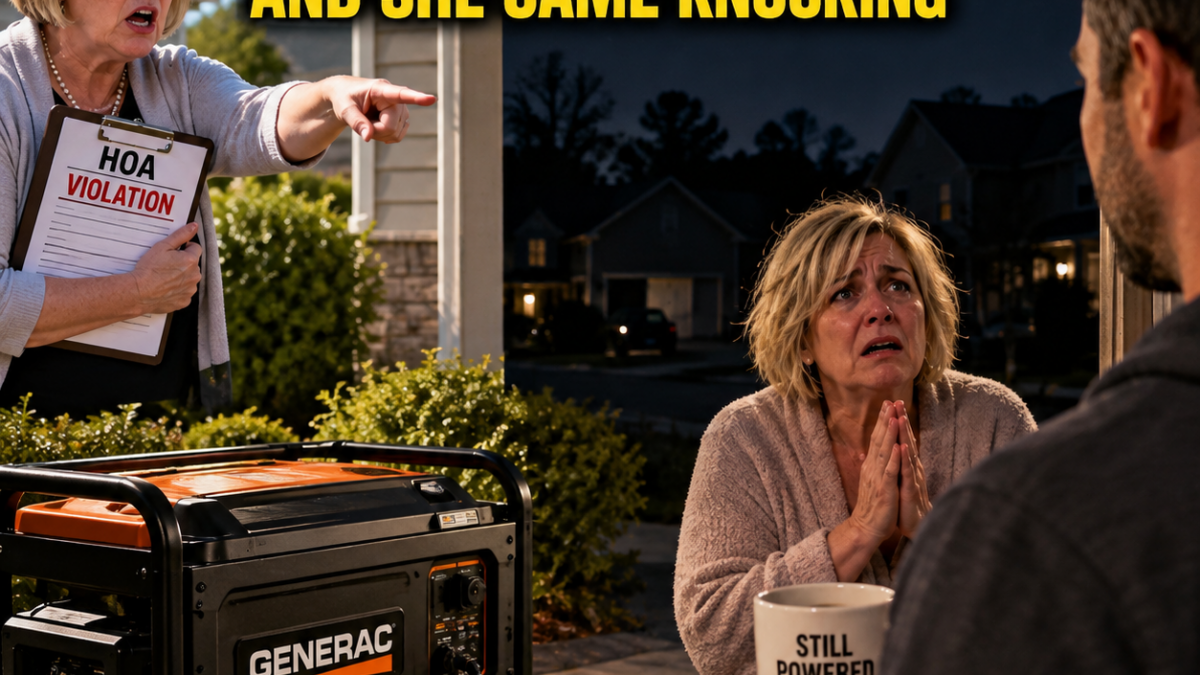
PART 2
I stared at the weather alert until the screen dimmed in my hand.
Sarah was standing at the kitchen sink.
“What is it?”
I turned the phone toward her.
The map showed a huge spiral of red and orange over the Gulf.
Its projected cone widened inland, but our county sat almost directly through the center of it.
Sarah dried her hands on a towel and came closer.
“How bad?”
“Too early to know.”
She gave me the look spouses develop after enough years together—the one that says, Don’t protect me from information I’m going to find out anyway.
I sighed.
“They’re saying it could strengthen before landfall.”
Her eyes went automatically toward the refrigerator.
Not toward the windows.
Not toward the roof.
The refrigerator.
That was what illness did to a family.
It rearranged your definition of danger.
A hurricane could tear shingles from the house and topple trees, but the first thing both of us thought about was a row of small medication boxes sitting behind the milk.
“I’m going to test the generator again tomorrow,” I said.
Sarah nodded.
Then she lowered her voice.
“What happens if Karen tries to stop you from using it?”
I almost laughed.
Not because it was funny.
Because the question was so absurd that laughter was the only safe response.
“If the grid goes down, I’m turning it on.”
“Even with the fines?”
“Especially with the fines.”
She leaned against the counter.
“You know she’s going to lose her mind.”
“She can lose whatever she wants.”
I looked toward Lily’s room.
“She doesn’t get to gamble with our daughter.”
That night, after Sarah and Lily went to bed, I sat alone at the dining room table.
The house was quiet except for the soft hum of the refrigerator.
I opened the thick binder I had created.
At the beginning of all this, I had thought one letter would resolve everything.
Then I had thought one appeal would.
Then a professional acoustic report.
Then proof from the HOA’s own bylaws.
I kept assuming facts would matter because reasonable people eventually respond to facts.
Karen didn’t.
Every time evidence closed one door, she invented another rule and walked through it.
But she had made one mistake.
She put everything in writing.
The invented concrete rule.
The landscaping violation.
The daily fines.
The denial of my appeal.
And most importantly, the board’s statement that aesthetic concerns outweighed an individual medical request.
Frank Peterson had nearly laughed when I sent him that one.
Frank had been a JAG officer when we served together. Now he handled real-estate and contract litigation.
When I first called him, I expected him to tell me to negotiate.
Instead, after listening quietly for fifteen minutes, he said, “Mark, stop trying to convince her.”
“What?”
“She isn’t operating in good faith. Every time you send her proof, you think you’re giving her a reason to back down. She thinks you’re challenging her authority.”
“So what do I do?”
“You let her document what she’s doing.”
He had helped me draft three letters.
The first demanded the exact governing language supporting every fine.
The second requested written clarification of whether the board believed its aesthetic preferences overrode medically necessary accommodation.
The third demanded architectural-review records so we could compare how rules had been enforced against other owners.
Karen responded to all three.
Badly.
Her board refused to provide the records.
They doubled down on their position.
And they signed their names beneath it.
Frank called the resulting letters “exhibits disguised as arrogance.”
We were preparing for a legal challenge based on selective enforcement, breach of the HOA’s own governing documents, disability-accommodation issues, and the board’s refusal to follow its established procedures.
Dave was helping too.
The more he talked to neighbors, the more stories came out.
His basketball hoop.
Mrs. Gable’s wheelchair ramp.
A widow who had been threatened with fines because her front-door paint was allegedly one shade too dark.
A family that had been ordered to move a small storage box no one could see from the street.
But enforcement was never consistent.
People Karen liked received warnings.
People she disliked received fines.
Board members somehow never seemed to notice their own violations.
One evening Dave came over with his phone full of photographs.
“You’re going to enjoy this one.”
He showed me Karen’s yard.
Peeling trim.
Decorative structures prohibited by the same standards she kept citing against others.
Then he showed me large commercial-style freezer units being delivered to her garage.
“You taking up photography?” I asked.
“Wildlife documentation.”
I raised an eyebrow.
“Rare suburban tyrant in natural habitat.”
For the first time in weeks, I laughed hard enough for Sarah to hear from inside.
The laughter mattered.
Stress had turned our house quiet.
Every envelope from the HOA felt like a hand reaching through the mailbox to squeeze our family.
Even Lily had noticed.
One afternoon she found me at the table and looked at the piles of paper.
“Is the generator in trouble?”
I froze.
Children are always listening more carefully than adults realize.
“No, sweetheart.”
“Mrs. Fessio doesn’t like it.”
I pulled out the chair beside me.
“Mrs. Fessio and I disagree about some neighborhood rules.”
“Are they taking it away?”
There it was.
The fear beneath the question.
She knew why we had bought it.
I crouched in front of her.
“No.”
“Promise?”
I hesitated only because promises are sacred to children.
Then I held out my hand.
“Promise.”
She wrapped both arms around my neck.
“Good. I like the magic box.”
“The magic box?”
“It keeps my medicine safe.”
From that day forward, that was what she called it.
Not the Kohler.
Not the generator.
The magic box.
Karen would probably have fined us for the nickname if she’d known.
Three days later, Hurricane Melissa became a named major hurricane.
By the following morning, the television meteorologists had lost their calm tone.
The storm had strengthened rapidly.
Projected landfall moved closer.
Schools announced closures.
Hardware stores sold out of plywood, batteries, gasoline cans, and bottled water.
At the grocery store, people were buying anything that could be eaten without refrigeration.
Our neighborhood, usually obsessed with lawns and landscaping schedules, suddenly discovered that nature did not care about property values.
I spent the day preparing.
Patio furniture went into the garage.
Trash cans were secured.
Gutters checked.
Flashlights charged.
Power banks topped off.
I filled the truck.
Then I went to the side yard.
The generator sat behind the hollies exactly where it had sat through every threatening letter.
I opened the service panel.
Oil level good.
Diagnostics green.
Natural-gas supply good.
Automatic transfer switch ready.
I put it through a test cycle.
The engine started with a low mechanical purr.
Inside, the transfer switch clicked.
The house changed power sources so smoothly that the lights barely trembled.
I stood beside the machine listening.
Rain had not started yet.
Cicadas were louder than the generator.
A lawn service three houses away was louder.
A pickup passing the subdivision entrance was louder.
Then I felt someone watching me.
Karen stood across the street on her porch.
Arms crossed.
She wore sunglasses although the sky had turned gray.
I lifted one hand.
She did not return the gesture.
Ten minutes later, the generator completed its test.
That afternoon an HOA email arrived.
EMERGENCY HURRICANE PREPAREDNESS NOTICE.
At first it contained normal advice.
Secure outdoor items.
Do not enter flooded roadways.
Keep emergency numbers available.
Then I reached the bottom.
A separate paragraph had been emphasized.
Residents are reminded that community acoustic standards remain in effect during emergency conditions. Operation of unapproved generators or other non-compliant machinery will result in maximum penalties.
I read it twice.
Sarah came up behind me.
“You have got to be kidding.”
“No.”
“She sent that during a hurricane?”
I forwarded it to Frank.
In the subject line I typed:
Another exhibit.
His reply arrived less than a minute later.
Keep it.
Dave called.
“You see the email?”
“Yeah.”
“That woman is willing to freeze food for two hundred houses just to prove a point.”
“I think the email is mostly for me.”
“Oh, everybody knows it’s for you.”
“How?”
“Because half the neighborhood is talking about it.”
That was new.
Until then, most residents had stayed quiet.
Karen’s hurricane message apparently crossed some invisible line.
People could tolerate petty enforcement when it involved basketball hoops or paint colors.
Threatening emergency equipment while a major hurricane approached felt different.
Still, no one openly challenged her.
Not yet.
By sunset the outer bands reached us.
Rain struck the windows sideways.
The palms bent.
Branches began whipping back and forth.
Lily sat on the couch between Sarah and me with a blanket around her shoulders.
The television showed radar images that looked almost unreal.
A red crescent wrapped around the storm’s eye.
The meteorologist pointed toward our county.
“If you are in this area, you should already be sheltered.”
A gust hit the house hard enough to make Lily jump.
I put an arm around her.
“We’re okay.”
“Is the magic box ready?”
“It’s ready.”
“What if the power goes out?”
“Then it wakes up.”
She smiled faintly.
Outside, the wind grew louder.
At 8:17, the lights flickered.
Once.
Twice.
Sarah and I looked at each other.
The television blinked off and back on.
Then came a cracking sound from somewhere down the street.
Blue-green light flashed through the rain.
The house went black.
Complete darkness.
For perhaps three seconds, nobody moved.
Wind screamed around the roof.
Rain hammered the windows.
Then I heard the sound I had spent thousands of dollars hoping I would never need.
Click.
A low engine turned over outside.
Hum.
The lights came back.
The refrigerator restarted.
The air-conditioning system resumed.
The television booted.
And from beside me came Lily’s small voice.
“The magic box woke up.”
I swallowed.
“Yeah, baby.”
She grinned.
“It works.”
I pulled her against my chest.
“It works.”
What I didn’t tell her was that I was fighting tears.
I had spent months defending that machine.
Not because I enjoyed fighting.
Not because I hated Karen.
Not because I wanted to prove I was smarter than an HOA board.
I had defended it for exactly this moment.
The refrigerator temperature stayed stable.
Lily’s medication stayed safe.
My daughter did not have to know that her parents were afraid.
The generator Karen had called an aesthetic violation had become the quiet heartbeat of our home.
I checked through the front window.
Every house on the street was dark.
Ours was the only one glowing.
I didn’t feel triumphant.
Not then.
I felt grateful.
That distinction would become important later.
The storm continued for six brutal hours.
We heard branches snapping.
Something metallic rolled down the street and disappeared into the dark.
Emergency alerts sounded on our phones.
At one point a tornado warning forced us into the hallway.
Lily sat on the floor between Sarah and me while the generator continued humming outside.
At around three in the morning, the worst of the wind began to weaken.
None of us really slept.
At first light I walked outside.
The neighborhood looked bruised.
Leaves covered everything.
Fence panels were down.
A basketball goal had fallen into the road.
Several trees had split.
At the end of our block, a large oak lay across utility lines.
That explained the outage.
I checked the power company website.
Countywide outages.
No restoration estimate.
Could be days.
I walked back toward the house.
Across the street, Karen was standing in her driveway holding her phone toward the sky, apparently searching for a signal.
She saw me.
Then she looked toward my generator.
Then at the lights visible through my kitchen windows.
I kept walking.
The first several hours were manageable.
People cooked breakfast on grills.
Children rode bicycles around fallen branches.
Neighbors stood in driveways comparing damage.
But by afternoon, heat settled over the subdivision.
Without air conditioning, houses became ovens.
Refrigerators warmed.
Freezers began thawing.
Cell phones died.
People started driving out looking for ice and fuel, only to discover gas stations without power and stores with lines wrapping around buildings.
Portable generators appeared.
Unlike mine, several were loud enough to hear from the opposite end of the street.
Ironically, those were exactly the sort of machines an HOA noise rule might reasonably regulate.
My generator remained behind the hollies, running quietly.
At about eight that evening, Sarah and I were eating sandwiches when she stopped chewing.
“Mark.”
“What?”
She nodded toward the window.
Someone was coming up the driveway.
A silk caftan.
Messy hair.
Slow steps.
Karen.
I looked at Sarah.
She looked at me.
Neither of us said anything.
Karen reached the porch.
Before she knocked, I opened the door.
She blinked against the porch light.
I had never seen her look so different.
No clipboard.
No makeup.
No controlled smile.
Her hair was damp with sweat.
Her face looked exhausted.
“Karen.”
“Mr. Riley.”
A pause.
Then she corrected herself.
“Mark.”
That alone told me how desperate she was.
“Can I help you?”
Her eyes drifted past me.
Inside, our house was cool and bright.
The refrigerator hummed in the kitchen.
Some cartoon Lily had been watching played quietly in the living room.
Karen looked at it the way a starving person looks through a bakery window.
“It’s terribly dark,” she said.
I waited.
“Yes.”
“And hot.”
“Yes.”
She glanced toward the side yard.
“That generator seems to be working.”
“It is.”
Another pause.
She was waiting for me to rescue her from having to ask.
I didn’t.
Finally she cleared her throat.
“My phones are dead.”
“I’m sorry to hear that.”
“I need to coordinate the community response.”
I almost admired the wording.
The community response.
Even now, asking for help, she needed to wrap herself in authority.
Then the wrapper tore.
“And my freezer,” she added quickly. “I had a delivery just before the storm.”
“A delivery?”
“Food.”
She looked annoyed that I had made her specify.
“Steaks. And several frozen items.”
I thought about George Gable’s oxygen concentrator.
I thought about Lily’s medicine.
Then I thought about Karen’s steaks.
She continued.
“I was wondering whether I could run an extension cord over here. Just temporarily. Phones, maybe a small freezer, possibly—”
“No.”
She stopped.
“What?”
“I’m sorry. I can’t do that.”
Her face changed instantly.
The old Karen came rushing back.
“You have more than enough capacity.”
“My system is sized for my house.”
“You’re powering air conditioning.”
“Yes.”
“So obviously you have spare capacity.”
“That isn’t how it works.”
Her jaw tightened.
“Mark, I am asking for a reasonable accommodation during an emergency.”
The irony nearly knocked me backward.
But I kept my voice calm.
“Extension cords across wet property, connecting multiple homes to a permanently installed standby system, create electrical and liability issues. I’m not running one to your freezer.”
“This is unbelievable.”
“No. It’s safe.”
Her nostrils flared.
“You’re doing this because of the fines.”
“I’m doing it because I’m not improvising electrical connections during storm cleanup.”
She stared at me.
I could have ended it there.
I almost did.
Then I remembered her standing on my porch.
Her clipboard.
Her little smile.
Her exact words.
So I added, quietly:
“The rules are the rules, Karen.”
Her face went red.
“They exist to protect the community.”
Silence.
No insult I could have invented would have hit harder.
Because the words were hers.
She opened her mouth.
Closed it.
Looked past me one more time.
Then turned.
“Good night, Karen.”
I gently shut the door.
Sarah stood behind me in the hall.
For several seconds neither of us spoke.
Then she pressed her lips together.
“What?”
She shook her head.
“Nothing.”
“What?”
“I’m trying very hard to be a good person.”
I laughed.
She did too.
Not cruelly.
Just the kind of exhausted laughter that comes when the universe delivers irony with perfect timing.
But after the laughter faded, Sarah’s expression became serious.
“Are we really not helping anybody?”
I looked at her.
“I didn’t say that.”
The next morning, I knocked on Mrs. Gable’s door.
She opened it almost immediately.
Her normally neat white hair was damp against her forehead.
“Mr. Riley?”
“How’s George?”
Her face tightened.
“We’re using the backup oxygen tanks.”
“How many?”
“Not enough if the outage lasts as long as they’re saying.”
“I thought so.”
I held up a heavy-gauge outdoor extension cord.
Her hand flew to her mouth.
“Oh.”
“Where’s the concentrator?”
Tears filled her eyes.
“Mark, I can’t ask you—”
“You didn’t.”
“But Karen—”
“Karen doesn’t breathe for George.”
She stared at me.
Then she stepped aside.
George was sitting in a recliner with an oxygen cannula beneath his nose.
He looked pale but smiled when he saw me.
“Causing trouble again, Riley?”
“Trying.”
I ran the cord safely along the edge of our properties, protected the connection, and calculated the load before plugging in the oxygen concentrator.
The machine started.
Its soft mechanical sound filled the room.
Mrs. Gable began crying.
Not dramatically.
Quietly.
She took my hand with both of hers.
“I don’t know how to repay you.”
“You don’t.”
“Please.”
“We’re neighbors.”
She looked toward George.
I followed her gaze.
“This is what neighbors are supposed to do.”
From there, I went to Dave’s.
He opened the door shirtless and sweating.
“You here to gloat about central air?”
“I was thinking about your refrigerator.”
His expression changed.
“You serious?”
“One refrigerator. That’s it.”
“Done.”
His two sons appeared behind him.
“Mr. Mark!”
“Hey, guys.”
“Our ice pops are melting.”
Dave rubbed his forehead.
“Children have suffered greatly.”
I held up the cord.
The younger boy gasped.
“You can save them?”
“I’ll see what I can do.”
Five minutes later, their refrigerator was powered.
The kid hugged my leg.
“My ice pops!”
Dave watched him run back inside.
“You realize you’ve just become more important than FEMA.”
“I’ll put it on my résumé.”
Then his face became serious.
“She came to your house last night, didn’t she?”
“How do you know?”
“Everybody knows.”
“How?”
“My wife saw her.”
I groaned.
“And?”
“And nothing. But if she asked you for power after sending that hurricane email, I may believe in divine comedy again.”
“She asked.”
Dave stared.
“For real?”
“Phones and freezer.”
He slowly turned toward Karen’s house.
“What did you say?”
“No.”
Dave looked back at me.
Then he smiled.
“Please tell me you used the line.”
“What line?”
“The rules are the rules.”
I said nothing.
His grin widened.
“You absolutely did.”
“Go check your refrigerator, Marine.”
“Sir, yes sir.”
By the second full day, something changed in the neighborhood.
People stopped behaving like isolated homeowners and started behaving like neighbors.
Someone with a chainsaw organized a crew to clear fallen limbs.
A nurse checked on elderly residents.
A family with a gas stove made coffee for half the block.
People with charged phones relayed power-company updates.
Our house became one of several informal information points.
I let people charge phones in the garage under supervision.
We ran only essential loads outside the house.
No freezers full of premium steaks.
Medical equipment first.
Food storage where practical.
Communication.
That order wasn’t written down anywhere.
It didn’t need to be.
Karen remained inside.
Occasionally I saw her staring through the blinds.
I wondered whether she understood what was happening.
The authority she had spent years manufacturing with notices and fines had vanished the moment people faced a real problem.
Nobody was asking who had the clipboard.
They were asking who had a chainsaw.
Who had medical training.
Who had ice.
Who had information.
Who was willing to help.
Leadership, it turned out, was not a title.
That lesson arrived for Karen on the third afternoon.
I was standing in my driveway with Dave when she came marching across the street.
Her face was flushed.
Her hair was pulled back tightly.
She pointed toward the heavy extension cord running safely along the edge of my yard toward the Gables’ house.
“That cable has to be removed.”
Dave looked at me.
I looked at Karen.
“Excuse me?”
“It crosses property boundaries.”
“It runs from my property directly to theirs.”
“It creates a trip hazard.”
“It’s secured.”
“It violates community standards.”
“What standards?”
“Temporary exterior electrical connections.”
“Show me the rule.”
Her mouth tightened.
“You know perfectly well I don’t have the governing documents with me.”
“Convenient.”
She stepped closer.
“You are not authorized to create an electrical distribution network.”
Dave coughed into his fist.
I knew that cough.
It meant he was trying not to laugh.
“It powers one medical device,” I said.
“I don’t care what it powers.”
The words were barely out of her mouth when Mrs. Gable’s front door opened.
She stepped onto the porch.
“Karen!”
I had never heard the woman raise her voice.
Apparently neither had Karen.
She turned.
Mrs. Gable came down one step.
“That cord is powering George’s oxygen.”
Karen’s expression flickered.
Then hardened again.
“There are emergency services for that.”
“Which emergency service would you like me to call?” Mrs. Gable asked. “The one clearing trees, the one responding to medical calls, or the one trying to restore electricity to half the county?”
“This is an HOA safety matter.”
Mrs. Gable’s hands shook.
Her voice didn’t.
“If you touch that cord, I will call the sheriff and tell them you deliberately interfered with my husband’s medical equipment.”
Karen looked toward me.
“You put her up to this.”
Mrs. Gable took another step.
“He didn’t put me up to anything.”
Dave lifted his phone.
Karen noticed.
“Are you recording me?”
“Public street,” he said.
“You don’t have permission.”
“Keep talking about the oxygen cord.”
Several neighbors had started coming outside.
A man across the street folded his arms.
Another woman called out, “Leave them alone, Karen.”
Someone else said, “He’s helping people.”
Then another.
“What is wrong with you?”
Karen turned slowly.
For years, she had controlled these people one at a time.
A private warning here.
A threatening letter there.
A whispered rumor.
A fine mailed to one house while everybody else kept their heads down.
Now they were standing together.
Her expression changed.
I saw the exact moment she understood.
She had lost them.
Not because of me.
Because they had finally seen her behavior in daylight.
No boardroom.
No letterhead.
No official language.
Just an exhausted woman arguing that an HOA technicality mattered more than an elderly man breathing.
Karen pointed at Dave’s phone.
“This is harassment.”
Dave lowered it slightly.
“No, Karen. This is documentation.”
That word hit her hard.
Documentation had always been her weapon.
Now it belonged to someone else.
She looked at me one last time.
There was rage in her eyes.
But beneath it was something new.
Fear.
She walked away.
No final threat.
No triumphant line.
She just went home.
Dave watched her door close.
Then he looked at me.
“Think she’s done?”
“No.”
“You’re right.”
He put his phone away.
“But she’s wounded.”
Late that night, electricity returned.
It happened without warning.
Streetlights flashed.
Air conditioners groaned back to life.
Cheers echoed from several houses.
My generator sensed utility power, cooled down, and shut itself off.
For the first time in days, our side yard became silent.
I stood there for a moment.
Then Lily came running barefoot onto the porch.
“Daddy!”
“Yeah?”
“The real electricity is back!”
“It is.”
She looked toward the generator.
“Did the magic box die?”
I laughed.
“No. It’s resting.”
“Good.”
She patted the air in its direction as if saying goodnight to a pet.
“Good job, magic box.”
I picked her up.
Over her shoulder I could see porch lights glowing all the way down the street.
Power was back.
But nothing had returned to normal.
The next morning Frank called.
“I saw Dave’s video.”
“You already have it?”
“Dave sent it at six twelve.”
“Of course he did.”
“Mark, we’re done waiting.”
I walked into my office and shut the door.
“What are you thinking?”
“I’m thinking your board has now given us written evidence, financial evidence, selective-enforcement evidence, medical-accommodation evidence, and video evidence showing the president attempting to interfere with an emergency connection powering an oxygen concentrator.”
“She didn’t actually unplug it.”
“She was smart enough not to.”
“Barely.”
“Doesn’t matter. Our case was strong before. Now the homeowners understand the stakes.”
“So we file?”
“We file.”
I looked through the glass door toward the kitchen.
Lily was eating cereal.
Sarah was packing medication into a small insulated travel case for an appointment.
I remembered my promise.
No one was taking that generator away.
“Do it.”
Frank did more than file.
He attacked the problem from every direction available to us.
The civil complaint challenged the fines, selective enforcement, the board’s disregard of its own approval deadlines, and its handling of a documented disability-related accommodation request.
It sought damages for the costs we had incurred and the emotional and financial pressure caused by the campaign against us.
He also demanded a complete accounting of the HOA’s legal spending.
Mrs. Gable’s son had already uncovered enough irregularities to raise serious questions.
Thousands of dollars had gone to consultations tied to Karen’s enforcement battles.
Homeowners were paying dues.
Karen was using part of that money to finance personal vendettas.
Frank sent notice to the HOA’s insurer as well.
That changed everything.
Board members who had treated our letters like background noise suddenly discovered a fascinating interest in detail.
The first call came from Stan, the board treasurer.
I recognized his number but let it ring twice before answering.
“Hello?”
“Mark?”
“Yes.”
“This is Stan Holloway.”
“I know.”
A pause.
“We need to talk.”
“I’m listening.”
“I think there has been a misunderstanding.”
“No.”
Another pause.
“Excuse me?”
“A misunderstanding is when someone sends the wrong meeting date. You signed letters fining my family thousands of dollars after receiving medical documentation. That isn’t a misunderstanding.”
“Karen handled most of the architectural correspondence.”
“Your signature is on it.”
“She told us the generator had been installed without approval.”
“I have the certified receipt proving she received the notice. I have your bylaw establishing deemed approval after thirty days.”
“She never showed us that.”
“Then why did you sign?”
Silence.
That was the question no board member could answer.
Because the answer was embarrassing.
They had trusted Karen because trusting her was easier than doing their jobs.
“We didn’t understand the medical seriousness,” he finally said.
I felt my anger sharpen.
“You signed a letter saying the board was not bound by individual medical requests when they conflicted with visual standards.”
“I know.”
“My daughter is eight.”
“I know.”
“No, Stan. You know now.”
His voice became quiet.
“What do you want?”
“For everyone who helped create this mess to stop pretending Karen did it alone.”
He exhaled.
“Fair.”
That surprised me.
Then he said, “There are other board members who feel the same way.”
“Feel what way?”
“That this went too far.”
“It went too far the first day.”
“I understand.”
“No. You understand because lawyers and insurance companies are calling now.”
He didn’t argue.
I respected that more than another excuse.
An emergency meeting was scheduled.
Under the bylaws, homeowners could force one with enough signatures.
Dave gathered them in less than twenty-four hours.
People who once avoided eye contact at the mailbox were now signing their names beside ours.
Mrs. Gable signed first.
Dave signed second.
By evening, we had almost twice the required number.
The clubhouse meeting was scheduled for Thursday at seven.
I had been inside that room dozens of times.
Birthday parties.
Holiday events.
HOA meetings.
Karen always sat at the front beneath the community seal.
She liked a small wooden gavel.
Nobody had ever explained why an HOA president needed a gavel, but Karen used it with great enthusiasm.
Thursday night, every chair was filled before seven.
People stood along the walls.
Others gathered near the doors.
Sarah sat beside me.
Dave and his wife sat on our left.
Mrs. Gable and her son sat on our right.
Frank stood in the back.
He wore a dark suit and no expression.
Karen entered at 6:58.
Conversation dropped.
She wore a navy blazer.
Her hair was perfect.
The clipboard had returned.
So had the mask.
She sat down.
Stan sat several feet away from her.
That detail told me everything.
Karen struck the gavel once.
“This emergency meeting will come to order.”
Dave stood.
Karen’s eyes narrowed.
“You have not been recognized.”
“We didn’t sign a petition to discuss last month’s landscaping report.”
“Sit down.”
“No.”
The room became perfectly still.
Karen lifted the gavel.
“Mr. Walsh, if you refuse to follow meeting procedure—”
Stan interrupted.
“Let him speak.”
Karen turned.
“What?”
Stan swallowed.
“I said let him speak.”
For the first time since I had known her, Karen looked genuinely shocked by another board member.
Dave faced the room.
“I’m going to keep this simple.”
He held up several pages.
“For years, people in this neighborhood have been threatened with fines based on rules that were inconsistently enforced, selectively enforced, or, in some cases, apparently invented.”
Murmurs moved across the room.
Karen leaned toward her microphone.
“That is defamatory.”
Frank spoke from the back.
“No, it isn’t.”
Every head turned.
Karen saw him.
Her expression changed.
Frank folded his arms.
“Please continue, Mr. Walsh.”
Dave did.
He described his basketball hoop.
Then he described the Gables’ wheelchair ramp.
Other residents began raising hands.
Karen tried to regain control.
“Those incidents are irrelevant to the present litigation.”
“Actually,” Frank said, “selective enforcement makes them quite relevant.”
Karen’s jaw clenched.
Mrs. Gable’s son stood next.
He had brought financial statements.
He walked homeowners through legal expenditures.
No theatrics.
No shouting.
Numbers.
Dates.
Payments.
Thousands spent on disputes no homeowner remembered authorizing.
Then Dave connected his phone to the clubhouse television.
Karen saw what he was doing.
“No.”
Nobody moved.
The video started.
There she was.
Standing in the street.
Pointing toward the extension cord.
Declaring it a violation.
Mrs. Gable’s voice came through the speakers:
“That cord is powering George’s oxygen.”
Then Karen’s answer:
“There are emergency services for that.”
The video ended.
The room erupted.
Not screaming.
Something worse for Karen.
Disgust.
A woman near the back said, “My God.”
A man beside her shook his head.
Someone else muttered, “Unbelievable.”
Karen struck the gavel repeatedly.
“This video is presented without context!”
Mrs. Gable stood.
“What context would you like to add?”
Silence returned.
Mrs. Gable was seventy-six years old.
She barely reached Karen’s shoulder.
Yet Karen looked frightened of her.
“My husband was sitting inside that house trying to breathe,” Mrs. Gable said. “Mr. Riley gave us electricity without asking for money or anything else. You came outside during a countywide emergency and threatened the connection.”
“I was addressing a safety issue.”
“You were angry because he had power and you didn’t.”
Karen’s face reddened.
“That is not true.”
Mrs. Gable’s voice softened.
“That is exactly what happened.”
Then she sat down.
Sarah squeezed my hand.
Frank caught my eye from the back of the room.
He gave one small nod.
My turn.
I stood.
I hadn’t prepared a speech.
Frank had offered to write one.
I declined.
For months, Karen had hidden behind official language.
I wanted to use ordinary words.
“My daughter’s name is Lily.”
The room quieted.
“She’s eight years old.”
I held up a photograph Sarah had taken the previous spring.
Lily in the backyard.
Missing front tooth.
Hair tangled from running through the sprinkler.
Happy.
“She has an autoimmune condition that requires medication kept within a strict temperature range.”
Karen looked down.
“I installed the generator because during a previous outage I spent the middle of the night driving around with her medication in a powered cooler trying to keep it usable.”
Nobody moved.
“I researched the unit. I hired licensed contractors. I checked the city requirements. I read our covenants. And before installation, I sent the HOA everything.”
I held up the green certified-mail receipt.
“Karen signed for it.”
Several people turned toward her.
“Our rules say the architectural committee has thirty days to respond. They didn’t.”
I placed the receipt down.
“Then the generator was installed.”
Next I held up the acoustic report.
“Karen said noise.”
I read the measurement.
“Within the legal limit.”
Next came the street photograph.
“She said visual contamination.”
I showed the generator completely hidden behind bushes.
A few people shook their heads.
“Then came the concrete.”
Someone laughed bitterly.
I held up the violation notice.
“Apparently my concrete was the wrong natural shade of gray.”
More laughter.
Karen struck the table with one hand.
“This is a mockery.”
“No,” I said.
I picked up the final letter.
“This is.”
She knew which letter it was before I spoke.
I saw it in her face.
I read the sentence.
“The board is not bound by individual medical requests that compromise the visual integrity of the community.”
A woman gasped.
I looked toward the board.
“Every one of you signed this.”
Stan closed his eyes.
Another director stared at the table.
Karen finally spoke.
“We were protecting the governing standards.”
“My daughter is not a landscaping problem.”
The room exploded in applause.
I hadn’t expected it.
For a second I just stood there.
Sarah covered her mouth.
Dave slapped the table.
Mrs. Gable was crying.
I waited for the room to quiet again.
“I didn’t want a war with this HOA.”
That was important to me.
“I wanted reliable electricity for my child’s medication.”
I looked around the clubhouse.
“But when one person can invent rules, punish people selectively, spend community money enforcing personal grudges, and make families afraid to install medically necessary equipment, the problem isn’t one generator.”
I put the letter down.
“The problem is the system that lets her do it.”
Karen stood abruptly.
“I will not sit here and be personally attacked.”
Stan pushed his chair back.
“Then perhaps you should not be sitting there at all.”
She turned toward him.
“Stan?”
His hands were trembling.
But he stood.
“I move for an immediate vote of no confidence in President Karen Fessio.”
The room froze.
One of Karen’s closest board allies whispered, “Second.”
Karen stared at her.
“You?”
The woman’s eyes filled with tears.
“You told us he refused to provide documentation.”
“I gave you everything!”
“You told us the medical letter was vague.”
“It was not relevant to—”
“His daughter is eight!”
Karen looked around the table.
No one met her eyes.
“You are all cowards.”
Stan’s face hardened.
“No. We were cowards when we signed your letters without doing our jobs.”
That shut her down.
The vote proceeded.
Nearly unanimous.
When hands rose across the clubhouse, I felt no rush of joy.
What I felt was release.
Like a fist that had been clenched around our family for months finally opened.
Karen remained seated.
Her title disappeared in less than two minutes.
President.
Board member.
Gatekeeper.
The identity she had built around control was stripped away by the people she had controlled.
She looked at me.
I expected hatred.
There was some.
But mostly she looked stunned.
As if consequences were a language she had never learned.
Frank came forward after the vote.
“We still have litigation to resolve.”
That returned everyone’s attention to reality.
Removing Karen did not erase what had happened.
The HOA still faced legal exposure.
The board still had obligations.
Our fines still existed on paper.
Legal fees still had to be addressed.
And the governing documents still contained enough vague language for another Karen to emerge someday.
The new acting board met with Frank the next morning.
I attended with Sarah.
It lasted four hours.
Frank was calm.
That made him terrifying.
He did not threaten anyone.
He didn’t need to.
He simply placed documents on the table.
Certified notice.
Approval deadline.
Fine notices.
Acoustic report.
Doctor’s letter.
The board’s signed responses.
Architectural records.
Financial statements.
Dave’s video.
Affidavits.
Then he explained what continuing the case could cost.
Not just money.
Time.
Insurance.
Reputation.
Homeowner assessments.
Trust.
When he finished, the HOA’s newly hired attorney asked for a private discussion with the board.
We stepped outside.
Sarah and I sat on a bench.
She leaned her head on my shoulder.
“You okay?”
“I think so.”
“You don’t look okay.”
“I’m tired.”
“So am I.”
I looked at her.
“I’m sorry.”
“For what?”
“For bringing all this into the house.”
Her expression changed.
“You didn’t.”
“I could have given in.”
“And done what?”
“Removed it.”
“And then the hurricane came.”
I looked down.
Sarah took my hand.
“Mark.”
I turned toward her.
“You promised Lily she’d be safe.”
“I know.”
“You kept the promise.”
The conference-room door opened.
Frank stepped out.
“Come back in.”
His expression gave nothing away.
Inside, the acting board president had a document in front of him.
He looked exhausted.
“We’re prepared to settle.”
The fines would be permanently rescinded.
All of them.
Every invented violation.
Every daily penalty.
Every concrete-color charge.
Gone.
The HOA would issue a written apology to our family.
Not the usual “we regret any misunderstanding” language.
Frank rejected that.
The final apology acknowledged that the board had failed to follow its own procedures and had mishandled our documented medical concerns.
Second, the board agreed to review legal expenditures connected to Karen’s enforcement campaigns and establish stricter authorization requirements.
No HOA president would again be able to treat community dues like a private litigation account.
Third, and most important to me, the covenants would be amended.
Medically necessary equipment would receive explicit protection.
Standby generators would be permitted when installed to code and appropriately screened.
Accommodation requests would have a written timeline.
Denials would require actual citation to governing language.
Fines could no longer materialize from imaginary sections and invented phrases.
Owners would receive notice, evidence, and a meaningful appeal process.
Selective enforcement would be subject to review.
Board members would receive training on their fiduciary obligations.
Karen’s kingdom was being dismantled clause by clause.
Frank looked at me.
“Anything else?”
There was one thing.
I had been thinking about it since the hurricane.
“Yes.”
The acting president shifted nervously.
“What?”
“I don’t want settlement money paid to me beyond reimbursement of what this actually cost us.”
Frank already knew.
He had helped me work out the number.
“I want the HOA to make a five-thousand-dollar donation to the foundation that supports research and families dealing with Lily’s autoimmune disease.”
Sarah turned toward me.
She hadn’t known.
Her eyes filled immediately.
The room went quiet.
The acting president looked at the lawyer.
The lawyer nodded.
“Agreed.”
I sat back.
For the first time since Karen had walked onto my porch with her clipboard, it felt finished.
Not victorious.
Finished.
There is a difference.
Victory can make you want to keep fighting.
Closure makes you want to go home.
So we did.
Lily was at the kitchen table drawing.
When we walked inside, she held up a picture.
Our house.
Three stick people.
One smaller stick person.
A huge gray rectangle beside the house.
I pointed at it.
“What’s that?”
She looked at me as if I were stupid.
“The magic box.”
“Of course.”
“And this is you.”
My stick figure was holding something that looked like a sword.
“What am I carrying?”
“A tool.”
“What kind?”
“I don’t know. Daddy tools.”
Sarah laughed.
I sat beside Lily.
“Guess what?”
“What?”
“The generator isn’t in trouble anymore.”
Her eyes widened.
“Really?”
“Really.”
“Mrs. Fessio said yes?”
I thought about how to explain it.
“No. The neighborhood decided the rule wasn’t fair.”
She considered that.
“So the magic box can stay?”
“It can stay.”
She threw her arms around me.
That hug was worth every certified letter.
Every sleepless night.
Every dollar Frank threatened to bill before eventually making the HOA cover the legitimate legal costs.
Everything.
Karen stopped attending community events.
For several weeks, we barely saw her.
When she did appear, people were not cruel.
I was grateful for that.
They simply stopped being afraid.
Fear had been the fuel behind her authority.
Once it disappeared, she had nothing left to burn.
Nobody rushed across the street to avoid her.
Nobody lowered their voice when she entered the mailbox pavilion.
Nobody cared about her disapproving stare.
Her former board allies resigned one after another.
Some apologized personally.
Stan came to my house one Saturday.
He stood on the porch holding no paperwork.
“I owe you an apology.”
I let him speak.
He did not blame Karen.
That was what made me accept it.
“I signed things I didn’t read carefully enough,” he said. “I trusted someone because disagreeing with her was exhausting.”
I nodded.
“That’s how people like her get power.”
“I know.”
“No, you know now.”
He gave a sad smile.
“Fair.”
Then he looked toward the side yard.
“For what it’s worth, I’m getting a generator.”
I laughed.
“Read the new rules.”
“I plan to.”
“Send your paperwork.”
“To whom?”
I smiled.
“Not me.”
He laughed too.
Three months later, a FOR SALE sign appeared in Karen’s yard.
Dave texted me a picture.
CELEBRATION AT 1800 HOURS?
I replied:
NO.
A second message arrived.
SMALL CELEBRATION?
NO.
Third message.
QUIET, HOA-COMPLIANT CELEBRATION?
I stared at the phone.
Sarah looked over.
“What is it?”
“Dave.”
“What does he want?”
“To celebrate Karen moving.”
“Tell him he’s terrible.”
I typed:
SARAH SAYS YOU’RE TERRIBLE.
His reply:
SARAH IS RIGHT. STILL CELEBRATING.
The day the moving truck arrived, I was outside washing my pickup.
Karen stood in her driveway directing movers.
For a moment, she looked exactly as she had the first day.
Pointing.
Correcting.
Controlling.
Then she noticed me.
We looked at each other across the street.
I turned off the hose.
Part of me expected one final confrontation.
Instead, she walked over.
Her steps were slow.
She stopped at the edge of my driveway.
“Happy?”
The question contained no greeting.
I considered it.
“Yes.”
Her mouth tightened.
“I suppose you think you won.”
“No.”
That surprised her.
“You destroyed my reputation.”
“No.”
“You turned everyone against me.”
“No.”
Her eyes narrowed.
“Then what exactly do you call what happened?”
I set the hose down.
“You kept pushing people until they stopped being afraid of you.”
She looked away.
“You humiliated me.”
“You fined my family thousands of dollars over equipment protecting my daughter.”
“You could have handled it privately.”
“I tried.”
“You brought lawyers into it.”
“After you ignored everything else.”
She folded her arms.
“I was protecting standards.”
I shook my head.
“No, Karen. You were protecting control.”
Her face hardened.
Then, unexpectedly, softened.
Only slightly.
“You think I’m some kind of monster.”
“I think you forgot these houses have people inside them.”
She said nothing.
“Families,” I continued. “Older people. Sick people. Kids. People who work all week and want to come home without being afraid of an envelope in the mailbox.”
“That wasn’t what I wanted.”
“Maybe not.”
I believed that.
People rarely wake up one morning and decide to become tyrants.
They tell themselves they are maintaining standards.
Protecting order.
Preventing chaos.
Then they learn that fear gets faster results than cooperation.
Power becomes easier than persuasion.
And slowly, everything becomes about winning.
Karen looked toward my side yard.
“The generator is still ugly.”
I smiled.
“There she is.”
For one second, I thought she might smile too.
She didn’t.
But some of the tension left her face.
“My steaks were ruined.”
“I heard.”
“That was almost eight hundred dollars.”
“Tragic.”
This time she did almost smile.
Then it vanished.
“I shouldn’t have come to your house that night.”
“I don’t mind that you came.”
“You refused to help.”
“I refused to power your freezer.”
“You helped everyone else.”
“I helped medical equipment. Then refrigerators where the load was safe.”
“You could have charged my phone.”
“Probably.”
She looked at me.
That was the closest she came to asking why I hadn’t.
I answered anyway.
“Because you didn’t come to me like a neighbor.”
Her expression shifted.
“You came like the HOA president looking for a resource you believed you were entitled to.”
She looked down.
“And by then,” I said, “I needed you to understand something.”
“What?”
“That my house was never yours to command.”
She nodded slowly.
Behind her, one of the movers called her name.
Karen turned.
Then looked back.
“I hope your daughter stays well.”
Everything inside me softened a fraction.
“Thank you.”
She walked away.
That was the last conversation we ever had.
Her house sold two weeks later.
A young couple moved in.
Their first weekend, the husband came across the street.
“Hey, I’m Chris.”
“Mark.”
He shook my hand.
“I heard you’re the generator guy.”
I groaned.
“Please tell me that is not my neighborhood nickname.”
He laughed.
“Could be worse.”
“What do you need?”
“My wife’s pregnant.”
“Congratulations.”
“Thanks. We were thinking about getting backup power before hurricane season.”
I looked toward Dave’s house.
His generator had recently been installed too.
The Gables had one now.
Three other homeowners were waiting on installations.
“What did the HOA say?”
Chris grinned.
“They emailed me a one-page form.”
“One page?”
“Yeah. Took maybe five minutes.”
I shook my head.
“What?”
“Nothing.”
“Something funny?”
“You have no idea.”
By summer, the new board had transformed the way the association operated.
Meetings were quieter.
Not because people were scared.
Because meetings were boring again.
That was a beautiful thing.
Budgets.
Landscaping contracts.
Pool schedules.
Actual community business.
The new president was a retired teacher named Robert Hale.
He spoke softly.
He rarely used the gavel.
In fact, after his second meeting, he put it in a drawer and never took it back out.
When disputes happened, owners received calls before formal notices.
Most problems disappeared after conversations.
Amazing what occurred when adults spoke to one another like adults.
The revised rules passed by a large margin.
Frank helped review the language.
Mrs. Gable’s son volunteered on the governance committee.
Dave briefly considered joining the board.
Then he attended one budget meeting and changed his mind.
“I’ve been shot at,” he told me afterward. “I have limits.”
The community barbecue was scheduled in early September.
Normally I avoided HOA events.
That year Sarah insisted.
“You’re going.”
“I don’t want to stand around while people talk about me.”
“They’re not talking about you.”
“They absolutely are.”
“You’re going.”
“Yes, ma’am.”
The afternoon was warm but not oppressive.
Children ran between picnic tables.
Someone grilled burgers.
Music played near the pool.
For the first time in months, I looked around the neighborhood and did not associate it with conflict.
Robert tapped the microphone.
“Can I get everyone’s attention for one minute?”
Dave appeared beside me.
“This is you.”
“How do you know?”
“Because that check behind him is bigger than Lily.”
At the front stood an oversized ceremonial check.
Five thousand dollars.
Payable to the autoimmune-disease foundation.
In honor of Lily Riley.
Sarah saw it.
Her hand went to her mouth.
Lily tugged my shirt.
“Daddy, my name is giant.”
“It is.”
“Why?”
Robert began speaking.
He did not mention Karen.
I appreciated that.
“This community went through a difficult period,” he said. “But difficult periods can expose weaknesses and also show us what kind of neighbors we want to become.”
He talked about the hurricane.
About families helping one another.
About medical equipment staying powered.
About people cutting trees, sharing food, charging phones, checking on elderly residents.
Then he looked toward us.
“Sometimes one disagreement forces a community to ask whether its rules are serving its people or whether its people are serving the rules.”
Applause began.
I hated being the center of attention.
Lily loved it.
She ran toward Robert before we were called.
Everyone laughed.
Sarah took my arm.
“Come on.”
We walked up.
Robert gave us the check.
“This donation is being made under the settlement agreement and with the unanimous approval of the new board.”
Lily stared at it.
“Can I buy toys with that?”
The crowd laughed again.
“No,” I whispered.
“Why?”
“It helps doctors and families.”
She thought.
“Kids like me?”
“Kids like you.”
Her face changed.
“Oh.”
Robert lowered the microphone toward her.
“Would you like to say anything?”
I panicked.
“Maybe we should—”
Lily grabbed it.
“Thank you for helping sick kids.”
That was all.
Four words.
They destroyed me.
I looked away.
Sarah was crying.
Mrs. Gable was crying.
Even Dave looked suspiciously interested in the sky.
Later, Mrs. Gable found me near the drinks table.
George was beside her.
Portable oxygen cylinder at his side.
He looked healthier than he had during the outage.
Mrs. Gable hugged me.
“You saved him.”
I shook my head.
“The generator powered a machine.”
“You brought the cord.”
“Anybody would have.”
“No.”
She looked toward the crowd.
“Not anybody.”
George put a hand on my shoulder.
“Listen to your elders.”
“Yes, sir.”
Dave arrived carrying two lemonades.
“Group therapy happening?”
Mrs. Gable pointed at him.
“You helped too.”
“I held a phone.”
“You stood beside him.”
Dave handed me a lemonade.
“That’s what Marines do.”
“You were Force Recon.”
“Still Marines.”
“Fair.”
He raised his cup.
“To the magic box.”
I laughed.
“To the magic box.”
That evening, after the barbecue ended, our backyard filled with fireflies.
Sarah went inside to clean up.
I sat on the porch.
Lily ran through the grass barefoot.
Every few seconds she tried to catch one.
She never did.
She didn’t care.
Her laughter drifted across the yard.
Behind the hollies, the generator sat silent.
A gray metal box.
Nothing beautiful about it.
No great monument.
No symbol anyone driving past would notice.
But I knew what it meant.
It meant a father driving through the night with medicine in a cooler had refused to experience that fear again.
It meant Sarah could sleep when storms came.
It meant George Gable’s oxygen concentrator had kept running.
It meant Dave’s children had saved their precious ice pops.
It meant a frightened neighborhood had learned that rules should protect people, not empower bullies.
And it meant my promise to Lily had survived a hurricane, thousands of dollars in fines, a hostile board, and one woman who believed a clipboard made her more important than the people around her.
Lily stopped running.
“Daddy?”
“Yeah?”
“Can the magic box hear us?”
I smiled.
“I don’t think so.”
She walked toward the holly bushes.
“Thank you, magic box!”
Then she ran away laughing.
I leaned back in my chair.
For months, I had imagined what revenge against Karen might feel like.
I had pictured the fines disappearing.
Her losing the presidency.
The apology.
The lawsuit.
Maybe even the sight of her asking for electricity from the very generator she had tried to outlaw.
Those moments had come.
Some had been satisfying.
I won’t pretend otherwise.
When I told her “the rules are the rules,” part of me enjoyed it.
When homeowners voted her out, part of me felt vindicated.
When the board rescinded every fine, I felt justice.
But sitting there beneath the evening sky, I finally understood something.
The best revenge wasn’t making Karen suffer.
It was making sure nobody could become Karen again.
We rewrote the rules.
We protected medical needs.
We created real appeals.
We forced transparency.
We stopped giving one personality enough unchecked authority to frighten an entire neighborhood.
That mattered more than humiliating one woman.
Real justice did not leave ashes.
It left something better standing where the damage had been.
A safer system.
A stronger neighborhood.
People who knew one another’s names.
Neighbors who would run a cord across a yard when somebody needed help breathing.
I had spent years in the military believing strength meant holding your position under pressure.
Sometimes it does.
But home taught me another version.
Strength can mean staying calm when somebody wants a fight.
Keeping records instead of shouting.
Helping the people who were too afraid to help you.
Refusing to become cruel simply because cruelty would feel satisfying.
And knowing when the battle is finally over.
Sarah came onto the porch and handed me a glass of iced tea.
“What are you thinking about?”
I nodded toward Lily.
“That.”
She sat beside me.
Lily chased another firefly.
Missed.
Laughed.
Tried again.
Sarah rested her head against my shoulder.
“You kept your promise.”
I knew which one she meant.
The promise I had made during that two-in-the-morning drive.
Never again.
Never again would we be that helpless.
I reached for her hand.
“Yeah.”
Behind us, the refrigerator quietly held Lily’s medication at the exact temperature it needed.
Beside our house, the generator waited.
And across a neighborhood that once went silent whenever one woman lifted a clipboard, porch lights glowed beneath the trees.
People waved.
Children played.
Mrs. Gable sat outside with George.
Dave was arguing with his sons over a basketball.
Life had become ordinary again.
After everything we had gone through, ordinary felt miraculous.
Lily finally trapped a firefly gently between her hands.
“Daddy!”
I stood.
“I got one!”
She opened her fingers.
The tiny light blinked once.
Then flew into the twilight.
Lily watched it disappear.
I watched her.
Safe.
Laughing.
Home.
That was the ending I wanted.
Not Karen losing her title.
Not the settlement.
Not the apology.
Not the fines erased from our account.
This.
My daughter standing in our yard without knowing how close fear had come to controlling our lives.
The generator had protected her medicine.
But standing up to Karen had protected something else.
Our right to live in our own home without being intimidated for doing what was necessary to keep our family safe.
The fight started with noise.
It ended with silence.
Peaceful silence.
The kind you hear when the storm has finally passed.
And this time, nobody was coming to my porch to tell me what I was allowed to protect.








