PART 2: HOA Karen Reported My Barn as “Illegal”—She Had No Idea I Was the County Assessor Who Would Inspect Her Mansion
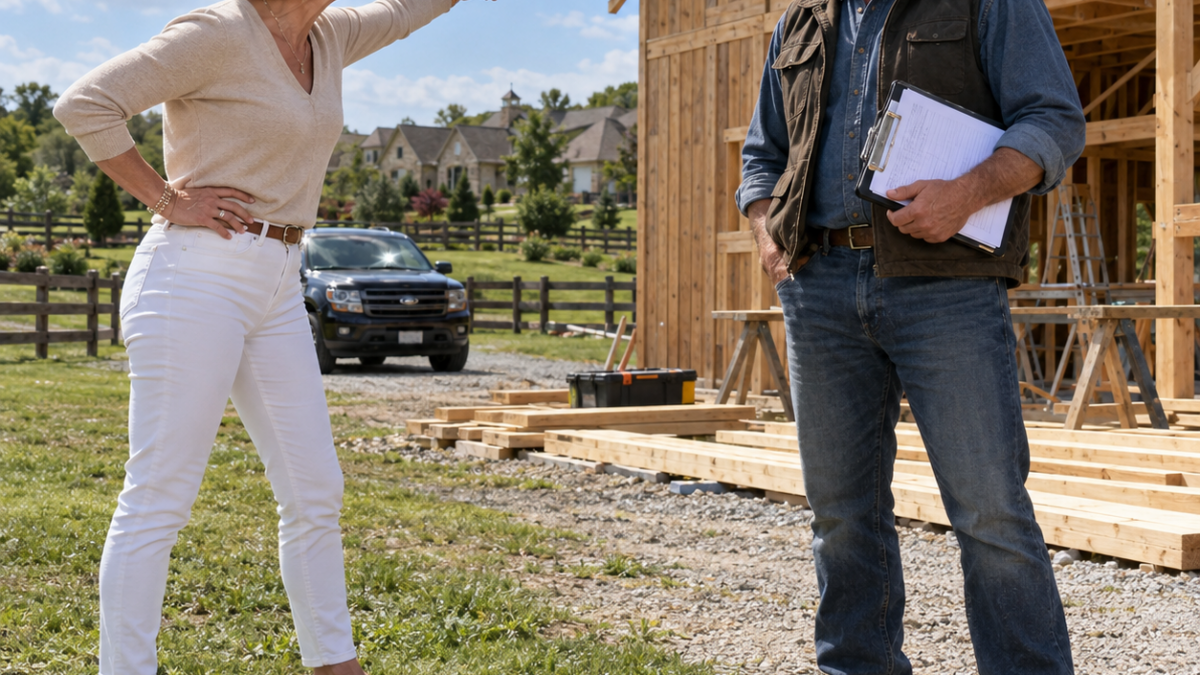
PART 2
I waited until Karen disappeared behind the row of maple trees before I unfolded the red notice again.
Ten thousand dollars.
Five hundred dollars every additional day.
Demolition.
The language was designed to make an ordinary homeowner panic.
That was the entire point.
A person saw words like FINAL NOTICE, PENALTY, ENFORCEMENT, and DEMOLITION printed in capital letters and assumed somebody with actual authority had approved them.
But I had spent too many years dealing with government documents to be impressed by bold lettering.
Real authority had procedures.
Real enforcement had signatures.
Real demolition orders did not get printed by an HOA president and attached to a barn with plastic zip ties.
I carried the notice into my house and placed it on the dining room table.
Then I opened the file cabinet in my study.
Karen had made one mistake from the beginning.
She assumed I was keeping her letters because I was frightened.
I was keeping them because I document everything.
Every email.
Every certified envelope.
Every notice.
Every fine.
Every response.
Every postal receipt.
By noon, my dining room table looked like the evidence room of a small police department.
At the center was the deed to my property.
The relevant language was not ambiguous.
The residential lot containing my house belonged to Harmony Creek and remained subject to its ordinary HOA restrictions.
The acreage behind it did not.
The five acres had been carved from the original agricultural tract before the subdivision covenants were recorded.
Karen could dislike my barn.
She could complain about it.
She could stand at the property line every morning and glare at it until Christmas.
What she could not do was regulate it under covenants that did not apply.
Still, I wanted more than my deed.
Karen had escalated.
So I decided to understand exactly how much authority she actually possessed.
The next morning, I went to the county records office.
There was something comforting about that building.
Most people hated government archives.
They saw gray filing cabinets, fluorescent lights, dusty plats, and pages of legal language.
I saw memory.
People lied.
Paper usually didn’t.
I pulled the original Harmony Creek subdivision plat.
Then the declaration of covenants.
Then the amendments.
Then the association bylaws.
Then every filing connected to the HOA since incorporation.
I brought copies home and spread them across the dining room table.
For three nights, I read.
My late wife, Ellen, used to laugh at the way I could disappear into technical documents.
She would come into the room carrying coffee and say, “You know normal people read novels for entertainment.”
“I read novels.”
“You read bridge specifications.”
“They have suspense.”
She had been gone four years by then.
Cancer.
Fast and merciless.
The barn had partly been for me and partly been for her.
Ellen had been the one who refused to let me sell the Mustang.
Every few years I would say it was ridiculous to keep an old car that hadn’t run since the nineties.
She would answer, “Someday you’ll finally have time.”
The barn was supposed to be that someday.
Maybe that was why Karen’s campaign bothered me more deeply than I wanted to admit.
She hadn’t merely attacked lumber and concrete.
She had invaded the quiet future Ellen and I had once imagined.
That thought kept me reading until nearly two in the morning.
And sometime after midnight on the third night, I found what I needed.
Actually, I found two things.
The first confirmed what I already knew.
My acreage was exempt.
Explicitly.
Completely.
No architectural-review authority.
No exterior-structure restriction.
No HOA approval requirement.
Karen’s legal theory existed only inside Karen Bishop’s head.
The second discovery was more interesting.
Harmony Creek’s own bylaws contained detailed enforcement procedures.
Before monetary penalties could be imposed, the association had to provide written notice.
Then a cure period.
Then the homeowner had a right to request a hearing.
Major fines required approval of the board.
Certain actions required legal review.
Anything approaching forced removal of a permanent structure required a court order.
Karen had followed almost none of those procedures with me.
When I began comparing her notices with the bylaws, another pattern emerged.
The covenant sections she cited were sometimes wrong.
One section had nothing to do with buildings.
Another dealt with recreational vehicles.
A third had been superseded by an amendment five years earlier.
She wasn’t interpreting the rules aggressively.
She was bluffing.
And she had probably been bluffing for years.
I leaned back in my chair.
That possibility bothered me more than anything she had done to me personally.
Because I could fight back.
I understood documents.
I knew where to look.
But what about people who didn’t?
How many residents had paid fines simply because Karen used official-looking stationery?
How many had removed things they loved?
How many had been humiliated because they assumed she knew the rules better than they did?
The next morning I drafted a response.
Not an angry letter.
Angry letters are gifts to the other side.
I wrote something colder.
Twenty-three numbered paragraphs.
Parcel identification.
Deed references.
Exemption language.
Building-permit number.
Inspection dates.
Applicable HOA provisions.
Procedural failures.
Copies of every communication.
At the end I demanded three things.
Immediate cancellation of all fines.
Written withdrawal of the demolition notice.
No further interference with construction on the exempt acreage.
Then I added a deadline.
Ten business days.
Karen liked deadlines.
I thought she should experience one.
I sent a copy to every board member.
Not email.
Not regular mail.
I hired a process server.
That decision cost me a little money, but it bought something more valuable.
Nobody on the board could later say they had not known.
Two days later, I was standing on a ladder installing cedar trim when a dark sedan stopped at the end of my driveway.
A man in a gray suit walked toward me carrying an envelope.
“Mark Davies?”
“That’s me.”
He handed it over.
“You’ve been served.”
I climbed down.
The letter came from the law firm representing Harmony Creek.
The first paragraph contained approximately a hundred words designed to avoid saying the HOA had been wrong.
The second paragraph announced that the fines against my property were being “temporarily suspended pending review.”
The demolition discussion was also being “tabled.”
I laughed.
They had retreated while carefully refusing to use the word retreat.
Then I reached the final paragraph.
My amusement disappeared.
The attorneys warned that although the structural issue remained under review, operating a commercial business from the property could violate both county zoning regulations and community restrictions.
There it was.
A new angle.
The barn itself had become difficult to attack.
So Karen was preparing to claim I was using it as a business.
I folded the letter and slipped it into my evidence file.
Then I went back outside.
For the next week, nothing happened.
No new fines.
No angry emails.
No Karen.
The silence should have felt peaceful.
Instead, it felt like standing on a railroad track after hearing a whistle somewhere in the distance.
I knew something was coming.
I also knew I could no longer treat the dispute as simply mine.
So I started knocking on doors.
The first belonged to Luis and Maria Garcia.
They lived two streets into Harmony Creek in a beautifully maintained ranch house with white shutters.
They were in their seventies.
Luis had spent most of his career repairing school buses.
Maria had worked in a library.
I had seen them walking their little terrier almost every morning.
They were the kind of neighbors who waved even when they couldn’t remember your name.
When I knocked, I carried a plate of cinnamon scones my sister had dropped off the day before.
Luis opened the door.
“Mark.”
“Hope I’m not interrupting.”
“Depends. Are those for us?”
“They can be.”
He grinned.
“Then you could interrupt a funeral.”
Maria made coffee.
We sat at the kitchen table.
I explained what had happened with the barn.
I barely finished describing Karen’s demolition notice before Luis exchanged a look with his wife.
“Oh,” he said quietly. “She’s doing it to you now.”
The way he said now made my stomach tighten.
“What happened?”
Maria walked into the living room and returned carrying a small photo album.
She opened it.
Their granddaughter appeared in photograph after photograph.
Birthday parties.
Christmas.
A backyard picnic.
And beside her in several pictures stood a ceramic garden gnome with a red hat.
Maria touched one photo.
“She named him Gnorman.”
“With a G,” Luis added.
Their granddaughter had given them the gnome when she was six.
He stood beside the porch.
Twenty-two inches tall.
Nothing offensive.
Nothing dangerous.
Nothing anybody sane would consider a neighborhood crisis.
Karen sent them a violation.
Harmony Creek’s landscaping rules permitted only certain decorative objects visible from the road.
According to Karen, Gnorman failed to qualify.
Luis wrote back.
He explained it had sentimental value.
He offered to move it deeper into the flowerbed.
Karen refused.
Then came the fines.
Twenty-five dollars a day.
Luis and Maria lived comfortably, but they were retired.
Eight hundred dollars mattered.
When they tried to request a hearing, Karen told them the board had already reviewed the situation.
Luis lowered his eyes.
“What did you do?” I asked.
He stared at his hands.
Maria answered.
“He broke it.”
I didn’t understand at first.
Then I did.
“With a hammer,” she said.
Luis swallowed.
“I thought if I put it in the garage, she might claim we still hadn’t complied. So I broke it up.”
Maria’s voice cracked.
“Our granddaughter asked where he went.”
Luis stared toward the window.
“We told her Gnorman was traveling.”
I sat very still.
There are injustices that sound ridiculous when described quickly.
A garden gnome.
A blue door.
A swing set.
A vegetable garden.
The objects sound trivial.
The humiliation isn’t.
Karen had taken two decent elderly people and made them destroy something their granddaughter loved because she wanted proof that they understood who was in control.
“Do you still have the letters?” I asked.
Maria disappeared into a bedroom.
She returned with a shoebox.
Every notice was inside.
Every envelope.
Every fine.
I spent an hour reading them.
The same language.
The same threats.
The same procedural shortcuts.
When I left, Maria touched my arm.
“Mark?”
I turned.
“If you’re going to fight her…”
She hesitated.
“Don’t stop halfway.”
“I won’t.”
My next visit was the Patel house.
Amir Patel answered the garage door wearing sweatpants and holding a plastic dinosaur.
Behind him, two children were conducting what appeared to be a war involving approximately forty stuffed animals.
“Mr. Davies.”
“Mark.”
He looked at the folder under my arm.
“You selling insurance?”
“No.”
“Then come in.”
When I mentioned Karen, he groaned.
“My wife calls it the Beige Inquisition.”
He pointed toward their front door.
It was beige.
Not attractive beige.
Not warm beige.
The kind of beige usually found in government waiting rooms.
“It used to be blue,” he said.
He showed me a picture on his phone.
Muted colonial blue.
Tasteful.
Clean.
Beautiful against the cream-colored siding.
“Karen hated it?”
“Karen declared war.”
The Patels had painted the door three months after moving in.
Two days later, a violation notice arrived.
Unauthorized color.
Harmony Creek maintained an approved palette.
Amir pulled out the design guide.
Twenty-four exterior colors.
Nearly all beige, brown, gray, taupe, or off-white.
Gentle Fawn.
Windswept Sand.
Autumn Oatmeal.
Hint of Biscuit.
I stared at that one.
“Hint of Biscuit?”
He nodded solemnly.
“We live in Hint of Biscuit.”
“What happened when you challenged it?”
“We went to a board meeting.”
“And?”
“Karen talked over us for four minutes, told us we should have read the rules before buying, and called the next agenda item.”
“You got fined?”
“Two hundred fifty bucks, plus repainting.”
His wife Priya walked into the garage carrying laundry.
“Tell him about the swing set.”
Amir sighed.
Another family had installed an expensive backyard play structure.
The canopy was dark green.
Karen said only neutral coverings were permitted.
The family could not find a replacement canopy compatible with the structure.
Eventually they removed the entire thing.
Then there was a retired teacher named Dorothy Shaw.
Dorothy grew tomatoes and peppers along the sunny side of her house.
Karen classified it as prohibited agricultural activity.
Another couple received repeated warnings because their American flag bracket extended several inches beyond an approved mounting position.
One widow was cited because her trash bin remained visible from the street for two hours after the permitted collection window while she was at a medical appointment.
The more stories I heard, the clearer the pattern became.
Karen didn’t enforce rules consistently.
She enforced submission.
Residents who apologized quickly were sometimes forgiven.
People who questioned her received escalating penalties.
People she liked got warnings.
People she disliked got certified letters.
She operated through fear.
And most disturbingly, the rest of the HOA board had allowed it.
Over the next two weeks, I built files.
Garcia.
Patel.
Shaw.
Bennett.
Morrison.
Reed.
Each contained copies of notices, photographs, dates, and witness statements.
I found several cases where Karen appeared to have imposed fines without the vote required by the bylaws.
I found another where she claimed a homeowner had waived the right to appeal simply by paying a portion of the disputed amount.
That language appeared nowhere in the governing documents.
By the time the quarterly HOA meeting arrived, I had stopped thinking of my barn as the main issue.
The barn was merely the first loose thread.
I was pulling it.
The entire fabric was starting to unravel.
The meeting began at seven on a Thursday evening.
The Harmony Creek clubhouse looked exactly like every suburban clubhouse built between 1995 and 2005.
Beige walls.
Brown carpet.
Artificial plants.
Stackable chairs.
A coffee machine nobody trusted.
About sixty residents attended.
That was unusually high.
Word had spread.
I sat beside Luis and Maria.
Amir sat two rows behind us.
Karen occupied the center seat at the long board table.
She wore a flowered dress and pearls.
Her wooden gavel rested in front of her.
At exactly seven, she struck it.
“The quarterly meeting of the Harmony Creek Homeowners Association is hereby called to order.”
She smiled.
I had seen friendlier expressions on people being photographed for driver’s licenses.
The meeting crawled through minutes, maintenance reports, landscaping contracts, and a lengthy speech from Karen congratulating herself on the success of what she called the Fall Decorative Compliance Initiative.
Apparently several families had placed Halloween decorations too early.
Karen had corrected them.
The neighborhood had survived.
Finally she reached new business.
“Does anyone have properly submitted new business for board consideration?”
I stood.
“I do.”
The room changed.
Karen saw me.
Her mouth tightened.
“Mr. Davies, I don’t believe you submitted an agenda request.”
“No.”
“Then your issue cannot be heard tonight.”
“My issue concerns board misconduct.”
Murmurs moved through the room.
Karen raised the gavel.
“Sit down.”
I remained standing.
She leaned toward the microphone.
“Mr. Davies, you are out of order.”
“So was the demolition notice you put on my barn.”
Luis inhaled beside me.
Karen’s face flushed.
“That matter is under legal review.”
“So are your fines against the Garcias?”
Silence.
Maria stared forward.
Karen blinked.
“I don’t know what you’re referring to.”
“Yes, you do.”
I held up a copy of the gnome violation.
“You fined two retired residents until they destroyed a gift from their granddaughter.”
A whisper traveled through the room.
Karen struck the gavel.
“This is inappropriate.”
“So was charging the Patels because their front door was blue.”
Amir stood.
“It was a nice blue.”
A few people laughed.
Karen glared at him.
I continued.
“And so was threatening a retired teacher over tomatoes.”
Dorothy Shaw raised her hand.
“Best tomatoes in the subdivision.”
More laughter.
Something important happened then.
People stopped being afraid.
Fear depends on isolation.
Karen had spent years making residents feel each conflict was theirs alone.
Now they were looking around and realizing almost everybody had a story.
Karen sensed it too.
“This meeting will not become a forum for personal attacks.”
“These aren’t personal attacks,” I said. “They’re documented enforcement actions.”
I lifted the folder.
“And many appear to violate your own bylaws.”
One of the board members, a quiet man named Stewart Collins, finally looked up.
“What violations?”
Karen turned sharply.
“Stewart.”
He ignored her.
“Mark, what violations?”
I opened the summary I had prepared.
“Fines imposed without required hearings. Fines above the president’s authority without documented board approval. Improper denial of appeals. Citation of provisions that were amended or don’t apply. And in my case, a demolition notice issued without any judicial authority whatsoever.”
Stewart looked at Karen.
“Is that true?”
“Absolutely not.”
I handed him a copy.
Then I handed another to the woman beside him.
Karen banged the gavel.
“No documents are to be distributed without board approval.”
I looked at her.
“Where is that rule?”
She froze.
Someone in the back laughed.
Karen stood.
“This meeting is adjourned.”
“I move for a vote of no confidence in the president.”
She stared at me.
“You can’t.”
“Then say why.”
“The motion is out of order.”
“Under which section?”
Her eyes flicked toward the binder in front of her.
She did not answer.
“I second it.”
Amir Patel stood.
Karen spun toward him.
“You sit down.”
“No.”
The word was quiet.
But it hit the room harder than shouting.
Another resident stood.
Then another.
Karen grabbed the gavel.
“This meeting is over.”
She struck the table so hard the wooden head separated from the handle.
It flew across the room.
Hit the carpet.
Rolled beneath a folding chair.
Nobody moved.
For approximately three seconds there was complete silence.
Then Dorothy Shaw started laughing.
Not cruelly.
She simply couldn’t help herself.
Others joined.
Karen’s face turned almost purple.
She stuffed papers into her bag and stormed toward the exit.
As she passed me, she whispered, “You’re going to regret this.”
I watched her leave.
“No,” I said quietly.
“I don’t think I am.”
The next morning, the county email arrived.
FORMAL NOTICE OF ZONING COMPLAINT.
Alleged unlicensed commercial automotive operation.
My barn.
The complaint claimed I intended to operate an auto restoration business.
It described customers, equipment, vehicle traffic, chemical storage, and signage.
Almost none of it existed.
There were no customers.
No business.
No signage.
The only car intended for the barn was my Mustang.
The complainant was listed as confidential.
I didn’t need a detective.
The HOA attorney’s previous letter had already previewed the accusation.
Karen had done exactly what I expected.
She had taken her war outside the HOA.
And brought it to the county.
I read the complaint twice.
Then I smiled.
That may sound sinister.
It wasn’t.
I smiled because after months of Karen inventing rules, she had finally entered a system governed by real ones.
My official position with the county had grown out of an odd second career.
After leaving my long engineering career, I had taken what I originally expected to be temporary consulting work assisting the county with property valuation, land-use reviews, and complex improvements.
I liked the work.
I understood construction.
I understood structures.
I understood how renovations, additions, easements, parcel boundaries, zoning changes, and improvements affected property value.
Temporary consulting eventually became a permanent senior assessor position.
Most of my neighbors knew I had “worked for the county.”
Few understood exactly what I did.
Karen apparently had never bothered to ask.
Because if she had, she might have understood the significance of filing a formal complaint alleging that a property in Harmony Creek had undergone a material change of use.
Certain complaints could trigger an inspection.
And once a potentially material change affected one parcel inside a development, assessment equity procedures sometimes required surrounding comparable properties to be reviewed as well.
I did not get to decide someone was guilty.
I did not get to retaliate.
I did not get to create penalties because I disliked somebody.
What I could do was follow procedure.
So that is exactly what I did.
I documented the complaint.
I disclosed my personal dispute with the HOA president to my supervisor.
That part mattered.
I was not going to become Karen.
My supervisor, Robert Keller, read everything.
Then he leaned back.
“You understand that because of the conflict, you don’t get unilateral authority over anything involving Bishop.”
“Absolutely.”
“Any reassessment gets independently reviewed.”
“Good.”
“Any code issues go to enforcement.”
“Good.”
“And every step gets documented.”
“That’s what I want.”
Robert studied me.
“You’re enjoying this a little.”
“I’m enjoying procedure.”
“Mark.”
“Fine. I’m enjoying procedure a lot.”
He laughed.
Then he signed the review authorization.
The county initiated a valuation-equity review connected to the zoning complaint.
My property was inspected first.
Not by me.
By another assessor.
He confirmed there was no commercial operation.
No customer vehicles.
No signs.
No employees.
No business equipment beyond ordinary private workshop tools.
No zoning violation.
Karen’s complaint failed.
But the review did not stop there.
Comparable properties were examined for consistency.
Harmony Creek contained several homes whose county records had not been physically verified for years.
One of those homes belonged to Karen Bishop.
Twelve Serenity Lane.
The largest residence in the subdivision.
I remembered the first time I had seen it.
Faux Tuscan façade.
Three-car garage.
Stone fountain.
Tall arched windows.
Large deck visible behind the house.
I pulled the public property card.
Four thousand two hundred square feet.
Four bedrooms.
Three and a half bathrooms.
Unfinished basement.
Standard kitchen.
Small rear patio.
I stared at the screen.
Then I remembered a neighborhood Christmas party three years earlier.
Karen had spent twenty minutes telling a group of women about her home theater.
In the basement.
She had also bragged about her wine cellar.
In the unfinished basement.
I said nothing.
The inspection notice went out through ordinary county channels.
Karen received it by certified mail.
Her attorney contacted the office two days later.
He questioned whether the review was retaliatory.
Robert responded personally.
He provided the statutory basis.
The triggering complaint.
The assessment-equity procedure.
My written conflict disclosure.
The independent supervisory controls.
The lawyer had no procedural argument left.
Inspection day arrived on a Tuesday.
At nine in the morning, I parked beside another county vehicle in front of Karen’s house.
Robert had decided that because I possessed the construction expertise needed for the physical review, I could participate—but only with a second assessor present and with Robert reviewing every conclusion.
I appreciated that decision.
Not because I feared Karen.
Because whatever happened next needed to be unimpeachable.
My colleague was Rachel Monroe.
Twenty-nine years old.
Sharp.
Unimpressed by drama.
She looked at the house.
“Big place.”
“Records say forty-two hundred square feet.”
She glanced at the roofline.
“Records say lots of things.”
Karen opened the door before we rang.
She wore a cream-colored silk robe.
Her expression could have soured milk.
“You.”
“Good morning, Ms. Bishop.”
“My attorney told me you would not be conducting this inspection alone.”
“I’m not.”
Rachel raised a hand.
“Rachel Monroe. County assessor’s office.”
Karen looked from her to me.
“This is harassment.”
Rachel answered before I could.
“Any procedural complaint should be directed to Mr. Keller. Today we’re here to verify property characteristics.”
Karen stepped aside.
The foyer told us almost immediately that the property card was outdated.
Polished stone flooring.
Custom staircase.
High-end millwork.
Rachel photographed features while I took measurements.
We moved into the living room.
Custom fireplace.
Coffered ceiling.
Built-in cabinetry.
Kitchen.
Six-burner professional range.
Oversized refrigerator.
Custom cherry cabinets.
Stone counters.
Rachel checked the property card.
“Standard laminate.”
Karen crossed her arms.
“It was renovated.”
“Permits?” Rachel asked.
“My contractor handled that.”
Rachel wrote something down.
We inspected the main level.
Then the upper floor.
A room listed as open loft space had been enclosed.
It contained a bed.
Closet.
Permanent heating.
Electrical outlets.
Bedroom.
“Was this original?” I asked.
Karen hesitated.
“We changed it.”
“When?”
“Years ago.”
“Permit?”
“My husband handled that.”
I wrote down the answer.
Then came the basement.
Karen stopped at the door.
“There’s nothing downstairs.”
Rachel glanced at the property card.
“It’s listed unfinished. We still verify unfinished space.”
“It’s storage.”
“We’ll be quick.”
Karen stood still.
For the first time that morning, the anger in her face was replaced by something else.
Fear.
She unlocked the door.
We descended.
At the bottom, Rachel stopped.
“Oh.”
That one syllable said everything.
The “unfinished basement” contained a full bar.
Stone counters.
Built-in refrigeration.
A wine cellar enclosed by glass.
Theater.
Leather seats.
Projection system.
Finished walls.
Finished ceilings.
Recessed lighting.
A bathroom.
A billiard room.
Climate control.
Approximately two thousand square feet of finished living and recreational space.
I didn’t gloat.
I didn’t smile.
I measured.
Rachel photographed.
Karen followed us from room to room.
Her breathing became louder.
“You don’t need pictures of everything.”
“We document improvements.”
“This is private.”
“You requested privacy by filing an official complaint against another property owner?”
Rachel looked at me.
I stopped.
That sentence had slipped out.
Karen noticed.
“There it is.”
She pointed.
“Retaliation.”
I lowered the laser measure.
“You’re right.”
Rachel looked surprised.
I continued.
“That comment was inappropriate.”
Karen blinked.
“I’m documenting that I made it, and Rachel can conduct the rest of the interior questions.”
The room went quiet.
That was one of the strangest moments in the entire fight.
Karen expected me to defend myself.
To argue.
To do what she would have done.
Instead I admitted the mistake.
Because rules only mean something if you obey them when they inconvenience you too.
Rachel took over.
We finished the basement.
Then we went outside.
The rear deck was enormous.
Multiple levels.
Outdoor kitchen.
Electrical service.
Gas line.
Hot tub.
Built-in lighting.
The county drawing showed a ten-by-twelve concrete patio.
Rachel stared at the plans.
Then at the deck.
“That’s not close.”
“No.”
She measured.
Karen remained near the back door.
Her confidence had disappeared completely.
“Are we done?”
Rachel checked her list.
“Almost.”
The outdoor kitchen required review.
The spa electrical system required review.
The deck foundation required permit verification.
Several changes could affect valuation.
Nothing we found automatically meant fraud.
Records become outdated.
People inherit bad permits.
Contractors fail to file documents.
Additions sometimes predate current owners.
That was why investigations existed.
We packed our equipment.
Karen looked at me.
“Happy?”
I thought about the Garcias breaking Gnorman with a hammer.
The Patels repainting their blue door.
Dorothy hiding her tomatoes behind lattice.
My barn covered with a fake demolition notice.
A petty answer rose in my throat.
I swallowed it.
“No,” I said.
“This is my job.”
For once, Karen had nothing to say.
Back at the county office, we began verification.
That was when the situation moved beyond embarrassing.
The permit department had no record for most of the improvements.
No basement finishing permit.
No deck permit matching the existing structure.
No permit for the converted fifth bedroom.
No documented inspection for several electrical additions.
No record of the outdoor kitchen gas connection.
Rachel forwarded the information to code enforcement.
Not me.
Robert reviewed the assessment changes.
Not me.
The process moved through separate departments.
The revised valuation increased significantly.
Not because anybody punished Karen.
Because the house she actually owned was materially different from the house described on the county’s books.
Code enforcement scheduled its own inspection.
George Hanley led it.
George had inspected my barn during construction.
He called me after receiving the referral.
“You know this address?”
“I do.”
“I figured.”
“Treat it like any other property.”
“Mark, I treat every property like every other property.”
“That’s why I’m saying it.”
He laughed.
“Understood.”
Karen’s first real blow arrived approximately three weeks later.
Notice of reassessment.
Then code enforcement findings.
Then retroactive permitting requirements.
Some work could potentially remain if engineers certified it.
Some might need to be opened for inspection.
Walls could have to be cut.
Electrical systems exposed.
Deck footings examined.
Gas connections tested.
If structural components failed current requirements, portions could require modification or removal.
Expensive?
Absolutely.
Automatic destruction?
No.
That distinction mattered.
I had spent months being threatened with punishment invented to frighten me.
I had no interest in inventing punishment for Karen.
The facts were enough.
The neighborhood noticed the county vehicles.
Of course it did.
Harmony Creek could detect an unauthorized flowerpot at three hundred yards.
Three government trucks in the HOA president’s driveway might as well have been a parade.
Rumors spread.
I refused to participate.
When Amir asked what inspectors had found, I told him property information would follow ordinary public-record rules once finalized.
“Come on, Mark.”
“No.”
“She would tell everybody.”
“I’m not her.”
He stared at me.
Then smiled.
“Fair.”
Meanwhile, the board situation deteriorated.
Stewart Collins contacted me.
He wanted copies of the materials I had distributed at the meeting.
I gave them to him.
Two other directors contacted residents independently.
They began auditing association enforcement records.
What they found was worse than I expected.
Karen had sometimes described fines as “board approved” when meeting minutes contained no vote.
She had authorized legal letters before formally consulting the board.
She had directed the management company to treat disputed fines as final before hearings occurred.
Most disturbing was the money.
Not theft.
At least not initially.
But the financial records showed thousands of dollars in penalties collected through processes that may not have complied with the bylaws.
Residents began demanding refunds.
The board scheduled an emergency meeting.
Karen tried to cancel it.
The other directors refused.
That meeting drew nearly a hundred residents.
People stood along the walls.
Some watched from the hallway.
Karen sat at the board table.
This time there was no gavel in front of her.
Stewart opened the meeting.
Karen immediately objected.
“As president, I call meetings.”
Stewart looked exhausted.
“Not when a majority of the board calls a special meeting under Section Four.”
“I did not authorize it.”
“That section does not require your authorization.”
Karen turned toward the crowd.
“This is a coup.”
Dorothy Shaw whispered loudly, “Do we get tomatoes after?”
Laughter rolled across the room.
Karen’s eyes found me.
“You did this.”
I was standing against the back wall.
“No.”
“You turned them against me.”
“I told people what happened.”
“You humiliated me.”
Luis Garcia stood.
His voice shook, but he spoke clearly.
“You humiliated us.”
Karen looked at him.
Luis continued.
“You made me destroy my granddaughter’s present.”
“That decoration violated published standards.”
“I asked for a hearing.”
“You were given—”
“No.”
Maria stood beside him.
“We were never given one.”
The room quieted.
Amir stepped forward.
“You fined us before our appeal was heard.”
Dorothy raised a hand.
“You told me vegetables counted as farming.”
Someone else spoke.
“You threatened a lien over a basketball hoop.”
Another voice.
“You fined us because our trash cans were visible while my wife was in the hospital.”
Another.
“You approved the Johnsons’ fence and denied ours even though they’re identical.”
The stories came faster.
Karen tried answering.
Then interrupting.
Then shouting.
Finally Stewart raised his voice.
“Enough.”
Everyone stopped.
He looked at Karen.
“The board has completed a preliminary review.”
Her expression changed.
“This review identified enforcement actions undertaken without documented board authorization, procedural violations involving hearings and appeals, and material inconsistencies in penalty administration.”
“My decisions were made for the good of the community.”
“That isn’t the issue.”
“I protected property values!”
Amir laughed bitterly.
“By making everybody afraid to live here?”
Karen pointed toward me.
“And what about him?”
The room turned.
“He built a massive illegal building!”
Stewart looked at me.
“Is the barn illegal?”
“No.”
“County permit?”
“Yes.”
“Inspections?”
“Yes.”
“Does the architectural covenant apply to that acreage?”
“No.”
Karen slammed her palm against the table.
“That exemption is a technicality.”
I finally stepped forward.
“No, Karen.”
My voice stayed level.
“Rules are technicalities when they protect somebody you don’t like. They become sacred law when you can use them against somebody you do.”
She stared at me.
I continued.
“You never cared about consistency.”
“You don’t know anything about what I cared about.”
“Then tell us.”
Something shifted in her expression.
For a moment, the powerful HOA president disappeared.
What remained looked tired.
“I cared about this neighborhood not turning into every other declining subdivision.”
Nobody interrupted.
“When my husband and I moved here, Harmony Creek was beautiful. People maintained things. They respected standards.”
Her voice trembled.
“Then one person paints a door whatever color they want. Someone else puts junk in a yard. Another builds something. Another ignores landscaping. Pretty soon nobody cares.”
Maria spoke softly.
“A garden gnome wasn’t going to destroy the neighborhood.”
“You don’t understand.”
Karen looked around.
“If you let one thing go, everybody demands an exception.”
“No,” I said.
“Everybody demands fairness.”
Her eyes met mine.
“And you think you’re fair?”
“I try to be.”
“You enjoyed inspecting my house.”
That accusation landed because part of it was true.
Not the inspection itself.
But the irony.
I had felt satisfaction when her bluff brought scrutiny to her own property.
I could lie.
Or I could be honest.
“Part of me appreciated the irony.”
Murmurs moved through the room.
Karen almost smiled.
“There.”
“But that’s why I disclosed the conflict. That’s why another assessor attended. That’s why my supervisor reviewed everything. That’s why code enforcement made its own decisions.”
I gestured toward the board.
“Power requires controls, Karen. Especially when the person using it believes they’re right.”
She looked away.
Stewart resumed.
“The board will vote on a motion to remove Karen Bishop as president pending a full independent audit.”
Karen stood.
“You can’t remove me.”
“We can.”
“I built this association.”
“No,” Luis said.
“We did.”
The vote was four to one.
Karen voted for herself.
Everyone else voted to remove her.
She gathered her purse.
Then she looked at me.
“I hope you’re proud.”
I thought about answering.
Instead I moved aside so she could walk past.
The room stayed silent until the doors closed behind her.
Then people exhaled.
Not cheered.
Exhaled.
Like a storm warning had finally been canceled.
The board appointed Stewart temporary president.
Its first action was to suspend enforcement penalties while outside counsel reviewed questionable cases.
Its second was to commission an audit.
Its third was to invite residents to submit disputed enforcement histories.
The mailbox overflowed.
Karen’s personal problems also continued.
Her property assessment went through formal review.
She challenged it, which she had every right to do.
Her attorney argued that some improvements had been valued too aggressively.
The appeals panel reduced a few adjustments.
Others remained.
That was fine with me.
The system worked.
Karen also sought retroactive permits.
Engineers examined the basement.
The finished space could remain after electrical corrections, fire-blocking improvements, egress changes, and substantial permit fees.
The deck required more serious reconstruction.
Several footings failed inspection.
A portion of the structure had to be dismantled and rebuilt.
The outdoor gas installation required replacement.
It cost her heavily.
But reality was different from the fantasy of instant financial annihilation.
She did not lose everything because I waved a government badge.
No assessor has that kind of legitimate power.
What happened was slower.
More ordinary.
And, in many ways, more devastating.
Karen’s husband, Richard, had tolerated the HOA obsession for years.
According to neighbors, he had mostly stayed out of it.
The inspection and permitting mess exposed how much money had been spent on additions.
Legal bills followed.
Then association counsel informed Karen that the HOA’s insurance carrier might not cover actions taken outside authorized procedure.
For the first time, some legal expenses could become personal.
The independent HOA audit eventually identified dozens of disputed penalties.
Many residents were refunded.
Not everyone received everything back.
Some violations had been legitimate even when Karen’s manner was unpleasant.
That distinction caused arguments.
Amir wanted nearly every penalty reversed.
Stewart insisted the board evaluate each one.
I supported Stewart.
If we replaced Karen’s arbitrary punishment with arbitrary forgiveness, we had learned nothing.
Luis and Maria received their eight hundred dollars back.
The letter arrived on a Friday.
Luis called me.
“Come over.”
I found him and Maria at the kitchen table.
The refund check lay between them.
Maria was crying.
“I know it’s only money,” she said.
“No.”
“It’s not.”
Luis nodded.
“It means she was wrong.”
That evening I went into my barn and opened an old cedar box.
Inside were several woodworking tools that had belonged to my father.
A block plane.
Two chisels.
A small carving knife.
I hadn’t carved anything decorative in years.
But over the next week, I worked at night.
I found a piece of cedar.
Cut the shape.
Rounded the body.
Carved a beard.
A tall hat.
Boots.
The result was not elegant.
One eye was slightly higher than the other.
The nose was too large.
The hat leaned.
Ellen would have laughed until she cried.
I painted the hat red.
The coat blue.
Then I took it to the Garcias.
Maria opened the door.
I held the wooden gnome out.
“This is terrible,” I said, “but he should survive a hammer better than ceramic.”
Maria covered her mouth.
Luis stared.
“You made that?”
“I attempted to.”
Maria took it.
She ran her fingers along the uneven beard.
“What’s his name?”
I looked at Luis.
He smiled.
“Gnorman Two.”
“With a G,” Maria said.
“With a G.”
They placed him in the exact spot where the original had stood.
Twenty-four inches tall.
Two inches over the old limit.
The new board repealed that provision a month later.
The Patels repainted their door.
Blue.
Not the subdued colonial blue they had originally chosen.
Amir selected a brighter shade.
When I saw it, I raised an eyebrow.
“Little aggressive.”
He grinned.
“Freedom is ugly sometimes.”
Dorothy expanded her garden.
She brought me tomatoes all summer.
The Bennett family found a replacement green canopy for the swing set.
Harmony Creek did not collapse.
Property values did not plummet.
Civilization survived.
Children rode bicycles.
People walked dogs.
Someone put a flamingo in a flowerbed.
Nobody died.
My barn reached completion in November.
George performed the final inspection.
He checked the electrical work.
Looked at the framing.
Tested several details.
Then he signed the certificate.
“You built this thing like a bridge.”
“Occupational disease.”
He looked around the workshop.
“Where’s the commercial auto business?”
I pointed toward the Mustang chassis.
“Customer number one.”
“That yours?”
“Since 1989.”
George whistled.
“You ever going to finish it?”
“My wife asked me that for twenty years.”
He grew quiet.
“You miss her?”
“Every day.”
He nodded.
Then looked around the barn again.
“She’d like this.”
I swallowed.
“Yeah.”
After he left, I hung the final inspection certificate beside the door.
Then I opened the folder where I had kept Karen’s red demolition notice.
I considered throwing it away.
Instead I framed it.
Not because I wanted a trophy.
Because I wanted a reminder.
Rules can protect people.
Rules can also be weaponized.
The difference is process.
Transparency.
Accountability.
And the humility to understand that authority does not make a person infallible.
Winter came.
The HOA election happened in January.
Amir ran for president.
So did Stewart.
To everyone’s surprise, Amir withdrew the night before voting and supported Stewart.
When I asked him why, he shrugged.
“I realized I wanted revenge more than governance.”
“That’s unusually self-aware.”
“My wife told me.”
“That sounds more realistic.”
Stewart won.
Amir joined the architecture committee.
Luis became its loudest unofficial critic.
Dorothy supplied tomatoes to every meeting.
For the first time since I had moved there, HOA meetings became boring.
That was progress.
Then, late one February afternoon, I saw Karen again.
I was working on the Mustang when a car stopped near my driveway.
A modest gray sedan.
Karen stepped out.
She had changed.
Not physically as much as somehow in scale.
Without the board table, gavel, official emails, and authority surrounding her, she simply looked like a middle-aged woman standing beside a road.
I wiped my hands and walked outside.
She remained on the other side of the property line.
For a few seconds neither of us spoke.
Finally she said, “I’m moving.”
I had heard.
Her house had been listed.
Not foreclosed.
Not seized.
Sold voluntarily, according to what I knew.
Legal expenses, renovation costs, and the increased tax burden had apparently made the house impractical.
“I’m sorry,” I said.
She laughed once.
“You don’t have to pretend.”
“I’m not.”
“You wanted consequences.”
“Yes.”
“And now I’m selling my home.”
“That wasn’t the consequence I asked for.”
“No. You were smarter than that. You just pushed the first domino.”
I considered the accusation.
“You filed the county complaint.”
“So this is my fault.”
“I didn’t say that.”
“You don’t need to.”
The cold wind moved through the grass between us.
Karen looked toward the barn.
“It is beautiful.”
I almost thought I had misheard her.
“What?”
“The barn.”
She nodded toward it.
“It’s beautiful.”
“Thank you.”
“I hated it before I ever saw what it would become.”
“Why?”
Her answer surprised me.
“Because you didn’t ask me.”
I said nothing.
She smiled without humor.
“That sounds insane when I say it out loud.”
“It sounds honest.”
“I spent years being the person everyone had to ask.”
“And eventually you believed permission came from you instead of the rules.”
“Yes.”
The admission hung between us.
Then she looked toward Harmony Creek.
“When Richard left, the HOA became… everything.”
I frowned.
“Richard left?”
“Three months ago.”
“I didn’t know.”
“Most people don’t.”
She wrapped her coat tighter.
“He said he had lived with an HOA president longer than he had lived with a wife.”
There was no satisfaction in hearing that.
Only sadness.
Karen had hurt people.
That remained true.
But watching her stand there, I understood something else.
Bullies are not always powerful people.
Sometimes they are frightened people who discover that controlling others briefly silences whatever they cannot control inside themselves.
Understanding that did not excuse her.
It simply made the story less comfortable.
“I owe you an apology,” she said.
I waited.
She swallowed.
“For the barn.”
I nodded.
“And for filing the complaint.”
I said nothing.
“And probably for a lot of things I’m not ready to say.”
“That part isn’t mine.”
“No.”
She looked toward the Garcias’ house in the distance.
“No.”
A minute passed.
Then she turned toward her car.
“Karen.”
She stopped.
“Why did you come here?”
She looked back.
“Because I wanted to see whether you were as pleased as I imagined.”
“And?”
“You’re not.”
“No.”
“That somehow makes it worse.”
She opened the car door.
Before getting inside, she looked at the barn again.
“You won.”
I shook my head.
“That’s the mistake you’re still making.”
Her brow furrowed.
“This wasn’t about winning.”
“Then what was it about?”
“Being allowed to build a barn on my own land.”
For the first time since I had known Karen Bishop, she laughed.
A real laugh.
Brief.
Tired.
Almost embarrassed.
Then she got into the sedan and drove away.
Her house sold two months later.
A family with three children moved in.
They painted one upstairs bedroom purple.
Nobody filed a complaint.
Life moved on.
The Mustang took longer.
Restoration always does.
Every bolt seemed connected to another problem.
Rust appeared where I expected clean metal.
Parts arrived wrong.
One supposedly simple wiring job consumed two weekends.
On difficult evenings, I would stop working and sit on the wooden bench near the open barn door.
That was when I thought about Ellen most.
Sometimes grief feels enormous.
Other times it hides in tiny things.
A song on an old radio.
A coffee mug.
The empty passenger side of a car you haven’t driven in twenty years.
One Saturday in October, almost a year after Karen put the demolition notice on my barn, I finally turned the Mustang’s engine over.
It coughed.
Stopped.
I adjusted the carburetor.
Tried again.
The engine caught.
The sound filled the barn.
Deep.
Uneven.
Then smooth.
I stood beside the car with one hand on the fender.
For no sensible reason, I started crying.
Not dramatically.
Just quietly.
Ellen should have been there.
She should have been standing in the doorway with her arms crossed, telling me that she had been right to stop me from selling it.
I could hear exactly what she would have said.
“Told you someday would come.”
I shut the engine off.
The silence afterward felt different.
Not empty.
Peaceful.
A few minutes later, someone knocked against the open barn door.
Luis stood outside.
Behind him were Maria, Amir, Priya, Stewart, Dorothy, and several other neighbors.
Amir held a cake.
The frosting was blue.
Bright blue.
“What is this?”
“Mustang resurrection ceremony,” he said.
“That’s not a thing.”
“It is now.”
Dorothy carried tomatoes.
“In October?”
“Greenhouse.”
Of course.
Maria walked toward the car.
“She’s beautiful.”
“She needs paint.”
“She’s beautiful anyway.”
Luis wandered to the wall.
He noticed the framed demolition notice.
“You kept it.”
“Yeah.”
He read the red lettering.
Then looked around at the finished barn.
“You know what you should put under it?”
“What?”
He smiled.
“Final notice denied.”
I laughed.
We spent the afternoon in the barn.
Coffee.
Cake.
Arguments about car colors.
Stories.
Children running across the grass.
Someone brought folding chairs.
At sunset, I walked outside.
From my driveway I could see the Garcias’ wooden gnome.
The Patels’ blue door.
A green swing-set canopy rising above a fence.
Harmony Creek looked less uniform than it had a year earlier.
It also looked more alive.
That was the part Karen had never understood.
A neighborhood is not beautiful because every door matches.
It is beautiful because people feel safe enough to make it home.
I had originally believed my revenge would be seeing Karen confronted by the same system she tried to weaponize against me.
For a while, I enjoyed the symmetry.
She challenged my permitted barn.
Her own unrecorded improvements were discovered.
She ignored due process.
Due process removed her.
She used paperwork to frighten people.
Paperwork eventually exposed her.
But that wasn’t the ending that stayed with me.
The ending was Luis standing beside a crooked wooden gnome.
It was Amir repainting his front door with his kids.
It was Dorothy bringing tomatoes to an HOA meeting.
It was Stewart becoming president and discovering that the best meetings were the ones where almost nothing happened.
It was my old Mustang finally breathing again inside the barn Ellen had imagined before either of us knew I would ever build it.
And it was the realization that revenge and justice are not the same thing.
Revenge wants another person to hurt.
Justice wants the hurting to stop.
Karen hurt.
I would be lying if I said I never felt satisfaction watching her authority collapse.
But her pain did not repair Harmony Creek.
People repairing Harmony Creek repaired Harmony Creek.
One fair decision at a time.
One apology.
One refund.
One rewritten rule.
One blue door.
One ridiculous twenty-four-inch wooden gnome.
Years later, that barn still stands.
The cedar has darkened.
The Mustang is finished now.
Deep forest green.
Ellen once told me that was the only respectable color for a late-sixties fastback, so I didn’t dare argue with her memory.
Sometimes on Sunday mornings I raise the rolling door and drive the Mustang through Harmony Creek.
Past the Patels.
Past Dorothy’s garden.
Past the Garcia house.
Gnorman Two is still there.
Weathered.
Faded.
Crooked.
Luis refuses to repaint him.
“He earned those scars,” he says.
I understand.
So did all of us.
The red demolition notice is still framed inside my barn.
Underneath it, I eventually added a small brass plate.
Not Luis’s joke.
Something quieter.
It says:
BUILD ON SOLID GROUND.
Because that was the lesson.
Karen believed authority came from making people afraid.
She believed the loudest notice, the largest fine, the sharpest threat, and the most official-looking letter would always win.
For a long time, they did.
Until she chose somebody who checked the foundation underneath every claim she made.
And foundations matter.
In barns.
In governments.
In neighborhoods.
In people.
Karen tried to make me tear down something that was perfectly legal.
Instead, her complaint forced all of us to inspect something much bigger.
The system she had built around herself.
Once we did, we discovered it had never been as strong as it looked.
My barn survived because it had been built properly from the beginning.
Harmony Creek survived because eventually we decided to rebuild it the same way.
Not on fear.
Not on obedience.
Not on one person’s ego.
On fairness.
On accountability.
On neighbors willing to stand beside one another.
And on the simple understanding that nobody—HOA president, assessor, board member, or homeowner—is supposed to be above the rules.
That was the victory that mattered.
Not that Karen lost her title.
Not that county inspectors discovered problems with her house.
Not that my barn remained standing.
The real victory was that, after years of being afraid to question one woman, an entire neighborhood remembered how to speak.
And once they did, Karen’s kingdom disappeared almost overnight.
The barn didn’t.
It’s still standing.
So is Gnorman.
And every time I pull that Mustang through the big wooden doors and see the red demolition notice hanging on the wall, I remember the morning Karen smiled at me and said she was the authority.
She thought she was declaring the end of my barn.
She had no idea she was standing at the beginning of the end of everything she had built on fear.








