PART 2: HOA KAREN Rammed Through My Farm Fence for an “Inspection” — Then Parked Her Lexus Where She Shouldn’t Have
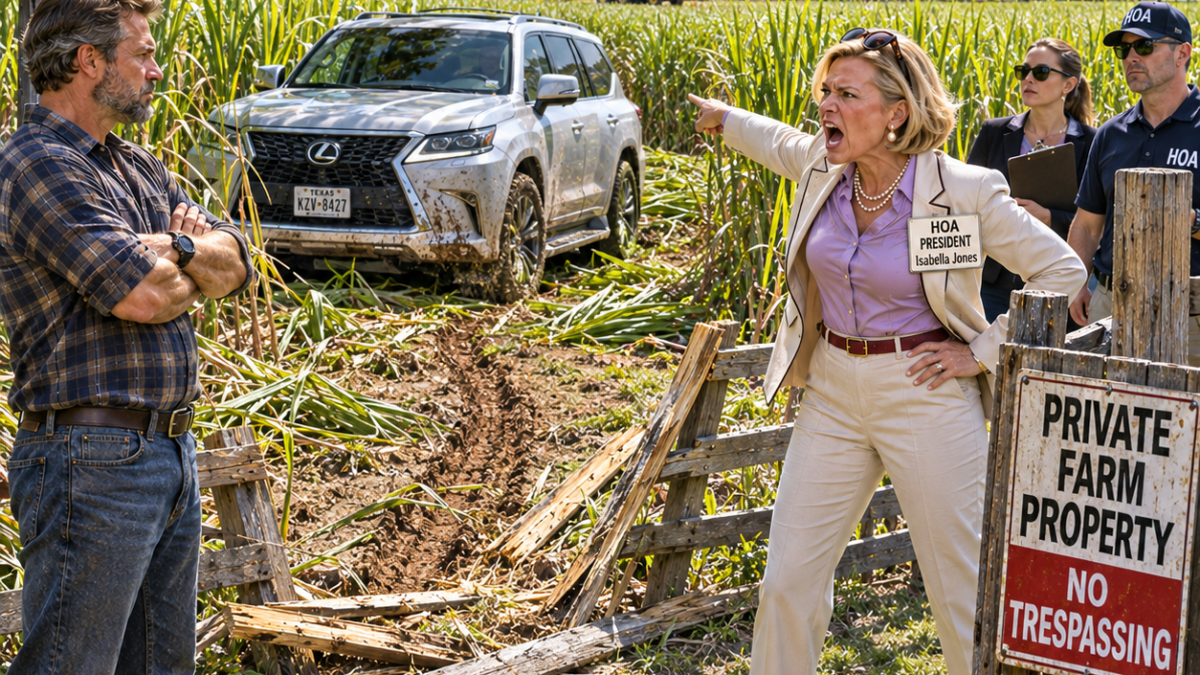
The morning I found twenty yards of my fence smashed flat and fresh Lexus tire tracks cutting fifteen feet into my sugarcane field, I still wanted to believe somebody had lost control of a vehicle in the dark—until I saw a woman’s footprints leading away from the wreckage and toward the exact section of my property the Magnolia Heights HOA had been trying to control for months.
Less than three hours later, HOA president Isabella Jones emailed me a formal “inspection notice” claiming she had discovered my fence illegally encroaching on a public easement, attached photographs taken from inside my land, and ordered me to remove the very fence that somebody had just driven through before sunrise.
What Isabella didn’t know was that six months of complaints had already taught me to save everything, and the camera mounted above my equipment barn had recorded enough of that morning to make one question impossible to ignore: why would an HOA president destroy a boundary first and then pretend she had simply discovered a violation?
My name is David Wilson, and my family has farmed fifty acres of Louisiana sugarcane since my grandfather bought the place in 1952.
He had almost nothing when he started. My father expanded the operation, modernized the equipment, survived floods, bad prices, and storms that tore sheet metal off the barn roof. When he died eight years ago, he left the farm to me with one sentence I never forgot.
“Don’t let anybody take what we built.”
For most of my life, that sounded less like a warning than a family motto.
Then Magnolia Heights arrived.
The development went up along my eastern boundary about fifteen years ago—large houses, manicured lawns, matching mailboxes, and an HOA with rules for everything from grass height to driveway parking. My farm predated the neighborhood by more than half a century. I never joined their association, never signed their covenants, and never gave the HOA authority over one square foot of my property.
Most residents understood that.
Isabella Jones did not.
She was fifty-two, always polished, always certain, and within months of moving into the corner lot beside my farm she had become HOA president.
Our first real argument started over fertilizer.
She marched into my field in heels and told me the smell violated Magnolia Heights air-quality standards.
“It’s fertilizer,” I said.
“It’s unacceptable.”
“It’s also on my farm.”
She lifted her chin.
“The residents have rights.”
“So do I.”
I explained that my property wasn’t inside her HOA.
The expression on her face should have warned me.
People who are used to authority don’t always recognize the sound of a boundary.
After that came letters.
Equipment noise.
Fence color.
Commercial trucks.
Barn lighting.
Every time, I sent back the same thing: my deed, county records, and a polite reminder that Magnolia Heights rules ended at Magnolia Heights property.
She called the sheriff twice.
Both complaints went nowhere.
She sent a lawyer.
My lawyer answered once, and that disappeared too.
Then my neighbor Tom told me Isabella had spent half an HOA meeting presenting a slideshow she called “The Wilson Farm Problem.”
Three board members refused to support legal action.
I thought that would finally end it.
Instead, Monday morning came.
October 6.
I was out before sunrise checking irrigation when I saw the broken fence.
Posts snapped.
Boards scattered.
Wire twisted.
Fresh tracks.
The vehicle had come from the direction of Isabella’s corner lot, hit the fence, pushed through, stopped inside my field, then backed out through the same opening.
That was when I noticed the footprints.
Small.
Controlled.
Someone had gotten out.
Walked around.
Then left.
I called the sheriff.
While I waited, I went to the equipment barn and pulled up the security recorder.
The camera had captured the eastern boundary at 6:04 that morning.
I clicked the file.
The timestamp matched the tire marks, and the angle covered the exact stretch of fence Isabella had spent months complaining about. I felt my coffee turn bitter in my mouth as I dragged the playback bar back ten seconds and watched again.
A white SUV appeared at the edge of the screen.
It slowed near my fence.
Stopped.
For almost ten seconds, nothing happened.
Then the vehicle turned.
Straight toward my property.
I leaned closer to the monitor.
The SUV accelerated.
And when the fence exploded across the screen, I finally saw the driver’s door begin to open.
PART 2
The driver stepped out.
Cream-colored jacket.
Dark jeans.
Blonde hair pulled back.
Phone already in her hand.
Isabella Jones.
I sat completely still.
There are moments when anger comes hot.
This wasn’t one of them.
This was colder.
My hands stopped moving.
My breathing slowed.
I watched Isabella circle the front of her Lexus.
She photographed the broken posts.
Then the tire tracks.
Then she walked deeper onto my property.
Ten feet.
Twenty.
She photographed the fence from different angles.
My equipment shed.
The gravel path behind it.
The old drainage ditch.
She even crouched to photograph one of the survey stakes I had installed after refinancing three years earlier.
Then she stood there speaking into her phone.
No audio.
Just her mouth moving.
Narrating something.
Building something.
Five minutes later she returned to the Lexus, backed carefully through the hole she had created, and disappeared toward Magnolia Heights.
I played the footage again.
Then once more.
By the fourth viewing, Deputy Luis Rodriguez’s cruiser was coming up the drive.
He had been to my farm twice already because of Isabella’s noise complaints.
He got out carrying a notebook.
“Morning, Mr. Wilson.”
“David.”
He looked toward the fence.
His face changed.
“Okay.”
“Yeah.”
“This happened last night?”
“Six-oh-four this morning.”
“You know that exactly?”
“I have video.”
That got his attention.
We went into the equipment barn.
I played it once.
Rodriguez leaned toward the monitor.
“Is that Mrs. Jones?”
“Yes.”
He watched her drive through the fence.
Then get out.
Then photograph everything.
He looked at me.
“Did she contact you before this?”
“No.”
“Any permission to enter?”
“No.”
“Any dispute over this boundary?”
“Only in her imagination.”
He didn’t smile.
Good.
This wasn’t funny yet.
He watched again.
Then said:
“I need a copy.”
“I already made one.”
“You want to make a report for property damage and trespass?”
“Yes.”
“No hesitation?”
“None.”
That mattered.
Six months earlier, I might have hesitated.
I had spent my whole life around people who believed being a good neighbor meant absorbing small offenses.
A gate left open.
A truck parked too close.
A dog wandering through.
You talk.
You fix it.
You move on.
But this wasn’t a mistake.
She had aimed.
Accelerated.
Then built a photo record afterward.
Rodriguez photographed the damage.
Measured tire tracks.
Took pictures of the survey marker.
He estimated repairs at several thousand dollars depending on how much wire and post work needed replacement.
Before he left, he said:
“Don’t contact her while I’m filing this.”
“I wasn’t planning to.”
He gave me the same look law enforcement gives people when they don’t fully believe the sentence they just heard.
“David.”
“I won’t.”
“Good.”
At 8:17 that morning, my email chimed.
I almost ignored it.
Then I saw the sender.
MAGNOLIA HEIGHTS HOA.
Subject:
NOTICE OF VIOLATION — IMMEDIATE ACTION REQUIRED.
I opened it standing in my kitchen.
By the third line, my hand tightened around the coffee mug.
During a routine boundary inspection conducted this morning, Magnolia Heights Homeowners Association identified a fence encroachment along the eastern boundary adjacent to the community walking path.
The letter claimed my fence extended roughly eighteen to twenty-four inches into a public-access easement.
It demanded removal within forty-eight hours.
Restoration of the supposed easement.
Replacement plans submitted for approval.
And threatened a five-thousand-dollar penalty plus legal action.
Signed:
Isabella Jones
President, Magnolia Heights HOA.
Attached:
Twelve photographs.
Her photographs.
Taken after she drove through my fence.
I spread them across my computer screen.
Each angle had been chosen carefully.
Close crops.
No clear survey marker.
No wide shot showing the walking path was actually inside Magnolia Heights.
One photograph made the damaged fence appear aligned with the edge of their gravel path.
Another was taken almost parallel to the boards, creating the illusion that the fence projected toward HOA land.
The photographs weren’t altered.
That made them more dangerous.
They were selectively truthful.
The kind of evidence that doesn’t technically lie until somebody explains what you’re looking at.
I went to my filing cabinet.
Pulled my 2021 survey.
There it was.
The fence wasn’t over the line.
It was approximately three feet inside my property.
The so-called public sidewalk easement?
No public easement.
Magnolia Heights owned its own gravel walking path.
Their property ended before my fence even began.
I read Isabella’s letter again.
Then the security footage.
Then her letter again.
That was when I understood what bothered me more than the destroyed fence.
She hadn’t lost control.
She had created evidence.
My phone rang.
Bill Henderson.
My lawyer.
I hadn’t called him yet.
Tom had.
Apparently Magnolia Heights gossip traveled faster than farm equipment.
“David.”
“Morning.”
“Tell me Tom exaggerated.”
“He probably didn’t.”
“What happened?”
I sent everything.
Video.
HOA email.
Survey.
Photographs.
Bill called back eleven minutes later.
He didn’t even say hello.
“She drove through your fence?”
“Yes.”
“Then wrote that she discovered a violation during an inspection?”
“Yes.”
“And attached photographs she took after entering through the hole she made?”
“Yes.”
Long silence.
“Bill?”
“I am trying to decide which part irritates me most.”
“Take your time.”
“Do nothing.”
“I’m going to repair my fence.”
“I mean to her.”
“I know.”
“I’m sending a preservation notice and cease-and-desist today. We’ll pursue damages. Depending on what law enforcement and the prosecutor determine, there may be criminal consequences separately.”
“How long does civil action take?”
“Months.”
I looked through the window toward Magnolia Heights.
“Months.”
“Yes.”
“She’s been escalating for six months.”
“I know.”
“She just drove through my fence.”
“I know.”
“And now I’m supposed to wait.”
“Yes.”
I hated that answer because it was probably the correct one.
“David.”
“Yeah?”
“Do not turn a strong case into a stupid one.”
“I’m offended you think I would.”
“I’ve known you since high school.”
“Fair.”
After we hung up, I sat at my father’s old kitchen table.
Same table where he used to spread receipts during harvest season.
Same table where he signed the paperwork transferring the farm to me while cancer had already made his handwriting shaky.
I could hear his voice.
Don’t let anybody take what we built.
For years I interpreted that sentence as property.
Acres.
Deed.
Fence.
That morning it felt larger.
Don’t let anybody rewrite what belongs to you simply because they’re more comfortable with paperwork than you are.
I repaired enough of the fence temporarily to secure the field.
Then I started collecting records.
Every letter Isabella had sent.
Every complaint.
Every sheriff visit.
Every email.
Every HOA demand.
Tom sent me minutes from the meeting where Isabella had proposed suing me.
I called Bill again.
“Can you find out whether Magnolia Heights ever had any boundary agreement with my dad?”
“I can.”
“I want everything.”
“That’s what discovery is for.”
“I mean older.”
“How old?”
“Development approval.”
Bill paused.
“I’ll call somebody.”
That somebody was David Reeves.
Everyone called him Engineer Dave because having two Davids in one rural county apparently exceeded local naming capacity.
He had worked in county planning for years and knew where records went when everyone else thought they disappeared.
I explained the problem.
He said:
“Give me a day.”
He called the next morning.
“You sitting down?”
“No.”
“You should.”
“I hate when people say that.”
“Developer boundary acknowledgment.”
“What?”
“When Magnolia Heights was approved, the county required recorded acknowledgment of existing adjacent parcels.”
“And?”
“Your father signed in 2010.”
“That makes sense.”
“Every Magnolia Heights buyer also signed purchase disclosures referencing those recorded boundaries.”
My stomach tightened.
“Isabella?”
“I’m looking at hers.”
“What does it say?”
“That the Wilson agricultural parcel boundary is established according to recorded survey documents and that ownership of adjacent agricultural land is not conveyed, shared, or subject to HOA governance.”
I sat down.
“When?”
“2018.”
“She signed that?”
“Her signature.”
That was better than anger.
It was contradiction.
She had signed a document acknowledging my boundary.
Then six years later, she drove through the fence marking that boundary and claimed she had discovered an encroachment.
Engineer Dave emailed the record.
I forwarded it to Bill.
His reply:
Well. That simplifies things.
I stared at the screen.
Then smiled for the first time since Monday morning.
Not because I wanted revenge.
Because evidence was beginning to stack higher than Isabella’s confidence.
Still, I knew her.
A letter wouldn’t stop her.
A survey hadn’t.
Police complaints hadn’t.
Her own board had voted against suing me, and she had simply changed tactics.
So I sent an email.
Not a trap.
Not exactly.
An invitation.
Mrs. Jones,
I dispute the alleged fence violation and have documentation establishing the recorded boundary. In the interest of resolving this matter without further escalation, I am willing to meet with you and any HOA representatives at my farm Thursday at 2:00 p.m. to review surveys, county records, and the boundary location.
Please confirm.
David Wilson.
Bill called within five minutes of receiving the copy.
“Why?”
“Because she keeps claiming she wants inspection and documentation.”
“David.”
“I’m going to show her documentation.”
“On camera?”
“Yes.”
“With witnesses?”
“Yes.”
“Do not provoke her.”
“I won’t.”
“Do not block her.”
“I won’t.”
“Do not touch her vehicle.”
I paused.
Bill heard it.
“David.”
“I haven’t done anything.”
“That pause had machinery in it.”
“I own a farm.”
“You own several machines large enough to ruin both our weeks.”
“I promise not to damage anything.”
“That is not the reassurance you think it is.”
I called Marcus Hayes next.
Marcus had retired after twenty-eight years with the sheriff’s department.
He was the kind of man who never said something was legal unless he was holding the statute, policy, or a lawyer’s phone number.
I told him what I planned.
“Witness.”
“Yes.”
“Cameras.”
“Yes.”
“You’re not going to put hands on her?”
“No.”
“Mess with her vehicle?”
I said:
“If she blocks active equipment access after being told to move?”
Marcus was silent.
Then:
“Call your lawyer.”
“He already hates this.”
“Good instincts.”
“I’m not trying to damage the car.”
“You’re trying to make a point.”
“Yes.”
“Those are the moments people get stupid.”
“I’m not stupid.”
“Debatable.”
He agreed to be there anyway.
Not as law enforcement.
He was retired.
Just as a witness.
Engineer Dave agreed too.
The farm already had cameras around the equipment yard.
I made sure they were working.
Nothing hidden.
Nothing clever.
Just documentation.
I also replaced a faded sign beside the barn entrance.
ACTIVE FARM OPERATIONS
KEEP ACCESS CLEAR
AUTHORIZED VEHICLES ONLY
That sign had existed in one form or another for years because cane loaders, tractors, trucks, and trailers moved through the yard regularly.
Thursday came.
At 1:58 p.m., Isabella’s white Lexus entered the drive.
Behind it, a silver Honda.
The Lexus rolled past the farmhouse.
Past the visitor parking space.
Past the gravel shoulder.
Then stopped directly in front of the equipment-barn entrance.
Five feet from the sign.
Of course it did.
Mark Stevens and Carol Reed climbed from the Honda.
Both HOA board members.
I knew Mark casually.
Carol had bought sugarcane stalks from me every Thanksgiving for her grandchildren.
They looked nervous.
Isabella looked delighted.
Cream pantsuit.
Leather portfolio.
Heels completely unsuited to a farm.
She walked toward me.
“Mr. Wilson.”
“Mrs. Jones.”
“We’re here regarding your fence violation.”
“We’re here regarding the boundary.”
“I trust you prepared a removal plan.”
“No.”
Her smile tightened.
“I see.”
“Before we start, you need to move the Lexus.”
She looked over her shoulder.
“Why?”
“It’s blocking the barn access.”
“We won’t be long.”
“That’s an active operations area.”
“I’m here on official HOA business.”
I almost laughed.
“Still my barn.”
Mark said quietly:
“Isabella, I can move it if you want.”
She snapped:
“No.”
Then to me:
“You invited us here.”
“Yes.”
“That includes reasonable parking.”
“Not in front of equipment access.”
She waved a hand.
“We’re wasting time.”
“Move the car.”
Her eyes narrowed.
“Are you refusing to cooperate with an inspection?”
“I’m asking you to move your vehicle fifteen yards.”
Carol stepped in.
“Isabella, just move it.”
The request from another board member made things worse.
I saw it happen.
That little stiffening.
The need not to yield in front of an audience.
“It’s fine.”
I said:
“Last time.”
She smiled.
“No.”
Then:
“Show me this famous survey.”
We started toward the eastern fence.
Marcus remained near his truck.
Engineer Dave waited at the farmhouse with the county records.
I kept my phone recording openly.
Isabella noticed.
“Are you recording me?”
“Yes.”
“Why?”
“Because Monday happened.”
She said nothing.
At the fence, I stopped beside one of the surviving posts.
“Did you inspect this boundary Monday morning?”
“I did.”
“With a surveyor?”
“I am authorized to inspect conditions affecting Magnolia Heights.”
“That wasn’t my question.”
She stared.
“Did you bring a surveyor?”
“No.”
“County official?”
“No.”
“Engineer?”
“No.”
“Permission from me?”
“HOA authority allowed—”
“No.”
Mark looked at her.
“Isabella.”
I pulled out my phone.
Opened the security video.
Turned the screen toward them.
The white Lexus appeared.
Stopped.
Turned.
Accelerated.
Fence exploded.
Isabella’s face lost all expression.
Carol put one hand over her mouth.
Mark said:
“Oh my God.”
The video continued.
Isabella stepped out.
Photographed the damage.
Walked the property.
Returned to the vehicle.
Backed out.
Mark looked from the screen to Isabella.
“You drove through his fence?”
“That video is misleading.”
I almost admired the instinct.
Not fake.
Not denial.
Misleading.
“It’s one continuous clip.”
“You don’t know what happened before.”
“I know what happened during.”
“The fence was already defective.”
Carol said:
“You hit it with your car.”
Isabella’s head snapped toward her.
“Carol, please.”
I said:
“Deputy Rodriguez has the original.”
Isabella looked at me.
“You filed a police report?”
“Yes.”
“You’re trying to criminalize an HOA dispute.”
“You drove through my fence.”
“It was an inspection.”
“With your Lexus?”
She changed direction.
“The fence was illegally positioned.”
I unfolded the survey.
“No.”
She barely looked.
“This survey is old.”
“2021.”
“Conditions change.”
“Property lines generally don’t move three feet because you become HOA president.”
Mark covered his mouth.
Possibly hiding a smile.
Isabella glared at him.
I continued.
“Fence is inside my boundary.”
“The public easement—”
“No public easement.”
“There is.”
“Show me.”
“I have HOA maps.”
“County records beat HOA maps.”
She raised her voice.
“You don’t get to dictate planning law because you grow sugarcane.”
Engineer Dave approached from the farmhouse carrying the folder.
I almost felt bad.
Almost.
“Mrs. Jones,” I said, “this is David Reeves. He worked county planning.”
Engineer Dave nodded.
“Afternoon.”
She looked at him suspiciously.
He opened the folder.
“Recorded development boundary acknowledgment.”
He handed her a copy.
“Magnolia Heights purchase disclosure, 2018.”
She looked down.
Then stopped breathing for a second.
I knew exactly where her eyes landed.
Her signature.
Engineer Dave pointed.
“You acknowledged the Wilson agricultural parcel boundary when you purchased Lot Forty-Seven.”
“I don’t remember signing this.”
Mark leaned closer.
“That’s your signature.”
“I signed hundreds of closing documents.”
“Still your signature,” Carol said.
Isabella’s composure cracked.
Not completely.
Enough.
“This proves nothing.”
I looked at her.
“It proves you knew the boundary existed.”
“The issue is the fence.”
“Which is inside that boundary.”
“This is harassment.”
I laughed once.
She pointed at me.
“See?”
“See what?”
“You invited me here under false pretenses.”
“I invited you to review documents.”
“I came to inspect a violation.”
“There is no violation.”
“You don’t decide that.”
“Neither do you.”
Her face hardened.
I felt the last six months sitting between us.
Every letter.
Every complaint.
Every call to the sheriff.
Every time I explained the same thing.
My farm was not in Magnolia Heights.
I said:
“This meeting is over.”
Her eyebrows lifted.
“You don’t get to end it.”
“I do on my property.”
“I’m not finished.”
“I am.”
“You will remove that fence.”
“No.”
“We’ll fine you.”
“You have no authority.”
“We’ll sue.”
“Bill Henderson would enjoy that.”
Her expression flickered at my lawyer’s name.
I pointed toward the driveway.
“Leave.”
She smiled.
A mean little smile.
“Make me.”
Behind her, Mark closed his eyes.
Carol whispered:
“Oh, Isabella.”
I looked toward the equipment yard.
Her Lexus was still blocking the barn entrance.
A cane trailer sat inside.
Jorge Martinez, my senior equipment operator, had been waiting to move it for the afternoon maintenance schedule.
I had warned Isabella three times.
I said:
“Your vehicle needs to move.”
She laughed.
“I’m not moving anything until this inspection is complete.”
I turned toward Jorge.
“Hold operations.”
That was not what Isabella expected.
She looked pleased.
As if she had won.
Then I called Bill.
Put him on speaker.
“Bill.”
“I dislike your tone already.”
“Guest vehicle is blocking active farm access. Owner has been repeatedly asked to move it and refuses.”
“Is anyone inside the vehicle?”
“No.”
“Any emergency?”
“No.”
“Have you called law enforcement?”
“Not yet.”
“Then do that before your farmer brain invents anything.”
Isabella scoffed.
“This is absurd.”
I called the sheriff’s non-emergency line.
Explained the situation.
Vehicle blocking equipment access.
Owner refusing to remove it.
Existing criminal complaint involving same person.
Dispatcher said a deputy would respond.
Isabella crossed her arms.
“Good.”
“You’re right.”
She blinked.
“Excuse me?”
“Good.”
I looked at Mark and Carol.
“You two heard me ask her to move?”
“Yes,” Mark said immediately.
Carol nodded.
I looked toward the cameras.
Everything was recorded.
Marcus walked closer.
“Dave.”
“What?”
“Wait for Rodriguez.”
“I am.”
That wasn’t dramatic enough for Isabella.
She walked toward the Lexus.
For half a second I thought she would simply move it.
Instead she leaned against the hood.
“I’m not going anywhere.”
Marcus said:
“That seems unwise.”
She looked at him.
“And you are?”
“Marcus Hayes.”
“Lawyer?”
“No.”
“Police?”
“Retired.”
She smiled.
“Then you have no authority here.”
“Correct.”
Marcus nodded.
“I’m just enjoying retirement.”
Mark actually laughed.
Isabella’s face tightened.
Twenty minutes later, Deputy Rodriguez arrived.
He stepped out.
Looked at the broken-fence section.
Looked at Isabella.
Then looked at the Lexus blocking the equipment barn.
“Mrs. Jones.”
“This man invited me here and is now attempting to intimidate me.”
Rodriguez looked at me.
“Mr. Wilson?”
“She refuses to move the SUV from active farm access.”
“Have you asked?”
“Four times.”
Mark said:
“He has.”
Carol nodded.
Rodriguez looked at Isabella.
“Ma’am, please move the vehicle.”
Her jaw dropped.
“You’re taking his side?”
“I’m asking you to move your car.”
“I’m conducting an official inspection.”
“Of property outside your HOA?”
She stared at him.
“That is disputed.”
Rodriguez looked toward the documented boundary markers.
“Not by county records I’ve seen.”
Her voice rose.
“So he calls you and suddenly you enforce his demands?”
“No.”
Rodriguez pointed toward the sign.
“I’m asking a vehicle owner to move from a marked agricultural access area on private property after the property owner withdrew permission for you to remain.”
Silence.
Then Isabella said:
“I want your supervisor.”
Rodriguez sighed.
“You can request one.”
“I will.”
“Move your car while we wait.”
“No.”
Rodriguez stared at her.
“Ma’am.”
“No.”
That was the moment the story everyone tells later began.
Not with me secretly planning some elaborate revenge.
Not with a retired cop declaring farm law.
With a deputy standing beside a white Lexus and asking its owner to move it.
And Isabella saying no.
Rodriguez stepped aside and called his supervisor.
Bill stayed on the phone.
Jorge stood by the loader.
I said:
“We have a cane trailer that needs this bay.”
Rodriguez looked toward the barn.
“Can operations wait?”
“Yes.”
“Then wait.”
I did.
Isabella smirked.
Twenty-five more minutes.
The supervising deputy arrived.
Sergeant Ellis.
He listened to everyone.
Reviewed the security footage from Monday.
Looked at Isabella’s violation notice.
Looked at my survey.
Looked at her signed boundary acknowledgment.
Then he looked at the Lexus.
“Mrs. Jones.”
“Yes?”
“You need to remove your vehicle.”
She folded her arms.
“No.”
He paused.
“Are you refusing?”
“I am entitled to remain here until the inspection concludes.”
“No.”
His voice stayed calm.
“Mr. Wilson has revoked permission for you to remain. You can leave voluntarily or we can address it differently.”
She looked at me.
“This is your little performance.”
I said nothing.
Sergeant Ellis continued:
“Move the car.”
She didn’t.
Finally he said:
“Mr. Wilson, do you have a way to clear your equipment access without damaging the vehicle?”
Bill’s voice came from my phone.
“David, do not improvise.”
I looked at Jorge.
Then the loader.
The Caterpillar telehandler was designed for agricultural loads, not humiliating HOA presidents.
I knew that.
Jorge knew that.
Sergeant Ellis knew enough to say:
“I’m not authorizing you to damage her car.”
“I don’t want to damage it.”
Isabella laughed.
“You touch my Lexus and I’ll own this farm.”
I looked at her.
“That sentence explains a lot.”
A commercial tow could take considerable time to reach us.
The cane trailer needed moving.
We had a trained operator.
A large open staging area.
And an empty vehicle.
After discussion with the deputies, my lawyer, and the operator, we agreed on one thing:
If the vehicle was moved, it would be moved only far enough to clear the work zone, with Isabella standing well away, every camera recording, and no one pretending this was anything except a temporary relocation of an obstruction.
No tricks.
No occupant in the car.
No dramatic ten-foot suspension.
No risking a person for a point.
Jorge approached the loader.
Isabella’s expression changed.
“What is he doing?”
I said:
“Clearing the access.”
“With that?”
“Yes.”
“You can’t.”
Sergeant Ellis said:
“Mrs. Jones, you were given repeated opportunities to move your own vehicle.”
Her face flushed.
“This is insane.”
Mark whispered:
“You could just move it.”
She turned on him.
“Whose side are you on?”
“The side where this stops getting worse.”
Jorge started the machine.
Diesel engine rumbled through the equipment yard.
Isabella took one involuntary step backward.
The loader approached slowly.
No one was laughing now.
Not even me.
Jorge stopped.
Got out.
Walked the area with Sergeant Ellis.
Checked clearances.
Then climbed back in.
The Lexus rose.
Not high.
Not dangling over anybody.
Just enough to clear the ground safely while Jorge repositioned it toward the empty packed-dirt staging area beside the barn.
Still, the image was unforgettable.
Isabella’s spotless white SUV floating above a Louisiana sugarcane yard while two HOA board members, two sheriff’s deputies, a retired deputy, a county planner, my farm operator, and I watched.
Isabella screamed:
“PUT IT DOWN!”
Sergeant Ellis said:
“Ma’am, step back.”
“This is destruction of property!”
“No damage observed.”
“This is theft!”
“The vehicle is being moved thirty yards.”
“You’re all insane!”
Jorge moved at a crawl.
The cameras captured every second.
Then he lowered the Lexus gently onto the staging area.
Four tires touched dirt.
Machine backed away.
Done.
No scratch.
No broken glass.
No heroic forklift stunt.
Just an SUV no longer blocking my farm.
Silence.
Then Mark started laughing.
He tried to hide it.
Failed.
Carol covered her mouth.
Even Rodriguez turned away.
I looked at them.
“Really?”
Mark shook his head.
“I’m sorry.”
He wasn’t.
Isabella marched toward her vehicle.
She inspected every panel.
Every wheel.
Every mirror.
Nothing.
She spun toward me.
“You humiliated me.”
I looked at the broken fence.
“No.”
“You planned this.”
“I asked you to move.”
“You set me up.”
“I invited you to look at documents.”
“You knew I would park there.”
“I suspected you’d ignore the sign.”
“That’s the same thing.”
“No, Isabella.”
I pointed toward the Lexus.
“You had five chances to move your own car.”
Then toward the fence.
“You had six months to accept that my property wasn’t yours.”
Sergeant Ellis interrupted.
“Mrs. Jones, we still need to address Monday.”
Her anger vanished.
For a second.
“What about Monday?”
Rodriguez opened his notebook.
“The property-damage report.”
“That was an accident.”
I stared at her.
Three days earlier, her HOA email had described Monday as a routine inspection.
Now it was an accident.
Rodriguez noticed too.
“You told the HOA you were conducting an inspection.”
“I inspected after the accident.”
“Why did you accelerate toward the fence?”
“I didn’t.”
“We have video.”
“The road was wet.”
“It hadn’t rained.”
She looked around.
Too many witnesses.
Too many documents.
Too many versions of her story.
Sergeant Ellis said:
“We need a formal follow-up statement.”
“I’m calling my attorney.”
“That’s your right.”
“I’m leaving.”
He nodded.
“We’ll speak through counsel if that’s what you prefer.”
She climbed into the Lexus.
Paused.
Looked at me through the windshield.
I expected rage.
What I saw was fear.
Not fear of me.
Fear of losing control of the story.
That turned out to be much more powerful.
The Lexus left.
Mark and Carol stayed.
For a while neither spoke.
Then Carol said:
“David, I’m sorry.”
“You didn’t drive through my fence.”
“No.”
“But we let this go too far.”
Mark nodded.
“We knew she was targeting you.”
I looked at him.
“You knew?”
“Not like this.”
“What did you know?”
He rubbed the back of his neck.
“The complaints.”
“The presentation.”
“The pressure to make the board take action.”
“You voted against it?”
“Yes.”
“And then?”
“We thought she’d stopped.”
I looked toward the broken fence.
“She didn’t.”
Carol’s face tightened.
“No.”
Mark said:
“We’re holding an emergency meeting.”
“When?”
“Tonight if we can.”
“I don’t want to join your HOA drama.”
“You won’t have to.”
Carol looked toward Magnolia Heights.
“This isn’t about drama anymore.”
They left.
Marcus walked over.
“That could’ve gone very differently.”
“I know.”
“You wanted the spectacle.”
I didn’t answer.
“Dave.”
“Part of me did.”
“Good.”
“Good?”
“Better than lying to yourself.”
He leaned against his truck.
“You’ve been pushed for months.”
“Yeah.”
“Just remember something.”
“What?”
“The loader wasn’t the win.”
I looked at him.
“The documents were.”
That annoyed me because Marcus had a talent for saying reasonable things right when I wanted to feel righteous.
Engineer Dave came over.
“Also, for the record, I brought a very nice county folder and nobody appreciated it.”
I laughed.
“Your moment will come.”
“It better.”
That night I walked the damaged fence alone.
The cane fields were dark except for motion lights.
My father used to walk boundaries whenever he had a hard decision.
Not because the line changed.
Because walking reminded him what he was responsible for.
I understood that more now.
My phone rang.
Tom.
“You sitting down?”
“Why does everybody ask me that?”
“Emergency HOA meeting.”
“Already?”
“Packed clubhouse.”
“I’m not coming.”
“You can’t anyway. Members only.”
“Perfect.”
Tom lowered his voice.
“People know about the Lexus.”
“Of course they do.”
“Mark apparently told his wife.”
“Of course.”
“And somebody saw it from the walking path.”
“Of course.”
Tom laughed.
“Story is already growing.”
“How high is the SUV now?”
“Fifteen feet.”
“It was barely off the ground.”
“By tomorrow it’ll be over the barn.”
I sighed.
“Tell me what happens.”
He called three hours later.
“Thirty-six homeowners showed up.”
“That many?”
“Isabella came with a lawyer.”
“Smart.”
“Didn’t help.”
“What happened?”
Tom started listing names.
Mrs. Patterson.
Five-hundred-dollar mailbox fine after an approved color mysteriously disappeared from the list.
The Kowalskis.
Threats over a basketball hoop.
Mr. Harrison.
Solar-panel fight followed by a grass-height citation after he cited state protections.
A retired veteran fined for leaving a flag-light fixture on fifteen minutes past an arbitrary time.
A widow repeatedly cited because her visiting daughter parked in her driveway overnight.
One after another.
Fifteen homeowners stood.
Documentation.
Emails.
Fines.
Patterns.
Selective enforcement.
Retaliation after disagreement.
Then Engineer Dave arrived.
Apparently the board’s counsel had asked him to present the county boundary filing.
He showed Isabella’s signature.
The fence video.
Her HOA email.
Her supposed violation.
Tom said the room changed.
Not because people suddenly hated Isabella.
Because they suddenly realized she had been willing to expose the entire association to liability while hiding what she had done.
Mark moved to suspend her.
Carol seconded.
Vote:
Thirty-four in favor among eligible participants or proxies according to their rules.
No opposition.
Two abstentions.
Isabella stood.
“You’re all fools.”
Then left.
Tom said:
“She looked like somebody unplugged her.”
I sat on the porch after the call.
I thought I would feel victorious.
I didn’t.
I felt tired.
My father’s fence was still broken.
The legal case still existed.
My farm still needed work tomorrow morning.
And suddenly dozens of Magnolia Heights residents had learned the difference between leadership and control in the ugliest possible way.
The next Saturday, Carol Reed drove up.
She parked beside the farmhouse.
Not the barn.
Good start.
She carried a basket.
Honey.
Preserves.
Homemade bread.
I said:
“Is this how HOAs settle wars?”
She smiled awkwardly.
“It’s how my mother settled everything.”
She handed me a letter.
Formal apology from the board.
The HOA disclaimed Isabella’s actions.
Confirmed my farm was outside HOA jurisdiction.
Acknowledged the recorded boundary.
Promised to cooperate with law enforcement and my civil claim.
I read it.
“Thank you.”
Carol looked toward the cane.
“I’m embarrassed.”
“You didn’t do it.”
“I sat on the board while it happened.”
“That’s different.”
“Is it?”
I thought about that.
“A little.”
She nodded.
“We’re reviewing every enforcement action she issued for the last two years.”
“That sounds miserable.”
“It is.”
“Good luck.”
She hesitated.
“There’s something else.”
There always is.
“What?”
“Our treasurer found irregular reimbursements.”
I looked at her.
“What kind?”
“Personal expenses.”
“Isabella’s?”
“Yes.”
“How much?”
“We don’t know.”
“Call your accountant.”
“We did.”
“Call your lawyer.”
“We did.”
“Then why tell me?”
“Because some of the expenses were coded under boundary enforcement.”
That got my attention.
“What expenses?”
“Legal consultation.”
“Okay.”
“Vehicle mileage.”
“Her Lexus?”
“Possibly.”
“Photography.”
I laughed once.
“She charged the HOA for photographing the fence she destroyed?”
Carol looked sick.
“That’s what it appears.”
The financial audit widened.
This was where rumors later exaggerated everything.
Some people claimed Isabella had stolen hundreds of thousands.
She hadn’t.
The verified amount was smaller.
Still serious.
Personal landscaping.
Vehicle costs.
A vacation partially categorized as conference travel.
Cash reimbursements that lacked proper documentation.
And HOA fines that had been handled inconsistently enough that the board’s accountant had to reconstruct deposits.
The total improper charges and missing funds eventually reached roughly forty-seven thousand dollars.
Not enough to buy an empire.
Enough to betray people who trusted her.
The HOA filed its own civil claim.
My criminal case moved separately.
The prosecutor reviewed:
Security footage.
The broken fence.
Isabella’s email.
Survey records.
The signed boundary acknowledgment.
Her conflicting statements.
She initially insisted the collision had been accidental.
Then argued she had legitimate reason to inspect.
Those two positions did not fit together well.
Her lawyer knew it.
The case resolved before trial.
Probation.
Restitution.
Mandatory counseling and anger-management requirements.
A formal admission relating to the property damage and unauthorized entry.
I received reimbursement for the fence.
No dramatic prison sentence.
No judge giving a speech about evil HOA presidents.
Real consequences are often less cinematic.
But the admission mattered.
For months she had insisted she was right.
Now a court record said otherwise.
Bill filed my civil claim too.
Fence damage.
Related costs.
Attorney fees.
The fraudulent violation notice.
We settled.
I got enough to rebuild the eastern fence better than before.
Treated posts.
Improved wire.
Motion lighting.
Additional cameras.
Total project cost came to about eighty-five hundred dollars.
I stood beside the construction crew while they removed one of the last broken posts.
It had been installed with my father.
I remembered the day.
Hot August.
I had been thirty-seven.
He was already slowing down.
We argued about post depth.
Of course we did.
Dad believed every fence post should be capable of surviving a hurricane, a tractor collision, and possibly the end times.
I told him he was overbuilding.
He said:
“Overbuilding is what people call it before the storm.”
Now the post was split.
I ran one hand along the old wood.
Crew supervisor asked:
“You want it?”
“What?”
“The post.”
I almost said no.
Then:
“Yeah.”
I kept it.
Put it behind the barn.
Not as a trophy of Isabella.
As a piece of Dad.
A few weeks after the HOA suspended her, I received a phone call from Patricia Gomez, a real-estate agent.
“Mr. Wilson?”
“Yes.”
“I represent a party interested in purchasing your farm.”
“Not for sale.”
“I understand, but my client asked me to present an offer.”
“How much?”
“Two-point-five million.”
I stopped.
That was above agricultural value.
“Who?”
“I’m not authorized—”
“Isabella Jones?”
Silence.
That was answer enough.
I laughed.
Not because the money was small.
Because the absurdity was enormous.
She had spent six months trying to regulate my farm.
Destroyed my fence.
Tried to create a boundary violation.
Then offered millions to buy the thing she couldn’t control.
“Ms. Gomez.”
“Yes?”
“Please tell your client the farm is not for sale.”
“Even at that figure?”
“Correct.”
“There may be flexibility.”
“No.”
“May I ask why?”
I looked through the window at the cane rows.
“No.”
She respected that.
Two days later, another agent called.
Three million.
Anonymous development company.
I checked the company registration through public records.
One of the officers had a business connection to Isabella’s husband.
Bill sent cease-and-desist letters.
The offers stopped.
That part bothered me more than the Lexus.
Because it showed the fence dispute had never been only aesthetic.
Isabella wanted the farm changed because the farm represented something she couldn’t manage.
Agricultural land beside Magnolia Heights limited expansion.
Created odors.
Noise.
Views she didn’t curate.
And apparently had development value worth far more than she had ever admitted.
I wondered whether she had been trying to pressure me toward selling.
We never proved that.
So I never claimed it.
Maybe she wanted control.
Maybe development.
Maybe both.
What we did know was enough.
A FOR SALE sign appeared in front of her house one month later.
Tom called.
“She’s leaving.”
I stood beside the new fence.
“That fast?”
“People stopped inviting her places.”
“That’s not good.”
“You feel bad?”
“I didn’t say that.”
“She got removed from the board. Book club. Some volunteer committee.”
“That’s a lot.”
Tom said:
“She did it to herself.”
Maybe.
Social punishment makes me uncomfortable.
People deserve consequences.
They also deserve somewhere to go after.
I didn’t want Magnolia Heights turning into the same kind of mob Isabella had created in miniature.
“Tom.”
“Yeah?”
“Don’t celebrate too hard.”
He was quiet.
Then:
“You’re nicer than she was.”
“That’s a low bar.”
Her house sold six weeks later.
Young couple.
Evan and Rachel Parker.
Two kids.
I brought sugarcane as a welcome gift.
Evan looked at the bundle.
“What do we do with this?”
Rachel laughed.
“You chew it.”
He looked terrified.
I showed them.
Their daughter loved it.
Their son did not.
They apologized for asking, but eventually Rachel said:
“We heard something happened with the previous owner.”
“Something did.”
“Do we need to worry about the farm?”
“No.”
“Noise?”
“Yes.”
She smiled.
“Smell?”
“Sometimes.”
“Tractors?”
“Definitely.”
“Okay.”
That was all.
No complaint.
No HOA memo.
Just adults understanding they bought a house next to agriculture.
Five months after the fence incident, I saw Mark Stevens at the hardware store.
He had six bags of mulch stacked in a cart.
“David.”
“Mark.”
“How’s the farm?”
“Still there.”
“Fence?”
“Better.”
He smiled.
“Magnolia Heights is different.”
“How?”
“Carol’s president now.”
“How’s that going?”
“She hates the job.”
“Excellent qualification.”
He laughed.
“Meetings are shorter.”
“Even better.”
“People talk again.”
That caught me.
“What do you mean?”
He shifted a bag of mulch.
“Under Isabella, everybody worried that disagreeing with her meant getting inspected next.”
I frowned.
“It was that bad?”
“Not at first.”
He looked embarrassed.
“It happened slowly.”
He told me about neighbors checking rule books before planting flowers.
People refusing board nominations because they didn’t want conflict.
Homeowners paying questionable fines simply because appeals were exhausting.
Not tyranny.
That word gets thrown around too easily.
Something quieter.
A community learning that resistance cost more energy than compliance.
Mark said:
“When you stood up to her, people realized no was still a word.”
I looked at him.
“I was protecting my fence.”
“I know.”
“You all could’ve pushed back anytime.”
“We know that now.”
That sentence stayed with me.
You all could’ve pushed back anytime.
Maybe.
Maybe not.
People who live inside a system see risks outsiders don’t.
I was easy to defy Isabella because she never had legitimate authority over me.
Magnolia Heights residents had contracts, dues, fines, appeals, social relationships.
Their situation was different.
Still, the new board changed things.
Term limits.
Two-signature rules for significant spending.
Independent financial review.
Formal appeal procedures.
Board members could not adjudicate complaints they personally initiated.
Boundary disputes involving outside properties required professional surveys and legal review before any HOA action.
Carol called me while they drafted that section.
“We want your input.”
“I’m not joining the HOA.”
“God forbid.”
“What do you need?”
She read the proposed language.
I suggested one sentence:
“No association officer may enter neighboring private property without owner permission except where authorized by law in a genuine emergency.”
Carol laughed.
“We’re calling that the Isabella clause.”
“No.”
“Too late.”
“Do not put my name anywhere.”
“We weren’t.”
“Good.”
The criminal matter resolved in December.
I didn’t attend the final hearing.
Bill did.
Isabella paid restitution.
Completed court requirements.
The HOA civil case settled separately.
She repaid the verified improper charges.
Several homeowners received refunds for fines the board concluded had been issued outside proper procedure.
By January, Magnolia Heights had mostly stopped talking about her.
That surprised me.
For months she had occupied an enormous amount of everybody’s attention.
Then suddenly:
Nothing.
Grass still needed cutting.
Roofs leaked.
Kids left basketballs in streets.
People moved on.
Farm life did too.
Harvest doesn’t care about drama.
Sugarcane grows on its own schedule.
By spring, parents from Magnolia Heights began bringing kids by the fence to watch equipment.
They asked first.
That made all the difference.
One retired couple asked whether they could walk along the outside gravel edge beside my fence in the mornings.
“That’s Magnolia property.”
“We know.”
“Then why ask me?”
They laughed.
“Practice.”
I said yes anyway.
They started bringing coffee on Saturdays.
The local elementary school invited me to talk about agriculture.
I brought cane stalks.
Soil samples.
Old photographs.
A picture of my grandfather beside the first tractor he owned.
One little girl raised her hand.
“Mr. Wilson, why don’t you sell the farm if people offer a lot of money?”
The teacher looked horrified.
I smiled.
“Good question.”
I thought about Dad.
Granddad.
The fence.
Isabella.
Three million dollars.
Then answered:
“Because not everything becomes more valuable when you put a bigger number on it.”
She frowned.
“What does that mean?”
“It means this farm is where my grandfather built his life and my father built his. I’m still building mine.”
The girl nodded.
Then asked:
“Can sugarcane cut you?”
“Now that is an important question.”
The class laughed.
By summer, the Lexus story had become local mythology.
Every retelling made the loader larger.
The SUV higher.
One man at the feed store claimed I lifted it twenty feet and rotated it in circles.
I said:
“That would be unbelievably unsafe.”
He replied:
“It’s how I heard it.”
“It’s wrong.”
He shrugged.
“Better story.”
That bothered me.
So when a local reporter called, I agreed to speak on one condition.
“No exaggeration.”
He arrived with a notebook.
“Mr. Wilson, did you lift Isabella Jones’s Lexus with a sugarcane loader?”
“Yes.”
“How high?”
“Only what was necessary to relocate it safely.”
“Not ten feet?”
“No.”
“Was she inside?”
“Absolutely not.”
“Did you trap her?”
“No.”
“Was the vehicle damaged?”
“No.”
“Were deputies present?”
“Yes.”
He looked disappointed.
“The internet version is much more dramatic.”
“The internet wasn’t responsible for insurance.”
He laughed.
Then asked:
“Was it revenge?”
I took my time.
“Partly.”
His pen stopped.
“You’re admitting that?”
“I’m admitting I was angry.”
“But you planned the meeting.”
“Yes.”
“You expected her to park there.”
“I expected her to ignore me.”
“Did you enjoy seeing the car moved?”
I looked toward the equipment yard.
“I enjoyed the first thirty seconds.”
“And after?”
“I realized everybody would remember the machine and forget the documents.”
That surprised him.
I continued.
“The important part wasn’t the Lexus.”
“It was the video of her hitting the fence.”
“The survey.”
“Her signature acknowledging the boundary.”
“The email she wrote afterward.”
“The witnesses.”
“Evidence.”
I rubbed my hands together.
“The loader made a picture.”
“The paperwork made consequences.”
He wrote that down.
The article ran under the headline:
FARMER, FENCE, AND THE LEXUS: WHAT REALLY HAPPENED AT MAGNOLIA HEIGHTS.
Better than I expected.
Months passed.
Then one August evening, almost a year after the first fertilizer complaint, my phone rang.
Unknown Baton Rouge number.
I answered.
“David Wilson.”
Silence.
Then:
“Mr. Wilson?”
I recognized her voice.
Isabella.
My shoulders tightened automatically.
“Yes.”
“This is Isabella Jones.”
“I know.”
“I can hang up if you want.”
I nearly said yes.
Instead:
“Why are you calling?”
She breathed in.
“I’ve been seeing a therapist.”
I said nothing.
“Not just the anger classes.”
Still nothing.
“My therapist suggested making amends where it’s appropriate.”
“You have my lawyer’s address.”
“I’m not calling about money.”
“What are you calling about?”
Long pause.
“To apologize.”
I looked over the field.
Sun low.
Cane leaves moving in the heat.
“Okay.”
She sounded surprised.
“That’s all?”
“I’m listening.”
Another pause.
Then:
“I was wrong.”
The sentence was so simple I almost didn’t trust it.
She continued.
“I was wrong about the farm.”
“The fence.”
“The HOA.”
“What I thought being president meant.”
Her voice shook.
“I kept telling myself I was protecting property values.”
I didn’t respond.
“I liked being necessary.”
That was more honest.
“People came to me when something bothered them. They asked what the rule was. They wanted decisions.”
She gave a humorless laugh.
“I started thinking that meant I was good at making decisions for everyone.”
I leaned against the new fence.
“What changed?”
“You.”
I stiffened.
“The car.”
She corrected herself.
“Not because you lifted it.”
“I hated you for that.”
“Good to know.”
She almost laughed.
“I did.”
“For months.”
“Then my therapist asked me why I had refused to move it.”
I waited.
“I didn’t have an answer.”
“You told me it was official HOA business.”
“I know.”
“Why didn’t you move?”
Her voice became quiet.
“Because you asked.”
That landed.
She continued.
“I know how ridiculous that sounds.”
“It doesn’t.”
“No?”
“No.”
I had seen the same thing in her face.
Yielding had become losing.
She said:
“I had built my whole identity around not being told no.”
I looked toward the old fence post I had saved behind the barn.
“What about Monday?”
“The fence?”
“Yes.”
Long silence.
“I wanted proof.”
“Of what?”
“That you were obstructing us.”
“You knew the boundary.”
“I knew what I had signed.”
“That’s not an answer.”
“I told myself the development map created some kind of shared setback.”
“You told yourself.”
“Yes.”
She swallowed.
“I thought if I could document the fence as a problem, I could pressure the board to act.”
“Why drive through it?”
Another silence.
Then:
“Because I was angry.”
No excuse.
No “accident.”
Just angry.
“I had gone there planning to photograph it.”
“I sat in my car looking at the fence and thought about every time you told me I had no authority.”
Her voice broke slightly.
“And I wanted the fence gone.”
I closed my eyes.
“So you hit it.”
“Yes.”
“And then photographed it.”
“Yes.”
“Then sent the notice.”
“Yes.”
I waited for justification.
None came.
Finally she said:
“I’m sorry.”
I looked across the cane.
For almost a year, I had imagined that moment.
In some versions I hung up.
In others I told her exactly what she had cost me.
Money.
Time.
Sleep.
Trust.
The feeling of watching my father’s fence collapse on a screen.
Instead I asked:
“Why did you try to buy the farm?”
She exhaled.
“You found out about that.”
“Yes.”
“My husband knew a development group.”
“I know.”
“I thought if I owned the land, then none of this would matter anymore.”
“That’s one way to solve a boundary dispute.”
“It sounds insane when you say it.”
“It sounded insane when you did it.”
She accepted that.
“The farm is beautiful.”
I looked around.
“It is.”
“I couldn’t see that when it belonged to someone I couldn’t control.”
That may have been the most truthful thing she said.
“I’m not asking you to forgive me.”
“Good.”
“I just wanted to say I understand now.”
“Understand what?”
“That your fence wasn’t an insult.”
Wind moved through the cane.
She continued.
“It was just your fence.”
For some reason, that was the sentence that brought closure.
Not the apology.
Not the court.
Not the restitution.
It was just your fence.
“Yes,” I said.
“It was.”
She told me she had moved to a condo in Baton Rouge.
No board position.
No association committee.
No volunteer leadership.
“I’m practicing being nobody important.”
“That sounds dramatic.”
She laughed softly.
“Probably.”
“Try being a neighbor.”
Silence.
Then:
“I will.”
Before hanging up, she said:
“Mr. Wilson?”
“Yeah?”
“I hope the farm does well.”
I looked at the sugarcane moving under the sunset.
“It usually does.”
We never spoke again.
I didn’t need us to.
The old broken fence post stayed behind the barn for another year.
Then one afternoon, I carried it into my workshop.
I planned to cut it into scrap.
Instead I found my father’s initials near the bottom.
DW.
Same as mine.
He had marked posts sometimes during installation.
Not because anyone else cared.
Because he did.
I sat on an overturned bucket holding that piece of wood.
Suddenly I was back twenty years earlier.
Dad telling me the post wasn’t straight.
Me telling him it was close enough.
Him saying:
“Close enough is what people say about things they don’t plan to keep.”
I had forgotten that.
I ran my thumb over the letters.
Then mounted the broken section above my workbench.
No plaque.
No mention of Isabella.
Just DW.
A few months later, Magnolia Heights held a block party.
Carol invited me.
I almost refused.
Then she added:
“No meetings.”
“Good.”
“No violation forms.”
“Better.”
“No Lexus lifting.”
“I make no promises.”
She laughed.
I went.
Tom handed me a plate.
Mark Stevens was grilling.
Mrs. Patterson had repainted her mailbox whatever color she wanted.
The Kowalski kid’s basketball hoop stood in the driveway.
Mr. Harrison had solar panels.
Nobody died.
Nobody’s property values collapsed.
Carol came over.
“See?”
“What?”
“Community.”
I looked around.
Children.
Neighbors.
People talking.
Not agreeing on everything.
Not needing to.
“Looks dangerous.”
She rolled her eyes.
“You know what the strange part is?”
“What?”
“People follow more rules now.”
I frowned.
“Why?”
“Because they trust them.”
That stayed with me.
A rule enforced unfairly becomes a challenge.
A boundary explained honestly becomes normal.
Maybe that was true beyond HOAs.
The following spring, the young couple living in Isabella’s old house had a baby.
They stopped by the farm.
Rachel held the infant.
Evan carried a bag.
“We brought you something.”
“What?”
A framed photo.
My sugarcane field at sunset.
Taken from their backyard.
No trespass.
No drone.
Just the view.
Rachel said:
“We thought you might like seeing the farm from our side.”
I studied it.
The new fence crossed the bottom of the picture.
Strong.
Straight.
Behind it, cane glowing gold.
I smiled.
“I do.”
Evan hesitated.
“Can I ask something?”
“Sure.”
“Why is the fence three feet inside your boundary?”
I laughed.
“Survey gave me room to maintain both sides without stepping onto neighboring property.”
“So Isabella…”
“Was arguing about land I deliberately gave myself setback from.”
He shook his head.
“That makes the whole thing even crazier.”
“Yep.”
I hung their photograph in the farmhouse.
Across from my father’s old picture.
One showed the farm from inside.
One from outside.
Same land.
Different side of the line.
Years after the fence incident, the sugarcane loader still worked.
Older.
More repairs.
Jorge retired.
Miguel’s nephew started operating equipment with us.
Every once in a while a new worker would hear the story.
“Is that the machine?”
“Yes.”
“How high did the car go?”
“Not high.”
“My uncle said fifteen feet.”
“Your uncle lies.”
“Did she really scream?”
“Yes.”
That part I never denied.
Then I would point at the operational sign.
“What’s that say?”
“Keep access clear.”
“And?”
“Authorized vehicles only.”
“And?”
“Don’t park there.”
“Congratulations. You already learned more than an HOA president did.”
They’d laugh.
But I always added the same thing.
“Never move a vehicle with farm equipment because you want to make somebody angry.”
They would stop smiling.
“Why?”
“Because machinery doesn’t care about your point.”
I meant that.
The older I got, the less proud I felt of the spectacle.
Not ashamed.
But clear-eyed.
There had been safer ways.
A tow truck.
More waiting.
Letting law enforcement finish.
The loader worked out because trained people, witnesses, and caution kept it from turning stupid.
That doesn’t make it something I’d recommend repeating.
What I remained proud of was everything around it.
The cameras.
The survey.
The police report.
The signed acknowledgment.
Calling my lawyer.
Letting records contradict her.
Showing up with proof instead of fists.
My father’s sentence changed meaning over time.
Don’t let anybody take what we built.
When I was younger, I heard:
Fight.
Now I hear:
Steward.
Protecting something doesn’t mean becoming reckless around it.
Sometimes protecting land means knowing when to call a lawyer.
When to call the sheriff.
When to say no.
When to stop talking.
And when to let the evidence do what anger can’t.
One August evening, years after Isabella left, I walked the eastern fence at sunset.
Cicadas screamed from the trees.
The cane had grown tall enough to hide most of Magnolia Heights.
Through one gap, I could see children riding bikes.
Somebody grilling.
A dog running along a backyard fence.
Normal life.
I stopped at the exact place Isabella’s Lexus had broken through.
The new posts were still straight.
Motion light above.
Camera nearby.
No scar in the ground anymore.
Grass had grown over the tire tracks years ago.
I put one hand on the top rail.
Dad would have approved of the fence.
Overbuilt.
Of course.
I could almost hear him.
Told you.
I laughed.
From Magnolia Heights, someone called:
“David!”
Mark Stevens.
He stood on the walking path.
“Evening.”
“Evening.”
“Block party Saturday.”
“I heard.”
“You coming?”
“Maybe.”
“That means no.”
“It means maybe.”
“Carol said to tell you there’s pie.”
“What kind?”
“Pecan.”
“I’ll consider it.”
He smiled.
Then glanced at the fence.
“You ever think about what would’ve happened if Isabella had just moved the car?”
“All the time.”
“No loader story.”
“No.”
“No local legend.”
“No.”
“Shame.”
I looked at him.
“No.”
He laughed.
“Fair.”
Mark continued down the path.
I stayed at the fence.
That was the strange thing about the whole story.
People remember the car rising.
The loader.
The shouting.
The humiliation.
I remember a fence collapsing at 6:04 in the morning.
I remember my father’s old instruction.
I remember Isabella’s signature on a document she thought nobody would find.
I remember Carol apologizing for a board that had stayed quiet too long.
I remember Mark telling me I gave people permission to say no.
I remember Isabella finally admitting that the problem wasn’t really my fence.
It was that I had a boundary she couldn’t control.
The sun dropped lower.
Gold light filled the cane rows.
I closed the eastern gate.
The latch clicked.
Nothing dramatic.
Nothing lifted into the air.
No sheriff.
No HOA president.
Just a farmer closing his gate at the end of a workday.
Before walking back to the house, I looked once more at the fence line.
On my side:
Sugarcane.
Equipment.
Family history.
Responsibility.
On theirs:
Homes.
Lawns.
Families.
Their lives.
Neither side needed the other one erased.
We just needed the line respected.
I turned toward the farmhouse.
Behind me, Magnolia Heights disappeared into evening.
Ahead of me, the cane moved in the wind exactly the way it had before Isabella arrived and exactly the way, if I did my job right, it would move long after I was gone.
And for the first time, my father’s words didn’t sound like a warning anymore.
They sounded like permission to finally stop fighting.
[END OF STORY]








