PART 2: HOA Karen Put My 40-Acre Family Farm Up for Auction—Then My 1888 Deed Destroyed Her Entire Scheme
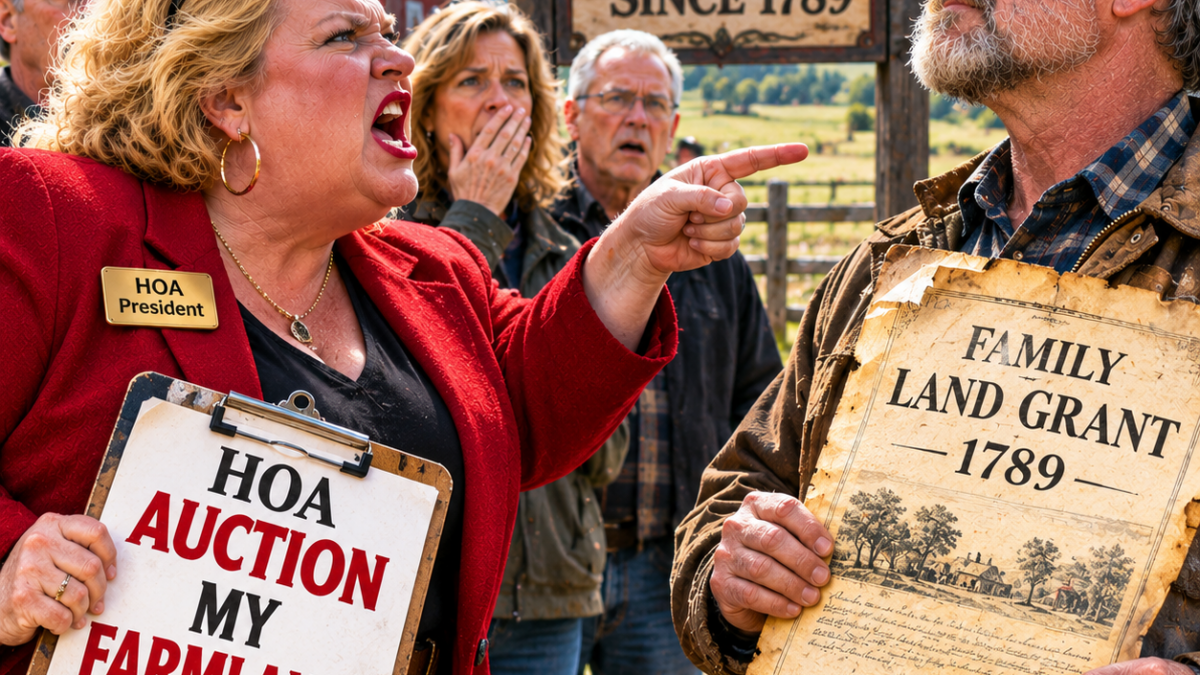
PART 2
I went inside without turning on the television, without pouring a drink, and without calling anyone. I walked straight past the framed family photographs in the hallway and into the dining room, where the massive oak table my grandfather had built still bore a shallow burn mark from the time my father set down a cast-iron skillet without a trivet and blamed it on me for twenty years.
The house had never been fancy. It leaned slightly north. The upstairs floor complained in winter. The back door stuck when humidity climbed. But everything about it felt honest.
That night, honesty was exactly what I needed.
I went to my father’s old rolltop desk.
Bottom drawer.
Canvas bundle.
Twine.
I carried it carefully to the table.
Sarah and I had been told since childhood never to handle it unless necessary. My father treated old documents almost the way other men treated firearms: respect, dry storage, no careless hands.
I untied the twine.
The canvas opened.
There it was.
The original deed.
April 12, 1888.
Silas Sterling.
Forty acres.
Embossed seal.
Flowing script.
Land described by landmarks that had disappeared before I was born.
I had seen it dozens of times.
That night, it looked different.
It looked like a weapon.
Not because paper possesses power by itself, but because law is built on records, and records do not care how loudly Karen Miller holds a gavel.
I sat down.
Then retrieved the box I had labeled years earlier:
**HOA NONSENSE**
It was full.
That should have bothered me sooner.
The first note Karen ever left was handwritten in purple ink and tucked under my windshield wiper.
**Your barn-red front door is not an approved Whispering Pines exterior color. Please submit an Architectural Review application.**
I had laughed.
Thrown it in the box.
Second:
Rooster noise.
Third:
Vegetable garden visible from road.
Fourth:
Unapproved agricultural structure.
Fifth:
Grass height.
The grass was hay.
Then certified letters.
Fines.
Threats.
Photographs.
Each letter assumed something that had never happened:
That my farm belonged to them.
Years earlier, I had spoken to a lawyer friend.
“They’re fishing, John.”
“What should I do?”
“Nothing.”
“They don’t have jurisdiction.”
So I ignored them.
That had been legally understandable.
Strategically?
A mistake.
Silence is interpreted according to the listener.
A reasonable person hears silence and thinks:
Maybe he doesn’t want to engage.
Karen heard silence and thought:
He is afraid.
And every year she pushed a little further.
I pulled out an old service logbook from my Army days.
Opened to a clean page.
Then wrote:
**OBJECTIVE: DEFEND STERLING FARM.**
Underneath:
**METHOD: DOCUMENT. VERIFY. COUNTER.**
Then:
**PRIMARY THREAT: HOA ASSERTING FALSE JURISDICTION.**
I considered writing Karen’s name.
Didn’t.
This needed to be about facts.
My phone rang.
Sarah.
Not my wife.
My sister.
“John?”
“What happened?”
“Facebook.”
I closed my eyes.
“What Facebook?”
“The neighborhood page.”
“What about it?”
“They posted an auction notice.”
“Already?”
“John, it says ‘prime development parcel.’”
I said nothing.
Her voice changed.
“They’re really doing this?”
“They’re trying.”
“Forty-seven thousand dollars?”
“Fiction.”
“But they’re telling everyone—”
“I know.”
“That farm is ours.”
“Mine legally.”
“You know what I mean.”
I did.
Sarah lived two hours away.
She had never wanted the farm.
But she still called it home.
“You’re not losing it.”
“You sound very sure.”
“I am.”
“You said that when Dad’s tractor rolled into the pond.”
“And I got it out.”
“You needed three trucks.”
“It came out.”
She almost laughed.
Then:
“Call Dave.”
“I’m about to.”
“I mean now.”
“Yes, ma’am.”
Dave Chen had served as a JAG officer before moving into civilian property law.
Short.
Broad shoulders.
Permanent expression suggesting someone had just handed him a badly written contract.
He answered after two rings.
“Sterling.”
“Dave.”
“You sound irritated.”
“HOA scheduled an auction.”
Pause.
“Of what?”
“My farm.”
Longer pause.
Then a low whistle.
“They’re auctioning the forty acres?”
“Yes.”
“For HOA debt?”
“Forty-seven thousand three hundred twelve dollars.”
Dave laughed.
Not because anything was funny.
Because attorneys sometimes respond to catastrophic stupidity the way mechanics respond to someone pouring gasoline into a diesel tank.
“Send me everything.”
“I have a box.”
“I want the box.”
“I have the original deed.”
“Do not bring the original.”
“Certified copy?”
“Tomorrow.”
“County courthouse first.”
“I was going there.”
“I know.”
“John?”
“Yes?”
“Do not call Karen.”
“I wasn’t planning to.”
“Do not email Karen.”
“No.”
“Do not threaten anyone.”
“No.”
“Do not post anything online yet.”
“Fine.”
“And do not show up at that auction in uniform waving a saber.”
“I don’t own a saber.”
“That was not the point.”
I hung up.
The next morning, I drove to the county courthouse.
Patty Morrison worked records.
She knew my father.
The moment I explained why I was there, her mouth fell open.
“They’re doing what?”
“Trying to auction the farm.”
“Whispering Pines?”
“Yes.”
“John, your place isn’t in Whispering Pines.”
“I know.”
“Everybody knows.”
“Apparently Karen doesn’t.”
Patty shook her head.
“Give me twenty minutes.”
It took three hours.
Worth every minute.
Certified deed.
1952 survey.
Road acquisition documents.
Tax maps.
Then the subdivision plat from 2006.
Patty unrolled it across a large counter.
Whispering Pines.
Phase One.
Lots.
Roads.
Common areas.
Entrance.
My farm sat directly beside the subdivision boundary.
Gray shading.
Clear label:
**NOT A PART OF THIS PLAT**
I stared.
Patty tapped it.
“Well?”
“That’s beautiful.”
“It’s a plat map.”
“Today it’s beautiful.”
I paid for certified copies.
Then drove to Dave’s office.
He cleared half a conference table.
I laid everything out chronologically.
1888.
1952.
2006.
HOA notices.
Auction announcement.
Dave put on glasses.
Read.
Twenty minutes.
Thirty.
Finally:
“This might be the stupidest thing I’ve seen this quarter.”
“Quarter?”
“It’s January.”
“Comforting.”
He picked up the subdivision plat.
“This is definitive.”
“Meaning?”
“Meaning they have no jurisdiction over the land.”
“None?”
“None that I see.”
He pointed to the boundary.
“Not annexed.”
“No recorded declaration.”
“No membership covenant running with your title.”
“No lien authority.”
“Nothing.”
He looked at Karen’s auction notice.
“If they actually attempt conveyance, we potentially have slander of title, attempted conversion, interference with property rights, harassment, possible fraud depending on representations to bidders.”
I sat back.
“Civil?”
“At minimum.”
“Criminal?”
“Too early.”
“Don’t get ahead of facts.”
He tapped the stack of letters.
“Though somebody apparently already has.”
We drafted a cease-and-desist.
Professional.
Not emotional.
Parcel 7B was not HOA property.
Never had been.
The claimed fees were invalid.
No lien authority.
No auction authority.
Immediate cancellation demanded.
Written retraction required.
Otherwise:
Injunction.
Damages.
Costs.
Claims against the association and potentially individual directors depending on their conduct.
Dave arranged personal service.
Mike, former police officer, delivered it.
I parked down the street.
Not because I needed the spectacle.
Because I wanted confirmation.
Karen was supervising gardeners.
Of course.
Mike walked up.
“Karen Miller?”
“Yes?”
“You’ve been served.”
She ripped open the envelope.
Read.
Her posture changed.
Then she looked up.
Straight toward my truck.
I was far enough away that she probably couldn’t see my face.
But she knew.
She crumpled one corner of the paper.
Turned.
Went inside.
Door slammed.
I called Dave.
“Delivered.”
“Good.”
“Think she’ll cancel?”
“No.”
“You sound confident.”
“I’ve met her through correspondence.”
He was right.
One week later, an inch-thick response arrived from a city law firm.
Glossy blue cover.
Aggressive letterhead.
Legal vocabulary assembled in formations large enough to make nonsense look expensive.
Dave had me on speaker.
“They’re claiming implied consent.”
“How?”
“Because your property allegedly benefits from Whispering Pines.”
I laughed.
“It benefits from their existence?”
“Apparently surrounding development increased your property value, therefore you accepted association jurisdiction.”
“That’s insane.”
“Yes.”
“Anything else?”
“Estoppel.”
“Because I ignored the earlier letters?”
“That’s their argument.”
“They’re saying by not suing them earlier, you admitted membership.”
“I know.”
“That’s not how deeds work.”
“I know.”
“Why are we still talking?”
“Because their lawyers bill hourly.”
That weekend, I read their response line by line.
One section called me an HOA member.
Another described the Sterling farm as an “adjacent nonconforming parcel.”
I highlighted both.
Same document.
Two incompatible descriptions.
I wrote:
**If member, prove recorded basis. If adjacent, no jurisdiction.**
That became our strategy.
Facts.
Every contradiction.
Every document.
No drama.
Then something changed.
I realized that even if we won legally, Karen would still control the story inside Whispering Pines.
To residents, I was the reclusive farmer refusing to pay dues.
She had years of meetings behind her.
Years of repetition.
People believed what they heard most often.
So I walked.
Outer boundary first.
Older properties.
Places that existed before the subdivision.
Arthur Henderson’s place sat behind one cul-de-sac.
Two acres.
Old workshop.
Project cars.
Vegetable garden.
Chain-link fence with some rust.
I found him replacing a carburetor.
“Arthur?”
He looked up.
“John Sterling.”
“You know me?”
“Everybody knows the man Karen is trying to auction.”
“Good news travels.”
“That isn’t good news.”
“No.”
He wiped his hands.
“What happened?”
I explained.
His face darkened.
“She’s crazy.”
“Maybe.”
“Don’t diagnose.”
“She’s been after me for six months.”
“What for?”
He pointed.
“Fence.”
“Rust?”
“Visual nuisance.”
He pulled a paper from his workshop.
Photo of fence.
Red circle.
Threatened five-hundred-dollar penalty.
“Are you in Whispering Pines?”
“No.”
“Never signed?”
“No.”
“Property predates subdivision?”
“Since sixty-three.”
I nodded.
“Keep every letter.”
Arthur stared.
“You think she can do something?”
“I think she thinks she can.”
Different.
Next:
Eleanor Gable.
Eighty-one.
Widow.
Rose garden so beautiful it looked deliberately disobedient.
Karen had cited her for “noncompliant floral arrangements.”
Her heirloom roses were not on approved landscape lists.
“Are you inside the HOA?”
“Technically my front half-acre touches their common road, but my deed predates the development.”
“Have you signed membership documents?”
“No.”
“Yet you pay fines?”
Eleanor looked embarrassed.
“Small ones.”
“Why?”
“They scare me.”
That answer hurt.
Not because Eleanor was weak.
Because fear is expensive.
A two-hundred-dollar fine to someone on fixed income is not petty.
It is groceries.
Medicine.
Utilities.
I invited Arthur.
Eleanor.
Several others.
Sunday.
Farmhouse.
Oak table.
Six people arrived.
Nobody wanted revolution.
Good.
Revolutions are messy.
We needed information.
I laid out the deed.
Plat.
Auction notice.
Dave’s letter.
Then:
“Karen’s authority ends where the recorded subdivision ends.”
Arthur leaned forward.
“So these fines?”
“If your parcels are not subject to the declaration, they may have no basis.”
Eleanor whispered:
“She said she could lien my house.”
“Not simply because she says so.”
“But the letter…”
“Official letterhead is not land title.”
She looked down at her hands.
“They made it sound like I could lose everything.”
I understood.
Karen’s power came from that sentence:
**They made it sound like.**
We needed to replace appearance with proof.
My niece Jessica helped search public records.
Not social media gossip.
Documents.
Court filings.
Transfers.
LLC records.
HOA minutes.
Then she called.
“Uncle John.”
“What?”
“I found something.”
“What?”
“One-acre parcel.”
“Where?”
“Between Lots 14 and 15.”
“Owner?”
“Used to be Raymond Cole.”
“Know him?”
“No.”
“Florida address.”
Then she sent records.
Three years earlier, HOA minutes described the parcel as abandoned and blighted.
Fines for grass.
Maintenance.
No response.
Lien.
Foreclosure.
Transfer to HOA.
Then sale.
Ten thousand dollars.
Private.
Buyer:
Oak Development Holdings LLC.
Registered agent:
Robert Miller.
Karen’s husband.
Two months later, Oak Development Holdings sold the same acre.
One hundred fifty thousand dollars.
I sat staring at the screen.
Sarah was on speaker.
“John?”
“Yeah.”
“You’re doing that silence thing.”
“I’m thinking.”
“Tell me.”
I did.
She swore.
I printed everything.
Then called Dave.
He listened.
Asked dates.
Amounts.
Names.
Documents.
When I finished, he went quiet.
“Dave?”
“Do not call this racketeering yet.”
“Okay.”
“Do not call it criminal theft.”
“Okay.”
“But this is serious.”
“How serious?”
“Serious enough that I’m requesting every underlying file.”
He continued:
“If the HOA used questionable fines to acquire land and then sold it through an entity tied to the president’s spouse for a massive private gain, we may have fraud, fiduciary violations, improper foreclosure, self-dealing.”
“And my farm?”
“Forty acres next to a subdivision?”
He exhaled.
“John, if someone believed they could force a transfer of that land cheaply, subdivide it, and resell it…”
“Millions.”
“Potentially.”
My anger returned.
Cold again.
For years I had assumed Karen wanted conformity.
Maybe she did.
But forty acres was not a mailbox.
If the earlier transaction meant what it appeared to mean, my farm was not just an annoyance.
It was an opportunity.
That changed everything.
Dave said:
“We need absolute boundaries.”
“Plat already shows them.”
“I want a current certified survey.”
I knew who.
Chet Romano.
Surveyor.
Expert witness.
Sixties.
Zero patience.
Expensive.
Worth it.
He met me at sunrise.
I gave him deed.
1952 map.
County plat.
He read.
Then:
“HOA trying to annex by attitude?”
“Something like that.”
“Seen it.”
He spit into the grass.
“People forget lines exist even when they don’t like them.”
His crew spent four days on my farm.
Modern GPS.
Total stations.
Magnetometer.
Historic calls.
Iron pins.
Old monuments.
The work fascinated me.
Land ownership feels abstract until someone physically reconstructs where history meets dirt.
On day two, Karen arrived.
Minivan.
Clipboard.
Storm clouds.
“What is this?”
Chet kept looking through his instrument.
“Survey.”
“I can see that.”
“Then why ask?”
I almost smiled.
Karen pointed.
“You are conducting commercial activity within Whispering Pines without authorization.”
Chet did not look at her.
“This is private property.”
“The road easement is HOA common area.”
Chet finally straightened.
He walked to his truck.
Pointed at certified plat.
“Ma’am.”
“Whispering Pines common property ends there.”
He pointed toward ornamental pear trees.
Karen frowned.
“That is incorrect.”
“No.”
“It is recorded.”
She stepped forward.
Chet looked at the ground.
Then at her.
“You are currently standing on Sterling property.”
Her face changed.
“What?”
“About six feet inside.”
She stepped backward automatically.
Arthur later said that was his favorite moment of the entire war.
Karen recovered.
“This survey is biased.”
Chet stared at her.
“Ma’am, satellites do not know you.”
I had to turn away.
Karen left furious.
She returned the next day with another complaint.
Chet ignored her.
Day three:
She claimed stakes were unauthorized visual obstructions.
Chet ignored her.
Day four:
Final boundary.
Then Chet called me to the entrance.
Whispering Pines sign.
Massive brick footing.
Carved wood.
Flower beds.
Uplighting.
**WHISPERING PINES — A COMMUNITY OF DISTINCTION**
Chet kicked an orange stake.
“John.”
“Yes?”
“We’ve got a problem.”
My stomach tightened.
“What?”
He pointed.
“The sign.”
“What about it?”
“Four feet, two inches.”
“Meaning?”
“On your land.”
I stared.
“You’re sure?”
He looked offended.
“Do I seem uncertain?”
“No.”
“The entire footing on this side crosses the line.”
He pointed toward flowers.
“Petunias too.”
I laughed.
Couldn’t help it.
Karen’s monument to jurisdiction was literally trespassing.
Chet did not laugh.
Surveyors apparently consider boundary irony less entertaining than normal humans.
His final report was devastating.
Maps.
Coordinates.
Historic records.
Survey monuments.
Methodology.
Photographs.
Conclusion:
Sterling farm entirely outside HOA boundary.
HOA entrance structure encroaching four feet two inches onto Sterling property.
Dave called after reading.
“You understand what this does?”
“Improves our mood?”
“It adds encroachment and trespass.”
“Can we make them move the sign?”
“Yes.”
I looked through the window toward the entrance in the distance.
“Good.”
The auction was still scheduled.
Karen had not canceled it.
In fact, she escalated.
Glossy flyers appeared.
**PUBLIC AUCTION — PRIME 40-ACRE DEVELOPMENT PARCEL**
She called my farm a development parcel.
Not farm.
Not Sterling land.
Development parcel.
That told me more than any legal argument.
She had started marketing what she did not own.
Dave and I decided potential bidders needed warning.
County Chronicle.
Quarter-page advertisement.
Bold heading:
**PUBLIC NOTICE AND WARNING REGARDING PROPOSED AUCTION OF PARCEL 7B / STERLING FARM**
Then facts.
I held title.
HOA had no right to convey.
Certified records showed farm outside association.
Pending injunction.
Prospective bidders warned that no clear title could be obtained from HOA.
Dave’s phone number.
The ad ran every day for a week.
Calls began.
Developers.
Investors.
One man asked:
“If I bid anyway, could I acquire rights through litigation?”
Dave said:
“You could acquire legal fees.”
Most lost interest immediately.
Inside Whispering Pines, Jessica created:
**WHISPERING PINES HOMEOWNERS FOR FAIR GOVERNANCE**
No insults.
No memes initially.
Just documents.
1888 deed.
2006 plat.
Survey.
Photograph of entrance sign crossing boundary.
Eleanor posted her rose fine.
Arthur posted fence notice.
Then the page exploded.
Mailbox paint.
Basketball hoops.
Christmas lights.
Trash cans.
Grill smoke.
Swing set two inches too tall.
Driveway stain.
Patio furniture.
People compared.
Patterns emerged.
Some residents remained loyal to Karen.
That was fine.
We did not need unanimity.
We needed truth available.
Someone nicknamed her Clipboard Karen.
Another:
Beige Dictator.
I discouraged that.
Not because it wasn’t funny.
Because mockery makes evidence look partisan.
Jessica understood.
We moderated posts.
Documents.
Dates.
Facts.
No threats.
No doxxing.
No fantasies.
That credibility mattered later.
The day before auction, Dave filed for emergency injunction.
We had everything.
Deed.
Plat.
Survey.
Public auction advertisement.
Prior letters.
HOA’s implied-consent theory.
Evidence connected to the earlier lot transaction.
Court moved quickly.
Temporary injunction issued.
Auction legally barred from proceeding.
But Karen still planned to hold the meeting.
Dave smiled.
“Let her.”
I called Sheriff Brody.
Explained.
Not asking for arrest.
Not asking for intervention.
Just crowd control.
“Deputy nearby?”
“Probably wise.”
Brody knew the Sterling farm.
His father had hunted rabbits there with my dad.
He said:
“I’ll send Miller.”
Auction night.
Clubhouse packed.
Fifty people.
Maybe more.
Rows of chairs.
Podium.
Large map:
**WHISPERING PINES EXPANSION PARCEL**
My farm shaded like vacant land.
Three developers in suits.
Reporter.
Camera.
Residents.
Deputy outside.
Karen wore pink again.
Not tracksuit.
Power suit.
Corsage.
I had no idea why.
At seven exactly, she tapped microphone.
“Good evening.”
The room quieted.
She gave a speech about standards.
Fiscal responsibility.
Protecting responsible homeowners from noncompliant owners.
Then:
“We will begin bidding at fifty thousand dollars.”
Fifty thousand.
For forty acres.
My stomach turned.
Not because I feared they could convey clean title.
Because the number made the scheme visible.
She was offering family land for almost nothing to create momentum.
I stood at the back.
Dave beside me.
Chet on the other side.
He carried the certified survey.
I wore my old service uniform.
Not for intimidation.
Not nostalgia.
Because Karen’s narrative painted me as a delinquent recluse hiding behind an old barn.
I wanted people to see who I was.
A man who had served.
Returned home.
Maintained land.
Paid taxes.
Kept records.
The crowd parted as we walked.
Karen froze.
“Mr. Sterling.”
I continued.
“You are out of order.”
I stopped at the podium.
“This auction is illegal.”
She banged gavel.
“Security.”
Nobody came.
Deputy Miller looked through the glass.
Dave stepped forward.
“Karen Miller?”
Her face changed.
“Yes.”
“You are hereby served with an injunction prohibiting any sale, transfer, bidding process, or representation that the Whispering Pines HOA possesses conveyable interest in the Sterling farm.”
He placed papers on podium.
Then:
“You are also being served with a civil complaint.”
Karen stared.
Dave turned.
Board members received copies.
Vice president.
Secretary.
Treasurer.
Faces drained.
Camera’s red light turned toward them.
Karen found her voice.
“This is harassment.”
“No.”
Dave said.
“This is court process.”
I unrolled Chet’s survey.
Table.
Large.
Clear.
I pointed to subdivision.
“This is Whispering Pines.”
Then farm.
“This is the Sterling farm.”
Then 1888 deed.
“My family acquired this land before Whispering Pines existed.”
Karen said:
“The association has accrued rights.”
“Show me.”
“What?”
“Show me the document.”
She looked around.
I continued.
“Show this room one recorded instrument placing my forty acres under your declaration.”
Nothing.
“Show one deed.”
Nothing.
“One signed membership agreement.”
Nothing.
“One annexation.”
Nothing.
I held up the plat.
“The county record says ‘NOT A PART OF THIS PLAT.’”
A resident whispered:
“Oh my God.”
Then Chet stepped forward.
He pointed toward entrance sign shown on the survey.
“And according to the certified field survey, your HOA’s entrance monument is four feet two inches inside Mr. Sterling’s property.”
The room erupted.
Karen’s mouth opened.
Chet continued:
“Which means before discussing forty acres you do not own, you might consider removing the sign you built on land you also do not own.”
That was the moment her authority cracked visibly.
The developers started packing.
One of them asked Dave quietly:
“This auction is dead?”
“Very.”
He left.
Then the others.
Karen grabbed microphone.
“This is an illegal disruption.”
Nobody listened.
Arthur stood.
“Read the lawsuit.”
Eleanor said:
“Read the deed.”
Others joined.
Karen shouted:
“I am ordering everyone to leave.”
No one moved.
That silence defeated her more effectively than shouting.
For years, people obeyed because she expected obedience.
Now they simply remained seated.
Karen looked around.
Nobody responded.
She dropped the gavel.
Not dramatically.
It bounced.
Clattered.
Then she stormed out.
The auction ended without a bid.
Without a sale.
Without even a legal possibility of sale.
The reporter followed Dave outside.
News aired at ten.
**LOCAL VETERAN HALTS HOA LAND AUCTION, ALLEGES FRAUDULENT SEIZURE SCHEME**
They showed the deed.
Plat.
Survey.
Encroaching sign.
Eleanor’s roses.
Arthur’s fence.
My old barn.
Karen leaving.
The next morning, Whispering Pines woke up different.
People were angry.
Not because I told them to be.
Because evidence changed what they thought they knew.
HOA counsel called Dave.
Settlement discussion.
Dave said:
“No confidential disappearance.”
“What does your client want?”
We had discussed it.
First:
Public cancellation of all Sterling farm claims.
Second:
All expenses reimbursed.
Legal.
Survey.
Public notice.
Third:
Entrance sign removed from my property.
Fourth:
Karen resigns.
Fifth:
Independent forensic audit of five years of finances and property transactions.
Sixth:
Public apology to wrongly targeted residents.
HOA lawyer said:
“That’s extensive.”
Dave answered:
“So is attempting to auction forty acres you don’t own.”
They folded.
Not immediately.
But quickly.
The existing board understood what continued litigation meant.
Costs.
Discovery.
Prior land transaction scrutiny.
Potential personal exposure.
Agreement signed.
The first visible consequence arrived one week later.
Backhoe.
Contractor crew.
Survey map.
Entrance sign.
I sat on porch with coffee.
Sarah had driven down.
“You planned this.”
“I did not order a viewing party.”
“You put out two chairs.”
“Coincidence.”
Excavator bucket broke brick footing.
Wood sign came down.
Flower beds removed carefully.
Petunias moved to HOA side.
Concrete pulled.
Soil filled.
By noon, four-foot strip of Sterling land was empty again.
Karen drove past.
Slowed.
Window down.
She looked at wreckage.
Then toward me.
Our eyes met.
I did not smile.
That mattered.
Revenge can become intoxicating if you start needing the other person’s pain.
I wanted my land back.
I had it.
That was enough.
She drove away.
The reimbursement check arrived.
Every dollar.
Dave fees.
Survey.
Ad.
Costs.
Sarah watched me endorse it.
“How does that feel?”
“Like paperwork.”
“You are impossible.”
“It’s reimbursement.”
“You’re smiling.”
“Am I?”
“Yes.”
“Maybe slightly.”
Then the clubhouse meeting.
Settlement ratification.
Standing room only.
Karen absent.
Vice president read terms.
Apology.
Reimbursement.
Audit.
Resignation.
Applause grew with each.
Then side door opened.
Karen.
Tear-streaked.
Angry.
“I am not resigning.”
Silence.
She walked toward podium.
“This is a coordinated attack.”
People shifted.
“This man has slandered me.”
She pointed at me.
“I have spent fifteen years protecting this community.”
Eleanor stood.
Tiny woman.
Straight back.
“You fined me because my roses were wrong.”
Karen looked at her.
“You violated the landscaping standard.”
“My husband planted those roses.”
Her voice trembled.
“He died seven years ago.”
“I paid your fine because I was scared.”
Karen said nothing.
Arthur stood.
“You threatened a lien because my fence was rusty.”
Another homeowner:
“You fined us for Christmas lights.”
Another:
“You measured my son’s swing set.”
Another:
“You sent six notices over a mailbox.”
One after another.
Not screaming.
Testimony.
That was more powerful.
Karen tried to interrupt.
Vice president finally said:
“Karen.”
She turned.
“It’s over.”
Her face changed.
“All in favor of accepting the resignation?”
Hands.
Almost every hand.
“All opposed?”
Nobody.
Karen stared.
Then walked out.
No gavel.
No followers.
No power.
The forensic audit took months.
That part was not entertainment.
Accountants.
Bank records.
Invoices.
Transfers.
LLCs.
Contracts.
It confirmed what we had feared.
Padded invoices.
Payments tied to a landscaping business owned by Karen’s brother-in-law.
Nearly one hundred thousand dollars skimmed or improperly routed over several years.
Then the old one-acre parcel.
The audit and subsequent investigation tied the transaction to Karen and her husband’s LLC.
The evidence went to state investigators.
Charges followed.
I did not attend every hearing.
I had a farm.
Eventually:
Guilty plea.
No trial.
Probation.
Community service.
Restitution.
Assets sold.
Karen and her husband moved out of state after selling their house.
That should have felt like the climax.
It didn’t.
The climax happened earlier.
In the clubhouse.
When residents who had been isolated started standing.
That was the moment Karen truly lost.
Everything afterward was accounting.
A new HOA board formed.
Arthur joined.
Against his better judgment.
“I hate meetings.”
“Perfect qualification.”
He glared.
First major project:
Rewrite covenants.
Not burn everything literally, despite jokes.
Review.
Remove intrusive nonsense.
Paint palette relaxed.
Gnome rules removed.
Basketball hoop restrictions simplified.
Complaint process changed.
Anonymous accusations no longer automatically became enforcement.
Board financial reporting improved.
Outside audit annually.
Related-party transactions disclosed.
Property boundaries verified before enforcement.
That last one drew laughter.
The neighborhood changed.
Not overnight.
Fear has residue.
People had spent years watching one another because Karen rewarded reporting.
Suddenly they had to remember how to be neighbors instead of informants.
Eleanor’s roses flourished.
Arthur’s fence remained rusty.
He repainted one section voluntarily.
Then got bored.
David’s basketball hoop stayed in the driveway.
Children left bikes visible.
The world did not end.
My farm became quieter too.
Not literally.
Rooster still crowed.
Tractor still ran.
Hay still needed cutting.
But the legal pressure stopped.
No certified letters.
No photographs attached to violation notices.
No strange cars slowing by gate.
I slept better.
Sarah visited more.
One Saturday, Arthur arrived with beer.
“Need help?”
“With?”
“Old Chevy in your barn.”
“That isn’t mine.”
“Exactly.”
We spent six hours arguing over carburetor settings.
Eleanor started bringing bread.
I gave her tomatoes.
Something had changed in me.
Before Karen, I liked isolation.
I had earned solitude after the Army.
Or thought I had.
I kept the farm as a fortress.
Whispering Pines existed over there.
I existed here.
The fight forced me to cross the boundary socially even while defending it legally.
That irony stayed with me.
The physical line mattered.
Ownership mattered.
But human connection did not need a fence.
Months after the sign disappeared, I walked to the reclaimed strip.
Four feet wide.
Bare soil had turned green.
I considered fencing it.
Strong posts.
Clear line.
Nobody could ever misunderstand again.
Then I looked toward Whispering Pines.
Kids riding bikes.
Arthur talking to a neighbor.
Eleanor trimming roses.
No Karen.
No need.
Instead, nursery.
Twelve saplings.
Oak.
Maple.
Sycamore.
I planted them loosely.
Not straight.
Not uniform.
Not HOA style.
Natural.
Sarah helped with two.
Then stopped.
“You said twelve.”
“Yes.”
“This is tree nine.”
“Yes.”
“You are younger than me.”
“No.”
“You are doing the rest.”
Fair.
At sunset, I stood beside the last sapling.
Small.
Flexible.
Almost nothing compared with oaks behind the farmhouse.
But every big tree starts looking insignificant.
Grandfather used to say:
“You don’t own land.”
“You borrow it from whoever comes next.”
I never completely agreed.
Legally, ownership matters.
Karen taught me that painfully.
But I understood his point.
Stewardship.
The deed said Sterling.
The soil did not.
My job was to protect it long enough to hand it forward.
That thought changed how I saw the fight.
At first:
Karen versus John.
Then:
HOA versus Sterling farm.
Later:
Power versus property rights.
Eventually:
What kind of neighbor and caretaker did I want to become after winning?
That last question was harder.
Winning can make you cruel if you keep fighting after danger passes.
I did not want that.
So I stopped.
No victory signs.
No billboard saying **1888 BEATS HOA**.
Arthur proposed one.
I said no.
No lawsuits beyond what settlement required.
No harassment.
No humiliating photos of Karen.
No celebration when she moved.
People asked:
“Don’t you want revenge?”
I thought I had already received the best kind.
The farm remained.
Her auction failed.
Truth became public.
Residents got their voices back.
Nothing else improved that.
Years passed.
The saplings grew.
One sycamore struggled first summer.
I watered it.
Second year, stronger.
Oak took slowly.
Maples faster.
By year five, the old entrance looked different.
Not grand.
Better.
Less like a monument to exclusivity.
More like an edge between two places that had learned to coexist.
Whispering Pines put up a new sign entirely on its own property.
Smaller.
Wood.
No brick fortress.
Someone asked me if I approved.
“I have no jurisdiction.”
That made Arthur laugh for five minutes.
The Sterling farm stayed in the family trust.
I had no children.
Sarah did.
Her daughter Jessica loved the property more than either of us expected.
The same niece who helped research Karen’s records began bringing her own kids.
They ran through hay.
Fed chickens.
Climbed the old oak.
One afternoon, her son asked:
“Uncle John, is this the land somebody tried to steal?”
Children simplify.
“Yes.”
“Why?”
“Money.”
“Didn’t they know it was yours?”
“They knew I said it was.”
“That’s not the same?”
“Sometimes people decide their story matters more than facts.”
He frowned.
“That’s dumb.”
“Yes.”
“Then what happened?”
“I showed everyone the papers.”
He looked disappointed.
“That’s it?”
“Mostly.”
“No fight?”
“Lawyers.”
“Boring.”
“Very.”
He ran away.
I smiled.
Good.
Let the next generation think paperwork is boring.
That means they are not living through the threat.
The old 1888 deed eventually went into professional archival storage.
Humidity controlled.
Protected.
Certified copies used.
Dave insisted.
“You carried this thing around too much.”
“I carried it twice.”
“Twice too many.”
He was right.
We scanned it at high resolution.
One copy framed in farmhouse hallway.
Not original.
Under it:
**STERLING FARM — EST. 1888**
No mention of Karen.
I liked that.
She did not deserve a permanent place in the family story.
Years after the case, the County Chronicle called.
Anniversary feature.
Reporter asked:
“What was the moment you knew you’d won?”
I thought she expected the injunction.
Or auction.
Or resignation.
I answered:
“When people stopped being afraid to stand up in the clubhouse.”
“Not when the auction stopped?”
“No.”
“Why?”
“Because another bad leader can always show up.”
“But if residents remember they have a voice, the system is harder to abuse.”
She wrote that.
Good.
Arthur became HOA president reluctantly.
One term.
Then stepped down.
“Why?”
“Because I hate everybody.”
“That seems extreme.”
“I hate meetings.”
“Better.”
New president:
Schoolteacher.
Then accountant.
Then nurse.
Leadership rotated.
No throne.
No cult.
That was healthier.
The audit rules remained.
Every year, statements posted.
Contracts published.
Related-party disclosures.
Residents complained that financial reports were boring.
Arthur said:
“Boring is what you want.”
He was right.
Good governance is boring.
Nobody makes viral videos about accurate minutes.
That is precisely why accurate minutes matter.
Eleanor died at eighty-nine.
Her family held memorial at Whispering Pines clubhouse.
Her roses were in photographs everywhere.
The new board named a small garden after her.
No approved plant list.
Just:
**ELEANOR’S GARDEN — GROW SOMETHING YOU LOVE**
I stood there longer than expected.
She had once been terrified of a two-hundred-dollar fine.
Now her name was on community soil.
That felt like justice more meaningful than punishment.
Arthur eventually sold his place to his grandson.
Fence got painted.
Arthur complained.
“Ruined the character.”
His grandson laughed.
The project cars remained.
HOA did not collapse.
I aged too.
Farm work became slower.
I hired help during hay season.
That was hard.
For a man who had spent a lifetime proving he could carry weight, accepting that younger shoulders should carry some is its own battle.
Jessica said:
“You preserved the farm so someone else could work it.”
“That was the point.”
“Then let them.”
Annoying when younger people are right.
One winter, I found Karen’s original auction flyer while cleaning a cabinet.
Glossy.
**PRIME 40-ACRE DEVELOPMENT PARCEL**
I stared.
Sarah was visiting.
“Burn it.”
“No.”
“Frame it?”
“No.”
“Why keep it?”
“Record.”
“You already have court files.”
I looked at the flyer.
She was right.
I tore it in half.
Then again.
Trash.
That surprised me.
For years I thought preserving every artifact was protection.
At some point, keeping too much becomes another way of letting conflict occupy your home.
The deed deserved preservation.
The auction flyer did not.
I kept the injunction.
Settlement.
Survey.
Important records.
Not propaganda.
That was progress.
Chet’s survey remained one of the most useful documents I owned.
After he retired, his firm sent a digital boundary file.
Modern.
Precise.
I walked the line occasionally.
Not because I feared the HOA.
Because land changes.
Fences drift.
Trees grow.
Markers disappear.
One day, a young board member joined me.
“Mr. Sterling?”
“John.”
“John.”
He pointed to one old pin.
“So that’s the line?”
“That’s one monument.”
“Seems small.”
“Most important lines are.”
He looked toward subdivision.
“I wasn’t living here during Karen.”
“Lucky.”
“My parents told me stories.”
“Half are probably wrong.”
“They said she tried to auction your farm.”
“That part is right.”
“Why didn’t the county stop her earlier?”
“Because institutions don’t automatically know every bad decision somebody is about to make.”
“So you had to act.”
“Yes.”
He nodded.
“That’s scary.”
“It can be.”
He asked:
“What’s the biggest lesson?”
I thought.
“Never confuse a notice with authority.”
He waited.
“Anybody can print letterhead.”
“Authority comes from law, recorded rights, valid contracts, proper process.”
He looked at pin again.
“And documents.”
“Yes.”
“Documents.”
The new HOA added that principle informally to training.
Verify jurisdiction before enforcement.
Obvious.
Apparently necessary.
The earlier one-acre property transaction was revisited after Karen’s case.
The elderly owner’s family eventually received compensation through separate legal processes.
I followed from distance.
That mattered to me.
My farm had resources.
History.
Records.
Dave.
I was equipped to fight.
That older man had not been.
Maybe dementia.
Maybe isolation.
Maybe he never understood letters.
Predatory systems test who is least able to respond.
That was the ugliest part.
Karen did not begin with forty acres.
She began where resistance was low.
The investigation made that clear.
That changed the reforms.
Whispering Pines created an elderly-resident assistance process for serious notices.
Not special treatment.
Clear communication.
Optional contact with family or representative.
No major enforcement action based solely on unanswered letters without additional verification.
That might sound minor.
It was not.
Silence can mean defiance.
Or illness.
Or absence.
Or confusion.
Systems should know the difference before taking homes.
The phrase “abandoned property” became almost taboo after my case.
Any board member using it had to verify occupancy carefully.
Arthur joked:
“John lives there. Check for tractor noise.”
Good system.
My barn reached its hundredth anniversary.
We repaired siding.
Replaced rotten beams.
Kept original shape.
I considered plaque.
Sarah said:
“Do not become the HOA.”
I reconsidered.
Instead, I invited neighbors for a barn dinner.
Long tables.
Lights.
Food.
Whispering Pines residents.
Farm friends.
Veterans.
Kids.
No speeches planned.
Of course Arthur gave one.
“John tried to be a hermit.”
Laughter.
“Karen failed to steal his farm and accidentally forced him to make friends.”
More laughter.
I shook my head.
He raised beer.
“To property rights.”
People cheered.
Then:
“And to neighbors who know where the property line is.”
Chet, retired but present, raised his glass.
Best toast.
Later, I stood outside barn.
Music inside.
Children running.
Sarah beside me.
“You know he’s right.”
“Who?”
“Arthur.”
“About?”
“You were a hermit.”
“Private.”
“Hermit.”
“I had friends.”
“Three.”
“Quality.”
She smiled.
“Would you change it?”
I looked toward lights of Whispering Pines.
Then farmhouse.
“No.”
“Even Karen?”
I considered.
“I’d change what she did to other people.”
“But your part?”
“No.”
“That fight pulled me out.”
Sarah nodded.
“Dad would be amused.”
“Dad would have shot the entrance sign.”
“Probably.”
We laughed.
My father belonged to a less litigiously patient generation.
The oak saplings grew tall enough to cast shade.
Not giants.
Maybe someday.
I would not see that.
Fine.
That is land.
You plant for people who have not arrived.
One fall afternoon, Jessica asked about succession.
“Uncle John.”
“Yes?”
“What happens when you’re gone?”
“Cheerful.”
“I’m serious.”
“So am I.”
We sat at the dining table.
Same table where deed had been unwrapped.
I showed her trust documents.
Farm protected from subdivision without family approval.
Agricultural conservation provisions.
Historic structures.
Boundary maps.
She read.
“You did all this because of Karen?”
“Partly.”
“She made you paranoid.”
“Prepared.”
“Same argument you always use.”
“Yes.”
Then I pointed.
“The goal isn’t freezing the land in 1888.”
“Change can happen.”
“But deliberately.”
“Not because someone prints an auction flyer.”
She nodded.
“Good.”
I looked at her.
“You want it?”
“The farm?”
“Yes.”
Her eyes filled.
“I don’t know if I deserve it.”
“Wrong answer.”
“What?”
“Land doesn’t care about deserving.”
“It needs stewardship.”
“You’ll learn.”
She reached across table.
Took my hand.
That was the moment I understood grandfather’s saying completely.
You own land legally.
But stewardship is temporary.
Karen viewed land as value to capture.
Lots.
Expansion.
Development parcel.
My family viewed it as continuity.
That difference made the fight emotional.
It was not forty acres of market value.
It was time made physical.
1888.
Barn.
Wars.
Depression.
Highway.
Developers.
Karen.
Now Jessica.
That is why her auction announcement felt like violence.
She reduced continuity to a debt entry.
Parcel 7B.
Abandoned.
Auction.
I hated those words.
Years later, they no longer had power.
The farm had outlived them.
One morning, Sheriff Brody stopped by.
Retired now.
He brought coffee.
“You know I almost arrested somebody auction night.”
“Who?”
“Karen.”
“For?”
“Disturbance.”
I laughed.
“You didn’t.”
“No.”
“Deputy Miller said she was close to putting hands on that reporter.”
“I missed that.”
“Good thing.”
We sat.
He said:
“Your case changed how county folks think about HOA disputes.”
“How?”
“Used to sound like rich-neighbor nonsense.”
“And now?”
“Property seizure got attention.”
“Should.”
He nodded.
“Most HOA disputes are still mailbox nonsense.”
“Until they aren’t.”
“Exactly.”
Another lesson:
Never dismiss small governance because scale seems trivial.
A board controlling a gate can still abuse.
A committee handling paint can still harm.
Local power feels tiny from distance.
Not if it points at your home.
Whispering Pines eventually established a mediation requirement before most litigation.
Good idea.
Not absolute.
Some cases need immediate court action.
But routine disputes?
Talk.
Document.
Mediate.
Litigate last.
Karen had skipped straight to threats because escalation made her feel powerful.
The new system treated escalation as failure.
That saved money.
And relationships.
A new resident once asked Arthur why the HOA settlement reserve was so conservative.
Arthur pointed at me.
“That man.”
I said:
“Not helpful.”
Resident laughed.
Arthur continued:
“We once tried to auction a farm we didn’t own.”
Resident stopped laughing.
“You what?”
“History.”
That story became institutional folklore.
Useful.
Embarrassing.
Good.
Institutions need memory of failure.
Otherwise, confidence resets faster than wisdom.
As I aged, the farmhouse leaned slightly more.
We repaired foundation.
Kept character.
One contractor suggested demolition and rebuild.
I almost threw him off property.
Sarah said:
“Emotionally, not physically.”
“Yes.”
We reinforced.
Updated wiring.
Plumbing.
Roof.
Kept original wood where possible.
Stewardship again.
Not freezing.
Preserving.
Whispering Pines changed too.
Houses aged.
Trees matured.
Once-identical façades diversified.
People painted doors different colors after palette rules disappeared.
Some elegant.
Some terrible.
World continued.
Property values rose anyway.
That made me laugh.
Karen had treated uniformity as financial necessity.
Turns out buyers also like personality.
Eleanor’s garden became neighborhood attraction.
Arthur’s grandson hosted car nights.
Kids shot basketball.
None destroyed civilization.
Rules still existed where needed.
Noise after midnight.
Dangerous storage.
Shared road obstruction.
Actual issues.
Good rules gain legitimacy when people can distinguish them from vanity.
That was the reform’s success.
One of the last times Dave visited, we sat on porch.
Older.
Slower.
He said:
“You know what I remember?”
“What?”
“Your first phone call.”
“What about it?”
“You said ‘I think it’s time we stopped ignoring the mail.’”
I smiled.
“Accurate.”
“You were angry.”
“Yes.”
“But not scared.”
I looked toward field.
“I was scared.”
He turned.
“Really?”
“Of losing the farm?”
“Of failing Dad.”
That truth had taken years to say.
Dave nodded.
“Fear isn’t absence of calm.”
“No.”
“Sometimes calm is what fear looks like when trained.”
He had always been good with words.
I said:
“You should have put that in the cease-and-desist.”
“Would’ve billed you extra.”
We laughed.
Dave died two years later.
Heart attack.
His firm sent me a copy of our original letter from their archive with a handwritten note he had added years earlier:
**Client stubborn. Opponent more stubborn. Fortunately opponent also wrong.**
I framed that.
Allowed in house.
Sarah approved.
Chet died too eventually.
Arthur moved.
Eleanor gone.
Karen somewhere else.
People rotate.
Land stays.
That truth becomes heavier with age.
One spring, I walked the boundary alone.
The oak saplings I planted after sign removal were now real trees.
One had a trunk thick enough that I could not wrap both hands around it.
I touched bark.
Remembered bare strip.
Backhoe.
Petunias.
Karen’s face from minivan.
All of it felt distant.
A child from Whispering Pines rode bike nearby.
Stopped.
“Mr. Sterling?”
“Yes?”
“Can I cut through your field?”
“Where to?”
“Creek.”
“Stay on mowed path.”
“Okay!”
No gate.
No dispute.
Clear boundary.
Permission.
That interaction captured everything I eventually learned.
Property rights and community do not conflict.
Ownership does not require hostility.
A boundary is not an insult.
It tells you where consent begins.
Karen’s mistake was not liking neat landscapes.
Her mistake was believing preference created jurisdiction.
Once you accept that, every boundary becomes negotiable according to whoever has the clipboard.
That is dangerous.
I became protective of the word consent.
Recorded agreements.
Deeds.
Easements.
Votes.
Membership.
Clear.
No implied authority invented after the fact.
That principle guided farm trust documents.
HOA reforms.
Everything.
One fall, County Chronicle returned.
They wanted photographs of 1888 deed for historical issue.
I agreed.
Reporter younger than my boots asked:
“Did your family really own this before the town existed?”
I corrected him.
“Before the subdivision.”
“The town predates us.”
He looked disappointed.
“Headline less dramatic.”
“Accuracy better.”
He smiled.
“Fair.”
That is another thing age taught me.
Truth does not need exaggeration.
Karen trying to auction forty acres outside her HOA was dramatic enough.
No need to claim she tried to auction a town.
The article ran:
**STERLING FARM: 1888 LAND DEED THAT STOPPED A MODERN HOA AUCTION**
Good.
They photographed deed.
Barn.
Boundary oak.
No Karen photo.
Perfect.
Jessica’s oldest daughter eventually studied environmental planning.
Family apparently cannot escape land records.
She asked about preserving farm as agricultural open space.
We discussed.
Not forever necessarily.
But protections.
She said:
“Whispering Pines needs green space.”
I stared.
She laughed.
“I knew you’d make that face.”
“They once tried to steal this green space.”
“I know.”
“But now residents value it.”
“That’s different.”
“Yes.”
She was right.
Some Whispering Pines families bought produce from us.
Kids visited.
Fields provided visual break.
Wildflowers supported pollinators.
Old oak line buffered storms.
The farm had community value without being community-owned.
Important distinction.
You can benefit from something you do not control.
Karen never understood that.
She thought benefit justified authority.
No.
Benefit can justify gratitude.
Respect.
Cooperation.
Not ownership.
When drought hit one summer, I let HOA access pond water for newly planted common trees under written temporary agreement.
Arthur’s grandson joked:
“Careful, implied consent.”
I stared.
He laughed.
Paperwork specified:
No membership.
No easement beyond temporary license.
No expansion.
Dave would have been proud.
Generosity with documentation.
Best combination.
The farm became stronger after conflict.
So did community.
That was the best revenge.
Not Karen suffering.
The thing she tried to exploit becoming healthier after she left.
Her grand entrance sign?
Gone.
But neighborhood identity improved.
Her restrictive rules?
Reduced.
Property values fine.
Her fear system?
Replaced by relationships.
My isolation?
Softened.
Her scheme to convert farm into development?
Failed.
Farm stayed.
I did not need more.
One evening, I found myself at edge where old sign stood.
Sunset.
Long shadows.
The trees I planted moved in wind.
Jessica joined me.
“You come here a lot?”
“Sometimes.”
“Why?”
“Perspective.”
She looked toward subdivision.
“Do you still think about Karen?”
“Less.”
“The auction?”
“More than Karen.”
“Why?”
“Because the auction reminds me how quickly fiction becomes dangerous when printed officially.”
She nodded.
“And the deed?”
“I think about that too.”
She smiled.
“1888.”
“1888.”
“You know one day those trees will be older than you were during all this.”
“Hopefully.”
“Then nobody will remember the sign.”
“Good.”
That was exactly right.
I wanted the scar to become forest.
Not monument.
Some injuries deserve markers.
Others deserve healing.
When the first oak dropped acorns, I collected a handful.
Planted two near barn.
Maybe foolish.
I may never see them mature.
Again:
Stewardship.
The final HOA file eventually moved from office to attic.
One banker box.
Labeled:
**WHISPERING PINES / 2010s**
Not:
Karen.
Not:
War.
Just records.
The old service logbook stayed on shelf.
Operation Enduring Karen.
I cringed at name.
Sarah found it hilarious.
“You were dramatic.”
“I was under pressure.”
“You wrote ‘enemy assessment.’”
“Military habit.”
“You wrote ‘prone to overreach.’”
“Accurate.”
“Can I keep this when you die?”
“No.”
“Yes.”
“Absolutely not.”
She will.
I know.
Years later, I was invited to speak at an HOA governance workshop.
The irony.
I almost declined.
Then agreed.
Room of board members.
I told them:
“Most HOA leaders are not criminals.”
“Most homeowners are not saints.”
Laughter.
“But authority needs boundaries.”
I showed anonymized lessons.
Verify jurisdiction.
Record votes.
Avoid related-party transactions without disclosure.
Do not use enforcement as retaliation.
Do not assume silence equals consent.
Do not threaten liens without legal authority.
Never advertise property for sale unless you are certain you can convey it.
That got nervous laughter.
Then:
“If your governing documents allow something, ask whether doing it serves the community.”
“Legal authority is not always good judgment.”
Someone asked:
“Do you think HOAs are bad?”
“No.”
“Bad governance is bad.”
“An HOA can manage common roads, insurance, shared spaces, reserves.”
“It should not become a personality cult.”
Another asked:
“How do residents stop that?”
“Show up.”
“Read.”
“Vote.”
“Request records.”
“Build procedures that survive personalities.”
Boring advice.
Useful.
The workshop organizer later said my session had highest attendance.
Apparently land-auction disasters market well.
I returned home.
Fed chickens.
Better.
Eventually, Jessica and her family moved into farmhouse addition.
Not full takeover.
Transition.
I moved downstairs.
She handled more operations.
Her husband managed equipment.
Children did chores badly then better.
Farm changed.
Necessary.
One afternoon, her son complained:
“Why do we keep all these old papers?”
I pointed toward deed copy.
“That one stopped us losing forty acres.”
He looked.
“Oh.”
“Still boring?”
“A little.”
Fair.
I showed him survey.
Boundary.
Old sign encroachment.
He laughed.
“They built their sign on our land?”
“Yes.”
“How stupid.”
“People become confident before they become careful.”
He considered.
“Grandpa John?”
“I’m not your grandpa.”
“Basically.”
“Fine.”
“Can I put up a sign there?”
“No.”
“Why?”
“Because we learned nothing if the ending is another sign.”
He rolled eyes.
Children.
I was tired more often.
Walked slower.
But peace had settled deeply.
The farm no longer felt like something under siege.
It felt inherited and ready to be inherited again.
That was all I wanted.
One final autumn, brilliant.
Hay cut.
Leaves red.
Barn shadows long.
Whispering Pines held community event.
They invited Sterling family.
I went.
A plaque near new entrance:
**WHISPERING PINES
ESTABLISHED 2006**
Below, smaller:
**PLEASE RESPECT ADJACENT PRIVATE PROPERTY**
I laughed.
Arthur’s grandson saw.
“Too much?”
“Perfect.”
No grand claim.
Just respect.
Karen’s old sign had said:
**A COMMUNITY OF DISTINCTION**
As if distinction came from brick and petunias.
The new sign was simpler.
Better.
People changed.
Institutions can too.
That night, I sat on farmhouse porch.
Jessica brought coffee.
“Cold.”
“Yes.”
“You okay?”
“Yes.”
We looked across field.
She asked:
“What was Grandpa like?”
“My father?”
“Yes.”
“Stubborn.”
“Like you?”
“Worse.”
“Did he know about HOA?”
“He died before most of this.”
“What would he have done?”
I smiled.
“Probably driven tractor into clubhouse.”
She laughed.
“Seriously.”
“He’d have protected farm.”
“How?”
“Different generation.”
She nodded.
Then:
“You did.”
I looked toward barn.
“Temporary assignment.”
“What?”
“Protect it until next caretaker.”
She knew.
Grandfather’s saying.
“You don’t own land.”
“You borrow it.”
I said:
“Legally, we definitely own it.”
She laughed.
“You cannot help yourself.”
“No.”
The sun set.
Fields darkened.
Lights came on in Whispering Pines.
Once, those lights felt like an invading edge.
Now they were neighbors.
Not owners.
Not enemies.
Neighbors.
That distinction was worth every legal bill.
One of the last official things I did was record updated survey and trust cross-references so no future Sterling would ever face ambiguity.
County clerk—Patty long retired—stamped documents.
Young clerk asked:
“Anything else?”
I said:
“Make sure the boundary copy is readable.”
“It is.”
“The ‘not a part’ notation?”
“Yes.”
“The old survey references?”
“Yes.”
She smiled.
“You seem experienced.”
“You could say that.”
I walked out lighter.
Paperwork done.
Years earlier, Karen tried to create ownership through repetition.
Now the record was stronger than ever.
Not because I expected another Karen.
Because stewardship means preparing for people you’ll never meet.
I passed old clubhouse on way home.
No meeting.
No conflict.
Just empty parking lot.
That building once felt like enemy territory.
Now it looked small.
Most stages of fear look smaller after the play ends.
I drove onto gravel lane.
Farmhouse ahead.
Barn.
Fields.
Trees.
Home.
The fight started because Karen called it Parcel 7B.
A number.
Abandoned.
Debt.
Asset.
Auction.
She never understood that land can be legally measurable and emotionally immeasurable at the same time.
Forty acres.
Yes.
Tax value.
Yes.
Development potential.
Yes.
But also my grandfather’s hand.
My father’s tractor.
Sarah’s childhood.
Silas Sterling’s deed.
Barn nails driven by men whose names are now on stones.
You cannot put all of that in a plat description.
But you can protect the plat description that keeps it from being taken.
That is why the 1888 deed mattered.
Not magic.
Not sentiment.
Proof.
History backed by law.
When Karen announced the auction, she believed paper made her powerful.
In the end, paper did matter.
Just not hers.
The deed mattered.
The county plat mattered.
The survey mattered.
The injunction mattered.
The audit mattered.
The votes mattered.
The resignation mattered.
The difference between tyranny and order is often not whether paperwork exists.
It is whether paperwork corresponds to truth.
Karen’s did not.
Mine did.
That was the entire war.
People still occasionally call what happened revenge.
Maybe.
She tried to auction my farm.
Her entrance sign got torn out because it was on my property.
She tried to collect false fines.
The HOA reimbursed every penny I spent.
She tried to isolate me.
Her own residents stood against her.
She tried to profit from control.
An audit exposed the money trail.
She called my farm abandoned.
Years later, it was more alive than ever.
There is satisfying symmetry in that.
But the best revenge was never watching her leave.
It was planting trees where her monument stood.
It was seeing Eleanor’s roses bloom.
Arthur’s grandson repairing the old fence.
Kids riding bikes.
Jessica preparing to inherit the farm.
It was the fact that the thing Karen tried to turn into a quick development deal instead became more secure for the next generation.
That is revenge I can live with.
Not destruction.
Continuity.
Not humiliation.
Restoration.
Not taking her home.
Keeping mine.
Years after everything ended, I stood beneath one of the oaks I planted along that reclaimed strip.
The tree was tall enough to cast real shade now.
I put my palm against its bark.
Beyond it, Whispering Pines was quiet.
A basketball bounced.
Someone started a mower.
A child laughed.
Behind me, wind moved through hay.
Two communities touching without swallowing each other.
Exactly as it should be.
I thought of Karen’s voice in the clubhouse:
**Parcel 7B has been declared abandoned.**
Then I looked across forty acres.
Farmhouse.
Barn.
Fields.
Trees.
Family.
Nothing abandoned.
Never had been.
I smiled.
Then walked home.








