PART 2: HOA Karen Put My $1.2M Vineyard Up for Sale—Then I Walked Into Closing With the Real Deed
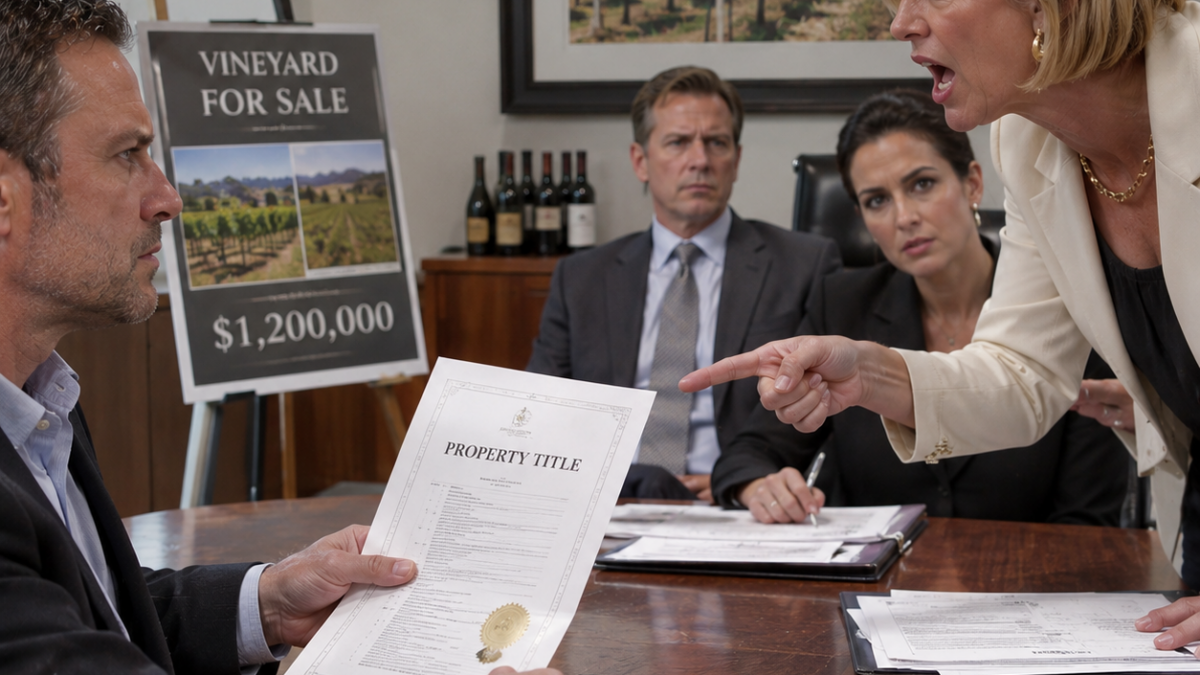
PART 2
For several seconds, neither photographer spoke.
I handed the phone back.
The older man finally said, “Sir, we were told the parcel was vacant agricultural property under HOA control.”
I looked toward my production shed.
A tractor sat beside it.
Harvest bins were stacked against the wall.
Two workers were repairing trellis wire less than two hundred yards away.
“Does this look vacant?”
He looked embarrassed.
“No.”
“Who hired you?”
“The listing agency.”
“Did anyone give you permission to enter?”
“We were told the seller had full access.”
“I’m the owner.”
The younger photographer lowered his eyes.
“We didn’t know.”
“I believe you.”
I wasn’t interested in turning two contractors into enemies because someone else had lied to them.
“Pack up your equipment and leave.”
They did.
Before driving away, the older man handed me his card.
“If you need proof we were instructed to photograph this parcel, call me.”
I kept the card.
That turned out to matter later.
The listing agency answered on my first call.
A cheerful office manager introduced herself and asked how she could help.
“You’re marketing Ashfall Vineyard.”
“Yes, sir.”
“Who authorized the listing?”
“The seller.”
“Who do you believe the seller is?”
There was a pause.
“Cedarvale Homeowners Association.”
“No.”
Another pause.
“I’m sorry?”
“My name is Blaine Huxley. I own Ashfall Vineyard.”
Her tone shifted from friendly to careful.
“Sir, the association provided documentation showing ownership.”
“What documentation?”
“I’m not able to release a client’s confidential file.”
“I have the recorded deed.”
“You’ll need to address any title dispute with the seller or your attorney.”
I almost snapped at her.
Instead, I asked one question.
“Is there already a purchase contract?”
She hesitated.
“I can’t discuss transaction details.”
The red banner on the listing had already answered me.
I thanked her.
Hung up.
Then called Priscilla.
She answered on the second ring.
“Blaine.”
“You listed my vineyard.”
A soft laugh came through the phone.
No surprise.
No hesitation.
A laugh.
“I wondered when you’d notice.”
I pulled the phone away from my ear and stared at it.
“You’re selling property you don’t own.”
“You had years to cooperate.”
“This is not HOA land.”
“The attorneys have handled the title.”
“Which attorneys?”
“You should stop interfering with a lawful transaction.”
I could hear traffic behind her.
She sounded relaxed.
That frightened me more than anger would have.
“Priscilla, you cannot sell Ashfall.”
“Apparently someone disagrees.”
“Who?”
“The county records.”
“You know I never transferred this property.”
She laughed again.
“You had three opportunities to negotiate with Cedarvale.”
“That has nothing to do with ownership.”
“Actions have consequences, Blaine.”
“So does fraud.”
Her voice cooled instantly.
“Be very careful with that word.”
“Then send me the deed.”
“Go pull it yourself.”
“I will.”
“You should also consider getting your equipment organized.”
“What?”
“The buyer intends to take possession quickly.”
I felt something tighten inside my chest.
“Are you threatening my employees?”
“No.”
“Then what are you saying?”
“That by tomorrow afternoon, your relationship with that property may be very different.”
“You have a buyer?”
“Cash.”
“How much?”
“You saw the listing.”
“Priscilla—”
“You had years to cooperate. Now you can watch somebody else own those vines.”
She hung up.
I stood between rows I had planted myself.
The dial tone buzzed against my ear until I finally lowered the phone.
Almost every serious problem I had faced at Ashfall had been physical.
Frost.
Drought.
Mildew.
Broken pumps.
Deer.
Labor shortages.
Storm damage.
Things I could see.
Measure.
Repair.
This was different.
Somewhere, a piece of paper apparently said my life belonged to someone else.
And enough people believed that paper to put $1.2 million behind it.
The following morning I drove to Cedarvale’s office without an appointment.
The receptionist saw me and went pale.
“Mr. Huxley.”
“Where’s Priscilla?”
“She’s in a meeting.”
“I’ll wait.”
“You really need an appointment.”
“I’m not asking for association services.”
She reached for her phone.
I stepped toward the conference area.
I didn’t enter any closed private office.
I didn’t touch computer equipment.
But one conference-room door stood open.
On the table sat a thick binder.
The cover stopped me.
**VINEYARD TRANSITION PLAN**
I opened it.
The first pages concerned utilities.
Irrigation control.
Equipment inventory.
Access routes.
Buyer possession.
Then page three.
A heading:
**OBSTACLES TO POSSESSION**
My name was first.
**BLAINE HUXLEY — CURRENT OCCUPANT**
Current occupant.
Not owner.
Occupant.
Below my name were instructions discussing removal of personal equipment after closing.
I heard heels behind me.
Priscilla walked in.
Perfect suit.
Perfect posture.
The kind of expression people wear when they believe anger is beneath them because authority has already settled the issue.
“You have no business being in here.”
I held up the binder.
“My name is under ‘obstacles.’”
“You should not be reading confidential documents.”
“You should not be selling my vineyard.”
She closed the door behind her.
“Part of Ashfall has always belonged to Cedarvale’s protected landscape corridor.”
“No.”
“And recent title corrections resolved the remainder.”
“What corrections?”
She walked to a filing cabinet.
Pulled out a document.
Placed it on the table.
“Read.”
I did.
It was a deed.
Grantor:
Blaine Huxley.
Grantee:
Cedarvale Homeowners Association.
Property:
All twenty-six acres.
Consideration:
Gift.
Voluntary transfer.
My name appeared at the bottom.
And beneath it—
a signature.
My signature.
Almost.
The resemblance was disturbing.
The first letter had the long downward stroke I often used.
The middle letters crowded slightly.
The final H slanted.
Someone had studied the way I signed.
I put my finger on the page.
“That’s my name.”
Priscilla folded her arms.
“The county has it recorded.”
“That is not my signature.”
“The recorder accepted it.”
“I have never given Cedarvale this property.”
“Your disagreement does not change the public record.”
“Who is Sylvie Merrick?”
Priscilla’s eyes moved toward the notary section.
“The notary.”
“I’ve never met her.”
“You may not remember.”
“I remember signing away twenty-six acres.”
“People forget paperwork all the time.”
I laughed.
Not because it was funny.
“You’re telling me I forgot giving away a vineyard worth over a million dollars for zero dollars?”
“The filing speaks for itself.”
“No.”
I took out my phone.
Photographed every page.
“The filing says somebody filed something.”
Priscilla’s expression hardened.
“You’re making this much more difficult than it needs to be.”
“You’re selling my land.”
“You had a chance to work with us.”
“I said no.”
“You always say no.”
“That’s what ownership means.”
She moved closer.
“You think fifteen years of working vines makes you untouchable?”
“No.”
“I think the deed does.”
Her mouth twisted.
“That old deed is no longer controlling.”
“Then we’ll see.”
I left.
The next person I called was Mara Welling.
Mara was thirty-nine and had a reputation among local brokers for two things:
She was excellent with real-estate law.
And she hated shortcuts.
I drove straight to her office.
She let me speak uninterrupted.
I placed the copied deed in front of her.
She read it slowly.
Then again.
“You signed none of this?”
“No.”
“Never appeared before Sylvie Merrick?”
“Never heard the name.”
“You never transferred Ashfall into Cedarvale?”
“No.”
“No membership agreement?”
“No.”
“No annexation document?”
“No.”
“No easement that could somehow be mischaracterized as ownership?”
“No.”
She leaned back.
“This is serious.”
“How can the county record a fake deed?”
“Because the recorder is not a courtroom.”
I frowned.
She rotated the paper toward me.
“A recorder checks whether a document is in recordable form. Names. Legal description. Acknowledgment. Notary block. Fees. Formatting.”
“They don’t verify the signature?”
“Not like a forensic examiner would.”
“So the county stamp means nothing?”
“No. It means the document was accepted for recording. That matters.”
She tapped the page.
“But recording is not the same as proving the underlying transaction actually occurred.”
I looked at the fake signature.
“How bad is this?”
“Bad enough that we move immediately.”
“What happens if the buyer closes?”
“Potentially more recorded instruments. More people claiming rights. More money. More litigation.”
“Can they remove me?”
“Not lawfully based on a forged deed, but if you let this sit, the practical mess becomes larger.”
“How much time?”
“Do you know the closing date?”
“No.”
“Find out.”
She handed me a legal pad.
“From now on, you stop speaking directly with Priscilla.”
“Gladly.”
“You save every email.”
“Yes.”
“Every text.”
“Yes.”
“Every voicemail.”
“Yes.”
“Photograph the vineyard every morning.”
“Why every morning?”
“Because if anyone enters, removes equipment, marks vines, damages irrigation, or changes the property, we establish when it happened.”
I nodded.
“Anything else?”
“Do not threaten anyone.”
“I haven’t.”
“Do not lock anyone inside a gate.”
“I won’t.”
“Do not physically confront surveyors or contractors.”
“I understand.”
“Do not post accusations online.”
“Wasn’t planning to.”
She looked at me.
“Good.”
Then she said something I remembered for years.
“Paper can lie, Blaine.”
I looked down at the fake deed.
“But it can lie loudly.”
Mara spent the afternoon at the county records office.
Meanwhile, Priscilla kept moving.
Two Cedarvale staff members arrived at my gate the following day.
Both wore association jackets.
Clipboards.
One said, “We need an inventory of all fixed assets and removable equipment.”
“No.”
“We have authorization.”
“From who?”
“The property owner.”
“You are looking at him.”
They exchanged glances.
One handed me a notice.
I read it.
It claimed that after closing, any continued use of the vineyard by me or my employees could constitute trespass against the new owner.
Tomas had walked up behind me.
He was my foreman.
Eleven years at Ashfall.
He waited until the Cedarvale staff drove away.
Then asked quietly,
“Are we losing this place?”
That question broke something in me.
Not because I thought the answer was yes.
Because I couldn’t promise him no.
I looked toward the rows.
Twelve people depended directly on Ashfall for work during the core season.
Some had been with me for years.
Tomas had two children.
Another worker was helping his mother with medical bills.
A seasonal employee had just put a deposit on an apartment.
People imagine property disputes as rich people arguing about maps.
They forget payroll.
Livelihood.
Harvest.
Community.
“I’m fighting it.”
Tomas nodded.
“But can they really take it?”
“No.”
I said it stronger the second time.
“No.”
He studied me.
“You sure?”
“I’m sure I own it.”
“That wasn’t exactly my question.”
I didn’t answer.
That night I walked the rows alone.
Flashlight in one hand.
The first grapes were beginning to turn dark.
Harvest was approaching.
I touched one cluster.
The skins were still firm.
Not ready.
I remembered planting some of those vines.
I remembered a terrible frost year when we lost almost half the crop.
I remembered borrowing money to rebuild irrigation.
I remembered my father visiting one autumn.
He stood on the upper slope.
Looked down across the neat rows.
“You finally made it look intentional.”
I laughed.
“Thanks.”
“It used to look like you were surviving a mistake.”
“That’s nicer.”
He grinned.
He died three years later.
I hadn’t thought about that conversation in months.
Standing there under a flashlight, I suddenly felt furious.
Not loud fury.
Something heavier.
I whispered,
“No.”
The vines didn’t answer.
“I’m not letting her take this.”
Mara called the following morning.
“Come in.”
Two folders were on her desk.
Same parcel number.
One contained my legitimate chain.
2014 deed.
Survey.
Previous ownership.
Tax records.
Recorded description.
Boring.
Beautifully boring.
The other folder contained the 2026 gift deed to Cedarvale.
Mara pointed to my signature.
“Look at this.”
She had found an old business letter I had signed.
My signature on the letter and the transfer signature looked almost identical.
Not similar.
Almost perfectly identical.
Same curve.
Same hesitation.
Same tiny gap in one stroke.
“I don’t sign exactly the same twice,” I said.
“No one does.”
“You think they copied it?”
“I think that requires expert analysis before I say it publicly.”
Next problem.
The deed stated that execution occurred in an office in Bellford.
“I have never signed anything there.”
“Can you prove where you were that date?”
“Probably. Vineyard records. Supplier meeting. Phone location maybe.”
“We’ll build it.”
Next problem.
Notary.
Sylvie Merrick.
Mara had reached out.
No response yet.
Then she opened Cedarvale’s founding documents.
2019 subdivision plat.
Association boundaries clearly shown.
Ashfall clearly outside.
“Priscilla claims part of the vineyard was always community property.”
“These documents contradict her.”
“Completely.”
“So she needs the gift deed.”
“She needs it desperately.”
The whole story rested on one new page.
That evening I searched old emails.
“Priscilla.”
Hundreds of results.
Violation-like demands she had no authority to enforce.
Invitations.
Offers.
Complaints about vineyard equipment visible from Cedarvale.
Then an email from years earlier.
She had asked to use my private service road temporarily for HOA landscaping traffic.
I declined.
Her response:
**You will regret making this difficult.**
I remembered reading it.
I had laughed then.
Printed now, it looked different.
Mara added it to the chronology.
“Doesn’t prove forgery,” she said.
“I know.”
“But shows ongoing dispute and refusal.”
She started drafting a petition to declare the false deed void.
Fraud warnings went to the title company.
Listing agency.
Buyer’s attorney once identified.
Then Sylvie Merrick replied.
She would meet.
No phone discussion.
Her office was small.
Two rooms.
Old-fashioned notary supplies.
She looked exhausted.
Mara introduced us.
Sylvie placed her journal on the desk.
Then her actual notary seal.
She turned to the date written on the deed.
No entry.
She ran one finger down the page.
“This is my journal for the entire day.”
No Blaine Huxley.
No Cedarvale.
No Ashfall.
Mara asked, “Could you have completed an acknowledgment and failed to record it?”
“No.”
“Could you have notarized off-site?”
“I would still make an entry.”
“Have you ever met Mr. Huxley?”
Sylvie looked directly at me.
“No.”
“Before today?”
“No.”
“Did you place your seal on this transfer?”
“No.”
Her hands trembled slightly.
“Someone used my identity.”
I felt a strange kind of relief.
Not because the situation improved.
Because reality finally had another witness.
Sylvie signed a sworn statement.
On our way back, Mara received an email from the title office.
Closing date.
Seven days.
I stared at the calendar.
Seven days.
Fifteen years of work.
Seven days to stop a forged page from transferring it.
The buyer was named Harlan Pierce.
Fifty-five.
Experienced real-estate investor.
He was looking for a property to develop into a luxury wine retreat.
Rooms.
Restaurant.
Event space.
Small tasting operation.
Priscilla’s $1.2 million asking price looked attractive.
Maybe too attractive.
But she explained that Cedarvale wanted to liquidate land quickly before harvest complicated transition.
She pushed cash.
No bank financing.
Faster.
Cleaner.
No lender appraisal delay.
Harlan liked speed.
He had lost an investment years earlier because he waited too long.
Priscilla understood that.
Every message emphasized urgency.
**Serious buyers don’t waste time.**
**Closing before harvest protects your position.**
**The association has already cleared title.**
When I tried to contact Harlan, his staff refused.
From their perspective, I sounded like a disgruntled former owner.
Priscilla reinforced that.
She emailed Harlan claiming I had agreed to transfer Ashfall months earlier and was now trying to sabotage the deal because I learned the final sale price.
I wanted to respond directly.
Mara stopped me.
“Facts.”
“She’s lying about me.”
“Facts.”
“He thinks I’m extorting them.”
“Facts.”
“I need to tell him—”
“You need him to see evidence from someone who doesn’t sound emotionally invested.”
“I am emotionally invested.”
“Exactly.”
I glared at her.
She smiled.
“Facts win closing rooms.”
So we sent Harlan’s attorney the certified deed.
Survey.
Cedarvale boundaries.
Sylvie’s affidavit.
Notice of dispute.
Nothing else.
Then I found orange paint on my property.
Several vine rows marked.
Corners of the stone shed.
A utility box.
Demolition marks.
I stood staring at one bright orange X painted on a post I had replaced myself.
Harlan’s resort plans were already moving into preconstruction.
I photographed every mark.
Found a contractor tag left near the shed.
Called the company.
“This is Blaine Huxley. I own Ashfall Vineyard. You do not have permission to enter.”
The project manager sounded alarmed.
“We were told possession transfers next week.”
“It hasn’t.”
“We’ll suspend field work.”
“Thank you.”
That interaction reminded me again that most people around the transaction were not villains.
They were being fed bad information.
That distinction kept me sane.
Harlan finally agreed to speak with Mara.
I sat in her office during the call.
His voice was firm.
“I have already spent significant money on due diligence.”
Mara said, “I understand.”
“I have architects working.”
“I understand.”
“I don’t appreciate having an alleged former owner disrupt a transaction at the last moment.”
Mara didn’t react.
“Did you independently verify title?”
“We received a recorded deed.”
“That wasn’t my question.”
Silence.
“Did you verify ownership independently, or did you rely on documents provided by Priscilla Calder?”
I heard typing.
More silence.
Harlan said,
“I’ll call back.”
An hour passed.
Then ninety minutes.
When the phone rang again, his voice had changed.
“Send me the 2014 deed.”
Mara did.
“Subdivision boundary.”
Sent.
“Notary statement.”
Sent.
He read.
Then asked,
“Why would the county record the transfer if it’s forged?”
Mara explained.
Acceptance for recording versus validity.
He went quiet.
“I’m not withdrawing yet.”
“That’s your choice.”
“I want the title company to review.”
“Good.”
“I also want to know why Priscilla repeatedly told me not to contact Blaine.”
That was the first time I felt the ground shift.
Harlan was still a buyer.
But he had started asking his own questions.
That night someone left an envelope against my office door.
No name.
Inside:
A photocopied invoice.
A handwritten note.
**Ask Priscilla where the first $92,000 went.**
Signed:
**Deirdre Sutton — Treasurer**
Deirdre chose a diner two towns away.
She arrived alone at first.
Her attorney came several minutes later and sat at another table until needed.
Deirdre had served as Cedarvale treasurer for six years.
She stirred coffee but never drank it.
“Priscilla says the board voted unanimously to sell Ashfall.”
“There was no board meeting?”
“No.”
“Any minutes?”
“No.”
“Resolution?”
She removed a paper.
“There’s this.”
Board resolution approving disposition of vineyard property.
At the bottom:
Deirdre’s signature.
She pointed.
“That isn’t mine.”
Mara leaned forward.
“You’ll state that under oath?”
“Yes.”
“What about the other board signatures?”
“I can only speak for mine.”
Good answer.
Then she opened a ledger.
“Priscilla has been pressuring me over expenses.”
“What kind?”
“Land disposition.”
One payment stood out.
$48,000.
Recipient:
Vellum Consulting.
Supposed purpose:
Zoning review.
Transaction preparation.
Property disposition support.
“Any reports?”
“No.”
“Work product?”
“None I can locate.”
“Who hired them?”
“Priscilla.”
“Board vote?”
“No.”
I looked at Deirdre.
“Why are you helping me?”
Her eyes filled slightly.
Then she looked away.
“Because I helped her.”
Mara stayed silent.
Deirdre continued.
“Not with this. Not knowingly.”
She swallowed.
“But for years I signed things because questioning her was exhausting.”
Her fingers tightened around the spoon.
“She embarrassed people in meetings. Threatened fines. Made everything personal.”
“You were treasurer,” I said.
“I know.”
There was no defensiveness.
“That is why I’m ashamed.”
Mara asked,
“What changed?”
“The vineyard sale.”
Deirdre looked at me.
“I knew Cedarvale didn’t own your land.”
That sentence hurt.
“You knew?”
“Everyone who’s lived there long enough knows.”
“And you said nothing?”
“I asked Priscilla privately.”
“What did she say?”
“That lawyers had corrected the title.”
“Did she show you the deed?”
“Later.”
“The fake resolution?”
“Yes.”
“Your signature?”
“I saw it after.”
Her voice cracked.
“I realized she didn’t need my cooperation anymore. She could simply create it.”
That was terrifying.
Deirdre had backed up records she was legally entitled to preserve.
Mara instructed her to stop gathering anything beyond her existing authority.
“From now on, your lawyer coordinates.”
Deirdre nodded.
That night, we filed a complaint with property-fraud investigator Iris Fletcher.
Mara also contacted Taryn McBride.
The title officer handling closing.
Taryn had received a polished file.
Recorded transfer.
Association resolution.
Seller authorization.
Buyer funds.
Everything looked routine.
Until Mara presented the contradiction.
My 2014 deed.
Boundary.
Notary denial.
Disputed signatures.
Existing owner in possession.
Threatening email.
Taryn read in silence.
Finally:
“I will not release funds while ownership is materially disputed.”
I let out a breath.
Closing would still happen as a meeting.
But the $1.2 million would sit in escrow.
Harlan agreed to attend personally.
I asked to be there.
Taryn agreed.
Mara warned,
“You speak only when necessary.”
“I know.”
“No speeches.”
“I know.”
“No calling Priscilla a thief.”
“Even if—”
“No.”
I smiled despite myself.
“Fine.”
The night before closing, Priscilla sent me one final email.
**By tomorrow afternoon, you’ll have no legal reason to set foot on that vineyard.**
I printed it.
Placed it on top of the binder.
Mara saw it the next morning.
“That’s useful.”
“She threatened me.”
“She documented knowledge.”
At 10:47 a.m., we entered the title office.
Eight people sat around the table.
Harlan.
His attorney.
Taryn.
Association representatives.
A notary clerk.
Priscilla.
Two private security guards stood near the wall.
Priscilla wore an expensive suit.
A fountain pen rested beside the contract.
$1.2 million printed prominently on the first page.
She was explaining that Cedarvale wanted to close efficiently and “move forward for the good of the community.”
Then she saw me.
She stood so quickly the chair rolled backward.
“What are you doing here?”
I didn’t answer her.
I looked at Harlan.
“Mr. Pierce, before you sign anything, you need to know you’re buying property from someone who doesn’t own it.”
Priscilla snapped her fingers.
“Security.”
One guard stepped forward.
Harlan raised his hand.
“No.”
Everyone froze.
He looked at the guards.
“Nobody removes anyone.”
Priscilla stared.
“Harlan, this is a private transaction.”
“It’s my money.”
“He is interfering.”
“It’s my money.”
That ended the security question.
Mara placed my certified deed on the table.
“Taryn, please verify the parcel.”
Taryn opened the county data on her laptop.
Read the number aloud.
Then the legal description.
Twenty-six acres.
Owner shown in the 2014 conveyance:
Blaine Huxley.
Priscilla laughed.
“Outdated.”
Mara placed the 2026 gift deed beside it.
Then Sylvie’s sworn statement.
Taryn read slowly.
No notarization.
No journal entry.
No meeting.
Seal not used.
Priscilla waved one hand.
“Notaries make mistakes.”
Mara said,
“Her journal is complete.”
“Then she forgot.”
“She swore she never met Mr. Huxley.”
“People forget faces.”
Mara moved to the signature comparison.
Not a final expert conclusion.
But suspiciously identical features.
Then the claimed signing location.
Then Cedarvale’s own 2019 founding documents showing Ashfall outside association boundaries.
Harlan turned toward Priscilla.
“You told me the property was uncontested.”
“It is.”
“The owner is sitting here.”
“He transferred it.”
I spoke.
“Then show everyone where I agreed.”
Priscilla looked at me.
“Your deed is recorded.”
“No.”
I tapped the table.
“Show the agreement.”
She said nothing.
“Show where I joined Cedarvale.”
Nothing.
“Show where I donated twenty-six acres.”
Her jaw tightened.
“The recorded instrument—”
“Was allegedly notarized by someone who says she never saw me.”
Taryn looked down.
Priscilla’s voice rose.
“The HOA has authority to dispose of community property.”
I answered quietly.
“Then show where Ashfall became community property.”
Silence.
The air conditioner hummed.
Somebody shifted in a chair.
Taryn closed her laptop.
The small click sounded final.
“The title company cannot confirm marketable title.”
Priscilla turned.
“What?”
“Closing is suspended.”
“You have a recorded deed.”
“We have a serious ownership defect and an allegation of forgery supported by the named notary.”
“You are exposing your company to liability.”
“Releasing funds under these circumstances would expose us to more.”
“Harlan.”
Harlan pushed the contract away.
“I did not come here to buy a lawsuit.”
Priscilla’s hand hit the table.
“You’re letting one bitter farmer ruin a legitimate transaction.”
I looked at her.
“And I came because it’s mine.”
That should have been the climax.
It wasn’t.
I opened the binder.
Removed the Vellum invoice.
Placed it in front of Harlan.
“There’s another issue.”
He picked it up.
$92,000.
Vellum Consulting.
His expression changed.
“That’s my payment.”
Mara asked,
“You paid Vellum?”
“Yes.”
“Why?”
“Zoning preparation and accelerated site processing.”
“Who instructed you?”
Harlan looked at Priscilla.
“She did.”
Priscilla leaned back.
“That was separate from the property price.”
Harlan opened his laptop.
Started searching.
“You told me the fee was mandatory.”
“It was necessary to preserve the schedule.”
“Show me the work.”
“What?”
“The reports.”
Priscilla looked toward her association representative.
Nobody moved.
Then the conference-room door opened.
Deirdre Sutton entered with her attorney.
Priscilla stared.
“No.”
Deirdre sat.
“Yes.”
She placed Cedarvale records beside Harlan’s invoice.
$48,000.
Same recipient.
Vellum Consulting.
Mara aligned the documents.
“Ninety-two thousand from the buyer.”
Then the other.
“Forty-eight thousand from Cedarvale.”
Total:
$140,000.
Harlan looked at Priscilla.
“What exactly did this company do?”
“Transaction work.”
“Which work?”
“Zoning.”
“Where?”
“Across the project.”
“That’s not an answer.”
Deirdre spoke.
“I searched the HOA records. There are no reports supporting the $48,000 payment.”
Priscilla turned on her.
“You had no authorization to disclose association records.”
“I’m the treasurer.”
“You are violating confidentiality.”
“I’m represented by counsel.”
That stopped Priscilla for half a second.
Deirdre continued.
“There was no board vote to sell Ashfall.”
“That is false.”
“The resolution contains my signature.”
“Yes.”
“I did not sign it.”
Priscilla’s face tightened.
“You’ve been confused for months.”
Deirdre looked at her.
“No.”
Her voice was remarkably calm.
“I was afraid for years.”
A pause.
“That is not the same thing.”
Harlan stood.
His chair scraped hard against the floor.
“You didn’t just try to sell me somebody else’s vineyard.”
He held up the Vellum receipt.
“You took my money before I owned anything.”
Priscilla’s composure cracked.
“This meeting is over.”
Taryn started typing.
“No.”
Everyone looked at her.
“I’m preparing an incident report.”
Priscilla stared.
“This is confidential.”
“The title irregularity is material to our file.”
Harlan’s attorney spoke next.
“All records related to this transaction need to be preserved immediately.”
Mara placed Priscilla’s old emails on the table.
My refusals.
Her threats.
Her message from the night before.
Harlan read.
His face became colder with each page.
“You knew he objected.”
Priscilla said nothing.
“You knew he claimed ownership.”
Still nothing.
“You told me there was no dispute.”
“He was being unreasonable.”
“That is not what I asked.”
Her voice rose.
“He had opportunities to cooperate.”
Harlan looked almost stunned.
“Cooperate with what?”
Priscilla turned toward me.
“You think this proves anything?”
I nodded.
“You’re right.”
She seemed surprised.
“A court decides title.”
I pointed toward the contract.
“But nobody here is giving you $1.2 million today.”
For the first time, she had nothing.
She gathered her bag.
Walked out.
Her heels echoed down the hallway.
The door closed.
Harlan sat again.
He looked exhausted.
“I almost bought this.”
Mara corrected him.
“You almost paid for it.”
He looked at me.
“I owe you an apology.”
“Later.”
I wasn’t ready.
Investigator Iris Fletcher entered a few minutes afterward.
No arrest.
No theatrical handcuffs.
She was there because our complaint had already opened a file.
She requested voluntary statements.
Asked everyone to preserve originals.
Emails.
Drafts.
Payment confirmations.
No deleting.
No shredding.
No modifying metadata.
I looked at Priscilla’s empty chair.
The closing was dead.
But Mara reminded me immediately:
“The deed is still recorded.”
I knew.
“Today stopped the money.”
“What’s next?”
“Court stops the title.”
That afternoon, Priscilla called an emergency HOA meeting.
She wanted a new resolution.
Retroactive approval.
A declaration that she had acted within presidential authority.
And she wanted Cedarvale residents angry at me.
Ten days later, nearly every adult homeowner attended.
The room was packed.
Priscilla stood at the podium.
She was good.
Better than I expected.
She described me as a stubborn neighboring landowner exploiting technical paperwork.
She warned the community stood to lose $1.2 million.
She said I was threatening Cedarvale’s financial stability.
Murmurs moved through the room.
Some angry.
Some afraid.
Then Deirdre stood.
Priscilla tried to deny her the floor.
Two directors overruled her.
Deirdre carried no dramatic speech.
Only documents.
No meeting authorizing the sale.
No asset register showing Cedarvale owned Ashfall.
Disputed resolution.
Her allegedly forged signature.
$48,000 payment.
Vellum.
A board member asked,
“Why isn’t Ashfall on our property list?”
Priscilla answered,
“The title was recently corrected.”
Another asked,
“Why is there no acquisition vote?”
“The association’s rights predate the current board.”
“Then show us.”
She couldn’t.
A third asked,
“What is Vellum Consulting?”
“Professional services.”
“Who owns it?”
“I’m not here to answer defamatory insinuations.”
Then someone in the back called,
“Why did a buyer pay them ninety-two thousand dollars?”
The room changed.
Priscilla looked toward Deirdre.
“You had no right to discuss buyer finances.”
Deirdre said,
“I didn’t.”
Heads turned.
Mara had provided only what could lawfully be discussed.
The buyer’s attorney had independently confirmed the payment in the transaction dispute.
Priscilla’s control started slipping.
She raised her voice.
Threatened to remove disruptive residents.
Nobody moved.
That was the moment fear broke.
People who had spent years quietly obeying violation letters and committee demands began talking over her.
One board member stood.
“You did not protect this community.”
Priscilla pointed at him.
“Sit down.”
He didn’t.
“You put us at risk to make yourself rich.”
Noise filled the room.
Under the bylaws, the special meeting moved into a removal vote.
Forty-eight valid ballots.
Forty-one voted to remove Priscilla.
Seven voted to retain her.
The election officer read the count.
Priscilla demanded a recount.
Same result.
She demanded the vote be declared invalid.
Association counsel confirmed procedure had been followed.
She was no longer president.
Somebody asked whether I wanted to speak.
I stood.
“I never wanted a fight with Cedarvale.”
The room quieted.
“I wanted one woman to stop pretending she owned my land.”
I looked around.
“Most of you did not create the deed.”
Several people lowered their eyes.
“I don’t blame a neighborhood for one person’s choices.”
Then I sat.
The new board immediately voted to cooperate with investigators.
Freeze questionable payments.
Preserve all records.
Commission an independent audit.
Iris Fletcher then disclosed something carefully.
Early tracing suggested that at least part of the money moving through Vellum may have been used for Priscilla’s personal debts.
Still under verification.
Not a verdict.
But motive was becoming visible.
Priscilla had been under financial pressure.
The woman who looked wealthy enough to own the room was apparently struggling behind the scenes.
That didn’t excuse anything.
But it explained the desperation.
The court hearing on my title came next.
Mara presented the chain.
My legitimate deed.
Cedarvale boundary.
False gift deed.
Notary denial.
Emails.
Attempted closing.
Existing possession.
Judge issued temporary protection.
No transfer.
No liens based on the disputed deed.
No new interests.
I remained in control of Ashfall while the case proceeded.
That night, I slept almost six hours.
Longest sleep in weeks.
Harvest arrived.
Work saved me.
Grapes don’t care about litigation.
They reach sugar whether your lawyer is ready or not.
Tomas ran crews.
I checked fruit.
We cut blocks in stages.
The smell of crushed grapes filled the production area.
For several hours at a time, I could forget Priscilla.
Then Mara would call.
Or Iris.
Or the title investigator.
And the paper world returned.
Forensic review strengthened the case.
My alleged signature on the gift deed had been copied.
Sylvie never notarized it.
No legitimate board process transferred ownership.
Priscilla had directed preparation of the transaction file.
The Vellum payments were traced further.
The emails became devastating.
Priscilla had been told repeatedly that I owned Ashfall and refused to sell.
That mattered.
An honest mistake was becoming impossible to argue.
Mistakes don’t threaten people first.
Mistakes don’t hide the owner from the buyer.
Mistakes don’t manufacture board votes.
Mistakes don’t use another person’s notary identity.
Mistakes don’t rush cash closings after warnings.
The civil ruling eventually came.
The 2026 deed was forged.
Void.
No legal effect.
My ownership confirmed.
Recorder ordered to correct the property record.
Cedarvale barred from asserting future rights based on the false document.
The $1.2 million sale was officially dead.
I opened the listing page that night.
Gone.
The photographs.
Price.
Red banner.
Everything.
For weeks that page had felt like a gun pointed at my life.
Now it didn’t exist.
Harlan’s purchase money returned through escrow.
The title company had never released it.
His separate $92,000 payment became part of his recovery claim.
Cedarvale pursued the $48,000.
Auditors widened their search into six years of association finances.
At that point, I stepped back.
I answered questions.
Provided documents.
But I no longer chased every update.
I had Ashfall back.
The criminal side belonged to investigators.
When Priscilla was finally charged, I learned through a notification on my phone.
Forgery.
Attempted theft of property.
Financial fraud.
Related charges based on the evidence.
I read it once.
Then turned the screen off.
Tomas was nearby.
“You saw?”
“Yes.”
“You okay?”
“Yes.”
He waited.
“That’s it?”
“What do you want?”
“A speech.”
I laughed.
“Go pick grapes.”
He grinned.
“You don’t look happy.”
I looked across the vineyard.
“I wanted my property safe.”
“It is.”
“Yes.”
“That’s enough?”
I considered.
“Yes.”
Mostly.
Fourteen months after the failed closing, Priscilla’s case reached sentencing.
She entered a plea agreement on approved fraud counts.
Four years.
Restitution.
Accounting for the $140,000:
$92,000 tied to Harlan.
$48,000 tied to Cedarvale.
Her personal assets became part of securing obligations.
The big house where she once hosted board members no longer represented power.
Cedarvale moved on.
People stopped returning calls.
Committees changed.
New president.
New procedures.
The woman who had once decided who belonged discovered how quickly authority disappears once everyone stops pretending it is permanent.
Cedarvale made structural reforms.
A published inventory of association-owned property.
Two signatures for major payments.
Recorded votes.
Outside title review before land transactions.
Vendor disclosures.
Independent review for large transfers.
No president could casually point across a fence and call someone else’s property community land.
Ashfall stayed Ashfall.
The harvest that year was heavy.
Tomas and the crew kept their jobs.
That spring, we planted a new row.
I let Tomas choose the location.
He looked surprised.
“My choice?”
“You’ve complained about my row layout for eleven years.”
“True.”
“Prove you can do better.”
He picked the lower east slope.
Good drainage.
Morning sun.
We planted young vines.
Watching those thin new plants go into the ground moved me more than I expected.
Planting is an act of faith.
You put something small into soil because you believe you’ll still be there when it becomes useful.
For nineteen days, Priscilla had made me question whether I would even control Ashfall at the next harvest.
Now we were planting for years ahead.
That felt like victory.
Harlan visited later that spring.
No attorney.
No development team.
Just him.
I opened the gate.
We walked the rows.
He said,
“I owe you an apology.”
“You already said that.”
“I’m saying it properly now.”
I waited.
“I trusted polished documents because they looked legitimate.”
“Most people do.”
“I ignored the fact that Priscilla kept steering me away from you.”
“That should’ve bothered you.”
“It does now.”
He looked across the upper block.
“My resort plan would have removed a lot of vines.”
“Yes.”
“I thought I was improving the place.”
“For your use.”
“Fair.”
He smiled slightly.
Then he said,
“If you ever want a partner for the wine brand—not the land—I’d still be interested.”
I looked at him.
“You want to work with me after this?”
“I wanted Ashfall because I thought it had value.”
“It does.”
“Now I understand some of that value isn’t real estate.”
That answer earned some respect.
I declined.
But I didn’t slam the door forever.
Before leaving, Harlan stopped near my new entrance sign.
**ASHFALL VINEYARD**
**PRIVATE PROPERTY**
**BLAINE HUXLEY — OWNER**
He read it.
“Not for sale?”
“Definitely not.”
He laughed.
Months earlier, I thought revenge would feel like watching Priscilla lose everything.
I imagined satisfaction.
The woman who tried to steal my vineyard finally powerless.
Reality felt different.
Yes, I was relieved when she lost control.
Yes, part of me believed she deserved consequences.
But her punishment did not give me the deepest satisfaction.
Normal life did.
Tomas driving a tractor.
Payroll clearing.
Irrigation running.
Harvest bins filling.
My deed sitting quietly in the same drawer where it belonged.
Normal life is an underrated victory.
Deirdre came by before moving away from Cedarvale.
We sat outside the production shed.
She looked tired.
“I resigned.”
“Probably healthy.”
“I’m moving too.”
“Why?”
“Too many memories.”
I nodded.
She stared at the vines.
“I keep thinking about how long I stayed quiet.”
“You eventually spoke.”
“Eventually.”
“You want me to say that erases everything?”
“No.”
“Good.”
She gave a tiny smile.
“I don’t want easy forgiveness.”
“I’m not sure forgiveness is mine to give.”
She looked at me.
“I helped build the system that gave her power.”
“You also helped dismantle it.”
“After she forged my name.”
“Yes.”
Deirdre sighed.
“I used to think power meant being the person nobody challenged.”
“And now?”
She looked toward the fence between Ashfall and Cedarvale.
“Power is asking the question even when the person in charge wants silence.”
I remembered that.
The following year, Cedarvale still held its spring gala.
Smaller.
Entirely on its own property.
Music carried over the fence.
Tomas walked up beside me.
“You going?”
“No.”
“You should.”
“Why?”
“Free food.”
“I have dignity.”
“Debatable.”
I laughed.
That was another sign life had healed.
We could joke about Cedarvale.
For months, the name made my stomach tighten.
Eventually it became a neighborhood again.
A new HOA president named Rachel approached me later about drainage maintenance near the shared boundary.
She came with another director.
No lawyers.
No threats.
She handed me a written request.
Two workers.
One day.
Specific location.
Insurance.
No permanent access right.
I read it.
“Fine.”
She looked surprised.
“That easy?”
“You asked.”
She laughed nervously.
“I expected more resistance.”
“Why?”
“History.”
“I don’t fight requests.”
“What do you fight?”
“People telling me they already own my answer.”
She smiled.
Fair.
Workers came.
Fixed drainage.
Left.
That simple interaction proved something.
Conflict had never been inevitable.
Priscilla made it inevitable because she could not accept a boundary she didn’t control.
Years later, I found the original listing screenshot on an old phone backup.
**ASHFALL VINEYARD — $1,200,000**
**SELLER: CEDARVALE HOMEOWNERS ASSOCIATION**
I stared for a long time.
Then looked out the office window.
Ashfall had changed.
New vines.
Better irrigation.
A small tasting addition.
Frost fans.
Tomas had more gray in his beard.
So did I.
The vineyard was worth more now.
But money wasn’t what bothered me about the old listing.
It was how easily a place could be reduced to a product page.
Twenty-six acres.
Drone pictures.
Price.
Seller.
To Priscilla, Ashfall was a path to cash.
To Harlan, initially, it was resort potential.
To the broker, a commission.
To the title office, a file.
To the recorder, a document.
To me, it was where my father had stood on the upper hill and finally admitted the place looked good.
That difference was why I fought.
One harvest worker once asked,
“Is it really true someone almost sold this place without telling you?”
“Yes.”
“How?”
“Paper.”
He laughed.
“No, seriously.”
“I am serious.”
“How can paper steal land?”
“It doesn’t.”
He waited.
“People trust systems.”
“That sounds bad.”
“It’s necessary.”
I explained.
“You buy a house because you trust deeds.”
“Right.”
“You lend money because you trust title.”
“Right.”
“You trust notarized signatures.”
“Right.”
“So society works because strangers can rely on records.”
“And she used that?”
“Yes.”
“Against you.”
“For a while.”
“What stopped her?”
“More records.”
He frowned.
“The real notary journal.”
“Okay.”
“My original deed.”
“Okay.”
“Association boundaries.”
“Okay.”
“Bank transfers.”
“Okay.”
“Court.”
He smiled.
“So paperwork beat paperwork.”
“Truth beat a better-looking lie.”
That became part of how I understood the case.
Priscilla didn’t create chaos.
She created something that looked normal.
That was why it was dangerous.
Fraud rarely announces itself with messy handwriting and suspicious envelopes.
Sometimes it arrives in perfect formatting.
Stamped.
Filed.
Organized.
People expect lies to look like lies.
Hers looked professional.
That almost worked.
On the fourth anniversary of the failed closing, I happened to look at the clock.
10:47.
Same time.
I smiled.
Tomas saw me.
“What?”
“Nothing.”
“You’re doing the weird smiling thing.”
“Four years.”
He understood.
“The closing room.”
“Yeah.”
“You want me to call security?”
I laughed.
“Go work.”
“Maybe I should list the place again.”
“You’re fired.”
“Worth it.”
Humor returned.
Iris Fletcher called one year later.
She was training new fraud investigators.
She asked permission to use an anonymized version of the case.
“What lesson?”
“How one false recorded instrument can activate several legitimate systems before people realize the premise is wrong.”
“That sounds comforting.”
“It’s useful.”
“What did I do right?”
She answered immediately.
“You didn’t destroy evidence trying to fix the problem yourself.”
I thought about orange paint.
The fake deed.
Priscilla’s threats.
The temptation to confront.
“I came close to doing stupid things.”
“Almost doesn’t count.”
After that call, I thought about reaction versus response.
Priscilla depended on reaction.
She wanted me yelling.
Threatening.
Fighting security.
Making emotional accusations.
Anything that made me look unstable.
Mara forced me to respond.
Save email.
Pull deed.
Call notary.
Notify title.
Preserve records.
Go to court.
Boring.
Effective.
Vineyards teach patience anyway.
You cannot force grapes to ripen because a buyer wants them Friday.
You cannot negotiate with frost.
You prepare.
Observe.
Respond.
Priscilla operated through urgency.
Close fast.
Cash buyer.
Before harvest.
Don’t contact Blaine.
Pay the fee.
Sign now.
Urgency was camouflage.
The moment everyone slowed down, she lost control.
That might be my favorite irony.
She built her power through speed.
One title officer defeated the $1.2 million plan by closing a laptop and saying:
No funds released.
Sometimes the strongest move is refusing to move until the truth catches up.
Several years later, Mara and I met at the same diner where Deirdre first showed us the ledger.
She asked,
“You still have the forged deed?”
“Yes.”
“Why?”
“Reminder.”
“You’re sentimental about fraud.”
“No.”
“You’re going to frame it, aren’t you?”
“Absolutely not.”
She smiled.
Then asked,
“Would you ever sell Ashfall?”
Years earlier, the answer would have been immediate.
No.
Now I thought.
“Maybe someday.”
Mara raised an eyebrow.
“That’s new.”
“I’m older.”
“True.”
“Thank you.”
“You’re welcome.”
I looked out the window.
“If I ever sell, it’ll be because I decide.”
She nodded.
“That’s the entire case.”
“What?”
“Choice.”
Exactly.
Ownership is not only possession.
It is the right to choose.
Sell.
Don’t sell.
Lease.
Farm.
Develop.
Leave alone.
Priscilla’s first crime against me was not money.
It was trying to take the choice.
The money followed.
The lies followed.
The forged deed followed.
But it started with a refusal she could not accept.
When I returned to Ashfall that evening, sunset turned the rows gold.
The entrance sign stood clean against the road.
**ASHFALL VINEYARD**
**PRIVATE PROPERTY**
**BLAINE HUXLEY — OWNER**
I walked the upper hill.
The vines moved lightly in the wind.
Across the fence, Cedarvale families were eating dinner.
Nobody cared about the old scandal.
I was glad.
I didn’t want Ashfall remembered as the vineyard someone tried to steal.
I wanted it remembered for wine.
Harvest.
Work.
People.
Inside the office, I opened the case drawer.
Fake deed.
Judgment.
Side by side.
The fake deed looked authoritative.
Recorder stamp.
Notary seal.
Legal description.
My name.
It had almost moved $1.2 million.
The judgment looked equally boring.
Parcel number.
Findings.
Order.
One was a lie.
One corrected the lie.
Courts rarely write:
This property contains fifteen years of your life and someone tried to steal it.
They don’t need to.
Legal descriptions are enough.
I filed both.
Turned off the office light.
Tomas was outside locking the equipment shed.
“Heading home?”
“Yeah.”
He pointed toward the young row we had planted.
“They look good.”
“They do.”
“Fruit next year?”
“Maybe some.”
“Two years?”
“Better.”
He nodded.
We walked toward the gate.
Then he stopped.
“You know what I thought the day those HOA people showed up asking for equipment inventory?”
“What?”
“That I’d lose my job.”
“I remember.”
“You couldn’t even promise me I wouldn’t.”
“I know.”
He looked across the vineyard.
“But we’re still here.”
That sentence hit harder than anything a judge had said.
We’re still here.
Maybe that was the real ending.
Not four years in prison.
Not $1.2 million frozen.
Not $140,000 traced.
Not the removal vote.
Not the title judgment.
We’re still here.
The crew.
The vines.
The old stone shed.
The stubborn irrigation line I still promise to replace every winter.
People who depended on Ashfall survived somebody else’s greed.
At the gate, I looked back.
Fifteen years earlier, Ashfall had been a tired piece of agricultural land.
Then it became a working vineyard.
Then, for nineteen terrifying days, it became a commodity somebody else believed she could sell.
Now it was home again.
Priscilla walked into that closing expecting $1.2 million to make her lie real.
She had the deed.
The board resolution.
The title package.
The confident smile.
And she believed I was three counties away.
Instead, I walked through the door carrying the real record.
But my deed alone didn’t destroy her plan.
The truth came from different directions.
Sylvie’s journal.
Deirdre’s books.
Harlan’s transfer.
Taryn’s title review.
Cedarvale’s own boundary documents.
Old emails.
The court record.
Separate pieces.
Same answer.
That is how a large lie collapses.
Not necessarily because one person confesses.
Because independent facts start agreeing with each other.
Priscilla believed official-looking paper could overpower reality.
For a while, it almost did.
But in the end, the paperwork she could not control mattered more than the paperwork she created.
She tried to steal my vineyard with a signature that wasn’t mine.
Eventually, her own real signatures, emails, instructions, and financial records told the story she could no longer rewrite.
That was enough justice for me.
I closed the gate.
The evening light caught the sign.
**ASHFALL VINEYARD.**
**PRIVATE PROPERTY.**
**BLAINE HUXLEY — OWNER.**
Months after everything ended, I added one final line underneath.
Not as a threat.
Not as a joke.
Just a fact.
**NOT FOR SALE.**
And every time I drive through that gate now, I remember the morning a stranger’s listing told the world my life belonged to somebody else.
Then I remember the closing room.
The fake deed.
The real deed.
The title officer closing her laptop.
The silence after Priscilla realized nobody in the room believed her anymore.
But most of all, I remember what came afterward.
Harvest.
New vines.
Workers coming back the next season.
Tomas complaining about irrigation pressure.
Ordinary problems.
Ordinary mornings.
My property still mine.
That is the ending she never understood.
She thought winning meant taking control away from someone else.
I learned winning sometimes means simply keeping what was already yours.
And after everything Priscilla tried to sell, forge, threaten, and control, Ashfall Vineyard remained exactly where it had always been.
On my side of the fence.
Under my name.
Growing toward another harvest.








