PART 2: HOA Karen Poured Concrete Into My 70-Year-Old Well at 2 A.M.—She Never Saw the 4K Camera Watching
PART 2
My neighbor Dave was watering a row of boxwoods when he saw me walking toward him with two five-gallon buckets.
He shut off the nozzle.
“Everything okay, Jack?”
I made myself look tired.
That part wasn’t difficult.
I had slept maybe forty minutes.
“Something’s wrong with the well.”
His eyebrows lifted.
“The old one?”
“That’s the only one I have.”
“What happened?”
“I don’t know yet.”
That was technically true.
I knew who had caused the problem.
I didn’t know how badly she had damaged it.
Dave immediately unwound another section of hose.
“Take whatever you need.”
“I appreciate it.”
“You want me to help carry those?”
“I’ve got them.”
He watched me fill the first bucket.
“You call anybody?”
“Pump guy’s coming.”
Dave shook his head.
“Bad timing.”
“It usually is.”
I carried the water back slowly.
I knew Karen’s front windows had a clear view of my yard.
I never looked toward them.
That was harder than it sounds.
Every instinct in me wanted to turn, find the tiny movement of a curtain, and let her know I knew.
But Tom Jennings, my attorney, had been right.
Karen believed she had done something in darkness.
That belief was valuable.
Tom had been a military lawyer years earlier, back when I was still an engineer working on infrastructure projects overseas. We had disagreed often enough to become friends.
His mind worked differently than mine.
I looked at structures.
Loads.
Weak points.
Failure modes.
Tom looked at people the same way.
He called me again around eight.
“You haven’t spoken to her?”
“No.”
“Good.”
“Sheriff?”
“Soon.”
“That well is my drinking water.”
“I know.”
“So why am I waiting?”
“Because we need the damage documented independently before anybody touches it.”
I looked through the window at the stone pump house.
“You think she’ll come back?”
“No. I think she’ll talk.”
“About what?”
“Herself.”
I almost laughed.
“That’s your legal strategy?”
“My legal strategy is evidence. Her personality is just a bonus.”
Tom told me to preserve the original footage exactly as recorded.
No edits.
No compression.
No posting it online.
He wanted forensic copies made, storage media logged, timestamps documented, and the camera system photographed in place.
I did everything he asked.
Years of engineering had made documentation second nature.
Photographs.
Time.
Date.
Device serial numbers.
Weather conditions.
File hashes.
A separate copy stored off-site.
Then I photographed the well without disturbing anything.
The gray residue around the opening was visible even in daylight.
Karen had done a sloppy job.
Small concrete splashes dotted the stone.
A torn corner of one Quikrete sack had caught beneath a bush.
I left it where it was.
At nine-thirty I called Gus Martinez.
Gus owned a well and pump company that had been operating in the county for decades.
His voice sounded like gravel being moved with a shovel.
“What’s it doing?”
“Nothing.”
“Pump dead?”
“I don’t think it’s the pump.”
“Pressure tank?”
“No.”
“Then what?”
“I need you to look.”
He sighed.
“I’m booked through Friday.”
“I’ll pay emergency rate.”
“Everybody says that until they hear emergency rate.”
“I’m not everybody.”
There was a pause.
“Thursday morning.”
“I’ll take it.”
For the next two days, I lived out of bottles and buckets.
I could have stayed in a hotel.
I didn’t.
Partly because I didn’t want to leave the property unattended.
Partly because I needed Karen to see the consequences of what she had done.
I bought cases of water and stacked them on the porch.
I shaved using water heated in a kettle.
I washed dishes in a plastic tub.
I showered at the county recreation center.
The roses Sarah had planted from cuttings I had brought from our old house began to droop.
That bothered me more than having to flush the toilet with a bucket.
Sarah had loved roses.
She claimed they rewarded neglect if you ignored them intelligently.
I had never understood what that meant.
After she died, I kept every plant she had ever touched alive out of sheer stubbornness.
On the third morning, I was pouring bottled water around the base of one bush when Karen appeared at the property line.
White slacks.
Pink cardigan.
Perfect hair.
She carried a clipboard.
“Good morning, Jack.”
I kept watering.
“Morning.”
She waited.
I waited longer.
Finally she said, “I noticed your porch.”
“What about it?”
“The bottled water.”
I glanced back.
“What about it?”
“Bulk storage of commercial goods is not permitted in visible areas.”
I nearly admired the audacity.
Nearly.
“My water system failed.”
“I’m sorry to hear that.”
Her face said she wasn’t.
“I’ll move the bottles when I can drink from the tap again.”
“The rule doesn’t contain an exception for inconvenience.”
Inconvenience.
Five bags of concrete.
No running water.
Twenty-eight thousand dollars of potential damage.
Inconvenience.
I looked directly at her for the first time since the sabotage.
“You want to fine me for drinking water?”
She straightened.
“I’m not fining you for drinking water. I’m enforcing appearance standards.”
“Of course.”
“That well has been a problem from the beginning.”
There it was.
She couldn’t resist.
“What problem?”
Karen made a small gesture toward the pump house.
“It’s obsolete. It doesn’t fit the community.”
“It predates the community.”
“So do a lot of things that eventually need to be modernized.”
“What are you suggesting?”
Her lips curled slightly.
“Maybe this is an opportunity.”
“For what?”
“To connect to municipal water like everyone else.”
I stared at her.
She smiled.
“Sometimes nature makes the decision for us.”
Nature.
I could hear her voice from the recording.
That’ll teach you.
I wanted to tell her.
Instead I nodded.
“Maybe.”
The smile widened.
She thought I was breaking.
That afternoon, an HOA violation notice appeared electronically.
Unapproved outdoor storage.
Three hundred dollars.
I forwarded it to Tom.
His answer contained only five words.
Perfect. Keep every single one.
Gus arrived Thursday at eight in a drilling truck big enough to make half the neighborhood step onto its porches.
He climbed out wearing old jeans, steel-toed boots, and a faded work shirt.
He shook my hand.
“Show me the patient.”
I took him to the well.
He removed the cap.
Looked down.
Sniffed.
Then looked at me.
“What the hell did you do?”
“Nothing.”
“Something’s in there.”
“I know.”
“You drop gravel?”
“No.”
“Mortar?”
“No.”
He lowered a weighted probe.
It stopped far too early.
He raised it.
Lowered it again.
Same depth.
Gus frowned.
“I need the camera.”
His assistant brought a borehole camera system.
By then Dave had wandered across the lawn.
So had two other neighbors.
People pretended not to be watching from driveways.
Gus lowered the lens.
The monitor flickered.
Dark casing.
Mineral stains.
Water.
Then gray.
A solid mass filled the shaft.
Gus stopped moving.
He stared at the screen.
“What?” Dave asked.
Gus enlarged the image.
“Concrete.”
Dave laughed because he thought Gus was joking.
Then he saw Gus’s face.
“You’re serious?”
“Oh, I’m serious.”
Gus looked toward me.
“Jack, somebody poured concrete down your well.”
A woman across the street put a hand over her mouth.
“How much?” I asked.
“Can’t tell from this angle.”
He lowered another probe.
Measured.
Raised it.
Then removed his cap and scratched his head.
“I’ve been doing this forty-one years.”
“Good news or bad news?”
“Bad.”
“How bad?”
“This isn’t somebody dropping a cup of cement.”
He pointed into the shaft.
“You’ve got a plug down there. Several feet. Maybe more. And depending on how that material cured around the casing, this well may be finished.”
“What would replacement cost?”
He exhaled.
“Same depth, new casing, pump, abandonment work on this one, water-quality testing…”
“Number.”
“Twenty-five to thirty grand.”
Someone behind me muttered, “Jesus.”
Gus looked around at the growing cluster of neighbors.
Then he turned back to me.
“This wasn’t an accident.”
“I figured.”
“You need law enforcement.”
“I’m calling my attorney.”
“You need both.”
He lowered his voice.
“And environmental health. You can’t have unknown cement material sitting in a potable well and pretend it didn’t happen.”
I nodded.
Across the street, one curtain moved.
Just once.
Gus saw me looking.
“That somebody?”
“Maybe.”
He narrowed his eyes.
“You know more than you’re telling me.”
“I know enough.”
“Then tell the sheriff.”
“I will.”
“Today.”
“Yes.”
Gus wrote a preliminary report on the hood of his truck.
Deliberate introduction of cementitious material.
Well rendered unusable pending remediation.
Replacement estimate: $28,500.
He signed it.
His assistant took photographs.
Measurements.
Video.
Samples of residue around the opening.
Independent evidence.
Exactly what Tom wanted.
That afternoon, Tom and I met at his office.
He watched Gus’s inspection footage.
Then leaned back.
“Now we report it.”
“Finally.”
“Yes.”
“Why not arrest her today?”
“Because you’re still thinking like a man whose well got destroyed.”
“That seems reasonable.”
“I need you thinking like the plaintiff who may eventually sit in front of a judge.”
I frowned.
“Go on.”
“We give law enforcement the original evidence privately. We do not turn the neighborhood into a jury pool. We do not threaten her. We do not post the video. We do not tell people she did it.”
“Even though she did.”
“Especially because she did.”
He tapped the folder.
“You want justice? Stop trying to enjoy it early.”
I hated that he was right.
We contacted the sheriff’s department.
A deputy came to my house late that afternoon.
His name was Daniel Ortega.
He was younger than I expected, maybe early forties, calm, careful.
He watched the footage once.
Then again.
“Do you know this woman?”
“My neighbor. HOA president.”
He paused the video on Karen’s face.
“She knows there’s a camera?”
“No.”
“Any chance she had permission to be on the property?”
“No.”
“Any chance she had permission to touch the well?”
“Absolutely not.”
He wrote.
“History between you?”
I handed him the HOA file.
He looked at its thickness.
“That bad?”
“That’s the short version.”
He flipped through the letters.
“Do you want to tell her you filed a report?”
“No.”
His eyes came up.
“That’s unusual.”
“My lawyer advised me not to confront her.”
“That’s good advice.”
“What happens now?”
“We document. Preserve evidence. Obtain the contractor statement. Depending on damage valuation and prosecutor review, charges could be serious.”
He pointed toward the well.
“But nobody touches anything until our evidence tech clears it.”
“Understood.”
“Where are the concrete bags?”
“She carried them away.”
“Do you know where?”
“No.”
He closed his notebook.
“We’ll handle that.”
I did not ask how.
The next day, I posted on the Crimson Glades community message board.
Not the video.
Not Karen’s name.
Only facts.
My well had failed.
A licensed contractor had inspected it.
Concrete had been deliberately poured inside.
Estimated replacement cost: $28,500.
The sheriff had been notified.
I ended with one question.
Does anyone know why someone would do something like this?
The first response arrived in three minutes.
Oh my God, Jack. That is horrifying.
Then another.
Who destroys someone’s WATER?
Then Dave.
For anyone wondering, I was there when the well contractor inspected it. This is real.
Twenty comments became fifty.
Then people started telling stories.
Mark Turner, three streets over, wrote about a $200 fine because his five-year-old son’s plastic riding toy remained visible in the driveway overnight.
Eleanor Price complained about citations against her rose bushes.
Someone mentioned a basketball hoop.
Someone else mentioned wind chimes.
A retired teacher said Karen had threatened daily fines because a small wooden bench on her front porch was not on the approved furniture list.
The conversation changed.
It stopped being about my well.
It became about years of accumulated resentment.
Then Karen arrived.
HOA_PRESIDENT:
This forum is intended for constructive community communication. Unsupported accusations, inflammatory statements, and attempts to undermine confidence in the board will not be tolerated.
I smiled.
She couldn’t help herself.
A homeowner named Lisa replied immediately.
What accusation? Jack didn’t accuse anybody.
Karen deleted it.
Another resident wrote:
Why did you delete Lisa’s comment?
Deleted.
Another:
Can you explain why the HOA is commenting on a criminal vandalism investigation?
Deleted.
The faster Karen deleted comments, the faster screenshots appeared.
People reposted them.
Someone created a second private group.
Karen threatened to suspend message-board access.
That made things worse.
By evening, residents who had barely spoken to each other in years were trading phone numbers.
I received a private message from Mark Turner.
Need to talk.
We met at a bar near the highway.
Mark was thirty-eight, former Marine, married, two children.
He placed a folder on the table.
“This is eighteen months.”
I opened it.
Violations.
Fines.
Warnings.
A photograph of a plastic Big Wheel.
A notice stating recreational equipment was visible from a public roadway.
A $200 penalty.
“This was outside overnight,” he said. “One night.”
I flipped another page.
Basketball hoop paint color.
Mulch brand.
Trash container timing.
“Why didn’t you challenge them?”
“I did.”
“And?”
“Karen chaired the hearing.”
That said everything.
Mark took a drink.
“You’ve got proof of who did your well, don’t you?”
I looked at him.
“What makes you think that?”
“Because you’re too calm.”
“Maybe I’m naturally calm.”
“You’re an engineer.”
“That’s not the same thing?”
He laughed.
Then his expression hardened.
“If you know, tell me.”
“I can’t.”
“Can’t or won’t?”
“Both.”
He leaned back.
For a second I thought he would be angry.
Instead he nodded.
“Legal?”
“Yes.”
“Fair enough.”
I closed his file.
“But if you’re serious about changing things, there’s an annual HOA meeting in three weeks.”
“Oh, I’m going.”
“Bring everybody you know.”
Mark smiled.
“That I can do.”
The next morning I visited Eleanor Price.
She was seventy-two and lived alone in a cottage-style home near the entrance.
Her front yard contained roses in every shade I could name and several I couldn’t.
She met me wearing gardening gloves.
“You’re the well man.”
“That’s apparently my title now.”
She smiled.
“Come see my criminal enterprise.”
She led me toward the side property line.
A branch from one rosebush extended perhaps six inches beyond a decorative edging stone.
“This,” she said, “has apparently destabilized Crimson Glades.”
She showed me her notices.
The first had been polite.
The second wasn’t.
The third threatened escalating fines.
“Why is Karen focused on you?”
Eleanor shrugged.
“I voted against her five years ago.”
“That’s it?”
“I also told her that her Christmas wreath looked like a deceased peacock.”
I laughed before I could stop myself.
“It did.”
“Eleanor.”
“It absolutely did.”
Her smile faded.
“My husband bought me those wind chimes on our fortieth anniversary. After he died, Karen told me they violated the noise provision.”
“Did they?”
“They make less noise than her leaf blower.”
She looked at the chimes hanging near her porch.
“I took them down for eight months.”
“Why put them back?”
“Because one morning I realized I had begun asking myself what Karen would think before I did anything in my own home.”
She looked at me.
“That frightened me more than the fines.”
That sentence stayed with me.
Fear changes ordinary behavior before people even notice.
You stop planting.
Stop decorating.
Stop questioning.
Stop speaking.
Eventually the person enforcing the fear barely has to do anything.
People police themselves.
I told Eleanor about the annual meeting.
She removed her gloves.
“I’ll be there.”
“And bring people.”
“Oh, sweetheart.”
Her eyes sharpened.
“I know everybody.”
Within a week, we had a group.
Not a mob.
A coalition.
Teachers.
Retirees.
Accountants.
Veterans.
Young parents.
People who had nothing in common except Karen had eventually found a reason to threaten each of them.
We met in my workshop.
I put the HOA bylaws on a table.
“First rule,” I said. “We do everything correctly.”
Mark leaned against my workbench.
“More correctly than she does.”
“Exactly.”
“No yelling?”
“No.”
“No threatening?”
“No.”
“No social-media warfare?”
“Definitely no.”
Eleanor raised her hand.
“Can I still insult her wreath?”
“No.”
“Oppressive.”
Everybody laughed.
The laughter mattered.
For the first time, these people weren’t gathered because they were afraid.
They were gathered because they realized they had options.
Dave, the accountant, became our numbers man.
He reviewed publicly available HOA budgets.
Nothing immediately screamed fraud.
But the financial reporting was vague.
Too vague.
Legal fees had tripled in three years.
“Probably enforcement letters,” Dave said.
“Can residents inspect records?” I asked.
He pointed toward a bylaw provision.
“With written request.”
“Then we request them.”
We drafted a formal records request.
Legal invoices.
Fine collections.
Vendor contracts.
Board votes.
Reserve expenditures.
We submitted it.
No response.
Five days later Tom sent a formal letter.
Still no records.
Then Karen made the mistake that changed everything.
A thick envelope appeared in every homeowner’s mailbox.
SPECIAL ASSESSMENT NOTICE.
One-time payment: $1,200.
Two hundred fifty homes.
Total potential collection: $300,000.
The first page contained phrases like proactive infrastructure investment and community enhancement initiative.
Page two described landscaping.
Playground resurfacing.
Clubhouse remodeling.
Page three contained the line I read twice.
UTILITY INFRASTRUCTURE REVIEW AND STANDARDIZATION: $35,000.
I felt my anger return.
Municipal connection studies.
Private utility compliance.
Legacy system review.
Legacy system.
There was only one privately maintained residential well in Crimson Glades.
Mine.
My phone rang.
Mark.
“You seeing this?”
“I’m looking at it.”
“Twelve hundred dollars.”
“I know.”
“What the hell is utility standardization?”
“You already know.”
Silence.
“Your well?”
“That’s what it looks like.”
He swore.
“She destroyed your well and now she wants us to pay to finish the job?”
“We cannot say she destroyed it.”
“Jack.”
“Not publicly.”
“You sound like your lawyer.”
“He’s becoming contagious.”
Eleanor called next.
Then Dave.
Then seven other residents.
By seven that evening, my workshop was full.
I wrote $300,000 on a whiteboard.
Underneath it:
$35,000—UTILITY STANDARDIZATION.
“This is not about anger,” I said.
Mark folded his arms.
“I’m pretty angry.”
“You’re allowed to be. You’re not allowed to let it make decisions.”
Dave adjusted his glasses.
“The assessment requires ratification at the annual meeting.”
“How many votes?”
“Majority of eligible votes represented under the meeting rules.”
“Typical turnout?”
“Twelve to twenty households.”
Everyone looked at one another.
Eleanor smiled.
“Oh.”
I pointed at her.
“That expression worries me.”
“Karen assumes nobody shows up.”
“Yes.”
“So we show up.”
“Yes.”
“All of us.”
“As many as possible.”
Mark stepped toward the board.
“We kill the assessment.”
“Vote it down.”
“Same thing.”
“And then?”
I opened the bylaws.
“Article Twelve. Section Four.”
Dave had found it earlier.
Any member in good standing could introduce a motion during new business.
Once seconded, it required consideration.
Mark read the section.
Then looked at me.
“No confidence?”
“Yes.”
“In Karen?”
“In the board if necessary.”
Eleanor’s smile disappeared.
“That’s bigger.”
“It should be.”
I placed another document on the table.
“Then we request an independent audit.”
Silence.
Dave nodded slowly.
“That makes sense.”
Mark looked energized.
“This is it.”
“No,” I said.
“This is a meeting.”
He frowned.
“You know what I mean.”
“I do. And that’s why I’m saying it. We are not going to war. We are going to a homeowners meeting.”
Several people laughed.
I didn’t.
“If we turn Karen into an enemy, we start thinking every rule is justified because we dislike her. That’s exactly how she got here.”
That quieted the room.
“We follow procedure. We stay factual. We give undecided people room to decide. Nobody gets bullied into agreeing with us.”
Eleanor looked at me for a moment.
“Sarah would have liked that.”
The name hit me unexpectedly.
Eleanor had never met my wife.
I had told her about Sarah once while discussing the roses.
“How do you know?”
“Because the way you talk about her makes me think she probably spent a lot of time preventing you from becoming unbearable.”
I laughed.
“That is extremely accurate.”
The next weekend we went door to door.
Our flyer asked one question:
DO YOU HAVE $1,200 TO SPARE?
No insults.
No accusations.
No Karen caricatures.
Just numbers.
Proposed projects.
Bylaw provisions.
Meeting date.
Voting rights.
Record-access rights.
Residents read it.
Then they talked.
A young father named Miguel stood on his porch with his baby daughter on one arm.
“Thirty-five grand to review utilities?”
“Yes.”
“What does that mean?”
“We requested supporting documents.”
“And?”
“Nothing yet.”
“So they want the money before they explain the work?”
“That’s one concern.”
He looked down at the flyer.
“I’ll be there.”
An older man named Charles opened his garage.
He had received four notices because his garden hose occasionally remained visible after watering.
“I thought I was the only one she did this to.”
That became the sentence I heard most often.
I thought I was the only one.
Isolation had been Karen’s strongest weapon.
We were dismantling it without attacking anybody.
Just by talking.
The night before the annual meeting, thirty people crowded into my workshop.
Mark had created a spreadsheet of confirmed attendees.
One hundred twenty-seven households.
Possibly more.
Normal annual turnout was under twenty.
Dave looked at the number.
“She is going to lose her mind.”
“Then we let her,” I said.
Mark pointed toward a laptop bag near my workbench.
“What’s that?”
“Laptop.”
“Why are you bringing a laptop?”
“Minutes.”
“You hate typing minutes.”
“Yes.”
His eyes narrowed.
“You have something.”
I said nothing.
Eleanor looked between us.
“Something involving the well?”
I closed the laptop bag.
“If it becomes necessary.”
Mark shook his head.
“You really do enjoy this.”
“No.”
He gave me a look.
“Fine. A little.”
The truth was more complicated.
I had spent weeks imagining the moment Karen discovered there was video.
Sometimes I pictured showing her privately.
Sometimes the sheriff confronting her.
Sometimes the footage playing in front of every person she had bullied.
The third version felt best.
That bothered me.
Justice and humiliation are not the same thing.
Tom had warned me about that.
“Evidence is not entertainment,” he had said.
So we agreed on conditions.
I would not use the footage merely to embarrass Karen.
If she lied publicly about the well, accused me, or attempted to manipulate the vote using false claims about the sabotage, the video could become relevant evidence.
Otherwise, it stayed in the bag.
The community center parking lot filled before six-thirty.
By seven, cars lined both sides of the street.
People stood in the hallway.
Extra folding chairs came out of storage.
Karen arrived ten minutes late.
She stepped through the door and stopped.
One hundred fifty homeowners turned toward her.
She recovered quickly.
I watched the transformation.
Surprise.
Fear.
Then the public smile.
“How wonderful to see such community engagement!”
Mark leaned toward me.
“She looks terrified.”
“Don’t underestimate her.”
Karen took her seat onstage between Barb Sutton and Gary Miles, the other board members.
Barb looked like she wanted to disappear.
Gary shuffled papers without reading them.
Karen struck the gavel.
“Meeting called to order.”
She rushed through the minutes.
Then the budget.
Then a treasurer report so vague Dave muttered, “That should be illegal on aesthetic grounds.”
I nearly laughed.
Karen reached the assessment.
Her voice became warmer.
Salesperson warm.
“Crimson Glades has always been a premier residential community.”
She spoke about property values.
Safety.
Aesthetics.
Modernization.
Then she reached utilities.
“Our patchwork of outdated infrastructure creates unnecessary risk. Standardization will allow every property to benefit from modern municipal services.”
Several people looked at me.
Karen noticed.
She smiled.
“This is not directed toward any individual homeowner.”
Mark whispered, “Sure.”
I raised one finger.
Quiet.
Let her talk.
Karen concluded.
“Therefore, I move that the special assessment be approved.”
Gary seconded.
“All in favor?”
A few voices.
Maybe fifteen.
Karen blinked.
She tried again.
“All opposed?”
The response filled the room.
“NAY!”
It came from nearly every direction.
Walls.
Doorway.
Hallway.
Front rows.
Back rows.
For one second Karen simply stared.
The motion failed overwhelmingly.
Applause broke out.
Karen hammered the gavel.
“Order.”
People quieted.
I stood.
“Madam President.”
Her eyes found me.
I could see hatred before she opened her mouth.
“Mr. Riley.”
“I’d like to introduce a motion under Article Twelve, Section Four.”
“New business has not begun.”
“Then please tell us when it begins.”
She looked at Gary.
Gary looked at Barb.
Barb looked at the table.
Karen’s jaw tightened.
“We are now entering new business.”
“Thank you.”
I opened the binder.
“I move for a vote of no confidence in the current president and for an independent review of the board’s enforcement practices and financial records.”
Mark stood.
“I second.”
Whispers.
Then applause.
Karen shot to her feet.
“You cannot do this.”
I looked at the bylaws.
“Which part?”
“You’ve manipulated these people.”
“No.”
“You’ve lied to them.”
“No.”
“You’ve turned this neighborhood into a mob.”
I glanced behind me.
Everyone was seated.
No shouting.
No signs.
No insults.
“If this is a mob, it’s unusually organized.”
A few people laughed.
Karen flushed.
“This man moved here less than a year ago.”
Her finger pointed at me.
“He refuses to follow community standards. He has challenged virtually every attempt this board has made to protect Crimson Glades.”
I remained standing.
“He has an illegal private well—”
“Grandfathered.”
“—an unsafe private well.”
“Tested annually.”
“—a primitive eyesore that threatens the consistent utility structure of the neighborhood.”
I heard people muttering.
Karen raised her voice.
“And now he expects you to believe someone somehow snuck onto his property and destroyed it for no reason.”
My pulse slowed.
Tom’s condition.
She was stepping directly toward it.
Karen continued.
“This whole supposed sabotage story appeared at exactly the right time to make him a victim.”
The room became quieter.
“Karen,” Barb whispered.
Karen ignored her.
“I think everyone should ask themselves a simple question.”
She stared directly at me.
“How convenient is it that the man fighting the HOA suddenly has a destroyed well?”
Someone gasped.
Karen pressed harder.
“For all we know, he poured that concrete himself.”
Silence.
Absolute silence.
Mark turned toward me.
I looked at Tom, who had taken a seat near the rear doors.
He gave one slow nod.
I closed the binder.
“Karen?”
“What?”
“I want to make sure I understand what you just said.”
“You heard me.”
“You are publicly suggesting I sabotaged my own well.”
“I am saying it is possible.”
“And you believe there is no evidence showing otherwise?”
“If there were, you would have shown it.”
There it was.
I felt no triumph.
Not yet.
Only certainty.
I turned toward Mark.
“Laptop.”
He stood.
Karen frowned.
“What are you doing?”
I walked toward the small projector table used for presentations.
“Answering your question.”
“This meeting is not your theater.”
“No.”
I connected the laptop.
“It’s yours.”
The projector came alive.
A blank white rectangle appeared on the wall behind the board.
Karen’s face changed.
Not because she knew.
Because suddenly she wondered.
I opened one file.
Timestamp.
2:13:07 A.M.
I looked toward the residents.
“For several weeks, law enforcement and my attorney asked me not to discuss certain evidence publicly.”
Karen’s eyes widened.
“This footage has already been preserved and provided through appropriate channels.”
“What footage?”
I pressed play.
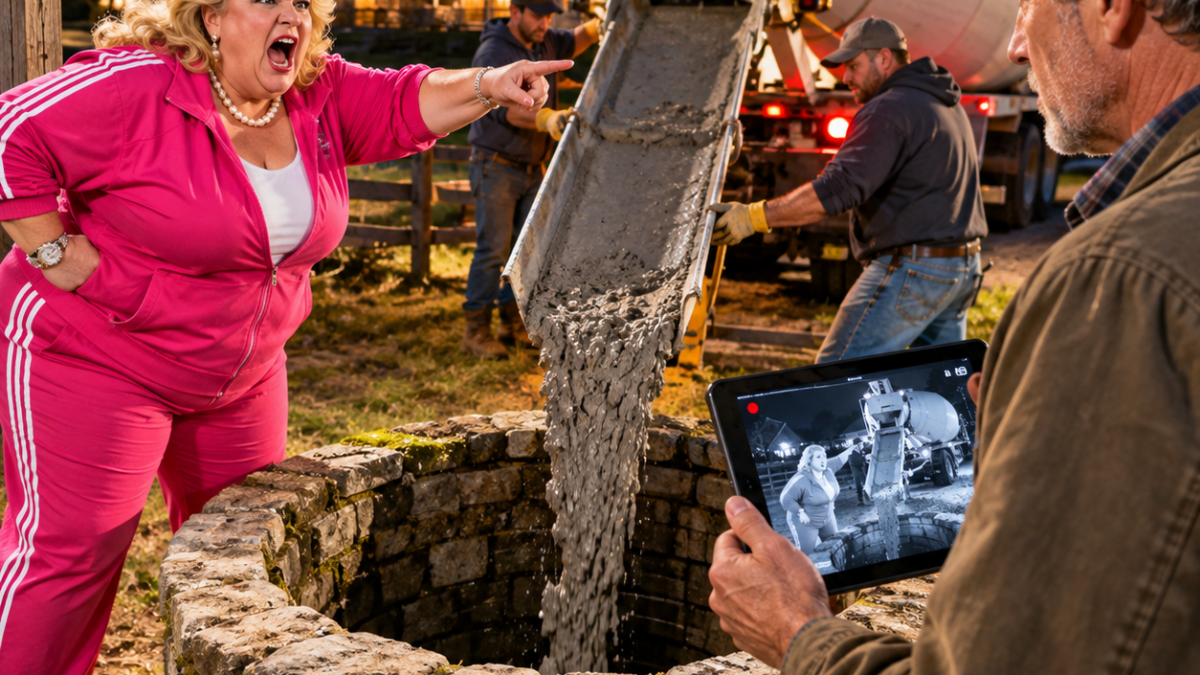
The well appeared.
Night vision.
Stone wall.
Pump house.
Empty lawn.
Then movement.
A figure entered from the right side of the image.
Floral nightgown.
Utility cart.
Concrete.
Someone whispered, “Oh my God.”
Karen did not move.
Onscreen, she lifted the first sack.
The floodlight came on.
The image became brutally clear.
Her face.
Her hair.
Her clothing.
The Quikrete logo.
The blade cutting the bag.
Gray powder dropping into my well.
A woman near the back began crying.
Nobody spoke.
Second bag.
Third.
Fourth.
Fifth.
Then Karen’s recorded voice filled the community center.
“That’ll teach you to defy the board.”
A pause.
“To defy me.”
I stopped the video.
No applause.
No cheers.
Only silence.
Karen stood beneath her own frozen image.
For five seconds she looked like she had forgotten how to breathe.
Then she shook her head.
“No.”
Nobody answered.
“That’s fake.”
Mark closed his eyes.
“Karen…”
“It’s fake!”
She pointed at me.
“He manufactured it.”
I stayed calm.
“The sheriff’s department has the original files.”
“He’s an engineer! He knows computers.”
“The system recorded continuously. Multiple cameras captured your approach and departure.”
“You edited it.”
“The original metadata is preserved.”
She looked toward Barb.
“Tell them!”
Barb recoiled.
“I didn’t know anything about this.”
“You knew about the well.”
“I knew you wanted it removed. I did not know you—”
“Stop talking!”
Gary stood.
“I’m leaving.”
“You sit down!”
“No.”
It was the first decisive thing I had ever heard Gary say.
Karen turned toward the audience.
“This is exactly what he wanted.”
Nobody responded.
“He set me up.”
Eleanor stood slowly.
“Did he make you carry the concrete?”
Karen stared at her.
Eleanor’s voice was quiet.
“Did Jack make you go onto his land?”
“No, but—”
“Did he make you pour it into his water?”
Karen’s mouth opened.
Closed.
A woman in the hallway said, “That could have poisoned him.”
Gus’s report stated the immediate concern was contamination and loss of a potable water source, though testing would determine the precise environmental impact. The source itself described the destroyed well as my home’s sole water supply and estimated tens of thousands of dollars to replace it.
Karen looked smaller.
But then rage returned.
“You people are unbelievable.”
Mark stood.
“No.”
His voice shook.
“We’re done being scared of you.”
Karen’s expression twisted.
“I protected your property values!”
“You fined my son because his toy was outside.”
“Rules exist for a reason.”
“One night.”
“Rules don’t disappear because you find them inconvenient.”
I almost admired the irony.
Eleanor stood beside Mark.
“You threatened me over my husband’s wind chimes.”
“They violated—”
“My husband is dead.”
Karen stopped.
Eleanor’s eyes filled.
“And for eight months, I took down the last thing in my yard that sounded like him because I was afraid of your letters.”
The room changed.
The well video was dramatic.
But Eleanor’s sentence did more damage.
Karen looked around.
Not at opponents.
At people.
At the human cost of every letter she had reduced to a file number.
A father stood.
“My daughter cried because you made us remove her playhouse.”
Another woman rose.
“You fined us while my husband was in chemotherapy because the lawn got too long.”
An elderly man spoke.
“You threatened a lien over a fence you approved two years earlier.”
Story after story.
Karen tried to interrupt.
Nobody shouted her down.
They simply kept speaking.
It was worse.
Every person got heard.
Eventually she sat.
For the first time since I had known her, Karen Miller had nothing to say.
Then the community center doors opened.
Deputy Ortega entered with another deputy.
People turned.
He surveyed the projector image.
Then me.
“Mr. Riley.”
“Deputy.”
“Everything okay?”
“No disturbance,” I said. “Just an HOA meeting.”
He almost smiled.
Tom approached him.
They spoke quietly.
Karen saw them.
Her face went pale.
Ortega walked toward the stage.
“Ms. Miller?”
She gripped the edge of the table.
“Yes?”
“I need to speak with you regarding an ongoing property-damage investigation.”
“Now?”
“Yes, ma’am.”
“I have an HOA meeting.”
Barb whispered, “Not anymore.”
Karen looked at her.
The betrayal seemed to hurt almost as much as the video.
Ortega remained professional.
“You’re not under arrest at this moment. But I need you to come with us and answer some questions voluntarily, or we can discuss next steps with counsel.”
“My lawyer.”
“You may call your attorney.”
She looked toward me.
The hatred I expected wasn’t there.
Fear was.
Pure fear.
“Jack.”
It was the first time all evening she used my first name.
I didn’t answer.
“Please.”
That word startled everyone.
“What?”
“Turn that off.”
She looked at the frozen image behind her.
“Please turn it off.”
I studied her for a moment.
Then I closed the laptop.
The wall went blank.
Not because she deserved protection from consequences.
Because evidence had done its job.
Humiliation didn’t need an encore.
Karen picked up her purse.
The deputies walked beside her toward the doors.
Nobody clapped.
Nobody jeered.
People simply watched.
As she passed me, she stopped.
Her eyes were wet.
“You ruined my life.”
I shook my head.
“No, Karen.”
My voice was quiet enough that only a few people heard.
“I installed a camera.”
She flinched.
Then walked away.
The doors closed.
For several seconds nobody moved.
Then Dave stood.
“I believe we still have a motion on the floor.”
A ripple of laughter moved through the room.
Mark walked toward the stage.
“Can we legally continue?”
Tom answered from the back.
“Yes.”
Barb raised both hands.
“For the record, I resign.”
Gary immediately said, “Same.”
Dave nodded.
“That simplifies things.”
The vote of no confidence passed.
Then residents voted to establish an interim board until a special election.
Mark was nominated for president.
Eleanor for vice president.
Dave for treasurer.
Someone nominated me.
I declined.
Mark objected.
“Come on, Jack.”
“No.”
“You started this.”
“I wanted running water.”
The room laughed.
I continued.
“I’ll help. But the last thing this neighborhood needs is another person who thinks winning one fight entitles him to run everybody else’s lives.”
That ended the argument.
Mark won interim president.
Eleanor became vice president.
Dave became treasurer.
Their first vote canceled the special assessment.
Their second authorized an independent audit.
Their third suspended disputed enforcement penalties until individual cases could be reviewed.
Mark wanted to cancel everything Karen had done immediately.
I stopped him.
He stared at me.
“After what she did?”
“Especially after what she did.”
“Some of these fines are garbage.”
“Then review them and cancel them.”
“Why waste time?”
“Because if you decide rules don’t matter whenever you feel morally certain, you’re just Karen with better intentions.”
He hated hearing that.
Then nodded.
“Damn you.”
“I get that a lot.”
The criminal case moved slower than neighborhood gossip.
Karen retained an attorney.
The sheriff executed evidence procedures.
Investigators documented the well.
They collected material samples.
They reviewed the security recordings.
They obtained the contractor’s report.
The concrete bags became an issue.
I had seen Karen carry empty sacks back toward her property, but I had never personally searched her trash.
The original story circulating around the neighborhood claimed somebody had.
That was nonsense.
I wasn’t about to trespass through garbage looking for dramatic evidence when I already had video.
Investigators handled whatever additional evidence they needed legally.
The well itself became the strongest physical proof.
Five bags’ worth of concrete material had plugged the shaft.
The damage estimate remained near $28,500.
Environmental testing found the old well could not economically be restored to reliable potable service.
Gus gave me the news personally.
“I’m sorry.”
We stood beside the stone pump house.
“So it’s dead?”
“Yeah.”
I touched the old stone.
Seventy years.
Gone because one person needed to prove she was in charge.
“I can drill another.”
“Same location?”
“Nearby. We abandon this one properly.”
“How long?”
“Week, maybe more.”
I nodded.
Gus watched me.
“You okay?”
“No.”
“Thought so.”
“It sounds stupid.”
“No, it doesn’t.”
“It’s a hole in the ground.”
“No.”
He pointed toward the house.
“It’s water.”
Then he looked at the old stones.
“And it meant something.”
That was exactly it.
Sarah had never stood beside that well.
She had died before I bought the house.
But the place had become part of what came after her.
The first place that felt like mine without feeling like I was erasing us.
Losing the well felt strangely personal.
As if Karen had reached backward and damaged something connected to Sarah.
That night I sat on the porch with one of Sarah’s old coffee mugs.
Empty.
No running water meant I had become very strategic with dishes.
The porch light clicked on.
Mark walked up carrying a case of bottled water.
“You planning to stay forever?”
“No.”
He set it down.
“Community fund.”
“What community fund?”
He looked guilty.
“Don’t get mad.”
“Mark.”
“People started collecting money for the new well.”
“No.”
“Jack.”
“No.”
“You’re not paying thirty grand because Karen went insane.”
“She’ll be liable for restitution if convicted.”
“That could take forever.”
“I can cover the well.”
“Not the point.”
“What is the point?”
He sat opposite me.
“The point is you made everybody show up.”
“I handed out flyers.”
“You showed people they weren’t alone.”
“Eleanor did that.”
“You made the plan.”
“Dave read the books.”
“Jack.”
I looked away.
Mark lowered his voice.
“You ever consider letting people help you?”
The question landed harder than I wanted.
Sarah used to ask the same thing.
Different words.
Same accusation.
After she died, I became efficient.
Efficient grief is dangerous.
You handle paperwork.
Sell things.
Donate clothes.
Call insurance.
Cancel appointments.
Repair the gutter.
Change the oil.
You keep moving because movement looks healthy from the outside.
Then one day you realize you have designed a life where nobody can inconvenience you by needing you, and nobody can frighten you by being needed.
“I’m fine,” I said.
Mark laughed.
“That’s the most veteran answer possible.”
“I was an engineer.”
“Still counts.”
He pushed the water toward me.
“Take the help.”
I did.
The next Saturday, Gus returned.
Not alone.
His crew pulled onto my property at seven.
Behind them came pickup trucks.
Mark.
Dave.
Eleanor.
Miguel.
Lisa.
Charles.
More.
Some carried shovels.
Others coffee.
One family brought breakfast sandwiches.
Children carried handmade signs.
One read:
WELCOME WELL 2.0.
Another:
WATER > HOA.
I laughed so hard I had to turn away.
Gus climbed down from his truck.
“You organize this?”
“No.”
“Good.”
“Why good?”
“You’re bad at accepting things.”
“You know me for approximately four conversations.”
“Enough.”
They couldn’t drill the well for him, obviously.
But neighbors cleared brush.
Moved old landscaping.
Set up tables.
Ran extension cords.
Delivered food.
Helped rebuild the stone edging after the drilling work.
For two days my property sounded like construction and laughter.
Karen’s house remained closed.
Blinds shut.
Her car rarely moved.
The interim board sent her formal notice regarding the suspension of her HOA authority.
No angry response came back.
Three weeks later, Tom called.
“Prosecutor is offering a plea.”
“What terms?”
“Criminal property-damage charge reduced under the agreement. Probation. Restitution. Community service. No contact with you except through counsel.”
“Jail?”
“Unlikely under the proposed disposition given her record, restitution potential, and other factors.”
I was surprised by my own reaction.
I had imagined jail.
Not because I believed it was necessary.
Because dramatic stories teach you to expect dramatic endings.
“What do you think?”
“I think criminal punishment is not your decision.”
“I know.”
“The restitution matters. So does a conviction or plea record. Your civil claim remains.”
“Do you think she deserves jail?”
Tom was silent.
“That’s not a legal question.”
“I asked you as my friend.”
Another pause.
“I think she deserves consequences. I don’t think we should confuse suffering with justice.”
Sarah would have liked Tom.
She used to say revenge was grief wearing work boots.
I told him I wouldn’t oppose the plea.
Karen eventually accepted it.
The final court hearing occurred on a rainy Monday.
I attended because I wanted to see the process end.
Karen sat beside her attorney.
She looked different.
Her hair was shorter.
No pearls.
No bright blazer.
Just a dark suit.
The prosecutor summarized the case.
Unauthorized entry.
Intentional destruction.
Loss of potable water.
Financial damage.
Video evidence.
Karen’s attorney spoke about lack of criminal history, stress, remorse, and willingness to pay restitution.
Then the judge addressed Karen.
“Mrs. Miller, why?”
Her attorney shifted.
Karen surprised him by answering.
“Control.”
The courtroom became completely still.
The judge leaned forward.
“Explain.”
She looked toward me once.
Then down.
“I convinced myself the well was dangerous.”
“Was it?”
“No.”
“Did you believe it was?”
“At first maybe.”
“And later?”
She swallowed.
“Later I hated that he could tell me no.”
The judge watched her.
Karen continued.
“People usually backed down.”
“So you destroyed his water supply.”
“I wanted him to connect to municipal water.”
“You could have petitioned through legal channels.”
“He had grandfathered rights.”
“Meaning you knew you could not legally force him.”
“Yes.”
The judge’s expression hardened.
“And instead of accepting the limit of your authority, you committed a crime.”
“Yes.”
It was the most honest thing I had ever heard Karen say.
The judge accepted the negotiated disposition.
Probation.
Hundreds of hours of community service.
Full restitution.
Court costs.
No contact order.
Mandatory compliance with any related civil judgments.
Her HOA role was over permanently under the association’s new eligibility rules and the settlement she later signed.
Afterward I waited under the courthouse awning for the rain to slow.
Karen emerged with her attorney.
She saw me.
The no-contact order meant she wasn’t supposed to approach.
She didn’t.
But she stopped twenty feet away.
For a second we simply looked at each other.
Then she nodded.
Not apology.
Not forgiveness.
Recognition.
I nodded back.
She left.
I never needed more than that.
The HOA audit took months.
Dave treated it like an archaeological expedition.
He discovered no secret offshore accounts.
No stolen mansion fund.
Reality was less sensational and more believable.
Karen had not been stealing HOA money for herself.
What she had done was spend association money recklessly to enforce her personal obsessions.
Attorney letters.
Collection costs.
Unnecessary inspections.
Consultants.
Administrative charges.
The association had spent tens of thousands of dollars turning minor disagreements into formal disputes.
Worse, some penalties had been imposed without proper process.
Several residents received refunds.
Others received partial refunds.
A few fines stood because the violations were real.
That caused arguments.
One homeowner became furious because his penalty for repeatedly blocking a fire lane was not canceled.
He accused Mark of becoming “another Karen.”
Mark called me.
“You wanted process.”
“Yes.”
“Well, process is annoying.”
“Yes.”
“He was parked in a fire lane six times.”
“Then uphold the fine.”
“He says we’re hypocrites.”
“Let him.”
“I liked revolution better.”
“Government ruins everything.”
The association changed gradually.
Meeting minutes became public.
Financial records were easier to inspect.
Enforcement required documented board authorization.
Appeals were heard by people who had not issued the original citation.
Warnings came before fines except where safety required otherwise.
Residents helped rewrite the design rules.
Not eliminate them.
Rewrite them.
The neighborhood still prohibited abandoned vehicles on lawns.
People still had to maintain drainage easements.
Nobody suddenly decided thirty-foot commercial signs belonged in residential yards.
But blue doors became legal.
Reasonable children’s toys became legal.
Wind chimes became legal.
Vegetable gardens became legal.
Rosebushes were permitted to exist without legal counsel.
Eleanor rehung her husband’s wind chimes.
The first evening I heard them again, I was repairing trim near my workshop.
A breeze moved through the neighborhood.
Soft metal notes drifted across the street.
Eleanor stood on her porch listening.
She saw me.
Neither of us waved.
We didn’t need to.
The new well was finished in early spring.
Gus called me outside.
“Moment of truth.”
He opened the valve.
At first came air.
Then cloudy water.
Then clear.
Cold.
Fast.
Clean.
He filled a glass after flushing the system.
I held it up.
“Safe?”
“Testing comes first.”
“You are no fun.”
“I enjoy not poisoning customers.”
Two days later the laboratory results returned clean.
Gus brought them himself.
This time we filled two glasses.
He raised his.
“To Well 2.0.”
“To getting paid.”
“That too.”
The water tasted different.
Not better.
Not worse.
Just new.
I stood there longer than necessary.
Then I walked to the rose garden.
Several bushes had survived.
One had not.
The yellow rose Sarah loved most had died while the water was out.
That broke something loose in me.
I had survived deployments.
Buried friends.
Buried my wife.
Sat through Karen’s threats with a straight face.
But standing over one dead rosebush, I cried.
Not because of Karen.
Not really.
Because grief stores itself wherever it finds space.
Mark found me sitting on the low stone wall twenty minutes later.
He didn’t ask if I was okay.
Smart man.
He sat beside me.
After a while, I said, “Sarah planted the original.”
He nodded.
“I figured.”
“This cutting came from it.”
“We can replace it?”
“Not the same.”
“No.”
We sat quietly.
Then Eleanor appeared carrying gardening gloves and a small pot.
Behind her came three other neighbors.
I wiped my face.
“What is this?”
Eleanor set the pot beside me.
Inside was a young yellow rose.
“This is from mine.”
“I don’t understand.”
“My yellow climber came from a cutting Sarah gave your sister years ago.”
I stared at her.
“What?”
Eleanor smiled.
“Your sister came to the neighborhood barbecue last month.”
I had forgotten introducing them.
“She recognized the variety. Turns out the plant she gave me six years ago originally came from Sarah.”
I looked at the little rose.
“So…”
“Same plant line.”
I touched one leaf.
My throat closed.
Eleanor squeezed my shoulder.
“Some things come back differently.”
We planted it beside the new well.
That became the part of the story I told people later.
Not the camera.
Not the concrete.
Not the courtroom.
The rose.
Karen wanted to prove she could control what happened on my land.
Instead, the damage she caused gave my neighbors a reason to cross property lines they had been afraid to cross for years.
People began having cookouts again.
Children played in front yards.
Dave organized an outdoor movie night.
Mark discovered being HOA president involved answering emails about sprinkler schedules and regretted every decision that had led him there.
Eleanor became vice president and took wicked pleasure in using parliamentary procedure correctly.
At one meeting, someone complained that a resident’s front door was “too intensely blue.”
Eleanor adjusted her glasses.
“Is it dangerous?”
“No.”
“Blocking traffic?”
“No.”
“On fire?”
“No.”
“Then I suggest we recover emotionally.”
Motion denied.
The room applauded.
By summer, Karen’s house was listed for sale.
I heard she and her husband were separating.
I didn’t know whether that was true.
I didn’t ask.
There were things I no longer needed to know.
Her property sold in August.
The buyers were a young couple named Daniel and Rebecca Cho.
They had two children and a golden retriever that immediately decided my yard was part of its patrol route.
Daniel came over the first weekend.
“Mr. Riley?”
“Jack.”
“Jack. I wanted to introduce myself.”
“Welcome.”
He glanced toward the stone pump house.
“Is that the famous well?”
I sighed.
“How famous?”
“The realtor said there was ‘an HOA incident.’”
“That’s a diplomatic description.”
He smiled.
“We were told the HOA is better now.”
“It is.”
“Anything we should know?”
“Read the bylaws.”
His face fell.
I laughed.
“I’m serious. Read them. Rules aren’t the problem. People refusing to understand them are.”
Rebecca appeared at their driveway.
“Daniel!”
He turned.
She held several paint samples.
“We’re deciding on the door.”
I pointed at him.
“Choose carefully.”
His face changed.
Then he realized I was joking.
Their door ended up red.
Very red.
Crimson Glades survived.
Nobody’s property value collapsed.
Nobody fled because a door contained pigment.
The new HOA published a quarterly financial summary.
Residents actually attended meetings.
Not one hundred fifty people anymore.
Maybe thirty.
Sometimes twelve.
That was healthy too.
People should not need a crisis to care constantly.
Normal communities are allowed to become boring.
The restitution payments from Karen eventually covered the well replacement.
Insurance handled part of the immediate work and recovered funds through the legal process.
The neighborhood money residents had collected remained untouched.
I tried returning it.
They refused.
So I used it for something else.
A barbecue.
Not a small one.
Tables filled my backyard.
Gus came.
Deputy Ortega came off duty with his wife after Tom bullied him into accepting the invitation.
Tom arrived carrying expensive bourbon and no food.
Mark brought enough meat for an infantry company.
Eleanor supervised desserts.
Dave created a spreadsheet for side dishes until everyone threatened to throw him into the sprinkler.
Children ran across the grass.
Water sprayed from hoses.
The new well pump cycled on and off.
Every time I heard it, I smiled.
At sunset Mark found me standing near the old pump house.
We had left the original stone structure intact.
The destroyed well had been professionally abandoned beneath it.
I placed a small plaque inside.
1954–2026
WATER SERVED HERE.
Mark read it.
“No mention of Karen?”
“No.”
“I would’ve put, ‘Murdered by HOA President.’”
“That’s why you’re not allowed to design plaques.”
He handed me a beer.
“You ever miss the fight?”
“No.”
“Liar.”
I thought about it.
“I miss having a clear objective.”
“Same thing.”
“No.”
I watched the neighbors.
“The fight was easy compared with this.”
“This?”
“Living afterward.”
Mark nodded.
He understood.
People who spend enough years solving problems can become dependent on problems.
Conflict gives structure.
Wake up.
Identify threat.
Respond.
Measure progress.
Win or lose.
Grief doesn’t work that way.
Neither does community.
Neither does healing.
There is no final report declaring completion.
The barbecue continued after dark.
Someone switched on string lights.
Music played.
Eleanor’s wind chimes moved in the breeze.
My sister arrived late carrying an old cardboard box.
“What’s that?”
“Your problem.”
“Helpful.”
She placed it on my workbench.
Inside were photographs.
Sarah.
Most were ordinary.
Sarah painting a bedroom.
Sarah laughing beside a Christmas tree.
Sarah holding a garden hose.
Sarah sitting on the hood of my old truck.
Then I found one photograph I had forgotten.
She was standing beside the house we had owned early in our marriage.
In the background was the original yellow rose.
On the back, in Sarah’s handwriting:
Jack says someday we’ll live somewhere quiet where he can build things and I can grow roses.
I sat down.
My sister touched my shoulder.
“You all right?”
“Yeah.”
For once, I meant it.
Behind me, children screamed as someone turned the sprinkler higher.
The water arced through the porch lights.
For years I had thought moving to Crimson Glades was about escaping memories.
But that night I understood I had brought Sarah with me in all the ways that mattered.
In the roses.
In the insistence on doing things correctly.
In the voice inside my head telling me not to become cruel just because cruelty would feel satisfying.
In my inability to throw away chipped coffee mugs.
In the stubborn belief that a home should be a place where people can breathe.
The next morning the yard looked like a small festival had exploded.
Paper plates.
Folding chairs.
Half-empty coolers.
One child’s shoe.
I made coffee using water from the new well.
Then I sat on the porch.
The neighborhood was quiet.
No Karen.
No violation letters.
No emergency planning.
Just birds.
Wind.
A delivery truck somewhere in the distance.
Eleanor’s chimes.
I took a drink.
Cold.
Clean.
Simple.
That should have been the end.
But three months later, I received a letter.
No return address I recognized.
Inside was a single sheet.
Jack,
I have written this six times.
I don’t expect forgiveness.
I told myself for years that I was protecting Crimson Glades.
The truth is that being HOA president made me feel important at a time when very little else in my life did.
Every time somebody complied, I felt stronger.
Every time somebody challenged me, I felt threatened.
Your well made me furious because I could not control it.
That sounds ridiculous now.
It was ridiculous then.
I destroyed something that belonged to you because I couldn’t tolerate hearing the word no.
There is no excuse.
I am sorry.
Karen.
I read it twice.
Then placed it on the table.
Tom happened to call later.
I told him.
“You writing back?”
“I don’t know.”
“You don’t owe her anything.”
“I know.”
“What do you want to say?”
That question took me several days to answer.
Eventually I wrote three sentences.
Karen,
I accept that you are sorry.
I hope you build a life where being unable to control other people no longer feels like losing control of yourself.
Take care.
Jack.
I mailed it.
No friendship followed.
No dramatic reunion.
No Christmas cards.
That was fine.
Forgiveness does not require restoration.
Sometimes it simply means deciding another person will not occupy free space in your mind forever.
The old camera remained above my workshop.
The motion light stayed too.
Ironically, under the revised rules, both were explicitly allowed as reasonable residential security equipment.
Mark called the provision the Riley Amendment.
I threatened to resign from a board I did not belong to.
Years passed.
The new yellow rose grew.
It climbed halfway across the stone wall.
Every spring it produced more flowers.
I never won prizes.
I didn’t care.
Gus retired.
Dave eventually stopped making spreadsheets for social events.
Almost.
Mark served two terms and refused a third.
Eleanor became HOA president at seventy-five.
Her first speech lasted forty-two seconds.
“Pay your dues, don’t block fire lanes, and try not to annoy your neighbors on purpose.”
She received a standing ovation.
Crimson Glades changed.
Not into a paradise.
People still argued.
Dogs barked.
Lawns got too long.
Teenagers parked badly.
Someone once painted a garage door an orange color so violent even I questioned the limits of liberty.
But disagreements became disagreements.
Not wars.
One Saturday morning, years after the concrete incident, a little boy from the Cho family wandered toward my well while I was working outside.
He pointed to the metal cap.
“My dad says a bad lady broke your old one.”
Children are efficient historians.
“Something like that.”
“Why?”
“She was angry.”
“At the well?”
“At me.”
He considered that.
“That’s dumb.”
“Yes.”
“Did you beat her?”
I smiled.
“What do you mean?”
“Dad said you beat the HOA.”
I looked toward the neighborhood.
Red door.
Blue door farther down.
Eleanor’s roses.
Children’s bicycles.
The community center lawn where residents now held summer picnics.
“No.”
He seemed disappointed.
“What happened?”
“People stopped being afraid.”
He thought about that.
Then shrugged.
“Can I have water?”
I opened the outdoor spigot.
He drank directly from the stream until water ran down his shirt.
His mother shouted from next door.
“Ethan!”
He ran away laughing.
I shut off the valve.
A few drops remained on the grass.
I stood there thinking about the night Karen carried five concrete bags across my property.
At the time, I believed the camera was the thing that saved me.
I was wrong.
The camera saved evidence.
That mattered.
But evidence alone didn’t change Crimson Glades.
People did.
Mark speaking up.
Eleanor rehanging her chimes.
Dave asking questions about finances.
Parents attending meetings.
Neighbors refusing to let one another stand alone.
Karen had survived for years because every homeowner believed his or her problem was private.
The toy fine belonged to Mark.
The rose citation belonged to Eleanor.
The wind chimes belonged to someone else.
My well belonged to me.
Karen’s real power came from convincing us those things were unrelated.
The moment we saw the pattern, her authority collapsed.
The 4K video only removed the final doubt.
Sometimes people ask what my favorite moment was.
They expect me to say it was Karen’s face when the video appeared behind her.
It isn’t.
For a while, maybe it was.
There was satisfaction in watching an undeniable truth replace months of threats.
I’m human.
But the older I get, the less important that moment feels.
My favorite memory is the first neighborhood barbecue after the new well opened.
Eleanor laughing beneath her wind chimes.
Mark arguing with Gus about barbecue sauce.
Dave trying to organize disposable forks.
Kids running through water pumped from the ground beneath my own land.
And Sarah’s yellow rose growing beside the pump house.
Karen poured concrete into my well because she wanted to teach me what happened when someone defied her.
Instead, she accidentally taught an entire neighborhood something else.
Authority is not the same as power.
Rules are not the same as justice.
Silence is not the same as peace.
And a bully’s strongest weapon is rarely the fine, the letter, the title, or even the threat.
It is the belief that you are standing alone.
I wasn’t.
None of us were.
It just took five bags of concrete, one camera, and one terrible night for us to finally see each other.
Every morning now, I walk past the pump house before making coffee.
Sometimes I stop beside the rose.
Sometimes I don’t.
The well pump hums beneath the ground.
Water moves through the pipes.
The house wakes slowly around me.
And occasionally, when the sunlight hits the security camera under the workshop eave, I remember Karen crossing my yard at 2:13 in the morning, absolutely certain nobody was watching.
She thought she was burying my independence beneath five bags of concrete.
What she actually buried was the fear that had kept Crimson Glades quiet for years.
And when that fear finally cracked open, something much stronger came up through it.
A community.
I turn the faucet.
Fill Sarah’s old coffee mug.
And take the first cold drink of the morning.
After everything that happened, it still tastes better than any water I have ever known.








