PART 2: HOA Karen Poisoned the Creek on My Land to Force Me to Sell—She Had No Idea What I Did for the State
PART 2
I walked back to the house and called the emergency number for the State Environmental Enforcement Division.
The dispatcher recognized my name immediately.
“Evan? You taking this one?”
“No.”
There was a pause.
“You’re reporting something?”
“Illegal disposal. Possible contaminated material in a waterway.”
“Where?”
“My property.”
Another pause.
“Oh.”
“Exactly.”
I gave her the location.
Then I called my supervisor.
I explained everything.
Three trucks captured on camera that night.
Possible dumping.
Visible contamination.
Dead aquatic life.
Potential company identification.
HOA involvement.
Then I said the most important thing.
“I’m recusing.”
My supervisor did not argue.
He knew why.
If I personally investigated contamination on my own land, every decision I made could be attacked.
Every sample.
Every interview.
Every warrant request.
Every enforcement recommendation.
A defense attorney would not need to prove I had acted improperly.
He would only need to make people wonder.
I had spent sixteen years watching good cases become weaker because somebody got careless with procedure.
I was not going to make that mistake.
By eight that morning, my recusal was formally documented.
The case went to Allison Trent.
If I had been allowed to choose an investigator myself, I probably would have chosen her anyway.
Allison was methodical to the point of irritating people.
She never rushed.
Never exaggerated.
Never guessed.
If she said she could prove something, she could prove it twice.
From that moment forward, I became exactly what the case required me to be.
A victim.
A witness.
Nothing more.
It was harder than I expected.
When you have spent your career investigating environmental violations, standing beside your own contaminated creek while someone else controls the evidence feels like having both hands tied behind your back.
But procedure mattered more than my frustration.
So I waited.
While I waited, I walked my property line.
That was when I realized the dumping was much worse than what I had seen at sunrise.
Fresh truck ruts continued farther downstream.
One set led to a second dumping site.
Then a third.
I went back through security footage from the previous two nights.
I had ignored those alerts because I had been away on state work and assumed deer or equipment had triggered the cameras.
I was wrong.
Truck after truck had entered.
Fourteen loads.
At least.
Some dump locations had been covered with clean topsoil.
Someone had spread it smooth over the contaminated material.
That detail changed how I viewed everything.
This was not a driver getting rid of material wherever he could.
Somebody had tried to hide it.
Before noon, Meredith came back.
This time she brought a man.
Broad shoulders.
Work boots.
Company jacket.
The name stitched over his chest read **Lucas**.
He introduced himself as Lucas Greer.
Owner of Greer Site Services.
“Whatever you think happened here,” he said, “you’re overreacting.”
I stood on my side of the gate.
“Am I?”
“It’s clean construction fill.”
I pointed toward the gray water.
“Clean?”
“Mostly soil.”
“Do you have manifests?”
His expression changed slightly.
“Manifests?”
“For the material.”
“Not with me.”
“Laboratory analysis?”
“No reason to test clean dirt.”
“If you know it’s clean, somebody tested it.”
Meredith stepped between us.
“You’re not an inspector, Mr. Rston.”
I looked at her.
“Are you sure about that?”
It was the closest I came to telling her.
She interpreted it as sarcasm.
That mistake would stay with her.
“Lucas,” she said, “bring the trucks through.”
I locked the gate again.
“No.”
Meredith pulled out her phone.
“Then I’m calling the sheriff.”
“Please do.”
She stared at me.
I meant it.
Twenty minutes later, Deputy Carl Hendris arrived.
He listened to both sides.
I handed him my deed.
Then the certified property survey.
He studied them.
Meredith handed him the violation notice she had written herself.
Carl looked at her.
“Where’s your access easement?”
“The creek serves our drainage system.”
“That’s not what I asked.”
“We’ve always had maintenance rights.”
“Do you have documentation?”
“The association’s authority is established.”
“By what?”
She did not answer.
Carl looked back at the survey.
“Mr. Rston owns the road.”
“Yes,” I said.
“And the bank?”
“Yes.”
He looked toward Meredith.
“I don’t see a recorded access right here.”
She became angry.
“We’re trying to protect an entire neighborhood.”
Carl handed the papers back to me.
“This looks like a civil access dispute. I’m not ordering him to open his gate without documentation showing you have a legal right to enter.”
Meredith’s mouth tightened.
Before leaving, she stepped close enough that only I and Carl could hear.
“You are making this so much harder on yourself.”
I said nothing.
I pulled out my notebook after she left.
Wrote the time.
Then wrote her sentence word for word.
**You are making this so much harder on yourself.**
Statements change when people are forced to explain them later.
That afternoon, Allison arrived with the state response team.
Protective suits.
Rubber boots.
Sampling equipment.
Evidence containers.
Cameras.
Chain-of-custody forms.
I stayed back.
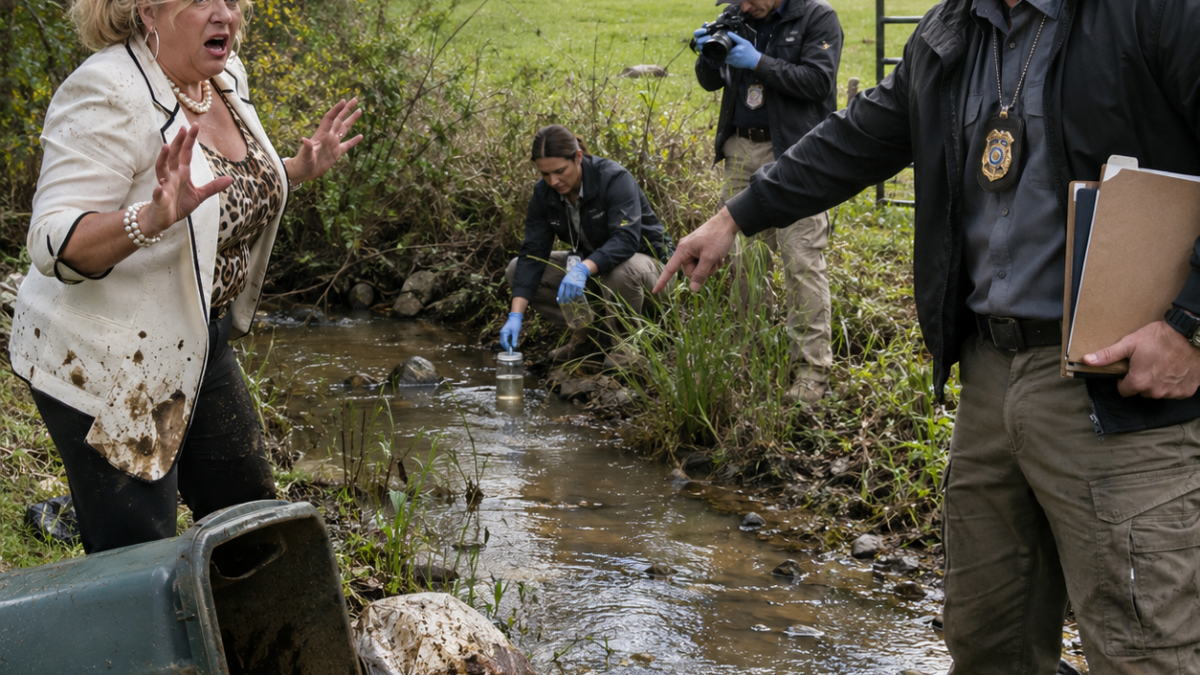
They photographed the bank.
Measured the visible contamination.
Collected water.
Collected sediment.
Collected sludge.
Collected dead fish.
Every container was labeled.
Sealed.
Documented.
Allison spoke to me only when necessary.
Meredith watched everything from beyond the property line.
For the first time that day, she looked uncertain.
But I could tell what she was thinking.
She still believed this was about improper disposal.
Maybe a citation.
Maybe a cleanup bill.
Maybe some angry letters.
She did not understand what the lab would tell us.
Four days later, Allison came to my house.
She did not smile.
“I have preliminary results.”
“How bad?”
“Bad enough.”
She placed a summary on the kitchen table.
Petroleum hydrocarbons.
Lead.
Chromium.
Wood-treatment residues.
Industrial degreasers.
Chlorinated solvents.
Multiple sampling points showed concentrations far beyond normal runoff.
I stared at the page.
“Source?”
“Not established yet.”
I nodded.
Of course.
An investigator does not say what the evidence has not yet proven.
But I knew what she knew.
This was not harmless soil.
Somebody had intentionally moved contaminated waste and deposited it beside a living stream.
Allison issued protection measures for Willow Creek.
No excavation.
No pumping.
No moving material.
No cleanup activity unless approved and supervised.
Greer Site Services received a preservation notice.
So did the HOA.
Every invoice.
Every email.
Every contract.
Every text.
Every document related to the creek and the trucks had to be retained.
The notice landed Tuesday morning.
Tuesday night, Meredith called an emergency community meeting.
I attended.
Nearly one hundred residents packed into the Cedar Ridge clubhouse.
I took a seat near the back.
Meredith stood at the podium.
She was good in front of crowds.
That was one of the reasons she had remained HOA president for six years.
She knew how to turn complicated problems into simple villains.
That night, the villain was me.
“Our neighborhood,” she began, “is being targeted by an individual who has opposed every improvement this community has ever attempted.”
People looked back at me.
“A neighboring landowner has used his connections with the state to turn ordinary erosion work into a regulatory attack.”
That was clever.
She did not know my job.
But she knew state investigators were involved.
So she suggested I had somehow manipulated them.
I stayed quiet.
Then she changed the story.
“The contaminated material did not come from Cedar Ridge.”
I leaned forward.
“The material existed on Mr. Rston’s property before our contractor began stabilization work.”
A murmur spread.
That was new.
Three days earlier, she had admitted the trucks were authorized maintenance.
Now she was claiming the waste had already been mine.
Then she clicked a remote.
A document appeared on the screen.
**WASTE PLACEMENT AUTHORIZATION**
Site:
**RSTON PROPERTY — WILLOW CREEK RESTORATION AREA**
Landowner:
**EVAN RSTON**
At the bottom was my signature.
I stared.
For one second, the room seemed to disappear.
Meredith looked directly at me.
“Mr. Rston approved the placement of fill material himself.”
Several residents turned.
Someone whispered behind me.
Another person shook his head.
It was a devastating document if anyone believed it.
Because if I had voluntarily accepted contaminated material, my position changed completely.
I might not be a victim.
I might become responsible for part of the cleanup.
That was not just a lie.
It was a trap.
I looked toward the board.
One man appeared more disturbed than anyone else.
Raymond Boon.
HOA treasurer.
He raised his hand.
“Meredith, when was that document approved?”
She ignored him.
“Meredith?”
“This is not the time, Raymond.”
“I’ve handled association records for four years. I’ve never seen it.”
“We will discuss internal paperwork privately.”
She continued speaking.
But Raymond kept staring at the screen.
The next morning, my attorney emailed me a scan of the document.
I enlarged the signature.
My stomach turned.
I recognized it.
Not because I had signed the waste authorization.
Because I had signed something else.
Two years earlier, the HOA had asked me to grant an easement along the creek.
I refused.
My letter ended:
**Respectfully,
Evan Rston**
Someone had copied that signature.
Exactly.
The slant.
The break in one letter.
Even a tiny ink smudge near the final stroke.
It had been lifted and pasted onto the waste authorization.
I called my attorney.
“They copied it.”
“You’re sure?”
“I have the original letter.”
That afternoon, Meredith emailed county officials requesting an investigation into me for illegal waste disposal.
I sat in my office reading the email.
For the first time, my anger became personal.
Dumping waste was one thing.
Forging my signature was another.
But accusing me of the crime after using my name to authorize it?
That crossed into something darker.
She was not trying to defend herself anymore.
She was trying to make me the criminal.
A special HOA meeting was scheduled for the following Thursday.
Meredith expected another public performance.
She got one.
Just not hers.
The clubhouse was packed.
Allison attended officially for the state.
I sat near the back again.
Meredith put the forged authorization on the screen.
“Mr. Rston authorized this material,” she announced.
I stood.
“Meredith?”
She looked pleased.
“Yes?”
“Just so everybody understands, this is the document your association says authorized the trucks?”
“Absolutely.”
“All fourteen loads?”
Her eyes shifted.
“The authorized work.”
“Who received this document?”
“The HOA office.”
“Who verified my signature?”
Her posture changed.
“This is not a courtroom, Mr. Rston.”
“No.”
I walked toward the front.
“But you publicly accused me of authorizing contaminated waste on my property.”
“You signed it.”
I stopped beside the table.
Then I took the credential case from my jacket.
I had carried it thousands of times.
That night, opening it felt different.
The gold badge reflected the overhead lights.
Beside it was my identification.
**STATE ENVIRONMENTAL ENFORCEMENT DIVISION**
**SENIOR INVESTIGATOR EVAN RSTON**
The room went silent.
Completely.
A chair creaked somewhere behind me.
Meredith stared at the badge.
Her face lost color.
I kept my voice calm.
“I want everyone here to understand something very clearly.”
Nobody moved.
“I am not investigating this case.”
Meredith blinked.
“I formally recused myself the morning the dumping was discovered because the contamination occurred on my land.”
I gestured toward Allison.
“Investigator Trent and her team are handling the case independently.”
Then I pointed toward the document on the screen.
“But I have spent sixteen years investigating environmental violations, fraudulent disposal records, false manifests, and illegal waste operations.”
I looked directly at Meredith.
“And you have just publicly relied on a document containing a forged copy of my signature.”
Her voice changed instantly.
“I had no idea what you did for a living.”
“That isn’t the point.”
“We relied on documents provided to us.”
“Then tell us who provided that one.”
Silence.
“The point,” I continued, “is that somebody knows who authorized those trucks to enter my land.”
I closed the credential case.
“And it wasn’t me.”
Then I sat down.
I had nothing else to say.
Allison stood.
She was much less theatrical than Meredith.
Which made her more frightening.
“The Cedar Ridge Estates HOA and Greer Site Services are under formal evidence-preservation obligations.”
Several board members shifted.
“Deletion of records, alteration of records, destruction of material at the site, or interference with evidence may create additional legal consequences.”
Meredith stared at her.
Allison continued.
“If you have responsive records, preserve them.”
Then she sat.
Meeting over.
Or it should have been.
In the parking lot, Raymond approached me.
He kept his hands visible and stayed several feet away.
“I’m not giving you anything.”
“Good.”
He looked surprised.
“I mean that.”
I pointed toward Allison’s state vehicle.
“Anything you have goes to her.”
He nodded.
“I already planned to.”
Then he lowered his voice.
“But you deserve to know something.”
“What?”
“Over the last six weeks, Cedar Ridge paid Greer one hundred eighty-six thousand dollars.”
“For what?”
“That’s the problem.”
He swallowed.
“The invoices don’t say drainage maintenance.”
“What do they say?”
“Contaminated soil removal.”
I stared at him.
“Are you sure?”
“I’m the treasurer.”
The cold seemed sharper suddenly.
“You knew the material was contaminated?”
“I didn’t. Meredith approved the contracts herself. I saw payments. I assumed they were connected to the clubhouse renovation.”
“But the invoices specify contaminated soil?”
“Yes.”
That changed everything.
If the invoices were genuine, the association had known contaminated material existed before those trucks entered my property.
Allison began reconstructing the source.
Cedar Ridge had been renovating its clubhouse and maintenance yard as part of a planned expansion.
During excavation, workers discovered an old underground fuel tank.
The surrounding soil smelled strongly of petroleum and chemicals.
A licensed remediation company inspected it.
Their proposal?
Approximately $470,000.
Excavate the contaminated soil.
Transport it to an approved facility.
Dispose of it properly.
Document everything.
Meredith rejected the proposal.
One email.
One sentence.
**Too expensive. Find another option.**
A few days later, Greer Site Services appeared.
$186,000.
Less than half the legitimate remediation quote.
On paper, Greer claimed the soil would be transported more than seventy miles to a licensed disposal facility.
Allison obtained the trucks’ GPS records.
Not one truck went there.
Not one.
Every route ended beside Willow Creek.
My creek.
Dr. Heather Larkin, an environmental chemist with the state laboratory, compared samples from the contaminated excavation behind Cedar Ridge’s clubhouse with material taken from my bank.
Petroleum composition.
Metal ratios.
Solvent breakdown products.
Wood-treatment residues.
The pattern was close enough to form what she described as a chemical fingerprint.
The contamination in Willow Creek was consistent with the Cedar Ridge excavation.
I remember Allison telling me.
I was standing at my kitchen counter.
“So now you have the source.”
“Yes.”
“What does Meredith say?”
“She says the contractor handled disposal.”
“And Lucas?”
“He says he was told it was excess soil.”
I laughed once.
No humor in it.
Allison looked at me.
“What?”
“Everybody knew until knowing became expensive.”
She did not disagree.
The state inspected the Cedar Ridge excavation.
Behind the maintenance yard they found a trench where contaminated soil had been removed.
Fresh gravel had been spread across parts of it.
Owen Bartlett, the county stormwater director, scraped aside the stones.
Dark soil remained underneath.
Even before laboratory testing, the smell told experienced people what they were dealing with.
Meredith continued claiming ignorance.
“I approved a contractor.”
That became her new line.
“I did not control where individual trucks went.”
Lucas Greer was interviewed separately.
He tried the same strategy.
“Meredith said move excess soil.”
Allison placed one of his invoices on the table.
A line item read:
**SPECIAL HANDLING — IMPACTED MATERIAL**
Lucas stared at his own words.
His silence probably lasted only seconds.
But those seconds mattered.
He was beginning to understand something every investigator eventually sees.
When a conspiracy starts collapsing, loyalty disappears faster than evidence.
Meanwhile, Willow Creek was still damaged.
That was the part no one at Cedar Ridge had to see every morning.
I did.
I could not use creek water for irrigation.
I moved my cattle away from the lower pasture.
Temporary barriers were installed to prevent contaminated sediment from spreading during rain.
My hay fields became harder to manage.
Every day cost money.
But money was not what bothered me most.
At night I sat on my porch.
For eleven years, Willow Creek had been the sound I listened to when I wanted everything else to disappear.
Now I heard water and thought about solvents.
Lead.
Chromium.
Dead fish.
Contaminated sediment.
Evidence numbers.
That made me angrier than any HOA violation notice ever could.
Then Allison found something that changed the case again.
Three months before the dumping, Cedar Ridge Estates had paid for an appraisal.
Not the clubhouse.
Not the maintenance yard.
My land.
Specifically 12.4 acres along Willow Creek.
Exactly the strip Meridian—no, Meredith—had tried repeatedly to acquire.
The final HOA offer had been $620,000.
I had rejected it.
Not because the money was insulting.
Because I did not want to sell.
That strip contained the creek, mature trees, and part of my lower pasture.
It was also the only practical corridor for the western expansion Cedar Ridge wanted to build.
Dozens of new homes.
A road.
A retention basin.
Golf-cart access.
Without my land, the engineering plan became difficult.
Meredith had asked three times.
I said no three times.
After the last refusal, the expansion appeared to die.
Apparently Meredith had never accepted that.
Raymond gave Allison internal board material.
Not me.
Allison.
Exactly as he should have.
One document described **CEDAR RIDGE WEST EXPANSION**.
Another email contained a line from Meredith.
When Allison showed it to me, I read it twice.
**Once the creek parcel becomes a liability, his position changes.**
I looked at her.
“What does that mean?”
“We’re still establishing context.”
“You know exactly what it sounds like.”
“I do.”
Another email used the phrase:
**environmental burden on the property.**
A board member had replied asking Meredith to explain.
She did not.
She called him instead.
No written response.
Then investigators found Northvale Holdings.
A limited-liability company.
Its attorneys had prepared an option to purchase my 12.4-acre creek parcel.
There was one unusual condition.
The purchase option activated only if the appraised value fell below a specific threshold.
I felt cold when Allison explained it.
“When was that drafted?”
“Five weeks before the first truck entered your property.”
“Who owns Northvale?”
“It’s layered.”
“That means you found something.”
She nodded.
“The ownership structure connects financially to Meredith.”
“How?”
“Shared business accounts. A loan she personally guaranteed. We’re documenting the full relationship.”
I sat back.
The plan assembled itself in my head before Allison finished.
Dump Cedar Ridge’s contaminated soil on my property.
Save hundreds of thousands in legitimate disposal costs.
Forge my signature so it appears I accepted the material.
Make regulators believe I knowingly received contaminated waste.
Force me to absorb cleanup costs.
Destroy the value of the creek parcel.
Then purchase it through a connected company after the value collapsed.
Meredith had not dumped on my land because it was convenient.
She had dumped there because it was mine.
Allison laid another document down.
I could barely look at it.
“She was trying to poison the property until I had to sell.”
Allison did not answer immediately.
Finally she said, “The evidence is moving in that direction.”
I stood and walked to the window.
Willow Creek ran beyond the pasture.
I thought of Meredith smiling at my gate.
**You are making this so much harder on yourself.**
Now I understood.
The sentence had not been a general threat.
It was frustration.
She believed I was resisting an outcome she had already designed.
My fists tightened.
Allison noticed.
“Evan.”
“I know.”
“Do you?”
“Yes.”
Because I knew exactly what she was about to tell me.
Do not confront Meredith.
Do not threaten her.
Do not investigate independently.
Do not use my state position.
Do not create evidence she could weaponize.
A vindictive senior investigator harassing the HOA that was supposedly under investigation?
That was the story Meredith needed.
I gave her nothing.
Everything went through Allison or my attorney.
Written communication.
Documented access.
No shouting matches.
No late-night visits.
No threats.
My restraint bothered Meredith more than anger would have.
Because she could not make me behave like the villain she had described.
Then she made the mistake that broke the case wide open.
After receiving the preservation notice, she finally understood that the contaminated material beside Willow Creek was evidence.
So she tried to remove it.
Sunday.
7:00 a.m.
My cameras alerted again.
I opened the feed.
A compact excavator was moving down the maintenance road.
A pickup followed.
Three landscaping workers got out.
The excavator began scraping contaminated sludge from the creek bank.
Then the crew unloaded a portable pump.
They dropped one end into the HOA’s decorative pond above the property.
A hose ran downhill toward Willow Creek.
I stared at the screen.
They were going to pump clean water into the creek.
Dilute it.
Change the concentrations before future sampling.
Maybe they thought if enough contaminated sediment disappeared and enough clean water passed through, nobody could prove what had been there.
I did not go outside.
I called Allison.
“Check your phone.”
I sent her the live camera feed.
She swore quietly.
“I’m on my way.”
Thirty-eight minutes later, a state enforcement vehicle entered my drive.
Owen Bartlett followed.
Allison went straight to the worksite.
I stayed near the house.
Through the camera feed, I saw her step in front of the excavator.
The operator killed the engine almost immediately.
The landscaping crew looked terrified.
They were not environmental remediation workers.
They were ordinary landscapers.
One of them eventually told investigators the smell had made him sick.
He had asked why they were doing this secretly on Sunday.
The foreman only said the HOA needed emergency restoration.
Then someone produced the work order.
Issued by the HOA.
Signed by:
**Meredith Crowley.**
The date mattered.
It was after the preservation notice.
She could not claim she did not know the site was protected.
Allison met her that afternoon.
Meredith tried to reverse the story again.
“I was preventing further environmental damage.”
Allison asked one question.
“If you intended to remediate a protected contamination site, why didn’t you contact the agency overseeing it?”
Meredith had no answer.
Because there was no good answer.
Legitimate cleanup is coordinated.
Documented.
Sampled.
Supervised.
You do not send landscapers with an excavator and a pond pump on Sunday morning.
Lucas Greer understood the meaning of that mistake immediately.
Meredith was going to blame him.
He hired an attorney.
Within a week, his attorney approached the state.
Lucas had records.
Lots of them.
Invoices.
Truck schedules.
Emails.
Texts.
Voice memos.
He had protected himself because, apparently, he had never fully trusted Meredith.
Two text messages mattered more than everything else.
The first came from Meredith the night before the original dumping.
**Use the creek entrance. Rston isn’t there at night.**
I read it.
Then read it again.
She knew.
She knew the access point.
She knew I traveled for work.
She believed the house would be empty.
The second message:
**No facility tickets. Keep the price where we agreed.**
No facility tickets.
Meaning no disposal receipts from the licensed site seventy miles away.
Meaning Lucas had not independently chosen my property.
She had directed him there.
The association began collapsing internally.
Raymond demanded an emergency audit.
This time, no board member opposed him.
The results were ugly.
$186,000 to Greer Site Services.
Another $74,000 in consultants connected with Cedar Ridge West.
Some consulting expenses traced back toward Northvale Holdings.
Residents learned something that made the anger spread through the entire neighborhood.
Their HOA dues had financed the plan.
Their money had paid a contractor involved in dumping contaminated soil on my land.
Their money had paid consultants tied to a development scheme most of them had never approved.
At the next board meeting, Raymond laid bank statements on the table.
One after another.
Meredith sat at the head of the room.
“This is being taken out of context.”
Raymond did not look up.
“Then provide the context.”
“I was protecting the financial interests of Cedar Ridge.”
“You spent reserve funds without disclosing the actual purpose.”
“I had authority.”
“Not for this.”
She slammed her hand down.
“You would rather bankrupt this association than admit I solved a problem.”
Raymond finally looked at her.
“You didn’t solve anything.”
He pointed at the statements.
“You moved the problem onto someone else’s land and made it ten times more expensive.”
Meredith looked around for support.
People who once nodded whenever she spoke now avoided her eyes.
The board suspended her authority to sign contracts and approve payments.
She accused Raymond of betrayal.
“You stabbed me in the back.”
He answered quietly.
“I’m the treasurer. Protecting the association’s money is literally my job.”
The state issued an emergency remediation order.
Cedar Ridge had to fund initial removal.
Construction stopped.
The clubhouse excavation was secured.
The western expansion froze.
Records had to be surrendered.
Inspections had to be permitted.
The bank financing Cedar Ridge West suspended the credit line.
Then came the insurance problem.
The HOA’s carrier issued what amounted to a warning.
Coverage might not apply to intentional misconduct.
That frightened residents more than anything else.
If insurance would not cover the damages, somebody still had to pay.
A special assessment became possible.
Suddenly Meredith’s speeches about economic progress sounded very different.
Neighbors who once praised her stopped answering her calls.
People talked at mailboxes.
On walking paths.
At the clubhouse.
A few weeks earlier, the question had been:
**Why is Evan making trouble?**
Now it was:
**How much is Meredith going to cost us?**
At what became her final meeting as president, Meredith still refused to admit she had done anything wrong.
“If I hadn’t acted,” she said, “Cedar Ridge would have lost hundreds of thousands of dollars.”
Raymond sat across from her.
“Now we could lose millions.”
Nobody defended her.
The vote to remove Meredith Crowley as HOA president passed.
Every voting member opposed her except Meredith herself.
She stood before the result was formally recorded.
“You’ll regret this.”
No one answered.
She walked out.
For six years, she had run Cedar Ridge as though the board existed to confirm her decisions.
Now the door closed behind her and the meeting continued without her.
But losing the presidency was not the punishment that mattered.
Allison had already referred portions of the case to the environmental crimes unit.
The forged authorization.
Illegal disposal.
Evidence tampering.
Potential fraud.
Financial records.
Those were no longer HOA issues.
Those were prosecutor issues.
The major enforcement hearing was held at the state administrative building.
I arrived early.
The room was already crowded.
Residents.
Attorneys.
Agency staff.
Reporters.
Representatives from Greer Site Services.
Meredith entered with two lawyers.
She looked almost exactly as she had at my gate.
Straight back.
Head high.
Expression controlled.
Her defense was simple.
Lucas Greer had acted independently.
She had hired a contractor.
He chose the disposal location.
She knew nothing about illegal dumping.
For the first hour, her attorneys tried to create distance.
Meredith signed broad contracts.
Meredith was not at the wheel of the trucks.
Meredith did not personally dump soil.
Meredith was not an environmental expert.
Then Allison testified.
She built the timeline slowly.
No drama.
No raised voice.
2:13 a.m.
First truck entered my property.
Camera footage.
Next truck.
Camera footage.
Third truck.
Then GPS data.
Fourteen truck movements.
Each route ended along Willow Creek.
The material originated at the Cedar Ridge excavation.
Invoices tied Greer to the removal.
Dr. Larkin testified next.
She explained the chemical comparison.
Petroleum hydrocarbons.
Metals.
Solvent compounds.
Wood-treatment residues.
The profile in my creek corresponded closely with the contaminated excavation behind the Cedar Ridge clubhouse.
Then the waste authorization appeared on the screen.
My forged signature.
A forensic examiner testified.
The digital file metadata showed the document had been created on a computer inside the HOA office.
And not before the dumping.
Eleven days after the first load entered my land.
I heard people whisper.
That date was devastating.
The document supposedly authorizing the waste had not existed when the dumping began.
Someone created permission after the crime.
Then copied my old signature onto it.
The examiner displayed the original easement-refusal letter.
Then the fake authorization.
Same slant.
Same breaks.
Same ink smudge.
Meredith stared straight ahead.
Next came the appraisal.
12.4 acres.
My creek parcel.
Then her email.
**Once the creek parcel becomes a liability, his position changes.**
Another exhibit.
**Environmental burden.**
Northvale Holdings.
The option contract.
Its connections to Meredith.
Its purchase condition requiring my property value to fall.
Then the texts.
**Use the creek entrance. Rston isn’t there at night.**
Her attorney objected.
Overruled.
The second message appeared.
**No facility tickets. Keep the price where we agreed.**
Then the Sunday work order.
Issued after the preservation notice.
Signed by Meredith.
The excavator.
The landscapers.
The pump.
Attempted movement of protected material.
Attempted dilution of contaminated water.
Each exhibit seemed small by itself.
Together they became a wall.
Halfway through, one of Meredith’s attorneys leaned toward her.
He whispered.
She shook her head sharply.
Whatever advice he gave, she rejected it.
Then Lucas Greer testified.
He looked ten years older than the first day he appeared at my gate.
His company was damaged.
His reputation was damaged.
His cooperation agreement did not erase his responsibility.
He knew that.
Allison asked him about the first conversation.
Lucas looked toward Meredith.
“She called me.”
“What did she ask?”
“She said Cedar Ridge needed contaminated soil moved.”
“Where?”
“At first she said we’d discuss it.”
“When did Willow Creek enter the conversation?”
“The next call.”
“What did she say?”
Lucas took a breath.
“She said use the creek road on Rston’s property.”
A murmur moved through the room.
“Did you tell her you had permission?”
“No.”
“Did she?”
“She said if Evan ever complained, paperwork would show he had agreed.”
The room became silent.
I looked at Meredith.
For the first time, her posture changed.
She leaned forward.
Lucas continued.
“I should have walked away.”
“Why didn’t you?”
“Money.”
He swallowed.
“She was paying us less than licensed disposal would cost but enough that I convinced myself I didn’t need to ask questions.”
“Did you know the material was contaminated?”
“Yes.”
Meredith’s attorney stood.
He tried to discredit Lucas.
Cooperation deal.
Self-interest.
Company survival.
All fair questions.
But the texts still existed.
The invoices existed.
GPS records existed.
The chemistry existed.
The forged file existed.
Lucas was no longer the foundation of the case.
He was confirmation.
During a recess, Meredith looked directly at me.
“You did this.”
I remained seated.
Her attorney put a hand on her arm.
She pulled away.
“You used your position to destroy me.”
I stood.
“No.”
Her face twisted.
“You think anyone believes you just happened to have all this power?”
“I recused myself.”
“You started everything.”
“You dumped waste on my creek.”
“You called the state!”
“It was contaminated waste in a waterway.”
“You knew exactly what would happen.”
“Yes.”
That stopped her.
I stepped closer, but not threateningly.
“I knew investigators would collect evidence.”
“You wanted this.”
“I wanted you off my land.”
Her eyes filled with rage.
“You ruined my life.”
I looked toward Allison.
“I didn’t investigate you.”
Then back at Meredith.
“They did.”
I paused.
“All I did was lock my gate and keep the cameras running.”
She had no answer.
Because that was the truth she hated most.
I had not needed to abuse authority.
I had not needed secret access.
I had not planted evidence.
I had not manipulated an agency.
Her own actions had built the case.
Her contracts.
Her texts.
Her payments.
Her fake authorization.
Her work order.
Her attempted evidence cleanup.
Her company connections.
Her plan.
By the end of the proceedings, the state determined the dumping had been intentional.
Evidence involving forgery and tampering was referred for separate prosecution.
Civil responsibility extended to Meredith and Greer Site Services.
Lucas reached a cooperation settlement and agreed to contribute heavily toward remediation.
Meredith suddenly stood alone.
The HOA she had once used to threaten me was sitting on the other side.
And then came the cleanup.
More than one thousand tons of contaminated soil and sediment eventually had to be removed.
Think about that number.
One thousand tons.
Material that should have been transported legally from the beginning.
Crews excavated contaminated sections of the creek bank.
Every load went to an authorized disposal facility.
Every movement was documented.
Engineers rebuilt damaged areas.
Native grasses were planted.
Willows.
Sycamores.
Monitoring wells went in.
For weeks, I listened to excavators instead of water.
Some evenings, I stood on the bank after the crews left.
The creek looked worse before it looked better.
Bare soil.
Protective barriers.
Equipment tracks.
Temporary structures.
But this time the machines were there to repair damage, not hide it.
Eventually the costs passed $1.8 million.
The number made the original $470,000 remediation quote almost unbelievable.
Meredith had tried to avoid half a million dollars.
Her plan created damages several times larger.
The HOA sued her.
My civil case moved forward too.
Trespass.
Contamination.
Loss of use.
Restoration.
Pasture damage.
Legal expenses.
Fraudulent documentation.
I won judgment covering the proven losses.
Because Meredith’s conduct was found intentional, insurance did not simply absorb everything for her.
Judgment liens reached her personal assets.
Northvale Holdings was dissolved.
The Cedar Ridge West expansion was canceled permanently.
And the 12.4 acres Meredith had worked so hard to devalue remained exactly where they had always been.
Mine.
The most visible consequence came months later.
Her house.
It was one of the largest homes in Cedar Ridge.
Stone exterior.
Three-car garage.
Perfect landscaping.
I had driven past it hundreds of times.
When financial obligations could not be satisfied, the property was sold as part of the effort to address judgments and restitution.
I did not go watch.
Several people asked me whether I wanted to.
I said no.
One neighbor called me the morning the moving truck arrived.
“She’s leaving.”
I looked out toward the creek.
“All right.”
“That’s it?”
“What do you want me to say?”
“I thought you’d be happy.”
I considered that.
“I’m happy the creek is being restored.”
“That woman tried to take your land.”
“I know.”
“She tried to frame you.”
“I know.”
“She almost destroyed you.”
“I know.”
“So you don’t feel anything?”
I did.
Of course I did.
Satisfaction.
Anger.
Relief.
Sometimes even bitterness.
But celebration?
No.
I had spent my career seeing what environmental crimes did after the headlines disappeared.
Water did not care who won in court.
Soil did not repair itself because a guilty person lost a house.
Fish did not return because residents voted somebody out of office.
The only victory that mattered was the creek.
Nearly one year after the first dump truck arrived, I walked down to Willow Creek on a cool autumn morning.
The water was clear.
Actually clear.
For months, every time I approached the bank, I had unconsciously prepared myself to see gray.
That morning sunlight reached the stones at the bottom.
I stood still.
A small fish moved against the current.
Then another.
I laughed.
Just once.
Quietly.
No one was there to hear it.
Around nine, Allison drove down for one of the final scheduled inspections.
She carried a tablet and sampling notes.
We walked the bank together.
She checked monitoring wells.
Looked at planted vegetation.
Reviewed restoration areas.
The young sycamores were beginning to turn gold.
Near the bend, Allison stopped.
“Latest results are improving again.”
“How much?”
“Still monitoring.”
I smiled.
“Investigator answer.”
“You taught me well.”
“I never trained you.”
“You complained enough that it had the same effect.”
I laughed.
She closed her tablet.
Then looked downstream.
“Can I ask you something?”
“Sure.”
“Did you ever think about selling after all this?”
I knew what she meant.
Not selling to Meredith.
Selling everything.
Leaving the memory behind.
“No.”
She glanced at me.
“Not once?”
“Maybe at three in the morning when lawyers were emailing me.”
“That counts.”
“No.”
I looked at the creek.
“If I sold because someone poisoned it to make me leave, then part of her plan still worked.”
Allison nodded.
We walked back toward the gate.
I had added a sign.
Plain wood.
Black lettering.
**PRIVATE PROPERTY — NO DUMPING**
Underneath, in smaller letters:
**CAMERAS ARE RECORDING**
Allison laughed.
“That second line feels personal.”
“It’s educational.”
“Very subtle.”
“I’m known for subtlety.”
She shook her head.
We stood there for a moment.
I remembered Meredith on the opposite side of that gate.
Clipboard in hand.
Telling me Willow Creek belonged to the community because she said it did.
Threatening me with $500-a-day fines.
Ordering contractors through.
Telling the sheriff I was obstructing her.
Then I remembered the first HOA meeting.
The forged authorization on the giant screen.
Residents looking at me like I had poisoned my own property.
For a while, Meredith had almost succeeded.
That was the part people forgot later.
Before the laboratory results.
Before the GPS records.
Before Lucas cooperated.
Before Northvale.
Before the forensic examiner.
Before the texts.
There were days when her version sounded easier to believe.
She was the HOA president.
She had documents.
She had contractors.
She spoke confidently.
I was the quiet man behind a gate saying no.
Most people do not realize how much power confidence has when evidence has not arrived yet.
Meredith understood that better than almost anyone.
She believed if she said something loudly enough, wrote it on official-looking paper, and repeated it in front of enough people, reality would eventually become negotiable.
But property lines do not care about confidence.
Chemical fingerprints do not care about speeches.
GPS data does not care how long you have been HOA president.
Metadata does not care how expensive your attorney is.
And a copied signature still carries every tiny flaw from the document it was stolen from.
Meredith’s greatest mistake was not that she failed to discover I worked for the State Environmental Enforcement Division.
People always focused on that part when they heard the story.
They loved the irony.
HOA president illegally dumps on environmental investigator’s property.
It made a great headline.
But my job did not destroy her.
If I had been a teacher, mechanic, accountant, farmer, or retired postal worker, what she did would still have been wrong.
The thing that destroyed Meredith was her belief that nobody would look closely.
She thought I would see dirty water and panic.
She thought I would confront drivers.
She thought I would make threats.
She thought she could provoke me into behaving badly enough to change the story.
Instead, I took photographs.
She thought the HOA violation notice would intimidate me.
Instead, I kept it.
She thought forging my signature would make me responsible.
Instead, the copied ink smudge became evidence.
She thought Lucas Greer would absorb the blame.
Instead, he kept her messages.
She thought the residents would always support her.
Instead, their own dues records showed them what she had done.
She thought returning with an excavator would erase evidence.
Instead, she signed a work order proving she acted after receiving the preservation notice.
Every time she tried to escape one lie, she created evidence for the next one.
That was the revenge people kept asking me about.
They wanted some dramatic moment where I got even.
Where I humiliated her.
Where I used my badge.
Where I made her beg.
None of that happened.
And it would have ruined the case if I had tried.
The most satisfying revenge was much quieter.
I followed procedure.
I stayed on my property.
I preserved the evidence.
I let independent investigators do their jobs.
Then I watched Meredith become trapped inside the paper trail she created herself.
One afternoon several months after the restoration, Raymond came by.
He had called first.
That mattered.
People from Cedar Ridge had finally learned that my gate was not a community entrance.
I opened it.
He parked near the barn.
We walked toward the creek.
The bank was greener now.
“Looks better.”
“It does.”
He shoved his hands into his jacket.
“I owe you an apology.”
“You already helped investigators.”
“That isn’t the same thing.”
I waited.
He looked uncomfortable.
“When Meredith started calling you difficult, I believed her.”
“A lot of people did.”
“I saw the purchase offers.”
“I know.”
“I thought you were holding out for more money.”
“I wasn’t.”
“I know that now.”
We stopped beside one of the young willow trees.
Raymond looked at it.
“She kept saying one landowner shouldn’t be allowed to block progress for hundreds of families.”
“That sounds like Meredith.”
“I never asked what progress actually meant.”
He took a breath.
“We were talking about your land like it was already ours.”
I looked at him.
“That was the problem.”
He nodded.
“The association has new rules now.”
“What kind?”
“Contracts above a certain amount require multiple signatures. Independent review for major land deals. Full membership disclosure for development projects.”
“Good.”
“No president can approve something like Greer alone again.”
“Even better.”
He gave me a small smile.
“We learned.”
I looked toward Cedar Ridge.
“Expensive lesson.”
“Very.”
Then his expression became serious.
“People are angry about the special assessments.”
“I know.”
“Some still blame you.”
“That doesn’t surprise me.”
“It bothers me.”
“It shouldn’t.”
“How can it not bother you?”
“Because they’re wrong.”
He laughed softly.
“That simple?”
“Usually.”
Raymond left before sunset.
I locked the gate behind him.
Not because I hated Cedar Ridge.
Because boundaries matter.
Physical boundaries.
Legal boundaries.
Ethical boundaries.
Meredith had crossed all three.
The criminal cases connected with the dumping, forged documents, and evidence interference moved more slowly than the HOA gossip had.
That frustrated people.
They expected handcuffs instantly.
Courtrooms do not work like social media.
Documents must be authenticated.
Experts must testify.
Attorneys file motions.
Facts get challenged.
Evidence gets tested.
I understood that.
I had lived inside that process for sixteen years.
Eventually, consequences came.
Not because anyone wanted a dramatic ending.
Because the evidence supported them.
Meredith lost the presidency.
Lost the development project.
Lost Northvale.
Faced civil judgments.
Faced personal financial consequences.
Faced prosecution over conduct referred from the environmental investigation.
Her reputation in Cedar Ridge disappeared.
People who once repeated her claims began pretending they had never believed her.
That part bothered me more than I expected.
At the first meeting, I had watched people nod when she called me dishonest.
Later, some of those same people told me:
“I always knew something was wrong.”
No, they did not.
And pretending they had learned nothing.
So whenever somebody apologized honestly, I respected it.
One woman named Carol came to my gate with a pie.
I almost did not answer.
She stood holding it awkwardly.
“I was at that meeting.”
“I remember.”
Her eyes widened.
“You do?”
“You were three rows behind Raymond.”
She looked embarrassed.
“I said something.”
“You did.”
She had.
When Meredith showed my forged signature, Carol had whispered loudly enough for half the room to hear:
**That man should be ashamed of himself.**
Now she looked at the gravel.
“I am sorry.”
I stayed quiet.
She continued.
“I had never spoken to you once.”
“No.”
“But I decided I knew what kind of person you were.”
I nodded.
“That’s what bothered me most.”
She looked up.
“Not the accusation?”
“The fact that you didn’t need evidence.”
Her face reddened.
“I deserved that.”
“I’m not trying to hurt you.”
“I know.”
She held out the pie.
“I didn’t know what else to bring.”
I took it.
“What kind?”
“Apple.”
“That helps.”
She laughed nervously.
Before leaving she looked toward the creek.
“Is it getting better?”
“Yes.”
“I’m glad.”
“So am I.”
That conversation meant more to me than Meredith losing her office.
Because land can be restored.
Trust is harder.
The following spring, I saw something I had not seen since the contamination.
A pair of herons returned to Willow Creek.
I was fixing fence near the lower pasture when one landed along the bank.
Tall.
Gray.
Still.
I stopped working.
Then another landed farther downstream.
For ten minutes, I barely moved.
I knew enough professionally not to turn one wildlife sighting into proof of recovery.
But personally?
I allowed myself the moment.
Later that day, I found Allison’s number and sent her a photograph.
**Look who came back.**
She replied:
**Don’t contaminate my data set with optimism.**
I laughed harder than I had in months.
The official monitoring continued.
Contamination levels kept falling.
Groundwater remained under observation.
Restoration vegetation took hold.
Some consequences would last for years.
That mattered.
A happy ending does not mean pretending damage never happened.
Willow Creek had been poisoned.
Fish died.
Soil was removed.
My livestock had to be relocated.
My land had been turned into a crime scene.
My reputation had been attacked.
Residents had faced financial consequences because their association leadership failed.
Greer employees lost work.
People who had nothing to do with Meredith’s decisions still felt the impact.
I could not erase that.
But we stopped it from becoming permanent.
That was enough.
One year and a few weeks after the trucks first arrived, I woke before sunrise.
No camera alert.
No engines.
No headlights in the dark.
I made coffee.
Put on an old jacket.
Walked down to Willow Creek.
Mist hung above the water.
The current moved slowly around the stones.
I crouched at the exact place where the first contaminated pile had been discovered.
Nothing there now but new grass and stabilized bank.
The restoration crew had planted a young sycamore nearby.
I put my hand around the trunk.
Thin.
Flexible.
Alive.
For some reason, that nearly broke me.
I had stayed controlled through hearings.
Through forged documents.
Through threats.
Through cleanup bills.
Through Meredith trying to blame me.
But standing there touching that little tree, I remembered the dead fish floating in gray water.
I remembered wondering whether my creek would ever be clean again.
I had spent my whole career looking at contaminated places professionally.
You learn to create distance.
Sample A.
Sample B.
Concentration.
Migration pathway.
Responsible party.
Remediation standard.
Those words protect you.
They turn damage into a problem that can be solved.
But Willow Creek had never been a file to me.
It was where I sat after my father died.
It was where I taught my niece to skip stones.
It watered my pasture.
It was the first thing I heard every summer morning through an open bedroom window.
Meredith did not know any of that.
Maybe she would not have cared if she did.
To her, 12.4 acres were an obstacle on an engineering drawing.
A parcel.
A number.
Something standing between Cedar Ridge and expansion.
She thought poisoning it would change my price.
Instead, it changed something else.
It made me understand why I had refused every offer.
Not because $620,000 was too little.
Because some things stop having a meaningful price once they become part of your life.
I heard tires on gravel.
Allison’s state vehicle appeared near the gate.
I checked my watch.
“You’re early.”
“So are you.”
“Couldn’t sleep.”
She looked at the creek.
“Not because of camera alerts, I hope.”
“No trucks.”
“Good.”
We walked downstream.
At one of the monitoring locations, she collected final readings.
Then she stood.
“You know, most people would have sold.”
“You’ve said that before.”
“I’m still surprised.”
“Why?”
“After everything that happened here.”
I looked around.
“That’s why.”
She waited.
“If I leave because Meredith tried to destroy this place, then the story ends with her decision.”
“And now?”
“Now it ends with mine.”
Allison smiled.
“Which is?”
I pointed toward the creek.
“This stays.”
We walked toward the gate.
My wooden sign was weathering now.
**PRIVATE PROPERTY — NO DUMPING**
**CAMERAS ARE RECORDING**
Allison tapped it.
“You should probably replace this.”
“No.”
“It’s fading.”
“Adds character.”
“It looks terrible.”
“You sound like an HOA president.”
She stared at me.
I laughed.
She did too.
That joke would have been impossible a year earlier.
Before leaving, she stopped beside her vehicle.
“You know what still gets me?”
“What?”
“She never knew your job.”
“Not until the meeting.”
“If she had?”
I thought about it.
“She probably would have dumped somewhere else.”
Allison nodded.
“Probably.”
“That wouldn’t make her better.”
“No.”
“It would just mean another person got hurt.”
That was why I eventually stopped thinking of the story as ironic.
The irony was amusing.
A woman dumped toxic waste onto an environmental investigator’s land.
Fine.
But the real lesson was uglier.
Meredith believed wrongdoing was safe if the victim lacked power.
She thought my privacy made me weak.
She believed I was simply one man with fifty-four acres.
No political connections.
No HOA membership.
No crowd of neighbors.
No development company.
No attorneys standing beside me at the gate.
That was why she chose my property.
And that was her deepest mistake.
Not because I secretly had a badge.
Because rights should not depend on whether the person being violated has one.
My deed would have been valid if I were unemployed.
My signature would still have been forged if I were a cashier.
The contaminated creek would still have been contaminated if I were eighty years old and living alone.
The dumping would still have been illegal if nobody had ever heard of Evan Rston.
The badge only meant I knew enough not to make mistakes.
I knew to save the original camera files.
I knew not to touch the waste.
I knew to document Meredith’s statements.
I knew to recuse.
I knew evidence had to belong to the case, not to my anger.
That discipline gave Meredith nowhere to hide.
Months later, I found the original HOA violation notice in a folder.
The one she handed me at the gate.
Five hundred dollars per day for obstructing community drainage maintenance.
I sat at my desk reading it.
For a second, I considered framing it.
Then I laughed.
Too petty.
I put it back in the evidence archive box my attorney had returned.
On the top of that box were copies of the most important records.
The forged authorization.
The GPS summary.
Chemical comparison.
Northvale paperwork.
Meredith’s text:
**Use the creek entrance. Rston isn’t there at night.**
The Sunday restoration order.
All the little pieces she thought would never appear beside one another.
That is what investigations do.
People commit wrongdoing in fragments.
A payment here.
An email there.
A truck at night.
A copied signature.
A quiet phone call.
A hidden company.
They assume because no individual piece tells the whole story, nobody will ever see the whole thing.
Then someone lays every piece on one table.
And suddenly the truth becomes impossible to misunderstand.
Meredith’s plan had been clever only while the evidence remained separated.
Once connected, it was brutally simple.
Cedar Ridge discovered expensive contamination.
Proper disposal cost roughly $470,000.
Meredith wanted a cheaper solution.
She also wanted my creek parcel.
So contaminated material was moved onto the very property she needed for the expansion.
My signature was forged to create false consent.
My land would become a liability.
Its value would fall.
A connected company was positioned to buy.
When the dumping was discovered, she blamed me.
When evidence remained, she tried to move it.
When investigators closed in, she blamed Lucas.
At each stage, she protected herself by sacrificing someone else.
Me.
Greer.
The HOA.
Eventually her own neighbors.
That strategy works only until everyone realizes they are disposable.
Lucas realized.
Raymond realized.
The board realized.
The homeowners realized.
By then Meredith had nobody left willing to carry her version of the story.
I closed the evidence box.
Put it in storage.
Then walked outside.
The afternoon was warm.
Cattle grazed on the lower pasture again.
Willow Creek flashed through the trees.
A truck approached the gate.
My body still reacted for half a second.
Then I recognized the vehicle.
Delivery driver.
He stopped outside the gate and called me.
“I’ve got fencing supplies.”
“I’ll open it.”
I walked down.
Unlocked the chain.
Swung the gate inward.
The driver looked at my sign.
“Cameras recording, huh?”
“Twenty-four hours.”
“Have trouble with dumping?”
“You could say that.”
He laughed.
“People are unbelievable.”
“Sometimes.”
He drove through.
I closed the gate behind him.
For years, Meredith had hated that gate.
She called it obstruction.
Unneighborly.
Selfish.
She wanted access because my land interrupted her plans.
The night the trucks came, she believed my gate meant nothing.
A road existed.
Therefore she could use it.
A creek received runoff.
Therefore she could claim it.
A signature existed on an old letter.
Therefore she could copy it.
A neighborhood wanted expansion.
Therefore my refusal became unreasonable.
That mindset caused everything.
She did not understand the simplest word I had given her for two years.
No.
No to the easement.
No to the purchase offer.
No to the road.
No to the retention basin.
No to unauthorized access.
No to reopening the gate.
She kept treating “no” like an opening bid.
Eventually the law explained it more clearly than I could.
One autumn evening, I walked to the creek just before dark.
The sycamores planted during restoration were taller.
The willow branches reached toward the water.
Insects moved above the surface.
A fish broke the current.
Then another.
The creek sounded like it used to.
Not exactly.
Maybe I was different.
But close enough.
I sat on a flat stone.
The sunset turned the water orange.
I thought about the first morning.
Meredith behind the gate.
Clipboard.
Violation notice.
Perfect confidence.
**You’re not an inspector, Mr. Rston.**
I smiled.
She had been right about one thing.
That morning, I was not her inspector.
I was the victim.
And because I understood the difference, I never allowed myself to become both.
That decision probably saved the case.
Meredith spent the entire investigation insisting my profession had destroyed her.
It was easier than accepting the truth.
My profession had not told her to dump fourteen truckloads of contaminated soil.
My profession had not created Northvale Holdings.
My profession had not copied my signature.
My profession had not sent landscapers to interfere with a protected site.
My profession had not written her emails.
My profession had not typed:
**Use the creek entrance.**
She did all of that.
I simply knew enough to step aside and let the evidence speak.
In the end, that evidence spoke louder than Meredith ever could.
Her western expansion vanished.
Her company vanished.
Her presidency vanished.
The property she tried to steal stayed in my name.
The creek she tried to turn into a dumping ground survived.
And the gate she once demanded I open remained exactly where it had always been.
On my land.
Under my control.
One morning, Raymond sent me a photograph from the Cedar Ridge clubhouse.
A new plaque had been installed beside the boardroom door.
It listed financial oversight rules adopted after the scandal.
Multiple approvals.
Independent audits.
Conflict disclosures.
Member review for large development agreements.
Below the picture he wrote:
**Should have had these years ago.**
I replied:
**Better late than another $1.8 million lesson.**
He sent back one word.
**Fair.**
I put my phone away.
Then stepped onto the porch with coffee.
Willow Creek ran somewhere beyond the trees.
Clear water.
Cold stones.
Young sycamores.
Life returning quietly.
That was the ending I wanted.
Not Meredith losing her house.
Not seeing her removed from office.
Not watching lawyers dismantle her story.
Those were consequences.
Necessary ones.
But they were never the victory.
The victory was hearing water again without thinking about poison.
It was moving my cattle back to the lower pasture.
It was seeing fish where dead ones had floated.
It was watching new trees take root in soil crews had worked months to restore.
It was knowing the 12.4 acres she deliberately tried to turn into a toxic liability would remain exactly what she could never tolerate.
Mine.
Not for development.
Not for her retention basin.
Not for Cedar Ridge West.
Not for Northvale Holdings.
Just land.
Creek.
Trees.
Pasture.
And memory.
People sometimes ask what I would have said to Meredith if I had known on that first morning how far the conspiracy went.
Nothing different.
I would still have asked for the easement.
I would still have refused entry.
I would still have kept her violation notice.
I would still have called the agency.
I would still have recused myself.
Because the fastest way to destroy a strong case is to make it about revenge.
Meredith wanted it personal.
She needed it personal.
If she could turn the story into Evan versus Meredith, neighbor versus HOA, angry investigator versus community leader, facts could become opinions.
So I refused.
I made it about evidence.
Evidence does not care who is louder.
Evidence does not care who has more neighbors supporting them.
Evidence does not care whose house is bigger or whose title sounds more impressive.
Evidence only asks one question.
What happened?
Fourteen trucks entered my property.
Contaminated soil was dumped.
The contamination matched Cedar Ridge’s excavation.
The trucks never reached the legal disposal facility.
Meredith knew the proper cleanup price.
She authorized cheaper payments.
She targeted my creek entrance.
A forged document appeared after the dumping.
Her connected company expected my land value to fall.
She tried to interfere with the contaminated site after receiving a preservation notice.
Those were facts.
Everything else was noise.
And Meredith had spent her entire life believing noise could defeat facts.
Until Willow Creek taught her otherwise.
I finished my coffee.
Then I walked down the gravel road toward the gate.
The wooden sign moved slightly in the breeze.
**PRIVATE PROPERTY — NO DUMPING**
The smaller line beneath it was faded but still readable.
**CAMERAS ARE RECORDING**
I touched the top of the gate.
Beyond it stood Cedar Ridge Estates.
Quiet houses.
Trimmed lawns.
A clubhouse under new management.
People rebuilding trust after one leader convinced them that progress justified crossing every boundary in her way.
Behind me, Willow Creek moved through my property.
The same creek Meredith called “community drainage.”
The same creek she tried to poison until I surrendered.
The same creek that became the evidence she could never outrun.
I unlocked the gate.
Walked through.
Checked the mailbox.
Then locked it again.
Not out of fear.
Not out of anger.
Because sometimes a boundary does more than separate one piece of land from another.
Sometimes it reminds people where their authority ends.
Meredith learned that lesson the most expensive way possible.
She thought she could dump her problem onto my property.
She thought contamination would break me.
She thought a forged signature could turn a crime into permission.
She thought poisoning my creek would force me to sell.
Instead, the creek recovered.
My land remained mine.
Her scheme collapsed.
And every document she created to steal twelve acres became another piece of evidence proving why she should never have touched them.
She never lost because I was a state environmental investigator.
She lost because she believed the rules only mattered when someone powerful was watching.
She was wrong.
The cameras were watching.
The records were waiting.
And eventually, the evidence caught up with her.
I looked back toward Willow Creek one last time.
Sunlight moved across the water.
Clear enough to see the stones again.
For me, that was justice.
Everything else was just paperwork.








