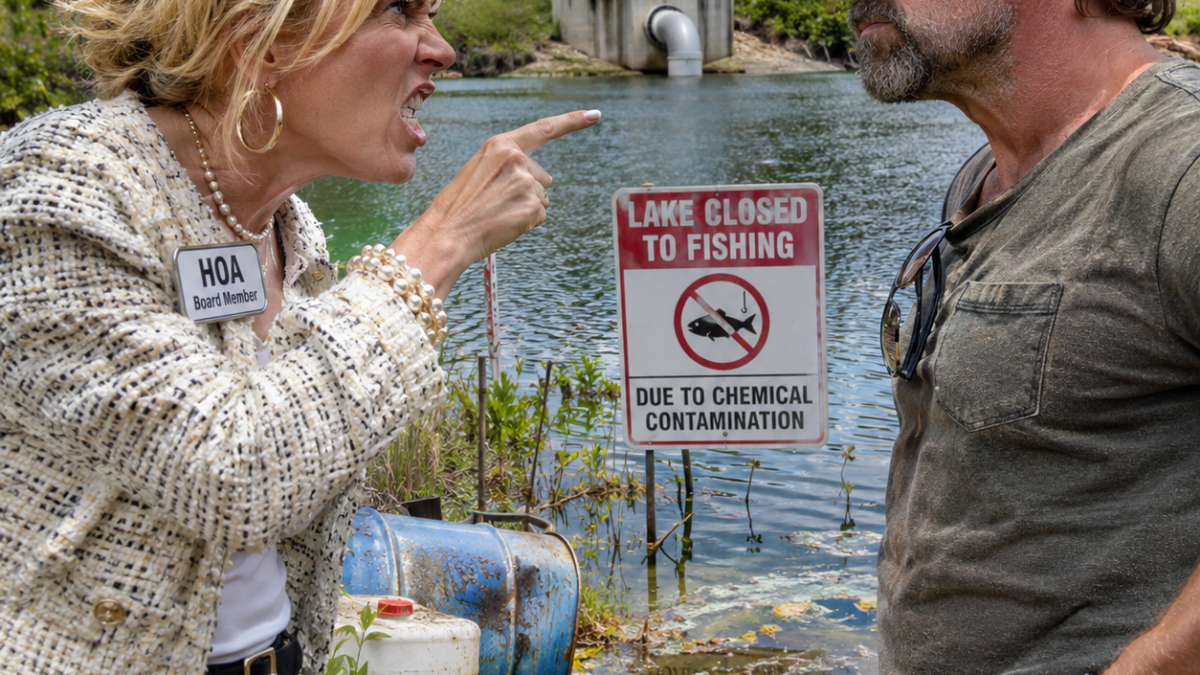
PART 2: HOA Karen Poisoned My Private Lake to Stop Me Fishing — Then Learned Her Own Drinking Water Came From It
PART 2
## THE FIRST DEPUTY
Deputy Martinez looked embarrassed before I even opened the door.
It was five-thirty in the morning.
Frost edged the porch railing.
His patrol car lights painted the pines blue and red.
“Mr. Blackwood?”
“That’s me.”
“Sorry about the hour.”
“What happened?”
He held a folder.
“We received a formal complaint alleging unlicensed commercial fishing.”
I stared at him.
Then at the lake.
Then back at him.
“I have three rods.”
“I know.”
“One rowboat.”
“I know.”
“A tackle box my wife bought me twenty years ago.”
Martinez sighed.
“I know.”
We walked to the dock.
The lake was black glass under the early sky.
He looked at the boat.
Then the rods.
Then me.
“This doesn’t exactly scream commercial fleet.”
“Glad we agree.”
“But the complaint was filed through proper channels.”
“Vivian Hartwell?”
He didn’t answer immediately.
He didn’t have to.
“She has pull?”
“That’s not how I’d phrase it.”
“How would you phrase it?”
Martinez looked toward Meadowbrook.
“People return her calls.”
That told me enough.
He gave me paperwork explaining that the complaint needed administrative review.
No arrest.
No seizure.
But until it was cleared, I was advised not to do anything that could be interpreted as commercial activity.
“Meaning?”
“Probably don’t sell fish.”
“I’ve never sold a fish.”
“I believe you.”
“Can I fish?”
He winced.
“You should probably get the county to confirm your status first.”
Vivian had managed to make a fishing rod feel like evidence.
That irritated me more than I expected.
## THE COURTHOUSE BASEMENT
The county offices occupied a brick building that looked like it had been designed during a national shortage of windows.
The records department was downstairs.
Fluorescent lights.
Metal shelves.
Old coffee.
A clerk named Janet sat behind the counter.
She had worked there longer than half the town had been alive.
I handed her the complaint.
She read it.
“Commercial fishing?”
“Apparently.”
She looked over her glasses.
“You selling trout?”
“No.”
“Guided tours?”
“No.”
“Charging access?”
“No.”
She shrugged.
“Then somebody’s wasting everybody’s time.”
“I agree.”
She pulled up records.
A standard recreational license cost almost nothing.
But once a formal commercial-use allegation existed, reviews could become expensive.
Environmental documentation.
Legal review.
Site evaluation.
Suddenly the number was measured in thousands.
Vivian had found a way to transform a simple activity into a procedural burden.
“Who can file this kind of complaint?”
“Anybody.”
“Anybody with no evidence?”
“Technically.”
Janet lowered her voice.
“Some people file more than others.”
“Vivian?”
She gave me a look.
“Fourteen this year.”
“Fourteen?”
“Property issues. Environmental concerns. Code complaints.”
“All successful?”
“Most people settle whatever she’s complaining about.”
“Because she’s right?”
Janet smiled without humor.
“Because lawyers cost money.”
There it was.
Not law.
Economics.
Vivian didn’t need to win every argument.
She only needed resisting her to cost more than giving in.
Emma hated people like that.
She once told me:
“Bullies aren’t always stronger, Garrett. Sometimes they’re just more willing to waste your afternoon.”
I could almost hear her saying it in that basement.
## THE FIRST THREE DAYS OF RESEARCH
I went home and opened my laptop.
Then county databases.
Then development records.
Then environmental permits.
For three days, I barely fished.
I barely slept.
It felt familiar.
Not the conflict.
The work.
Twenty-six years in the Navy had trained me to solve problems by identifying systems.
Inputs.
Outputs.
Dependencies.
Weak points.
A system looks complicated until you understand what must be true for it to function.
Vivian’s system depended on three things.
People believing her.
Officials getting tired.
Targets quitting.
I couldn’t control the first two immediately.
I could control the third.
So I did not quit.
## MEADOWBROOK’S BUFFER
The first useful document was buried in Meadowbrook’s 2019 development approvals.
Fifty-foot environmental buffer around protected water features and wetland margins.
I pulled the county survey.
Then satellite imagery.
Then development drawings.
Vivian’s property extended well into the protected area.
Her rose garden.
Stone patio.
Part of the landscaped yard.
The same rose garden a magazine had photographed.
I checked twice.
Then a third time.
Seventy-three feet into the protected zone at the deepest point.
I laughed.
It was not joy.
It was recognition.
Vivian had spent weeks using environmental language against me while her own showcase property appeared to violate the exact kind of restrictions she claimed to care about.
Then I found broader issues.
Several Meadowbrook lots had structures close to protected areas.
Development approvals looked sloppy.
Some setbacks were questionable.
Nothing yet proved criminal misconduct.
But it proved something useful.
Vivian’s kingdom had vulnerabilities.
## THREE COMPLAINTS
I filed formal requests for review.
Her property.
HOA jurisdiction claims.
Development compliance.
No insults.
No social-media post.
No threats.
Just documents.
Vivian arrived forty-eight hours later.
This time she brought two board members.
And a lawyer.
The lawyer wore a suit that probably cost more than my boat.
They stood by the dock.
Vivian crossed her arms.
“Your complaints are frivolous.”
“Then the county will dismiss them.”
“You’re wasting public resources.”
I kept sorting fishing lures.
“That sounds familiar.”
The lawyer stepped forward.
“Mr. Blackwood, my clients would prefer an amicable resolution.”
“Good.”
“Restrict fishing between six and ten in the morning.”
I looked up.
“Why?”
“Noise concerns.”
“I fish.”
“Yes.”
“Fishing is quiet.”
“Boats create disturbance.”
I pointed.
“That boat has oars.”
His eyes moved toward the aluminum rowboat.
For the first time, he looked slightly embarrassed.
Vivian took over.
“This isn’t about your boat.”
“What is it about?”
“Respect for the community.”
“I don’t belong to your HOA.”
“Your actions affect us.”
“So do yours.”
Her face tightened.
I stood.
“Drop the harassment.”
“That isn’t happening.”
“Then neither is my compliance review request.”
She stepped closer.
“This isn’t over.”
“No.”
I looked toward her garden across the distant slope.
“It probably isn’t.”
## THE BOAT
Friday morning, my boat was gone.
For about five seconds, my heart stopped.
Then I saw it downstream.
Someone had dragged it maybe fifty yards and chained it to a tree.
Industrial padlock.
Laminated sign.
**IMPOUNDED PENDING ENVIRONMENTAL REVIEW**
I read it twice.
Then called the sheriff.
Martinez arrived.
He looked at the sign.
Then at me.
Then laughed.
Not politely.
Actually laughed.
“Who has authority to impound private watercraft from private property?”
“Apparently Meadowbrook.”
“No.”
He crouched beside the chain.
“They’d need lawful authority.”
“So this is?”
“Somebody moving your property without consent.”
He called for bolt cutters.
When the chain snapped, I lifted the sign.
“Can I keep this?”
“Evidence.”
“Shame.”
He looked at me.
“You documenting everything?”
“Everything.”
“Good.”
Then he lowered his voice.
“Sheriff’s getting tired of the complaints.”
“How tired?”
“Enough.”
That mattered.
Vivian’s system depended on officials being willing to keep responding.
She was spending that goodwill quickly.
## THE NEWSPAPER
The Pine Ridge Gazette ran a story the following afternoon.
**Environmental Concerns Raised Over Crystal Lake Fishing**
The writing was careful.
No direct accusation.
But my name appeared repeatedly beside phrases like:
“refuses cooperation.”
“ongoing environmental concerns.”
“community safety.”
Vivian was quoted extensively.
“We simply want to preserve this precious ecosystem.”
I read that sentence three times.
Then put the newspaper down.
At Murphy’s Tavern, Danny Murphy slapped a copy on the table.
“This is garbage.”
Tom Bradley—no relation to Vivian’s husband—pointed at the headline.
“She’s making you sound like you’re poisoning the lake by fishing in it.”
Irony has a sense of humor.
I didn’t know how dark it was about to become.
## BUSINESS PRESSURE
Vivian started contacting businesses.
Not openly threatening.
Suggesting.
Questioning.
“Community concerns.”
“Environmental responsibility.”
People got nervous.
A catering company canceled an event I had planned to host later that summer.
Another vendor stopped returning calls.
It wasn’t catastrophic.
It was pressure.
I recognized the method.
Create the sense that association with a person has a cost.
Eventually other people create the isolation for you.
The same thing happens in military organizations when somebody weaponizes reputation.
You don’t need formal orders.
Rumors can redirect behavior.
I refused to respond publicly.
Instead, I kept reading.
## THE SEVENTEEN HOMES
Meadowbrook’s development file contained more inconsistencies than I expected.
I cross-referenced county GPS survey points with permits.
Seventeen homes appeared to have construction inside zones requiring additional review.
Vivian’s was among the clearest.
Foundation.
Patio.
Landscaping.
The consequences could be expensive if confirmed.
I brought everything to county environmental scientist Sarah Finley.
Sarah was younger than me by almost twenty years.
Sharp.
Direct.
Coffee mug that said:
**WORLD’S BEST ENVIRONMENTAL SCIENTIST**
I pointed at the maps.
“These coordinates match your system?”
She checked.
Then checked again.
“This is significant.”
“How significant?”
“Let us verify before we use adjectives.”
I liked her immediately.
Engineers and scientists trust nouns more than adjectives.
County notices went out.
Meadowbrook residents started asking questions.
Three houses were listed for sale.
An emergency HOA meeting reportedly became a shouting match.
Vivian called my house.
I let it ring.
Then she made the mistake that changed everything.
## THE LANDSCAPING TRUCK
Thursday morning.
I was returning from town when I saw a landscaping truck near my lake.
Not on the public road.
On my property.
Two workers stood near several industrial containers.
A third carried testing equipment.
My entire body went cold.
I parked behind their truck.
Not aggressively.
Just enough to prevent them from leaving without talking to me.
“Morning.”
A crew leader turned.
His name patch said RICO.
“Morning, sir.”
“What are you doing?”
“Water assessment.”
“Authorized by who?”
He checked his clipboard.
“Pine Ridge Water Management District.”
There was no such agency that I knew of.
“What treatment?”
“Preventive algae control.”
I looked at Crystal Lake.
Clear enough to see trout moving deep beneath the surface.
“What algae?”
Rico shrugged.
“We work from orders.”
“Who signed it?”
He turned the form.
Vivian Hartwell.
Something inside me went perfectly still.
“What product?”
He named an algaecide commonly used in controlled situations.
As an environmental engineer, I knew enough to understand that careless or excessive application could damage aquatic life.
“Has anything been applied?”
“No.”
“You stop now.”
Rico looked uncomfortable.
“Sir—”
“This is private property. I’m the owner. There is no Pine Ridge Water Management District.”
His face changed.
“You sure?”
“Very.”
I called Sarah Finley.
Five minutes later she confirmed it.
No authorization.
No county treatment.
No district.
No permit.
Rico’s crew began reloading everything before I even finished the call.
He handed me his card.
“Mr. Blackwood, we didn’t know.”
“I believe you.”
“We were given paperwork.”
“Keep every copy.”
He nodded.
Then looked toward the lake.
“Somebody really tried to authorize this without telling you?”
“Yes.”
He whistled.
“That’s insane.”
He was right.
## THE SHERIFF
Sheriff Tom Rodriguez had been in Pine Ridge law enforcement fifteen years.
His office smelled like burnt coffee and gun oil.
I spread the papers across his desk.
Fake work order.
Vivian’s signature.
Rico’s statement.
Property records.
Prior complaints.
Rodriguez leaned back.
“How long has this been happening?”
“Six months.”
He pulled a folder.
Vivian Hartwell.
Thick.
I looked at him.
“You already had one?”
“Complaints.”
“Against her?”
“And by her.”
He flipped pages.
“Neighbors. Contractors. Property disputes.”
He looked at me.
“Mrs. Hartwell seems to believe paperwork is a competitive sport.”
“That’s one way to put it.”
Rodriguez tapped the fake water-management order.
“This one is different.”
“I know.”
“Someone attempted to authorize chemical treatment of water they don’t own.”
“Yes.”
“Using a fake public entity.”
“Yes.”
He rubbed his forehead.
“Do you understand how bad that can become?”
“I do.”
Then he said something that stayed with me.
“People who escalate because they’re losing don’t usually become more rational.”
I went home and checked every camera.
Every lock.
Every trail.
Then I did what engineers do when a system no longer makes sense.
I went back to the original drawings.
## THE LIBRARY BASEMENT
Pine Ridge maintained old municipal infrastructure plans in the library archive.
The librarian knew me through volunteer work.
That night I accessed historical maps.
Water distribution.
Treatment plant.
Spring channels.
I unfolded a 1987 blueprint.
Then another.
Crystal Lake.
A line left its southern basin.
Underground spring connection.
Treatment intake.
Municipal distribution.
I followed it with my finger.
Lake.
Treatment plant.
Main line.
Town.
Meadowbrook.
My breathing slowed.
I checked the legend.
Then the engineering notes.
Then an older water study.
Crystal Lake wasn’t simply a private recreational lake.
Its spring system fed the municipal source Pine Ridge had used for decades.
My water.
Their water.
One system.
I sat back.
Vivian had tried to chemically treat the source connected to her own kitchen faucet.
## THE DEVELOPMENT STUDY
Then I found the Meadowbrook environmental impact assessment.
Clearwater Development.
Consultant signature:
**Bradley Winters.**
Vivian’s husband.
I knew the name.
Developer.
Water infrastructure investor.
The report explicitly discussed Crystal Lake’s hydrological connection.
Bradley knew.
He had always known.
That made Vivian’s fake treatment order harder to explain as simple ignorance.
I felt sick.
I photographed the pages.
Then kept reading.
Clearwater Development had private wells south of town.
Backup wells.
Commercial potential.
The more I read, the worse the picture became.
If Pine Ridge lost confidence in its existing water source, an alternate supplier stood ready.
Clearwater.
Owned by Bradley Winters.
Suddenly the fight over fishing looked smaller.
Much smaller.
Vivian had not merely been trying to silence a widower with a rod.
There appeared to be a financial motive connected to water.
I called Sarah at seven the next morning.
“I need you to see something.”
## SARAH READS THE PLANS
She came to my cabin.
I spread the blueprints across the dining table.
She followed the lines.
Her expression changed.
“Where did you get these?”
“Library archive.”
“Bradley signed this?”
“Yes.”
She read the old assessment.
Then looked toward the lake through the window.
“If somebody interfered with this source…”
“Townwide consequences.”
“Yes.”
“Including Meadowbrook.”
“Yes.”
“And Clearwater owns backup wells.”
She looked back at the paperwork.
“Garrett.”
“I know.”
“No.”
She pointed.
“This stops being a neighborhood dispute right here.”
She was right.
## THE FIRST WATER MONITORS
Sarah arranged professional monitoring.
Not to provoke anyone.
To protect the source.
Continuous water-quality readings.
Documented baselines.
Cameras at legal access points.
Chain-of-custody procedures.
Sheriff Rodriguez coordinated with appropriate authorities.
I added my own security cameras around the property.
Nothing exotic.
Trail cameras.
Motion lighting.
Enough to know if trucks came back.
Word spread.
That part worried me at first.
Then Pine Ridge did what small towns sometimes do when threatened.
People showed up.
Pete from the hardware store gave me extra batteries.
Volunteer firefighters offered to watch the public roads.
Danny Murphy called if he saw unfamiliar vehicles.
Church ladies organized phone numbers.
I had moved to Pine Ridge wanting isolation.
Now the town was circling the lake like family.
Emma would have laughed at the irony.
## MARCUS THOMPSON
Marcus wrote for a regional paper.
He arrived with a camera and three notebooks.
“This could be bigger than Pine Ridge.”
“I don’t want bigger.”
“Doesn’t matter.”
He interviewed Sarah.
Rodriguez.
Old residents.
Water plant staff.
He asked me about Emma.
I almost refused.
Then told him.
Cancer.
Insurance money.
Dream.
Lake.
He closed his notebook.
“Sorry.”
“Thanks.”
“Do you regret buying it?”
I looked toward Crystal Lake.
“No.”
Even then.
Especially then.
## VIVIAN RETURNS
Friday morning, she appeared alone.
No clipboard.
Leather briefcase.
Different energy.
“Garrett.”
First-name basis.
Interesting.
“What can I do for you?”
“I think we’ve both let this get out of hand.”
“I didn’t forge a water-treatment order.”
Her smile strained.
“I’m not here to argue.”
“What are you here for?”
She opened the briefcase.
Cash.
Stacks.
“Fifty thousand dollars.”
I stared.
“For what?”
“A clean break.”
“Meaning?”
“You sell the property.”
“To who?”
“Clearwater Development.”
There it was.
“Fifty thousand?”
“In addition to assumption of certain liabilities and relocation assistance.”
“This property cost more than that.”
“It has complications now.”
“You created the complications.”
She ignored that.
“You could move somewhere warmer.”
“My wife and I chose this place.”
“Garrett.”
Her voice softened.
Fake sympathy.
“Emma is gone.”
Every muscle in my body tightened.
She continued.
“You don’t have to keep punishing yourself.”
I closed the briefcase.
Pushed it back.
“What happens if I say no?”
Her smile disappeared.
“Litigation.”
“From who?”
“People with resources.”
“Clearwater?”
“Everyone who has an interest in responsible water management.”
I almost admired the wording.
“Give me the weekend.”
She smiled again.
“Monday.”
Then she left.
## EMMA’S NOTEBOOK
That night, I opened Emma’s notebook.
The same one with Pine Ridge on the list.
A later page contained a sketch.
Mountains.
Lake.
Two stick figures on a dock.
Underneath:
**Don’t spend retirement arguing with idiots.**
I laughed so suddenly I cried.
That was Emma.
Not poetic every day.
I sat at the kitchen table.
For months, I had framed the fight as keeping a promise to her.
Protecting the dream.
But Emma had never wanted me trapped inside grief.
She wanted us to grow old together.
We didn’t get that.
The lake couldn’t change it.
Protecting Crystal Lake mattered.
But destroying myself over revenge would not honor her.
I made a decision.
Whatever came next had to protect people.
Not satisfy anger.
## THE HOSPITAL CALLS
Before Monday, several residents were hospitalized with gastrointestinal symptoms.
Rumors spread immediately.
Water poisoning.
Copper exposure.
Municipal contamination.
Sarah called.
“The municipal system tests are clean.”
“So not the lake?”
“Current samples don’t show it.”
“Then what?”
“We don’t know yet.”
Fear did the rest.
People bought bottled water.
Stores sold out.
Clearwater issued public statements offering emergency supply capability.
That timing was impossible to ignore.
But suspicion is not proof.
Rodriguez reminded me.
“Don’t get ahead of evidence.”
“I know.”
“You sound like you don’t.”
“I’m an engineer.”
“That is not the same thing as patient.”
Fair.
## MONDAY
Vivian returned at eight.
Briefcase again.
“Have you reconsidered?”
“I have questions.”
She sat.
“What questions?”
“Why Clearwater?”
“Qualified buyer.”
“Why now?”
“Because this conflict has become unsustainable.”
“Why does Bradley’s development assessment identify Crystal Lake as part of the municipal system?”
Her face changed.
Tiny.
Enough.
“I don’t know what you’re referring to.”
I slid a copy across the table.
She didn’t touch it.
“Your husband signed it.”
“He signs many technical documents.”
“He knew.”
“Garrett—”
“He knew the lake fed the town.”
She stood.
“This conversation is over.”
“No.”
I stayed seated.
“You tried to have contractors put chemicals into water your husband’s own report identified as connected to Pine Ridge.”
“That treatment was environmentally responsible.”
“According to a fake district?”
She picked up the briefcase.
“You have no idea what you’re dealing with.”
“I’m beginning to.”
She looked at me with genuine contempt.
Then she said the thing I never forgot.
“You’re a retired sailor clinging to a dead woman’s fantasy.”
The room went quiet.
She continued.
“People with vision are trying to build something here.”
I stood.
“Emma was not a fantasy.”
Vivian rolled her eyes.
“Your wife is dead, Garrett.”
My hand tightened against the table.
Not into a fist.
Into wood.
“She was a nobody who died in a nowhere place, and you are using grief as an excuse to obstruct progress.”
For one second, I did not see Vivian.
I saw Emma in a hospital bed.
Thin.
Tired.
Smiling anyway.
Then the anger passed through me.
And something colder replaced it.
“Leave.”
Vivian lifted her chin.
“You’ll regret this.”
“Get off my property.”
She left.
Her BMW disappeared through the pines.
I stood there shaking.
Not from fear.
Grief.
Some wounds stay open enough that a stranger can still find them.
## THE TOWN HALL
Pine Ridge called an emergency meeting.
High school gym.
Water concerns.
Clearwater’s proposed emergency service.
Residents filled the bleachers.
Families.
Ranchers.
Teachers.
Firefighters.
Retirees.
Meadowbrook residents sat together.
Many looked uncomfortable.
Mayor Patricia Walsh called the meeting to order.
Bradley Winters spoke first.
Polished.
Calm.
Expensive suit.
“Recent concerns regarding the municipal water source require contingency planning.”
He proposed Clearwater provide emergency water.
Daily household cost.
Long-term contracts.
The number drew murmurs.
He framed it as rescue.
A private solution to public uncertainty.
I sat beside Sarah.
She whispered:
“He’s selling the cure before anyone proves the disease.”
Exactly.
Then Sheriff Rodriguez stood.
“Before the town considers contracts, there is evidence relevant to the source of this crisis.”
The room quieted.
My name was called.
I walked forward.
Not as a hero.
Not as an avenger.
As the property owner who had kept records.
## THE FIRST IMAGE
The screen showed security footage.
The original unauthorized treatment crew.
Truck.
Containers.
Time stamp.
Work order.
Vivian’s signature.
People began talking.
I explained.
“These contractors stopped before applying anything because I challenged the authorization and county officials confirmed it was not legitimate.”
A Meadowbrook resident shouted:
“Vivian, is that your signature?”
She stood.
“This is a distortion.”
I clicked.
County confirmation.
No Pine Ridge Water Management District.
No permit.
No authorization.
Bradley leaned toward his lawyer.
Vivian remained standing.
## THE WATER MAP
Next slide.
1987 municipal plan.
Crystal Lake.
Spring path.
Treatment intake.
Distribution network.
I traced it.
“This lake does not merely sit upstream from Pine Ridge.”
Silence.
“It feeds the source the town depends on.”
People turned toward Meadowbrook.
I continued.
“The same water system supplies Meadowbrook Estates.”
Someone shouted:
“You tried to put chemicals in our drinking water?”
Vivian snapped:
“It was a routine environmental treatment!”
Sarah stood from the front row.
“No county environmental office authorized it.”
That changed the room.
## BRADLEY’S SIGNATURE
Then the development impact assessment.
Bradley Winters.
Signature.
Date.
Clear description of the hydrological connection.
I looked at him.
“You knew.”
He remained seated.
His lawyer whispered.
Mayor Walsh said:
“Mr. Winters?”
Bradley stood.
“Technical consultants sign many documents prepared by staff.”
“You were listed as environmental safety consultant.”
No answer.
Then Marcus Thompson rose from the media table.
“Mr. Winters, does Clearwater Development own private well infrastructure south of town?”
Bradley looked at him.
“This is not relevant.”
The room erupted.
It was relevant.
Everybody understood that immediately.
## THE MONEY
I explained the acquisition offer.
Clearwater wanted my property.
Vivian had offered cash.
Wanted environmental complaints withdrawn.
Wanted the lake transferred.
The lawyer objected verbally.
“This is an unsubstantiated characterization.”
I held up the written terms Vivian had left behind.
Not the cash.
The paper.
Documents win.
Always.
## THE RECORDING
Then came the audio from Vivian’s second visit.
Her voice filled the gym.
“People with resources you can’t imagine.”
“Transfer your property to Clearwater Development.”
Then the line about Emma.
My stomach tightened hearing it again.
Hundreds of strangers heard my dead wife dismissed as nobody.
I wished we could skip it.
But it showed motive.
Attitude.
Pressure.
When the recording stopped, the gym was completely silent.
Vivian stood.
“This is manipulation.”
Nobody answered.
Then Danny Murphy yelled from the bleachers:
“You went after the whole town because one man wouldn’t stop fishing?”
Applause broke.
Angry.
Loud.
Mayor Walsh struck the gavel.
“Order!”
It barely helped.
## FEDERAL INVESTIGATORS
Authorities had been reviewing the evidence.
The fake governmental authorization.
Potential environmental harm.
The water infrastructure connection.
Financial interests.
I won’t pretend I knew every legal theory involved.
I didn’t.
I was an engineer.
Not a prosecutor.
But investigators did.
Vivian and Bradley were escorted out for questioning under warrants connected to the investigation.
The gym did not cheer for five minutes like some movie.
Real people were too frightened.
Too angry.
Too confused.
A few applauded.
Others stared.
One woman cried.
A Meadowbrook father sat with both hands on his head.
That reaction felt more truthful.
These people had trusted their HOA president.
Some had defended her.
Now they were being told the fight over fishing might have touched their drinking water.
That is not a victory moment.
It is betrayal.
## AFTER THE MEETING
I stepped outside.
Cold night.
Sarah followed.
“You okay?”
“No.”
“Emma?”
I nodded.
She stood beside me.
No speech.
That mattered.
After a while, I said:
“I wanted to embarrass Vivian.”
“I know.”
“I thought it would feel good.”
“Did it?”
“No.”
Sarah looked through the gym windows.
“Because this got bigger.”
“Yes.”
“You protected the lake.”
“Not yet.”
She looked at me.
“Then do that.”
That became the next part of my life.
## TESTING EVERYTHING
Crystal Lake underwent extensive testing.
Town water too.
Multiple agencies.
Independent labs.
We needed facts.
Not rumors.
The main municipal system had not suffered the catastrophic contamination people feared.
That was the first relief.
But there had been environmental damage associated with later unauthorized activity around the lake, including fish loss and localized contamination.
Cleanup began.
Dead trout were collected.
Sediment tested.
Water sampled repeatedly.
Every morning I walked to the dock.
For weeks, I did not fish.
There was nothing peaceful about the lake.
It looked beautiful from a distance.
Up close, it smelled wounded.
That was the hardest part.
## THE SECURITY FOOTAGE
Investigators reviewed the cameras.
Vehicles.
Times.
People.
The HOA connection.
Contractors.
Some workers cooperated.
Some said they had believed the instructions were legitimate.
Others had clearly known something was wrong.
I stayed out of charging decisions.
That mattered.
There is a difference between demanding accountability and deciding guilt yourself.
Vivian had blurred those boundaries constantly.
I refused to.
## MEADOWBROOK TURNS ON ITS BOARD
Residents demanded records.
Contracts.
Payments.
Communications with Clearwater.
Emergency meeting.
Vivian was unavailable.
Other board members resigned quickly.
One said publicly:
“I signed things I did not read carefully enough.”
That sentence did not excuse him.
But it was honest.
Meadowbrook residents discovered their HOA had asserted authority far beyond what its documents supported.
Financial relationships were reviewed.
Environmental approvals were challenged.
The neighborhood that had once treated Vivian like royalty suddenly wanted every file she had touched.
People become excellent auditors after betrayal.
## THE ROSE GARDEN
County environmental review confirmed major problems with some protected areas around Meadowbrook.
Vivian’s famous garden was affected.
The roses she had used in magazine photographs had been planted where development plans required natural buffer.
Removal and restoration followed.
I drove past once.
Workers were taking out stone edging.
A neighbor standing nearby recognized me.
“Enjoying this?”
I thought.
“No.”
He looked surprised.
“I thought you hated her.”
“I do.”
“Then why not enjoy it?”
I looked at the torn-up garden.
“Because environmental restoration isn’t revenge.”
He nodded slowly.
That was something I had learned.
Protecting land only when it hurts your enemy is not environmentalism.
## THE FEDERAL CASE
Months passed.
Vivian eventually entered a plea resolving federal charges related to the environmental scheme.
Bradley faced a harsher outcome tied to Clearwater’s role and the broader water plan.
The exact legal language mattered to attorneys.
To Pine Ridge, the results were simpler.
Vivian lost her position.
Fines.
Restitution.
Prison time.
Bradley’s company was dismantled.
Assets were used toward restitution, medical costs, environmental work, and water-system improvements under the resolution of the cases.
Clearwater disappeared.
The private wells were transferred out of their control.
Pine Ridge kept its water.
## THE $847,000
People loved the number.
Environmental penalties associated with the Meadowbrook violations approached $847,000 in the story that spread through town.
Vivian had once used environmental rules as a weapon against my fishing.
Now the actual rules applied to her own development.
The irony was obvious.
But again, the money was not the part that stayed with me.
What stayed was a pregnant woman asking whether her tap water was safe.
A father asking if his kids could brush their teeth.
An elderly man carrying cases of bottled water because he didn’t trust the faucet.
Fear is expensive in ways no penalty calculation captures.
## THE FIRST TROUT
Months after cleanup, Sarah called me at dawn.
“Get to the dock.”
I was there in five minutes.
She pointed.
A trout.
Small.
Alive.
Moving through clear water.
I stared.
“First one?”
“First one I’ve seen.”
It vanished beneath the dock.
I sat down.
Sarah looked at me.
“You’re crying.”
“No.”
“You are.”
“Cold wind.”
“Sure.”
I laughed.
Then cried harder.
Emma and I had planned to fish that lake when we were old.
We never got to.
Seeing life return felt like receiving part of the dream back without pretending the loss had disappeared.
## THE SCHOLARSHIP
Pine Ridge established an environmental scholarship in Emma’s name.
I argued against it at first.
“Why her?”
Mayor Walsh looked at me.
“Because this started with a place you bought for both of you.”
“She wasn’t an engineer.”
“So?”
“She was an artist.”
“Environmental science needs people who care before they calculate.”
That sounded like Emma.
So I agreed.
The **Emma Blackwood Environmental Scholarship** funded local students studying environmental science, water quality, ecology, and related fields.
At the announcement, I brought one of Emma’s sketches.
Crystal Lake.
Done years before we ever saw it.
Not accurate.
But somehow recognizable.
## THE FIRST RECIPIENT
The first student was connected to the Martinez family.
She wanted to study water-quality protection.
She stood beside the lake holding the scholarship certificate.
“I used to think clean water was just something that came out when you turned the handle.”
Everyone laughed softly.
Then she said:
“Now I know someone has to protect everything behind that handle.”
That line hit me.
Because that had been my career.
Systems behind ordinary life.
People rarely notice infrastructure until it fails.
Vivian had counted on that.
## MEADOWBROOK CHANGES
The neighborhood changed dramatically.
Not overnight.
But visibly.
The old board disappeared.
New leadership.
Financial transparency.
Environmental compliance.
Less obsession with appearances.
Vegetable gardens appeared.
Children’s playsets.
Mailboxes stopped matching perfectly.
I considered that progress.
Some expensive homes changed hands.
Teachers.
Firefighters.
Nurses.
Veterans.
Not because every house suddenly became cheap.
But the neighborhood lost some of the culture that treated exclusivity like virtue.
One afternoon I drove through.
A kid had left a bicycle in a driveway.
No warning sticker.
Civilization survived.
## THE LAKE CLEANUP FESTIVAL
Someone suggested a community cleanup day.
Then it became a festival.
I hated the name.
Too cheerful.
But Pine Ridge embraced it.
Families collected trash along feeder streams.
Scientists gave demonstrations.
Kids learned about watersheds.
Volunteer firefighters grilled burgers.
Local musicians played.
Fishing clinics resumed once the lake was safe.
I stood on the dock watching children cast lines.
One little boy kept tangling himself.
Emma would have loved him.
## SARAH FINLEY
Sarah stayed involved professionally.
Water monitoring.
Restoration.
Long-term planning.
Coffee meetings became normal.
Then dinner.
Then conversations that had nothing to do with chemistry.
She had lost her husband in a climbing accident years earlier.
The first time she told me, we sat quietly for a long time.
Grief recognizes grief.
There is no need to explain the strange guilt of laughing again.
Or the fear that loving anything new means betraying what came before.
She understood.
So did I.
## THE FIRST DINNER
Sarah came to the cabin.
I cooked badly.
She ate politely.
“This chicken is dry.”
“Thank you for your honesty.”
“You’re welcome.”
“Emma would have said worse.”
“What would she have said?”
“That the Navy apparently taught me to remove moisture from everything.”
Sarah laughed.
The sound filled the kitchen.
For one second, guilt hit me.
Sharp.
Then I remembered Emma laughing.
She would not have wanted silence as a memorial.
That realization took time.
## I STARTED CONSULTING
Other towns called.
Small communities with water disputes.
Development pressure.
Well contamination.
Environmental manipulation.
I had expertise.
Now I had experience.
Blackwood Environmental Consulting started accidentally.
One town.
Then another.
I helped communities document.
Test.
Ask better questions.
Read old infrastructure plans.
The work gave me purpose.
Not revenge.
Purpose lasts longer.
## THE SECOND ATTEMPT AT CORPORATE WATER CONTROL
A company in another state tried to acquire public well rights through complicated contracts.
The town called me.
I drove there.
Sat in a community center.
Listened.
Reviewed documents.
The whole time I thought about Pine Ridge.
Not every corporation is evil.
Not every private water provider is a criminal.
That matters.
The lesson wasn’t “business bad.”
The lesson was transparency.
Who owns the source?
Who benefits?
Who bears risk?
Who signs?
Who monitors?
Simple questions.
Vivian’s scheme had depended on people not asking them.
## THE DOCK
I rebuilt the dock.
Emma and I had planned it together.
Her sketch showed a wider platform on the western side.
I followed it.
Sarah helped hold boards.
At one point she looked at the drawing.
“Emma had better design instincts than you.”
“Objectively false.”
“She put the bench where sunset hits.”
“I was going to do that.”
“You put it on the east side.”
“Engineering reasons.”
“Wrong reasons.”
We moved the bench.
She was right.
Emma was right.
Usually dangerous when two women agree against you.
## THE FIRST TIME SARAH STAYED
I barely slept.
Not because of Sarah.
Because Emma’s photograph sat on the dresser.
I felt like I was crossing some invisible line.
At dawn, I went to the dock.
Sarah joined me.
No shoes.
Coffee.
We sat.
Finally I said:
“This was supposed to be Emma’s place.”
Sarah looked at the water.
“It still is.”
I turned.
“And yours.”
She waited.
“If you want it to be.”
I swallowed.
“Is that allowed?”
She smiled sadly.
“I hope so.”
That was the first morning I understood love does not replace grief.
It grows beside it.
## WE MARRIED
The following spring.
Small ceremony by Crystal Lake.
It became larger than intended because Pine Ridge has no understanding of the phrase “small ceremony.”
Two hundred people.
Murphy brought food.
Martinez helped direct parking.
Mayor Walsh officiated.
Sarah wore a simple dress.
I kept Emma’s wedding ring on a chain beneath my shirt.
Sarah knew.
She never asked me to remove it.
That mattered more than I can explain.
Before the ceremony, I stood alone beneath the pines.
“Okay,” I whispered.
Not goodbye.
Just okay.
## THE WATER STATION
Pine Ridge installed permanent monitoring.
Independent oversight.
Public reporting.
Multiple sampling points.
Nobody could secretly alter the system and assume no one would notice.
The equipment became part of environmental education.
Students visited.
Engineers visited.
Small-town officials from other counties visited.
The place Vivian had tried to exploit became a model for protecting community resources.
That irony felt better than punishment.
## THE OLD MEADOWBROOK LETTER
I kept Vivian’s first fishing notice.
“Commercial fishing.”
I eventually framed it.
Sarah laughed.
“You actually framed it?”
“Yes.”
“Why?”
“Historical artifact.”
“You have issues.”
“Document retention.”
“It’s above the toilet.”
“Strategic display.”
That was where it stayed.
## RICO RETURNS
Years later, Rico came to a cleanup festival.
The contractor whose crew had almost treated the lake.
He brought his daughter.
He looked embarrassed.
“I still think about that day.”
“You stopped.”
“Because you caught us.”
“You listened when I said stop.”
He nodded.
“My company changed our authorization procedures after that.”
“Good.”
“We verify directly with property owners now.”
“Better.”
His daughter tugged his sleeve.
“Dad, are we fishing?”
He smiled.
“Yeah.”
I handed her a rod.
People should be allowed to become better after almost making a terrible mistake.
Rico had been lied to.
That mattered.
## THE PEOPLE WHO DEFENDED VIVIAN
Some Meadowbrook residents had defended her for months.
A few apologized.
One woman approached me during the festival.
“I said terrible things about you online.”
“I remember.”
She winced.
“I thought you were trying to destroy our property values.”
“I wasn’t.”
“I know.”
She looked toward the lake.
“I believed her because she sounded certain.”
That sentence stayed with me.
People often confuse certainty with competence.
Vivian understood that instinctively.
She never hesitated.
Never said maybe.
Never said I don’t know.
Confidence filled gaps where evidence should have been.
## THE ROSE GARDEN TWO YEARS LATER
The protected buffer recovered.
Native grasses.
Willow.
Wildflowers.
No magazine roses.
I walked past with Sarah.
“Looks better.”
“Don’t let Vivian hear you.”
“She’s not here.”
“No.”
We stood quietly.
The native plants moved in the wind.
Nature has no interest in expensive landscaping.
It simply takes whatever space we stop forcing into shape.
## THE WATER BILL
Pine Ridge invested in the municipal system.
Upgrades.
Backup treatment.
Better monitoring.
Emergency plans.
Residents complained about the cost.
Of course they did.
At one town meeting, a man stood.
“Why are we spending this much?”
Sarah explained redundancy.
Risk.
Source protection.
He still complained.
I loved it.
That was democracy functioning normally.
People questioning money openly.
Not discovering secret plans after the fact.
## MAYOR WALSH
Years later she told me:
“You know what scared me most?”
“The contamination?”
“The fact that we didn’t understand our own water system.”
That was true.
The town had depended on Crystal Lake for decades.
Most residents didn’t know.
Knowledge existed in blueprints.
Engineering reports.
Old cabinets.
But not in public understanding.
A secret does not require conspiracy.
Sometimes neglect is enough.
Vivian exploited that ignorance.
Afterward, Pine Ridge made water education part of public planning.
## THE TOURISTS
The story brought tourists.
I hated that at first.
People wanted to see “the poisoned HOA lake.”
I refused any attraction built around scandal.
No Vivian merchandise.
No “Karen Dock.”
Danny Murphy actually suggested that.
I threatened to throw him in the lake.
Instead, visitors learned about ecology.
Water.
Fishing.
Engineering.
Emma.
That felt right.
## THE SECOND SCHOLARSHIP RECIPIENT
A boy named Caleb.
Ranch family.
Wanted to study hydrology.
At the ceremony he asked:
“Mr. Blackwood, why did you keep fighting?”
I gave him the easy answer.
“Because the lake mattered.”
Then thought.
“No.”
He waited.
“Because eventually it wasn’t my lake anymore.”
He frowned.
“Legally?”
“No. Legally it was.”
I pointed toward town.
“But everyone depended on it.”
He nodded.
That is stewardship.
Ownership gives rights.
Dependency creates responsibility.
## EMMA’S ASHES
I had scattered some of Emma’s ashes near the western shore.
Private place.
Only Sarah knew exactly where.
One summer morning we walked there.
Wildflowers had grown.
Sarah stopped.
“Want me to wait?”
“No.”
We sat.
I told Emma about the scholarship.
Consulting.
Marriage.
I felt ridiculous.
Then stopped.
The dead remain part of our internal conversations whether we admit it or not.
I said:
“I’m okay.”
That was the first time I meant it.
## VIVIAN’S SENTENCE
People asked whether eighteen months was enough.
Some thought no.
Some wanted decades.
I stopped thinking in those terms.
Sentencing belonged to courts.
My role had been evidence.
Protection.
Restoration.
Once accountability happened, I wanted my life back.
If you measure healing by how much punishment still satisfies you, you stay tied to the person who hurt you.
I didn’t want Vivian living in my head after she had already tried to control my lake.
## BRADLEY
Bradley’s case destroyed Clearwater.
That mattered more structurally.
The wells.
Contracts.
Financial scheme.
Those assets no longer represented a private lever over Pine Ridge.
He had understood the system.
That was what made his conduct worse.
Vivian acted from arrogance and greed.
Bradley had technical knowledge.
He knew the hydrology.
He knew the risks.
Expertise increases responsibility.
I believed that in the Navy.
I believe it now.
## THE THREE HOSPITALIZED RESIDENTS
All recovered.
Investigators traced their exposure through the wider criminal investigation rather than the main municipal line.
For weeks, those families had lived with fear.
Medical bills were covered through restitution.
One of them, an older man named Ray, came to the lake later.
He had never fished.
I handed him a rod.
“What do I do?”
“Mostly wait.”
“I’m good at that.”
He caught nothing.
Loved it.
## TOM BRADLEY THE LOCAL VETERAN
The unfortunate name confusion became a running joke.
Tom Bradley, local veteran.
Bradley Winters, developer.
Tom insisted everyone use his full name after the town hall.
“I don’t want anybody thinking I’m related to that idiot.”
At Murphy’s Tavern, Danny printed a sign:
**GOOD BRADLEY SEATED HERE.**
Tom hated it.
We kept it.
## THE PINE RIDGE LAKE CLEANUP FESTIVAL
By year three it had become enormous.
Too enormous.
Food trucks.
Kids.
Environmental booths.
Fishing competitions.
I complained.
Sarah ignored me.
“You like it.”
“I like quiet.”
“You stand there smiling all day.”
“I’m supervising.”
“You gave a six-year-old a fishing hat.”
“He needed it.”
“Exactly.”
Emma would have loved the festival.
That thought stopped hurting eventually.
It became warm.
## THE CABIN
We expanded it slightly.
Not luxury.
A second office.
Sarah’s equipment.
My consulting files.
Emma’s paintings stayed.
Sarah added photographs.
No one erased anyone.
That became the architecture of our life.
New things beside old things.
Not on top of them.
## A CALL FROM OREGON
A rural community suspected a developer was manipulating well-access agreements.
They called.
I reviewed documents remotely.
Then visited.
At the public meeting, an elderly rancher asked:
“You the guy whose HOA poisoned the lake?”
I sighed.
“That version refuses to die.”
He laughed.
“You win?”
“The town did.”
He nodded.
“Good answer.”
## THE ORIGINAL BLUEPRINT
I donated a copy of the 1987 municipal plan to the town display.
The original remained archived properly.
Beside it, a plaque explained the hydrology.
No mention of Vivian in the first paragraph.
That was deliberate.
The water system existed before her.
Would exist after her.
I did not want the most important story about Crystal Lake to be a criminal.
The lake deserved a longer history.
## THE LAST DEAD FISH MEMORY
For years, I could still smell that morning.
Rotting trout.
Chemical odor.
Hot coffee.
Certain memories attach to smell more strongly than images.
Then one summer, a kid caught a large cutthroat near the dock.
His father took a picture.
They released it.
The fish disappeared beneath clear water.
Something shifted.
The living fish replaced the dead ones in my mind.
Not completely.
Enough.
## SARAH’S THEORY
Sarah once said:
“You know why Vivian lost?”
“Evidence?”
“No.”
“Hydrology?”
“No.”
“Terrible lawyer?”
She laughed.
“Because she thought everything was separate.”
I looked at her.
“Explain.”
“She thought your fishing was separate from town water. Your lake was separate from Meadowbrook. Her husband’s company was separate from the HOA. Your grief was separate from your stubbornness.”
I smiled.
“And?”
“Systems connect.”
Engineer answer.
I loved her for it.
She was right.
## SYSTEMS CONNECT
That became a phrase I used in consulting.
Systems connect.
Water connects.
Money connects.
Authority connects.
Records connect.
People connect.
Vivian’s entire plan depended on nobody following the connection far enough.
A complaint about fishing.
A fake environmental concern.
A treatment order.
A development company.
A private well.
A public water system.
Follow the lines.
The truth was sitting there.
## THE MEADOWBROOK KIDS
Children from Meadowbrook started attending environmental programs.
At first that amused me.
Their parents had once complained about fishing noise.
Now their kids learned fly-fishing on my dock.
One boy asked:
“Did Mrs. Hartwell really ban fishing?”
“She tried.”
“Why?”
“Long story.”
“My mom says she was evil.”
I thought.
“People are more complicated than that.”
“Was she bad?”
“She made very bad choices.”
He considered.
“So don’t be like her?”
“That works.”
Then he cast directly into a tree.
We spent ten minutes recovering the line.
## THE PRICE OF THE PROPERTY
After the case, investors offered ridiculous money.
Lakefront.
Media history.
Water importance.
I declined.
One offer would have made me wealthy enough to never work again.
Sarah asked:
“You tempted?”
“Yes.”
“Why say no?”
I looked at Emma’s dock.
“Because I finally know what I own.”
Not market value.
Responsibility.
Some assets are worth more after you understand what they mean.
## PUBLIC WATER EASEMENTS
We clarified everything legally.
Municipal access.
Monitoring.
Emergency authority.
Property rights.
No ambiguity left for another Vivian to exploit.
I insisted.
If a town depends on private land for public water, everyone should know the rules before a crisis.
No secret handshakes.
No century-old assumptions.
Clear agreements.
Clear responsibilities.
That may have been the most important reform.
## THE DAY I FISHED AGAIN
I waited longer than necessary.
Months after officials said fishing was safe.
I couldn’t.
The rod felt connected to the dead trout.
Then Sarah walked down one morning carrying Emma’s tackle box.
She set it beside me.
“You don’t have to.”
“I know.”
“But you want to.”
I nodded.
She handed me the rod.
I cast.
Line landed.
Circle spread across Crystal Lake.
Nothing dramatic happened.
That was perfect.
I sat.
Waited.
Emma had always said fishing was just an excuse to sit somewhere beautiful without admitting you were doing nothing.
She was right.
## I CAUGHT ONE
Small cutthroat.
I reeled it in.
Held it carefully.
Healthy.
Bright.
Sarah took a picture.
Then I lowered it into the water.
It paused against my hand.
Then disappeared.
I cried again.
Apparently retirement made me emotional.
Or maybe grief had finally taught me not to care.
## MURPHY’S TAVERN
My usual table stayed the same.
Danny framed the newspaper front page.
I complained.
“You’re exploiting me.”
“You don’t buy enough beer for exploitation.”
Tom raised his glass.
“To Garrett.”
“No.”
“To Emma.”
That I accepted.
We drank.
## EMMA’S FAVORITE SAYING
Vivian once said bullies understood power.
Emma said something different:
“People understand consequences.”
She believed consequences could teach without becoming cruelty.
I tried to remember that.
The goal was never to poison Vivian back.
Or destroy Meadowbrook.
Or make people suffer.
The goal was consequence proportional to conduct.
That is harder than revenge.
Revenge asks:
How much pain can I return?
Justice asks:
What needs to change so this cannot happen again?
## THE NEW MONITORING BOARD
Pine Ridge created a public water advisory group.
Scientists.
Residents.
Business owners.
One Meadowbrook representative.
Meetings were open.
Data published.
Sometimes painfully boring.
I attended two.
Then stopped.
Sarah kept going.
“Why aren’t you coming?”
“Because I won.”
“You did not win the right to skip meetings.”
“I disagree.”
She rolled her eyes.
Marriage.
## THE FIRST TIME I HEARD LOONS AGAIN
The loons had disappeared during the worst period.
Noise.
Activity.
Contamination.
One dawn, months later, I heard them.
Long call across the water.
Exactly like the first week I owned the property.
I closed my eyes.
Emma.
Not literally.
Memory.
But enough.
## WHY I KEPT THE HOUSE
People thought marrying Sarah might mean leaving.
Starting fresh.
No.
We stayed.
The cabin was not a tomb.
It had only become one because I was afraid to live in it.
Sarah never asked me to change that.
We added life.
Friends.
Students.
Coffee.
Arguments.
Wet boots.
Field equipment.
The house became noisy sometimes.
Emma would have approved.
## THE PERSON VIVIAN THOUGHT I WAS
She saw:
Widower.
Retired.
Alone.
Probably emotionally fragile.
Probably financially limited.
Probably easy to frighten with legal paper.
She was not entirely wrong.
I was fragile.
I was financially limited compared with Meadowbrook.
Legal threats scared me.
Grief had exhausted me.
What she misunderstood was that vulnerability does not equal weakness.
Sometimes the person most afraid of losing something is also the person willing to learn everything necessary to protect it.
## THE ENGINEER
My Navy career mattered.
Not because it turned me into some action hero.
It did not.
It taught me patience.
Procedures.
Checklists.
Redundancy.
Documentation.
Never assume.
Verify.
If one sensor matters, use two.
If one record says something, find the original.
If a system fails, identify what else depends on it.
That is how I found the water connection.
No dramatic intuition.
Work.
## THE WIDOWER
Emma mattered more.
Losing her had already taught me what true loss felt like.
A fine was not true loss.
A headline was not true loss.
Vivian insulting me was not true loss.
That perspective made it easier to stay calm.
She could threaten money.
Reputation.
Property.
I had already held the hand of the person I loved while she died.
There are experiences that rearrange fear.
## THE FINAL LETTER FROM VIVIAN
Years later, a letter arrived.
No return address I recognized.
Vivian.
Short.
Not an apology exactly.
She wrote that prison had given her time to reconsider certain choices.
She claimed Bradley had influenced much of what happened.
Maybe true.
Maybe not.
She said:
“I still believe Pine Ridge resisted progress, but I acknowledge I went too far.”
Went too far.
An enormous phrase covering enormous damage.
I read it twice.
Sarah asked:
“Going to answer?”
“No.”
“Angry?”
“No.”
That surprised me.
I put it away.
Forgiveness does not always require correspondence.
## BRADLEY NEVER WROTE
Fine by me.
## THE SCHOLARSHIP GROWS
Local businesses contributed.
Environmental groups.
Former Meadowbrook residents.
The scholarship expanded.
One recipient later worked for Montana’s water-quality program.
Another became a civil engineer.
A third studied watershed ecology.
At each ceremony, someone mentioned Emma.
People who never knew her.
That felt strange at first.
Then beautiful.
A person can continue shaping the world after they are gone through choices made in their name.
## SARAH AND I TRAVEL
Colorado.
Oregon.
Idaho.
Small towns.
Water disputes.
Not every case dramatic.
Usually boring.
Contracts.
Sampling.
Permits.
That’s good.
The boring work prevents dramatic disasters.
We became good partners.
She understood chemistry better.
I understood infrastructure better.
We argued constantly about coffee.
She drinks terrible light roast.
I remain correct.
## CRYSTAL LAKE TODAY
Clear.
Cold.
Trout.
Loons.
Monitoring station on the southern edge.
Small educational sign near the public access point.
My property remains private except where I choose access.
That distinction matters.
The town depends on the source.
That does not erase ownership.
Ownership does not erase responsibility.
Both can exist.
## THE ORIGINAL FISHING COMPLAINT
Still framed above the guest bathroom toilet.
Sarah refuses to let me move it.
“You chose the location.”
“I’ve matured.”
“No.”
Visitors read it.
Laugh.
The letter claimed fishing threatened environmental integrity.
That sentence has aged badly.
## DEPUTY MARTINEZ
He eventually became sheriff after Rodriguez retired.
At his swearing-in, he saw me.
“Commercial fisherman.”
“Public servant.”
He laughed.
“You ever get that permit?”
“No.”
“Dangerous man.”
His wife Jenny hugged Sarah.
Their family had been part of the water scare.
Life connected us in ways nobody expected.
## RODRIGUEZ
Retired.
Fishes Crystal Lake occasionally.
First time he came, he asked:
“Legal?”
“Debatable.”
He smiled.
“Good.”
He caught three trout.
Released all.
## THE BIG LESSON FROM THE HOA
The HOA itself was not the villain.
Vivian used it.
That distinction became important to me.
Organizations are tools.
A hammer can build.
A hammer can break.
The structure matters.
Oversight matters.
Culture matters.
Meadowbrook still has an HOA.
Smaller powers.
Clearer rules.
Open finances.
Environmental review by actual professionals.
No president authorizing chemical treatments.
Low bar.
But progress.
## ONE MEADOWBROOK MEETING
They invited me.
I almost refused.
Then attended.
New president was a middle-school teacher named Ellen Park.
She began:
“First item, landscaping.”
I groaned.
Everyone laughed.
Then she said:
“Second item, annual water-system briefing.”
That made me smile.
Institutional memory.
Exactly what we needed.
## VIVIAN’S OLD BMW
Someone claimed it was sold at auction.
I never verified.
Danny Murphy wanted to buy it as a joke.
I threatened to ban him from the lake.
He said:
“You can’t. Public water.”
I reminded him the shoreline was still mine.
He bought a pickup instead.
Wise.
## THE LAST TIME I DREAMED ABOUT THE DEAD FISH
Years after the event.
Dream.
Same blue-green water.
Dead trout.
Emma standing at the end of the dock.
I tried to warn her.
She looked at me.
Then the water cleared.
Dream logic.
I woke crying.
Sarah held my hand.
No words.
Trauma leaves afterimages.
Justice does not erase them.
It simply gives them somewhere to go.
## THE DAY A CHILD ASKED ABOUT EMMA
School field trip.
Girl maybe nine.
She saw the scholarship plaque.
“Who was Emma?”
“My wife.”
“Where is she?”
“She died.”
“Oh.”
Kids are direct.
Then:
“Did she like the lake?”
“She never got to see this one.”
The girl frowned.
“Then how is it hers?”
I almost answered quickly.
Stopped.
“Because we dreamed about it together.”
She nodded as if that made perfect sense.
Maybe it does.
## A PLACE CAN HOLD TWO LIVES
Emma’s dream.
Sarah’s work.
My grief.
My future.
The lake held all of it.
No conflict.
Water is good that way.
It reflects whatever stands beside it without deciding which image belongs more.
## THE PEOPLE WHO CALLED ME STUBBORN
Correct.
I am.
But stubbornness alone would have failed.
If I had simply yelled at Vivian, nothing changes.
If I had refused every official request without researching, she could have painted me as unreasonable.
If I had trespassed at Meadowbrook in retaliation, I would have hurt my own case.
If I had tried to sabotage Clearwater, I would have become part of the problem.
Stubbornness needs direction.
Evidence gave it direction.
## THE REVENGE PEOPLE EXPECT
They want me to say I poisoned Vivian’s pool.
Didn’t.
Cut her water.
Didn’t.
Destroy her roses.
Didn’t.
Leak private information.
Didn’t.
The satisfying part was simpler.
She weaponized environmental regulations.
Real environmental review exposed her development.
She used paperwork.
Paperwork exposed Clearwater.
She used money.
Financial records showed motive.
She tried to manipulate water.
Hydrology connected her actions to the whole town.
She created every piece of the consequence herself.
I just followed the system.
## THE REVENGE I ACTUALLY GOT
A healthy lake.
A scholarship.
A stronger town.
A second chance at love.
A career after retirement.
People who know where their water comes from.
That is more satisfying than ruining somebody’s lawn.
## THE SUNRISE
Most mornings I still wake early.
Habit.
Coffee.
Dock.
Sometimes Sarah joins me.
Sometimes she sleeps.
I sit with Emma’s old rod.
Mist rises.
Mountains turn gold.
The first few minutes always feel sacred.
Then somebody’s phone rings or a duck starts making ridiculous noise and the world becomes ordinary again.
I like ordinary.
Ordinary was what I wanted all along.
## THE FINAL FISH
Last summer I caught a cutthroat larger than any I had seen since buying the lake.
Beautiful fish.
Strong.
I held it in the water.
Sarah took a picture.
Then I released it.
It disappeared instantly.
I sat back.
Thought about Vivian’s original goal.
Stop the fishing.
She tried complaints.
Lawyers.
Impoundment.
Public pressure.
Fake environmental authority.
Then chemicals.
Years later, I was still fishing.
The trout were still there.
Her power was not.
That is a clean ending.
## WHAT EMMA WOULD SAY
Probably:
“Told you consequences work.”
Then:
“Stop talking and fish.”
So I do.
## THE STORY PEOPLE REMEMBER
The headline became:
**HOA Tried to Poison Man’s Lake, Didn’t Know It Fed Their Water.**
Close enough.
But the full story is better.
A grieving man bought a lake because it represented a future he lost.
An HOA president mistook grief for weakness.
She used bureaucracy to control him.
He read.
She escalated.
He documented.
Her husband’s business interests connected the conflict to something larger.
A town learned its drinking water depended on a private landscape almost nobody understood.
The community defended it.
The lake recovered.
The man did too.
That is the story I care about.
## ONE FINAL MORNING
It is dawn as I finish telling it.
Sarah is inside making coffee.
I can hear the grinder through the open cabin window.
The water is so clear I can see stones beneath the dock.
A trout moves through sunlight.
Mist hangs over the northern shore.
Somewhere beyond the pines, Pine Ridge is waking.
Showers turning on.
Coffee pots filling.
Children brushing their teeth.
Restaurants washing dishes.
Firefighters filling tanks.
Nurses drinking from hospital fountains.
Meadowbrook residents opening kitchen faucets.
Most of them probably don’t think about where the water began.
That is okay.
Infrastructure is successful when ordinary people do not have to fear it.
But now Pine Ridge knows.
The source is protected.
Monitored.
Understood.
Vivian wanted to turn that water into leverage.
Instead, she taught an entire town to value it.
She wanted to stop one widower from fishing.
Instead, children now come here to learn watershed science.
She wanted my property.
Instead, the town strengthened the agreements protecting it.
She wanted Clearwater to profit.
Instead, its assets helped repair the damage.
She mocked Emma.
Instead, Emma’s name now helps send young people to college.
That last part matters most.
Vivian said my wife was nobody.
Years later, students who never met Emma stand beside Crystal Lake holding scholarship certificates with her name printed across the top.
They study water.
Protect rivers.
Design safer systems.
Work in communities Vivian will never control.
Emma’s influence travels farther every year.
That is an answer I never had to send.
## THE REAL REVENGE
I used to imagine revenge as reversal.
Make Vivian afraid.
Make her poor.
Make her embarrassed.
Make her experience everything she had inflicted on me.
But grief had already taught me something revenge never could.
Pain does not become smaller because another person receives some too.
The lake did not heal when Vivian was arrested.
It healed because people cleaned it.
The town did not heal when Clearwater collapsed.
It healed because people rebuilt trust.
I did not heal because Vivian lost.
I healed because I allowed myself to keep living.
That is the ending I never expected.
## SARAH BRINGS THE COFFEE
She walks onto the dock.
Hands me a mug.
“Writing?”
“Finished.”
“Good ending?”
“I think so.”
She sits beside me.
I look at the mountains.
Then the lake.
Then the fishing rod.
“You know what Emma would say?”
Sarah smiles.
“You’ve talked enough?”
“Exactly.”
We sit.
The line moves slightly.
Probably current.
Maybe a fish.
I wait.
No lawsuits.
No BMW.
No clipboard.
No dead trout.
No chemical smell.
Just water.
Clear.
Cold.
Alive.
And running silently beneath the mountains toward a town that finally understands how much depends on protecting it.
## THE LAST WORD
Vivian Hartwell believed she was fighting over fishing.
Then she believed she was fighting over property.
Then control.
Then money.
She never understood the larger system until it was too late.
Crystal Lake connected everything.
My property.
Meadowbrook.
Pine Ridge.
Clearwater.
Bradley.
The treatment plant.
The people opening taps every morning.
One body of water.
One system.
One reckless decision capable of touching everyone.
That is what engineers learn.
Nothing important exists alone.
And that is what Vivian never learned.
She thought she could poison one man’s peace without poisoning her own world.
She was wrong.
I still own Crystal Lake.
I still fish.
The town still drinks from the system it feeds.
Emma’s name still lives beside the water.
Sarah sits beside me at sunrise.
And every time a trout breaks the surface, I remember the morning I stood on this dock surrounded by dead fish and thought everything I loved had been destroyed.
It hadn’t.
The lake came back.
The town became stronger.
And so did I.
That was the justice.
That was the revenge.
And that was enough.








