PART 2: HOA Karen Poisoned My 7 Heritage Apple Trees—Then Learned They Were Worth $420,000
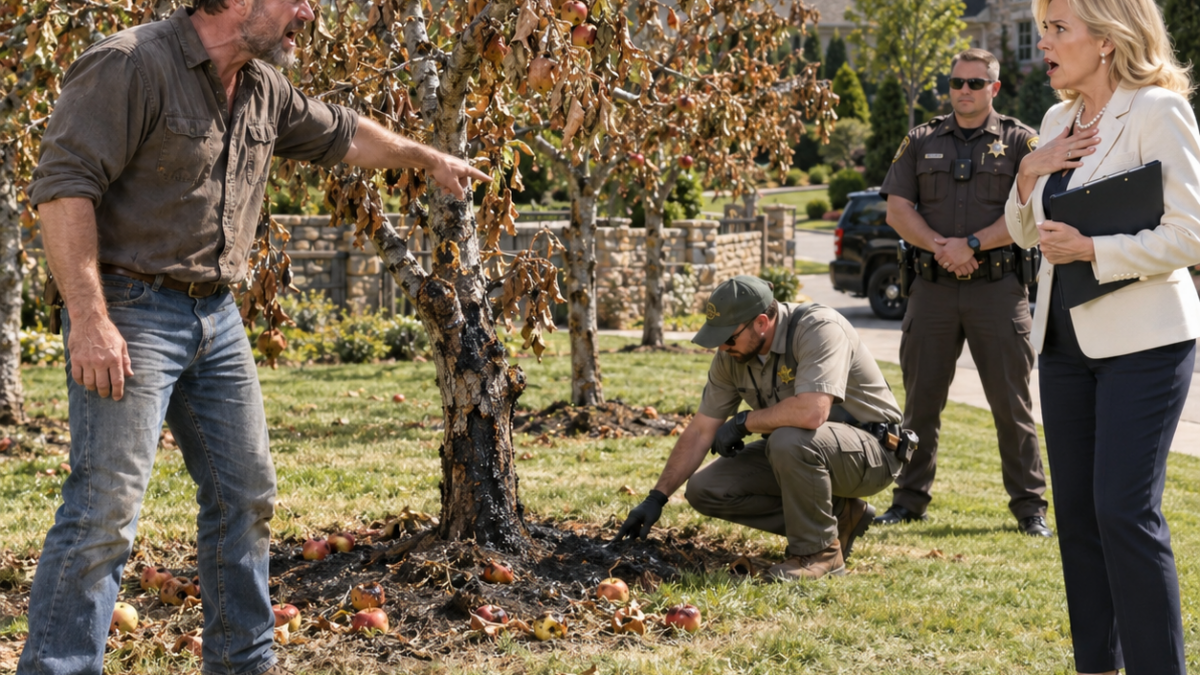
Karen stood beside my dying apple trees and told me they belonged to the HOA, as if repeating the lie confidently enough could somehow move my property line fifteen feet across the ground. All seven trees had been healthy the evening before, but by sunrise their leaves were curling yellow around the edges and a strange white chemical foam was seeping from the soil around their trunks. What she didn’t know was that those trees carried ten years of my family’s memories, and before that morning was over, I would discover that she had made a mistake far bigger than anything written in her little HOA rulebook.
“They’re community property, Sergeant,” Karen said, folding her arms while the humid morning air carried a harsh chemical odor through my backyard. “And frankly, they’ve been an eyesore for years.”
I stared at her for several seconds because my mind was struggling to reconcile the calm confidence in her voice with what was happening ten feet away. My oldest Gravenstein apple tree stood closest to us, its thick branches already sagging even though there had been no storm, no frost, no disease warning, nothing that explained why leaves that had been deep green twenty-four hours earlier now looked burned from the inside. Beyond it were six more heritage trees planted in a careful row, each a different cultivar I had spent years locating, grafting, pruning, protecting, and coaxing into maturity.
“They’re fifteen feet inside my survey line,” I said.
Karen waved one hand dismissively toward the narrow strip of HOA grass behind my fence. “There’s a community buffer.”
“No. There’s a five-foot common strip beyond my property.”
“That’s your interpretation.”
“It was surveyed by the county.”
She sighed as though I were a difficult employee wasting her morning. “The trees overhang community property. They drop fruit. Fruit attracts pests. We have received complaints.”
“From whom?”
“I am not required to disclose complainants.”
My eyes shifted toward her patio. Behind a decorative pink flamingo sat a large garden sprayer, poorly hidden beside a hedge. A hose was still looped around the handle.
I smelled the air again.
Chemical.
Sharp.
Wrong.
“What did you put around my trees?”
Karen’s expression changed for the first time.
Barely.
But I saw it.
“What are you talking about?”
“That foam isn’t fertilizer.”
“I wouldn’t know.”
“You were out here this morning.”
“I inspect the common areas regularly.”
“This isn’t common area.”
“There you go again.”
My hands started to tighten, and for a few seconds I could hear an old platoon sergeant in the back of my mind telling me the same thing he’d told us before every high-pressure operation: slow down enough to think.
So I unclenched my fists.
My daughter Lily had helped plant the smallest of those trees when she was four. She had carried a plastic bucket barely half full of soil because anything heavier tipped her backward. Sarah had taken photographs while Lily patted dirt around the roots with both hands and announced that someday she was going to make the first apple pie.
That little tree was six years old now.
Its leaves were dying with the others.
I looked at Karen.
“You entered my property.”
“I serviced the community buffer.”
“You poisoned my trees.”
Her face hardened.
“Watch your accusations.”
“What was in the sprayer?”
“That is none of your business.”
“It became my business when it ended up in my soil.”
Karen lifted her chin. “Mr. Davidson, I am the president of Lakeside Meadows, and I will not stand here being interrogated because you are upset about some old fruit trees.”
“Heritage fruit trees.”
“Trees.”
“They’re mine.”
“That’s debatable.”
“No, Karen. That’s measurable.”
That irritated her.
She adjusted the sleeve of her pink tracksuit and turned toward her house.
“You’ll receive formal notice regarding the landscaping violation.”
I almost thought I’d misheard her.
“You’re fining me?”
“If necessary.”
“For trees you just damaged?”
“You have no proof anyone damaged anything.”
Then she walked away.
I didn’t follow.
I took out my phone instead.
Photographs first.
Every trunk.
Every patch of foam.
Every leaf.
The survey stakes.
The distance to the actual property line.
Then video.
By noon, Arthur Henderson, the most respected arborist in three counties, was kneeling beside my Gravenstein wearing gloves and collecting soil into sterile containers.
He worked silently for nearly twenty minutes before finally looking at me.
“Jack.”
Something in his voice turned my stomach.
“How bad?”
“I don’t know yet.”
He held up the sample.
“But this isn’t ordinary weed killer.”
“What is it?”
“Lab will tell us.”
He stood, looking down the row of seven sick trees.
“Whatever somebody put here was meant to kill something and keep it dead.”
Behind us, my six-year-old daughter had come outside holding Sarah’s hand.
Lily looked at the tree she had helped me plant.
“Daddy?”
I turned.
“Yeah, sweetheart?”
Her eyes filled.
“Can you give them medicine?”
I couldn’t answer immediately.
Arthur could.
He removed his hat and looked at the trees.
“We’re going to find out exactly what happened.”
A week later, his laboratory package arrived.
I opened the first report.
Then the second.
And finally an appraisal with seven separate valuations.
At the bottom of the last page was one number printed in bold.
I stared at it three times before calling my wife into the room.
Because Karen thought she had killed seven ordinary trees.
The expert said she had destroyed **$420,000 worth of property**.
PART 2
Sarah stood behind my chair with one hand resting on my shoulder while I read the number again, because four hundred twenty thousand dollars attached to seven apple trees looked less like an appraisal and more like an accounting error. Arthur Henderson’s name and certification number appeared at the bottom of the document, however, and the twenty pages before that number explained exactly how he’d reached it: species rarity, mature trunk diameter, health before the incident, landscape contribution, replacement impossibility, years required to establish comparable specimens, and the accepted appraisal methodology he used when mature trees were destroyed in property disputes.
“Four hundred and twenty thousand?” Sarah whispered.
“That’s what it says.”
“For the trees?”
“For the trees.”
She pulled the report toward herself. “Jack, that’s more than we paid for our first house.”
“I know.”
She sat beside me, still reading. “Are these numbers real?”
“Arthur wouldn’t put his license behind them otherwise.”
The Gravenstein, my largest tree, had been valued at sixty-five thousand dollars. The Black Oxford, smaller but far rarer, came in at sixty thousand. Ashmead’s Kernel, Hudson’s Golden Gem, Spitzenburg, Roxbury Russet, and the young Esopus Spitzenburg graft I’d spent years babying accounted for the rest. Arthur had described several as “functionally irreplaceable at comparable maturity,” which meant I could buy another tree with the same cultivar name, but I couldn’t buy back the ten years that had turned a thin nursery whip into a productive living structure shading half my backyard.
The money felt obscene until I looked through the photographs Arthur had included. There was Lily at four years old standing beside the youngest tree with dirt across her cheeks. There was Sarah holding baskets of apples during the first good harvest. There was a photograph of me beside the Gravenstein with three men from my old engineering unit who had visited one autumn, two of whom were no longer alive. Suddenly I understood what Arthur had meant when he called the trees “high-value landscape assets.” Their monetary value could be calculated, but what made losing them painful existed outside a spreadsheet.
The lab report was worse.
The chemical Arthur collected from the soil wasn’t an ordinary residential herbicide. According to the analysis, it contained a powerful soil-sterilizing compound typically associated with industrial vegetation control, the sort of product used where someone wanted growth suppressed for years rather than weeks. Arthur’s written opinion stated that the concentration around the tree roots was consistent with deliberate direct application, not wind drift, accidental overspray, or runoff from another property.
The recommendation made Sarah put the document down.
“Excavation?”
I nodded.
“How much?”
“Potentially the whole root-zone corridor.”
“Where Lily plays?”
“Yes.”
Sarah looked through the window toward the backyard, and I could see the exact moment this stopped being about trees for her.
“She put that around our daughter?”
“She put it in our soil.”
Sarah’s jaw tightened. “That’s what I meant.”
I understood.
A dead tree was property damage. Poisoned soil beside the place your child played was something more intimate.
That afternoon I called Arthur.
“Tell me the truth,” I said. “Can any of them survive?”
There was a pause long enough that I already knew the answer.
“The smallest one might push some growth from above the graft for a while,” he said. “But with what I’m seeing in the root zone, I’d consider all seven fatally compromised.”
I looked through my office window. The leaves had continued deteriorating during the week we waited for testing. Green had become yellow, yellow had turned brown, and entire branches now hung limp against the August sky.
“So they’re dead.”
“They’re dying.”
“Same destination.”
“I’m sorry, Jack.”
“How certain are you about the appraisal?”
Arthur’s tone changed. “Very.”
“I need something that’ll stand up in court.”
“What I sent you is exactly that.”
“And the chemical?”
“Same answer.”
“Could somebody argue it was accidental?”
“Anybody can argue anything. The pattern will hurt them. Seven separate trees, chemical concentrated around every root zone, and very little contamination between the trees. Whoever did this wasn’t broadcasting weeds. They targeted trunks.”
A cold feeling moved through me.
“Seven targets.”
“Yes.”
“Individually.”
“Yes.”
Arthur lowered his voice. “You told me you suspected somebody.”
“I do.”
“Then don’t confront her again.”
“She already admitted being in the buffer area.”
“That’s not an admission of poisoning.”
“I know.”
“You’re a smart man, Jack. Be boring now.”
I smiled despite myself. “Boring?”
“Photographs. Samples. surveys. lawyers. Very boring.”
“That advice sounds expensive.”
“Less expensive than doing something angry.”
He was right.
When I hung up, I pulled the sealed plat survey from our closing documents and spread it across my desk. Karen’s claim about a community buffer was not just wrong; it was embarrassingly wrong. The HOA owned a five-foot maintenance strip beyond my rear boundary. My fence sat approximately on the line, and each tree trunk was between fourteen and sixteen feet inside my property. There was no easement allowing landscape maintenance. No shared-use designation. No ambiguous wedge of land.
The trees were mine.
The poisoned soil was mine.
Whatever Karen had believed didn’t change those facts.
As if summoned by arrogance itself, my printer woke up.
The official HOA email account had sent a PDF notice.
I opened it.
VIOLATION NOTICE.
Two hundred dollars for unapproved landscaping.
One hundred dollars for “failure to remove unsightly biological debris.”
I actually laughed.
Sarah appeared in the doorway.
“What’s funny?”
I handed her the paper.
She read it.
Then read it again.
“She poisoned the trees and fined us because they’re dying?”
“Apparently.”
“I don’t know whether that’s evil or stupid.”
“Sometimes those two travel together.”
Karen had signed at the bottom.
Karen Miller
President
Lakeside Meadows Homeowners Association
I placed that page in a new file folder.
On the tab I wrote one word:
KAREN.
Then I called David Chen.
David had served as a JAG attorney before moving into private litigation. We had met years earlier through a veteran housing project, and while we weren’t close friends, I knew enough about him to understand that he disliked people who relied on intimidation more than law.
His paralegal asked for the nature of my matter.
“HOA president entered my property and destroyed seven mature trees with a restricted herbicide.”
There was a pause.
“Estimated damages?”
“Four hundred twenty thousand for the trees, remediation not included.”
Another pause.
“Can you hold Wednesday at ten?”
“I can hold today.”
She laughed.
“Wednesday.”
David’s office occupied the second floor of a brick building downtown. Nothing about it screamed expensive lawyer. No marble lobby. No sculpture. Just clean furniture, organized files, and a receptionist who seemed capable of managing a military airlift without raising her voice.
David entered carrying coffee.
“Jack.”
“David.”
He looked at the document case beside my chair.
“You brought homework.”
“I brought everything.”
“Good answer.”
For the next forty minutes, I told him the story without embellishment.
Property line.
Seven heritage apple trees.
Karen’s claim that they were common property.
Sprayer beside her house.
Visible chemical foam.
Arborist.
Lab results.
Valuation.
HOA fine.
David barely reacted until I handed him Arthur’s report.
He read the first page.
Turned several more.
Stopped at the lab analysis.
Then the valuation.
His eyebrows rose.
“Four hundred twenty thousand.”
“Yes.”
“These are mature?”
“Ten years.”
“And rare cultivars.”
“Several.”
He returned to the laboratory section.
“This chemical is nasty.”
“Arthur says the soil may need excavation.”
“How much land?”
“Approximately ten feet by fifty, maybe more depending on migration.”
He leaned back.
“Any cameras?”
“Not mine.”
“Neighbors?”
“Possibly.”
“Witnesses?”
“Not yet.”
“Did Karen explicitly admit applying anything?”
“No. She admitted being in what she called the buffer zone. She refused to tell me what was in her sprayer.”
“Good.”
“Good?”
“Good that you didn’t embellish the answer.”
David closed the report.
“Here’s where you are. Strong evidence of intentional property damage. Strong survey evidence. Strong valuation. Strong evidence that the HOA president is retaliating through association enforcement. What we don’t yet have is direct proof placing the chemical in her hand when it went onto your land.”
“I saw the sprayer.”
“That helps. Not enough by itself.”
“What about her claiming authority?”
“Shows motive and potentially state of mind.”
He tapped Karen’s violation notice.
“This is useful.”
“I figured.”
“Extremely useful.”
“She fined me because the trees she poisoned looked messy.”
“You said that. I didn’t.”
“Right.”
David smiled faintly.
“You learn quickly.”
He spread the survey beside the violation notice.
“If this goes where I think it goes, Karen’s first defense will be authority. She’ll say she reasonably believed the trees were within HOA-controlled land or affected common property.”
“The survey destroys that.”
“Yes, assuming the governing documents don’t contain some bizarre easement you haven’t shown me.”
“They don’t.”
“I’ll verify.”
He turned to the appraisal.
“Second defense will be value. Nobody wants to believe apple trees can be worth sixty thousand apiece.”
“I didn’t.”
“Which is why Arthur needs to defend the methodology, not just the number.”
“He can.”
“Good.”
“Third?”
“She’ll say she didn’t apply the chemical.”
“That one bothers me.”
“It should.”
David folded his hands.
“Don’t sue tomorrow.”
I frowned.
“You think we wait?”
“We preserve evidence, put everyone on notice, investigate, and give her an opportunity to explain herself.”
“Why?”
“Because arrogance becomes more expensive when somebody is warned.”
That sounded familiar.
“What do we send?”
“A demand to preserve all relevant evidence and a notice of claim. Separate from a settlement demand.”
“Against the HOA?”
“Against Karen individually and the association to the extent it authorized, ratified, paid for, or participated.”
“I don’t want my neighbors paying for what she did.”
“Then let’s find out who did what before deciding who should pay.”
That answer mattered.
I wasn’t interested in financially punishing two hundred households because one woman had crossed my property line.
David spent the next two days examining governing documents.
He confirmed what I already knew.
The HOA common strip ended at my boundary.
No landscape easement extended fifteen feet inward.
No buffer existed on my property.
The board could regulate certain visible plantings because we were technically within the HOA, but it could not enter private property and destroy them without following enforcement procedures.
And even its regulation of mature trees was narrower than Karen had suggested.
Then David called.
“I’ve drafted the first letter.”
“How ugly?”
“Professionally ugly.”
The preservation notice went to Karen and every board member.
It instructed them to retain emails, text messages, herbicide purchase records, contractor communications, landscape committee records, meeting minutes, enforcement histories, photographs, security footage, and insurance correspondence.
The second letter laid out the claim.
Seven destroyed heritage apple trees.
Appraised loss: $420,000.
Preliminary soil remediation estimate: potentially $50,000 or more.
Additional claims reserved.
Thirty days to notify insurers and counsel.
Nobody was asked to write a check yet.
We wanted information.
Three days after the board members signed for their letters, Karen posted an emergency meeting notice.
Subject:
DEFENSE OF COMMUNITY AGAINST UNWARRANTED FINANCIAL AGGRESSION.
I read it at our kitchen table.
Sarah groaned.
“She made herself the victim.”
“Predictable.”
“She’ll tell everyone you’re suing them.”
“I haven’t sued anyone.”
“She won’t mention that.”
“No.”
“Are we going?”
I folded the notice.
“Absolutely.”
The night of the meeting, I brought a four-foot enlargement of the recorded survey.
Nothing else dramatic.
No uniform.
No medals.
No veteran hat.
Jeans.
Blue shirt.
The truth didn’t need costume design.
The clubhouse was packed.
Karen stood behind the podium with the other board members seated behind her.
George Patterson, treasurer.
Linda Marsh, vice president.
Paul Everett, secretary.
Denise Hall, architectural committee chair.
They looked uncomfortable before the meeting even began.
Karen did not.
She wore a cream blazer and the expression of someone preparing to save civilization.
“Thank you for coming,” she began.
Then she spent almost fifteen minutes telling my neighbors that our community was “under attack.”
She described a resident demanding nearly half a million dollars.
She described common-area trees.
Dangerous falling fruit.
Rodents.
Aesthetic concerns.
A man using “military intimidation” against a volunteer board.
That phrase almost made me laugh.
Then she said the sentence I had been waiting for.
“The trees were located within the community maintenance buffer.”
I stood.
Karen’s eyes locked onto me.
“Mr. Davidson, please sit down.”
“I’d like to correct that statement.”
“You’ll have homeowner comment time.”
“This doesn’t require comment.”
I lifted the survey.
“It requires a map.”
A few people laughed.
Karen banged the gavel.
“You are out of order.”
George leaned toward her.
“Let him show it.”
Karen turned.
“What?”
“If we’re potentially facing a claim based on property boundaries, I’d like to see the survey.”
That was the first crack.
Karen’s own treasurer wanted evidence.
I carried the map to an easel beside the podium.
“This is a certified plat recorded with the county.”
I pointed to the thick boundary line.
“The HOA common area is here.”
Then I pointed inward.
“My trees stood here.”
People leaned forward.
“Distance from the common strip to the nearest trunk: fourteen feet eight inches.”
Another tree.
“Fifteen feet three.”
Another.
“Sixteen feet.”
I looked at Karen.
“There is no ten-foot HOA buffer inside my property.”
She stared at the map.
“That survey could be outdated.”
“Recorded last year.”
“It may not reflect the covenants.”
“It reflects ownership.”
Karen looked toward her board.
Nobody rescued her.
I continued.
“I haven’t filed a lawsuit against this neighborhood.”
That got attention.
“What my attorney sent was notice of a property-damage claim and evidence-preservation demand.”
Karen interrupted.
“He’s demanding four hundred twenty thousand dollars.”
I looked at the residents.
“That number came from an independent certified arborist.”
I held up a one-page appraisal summary.
“Seven mature heritage apple trees.”
Someone called, “They’re apple trees.”
“Yes.”
Another person said, “How can seven apple trees be worth that?”
“That’s exactly what I asked.”
A few people laughed.
I continued.
“The appraisal considers maturity, size, species rarity, health, landscape placement, and replacement feasibility. You’re welcome to dispute the expert. I didn’t invent the calculation.”
George raised his hand.
“Can the board obtain a copy?”
“My lawyer already sent one.”
George turned toward Karen.
“Did we receive it?”
She hesitated.
“I received attorney correspondence.”
“That wasn’t my question.”
The room changed.
Karen felt it.
She banged the gavel.
“We are not conducting litigation strategy publicly.”
I rolled the survey up.
“Fair enough.”
Then I looked at the homeowners.
“One other fact. Those trees weren’t removed because they were old.”
Karen’s shoulders stiffened.
“They were chemically killed.”
Whispers.
I continued carefully.
“Independent laboratory testing found a potent soil-sterilizing herbicide concentrated around all seven root zones.”
The room went quiet.
Karen snapped, “That proves nothing.”
“I didn’t say who applied it.”
Her face betrayed her.
Just slightly.
But enough for me.
“Then why are you defensive?”
“Because you’re implying criminal conduct.”
“No. I’m describing a laboratory result.”
George looked at her.
“Karen, did the HOA apply herbicide?”
“No.”
“Did any contractor?”
“Not that I’m aware.”
I stored that answer.
The meeting ended ten minutes later.
Karen adjourned it abruptly after residents began asking questions she couldn’t control.
Sarah and I walked home slowly.
A woman named Maria Alvarez caught up to us.
“Jack.”
I turned.
She glanced over her shoulder.
“My son is a Marine.”
“Okay.”
“Last year he came home from deployment.”
Her voice tightened.
“We hung a banner across our garage. WELCOME HOME, DANIEL.”
I waited.
“Karen fined us because it was unapproved signage.”
I closed my eyes.
“For how long?”
“Three days.”
“How much?”
“Two hundred dollars.”
“Did you pay it?”
“Yes.”
“Why?”
Maria laughed without humor.
“Because I wanted to enjoy my son’s homecoming instead of spending it fighting the HOA.”
There it was again.
Normal people paid for peace.
Bullies counted that as consent.
“I have the letters,” Maria said.
“Keep them.”
“Why?”
“Because if Karen is using HOA authority to retaliate or intimidate people, records matter.”
Maria lowered her voice.
“I never liked how scared everyone was of her.”
“Then stop being scared.”
She looked at me.
“Easy for you to say.”
“No.”
I thought about Lily’s dead tree.
“Just necessary.”
Karen escalated immediately.
Violation notices arrived every few days.
Lawn too tall.
I photographed the grass beside a ruler.
Two and a half inches.
Violation dismissed only after I challenged it.
Trash bins visible too early.
Timestamped security footage showed them out within the allowed window.
Decorative border around Sarah’s flowerbed allegedly unapproved.
The border had existed before we bought the house and appeared in the HOA’s own resale inspection photographs.
Each envelope went into the Karen file.
David loved them.
“Please tell me she sent another.”
“She sent three.”
“You sound annoyed.”
“I am.”
“I sound delighted.”
“You are.”
“Because this establishes retaliation better than anything I could write in a complaint.”
Other neighbors noticed.
Frank Delaney came first.
Retired electrician.
Three houses down.
He found me beside the dying orchard.
“My grandkids put Christmas lights on our shrubs.”
“Sounds dangerous.”
He snorted.
“Karen fined me for excessive wattage.”
“How much?”
“One-fifty.”
“You pay?”
“Yep.”
“Why?”
“My wife was sick. Didn’t have energy.”
Same story.
Different house.
Susan Parker brought paperwork showing she’d been forced to repaint an entire exterior because Karen decided an approved beige was “too creamy.”
Six thousand dollars.
A young couple had been warned because their toddler’s plastic slide could be seen above a fence.
A widower had been threatened over a memorial bench beneath the oak tree where his wife used to read.
I didn’t go hunting for complaints.
They came to me.
That distinction mattered.
David told me to collect only facts people were willing to put in writing.
No gossip.
No “everybody knows.”
No anonymous rumors.
We used a local notary for signed statements where necessary.
Dates.
Notices.
Receipts.
Board responses.
The Karen file became a storage box.
Then Ben Wallace called me.
Ben lived across the street.
Software engineer.
Quiet.
The kind of man who could live beside you for five years and still apologize for waving too enthusiastically.
“I think I have something.”
“What kind of something?”
“Camera.”
My pulse changed.
“When?”
“Night before you found the trees.”
I was at his house in five minutes.
His doorbell system stored thirty days of footage in the cloud.
He had searched because the news about my trees bothered him.
Timestamp:
2:17 a.m.
Infrared image.
Karen’s front door opened.
A large figure stepped out wearing a robe.
Even in grainy night footage, I recognized her gait.
She carried a sprayer.
She crossed the road.
Disappeared beyond the edge of Ben’s camera toward my side yard.
Nine minutes later, she returned.
Sprayer in hand.
She placed it beside the hedge.
Right where I’d seen it that morning.
Ben paused the video.
Neither of us spoke.
Finally he said, “Is that enough?”
I stared at the screen.
“It’s enough to call David.”
Before leaving, I asked Ben to preserve the original file.
He downloaded it.
Then uploaded a second copy.
Then exported system logs showing the recording date and unedited status.
Software engineer.
I liked him more every minute.
David watched the clip three times.
Then he leaned back.
“Well.”
“Well?”
“This is the difference between suspicion and evidence.”
“It doesn’t show her spraying.”
“No.”
My satisfaction dimmed slightly.
“It shows her carrying a sprayer from her house toward your property at 2:17 a.m., then returning minutes later. Combined with residue, timing, your conversation, and later statements, it’s powerful circumstantial evidence.”
“Enough to sue?”
“We had enough to sue before.”
“Enough to win?”
“Lawyers who promise wins should sell lottery tickets.”
I glared.
He smiled.
“But I’d rather have this video than not have it.”
“Next move?”
“Purchase records.”
“How?”
“Discovery if necessary.”
“You think she bought the chemical herself?”
“Restricted products leave trails.”
David amended the demand.
This time the amount was explicit.
$420,000 tree loss.
$50,000 estimated remediation reserve.
Legal and expert costs.
Additional damages to be determined.
The letter went to Karen personally and the board through counsel.
Then something unexpected happened.
A journalist called David.
Her name was Sharon Price.
Investigative consumer reporter for a local station.
Someone had tipped her.
David asked if I wanted to talk.
“Will it hurt the case?”
“Not if you stick to verifiable facts and let me review what documents you provide.”
“What do you think?”
“Karen is trying to make you look like a greedy homeowner threatening the neighborhood.”
“So?”
“Transparency can help.”
Sarah hated the idea initially.
“I don’t want Lily on television.”
“She won’t be.”
“I don’t want our house becoming entertainment.”
“Neither do I.”
“Then why?”
I looked toward the orchard.
“Because Karen keeps using everyone else’s ignorance.”
Sarah thought.
“If we do it, no uniform.”
I smiled.
“You know me.”
“Exactly. No medals. No heroic veteran framing.”
“Agreed.”
The source story I was living didn’t need costume jewelry.
The trees were enough.
Sharon Price arrived with one cameraman.
She was shorter than I expected, direct, and extremely prepared.
“Show me the boundary first.”
Good question.
I unrolled the survey.
Then the trees.
Then Arthur’s report.
Then the laboratory analysis.
Then Karen’s notices.
Then neighbor statements.
Sharon read silently for almost twenty minutes.
When she reached the appraisal total, she looked up.
“Four hundred twenty thousand?”
“That’s the expert’s number.”
“Do you expect ordinary viewers to believe an apple tree is worth sixty grand?”
“No.”
That surprised her.
“Then explain.”
“I didn’t believe it either.”
I handed her Arthur’s methodology pages.
“Ask him.”
She did.
Arthur agreed to an interview.
He explained mature-tree valuation without drama.
“These aren’t grocery-store saplings,” he said on camera. “Some are rare cultivars and mature landscape specimens. You don’t replace ten years by planting a four-foot tree.”
Sharon interviewed Maria.
Frank.
Susan.
Ben.
Ben allowed the station to view his footage after David established conditions.
The station blurred Karen’s face in the first broadcast because no criminal charge existed, but anyone in Lakeside Meadows knew the robe, the gait, and the house.
Sharon asked Karen for comment.
Karen responded by email.
She had acted within her rights to protect community property.
That statement became devastating once Sharon displayed the certified survey.
The segment aired Tuesday at six.
I watched from our living room with Sarah.
Lily was upstairs doing homework.
The opening shot showed the dead orchard.
No uniform.
No medals.
Just seven dying trees.
Thank God.
Sharon’s narration was measured.
A property dispute.
An HOA president.
A veteran homeowner.
Rare heritage trees.
A certified survey.
A laboratory report.
A $420,000 valuation.
Multiple residents alleging aggressive enforcement.
Then Ben’s video.
A figure leaving Karen’s house at 2:17 a.m. with a sprayer.
Sarah reached for my hand.
“That’s worse on TV.”
“Yes.”
The segment ended with Sharon standing beside the property line.
“The question now is not whether these trees were on common property—the recorded survey appears clear that they were not—but who applied the chemical that killed them, and whether the HOA will be financially responsible for actions residents say were never authorized.”
That wording impressed David.
“She did her homework.”
My phone began ringing before the weather report.
Neighbors.
Old Army friends.
A cousin in Tennessee.
Someone posted the clip online.
Within twenty-four hours, larger sites had picked it up.
I hated the attention.
Karen hated it more.
The next event came from somewhere neither of us controlled.
Insurance.
Lakeside Meadows carried directors and officers liability coverage.
Two investigators from the carrier arrived at the clubhouse forty-eight hours after the story aired.
I wasn’t there.
George called me that evening.
His voice sounded ten years older.
“Jack.”
“George.”
“We’re in trouble.”
“Define trouble.”
“The insurance company.”
“What happened?”
“They interviewed the board.”
“And?”
“They asked Karen whether she personally applied herbicide.”
I sat down.
“What’d she say?”
“She said she acted as president to address a community hazard.”
The room around me seemed to get quieter.
“She admitted it?”
“Not in those words.”
“But close.”
“Very.”
George exhaled shakily.
“Jack, she told us she had a landscaping contractor handle the trees.”
“That wasn’t true.”
“No.”
“You believed her?”
“I didn’t ask enough questions.”
The shame in his voice sounded genuine.
“What did insurance say?”
“Reservation of rights.”
David had explained that phrase to me.
It meant the carrier would investigate and possibly provide a defense while preserving the right to deny coverage based on policy exclusions.
“Intentional misconduct?”
“Yes.”
“Criminal acts?”
“Yes.”
“Pollution exclusion?”
“That too.”
George lowered his voice.
“They showed us purchase records.”
I straightened.
“What purchase records?”
“She bought the herbicide.”
“Where?”
“A commercial supplier about fifty miles away.”
“How’d she buy restricted product?”
“Apparently she represented that it was for clearing rural fence line on property she managed.”
My stomach turned.
So much for uncertainty.
“When?”
“Two days before your trees died.”
I closed my eyes.
George continued.
“The investigators have the receipt.”
“Do they have footage?”
“Yes.”
“Survey?”
“Yes.”
“Lab?”
“Yes.”
“George.”
“Yeah?”
“Get your own lawyer.”
“We have HOA counsel.”
“No. You.”
Silence.
“Why?”
“Because if Karen did this personally and the carrier denies coverage, you need to know whether the rest of the board faces exposure.”
George’s breathing tightened.
“David’s demand names us.”
“It preserves claims against anyone responsible.”
“I didn’t poison your trees.”
“I know.”
“I didn’t authorize it.”
“Then document that.”
He was quiet.
Finally he said, “We’re removing her.”
“That is your business.”
“She lied to us.”
“That is definitely your business.”
An emergency removal meeting was called two days later.
This time Karen didn’t control the notice.
George did.
It cited the bylaws.
Removal of president and director for misconduct and actions exposing the association to substantial liability.
The clubhouse filled beyond capacity.
Karen sat alone at the main table.
The other four board members sat to the side.
Physical distance can say more than speeches.
George stood at the podium with a stack of documents.
He looked terrified.
But he began.
“I owe all of you an apology.”
The room went still.
“For too long, this board allowed too much authority to concentrate in one office.”
Karen’s face tightened.
George continued.
“I personally failed to ask questions I should have asked.”
That impressed me.
People forgive weakness faster when it stops pretending to be innocence.
George displayed the county survey.
“Fact one. Mr. Davidson’s trees were located on private property.”
He displayed Arthur’s lab report.
“Fact two. They were killed through application of a powerful herbicidal compound.”
Then the appraisal.
“Fact three. A certified expert has appraised the seven trees at a combined value of four hundred twenty thousand dollars.”
Gasps even from people who already knew.
George held up the insurance letter.
“Fact four. Our insurer has reserved the right to deny coverage for intentional or malicious conduct.”
Karen stood.
“This is defamatory.”
George looked at her.
“Sit down.”
The room inhaled.
I don’t think anyone had ever heard him talk to Karen that way.
“I will not sit down while you participate in this coup.”
“It isn’t a coup.”
“You’re trying to steal my position.”
“No.”
George’s voice shook.
“I’m trying to stop losing my retirement because you poisoned somebody’s apple trees.”
Nobody laughed.
Karen looked at the homeowners.
“He is greedy.”
She pointed toward me.
“He is asking you to pay nearly half a million dollars for fruit trees.”
I stood only because she addressed me.
“My attorney has repeatedly offered to separate individual wrongdoing from innocent homeowners.”
Karen sneered.
“Yet you’re suing the HOA.”
“I haven’t filed suit.”
That mattered.
Murmurs spread.
Karen looked confused.
I continued.
“You keep telling residents I’ve sued them. I haven’t.”
George nodded.
“That is correct.”
Karen turned on him.
“You’re helping him.”
“No.”
George held up a page.
“I’m reading the correspondence.”
Then came the insurance investigation summary.
The purchase.
The date.
The supplier affidavit.
Karen’s face changed.
It wasn’t dramatic.
Just drained.
George read only what counsel had cleared for the meeting.
“A purchase matching the chemical identified in the soil was made under Mrs. Miller’s name shortly before the damage occurred.”
A woman in the back said, “Oh my God.”
Karen shouted, “I bought weed control for the common strip.”
George pointed to the survey.
“The common strip is over here.”
Karen’s mouth opened.
Nothing came.
George proceeded to the vote.
Removal from presidency.
Removal from board.
Nearly every hand rose.
Some Karen loyalists abstained.
Only two homeowners voted against.
George announced the result.
“Motion carries.”
Karen sat perfectly still.
Then she stood.
She looked at me.
“I hope you’re happy.”
I answered quietly.
“No.”
That seemed to surprise her.
“I hope my daughter can someday eat an apple from our yard again.”
Karen grabbed her purse and left.
No cheering.
No applause.
Just the sound of the clubhouse door closing.
The legal negotiations began the next morning.
The new board’s attorney called David.
His first sentence reportedly was:
“We need to separate the association from Mrs. Miller’s intentional conduct.”
David’s answer:
“So do my clients.”
That changed everything.
I wasn’t interested in a special assessment bankrupting families because they happened to live under Karen’s reign.
David and HOA counsel reviewed every relevant board action.
There was no vote authorizing herbicide use.
No committee recommendation.
No contractor.
No written enforcement order.
Karen had acted alone.
The association was not completely blameless, however.
Board members had allowed her to dominate enforcement.
They had processed some retaliatory fines after receiving notice of our claim.
HOA counsel proposed settlement for the association’s limited role.
Karen remained separately liable for the primary property destruction.
Then her personal lawyer entered.
Karen had hired a bankruptcy and civil-defense attorney named Malcolm Reeves.
He requested mediation.
David called.
“She’s scared.”
“She should be.”
“Don’t enjoy that too much.”
“I don’t.”
“Good.”
“What’s she offering?”
“Nothing yet.”
“What does she want?”
“To avoid trial.”
“Same.”
That surprised David.
“You don’t want trial?”
“I want my land repaired.”
“And the trees?”
“They’re gone either way.”
“That’s unusually rational.”
“I’m old.”
“You’re fifty-eight.”
“Ancient.”
We commissioned a formal soil-remediation plan.
The number came in just above fifty thousand dollars.
Removal of contaminated soil.
Hazardous disposal.
Clean replacement loam.
Testing.
Drainage control.
Monitoring.
Total potential damages now exceeded $470,000 before attorney fees.
Karen’s attorney challenged the tree appraisal.
Predictably.
He hired his own expert.
That expert valued the trees lower.
Much lower.
David wasn’t concerned.
“That’s litigation.”
“Whose number wins?”
“Neither automatically.”
“Helpful.”
“A court weighs methodology.”
Arthur prepared a response explaining why ordinary nursery replacement pricing was inadequate for mature rare cultivars.
More reports.
More bills.
More paper.
Then David obtained full purchase documentation through counsel.
Karen had driven fifty-two miles to an agricultural supplier.
She told the vendor she managed a large rural property and needed industrial vegetation control along a fence line.
The employee had warned her about application restrictions.
The transaction record contained her signature.
Security footage from the store showed her loading the container into her SUV.
I watched only once.
It made me sadder than angry.
At 2:17 a.m., she crossed our street carrying the sprayer.
The sequence was complete.
Purchase.
Motive.
Opportunity.
Application evidence.
Afterward, retaliation.
Mediation was scheduled.
Karen and her husband, Michael, sat in another room.
I had barely met Michael.
He traveled frequently for work and had stayed almost invisible through Karen’s HOA years.
The mediator moved between us for hours.
First proposal:
$180,000 total.
David barely finished reading it.
“No.”
Second:
$250,000.
“No.”
Third:
$310,000 plus remediation.
I looked at David.
“That’s serious.”
“It is.”
“How much of the tree loss?”
“Two-sixty.”
I stared at the dead-orchard photographs on the table.
“This isn’t about squeezing her.”
“I know.”
“Then what’s fair?”
David leaned back.
“That isn’t purely legal.”
“What’s legally reasonable?”
“Our expert supports $420,000. Their expert disputes it. Trial creates risk. Strong evidence increases your leverage. But no outcome is guaranteed.”
I nodded.
“What does HOA contribute?”
“A separate amount covering limited governance failures, your improperly assessed fines, and a portion of fees. They don’t want it taken from homeowners through a large special assessment.”
“Neither do I.”
“George proposed using insurance-covered defense-resolution funds and reserves within statutory limits.”
“Good.”
“And Karen?”
“Personal assets.”
“What does that mean?”
“Potential refinance or home sale.”
I hated that more than I expected.
Not because I felt she deserved protection from consequences.
Because homes contain innocent people too.
“Michael?”
“Co-owner.”
“Did he know?”
“No evidence.”
David read my face.
“You can settle lower.”
“I know.”
“What do you want?”
I took a long breath.
“My land fixed completely.”
“Yes.”
“Every legal bill caused by this paid.”
“Yes.”
“HOA fines erased.”
“Yes.”
“Formal admission that the trees were on my property.”
“Easy.”
“And enough compensation for the trees that Karen doesn’t walk away believing they were worthless.”
David studied me.
“That last one is emotional.”
“Of course it is.”
“That’s allowed.”
The mediator returned.
Karen wanted to speak directly.
I agreed only with attorneys present.
She entered without the armor I’d associated with her.
No bright tracksuit.
No clipboard.
No HOA pin.
Gray cardigan.
Tired face.
She sat across from me.
For nearly a minute, nobody spoke.
Then she said, “I didn’t think they were worth that.”
I stared at her.
“Would fifty-dollar trees have been okay?”
“No.”
“Ten-dollar trees?”
“No.”
“Then their price wasn’t the problem.”
She looked down.
“I thought that area belonged to the HOA.”
“The survey was available.”
“I believed there was a buffer.”
“You didn’t poison a buffer.”
Her eyes lifted.
“You walked fifteen feet across my property and treated seven trunks individually.”
She didn’t answer.
“My daughter planted one of them.”
Her expression shifted.
“I didn’t know that.”
“You didn’t ask anything about them.”
“They dropped fruit.”
“So?”
“It made the back strip messy.”
“They were in my yard.”
“I know that now.”
That sentence angered me more than denial would have.
“You knew it before.”
She flinched.
“The property markers were visible.”
Silence.
“You’d been HOA president six years.”
Silence.
“You had the plats.”
She finally whispered, “Yes.”
David said nothing.
Neither did Karen’s lawyer.
I continued.
“Why?”
She looked at me.
“Why what?”
“Why did seven apple trees bother you enough to wake up at two in the morning?”
For the first time, shame appeared.
Not fear.
Not humiliation.
Shame.
“They made that side of the neighborhood look rural.”
I almost laughed.
“We live beside farmland.”
“I spent years trying to get Lakeside Meadows looking consistent.”
“Consistent.”
“Yes.”
“You poisoned living trees because they didn’t match beige houses.”
She rubbed both hands together.
“When you say it like that—”
“There’s no better way to say it.”
Her face reddened.
“I lost perspective.”
“You crossed my property line.”
“Yes.”
“You bought a chemical under false pretenses.”
Her lawyer shifted.
Karen closed her eyes.
“Yes.”
“You came onto my land in the middle of the night.”
“Yes.”
“You applied it to seven trees.”
Long pause.
“Yes.”
There it was.
Not sworn testimony.
Not a courtroom confession.
But the first honest conversation we’d had.
“Then you fined me.”
Karen looked genuinely ashamed now.
“I panicked.”
“Why?”
“Because you knew.”
“I knew my trees were dying.”
“You knew it was me.”
“I suspected.”
“And I thought if I established the trees were violations…”
She stopped.
“You could justify it afterward.”
“Yes.”
Sarah had chosen not to attend mediation.
I was suddenly glad.
Hearing Karen reduce our trees to a problem she could retroactively legalize would have hurt her.
I leaned back.
“This is the part you never understood.”
Karen waited.
“I wasn’t angry because you’re HOA president.”
“No?”
“I was angry because you treated something that wasn’t yours as if my ownership mattered less than your preference.”
She looked at the table.
“My entire career was built around boundaries.”
That was true.
Combat engineering.
Logistics.
Construction.
Survey lines.
Access lanes.
Safe zones.
Property.
Responsibilities.
“You decided a line didn’t matter because you wanted land on the other side of it.”
Karen swallowed.
“I was wrong.”
The words were quiet.
I had imagined them for months.
They felt surprisingly small.
“Yes.”
She looked at me.
“If I apologize, does it change anything?”
“No.”
Her face fell.
“But you should still apologize.”
“Why?”
“Because not everything valuable changes the settlement number.”
Karen nodded slowly.
Then she said it.
“I’m sorry.”
I didn’t tell her it was okay.
It wasn’t.
I simply said, “I heard you.”
She returned to her room.
Negotiations continued.
Final structure:
Karen would pay the overwhelming majority of compensation for the destroyed trees through personal funds and proceeds associated with the sale or refinancing of her property.
The HOA’s portion would cover only claims arising from its later enforcement failures, invalid fines, certain legal costs, and governance-related exposure.
Soil remediation would be fully funded.
All violation notices related to the orchard and retaliatory citations would be permanently rescinded.
The HOA would publish a formal correction acknowledging the seven trees were located on my privately owned lot and that no community buffer gave the association ownership or unilateral removal rights.
The aggregate settlement associated with the tree valuation reached the full $420,000 appraisal figure, with remediation and legal components addressed separately under the final agreement.
When David read the completed settlement to me, I felt no surge of victory.
Just relief.
“That’s it?” I asked.
“If everyone signs.”
“Karen?”
“Signed.”
“HOA?”
“Signed.”
“Insurance?”
“Where applicable.”
I stared at the signature pages.
“Then we’re done.”
“Legally, mostly.”
“What does mostly mean?”
“Don’t become friends with lawyers.”
The environmental crew arrived three weeks later.
That hurt more than any meeting.
Men wearing protective equipment marked a rectangular zone through our backyard.
The apple trees had to come down first.
Arthur insisted on being there.
So did Sarah.
Lily stayed with her grandmother.
I had told myself the trees were already dead.
That cutting them wouldn’t matter.
I was wrong.
The chainsaw started at eight thirteen.
The Gravenstein came down first.
Ten years of growth fell in less than ten seconds.
The sound of the trunk hitting the ground seemed to move through my chest.
Sarah cried openly.
I stood beside her.
Arthur removed his hat.
One by one, the seven trees fell.
The youngest was last.
Lily’s tree.
Its trunk was barely thick enough to justify a large saw.
When it dropped, Sarah turned into me and buried her face against my shoulder.
I held her.
“I’m sorry.”
“For what?”
“I should’ve protected them.”
She pulled back.
“From a woman sneaking into the yard at two in the morning?”
“I don’t know.”
“You were asleep.”
“I know.”
“Jack.”
She put both hands on my face.
“This isn’t your failure.”
I nodded.
But grief doesn’t always listen to logic.
After the trees were removed, excavation began.
The crew stripped contaminated soil along the entire orchard corridor.
Deeper around root balls.
Wider where testing suggested migration.
Truck after truck carried poisoned earth away.
Our backyard looked like a trench line.
Lily came home after the trees were gone.
She stood at the edge of the temporary barrier holding my hand.
“Are they all dead?”
“Yes.”
“Even mine?”
“Yes.”
Her lower lip trembled.
“Because of the bad medicine?”
I crouched beside her.
“Because somebody used something where they shouldn’t have.”
“Karen?”
Children don’t respect legal ambiguity.
I answered carefully.
“Yes.”
“Why?”
I looked toward Karen’s house.
“I think she cared too much about controlling how things looked.”
Lily thought about that.
“That’s dumb.”
I almost smiled.
“Yes.”
“Is she going to jail?”
“No.”
“Why?”
“This was handled through lawyers.”
She clearly found adults disappointing.
“Can we plant another one?”
I looked at the trench.
“Not until the soil is safe.”
“When?”
“When the people testing it say yes.”
She nodded.
“Then I want a sweet apple.”
“Not Gravenstein?”
“Those were sour.”
That was Lily.
Ten years of horticultural heartbreak reduced to fruit flavor.
The remediation took weeks.
Contaminated soil out.
Clean loam in.
Groundwater and drainage testing.
Barrier removal.
Retesting.
The final certification arrived in spring.
Safe for residential landscaping.
I carried the report outside.
The orchard corridor was bare soil.
Sarah joined me.
“What now?”
“I don’t know.”
For months, I’d assumed we’d replace the seven trees.
Try to reconstruct what Karen destroyed.
But standing on the clean soil, I realized I didn’t want replicas.
Those trees had belonged to a particular decade of our life.
Trying to rebuild them exactly would turn the yard into a museum of loss.
Sarah seemed to reach the same conclusion.
“What about a garden?”
“What kind?”
“Community.”
I looked at her.
“On our property?”
“You’ve spent a year telling everyone to respect boundaries. Put a gate in the fence.”
I laughed.
“I’m serious.”
“I know.”
“Raised beds. A path. Apples eventually. Vegetables. Neighbors can help.”
“HOA-approved vegetables?”
She gave me a look.
“Careful.”
Lily chose the first new tree.
Honeycrisp.
Common.
Easy to replace.
Exactly what I needed.
We bought a young sapling no taller than she was.
On planting day, George came.
Maria.
Frank.
Susan.
Ben.
Arthur Henderson.
Half the neighborhood eventually wandered over.
Nobody called the press.
Nobody posted a dramatic announcement.
We dug.
Filled raised beds.
Installed irrigation.
Laid gravel.
Painted a small sign.
The community garden remained legally ours, but neighbors could use assigned beds by invitation.
Boundaries and generosity weren’t opposites.
That became the lesson.
At the entrance, I installed a bronze plaque.
Sarah hated my first draft.
“Too angry.”
It had said:
RESPECT PROPERTY LINES.
“What do you suggest?”
She wrote:
**GOOD FENCES MAKE GOOD NEIGHBORS. GOOD NEIGHBORS KNOW WHEN TO OPEN THE GATE.**
I stared at it.
“That’s annoyingly better.”
“I know.”
We used hers.
George became interim HOA president after Karen’s removal.
He hated the job.
That was probably healthy.
The first board meeting under him lasted thirty-eight minutes.
No speeches.
No threats.
No gavel pounding.
He opened by saying, “Our primary goal is to become boring.”
People applauded.
The board reviewed years of enforcement files.
Some fines were valid.
Most were mundane.
A disturbing number appeared arbitrary or excessively aggressive.
George did not erase everything automatically.
He brought in outside management.
Created written appeals.
Required two-person review for significant fines.
No board officer could authorize entry onto a homeowner’s private lot for nonemergency work without documented legal authority.
That one received unanimous support.
Maria got her welcome-home-banner fine refunded.
Frank’s Christmas-light fine was reversed.
Susan’s paint dispute ended with reimbursement from a reserve set aside for prior improper enforcement.
The widower kept his memorial bench.
Children kept their slides.
No apocalypse followed.
Property values did not collapse because a plastic toy could be seen over a fence.
Karen listed her house.
That part of the source story circulated through the neighborhood with more drama than reality.
Some people said she was forced to sell.
Some said she and her husband had planned to downsize already.
What I knew was simple.
The settlement required substantial personal payment.
The house went on the market.
Months later, a moving truck appeared.
I was working in the garden when Karen walked outside carrying a cardboard box.
She saw me.
I saw her.
For several seconds neither of us moved.
Then she walked toward the property line.
Not across it.
That detail mattered.
“Jack.”
“Karen.”
She looked toward the garden.
“What did you plant?”
“Little bit of everything.”
“And one apple tree.”
“Honeycrisp.”
She almost smiled.
“I always liked those.”
I resisted the obvious response.
She looked older.
Not ruined.
Not broken.
Just tired.
“I suppose you’re happy I’m leaving.”
“No.”
She frowned.
“You don’t have to pretend.”
“I’m not.”
“You spent a year trying to destroy me.”
“No.”
She looked angry again.
“You hired lawyers. Went on television. Got me removed from the board.”
“You poisoned my trees.”
“I apologized.”
“And I heard you.”
“You got your money.”
“The land cost fifty thousand to repair.”
“I know.”
“You lied about the boundary.”
She looked away.
“I know.”
“You retaliated after I caught you.”
“I know.”
I softened my voice.
“Karen, accountability isn’t destruction.”
She laughed bitterly.
“Easy to say when you’re not the one selling your house.”
I understood why she felt that way.
But consequences don’t become unfair simply because they’re painful.
“I didn’t decide what your house was worth or how you financed the settlement.”
“No.”
“You did decide to cross the street.”
Her eyes met mine.
That ended the argument.
She looked toward the Honeycrisp.
“Do you really not hate me?”
I thought about it.
“No.”
She seemed surprised.
“I hated what you did.”
“Difference?”
“Big one.”
Karen nodded slowly.
The moving truck driver called her name.
She turned.
Then stopped.
“For what it’s worth, I am sorry about your daughter’s tree.”
That was the first apology that felt personal.
“Thank you.”
She walked away.
I never saw her again.
Lily’s Honeycrisp flowered the following spring.
Not much.
Five blossoms.
She photographed every one.
One eventually produced a tiny apple that dropped before summer.
Lily carried it into the kitchen like evidence in a murder trial.
“Dad.”
I inspected it.
“Premature fruit drop.”
“Is it sick?”
“No.”
“Did somebody poison it?”
“No.”
She looked relieved.
I hated that she had asked.
Children remember danger in strange ways.
So we installed a small camera near the garden.
Not aimed at neighbors.
Not to catch anyone.
Just enough to let Lily feel that the yard was watched.
By the second year, the Honeycrisp produced nine apples.
Lily counted them daily.
One morning there were eight.
She came running inside.
“Somebody stole one!”
I followed her outside.
A deer stood beyond the fence chewing suspiciously.
Lily pointed.
“Him!”
I laughed so hard I had to sit on the garden border.
She was furious.
“That’s stealing.”
“Technically.”
“Call the HOA.”
That nearly killed me.
Sarah heard and started laughing too.
We didn’t call the HOA.
We added a deer guard.
Life resumed.
That sounds simple.
It wasn’t.
For months after the settlement, I still woke sometimes thinking I smelled the chemical.
I would walk outside before sunrise and inspect the soil.
Nothing.
Check the camera.
Nothing.
Touch the Honeycrisp leaves.
Healthy.
Trauma doesn’t require gunfire.
Sometimes violation is enough.
Someone crossed a boundary while we slept and destroyed something we’d nurtured for a decade.
Part of me remained on guard afterward.
Arthur noticed during one visit.
“You know trees don’t like being stared at.”
“I’m monitoring.”
“You’re obsessing.”
“Difference?”
“Monitoring happens on schedule.”
I looked at him.
“And obsessing?”
“Every morning before coffee.”
He had me.
Arthur walked through the new garden.
Tomatoes.
Beans.
Herbs.
Three berry bushes.
Honeycrisp.
He touched the young trunk.
“Healthy.”
“Sure?”
“Yes.”
“Lab?”
“No.”
“Can we test?”
Arthur stared at me.
“Jack.”
“Fine.”
He sat on the garden bench.
“You going to plant heritage apples again?”
“I don’t know.”
“Why not?”
“Takes too long.”
He nodded.
“That’s exactly why you should.”
I understood.
“You sell trees now?”
“No.”
“You sound like it.”
He pointed toward an empty corner.
“I know a nursery with a Black Oxford graft.”
My chest tightened.
“No.”
“Didn’t say plant seven.”
“No.”
“One.”
“I said no.”
Arthur stood.
“Okay.”
Two weeks later, Sarah drove home with a Black Oxford sapling in the back of her SUV.
I stared at it.
“You conspired with Arthur.”
“Yes.”
“Against your husband.”
“Yes.”
“Unacceptable.”
“Dig.”
We planted it fifteen feet from the Honeycrisp.
The same distance from the property line as the old orchard.
I measured twice.
Sarah watched.
“You’re unbelievable.”
“I like precision.”
“You like spite.”
“Precision with emotional benefits.”
She laughed.
The Black Oxford grew slowly.
That’s what those trees do.
Slowly became meaningful.
Karen’s destruction had happened in one night.
Restoration took years.
That asymmetry once frustrated me.
Eventually I appreciated it.
Destruction is often fast because it requires very little imagination.
Building requires patience.
The community garden expanded.
George gave up the presidency after eighteen months.
Maria replaced him.
Her first meeting included a proposed rule about vegetable trellises visible from common areas.
She stared at the proposal.
Then at the resident who submitted it.
“Is there a safety problem?”
“No.”
“Drainage?”
“No.”
“Property damage?”
“No.”
“What problem are we solving?”
The resident said, “They look messy.”
Maria folded the paper.
“Motion denied.”
Someone asked whether she could do that.
She grinned.
“Fine. Motion to discuss whether tomatoes offend community aesthetics.”
The room laughed.
No rule passed.
I wasn’t at that meeting.
I heard about it from George.
“Progress,” he said.
“Revolutionary.”
The $420,000 figure followed me longer than I expected.
People heard it and imagined I had somehow won the lottery.
I hadn’t.
Large portions went into the settlement structure, experts, legal expenses covered under the agreement, restoration planning, tax advice, replacement property considerations, and future landscape investment.
More importantly, the number was compensation for something destroyed.
People forget that.
Receiving money after loss is not the same as receiving a gift.
If someone totals a truck and insurance pays you, you don’t suddenly have a free truck.
You had a truck.
Then someone destroyed it.
Money approximates restoration.
It doesn’t reverse time.
I would have traded the settlement for one more autumn with all seven trees loaded with fruit.
I’d have traded it to watch Lily complain about sour Gravensteins again.
I’d have traded it for the afternoon my old unit friends sat beneath those branches drinking coffee.
But legal systems can’t manufacture ten-year-old trees.
They use numbers because numbers are the only language available when time cannot be returned.
One afternoon Ben stopped by.
He carried a hard drive.
“What’s this?”
“Original footage archive.”
“You still have it?”
“Of course.”
“Why?”
“In case appeals or insurance issues came up.”
“Everything’s closed.”
“That’s why I’m giving it to you.”
I held the drive.
“I don’t want it.”
He smiled.
“Neither do I.”
“What am I supposed to do with it?”
“Destroy it.”
That surprised me.
“You’re serious?”
“Jack, you backed it up fourteen times.”
“Twelve.”
“That’s not better.”
He nodded toward the garden.
“You don’t need video of Karen walking across the street at 2:17 in the morning for the rest of your life.”
He was right.
That evening, Sarah and I deleted our unnecessary duplicates.
Not legal records we were required to retain.
Not settlement documents.
Just personal copies we’d accumulated out of fear.
The clip had once been power.
Now it was weight.
I kept one archived copy with David’s office as required.
Everything else went.
The next morning I woke before coffee.
Walked outside.
Stopped.
Arthur’s rule came back.
Monitoring happens on schedule.
Obsessing happens before coffee.
I turned around.
Went inside.
Made coffee first.
Sarah noticed.
“Breakthrough?”
“Don’t make it weird.”
She smiled.
The Black Oxford took five years to produce a proper crop.
Five years.
By then Lily was a teenager.
She barely remembered planting the Honeycrisp.
She definitely remembered losing the old orchard.
On harvest day, she stood beneath the Black Oxford holding one dark red apple.
“This one’s ugly.”
“They’re supposed to look like that.”
“Why would anyone grow ugly apples?”
“Taste it.”
She bit.
Chewed.
Her eyebrows rose.
“Okay.”
“Okay what?”
“It’s good.”
“Respect heritage.”
“Calm down, Dad.”
She took another bite.
I looked at the tree.
Not the same tree.
Never would be.
But the cultivar survived.
History does that sometimes.
Not unchanged.
Continued.
Arthur had retired by then.
I drove two apples to his house.
He opened the door wearing slippers.
“You finally got fruit.”
“How’d you know?”
“Sarah sent me pictures.”
“Everyone betrays me.”
He took an apple.
Turned it in his hand.
“Beautiful.”
“Lily called it ugly.”
“She’s wrong.”
“She’ll survive.”
Arthur looked at me.
“You ever calculate what this one’s worth?”
“No.”
“Good.”
I laughed.
We sat on his porch.
He asked about Karen.
“No idea.”
“The HOA?”
“Boring.”
“Best kind.”
“The garden?”
“Too many zucchini.”
“No such thing.”
“Take six.”
I left with fewer apples and no zucchini, because Arthur was smarter than he looked.
That night, I stood by the original orchard line.
Honeycrisp on one side.
Black Oxford on the other.
Raised beds between them.
Children from three nearby homes tending tomatoes.
Maria’s husband repairing irrigation.
Frank arguing with George over compost.
Nothing about the scene looked like a battlefield.
That made it a success.
I thought back to Karen saying, “Those aren’t your trees.”
Such a small sentence.
Wrong in every possible way.
Legally wrong.
Factually wrong.
Morally wrong.
She believed authority could redefine ownership.
That title could override a survey.
That community interest meant whatever she decided it meant.
The actual lesson wasn’t that HOAs are evil.
The new HOA proved that.
Shared governance can be useful.
Pools need budgets.
Common areas need maintenance.
Storm drains need inspection.
Neighbors sometimes genuinely create nuisances that require rules.
The problem comes when authority stops asking, “What do the rules permit?” and starts asking, “How can the rules justify what I already want?”
Karen had decided the trees should disappear.
Everything after that became justification.
Common property.
Buffer zone.
Vermin.
Aesthetic harmony.
Safety.
Whatever language moved her closer to the outcome she’d already chosen.
Facts became obstacles.
The property line didn’t matter.
My ownership didn’t matter.
My daughter’s connection didn’t matter.
The trees’ history didn’t matter.
Only her preference.
That’s not governance.
That’s domination wearing paperwork.
The most satisfying moment of the entire story happened years later, and it had nothing to do with Karen.
Lakeside Meadows held a harvest dinner in the common park.
The community garden contributed vegetables.
Maria brought tamales.
George brought a pie he absolutely did not bake despite claiming otherwise.
Frank grilled.
Ben set up lights.
Kids ran everywhere.
Lily brought a basket containing apples from both our Honeycrisp and Black Oxford.
She sliced them at a table and labeled them with handwritten cards.
HONEYCRISP — SWEET.
BLACK OXFORD — UGLY BUT GOOD.
I changed the second sign.
She changed it back.
Around sunset, George stood beside me.
“Look at this.”
“What?”
“All these people.”
“Yes.”
“No one fighting.”
“Give Frank another beer.”
“I heard that,” Frank shouted.
George smiled.
“Remember the emergency meeting?”
“Unfortunately.”
“Remember Karen saying you were going to destroy the community?”
“Yes.”
He gestured toward the park.
“Turns out transparency didn’t kill us.”
“Shocking.”
“Neither did welcome-home banners.”
“Dangerous precedent.”
“Nor Christmas lights.”
“The horror.”
“Nor apple trees.”
I looked toward Lily’s table.
“No.”
George became serious.
“I should have stopped her sooner.”
We’d had versions of that conversation before.
“You didn’t poison the trees.”
“I enabled the climate.”
“That part is yours.”
He nodded.
“I know.”
“But you changed.”
“I had motivation.”
“Your retirement account?”
“Powerful civic inspiration.”
I laughed.
He looked toward the garden gate.
“That plaque was the right choice.”
GOOD FENCES MAKE GOOD NEIGHBORS. GOOD NEIGHBORS KNOW WHEN TO OPEN THE GATE.
“Sarah wrote it.”
“Of course she did.”
“Why of course?”
“You would’ve installed something that sounded like a warning sign.”
He knew me too well.
Later that evening, families carried chairs home.
Children chased lightning bugs.
Lily stayed behind helping clean.
The community park bordered the same common strip Karen had once claimed extended through my orchard.
I stood at the property line.
The survey marker remained visible.
A small metal cap in the ground.
Unremarkable.
Absolutely important.
Lines are strange things.
Some divide.
Some protect.
A property line doesn’t mean you hate the person on the other side.
It means both people know where responsibility begins and ends.
Healthy boundaries make generosity possible because generosity given freely is different from something taken.
Our community garden existed because we chose to share access.
Karen’s “buffer zone” existed because she wanted to take control.
One was invitation.
The other was trespass.
That difference ended up costing $420,000.
But even that isn’t quite accurate.
The money wasn’t the real cost.
Karen lost her position.
Her home in Lakeside Meadows.
Her standing with people who once trusted her.
Years of relationships.
Peace.
My family lost seven living things we’d spent a decade growing.
Time.
Shade.
Harvests.
Memories attached to physical places.
The neighborhood lost trust.
All because one person could not tolerate a row of apple trees she couldn’t control.
Everyone paid something.
That’s why I resist calling it revenge now.
At the height of the fight, revenge sounded satisfying.
I wanted her exposed.
Removed.
Financially responsible.
I wanted the consequences big enough that she could never shrug and say, “They’re just trees.”
And consequences came.
But once they did, I realized revenge has a limit.
If your goal remains the other person’s suffering after the harm has stopped, you’re still letting them organize your life.
I wanted to organize mine around something else.
Sarah.
Lily.
The garden.
Apples.
Neighbors.
Ordinary afternoons.
So that is what we did.
The year Lily left for college, she asked for a cutting from the Black Oxford.
“You suddenly respect ugly apples?”
“I want one someday.”
“Where?”
“Wherever I end up.”
My throat tightened.
“You know grafting isn’t as simple as sticking a branch in dirt.”
“I know.”
“I can teach you.”
“That’s why I’m asking.”
We spent a Saturday together taking scion wood.
Labeling it.
Wrapping it properly.
I showed her how to store it until grafting season.
She rolled her eyes through half my lecture but recorded the important parts on her phone.
Before leaving for school, she stood beside the Honeycrisp she’d chosen as a child.
“Dad.”
“Yeah?”
“I’m glad you fought.”
I looked at her.
“For the settlement?”
“No.”
“For the trees?”
“Kind of.”
“What then?”
She shrugged.
“I think if you had let her do that and nobody said anything, I would’ve grown up thinking people with titles can just take stuff.”
That hit harder than anything a lawyer had ever said.
“And now?”
“Now I know they can try.”
I laughed.
“That’s your lesson?”
“And you need evidence.”
“That’s my girl.”
She hugged me.
A week later we drove her to college.
The house became quieter.
Sarah and I adjusted.
The garden continued.
The trees grew.
Lakeside Meadows forgot Karen gradually.
New families moved in who had never met her.
Some heard the story.
Most only knew fragments.
One teenager asked me whether it was true the old HOA president “went to prison for killing an orchard.”
“No.”
He looked disappointed.
“Internet said she did.”
“The internet likes drama.”
“Did she really owe four hundred thousand?”
“Settlement reflected a tree appraisal of four hundred twenty thousand plus other costs.”
His eyes widened.
“For apples?”
“For destroying property.”
“That’s insane.”
“Which part?”
“All of it.”
“Correct.”
He walked away satisfied.
I was too.
Truth was dramatic enough.
Years after everything, I found the original HOA violation Karen emailed the morning after the poisoning.
Two hundred dollars for unapproved landscaping.
One hundred for biological debris.
I had stored it in a folder with the survey and settlement.
I showed Sarah.
“Keep or shred?”
She read it.
Then smiled.
“Shred.”
“Historical document.”
“Trash.”
“Could go in the archive.”
“What archive?”
“My Karen archive.”
She stared at me.
“You still have a Karen archive?”
I realized how ridiculous that sounded.
“No.”
“You literally just called it that.”
“Temporary nomenclature.”
“Shred it.”
I shredded it.
Then the next.
And another.
We retained the final legal documents required for records.
Everything else disappeared.
That evening I carried the shredded paper to recycling.
The symbolism was obvious enough that I almost hated it.
Then I saw Lily’s old plastic watering can hanging in the shed.
The one she’d used planting the first tree.
Small.
Faded purple.
Cracked handle.
I kept that.
Some history deserved space.
Other history had already taken enough.
The Black Oxford now stands almost as tall as the old orchard’s smallest tree was when Karen poisoned it.
The Honeycrisp is larger.
Every spring their blossoms open within days of each other.
Bees move between them.
In late summer, deer still attempt theft.
Sarah still complains when fallen apples attract wasps.
I still prune more aggressively than Arthur would approve.
Life.
Messy.
Unapproved.
Beautiful.
Sometimes I imagine what Karen would think if she drove through Lakeside Meadows today.
Raised vegetable beds visible near my fence.
A community garden.
Children carrying watering cans.
Two apple trees growing exactly where she wanted none.
Welcome-home banners occasionally hanging on garages.
Frank’s excessive Christmas lights visible from space.
George’s grandkids leaving bikes in his driveway.
Not chaos.
Not decline.
Just human beings living around one another.
Maybe she’d hate it.
Maybe she’d understand.
I genuinely don’t know.
And I no longer need to know.
The cleanest victory is reaching the point where your peace doesn’t require your opponent’s regret.
Mine doesn’t.
On the tenth anniversary of the poisoning, if you can believe I counted, Sarah brought three glasses of cider into the backyard.
Lily had come home for the weekend.
She was engaged.
That fact still seemed impossible.
We sat beside the community garden after sunset.
Lily pointed toward the Black Oxford.
“I want scions next winter.”
“For your place?”
“If we get the house.”
Her fiancé wanted acreage.
Smart man.
“Absolutely.”
Sarah looked at the trees.
“You know what’s strange?”
“What?”
“I can’t picture the old orchard clearly anymore.”
I could.
But not perfectly.
Memory had softened details.
Which branch reached toward the fence.
Which trunk had the deepest scar.
Where exactly Lily’s first tree stood.
For years I would have considered forgetting a betrayal.
Now it felt merciful.
“That’s okay,” I said.
Sarah nodded.
“I know.”
Lily looked between us.
“I remember mine.”
“The original?”
“Yeah.”
“You were six when it died.”
“I remember Dad checking the leaves every five minutes.”
“I did not.”
“You absolutely did.”
Sarah laughed.
Lily continued.
“And I remember asking if medicine would fix it.”
I looked at her.
“You remember that?”
“Yes.”
“Sorry.”
“For what?”
“That you had to see it.”
She shrugged.
“I remember planting the new one better.”
That was it.
The ending I’d been trying to find without knowing I was looking.
Children remember what we rebuild too.
Maybe more than we think.
Karen poisoned seven trees.
For a long time, I believed the story was about what she destroyed.
It isn’t anymore.
It’s about what came after.
A survey line respected.
A board forced to confront what happens when oversight becomes surrender.
Neighbors learning that rules are supposed to protect a community, not provide weapons for whoever enjoys enforcing them.
A patch of poisoned soil excavated and replaced with clean earth.
A little girl choosing a common Honeycrisp because she cared more about sweetness than rarity.
A wife refusing to recreate what we’d lost and insisting we make something new instead.
A Black Oxford growing again because an old arborist and a stubborn woman conspired against my fear.
A community learning that boundaries and kindness can exist together.
And eventually a grown daughter asking for a branch so that one piece of our orchard could follow her into the next chapter of her life.
That’s worth more to me than $420,000.
The money had a purpose.
It forced people who had dismissed seven trees as an inconvenience to recognize the real scale of what had been taken.
It cleaned our soil.
Paid the experts.
Helped restore our property.
Held the person responsible accountable.
But money was never capable of replacing ten years.
Only time could do that.
So we gave the land time.
The soil recovered.
Trees rooted.
Neighbors changed.
Anger cooled.
Years accumulated.
One morning not long ago, I walked outside before sunrise and realized I hadn’t checked the property camera in weeks.
I hadn’t thought about herbicide.
Hadn’t wondered what somebody might do while we slept.
Hadn’t looked toward Karen’s old house.
The new owners had been there for years.
Nice couple.
Two dogs.
No clipboard.
I made coffee.
Went to the garden.
The Black Oxford had dropped an apple onto the gravel path.
I picked it up.
Polished it against my shirt.
Bit into it.
Sharp.
Sweet underneath.
Not perfect.
Exactly right.
Fifteen feet beyond me sat the property marker.
On the other side was the HOA common strip.
Five feet wide.
Exactly where the county survey had always said it was.
No imaginary buffer.
No disputed line.
Just a simple boundary in the earth.
Karen once thought crossing it made the land hers to control.
She learned otherwise at a price neither of us would have chosen if she’d simply respected it from the beginning.
I looked at the apple in my hand, then at the two trees catching the first light of morning.
The old orchard was gone.
The new one had started.
And after everything—the poison, the lawyers, the meetings, the cameras, the insurance investigation, the $420,000 settlement, the excavators tearing contaminated earth from my yard—the part that mattered most was almost laughably small.
A young tree had survived long enough to become an old one.
My daughter had grown up beside it.
And the land was ours again.








