PART 2: HOA Karen Paved Over My Family’s 1928 Cobblestone Driveway—Then the Restoration Bill Hit $190,000
PART 2
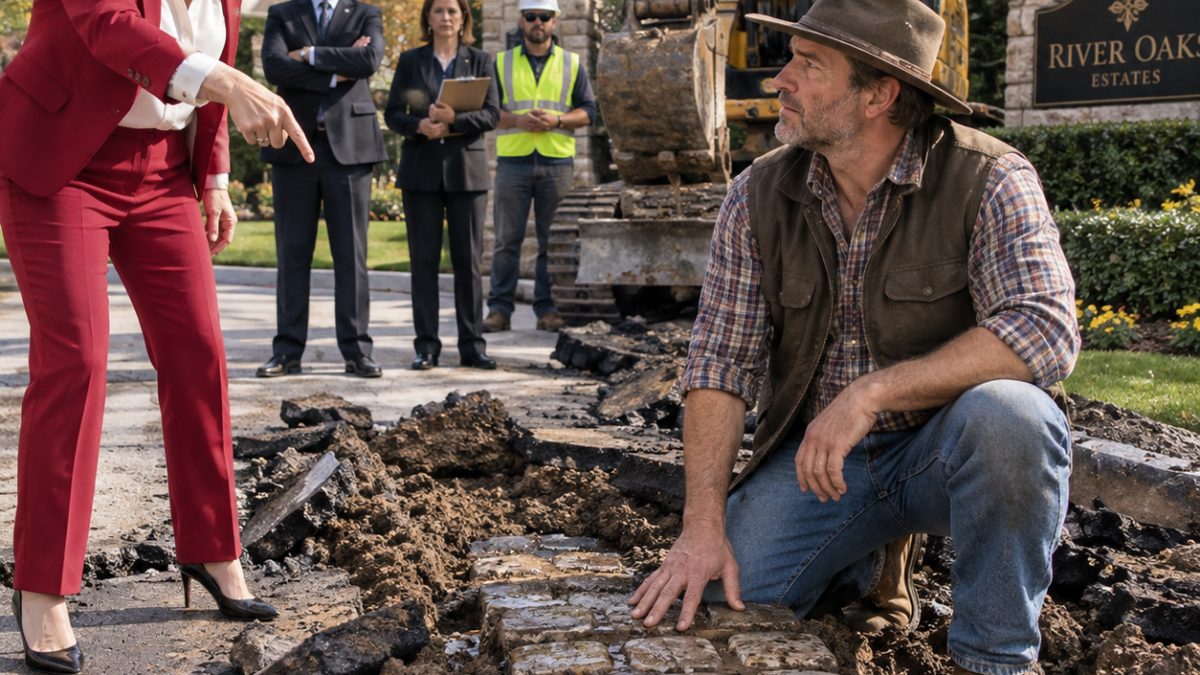
Dr. Alister Finch remained crouched in the driveway for another minute, turning the core sample between his fingers.
The black tack coat clinging to the granite looked like oil.
It made me sick.
“Can they be saved?” I asked.
He pushed his glasses higher on his nose.
“The stones? Probably.”
“Probably?”
“They’re granite. Your great-grandfather chose well. What worries me is what has been done around them.”
He pointed toward the hole he had drilled.
“A traditional drive like this works differently from modern pavement. The stones breathe. Water moves through the joints. The base shifts slightly with the seasons without destroying the surface. Somebody has now sealed the whole system beneath asphalt.”
I stared down the driveway.
A hundred feet.
Twelve feet wide.
Black from road to porch.
“What does that do?”
“Traps moisture for one thing. Contaminates the joint material for another.”
He scraped a little black residue with the tip of his tool.
“And whoever paved this used a petroleum tack coat.”
“They sprayed adhesive?”
“Essentially.”
“On the stones?”
“Yes.”
My jaw tightened.
He heard the change in my breathing.
“Mr. Thorne.”
“Marcus.”
“Marcus, getting angry won’t help the stones.”
“I know.”
And I did.
But knowing something and controlling your reaction to it aren’t the same thing.
For twenty years I had worked around explosives, heavy equipment, damaged roads, collapsed bridges, and men who had to keep thinking clearly when everything around them screamed urgency.
I knew the value of calm.
But this wasn’t a bridge.
This was home.
Dr. Finch stood and brushed grit from his pants.
“To restore this correctly, the asphalt would have to come off without damaging the historic surface beneath it. Then every stone would need to be lifted.”
“Every stone?”
“I’d estimate four to five thousand.”
I stared at him.
“Individually?”
“Yes.”
He continued before I could respond.
“They’d need to be cataloged so the original pattern could be reconstructed. The petroleum residue would have to be removed using a treatment safe for the granite. The contaminated bed beneath the stones would need excavation and replacement.”
He looked down the length of the drive.
“Then they would all be reset by hand.”
I knew enough about construction to understand labor.
A lot of labor.
“What are we talking about?”
“Until I prepare a formal scope, I can only estimate.”
“Estimate.”
He hesitated.
“Minimum?”
“Yes.”
“One hundred ninety thousand dollars.”
I thought I had misheard him.
“One-nine-zero?”
“Thousand.”
“For a driveway?”
“For a historic stone surface that somebody paved over without documentation, protection, or investigation.”
I sat down on the porch step.
One hundred ninety thousand dollars.
Dad had bought the house from Grandpa for less than half that.
I looked at the asphalt again.
Karen had called it a favor.
Dr. Finch sat beside me.
“I’m sorry.”
“My father died six months ago.”
He said nothing.
“He knew I was coming home after this deployment. In his last letter, he told me to take care of these stones.”
I rubbed my palms together.
“He used to say Giuseppe picked every one from the creek.”
“Family stories have a way of attaching themselves to objects.”
“These weren’t just objects.”
“I know.”
I looked at him.
“Can you write everything down?”
“Everything?”
“Damage. Restoration method. Estimated labor. Historical significance. What should have been done before anybody touched it.”
He nodded.
“I can prepare a full report.”
“I need something that will survive a lawyer reading it.”
A faint smile touched his face.
“That happens to be the kind of report preservationists enjoy writing.”
I almost smiled back.
Almost.
The HOA meeting was three days away.
By then I had Dr. Finch’s preliminary report.
I also had photographs.
The paving company name.
K&M Asphalt Services.
The crew’s license plate numbers.
My video of Karen admitting she had authorized the work.
The newsletter in which she had previously complained about what she called my “mud access lane.”
And Dad’s old photographs.
The one that mattered most showed my grandfather in 1954.
He was standing beside a Chevrolet, one foot on the running board, smiling like he owned the world.
Beneath him stretched the driveway.
The stones were clean then.
The pattern was obvious—curved bands of gray and reddish granite set by hand.
My great-grandfather’s work.
I put that photograph into Dad’s old leather briefcase.
Then I went to my first HOA meeting.
Oak Haven’s clubhouse was exactly what I expected.
Beige carpet.
Beige walls.
Artificial plants.
Thirty folding chairs occupied by people who looked as though they had learned not to enjoy meetings.
Karen sat in the center of the board table.
Gary Bennett, the treasurer, sat to her right.
Thin.
Nervous.
Glasses slipping down his nose.
Stan Whitcomb, the secretary, sat on the other side.
He looked bored enough to fall asleep.
Karen saw me enter.
Her expression hardened immediately.
I took a seat in the last row.
For twenty minutes they debated seasonal flowers.
Petunias.
Impatiens.
Mulch color.
The condition of two decorative shrubs near the pool.
Then Karen adjusted her papers.
“New business?”
I stood.
“I have some.”
Several heads turned.
Karen’s mouth tightened.
“Marcus, homeowners are asked to submit agenda items in advance.”
“You changed my property without submitting anything to me in advance.”
Someone in the second row coughed to hide a laugh.
I walked forward.
Placed Dad’s briefcase on the table.
Opened it.
Karen leaned back.
“What exactly are you doing?”
“Giving the association an opportunity to correct damage it caused.”
I placed the photograph of Grandpa’s driveway in front of her.
“This is 1210 Heritage Lane in 1954.”
Karen glanced at it.
Then away.
“The driveway you called dirt was constructed in 1928.”
“Marcus—”
“It consisted of locally sourced river cobbles laid by my great-grandfather.”
“Ancient history does not supersede community standards.”
A few people shifted in their chairs.
I took out Dr. Finch’s report.
“This is an assessment by Dr. Alister Finch from the state university’s historical preservation program.”
That got Gary’s attention.
Karen barely looked at it.
“Assessment of what?”
“The damage.”
“What damage?”
“The asphalt.”
Her eyes narrowed.
“That is not damage.”
“According to Dr. Finch, the work contaminated the historic surface, sealed the traditional base, and requires a full restoration.”
Karen laughed.
It was sharp and dismissive.
“A restoration.”
“Yes.”
“Marcus, you received a new paved driveway. Most homeowners would thank us.”
“You paved private historic property without permission.”
“Our authority—”
“Before we discuss authority, let’s discuss cost.”
I removed one more sheet.
Gary was staring at me now.
“The estimated restoration cost is one hundred ninety thousand dollars.”
Nobody moved.
Then somebody whispered, “Jesus.”
Gary’s face drained.
Stan sat upright.
Karen stared at me.
Then she laughed again.
“You’re insane.”
“No.”
“One hundred ninety thousand dollars?”
“That is the expert estimate.”
“For rocks?”
“For restoring the property you altered.”
“That is extortion.”
“No, Karen. It’s an invoice.”
I placed it in front of her.
“Thirty days.”
Her hands shook as she picked it up.
The room was completely silent.
“We are not paying this.”
“Then you should speak with counsel.”
“We have counsel.”
“Good.”
Her voice rose.
“You are not going to intimidate this board.”
“I’m not trying to.”
“You think because you wore a uniform you can come home and threaten volunteers?”
That landed differently than she expected.
Three people in the room looked down.
One older man shook his head.
I kept my voice level.
“I came home and found contractors on property I own. You personally authorized them to alter it without my permission.”
“The HOA has authority under Section Seven, Article B.”
“Then your lawyer can explain it to mine.”
Karen pushed the invoice back across the table.
“I’m not accepting this.”
I didn’t touch it.
“You already have.”
“What?”
“It’s addressed to the association. Consider tonight delivery.”
Her cheeks turned purple.
“You listen to me—”
“No.”
I closed the briefcase.
“Now you listen.”
I didn’t shout.
That made the room quieter.
“I’ve spent twenty years learning that before you put machinery on somebody else’s ground, you identify who owns it, what restrictions apply, and what you might destroy.”
I pointed at the photograph.
“You did none of those things.”
“That driveway was an eyesore.”
“It was mine.”
“You are part of this community.”
“Being someone’s neighbor does not transfer ownership.”
I stepped back.
“You have thirty days.”
Then I walked out.
I could hear Karen talking before the clubhouse door closed.
I couldn’t make out the words.
I didn’t need to.
I knew her type.
She would double down.
And for the first time in the entire fight, I was counting on it.
The following morning I called David Chen.
Dave and I had served together years earlier.
He was a JAG officer then.
The kind of lawyer soldiers trusted because he never tried to sound clever when clarity would do.
After retiring, he built a practice handling property disputes, administrative fights, veterans’ cases, and small organizations that had forgotten rules applied to them too.
I told him everything.
At the end, he was quiet.
Then came a low whistle.
“She paved over it?”
“Yes.”
“You were overseas?”
“Yes.”
“No written consent?”
“No.”
“And now the HOA says it had authority?”
“Yes.”
“What did your dad sign?”
“That’s what I need you to tell me.”
“Bring everything.”
His office was downtown above a credit union.
Law books on one wall.
Military photographs on another.
A dented helmet sat beside a framed law degree.
I put the files on his conference table.
He started with the HOA declaration.
Then bylaws.
Then deed.
Then Dr. Finch’s report.
Then photographs.
He barely spoke.
After forty minutes, he leaned back.
“Karen keeps citing Section Seven?”
“Article B.”
He found it.
Read it.
Then turned backward through the declaration.
“When was Oak Haven recorded?”
“Late eighties.”
“Your house?”
“Nineteen twenty-six.”
“Driveway?”
“Nineteen twenty-eight.”
“Your father owned it when they built the subdivision around him?”
“Yes.”
“Did he ever tell you he agreed to annex the parcel?”
“He paid dues.”
“That wasn’t my question.”
“No.”
Dave tapped the declaration.
“These covenants say they apply to properties within the recorded Oak Haven plat.”
“Okay.”
“Your address may not be in it.”
I stared.
“My father paid dues for thirty years.”
“People pay things they don’t legally owe all the time.”
“He attended meetings.”
“Voluntary membership and deed-based jurisdiction are not necessarily the same thing.”
“You’re saying we might not be part of the HOA?”
“I’m saying we need the plat and title history.”
He smiled slightly.
“If your parcel was excluded and there is no later annexation instrument, Karen may have paved property her organization had absolutely no authority over.”
I thought of Dad.
All those complaint letters.
All those times he trimmed something because the HOA asked.
All those checks.
“He thought he belonged.”
“Maybe he did socially. Maybe he bought amenities. Maybe somebody simply started billing him and he paid.”
Dave pushed the bylaws toward me.
“Look at this too.”
Article Four defined common areas.
Clubhouse.
Pool.
Green spaces.
Developer-installed infrastructure.
It excluded privately owned improvements predating the subdivision.
Including driveways not constructed by the developer.
I read it twice.
“So even if they had jurisdiction…”
“She still appears to have exceeded it.”
I sat back.
Dave’s expression changed.
He knew that look.
“What?”
“I’m trying to decide how angry I’m allowed to be.”
“As your lawyer?”
“Yes.”
“Very.”
That afternoon we went to county records.
I had spent enough of my life around plans and documents to enjoy archives.
Old paper has honesty to it.
Nobody can edit a bound book after the fact because the outcome became inconvenient.
A clerk named Ruth helped us locate Oak Haven’s 1988 recorded plat.
She rolled the oversized sheet across a table.
There was the subdivision.
Loops of streets.
Lots.
Common areas.
Drainage.
And at the western edge, one irregular rectangle.
1210 Heritage Lane.
My house.
Beside it were five words.
NOT A PART OF THIS PLAT.
I stared until Dave touched my shoulder.
“Marcus.”
“I see it.”
“We need certified copies.”
We traced the deed history.
Giuseppe.
My grandfather.
Dad.
Me.
No annexation.
No amended declaration.
No covenant acceptance attached to the title.
Nothing.
Dave finally sat back.
“She had no jurisdiction.”
I nodded.
“She had no jurisdiction.”
“And she has now put in writing that she intentionally acted under HOA authority.”
“Yes.”
“And I recorded her admitting she authorized it.”
His smile returned.
“Never interrupt somebody while they’re documenting your case.”
But something bothered me.
“If this goes straight to court, what happens to everyone else?”
“What do you mean?”
“I’m going to win the legal point. Maybe damages too.”
“Likely.”
“But the people living there will still have Karen.”
Dave leaned back.
“Now you’re thinking beyond your case.”
“I met some of them at that meeting. Nobody spoke.”
“They’re afraid.”
“Exactly.”
He studied me.
“What are you proposing?”
“I don’t know yet.”
“Marcus.”
“Something my father used to say.”
“What?”
“If one fence post is rotten, you replace the post. If the whole fence keeps falling, you inspect the line.”
Dave smiled.
“I assume this means you’re about to inspect the neighborhood.”
My first stop was next door.
Mark and Sarah Henderson had moved in five years earlier.
Two children.
A plastic slide in the backyard.
I had seen Karen arguing with Sarah before my final deployment.
I brought cookies.
My mother’s recipe.
Diplomacy had many forms.
Mark opened the door.
“Marcus.”
“Hope I’m not interrupting.”
His eyes drifted toward my black driveway.
“No.”
“I wanted to properly introduce myself.”
Sarah appeared behind him.
They invited me in.
We talked for ten minutes before I mentioned Karen.
Sarah immediately looked tired.
“She fined us over the kids’ slide.”
“How much?”
“One hundred.”
“Did she show you the rule?”
“She sent three notices.”
“That wasn’t my question.”
Sarah looked at Mark.
“No.”
“What did the notice say?”
“Visible play equipment inconsistent with neighborhood aesthetic harmony.”
I nearly laughed.
“And now?”
“We moved it behind the house,” Mark said. “No shade there, but it’s easier than fighting.”
“Why?”
Sarah answered.
“Because she makes your life miserable.”
I told them about the driveway.
They already knew Karen had paved it.
What they didn’t know was that I never agreed.
Sarah’s face changed.
“The email said you were receiving a community-funded improvement as a welcome-home project.”
“She told people I asked for it?”
“Not exactly.”
Mark fetched his phone.
The message described beautification work at “the Thorne residence” and praised the board for upgrading an unsafe, deteriorated entrance.
I forwarded it to myself.
Then I told them about Dr. Finch.
“One hundred ninety thousand?” Mark said.
“To restore it correctly.”
They both stared.
Then I told them the bigger discovery.
“My parcel isn’t in Oak Haven.”
“What?”
I explained the plat.
The title.
The lack of annexation.
Sarah slowly sat down.
“So she really had no right.”
“None that we’ve found.”
Mark looked toward the window.
“Are you suing?”
“Yes.”
“Good.”
I hadn’t expected how quickly he said it.
“You don’t seem conflicted.”
“You didn’t hear what she said to our daughter.”
Sarah looked down.
I waited.
“She told Lily that nice neighborhoods don’t leave toys where people can see them.”
“How old is Lily?”
“Six.”
That sentence did more to change the nature of my fight than the $190,000 estimate.
Karen had stopped seeing homes.
She saw violations.
I left with copies of the Henderson notices.
My next important ally found me before I found her.
Clara Mae Thompson was eighty-one and lived four houses away.
Her property stood out immediately.
Wrought-iron bluebird mailbox.
Rose garden.
Old porch swing.
Individuality everywhere.
I was walking past when she called from behind her roses.
“You’re John Thorne’s boy.”
I stopped.
“Marcus.”
“I know.”
She straightened.
“Welcome home.”
“Thank you.”
Then she looked toward my driveway.
“What that woman did is a sin against good taste.”
That was my introduction to Clara Mae.
“You remember the stones?”
“Son, I drank coffee with your mother while your father reset half those stones after the freeze of ’94.”
That hit me unexpectedly.
“You knew Dad well?”
“Thirty years.”
She put down her shears.
“He complained about that HOA every spring.”
“Did he know his property wasn’t part of it?”
Her eyes sharpened.
“You finally figured that out?”
I laughed.
For the first time in weeks, the sound came easily.
“You knew?”
“Of course.”
She pointed at her mailbox.
“Why do you think that monstrosity is still standing?”
“It’s not a monstrosity.”
“It is to Karen.”
She led me inside.
In a file cabinet were decades of letters.
Her husband Harold had been a real estate attorney.
When Oak Haven was created, the developer attempted to annex the Thompsons’ preexisting property.
Harold declined.
Years later, every new HOA board seemed to forget.
Every time, Clara Mae mailed them a copy of the 1989 letter.
Karen had tried three times.
The bluebird mailbox remained.
“Would you be willing to provide copies?”
“I’ll provide originals if it helps.”
“Copies are safer.”
She nodded approvingly.
“Army taught you something.”
“A few things.”
Then she became serious.
“This isn’t only about your stones.”
“I know.”
“No. You don’t yet.”
She began naming people.
Mr. Diaz.
Fined for vegetables in his front yard.
The Hendersons.
The Patels.
A couple whose red front door Karen disliked.
A widow cited over a memorial flag.
A family told to remove a welcome-home banner for their son returning from deployment.
By the time Clara Mae finished, my legal dispute looked like one entry in a much larger file.
“You want to help me?” she asked.
“I thought I came here asking you.”
“I’m old. I can ask whatever I want.”
I smiled.
“Yes.”
“Good. Tomorrow we start knocking on doors.”
Clara Mae knew everybody.
More importantly, everybody trusted Clara Mae.
Within a week my dining room table looked like an evidence room.
Violation notices.
Fine letters.
Rejected appeals.
Emails.
Photos.
Minutes.
Residents didn’t need convincing once they realized someone was listening.
They had been isolated for years.
That was Karen’s real power.
One person being told his vegetable plants were ugly feels petty.
Ten people comparing unsupported citations realize something else is happening.
I created a folder for each household.
I asked everyone the same questions.
What happened?
What rule did Karen cite?
Did you request a hearing?
Was the rule produced?
Did the full board vote?
Do you have copies?
Facts first.
Anger later.
Then the HOA’s lawyer sent his response to my $190,000 demand.
Dave opened it in front of me.
Cream paper.
Heavy letterhead.
Smith, Abernathy & Lyle.
Two pages.
He read silently.
Then smiled.
“What?”
“They did exactly what we hoped.”
The letter rejected the restoration demand as frivolous.
It claimed the HOA had clear authority under Section Seven, Article B.
The same provision Karen kept citing.
It described the paving as legitimate maintenance intended to protect property values.
And then came their settlement offer.
One year of waived HOA dues.
Value: six hundred dollars.
I looked at Dave.
He looked at me.
Then we both laughed.
It was ridiculous enough to be funny.
“Six hundred.”
“Against one hundred ninety thousand.”
“Generous.”
“Extremely.”
He put the letter down.
“More importantly, their lawyer just formally adopted the jurisdiction argument.”
“Without checking the title.”
“Apparently.”
“So now?”
“Now we answer.”
Dave’s response was thirty pages.
He started with the county plat.
NOT A PART OF THIS PLAT.
Certified title history.
No annexation.
Then the HOA bylaws.
Even if my parcel were covered, the maintenance provision excluded privately constructed pre-development driveways.
Then Dr. Finch’s report.
Photographs.
Core samples.
Restoration scope.
Estimated cost.
Then Clara Mae’s affidavit.
Thirty years of precedent involving another preexisting excluded parcel.
Then resident statements showing Karen repeatedly interpreted rules beyond their text.
I thought that was enough.
Dave didn’t.
He looked at the paving invoice information.
“K&M Asphalt.”
“Yes.”
“Do we know who owns it?”
“No.”
“I want to.”
Two days later he called.
“Marcus.”
“What?”
“Kevin Miller.”
“Who?”
“Owner of K&M Asphalt Services.”
The last name registered.
“You’re joking.”
“I wish.”
“Relation?”
“Karen’s brother-in-law.”
I went completely still.
Dave continued.
“Company incorporated six months ago.”
“You’re telling me the HOA president used association money to hire her husband’s brother to pave property the HOA didn’t own?”
“That appears to be what happened.”
“Was there bidding?”
“Don’t know.”
“Conflict disclosure?”
“Don’t know.”
“Board approval?”
“Don’t know.”
I remembered Gary’s face when I mentioned the restoration cost.
“Then we find out.”
Dave advised me not to accuse Karen publicly yet.
Evidence first.
I started with Gary.
His hands were shaking before he invited me inside.
“I can’t discuss board business.”
“You can discuss what you personally approved.”
“I don’t want trouble.”
“Neither do I.”
He laughed nervously.
“That’s not how this looks.”
“Gary, my attorney is preparing claims involving the association and possibly individual board conduct. I need one factual answer.”
He swallowed.
“Okay.”
“Did you vote to hire K&M Asphalt?”
He hesitated.
“No formal vote.”
“Did you receive an invoice?”
“No.”
“Did you approve eight thousand five hundred dollars?”
His eyes widened.
“How do you know the amount?”
“I didn’t.”
He realized what he had revealed.
I kept my voice calm.
“Tell me what happened.”
Gary sat down.
Karen had told him the driveway presented erosion problems.
She described it as urgent common-area maintenance.
According to Gary, she had authority to use a board debit card within certain maintenance categories.
“She said Stan had agreed.”
“Did she identify the contractor?”
“No.”
“Did she disclose a family relationship?”
“No.”
“Did you personally sign a check?”
“No.”
“Did you see bids?”
“No.”
“Did you vote?”
“No.”
He put his face in his hands.
“Oh God.”
“Gary.”
“She told us it was routine.”
“You need independent legal advice.”
“Am I going to lose my house?”
“I’m not here to threaten you.”
“But your lawyer—”
“If you were misled, tell the truth.”
Dave prepared an affidavit.
Gary reviewed it with counsel.
He signed.
Stan took longer.
He insisted he had approved the project because Karen emailed him and he replied, “Okay.”
“Did she tell you it was my private driveway?”
“She called it a boundary maintenance issue.”
“Did she tell you the contractor belonged to her brother-in-law?”
“No.”
“Cost?”
“No.”
“Competing bids?”
“No.”
“Did you review the agreement?”
“There wasn’t one.”
Eventually Stan signed a narrower affidavit.
No formal meeting.
No reviewed proposal.
No specific vendor approval.
No conflict disclosure.
Karen had made the decision.
Then came the bank records.
Once lawyers became involved, document requests started moving quickly.
The transaction sat there among ordinary expenses.
Pool chemicals.
Landscaping.
Electrical repair.
Then:
K&M ASPHALT SERVICES — $8,500.
The memo read:
COMMON AREA LANDSCAPING / EROSION CONTROL.
I looked at Dave.
“That wasn’t common area.”
“No.”
“There was no erosion emergency.”
“No.”
“And it wasn’t landscaping.”
“No.”
He turned to the corporate record confirming Kevin Miller owned the company.
“This is where your property case becomes a governance case.”
“And maybe worse.”
“Yes.”
The next emergency HOA meeting was announced within days.
The notice called my claim frivolous.
It warned residents that defending against me might require a special assessment.
Karen was going to ask the neighborhood to pay for her mistake.
Clara Mae read the notice at my kitchen table.
“She has nerve.”
“She has fear.”
“That too.”
Dr. Finch sat across from us.
Dave stood by the window.
“How do you want to handle the meeting?” he asked.
“I don’t want a screaming match.”
Clara Mae smiled.
“I’m disappointed.”
“I want residents to see documents.”
“They’ll see them,” Dave said.
“And I don’t want to look like I’m trying to bankrupt everybody.”
“You’re asking to be made whole.”
“I know what I’m asking. I also know who ultimately funds an HOA.”
Clara Mae tapped the table.
“Then remind them Karen spent their money first.”
That was important.
I had been so focused on the stones that I sometimes forgot the $8,500 hadn’t come from Karen.
It came from neighbors.
People who had trusted the board.
The clubhouse was standing room only.
Karen sat at the front.
Gary looked physically ill.
Stan kept staring at his phone.
I arrived with Dave.
Dr. Finch came carrying a laptop.
Clara Mae walked between us like she owned the building.
Perhaps spiritually she did.
Karen started with a speech.
Years of service.
Community standards.
Property values.
Then me.
“Mr. Marcus Thorne is demanding one hundred ninety thousand dollars from this association.”
Gasps.
“He claims the board destroyed an old driveway.”
Claims.
I felt my jaw tighten.
“He has retained expensive counsel and is attempting to exploit the association for personal gain.”
Dave touched my arm.
Don’t interrupt.
Karen continued.
“If his outrageous demand is pursued, every household could face a significant special assessment.”
There it was.
Fear.
“One thousand dollars or more per property.”
Voices rose.
Karen raised her hand.
“I understand. I understand. But this board acted in good faith.”
Clara Mae laughed out loud.
Every head turned.
Karen glared.
“Mrs. Thompson.”
“What?”
“Please refrain from disruptions.”
“You called that nonsense good faith. I thought you were telling a joke.”
Several people laughed.
Karen struck her gavel.
“We will proceed to the proposed assessment.”
I stood.
“Before anyone votes, they should understand why the money is being requested.”
“You are out of order.”
Clara Mae rose immediately.
“I move that Marcus Thorne and his counsel be given time to present information relevant to the proposed assessment.”
Karen stared.
“You cannot—”
A man near the aisle said, “Second.”
Karen’s face changed.
She looked at Gary.
He stared down.
“All in favor?” Clara Mae called.
“Aye.”
The room thundered.
Karen sat frozen.
Dave walked to the projector.
The first photograph appeared.
Grandpa.
His Chevrolet.
The cobblestones.
A murmur moved through the room.
Dave spoke calmly.
“This is the driveway that existed at 1210 Heritage Lane before the HOA ordered asphalt installed.”
Next image.
Black pavement.
“This is what exists now.”
Next.
County plat.
My parcel outlined.
Five words enlarged.
NOT A PART OF THIS PLAT.
People leaned forward.
“This recorded county document,” Dave said, “establishes something the board apparently failed to investigate before acting.”
He pointed.
“Mr. Thorne’s property was excluded from the original Oak Haven Estates subdivision.”
Somebody said, “What?”
Another voice:
“Then why does he pay dues?”
“Voluntary participation does not create deed restrictions by magic,” Dave said. “We have reviewed the chain of title and found no annexation instrument.”
He displayed the relevant deeds.
Then Clara Mae’s old correspondence.
Her exclusion.
The decades-old precedent.
Karen stood.
“This is legal trickery.”
Dave turned toward her.
“No. These are county land records.”
She sat.
Next slide.
The HOA’s own bylaws.
Private pre-development driveways excluded from common-area maintenance responsibility.
“So even if Mr. Thorne’s property had been subject to the declaration, the provision repeatedly cited by the president still did not authorize paving this driveway.”
Karen’s breathing was visible from across the room.
Then Dr. Finch spoke.
He showed core samples.
Photographs.
The tar coating.
The saturated bed beneath the stones.
He explained why the restoration required individual removal, cleaning, cataloging, foundation replacement, and hand resetting.
“Ninety-eight-year-old work was not resurfaced,” he said. “It was buried.”
He showed the estimate.
$190,000.
No one laughed.
Karen had called the number absurd.
Now people were reading line items.
Labor.
Removal.
Numbering.
Cleaning.
Historical reconstruction.
Stone setting.
Drainage correction.
Preservation oversight.
Then Dave changed slides.
Gary’s affidavit.
Gary closed his eyes.
“This sworn statement from the association treasurer says he never approved the specific expenditure, never reviewed a vendor contract, and was told the project was urgent common-area maintenance.”
Whispers spread.
Stan’s affidavit followed.
No formal vote.
No cost review.
No vendor disclosure.
Karen stood again.
“Those men are trying to save themselves.”
Dave looked at her.
“Yes.”
The answer caught everyone off guard.
“They are trying to save themselves by telling the truth about what happened.”
Next slide.
K&M Asphalt Services.
Corporate registration.
Owner: Kevin Miller.
The room went still.
Somebody knew the name immediately.
“Is that your brother-in-law?”
Karen said nothing.
“Karen?”
Still nothing.
Then the bank record appeared.
$8,500.
Reserve fund.
Common area landscaping and erosion control.
Dave’s voice hardened.
“Your association paid the president’s brother-in-law eight thousand five hundred dollars from reserve funds for work on property the association did not own.”
Nobody moved.
“The expenditure was recorded as common-area landscaping and erosion control.”
He let the words hang.
“There was no disclosed family relationship. No formal vendor selection process. No documented approval of this specific expense. And the property was not a common area.”
Karen finally found her voice.
“That is a malicious interpretation.”
From the back, Mark Henderson shouted:
“Did you pay your brother-in-law?”
Karen looked toward him.
“The company was qualified.”
“That wasn’t the question.”
Another resident stood.
“Did you tell the board he was family?”
Karen gripped the edge of the table.
“I was trying to improve this neighborhood.”
Clara Mae’s voice cut through the room.
“With our money?”
Karen pointed at me.
“This man is manipulating all of you!”
I stayed seated.
That mattered.
She wanted a fight between us.
Instead, she had the entire neighborhood asking questions.
Priya Patel stood.
“Did you tell us Marcus approved the project?”
“I said it was a community improvement.”
“Your email called it a welcome-home beautification project.”
“I never said he signed anything.”
“You implied he wanted it.”
Karen’s face reddened.
Mr. Diaz raised one of his violation notices.
“You fined me for tomatoes.”
Karen looked confused.
“What does that have to do with this?”
“Everything.”
He held up the paper.
“You said the board voted.”
He turned toward Gary.
“Did you?”
Gary shook his head.
The room erupted.
People stood.
Letters appeared.
Fine notices.
Emails.
Years of frustration.
The Hendersons.
The Patels.
Mr. Diaz.
A widow who had been cited for her flag.
The couple with the red door.
Karen hammered the gavel.
Nobody cared.
Her authority was gone.
Not weakened.
Gone.
I finally stood.
The room quieted slowly.
“I want everyone to understand something.”
People turned.
“I do not want your homes.”
I pointed toward the screen.
“I do not want to bankrupt this neighborhood.”
Karen laughed bitterly.
“You’re demanding almost two hundred thousand dollars!”
“Yes.”
I faced her.
“Because you caused almost two hundred thousand dollars of documented restoration work.”
Then I looked back at the residents.
“My father lived beside many of you for decades. My family was here before Oak Haven, and I expect we’ll be here long after this dispute ends.”
I took a breath.
“What I want is simple.”
I pointed toward Grandpa’s photograph.
“I want that back.”
Silence.
“And I want a board that can never again use your money to make private decisions without your knowledge.”
Karen shook her head.
“You’re destroying this community.”
“No.”
Clara Mae answered before I could.
“You mistook yourself for the community.”
Karen looked at her.
Clara Mae didn’t blink.
That sentence ended the meeting.
Not officially.
People kept shouting.
Karen eventually walked out.
Gary stayed behind.
Stan followed him.
Residents gathered around Dave.
Around Dr. Finch.
Around Clara Mae.
Around me.
But the presidency Karen had walked into that evening no longer existed by the time she walked out.
The following morning, Dave sent our full evidence package to the appropriate authorities for review.
He also notified the association’s insurance carrier.
Then the local investigative news station obtained the story.
I agreed to one interview.
One.
The reporter stood beside my ruined driveway.
“Why does this matter beyond the cost?” she asked.
I looked down at the pavement.
“Because money can be replaced.”
I pointed toward the house.
“My father died while I was overseas.”
The reporter became quiet.
“He left me a letter telling me to care for this driveway because his grandfather built it.”
I swallowed.
“Somebody saw dirt. My family saw four generations.”
That was the clip the station used.
Not the legal arguments.
Not Karen.
Not the $190,000.
Dad.
The story spread.
Power, Pavement, and a Family Legacy.
That was the station’s headline.
They interviewed Clara Mae too.
Her segment was devastating.
Karen’s years of letters.
The old exclusion document.
The bluebird mailbox.
The residents’ stories.
Then the $8,500 payment.
By evening, Karen’s phone stopped being her weapon.
It became her punishment.
Reporters called.
Residents called.
The board’s attorney called.
The insurer called.
Gary resigned.
Stan resigned the following day.
Both issued apologies.
Karen refused.
For almost a week she claimed she had done nothing wrong.
Then the insurance carrier issued a reservation-of-rights notice.
Intentional misconduct, undisclosed conflicts, or dishonest acts might not be covered.
That changed everything.
Karen had believed the HOA’s policy would absorb the risk.
Suddenly she faced the possibility that it wouldn’t.
The civil negotiations started quickly.
Her new attorney offered fifty thousand.
Dave read the proposal.
“Thoughts?”
“No.”
“Counter?”
“One ninety.”
“Plus expenses?”
“Yes.”
He smiled.
“They’ll call you unreasonable.”
“I didn’t establish the restoration price.”
“Good.”
The second offer was one hundred thousand.
No.
Then one hundred fifty.
No.
Clara Mae thought I should make them pay extra simply for annoying her.
Sarah Henderson disagreed.
“This should end with the stones restored.”
She was right.
My position stayed consistent.
Full restoration.
Professional fees.
Legal fees.
A written apology.
Governance reform negotiated separately with the new resident board.
I did not demand Karen’s house.
I did not demand the destruction of Oak Haven.
I did not demand punitive theatrics.
I wanted restoration.
The word mattered.
Eventually the call came.
“They accepted,” Dave said.
“All?”
“All.”
The settlement meeting was held in his conference room.
Karen arrived in a gray pantsuit.
No lavender.
No clipboard.
No confidence.
She looked exhausted.
For the first time, I saw the person beneath the role.
It did not erase what she had done.
But it changed what victory felt like.
She sat across from me.
Her lawyer reviewed the settlement.
Payment mechanism.
Escrow.
Restoration scope.
Fees.
Release.
No interference with the work.
Then the apology.
Karen stared at the page.
She looked at me.
“Do you really need this?”
“Yes.”
“You already won.”
“This isn’t about winning.”
“Then what is it about?”
I leaned forward.
“You told an entire neighborhood you did me a favor.”
She looked away.
“You told people my history was an eyesore.”
Silence.
“You used their money to bury it.”
Her eyes filled.
I continued.
“I want the record corrected by the same person who created the false one.”
She read the apology again.
It admitted she acted without proper authority.
It acknowledged that the paving occurred without my consent.
It acknowledged the financial burden her decision caused.
Then she signed.
Her hand shook.
When she pushed the document back, she whispered something.
“What?”
“I said I thought it looked better.”
For a second I thought she was defending herself again.
Then I realized she wasn’t.
She sounded almost confused.
“I really did.”
I nodded.
“I believe you.”
That made her look up.
“You do?”
“Yes.”
“Then why did you make this into—”
“Because believing something is better doesn’t give you the right to decide for somebody else.”
Her face crumpled slightly.
“I was trying to improve Oak Haven.”
“And somewhere along the way, you started believing Oak Haven belonged to you.”
Neither of us spoke after that.
The money went into escrow.
The restoration company arrived two weeks later.
Dr. Finch supervised.
The first morning, I stood near the porch watching a specialized milling machine shave off asphalt in controlled layers.
I hated the sound.
Every scrape reminded me how easily the whole thing could have been avoided.
But slowly, black disappeared.
Gray emerged.
Then reddish brown.
Then pale river stone.
The workers switched to hand tools near the historic surface.
Trowels.
Small pry bars.
Brushes.
The first intact cobble came free before noon.
The technician handed it to me.
Tar stained one side.
The rest was beautiful.
Smooth from water.
Heavy.
Real.
I turned it in my hands.
My great-grandfather had touched it.
Dad had driven across it.
Now it sat in my palms.
I didn’t realize Clara Mae was beside me until she spoke.
“You going to cry?”
“No.”
“Liar.”
I laughed.
Then wiped my eyes.
“Don’t tell anyone.”
“I’m eighty-one. Secrets cost extra.”
The restoration took months.
Every stone received a number.
Every original position went onto a grid.
Rows of labeled cobbles filled temporary racks across my yard.
Some needed more cleaning than others.
The tack coat had penetrated certain stones deeply.
The artisans tested solvents.
Brushed by hand.
Rinsed.
Repeated.
The black slowly disappeared.
Underneath were colors I had forgotten.
Charcoal.
Rust.
Cream.
Greenish gray.
Some stones carried tiny mineral streaks that caught the sun.
Watching them return was like watching family photographs develop.
Then one afternoon, a worker called.
“Mr. Thorne?”
I walked over.
He was kneeling near where the driveway met the porch.
A larger flat stone had just been lifted.
“Thought you should see this.”
He turned it.
Carved into the upper face were letters.
G.T.
Below them:
I stopped breathing for a second.
“Giuseppe Thorne.”
The worker nodded.
“Your great-grandfather?”
“Yes.”
I knelt.
The carved lines were shallow.
Simple.
Handmade.
I ran my fingers across them.
Dad had known.
That was why his letter said the stones remember.
Maybe he had never told me because he wanted me to discover it myself.
Maybe he assumed I already knew.
I didn’t.
For almost a century, that stone had sat near the porch.
Cars crossed it.
Children ran over it.
Rain washed it.
Snow covered it.
Dad stepped over it thousands of times.
Then Karen buried it.
And now it was back in the light.
Dr. Finch came over.
He removed his glasses.
“Well.”
His voice softened.
“That changes the significance somewhat.”
“To me it does.”
“To preservation documentation too.”
I laughed through the tightness in my throat.
“Please don’t tell me the bill goes up.”
He smiled.
“No. This one is on the house.”
We left Giuseppe’s stone aside until the end.
The old base had to be removed completely.
Contaminated material was excavated.
Drainage corrected.
A historically appropriate crushed-stone foundation installed.
Then resetting began.
One stone at a time.
Four thousand.
Then more.
The artisans worked from the grid.
Curves returned.
Borders reappeared.
The pattern moved outward from the porch like memory rebuilding itself.
Neighbors started walking over to watch.
Children asked questions.
Mark Henderson helped me bring drinks to the crew.
Priya brought lunch one Saturday.
Mr. Diaz gave everyone tomatoes from the front-yard garden Karen had once tried to eliminate.
Clara Mae supervised without permission.
“Too much gap there,” she told one mason.
The man looked at her.
“Ma’am, I’ve been setting stone for thirty-two years.”
“And I’ve been looking at this driveway for forty-five.”
He adjusted the stone.
Later he whispered to me:
“She was right.”
“I know.”
As the driveway came back, Oak Haven changed too.
The interim board was led by residents who wanted the job because someone had to do it, not because they enjoyed control.
That difference mattered.
Clara Mae refused the presidency.
“I survived eighty-one years without becoming stupid. Why ruin the streak?”
Mark Henderson became interim president.
Priya joined the architectural committee.
Gary resigned completely and cooperated with every financial review.
The new board ordered an independent audit.
They published expenditures online.
Vendor relationships required disclosure.
Competitive bids became mandatory above a set threshold.
No board member could vote on a contract involving family.
Rules had to be written.
No more “Karen said.”
No more hidden standards.
No more vague aesthetic harmony.
If somebody received a violation, the notice had to identify the exact governing provision.
An independent appeal panel was created.
The most ridiculous rules disappeared.
The Henderson kids moved their slide back under the shade tree.
Priya painted her front door the color she originally wanted.
Mr. Diaz expanded his vegetable garden.
Clara Mae’s bluebird mailbox remained untouched.
Oak Haven became less uniform.
It became more human.
Karen’s house went up for sale a month after the settlement.
I saw the sign during an evening walk.
For Sale.
For a moment, I felt the old satisfaction return.
Then I remembered her sitting in Dave’s office.
No clipboard.
No crowd.
Just a tired woman learning what uncontrolled authority had cost her.
Revenge is easy to imagine while you’re angry.
Reality is more complicated.
I wanted consequences.
She got them.
I didn’t need to enjoy watching her lose everything.
The criminal investigation continued separately.
The outcome was far less dramatic than neighbors had predicted.
Karen ultimately accepted responsibility for falsified association records tied to the expense. She received probation, community service, and restrictions that prevented her from returning to similar board leadership during the term imposed.
Her brother-in-law’s company faced its own licensing and permitting problems.
By then, I had stopped paying much attention.
My fight had never really been about putting Karen in a courtroom.
It was about getting Dad’s driveway back.
The restoration ended on a cool Saturday morning.
The artisans installed the final stones near the porch.
Giuseppe’s carved stone was last.
Dr. Finch asked me where I wanted it.
“Exactly where it was.”
They checked the grid.
Set the bed.
Lowered the stone carefully.
Tapped it until level.
Then brushed stone dust around the edges.
G.T.
Visible again.
I stood there a long time.
The final restoration invoice came in slightly higher than the estimate.
$193,450.
Escrow covered it.
Legal and expert expenses were covered separately under the settlement.
For months, the number $190,000 had represented anger.
By the time the work was finished, I barely thought about money.
I thought about survival.
The stones survived.
The neighborhood survived.
Even something valuable inside me survived.
That surprised me most.
I had come home carrying more than a duffel bag.
Twenty years of deployments.
Friends lost.
A father buried while I was overseas.
A home that felt familiar and strange at the same time.
I had expected returning home to be easy.
People think the hard part is leaving war behind.
Sometimes the hard part is discovering who you are when nobody needs you to be a soldier anymore.
The driveway gave me something to fight for.
At first, that worried me.
Maybe I had simply replaced one battlefield with another.
But restoration is different from combat.
Combat asks what must be defeated.
Restoration asks what deserves to be saved.
That difference changed me.
When everything was finished, I hosted a neighborhood barbecue.
Nothing formal.
No speeches planned.
No press.
Just folding tables, food, music, children running across stones nearly a century old.
The Henderson kids drew chalk pictures near the edge.
I almost stopped them.
Then I laughed at myself.
Giuseppe built a driveway.
Not a museum floor.
Let kids use it.
Mr. Diaz arrived with tomatoes.
Priya brought trays of food.
Mark manned the grill until he nearly burned everything.
Clara Mae sat on the porch swing with iced tea.
Dr. Finch came too.
He spent most of the afternoon giving unsolicited history lessons to anyone who stood still long enough.
Near sunset, I found Clara Mae alone on the porch.
She watched people laughing below.
“You did all right, son.”
“I had help.”
“You still did all right.”
She nodded toward Giuseppe’s stone.
“Your father showed me that once.”
I turned.
“He knew about the initials?”
“Of course.”
“Why didn’t he tell me?”
“He probably did.”
“No.”
She smiled.
“Your father told stories in pieces. He assumed you’d eventually put them together.”
I looked at the stone.
“His last letter said they remember who we are.”
Clara Mae became quiet.
“I know.”
“You saw the letter?”
“No.”
“He told Harold something similar years ago.”
“What?”
She looked toward the driveway.
“People think a house is the walls. Your father said a home is every mark people leave caring for it.”
My throat tightened.
“He missed you terribly.”
“I missed him too.”
“He was proud.”
I looked away.
Those words can break a man when they come from the right person.
Clara Mae put her hand on mine.
“He worried he wouldn’t live long enough to see you come home.”
I closed my eyes.
“He didn’t.”
“No.”
“But you came home anyway.”
I nodded.
The barbecue continued below us.
Children laughing.
Plates clattering.
Someone arguing about football.
Ordinary noise.
Good noise.
Clara Mae squeezed my hand.
“John would have liked this.”
I looked at the driveway.
“So would Giuseppe.”
“You know what Giuseppe would really say?”
“What?”
“He’d ask why you paid somebody almost two hundred thousand dollars to put back stones he laid himself.”
I burst out laughing.
Clara Mae joined me.
People turned to look.
For the first time since I had stepped out of the car and smelled hot asphalt, home felt like home again.
A few months later, a letter arrived from Karen.
No lawyer.
No HOA letterhead.
Just an envelope.
I considered throwing it away.
Instead, I opened it.
The letter was short.
She wrote that she had moved two counties away.
She didn’t ask forgiveness.
I respected that.
She said she had spent months being angry at me, the board, the residents, the lawyers, reporters, and everyone except herself.
Then one line stopped me.
I believed caring about something gave me the right to control it.
I read that twice.
She wrote that she had truly believed every improvement she imposed was making Oak Haven better.
Neater.
More valuable.
More respectable.
She had confused uniformity with community.
She had also confused being elected with being entitled.
At the end she wrote:
I am sorry about your father’s driveway. I know now that I didn’t pave over dirt. I paved over a story that wasn’t mine to rewrite.
I folded the letter.
Walked outside.
Stood on the stones.
For several minutes, I debated whether to answer.
Eventually I did.
Three sentences.
Thank you for writing.
The driveway has been restored.
I hope you build something better wherever you go next.
I never heard from her again.
That was enough.
Years have passed.
The stones are still there.
They aren’t perfect.
That is part of their beauty.
Some sit slightly higher than others.
Moss has returned to the shaded edges.
After heavy rain, the granite darkens until every color becomes richer.
In winter, frost appears between the joints.
Every spring I spend a weekend checking the surface.
Resetting anything loose.
Sweeping new stone dust into the gaps.
The same work Dad did.
The same work Grandpa did.
Probably the same work Giuseppe expected somebody to do after him.
Oak Haven is still an HOA.
That surprises people when they hear the story.
Some expect me to say we abolished it.
We didn’t.
The pool still needs maintenance.
Common landscaping still needs funding.
Drainage still needs managing.
Shared property still requires decisions.
The problem was never the existence of an association.
The problem was an association forgetting the difference between managing what belonged to everyone and controlling what belonged to individuals.
The new rules are simpler.
Meetings are less exciting.
That’s good.
People can appeal.
Financial records are accessible.
Contracts are reviewed.
Conflicts are disclosed.
Nobody gets to spend reserve money just because they carry the right title.
Mark eventually stepped down.
Priya became president for a term.
Clara Mae attended every meeting and frightened every president equally.
The bluebird mailbox remains.
She says she’ll leave it to the Smithsonian.
The Henderson kids are older now.
The plastic slide disappeared because they outgrew it, not because somebody ordered it removed.
Mr. Diaz still grows vegetables in front.
His tomatoes win an informal neighborhood contest every August.
And my driveway has become an odd little landmark.
New neighbors ask about it.
Why stones?
Why not pavement?
Who carved the initials?
I tell them.
Giuseppe came here with little money.
He built things.
A porch.
A shed.
A driveway.
He gathered river stones because he could get them himself.
He placed them by hand because hiring somebody cost money he didn’t have.
He never imagined preservation experts.
He never imagined an HOA.
He certainly never imagined his work would someday require a $193,450 restoration.
He was just trying to build something his family could use.
That is what heritage usually is.
Not monuments.
Not plaques.
Not museums.
Ordinary things somebody cared enough to make well.
A table.
A recipe.
A tool.
A row of trees.
A stone driveway.
Their value often becomes visible only when someone threatens to erase them.
Every once in a while, someone asks whether the revenge was worth it.
I don’t think of it as revenge anymore.
Yes, Karen paid.
Yes, she lost her position.
Yes, the investigation exposed conduct she had hidden.
Yes, she had to publicly admit what she did.
But if punishment had been my only goal, the ending would have felt empty.
The part that mattered was watching black asphalt come away inch by inch.
Seeing those first stones again.
Finding Giuseppe’s initials.
Watching neighbors who once whispered about Karen begin talking to each other openly.
Watching a little girl run across a driveway somebody had once called an eyesore.
That was the victory.
The afternoon Karen paved my driveway, she stood on my lawn convinced she was giving me something better.
Fresh asphalt.
Uniform appearance.
Higher property value.
She thought history was just old material standing in the way of improvement.
I learned something from her mistake.
Not everything old needs saving.
Not every tradition deserves protection.
But before you destroy something, you should understand what it means to the people whose lives are attached to it.
Karen never asked.
If she had knocked on my father’s door years earlier, he would have told her.
He might have taken her to the porch.
Shown her Giuseppe’s carved stone.
Explained how four generations had crossed that drive.
Maybe she would have understood.
Maybe not.
But she would at least have known what she was choosing to erase.
Instead, she saw an uneven surface.
She called it ugly.
She called it mud.
Then she buried it beneath asphalt and sent me a bill.
That decision cost more than $190,000.
It cost her position.
Her reputation.
Her neighbors’ trust.
And eventually her place in the community she claimed to love.
But something good came out of all of it.
The stones came back stronger.
The rules became clearer.
Neighbors became closer.
And I finally understood Dad’s last line.
Take care of the stones, son.
They remember who we are.
He wasn’t really asking me to protect granite.
He was asking me to protect continuity.
To remember Giuseppe.
Grandpa.
Him.
To understand that coming home meant accepting my place in a chain of people who built something, cared for it, and handed it forward.
One evening, long after the lawyers and reporters disappeared, I sat alone on the porch.
The sun was low.
The stones glowed warm in the light.
I could see Giuseppe’s initials from where I sat.
For a moment, I imagined Dad beside me.
He would have looked at the restored driveway.
Then at me.
He probably wouldn’t have said much.
That was his way.
Maybe he would have nodded.
Maybe he would have complained that the restoration crew charged too much.
Then he would have asked whether I remembered to sweep new stone dust into the joints before winter.
I laughed at the thought.
“Yeah, Dad,” I said quietly.
“I took care of them.”
The yard was silent.
No answer came.
I didn’t need one.
I looked down that old driveway, past the porch, toward Oak Haven’s newer houses and newer lives.
For almost a century, those stones had carried people home.
Giuseppe.
My grandfather.
Dad.
Me.
They had been buried.
But they had not disappeared.
Sometimes that is what inheritance really means.
Not receiving something untouched.
Receiving something damaged and deciding it is still worth restoring.
Karen thought she was covering up an ugly old road.
What she actually buried was proof that my family had been there long before her rules.
And when the asphalt finally came off, what returned wasn’t just a driveway.
It was my father’s voice.
My great-grandfather’s signature.
My neighbors’ courage.
And the feeling I had spent years overseas wondering whether I would ever know again.
Home.








