PART 2: HOA KAREN Parked Her Porsche Across My Driveway Every Morning — So I Took It Apart Piece by Piece
PART 2
Eleanor lifted the first sheet.
“Rule 14B,” she said, “prohibits automotive repair activity visible from common areas.”
I stared at her.
“My truck was halfway out of my garage for forty minutes.”
“Visible from the street.”
“On my driveway.”
“That isn’t relevant.”
A few people shifted in their chairs.
Eleanor picked up the next page.
“Your recycling container was visible Thursday afternoon.”
“Because Thursday is recycling day.”
“It remained visible after collection.”
“For about an hour.”
She smiled.
“Rules don’t stop applying because an owner finds them inconvenient.”
There it was.
The entire point.
She wasn’t even pretending anymore.
I looked around the clubhouse.
Most of the residents avoided my eyes.
Some clearly thought the whole thing was ridiculous, but nobody wanted to be Eleanor’s next project.
Then she held up a photograph of my front shutters.
“And finally, there appears to be uneven fading.”
I actually laughed.
Not loudly.
Just once.
“You photographed my shutters?”
“As HOA president, I have an obligation to protect property values.”
“Then maybe we can discuss the Porsche you’ve been parking beside my driveway every morning.”
The room went quiet.
Eleanor didn’t even blink.
“That is legal curbside parking.”
“It obstructs my access.”
“It does not block your driveway.”
“I have photographs.”
“So do I.”
She slid one across the table.
It showed her Porsche sitting beside my driveway with perhaps eighteen inches between her bumper and the beginning of the apron.
Technically clear.
Practically obnoxious.
“See?” she said. “Perfectly legal.”
Mr. Patterson, an eighty-year-old widower who lived two houses down, cleared his throat.
“I’ve seen it.”
Eleanor turned.
He shifted in his chair but continued.
“She parks there almost every morning. Marcus has a point.”
“Thank you, Harold,” Eleanor said in a tone suggesting the opposite. “But unless the board has appointed you parking enforcement, let’s stay on the agenda.”
Mr. Patterson looked down.
That bothered me more than her words.
I had known Harold nearly fifteen years.
He had survived Korea, a heart attack, and raising four children.
Eleanor could silence him with one look.
Mrs. Klein spoke next.
“Maybe she could just park in front of her own house.”
Eleanor’s head turned.
“Elaine, would you like us to discuss the complaint about the decorative trellis beside your side gate?”
Mrs. Klein’s mouth closed.
I looked from one face to another.
That was how Eleanor controlled people.
Not through authority.
Through inventory.
She knew everyone’s vulnerabilities.
Who had unapproved landscaping.
Who had fallen behind on an assessment.
Who had a teenager parking overnight in the wrong spot.
She kept tiny violations ready like bullets.
I collected my photographs.
“Forget it.”
Eleanor smiled.
“I’m glad we could resolve this.”
I stood.
“We didn’t.”
Her smile faded slightly.
I walked out.
For the first time since Marlene died, I sat in my pickup outside my own house and seriously considered selling.
That embarrassed me.
Not because moving would be defeat.
Because Eleanor had managed to make the place Marlene and I built feel hostile.
I looked at the gray pavers glowing under the porch light.
I could almost hear Marlene.
Clean lines, Marcus.
Everything in its proper place.
“No,” I said aloud.
I wasn’t leaving.
The next morning the Porsche was back.
Closer.
I took another photograph.
Then another from the side.
Then a short video of myself backing out.
I created a folder on my computer.
ELEANOR PARKING.
By Friday, I had five entries.
By the following Wednesday, eleven.
Every morning I recorded the time.
Every morning Eleanor walked away without looking back.
One day she left the car there until almost noon.
I called the nonemergency police line.
A young officer named Carter arrived.
He spent several minutes walking around the Porsche.
Then he looked at the curb.
“She isn’t technically blocking the driveway.”
“I know.”
“She is making it difficult.”
“That’s the problem.”
He nodded sympathetically.
“But difficult and illegal aren’t always the same thing.”
“So there’s nothing you can do?”
“If she crosses into the driveway opening or violates a posted restriction, yes. Right now? Not much.”
He hesitated.
“Document it.”
“I already am.”
“Good. If this becomes harassment or escalates, documentation matters.”
Then he crossed the street.
I watched from my porch.
Eleanor opened her door.
Instant transformation.
Her shoulders softened.
Her expression changed.
“Oh, officer. Is something wrong?”
Carter gestured toward the Porsche.
She placed one hand dramatically against her chest.
“I had no idea Marcus was this upset. I thought we were having a neighborly disagreement.”
Neighborly.
I almost choked.
She nodded several times.
Smiled.
Promised to be considerate.
The officer returned.
“She says she’ll avoid parking there.”
“Great.”
He drove away.
Eleanor waited until the cruiser disappeared.
Then she crossed the street.
“Feel better?”
“I will when you stop.”
She smiled.
“The police agreed I’m not violating anything.”
“They asked you to move.”
“They asked me to be considerate.”
“Yes.”
“That’s different.”
The next morning, she parked closer than ever.
I had to fold my passenger-side mirror to clear her front bumper.
She happened to be walking her dog when I left.
She stopped to watch.
“Careful.”
I didn’t answer.
She smiled.
“You’re becoming awfully dramatic about this.”
I took out my phone and photographed her car.
“What are you doing?”
“Documenting.”
Her smile slipped.
“For what?”
“Don’t know yet.”
That was the first time I saw concern.
Tiny.
Gone almost instantly.
But there.
I kept documenting.
The neighbors began noticing my routine.
Mr. Patterson would walk past around seven.
“Day twelve?”
“Thirteen.”
He shook his head.
“She fined me seventy-five dollars because my trash-can handles faced the wrong direction.”
“That can’t be real.”
“I wish it wasn’t.”
Mrs. Klein stopped while walking her terrier.
“She cited my trellis.”
“I heard.”
“Do you know why?”
“No.”
“She said climbing jasmine could eventually exceed approved vegetation height.”
I stared at her.
She shrugged.
“I’m seventy-two. Apparently my flowers are a threat to civilization.”
It would have been funny if it hadn’t made everyone so tired.
I tried a towing company.
The dispatcher listened to the situation.
“Is the vehicle actually on your property?”
“No.”
“Blocking the driveway?”
“Not technically.”
“Then we can’t touch it.”
The second company said the same.
The third agreed to come look.
A tow truck arrived just after seven.
The driver, a heavyset man named Doug, examined the Porsche.
“I don’t love this.”
“Neither do I.”
“You’ve got photos?”
I showed him.
He scratched his beard.
“She’s definitely targeting you.”
“Can you move it?”
“Maybe, if the HOA street rules allow owner-requested nuisance removal.”
That word—maybe—was enough.
He began positioning his truck.
Eleanor’s front door flew open.
She came outside in bright green pajamas and hair curlers.
“What are you doing?”
Doug kept working.
She marched closer.
“I asked what you’re doing.”
“Checking a removal request, ma’am.”
“You touch that car and I’ll own your company.”
Doug stopped.
Eleanor pointed at his truck.
“I am president of this HOA. This is private association roadway. You have no authority to remove my vehicle without board authorization.”
Doug looked at me.
“Is that true?”
“The board won’t authorize anything because she controls it.”
Eleanor smiled.
“If you scratch one inch of that Porsche, I will sue you personally, your company, your dispatcher, and whoever insured that truck.”
Doug sighed.
I knew what was coming before he spoke.
“Marcus, I’m sorry.”
He raised the wheel lift.
“This job isn’t worth it.”
I couldn’t blame him.
Eleanor watched the truck leave.
Then she folded her arms.
“This is getting embarrassing.”
“For you?”
“For you.”
She turned toward her house.
“You won’t win this.”
I stood beside the empty tow truck tracks long after she went inside.
That was the moment I stopped looking for someone else to solve the problem.
I went to the city transportation office.
Not because I believed there was a magical law allowing me to destroy someone’s car.
There wasn’t.
That part mattered.
I asked questions.
I brought photographs.
A city employee named Raymond studied them.
“She is staying just outside the restricted access zone.”
“I know.”
“Probably deliberately.”
“I know that too.”
“Have you considered widening your driveway apron?”
“My driveway existed for twenty years before she started doing this.”
“Fair point.”
“What can I legally do?”
Raymond leaned back.
“Keep reporting the pattern. If her vehicle crosses the apron, document it immediately. If you can demonstrate targeted harassment, that’s different from ordinary parking.”
“Different how?”
“Civilly. Not necessarily as a traffic citation.”
He gave me copies of several ordinances.
Most didn’t help.
One did.
Oakridge’s municipal definition of obstructed access considered not only total blockage but repeated positioning that materially interfered with safe entry or exit when combined with documented notice.
It wasn’t the weapon I wanted.
But it gave me leverage.
I also reviewed our HOA bylaws.
Buried near the back was a harassment provision prohibiting residents from repeatedly using common areas for the purpose of targeting or interfering with another owner.
I smiled.
Eleanor loved rules.
Fine.
We were going to read rules.
I spent the next week building what became known as the blue binder.
Photographs.
Videos.
Police incident numbers.
Copies of emails.
Notes from the HOA meeting.
The attempted tow.
Statements from Harold and Mrs. Klein.
I measured the distance between Eleanor’s Porsche and the driveway on multiple mornings.
Then I sent her a certified letter.
Not a threat.
A notice.
It explained that I considered the repeated parking targeted interference, cited the relevant HOA harassment rule, documented the access problem, and demanded she stop.
I copied the HOA board.
I copied the management company.
And because I knew Eleanor, I included one line in bold:
FURTHER INCIDENTS WILL BE DOCUMENTED AND REFERRED FOR ALL AVAILABLE CIVIL REMEDIES.
She signed for it Friday.
Saturday, no Porsche.
Sunday, nothing.
Monday morning I heard the engine.
I looked through the blinds.
The black Porsche rolled slowly down the street.
Eleanor passed her own empty curb.
Passed two guest spaces.
Then stopped beside my driveway.
She reversed.
Forward.
Reverse again.
She was positioning it.
Carefully.
When she finished, the rear bumper sat closer to my driveway than ever.
Eleanor climbed out.
She adjusted her sunglasses.
Then she looked directly at my house.
She smiled.
I took a photograph.
7:23 a.m.
Monday.
Incident nineteen.
That night I sat in my garage.
The ’67 Chevy was behind me.
Marlene had loved that truck.
She liked old things restored carefully.
“No shortcuts,” she’d say when I tried to finish something too quickly.
I looked at my tools.
Then at the photograph of Eleanor’s Porsche.
An idea came.
A terrible idea.
The kind of idea you recognize instantly as both satisfying and dangerous.
I could take that car apart.
I had rebuilt German cars for customers years earlier.
Not destroy it.
Disassemble enough of it that Eleanor couldn’t simply climb inside and drive away.
The thought made me laugh.
Then I stopped laughing.
Because wanting to do something and being allowed to do it were very different things.
The next morning, I called my nephew Daniel.
He worked at a downtown law firm, though he wasn’t a lawyer himself.
“I have a hypothetical.”
“That phrase always means trouble.”
“If someone repeatedly parks in a way that interferes with your driveway after written warnings—”
“No.”
“I haven’t asked the question.”
“If the next sentence includes touching their car, no.”
I sighed.
“What if—”
“Uncle Marcus.”
“Fine.”
“Talk to an actual attorney before you get creative.”
He gave me a name.
Lydia Grant.
Lydia specialized in property and neighborhood disputes.
When I described Eleanor, she listened without interrupting.
When I described the Porsche, she rubbed her forehead.
When I described my idea, she put down her pen.
“Absolutely not.”
“Not even if nothing is damaged?”
“No.”
“What if everything is reversible?”
“Marcus.”
“I’m asking.”
“And I’m answering. Do not dismantle another person’s vehicle because you read a nuisance ordinance.”
I leaned back.
“So I’m stuck.”
“No. You’re impatient.”
“I’ve been patient for three weeks.”
“In litigation time, that’s approximately twelve minutes.”
I groaned.
She smiled.
“Your binder, however, is excellent.”
“So what do we do?”
“We send a real legal notice.”
“You mean my letter wasn’t real?”
“It was earnest.”
“That sounds insulting.”
“It was meant affectionately.”
Lydia drafted a demand addressed to Eleanor, the HOA, and the management company.
It cited the repeated interference.
The harassment provision.
The police reports.
The board’s failure to act.
Most importantly, it warned that if the behavior continued, we would pursue injunctive relief and legal costs against both Eleanor and potentially the association.
Eleanor received it Wednesday.
Thursday morning, no Porsche.
Friday, none.
Saturday, nothing.
I started believing Lydia had been right.
Then Monday came.
7:11 a.m.
Engine.
Porsche.
Same place.
Eleanor stepped out.
And this time, she placed an envelope under my windshield wiper.
I waited until she went inside.
The envelope contained an HOA violation notice.
UNAUTHORIZED COMMERCIAL AUTOMOTIVE ACTIVITY.
Five-hundred-dollar fine.
Hearing scheduled in ten days.
At the bottom was Eleanor’s signature.
I called Lydia.
“She fined me.”
“For what?”
“My truck restoration.”
“After receiving our legal notice?”
“Yes.”
“Send me a photo.”
I did.
There was silence.
Then Lydia said something that changed everything.
“Now she’s helping us.”
“How?”
“Retaliation.”
The legal strategy moved quickly after that.
Lydia requested internal HOA correspondence related to my property.
She demanded the board preserve emails, text messages, violation records, and meeting minutes.
Eleanor responded by sending me two more notices.
One for my mailbox paint.
One for “excessive exterior camera equipment.”
Lydia sounded delighted.
“Don’t remove anything.”
“I wasn’t planning to.”
“Don’t argue with her.”
“That’s difficult.”
“Enjoy it privately.”
Then something unexpected happened.
The board started cracking.
The first person to call me was Denise Carter, the HOA secretary.
“Marcus?”
“Yes?”
“I need to speak with you.”
“About?”
“Not by phone.”
She came over that evening.
She looked nervous walking into my house.
“I shouldn’t be here.”
“That’s encouraging.”
She didn’t smile.
“Eleanor didn’t get board approval for your last three fines.”
I stared at her.
“Can she issue them herself?”
“Not at that amount.”
“Why hasn’t anyone stopped her?”
Denise looked toward the window.
“Because she makes things miserable.”
That sentence again.
Everyone knew.
Everyone tolerated.
Nobody wanted to be first.
Denise handed me copies of meeting notes.
“The board never voted.”
I studied them.
“So the fines are invalid?”
“Likely.”
“Will you tell Lydia that?”
Denise swallowed.
“If subpoenaed.”
I nodded.
“That’ll do.”
The next HOA meeting was chaos.
Eleanor tried to begin with my violations.
Lydia attended with me.
That alone changed the room.
Eleanor stared at her.
“Who is this?”
“My attorney.”
A murmur moved through the audience.
Lydia smiled politely.
“Lydia Grant.”
Eleanor’s confidence flickered.
“Attorneys are not necessary for internal HOA hearings.”
“They become useful when an HOA president retaliates against a homeowner after receiving legal notice.”
Eleanor’s face tightened.
“I reject that characterization.”
“Of course.”
Lydia placed a folder on the table.
“We also have questions regarding the validity of these fines.”
Eleanor looked at Denise.
Denise avoided her eyes.
“What questions?”
“Where is the board authorization?”
Silence.
Eleanor flipped through papers.
“The president has enforcement discretion.”
“Not for enhanced fines above the standard schedule.”
“That interpretation is incorrect.”
“Show me.”
Eleanor didn’t.
For the first time, I watched her confronted by someone she couldn’t intimidate.
Lydia wasn’t louder.
She was quieter.
That made Eleanor talk more.
People who rely on dominance hate silence.
They fill it.
And Eleanor filled it with mistakes.
She claimed broad executive authority.
She claimed the board had always trusted her judgment.
She admitted she sometimes issued notices before formal approval because waiting was “inefficient.”
Then Mr. Patterson raised his hand.
“What about my garbage-can fine?”
Eleanor turned.
“This hearing concerns Marcus.”
Mrs. Klein spoke.
“And my trellis?”
Another voice.
“My parking notice?”
Then another.
Within minutes, residents were comparing stories.
Lydia sat down.
She didn’t need to say anything.
The room was doing her work.
Afterward, Eleanor followed me into the parking lot.
“You brought a lawyer to an HOA meeting.”
“You brought three fines to my house.”
“You’re escalating this.”
“You park your Porsche beside my driveway every morning just to irritate me.”
“You cannot prove motive.”
“I don’t need to anymore.”
Her expression changed.
“What does that mean?”
I smiled.
“Ask your attorney.”
I walked away.
The Porsche disappeared for four days.
On the fifth morning, it came back.
But Eleanor made a mistake.
A big one.
She parked while I was already outside.
I was standing beside the Chevy with my phone on the workbench.
The camera captured everything.
Eleanor pulled past her own house.
Stopped beside mine.
Backed toward the driveway.
Looked directly at me.
Then adjusted the Porsche another foot backward.
She got out.
I said, “Eleanor, you’re interfering with my driveway again.”
She looked at me.
“I know.”
Two words.
Perfectly recorded.
“You received Lydia’s letter.”
“Yes.”
“You know I’m asking you to stop.”
“Yes.”
“Then why are you doing it?”
She smiled.
“Because I can.”
Then she walked away.
I saved the video in three places.
When Lydia watched it, she actually laughed.
“Marcus.”
“What?”
“Christmas came early.”
The next morning, Lydia filed for injunctive relief.
Suddenly the HOA’s insurer became interested.
So did the association’s management company.
So did the other board members.
Eleanor had spent years operating in a world where nobody wanted the trouble of challenging her.
Now trouble had lawyers.
Her Porsche remained away from my house for nearly two weeks.
I should have been satisfied.
I wasn’t.
Because Eleanor hadn’t stopped.
She had simply changed tactics.
Violation letters appeared.
A landscaping inspection.
A demand that I submit paperwork for cameras that had been installed within HOA guidelines.
She challenged the vintage Chevy again.
She sent management photographs of my property taken from across the street.
Then I discovered something that made me forget the Porsche entirely.
One afternoon Lydia called.
“Have you ever paid a special vehicle-compliance assessment?”
“No.”
“Interesting.”
“Why?”
“Your HOA produced financial documents.”
“And?”
“There are expenses I don’t understand.”
“That sounds like an accountant problem.”
“It is becoming one.”
The association had billed residents repeatedly over several years for compliance and maintenance programs.
Some money went to real companies.
Some payments went to vendors with vague names.
Oakridge Consulting Services.
Community Standards Solutions.
Executive Grounds Management.
Lydia had requested records because Eleanor claimed these programs justified her aggressive enforcement.
Instead, the records raised questions.
One vendor shared a mailing address with another.
A third company had been dissolved.
Several invoices had no supporting work orders.
“Could be sloppy bookkeeping,” Lydia warned.
“Or?”
“Something else.”
I immediately thought of Eleanor.
But Lydia stopped me.
“Do not accuse her.”
“I didn’t.”
“Your silence was accusatory.”
“I’m learning from you.”
The HOA’s insurer requested an independent audit.
That was when Eleanor panicked.
Her attorney sent Lydia an offer.
The fines against me would disappear.
The HOA would agree to a no-parking buffer around my driveway.
Each side would pay its own legal costs.
In exchange, I would withdraw my claims.
I read the letter twice.
“What do you think?”
Lydia leaned back.
“As a parking settlement? Good.”
“As everything else?”
“The audit isn’t ours to stop.”
I smiled.
“So even if I settle—”
“The board’s financial review continues.”
I accepted the parking terms.
Not because I wanted Eleanor to win anything.
Because I had finally gotten what I had asked for from the beginning.
A clear driveway.
The association installed painted curb markings extending the safety buffer around both sides of my apron.
Not specifically for me, officially.
A neighborhood-wide access clarification.
Unofficially?
Everyone called it Marcus’s line.
For nine peaceful days, nothing happened.
Then Eleanor parked the Porsche across the new marking.
Not beside it.
Across it.
I found the car at 6:48 on a Saturday morning.
The rear tire sat directly over fresh yellow paint.
I laughed.
I honestly couldn’t help it.
There are moments when arrogance becomes so complete it crosses into self-sabotage.
I photographed everything.
Then I called the contracted HOA towing provider.
This time, the situation was different.
The board had adopted the buffer.
The curb was marked.
The tow company had written authorization.
The truck arrived at 7:30.
Eleanor came running outside.
“No!”
The driver checked his paperwork.
“Vehicle’s in a restricted access buffer, ma’am.”
“I am the HOA president.”
“Not according to the work order.”
She froze.
“What?”
Denise stepped out of a car at the end of the street.
I hadn’t known she was coming.
She held a folder.
“The board suspended your unilateral enforcement authority last night.”
Eleanor stared at her.
“You had a meeting without me?”
“Emergency executive session.”
“You can’t do that.”
“We did.”
The tow driver lowered the equipment.
Eleanor stood between him and the Porsche.
“You touch my car and I will sue everyone here.”
The driver shrugged.
“You can call my office.”
She looked at me.
“This is you.”
“No.”
“You did this.”
“I took pictures.”
“You’ve been obsessed with me for months.”
“You parked there.”
“Move your truck!” she screamed at the driver.
He didn’t.
Then something surprising happened.
I felt no satisfaction.
Not yet.
I looked at the Porsche.
Beautiful machine.
Wrong battlefield.
I walked toward Doug—the same driver who had backed away weeks earlier.
“You remember me?”
He grinned.
“Hard to forget.”
“Tow it carefully.”
“That was the plan.”
Eleanor’s head snapped toward me.
“You don’t get to give instructions about my car.”
“I’m giving him instructions not to damage it.”
Doug muttered, “I’d appreciate everyone letting me work.”
The Porsche was loaded.
Eleanor called the police.
Officer Carter returned.
He reviewed the markings.
The board authorization.
The tow order.
Then looked at Eleanor.
“Ma’am, the tow appears authorized.”
“You people are unbelievable.”
“You can contest it through the process.”
She turned toward me.
“I hate you.”
Officer Carter heard that.
So did three neighbors.
I said nothing.
The tow truck pulled away.
That should have been the end of the car story.
But it wasn’t.
Eleanor retrieved the Porsche from the impound yard the same afternoon.
Monday morning, she parked in front of my house again.
This time outside the painted zone.
Perfectly legal.
Perfectly deliberate.
She stood beside it waiting for me.
I stepped onto the porch.
“You’ve got to be kidding.”
She folded her arms.
“Legal parking, Marcus.”
I stared at her.
She smiled.
The injunction prevented her from interfering with my actual driveway access.
The settlement prevented parking inside the buffer.
She had complied with both.
She was now parking just outside it.
Annoying?
Yes.
Illegal?
No.
I called Lydia.
“She found the line.”
“That was predictable.”
“So now what?”
“You ignore her.”
I looked through the window at the Porsche.
“That answer lacks imagination.”
“Marcus.”
“I know.”
“Say it.”
“Do not dismantle the Porsche.”
“Good.”
I hung up.
Then spent half an hour in my garage staring at my tools.
I wish I could say I listened.
I didn’t.
The idea had been living in my head for weeks.
Mechanical disassembly.
No broken parts.
No smashed glass.
No slashed tires.
Everything cataloged.
Everything reversible.
Still a terrible idea.
Still potentially illegal.
I knew that.
And maybe if Eleanor had simply parked there and walked away, I would have let it go.
But Tuesday morning she stopped while I backed out.
“Careful.”
I looked at her.
She pointed toward the Porsche.
“Wouldn’t want you scratching something you can’t afford.”
The exact line again.
Something in me hardened.
Wednesday morning, same car.
Same place.
Thursday, same.
Friday, same.
That night, I made the worst decision of the entire story.
At 2:14 a.m., I opened my garage.
The neighborhood was silent.
I rolled out my floor jack.
Socket set.
Wheel pads.
Microfiber blankets.
Tool trays.
I approached the Porsche.
My heart was pounding.
This wasn’t righteous.
I knew that now.
It wasn’t some magical legal loophole.
It was retaliation.
Calculated, reversible retaliation.
And I did it anyway.
I started with the wheels.
Factory lift points.
Jack stands.
Lug bolts removed and labeled by position.
Every wheel placed on padded blankets.
Then the battery.
Disconnected.
Removed.
Stored upright.
Side mirrors came next.
Wrapped separately.
Wiper assemblies.
A removable trim panel.
Then I stopped.
The windshield idea crossed my mind.
I rejected it.
Too much risk.
Too easy to damage.
That became important later because the version Eleanor told people involved me “cutting the windshield out with a knife.”
I never touched it.
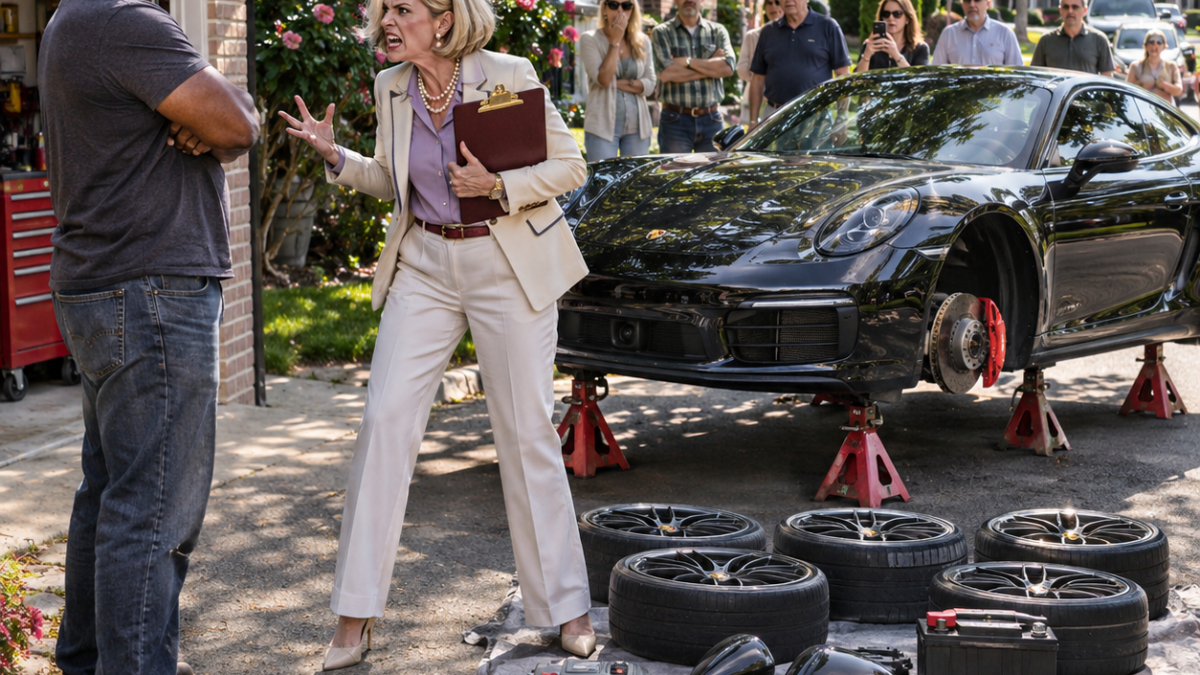
By 4:30, the Porsche looked absurd.
Four jack stands.
No wheels.
No side mirrors.
No battery.
Several removable exterior pieces arranged neatly beside my garage.
I placed every bolt and fastener into labeled containers.
Front left wheel.
Front right.
Mirror hardware.
Battery bracket.
Nothing stolen.
Nothing thrown away.
Nothing damaged intentionally.
Then I left one laminated card beneath the windshield wiper.
YOUR PROPERTY IS INTACT.
ALL REMOVED COMPONENTS ARE SECURED ON MY PROPERTY.
CALL ME OR YOUR MECHANIC FOR RETURN.
I went inside.
Showered.
Made coffee.
And waited.
At 7:18, Eleanor’s scream woke three dogs.
“OH MY GOD!”
I stood at the window.
She was in the street wearing a silk robe.
Her hands flew to her head.
“What did you do?”
Neighbors began opening doors.
She circled the Porsche.
Then screamed louder.
“My wheels!”
I stepped onto the porch.
“Morning.”
Her head whipped toward me.
“You psycho!”
“Everything is intact.”
“You destroyed my car!”
“No.”
“Where are my wheels?”
“Beside my garage.”
“My mirrors?”
“Wrapped.”
“My battery?”
“Stored.”
She stared at me.
Then her face changed from shock to fury.
“You touched my Porsche.”
“Yes.”
“You’re finished.”
“Possibly.”
That answer confused her.
She expected smugness.
What she got was a man who had already started questioning his own decision.
She pulled out her phone.
“I’m calling the police.”
“I assumed.”
“You’re done, old man.”
Within fifteen minutes, Officer Carter and a second officer arrived.
Carter stepped from the cruiser.
Saw the Porsche.
Then looked at me.
“Marcus.”
“Morning.”
He closed his eyes briefly.
“Please tell me you didn’t.”
“I did.”
Eleanor practically ran into him.
“Arrest him!”
“Ma’am—”
“He destroyed a two-hundred-thousand-dollar vehicle!”
“It’s not destroyed.”
“Shut up!”
Carter held up a hand.
“Everybody stop.”
He walked around the Porsche.
Examined the jack stands.
Looked toward the wheels.
Then toward me.
“You removed these?”
“Yes.”
“Why?”
I should have invented something clever.
Instead I told the truth.
“Because I got tired of her parking here.”
Carter stared at me.
“That is not a legal justification.”
“I know.”
Eleanor’s face lit up.
“See?”
He turned to her.
“I’m still investigating.”
“But he admitted it.”
“Yes.”
Carter asked whether anything was damaged.
Eleanor insisted the whole car was destroyed.
He inspected what he could.
I showed him the labeled parts.
The wrapped mirrors.
The battery.
The fasteners.
Then I gave him my binder.
He looked through weeks of documentation.
The letters.
The HOA retaliation.
The parking settlement.
The tow.
The repeated photos.
He sighed.
“This is a mess.”
Eleanor pointed at me.
“Arrest him.”
Carter’s partner asked, “Do you have a repair estimate?”
“Look at it!”
“That isn’t an estimate.”
“He vandalized it.”
Carter looked at me.
“You understand this may be investigated as criminal mischief or tampering.”
“Yes.”
For the first time Eleanor stopped shouting.
She had expected me to claim some imaginary nuisance law made everything legal.
I didn’t.
Because it didn’t.
She smiled.
“You’re going to jail.”
Carter shook his head.
“Nobody said that.”
“But—”
“We’ll document the condition, take statements, and refer it.”
He turned to me.
“Do not touch the vehicle again.”
“I won’t.”
“Do not withhold her parts.”
“I won’t.”
I handed him the key to my side garage.
“All of them are there.”
He looked almost annoyed by how organized everything was.
“You labeled the bolts?”
“Yes.”
“Of course you did.”
Doug arrived with a flatbed later that morning.
When he saw the Porsche, he whistled.
“Marcus.”
“I know.”
“I thought the tow was dramatic.”
“So did I.”
Eleanor stood nearby with arms crossed.
“I want every single piece documented.”
Doug nodded.
“That’s standard.”
“And if one bolt is missing—”
I held up labeled bags.
“Everything’s there.”
She glared.
Doug loaded the car with wheel dollies and collected the components.
As he prepared to leave, he leaned toward me.
“You’re either the calmest crazy man I’ve met or the craziest calm man.”
“Probably both.”
The Porsche disappeared.
The neighbors disappeared.
I went inside.
And for the first time since this started, I wondered whether Eleanor had finally succeeded in making me become exactly what she’d been telling people I was.
Unreasonable.
Obsessed.
Dangerous.
Lydia called before noon.
Her first words were:
“Tell me you did not dismantle her Porsche.”
“I dismantled part of her Porsche.”
Silence.
Long silence.
“Marcus.”
“I didn’t damage anything.”
“That is not the point.”
“I know.”
“No, I don’t think you do.”
She sounded genuinely angry.
“You just turned a strong harassment case into a potential property-damage claim against you.”
“Everything is reversible.”
“That helps damages. It does not create permission.”
“I know.”
“Stop saying you know.”
I sat down.
She exhaled.
“Did police arrest you?”
“No.”
“Did they cite you?”
“No. Report and referral.”
“Did you cooperate?”
“Completely.”
“Did you keep every part?”
“Yes.”
“Photographs?”
“Before and after.”
“Of course.”
Her tone softened slightly.
“Marcus, this was stupid.”
“Yes.”
“Very stupid.”
“Yes.”
“Do not do anything else.”
“I won’t.”
“You’re going to receive a lawsuit.”
She was right.
Three days later, a process server knocked.
Eleanor Price v. Marcus Jones.
The demand was enormous.
Property damage.
Loss of use.
Emotional distress.
Harassment.
Intentional interference.
Defamation.
Half a million dollars.
I sat at my kitchen table staring at it.
Then I called Lydia.
“It’s adorable,” she said after reading the complaint.
“That doesn’t sound encouraging.”
“Some claims are inflated. Others are not frivolous.”
“What does that mean?”
“It means we defend what is defensible and we don’t pretend your decision was magically lawful.”
I rubbed my forehead.
“So I’m in trouble.”
“You created risk.”
“Different?”
“Potentially.”
The Porsche dealership inspected the car.
That report saved me from the worst-case scenario.
No structural damage.
No damaged suspension.
No scratched body panels attributable to the disassembly.
No broken mirrors.
No damaged wheel hardware.
The battery tested normally.
The reassembly cost was substantial but nowhere near Eleanor’s claims.
Her lawyer had described the car as “rendered effectively destroyed.”
The dealer described it as “requiring reinstallation of removed components, inspection, calibration, and alignment.”
Still expensive.
Not scrap metal.
Not destruction.
That difference mattered.
Then Lydia did what good attorneys do.
She stopped talking about the Porsche.
And started asking why Eleanor had targeted me in the first place.
Discovery requests went out.
Emails.
Board messages.
Violation records.
Financial approvals.
Management communications.
Eleanor fought everything.
That made Lydia curious.
“People usually fight discovery because it’s annoying,” she told me. “She is fighting like there’s something behind the door.”
“What do you think?”
“I don’t guess.”
She paused.
“But I’m interested.”
Denise contacted us again.
This time she was willing to speak formally.
She described Eleanor issuing violations without votes.
Waiving fines for friends.
Threatening board members.
Using HOA reimbursements for “executive expenses.”
Lydia asked one question.
“What kind of expenses?”
Denise looked uncomfortable.
“Meals. Mileage. Consulting. Legal research.”
“Anything else?”
“A vehicle expense once.”
I sat forward.
“What vehicle?”
Denise looked at me.
“The Porsche.”
That changed the room.
The HOA had reimbursed Eleanor for several costs related to association business.
Some legitimate.
Some questionable.
Parking fees.
Mileage equivalents.
Detailing before community events.
A portion of an insurance rider Eleanor claimed was necessary because she used the Porsche for HOA duties.
Lydia requested everything.
Eleanor’s lawsuit had opened a door.
She had demanded damages tied partly to her claim that the Porsche was essential to HOA operations.
That meant the financial relationship between her vehicle and the association became relevant.
Her own pleading had made it relevant.
Lydia smiled when she explained that.
“She put the Porsche in the case.”
“So?”
“So now we ask why the HOA was paying anything associated with it.”
The board panicked.
An emergency meeting was scheduled.
This time the clubhouse was packed.
I sat beside Lydia in the second row.
Eleanor entered ten minutes late.
No Porsche.
She drove a rental sedan.
Nobody said anything.
Nobody needed to.
Denise called the meeting to order.
Eleanor immediately objected.
“I am still president.”
“Your authority is suspended pending review.”
“You cannot suspend an elected president without a membership vote.”
The association attorney spoke.
“You can be temporarily restricted from financial and enforcement authority under the board’s fiduciary obligations while an investigation is pending.”
Eleanor turned on him.
“You work for me.”
“No,” he said calmly. “I work for the association.”
That sentence landed like a hammer.
The financial review was presented.
Not every questionable payment was fraud.
Some were merely sloppy.
Some lacked documentation.
Others appeared to involve expenses Eleanor approved for herself without proper board authorization.
The total requiring further investigation exceeded forty thousand dollars.
Additional vendor invoices pushed the questionable amount toward sixty.
Gary—the same homeowner who had challenged her months earlier—stood up.
“You fined me two hundred dollars over a shed color while you were reimbursing yourself for Porsche expenses?”
“That is a gross mischaracterization.”
“Is it?”
“Yes.”
Mrs. Klein raised her hand.
“What about the landscaping company?”
Eleanor’s face tightened.
“What about it?”
“My nephew looked up the business address.”
Eleanor stopped moving.
“It belongs to your cousin.”
The room exploded.
Denise called for order.
Nobody listened.
Eleanor stood.
“This is a witch hunt.”
Harold Patterson called from the back.
“No, Eleanor. This is bookkeeping.”
People laughed.
Eleanor slammed her hand against the table.
“This is all because of him!”
She pointed directly at me.
“Marcus couldn’t stand being told no. He became obsessed. He dismantled my car!”
Every head turned.
I stood.
“I did.”
The room went silent.
I wasn’t proud of it.
That made what I said next easier.
“It was a bad decision. My attorney told me not to do it. I did it anyway.”
Eleanor looked almost triumphant.
Then I continued.
“But I didn’t issue fake fines. I didn’t approve my own reimbursements. I didn’t threaten board members. I didn’t invent vendors. And I didn’t make you park beside my driveway every morning.”
No one spoke.
I sat down.
Lydia leaned toward me.
“That was not terrible.”
“High praise.”
The meeting lasted three hours.
When it ended, the board voted unanimously to remove Eleanor from the presidency pending a full membership recall and financial investigation.
She shouted through the vote.
Claimed conspiracy.
Threatened individual lawsuits.
Accused Denise of betrayal.
Accused Harold of prejudice against strong women.
Accused me of stalking.
By the time she reached the doorway, nobody was listening.
Her lawsuit did not disappear immediately.
Negotiations lasted weeks.
The dealership wanted payment.
My insurer disputed portions.
Eleanor wanted public vindication.
I wanted the entire thing over.
Eventually Lydia worked out a settlement.
I paid part of the actual documented reassembly-related costs through insurance and personal funds.
Far less than Eleanor’s demand.
No admission that her half-million-dollar claims were valid.
No emotional-distress payout.
No defamation award.
No fantasy valuation for “loss of HOA leadership mobility.”
In exchange, Eleanor dismissed the lawsuit.
The HOA separately resolved my retaliation and invalid-fine claims.
My fines were voided.
My legal expenses were partially reimbursed.
The association adopted formal enforcement procedures preventing a president from issuing unilateral penalties.
The painted driveway buffer became permanent.
Eleanor hated all of it.
But the financial investigation was worse.
Several reimbursements had to be repaid.
Some vendor arrangements were terminated.
The association referred portions of the records to its insurer and appropriate investigators.
I never learned every detail.
Lydia told me not to speculate.
So I didn’t.
What I knew was simple:
Eleanor had spent years convincing everyone that rules were weapons she alone knew how to use.
Then people finally read the rules without her standing over their shoulder.
Her power disappeared quickly after that.
The apology came a month later.
Part of the HOA settlement required a written statement.
For thirty days, it remained pinned to the top of the association’s online bulletin.
It said Eleanor acknowledged that several enforcement actions taken against residents had not followed proper procedures and that personal disputes should never influence association decisions.
She never mentioned my name.
She didn’t need to.
Everyone knew.
Harold printed the apology.
Framed it.
Hung it in his garage.
“You’re a terrible person,” I told him.
“I’ve been waiting fifteen years for something worth framing.”
Mrs. Klein planted more jasmine.
Nobody fined her.
Life became quieter.
Then one sunny morning, a yellow flatbed pulled up in front of Eleanor’s house.
Doug stepped out.
He saw me checking my mailbox.
“Marcus.”
“Please tell me this has nothing to do with me.”
He laughed.
“Not this time.”
“What happened?”
“Porsche is back from the dealership.”
I looked toward Eleanor’s garage.
“And?”
“She disputed the final bill.”
I stared at him.
“Seriously?”
“Apparently.”
“Why are you here?”
“Mechanic’s lien paperwork. Dealership retained possession until the billing dispute is settled. I’m moving it to secured storage.”
I laughed.
Couldn’t help it.
Doug pointed at me.
“Don’t touch anything.”
“Very funny.”
He grinned.
Eleanor appeared behind her curtains.
She watched the flatbed drive away.
No screaming.
No robe.
No accusations.
Just silence.
Something about that silence felt different.
Not defeat exactly.
Exhaustion.
Three weeks later, a FOR SALE sign appeared in her yard.
Nobody celebrated publicly.
Oakridge was too tired for that.
The first open house attracted several couples.
The second attracted fewer.
Then the price dropped.
Eventually the house sold.
On moving day, I sat on my porch with coffee.
I hadn’t planned to watch.
But after everything that happened, pretending not to notice would have been ridiculous.
Movers carried boxes.
Furniture.
Artwork.
A ridiculous white chaise lounge.
Eleanor came outside near noon.
Large sunglasses.
Black coat.
No leather HOA folder.
She looked across the street.
At me.
I expected anger.
Instead, she looked tired.
She walked to the curb but stayed on her side.
For several seconds, neither of us spoke.
Then she said, “Was it worth it?”
I knew what she meant.
The lawyers.
The Porsche.
The money.
The months of stress.
I looked at my driveway.
Clear.
Quiet.
Gray pavers exactly where Marlene and I had laid them.
“No,” I said.
Eleanor seemed surprised.
I continued.
“The car wasn’t worth it.”
She stared at me.
“I shouldn’t have touched it.”
For the first time in months, her expression softened.
Only slightly.
“But you shouldn’t have kept coming after me either.”
The softness vanished.
“I was enforcing standards.”
“No. You were punishing people who didn’t submit.”
She shook her head.
“You’ll never understand what it takes to manage people.”
“Maybe not.”
I took another sip of coffee.
“But I’m pretty sure it doesn’t require parking a Porsche beside a widower’s driveway every morning because he challenged a truck citation.”
She looked down.
There it was.
Not an apology.
But no denial either.
After a moment, she turned toward the waiting SUV.
Before getting inside, she looked back.
“You know everyone here talked about me.”
“They were afraid of you.”
“Same thing.”
“No.”
I shook my head.
“It really isn’t.”
She got into the SUV.
The door closed.
The vehicle drove away.
That was the last time I saw Eleanor Price.
The couple who bought her house were named Ben and Rachel.
Normal people.
Almost suspiciously normal.
They brought cookies when they introduced themselves.
Ben asked whether the HOA really cared about trash-can orientation.
“Not anymore.”
Rachel laughed.
“Good.”
They planted roses along the front walkway.
Red ones.
The same shade Marlene used to grow near our mailbox.
One afternoon Rachel asked if I knew anything about roses.
“A little.”
That became Saturday morning gardening lessons.
Not HOA-approved gardening.
Just neighbors talking over a fence.
Harold started walking more.
Mrs. Klein expanded her trellis.
Children rode bicycles through the cul-de-sac.
Nobody measured grass blades.
Nobody photographed shutters.
Nobody parked beside my driveway.
The association still existed.
Rules still existed.
But the board stopped behaving like a royal court.
Denise remained president for one term, then refused reelection.
“Why quit?” I asked.
She laughed.
“Because normal people shouldn’t want this job forever.”
That might have been the healthiest thing any HOA president ever said.
One year after the whole mess began, I found the blue binder while cleaning my garage.
It was thick.
Photographs.
Certified-mail receipts.
Police incident numbers.
Legal letters.
Parking measurements.
HOA minutes.
The dealership report.
Settlement documents.
Months of my life condensed into plastic sleeves.
I sat at my workbench flipping through it.
Then I reached the photographs from that morning.
Eleanor’s Porsche on jack stands.
Four wheels stacked beside the garage.
Mirrors wrapped carefully.
Battery on the bench.
I studied the photograph for a long time.
At the time, I’d thought it looked beautiful.
Order.
Precision.
A mechanical answer to an emotional problem.
Now it looked different.
It looked like a man who had let another person’s obsession become his own.
I didn’t regret standing up to Eleanor.
I regretted giving her enough power over my emotions that I crossed a line too.
That distinction mattered.
Marlene would have understood it instantly.
She could always separate being right from doing the right thing.
Those weren’t necessarily the same.
I closed the binder.
Then I walked outside.
The ’67 Chevy sat in my driveway.
Fully restored now.
Deep blue paint.
Chrome shining.
Marlene had chosen that color before she got sick.
I had kept delaying the final work because every time I touched the truck, I remembered her.
After Eleanor left, I finally finished it.
Ben’s eight-year-old daughter, Sophie, rode her bicycle over.
“Mr. Marcus?”
“What’s up?”
“Can I see the truck?”
“Sure.”
She leaned over the hood.
“It’s old.”
“Thank you.”
“That wasn’t a compliment.”
“I know.”
She looked at the driveway.
“Did you build these rocks?”
“Pavers.”
“You built them?”
“My wife and I did.”
“Where is she?”
Kids ask questions adults carefully avoid.
“She died a while ago.”
Sophie looked at me.
“Oh.”
Then she touched one of the gray stones with the toe of her sneaker.
“They’re pretty.”
I smiled.
“Yeah.”
“They look straight.”
That hit me harder than she could have known.
Clean lines, Marcus.
Everything in its proper place.
“That’s what she liked about them.”
Sophie nodded as if this made complete sense.
Then she asked whether she could help wash the truck.
I handed her a sponge.
She soaked herself more than the Chevy.
Ben came running over apologizing.
“I’m sorry.”
“For what?”
“She wasn’t supposed to bother you.”
“She isn’t bothering me.”
I looked down the street.
No Porsche.
No tow trucks.
No police cars.
No HOA notices taped to doors.
Just kids, sprinklers, lawn mowers, and a half-washed old truck.
For months I had believed peace would arrive as a victory.
A judge’s order.
An apology.
Eleanor moving away.
Her Porsche disappearing on a flatbed.
But peace wasn’t any of those moments.
Peace was boring.
Wonderful, ordinary, boring.
It was drinking coffee without checking the curb first.
Backing out without holding my breath.
Leaving a recycling bin outside ten minutes too long without wondering whether somebody had photographed it.
It was a little girl accidentally spraying my shoes with a garden hose while laughing.
That evening, after Sophie went home, I sat alone on the porch.
The sunset turned the driveway gold.
I thought about the morning Eleanor had stood screaming beside the dismantled Porsche.
For years afterward, I knew that would be the version people told.
The old mechanic who took apart the HOA president’s Porsche.
It was dramatic.
Funny in retrospect.
Easy to turn into legend.
But it wasn’t the part I remembered most.
I remembered the first morning.
Eleanor’s Porsche sitting beside Marlene’s driveway.
The dismissive shrug.
You’ll manage.
Three words.
That was where everything started.
Not with a car.
With someone deciding another person’s inconvenience didn’t matter.
Then deciding his complaints didn’t matter.
Then deciding the rules could be bent until only her comfort remained.
And eventually, I made my own mistake.
I decided my frustration justified touching something that wasn’t mine.
It didn’t.
The difference between Eleanor and me wasn’t that I never crossed a line.
I did.
The difference was that when the dust settled, I could admit it.
I walked down the driveway.
Stopped beside the mailbox.
The roses Marlene planted were blooming.
I trimmed one dead branch.
Straightened a loose stone along the edge.
Then I looked down the empty curb.
Nothing there.
Exactly nothing.
I smiled.
Sometimes, after months of fighting for something, the most beautiful thing you can finally see is absolutely nothing at all.
[END OF STORY]








