PART 2: HOA Karen Parked Her Escalade in My Driveway for 354 Days—So I Built a 4,000-PSI Concrete Wall Behind It
PART 2
The next morning, the Escalade was still there.
The morning after that, too.
At first I kept trying to handle it the way normal neighbors handle normal problems.
Politely.
I knocked on Deborah’s door again.
“Can you move your vehicle?”
She looked over my shoulder.
“Why?”
“Because it’s in my driveway.”
“I’ll only be there an hour.”
“That isn’t the point.”
She sighed.
“Marcus, you’re turning something that has worked perfectly for years into a conflict.”
“I’m asking you not to park on property you don’t own.”
“And I’m explaining that the location serves an established community function.”
“It serves you.”
Her eyes hardened.
“There’s no reason to be rude.”
I almost laughed.
“I’m not being rude.”
She stepped back.
“I have HOA business to handle.”
Door closed.
That became our pattern.
She parked.
I asked.
She invented another explanation.
Week three, I stopped asking.
Instead, I bought a sign.
PRIVATE DRIVEWAY.
NO PARKING.
Reflective aluminum.
Steel post.
I installed it Saturday morning at the entrance to the driveway.
Sunday afternoon, it disappeared.
Not knocked down.
Not damaged.
Gone.
Even the hole had been filled with dirt.
I stood there staring at the smooth patch of ground.
Gary Patterson walked across the street holding a can of soda.
“You missing something?”
“My sign.”
He looked toward Deborah’s house.
“Yeah.”
“You saw something?”
Gary scratched his chin.
“Didn’t see anything.”
Then he glanced toward her house again.
“But I’ve lived here long enough to know things disappear when Deborah doesn’t approve of them.”
I bought another sign.
This time I set the post in concrete.
Two feet deep.
Quick-set mix.
The next day, the post was still there.
The aluminum sign wasn’t.
Somebody had removed the bolts.
Gary stood on his porch that evening.
He looked at the empty pole.
Then at me.
“You’re taking this well.”
“I pour concrete for a living.”
“What does that have to do with anything?”
“I believe in foundations.”
He laughed.
At the time, I didn’t realize how literal that answer would become.
Next I tried traffic cones.
Three bright orange cones across the driveway.
I left for work at six.
Came home at five.
The cones were stacked neatly beside my recycling bin.
Deborah’s Escalade sat behind them.
I walked around the vehicle.
No damage.
No note.
Nothing.
I went inside.
Opened a cheap spiral notebook.
Wrote:
**Day 19 — Escalade in driveway. Cones removed.**
The next day:
**Day 20 — Escalade in driveway.**
Day 21.
Day 22.
Day 23.
I started taking pictures.
Same angle.
Same license plate.
Same property.
Date and time stored automatically.
At first I didn’t know what I planned to do with them.
I just knew my father had taught me something else besides concrete.
Measure before you cut.
Document before you accuse.
By the second month, I had enough photographs to make a calendar.
Rain.
Sun.
Weekdays.
Weekends.
Morning.
Afternoon.
Deborah parked there whenever she felt like it.
Sometimes fifteen minutes.
Sometimes three hours.
Once, six.
I called the police non-emergency number.
The officer was sympathetic.
“Sir, the driveway is on your property?”
“Yes.”
“And the vehicle belongs to a neighbor?”
“Yes.”
“Have you told her not to park there?”
“Repeatedly.”
“This is probably going to be handled as a civil issue unless there’s another offense involved.”
“What about towing?”
“You can contact a private towing company. Just make sure you have documentation showing the vehicle is on private property.”
I had plenty.
I called Apex Towing.
A guy named Dale arrived around three in the afternoon.
Big man.
Ball cap.
Sunburned neck.
He backed the flatbed toward the Escalade and started lowering the lift.
I stood near the garage.
For one glorious minute, I thought the problem was finally over.
Then Deborah appeared.
I had never seen anyone walk so quickly in heels.
She came down the sidewalk with the clipboard against her chest.
“Excuse me!”
Dale stopped.
“I’m Deborah Kessler, community director of Sycamore Ridge Estates.”
Dale looked at me.
Then her.
Deborah pointed at the Escalade.
“That vehicle is authorized to park in a designated community access area.”
I said, “It’s my driveway.”
She ignored me.
“The HOA has established operational guidelines regarding this location.”
Dale rubbed his neck.
“Ma’am, is the vehicle yours?”
“Yes.”
“And he wants it removed?”
“He does not have the authority to interfere with HOA operations.”
“I own the property.”
Deborah held up the laminated badge.
“The board has jurisdiction over community access.”
I stared at the badge.
Dale stared at the badge.
Then at the two of us.
“I’m not touching this.”
I stepped toward him.
“Dale—”
“I’m sorry, man. I’m not getting caught between an HOA and a homeowner. You need lawyers to figure this out.”
He pulled away.
Deborah watched him leave.
Then gave me a smile.
Not big.
Just enough.
The kind of smile someone gives you when they want you to know they won.
The next towing company refused to come after I explained the situation.
The third sent a driver who stopped at the curb.
Deborah gave him the same speech.
He left.
Then she fined me.
The envelope arrived Thursday.
**UNAUTHORIZED EXTERIOR SIGNAGE — $75.**
I read the letter twice.
The sign she had removed.
The sign I had installed because she wouldn’t stop trespassing.
She was fining me for it.
I sat at the kitchen table.
Dad’s chair was on the other side.
His photograph hung on the wall.
For a second I imagined telling him.
He would’ve laughed first.
Then gotten angry.
Then asked me what the bylaws actually said.
Dad hated bullies, but he hated sloppy arguments almost as much.
So I pulled the CC&Rs out again.
Section 4.7.
Exterior modifications.
The language was vague.
Deborah was stretching it.
Still, I paid the seventy-five dollars.
Gary found out.
“You paid her?”
“Yes.”
“Why?”
“Receipt.”
“What?”
I held up the violation notice.
“Every time she does something stupid, she signs it.”
Gary stared at me.
Then slowly smiled.
“You’re planning something.”
“Not yet.”
That was true.
At least mostly.
By October, Deborah had stopped pretending the driveway was just a temporary convenience.
She began conducting HOA business there.
I came home from a commercial pour one Wednesday and found three vehicles packed across my concrete.
Deborah’s Escalade.
Nancy Whitfield’s Toyota.
Tom Greer’s Honda.
All HOA board members.
I parked at the curb.
Walked up carrying my lunch cooler.
Deborah sat in the driver’s seat with paperwork spread across the steering wheel.
Nancy stood outside.
Tom leaned against his Honda.
“What is this?”
Deborah glanced up.
“Board meeting.”
“In my driveway?”
“The clubhouse is being painted.”
“So use someone else’s driveway.”
Nancy looked uncomfortable.
Deborah didn’t.
“This location is central.”
“Deborah, move the cars.”
“We’ll be finished shortly.”
“How shortly?”
“Forty-five minutes.”
I looked at Tom.
He avoided eye contact.
Nancy said nothing.
“Fine.”
I went inside.
Forty-five minutes became an hour.
An hour became seventy-five minutes.
When they finally left, three dark oil spots remained.
One car had rolled onto the grass.
A tire cut a rut through the edge Dad used to trim by hand.
There was also a scrape on the mailbox post.
I crouched beside it.
The wood fibers were fresh.
My father had installed that post.
I remember because I had been fourteen and complained the entire time he made me hold the level.
“Straight matters,” he told me.
“People notice crooked.”
I ran my thumb across the fresh scrape.
That was the first time this stopped feeling like Deborah was disrespecting me.
She was damaging pieces of him.
I took pictures.
Added them to the folder.
Day 112.
Day 113.
Day 114.
The Escalade kept coming.
Then Deborah circulated a petition.
Gary brought me a copy.
“You seen this?”
The heading read:
**COMMUNITY PARKING RESOLUTION — EMERGENCY MEASURE**
I read the first paragraph.
Then the second.
Then I laughed.
“She’s trying to designate your driveway as HOA parking,” Gary said.
“I noticed.”
“She has twenty-two signatures.”
That stopped the laughter.
Twenty-two neighbors had signed a document that specifically identified my property as a proposed community parking zone.
I started knocking on doors.
The first woman I spoke to looked confused.
“I thought it was about adding guest parking.”
“Did Deborah show you the full document?”
“She gave me the signature page.”
The second resident said the same thing.
The third admitted he had signed because he didn’t want Deborah harassing him over his shed.
The fourth said something worse.
“I knew what it was.”
“Then why did you sign?”
He lowered his voice.
“Because I’m tired, Marcus.”
I waited.
“My wife’s sick. I work sixty hours a week. Last year Deborah threatened a lien over landscaping fines. I don’t have the energy.”
That answer stayed with me.
Fear doesn’t always look like fear.
Sometimes it looks like exhaustion.
The board considered Deborah’s resolution.
Three to two, they voted to table it.
Deborah and Nancy wanted it approved.
It failed.
Barely.
The Escalade kept appearing.
By winter, the driveway had stains that wouldn’t pressure-wash away.
Deborah left trash once.
Fast-food bag.
Half cup of sweet tea.
Brown circle on my concrete.
I carried the trash to her porch.
She opened the door.
I held it out.
“You left this.”
She looked inside.
“Oh.”
“That’s it?”
“What do you want me to say?”
“I want you to stop using my driveway.”
She exhaled.
“Marcus, you are the only person in this community who seems determined to create problems.”
“No. I’m the person who keeps telling you no.”
Her eyes narrowed.
“Maybe ask yourself why no one else has an issue.”
I thought about the man whose wife was sick.
The fake parking petition.
The fines.
The towing companies that backed away as soon as Deborah flashed her badge.
“I think I know why.”
She shut the door.
I walked home.
That was the last time I asked nicely.
Month seven was when she went too far.
I was in Durham pouring the foundation for a veterinary clinic.
It was one of those days where everything had to happen on schedule.
Rebar inspection at seven.
Truck at eight.
Finish crew by eleven.
My phone rang just after ten.
Gary.
“Marcus.”
“What?”
“Get home.”
“What happened?”
“There’s a tow truck hooked to your Ford.”
I stopped moving.
“My truck?”
“Your work truck.”
“Where?”
“Your driveway.”
I handed my screed to Tommy.
“Take over.”
“What’s wrong?”
“Deborah.”
That was enough.
I drove back fast.
Not reckless.
Fast.
I turned onto Sycamore Lane just in time to see my F-350 disappearing around the corner on a flatbed.
Cole Concrete and Masonry logo on the door.
Deborah stood beside my driveway with her clipboard.
I got out.
For seven months, I had controlled my voice.
Not then.
“What the hell did you do?”
She didn’t flinch.
“Your commercial vehicle was obstructing community access.”
“That is my work truck.”
“Yes.”
“Parked in my driveway.”
“Yes.”
“On my property.”
“Your driveway interferes with mailbox access when oversized commercial vehicles occupy it.”
I stared at her.
The mailbox cluster was thirty feet away with its own sidewalk.
“You had my truck stolen.”
“Don’t be dramatic.”
“Where is it?”
“The towing company can provide that information.”
“You authorized this?”
“As community director.”
“You have no authority.”
“If you disagree, file a grievance.”
She lifted the clipboard.
“The next board meeting is the third Thursday.”
For one second, I almost took that clipboard out of her hands.
Instead, I stepped back.
I remembered Dad.
Concrete tells on you eventually.
I drove fifteen miles to the impound lot.
Two hundred eighty-five dollars.
Four hours of lost labor.
Lost production on the Durham job.
Tommy had to supervise the pour.
We finished late.
I paid overtime.
That night, I photographed the towing receipt.
Scanned it.
Put it in the binder.
Day 206.
My anger felt different now.
Cold.
Useful.
Two weeks later, Wake County Code Enforcement mailed me a certified notice.
Someone had complained that my driveway might have been built without proper permits.
The complaint also alleged it needed modification to improve “community traffic flow.”
I read that phrase and smiled.
Deborah loved those words.
Community traffic flow.
She used them whenever she meant:
**Give me what I want.**
I went to county records.
The driveway had permits from 1988.
Original developer.
Inspections.
Approved plans.
Everything.
The code officer looked at the paperwork.
Then at the complaint.
“This is permitted.”
“I know.”
“I’m closing it as unfounded.”
“Can I get that in writing?”
“Sure.”
Another document.
Another date.
Another signature.
Then came the letter that finally decided things.
HOA stationery.
Deborah’s signature.
It claimed I owed $1,100 in **community parking assessment fees**.
If unpaid within sixty days, the letter threatened a lien on my house.
I read the CC&Rs again.
No such fee.
No board vote.
No resolution.
No amendment.
She had invented a charge.
Then threatened the house my father left me.
I sat at the kitchen table with the letter in front of me.
Behind the stove hung that old photograph.
Dad.
Thirty-two years old.
Standing in the brand-new driveway.
Carpenter’s level in his right hand.
The concrete bright and clean behind him.
No stains.
No tire marks.
No Escalade.
I picked up the photograph.
“Okay, Dad.”
I don’t know why I said it out loud.
Maybe I wanted permission.
Maybe I already knew what he would say.
Stop arguing.
Build something.
The next morning, I was sitting in the Wake County Register of Deeds parking lot before the doors opened.
Coffee.
Legal pad.
Folder.
For two hours, I pulled everything.
Survey.
Lot records.
Original subdivision documents.
Easements.
CC&Rs.
Amendments.
Site plans.
My property was 180 feet deep and seventy-two feet wide.
The driveway was entirely inside my lot.
Every inch.
The mailbox cluster was HOA common property.
Access came from the public sidewalk.
There was no easement through my driveway.
No community access right.
No parking entitlement.
Nothing.
Then I checked the building rules.
A freestanding wall up to four feet high could be constructed subject to setback and permit requirements.
I measured the location I had in mind.
Plenty of clearance.
Proper setback.
No need for an HOA easement.
No shared land.
I sat in my truck afterward staring at my notes.
A shape was forming in my mind.
Sixteen feet wide.
Four feet tall.
Eight inches thick.
Reinforced.
But I needed one more answer.
Mrs. Henderson.
Deborah had invoked her name for months.
“Mrs. Henderson always allowed it.”
“Mrs. Henderson never complained.”
“Mrs. Henderson understood community needs.”
I found Ruth Henderson in an assisted-living facility in Cary.
Eighty-three.
Small woman.
White hair.
Soft voice.
I brought chocolate-covered pretzels because Gary remembered she liked them.
We sat near a large window.
When I mentioned Sycamore Lane, her face changed.
“You bought James’s house?”
“My father left it to me.”
“James was kind.”
“He liked you.”
“He fixed my cabinet once.”
“That sounds like Dad.”
I waited a little while before asking about Deborah.
Ruth looked down at her hands.
“She still there?”
“Yes.”
“And still president?”
“Calls herself community director now.”
Ruth gave a tired smile.
“That sounds like her.”
“Deborah says you gave her permission to use our driveway.”
Ruth looked at me.
“No.”
One word.
Everything changed.
“She started after David died.”
Her husband.
“Once or twice a week at first.”
I stayed quiet.
“She said she needed somewhere near the mailboxes.”
“Did you tell her to stop?”
“Yes.”
“What happened?”
Ruth’s hands tightened together.
“She started sending notices.”
“For what?”
“The yard.”
Her eyes grew wet.
“David always did the yard. Forty years. He liked it perfect.”
I thought about Dad’s driveway.
Ruth continued.
“After he died, I couldn’t keep up. Deborah told me the grass was too tall. Then the shrubs. Then peeling paint.”
“She threatened fines?”
“And more.”
“What more?”
“She told me the HOA had options for owners who couldn’t maintain community standards.”
I knew exactly what that implied.
“She made you think you could lose the house.”
Ruth nodded.
“So you let her park.”
“I stopped fighting.”
Her voice became almost a whisper.
“She took my peace, Marcus.”
I felt something tighten behind my ribs.
“That house was the only place that still felt like David was there. And every day I looked outside and saw her car, and I felt like even the driveway wasn’t mine anymore.”
I looked through the window because suddenly I couldn’t look at Ruth.
“How long?”
“Years.”
“Why did you sell?”
She didn’t answer right away.
Finally:
“I was tired of being afraid in my own home.”
I drove back to Sycamore Ridge with the permit application on the passenger seat.
I wasn’t smiling anymore.
This wasn’t just my fight.
Deborah had done this before.
To an elderly widow.
She had discovered that if she pushed people when they were grieving, exhausted, lonely, or overwhelmed, eventually they stopped saying no.
She had mistaken surrender for permission.
That afternoon I stood in Dad’s driveway.
Looked toward Deborah’s house.
Her Escalade was there.
Day 241.
I photographed it.
Then went into the garage.
Pulled out graph paper.
And started drawing.
The wall would not touch her vehicle.
That mattered.
It would not damage anything.
It would not cross the property line.
It would not block the public sidewalk.
It would not interfere with mail access.
It would stand entirely on my land.
Permanent.
Legal.
Four feet tall.
Sixteen feet wide.
Rebar grid.
Full footing.
I called Walter Hwang, a licensed surveyor I trusted.
He came out two days later.
Shot every line with calibrated GPS.
Installed steel markers.
Reviewed the old plat.
Then I showed him my sketch.
“Wall goes here.”
Walter measured.
Checked setback.
Measured again.
He looked at me.
“You planning to keep something out?”
“Something like that.”
He laughed.
Then tapped the drawing.
“You’re clear.”
“Legally?”
“Property-wise, absolutely. Get the county permit.”
I submitted engineering drawings.
Site measurements.
Survey.
Setback calculations.
The county approved it eleven days later.
Permit number W-2024-08732.
I laminated a copy.
Put another in a file.
Then I called my attorney.
David Roe practiced property law.
Twenty-two years.
The kind of lawyer who read everything before speaking.
I spread the binder across his conference table.
Photographs.
Removed signs.
Towing attempts.
HOA fine.
Parking resolution.
My truck’s impound receipt.
Code complaint.
Fake assessment.
Lien threat.
Ruth’s written statement.
David flipped through page after page.
“How many photographs?”
“At the moment? Two hundred eighty-seven.”
“Same vehicle?”
“Every day.”
“You’ve told her not to park?”
“Repeatedly.”
“In writing?”
“Emails. Certified letter. HOA meeting minutes.”
He leaned back.
“Marcus.”
“What?”
“This is insane.”
“I know.”
“She has been knowingly trespassing, interfering with your use of the property, using HOA resources to retaliate, and possibly issuing unauthorized assessments.”
“I know.”
“Why haven’t you sued?”
“I might.”
“Might?”
I slid the wall permit across the table.
David read it.
Then looked at me.
Then read it again.
“You’re serious.”
“Completely.”
“Where is the wall going?”
“Rear edge of the driveway.”
He stared at the survey.
Then a smile appeared.
Not professional.
Human.
“Oh.”
“Exactly.”
“Will the Escalade be there?”
“If Deborah behaves normally.”
David removed his glasses.
“Marcus, I’m required to tell you this is going to make the situation much more dramatic.”
“I assumed.”
“And she’s going to call the police.”
“Permit.”
“Probably county inspection.”
“Permit.”
“She may sue.”
“That’s why I’m here.”
His smile widened.
He drafted a formal trespass notice.
A cease-and-desist.
A litigation preservation letter.
I told him I wanted to hold them.
“For how long?”
“Until after the wall.”
“You enjoy this more than you’re admitting.”
“Maybe.”
Then I started preparing like it was any other job.
Materials.
Forms.
Number four rebar.
Tie wire.
Bracing.
Tools.
Concrete vibrator.
Cameras.
I installed three security cameras covering the driveway.
Motion activated.
Cloud backed.
Timestamped.
Then I created the final evidence binder.
By the time I finished, it held nearly a year of photographs.
One vehicle.
One location.
One owner who had repeatedly been told to stop.
Deborah never noticed.
Why would she?
People who believe they own the room rarely look at what everyone else is doing.
She kept patrolling the neighborhood.
Kept issuing fines.
Kept wearing the badge.
Kept parking in my driveway.
I needed the right day.
That came every July.
Sycamore Ridge Summer Cookout.
Deborah’s favorite event.
She organized everything.
Catering.
Decorations.
Music.
And every year she parked her Escalade in my driveway because the pavilion lot was needed for vendors.
Apparently she usually walked home after the party and retrieved the SUV the next morning.
Perfect.
I circled the date.
Eight days before the cookout, I came home.
Escalade in driveway.
Day 347.
I parked on the street.
Walked past the Cadillac.
Went inside.
My work boots landed on Mom’s old doormat.
I washed my hands in Dad’s sink.
Opened the refrigerator.
Then looked at the calendar.
Red circle.
Eight days.
I thought about Ruth.
About Dad.
About my truck being taken away.
About Deborah threatening a lien.
Then I thought about concrete.
My father used to say:
“Don’t pour angry.”
He meant rushing.
Emotion makes you skip steps.
Bad grade.
Bad forms.
Bad finish.
So I didn’t pour angry.
I prepared.
The Friday of the cookout arrived clear.
Warm.
No rain in the forecast.
I checked three weather services anyway.
Tommy noticed.
“You pouring a hospital?”
“Something more important.”
“What?”
“My driveway.”
He already knew the outline of the plan.
By then, my crew knew Deborah’s Escalade better than some of our customers.
We finished a patio job in Apex that afternoon.
Good pour.
Sharp control joints.
Clean edges.
I got home at 3:15.
For once, the driveway was empty.
I parked inside the garage.
Closed the door.
Started staging.
Forms.
Rebar.
Tools.
Everything hidden.
At 4:27, I heard the V8.
I stood at the kitchen window.
White Escalade.
Turning in.
Deborah pulled forward until her front bumper sat near my garage.
Exactly where she always parked.
She stepped out wearing a turquoise sundress.
White sandals.
And the HOA lanyard.
At a barbecue.
I almost admired the commitment.
She removed a casserole from the back.
Locked the SUV.
Walked away.
Never looked at my house.
That detail bothered me more than I expected.
After nearly a year of conflict, she didn’t even check whether I was watching.
That was how completely she believed she had won.
My property had become invisible to her.
The driveway was no longer Marcus Cole’s.
It was simply a convenient object.
Like the sidewalk.
Or a bench.
Or air.
I texted Tommy.
**She’s parked. 5 a.m.**
His response:
**We’ll be there.**
I ate a sandwich.
Checked cameras.
Reviewed the permit.
Reviewed Walter’s survey.
Laid David’s documents on the table.
Then sat in Dad’s rocking chair on the back porch.
Music drifted from the pavilion.
People laughed.
Smell of charcoal.
Kids shouted.
I could almost convince myself Sycamore Ridge was peaceful.
At nine, people started leaving.
Ten-thirty, music stopped.
Eleven, silence.
Midnight.
I checked the window.
Escalade still there.
I set my alarm for 4:30.
I barely slept.
Not from excitement.
From calculation.
Footing.
Forms.
Rebar.
Placement.
Vibration.
Finish.
Cure.
At 4:30, I was already awake.
Boots on.
Garage open.
Cool morning air.
Tommy arrived at 4:50.
Carlos and Derek followed.
No jokes.
No unnecessary noise.
These were professionals.
I showed them the permit and survey one more time.
“Wall stays here.”
Tommy nodded.
“Sixteen feet.”
“Correct.”
“Four feet.”
“Correct.”
“Eight inches.”
“Correct.”
He looked at the Escalade.
“Beautiful.”
“Focus.”
“Trying.”
The footing trench had been prepared earlier and covered.
We opened it.
Checked depth.
Set forms.
Rebar cage.
Vertical and horizontal steel.
Twelve-inch spacing.
Every intersection tied.
Braces every two feet.
I measured the wall location again.
Then again.
Walter’s survey pins.
Setback.
Garage clearance.
Nothing crossed the line.
At 6:30, the ready-mix truck arrived.
I had ordered 4,000 PSI concrete.
The driver looked at the Escalade.
Then the forms.
Then me.
“You sure?”
“Yes.”
“Customer’s always right.”
The chute swung over.
Concrete flowed.
There is a smell to fresh concrete.
Mineral.
Wet.
Heavy.
I’ve loved it since I was a kid.
Tommy guided the chute.
Carlos worked the mix.
I vibrated each lift.
Derek watched steel alignment.
Slow.
Professional.
No shortcuts.
By 7:45, the wall was full.
We screeded the top.
Floated it.
Cleaned the edges.
The concrete began changing almost immediately.
Wet material becoming structure.
Chemistry taking over.
By nine, we stripped enough formwork to reveal the face.
Straight.
Clean.
Solid.
I walked backward down the driveway.
Stopped.
The wall stood eighteen inches behind Deborah’s rear bumper.
Four feet tall.
Sixteen feet wide.
There was no practical way to back around it.
Garage in front.
Wall behind.
Insufficient side clearance.
The Escalade hadn’t been touched.
Not one scratch.
Nothing attached to it.
No wheel blocked.
No tire flattened.
It was simply parked in a location that had now become inconvenient.
Tommy stood beside me.
“You realize she’s going to lose her mind.”
“Yes.”
“How long?”
I checked the time.
“Deborah sleeps late after the cookout.”
He nodded toward my house.
“You making coffee?”
“Absolutely.”
At 9:30, they left.
I cleaned up.
Hosed the area.
Checked cameras.
Then went inside.
Coffee.
Permit.
Survey.
Binder.
Cease-and-desist.
Everything arranged on the kitchen table.
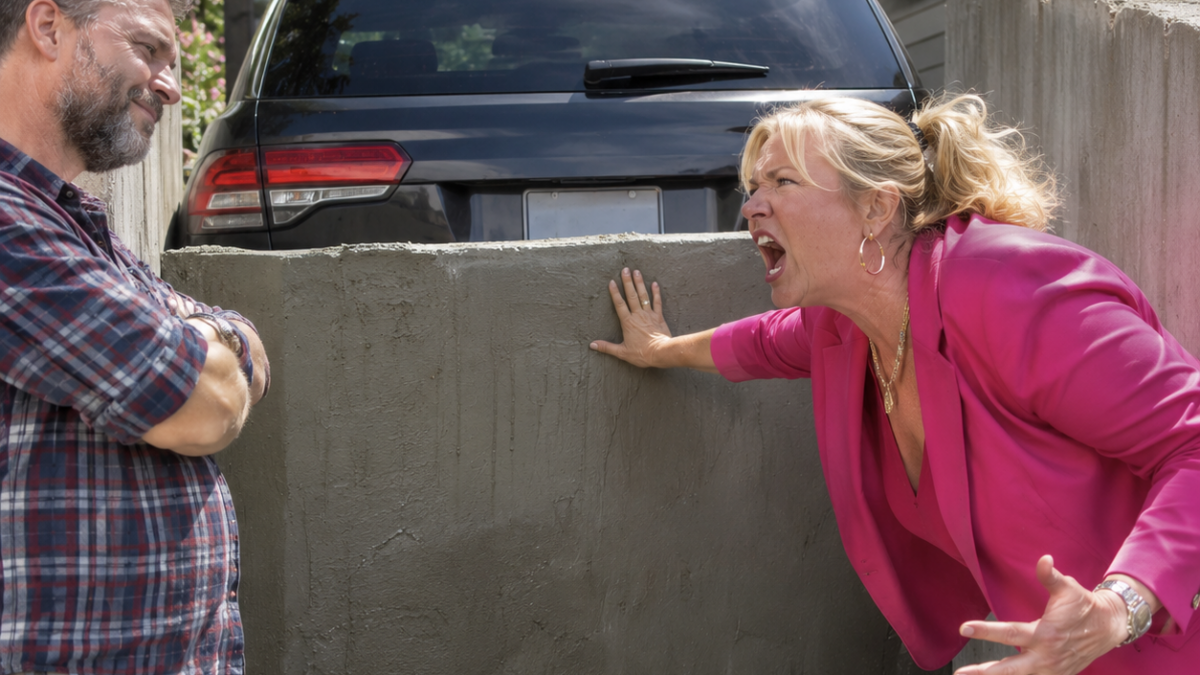
At 11:32, the scream came.
It was extraordinary.
Not a word at first.
Just sound.
I closed my eyes.
Took a sip.
Then walked outside.
Deborah stood behind the Escalade.
Both palms against the concrete wall.
Pushing.
Actually pushing.
The wall weighed thousands of pounds.
She shoved it as if outrage might override physics.
She spun toward me.
“What did you do?”
I stopped ten feet away.
“Morning.”
“What is this?”
“A wall.”
“I can see that!”
She slapped the concrete.
“You trapped my car!”
“I constructed a permitted wall on my property.”
“You built it behind me!”
“No. I built it behind a vehicle parked on my private driveway without authorization.”
Her face turned red.
“You knew my car was here!”
“I usually know. It’s been here almost every day for a year.”
“You cannot do this!”
I held up the laminated permit.
“Wake County disagrees.”
She grabbed toward it.
I pulled it back.
“Permit number W-2024-08732. Four-foot freestanding wall. Survey-approved location.”
“This is illegal!”
“Call the police.”
Her eyes widened.
“You think I won’t?”
“I think it would save us time.”
She dialed immediately.
While she spoke, neighbors began appearing.
Gary first.
Of course.
He came out holding coffee.
Looked at the wall.
Looked at me.
Then slowly sat down on his porch steps.
He was smiling so hard he had to cover his mouth.
Officer Rawlings arrived twelve minutes later.
Professional.
Calm.
He listened to Deborah first.
“She deliberately trapped my vehicle.”
He looked at me.
“Sir?”
I handed him the permit.
“Wall is permitted.”
Survey.
“Entirely inside my property.”
Then photographs.
“Vehicle has repeatedly been parked here after written notice to stop.”
Rawlings walked the wall.
Checked the orange survey markers.
Looked at the driveway.
Then the sidewalk.
Then the Escalade.
“Did the wall damage the vehicle?”
“No.”
“Did you move her vehicle?”
“No.”
Deborah interrupted.
“He boxed me in!”
Rawlings looked at her.
“Ma’am, is this his driveway?”
She crossed her arms.
“The HOA recognizes it as a community access location.”
I handed Rawlings the CC&Rs.
“No easement.”
He scanned the relevant pages.
Then turned to Deborah.
“Ma’am, the structure appears to be permitted and located on his property.”
“But my car is trapped.”
“Yes.”
“That’s illegal!”
“The vehicle is on his private property.”
“He did it intentionally.”
Rawlings paused.
“Intent doesn’t make a properly permitted wall disappear.”
Deborah stared.
“I want him arrested.”
“For what offense?”
She opened her mouth.
Nothing came out.
Rawlings continued.
“This looks civil.”
“A civil matter?”
“Yes.”
“My Cadillac is stuck behind four feet of concrete!”
Rawlings looked at the Escalade.
Then the wall.
Then Deborah.
“On his property.”
Gary made a choking sound across the street.
He was pretending to cough.
Rawlings left.
Deborah called Apex Towing.
The same company that had refused to tow her vehicle months earlier.
Dale showed up.
He recognized me.
Then he saw the wall.
His mouth fell open.
“You.”
“Me.”
He walked around the Escalade.
Measured one side.
Then the other.
Looked at Deborah.
“No.”
“What do you mean, no?”
“Can’t get equipment in.”
“Use dollies.”
“No clearance.”
“Then use the flatbed.”
“I can’t bend physics.”
She pointed at the wall.
“Take that down.”
Dale laughed once.
“That concrete?”
“Yes!”
“Ma’am, I tow cars. I don’t demolish reinforced walls.”
She called another company.
Same answer.
Third.
Same.
Fourth.
The driver came out just because, as he later admitted, “I wanted to see if the story was real.”
By one in the afternoon, word had spread.
People walked slowly past.
Very slowly.
Linda Park appeared carrying lemonade.
“Hot day,” she said.
Gary brought out a lawn chair.
Mr. Jennings sat on his porch with iced tea.
Even Tom Greer, the HOA secretary, stood on the opposite sidewalk pretending to check his mail for twenty minutes.
Deborah noticed everyone.
“You people think this is funny?”
Nobody answered.
Linda poured lemonade.
That made it worse.
Brad Kessler arrived around two.
He parked at the curb.
Got out.
Walked toward the driveway.
He saw the wall.
Stopped.
Looked at Deborah.
Looked at me.
Then walked around the Escalade in complete silence.
Finally he said:
“How?”
Deborah pointed at me.
“He trapped it!”
Brad looked at the permit posted near the garage.
Then at the survey marker.
Then at the wall.
“How do we get it out?”
“Crane,” Dale had told her.
Brad rubbed his forehead.
“How much?”
The first crane company quoted over four thousand dollars.
Earliest availability Monday.
Deborah exploded.
“I’m not leaving my vehicle here for two days!”
I said, “It’s spent almost a year here. Two more days shouldn’t hurt.”
Gary nearly fell out of his chair.
Deborah pointed at me.
“This is harassment.”
I kept my voice calm.
“You parked on my property after being told hundreds of times to stop.”
“Hundreds?”
I went inside.
Brought out the binder.
Set it on a folding table.
Opened it.
Photograph.
Date.
Photograph.
Date.
Photograph.
Date.
Deborah’s face changed.
“What is that?”
“Documentation.”
She stared.
I turned another page.
“Day forty-three.”
Another.
“Day one hundred eighteen.”
Another.
“Day two hundred six.”
Another.
“Day three hundred forty-seven.”
Brad leaned closer.
“You took a picture every day?”
“Almost every day.”
Deborah looked at him.
“This is obsessive.”
Brad didn’t answer.
I closed the binder.
“No, Deborah. Parking in someone else’s driveway for nearly a year after they repeatedly tell you to stop is obsessive.”
She had nothing.
For once.
Monday afternoon, the crane arrived.
By then, half the neighborhood knew the schedule.
A few folding chairs appeared.
Somebody brought a cooler.
A teenager sold lemonade for a dollar.
I didn’t organize any of it.
That made it better.
The crane operator rigged the Escalade carefully.
Straps under the chassis.
Lift points checked.
Deborah stood with arms crossed.
Brad stood beside her holding paperwork.
The Cadillac rose.
Slowly.
Four tires leaving my driveway.
Up over the wall.
Then sideways.
The entire neighborhood watched.
When the Escalade touched the street, someone clapped.
Then another.
Then several.
A small round of applause spread across Sycamore Lane.
Deborah’s face went rigid.
I didn’t clap.
I didn’t smile.
I just looked at the empty driveway.
My driveway.
For the first time in nearly a year, it was clear.
That should have been the end.
It wasn’t.
Because the wall had never been the whole plan.
Monday morning, before the crane even arrived, David Roe sent certified letters to every HOA board member.
Inside:
Photographs.
Towing receipts.
Code-enforcement documents.
Fake assessments.
Lien threat.
Petition.
Security footage.
Ruth Henderson’s statement.
Then David’s legal analysis.
The board had a choice.
Remove Deborah from all positions of authority.
Cancel unauthorized penalties.
Stop retaliatory activity.
Preserve all HOA records.
Or face litigation not only against the association, but potentially against board members individually if they knowingly continued supporting unauthorized conduct.
The emergency meeting happened Tuesday.
I attended.
So did more residents than I had ever seen at an HOA meeting.
The clubhouse was packed.
Deborah sat at the front.
No lanyard.
That surprised me.
Nancy sat beside her looking sick.
Tom Greer kept rearranging papers.
A board member named Howard Lee opened the meeting.
“We have received correspondence from counsel representing Marcus Cole.”
Deborah leaned into her microphone.
“This entire situation is being exaggerated by a hostile resident.”
Murmurs.
Howard continued.
“Counsel has provided substantial documentation.”
“Documentation he manufactured.”
I stood.
“Would you like me to play the security footage?”
Silence.
Deborah looked at me.
I stayed standing.
“Or the recording of the tow company?”
Nothing.
“Or Ruth Henderson’s statement?”
That one changed the room.
Linda Park turned.
Mr. Jennings sat forward.
Deborah said quickly:
“Ruth is elderly and confused.”
My jaw tightened.
I heard someone behind me whisper:
“Oh, no.”
I said, “Be careful.”
Deborah looked at me.
“Excuse me?”
“You bullied a grieving widow until she was afraid of losing her home.”
“That is completely false.”
“Then her written statement shouldn’t bother you.”
Howard raised his hand.
“Enough.”
He looked exhausted.
“We’re voting.”
The vote to remove Deborah as president and terminate the invented title of community director was six to one.
Deborah voted for herself.
Nobody laughed.
That made it feel more serious.
Her face went completely still.
“I founded this board.”
Howard replied:
“You joined it.”
“I have protected this neighborhood for seven years.”
Linda stood.
“From bird baths?”
A few people laughed.
Deborah spun.
“You have no idea how much work—”
Mr. Jennings stood next.
He was eighty years old and usually moved slowly.
Not that night.
“You told me to throw away the porch chair my wife bought me.”
Deborah stared.
“That was about architectural consistency.”
“My wife died sitting in that chair.”
The room went silent.
I hadn’t known that.
Neither had Deborah, apparently.
Mr. Jennings’ voice shook.
“You sent me a certified letter threatening fines because the chair wasn’t on your approved list.”
He looked around.
“I paid three hundred dollars because I was too tired to fight.”
Linda raised her hand.
“Fifty dollars for my bird bath.”
Another homeowner:
“Three hundred for my work van.”
Another:
“Two hundred for basketball equipment.”
Another:
“Four hundred for Christmas decorations.”
The meeting stopped being about me.
That was the best thing that could have happened.
For seven years, every resident thought their fight with Deborah was personal.
Private.
Embarrassing.
Their fault somehow.
Now they were hearing each other.
Deborah had relied on isolation.
The room destroyed that.
Nancy Whitfield suddenly said:
“I didn’t know about some of these.”
Deborah turned.
“Don’t.”
Nancy’s eyes widened.
“Don’t what?”
“Start pretending.”
Nancy looked down.
Then back up.
“No. I’m done.”
She pulled a folder from her bag.
“I have copies of assessment notices Deborah issued without formal board votes.”
Deborah’s face went pale.
“What are you doing?”
“What I should have done years ago.”
Tom Greer spoke next.
“There are at least thirty.”
Nancy shook her head.
“More.”
Howard rubbed his forehead.
David leaned toward me.
“This is getting interesting.”
The board ordered a full audit.
Three weeks later, the results came back.
More than fourteen thousand dollars in questionable or unsupported fines.
Unauthorized notices.
Fees without proper approval.
Threats that exceeded the governing documents.
Not every fine was illegal.
Some were legitimate.
But enough were not.
Refunds went out.
Linda got her fifty dollars back.
The Petersons got three hundred.
Mr. Jennings received his money.
And a written apology.
He framed it.
Put it beside the porch chair.
I visited Ruth Henderson again.
This time I brought photographs.
Not of Deborah’s Escalade.
Of the wall.
And the hydrangeas I planned to plant behind it.
Ruth held the photograph with both hands.
“You did that?”
“I did.”
“Her car was there?”
“Yes.”
Ruth covered her mouth.
Then she laughed.
Quietly at first.
Then harder.
I had never heard an eighty-three-year-old woman laugh with that much relief.
“She must have been furious.”
“She was.”
“Good.”
I laughed too.
Ruth touched the edge of the picture.
“David would’ve loved this.”
“My father too.”
Her smile faded into something softer.
“Thank you.”
“You don’t owe me thanks.”
“I know.”
She looked at me.
“That’s why I’m saying it.”
The wall remained.
Deborah tried to challenge it with the county.
Inspector came out.
Measured.
Reviewed the permit.
Passed it.
She complained it was visually offensive.
I planted hydrangeas.
Blue on one side.
White on the other.
Mom’s favorites.
Within a year, the flowers softened the whole thing.
Kids started calling it the Car Trap.
Gary called it the Great Wall of Sycamore.
Linda called it the best landscaping improvement the HOA had ever inspired.
I never named it.
To me, it was simply the property line made visible.
Deborah eventually stopped speaking to me.
That was fine.
Her Escalade never touched my driveway again.
Neither did any board member’s vehicle.
The HOA added a new policy requiring written permission before any association representative entered private property for non-emergency business.
Unauthorized fines required board review.
Complaints had to cite actual sections of the governing documents.
No more “operational guidelines” invented by one person.
No more fake titles.
No more laminated badges.
Gary suggested banning lanyards entirely.
That part didn’t pass.
Dad would’ve liked Gary.
Months later, I came home from work just before sunset.
The driveway was empty.
My F-350 sat inside the garage.
No oil stains beyond the old ones.
No Cadillac.
No clipboard.
I walked around the wall.
The first hydrangeas had started blooming.
White petals caught the evening light.
I thought about Mom.
She used to cut hydrangeas and put them in a glass pitcher on the kitchen table.
Dad always complained that bugs came inside with them.
Mom told him bugs needed homes too.
Their voices lived in that house in strange places.
The sink.
The patio.
The wall calendar.
A smell.
A flower.
A driveway.
For almost a year, Deborah made me feel like I was losing those pieces.
Not because she owned them.
Because she kept forcing herself into them.
Every afternoon I came home and saw her Escalade, it felt like another inch of Dad’s house had been taken.
Ruth had been right.
She took the peace.
That was what bullies actually steal.
Not always money.
Not always property.
Sometimes they steal the feeling that your home is yours.
That you can close the door and breathe.
That nobody gets to demand the space where you are supposed to feel safe.
The wall gave that back.
Not because concrete is magic.
Because the line was finally undeniable.
One Saturday morning, about nine months after the crane incident, I was washing my truck.
Mr. Jennings walked over carrying something.
His old porch chair.
The forbidden one.
He placed it beside my wall.
“What are you doing?”
“Sitting.”
He lowered himself carefully.
“You want coffee?”
“Iced tea.”
“Of course.”
I brought him a glass.
We sat.
After a while, Linda joined us.
Then Gary.
Nobody planned it.
We just sat near the wall.
Cars passed.
Children rode bikes.
Someone mowed a lawn.
Normal neighborhood sounds.
Mr. Jennings tapped the concrete with one finger.
“You know what I like about this thing?”
“What?”
“It doesn’t argue.”
I laughed.
“That’s concrete.”
He nodded.
“Wish more people were concrete.”
“People crack too.”
“Yeah.”
He looked toward Deborah’s house.
“Some crack louder.”
We sat until noon.
That evening I walked inside.
Dad’s photograph was still above the kitchen counter.
I took it down.
Looked at the clean driveway behind him.
Then looked through my window at the real one.
The concrete was older now.
Stained.
Weathered.
Imperfect.
But empty.
I put the photograph back.
“You were right,” I said.
About what?
I could imagine him asking.
“Straight matters.”
A year later, Walter Hwang stopped by for another job nearby.
He saw the hydrangeas.
“You hid my survey work.”
“Made it prettier.”
He looked over the wall.
“No cracks.”
“Of course not.”
“Good pour.”
“Obviously.”
He laughed.
Then asked:
“Was it worth it?”
I looked at the driveway.
“Every bag.”
The truth was, the concrete wasn’t the revenge.
People focused on that because it was visual.
Luxury SUV.
Huge wall.
Crane.
Neighborhood watching.
It made a good story.
But the real revenge came afterward.
It was Ruth realizing somebody finally believed her.
Mr. Jennings sitting in his forbidden chair.
Linda getting her money back.
The Petersons parking their work van without fear.
Nancy admitting she had helped enable Deborah.
The board learning that authority had limits.
My work truck sitting where it belonged.
And Deborah driving past my house without being able to claim a single inch of it.
She had spent seven years teaching Sycamore Ridge that resistance was more exhausting than surrender.
I spent one year proving the opposite.
Patience is not surrender.
Documentation is not weakness.
Quiet does not mean powerless.
Sometimes the person who stops arguing with you hasn’t given up.
Sometimes he’s measuring.
Checking setbacks.
Pulling permits.
Buying rebar.
Waiting for the perfect Saturday morning.
The final time Deborah ever confronted me happened almost two years after I returned home.
I was trimming the hydrangeas.
She stopped on the sidewalk.
No clipboard.
No badge.
Just Deborah.
“Marcus.”
I looked up.
“Deborah.”
She stared at the flowers.
“You made it look nice.”
“My mother liked hydrangeas.”
She nodded.
There was a long silence.
Then she said:
“You embarrassed me.”
I set down the clippers.
“You embarrassed yourself.”
Her jaw tightened.
“You could have handled it differently.”
“I tried.”
“No. You wanted to make a spectacle.”
“I asked you for almost a year.”
“You could have sued.”
“I eventually did involve a lawyer.”
“You could have gone through the board.”
“You were the board.”
She looked away.
“That isn’t fair.”
“No?”
“No.”
I stood.
For once, I wasn’t angry.
“Ruth Henderson asked you to stop.”
Deborah’s face changed.
“That’s not—”
“She told me.”
Silence.
“You threatened her yard after her husband died.”
“She couldn’t maintain the property.”
“So you used that.”
“I was enforcing standards.”
“You parked in her driveway until she was afraid to tell you no.”
Deborah looked toward the street.
I continued.
“You did the same thing to me. Difference was, I had the money, time, business knowledge, and support to fight.”
“I never forced Ruth to sell.”
“I didn’t say you did.”
“You implied it.”
“She said you took her peace.”
That finally silenced her.
For several seconds, she stood staring at the hydrangeas.
Then she said something I didn’t expect.
“I didn’t think she cared that much.”
I almost felt sorry for her.
Almost.
“That was always your problem, Deborah.”
She looked at me.
“You never asked what anything meant to anybody else.”
Her eyes moved toward my driveway.
Then the wall.
Then the flowers.
I picked up the clippers.
She walked away.
That was the last real conversation we ever had.
I never got an apology.
I didn’t need one.
Some endings don’t come with apologies.
They come with changed behavior.
The Escalade stayed across the street.
The HOA stayed out of my driveway.
The wall stayed where I built it.
And every spring, Mom’s hydrangeas covered more of the concrete.
Eventually, people driving through Sycamore Ridge stopped noticing the wall.
That’s my favorite part.
Something born from a year of conflict became ordinary.
Flowers.
A property boundary.
A quiet driveway.
Peace.
One Sunday afternoon, I visited Ruth again.
She wasn’t doing as well.
Memory came and went.
Some days she remembered me immediately.
Others she didn’t.
That afternoon, I showed her a new photograph of the wall covered in blooms.
She stared at it.
“Pretty.”
“My mother’s flowers.”
“She had good taste.”
“She did.”
Ruth touched the picture.
Then looked at me.
“That’s my old house?”
For a second, I thought she had confused things.
Then I understood.
“No. My house. Near yours.”
“Oh.”
She stared again.
Then suddenly smiled.
“The car.”
I smiled back.
“You remember?”
“That awful white car.”
“Yes.”
She laughed.
I sat beside her.
For a while we said nothing.
Then Ruth asked:
“Is she still parking there?”
“No.”
“Good.”
She leaned back.
“Then you fixed it.”
I thought about that sentence for a long time.
A concrete contractor hears “fixed it” differently.
We fix cracks.
Slabs.
Foundations.
Walls.
But what Ruth meant wasn’t structural.
I hadn’t fixed Deborah.
I hadn’t fixed the years Ruth spent scared.
I hadn’t fixed Dad’s death.
I couldn’t remove the stains from the driveway entirely.
What I fixed was the boundary.
The physical one.
And maybe, eventually, the emotional one too.
When I got home that evening, I parked my truck halfway up the driveway.
Not because I had to.
Because I could.
I left it there for an hour while I ate dinner.
Then went back outside.
The sun was dropping behind the oak trees.
Hydrangeas leaned over the wall.
A boy rode past on a bicycle.
No one fined him.
Gary waved.
Linda was watering her perfectly legal bird bath.
Mr. Jennings sat in his non-conforming wooden chair.
The whole street looked ordinary.
That was the victory.
Deborah had always wanted Sycamore Ridge to look perfect.
What she never understood was that neighborhoods aren’t supposed to look perfect.
They’re supposed to feel safe.
There’s a difference.
Perfect means every trash can disappears on schedule.
Every chair matches.
Every vehicle fits an approved image.
Every flower bed obeys a rule.
Safe means an elderly man can keep the chair his wife loved.
A contractor can park his work truck at home.
A widow can grieve without someone threatening her yard.
A homeowner can say:
This is mine.
Please stay off it.
And have that sentence mean something.
I walked to the wall.
Ran my hand over the concrete.
Still smooth.
Still solid.
No cracks.
Dad would have approved.
Then I looked at the driveway.
Thirty-six years earlier, he had stood there holding that carpenter’s level.
Back then, he had no idea his son would one day return to the same house.
No idea Mom would be gone.
No idea he would be gone.
No idea some HOA president would try to turn his driveway into community property.
Maybe that’s why homes matter.
They outlive moments.
They hold them.
Every scratch.
Every repair.
Every photograph.
Every stupid argument about where somebody is allowed to park.
They become containers for the people who lived there.
Deborah saw concrete.
I saw my father.
That was why she never understood the fight.
To her, it was fifteen feet of convenient parking near a mailbox.
To me, it was one more piece of home.
And when someone refuses to understand the value of something because it isn’t valuable to them, eventually you have to stop explaining.
Sometimes you have to make the boundary visible.
Mine happened to be four feet tall, sixteen feet wide, reinforced every twelve inches, and strong enough to make a Cadillac Escalade require a crane.
Maybe that was excessive.
Gary certainly didn’t think so.
Neither did Linda.
Ruth definitely didn’t.
And every morning when I back my truck out of the garage now, I see the wall in the mirror.
Then I see the open driveway behind it.
Empty.
Quiet.
Mine.
I don’t think about Deborah anymore.
Not much.
I think about Dad.
I think about Mom’s hydrangeas.
I think about Ruth finally laughing when she saw the picture.
And I think about one thing my father told me when I was sixteen and helping him repair a cracked retaining wall.
I was impatient.
Wanted to skip part of the prep.
Dad stopped me.
“Son, the wall isn’t where the strength starts.”
I remember rolling my eyes.
“Then where?”
He pointed at the trench.
“Underneath. The part nobody sees.”
I understand that now.
Everybody remembers the wall.
Nobody saw the year underneath it.
The requests.
The photographs.
The paperwork.
The towing receipt.
The county records.
The survey.
Ruth’s story.
The permit.
The patience.
That was the foundation.
And foundations are what I know.
Deborah thought she was fighting a man who wouldn’t fight back.
She was wrong.
I just wasn’t fighting in the way she understood.
She used noise.
I used records.
She used authority.
I used property lines.
She used threats.
I used patience.
And when I finally used concrete, there wasn’t much left to argue about.
The driveway has been empty every single day since.
Exactly the way Dad left it to me.
Exactly the way it should have been from the beginning.








