PART 2: HOA Karen Paid $2,000 to Tear Down My Bridge—She Didn’t Know I Controlled the Dam Holding Back Her Lake
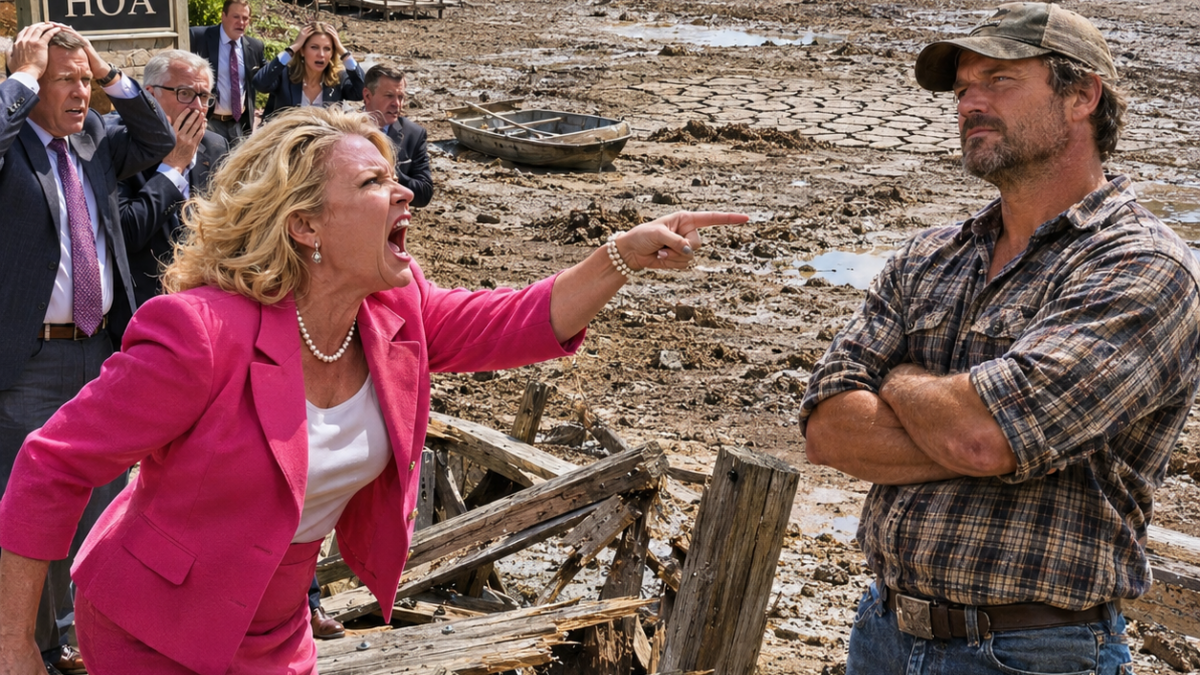
PART 2
Lake Cove Estates had started in 2006 when a Knoxville developer named Victor Palmetto bought one hundred twelve acres along the east shore.
Victor could sell anything.
He wore expensive golf shirts, sprayed himself orange enough to qualify as roadside construction equipment, and spoke about real estate the way televangelists speak about salvation.
He didn’t see Callaway Lake.
He saw inventory.
The first brochures showed drone photographs taken at sunset.
Mist rising.
Maples reflected on still water.
Stone houses with three-car garages.
Children paddling kayaks.
Couples holding wine glasses on decks.
The development promised a clubhouse, fitness room, community boat access, landscaped shoreline, and something Victor called the “Lakeside Promenade.”
It was a paved walking trail.
But “promenade” added sophistication.
And apparently sophistication added forty thousand dollars to a home price.
Before construction began, Victor negotiated with my father.
Dad did not mind neighbors using the water.
He fished every morning.
He liked children.
He believed a lake was better when somebody enjoyed it.
But he also knew exactly what we owned.
His attorney, Boone Satterfield, drafted a fifty-year recreational easement.
Simple.
Lake Cove residents could swim.
Fish.
Use nonmotorized boats.
That was it.
No structural alterations.
No motorboats.
No ownership interest in the lake bed.
No authority over the dam.
No right to control water level.
No right to modify spillway structures.
Paragraph Eleven mattered most:
The grantor retained all rights regarding water-level management, dam operation, and structural maintenance of impoundment infrastructure.
Boone told Dad:
“Ray, let them fish. Just don’t let them forget whose water they’re fishing in.”
Dad never forgot.
Neither did I.
Victor sold lots.
Homes went up.
For years, things stayed mostly peaceful.
Then Sandra Kesler moved in.
She was fifty-one.
Originally from Short Hills, New Jersey.
Before Tennessee, she had worked as a luxury interior-design consultant.
Sandra was beautiful.
I’m not saying that sarcastically.
She genuinely was.
Dark hair falling in deliberate waves.
Green eyes.
Perfect posture.
Expensive clothes.
She could walk into a room and make people look up before they knew why.
And she had spent enough of her life watching people react to her that she had begun confusing attention with agreement.
Three months after buying a house at Lake Cove, she ran for HOA president.
Won.
Within six months, she had fined a retired principal because his kayak rack violated an invented “lakefront visual standard.”
She ordered a family to replace a wildflower garden because it looked “too rustic.”
In Tennessee.
She sent a Vietnam veteran a four-page certified letter demanding that he shorten his flagpole by three inches.
When he refused, she doubled the fine.
She spent forty-two thousand HOA dollars importing ornamental grass recommended by a Nashville landscape architect.
The grass died in the first real winter.
So Sandra ordered the same grass again.
That died too.
She blamed the landscaper.
People laughed privately.
Nobody challenged her publicly.
Sandra noticed my bridge during one of her monthly promenade inspections.
I wasn’t there.
Two days later, I received a letter printed on cream card stock thick enough to stop small-caliber ammunition.
Gold HOA logo.
Formal heading:
**NOTICE OF VISUAL IMPAIRMENT**
I read that twice.
According to Sandra, my bridge was an “unapproved structure affecting the community aesthetic corridor.”
It “significantly degraded the premium lakefront experience.”
I had thirty days to remove or replace it with something “consistent with community visual harmony.”
Failure:
Two hundred dollars a day.
I showed Claire.
She adjusted her reading glasses.
“Visual impairment?”
“That’s what it says.”
“She means she can see it.”
“Apparently.”
Claire looked out toward the lake.
“It’s ugly.”
“Thank you.”
“Always has been.”
“It works.”
“That also describes you.”
I folded the letter.
“Her HOA has no jurisdiction.”
Claire returned to grading chemistry lab reports.
“I know.”
“She knows too.”
Claire looked up.
“No.”
“What?”
“She doesn’t know.”
“She has an easement.”
“She has a copy of an easement.”
Claire tapped her red pen against the table.
“That is not the same as understanding one.”
She was right.
I drove to the HOA office the next morning.
Sandra had turned one of the original model homes into an administrative office.
Granite counters.
Recessed lighting.
White flowers.
The lobby smelled like somebody had detonated a scented candle store.
I carried three things.
My deed.
Survey.
Certified copy of the recreational easement.
Sandra met me in a conference room overlooking the lake.
She wore a white linen blazer.
I wore work boots.
That difference seemed to matter to her.
“Mr. Callaway.”
“Ms. Kesler.”
She smiled.
“What can I do for you?”
“You can withdraw this.”
I slid the violation notice across the table.
She barely looked.
“The bridge has generated several complaints.”
“From whom?”
“The board.”
“That’s not what I asked.”
She crossed one leg over the other.
I placed the deed on the table.
“My bridge sits on Callaway property.”
Then the survey.
“Your HOA boundary stops here.”
I pointed.
“East shore.”
Then the easement.
“You have recreational access.”
Sandra smiled.
“Yes.”
“Swimming. Fishing. Nonmotorized boating.”
“Yes.”
“No bridge authority.”
She leaned back.
“Mr. Callaway, this community was marketed as premium lakefront living.”
“That doesn’t change property lines.”
“The bridge is visible from our promenade and fourteen showcase lots.”
“So?”
“It resembles something from a Depression-era logging camp.”
“That sounds about right.”
Her smile disappeared.
I continued.
“The bridge crosses the spillway discharge channel.”
“I’m aware.”
“No, ma’am. You’re looking at it. That is different from understanding it.”
Her eyes narrowed slightly.
I pointed through the window toward the dam.
“That dam creates the lake your houses are built around.”
“I understand what a dam is.”
“Good.”
“The bridge allows direct access to the west-side controls.”
“That can’t be the only access.”
“It isn’t.”
She smiled as though she had won something.
“The alternative is four miles round-trip over an unpaved service road that becomes nearly impassable after heavy rain.”
“Then use the road.”
“No.”
“Excuse me?”
“I inspect that dam monthly.”
“Then drive.”
“During a developing failure, four miles matters.”
Sandra tilted her head.
“Mr. Callaway, you’re being dramatic.”
That word irritated me more than I expected.
I had stood on failing embankments while evacuation sirens sounded below.
People who have never seen water take a building apart often think caution is drama.
I leaned forward.
“If that bridge is removed, dam inspection access is compromised.”
She folded her hands.
“If the dam cannot be inspected appropriately and the state becomes concerned, regulators can require a controlled drawdown.”
She looked bored.
“Do you know what that means?”
“I’m sure you’ll tell me.”
“It means lowering the lake.”
Her gaze shifted briefly toward the water.
“How much?”
“That depends on the safety problem.”
“Are you threatening the community?”
“No.”
I pointed to the documents.
“I’m informing you.”
Sandra looked at my hands.
There was dirt under one fingernail from replacing a valve that morning.
Then at my boots.
Then back at me.
“Mr. Callaway, I appreciate your attachment to your little bridge.”
Little bridge.
I said nothing.
“But property values are affected by what residents see.”
“Your residents can close their curtains.”
Her smile vanished completely.
“The board has spoken.”
“Your board does not own my bridge.”
“Thirty days.”
I left the deed, survey, and easement on the table.
She did not open them.
Later, one of the board members told me she used the easement as a coaster for sparkling water.
When I got home, Claire was at the kitchen table.
I told her everything.
She listened.
Then removed her glasses.
“She’s going to touch that bridge.”
“Yes.”
“She’s going to actually demolish it.”
“I think so.”
“What are you going to do?”
I looked toward the lake.
“Let her.”
Claire stared.
“And then?”
“Open the gates.”
Her eyebrows lifted.
“How far?”
“Fourteen feet if state inspection confirms the guide walls require submerged repair.”
“How long?”
“About seven days at controlled release.”
She understood immediately.
Claire had lived with an engineer too long.
“Every dock will be sitting in mud.”
“Yes.”
“Anything else?”
“I’ve been watching their shoreline.”
She waited.
“Some of those docks are built beyond easement rights.”
“How many?”
“At least thirty.”
“And the septic?”
I looked at her.
Claire already knew.
Downstream bacteria readings had been elevated for years.
Nothing catastrophic.
Enough to bother me.
“Could be several systems.”
Claire picked up her glasses.
“Document everything.”
“I already am.”
She put them back on.
“Good.”
Then she looked toward the lake.
“I swim in that water, Ev.”
“I know.”
“If there’s sewage in it…”
Her red pen stopped above the paper.
“I want somebody paying attention.”
Sandra escalated.
Second notice.
Bridge was now a “community safety concern.”
Apparently children could see it from a playground a quarter-mile away behind a hill.
Third notice.
HOA attorney.
Whitmore and Dahl.
Fourteen days to comply.
Threatened civil action for “aesthetic nuisance.”
I responded to every letter.
Certified mail.
Return receipt.
Deed.
Survey.
Easement.
Dam registration.
My inspection history.
Army Corps background.
Relevant state dam-safety provisions as described in the source.
I wrote plainly:
Removal of the bridge would interfere with critical maintenance access.
Unauthorized demolition could damage the spillway channel.
Any resulting dam-safety concern could require state inspection and controlled drawdown.
I wanted no ambiguity.
Sandra answered my third certified letter by email.
One line.
**We’ll handle it from here.**
I printed it.
Date.
Time.
File.
Claire read it.
“She’s not even smart enough to be scared.”
“She thinks I’m bluffing.”
“Are you?”
“No.”
Three weeks later, Claire and I were driving to Chattanooga to see our daughter Megan when my phone rang at 6:40 a.m.
Jesse Tate.
Eighty-one.
Retired tobacco farmer.
Lived above the spillway for fifty years.
Jesse never called before seven unless something was on fire.
“Ev.”
“What happened?”
“There’s a backhoe on your bridge.”
I looked at Claire.
She saw my face.
“What?”
I put Jesse on speaker.
“Tell me exactly.”
“Yellow Case machine. Two men. White Range Rover was here earlier.”
“Bridge still standing?”
“They’re cutting beams now.”
I could have stopped it.
One call to the sheriff.
I had certified letters.
Recorded deed.
Survey.
Proof of ownership.
Deputy Holt could have reached them before the first main beam came out.
I did not call him.
Instead, I called the Tennessee Department of Environment and Conservation.
I reported unauthorized demolition occurring on maintenance infrastructure associated with a registered private impoundment.
Dam registration number.
Location.
Spillway channel.
My credentials.
I documented the time.
Then hung up.
Claire looked ahead through the windshield.
“Done?”
“The bridge?”
“Yes.”
She gripped the steering wheel.
“No.”
“What?”
“The bridge is just the first thing.”
She drove.
We reached home about three hours later.
The bridge was gone.
Sixty years of timber.
White-oak beams my grandfather had cut himself.
Modern deck I rebuilt in 2019.
Steel bearing plates.
Everything shoved into a splintered pile beside the spillway.
The backhoe sat nearby.
Engine cooling.
Two workers were packing tools.
One saw me.
His face changed.
“You Callaway?”
“Yes.”
He looked at the other man.
“We were told the HOA owned this.”
“I know.”
“We had paperwork.”
“I know.”
“We didn’t know about the dam.”
“I know.”
I wasn’t interested in punishing the equipment operator.
He had been given a bad job order.
I was interested in damage.
And there was plenty.
They hadn’t simply removed the bridge.
The backhoe had torn out both abutments.
The bucket struck the concrete guide walls controlling the spillway discharge.
West wall:
Diagonal fracture.
Moisture seeping.
East wall:
Shifted downstream.
Roughly fifteen degrees off original alignment.
I stood there looking at it.
My mood changed.
Until that moment, part of me had viewed the drawdown as strategic.
Now it was necessary.
The shifted wall could redirect high-flow discharge toward the downstream toe.
The fracture could become a seepage pathway.
On an earth dam, water finding an uncontrolled route through soil is not cosmetic.
It is how failures begin.
I photographed everything.
Forty-seven images.
Twelve minutes of video.
Measurements.
Crack width.
Alignment.
Seepage.
Soil condition.
Then I conducted a preliminary assessment.
Calm language.
No anger.
Engineers don’t write “Sandra is an idiot” in inspection reports.
You write:
**Damage presents potential failure pathway requiring immediate professional evaluation.**
I found the work order on the ground.
**Ridgetop Equipment Rental**
Customer:
Lake Cove Estates HOA.
Attention:
Sandra Kesler.
Amount:
$2,000.
Instructions:
**Remove timber bridge structure at spillway crossing. Property owner has been notified and is non-compliant.**
I photographed that too.
Two thousand dollars.
That was the investment.
The return would be extraordinary.
The next morning, Sandra sent me a letter.
She congratulated me on “resolution of the aesthetic compliance matter.”
Thanked me for my cooperation.
I read it standing beside the destroyed spillway wall.
Then called Dale Pruitt.
State dam-safety inspector.
We had met at a conference several years earlier.
Dale was methodical.
Unimpressed by personality.
Exactly what I needed.
I explained the demolition.
Damage.
Preliminary assessment.
Then formally requested inspection.
“I think we’re going to need drawdown,” I said.
“How much?”
“Fourteen feet.”
Pause.
“That’s substantial.”
“I know.”
“You sure?”
“No.”
Another pause.
“That’s why I’m calling you.”
He respected that answer.
An engineer who claims certainty before inspection should find another profession.
Dale arrived the following week.
State truck.
Toolbox.
Clipboard.
No interest in HOA politics.
We walked the crest.
Examined guide walls.
Measured movement.
Checked downstream toe.
Inspected seepage.
Finally, Dale stood near the damaged wall.
“Ev.”
“Yeah?”
“This has to be repaired before spring runoff.”
“I agree.”
“We need access below normal pool.”
“I know.”
“Fourteen feet.”
I nodded.
Dale looked at me.
“You already calculated it.”
“I had a suspicion.”
He almost smiled.
Then we walked the eastern shoreline.
That was where things became much worse for Lake Cove.
First dock.
Large floating platform.
Boat lift.
Electrical connection.
Second dock.
Two levels.
Aluminum roof.
Ceiling fan.
Dale crouched.
“Permit?”
“No.”
“Corps authorization?”
“No.”
“Owner permission?”
“No.”
We continued.
Thirty-four docks.
Every one extended into my lake bed.
The recreational easement did not authorize permanent structures.
Dad had granted access to water.
Not the right to drill piles into our property.
Dale wrote.
Underlined.
We had reached Dock Seven when he asked:
“How long have you known?”
“Years.”
“Why didn’t you stop it?”
I looked at the houses.
“Dad liked letting people enjoy the lake.”
“That’s generous.”
“Maybe too generous.”
Dale nodded.
“Generosity needs paperwork.”
“Apparently.”
Then came the water-quality problem.
For years, monitoring downstream had shown elevated coliform bacteria.
Not enough for me to prove source.
Enough to suspect septic leakage.
With the shoreline about to drop fourteen feet, that evidence would stop hiding.
I drove the east side with topographic maps.
Twelve houses stood out.
Their recorded septic leach fields should have remained far enough from the normal pool line.
Actual drainage patterns suggested otherwise.
Limestone changes things.
Wastewater can move laterally.
Claire had been swimming there.
Families.
Children.
People had eaten fish from that lake.
I called Lucas Satterfield.
Boone’s son.
Same family law office.
Same habit of going quiet when something interested him.
“Lucas.”
“What happened?”
“Sandra happened.”
“That sounds expensive.”
“It will be.”
I explained.
Bridge.
Dam.
Docks.
Septic.
Fourteen-foot drawdown.
Silence.
Then a low whistle.
“My father used to do that.”
“I know.”
“Call the EPA.”
“I expected you to say that.”
“Unpermitted structures in jurisdictional waters on private land plus potential wastewater issues?”
“Yes.”
“Ev.”
“Yeah?”
“She picked the wrong bridge.”
“She did.”
My file grew into three banker’s boxes.
Deed.
Survey.
Easement.
Paragraph Eleven highlighted.
Sandra’s notices.
My certified responses.
Email.
Work order.
Inspection report.
Photographs.
Video.
Then I remembered one more thing.
Trail camera.
I had installed it near the dam crest years earlier to monitor wildlife and unauthorized access.
I pulled the card.
There it was.
6:20 a.m.
Backhoe arrives.
Workers.
Chainsaws.
Then 7:15.
White Range Rover.
Sandra steps out.
Ivory blouse.
Linen pants.
Walks toward the demolition.
At 7:18, she lifts her phone.
Frames the wrecked bridge.
Takes a photograph.
Smiling.
That mattered.
She had not simply authorized a job from an office.
She had been present.
She saw where it was.
Saw the spillway.
Saw the dam.
Saw the Callaway property signs.
And smiled.
Lucas filed suit.
Trespass.
Destruction of private property.
Damage to dam-safety infrastructure.
Bridge replacement.
Dam-related losses.
Legal costs.
Claim:
$185,000.
Then TDEC issued the formal drawdown order.
Fourteen feet.
Two feet per day.
Copied to county emergency management.
Copied to Lake Cove HOA.
EPA opened its own inquiry into shoreline structures.
The letters started arriving.
Sandra’s world changed quickly.
One Thursday afternoon she called me.
First direct phone call she had made since the bridge fight began.
“Mr. Callaway.”
“Ms. Kesler.”
“I received some extremely alarming government correspondence.”
“I imagine.”
“The state is saying you intend to drain the lake.”
“No.”
Pause.
“No?”
“The state ordered a drawdown.”
“You requested it.”
“I requested inspection.”
“You knew this would happen.”
“I suspected.”
“You manipulated the process.”
I looked at Claire across the kitchen.
She was listening.
“I warned you in writing three times that damaging the bridge could trigger a dam-safety response.”
Sandra’s voice sharpened.
“That lake is the central amenity of our community.”
“It is also water held by my dam.”
“You cannot destroy our property values over a bridge.”
“You damaged the dam.”
“It was an ugly timber structure.”
There it was.
Still.
After everything.
I closed my eyes.
“Sandra.”
“What?”
“You still think this is about the bridge.”
Silence.
“It isn’t.”
“What is it about?”
“Water.”
I hung up.
Monday morning in October, I walked to the gate controls.
The original manual wheel Harold installed in 1961 was still there.
Modernized in parts.
Same basic mechanism.
Claire stood a few yards away.
“You ready?”
“No.”
That was the truth.
Dropping a lake fourteen feet is not something a hydraulic engineer does casually.
There would be environmental consequences.
Fish stress.
Shoreline exposure.
Property impacts.
But structural repair required it.
State order required it.
The gate had to open.
I turned the wheel.
Steel moved.
Water pressed.
Then escaped.
Three thousand gallons per minute initially through the discharge channel.
White turbulence.
Roar.
The same force Sandra had dismissed as part of an ugly view.
For a long time, I stood watching.
Claire came beside me.
“Thinking about your grandfather?”
“Yes.”
“What would he say?”
“Probably ask why it took me so long to replace the bridge.”
“Sounds right.”
The lake began dropping.
Two feet per day.
By Wednesday:
Four feet.
The first floating docks settled onto mud.
Boat lifts hung awkwardly above shrinking water.
Boats trapped in aluminum frames.
Residents gathered along the promenade.
Phones out.
Confused.
Angry.
One man shouted across toward me:
“What are you doing?”
“State-ordered drawdown.”
“You’re ruining the lake!”
I pointed toward the dam.
“Repairing it.”
By Friday:
Eight feet.
The shoreline pulled forty yards away from some backyards.
Lakefront homes became mudfront homes.
The exposed bottom looked like an archaeological site documenting twelve years of bad decisions.
Tires.
Beer cans.
Fence wire.
A shopping cart.
Parts of patio furniture.
Someone had apparently thrown a treadmill into the lake.
Claire stood beside me looking through binoculars.
“Who throws a treadmill into a lake?”
“Someone who hates cardio.”
She laughed.
Then the smell arrived.
That was less funny.
Decades of submerged organic material met open air.
Sulfur.
Mud.
Rotting vegetation.
Residents closed windows.
Three families temporarily moved to a hotel.
Sandra’s Range Rover disappeared for several days.
By Sunday:
Twelve feet.
Twenty-six docks completely stranded.
Fish mortality began.
Bass.
Bluegill.
Catfish.
Crappie.
Wildlife biologists responded.
The receding shallows trapped fish faster than some could relocate.
By the time the event was documented, the estimated mortality reached around twelve thousand fish.
That part bothered me deeply.
I had anticipated fish stress.
Not that much.
I stood on the exposed bank watching biologists collect specimens.
Claire came beside me.
“You okay?”
“No.”
“This isn’t on you.”
“I opened the gates.”
“Under state order.”
“Fish don’t understand paperwork.”
She said nothing.
That was why I loved her.
She never tried to talk me out of feeling something just because the feeling was inconvenient.
Eventually she said:
“Repair the dam.”
“I will.”
“Restore the lake.”
“I will.”
“Then remember this part too.”
I nodded.
Revenge sounds clean in stories.
It rarely is.
Real consequences have collateral damage.
I was angry with Sandra.
The fish had done nothing.
That mattered.
Then the mud exposed something even worse.
Dark drainage streaks.
Below the twelve houses we had flagged.
Discolored channels.
Odor.
Septic effluent.
Water-quality teams collected sediment.
Twenty-eight samples.
The lab results were ugly.
Coliform concentrations in affected areas exceeded safe recreational contact levels by a factor of eleven.
Claire read the report twice.
Then set it down.
“We swam in that.”
“Yes.”
“Megan swam in that.”
“Yes.”
“Kids have been swimming in that.”
“Yes.”
Her jaw tightened.
“Now I’m angry again.”
The developer’s original plans placed septic fields forty feet from water.
Actual installations came far closer in several places.
Some as close as roughly twelve feet.
Cut corners.
Bad oversight.
Years of seepage.
The lake had hidden it.
The drawdown exposed it.
Home listings changed almost immediately.
Three properties went on the market.
Nobody used the word “lakefront.”
One described:
**Mountain community with pond views.**
Pond.
Claire showed me that listing.
“Three hundred forty acres becomes a pond fast when somebody’s trying to sell a house.”
“Language is flexible.”
“So are property values.”
The emergency community meeting happened the second Thursday after target drawdown.
Same Lake Cove clubhouse.
Granite.
Recessed lights.
Floor-to-ceiling lake-view windows.
Except there was barely a lake outside.
Mud flat.
Stranded docks.
Exposed bottom.
The sulfur odor was faint but noticeable even indoors.
One hundred twelve homeowners packed the room.
Sandra stood at the front.
Charcoal blazer.
Black silk blouse.
Hair pulled tight.
She looked controlled.
But not comfortable.
She read a prepared statement.
“Temporary water-management activities.”
“Productive regulatory dialogue.”
“Community resilience.”
She did not say:
Bridge.
Backhoe.
Dam damage.
Septic.
Unpermitted docks.
My name.
Then Paul Weissman stood.
Retired attorney.
Third row.
Quiet man.
He adjusted his glasses.
“Sandra.”
She stopped.
“Yes, Paul?”
“I’d like to make sure I understand the sequence.”
The room quieted.
“You ordered demolition of a bridge.”
“That bridge was a compliance issue.”
Paul raised one hand.
“Please.”
Sandra stopped.
“The bridge was on private Callaway property.”
“It affected our community—”
“Private property?”
Pause.
“Yes.”
“Connected to the dam?”
“It crossed a channel.”
“The dam that creates the lake?”
Sandra’s jaw tightened.
“Yes.”
“The demolition damaged the spillway?”
“That is disputed.”
“No.”
Paul held up the state report.
“It is not.”
Several residents murmured.
Paul continued.
“State inspection then required a fourteen-foot drawdown.”
“Yes.”
“Thirty-four docks have now been identified without proper authorization.”
Sandra looked toward the board.
Paul continued.
“Twelve septic systems appear to have contaminated the water.”
“That is a developer issue.”
“Children were swimming in that water.”
“I did not install septic systems.”
“No.”
Paul’s voice remained calm.
“But you did sign the bridge demolition work order that triggered the inspection exposing them.”
Sandra’s eyes narrowed.
“This is an unfair characterization.”
Paul looked around.
“EPA financial exposure, state penalties, remediation, dam repair, dock removal, civil litigation…”
He glanced at a paper.
“Potential total approaching two million dollars.”
Silence.
Then he looked directly at Sandra.
“Is that where we are?”
She stood straighter.
“The bridge situation was handled pursuant to aesthetic compliance authority.”
Paul actually laughed.
Not loudly.
Disbelieving.
“I’m an attorney.”
Sandra stared.
“I know what jurisdiction means.”
The room shifted.
“Your HOA has jurisdiction over Lake Cove property.”
He pointed toward the window.
“That bridge was not Lake Cove property.”
Sandra started to speak.
Paul continued.
“You had no more legal right to demolish that bridge than you had to demolish a county courthouse because you disliked the architecture.”
Someone clapped.
Then a woman in the second row stood.
Tears.
“My daughter had a skin infection last summer.”
Sandra looked at her.
“We thought it was from swimming.”
The woman pointed toward the exposed septic stains.
“Was that why?”
“I’m not a doctor.”
“My children were swimming in sewage.”
Her voice broke.
“You were busy sending me letters about my patio umbrella while nobody was checking the septic systems.”
That opened the room.
People stood.
Questions.
Anger.
Who approved docks?
Who told homeowners permits existed?
Where were environmental reviews?
Why did the HOA threaten residents over minor aesthetics but ignore actual infrastructure?
Sandra tried to restore order.
Nobody listened.
A no-confidence vote was called.
Ninety-seven to eight.
Sandra Kesler was removed as HOA president.
She walked out.
Pearl earrings catching the decorative porch light.
Lucas waited beside a sheriff’s cruiser.
Deputy Wayne Holt held an envelope.
Civil lawsuit.
Sandra was served in front of residents leaving the meeting.
For once, nobody looked at her because she was beautiful.
They looked at the paperwork.
And behind her, the empty lake.
Then came the bills.
TDEC:
$395,000.
Dam-safety interference.
Unauthorized work in protected infrastructure.
Environmental damage to the discharge channel.
EPA:
$345,000 in Clean Water Act-related penalties associated with the thirty-four unauthorized docks.
All docks removed.
Lake bed restored.
Estimated dock remediation:
$275,000.
Septic systems:
Replacement.
Excavation.
Sediment cleanup.
$215,000.
Dam and spillway:
New guide walls.
Channel restoration.
Engineering.
$385,000.
My civil case:
$185,000 settlement.
Bridge.
Trespass.
Property damage.
Legal costs.
Associated damages.
Total financial exposure:
Approximately $1.8 million.
From a two-thousand-dollar demolition order.
Claire sat at our kitchen table with a calculator.
“Two thousand to one point eight million.”
“Yes.”
“That’s impressive.”
“Not in the good way.”
She pressed buttons.
“Nine hundred times.”
“I know.”
She looked at me.
“Your grandfather would’ve hated Sandra.”
“He didn’t hate many people.”
“He would’ve made an exception.”
Sandra became personally responsible for part of the civil judgment.
Her husband, Greg, filed for separation months later.
The Range Rover was sold.
Vanity plate disappeared.
Last I heard, Sandra moved into a rental and took work with a home-staging company.
There was something almost poetic about it.
The woman who destroyed critical infrastructure because it offended her aesthetic standards was now paid to arrange decorative pillows for houses other people owned.
I didn’t celebrate her marriage ending.
Didn’t celebrate her losing the Range Rover.
Didn’t celebrate the embarrassment.
Those were personal consequences.
My concern was the lake.
Paul Weissman became new HOA president.
His first act was coming to my house.
No clipboard.
No violation letter.
Bottle of Blanton’s bourbon.
“Peace offering.”
I looked at the bottle.
“That’s too expensive.”
“I survived law school.”
“So?”
“I know what apologies cost.”
I let him in.
Claire brought glasses.
Paul stayed standing.
“Mr. Callaway—”
“Ev.”
“Ev.”
He took a breath.
“Lake Cove owes you an apology.”
“Yes.”
“The board exceeded its authority.”
“Yes.”
“The residents should have questioned it sooner.”
“Yes.”
He smiled slightly.
“You’re not making this easier.”
“I’ve had a long month.”
“Fair.”
He handed me a letter.
Formal apology.
No excuses.
Then:
“I want an environmental audit.”
“Good.”
“Everything.”
“Better.”
“Docks. Septic. Shoreline. Easements. Boat access. Stormwater.”
I looked at him.
“You understand that might be expensive.”
He looked through the window toward the mud.
“So was ignorance.”
That answer earned my respect.
The audit took four months.
Two hundred pages.
Paul called it:
“The most expensive document I have ever read, and I went to law school.”
Every unauthorized dock came out.
Homeowners who wanted new structures had to apply properly.
Written consent from me.
County permits.
State review.
Federal authorization where applicable.
Eight qualified.
Eighty-six did not.
The unauthorized boat launch was removed.
Septic systems were replaced.
Contaminated soil excavated.
Lake-bed areas restored.
Then the dam repair began.
The contractor demolished damaged guide walls.
Rebuilt both.
Reinforced.
Realigned.
Restored the discharge channel.
One afternoon, the project superintendent stood beside me looking at a section of Granddad’s original concrete.
“This was poured in 1961?”
“Yes.”
“Held sixty-two years?”
“Yes.”
“No cracking?”
“Not until the backhoe.”
He shook his head.
“Who designed it?”
“My grandfather.”
“Engineer?”
“Sawmill operator.”
The man laughed.
“He knew more about concrete than half the engineers I work with.”
“He knew water.”
“Sometimes that’s better.”
When repairs finished, the state cleared us to close the gates gradually.
Callaway Lake began refilling.
Slow.
Three months.
Water climbed inch by inch.
Mud disappeared.
Exposed rock vanished.
Vegetation went underwater.
The lake covered its wounds.
Not erased.
Covered.
Fish restoration took longer.
We worked with state biologists.
Restocking plans.
Habitat.
Water quality.
Claire became obsessed with the bacteria results.
Every new report landed on the kitchen table.
“What is it?”
I would ask.
“Clean.”
“How clean?”
“Clean enough that I’m considering swimming again.”
“That’s reassuring.”
“Don’t get excited.”
Eventually, bacterial counts returned to safe levels.
The septic fixes worked.
One warm afternoon the following summer, Claire stood at the dock in a swimsuit.
I looked at her.
“You sure?”
“No.”
“That makes two of us.”
She stepped into the lake.
Then turned.
“You coming?”
“I’m observing.”
“You spent twenty-eight years telling people water has to be respected.”
“Yes.”
“Respect it from inside.”
I jumped in.
Cold.
Clean.
Claire surfaced laughing.
That sound did more for me than every judgment and settlement combined.
Then I built the new bridge.
I could have made it elegant.
Paul suggested stone veneer.
Sandra would probably have approved from wherever she was.
I chose steel.
I-beams.
Reinforced concrete abutments.
Properly engineered bearings.
Wide enough for maintenance equipment.
Designed for loads Granddad never imagined.
Not pretty.
Claire saw it for the first time.
Hands on hips.
“Oh, Ev.”
“What?”
“It’s hideous.”
“Thank you.”
“That wasn’t praise.”
“Function beats form.”
She smiled.
“That still explains your wardrobe.”
On the east abutment, I installed a steel plaque.
**CALLAWAY BRIDGE
ORIGINAL CROSSING 1961
REBUILT AFTER 2024 SPILLWAY RESTORATION
SOME STRUCTURES EXIST FOR A REASON**
Claire read it.
“That’s subtle.”
“I’m an engineer.”
“Right.”
“Subtle is for architects.”
Every morning now, I cross that bridge.
Inspection kit.
Same twenty-pound bag.
Seepage gauges.
Crack card.
Probe.
Logbook.
I check gates.
Walls.
Discharge.
Downstream toe.
Crest.
And every time I step onto the new bridge, I think about the old one.
Granddad’s white oak.
Dad walking it.
My own boots over those planks.
Sixty years.
Gone in fifty-two minutes because a woman decided it ruined her view.
I also think about what followed.
That is more complicated.
People love the simple version.
HOA destroyed my bridge.
I drained their lake.
They lost $1.8 million.
Perfect revenge.
But real life is rarely that clean.
The drawdown exposed contamination that needed exposing.
Good.
It forced removal of illegal structures.
Good.
It made the dam safe.
Necessary.
It also killed thousands of fish.
It damaged property values for people who had no idea their board was acting illegally.
It created months of conflict.
Those things were real too.
I don’t regret requesting inspection.
I don’t regret complying with the drawdown order.
A damaged earth dam is not something you ignore to protect home prices.
But I refuse to pretend the consequences were entertainment.
Water doesn’t know who deserves what.
That is one reason I spent twenty-eight years respecting it.
One evening, after the lake had fully refilled, Paul walked across the bridge.
He stopped near the center.
Looked at the water.
“You know what’s strange?”
“What?”
“Before all this, I never thought about the dam.”
“Most people don’t.”
“I bought a lake house.”
“No.”
He looked at me.
“What?”
“You bought a house beside a lake.”
“Difference?”
“You didn’t buy the lake.”
Paul smiled.
“Fair.”
He leaned on the railing.
“Sandra never understood that.”
“No.”
“I’m not sure any of us did.”
“That’s the problem with amenities.”
“What?”
“When people get used to something, they start believing access equals ownership.”
Paul nodded slowly.
“That should be in the new resident packet.”
“Put it in bold.”
He laughed.
Lake Cove changed.
Not dramatically.
The houses were still expensive.
The promenade still existed.
People still cared too much about outdoor furniture.
But the community became quieter.
More careful.
New board meetings included actual documents.
If somebody proposed a rule, Paul asked:
“Where is the authority?”
If somebody proposed work near the lake:
“Who owns the land?”
If somebody said permits were handled:
“Show me.”
That was progress.
The Vietnam veteran with the flagpole got an apology.
His fine disappeared.
The retired principal put his kayak rack back exactly where Sandra had ordered it removed.
Paul offered to waive review.
The man said:
“No.”
Paul looked confused.
“I want the review.”
“Why?”
“Because I want the approval in writing.”
Smart man.
Claire returned to tutoring chemistry.
She told the bridge story to her students sometimes.
Not the revenge version.
The scientific version.
Systems.
Pressure.
Stored energy.
Cause and effect.
One day a student asked:
“So the lady broke a bridge and the whole lake disappeared?”
Claire came home annoyed.
“What?”
“They learned the wrong lesson.”
“What lesson did you want?”
“That systems are interconnected.”
“And what did they learn?”
“Don’t mess with Mr. Callaway’s bridge.”
I smiled.
“That’s also useful.”
She threw a dish towel at me.
The financial consequences stretched for years.
Lake Cove’s insurance increased.
Assessments rose.
Some homeowners sued the former board.
Several lawsuits settled quietly.
Property prices eventually recovered once the water was restored and contamination corrected.
Ironically, the lake became healthier than it had been before the demolition.
Water testing became routine.
Docks were limited.
Shoreline buffers improved.
Septic maintenance schedules were enforced.
People stopped dumping random junk because the drawdown had shown everyone exactly what lake beds remember.
That mattered.
A lake hides things.
Until it doesn’t.
One summer, Megan brought our grandchildren down.
The youngest, Ben, was seven.
He stood on the new bridge looking into the spillway.
“Grandpa?”
“Yeah?”
“Did a bad lady really break the old bridge?”
Children make everything simple.
“She made a bad decision.”
“Why?”
“She thought it was ugly.”
Ben looked at the new steel bridge.
“This one’s ugly too.”
“Runs in the family.”
He considered that.
“Did you drain the lake because you were mad?”
I looked toward Claire.
She was watching.
Good question.
“No.”
“But Mom said you did.”
“I opened the gates.”
“So yes.”
“I opened them because the dam was damaged and the state required the lake level lowered for repairs.”
“Were you mad?”
“Yes.”
“Did you like that her docks got stuck?”
Claire covered a laugh with a cough.
I looked at Ben.
“A little.”
He smiled.
“I knew it.”
Then he ran toward Claire.
Children also understand honesty.
That evening, I thought about the question.
Was it revenge?
Partly.
I would be lying if I said there was no satisfaction watching Sandra’s aesthetic lakefront turn into mud after she destroyed the bridge for aesthetics.
But revenge did not create the state order.
It did not create the illegal docks.
It did not place septic systems too close to the water.
It did not break the guide walls.
Sandra created the condition.
Regulators followed evidence.
Water followed gravity.
The rest was consequence.
There is an important difference.
If I had drained the lake simply to punish homeowners, I would have been no better than Sandra.
She believed power existed to enforce personal preference.
I believed authority needed a purpose.
Dam safety gave it one.
Repair gave it one.
Public health gave it one.
That is why documentation mattered.
Three certified warnings.
Property records.
Inspection history.
Trail-camera footage.
Work order.
State assessment.
No ambiguity.
My anger never needed to become evidence because the facts were already enough.
Years after the lawsuit ended, I received an envelope.
No return address I recognized.
Inside:
A handwritten letter.
Sandra.
I almost threw it away.
Claire said:
“Read it.”
“Why?”
“Because you’ll wonder otherwise.”
She knew me.
The letter was short.
Sandra did not apologize perfectly.
People rarely do.
She wrote that she had believed she was protecting property values.
That she trusted advisors who reinforced her assumptions.
That she did not understand dam safety.
That she had lost nearly everything after the case.
Then one sentence:
**I understand now that I had no right to touch that bridge.**
I read it twice.
Claire watched.
“Well?”
“What?”
“How does it feel?”
“Late.”
“That isn’t what I asked.”
I folded the letter.
“Better than I expected.”
“Are you going to answer?”
“No.”
“Why?”
“She doesn’t need anything from me.”
“And you?”
I looked toward the lake.
“I don’t need anything from her either.”
Claire smiled.
“That sounds healthy.”
“Don’t get used to it.”
I put the letter in the file.
Not because I hated Sandra.
Because it completed the record.
Engineer.
Always.
Granddad’s old bridge timbers didn’t all disappear.
I saved one section of white oak from the demolition pile.
Weathered.
Dark.
Scarred by the backhoe.
I cut a piece about three feet long.
Mounted it inside the maintenance shed.
Under it:
**1961–2024**
No message.
No insult.
No Sandra.
Just dates.
Sometimes simple records say enough.
Hatcher County changed too.
The planning department reviewed lake developments more carefully.
New waterfront projects got extra attention.
Developers complained.
Regulators ignored them.
Victor Palmetto had long since retired to Florida, but his shortcuts remained.
It took decades for the true cost to arrive.
That is another thing engineering teaches you.
Bad decisions can remain invisible for years.
A poorly compacted layer.
A missing permit.
A drainage system routed incorrectly.
A septic field installed twelve feet from a shoreline.
Nothing happens.
Then rain.
Pressure.
Time.
Eventually the bill comes.
Sandra simply opened the envelope.
One autumn morning, I crossed the bridge before sunrise.
Fog on the lake.
Maples red.
Water like dark glass.
Claire came behind me carrying two coffees.
“You forgot this.”
“I was coming back.”
“Liar.”
She handed me one.
We stood on the dam crest.
From there, Lake Cove’s east shore looked peaceful.
Eight permitted docks.
Modest.
No two-story platforms.
No floating bars.
No electrical jungle.
The promenade lights were turning off as morning arrived.
Claire leaned against the railing.
“Pretty.”
“Yeah.”
“Even with your bridge.”
“Especially with my bridge.”
She laughed.
Then:
“Do you miss working for the Corps?”
“Sometimes.”
“What part?”
“The people.”
“Not emergencies?”
“No.”
“Floods?”
“No.”
“Three in the morning phone calls?”
“Definitely no.”
She pointed toward the dam.
“You still inspect one.”
“Bad habit.”
“You still keep three logbooks.”
“Four now.”
“You still talk about hydraulic head at dinner.”
“That’s romance.”
“No.”
I took a sip.
“Retirement suits you.”
She looked across the lake.
“It does.”
We stood quietly.
I thought about Granddad.
He built the dam because he wanted electricity for a sawmill.
He could never have imagined million-dollar houses lining the east shore.
HOA boards.
EPA letters.
Instagram.
Two-story aluminum docks.
He certainly could not have imagined a woman in linen pants ordering a backhoe to demolish his bridge because it offended “visual harmony.”
But I knew exactly what he would understand.
Water.
Property.
Maintenance.
Responsibility.
If you build something that holds weight, maintain it.
If you control water, respect it.
If somebody warns you three times, maybe read the paperwork before you send heavy equipment.
The new bridge did not improve property values.
It did not appear in brochures.
Nobody posed beside it for real-estate photographs.
Good.
Its purpose was not to be admired.
Every month, I crossed it.
Every month, the inspection log got another entry.
Guide walls stable.
No active seepage.
Discharge normal.
Gate operation normal.
Crest settlement within limits.
Water quality good.
Boring.
Boring is wonderful when you manage a dam.
The lake refilled.
Fish returned.
Children swam.
Claire swam.
The shoreline recovered.
People eventually stopped talking about Sandra.
That may have been the most complete consequence of all.
For a while, she had been the center of Lake Cove.
Every rule.
Every meeting.
Every letter.
Everything revolved around her preferences.
Then one day she was gone.
The water remained.
The dam remained.
The community remained.
The bridge returned.
The system didn’t need her.
People who confuse authority with identity rarely understand that.
Titles disappear.
Infrastructure stays.
One afternoon Paul called.
“Ev.”
“What?”
“We have a new resident.”
“Congratulations.”
“She wants to install a dock.”
“Application?”
“Yes.”
“Survey?”
“Yes.”
“Environmental review?”
“Yes.”
“Design?”
“Small floating platform. No roof.”
“Send it.”
Pause.
“That’s it?”
“What do you want?”
“I’m still getting used to reasonable.”
“Enjoy it.”
He laughed.
A week later, I approved the dock.
Written consent.
Conditions.
Proper setback.
Permit process.
The owner came to thank me.
“You could have just said no.”
“Yes.”
“Why didn’t you?”
“Because access isn’t the problem.”
She looked confused.
“Entitlement is.”
That summed up the entire story better than any lawsuit.
Dad granted access.
Sandra converted access into ownership.
The residents built docks because they were told permission existed.
Nobody checked.
Then an ugly bridge became the object that finally forced everyone to check.
I still find that funny.
Claire says I shouldn’t.
“People lost a lot of money.”
“I know.”
“Fish died.”
“I know.”
“Then why smile?”
“Because she called it visual impairment.”
Claire tried not to laugh.
Failed.
“She did.”
“Over a bridge.”
“I know.”
“And now there’s a steel bridge twice as visible.”
“That part is funny.”
Exactly.
I made no attempt to hide the replacement.
No decorative stone.
No faux-wood cladding.
Steel.
Concrete.
Railings.
Functional.
From the promenade, it is obvious.
A real piece of infrastructure.
Paul once asked whether we could paint it dark green to blend into the trees.
I stared at him.
He immediately raised both hands.
“Forget I asked.”
Progress.
The final settlement payments arrived years ago.
I used some of the money to establish a dam-maintenance reserve.
Not legally required.
Smart.
Separate account.
Annual inspection funds.
Emergency excavation costs.
Gate replacement.
Instrumentation.
Claire joked:
“You turned revenge money into a savings account.”
“I’m sixty-something.”
“That is the most sixty-something thing you could have done.”
“What would you buy?”
“A boat.”
“We already have one.”
“A prettier bridge.”
“Get out.”
She kissed me.
Life became ordinary.
That is where satisfying endings actually live.
Not courtrooms.
Not dramatic meetings.
Ordinary mornings after the fight is over.
Coffee.
Inspection.
Claire complaining about my boots.
Megan calling.
Grandkids.
Bass breaking the surface near sunset.
A properly functioning spillway.
An HOA president who emails before doing anything near the water.
One evening, I sat on the bridge rail while Claire walked back toward the house.
I looked east.
Lake Cove lights reflected in the water.
For years after Sandra’s demolition, I thought of the event whenever I looked at that shoreline.
Then one day, I realized I hadn’t thought about her in months.
That surprised me.
Anger feels permanent while you are inside it.
It isn’t.
Consequences do their work.
Then time takes over.
The plaque on the bridge catches morning sun.
The old beam sits in the maintenance shed.
The file boxes remain in my office.
Sandra’s letter is inside.
But none of those things control the present.
The water does what water does.
Moves downhill.
Fills low places.
Reflects light.
Finds equilibrium.
Maybe people eventually do the same.
The $2,000 work order that started everything is framed in my office now.
Claire hates that.
“It looks petty.”
“It’s evidence.”
“The case is over.”
“Historical document.”
“You enjoy looking at the number.”
I smiled.
“Two thousand.”
“One point eight million.”
“Remarkable multiplier.”
“You’re impossible.”
Maybe.
But the number is a reminder.
Not of revenge.
Of scale.
A tiny action can trigger enormous consequences when it touches a system someone doesn’t understand.
Sandra thought she was removing forty feet of ugly timber.
She was interfering with dam access.
Dam access affected inspection.
Demolition damaged spillway walls.
Damage triggered regulatory review.
Review required drawdown.
Drawdown exposed unauthorized docks.
Exposed shoreline revealed septic contamination.
Regulators arrived.
Permits were examined.
Fines followed.
Repairs followed.
Lawsuits followed.
None of those things existed in isolation.
That is engineering.
Systems.
Connections.
Inputs.
Outputs.
Cause.
Effect.
Sandra understood aesthetics.
She did not understand systems.
And she paid an extraordinary tuition fee to learn.
The last time I crossed the bridge before writing this story down, it was just after sunrise.
Inspection bag on my shoulder.
Claire behind me with coffee.
Water level normal.
Gate indicators green.
No abnormal seepage.
Guide walls dry.
Everything boring.
Perfect.
I stopped midway.
Looked down at the spillway.
Claire nearly walked into me.
“What?”
“Nothing.”
“You stopped.”
“I was thinking.”
“Dangerous.”
I pointed at the steel beams.
“Granddad would hate how much this cost.”
“How much?”
“More than he paid for the original eighty-seven acres.”
Claire laughed.
“He would definitely hate that.”
“He’d like the load rating.”
“That sounds like him.”
We kept walking.
At the far abutment, I looked toward Lake Cove.
The promenade was empty.
Eight legal docks floated quietly.
A child’s kayak rested upside down near one house.
Morning mist lifted.
No mud.
No exposed septic channels.
No dead fish.
No backhoes.
Just water.
Clean water.
That was the part that mattered.
Sandra wanted a beautiful view.
In the end, after all the fines and destruction and remediation, she accidentally forced the community to earn one.
The lake was cleaner.
The shoreline was safer.
The docks were legal.
The dam had new guide walls.
My bridge was stronger.
And everybody understood the arrangement.
They could enjoy the lake.
They did not own it.
They could look at the bridge.
They could dislike it.
They could even call it ugly.
Nobody was going to touch it without asking.
Sometimes Claire and I sit on the dock at sunset.
She reads.
I pretend not to inspect things.
The water turns orange.
Bass jump.
A heron works the shallows.
The lake looks almost exactly the way it did before Lake Cove existed.
Those are the evenings when I think about Dad.
Granddad.
All the maintenance nobody sees.
All the quiet decisions that keep a system functioning.
People notice dramatic failures.
They rarely notice decades without one.
Granddad’s dam stood because somebody inspected it.
His bridge stood because somebody maintained it.
The lake existed because somebody understood that ownership comes with responsibility.
Sandra understood none of that.
She saw an ugly bridge.
That was all.
And maybe that is the simplest version of what happened.
She spent two thousand dollars destroying something she thought had no value because she judged it by appearance.
Then reality showed her what it had been carrying.
The bill was one point eight million dollars.
But the lesson was older than the dam.
Never confuse ugly with useless.
Never confuse access with ownership.
And never demolish a bridge until you understand what is on the other side.








