PART 2: HOA Karen Ordered My Dad’s Helipad Demolished—She Didn’t Know It Was FAA-Registered and Used by Air Ambulances
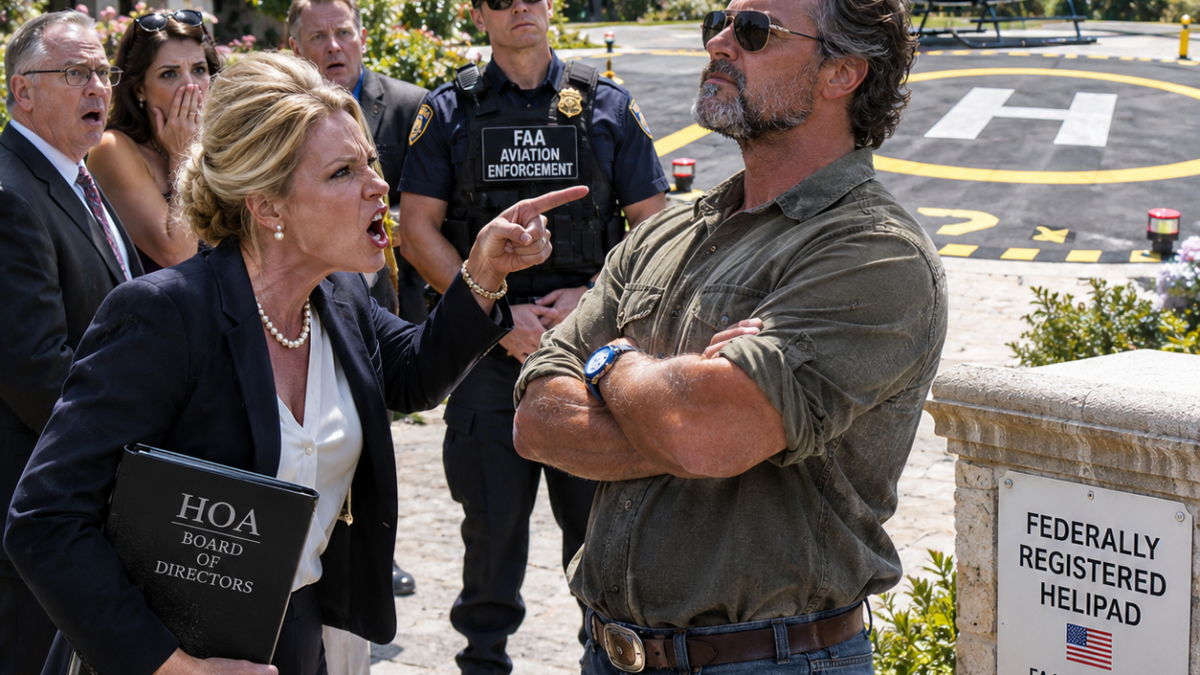
PART 2
Stone Canyon Estates did not exist when Dad built Randall Field.
It did not exist when the FAA assigned TS47.
It did not exist when Dad flew survey crews, sheriff’s deputies, ranchers, and emergency patients out of that concrete pad.
It did not even exist when Starflight began using the site for emergency medical landings.
The land on the south side of Randall Creek Road had belonged to the same ranch family for generations.
Cattle.
Hay.
Cedar.
Limestone.
Then the owner died.
His granddaughter lived in Houston and wanted nothing to do with fences, cattle guards, or maintaining two hundred acres.
Pinnacle Land Group bought the property.
By late 2020, what had been pasture became Stone Canyon Estates.
One hundred twenty-eight houses.
Limestone-veneer facades.
Smart-home systems.
Community pool.
Artificial-turf dog park.
Three-hundred-eighty-five-dollar monthly HOA dues.
The kind of neighborhood marketed with drone footage, golden-hour photographs, and phrases like **elevated Hill Country living**.
The first families moved in during the fall.
By spring 2021, the HOA elected its permanent board.
Brenda Hail won the presidency 47–12.
I did not vote.
I could not vote.
My land was outside Stone Canyon.
That distinction became important because Brenda behaved as though the subdivision had purchased not just two hundred acres, but every horizon visible from its windows.
She was thirty-eight.
Tall.
Honey-blonde hair.
Immaculate clothes.
Valentino heels to HOA meetings.
Pearl-white Range Rover Sport.
Custom vanity plate.
A leather portfolio embossed with the Stone Canyon crest.
And a gold charm bracelet with a diamond-covered pendant spelling:
**PRESIDENT.**
The first time Russell Vega told me about that bracelet, I assumed he was exaggerating.
Then I saw it.
He wasn’t.
Brenda had been divorced from a tech executive named Kyle Hail.
She got the house.
The SUV.
And apparently enough free time to turn an unpaid volunteer office into the central identity of her life.
She fined a retired teacher three hundred dollars over a garden gnome.
Sent a cease-and-desist letter to a twelve-year-old running a lemonade stand.
Objected to a veteran’s American flag because its size violated what she called “proportional exterior standards.”
Her newsletters referred to her in the third person.
**President Hail reminds residents…**
**President Hail has approved…**
**President Hail wishes to clarify…**
Russell once handed me a copy.
“You ever seen anybody write about herself like royalty?”
I read the opening paragraph.
“Maybe she has a staff.”
“She writes it herself.”
“That’s worse.”
“Much.”
For almost a year, Brenda left me alone.
Then on a Saturday morning in March 2022, I was inside the hangar checking the Bell 206 when I heard a horn.
Not a polite tap.
Three full seconds.
I walked down the gravel driveway.
Brenda sat behind the wheel of the Range Rover with the window down.
Her fingers rested over the wheel.
Sunglasses large enough to cover half her face.
She did not get out.
“Mr. Randall?”
“Cole.”
“I’m Brenda Hail.”
“I know.”
“President of Stone Canyon Estates.”
“I know that too.”
Something about my lack of surprise seemed to irritate her.
“I’m here on behalf of the community.”
“All right.”
“Several homeowners have raised concerns about your helicopter facility.”
She said *facility* like she meant sewage pond.
“It’s a registered heliport.”
“Yes, I understand it’s been there for a while.”
“Since 1982.”
Her smile stayed fixed.
“The community has changed.”
“Meaning?”
“We’re residential now.”
“You’re residential.”
She blinked.
“Families. Children. Property values.”
I waited.
“A commercial helicopter operation is not compatible with the lifestyle our residents purchased.”
“That sounds like something Pinnacle should have considered before building next to a heliport.”
The smile tightened.
“I’m sure we can work something out.”
“There’s nothing to work out.”
“Mr. Randall—”
“My land isn’t in Stone Canyon.”
“I understand that.”
“My operation predates your development by almost forty years.”
“I understand that too.”
“Then we’re done.”
The glacier smile remained.
“I’ll send you some information.”
She rolled the window up.
Drove away.
Four days later, the information arrived.
Four pages.
Heavy stationery.
Stone Canyon crest.
The letter asked me to “voluntarily decommission” Randall Field within ninety days.
Concerns listed:
Noise.
Safety.
Visual impact.
Property values.
And my favorite:
**QUALITY-OF-LIFE INCOMPATIBILITY.**
Linda—my ex-wife and Lily’s mother—once used to tell me military reports could make simple facts sound complicated.
Brenda had perfected the civilian version.
She could turn:
**I don’t like your helicopter**
into:
**quality-of-life incompatibility affecting community stakeholders.**
I filed the letter.
Did not answer.
Then another arrived.
And another.
Over the next eighteen months, Brenda sent eleven more.
Some from the HOA.
Two through an attorney named Patricia Kendrick.
Three certified.
The wording escalated.
Request.
Demand.
Final notice.
One called Randall Field:
**a relic from a different era.**
Another promised Stone Canyon would pursue:
**every available legal and regulatory channel.**
Then came a petition.
Seventy-one signatures.
I filed that too.
I had learned long ago that angry people reveal themselves in documents if you give them enough paper.
My concern started when she stopped limiting herself to me.
Bill Hadley called one afternoon.
Bill owned a ranch north of Johnson City and hired me for occasional aerial fence surveys.
“Cole.”
“Bill.”
“Got a woman calling my office.”
I already knew.
“Blonde?”
“Sounded blonde.”
I laughed despite myself.
“What’d she say?”
“That you’re operating an unlicensed helicopter facility and I should stop using you before I get named in a lawsuit.”
“She say who she was?”
“President of some neighborhood.”
“Stone Canyon.”
“That the one they built next to you?”
“Yes.”
Bill was quiet.
“Cole, is there anything wrong with your paperwork?”
“No.”
“Then why is she calling me?”
“Because she wants you to ask that question.”
Bill swore.
Two contracts paused while clients independently verified my credentials.
Eleven thousand dollars in delayed revenue.
That stopped being annoying.
That became interference with my livelihood.
Then the bureaucratic complaints started.
Nine noise complaints in four months.
County inspector Luis Padilla came out four times.
He brought the same calibrated sound meter every visit.
Takeoff reading at the property line:
72 decibels.
County limit:
80.
Fourth visit, Luis lowered the meter.
“Mr. Randall.”
“Cole.”
“I’ve been doing this fourteen years.”
“I’m sorry.”
He looked at me.
“For what?”
“You’ve had to drive out here four times.”
He laughed.
“I’ve never had anyone file this many complaints about an operation this far below the limit.”
“Can I quote you?”
“Officially?”
“No.”
“Then between you and me, this lady needs a hobby.”
Next came Code Enforcement.
Brenda claimed I was running an illegal commercial aviation business from residential land.
Inspector Maria Delgado reviewed the property zoning.
Rural residential.
Private aviation facilities permitted with proper compliance.
FAA registration current.
County documents valid.
Commercial operation properly certificated.
Her report:
**NO VIOLATIONS FOUND.**
Brenda appealed.
Denied.
Then she complained about my fuel storage.
Environmental inspection.
Permitted.
Secondary containment compliant.
No violation.
By then the binder on my office shelf had grown thick enough that Lily once asked:
“Dad, is all of that about Mrs. Hail?”
“Yes.”
“Does she have a job?”
I looked at her.
“That’s not a polite question.”
“She has a lot of free time.”
“That’s an observation.”
Lily nodded.
“Okay.”
Children sometimes reach the truth with fewer steps.
The county hearing came November 14, 2023.
Brenda appeared before the Hayes County Commissioners Court with sixteen Stone Canyon residents.
Cream blazer.
Designer earrings.
Twelve-page proposal.
Title:
**PROTECTING OUR FAMILIES**
She wanted helicopter-free residential zones extending one mile from neighborhoods.
Safety appeared fourteen times.
Children nine.
Property values eleven.
Commissioner Dale Wharton listened through the entire presentation.
Seventy-one years old.
Cattle rancher.
Boots that looked older than Brenda’s subdivision.
When she finished, he leaned toward the microphone.
“Ms. Hail, you are asking this court to prohibit helicopter operations within one mile of residential development?”
Brenda answered in the polished tone she used whenever cameras were present.
“This is about protecting families and preserving reasonable quality of life.”
Wharton looked down at her document.
“The county uses private heliports as emergency landing zones.”
She smiled.
“Of course, emergency operations could be accommodated through—”
“I believe the heliport you’re complaining about is one of those emergency landing zones.”
Pause.
Brenda recovered quickly.
“My understanding is that alternative locations—”
“Your proposed rule would shut down EMS access, agricultural operations, private aviation sites, and some military training across a large part of the county.”
“It could be drafted narrowly.”
Commissioner Maria Santos joined in.
“Ms. Hail, Randall Field has been in continuous operation since 1983.”
Brenda said nothing.
“Your subdivision has existed three years.”
Still nothing.
“The heliport was registered before you were born.”
A few people in the room looked down.
Not because it was funny.
Because they were trying not to make it obvious that it was.
Santos continued.
“We are not shutting it down.”
Brenda responded that Stone Canyon residents deserved a voice.
Wharton gave her one sentence.
“They have a voice. It’s called due process.”
Then another.
“And due process has cleared that heliport repeatedly.”
No commissioner seconded her proposal.
It died there.
Russell attended.
He called afterward.
“Cole.”
“How bad?”
“Better than television.”
“Russell.”
“She wore four-inch heels to county court.”
“How did the hearing go?”
“She got told no in multiple government dialects.”
I laughed.
“Think she understood?”
“No.”
He was right.
Three weeks later, Brenda called an emergency HOA board meeting.
December 4, 2023.
Article 7 allowed emergency meetings for an imminent threat to community welfare or property values.
Apparently a forty-one-year-old helipad qualified as imminent.
Tom Parish was on the board.
Retired firefighter.
Good man.
He told me afterward exactly what happened.
Brenda had a twelve-slide presentation.
**RECLAIMING OUR COMMUNITY’S AIRSPACE**
Before-and-after renderings.
Imaginary property-value studies.
A “community wellness survey” conducted among fourteen neighbors.
Thirty minutes of presentation.
Then she closed the portfolio.
Looked at the board.
“The county won’t act.”
Silence.
“The commissioners won’t act.”
Tom told me her voice changed.
Less polished.
More personal.
“Fine.”
Then:
“We will act.”
She pointed toward a photograph of Randall Field on the screen.
“That helipad is a blight on this community.”
Tom leaned forward.
“Brenda.”
She ignored him.
“I am directing this board to authorize its removal.”
Then the words from the title of this whole mess:
“Tear it down.”
Tom stared.
“What?”
“Tear it down.”
“Brenda, it’s on Cole Randall’s property.”
“It affects our property values.”
“We don’t have authority over his land.”
“We have a fiduciary duty to protect this community.”
“It’s a registered heliport.”
“The FAA.”
She turned toward Tom.
“The FAA doesn’t live here.”
Tom went still.
“I do.”
She swept one hand across the room.
“We do.”
“And I will not let some concrete slab from the 1980s define the value of these homes for one more day.”
Tom said:
“The federal government has it registered.”
Brenda called the vote.
Reynolds:
Yes.
Garza:
Yes.
Tom:
No.
Carolyn Marsh:
No.
Jeff Lou:
Abstain.
The source transcript calls it three to two despite the listed individual votes, and I’m keeping the story’s framing rather than rewriting its internal record.
What mattered was Brenda behaved as though she had won authority she did not possess.
Tom left feeling sick.
He called me the next morning.
“Cole.”
“Yeah?”
“She voted to remove the pad.”
“She what?”
“You heard me.”
“On my land?”
“Yes.”
“That board can’t authorize work on my land.”
“I said that.”
“What did she say?”
“FAA doesn’t live here.”
I was silent.
Tom continued:
“I’ve been inside buildings that were actively burning and felt less uneasy than I did looking at her when that vote finished.”
“Did anyone hire a contractor?”
“I don’t know.”
I called Jake Moreno.
Aviation attorney in Austin.
I told him about the meeting.
He listened.
Then said:
“She cannot lawfully demolish your heliport because an HOA board voted.”
“I know.”
“Send me the meeting notes.”
“I will.”
“Security cameras working?”
“Yes.”
“Keep them working.”
I wish that had been enough.
Six weeks later, Thursday, January 18, 2024, I left Randall Field at 7:15 in the Bell 206.
Charter to San Antonio.
Lily was at school.
Property empty.
At 8:45, my security system triggered.
I was flying.
Did not see it.
I landed at the FBO at 8:52.
Phone came alive.
Motion alert.
Camera feed.
White pickup.
Flatbed trailer.
Bobcat skid steer.
Pneumatic jackhammer.
Then the pearl-white Range Rover.
I called Russell.
He answered immediately.
“Cole.”
“Can you see my pad?”
“I was calling you.”
“What’s happening?”
“Crew’s there.”
My stomach tightened.
“What crew?”
“Two guys. Jackhammer.”
“Brenda?”
Pause.
“She’s standing right beside the pad.”
“What is she doing?”
“Watching.”
I opened the camera feed.
The image filled my phone.
8:41.
Truck entering through my cattle gate.
8:46.
Brenda getting out of the Range Rover.
She carried a to-go coffee.
Sage-green matching athletic set.
Expensive sneakers.
Large sunglasses.
She walked to the yellow H.
Pointed.
The crew chief nodded.
8:48.
The jackhammer hit.
I heard nothing from where I stood in San Antonio.
Only watched.
That somehow made it worse.
The concrete broke soundlessly on my phone.
First edge.
Then center.
The pad Dad poured in 1982.
The one he repainted every three years.
The one I had learned to hover over.
The one Lily had stood beside while asking when she could begin flying.
Pieces came loose.
Crew moved methodically.
I called Jake.
“She’s doing it.”
“Doing what?”
“Demolition.”
Silence.
“Right now?”
“Yes.”
“On your property?”
“Yes.”
“Record everything.”
“Already backed up.”
“Do not confront them alone.”
“I’m in San Antonio.”
“Good.”
“It doesn’t feel good.”
“No.”
He paused.
“Call the sheriff.”
I did.
Then watched.
They pulled out the solar edge markers.
Tossed them into brush.
Cut the windsock pole with a reciprocating saw.
The aluminum structure fell.
On video it looked almost gentle.
I hated that.
They pried up the TS47 identifier sign.
Threw it onto the trailer.
Brenda stayed there.
Two hours and seventeen minutes.
Sometimes drinking coffee.
Sometimes looking at her phone.
Sometimes pointing.
Never touching a tool.
She supervised the destruction the way another person might supervise a landscaping project.
By the time the crew finished, the pad was rubble.
Forty-one years gone in a morning.
The yellow H existed only in fragments.
Twisted rebar stuck through broken concrete.
The windsock lay in grass.
I flew back in fifty-eight minutes.
Randall Field no longer had a usable landing surface, so I set the Bell down on a flat part of pasture.
Shut down.
Waited for the rotors.
Then walked toward the pad.
I had seen combat damage.
Aircraft wreckage.
Buildings hit by explosives.
Places where the ground itself looked wounded.
This was different.
Because I knew every inch of that pad before it broke.
Dad’s hands had been there.
My hands had been there.
Lily’s footprints had crossed wet sealant once when she was little and I had spent twenty minutes pretending to be angry while Dad laughed from his chair.
The place where his lawn chair had sat on his final afternoon was now crushed aggregate.
I found a piece of yellow-painted concrete.
Picked it up.
Fit inside one hand.
I put it in my pocket.
Still have it.
Then I found the TS47 sign face-down in the cedar scrub.
Brushed dirt off.
Leaned it against the hangar.
The sheriff’s deputy photographed the scene.
I answered questions.
But my mind stayed on Dad.
Portable oxygen.
Iced tea.
Windsock turning.
**Keep it maintained, Cole. Somebody might need it.**
I had maintained it.
Brenda had destroyed it anyway.
I walked into the hangar.
Called Jake.
His first question:
“FAA registration current?”
“Yes.”
“Still listed?”
“Yes.”
“Emergency-services designation active?”
“Yes.”
Four seconds of silence.
Then:
“Cole, this isn’t a neighborhood dispute anymore.”
“I know.”
“No. Listen to me.”
I did.
“She destroyed a federally registered heliport used as an emergency landing zone.”
I sat down.
Jake continued.
“This is federal.”
Within the week, he made three filings.
FAA Flight Standards District Office in San Antonio.
FBI Austin Field Office.
Civil action in federal court.
The FAA inspector was Tom Nidheart.
Twenty-three years inspecting aviation facilities.
He arrived Tuesday morning.
Walked the entire debris field.
Forty minutes.
One hundred twelve photographs.
Measurements.
Destroyed markings.
Broken lights.
Severed windsock.
Identifier sign.
His report ran eleven pages.
On the first page:
**UNAUTHORIZED DESTRUCTION OF FAA-REGISTERED HELIPORT FACILITY TS47.**
Tom stood beside the rubble afterward.
“I’ve seen illegal pads.”
I nodded.
“I’ve seen people complain about legal pads.”
“Sure.”
“I’ve never seen someone simply demolish one.”
“Neither have I.”
“People complain about airports all the time.”
He looked at me.
“They don’t usually bring jackhammers.”
The FBI contacted me the following week.
Supervisory Special Agent Karen Park.
Yes.
Karen.
Investigating Brenda.
Russell thought that was the funniest part of the entire case.
I did not.
Not yet.
Agent Park watched the security video.
Once.
Then again.
“The subject is clearly directing the operation.”
“Yes.”
“No ambiguity.”
“No.”
“Do you have original files?”
“Yes.”
“Cloud backups?”
“Two.”
“Contractor identity?”
“Not yet.”
“We will.”
Brenda learned the FBI was involved February 3.
Agent Park knocked on her door.
Russell saw the government sedan.
Black Dodge Charger parked beside Brenda’s Range Rover.
He called me afterward.
“You should have seen her.”
“I’m glad I didn’t.”
“She almost dropped a smoothie.”
“Russell.”
“I’m serious.”
“Did she say anything?”
“Couldn’t hear.”
“Then stop narrating.”
“You take all the fun out of this.”
Brenda’s response to federal scrutiny was exactly what Jake predicted.
She doubled down.
February 8.
Emergency HOA meeting.
She proposed a twenty-five-thousand-dollar assessment per household for legal defense.
Tom Parish nearly came out of his chair.
“What are we defending?”
Brenda answered:
“Mr. Randall’s attempt to weaponize his property against this community.”
Tom stared.
Then asked the question that changed the room.
“Brenda, did an air ambulance have to divert because the pad was gone?”
Silence.
She looked at him.
“What?”
“January twenty-ninth.”
Her posture changed.
Tom continued.
“Walter Briggs.”
That name everybody knew.
Sixty-eight.
Stone Canyon resident.
Collapsed on the community hiking trail.
Suspected cardiac event.
His wife called 911.
Starflight launched from Austin.
Their navigation showed TS47 as the primary landing zone only about five hundred meters from the patient.
The helicopter arrived.
The pilot saw rubble.
Radioed dispatch.
**TS47 OUT OF SERVICE. PAD DESTROYED. NEED ALTERNATE LZ.**
They diverted.
Cleared pasture seven miles away.
Eighteen additional minutes.
Walter reached the medical center after fifty-three minutes of total ischemic time.
He survived.
But his cardiologist made clear those minutes mattered.
Diana Torres, county EMS coordinator, called me after the incident.
Her voice sounded controlled in the particular way emergency professionals sound when they are furious enough to become quieter.
“Cole.”
“Diana.”
“We almost lost somebody because TS47 wasn’t there.”
“I know.”
“What happened?”
I told her.
All of it.
When I finished:
“Brenda Hail?”
“Yes.”
“The HOA woman?”
“Yes.”
Pause.
“I’m making a phone call.”
“To who?”
“People who need to know.”
That call went to the county district attorney.
Back at the HOA meeting, Tom did not let Brenda escape into abstract language.
“Walter Briggs almost died.”
She said emergency services had alternatives.
Tom shook his head.
“They had a designated landing zone.”
“Private property.”
“Emergency access agreement.”
“Other sites exist.”
“They lost eighteen minutes.”
Brenda’s face changed.
Three board members stood.
Walked out.
The legal-defense assessment failed.
Brenda remained alone in the clubhouse for fifteen minutes after everyone left.
Or so Tom told me.
The president bracelet still on her wrist.
Sunglasses on her head.
Phone in one hand.
The symbols remained.
The authority was already disappearing.
Then she filed a complaint with Texas aviation authorities claiming Randall Field had been illegal.
The file was pulled.
Registration continuous since 1983.
Complaint dismissed almost immediately.
She hand-delivered letters to three of my charter clients claiming federal authorities had shut down my operation.
They had not.
Two clients forwarded the letters to me.
Jake read them.
Then looked almost pleased.
“That is not good for her.”
“Why?”
“Tortious interference.”
“I thought we had enough.”
Jake closed the folder.
“Never interrupt a defendant who is volunteering new exhibits.”
By March, the FBI had the contractor.
Danny Olsen.
Crew chief.
He cooperated.
Brenda had told him the pad was abandoned HOA property.
Old concrete.
Authorized removal.
No survey shown.
No federal records shown.
No demolition permit.
No property ownership proof.
Agent Park showed him the TS47 registration.
Danny stared at it.
“She told me it was just a slab.”
He provided his phone.
Texts.
One from Brenda instructed him to begin early:
**before the owner gets back.**
Another:
**remove all signs and fixtures.**
Then:
**I don’t want any trace of it left.**
Jake read the messages in my office.
He laid the phone transcript down.
“She didn’t merely authorize demolition.”
“No.”
“She wanted evidence of the facility erased.”
“Yes.”
“Premeditation.”
I looked at the broken yellow concrete sitting on my desk.
“Apparently.”
April 22.
Federal grand jury indictment.
Brenda Hail.
Destruction of an aviation facility.
Fraud-related charge.
The source framed the aviation count under federal law carrying extremely serious exposure.
For the first time since she appeared at my gate, I did not hear a single quote from Brenda about property values.
No press statement.
No HOA newsletter.
No four-page letter.
No Instagram caption.
Her lawyer negotiated.
She eventually entered a no-contest plea to a reduced felony charge for willful destruction of an aviation facility.
Federal courthouse in Austin.
Plain navy dress.
No president bracelet.
No oversized designer sunglasses.
No gold-embossed leather portfolio.
When I saw her, what struck me was not that she looked smaller.
People always say that.
She did not.
She looked like the same woman.
The difference was the room no longer cared how she looked.
The judge looked at evidence.
Not confidence.
Not title.
Not HOA stationery.
Evidence.
Two years federal probation.
Four hundred hours community service.
Twenty-five-thousand-dollar fine payable to the FAA aviation trust fund.
Then came the community-service assignment.
Hayes County Emergency Services District.
The same emergency system her decision had disrupted.
Phone answering.
Records.
Filing.
Office work.
Diana Torres later told me about Brenda’s first day.
“White jeans.”
I looked at her.
“No.”
“Cashmere.”
“Stop.”
“I’m telling you.”
“For an EMS office?”
“Yes.”
“What happened?”
“I gave her incident reports.”
Diana smiled.
“She stared at a metal filing cabinet like it had personally offended her.”
By week two, Brenda was answering the public-information line.
One caller asked about emergency landing zones.
She had to read from a laminated information card.
The list included:
**Randall Field — TS47.**
Diana said Brenda slowed when she reached the name.
Then read it.
Out loud.
Exactly as printed.
I did not celebrate.
But I appreciated the educational value.
The civil case remained.
Jake assembled the damages.
Reconstruction:
$185,000.
Lost charter revenue:
$94,000.
FAA recertification:
$12,000.
Destroyed equipment:
$8,000.
Attorney fees:
$61,000.
Then he opened the Starflight folder.
Walter Briggs.
Eighteen-minute diversion.
Cardiologist statement.
Emergency access agreement.
The mediation lasted hours.
Brenda’s attorney made call after call.
At one point Jake sat beside me in the hallway.
I was reading a Texas aviation-history book he had brought.
He looked at the cover.
“Good?”
“Yes.”
“You’re calm.”
“No.”
“You look calm.”
“Army training.”
“Useful.”
“Sometimes.”
Settlement eventually reached $720,000 total under the structure described in the source.
The HOA paid $480,000.
Part through insurance.
Part through a homeowner assessment.
Brenda personally paid $160,000 because intentional criminal conduct fell outside ordinary coverage.
Attorney fees accounted for the remaining amount.
Every homeowner received a bill.
That changed Stone Canyon faster than any legal argument had.
For years, some residents supported Brenda because the conflict felt abstract.
Helicopter noise.
Property values.
A man on land outside the subdivision.
Now it was personal.
Their president’s obsession had a dollar figure on their own kitchen tables.
Retired accountant Frank Delaney calculated the broader per-household cost of Brenda’s campaign.
Legal defense.
Settlement.
Insurance increases.
He printed one page.
Pinned it to the clubhouse bulletin board.
Somebody photographed it.
Posted it online.
Hundreds of shares.
No polished explanation could compete with arithmetic.
June.
Special election.
Brenda Hail removed as HOA president.
Vote:
119–1.
She voted for herself.
I was not there.
Tom called me.
“One nineteen to one.”
“Guess which one.”
“Don’t tell me.”
“Brenda.”
“Of course.”
“She didn’t hesitate.”
“Of course.”
There was something almost consistent about it.
Even after federal charges.
Even after Walter Briggs.
Even after the settlement.
Even after the entire community saw the financial cost.
She still believed the only person who understood the larger picture was herself.
That summer her house went on the market.
Purchased around $790,000.
Listed at $650,000.
Eventually sold for about $585,000.
A loss exceeding two hundred thousand dollars.
The woman who began by claiming my father’s helipad damaged her property value had managed to damage her own more effectively than TS47 ever had.
Tom Parish became HOA president.
His first communication to me was not on embossed paper.
Plain sheet.
Handwritten.
**Mr. Randall,**
**I’m sorry about what was done to your father’s helipad. Stone Canyon should have been a better neighbor.**
**—Tom Parish**
I read it twice.
Then called.
“Tom.”
“Cole.”
“Come over.”
We met at the rubble.
Months had passed.
Weeds were beginning to push through gaps between fragments.
Tom stood with hands in his pockets.
Retired firefighter looking at damage.
“When are you rebuilding?”
“Monday.”
He turned.
“Monday?”
“Concrete crew.”
His face changed.
For the first time that day, he smiled.
The original pad was sixty by sixty.
The new one would be eighty by eighty.
Twenty feet wider.
Reinforced.
Graded to current FAA specifications.
Sixteen flush-mounted LED edge lights.
Twenty-five-foot windsock pole.
LED uplight.
New signage.
The reconstruction took time.
More time than destruction.
That felt appropriate.
Breaking concrete is fast.
Building something trustworthy is not.
Lily came out almost every afternoon.
She was eleven then.
She watched forms go in.
Rebar.
Conduit.
Base preparation.
She asked questions.
A lot of questions.
“Why sixteen lights?”
“Visibility.”
“Why flush-mounted?”
“Less obstruction.”
“Why bigger?”
“Better emergency access.”
“Can two helicopters land?”
“Not at the same time.”
“Could they?”
“Lily.”
“What?”
“Let them finish one pad before you design the airport.”
She grinned.
Dad would have loved her.
August 12, 2024.
Finished.
Eighty feet by eighty.
Fresh concrete.
Aviation-yellow H.
TS47 sign bolted to a limestone post.
New windsock.
Lights.
But there was one thing the original had never had.
A bronze plaque.
I had the wording made simple.
**RANDALL FIELD**
**ESTABLISHED 1982 BY CW4 HENRY “HANK” RANDALL**
**FIRST CAVALRY DIVISION — VIETNAM 1969–1970**
**REBUILT 2024 BY COLE AND LILY RANDALL**
Then Dad’s words:
**KEEP IT MAINTAINED. SOMEBODY MIGHT NEED IT.**
When the plaque arrived, Lily read it silently.
Then:
“Why am I on there?”
“Because you helped.”
“I mostly asked questions.”
“That counts.”
“No it doesn’t.”
“It does when you’re eleven.”
She read Dad’s name again.
“Would Grandpa like the new pad?”
I looked across the concrete.
“Too big.”
She laughed.
“He’d say that?”
“Absolutely.”
“Then he’d use it.”
“Immediately.”
Beside the pad I built a proper forty-by-sixty insulated hangar.
Hydraulic bifold door.
Enough room for the Robinson and Bell.
On the Bell 206 tailboom, I had one word painted:
**HANK**
Dad had rarely put his name on anything.
That irritated me after he died.
Thirty-one flight logbooks.
Hundreds of missions.
People helped.
Patients moved.
County searches.
And he signed most things simply:
H. Randall.
So I put his name on the aircraft.
Lily saw it.
She ran her hand just below the lettering.
“You think he’d hate that too?”
“Yes.”
“Good.”
“Exactly.”
September 1, Starflight redesignated TS47 as a primary landing zone.
Diana Torres came personally.
She walked the new pad.
Checked access.
Approach.
Lighting.
Then stood in the center of the yellow H.
“This is the best pad in the county.”
“Don’t tell the other pad owners.”
“Cole.”
“Yeah?”
“Your dad would be proud.”
I looked away toward the hills.
“Thanks.”
In the fourteen months described by the source after redesignation, Starflight landed at Randall Field four times.
One cardiac event.
Motorcycle accident.
Heatstroke.
Then an eight-year-old girl from Stone Canyon fell from a play structure.
Severe head injury.
Possible skull fracture.
911.
Starflight.
TS47.
This time when the helicopter approached the coordinates, there was no rubble.
Sixteen lights.
Clear pad.
Windsock.
Yellow H.
The aircraft landed.
Medics ran.
The girl reached Dell Children’s in nineteen minutes.
She survived.
Recovered.
Her mother wrote me a letter.
I knew her name from Brenda’s petition.
She had signed it.
The letter was handwritten.
She said she was sorry.
Then one sentence that I read more than once:
**I didn’t understand what that helipad was for until my daughter needed it.**
I pinned the letter inside the hangar.
Next to Dad’s discharge papers.
Next to the Huey crew photograph from Vietnam.
Next to the original FAA confirmation.
I did not keep it because I wanted proof that somebody had changed her mind.
I kept it because it answered the entire argument better than anything I could say.
For Brenda, the pad had always been an object.
Concrete.
Yellow paint.
Noise.
Property-value problem.
For that mother, on the worst day of her life, it became a promise.
Help could land here.
That was what Dad understood in 1982.
A landing zone is boring right up until the second you need one.
Then it becomes the most important patch of ground in the world.
Lily is twelve now.
On weekends, she sits in the right seat of the Robinson while I do ground instruction.
Her headset is slightly too large.
She keeps pushing it back into place.
She writes notes in a spiral notebook.
Small handwriting.
Careful.
Weather.
Rotor systems.
Weight and balance.
Emergency procedures.
I do not rush her.
Dad never rushed me.
One Saturday, we finished a lesson and sat in the cockpit after shutdown.
Rotors slowing.
The hills quiet.
Lily closed her notebook.
“Dad?”
“Yeah?”
“When I really learn to fly…”
I waited.
“Can I use Grandpa’s call sign?”
That caught me.
Dad’s call sign in Vietnam was:
**Dust Off 72.**
Dustoff.
Medevac.
Help is coming.
Someone heard you.
A helicopter is on the way.
I looked at Lily.
She was waiting seriously, like this required authorization.
“Yes.”
Her face brightened.
“Really?”
“Really.”
“Dust Off 72?”
“If you earn it.”
“I will.”
I smiled.
“I know.”
At dusk, the lights on Randall Field come on automatically.
Sixteen white LEDs.
Clean square on the hillside.
Visible from Randall Creek Road.
Visible from Stone Canyon.
Visible from the sky.
Sometimes I stand at the hangar and watch them wake up one by one.
Dad’s original pad had four.
Now sixteen.
The new concrete is larger.
Lighting better.
Access better.
But when I look at it, I still see the old sixty-by-sixty slab.
Dad painting the H with a six-inch brush.
Dad checking the windsock.
Dad sitting in a lawn chair with oxygen beside him.
**Keep it maintained, Cole. Somebody might need it.**
Somebody did.
Several somebodies.
Walter Briggs needed it when it was gone.
An eight-year-old girl needed it after it came back.
That is the part I remember when people ask whether rebuilding bigger was revenge.
No.
Revenge would have been building something purely to make Brenda angry.
The bigger pad served a purpose.
Better emergency landing zone.
Better safety margins.
Better lighting.
Better access.
Brenda’s view of it from Stone Canyon was irrelevant.
That became the central lesson of the whole fight.
Other people’s property does not exist to complete your aesthetic.
A structure does not become illegitimate because you dislike seeing it.
And an HOA vote does not magically transfer ownership of land outside its boundaries.
Brenda spent years confusing authority with certainty.
She believed sounding certain created authority.
That works more often than it should.
She sent letters.
People worried.
Filed noise complaints.
County had to respond.
Filed code complaints.
Inspectors had to respond.
Appealed.
Commissioners listened.
Held board votes.
People sat through them.
Confidence can force institutions to spend time proving that confident people are wrong.
But eventually evidence catches up.
FAA records.
County zoning.
Noise measurements.
Emergency access agreement.
Security video.
Contractor texts.
The federal system did not care about her bracelet.
That was the first authority Brenda encountered that could not be intimidated by presentation.
It worked from records.
Date:
March 14, 1983.
Identifier:
TS47.
Registered.
Emergency access active.
Property ownership clear.
Demolition unauthorized.
Security footage clear.
Text messages clear.
That was the case.
Everything Brenda spent years turning into drama eventually became a sequence of facts.
Facts are less glamorous.
They also hold up better in court.
Tom once asked me afterward:
“Do you wish you’d fought harder earlier?”
“What do you mean?”
“Letters. Complaints. Clients.”
“I fought.”
“You mostly documented.”
“That’s fighting sometimes.”
He nodded.
“I should’ve stopped her at the board.”
“You voted no.”
“Could have done more.”
“Maybe.”
He looked at the new pad.
“I keep thinking Walter almost died.”
“So do I.”
“That one gets me.”
“Me too.”
We stood there.
Then I said:
“You know what Dad would’ve said?”
“What?”
“Maintain the thing that matters and stop spending so much time talking about the person who tried to destroy it.”
Tom smiled.
“Smart man.”
“Yes.”
That is why Brenda’s name comes up less now.
There is nothing useful left to do with it.
She moved to a townhouse complex in Round Rock.
No large yard.
No view over Randall Field.
No Stone Canyon presidency.
No board under her control.
Her final mass email carried the subject:
**I ACTED IN THE BEST INTEREST OF THIS COMMUNITY**
Almost nobody engaged.
That was probably the hardest consequence for her.
Not the fine.
Not probation.
Not the settlement.
Irrelevance.
Stone Canyon continued without her.
Tom’s newsletters were short.
Road maintenance.
Pool hours.
Budget.
Lost dog.
Normal things.
He once mailed me a copy.
At the bottom, handwritten:
**Notice: No plans to annex federal airspace this month.**
I called him.
“You’re getting funny.”
“Retirement.”
“Dangerous.”
The Range Rover disappeared from the neighborhood.
The vanity plate eventually went back to the state.
The president bracelet vanished with the rest of the performance.
I never cared where.
Brenda had spent three years trying to make herself larger than the institutions around her.
HOA.
County.
FAA.
Emergency services.
Private property.
Federal court.
In the end, all of them outlasted her title.
That is another thing Dad would have understood.
He never cared about titles beyond what they required him to do.
Chief warrant officer.
Pilot.
Owner.
He was more interested in whether the machine worked.
Whether the flight was safe.
Whether somebody got home.
That was why his emergency notebook hit me so hard after he died.
Patient names.
First names only.
No dramatic descriptions.
No newspaper clippings.
Just:
Date.
Call sign.
Name.
He had spent years landing and taking off from that pad, but the entries he quietly kept were not the profitable flights.
They were the emergencies.
The people.
I found the notebook inside flight log number thirty-one.
The last page had only a few names.
I sat at Dad’s desk reading them.
Thinking:
Why didn’t you ever tell me?
Then realized he did not think there was anything to tell.
Somebody needed help.
He had a helipad.
So the helicopter landed.
Simple.
Brenda’s entire worldview was the opposite.
Everything had to be seen.
Branded.
Presented.
Officially announced.
Even unpaid volunteer leadership required jewelry.
Dad built something useful and did not care whether anybody noticed.
She destroyed something useful because she cared too much about what she saw.
Those two philosophies met on one piece of concrete.
Dad’s won.
Not because he was alive to fight her.
Because useful work has a strange durability.
She could break the slab.
Could not erase the FAA record.
Could not erase emergency access.
Could not erase forty-one years of flight history.
Could not erase why the pad existed.
Could not erase the need.
And eventually that need rebuilt the concrete.
Bigger.
Better.
Still TS47.
That is what I tell Lily.
Not the ugly parts.
Not in detail.
She knows Brenda destroyed Grandpa’s pad.
She knows there was a legal case.
But what I want her to inherit is not resentment.
It’s responsibility.
Every time we finish a walk-around, I make her explain why each step matters.
Not just what.
Why.
“Edge lights?”
“So pilots can see the pad at night.”
“Windsock?”
“Wind direction.”
“Clear approach?”
“Obstacle avoidance.”
“Surface condition?”
“Safe touchdown.”
“Why maintain the pad?”
She used to answer:
“Because Grandpa said so.”
Now she says:
“Because somebody might need it.”
Better.
One evening, the Starflight helicopter came over the ridge.
Not for an emergency.
Training pass.
The pilot knew me.
He circled once.
Lily ran outside.
The aircraft banked.
Sun caught the fuselage.
Then it passed over TS47 and continued east.
Lily waved anyway.
I stood beside her.
“That might be me someday.”
“Could be.”
“Or Army.”
“Could be.”
“Or medevac.”
“Could be.”
She looked up until the helicopter disappeared.
Then:
“Dust Off 72.”
I nodded.
“Earn it.”
“I will.”
That is the future I care about.
Not Brenda in Round Rock.
Not federal filings.
Not property-value arguments.
Lily.
Right seat.
Notebook.
Her grandfather’s call sign.
The pad waiting below.
People like neat revenge stories.
Woman says tear it down.
Woman destroys it.
Federal government arrives.
Woman loses money, title, house.
Pad rebuilt bigger.
Yes.
All of that happened.
It is satisfying.
But that is not why the ending works for me.
The ending works because the pad still functions.
That is the only test that matters.
Can help land there?
Yes.
Can I operate legally?
Yes.
Can Starflight use it?
Yes.
Can Lily learn what Dad taught me?
Yes.
Then we won.
Not because Brenda suffered.
Because the thing she tried to erase still does what it was built to do.
The mother whose daughter fell from the play structure understood that.
Her letter is the one piece of paper from Stone Canyon I care about.
Not Brenda’s eleven letters.
Not the petition.
Not the board minutes.
Not the property-value charts.
One handwritten apology from a mother.
**I didn’t understand what that helipad was for until my daughter needed it.**
There is no answer to that except gratitude that it was there when she did.
Sometimes I take Dad’s yellow concrete fragment out of my desk drawer.
It fits in my palm.
One face rough.
One edge painted Federal Standard aviation yellow.
I could throw it away.
The new pad makes it unnecessary.
But I keep it.
Not as a trophy.
As evidence of two truths.
Things can be destroyed.
And function can survive destruction if people are willing to rebuild.
The new pad does not replace Dad’s.
Not emotionally.
It cannot.
That old concrete held forty-one years.
His boots.
My first flights.
His last afternoon.
You cannot pour history again.
But you can pour new concrete for the same reason.
That matters.
When Dad built the original in 1982, he was building for a future he could not see.
He did not know Starflight would use it.
Did not know Walter Briggs.
Did not know the little girl from Stone Canyon.
Did not know Lily.
He simply knew a safe landing site might matter someday.
Four decades later, it did.
That kind of foresight is a gift.
Maintaining it became mine.
Eventually it will become Lily’s if she wants it.
That is how useful things survive.
Not because one person owns them forever.
Because each person takes a turn caring for them.
Brenda believed ownership meant power.
Dad taught me ownership meant responsibility.
Huge difference.
One destroys.
The other maintains.
Every month, I still inspect the pad.
Lights.
Fasteners.
Surface.
Drainage.
Windsock.
Signage.
Nothing exciting.
Nobody films it.
No federal agents.
No reporters.
Just maintenance.
That is how the story really ends most days.
A checklist.
A wrench.
A flashlight.
Lily writing something in her notebook.
Texas sun going down.
Then dusk.
Sixteen LEDs waking up.
White points around concrete.
The yellow H fading into the darker surface.
The windsock moving.
TS47 visible from the sky.
A pilot approaching from Austin can look down and know:
There.
Safe landing zone.
Ready.
That is what Dad built.
Not a monument to himself.
A promise.
The promise survived Brenda Hail.
She could jackhammer concrete.
She could not jackhammer the registration out of existence.
She could not jackhammer the emergency need out of existence.
She could not jackhammer my father’s purpose out of existence.
And she could not jackhammer away the last thing he asked me to do.
Keep it maintained.
Somebody might need it.
So I do.
And somebody always does.








