PART 2: HOA Karen Ordered My 100-Year-Old Stone Wall Demolished—Then Engineers Revealed It Was Holding Up 30 Homes
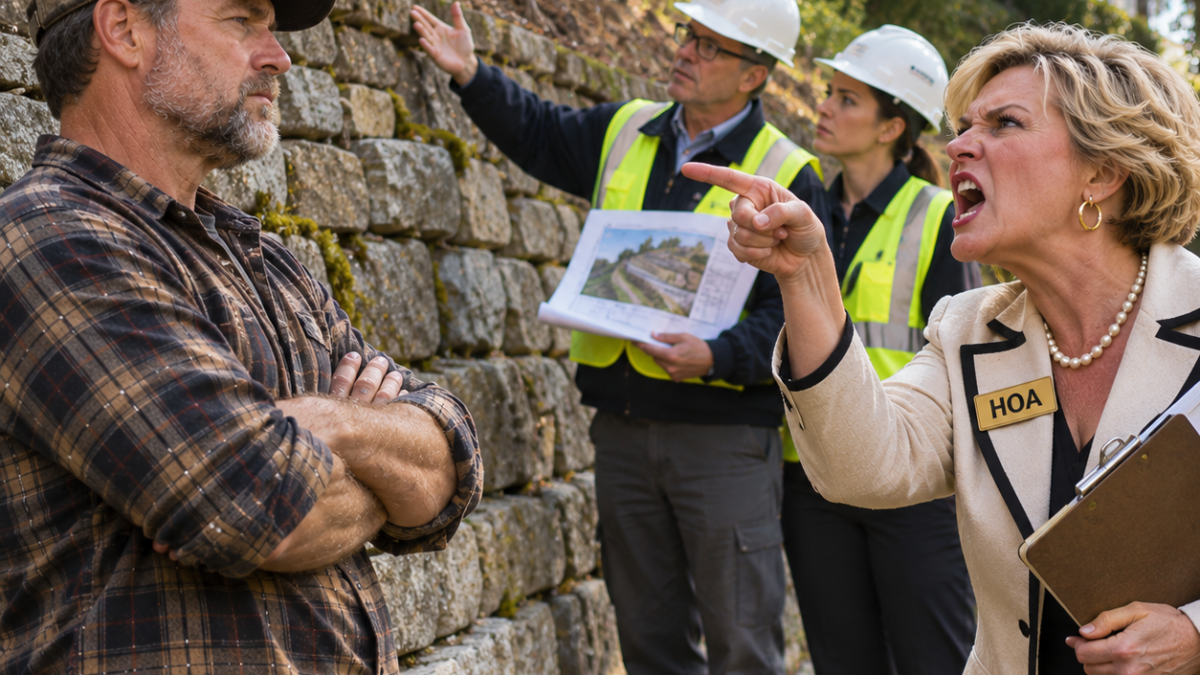
PART 2
Sarah and I had moved to Sterling Ridge because I wanted exactly the kind of life Karen would later make impossible.
Quiet.
That was all.
After twenty years in the Army Corps of Engineers, I had lived around noise most people never experience outside movies.
Aircraft.
Generators.
Heavy equipment.
Radios.
Explosions.
Construction in places where the ground itself sometimes wanted to kill you.
I had spent enough years thinking about blast resistance, soil density, bridge loads, drainage, slope stability, and what happened when someone made a small engineering mistake in an unforgiving environment.
By retirement, my ambitions had become embarrassingly simple.
I wanted a garden.
A porch.
A workshop.
A cup of coffee I could finish without somebody calling me over a radio.
Sarah wanted roses.
We found the house at 121 Sterling Drive almost by accident.
The neighborhood around it was relatively new.
Sterling Ridge climbed the side of a steep hill in carefully graded tiers of expensive homes, identical retaining terraces, decorative landscaping, and the kind of manicured lawns that made the entire place look less like a neighborhood and more like an architectural rendering.
Our property was different.
Older.
Lower.
It sat near the base of the hill and predated most of the development behind it.
The house was modest.
The lot was larger than average.
And across the front ran that old wall.
I noticed it before we even parked.
Sarah noticed me noticing it.
“Oh no.”
I looked at her.
“What?”
“You have the face.”
“What face?”
“The engineer face.”
I laughed.
“There is no engineer face.”
“There absolutely is.”
She pointed through the windshield.
“You’re already inspecting that wall.”
She was right.
I walked its length before we toured the house.
The stones leaned slightly back into the soil.
That slight batter wasn’t decorative.
It was intentional.
The lower stones were massive.
Upper courses grew smaller.
Drainage behind it appeared old but functional.
Whoever built it understood gravity.
There was craftsmanship in the pattern.
No mortar locking the stones rigidly together.
Instead, the wall had survived because it could move slightly.
Settle.
Drain.
Flex.
A rigid wall sometimes fights the earth until one side loses.
This one had learned to live with it.
“I love it,” I told Sarah.
“The house?”
“The wall.”
She shook her head.
“We haven’t even gone inside.”
“The wall’s good.”
“Excellent. We’ll sleep outside.”
We bought the place.
For the first year, retirement felt almost suspiciously peaceful.
I repaired small sections of the wall.
Sarah planted roses.
We met neighbors.
Nobody seemed especially interested in us, which suited me perfectly.
Then Karen Henderson became president of the Sterling Ridge HOA.
Our first conflict wasn’t about the wall.
It was about my mailbox.
Mine was stone.
A heavy steel locking mailbox set into a pillar built from matching fieldstone.
It had been there for decades.
Karen preferred identical black metal mailboxes mounted on standardized wooden posts.
One morning, I found a notice taped to the door.
**NON-COMPLIANT MAILBOX STRUCTURE.**
I read it twice.
Then brought it inside.
Sarah was drinking coffee.
“What’s that?”
“Apparently we’re criminals.”
“Already?”
“Mailbox.”
She held out her hand.
I gave her the notice.
She read the phrase “ancillary exterior structure.”
Then looked at me.
“Ancillary structure?”
“That’s what it says.”
“It’s where the electric company puts the bill.”
“Still architecture, apparently.”
She laughed.
I didn’t.
Not because I cared about the mailbox.
Because I’d read the HOA documents before we bought the house.
Our lot had grandfather protections.
The mailbox existed on old surveys.
So did the stone wall.
I wrote a polite response.
Attached the survey.
Quoted the grandfather clause.
Assumed that would end it.
Instead, Karen emailed me a month later.
The subject line was all caps:
**FINAL DECISION REGARDING NON-COMPLIANT MAILBOX STRUCTURE**
She claimed grandfathering did not apply because the mailbox could “reasonably be replaced.”
At the bottom:
**$100 FINE.**
Sarah looked over my shoulder.
“She really wants that mailbox.”
“No.”
“What does she want?”
I stared at the screen.
“Compliance.”
“With what?”
“Her.”
The next afternoon, I went to the county records office.
I pulled the original deed.
Plat.
Master development documents.
Historical surveys.
HOA filings.
I found exactly what I expected.
Our lot predated the primary Sterling Ridge development.
The grandfather language was clear.
The mailbox was explicitly shown.
Karen’s interpretation was nonsense.
I sent her the documents.
Copied the management company.
Copied the board.
Explained calmly that I would not pay the fine.
For two weeks, I heard nothing.
Then Karen came for the wall.
The notice was hand-delivered.
She didn’t knock.
She slid it beneath the front-door handle.
**VIOLATION: UNAPPROVED PERIMETER FENCING MATERIAL**
Fieldstone prohibited.
Approved materials:
White vinyl.
Cedar plank.
Thirty days to remove.
Five-hundred-dollar fine.
I read the notice standing in the foyer.
Sarah came downstairs.
“What now?”
I handed it to her.
She read.
Then looked through the window at the stone wall.
“They think that’s a fence?”
“Karen thinks it’s a fence.”
“What does the paperwork call it?”
“That’s what I’m going to find out.”
Sarah crossed her arms.
“Jack.”
“Yes?”
“Don’t get that look.”
“What look?”
“The one from the mailbox.”
“I don’t have a look.”
“You spent six hours in county archives over a mailbox.”
“That was principle.”
“This is a wall.”
“Exactly.”
She sighed.
“I’ll make coffee.”
I started with our property records.
The oldest survey clearly depicted the wall.
But the label was vague.
Boundary stone structure.
That wouldn’t be enough.
Karen could still pretend it was ornamental.
So I began talking to neighbors.
Not campaigning.
Not yet.
I wanted to understand the physical hillside.
Carlos and Maria Garcia lived directly uphill from us.
Their backyard ended at a steep grassy slope descending toward my property.
Carlos was trimming weeds when I approached.
“Morning.”
He shut off the trimmer.
“Hey, Jack.”
“You got a minute?”
“Sure.”
I pointed toward my wall.
“HOA wants that removed.”
He laughed.
Then realized I wasn’t joking.
“For what?”
“Noncompliant fence material.”
He stared at it.
“That thing’s ancient.”
“Yes.”
“They want you to replace it with vinyl?”
“Or cedar.”
Carlos shook his head.
“That’s insane.”
“Probably.”
Then I looked up the slope toward his house.
“If it comes out, there may be some erosion until a replacement system is engineered.”
He followed my eyes.
His expression changed.
“How much erosion?”
“I don’t know yet.”
“You think it affects my lot?”
“I think we should find out.”
That was all I said.
I had similar conversations with other uphill neighbors.
Never exaggerated.
Never claimed their houses were about to slide away.
I simply told them the truth.
Karen wanted the wall gone.
The wall appeared to be retaining soil.
Removing a retaining structure without understanding it could affect the slope.
People began paying attention.
Karen, meanwhile, sent fines.
Five hundred.
Then another notice.
Then an accumulated balance.
Then threats of further enforcement.
Her language grew more aggressive.
**DELIBERATE NONCOMPLIANCE.**
**CONTINUED DEFIANCE.**
**POTENTIAL REMEDIAL ACTION.**
The more I ignored her threats, the angrier the letters became.
Then the HOA announced a special hearing.
My property was on the agenda.
I called Marcus Bell.
Marcus had served with me years earlier.
He left the Army and eventually became a contract attorney.
Brilliant.
Aggressive.
Annoyingly pleased whenever someone handed him a complicated dispute.
We spent two hours on video.
When I finished, he leaned back.
“She’s sloppy.”
“Agreed.”
“She thinks the HOA documents are a magic wand.”
“Also agreed.”
“And the board?”
“Mostly follows her.”
“Then don’t expect to win the meeting.”
“I don’t.”
Marcus smiled.
“Good.”
“What do you suggest?”
“Leverage.”
“Define leverage.”
“Something that makes people afraid of following her.”
He drafted a cease-and-desist letter.
Professional.
Measured.
Almost painfully polite.
Which somehow made it more threatening.
The letter documented the grandfather provisions.
Rejected the HOA’s classification of the wall as ordinary fencing.
Demanded that enforcement stop.
Requested the minutes and supporting materials behind the Architectural Review Committee’s decision.
And warned that destruction of the wall without lawful authority could expose the association and individual directors to substantial liability.
We timed delivery three days before the meeting.
Certified mail.
Signed receipt.
Karen got it.
She did not distribute it to the residents.
Maybe not even the rest of the board.
That mistake mattered.
The clubhouse was packed the night of the hearing.
Karen sat behind the long table like a judge.
Two loyal board members flanked her.
I carried one folder.
No dramatic boxes.
No projector.
She started by describing the board’s sacred duty to protect property values.
Then she described me.
A homeowner who refused cooperation.
A homeowner who believed rules did not apply to him.
A homeowner allowing an unsightly “rock barrier” to violate community aesthetics.
She held up a photograph of a white vinyl fence.
Then a photograph of my wall.
People shifted uncomfortably.
When she finished, she smiled.
“Mr. Caldwell, do you have anything to say before the board considers additional enforcement?”
I stood.
“Yes.”
I walked to the podium.
“My first point is simple.”
I held up the historical survey.
“The structure Mrs. Henderson continues calling a fence predates the Sterling Ridge HOA.”
I passed copies forward.
“It is specifically protected by the grandfather provisions in your own governing documents.”
Karen interrupted.
“We have already rejected that interpretation.”
“I know.”
“Then move on.”
“I will.”
I looked toward Carlos.
“My second point is that calling something a fence doesn’t make it a fence.”
Murmurs.
“The wall visibly retains soil.”
I pointed through the clubhouse windows toward the hillside direction.
“Its removal would require excavation, drainage planning, and likely structural engineering.”
Karen rolled her eyes.
I continued.
“The houses uphill from my lot are built on terraced ground. Until we understand the original development design, destroying a retaining structure at the base would be reckless.”
Carlos went pale.
Karen leaned toward her microphone.
“This is fearmongering.”
“No.”
I opened my folder.
“Fearmongering would be making claims without documentation.”
I removed Marcus’s letter.
“This is documentation.”
I looked at the board members.
“My attorney sent each of you—or at least your association—formal notice three days ago.”
Several board members looked at Karen.
That told me everything.
They had not seen it.
I held the letter up.
“It explains the grandfather issue and the potential liability associated with damaging the wall.”
The room erupted in whispers.
Karen struck the table with her gavel.
“This is outside the scope of tonight’s agenda.”
“No.”
She glared at me.
“Excuse me?”
“You placed demolition of my property on the agenda. Liability for demolishing it is directly within scope.”
Her face flushed.
The other directors shifted.
One whispered something to another.
Carlos stood.
“I have a question.”
Karen snapped:
“You’ll have homeowner-comment time later.”
“My house is on the hill behind that wall.”
“Sit down.”
Carlos didn’t.
“If Jack is right, are you saying you planned to remove it without an engineering assessment?”
Karen’s voice became brittle.
“The board has authority to address covenant violations.”
“That wasn’t my question.”
More neighbors murmured.
Karen tried to continue.
The meeting was lost.
Not legally.
Socially.
Everyone had seen the same thing.
She had hidden Marcus’s warning.
She didn’t understand the wall.
And she was still insisting on demolition.
The board tabled enforcement pending legal review.
Temporary victory.
I knew Karen wouldn’t accept it.
People like her interpret restraint as humiliation.
Humiliation becomes rage.
Rage makes them sloppy.
Marcus called the next morning.
“She’ll come back.”
“I know.”
“What are you doing?”
“Research.”
He laughed.
“Of course you are.”
I returned to county archives.
This time I went deeper.
Not title records.
Engineering.
Old grading plans.
Permit packages.
Geotechnical studies.
Soil borings.
Stormwater documents.
The Sterling Ridge hillside had been massively modified during development.
The upper lots didn’t naturally exist in their current shape.
They’d been cut.
Filled.
Terraced.
Compacted.
Drainage systems installed.
Retaining elements incorporated.
I found soil reports showing clay and shale.
Bad combination if drainage failed.
Then I found the old phase-one master plan.
Faded blueprint.
Late 1970s.
I almost missed the note.
Tiny lettering near the legend.
**EXISTING DRY-STACKED STONE WALL — LOT 1A, 121 STERLING DRIVE — DESIGNATED PRIMARY BASAL RETAINING STRUCTURE FOR PHASE I. DO NOT REMOVE OR ALTER. CRITICAL TO SLOPE STABILITY, TIERS 1–3.**
I read it once.
Then again.
Then a third time.
My heartbeat changed.
I spread the blueprint across the table.
Tiers one through three.
Nearly thirty homes.
The developers had incorporated the old wall into their slope-stability design.
Instead of replacing it, they relied on it.
The modern neighborhood above had been engineered around a structure built decades earlier.
My wall wasn’t an incidental feature.
It was part of the development’s structural system.
I photographed the blueprint.
Scanned it.
Sent it to Marcus.
His response arrived within minutes.
**JACK. THIS IS THE WHOLE CASE.**
Then another message.
**GET AN ENGINEER. DO NOT LET ANYONE TOUCH THAT WALL.**
I didn’t need convincing.
Dr. Laura Albright came recommended through a civil engineering firm Marcus used.
She was a structural and geotechnical engineer with twenty-five years of experience.
Stern.
Precise.
Not easily impressed.
She spent an entire day on my property.
Measured the wall.
Reviewed drainage.
Examined deformation.
Walked the slope.
Reviewed soil data.
Compared the existing condition to the historical plans.
Used ground-penetrating equipment where appropriate.
At the end of the first inspection, she stood near the base.
“You maintain this?”
“Yes.”
“Who taught you dry-stack?”
“Army. Then mostly books.”
“You’ve done decent work.”
Coming from Dr. Albright, that sounded like a medal.
Then she looked uphill.
“This structure is doing more than I expected.”
“How much more?”
“A lot.”
Her written report arrived four days later.
I read the conclusion first.
The wall remained functional as a gravity retaining structure.
It was materially integrated into the slope-stability assumptions supporting the lower development tiers.
Uncontrolled removal would create a high probability of progressive slope failure.
Potential outcomes included severe soil movement, drainage disruption, foundation distress, and catastrophic damage to uphill properties.
I called Marcus.
“You read it?”
“Yes.”
“So?”
“So if Karen touches that wall after receiving this, she’s no longer merely wrong.”
“What is she?”
“Informed.”
I understood immediately.
Notice changes liability.
Before, she could claim ignorance.
Afterward, not so easily.
Marcus drafted the next letter.
Copies to every board member individually.
The HOA’s legal counsel.
Management company.
Certified mail requiring personal signatures.
Attached:
Historical blueprint.
Engineer note.
Dr. Albright’s report.
Relevant survey.
Our prior correspondence.
The final paragraph was simple.
The recipients were now formally notified that the wall constituted critical retaining infrastructure.
Any action compromising it could expose the HOA and individual actors to liability for property damage, remediation, engineering costs, bodily injury, or loss of life.
Marcus called it “informed liability.”
I called it one final chance to do nothing.
That was all they needed to do.
Nothing.
Leave the wall alone.
No fines.
No demolition.
No public apology required.
No surrender ceremony.
Walk away.
I also notified the city engineering department.
Not demanding action.
Courtesy notice.
Potential threat to critical private infrastructure affecting the developed hillside.
And I notified my homeowner’s insurer.
Then I installed cameras.
Sarah noticed them.
“You really think she’s going to try?”
“Yes.”
“After the engineer report?”
“Yes.”
“Why?”
“Because the report tells her she can’t.”
She stared at me.
“That makes no sense.”
“Not if the goal is safety.”
“What if her goal is winning?”
Sarah looked toward the wall.
Then up the hill.
“Jack, those are people’s houses.”
“I know.”
“What if she actually damages it?”
“We stop the contractor before he starts.”
“What if he doesn’t listen?”
“He will.”
“You sound confident.”
“I’m trying to be.”
She took my hand.
For the first time, I admitted the truth.
“I don’t like this.”
“Then don’t let it happen.”
“I won’t.”
Two weeks passed.
Quiet.
No notices.
No fines.
No Karen.
Then a white envelope appeared in my mailbox.
Community bulletin.
**NOTICE OF REMEDIAL ACTION**
Tuesday, October 12.
Heavy machinery.
Removal of noncompliant structure at 121 Sterling Drive.
Residents advised to avoid area.
Sarah read it.
Her face went pale.
“She really did it.”
“She scheduled it.”
“After signing for the report?”
“Yes.”
“What are the other board members doing?”
“Apparently nothing.”
“Jack.”
“I know.”
The night before demolition, neither of us slept well.
Sarah finally said:
“Promise me something.”
“What?”
“If that operator starts before you can stop him, get away from the wall.”
“I will.”
“Don’t try to be brave.”
“I won’t.”
“I’m serious.”
“So am I.”
She looked at me.
“You know what scares me?”
“What?”
“That you’re calmer when you’re scared.”
I smiled faintly.
“Occupational defect.”
At 7:53 the next morning, the flatbed arrived.
Skid steer chained on the back.
The operator was older than the man Karen had brought during the first confrontation.
Weathered face.
Heavy boots.
The posture of someone who had spent decades around machines capable of killing careless people.
Good.
Professionals respect risk.
At 7:58, Karen’s white SUV arrived.
Pink tracksuit.
Of course.
She stepped out smiling.
I watched from my kitchen camera feed.
Neighbors began appearing.
Carlos and Maria stood on their porch.
Sarah stayed inside near the window.
I picked up the prepared folder.
Walked out.
Karen spread her arms.
“Well, Mr. Caldwell. Looks like your thirty days are finally over.”
I ignored her.
Walked directly to the contractor.
“Morning.”
He nodded.
“Morning.”
“My name is Jack Caldwell. I own this property.”
“I know.”
“Before you begin, I’d like you to review this.”
Karen moved quickly.
“He does not need to review anything.”
The contractor looked at her.
Then at me.
I held out the folder.
“It concerns structural conditions and your liability.”
That got him.
He took it.
Karen’s voice rose.
“You have a valid work order.”
The contractor opened Dr. Albright’s report.
He read the first page.
Then the second.
Then the conclusion.
His face changed.
He unfolded the historical plan.
Looked at the circled engineer note.
Then looked at the wall.
Then uphill.
Silence.
Karen became restless.
“This is a stalling tactic.”
The contractor didn’t respond.
He reread the warning.
Then looked at me.
“This verified?”
“Licensed engineer. Certified report. Original city-filed development plan.”
He looked toward Karen.
“Did you know about this?”
She scoffed.
“It’s his interpretation.”
“No.”
He held up the report.
“This isn’t his interpretation.”
“The board has determined—”
“I don’t care what your board determined.”
Her face changed.
“I beg your pardon?”
The contractor pointed uphill.
“You hired me to remove a fence.”
“It is a fence.”
“No.”
He pointed toward the old plan.
“This says primary retaining structure.”
Karen crossed her arms.
“Our attorney says—”
“Your attorney going to pay for thirty houses if that hill moves?”
“You’re indemnified.”
“By who?”
“The HOA.”
He laughed once.
No humor.
“Lady, I’m not putting my company’s license on your promise.”
Karen took one step toward him.
“You signed a contract.”
“My contract doesn’t require me to knowingly create a landslide.”
She flushed.
“You are exaggerating.”
He handed the folder back to me.
“I wouldn’t touch that wall with a ten-foot pole.”
Then he walked toward his truck.
Karen moved in front of him.
“You cannot leave.”
“Move.”
“I am the president of this HOA.”
“Congratulations.”
“I am ordering you to complete the work.”
He stared at her.
“My job is construction, not professional suicide.”
That was when the city vehicle arrived.
Black sedan.
Municipal seal.
Mr. Davies stepped out.
City engineer.
Tablet in hand.
Karen turned.
“Who are you?”
“Edward Davies. City Engineering.”
Her face changed.
Only slightly.
He looked at the skid steer.
Then my wall.
Then uphill.
“I received notice concerning potential removal of a designated retaining structure.”
Karen immediately pointed at me.
“He’s manipulating this situation.”
Davies looked at the contractor.
“Were you preparing demolition?”
“Not anymore.”
“You reviewed the report?”
“Yes.”
Davies nodded.
“Good.”
He walked to the wall.
Ran one hand over a large granite stone.
Then examined the slope.
He opened the development plans on his tablet.
Karen followed.
“This is private HOA business.”
Davies kept looking at the screen.
“No.”
“Yes, it is.”
He pointed toward the wall.
“This feature appears in the city’s approved phase-one grading plan.”
Karen hesitated.
“So?”
“It was incorporated into slope-stability design.”
“No.”
He looked at her.
“No?”
“It’s a fence.”
Davies turned his tablet toward her.
The note was clearly visible.
**PRIMARY BASAL RETAINING STRUCTURE. DO NOT REMOVE OR ALTER.**
Karen stared.
“This must be outdated.”
Davies looked at the wall.
“Gravity isn’t outdated.”
A neighbor laughed.
Karen’s face reddened.
He continued.
“Who authorized demolition?”
“The board.”
“Was a structural engineer retained?”
“We didn’t need one.”
“You intended to remove a critical retaining element without structural review?”
“It is an aesthetic violation.”
Davies slowly lowered the tablet.
For the first time, he looked genuinely angry.
“Ma’am, aesthetics are not relevant to slope stability.”
The contractor was already securing his machine onto the flatbed.
Karen heard the chains.
She turned.
“You get back here!”
He ignored her.
Within minutes, he drove away.
The silence afterward felt enormous.
No diesel engine.
No hydraulic noise.
No threat.
Only Karen breathing hard on the sidewalk while half the neighborhood watched.
Davies started documenting.
Photographs.
Coordinates.
Wall condition.
Slope.
Then he turned back to Karen.
“I need your management company’s information.”
She didn’t respond.
“And the HOA’s insurance carrier.”
That got her.
“Why?”
“Because the city is issuing an immediate stop-work directive and opening an inquiry.”
“The HOA isn’t liable.”
Davies looked at her.
“You were about to remove the structure.”
“He built it illegally.”
“No.”
“He refuses to comply.”
“The wall existed before this development.”
“It doesn’t match our architectural standards.”
Davies stared at her.
Then said:
“Mrs. Henderson, your architectural standards do not override geotechnical reality.”
Karen looked around.
People were outside now.
Not hiding.
Carlos began walking downhill.
Maria followed.
His face was white with anger.
He stopped in front of Karen.
“My kids sleep in that house.”
Karen raised one hand.
“Carlos, this isn’t—”
“You were going to remove the thing holding up the slope under my house.”
“That’s not proven.”
Davies cut in.
“It is documented.”
Carlos looked at her.
“You got the report?”
Karen said nothing.
“You knew?”
“I was advised there were competing interpretations.”
“There aren’t competing interpretations!”
His voice broke.
“My children sleep there!”
Others came closer.
Mrs. Miller from three houses up.
George Walsh.
The Parkers.
People who had spent years lowering their eyes when Karen walked by.
Mrs. Miller spoke first.
“You fined my husband because our garden hose was visible.”
Karen stared.
“What does that have to do with—”
“Everything.”
Another voice.
“You put a lien notice on me over paint color.”
Another.
“You threatened my son’s basketball hoop.”
Another.
“Three hundred dollars for wind chimes.”
The accusations accumulated.
Not wild.
Specific.
Years of small humiliations.
Karen tried to raise her voice.
Nobody listened.
The system she’d built depended on one homeowner standing alone while everyone else watched.
Now everyone was standing together.
She looked at me.
For a second, pure hatred.
“This is what you wanted.”
“No.”
“Yes!”
She pointed around.
“You turned them against me.”
“I didn’t send their fines.”
“You’ve been undermining this board since the day you moved here.”
“I read the rules.”
“You think that makes you better than everyone?”
“No.”
“Then what do you want?”
I looked at the wall.
“I wanted you to leave it alone.”
She stared at me.
Then turned.
Walked quickly to her SUV.
No farewell.
No final order.
She drove away.
The Garcias came down to the wall.
Maria touched one of the stones.
“This really holds the hill?”
“It’s part of the system.”
“How much?”
“Enough that removing it without replacement would be dangerous.”
Carlos looked uphill at his home.
“Why didn’t anyone tell us?”
I thought about that.
“Because everybody assumed somebody else knew.”
That evening, Carlos and Maria came over with wine.
Sarah opened it immediately.
Carlos couldn’t stop looking out the window.
“I keep seeing that machine.”
“So do I.”
“What if you hadn’t found the plans?”
“I don’t know.”
“What if that contractor hadn’t listened?”
“I would’ve called the police and city before he touched it.”
“But what if—”
Maria put a hand over his.
“Carlos.”
He stopped.
Then looked at me.
“I’m sorry.”
“For what?”
“For not speaking up sooner.”
“You didn’t know.”
“We knew she was going after you.”
“That’s not the same.”
“We all watched.”
Sarah sat beside Maria.
“Everyone thought it was just Jack’s fight.”
Maria looked down.
“That’s how she did it.”
Exactly.
The next forty-eight hours changed Sterling Ridge.
A recall petition appeared.
Within two days, more than eighty percent of homeowners had signed.
Not just Karen.
The entire enabling board.
Marcus called when he heard.
“You realize she handed us your lawsuit.”
“I suspected.”
“City engineer. Certified notice. Video. Contractor witness. Thirty homes potentially exposed.”
“We don’t need millions.”
“I know.”
“I want the wall protected.”
“I know.”
“Legal and engineering fees.”
“Yes.”
“And I want them barred from touching it again.”
“Already drafting.”
We filed.
Injunctive relief.
Reimbursement.
Formal recognition of the wall’s structural role.
Claims related to harassment and reckless conduct.
Karen and other directors were named where legally appropriate because they’d received personal notice and proceeded anyway.
That changed everything.
The HOA’s insurer became involved.
Corporate insurance attorneys are not interested in neighborhood politics.
They are interested in exposure.
Marcus and I met with them.
I brought everything.
Mailbox notice.
Wall notice.
Surveys.
Emails.
Certified receipts.
Meeting records.
Historical blueprint.
Dr. Albright report.
Community demolition bulletin.
Security footage.
The lead insurance attorney watched the recording.
Karen telling the contractor to proceed.
Contractor refusing.
Karen insisting she had authority.
City engineer arriving.
The attorney watched in silence.
When the video ended, he closed the laptop.
“She had the engineering report before this?”
Marcus slid over the certified-mail receipt.
“Signed.”
“Board members too?”
“Individual delivery.”
He reviewed the signatures.
Then looked at his colleagues.
“She knew.”
One attorney nodded.
The lead counsel looked back at me.
“This goes beyond ordinary negligence.”
Marcus said nothing.
The attorney continued.
“Potential willful misconduct.”
That phrase changed Karen’s future.
Directors-and-officers coverage is not a blank check.
Insurance protects people from many mistakes.
It does not necessarily protect them when they knowingly engage in reckless or intentional conduct after receiving specific warnings.
The insurer launched its own investigation.
Interviews.
Emails.
Board minutes.
Communications.
One board member claimed Karen told them the engineering report was “fabricated scare material.”
Another admitted they hadn’t read it.
A third said Karen insisted the HOA’s authority was absolute.
The insurer’s attorneys were horrified.
Then came the financial review.
The board had spent association money on legal attacks against a grandfathered structure.
Had concealed relevant warnings.
Had failed to consult independent engineers.
Had authorized demolition.
And now faced potentially catastrophic claims.
The carrier made its position clear.
The existing board was a risk.
An emergency homeowner meeting was scheduled at the local high school auditorium because the clubhouse was too small.
Hundreds of people came.
Karen sat in the front row.
Not at a board table.
No gavel.
No microphone under her control.
An insurance representative chaired the meeting.
He explained the situation in painfully neutral language.
The wall was structural.
The HOA had received formal notice.
The attempted demolition created extraordinary liability.
Coverage questions existed because of potential willful misconduct.
The carrier required immediate governance changes if it was going to continue working with the association.
Then came the demand.
Current directors resign.
Karen’s two closest allies went first.
One apologized.
The other barely spoke.
Karen remained seated.
The attorney looked at her.
“Mrs. Henderson.”
She slowly stood.
I had never seen her look small before.
Not physically.
Something else.
The confidence was gone.
She read from prepared paper.
“I hereby resign as president and director of the Sterling Ridge Homeowners Association effective immediately.”
Silence.
No applause.
No cheering.
That surprised me.
I expected people to celebrate.
Instead, the room felt exhausted.
Karen folded the paper.
For a moment, she looked toward me.
I couldn’t read her expression.
Then she walked out.
That was the end of her presidency.
Not with police.
Not with screaming.
Not with someone dragging her from the room.
A sentence.
A folded paper.
A door closing.
Marcus leaned toward me.
“Feel good?”
I thought about it.
“No.”
He raised an eyebrow.
“Nothing?”
“Relief.”
“That counts.”
The lawsuit settled quickly after that.
The association reimbursed my legal expenses.
Engineering costs.
Related fees.
Formal written apology.
But the most important term was structural protection.
The wall would be legally recognized in HOA documents as critical retaining infrastructure.
No aesthetic committee could classify it as ordinary fencing again.
Any future repairs would be determined by qualified structural professionals.
And because the wall supported the developed hillside beyond my private benefit, the HOA agreed to share responsibility for required maintenance under the settlement framework.
Marcus called that poetic justice.
Sarah called it “the world’s most expensive apology to rocks.”
Both were correct.
Carlos Garcia became interim president.
He resisted.
Residents ignored him.
He eventually accepted.
His first major project was rewriting the architectural guidelines.
No vague “harmonious appearance” language without definitions.
No enforcement decisions made solely by one person.
Clear appeals.
Transparent minutes.
Conflict disclosures.
Reasonable warning periods.
Professional review required where structural, drainage, grading, or safety issues were involved.
Karen’s aesthetic committee disappeared.
So did many of the petty fines.
People began talking again.
Really talking.
Garage doors stayed open.
Kids left toys outside.
Wind chimes returned.
Someone painted a front door dark green.
Nothing collapsed.
Except the old culture of fear.
About a month later, an envelope arrived from the insurer.
Inside:
A $5,000 settlement payment related to harassment and emotional distress.
I sat at the kitchen table looking at it.
Sarah came in.
“That’s it?”
“Apparently.”
“You look disappointed.”
“No.”
“You wanted more?”
“I don’t want it.”
She sat across from me.
“Why?”
“Feels wrong.”
“You spent months fighting.”
“That wasn’t why.”
“What will you do?”
I stared through the window.
At the wall.
Then at the hillside.
“Give it back.”
Sarah smiled.
“Of course.”
I endorsed the check to the Sterling Ridge Community Landscape Fund.
Sent it to Carlos.
Included a note.
**Plant something worth keeping.**
He called me ten minutes after receiving it.
“You’re insane.”
“Possibly.”
“You could buy a very nice grill.”
“I have a grill.”
“Vacation?”
“I’ve traveled enough.”
“What trees do you want?”
“Not my decision.”
“We’re buying trees.”
“Buy good ones.”
“That’s the most engineer answer possible.”
A few weeks later, residents organized what George called “The Wall Party.”
I hated the name.
It stayed.
My front yard filled with folding chairs.
Coolers.
Children.
Potluck dishes.
Smoke from the grill.
Neighbors who’d barely spoken to one another six months earlier stood around laughing.
Carlos cooked burgers badly.
I took over the grill.
“You’re president,” I told him. “Delegate.”
“Finally, power.”
“Careful.”
He laughed.
Children climbed along the lower stones.
At first, every instinct in me wanted to yell:
Get down.
Then I stopped.
The wall had carried dirt for a century.
It could survive a few children sitting on it.
Old Mr. Miller came over holding potato salad.
“You know what I hate?”
“Several things, probably.”
“HOAs.”
“Understandable.”
“I’ve lived here twenty years.”
He looked toward the crowd.
“Nineteen years I paid every stupid fine because fighting was too much trouble.”
I handed him a burger.
He didn’t take it immediately.
“You showed us something.”
“What?”
“That you can say no.”
I thought about Karen.
Her entire system had depended on the opposite lesson.
Don’t fight.
Don’t ask.
Don’t read.
Don’t compare.
Pay.
Comply.
Move on.
“People showed themselves,” I said.
He took the burger.
“Same thing.”
Later, Sarah found me standing beside the wall.
Sunset turned the upper houses orange.
She leaned her head against my shoulder.
“You won.”
I looked around.
Carlos arguing with George.
Children running.
Maria laughing with Mrs. Miller.
People sharing food.
“No.”
Sarah nudged me.
“You absolutely won.”
“I mean that’s not the part that matters.”
“What does?”
I pointed toward the neighbors.
“This.”
She was quiet.
Then nodded.
The wall looked different.
When we’d bought the house, it represented solitude.
Solid stone.
Boundaries.
Something old and dependable after years of unstable places.
Now it represented connection.
The irony wasn’t lost on me.
A wall had brought a neighborhood together.
Time passed.
Karen’s house went on the market.
I heard she’d sold at a loss.
Maybe true.
Maybe neighborhood exaggeration.
I didn’t investigate.
She moved out of state.
No farewell.
No final confrontation.
Part of me was relieved.
Part of me wondered whether I should have felt more satisfied.
For months, I’d imagined the day she lost power.
I thought it would feel triumphant.
It didn’t.
It felt like finishing a difficult repair.
Necessary.
Worth doing.
But afterward, you’re mostly tired.
One evening, Marcus came by.
He’d been in town for work.
We sat beside the wall with beer.
“You disappoint me.”
“How?”
“No victory plaque.”
“No.”
“No bronze skid steer?”
“No.”
“No giant sign saying Karen Was Wrong?”
“Absolutely not.”
“Waste.”
We sat quietly.
Then he looked uphill.
“You know how close she came.”
“Yes.”
“I’ve been thinking about that.”
“So have I.”
“If she hired some idiot contractor instead…”
“I know.”
“If you hadn’t been standing there…”
“I know.”
“You okay?”
I stared at the stones.
“Not entirely.”
That surprised him.
“Why?”
“Because I played the situation.”
“You documented it.”
“I knew she’d escalate.”
“You warned her.”
“Yes.”
“Repeatedly.”
“Yes.”
“You notified the city.”
“Yes.”
“Then what exactly are you blaming yourself for?”
I rubbed one hand across the stone.
“I let it get close.”
Marcus thought for a while.
“Jack.”
“Yeah?”
“There is a difference between allowing someone to make a decision and forcing them to make it.”
“I know.”
“Do you?”
I looked at him.
“She received professional engineering documentation telling her demolition could endanger thirty homes.”
“Yes.”
“She scheduled demolition anyway.”
“Yes.”
“You didn’t make that choice.”
“No.”
“Then stop carrying it.”
Easy advice.
Harder to follow.
But he was right.
The wall became part of the community’s official maintenance planning.
Annual visual inspection.
Professional structural review on a defined schedule.
Drainage checked.
No more amateur interference.
The HOA paid part of the costs under the settlement.
Every time a maintenance invoice arrived, I smiled slightly.
Not because I enjoyed charging them.
Because documentation prevented future stupidity.
Carlos joked that the wall had better healthcare than most people.
“Annual checkups.”
“Specialists.”
“Preventive maintenance.”
“No deductible.”
Sarah added, “And excellent stone coverage.”
We were becoming old.
The neighborhood softened.
Residents planted trees in common areas with the settlement money I’d returned.
Not identical trees.
Different species.
Maples.
Oaks.
Dogwoods.
A few flowering trees.
Someone proposed a strict uniform plan.
Carlos vetoed it immediately.
“We’ve learned nothing if every tree has to match.”
The new landscaping looked less controlled.
More alive.
A year after Karen left, one of the new trees died.
Nobody was fined.
The board replaced it.
The world continued.
My relationship with the wall changed too.
Before the fight, I repaired it mostly because I enjoyed the craft.
Afterward, I felt responsible for more than my own property.
Every loose stone made me think of the houses above.
Dr. Albright returned for inspections.
One afternoon she found me reseating a small upper stone.
“You know,” she said, “you don’t need to treat this like a patient.”
“It’s infrastructure.”
“It’s also survived a hundred years without you.”
“Unverified.”
She laughed.
“You combat engineers are impossible.”
“We’re charming.”
“That’s not the word.”
She walked along the base.
Then stopped.
“You want to know why this wall lasted?”
“Drainage.”
“Partly.”
“Batter.”
“Yes.”
“Mass.”
“Yes.”
“Friction.”
“Yes.”
“What am I missing?”
She placed one hand against the stone.
“It can move.”
I looked at her.
“Most modern homeowners hate movement.”
“Exactly.”
She continued.
“People see a stone shift half an inch and panic. But a dry-stack wall survives because it can adjust. It settles instead of cracking like rigid concrete.”
I smiled.
“There’s probably a metaphor coming.”
“No.”
“Good.”
She walked away.
Then turned.
“Although your HOA could’ve learned something from it.”
I laughed.
So much for no metaphor.
Her observation stayed with me.
Sterling Ridge had nearly failed for the same reason Karen nearly destroyed the wall.
Too rigid.
No tolerance.
No adaptation.
Every deviation treated as threat.
Every disagreement punished.
Healthy systems need structure.
But they also need room to move.
The new HOA learned that slowly.
Not perfectly.
There were still disagreements.
Parking.
Noise.
Pool hours.
A dog that barked too much.
Real community problems.
But people argued without treating one another as enemies.
Most of the time.
George still believed every rule was unconstitutional.
Carlos still believed meetings could end in under an hour.
Both were wrong.
One Saturday morning, I heard a knock.
A young couple stood outside.
New homeowners uphill.
“We’re the Bennetts.”
“Welcome.”
The husband pointed toward the wall.
“Is that the famous wall?”
I sighed.
“Unfortunately.”
His wife smiled.
“Our realtor told us not to joke about tearing it down.”
“Good realtor.”
“We wanted to ask something.”
“Go ahead.”
“Does it really support our house?”
“Indirectly. It’s part of the slope system beneath your tier.”
Her eyes widened.
“So if something happens to it?”
“There are monitoring and maintenance plans now.”
She relaxed.
“Okay.”
The husband looked at the stones.
“How old?”
“More than a century.”
“Who built it?”
“No idea.”
That bothered me sometimes.
Some mason had stacked those stones long before Sterling Ridge existed.
Maybe a farmer.
Maybe a local crew.
Maybe generations of hands.
No plaque.
No records I’d found.
Yet their work outlived them.
Protected homes belonging to people they could never imagine.
I began researching.
Historical society.
Old tax maps.
Farm records.
Eventually I discovered the property had once belonged to the Caldwell family.
No relation to me.
The wall appeared in an early twentieth-century agricultural photograph.
A man stood beside it.
Horse behind him.
I enlarged the photograph.
Same stones.
Same basic alignment.
I framed a copy.
Sarah found me hanging it.
“So now the wall has a family album.”
“Historical record.”
“Right.”
“What?”
“Nothing.”
She kissed my cheek.
“Engineer.”
Years later, Carlos stepped down as HOA president.
Residents nominated me.
I refused immediately.
“Absolutely not.”
George said, “Why? You already run everything.”
“I do not.”
“You tell everybody when they’re wrong.”
“That is not governance.”
“Sounds like governance.”
Sarah voted against me privately by threatening divorce if I accepted.
The position went to Maria Garcia instead.
She was excellent.
Firm.
Warm.
Could end a meeting on time.
A miracle.
Her first year, she organized an emergency-preparedness workshop.
Slope hazards.
Gas shutoffs.
Drainage.
Fire evacuation.
The city engineer attended.
Mr. Davies.
Same man who had arrived the morning of the attempted demolition.
Afterward, he stood with me beside the wall.
“Still here.”
“So are you.”
He nodded toward the stones.
“You ever think what would’ve happened?”
“Too often.”
He was quiet.
Then:
“Want my professional opinion?”
“Always.”
“The contractor would’ve stopped even if you weren’t there.”
“You think?”
“He looked experienced.”
“That helps.”
“But never depend on that.”
“I don’t.”
“Good.”
He touched one of the stones.
“Most disasters require multiple failures.”
I knew that.
Engineering teaches it brutally.
One mistake rarely destroys a system by itself.
It’s usually a chain.
Bad assumption.
Ignored warning.
Missing inspection.
Weak communication.
Someone too afraid to speak.
Someone too arrogant to listen.
Karen had been trying to assemble that chain.
Old plans forgotten.
HOA ignorance.
Board passivity.
Contractor pressure.
Her own pride.
What broke the chain was documentation.
And people willing to say no.
That mattered.
Years passed.
The wall weathered storms.
One winter brought record rain.
For three days, water ran down the hillside.
Drainage channels filled.
Neighbors worried.
I checked the wall repeatedly.
So did Dr. Albright’s firm.
No significant movement.
Afterward, Maria organized drainage improvements uphill.
Not because the wall had failed.
Because responsible governance prevents failure.
I stood watching contractors install better runoff controls.
George came beside me.
“Boring.”
“What?”
“No drama.”
“That’s ideal.”
“No screaming HOA president.”
“Also ideal.”
“No skid steer showdown.”
“Especially ideal.”
He sighed.
“I miss the old days.”
“No, you don’t.”
“Not remotely.”
We laughed.
Then came something I didn’t expect.
A letter.
No return address I recognized.
Postmarked another state.
Sarah brought it inside.
“For you.”
I opened it.
Karen.
The letter was short.
I read it alone first.
Then again.
She did not ask forgiveness.
Did not justify herself.
Did not blame the board.
She wrote that years away from Sterling Ridge had given her time to think.
She said she’d believed standards created order.
Then she’d started believing obedience created order.
She admitted that once people stopped obeying willingly, she used fines and fear to force them.
She wrote:
**I confused being obeyed with being right.**
That sentence stopped me.
Later:
**The worst part is not losing the house or the position. It is knowing that when you warned me about danger to other families, I cared more about proving you wrong than about whether you were right.**
I sat quietly.
Sarah eventually came in.
“Everything okay?”
I handed her the letter.
She read.
Then sat beside me.
“What do you think?”
“I don’t know.”
“Do you believe her?”
“Probably.”
“You going to answer?”
I looked out at the wall.
“Yes.”
My response was simple.
I told her I appreciated the letter.
I told her accountability did not require permanent humiliation.
I told her Sterling Ridge had changed.
And I told her the wall was still standing.
I did not tell the neighborhood.
That letter wasn’t theirs.
People sometimes want villains to remain villains forever.
It’s cleaner.
More satisfying.
But humans are messier.
Karen did terrible things with authority.
She endangered property.
Potentially lives.
She deserved to lose power.
She deserved legal consequences.
But if she truly learned something after losing everything she thought made her important, I wasn’t going to resent that.
Sarah read my reply.
“You’re nicer than I am.”
“No.”
“Yes.”
“You would’ve answered.”
“I would’ve included a picture of the wall.”
I laughed.
“That would’ve been cruel.”
“Educational.”
We mailed the response.
Never heard from Karen again.
That was fine.
By then the wall had become part of Sterling Ridge’s identity.
People photographed it in autumn.
Children sat on it during block parties.
The historical society added it to a local preservation brochure.
Someone proposed naming it Caldwell Wall.
I objected.
I didn’t build it.
Eventually they called it the Sterling Ridge Basal Wall.
Terrible name.
Accurate.
Engineer-approved.
The original stone mailbox remained too.
Nobody ever mentioned replacing it again.
One morning, years after the dispute, I walked outside with coffee.
Sarah was cutting roses.
The scene was almost identical to the morning Karen had arrived with the skid steer.
Cool air.
Quiet street.
Stone wall.
Except the neighborhood felt different.
Not silent.
Alive.
Someone’s garage door open.
A basketball bouncing.
Dog barking.
Children laughing uphill.
A lawn mower.
Imperfect sounds.
Home sounds.
Sarah pointed toward the sidewalk.
“What?”
“A stone’s loose.”
I looked.
Upper course.
Small shift.
“I’ll fix it.”
She smiled.
“Of course you will.”
I brought my tools.
Lifted the stone.
Adjusted the smaller packing pieces underneath.
Reset it.
No mortar.
Just balance.
Weight.
Friction.
Patience.
As I worked, I thought about Karen’s first words.
**That illegal eyesore comes down today.**
She had believed the wall was ugly because it didn’t match.
Because it was old.
Because it wasn’t standardized.
Because she hadn’t approved it.
She never stopped to ask why it was there.
That may have been the simplest lesson of the entire conflict.
Before you destroy something that has survived a century, understand what it’s holding together.
The same applies to communities.
People.
Traditions.
Relationships.
Not everything old is sacred.
Not every rule is wrong.
But arrogance begins when you decide understanding is unnecessary.
Karen saw stone.
The original engineers saw infrastructure.
I saw craftsmanship.
The neighbors eventually saw safety.
Sarah saw the reason her husband kept disappearing into county archives.
Everyone saw something different.
The truth existed underneath all of it.
The wall was necessary.
When Karen tried to tear it down, she nearly destroyed much more than the thing she hated.
In the end, she lost her office.
The board changed.
The insurer forced accountability.
The HOA paid my legal and engineering costs.
The covenants were rewritten.
The wall received permanent protection and maintenance responsibility.
But those weren’t the parts I treasured most.
I remembered Carlos standing beside me at the barbecue.
Maria laughing.
Mr. Miller admitting he had paid fines for nineteen years because fighting seemed harder.
Children balancing on the stones.
Neighbors planting new trees with the settlement money I returned.
People speaking to one another again.
That was the victory.
Karen’s defeat was only the door we walked through.
The destination was a community that finally understood it belonged to the people living there—not whoever happened to hold the gavel.
Sometimes Sarah still teases me.
“You bought that house for the wall.”
“I bought it because you liked the kitchen.”
“You didn’t look at the kitchen.”
“I eventually did.”
“You spent forty minutes outside.”
“Structural due diligence.”
“You fell in love with rocks.”
“Historic masonry.”
“Rocks.”
I never win that argument.
One evening we sat on the porch as the sun disappeared behind Sterling Ridge.
The wall glowed gold in the last light.
Sarah rested her head against my shoulder.
“Still think retirement is quiet?”
I listened.
Children.
Wind.
A dog.
Somebody hammering something uphill.
George revving the Mustang unnecessarily.
“No.”
“Regret it?”
I thought about the fight.
The fear.
The anger.
The nights Sarah couldn’t sleep.
The months of research.
The morning the skid steer arrived.
Karen shouting.
The contractor refusing.
The city engineer stepping onto the street.
The neighbors finally speaking.
“No.”
She squeezed my hand.
Neither did I.
I had spent a military career building and protecting structures.
Bridges.
Roads.
Facilities.
Systems designed to keep people safe.
After retirement, I thought I had left all of that behind.
Turns out my final engineering battle was waiting in my own front yard.
A hundred-year-old wall.
Four feet tall.
Built by men whose names I never learned.
Strong enough to survive storms, soil pressure, neglect, changing neighborhoods, and one HOA president who believed a clipboard made her stronger than gravity.
It didn’t.
Gravity won.
Engineering won.
The documents won.
The contractor’s common sense won.
The neighbors won.
And the wall remained where it had always been.
Holding the hillside.
Holding history.
And, in a strange way, holding our community together.
Karen once brought heavy machinery to destroy it.
Years later, the HOA budget includes money to protect it.
Every time I see that line item, I smile.
Not because revenge is sweet.
Because irony sometimes is.
The organization that once declared the wall an illegal eyesore now lists it as:
**Critical Retaining Infrastructure — Annual Inspection and Preservation.**
That’s a satisfying sentence.
But not as satisfying as the sound I hear when I step outside most mornings.
Nothing dramatic.
No shouting.
No engines waiting to demolish anything.
Just neighbors living.
The kind of quiet I wanted all along.
And beneath it all, the old stones remain exactly where they belong.








