PART 2: HOA Karen Ordered Me to Rip Out My Late Wife’s Vineyard—Then Her Own Board Googled My Name and Learned Who Owned the Road, the Water, and the Valley
PART 2
Caldwell Valley is the kind of place that makes people slow down the first time they see it.
You turn off Route 29 onto Caldwell Road, travel about two miles through white oak and tulip poplar, cross a narrow bridge over the creek, and then the trees suddenly open.
The whole valley is there.
Pasture below.
Forest on the north faces.
Vineyard climbing the south-facing ridges.
In late summer, the rows look like green corduroy laid over the hills.
Margaret used to stop sometimes when we drove in.
Just stop the truck.
Look.
I would ask:
“What?”
She would say:
“Nothing.”
Then smile.
She never really meant nothing.
About one hundred eighty acres of the property eventually went into grape production.
The rest stayed forest, pasture, creek bottom, winery grounds, family homes, farm structures, and conservation acreage.
Our winery was small by commercial standards.
About two thousand cases annually.
Mostly restaurants in Charlottesville and Richmond.
A handful of shops around Washington had carried Caldwell Ridge wines for years.
In 2019, one of Margaret’s reserve vintages won Virginia’s Governor’s Cup.
The trophy still sits on her desk in the tasting room.
Beside it is a photograph from 1997.
Margaret holding the first successful cluster from South Ridge.
Dirt on both cheeks.
Hair tied badly behind her head.
That smile.
Every visitor notices the trophy first.
I always notice the photograph.
The vineyard was never a decorative hobby.
It was a business.
A farm.
A heritage operation.
A memorial.
And the oldest vines Victoria wanted removed were irreplaceable in the way mature vines usually are.
You can plant replacements.
You cannot purchase thirty years of roots.
You cannot buy decades of interaction between limestone, fungi, rainfall, heat, stress, and vine.
Young vines need years before producing serious fruit.
Mature vines have already learned the land.
Margaret used to say:
“The best vines are the patient ones.”
Victoria had no patience.
Ridgerest Estates existed because my father sold forty acres along Eastern Ridge eight years earlier.
Dad was eighty-one.
The land had never been good vineyard ground.
Wrong drainage.
Wrong soil.
He decided selling that section made sense.
Developer Todd Marsh paid $2.6 million.
But Dad cared less about the purchase price than what happened afterward.
He had watched suburbs eat farms his entire life.
First the developer buys a field.
Then houses arrive.
Then new homeowners complain about tractors.
Mud.
Roosters.
Dust.
Spray schedules.
Harvest traffic.
Farm smells.
Eventually the farm becomes the nuisance even though it was there first.
Dad was not going to let that happen to us.
So he called me.
At the time, I was still with USDA.
“You’re the lawyer.”
“That’s debatable.”
“Write me something.”
“What?”
“Something that keeps those people from telling us how to farm.”
I spent three weekends drafting the deed restrictions.
Section 4.1:
Agricultural Protection Covenant.
No purchaser, successor, homeowners association, or related entity could interfere with, restrict, or seek to limit existing agricultural operations on adjacent Caldwell family land.
Section 4.3:
Road access.
Ridgerest needed Caldwell Road.
There was no other practical entrance to the subdivision.
The development received a revocable access easement across family land.
That easement was conditioned on compliance with the agricultural-protection covenant.
Material breach could trigger revocation after ninety days’ written notice.
Then water.
The primary well servicing the eastern side of the valley sat on five acres my father retained.
Ridgerest received residential water rights under another conditional agreement.
Same principle.
Interfere with Caldwell agriculture, risk losing the contractual right.
Section 5.2 dealt with common areas.
Transfers or conversions required Caldwell family approval under specified circumstances.
I drafted the entire thing to survive.
Clear notice.
Defined breach.
Defined remedies.
Recorded restrictions.
No ambiguity.
Dad read it.
He was not a lawyer.
He did not pretend to be.
He reached the last page and nodded once.
“That ought to do it.”
It did.
For six years, Ridgerest and Caldwell Ridge got along fine.
Residents came to the tasting room.
Bought wine.
Attended harvest days.
Their brochures advertised:
LUXURY LIVING IN VIRGINIA WINE COUNTRY.
The photographs showed my vines.
My valley.
Margaret’s work.
Then Dad died.
Eighty-five.
In his porch chair.
Glass of Margaret’s wine beside him.
Four years after that sale, Victoria Langford arrived in the valley.
Three years later, she became HOA president.
Victoria had spent most of her career in commercial real-estate marketing around Northern Virginia.
She understood branding.
Presentation.
Positioning.
She spoke about homes the way political strategists speak about candidates.
She could turn square footage into “lifestyle.”
A retention pond into “waterside living.”
Distance from a grocery store into “curated accessibility.”
The problem was that she began treating Ridgerest not as a neighborhood but as a product.
Anything she disliked became a branding problem.
Trampoline visible from road?
Fine.
Four hundred dollars.
A retired teacher’s shutters the wrong blue?
Repaint.
A seventy-eight-year-old Vietnam veteran’s flagpole fourteen inches above the approved accessory height?
Violation.
Two Purple Hearts didn’t matter.
The American flag didn’t matter.
Victoria had decided rules were valuable mostly because they let her decide things.
Nobody challenged her seriously.
People had jobs.
Families.
Mortgages.
They did not want to spend their evenings arguing over paint.
That is how control grows.
Not because everyone agrees.
Because everyone is tired.
Eventually, Victoria looked west across the valley.
And saw my vineyard.
Her first letter arrived in April.
Heavy cream paper.
Embossed Ridgerest Estates logo.
NOTICE OF AESTHETIC AND ENVIRONMENTAL CONCERN REGARDING ADJACENT AGRICULTURAL ACTIVITY.
I remember reading that phrase twice.
Adjacent agricultural activity.
Thirty years of Margaret’s work reduced to bureaucratic wallpaper.
The letter accused South Ridge of attracting insects.
Wasps.
Fruit flies.
It claimed vineyard structures were visually inconsistent with Ridgerest’s residential character.
Most impressively, it claimed the vines reduced property values.
She demanded that every vine and trellis within five hundred feet of Ridgerest be removed or relocated within ninety days.
If I failed, the HOA intended to pursue damages estimated at forty thousand dollars per affected lot.
I laughed.
Standing alone in my kitchen.
I laughed hard enough my eyes watered.
The absurdity was perfect.
A subdivision marketed with vineyard photographs now claimed the vineyard destroyed its value.
Ruth called that evening.
“What’s funny?”
I read the letter.
Silence.
Then she started laughing too.
Ruth is an environmental attorney in Richmond.
She inherited Margaret’s precision.
She wastes very little language.
When she finally stopped:
“You’re going to answer?”
“Politely.”
“Why?”
“Because that annoys unreasonable people more.”
I wrote three paragraphs.
The vineyard predated Ridgerest by more than twenty years.
Caldwell property was not governed by its HOA.
The recorded deed contained express agricultural-protection language.
I cited the relevant section.
Closed with:
I trust this resolves the matter.
Four days later:
Mr. Caldwell, the board finds your response insufficient.
Then:
The vine structures remain a documented nuisance.
And:
Failure to comply will result in litigation.
This is not a request.
I created a folder.
LANGFORD.
Placed both letters inside.
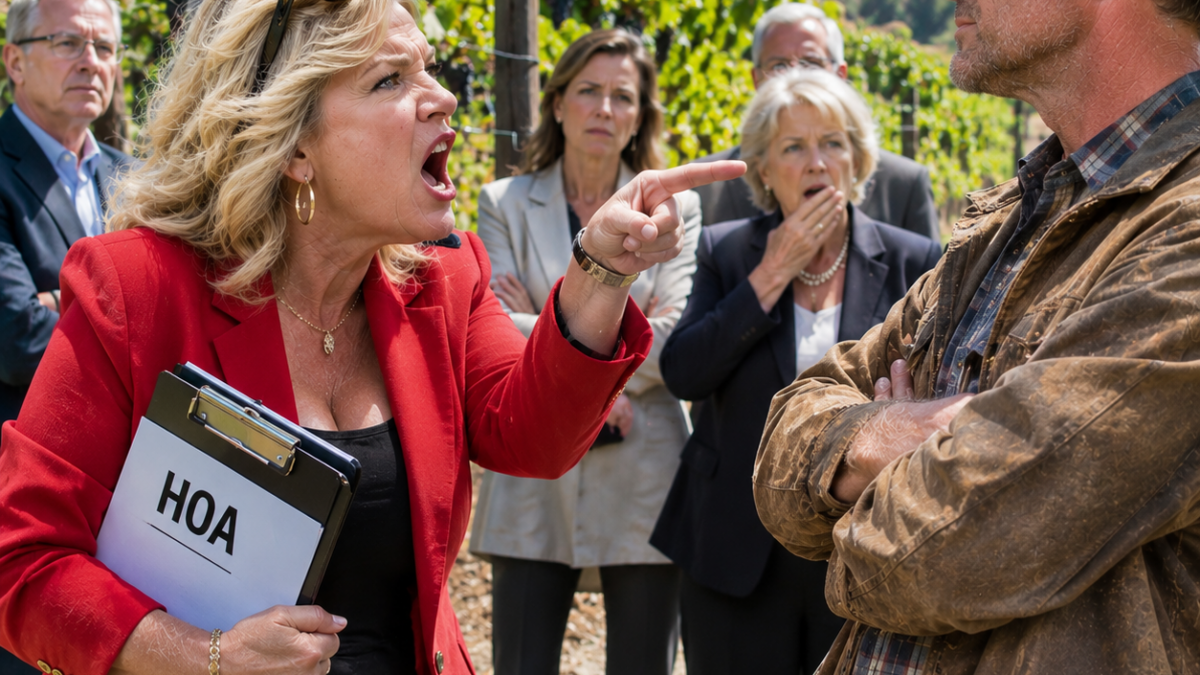
Three weeks later, Victoria came herself.
White Range Rover.
She parked diagonally across the tasting-room entrance.
Not accidentally.
People who view every environment as theirs often park the same way.
Two men came with her.
One carried a camera.
The other carried a laser measuring tool.
I was in South Ridge thinning canopy.
Margaret’s old hat on my head.
Pruning shears in hand.
I heard Victoria before I reached them.
“These vines are a blight on the community.”
The photographer started shooting.
The contractor measured row distances.
I put my shears on the trellis wire.
Walked toward Victoria.
She wore a cream blazer.
Silk blouse.
Professional flats unsuited to farm soil.
She looked immaculate.
I probably had mud on both knees.
“Victoria.”
“Mr. Caldwell.”
“What are they doing?”
“Documenting.”
“On private property.”
“We’re preparing for legal action.”
“You don’t have permission to be here.”
She gestured toward the vines.
“You need to understand something.”
“I understand the deed.”
“No.”
She smiled.
“You think being here first means rules don’t apply.”
“These aren’t your rules.”
“Look at the community.”
She pointed toward Ridgerest.
“Real homes.”
Then around us.
“Not this little hillbilly farm.”
That sentence almost impressed me.
Not because it was cruel.
Because she was standing in a vineyard that had won the Governor’s Cup while calling it a hillbilly farm.
I said:
“These vines have been here thirty years.”
“I don’t care if they’ve been here since Jesus.”
The photographer stopped moving.
Even he seemed surprised.
“They’re ugly.”
I stared.
“Rip them out or we sue.”
I stepped closer.
Not threatening.
Just enough that she had to stop looking past me.
“You’re standing on land my family has owned since 1891.”
Her smile remained.
“I have sixty-one homeowners, a legal team, and the full HOA board.”
“You have?”
She glanced at my old boots.
At Margaret’s hat.
At the pruning shears.
“Yes.”
She lowered her voice.
“You have whatever this is.”
I almost admired the contempt.
“Cooperate.”
She said.
“Or I can make your life very difficult.”
I picked up my shears.
“I spent thirty-one years around federal agricultural litigation.”
Her smile shifted.
Barely.
“And I’m very good at difficult too.”
Then I pointed toward the road.
“Get off my land.”
Victoria left as elegantly as she had arrived.
No shouting.
No slammed door.
The Range Rover disappeared down Caldwell Road trailing dust.
My road.
A fact she had not yet bothered to investigate.
More letters followed.
Formal demand.
Final warning.
Notice of intent.
Property-value claims.
Each one ignored Section 4.1.
I answered briefly.
One paragraph.
Certified mail.
Receipts.
No insults.
No threats.
Ruth once asked:
“You having fun?”
“No.”
“You sound like you are.”
“I enjoy good records.”
“That is why Mom said lawyers should not be allowed hobbies.”
Then Victoria stopped writing.
One Wednesday in June, I drove up South Ridge just after sunrise.
Coffee.
Shears.
Margaret’s hat.
I parked near row fourteen.
Something smelled wrong.
Chemical.
Sharp.
Out of place.
Anyone who has worked around agriculture long enough knows that smell.
I followed it downhill.
Leaves curling.
Hard.
Brittle.
Yellow streaks.
Canes darkening at their tips.
Row after row.
Margaret’s oldest vines.
I dropped to one knee.
Touched the soil.
Damp.
Oily sheen.
No rain for eleven days.
My stomach turned.
Not because I didn’t understand.
Because I did.
Somebody had sprayed them.
I walked row seventeen.
Above one dying plant, a faded blue ribbon fluttered from the trellis.
Margaret tied it there in 1997.
First viable cluster.
We had left it.
Twenty-six years of sun had bleached it almost white.
The vine beneath it was dying.
I sat down in the grass.
For several minutes, I forgot Victoria.
The HOA.
The letters.
All of it.
I saw Margaret.
Thirty-four years old.
Rubber boots.
Dirty hands.
Blue ribbon.
Laughing because we had finally proved the slope could produce.
I touched the old ribbon.
“I’m sorry.”
No answer.
Wind moved through damaged leaves.
Then the attorney in me returned.
I stood.
Photographed everything.
Soil.
Rows.
Leaves.
Boundary.
Tire tracks.
Trail camera.
3:42 a.m.
White panel van.
BLUE RIDGE PEST SOLUTIONS.
Two workers.
Backpack sprayers.
Forty-seven minutes.
I called the company.
Owner:
Gary Hinton.
Nervous immediately.
“Mr. Caldwell, I was told that was HOA property.”
“Who told you?”
“The HOA president.”
“Victoria Langford?”
“Yes.”
“Written work order?”
Pause.
“Yes.”
“Send it.”
He emailed it within an hour.
Ridgerest letterhead.
Signed:
Victoria Langford, President.
Target:
Invasive vine growth on community perimeter property.
Treatment:
Broadleaf herbicide.
Full elimination.
Full elimination.
Not pruning.
Not pest management.
Elimination.
She had hired a contractor to kill Margaret’s vineyard.
Paid $3,200 cash.
Told him the land was hers.
I sat on the porch that evening.
The damaged section looked like a bruise across South Ridge.
Niamh—
No.
That belonged to another life.
I caught myself thinking of Margaret whenever I needed someone to speak to.
That night I said aloud:
“You were right.”
Margaret had always told Ruth:
“The dangerous ones aren’t angry. They’re too vain to be afraid.”
I opened my laptop.
Created subfolders.
Correspondence.
Trespass.
Herbicide.
Vendor records.
Trail camera.
Deed.
Covenants.
County.
Victoria wanted a fight.
She was about to get documentation.
Lab results came six days later.
Triclopyr.
Heavy concentration.
Applied far beyond what those vines could tolerate.
State agriculture officials determined the treatment had been unlicensed and performed without consent.
Blue Ridge Pest Solutions had authority for ordinary pest-control work.
Not destroying agricultural vines.
Gary cooperated.
Probably because he realized he had been lied to.
I filed reports.
Then waited.
Victoria escalated exactly as expected.
Three weeks later, while the herbicide investigation remained active, she filed a formal nuisance complaint with the Albemarle County Board of Supervisors.
Against the vineyard.
Not against the illegal chemical attack.
According to Victoria:
Caldwell Ridge Vineyard created pesticide drift.
That accusation had audacity.
She had just arranged unauthorized spraying.
She complained of insects.
Machinery noise.
Visual degradation.
She submitted a petition.
Sixty-one Ridgerest homeowners.
Sixty-one signatures.
Demanding county action against my farm.
Then the crucial request:
Rezone Caldwell agricultural land for residential use.
I read that sentence again.
Then again.
That was the first time I stopped seeing her campaign as personal.
People do irrational things over aesthetics.
But rezonings are not aesthetic.
They are economic.
Two weeks before the county hearing, a Richmond litigation firm sent me a twelve-page demand.
Whitaker, Saurin and Cole.
Immediate cessation of viticultural operations within one thousand feet of Ridgerest.
Claimed damages:
$2.1 million.
I poured a glass from the last vintage Margaret personally supervised.
Took it outside.
Harvest was close.
Most vines remained heavy with fruit.
The evening smelled of ripe grapes, honeysuckle, and warm stone.
I was not frightened by the letter.
Right-to-farm protection.
Recorded deed covenant.
Agricultural zoning.
The legal threat was weak.
What bothered me was the shape of the campaign.
Letters.
Trespass.
Poison.
Nuisance petition.
Rezoning request.
Two-million-dollar threat.
That was not a woman protecting a view.
It was a strategy.
Someone wanted agriculture gone.
But why?
Walter Chen called that night.
Walter lived on the north side of Ridgerest.
Retired mechanical engineer.
Board member.
Quiet.
Good man.
The sort of person who carries tools in his vehicle because strangers might need them.
“Eli.”
“Walter.”
“I need to tell you something.”
I sat.
“What?”
“We had a closed board session.”
“When?”
“After the lawsuit letter.”
“Okay.”
“Sandra looked you up.”
“Sandra Okafor?”
“Treasurer.”
“I know her.”
“She had never Googled you.”
I laughed.
“I’m sorry?”
“None of us had.”
Walter sounded embarrassed.
“She searched Caldwell Valley.”
He told me what appeared.
Governor’s Cup article.
Caldwell Ridge Vineyard.
Historical register.
Caldwell family ownership since 1891.
My old USDA profile.
Then the property records.
Caldwell Road.
Private ownership.
Revocable easement.
Water parcel.
Walter continued:
“Sandra turned the laptop around.”
“What did she say?”
“She said, ‘Do you understand what we’re doing?’”
I closed my eyes.
Walter quoted her.
“This man’s family owns the road we use to reach our houses and the parcel supplying our water. He wrote the deed. We are threatening the attorney who drafted the document controlling whether those rights continue.”
I laughed.
Couldn’t help it.
“What did Victoria say?”
Walter was silent.
Then:
“She closed the laptop.”
“Closed it?”
“Like she was ending the conversation.”
“And?”
Walter sighed.
“She said she didn’t care if your family invented dirt.”
I started laughing harder.
Walter continued despite himself.
“She said the vines were ugly, they were coming down, and if the board didn’t have the spine, she would handle it.”
I wiped my eyes.
“Anything else?”
“She told us to stop wasting her time Googling.”
“Of course she did.”
“Three board members resigned the next morning.”
“Sandra?”
“Yes.”
Walter sounded tired.
“She knew exactly what could happen.”
I looked across the valley.
Ridgerest lights coming on.
Seventy-four homes.
Families who had no idea how much their access depended on contractual language signed before Victoria ever arrived.
“I don’t want those people trapped.”
“I know.”
“That matters.”
“I know.”
“But she needs to stop.”
“She won’t.”
Walter was right.
That conversation changed my strategy.
Victoria had been shown the cliff.
She closed the map.
So I started digging.
County property records first.
Developer filings.
Planning applications.
Business registrations.
One document made me sit back.
Blue Ridge Heritage Development LLC.
Preliminary application filed fourteen months before Victoria’s first vineyard letter.
Proposed:
120 residential lots.
110 acres.
South and west Caldwell Valley slopes.
Phase two of Ridgerest.
Luxury homes.
Starting prices north of eight hundred thousand.
Renderings labeled:
VINEYARD VIEW ESTATES.
The views were of my vineyard.
Again.
The proposed acreage was county agricultural reserve land.
To build there, Todd Marsh needed a rezoning.
Agricultural to residential.
That would normally be difficult.
Unless the county had reason to conclude agricultural use in the valley had become incompatible with surrounding residential development.
I read Victoria’s complaint.
Persistent agricultural nuisance inconsistent with residential character.
Then the rezoning request.
Then the phase-two application.
The sequence was almost elegant.
Destroy the vineyard’s reputation.
Claim agriculture is the problem.
Pressure county to change zoning.
Open the land.
Then I checked the LLC managers.
Todd Marsh.
And:
Victoria Langford.
I stared.
There it was.
Not speculation.
Filing.
Victoria had a direct financial interest in the development she was helping politically prepare.
She was not merely president of the HOA.
She was a partner in the company that stood to benefit if the county reclassified the valley.
Every fine.
Every letter.
Every petition.
Every legal invoice paid by Ridgerest homeowners.
The HOA had been financing her development strategy.
Walter obtained financial records.
Eighteen months.
$47,000 paid by Ridgerest to Whitaker, Saurin and Cole.
The same firm threatening me.
Forty-seven thousand dollars of homeowner dues used to support a campaign connected to Victoria’s private business interest.
I called Ruth.
She answered:
“Dad.”
“Busy?”
“Define busy.”
“I found the motive.”
Silence.
Then:
“Send everything.”
I did.
Twenty minutes later:
“Oh.”
“That good?”
“No.”
“That bad?”
“For Victoria?”
Ruth paused.
“Very.”
She drove home that weekend.
We spread documents across Margaret’s old harvest-schedule table.
That felt right.
Ruth organized.
I cross-referenced.
Coffee.
Highlighters.
Tabs.
Margaret’s chair remained empty between us.
At one point Ruth looked toward it.
“Mom would’ve enjoyed this.”
“The lawsuit?”
“The part where the woman who called the vineyard ugly turns out to be selling houses using vineyard views.”
I smiled.
“She would have poured wine first.”
“Good idea.”
We opened a bottle after midnight.
The case formed around four pillars.
First:
Agricultural Protection Covenant.
Victoria’s actions violated it repeatedly.
Second:
Road easement.
Conditional.
Breach the covenant, risk revocation after proper notice.
Third:
Water agreement.
Same.
Fourth:
Financial self-dealing and fraud.
Homeowner dues used for Victoria’s concealed private development interests.
Then the herbicide.
Trespass.
Agricultural destruction.
State violations.
Our family attorney, Robert Hail, reviewed the file.
Seventy-two years old.
Forty-six years practicing around Albemarle.
He read for four hours.
Three coffees.
Finally:
“Eli.”
“Yes?”
“This may be the best documented HOA fraud matter I have ever seen.”
“Compliment?”
“Not for them.”
He tapped Victoria’s letters.
“She wrote everything.”
“Most of it.”
“Signed everything.”
“Yes.”
“Then poisoned the vines through a contractor who kept the work order.”
“Yes.”
“Then filed for rezoning benefiting an LLC where she is a managing member.”
“Yes.”
“And used HOA money for lawyers.”
“Yes.”
Robert leaned back.
“She loaded the gun.”
Ruth added:
“And kept mailing us ammunition.”
County hearing came in October.
Thursday evening.
Fluorescent lights.
Government carpet.
Public chairs.
Victoria arrived polished.
Charcoal blazer.
Pearls.
Hair perfect.
Leather portfolio.
She gave a twenty-two-slide presentation.
Property-value comparables.
Maps.
Photographs.
Insect claims.
Noise.
Visual blight.
Then she showed photographs of the herbicide-damaged vines.
I almost laughed.
She had arranged their poisoning and now presented their damage as proof that the vineyard was neglected.
Ruth leaned toward me.
“That’s bold.”
“Keep that photograph.”
“Already did.”
Victoria spoke for eighteen minutes.
Smooth.
Controlled.
Professional.
I understood why sixty-one homeowners had signed her petition.
She was good.
That mattered.
Bullies are not always screaming fools.
Some are polished.
Some cite data.
Some wear pearls.
Some know exactly how to create the appearance of expertise.
Victoria finished.
Sat down.
I stood.
Khakis.
Work boots.
Corduroy blazer Margaret bought me on our thirtieth anniversary.
She told me:
“Every lawyer needs one jacket that doesn’t smell like soil.”
Mine still probably smelled faintly like soil.
I walked to the microphone.
“Chairman, my name is Eli Caldwell.”
Victoria looked bored.
“My family has owned Caldwell Valley since 1891.”
Less bored.
“The vineyard Ms. Langford asks you to classify as a nuisance has operated continuously since 1994.”
I placed the deed into the record.
Then the covenant.
Read Section 4.1.
No purchaser, successor, or homeowners association could interfere with existing Caldwell agricultural operations.
Victoria’s face changed.
Not dramatically.
Her smile stayed.
But she stopped moving.
I presented road access.
Conditional easement.
Then water.
Then the sale history.
Then Ruth stood.
“My name is Ruth Caldwell.”
She held up an LLC filing.
“This is Blue Ridge Heritage Development LLC.”
Victoria’s attorney looked down.
Ruth continued.
“Managing members: Todd Marsh and Victoria Langford.”
Silence.
One county supervisor leaned forward.
Ruth placed the phase-two site plan on the screen.
One hundred twenty proposed homes.
South and west valley.
“Ms. Langford has asked this board to rezone agricultural land after organizing a nuisance campaign against the valley’s existing agricultural operation.”
She changed slides.
Timeline.
Phase-two filing.
Then first HOA letter.
Then herbicide attack.
Then petition.
Then rezoning request.
Then HOA legal payments.
“This is not a neighborhood nuisance dispute.”
Ruth’s voice stayed calm.
“This is a development application disguised as community protection.”
Nobody moved.
Victoria’s attorney whispered to her.
She ignored him.
Ruth continued.
“Sixty-one homeowners signed a petition after being told the vineyard threatened their property values.”
She displayed Ridgerest’s original marketing brochure.
Luxury living in Virginia wine country.
Photograph:
Caldwell Ridge vineyard.
A supervisor actually laughed once.
Quietly.
Ruth said:
“The same agricultural operation used to sell these homes is now being described as the reason their values are allegedly declining.”
Then the financial records.
Forty-seven thousand dollars in HOA legal payments.
Then Victoria’s ownership interest.
The chair looked directly at her.
“Ms. Langford, did you disclose your membership in Blue Ridge Heritage Development to the homeowners whose dues funded this litigation?”
Victoria’s attorney stood.
“I would advise my client—”
The chair said:
“That’s a no?”
The room shifted.
I saw it.
That moment when a presentation stops being persuasive and starts looking like evidence.
The nuisance complaint was dismissed unanimously.
Rezoning denied.
The chairman asked:
“Mr. Caldwell, do you intend to pursue the other issues raised tonight?”
“Yes, sir.”
Victoria looked at me.
For the first time since I met her, she wasn’t smiling.
Not angry exactly.
Confused.
As though reality had violated protocol.
She gathered her folder.
Walked out.
Three days later, I mailed two sets of certified letters.
First:
Ridgerest HOA.
Formal covenant-breach notice.
Seventeen documented acts of interference.
Ninety days to remediate.
If not, I reserved all contractual remedies relating to road and water access.
Second:
Every homeowner.
Seventy-four letters.
I wrote them personally.
I explained the deed.
The road.
Water.
Covenant.
Victoria’s actions.
Then I wrote:
I have no desire to interfere with any family’s access to its home or essential water service. My objective is compliance, not punishment. But I will enforce the protections my family negotiated if the association continues to use its authority to interfere with Caldwell agricultural operations.
That sentence mattered.
I did not want families frightened.
They deserved truth.
Ridgerest called a community meeting ten days later.
Seventy of seventy-four households attended.
I stayed outside at first.
Walter asked me to come.
Victoria opened.
White blazer now.
Different pearls.
Same confidence.
She called me an aggressive neighboring landowner threatening community access.
Four sentences.
Walter stood.
“Vicky.”
She stopped.
“We’ve read the letters.”
“Walter, if you would allow—”
“All of them.”
She stared.
“His.”
Walter pointed toward me.
“And yours.”
Then:
“Sit down.”
The room erupted.
Not violently.
Voices.
Questions.
Years of stored irritation.
A woman stood.
“Why did our dues pay forty-seven thousand dollars to lawyers for your business project?”
Victoria lifted both hands.
“That’s a mischaracterization.”
A man behind her said:
“You own the development company.”
“An investment interest does not—”
Patricia Chen stood.
Walter’s wife.
Retired principal.
The kind of woman who could silence a cafeteria with one glance.
“You told us the vineyard was lowering our property values.”
Victoria said:
“Correct.”
“You never told us you planned to put one hundred twenty more houses behind ours.”
“That development would enhance—”
Patricia cut her off.
“Enhance what?”
Victoria paused.
“Our community.”
“For your bank account?”
Somebody laughed.
Then David Park stood.
Software engineer.
Moved from Seattle.
“I paid six hundred eighty thousand dollars for my house because of the vineyard view.”
Applause.
“You told me the vines were the problem.”
He pointed toward the phase-two rendering.
“These houses are the problem.”
Another homeowner stood.
Retired nurse.
“I signed your petition.”
Her voice shook.
“You came to my door and told me insects from Eli’s farm were threatening resale values.”
Victoria said:
“That remains—”
“You never said you were a developer.”
More voices.
A man:
“You used our money.”
Woman:
“You lied about the covenant.”
Someone:
“Did you know about the road?”
Another:
“And water?”
Victoria stood.
Smoothed the blazer.
Then deployed the smile.
I knew that smile.
Full commercial-grade confidence.
“This entire matter has been taken completely out of context.”
The room quieted.
“Todd’s project would have increased long-term value throughout the valley.”
Patricia:
“For who?”
Victoria’s smile froze.
Someone started clapping slowly.
Then another.
Not applause for Victoria.
Recognition of the absurdity.
Walter called for a vote.
Remove Victoria from the board.
Sixty-eight:
Yes.
Three:
No.
Three abstentions.
Victoria voted for herself.
Of course.
She walked out.
Heels clicking.
Graceful even then.
There is something unsettling about a person whose appearance remains perfectly controlled after their authority collapses.
Outside, two Albemarle County sheriff’s deputies were waiting.
Warrant connected to trespass and destruction of agricultural property.
That was when the clubhouse went completely silent.
Victoria stopped.
One deputy spoke.
She turned toward him.
Then toward the building.
For one second our eyes met through the glass.
I felt no triumph.
Just exhaustion.
Harvest was the following week.
And I still had damaged vines to deal with.
The aftermath moved slowly.
Which is how real consequences usually move.
Agriculture regulators assessed penalties against Blue Ridge Pest Solutions.
Gary surrendered his relevant license.
He cooperated.
I never hated him.
He should have verified ownership.
He should have known his application authority.
But Victoria lied to him.
His mistake was believing a person with HOA letterhead.
A Virginia Tech viticulturist assessed the vineyard damage.
Heritage rootstock.
Mature production.
Lost years.
Replacement.
Economic impact.
Estimated value:
$162,000.
I watched the evaluator walk row seventeen.
She touched the old trunks.
Then the dead section.
“These can’t be replaced.”
“They can be replanted.”
“That’s not what I said.”
I knew.
Robert filed the civil suit.
Agricultural property destruction.
Trespass.
Fraud.
Covenant breach.
Damages.
Enhancements allowed under the claims asserted.
Total demand:
$538,000.
Ruth filed separately regarding the legal campaign.
Whitaker, Saurin and Cole withdrew.
Todd Marsh abandoned phase two.
Blue Ridge Heritage Development LLC dissolved within sixty days.
Then another problem surfaced.
Todd had failed to properly disclose the conditional road and water arrangements to Ridgerest purchasers.
Seventy-four homes.
Families had signed closing documents without understanding the infrastructure beneath their community rested on revocable rights across Caldwell property.
I was furious.
Not at the homeowners.
At Todd.
Dad had negotiated those restrictions specifically so everyone knew the terms.
A developer had treated disclosure like an inconvenient footnote.
Homeowners began filing claims.
Todd’s problems multiplied quickly.
Victoria eventually pleaded guilty to misdemeanor destruction of agricultural property and trespass.
Probation.
Restitution.
Community service.
Her service placement was a county agricultural extension office.
When Ruth told me, I stared.
“You’re joking.”
“No.”
“They’re making her work around farmers?”
“Yes.”
“Who chose that?”
“Judge.”
I smiled.
Margaret would have appreciated it.
Victoria also lost the ability to serve on property-owner association boards in Virginia.
That consequence probably hurt more than the fine.
Power had been her favorite possession.
Her house sold later.
Loss around forty-two thousand dollars.
She moved back toward Northern Virginia.
I heard Tyson’s Corner.
Maybe McLean.
Maybe somewhere else.
I never checked.
That was another victory.
The day I stopped caring where Victoria lived.
Walter became Ridgerest president.
Reluctantly.
He came to my kitchen with a revised easement proposal.
He sat where Ruth and I had built the case.
“I’m sorry.”
“You didn’t poison the vines.”
“I signed her petition.”
“So did sixty other people.”
“I should’ve checked.”
“Yes.”
He looked surprised.
I continued:
“But you checked eventually.”
He nodded.
“We want a new agreement.”
I read it.
Full recognition of agricultural protections.
No HOA interference.
Transparent notice.
Road and water access confirmed so long as covenant terms were honored.
Then one addition:
Annual invitation for Ridgerest families to attend Caldwell Ridge Harvest Festival.
I looked at Walter.
“Whose idea?”
“Patricia.”
“Of course.”
I signed.
Walter reached into a canvas bag.
Set chrysanthemums on the table.
Bronze and gold.
Margaret’s favorite autumn colors.
“These are for her.”
I couldn’t answer immediately.
Walter looked toward Margaret’s photograph.
“She always said they looked good by the vines.”
“You knew her?”
“Bought wine here.”
He smiled faintly.
“She corrected the way I held pruning shears once.”
“That sounds like her.”
I took the flowers.
“Thank you.”
The following spring, we replanted the damaged rows.
Ruth came home from Richmond.
Work gloves.
Old jeans.
Margaret’s daughter on Margaret’s slope.
We propagated cuttings from surviving original stock.
Two hundred feet.
New vines.
Thin.
Fragile.
Nothing like the thick old trunks nearby.
Ruth held one cutting.
“Feels small.”
“It is.”
“How long?”
“Years.”
“Before fruit?”
“Several.”
“Before it looks like Mom’s?”
I looked down the row.
“Maybe thirty.”
She nodded.
Then dug.
We worked all morning.
At lunch, we sat under an oak.
Ruth was quiet.
Finally:
“Do you think she knew how much this place would matter to us after she was gone?”
“Yes.”
“Really?”
“No.”
Ruth smiled.
“Better answer.”
I installed a bench at the top of row seventeen.
White oak.
From a tree lost in a storm on North Ridge.
Tarquin—
No.
Different story again.
Grief has a way of pulling memories across invisible boundaries.
I commissioned a small brass plate.
FOR MARGARET
WHO PLANTED WITH PATIENCE
AND HARVESTED WITH GRACE
The first morning after installation, I carried coffee up.
Sat.
Looked at old vines.
Then new ones.
Mature trunks twisted and strong.
Young canes tied carefully to wire.
Same slope.
Same limestone.
Same sun.
I understood what Margaret meant.
They know what to do.
Not because plants possess wisdom the way people do.
Because growth has its own discipline.
Roots first.
Then cane.
Then fruit.
You cannot shout a vine into maturity.
You cannot threaten it.
You cannot market it.
You cannot hold a board meeting and vote it older.
You wait.
That was everything Victoria never understood.
Ridgerest changed too.
Not immediately.
People still argued.
Dues.
Pool maintenance.
Landscaping.
Normal HOA things.
But Walter published minutes.
Financials.
Contracts.
No closed-session development schemes.
Patricia insisted every board member disclose outside financial interests.
David built an online portal where homeowners could read invoices.
Someone joked that Ridgerest had become less glamorous.
Walter said:
“Good.”
The vineyard stopped being an enemy.
Families returned to the tasting room.
Some awkwardly.
One woman who had signed the petition came in with her husband.
She waited until the tasting ended.
“Mr. Caldwell?”
“Eli.”
“I owe you an apology.”
“You don’t owe me anything.”
“I signed it.”
“So did many.”
“I believed her.”
“That happens.”
She looked toward South Ridge.
“I told people the vines lowered my home value.”
I smiled.
“Do you still think that?”
She laughed nervously.
“No.”
“Then we’re improving.”
Her husband bought a case.
I didn’t give them a discount.
Forgiveness does not require poor business judgment.
That year’s harvest was lighter because of the damaged rows.
But the remaining vines performed well.
The winery kept going.
Restaurants kept ordering.
The Governor’s Cup trophy stayed on Margaret’s desk.
People asked about the brown section.
Then later the replanted section.
I told the story when appropriate.
Not every visitor needed Victoria.
Some people just wanted wine.
That felt healthy.
The legal case settled over time.
Restitution paid for replanting.
Lost production.
Repairs.
Fees.
But money never replaced age.
That is something courts cannot solve.
You can calculate market value.
Projected yields.
Replacement cost.
Lost profits.
You cannot invoice someone for thirty mornings in October.
For Margaret’s hands tying vines.
For the blue ribbon in 1997.
For conversations she had with plants when she thought nobody listened.
That loss remained.
But the new vines grew.
And eventually loss stopped being the only thing I saw.
One evening Walter came up during his walk.
I was tying new growth.
“Need help?”
“You know how?”
“No.”
“Perfect.”
I handed him a tie.
“Loose.”
“How loose?”
“Enough room to grow.”
He wrapped it too tightly.
“Looser.”
Again.
“Still.”
Third time.
“Good.”
Walter looked at the vine.
“That’s it?”
“That’s it.”
“Seems easy.”
“Most things do after somebody teaches you.”
He was quiet.
Then:
“Wish someone had taught us to read the deed.”
I smiled.
“You could’ve Googled sooner.”
He laughed.
That became a joke around Ridgerest.
Before any board action:
“Google it.”
Before changing a rule:
“Read the deed.”
Before sending Eli Caldwell a letter:
“Ask Walter if he wants another heart attack.”
Healthy institutions develop humor around previous stupidity.
It keeps people humble.
The annual harvest festival grew out of that new relationship.
First year:
Two hundred people.
Ridgerest families.
Charlottesville customers.
Local farmers.
Children.
Long tables.
Music.
Food.
Sunset over Blue Ridge.
Walter placed chrysanthemums beside Margaret’s bench.
Patricia brought grandchildren.
They picked wild blackberries.
Returned with purple hands.
A little girl stopped at the bench.
Seven or eight.
She sounded out the plaque.
Then looked up.
“Who’s Margaret?”
“My wife.”
“She planted this?”
I pointed toward the ridge.
“These old vines.”
The girl stared down the rows.
Old trunks.
New canes.
All reaching the same direction.
“She planted all of those?”
“Many.”
“She must’ve been really patient.”
I looked at the blue ribbon still tied above row seventeen.
Faded almost white.
Then at Ruth laughing farther down the hill.
Walter talking with neighbors.
Children running between rows where Victoria once sent a contractor to measure destruction.
“Yes.”
I said.
“She was.”
The girl read the plaque again.
Then ran toward Patricia.
I stayed on the bench.
The sun dropped behind Blue Ridge.
Gold light through leaves.
The air smelled like ripe fruit.
Honeysuckle.
Apricot.
Warm limestone.
Harvest was a week away.
The grapes were ready.
The oldest vines Margaret planted were still there.
Thirty years of roots below them.
The new vines beside them were thin.
Beginning.
Growing exactly as slowly as they were supposed to.
Below the ridge, Caldwell Creek reflected the evening sky.
Beyond it sat the seventy-four Ridgerest homes.
The neighborhood that once signed a petition demanding my vineyard disappear was now gathered among those same vines celebrating harvest.
Nobody was talking about ripping them out.
Nobody was complaining about insects.
Nobody was demanding residential rezoning.
Nobody was measuring row distances.
The valley had outlasted Victoria.
It would outlast me too.
That thought no longer frightened me.
My job had never been to freeze Caldwell Valley exactly the way Margaret left it.
My job was to protect what mattered long enough for someone else to care.
Ruth would.
Maybe her children.
Maybe a young winemaker we had not met yet.
Ownership is temporary.
Stewardship is the part that travels forward.
Victoria believed power meant deciding what other people had to remove.
Margaret believed growing anything worthwhile meant knowing when not to interfere.
One woman wanted thirty-year-old vines destroyed because they blocked a development plan.
The other spent thirty years teaching roots how to survive Virginia summers, wet springs, cold winters, disease pressure, drought, and time.
I know which one left the stronger mark on Caldwell Valley.
Sometimes visitors still ask about the famous HOA fight.
They expect the exciting part.
The county hearing.
The board revolt.
Victoria walking out toward deputies.
They ask:
“Was it satisfying?”
Yes.
I won’t pretend otherwise.
Watching a person who had poisoned Margaret’s vines lose the authority she had abused felt satisfying.
But satisfaction fades quickly.
The part that remains is quieter.
Ruth beside me planting replacements.
Walter bringing chrysanthemums.
A little girl reading Margaret’s plaque.
The old vines carrying fruit again.
That’s the part I think about.
Revenge can stop someone.
Legacy tells you what to do afterward.
And Margaret had already told me.
“They’ll be fine.”
She was right.
Not all of them.
Some died.
Some had to be replanted.
Some scars stayed visible for years.
But the vineyard survived.
The winery survived.
The valley survived.
And somehow, after everything Victoria did trying to transform Caldwell Valley into another phase of suburban development, her greatest contribution was teaching seventy-four neighboring families exactly why the agricultural covenant existed.
Dad had understood developers.
Margaret understood vines.
I understood documents.
Between the three of us, Victoria never really had a chance once the truth reached the same room.
She just didn’t know it.
That was why her own board looked me up too late.
Why Sandra’s face went pale when she read who owned Caldwell Road.
Why someone started calculating what a house was worth without guaranteed access.
Why everyone suddenly cared who controlled the well.
But the road and water were never weapons I wanted to use against innocent families.
They were safeguards.
Dad wrote them into the deal because he knew someday someone would confuse living beside a farm with owning the right to control it.
He was protecting the valley from exactly the kind of person Victoria became.
And when she finally tested those protections, they worked.
Not because I was powerful.
Because the documents were clear.
That distinction matters.
People sometimes tell this story as though I won because my family owned twenty-four hundred acres.
No.
Land helped.
The road helped.
The water agreement helped.
My legal background helped.
But the decisive thing was preparation made years before the conflict existed.
Dad negotiated carefully.
I drafted carefully.
The deed was recorded.
Margaret operated a legitimate farm.
Records existed.
Those details became armor long before anybody knew armor would be needed.
That is why Victoria’s confidence was never enough.
Confidence cannot erase a deed.
Marketing cannot rewrite a covenant.
A glossy presentation cannot make fraud disappear.
And sixty-one petition signatures cannot give somebody ownership of another person’s farm.
The night after the first harvest festival, I walked South Ridge alone.
Tables had been cleared.
Music gone.
The tasting room lights still glowed below.
I reached row seventeen.
Touched the old blue ribbon.
Then the newest vine beside it.
Small leaves.
Thin trunk.
Alive.
“I kept them.”
I said.
To Margaret.
To myself.
Maybe to nobody.
The wind moved through the leaves.
For a second I could hear her voice.
Not literally.
Memory.
“They know what to do.”
I smiled.
“Yeah.”
I looked down the valley.
“You did too.”
Then I walked home.
The next morning, I was back in the vineyard before sunrise.
Coffee in one hand.
Pruning shears in the other.
Margaret’s hat on my head.
Exactly where I had been before Victoria Langford ever drove her Range Rover onto Caldwell land and told me the vines were ugly.
The difference was that now the new plants were growing beside the old ones.
Ruth had helped put them there.
Ridgerest families had walked those rows willingly.
Walter’s chrysanthemums sat near the bench.
Harvest was coming.
The valley smelled alive.
And nobody had threatened to rip anything out.
Not anymore.
I stopped at the top of row seventeen as the first sunlight touched the Blue Ridge.
The old vines were heavy with fruit.
The new vines were still learning the wire.
I thought about Margaret’s thirty years of patience beneath my feet.
Then I looked toward Ridgerest Estates.
Seventy-four homes on land my father once sold under a covenant that had done exactly what he designed it to do.
For years, those homeowners had thought the vineyard was simply the beautiful view outside their windows.
Now they understood something deeper.
The vineyard was not scenery.
It was work.
History.
Agriculture.
Family.
And it was never theirs to command.
The little girl at the harvest festival had understood Margaret better in thirty seconds than Victoria had managed in three years.
She looked at old vines and new vines together.
Then said:
“She must have been really patient.”
She was.
She really was.








