PART 2: HOA KAREN Ordered Me to Open My Ranch—Then Her Own Map Proved I Was Never in Her HOA
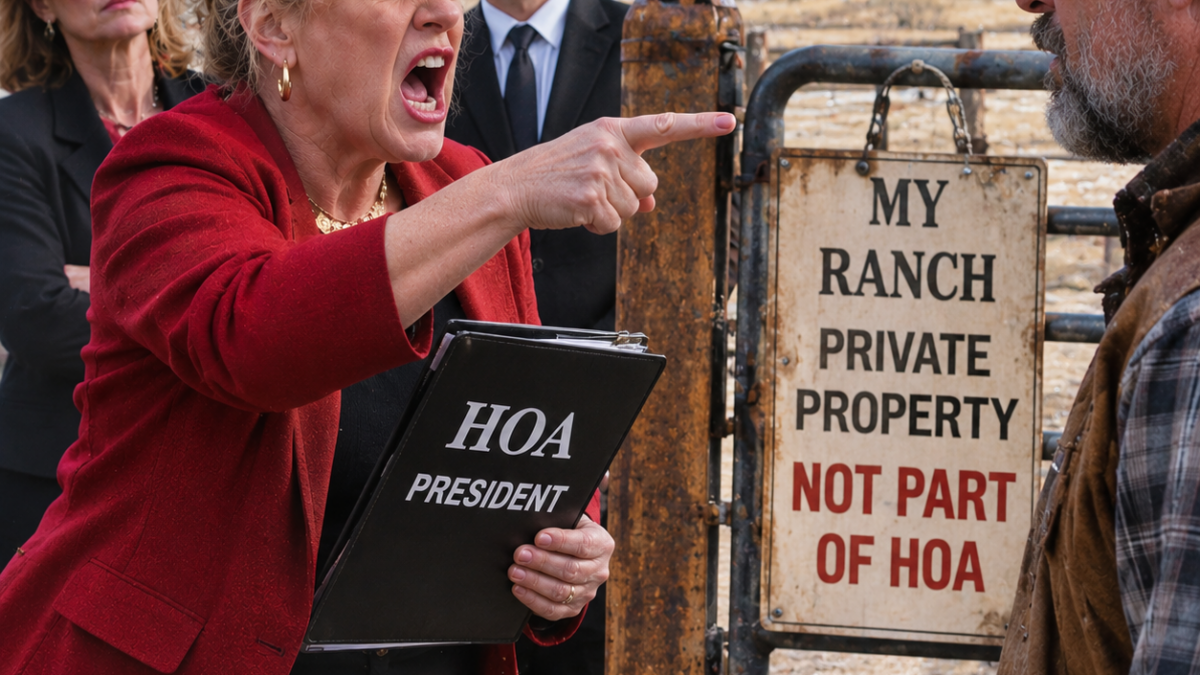
PART 2
I was at Elias’s office before he unlocked the front door the next morning.
His office sat above a hardware store in a brick building that had probably been standing since horses outnumbered cars downtown. Nothing about the place looked expensive. Elias liked it that way. He said people trusted lawyers too much when they had marble floors.
I carried in two old storage boxes, one under each arm.
He looked at them.
“That everything?”
“There’s another box in the truck.”
He sighed.
“Of course there is.”
“You told me to bring everything.”
“I was hoping your grandfather believed in throwing things away.”
“He considered receipts a form of family history.”
“That may save us.”
We spread documents across his conference table.
My grandfather’s original deed.
Tax receipts.
Fence surveys.
Water-right records.
Photographs.
County maps.
Grazing agreements.
Old correspondence with neighboring landowners.
Some documents dated back farther than Meridian Ridge itself.
By noon, Elias had created three stacks.
“Good.”
“Bad?”
“Good for you.”
“And bad?”
He pointed toward the HOA fine.
“This is nonsense unless they can produce something we haven’t found.”
“Such as?”
“A recorded easement. A covenant attached to your chain of title. Annexation documents. A contractual access agreement.”
“Any of those exist?”
“So far? No.”
I leaned back.
“Then we’re done.”
“No.”
I looked at him.
“You lawyers have a terrible sense of completion.”
Elias slid an older plat toward me.
“Look here.”
A narrow gravel road ran along the eastern side of my ranch before turning toward what later became Meridian Ridge.
Residents had used that stretch for years.
Not constantly.
But enough that I had seen their pickups, contractors, landscapers, teenagers on bicycles.
I had never cared.
Neither had my father.
Neither had my grandfather.
The road made it easier for people to reach an old county route near the south boundary.
“Marjorie’s going to build her argument around use,” Elias said.
“Using a road doesn’t make it theirs.”
“Correct. But years of use can create legal arguments depending on facts.”
“So we stop them now.”
“Not yet.”
I stared at him.
He folded his hands.
“Calder, I know exactly what you want to do.”
“Do you?”
“You want to close every gate, chain the road, and put a bull in the pasture.”
“That wasn’t all I wanted to do.”
“I’m happier not knowing the rest.”
Despite myself, I smiled.
Then he tapped the HOA declaration.
“Your ranch is outside Meridian Ridge. That part is clear. What isn’t clear is why Marjorie behaved as if obtaining access to the entire property mattered more than preserving her credibility.”
I thought about the convoy.
Six vehicles.
Inspectors.
Survey maps.
Cameras.
“She asked to inspect the whole ranch.”
“Exactly.”
“For one road.”
“Exactly.”
I leaned forward.
“What are you thinking?”
“That she doesn’t care about your fence color.”
“I figured that out when she arrived dressed like a real-estate brochure.”
Elias almost smiled.
Then his expression became serious again.
“I want the original Meridian Ridge filing.”
“We have it.”
“No. We have the copy attached to their declaration. I want the county-certified version, every amendment, every supplemental plat, every easement, every attempt to modify the boundary.”
“How long?”
“A few days.”
I stood.
“I’ll go myself.”
“You don’t need to.”
“I know.”
“That is usually when you become most determined.”
I left before lunch.
The county records office occupied a squat brick building beside the courthouse.
Saraphene Vale sat behind the main counter.
Everybody called her Sara except people trying to impress her.
I had known her since I was twenty.
She had processed family tax records, corrected parcel numbers, and once called me personally because a clerk accidentally entered an irrigation parcel twice.
She looked over her glasses.
“Calder Ror.”
“Saraphene Vale.”
“You only use my whole name when you need something unpleasant.”
“I need Meridian Ridge records.”
Her expression changed immediately.
“What kind?”
“All of them.”
“That unpleasant?”
“Six SUVs unpleasant.”
She motioned me toward a side desk.
“Start talking.”
I told her about Marjorie.
The convoy.
The demand.
The map showing the HOA boundary short of my gate.
The $5,000 fine.
Sara’s mouth became a thin line.
“They fined you?”
“Apparently.”
“On the ranch?”
“Apparently.”
“You’re not in Meridian Ridge.”
“I mentioned that.”
“What did they say?”
“Apparently geography is more of a suggestion now.”
Sara did not laugh.
She disappeared into the archive room.
Twenty minutes later, she returned carrying a large flat folder.
The first survey was exactly what I expected.
Original Meridian Ridge subdivision.
Property lines.
Roads.
Common areas.
Drainage easements.
My ranch clearly outside all of it.
Then Sara pulled out a second document.
“This came in later.”
“How much later?”
“Recently.”
The map looked similar at first.
Then I saw the difference.
The HOA boundary line had moved.
Not dramatically enough to catch the eye if you weren’t comparing documents.
But enough.
It pushed eastward across the gravel road.
Across the fence.
Into a broad strip of my pasture.
I felt the muscles in my jaw tighten.
“Who filed this?”
Sara pointed toward the signature block.
Blaine Mercer.
I looked at her.
“He can’t just redraw my property.”
“No.”
“Was this accepted?”
“It was scanned into a supplemental file.”
“That’s not what I asked.”
Her voice lowered.
“It does not have the supporting authorization I would expect.”
“What authorization?”
“Landowner consent. Proper survey certification. Legal description approved through the normal process. Depending on what they claim this document is, possibly more.”
“Could it be a mistake?”
“Anything can be a mistake.”
She looked at me directly.
“But I have worked here twenty years. I don’t like this one.”
I took certified copies.
Before leaving, I asked her one more question.
“If someone wanted to make it look like Meridian Ridge controlled part of my ranch, would this help?”
Sara removed her glasses.
“Calder, I document records. I don’t accuse people.”
“I know.”
“What I can tell you is this: the original county survey does not put your land inside that HOA.”
“And the newer map?”
“Changes the line.”
“Without my signature.”
“Yes.”
“Without my permission.”
“Yes.”
I nodded.
“That’s enough.”
That afternoon Elias read the documents twice.
Then a third time.
He called me at eight that night.
“I found an amendment.”
“To what?”
“The Meridian Ridge declaration.”
I drove back into town.
He had the amendment on his desk when I arrived.
The language was dry.
Technical.
Easy to ignore.
But buried in it was a description of “adjacent access territory subject to community administration.”
The legal description appeared to include the same strip shown on the newer map.
“Who signed?”
“Blaine.”
“So he filed both.”
“Yes.”
“Can he do that?”
“Not to your land.”
“What if he claims it’s only internal?”
“Then why describe territory outside the subdivision?”
I sat down.
“Is he trying to turn my ranch into HOA property?”
Elias was quiet for several seconds.
“Not the whole ranch.”
“That’s comforting.”
“Don’t be sarcastic.”
“It’s one of my few skills.”
He pointed at the road.
“I think somebody is trying to create a paper trail suggesting the association controls this corridor.”
“Why?”
“That’s what we need to find out.”
The following morning Marjorie sent another notice.
Then another the day after that.
Fence violation.
Unauthorized commercial activity.
Unapproved agricultural trailer.
Improper signage.
Landscaping noncompliance.
The agricultural trailer was parked beside my barn.
The “improper signage” was a PRIVATE RANCH — NO TRESPASSING sign that my father had put up fifteen years earlier.
By the end of the week, I had a folder thick enough to stop a door.
I answered none of them personally.
Elias sent one letter.
The Ror Ranch was not and had never been subject to Meridian Ridge covenants.
All fines were disputed.
All entry without permission was prohibited.
Any claimed easement must be produced in recorded form.
That should have slowed them down.
Instead, three survey trucks arrived Monday morning.
I met them at the gate.
The crew chief stepped out.
“We’re here to perform a boundary survey.”
“For who?”
“Meridian Ridge HOA.”
“You have a court order?”
“No.”
“Recorded easement allowing entry?”
He hesitated.
“We were told access had been cleared.”
“By me?”
“No.”
“Then access has not been cleared.”
He looked uncomfortable.
“We’re just trying to do a job.”
“I understand.”
I stayed calm.
“So am I.”
Ten minutes later Marjorie called.
“You’re obstructing an authorized survey.”
“Authorized by who?”
“The association.”
“Wrong answer.”
She exhaled sharply.
“You’re becoming unreasonable.”
“I’m standing behind a locked gate on my own property.”
“You’re interfering with our legal rights.”
“Send me the document.”
“You’ve already received notices.”
“Notices aren’t easements.”
She hung up.
Twenty minutes later a sheriff’s patrol vehicle appeared.
Deputy Hollis stepped out.
He was broad-shouldered, mid-forties, and had the patient expression of a man who had spent his career being summoned into arguments that should have been emails.
He approached me first.
“What’s going on?”
“Survey crew wants onto my ranch.”
“Your crew?”
“No.”
He looked at the trucks.
Then at my gate.
“Documents?”
I handed him my deed copy.
Original county map.
Elias’s letter.
Hollis read everything carefully.
Then walked over to the survey crew.
“What gives you legal authority to enter?”
The crew chief held up his work order.
Hollis read it.
“This is a contract.”
“Yes.”
“Not an access order.”
“No.”
“Do you have owner permission?”
“No.”
“Court order?”
“No.”
“Recorded easement?”
“I don’t have one with me.”
Hollis looked toward Marjorie’s white SUV, which had arrived while we spoke.
She stepped out before he reached her.
“Deputy, this is association-controlled land.”
Hollis pointed to my fence.
“His deed says otherwise.”
“Our legal team has documentation.”
“Do you have it?”
“Not with me.”
“Then I’m not forcing entry.”
Marjorie’s face tightened.
“Do you understand how much community business is being delayed?”
“I understand there is a private-property dispute.”
She lowered her voice.
“Officer, I don’t think you understand who you’re dealing with.”
Hollis remained perfectly calm.
“I’m dealing with a landowner, a survey contractor, and an HOA president. Unless somebody has different paperwork, the crew leaves.”
The crew chief did not need to be told twice.
Equipment went back into trucks.
Tripods folded.
Vehicles backed down the road.
Marjorie stood beside her SUV, furious.
Blaine was several yards behind her.
He had barely spoken.
Instead, he was on his phone.
Quietly.
Constantly.
When Marjorie finally left, he remained another thirty seconds.
His eyes moved from the survey pin to the gravel road.
Then toward my pasture.
Not angry.
Calculating.
That bothered me more than Marjorie ever had.
That night I reviewed my fence cameras.
Mostly cattle.
Coyotes.
One delivery truck.
At 2:13 p.m. two days earlier, an unfamiliar sedan had stopped near the eastern boundary.
A man got out.
Survey vest.
Tripod.
He spent twelve minutes near the road, then drove away.
I zoomed in on the license plate.
The next morning Sara called me before I could call her.
“Calder.”
“What happened?”
“You asked me to flag anything unusual tied to your parcel.”
“Yes.”
“A private surveyor requested archived coordinates two days ago.”
“What company?”
She gave me the name.
I recognized it from the truck on my camera.
“Who hired him?”
“That information isn’t in our file.”
I called Elias.
“I want to know who paid for that survey.”
“Good.”
“Good?”
“Yes.”
“You sound almost cheerful.”
“Because now you’re asking the right question.”
“What was I asking before?”
“What they were doing.”
“And now?”
“Why.”
Elias hired Priya Danforth.
She had been a county auditor before opening a private investigative accounting practice.
She was short, soft-spoken, and possessed the unnerving ability to sit silently until people volunteered information they had no intention of giving her.
At our first meeting, she asked me one question.
“Do you want evidence or answers?”
“Aren’t those the same?”
“No.”
She folded her hands.
“Answers come quickly. Evidence takes longer.”
“Evidence.”
“Good.”
She spent three days tracing invoices.
The survey company had billed a consulting firm.
The consulting firm had been paid through another company.
That company ultimately connected to Voss Meridian Development.
Marjorie’s development company.
Elias laid the documents across his desk.
I stared at the name.
“Voss Meridian.”
“Yes.”
“She owns it?”
“She holds a substantial interest.”
“How substantial?”
“Enough that this matters personally.”
Priya slid another file toward me.
Development proposal.
Projected expansion.
Luxury lots north of Meridian Ridge.
Commercial parcel near the highway.
Projected revenue in the millions.
I looked at the map.
Then saw the problem.
The proposed expansion needed direct highway access.
The route drawn on the plan crossed my ranch.
Not just the old gravel road.
It cut directly through pasture my grandfather had fenced before I was born.
I felt cold despite the warm office.
“They don’t want the road.”
Elias shook his head.
“No.”
“They want the corridor.”
“Yes.”
I traced the proposed route.
“How wide?”
“Initial plan? Sixty feet.”
“Through my ranch.”
“Yes.”
“Did anybody ever ask me to sell?”
“No.”
“Offer an easement?”
“No.”
“Call?”
“No.”
Priya spoke.
“They may have assumed pressure would produce negotiation.”
“Pressure?”
“HOA notices. Claimed jurisdiction. Surveys. Access demands.”
Elias leaned back.
“If they can establish that Meridian Ridge already controls the corridor, your bargaining position collapses.”
I looked from one of them to the other.
“So this was never about putting me in the HOA.”
“No.”
The words came slowly.
“They wanted me to become part of their project.”
Nobody answered.
They didn’t need to.
Priya turned another page.
Marjorie had personally guaranteed part of the development financing.
If the highway connection failed, the expansion became significantly less valuable.
And her personal exposure was substantial.
Suddenly her white blazer made more sense.
The convoy.
The threats.
The refusal to accept maps.
The desperate insistence that everyone nearby belonged to the HOA.
It wasn’t confidence.
It was fear wearing expensive clothes.
That understanding did not make me sympathetic.
It made me careful.
Desperate people rarely stop because they are embarrassed.
They stop when they run out of options.
“What about Blaine?” I asked.
Priya nodded toward the survey invoices.
“He appears throughout.”
“Why?”
“Legal coordination.”
Elias looked at me.
“He’s the dangerous one.”
“Not Marjorie?”
“She wants the outcome. Blaine understands how to build the paper.”
I thought about him standing behind her, always quiet.
Always watching.
A week later, Elias found something older.
Much older.
A document from before Meridian Ridge existed.
A development company had approached my grandfather decades earlier seeking road access across the eastern pasture.
My grandfather refused.
I knew that part.
Family story.
Granddad had once said, “Roads have a way of getting wider after you let strangers name them.”
I thought he had been exaggerating.
Maybe not.
What Elias found next bothered him.
After my grandfather’s refusal, an easement reference appeared briefly in a property index.
Then disappeared from later active records.
It was vague.
Incomplete.
Possibly abandoned.
Possibly improperly indexed.
But it gave us one important clue.
This wasn’t the first time somebody had wanted the same corridor.
“Could the HOA use this?” I asked.
“Maybe.”
“Against me?”
“Maybe.”
“You say that too much.”
“It keeps clients from doing stupid things.”
“What does it say?”
“That your family never conveyed full ownership of the road.”
“Good.”
“And that someone decades ago tried to create something after your grandfather refused.”
“Bad.”
“Potentially.”
“Was it valid?”
“That’s what we’re verifying.”
Marjorie called an emergency community meeting before we finished.
Her notice described the situation as “an urgent threat to shared access and property values.”
Residents packed the Meridian Ridge clubhouse.
I went.
Elias asked me not to.
I ignored him.
He came anyway.
We sat separately.
Marjorie took the podium.
She was polished again.
Calm.
Controlled.
She told residents I was blocking historic access.
Refusing reasonable inspection.
Jeopardizing future infrastructure.
Damaging property values.
She said one landowner should not be allowed to hold an entire community hostage.
People murmured.
A few nodded.
Some looked angry at me.
I sat in the back.
No reaction.
I had learned something from Elias.
Silence makes liars work harder.
Eventually Marjorie invited me forward.
“I’m surprised you came.”
“I was invited.”
“You’ve ignored every effort at cooperation.”
“No.”
She frowned.
“I rejected every effort to control my ranch.”
The room went quiet.
I placed one folder on the table.
“I’m not here to join your HOA.”
A man in the front row turned toward his wife.
I continued.
“I’m here because I have a question.”
Marjorie crossed her arms.
“Go ahead.”
“Why is Meridian Ridge spending so much money trying to control land that has never belonged to Meridian Ridge?”
“That’s a misleading characterization.”
“Then answer it.”
“Our association has longstanding obligations—”
“Why did your vice president file an amended boundary description?”
The room changed.
Blaine stood near the side wall.
He did not move.
Marjorie said, “Routine clarification.”
“Clarifying what?”
“Historic access.”
I pulled out the original county survey.
Then the newer map.
I placed them side by side beneath the document camera.
The screen behind us showed both.
Even residents with no surveying experience could see the difference.
Original line.
New line.
The newer line swallowed part of my pasture.
People began whispering.
Marjorie spoke quickly.
“Boundary records are updated all the time.”
“Who signed the update?”
She looked toward Blaine.
He remained silent.
I did too.
Let the room notice.
A man near the aisle stood halfway.
“Blaine?”
Still nothing.
I pointed to the signature block.
“Blaine Mercer.”
Then I held up the survey invoice.
“And who paid for the private survey used to create it?”
Marjorie’s face changed.
Only slightly.
But enough.
“Private consultants are routinely hired.”
“By Voss Meridian Development.”
That did it.
Several residents turned fully toward her.
A woman near the front said, “Your company?”
Marjorie lifted one hand.
“This meeting is not about my private business interests.”
“It became about them when your company paid for a map moving my boundary.”
“You cannot destroy a community over pieces of paper!”
Her voice rose.
First crack in the polished surface.
I looked at her.
“I’m not destroying anything.”
The room settled.
“I’m simply not letting you take what was never yours.”
The double doors opened.
Every head turned.
Elias entered first.
Sara came behind him carrying a thick folder.
I had known they were coming.
Marjorie had not.
Sara walked to the front.
The room quieted immediately.
County officials have a different kind of authority.
No election signs.
No HOA title.
Just records.
“My name is Saraphene Vale,” she said. “County recorder.”
Marjorie interrupted.
“This is an internal association meeting.”
Sara looked at her.
“I was asked to explain public property records.”
“That is unnecessary.”
Several residents shouted:
“Let her talk.”
“Sit down.”
“What records?”
Marjorie looked stunned.
Sara opened the folder.
She began with the original subdivision plat.
Meridian Ridge boundary.
Clear.
My ranch outside it.
Then the chain of title.
Ror family.
Unbroken.
Then the easement records.
No recorded HOA covenant controlling my ranch.
No recorded association ownership.
No recorded general inspection right.
Then the amendment.
Sara placed it on the screen.
“The county file contains this supplemental document.”
Marjorie leaned forward.
“As I said—”
Sara raised one hand.
“I am not finished.”
The room went still.
“The supporting materials do not establish landowner consent for the portion extending beyond the original Meridian Ridge subdivision.”
Every eye shifted toward Blaine.
He finally spoke.
“The map was prepared by a licensed surveyor.”
Sara nodded.
“Privately hired.”
“Yes.”
“That does not make it a county boundary determination.”
Blaine’s mouth tightened.
“The association relied on professional expertise.”
Elias stood.
“Then perhaps we should discuss who commissioned the professional.”
He walked forward holding a printed email.
Marjorie went pale.
I had not seen that document before.
Elias placed it under the camera.
Sender:
Blaine Mercer.
Recipient:
Marjorie Voss.
The sentence near the bottom was highlighted.
**Once Ror signs the access agreement, the development can finally proceed as planned.**
The room became completely silent.
I read it twice.
Then looked at Marjorie.
“That’s why you wanted onto my ranch.”
She said nothing.
I looked at Blaine.
“That’s why you moved the line.”
“This email does not prove—”
Elias cut him off.
“It proves the HOA dispute and Voss Meridian development plans were being discussed together.”
Blaine looked toward the residents.
“We were exploring lawful future access.”
“Then why didn’t you ask me?”
Nobody answered.
One woman near the front stood.
“Marjorie, did you know about the development connection?”
Marjorie opened her mouth.
Stopped.
Another resident asked:
“Were our HOA lawyers being used for your private company?”
“No.”
Her answer came too quickly.
Blaine looked at her.
That look told half the room more than words would have.
Elias placed another document on the table.
Formal demand.
Cease all enforcement against the ranch.
Cancel every fine.
Withdraw any lien.
Stop trespass.
Correct false boundary filings.
Preserve all records.
Reimburse legal expenses.
The room erupted.
Not at me.
At them.
Residents began asking questions faster than Marjorie could answer.
Had association money paid survey expenses?
Who approved the amendment?
Why hadn’t the board disclosed the development project?
Did Voss Meridian benefit?
Was the highway access plan already being marketed?
Marjorie hit the gavel.
Once.
Twice.
Nobody stopped.
She had called the meeting to isolate me.
Instead, she had built the room where her own authority began collapsing.
I walked out before the shouting ended.
Elias joined me in the parking lot.
“That was dramatic.”
“You enjoyed that.”
“A little.”
“What now?”
“Now the boring part.”
“Court?”
“Court.”
Marjorie tried to settle before we filed.
She arrived at Elias’s office three days later.
Alone.
No white blazer.
Dark coat.
Leather folder.
She placed a purchase offer on the conference table.
I looked at the number.
It was significant.
Enough to buy another ranch.
Maybe two smaller ones.
“I’m not selling.”
“You haven’t read the terms.”
“I read the number.”
“It’s generous.”
“I’m not selling.”
She increased the offer two days later.
I refused.
Again the following week.
Higher.
I refused.
Finally she called me herself.
“What do you want?”
“I already told you.”
“Everybody wants something.”
“I want you to admit the ranch never belonged to the HOA.”
“That doesn’t solve the access problem.”
“It solves mine.”
“You’re willing to destroy millions in investment over pride?”
“No.”
I looked through my kitchen window toward the pasture.
“I’m willing to keep my ranch.”
“You don’t even use that eastern strip.”
“That doesn’t make it yours.”
“You could retire.”
“I like working.”
“Your children could—”
“I don’t have children.”
She became quiet.
Then changed strategy.
“What happens to this land after you?”
“That’s my problem.”
“It affects the whole region.”
“No.”
My voice hardened.
“It affects your project.”
She hung up.
Residents began organizing.
A petition circulated demanding a no-confidence vote.
Some of the same people who had supported Marjorie days earlier now wanted answers.
Blaine stopped attending HOA events.
Voss Meridian announced that the expansion timeline was under review.
Investors began backing away.
Then the county attorney called.
“Mr. Ror?”
“Yes.”
“We’d like to meet regarding the boundary filings.”
“When?”
“As soon as possible.”
At the county office, three people sat across from me.
The attorney spoke carefully.
They were reviewing the newer survey.
The amendment.
The filing process.
Blaine’s role.
No one accused him of a crime.
Not yet.
They made that clear.
But the documents raised concerns serious enough for formal investigation.
“Are you continuing your civil case?” the attorney asked.
“Yes.”
“Why?”
The question surprised me.
“Because I want the record fixed.”
“You could settle privately.”
“I know.”
“You’ve been offered money?”
“Yes.”
“How much?”
“I’d rather not say.”
He nodded.
“Then why not take it?”
I thought about my grandfather.
My father.
The old gate.
The fence lines.
“Because if someone can redraw a quiet man’s boundary until he gets tired enough to sell, then the boundary never meant much.”
The attorney wrote something down.
Court moved faster than I expected.
Elias said clear documents have that effect.
The association tried to characterize everything as confusion.
A boundary misunderstanding.
Historic access.
Competing interpretations.
But every new piece of evidence made that harder.
Blaine testified.
At first, he remained controlled.
Professional.
He said the survey was commissioned to clarify access.
He said the amendment reflected an interpretation of historic usage.
Then Elias asked:
“Did you know the private survey had not been adopted as an official county boundary when you filed the amendment?”
Pause.
“Yes.”
“Did you know Calder Ror had not consented?”
“Yes.”
“Did you know his deed placed the disputed strip outside Meridian Ridge?”
Longer pause.
“Yes.”
“Why file the amendment?”
Blaine looked toward the association’s attorney.
Then toward Marjorie.
Finally:
“To support the access position.”
The courtroom went silent.
Elias continued.
“Access for the HOA?”
“Yes.”
“Or access for Voss Meridian Development?”
Blaine’s lawyer objected.
The judge narrowed the question.
Elias asked again.
“Were you aware the proposed Voss Meridian expansion required a route through Mr. Ror’s property?”
“Yes.”
“Were you aware Ms. Voss held a financial interest in that project?”
“Yes.”
“Were you aware she had personally guaranteed part of its financing?”
“Yes.”
Marjorie looked down.
Blaine’s calm began unraveling.
The court did not decide criminal liability.
That belonged elsewhere.
But on the property dispute, the findings were clear.
My ranch had never been part of Meridian Ridge.
The HOA had no authority to enforce covenants against me.
No inspection right existed simply because the association demanded one.
No fine was valid.
No lien could stand.
Any future access claim required actual legal documentation.
The disputed boundary amendment could not be used to alter my ownership.
The court ordered the association to cease enforcement actions against the ranch and barred unauthorized entry.
Every violation notice disappeared.
The $5,000 fine disappeared.
The threatened lien disappeared.
When the judge finished, I sat still.
Elias leaned toward me.
“You won.”
I looked at him.
“Not yet.”
He frowned.
I pointed toward the folder containing the development map.
“I want to know the entire reason they needed that route.”
“We know enough.”
“No.”
I shook my head.
“We know they wanted it. I want to know what happened if they didn’t get it.”
He studied me.
Then nodded.
“All right.”
The development disclosures answered that question.
Without access through my ranch, the proposed expansion had no efficient highway connection.
Alternative routes required steep grading, major environmental review, expensive bridge work, and miles of additional construction.
Projected profit collapsed.
Financing assumptions collapsed.
Land value projections collapsed.
The project didn’t merely become less attractive.
It became economically questionable.
Marjorie had personally guaranteed enough of the financing that failure threatened a large portion of her own wealth.
That was why she came herself.
Why six SUVs arrived.
Why she demanded the whole ranch.
Why she wouldn’t accept the first map.
Why Blaine pushed the paperwork.
Why the HOA became a weapon.
She wasn’t protecting Meridian Ridge.
She was protecting a development deal.
The no-confidence vote occurred the following week.
I did not attend.
Residents sent me the result.
Marjorie lost overwhelmingly.
Blaine resigned before the next board meeting and remained under formal review regarding his filings.
Voss Meridian suspended the expansion.
Then lenders withdrew.
Then investors.
The project died quietly.
No explosion.
No dramatic announcement.
Just emails.
Terminated contracts.
Withdrawn applications.
Cancelled meetings.
Sometimes millions of dollars disappear more quietly than cattle moving through fog.
A month after the ruling, I replaced the old gate sign.
The original had faded badly.
I considered repainting it.
Instead, I made a new one.
**PRIVATE PROPERTY
ROR RANCH
NO ASSOCIATION ACCESS WITHOUT PERMISSION**
I bolted it to the cedar post.
Then repaired one hinge my grandfather had installed.
The steel was old.
Still good.
I worked alone all afternoon.
Hammer.
Wrench.
Wind through grass.
Nothing else.
That silence felt more valuable than Marjorie’s largest offer.
Residents began coming by.
One elderly couple arrived with a basket of preserves.
The husband removed his hat.
“We owe you an apology.”
“You don’t owe me preserves.”
His wife gave him a look.
“We absolutely do.”
I smiled.
They had lived in Meridian Ridge nearly twenty years.
“We believed Marjorie,” the man said.
“Most people did.”
“She always sounded certain.”
“Certainty is cheap.”
His wife looked toward the pasture.
“We thought you were trying to stop road improvements.”
“I was trying to stop people entering my ranch.”
“We know that now.”
I invited them onto the porch.
Coffee became an hour-long conversation.
They told me how Marjorie had described me at meetings.
An obstacle.
A holdout.
A rancher preventing “regional progress.”
The husband shook his head.
“We never asked what progress meant.”
“That’s usually where trouble starts.”
A younger family came another Saturday.
The husband had signed a petition supporting the HOA.
“I didn’t read the maps.”
“Most people don’t.”
“I should have.”
“Yes.”
He looked surprised.
I shrugged.
“You came here for honesty.”
His wife laughed.
He did too.
“I deserved that.”
“No. You deserved better information from your board.”
That was the truth.
I didn’t hate Meridian Ridge residents.
Most had never seen the financial documents.
Never seen the original surveys.
Never known the road through my ranch was critical to a private development scheme.
They trusted leadership.
Leadership abused that trust.
Those are different failures.
Autumn arrived.
Cottonwoods turned yellow along the creek.
Cattle moved toward the lower pasture.
One afternoon, a single car stopped outside my gate.
Not an SUV.
No convoy.
Marjorie stepped out.
I almost didn’t recognize her.
Ordinary dark coat.
Hair pulled back.
No folder.
No board members.
I walked down but stayed inside the fence.
She stood on the road.
“Calder.”
“Marjorie.”
For a while neither of us spoke.
She looked at the sign.
Then toward the ranch.
“I wanted to ask you something.”
“Go ahead.”
“Were you really never part of Meridian Ridge?”
The question surprised me.
“Never.”
“Not your father?”
“No.”
“Grandfather?”
“The subdivision didn’t exist.”
She lowered her eyes.
“I know.”
“Then why ask?”
She looked toward the pasture.
“I think I spent so long telling myself there had to be some legal basis that part of me started believing one would appear.”
“That sounds dangerous.”
“It was.”
Wind moved across the road.
“The loan is public now,” she said.
“I know.”
“Voss Meridian is finished.”
“I heard.”
“I may have to sell my house.”
I said nothing.
She looked at me.
“Does that make you happy?”
“No.”
She seemed surprised.
“You could’ve taken my offer.”
“Yes.”
“You could have walked away rich.”
“I already have what I want.”
She gave a tired laugh.
“This?”
She gestured toward the ranch.
“Yes.”
“Grass and fences.”
“Mine.”
Her eyes met mine.
For the first time, I saw no challenge in them.
Just exhaustion.
“I thought if I could get the association boundary over that road, everything else would become easier.”
“For you.”
“Yes.”
“At my expense.”
“Yes.”
That admission hung between us.
Then she asked:
“If I had come here the first day and simply asked to buy an easement, would you have considered it?”
I thought about that.
“Maybe.”
She looked almost pained.
“Really?”
“Maybe.”
“For how much?”
“I don’t know.”
“You refused millions later.”
“Later you weren’t buying a road.”
“What was I buying?”
I looked at the gate.
“Permission to pretend you had been right.”
She closed her eyes for a moment.
Then nodded.
“I understand.”
She started toward her car.
“Marjorie.”
She turned.
“Why the white blazer?”
For the first time since I met her, she laughed.
A real laugh.
Short.
Tired.
“I thought it made me look in control.”
“It made you look cold.”
“I know that now.”
She drove away.
I never saw her at the ranch again.
Two weeks later Elias texted me while I was checking fence along the west ridge.
**County map corrected. Supplemental boundary claim removed from active record.**
I read the message twice.
Then put the phone back in my pocket.
My horse shifted beneath me.
From the ridge I could see Meridian Ridge roofs in the distance.
Farther south, the highway.
Between them, my ranch.
Exactly where it had always been.
The court ruling mattered.
The corrected map mattered.
Marjorie losing office mattered.
Blaine facing investigation mattered.
The failed development project mattered.
But standing on that ridge, none of those felt like revenge.
The land looked no different.
That was the point.
The grass did not know about the lawsuit.
The cattle did not know about the HOA.
The creek moved through cottonwoods the same way it had when I was a boy.
My grandfather used to walk these fence lines with me.
He never carried a map.
He would point.
“That cottonwood cluster is ours.”
Then farther.
“Ridge belongs to us until the draw.”
Then:
“See that windmill?”
“Yes.”
“That’s the corner.”
I once asked why he knew every boundary without checking papers.
He said:
“Because if you own land, you owe it the respect of knowing where it ends.”
At twelve, I thought that meant fence posts.
Now I understood the rest.
Knowing where your land ends also means knowing where someone else’s authority begins.
And sometimes where it doesn’t.
That winter Meridian Ridge elected a new board.
Their new president contacted Elias before contacting me.
Smart man.
He requested a meeting.
I agreed.
He came alone.
His name was Daniel Price.
Retired engineer.
No development company.
No convoy.
He stopped outside the gate.
Waited.
I walked down.
“Mr. Ror?”
“Calder.”
“Daniel.”
He held out his hand.
We shook through the open bars.
“May I come in?”
It was such a simple question.
I opened the gate.
“Yes.”
We sat on the porch.
He brought no demands.
Only a map.
The old gravel road still created practical access for some residents.
Daniel wanted to discuss whether limited use made sense.
He started with:
“We understand this is your property.”
Good beginning.
“We understand Meridian Ridge has no jurisdiction here.”
Better.
“We understand any access would require your permission and legal documentation.”
Best.
I poured coffee.
“What are you asking?”
“Whether there is a version of neighbor access that doesn’t threaten your ownership.”
I considered him.
“You really are an engineer.”
“I’ve been called worse.”
We discussed it for an hour.
No agreement that day.
I didn’t promise one.
But I listened.
Because asking and taking are different things.
Several months later, I granted a narrow revocable access license covering only a short portion of the road.
No development traffic.
No commercial expansion.
No HOA jurisdiction.
No right to inspect ranch property.
No boundary implications.
No automatic renewal.
Emergency access permitted.
Maintenance responsibilities written clearly.
Elias drafted twenty-three pages.
Daniel read all of them.
Then signed.
I signed.
That was cooperation.
Not surrender.
The difference was consent.
One spring morning, I watched a Meridian Ridge resident drive slowly along the permitted road.
He stopped near the gate.
Rolled down the window.
“Morning, Calder.”
“Morning.”
“Road’s holding up well.”
“Should.”
“Board finally fixed drainage.”
“I noticed.”
He smiled.
“Funny how much easier things are when people ask.”
I looked at him.
“Funny.”
He drove on.
Life settled.
Blaine’s investigation continued longer than people expected.
Legal processes usually do.
I heard pieces through public filings and Elias.
I never celebrated rumors.
Some allegations were more serious than others.
Some claims narrowed.
Some financial questions moved separately from the property issues.
What mattered to me remained simple.
The false boundary could no longer be used.
My title was clean.
My ranch was outside Meridian Ridge.
The HOA knew it.
The county knew it.
The court knew it.
More importantly, I knew I had defended it without becoming the kind of man who needed other people humiliated to feel whole.
That surprised me.
There had been nights I wanted revenge.
Real revenge.
When the fifth violation notice arrived, I imagined chaining Marjorie’s SUV outside my gate and making her walk.
When the survey crew came, I wanted to turn cattle into the road and let them spend an afternoon stepping around manure.
When I learned about the development financing, I wanted every resident to see exactly how badly she had lied.
Some of that happened anyway.
But not because I manufactured humiliation.
Because records became public.
Because questions were answered.
Because people saw documents.
Truth did the work more cleanly than anger would have.
One evening Elias visited the ranch.
He rarely came out unless food was involved.
I grilled steaks.
We ate on the porch.
Sunset turned the pasture copper.
He looked toward the gate.
“Do you realize this started because you said six words?”
“Which six?”
“I’m not in your HOA.”
“That’s five.”
He counted on his fingers.
“Damn.”
“You’re my attorney.”
“Not a mathematician.”
We laughed.
Then he became quiet.
“You ever think about selling?”
“The ranch?”
“Yes.”
“No.”
“Never?”
“Everybody sells eventually. Or dies.”
“Cheerful.”
“You started it.”
He looked across the land.
“You know what Marjorie’s last offer could’ve done for you.”
“I know.”
“You could’ve invested it.”
“I already invest.”
“Bought another place.”
“I have this place.”
“Travel.”
“I hate airports.”
He smiled.
“So you really don’t regret it?”
“No.”
“Even with the legal bills?”
“You sent me those?”
“Repeatedly.”
“I was hoping if I ignored them long enough they would become an easement.”
He nearly choked on his drink.
Night came slowly.
Coyotes started somewhere near the creek.
Elias leaned back.
“Your grandfather would’ve enjoyed this.”
“No.”
“Why not?”
“He hated lawyers.”
“Everyone says that until the boundary dispute.”
“He especially hated lawyers during boundary disputes.”
“Fair.”
After he left, I stayed outside.
The porch boards creaked under my boots.
A light glowed from one Meridian Ridge house beyond the ridge.
Then another.
Normal homes.
Normal families.
For months I had seen the subdivision as one thing.
An organization.
A threat.
A collection of people behind Marjorie.
That was unfair.
Organizations make it easy to forget individuals.
Most people there had never wanted my ranch.
They wanted roads.
Stable property values.
Quiet lives.
Marjorie had told them controlling my land served those goals.
Some believed her.
That didn’t make them evil.
It made leadership matter.
The following fall, the elderly couple who had brought preserves returned.
This time they brought their granddaughter.
She was maybe eight.
She wanted to see the horses.
I let her feed one an apple over the fence.
The little girl looked toward the PRIVATE PROPERTY sign.
“What’s an association?”
Her grandmother laughed.
“Something adults argue about.”
I said, “That’s close enough.”
The girl pointed toward my ranch.
“Is all this yours?”
“Yes.”
“Even the creek?”
“Part of it.”
“The sky?”
“No.”
“Why not?”
“I haven’t found the deed.”
She considered that seriously.
Her grandfather laughed.
For a few minutes, the whole conflict felt very far away.
Then December came.
First hard frost.
First snow.
On the anniversary of the morning the convoy arrived, I woke before sunrise.
I made coffee.
Put on the same worn jacket.
Walked toward the gate.
Frost covered the road.
The rusted iron survey marker still sat beside the entrance.
I knelt and brushed dirt from the top.
That little piece of iron had outlasted board presidents, lawyers, surveys, development plans, and threats.
It had never moved.
People moved lines on paper.
The ground stayed where it was.
I stood.
Headlights appeared down the road.
For one strange second, memory tightened in my chest.
Six black SUVs.
White blazer.
Inspectors.
Then I realized it was only Daniel in his pickup.
He stopped outside the gate.
Rolled down the window.
“Morning.”
“You’re up early.”
“Board meeting.”
“My condolences.”
He lifted a folder.
“Annual access report.”
“You could email it.”
“I was nearby.”
“No one is nearby at six-thirty.”
“Fair.”
I opened the gate.
He handed me the report.
Maintenance costs.
Drainage.
Usage.
No violations.
No demands.
At the bottom:
**Ror Ranch ownership and non-HOA status acknowledged.**
I read that line twice.
Daniel noticed.
“Something wrong?”
“No.”
“Then why are you staring at it?”
“Just enjoying good paperwork.”
He smiled.
“Elias really changed you.”
“He’d claim that.”
Daniel drove on.
I remained by the gate.
Sunlight began touching the ridge.
The ranch opened in front of me.
Pasture.
Barn.
Cottonwoods.
Creek.
Fence lines my grandfather had strung by hand.
There was nothing spectacular about a boundary when people respected it.
No courtroom.
No convoy.
No angry meeting.
Just a line.
One side yours.
One side mine.
That was all I had tried to say that first morning.
Marjorie had arrived believing authority came from numbers.
Hundreds of homeowners.
Six SUVs.
A legal budget.
A development company.
Board votes.
Formal notices.
She thought if enough people said the ranch belonged inside their system, eventually reality would cooperate.
It didn’t.
Because ownership did not begin with the loudest person in the room.
It began with title.
Consent.
History.
Boundaries.
And the willingness to defend them when someone decided your silence looked like permission.
I took a drink of coffee.
Then I swung the gate closed behind Daniel’s truck.
Not locked.
Just closed.
The latch clicked into place.
A simple sound.
The same sound Marjorie had heard months earlier when she stood outside asking whether I had truly never belonged to Meridian Ridge.
Never.
The ranch was still mine.
It had always been mine.
And after everything they tried to change on paper, the land itself had never moved an inch.
[EXPANDED ENDING — APPROX. 3,000 WORDS]
The development disclosures answered the question that had been sitting in the back of my mind since the morning those six black SUVs came through the fog.
Without access across my ranch, Voss Meridian’s expansion had no practical connection to the regional highway.
There were other theoretical routes, but once Elias and I looked at the engineering estimates, “theoretical” was exactly what they were. One option required carving a road through a steep drainage area and building a retaining system along a slope that had already experienced two slides. Another required negotiating with three separate landowners, crossing a protected creek, and constructing a bridge expensive enough to destroy most of the project’s projected profit.
The straightest route was mine.
It had always been mine.
And that was why Marjorie had been so desperate to make the paperwork tell a different story.
The documents showed that Voss Meridian had already presented preliminary expansion numbers to investors based on the assumption that direct highway access would exist. The company had not described my ranch as a legal uncertainty. On several planning maps, the corridor simply continued through my eastern pasture as though my family’s fence lines were temporary decorations.
One projected timeline even listed “access integration” as an early development milestone.
I stared at that phrase for a long time.
“Access integration,” I said.
Elias looked up from the papers.
“That bothers you?”
“They made stealing sound like engineering.”
He leaned back.
“That’s why lawyers get paid to read nouns.”
I almost laughed.
Then Priya handed me another file.
It contained loan documents.
Marjorie had personally guaranteed a meaningful portion of the development financing. I didn’t need to understand every financial detail to recognize what that meant. If the expansion failed, she wasn’t merely losing some future profit.
She had tied her own security to the project.
Her house.
Her investments.
A large part of everything she had spent years building.
That didn’t excuse what she had done.
But it finally explained the desperation I had mistaken for simple arrogance.
That first morning at my gate, I had thought she was a woman accustomed to getting her way.
By the end, I understood something more uncomfortable.
She was also scared.
Scared people can become dangerous when they convince themselves that survival gives them permission to decide what belongs to somebody else.
The vote of no confidence happened the following week.
I did not attend.
I had spent enough evenings in Meridian Ridge meeting rooms.
Daniel Price, who would later become president, called me afterward.
“She lost.”
“How badly?”
There was a pause.
“Badly enough that nobody is asking for a recount.”
“What happens now?”
“Temporary board until elections.”
“And Blaine?”
“Resigned before the meeting.”
“Convenient.”
“Residents aren’t letting him disappear quietly.”
I looked through the kitchen window toward the eastern pasture.
“What about Marjorie?”
“She stayed until the vote was certified.”
That surprised me.
“She didn’t walk out?”
“No.”
Daniel hesitated.
“She actually spoke.”
“What did she say?”
“Mostly that she believed the expansion would protect property values and give Meridian Ridge long-term growth.”
“That sounds like Marjorie.”
“She also said she crossed lines she shouldn’t have.”
I said nothing.
Daniel continued.
“She didn’t apologize to you.”
“I didn’t expect her to.”
“She apologized to the residents.”
That mattered more than I wanted to admit.
Not because I needed Marjorie forgiven.
Because the people of Meridian Ridge deserved to hear from their own president that the conflict had never been what she told them it was.
Voss Meridian’s expansion began collapsing soon afterward.
First came a delayed financing announcement.
Then one investor withdrew.
Then another.
An engineering consultant terminated work.
A regional lender requested revised access plans.
When the alternative-route estimates came back, the project numbers stopped making sense.
Nobody held a press conference.
No dramatic demolition crew arrived.
The project simply began disappearing from calendars.
Then budgets.
Then public agendas.
A month later the county planning website listed the application as inactive.
That was how millions of dollars died.
Not with shouting.
With a line of text on a government webpage.
APPLICATION INACTIVE — NO CURRENT REVIEW.
I looked at it once.
Then closed the browser.
I expected to feel victorious.
Instead, I felt tired.
For months I had pictured the end as some dramatic moment when Marjorie finally understood that I had beaten her.
But standing alone in my kitchen, the ranch dark beyond the glass, I realized I didn’t want to beat anyone anymore.
I wanted my life back.
The next morning I started repairing the old gate.
One hinge had sagged for years.
My grandfather had installed it with bolts thick enough to hold a barn together, but time had pulled the post slightly out of square.
I dug around the base.
Reset the post.
Replaced two rusted washers.
Greased the hinge.
No lawyer.
No county recorder.
No investigator.
Just a wrench, a shovel, and something that behaved exactly the way metal was supposed to behave when you understood the problem.
I spent most of the afternoon building the new sign.
The old PRIVATE RANCH — NO TRESPASSING board had faded almost white.
I cut a fresh piece of cedar.
Sanded it.
Painted the letters myself.
PRIVATE PROPERTY
ROR RANCH
NO ASSOCIATION ACCESS WITHOUT PERMISSION
I stood back.
Maybe the final line was unnecessary.
Maybe slightly petty.
I kept it.
The first Meridian Ridge residents came three days later.
An elderly couple pulled up in an old Subaru and stopped outside the gate.
They didn’t honk.
Didn’t enter.
They waited.
I walked down.
The woman held a basket.
“Mr. Ror?”
“Calder.”
“I’m Helen. This is my husband, Frank.”
Frank lifted one hand.
“We owe you an apology.”
“You don’t owe me anything.”
Helen held out the basket.
“Then accept preserves from two embarrassed old people.”
I opened the gate.
They came onto the porch.
Helen had made peach preserves and something involving jalapeños that nearly removed the roof of my mouth.
Frank had lived in Meridian Ridge almost from the beginning.
“We trusted Marjorie,” he said.
“That seems to be a common theme.”
“She always sounded certain.”
“Certainty and accuracy aren’t the same.”
Helen stared into her coffee.
“We voted for that first resolution against you.”
I nodded.
“We believed you were blocking a road that belonged to the community.”
“I figured.”
“We thought the ranch was being difficult.”
“That one might still be true.”
Frank laughed.
Helen didn’t.
“I’m serious.”
“So am I.”
She looked toward the pasture.
“I feel awful.”
I set down my cup.
“You believed the information your president gave you.”
“We should’ve asked questions.”
“Yes.”
That answer startled her.
I continued.
“But trusting leadership isn’t a crime. Leadership lying to that trust is the problem.”
Frank nodded slowly.
“You’re not angry with us?”
“I was.”
“Were?”
“I got tired.”
That made Helen smile faintly.
They stayed two hours.
Before leaving, Frank stopped at the new sign.
“That line about association access.”
“Yes?”
“Daniel is going to love that.”
“I haven’t met Daniel.”
“You will.”
He looked back at me.
“He reads documents.”
“Already sounds like an improvement.”
More people followed.
Not a parade.
Not 120 apologies.
Real life rarely organizes itself that neatly.
A young couple came on a Saturday.
The husband had signed a petition supporting Marjorie.
He admitted it before his wife could.
“I thought you were trying to stop road improvements.”
“I was trying to stop strangers surveying my pasture.”
“I know.”
“You know now.”
He nodded.
His wife elbowed him.
“He practiced that apology in the truck.”
“I did not.”
“You absolutely did.”
I laughed.
The tension broke.
They had two small children.
The older boy spent most of the visit staring at my horses.
Before they left, I let him feed one a piece of carrot.
“Is this whole place yours?” he asked.
“Yes.”
“All of it?”
“Most of what you can see from here.”
He stared across the pasture.
“Why did the lady think it was hers?”
His parents looked mortified.
I considered the question.
“Sometimes adults want something badly enough that they stop asking the right questions.”
The boy nodded as though that made perfect sense.
Children sometimes understand things adults spend months turning into litigation.
The new Meridian Ridge board elected Daniel Price president in January.
He was a retired civil engineer in his early sixties, thin, gray-haired, and apparently allergic to unnecessary adjectives.
Elias called me before Daniel did.
“New president wants a meeting.”
“About what?”
“Road access.”
“No.”
“You haven’t heard him.”
“I heard ‘HOA’ and ‘road.’”
“Calder.”
“No.”
“He asked through counsel.”
“That’s suspiciously respectful.”
“He also acknowledged in writing that the ranch is outside HOA jurisdiction.”
I paused.
“Send me the letter.”
Five minutes later it arrived.
Short.
Clear.
No claims.
No threats.
Meridian Ridge recognized that Ror Ranch was private property outside the association boundaries and that no covenant gave the HOA authority over it.
Then one sentence:
The board requests a voluntary discussion regarding limited access arrangements that may benefit both neighboring properties without impairing Ror ownership or control.
I read it twice.
Then called Elias.
“He wrote ‘voluntary.’”
“I noticed.”
“And ‘without impairing ownership.’”
“I noticed that too.”
“Is this some kind of trick?”
“You may have been traumatized by good grammar.”
I agreed to the meeting.
Daniel came alone.
That mattered.
No SUVs.
No vice president.
No surveyor.
No cameras.
He parked outside the gate and waited.
When I approached, he didn’t touch the latch.
“Mr. Ror?”
“Calder.”
“Daniel Price.”
He offered his hand through the bars.
We shook.
“May I come onto the property?”
Simple sentence.
Maybe ten words.
It did more to repair the relationship between the ranch and Meridian Ridge than all of Marjorie’s notices had managed to destroy.
I opened the gate.
“Come in.”
We sat on the porch.
Daniel brought a map.
Not an altered one.
The original county version.
He laid it on the table.
“I want to begin here.”
He pointed to the Ror boundary.
“This is yours.”
“Yes.”
“This is ours.”
He pointed to Meridian Ridge.
“Yes.”
“The old road touches both.”
“Yes.”
“Our residents have used it.”
“Yes.”
“That does not make it ours.”
I looked at him.
“You sure you want to be HOA president?”
He smiled.
“Ask me again in six months.”
He proposed a limited access license.
No expansion corridor.
No development traffic.
No permanent easement.
No HOA authority.
Mainly emergency access and limited resident use of a short road section under agreed conditions.
“I’m not saying yes today,” I told him.
“I didn’t expect you to.”
“You’re going to need maintenance responsibilities.”
“Agreed.”
“Insurance.”
“Agreed.”
“No survey crews wandering off the road.”
“Definitely agreed.”
“No architectural committee telling me what color to paint my barn.”
He laughed.
“I’m willing to put that in bold.”
“You joke.”
“I’m an engineer. I rarely joke.”
We worked for almost three months.
Elias drafted.
Daniel’s attorney revised.
I rejected two sections.
They rejected one of ours.
We argued over maintenance.
Insurance.
Emergency access.
Termination.
Whether snowplows could turn around beyond a certain cattle guard.
It was boring.
Beautifully boring.
No one threatened anyone.
No one moved a boundary.
No one arrived with six SUVs.
When the final agreement was ready, it covered twenty-three pages.
The part I cared about most appeared near the beginning:
Nothing herein shall subject Ror Ranch to Meridian Ridge covenants, rules, assessments, architectural authority, inspection authority, or association jurisdiction of any kind.
I signed.
Daniel signed.
Elias recorded the access license.
That afternoon, I drove home and opened the gate.
Not because anyone had forced me.
Because I chose to.
That difference meant everything.
Marjorie came one final time in early autumn.
A single sedan appeared just before sunset.
I recognized her only after she stepped out.
No white blazer.
No entourage.
No confidence performance.
Just a dark coat and hair pulled back.
She stood outside the gate.
I walked down slowly.
“Calder.”
“Marjorie.”
She looked at the sign.
“So you kept the association line.”
“I considered adding your name.”
She almost smiled.
“I probably earned that.”
I waited.
She looked thinner.
Tired.
I knew from public records that Voss Meridian had dissolved the expansion entity.
I knew part of her guarantee was still being negotiated.
I knew she had sold one investment property.
I had not looked further.
There is a point where information stops being evidence and becomes voyeurism.
“I wanted to ask you something,” she said.
“Go ahead.”
“Were you ever part of Meridian Ridge?”
The question was so strange that I almost thought she was joking.
“No.”
“Not before you inherited?”
“No.”
“Your father?”
“No.”
“Your grandfather?”
I looked toward the ranch.
“Meridian Ridge didn’t exist.”
“I know.”
“Then why are you asking?”
She lowered her eyes.
“Because I spent months convincing myself there had to be some hidden legal basis.”
“There wasn’t.”
“I know that now.”
Wind moved through the grass.
“I kept thinking if we searched long enough, we’d find something.”
“Instead you tried to create something.”
Her face tightened.
“Yes.”
It was quiet.
No excuse.
No technical language.
Just yes.
“The project is dead,” she said.
“I know.”
“I may lose my house.”
I didn’t know that.
“I’m sorry.”
Her head came up.
“You are?”
“Yes.”
“You sued me.”
“I defended my ranch.”
“Same result.”
“No.”
She stared at me.
“Different reason.”
For several seconds, neither of us spoke.
“Does any part of you feel good about what happened to me?”
I considered lying.
Then decided she deserved truth.
“Some parts did.”
Her mouth tightened.
“When the fine disappeared?”
“Yes.”
“When Blaine admitted what he did?”
“Yes.”
“When the court rejected the HOA claim?”
“Yes.”
“The project?”
I looked toward the pasture.
“No.”
That surprised her.
“Why?”
“Because losing something you built doesn’t improve my grass.”
She gave a small, exhausted laugh.
“That sounds like something a rancher would say.”
“I am one.”
She looked toward the eastern road.
“If I had come here that first morning alone and asked whether you would sell us access…”
I knew the question.
“Would I have considered it?”
“Yes.”
“Maybe.”
She looked genuinely shocked.
“After everything, you’re saying maybe?”
“You’re asking about before everything.”
She closed her eyes briefly.
“What would you have wanted?”
“A reason.”
“A price?”
“Eventually.”
“A legal agreement?”
“Obviously.”
“You might have said yes.”
“Might.”
She laughed once, but there was pain in it.
“I risked everything because I was afraid you might say no.”
“That’s usually how people create worse answers.”
She looked at the gate.
“I thought control would make things safer.”
“For who?”
“For me.”
There it was.
The most honest thing she had ever said.
She reached into her coat pocket.
For a moment I thought she had another document.
Instead, she pulled out a folded piece of paper.
“I wrote something.”
I didn’t take it.
“What?”
“An apology.”
“You don’t have to.”
“I know.”
That made me take it.
I did not read it while she stood there.
She seemed grateful.
At her car, she stopped.
“Why did you never sell?”
“Because I never wanted money.”
“You already had land.”
“That isn’t what I meant.”
She waited.
“I wanted the decision to stay mine.”
Marjorie nodded.
Then drove away.
Her letter sat unopened on my kitchen table for almost an hour.
Eventually I read it.
It wasn’t dramatic.
No excuses.
She wrote that she had confused leadership with control.
That she had let financial fear turn a neighbor into an obstacle.
That she had used the HOA because the association gave her actions the appearance of community authority.
One sentence stayed with me.
I told myself I was protecting hundreds of families when I was really protecting a decision I was too frightened to admit had failed.
At the bottom:
I am sorry I tried to make your ranch pay for my fear.
I folded the letter.
Put it in the same file as the first $5,000 fine.
Not because I wanted to remember the fight forever.
Because the two papers belonged together.
The first showed who she had been at my gate.
The second showed who she had become after losing control of the story.
Two weeks later I was checking fence on horseback when my phone buzzed.
Elias.
County map officially corrected. Supplemental boundary claim removed. Final recording attached.
I stopped on the west ridge.
Read it once.
Then again.
Below me, the ranch spread toward the creek.
Fences.
Cottonwoods.
Barn roof.
Eastern road.
Beyond that, Meridian Ridge.
Nothing on the land looked different.
That was the strange part.
For months, people had fought over lines, surveys, amendments, access routes, projections, and legal descriptions.
But the land itself had never participated.
The ridge stayed where it had always been.
The creek followed the same channel.
My grandfather’s iron boundary pins remained in the ground.
People had moved lines on paper.
The ground had refused to move with them.
I put the phone away.
My horse shifted beneath me.
I remembered riding that same fence line with my grandfather.
I must have been eleven or twelve.
He pointed toward a group of cottonwoods.
“Boundary turns there.”
“How do you know?”
“Because I know my land.”
Then the windmill.
“Corner there.”
“What if somebody moves the fence?”
He looked at me.
“Fence isn’t the boundary.”
I didn’t understand.
He tapped the side of his head.
“Know the difference between what marks a thing and what makes a thing.”
Decades later, standing on that ridge, I finally understood.
A sign didn’t create ownership.
A map didn’t create ownership just because someone printed it.
An HOA vote didn’t create authority.
A convoy didn’t create jurisdiction.
What mattered was the right beneath the claim.
The consent beneath the agreement.
The truth beneath the paperwork.
Winter returned.
On the anniversary of the morning Marjorie came to my gate, I woke before sunrise.
Made coffee.
Put on the old work jacket.
Walked down the road.
Frost covered the cattle guard.
The rusted boundary pin beside the gate was nearly hidden by frozen grass.
I crouched and brushed it clean.
Same piece of iron.
Same place.
Headlights appeared down the road.
For one second, memory tightened my chest.
Six black SUVs.
White blazer.
People stepping out with folders.
Then I recognized Daniel’s pickup.
He stopped outside.
Rolled down the window.
“Morning.”
“You’re early.”
“Board meeting.”
“My condolences.”
He lifted a folder.
“Annual access report.”
“You know email exists.”
“I was coming this way.”
“Nobody accidentally comes this way at six-thirty.”
“Fine. I wanted coffee.”
“That I believe.”
I opened the gate.
He handed me the report.
Maintenance expenses.
Road use.
Drainage work.
Insurance verification.
No disputes.
No violations.
At the bottom was one sentence.
Ror Ranch ownership and non-HOA status acknowledged without qualification.
I stared at it.
Daniel noticed.
“Problem?”
“No.”
“Then why are you smiling?”
I folded the paper.
“Good paperwork.”
He laughed.
We drank coffee on the porch while dawn came over the pasture.
Eventually he stood.
“Got to go argue about mailbox paint.”
“So the HOA survived.”
“Unfortunately.”
He walked toward his truck.
“Daniel.”
He turned.
“Thanks for asking.”
“For what?”
“The first day you came here.”
He thought about it.
Then understood.
“Permission matters.”
“Yes.”
He nodded.
“It does.”
After he left, I walked back to the gate.
Closed it.
Didn’t lock it.
Just closed it.
The latch settled into place with a solid click.
The same kind of sound I had heard the morning Marjorie arrived expecting the ranch to open because she said so.
Back then, I thought the fight was about authority.
Later, I thought it was about money.
Then a development route.
Then forged boundaries.
Then court.
In the end, it was simpler.
It was about whether another person’s need could erase my right to choose.
It could not.
The sun climbed over the ridge.
Cattle began moving across the lower pasture.
The creek caught the first light.
Meridian Ridge roofs appeared beyond the trees.
Normal homes.
Normal families.
No enemy army.
No black SUVs waiting on the road.
I rested one hand on the gatepost my grandfather had set decades earlier.
The ranch remained exactly where he left it.
Exactly where my father kept it.
Exactly where I intended to leave it for whoever came after me.
Marjorie once believed that if enough documents, enough votes, enough money, and enough confidence pointed in one direction, the land would eventually surrender.
It never did.
Because the one line nobody had the power to redraw was the one drawn by lawful ownership and consent.
I finished my coffee.
Then turned toward the house.
Behind me, the gate stood closed against the morning road.
Not as a threat.
Not as revenge.
Just a boundary.
And for the first time since those six SUVs appeared through the fog, that was all it needed to be.
[END OF STORY]








