PART 2: HOA Karen Ordered Me to Get Rid of My Daughter’s Horse—Then She Learned Our Ranch Predated Her Neighborhood by 60 Years
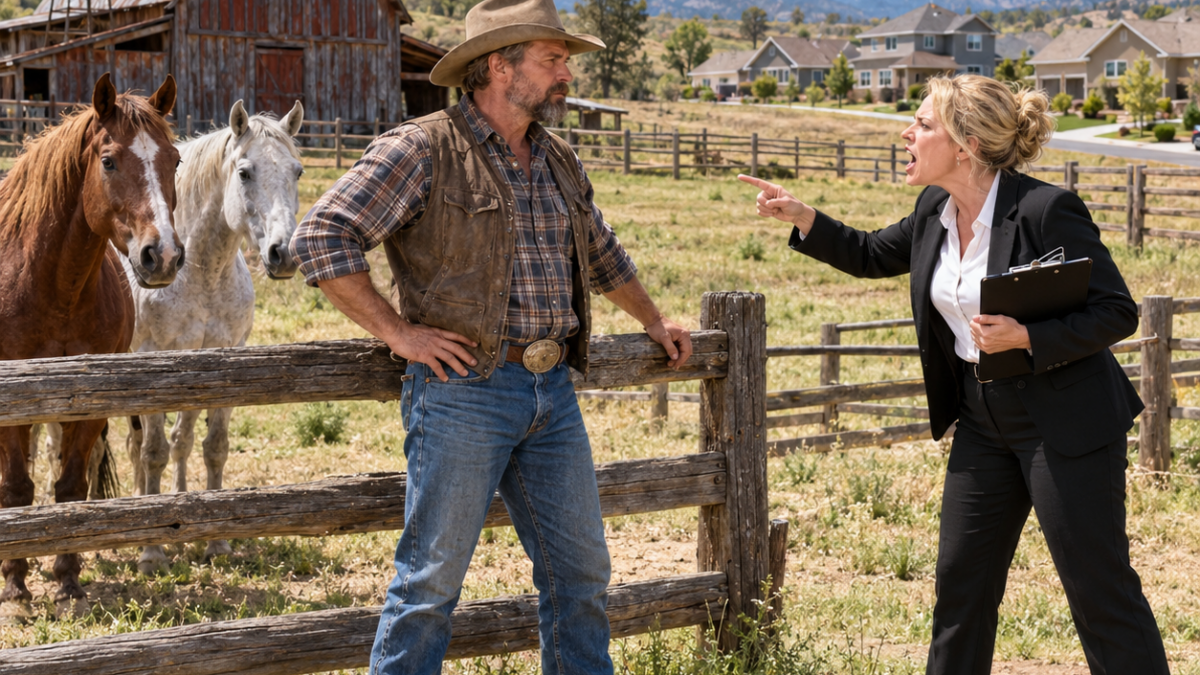
Karen pointed at my daughter’s old quarter horse and told me I had thirty days to remove him or the HOA would take my ranch.
She smiled when she said they would put a lien on the same hundred acres my grandfather bought after coming home from World War II.
What Karen didn’t know was that the oldest piece of paper on my kitchen table had been waiting nearly eighty years for someone exactly like her.
“Your horses have to go, Mr. Miller.”
Karen Whitmore stood outside my fence under the brutal Texas sun, clutching an HOA clipboard against her chest like a shield.
Behind me, Patches lifted his head from a pile of hay.
He was sixteen years old, chestnut with a white blaze down his face, and had belonged to my daughter Emily since she was nine.
Karen pointed one blood-red fingernail toward him.
“The bylaws are explicit. No livestock.”
I rested my arms on the top rail of the fence.
“Your bylaws.”
She gave me the patient smile adults use on children they think are slow.
“Yes, Mr. Miller. The bylaws governing this community.”
“My ranch isn’t in your community.”
Her smile disappeared.
“That issue has been settled.”
“By who?”
“The board.”
I almost laughed.
Whispering Pines had existed for barely fifteen years.
Miller Ranch had been here since 1946.
My grandfather, Thomas Miller, bought these hundred acres after coming home from the war. My father raised quarter horses here. I grew up fixing this fence, cleaning this barn, and swimming in the creek before there were subdivisions, golf carts, decorative fountains, or HOA newsletters anywhere in sight.
When I retired after twenty years with the Army Corps of Engineers, my wife Sarah and I came home for good.
Emily learned to ride here.
My father was buried less than five miles away.
Every piece of this land carried a memory.
Karen had moved into Whispering Pines five years earlier.
Now she was explaining my property to me.
“The current fine is five thousand dollars,” she said. “It doubles every thirty days until the livestock is removed.”
I stared at her.
“You fined me five thousand dollars for my own horse standing on my own land?”
“Your refusal to comply created the amount.”
Then she leaned closer.
Peppermint and stale coffee drifted across the fence.
“If you think some county judge is going to side with a dirt-kicker over an entire planned community, you’re mistaken.”
I felt my jaw tighten.
She kept going.
“We will lien this property. And when you fail to pay, I will personally attend the auction.”
That was when I stopped seeing her as an annoying neighbor.
She had threatened my home.
She had threatened my daughter’s horse.
And she had done it with the absolute confidence of someone who believed paperwork could rewrite history.
Emily was standing near the barn.
Karen didn’t notice her.
I did.
My daughter had heard everything.
Patches walked over and nudged Emily’s shoulder.
She wrapped both arms around his neck.
Karen climbed into her golf cart.
“You have thirty days.”
She drove away without looking back.
Ten minutes later, Emily came into the kitchen.
Her eyes were red.
“Dad?”
I turned.
“Is she really going to make us sell Patches?”
There are questions from your children that make you angry.
That one made me cold.
I put my hand on her shoulder.
“No.”
“But she said—”
“I heard what she said.”
“What if they take the ranch?”
“They won’t.”
“How do you know?”
I looked toward the window.
Beyond the glass stood the barn my grandfather had built, the fence my father repaired after the tornado of ’83, and the pasture where Emily had learned to stay in the saddle.
“Because Karen thinks this fight started when she became HOA president.”
I walked to the hallway closet and pulled down an old metal document box.
Inside was my grandfather’s original deed.
Then came the surveys.
Tax records.
Agricultural documents.
County maps.
I placed Karen’s certified letters beside them.
Sarah walked into the kitchen and stared at the growing pile.
“What are you doing?”
“Introducing Whispering Pines to its neighbors.”
I made a pot of coffee.
Then I downloaded every HOA covenant, amendment, board minute, and property exhibit I could legally obtain.
For the next four hours, I read.
On page 214 of an old annexation packet, I found a map.
I enlarged it.
Read the legal description.
Checked it against my grandfather’s deed.
Then I read it again.
Sarah saw my expression.
“What?”
I turned the screen toward her.
Whispering Pines had made a mistake.
Not a small one.
A mistake buried so deep in their own records that Karen had apparently never bothered to look for it.
And if I was reading those lines correctly, her threat to auction Miller Ranch had just placed something much larger than her presidency in danger.
PART 2
Sarah leaned over my shoulder.
“What am I looking at?”
I pointed to the heavy black boundary line on the original Whispering Pines plat.
“Here’s the subdivision.”
She nodded.
Then I tapped the irregular western edge.
“And here’s us.”
There was a narrow strip between the two boundaries, no more than thirty feet in some places and nearly seventy in others.
Sarah frowned.
“I thought our fence was the boundary.”
“It is.”
“Then what’s that?”
“The developer’s setback parcel.”
I enlarged the legal description.
When Whispering Pines was created, the original developer had deliberately excluded Miller Ranch from the subdivision. That much I already knew.
What I hadn’t known was how carefully they had done it.
A buffer strip had been retained between portions of the development and my ranch because the county had required separation from active agricultural operations.
The developer had recorded an acknowledgment that neighboring agricultural activities predated the subdivision.
Noise.
Dust.
Livestock odor.
Farm equipment.
Fencing.
Everything Karen had been complaining about for two years.
Sarah read the paragraph twice.
“They knew?”
“They absolutely knew.”
“When?”
“Before the first house was sold.”
I kept reading.
It got better.
Every original purchaser in Whispering Pines had bought subject to a disclosure that active agricultural land bordered the community.
The language was dry and legal, but the meaning was simple:
If you bought a house beside Miller Ranch, you did not get to pretend Miller Ranch had surprised you by existing.
Sarah pulled out a chair.
“Does that kill the horse rule?”
“Not by itself.”
Her smile faded.
I held up a finger.
“But this might.”
Buried in the HOA’s own declaration was a clause stating that covenants applied only to property legally described in attached exhibits or subsequently annexed through a recorded amendment signed according to specific procedures.
My ranch appeared nowhere in those exhibits.
There was no annexation amendment.
No signature from my father.
No signature from me.
No recorded document.
Nothing.
Karen had been sending me fines based on rules that had never applied to my land.
That part wasn’t surprising.
What surprised me was something else.
I opened the board minutes from the previous year.
The “no livestock” amendment had passed after a closed executive session.
The minutes summarized the reason as:
*Community health, sanitation, and visual harmony concerns arising from adjacent animal activity.*
Adjacent.
Not internal.
Adjacent.
They hadn’t banned livestock because homeowners were suddenly keeping cows in their swimming pools.
They had written the rule because of us.
I went back farther.
Three months before the amendment passed, Karen had proposed exploring “long-term incorporation of incompatible western parcels.”
Western parcels.
Plural on paper.
Singular on the map.
Miller Ranch was the only agricultural tract directly west of Whispering Pines.
I sat back.
Sarah folded her arms.
“So she wrote a rule for property she doesn’t control.”
“Looks like it.”
“Can she really put a lien on us?”
“She can file something.”
“That wasn’t what I asked.”
“No. A valid HOA lien requires a valid obligation.”
“And we don’t have one.”
“No.”
Sarah stared toward the hallway where Emily had gone upstairs.
“Then why am I still nervous?”
Because I was too.
Bad claims can still cause damage.
A fraudulent or baseless lien can interfere with refinancing, sales, title work, and credit.
A person doesn’t need to be right to hurt you.
They only need enough confidence to misuse a process.
Karen had confidence to spare.
I closed the laptop.
“Tomorrow I’m going to the county records office.”
“You said you weren’t calling a lawyer.”
“I didn’t say never.”
“What are you looking for first?”
“History.”
The county courthouse sat twenty-five miles away in a town that had grown around it rather than replaced it.
The records clerk, Maribel Santos, had worked there longer than some of the buildings around Whispering Pines had existed.
She knew my family name.
“Miller Ranch?”
“Yes, ma’am.”
“Your granddad used to bring pecans to my mother.”
“That sounds like him.”
“What trouble are you in?”
I laughed.
“What makes you think I’m in trouble?”
“You’re carrying a legal pad before nine in the morning.”
Fair point.
I told her I needed every recorded instrument affecting the ranch and the original Whispering Pines development.
Her eyebrows rose.
“That’ll take a while.”
“I brought coffee.”
“You planning to share?”
“I can be persuaded.”
Two hours later, Maribel wheeled out a cart of old volumes, microfilm references, subdivision maps, plats, easements, annexation instruments, right-of-way documents, and agricultural notices.
I found exactly what I expected.
Then I found something I didn’t.
In 2009, before Whispering Pines received final approval, the developer had signed a recorded Agricultural Compatibility Agreement with my father.
I remembered the discussions vaguely.
I had been deployed during part of that period.
Dad had mentioned some paperwork involving the subdivision and county access.
I had never needed to read it.
Until now.
The agreement was eight pages.
Page three made me sit perfectly still.
The developer acknowledged Miller Ranch as an existing agricultural operation.
Page four confirmed that nothing in the future residential development could impose private land-use restrictions upon our parcel without the written consent of the ranch owner.
Page five required the developer and any successor association to maintain the subdivision-side buffer fence.
Page six established that residents accepted ordinary effects associated with neighboring agricultural activity.
Page seven contained the sentence that changed everything:
*No association, board, committee, successor entity, architectural authority, or other private governing body created for the residential development shall assert assessment, enforcement, lien, or covenant authority over the Miller tract absent a separately recorded voluntary annexation executed by the then-current Miller tract owner.*
I read it again.
And again.
Maribel came around the counter.
“You find something?”
I slid the page toward her.
She read it.
Her eyebrows rose.
“Well.”
“That’s what I said.”
“No, you didn’t.”
“I said it internally.”
She tapped the recording stamp.
“Your father filed this properly.”
“Dad was particular.”
“Smart man.”
He was.
My father never trusted a handshake when land was involved.
He liked people.
He trusted neighbors.
But he used to tell me, “Good fences make good neighbors, and good paper keeps them good.”
For years, I thought that was one of those old-man sayings fathers use because their sons are legally required to roll their eyes.
Standing in the courthouse, I would have given anything to hear him say it again.
I ordered certified copies.
Then I asked Maribel one more question.
“Has anybody filed anything against the ranch recently?”
She typed.
Her expression changed.
“What?”
She looked at me.
“Whispering Pines HOA filed a notice yesterday.”
My stomach dropped.
“What kind?”
“Notice of continuing assessment delinquency.”
Karen hadn’t waited thirty days.
She hadn’t waited a week.
She had filed the first step in her lien strategy the same day she threatened me.
“Can I get a copy?”
Maribel printed it.
There was Karen’s signature.
There was the HOA’s attorney block.
There was my parcel number.
And there, under amount claimed due, was $5,000 plus “ongoing fines, collection costs, interest, and enforcement expenses.”
They had placed a cloud over my title before Karen’s golf cart tracks had even disappeared from the dirt.
The anger came back.
Not explosive.
Cold.
Precise.
The kind I understood.
I called Sarah from the courthouse steps.
“She filed.”
“What?”
“The notice.”
“Yesterday?”
“Yesterday.”
Silence.
Then, “What do we do?”
“Now I call a lawyer.”
His name was Nathan Cole.
I had known him casually for years.
Former county attorney.
Now mostly handled land disputes, agricultural law, and commercial litigation.
Nathan had the personality of a man who could make losing an argument feel like a paperwork error.
He listened without interrupting.
Then he read the Agricultural Compatibility Agreement.
Then he read Karen’s collection notice.
Then he took off his glasses.
“Did you make her angry?”
“I existed.”
“Ah.”
He read the document again.
“This is unusually good.”
“My father.”
“Your father was either lucky or suspicious.”
“Suspicious.”
“I like him.”
“He would’ve liked you.”
Nathan tapped Karen’s filing.
“This one is a problem.”
My chest tightened.
“You just said the agreement was good.”
“The agreement is excellent. Her legal position is terrible.”
“Then what’s the problem?”
“People confuse those two things. A terrible legal position can still create an expensive problem.”
“So we remove it.”
“Yes.”
“How?”
“We start politely.”
I stared at him.
“Politely?”
Nathan smiled.
“Nothing frightens unreasonable people like a reasonable letter backed by documents.”
That afternoon he drafted a demand.
Not emotional.
Not threatening.
Three pages.
It identified the ranch.
Cited the recorded agreement.
Cited the absence of any annexation.
Demanded immediate withdrawal of the assessment notice.
Demanded cessation of all enforcement activity.
Requested preservation of board communications concerning Miller Ranch.
And, importantly, asked Karen to identify the recorded instrument she believed gave the HOA authority over my land.
Nathan gave them ten business days.
Karen replied in three hours.
Not her lawyer.
Karen.
Her email said the compatibility agreement was “historical and superseded by modern community standards.”
Nathan read that sentence aloud twice.
Then he looked at me.
“Do you mind if I frame this?”
“Is it that bad?”
“It’s beautiful.”
Her next paragraph claimed Whispering Pines had acquired “equitable governance rights” over surrounding parcels because my property “functionally existed within the community footprint.”
I asked Nathan what that meant.
“It means she doesn’t have a document.”
The HOA’s attorney finally contacted Nathan the following morning.
His name was Gerald Pike.
He sounded less confident than Karen.
Nathan put the call on speaker with permission.
“Gerald,” Nathan said, “send me the annexation instrument.”
“We are evaluating the historical records.”
“So you don’t have one.”
“I didn’t say that.”
“Excellent. Send me the one you didn’t say you don’t have.”
I had to cover my mouth.
Gerald sighed.
“Your client’s property creates ongoing nuisance concerns for residents.”
“That’s not annexation.”
“There may be implied obligations.”
“Recorded land restrictions in Texas are not created because your board president dislikes horses.”
Gerald changed direction.
“The livestock prohibition is a health and safety measure.”
“For your members?”
“Yes.”
“My client is not one.”
“There are complicated boundary issues.”
“No. There are complicated personality issues. The boundary is easy.”
Silence.
Nathan continued.
“You have five thousand dollars in claimed fines attached to a parcel your association expressly agreed not to regulate.”
Gerald lowered his voice.
“I wasn’t counsel when that agreement was signed.”
“I know.”
“I need time.”
“You have the remainder of our demand period.”
That should have been the moment everyone calmed down.
A competent attorney had now seen the problem.
The board had an opportunity to withdraw.
Apologize.
Move on.
Karen did the opposite.
Three days later, a process server walked onto my porch.
Emily answered the door before I reached it.
He asked for me.
She called upstairs.
I came down.
The man handed me an envelope.
“What is it?”
“Civil action.”
Karen had sued us.
Not just me.
The complaint named Daniel Miller and Sarah Miller.
It alleged nuisance.
Covenant violations.
Unpaid assessments.
Interference with community property values.
And something called “equitable incorporation.”
She sought injunctive relief requiring removal of all horses, livestock equipment, trailers, agricultural machinery visible from Whispering Pines, and portions of fencing she claimed violated architectural standards.
She also requested judicial authorization to enforce the HOA’s claimed lien rights.
Sarah sat at the kitchen table reading the complaint.
I stood by the window.
Emily was upstairs with Patches visible through her bedroom window.
Finally Sarah said, “She really thinks she can do this.”
“Yes.”
“Can she?”
“No.”
“You’re very calm.”
“No, I’m not.”
“What are you?”
“Focused.”
Nathan filed our answer.
Then he filed counterclaims.
That was when Karen’s war stopped being one-sided.
Wrongful lien.
Declaratory relief.
Interference with property rights.
Abuse of process allegations.
Recovery of attorney fees where permitted.
And, because the board had knowingly targeted property outside its jurisdiction after receiving notice, claims tied to the association’s conduct.
Nathan also requested expedited relief to clear the title.
Karen called an emergency board meeting.
I know what happened because three different residents later told me.
She entered the clubhouse carrying a thick binder.
“Our community is under attack,” she announced.
Apparently I was the attacker now.
She told the board I was using “military intimidation tactics.”
I had not attended a single HOA meeting.
She told them I had refused “reasonable accommodation.”
The reasonable accommodation was removing my daughter’s horse from land the HOA did not control.
She said the lawsuit was necessary to defend property values.
One board member, a retired accountant named Tom Bender, finally asked the question she had avoided.
“Karen, is Miller Ranch actually inside our HOA?”
She answered, “The legal situation is evolving.”
Tom said, “That sounds like no.”
According to witnesses, Karen slammed her palm on the table.
“The ranch sits within the community.”
“On the map?”
“Geographically.”
“That’s not what I asked.”
Then Tom produced a copy of Nathan’s demand letter.
Karen’s face changed.
“Where did you get that?”
“The association attorney sent it to the board.”
“He was not authorized to distribute privileged material.”
“It was addressed to the association.”
“You don’t understand the legal strategy.”
Tom looked around the room.
“I understand we’re trying to fine a man whose recorded agreement says we can’t fine him.”
That was the first crack.
The second came from the treasurer.
“Why didn’t we vote to sue?”
Karen said emergency authority allowed it.
The treasurer said no emergency authority existed for initiating litigation without board approval unless immediate property damage was occurring.
Karen replied that horses constituted ongoing property damage.
A board member laughed.
Wrong reaction.
Karen removed him from the meeting.
Or tried to.
He refused to leave.
By the time the meeting ended, four board members had demanded independent legal review.
Karen sent them all an email accusing them of undermining community security.
That email eventually became evidence too.
Meanwhile, Emily stopped sleeping well.
That bothered me more than the lawsuit.
One night I found her sitting on a bale in Patches’s stall.
It was nearly midnight.
The barn light cast long shadows across the floor.
Patches stood with his head lowered over her shoulder.
I leaned against the stall door.
“You planning to sleep out here?”
“Maybe.”
“Your mother will blame me.”
“She already does.”
“That’s true.”
Emily didn’t smile.
I walked in.
Sat beside her.
For a while we listened to Patches chew.
Finally she said, “What if we lose?”
“We won’t.”
“You keep saying that.”
“Because it’s true.”
“You can’t know.”
She was right.
That is one of the worst parts of being a parent.
Children eventually become old enough to recognize when certainty is something you are giving them rather than something you possess.
I looked at Patches.
“He was your grandfather’s last breeding line.”
Emily nodded.
Dad had bred quarter horses for decades.
Patches wasn’t valuable because of bloodlines anymore.
He was gelded, older, and occasionally behaved like grass possessed greater strategic importance than human instructions.
But to Emily he connected generations she had barely known.
“Grandpa taught you to ride, right?” she asked.
“Badly.”
She looked at me.
“He taught me well. I was the bad student.”
A small smile.
Then it disappeared.
“Karen hates him.”
“No.”
“She does.”
“She doesn’t know him.”
“That’s worse.”
I understood what she meant.
Karen did not hate Patches as an animal.
She hated what he represented.
Something she could see but could not control.
I put my arm around Emily.
“She’s trying to make us afraid enough to surrender before anyone checks whether she has the right.”
“Are you afraid?”
“Yes.”
She looked surprised.
“You are?”
“Of course.”
“You don’t act like it.”
“That’s because being afraid and doing what fear tells you are different things.”
She looked down.
“I’m scared they’ll take him.”
“They won’t take him without going through me.”
“That sounds dramatic.”
“I’m your father. Drama is contractually required.”
She leaned against my shoulder.
Patches sneezed on my sleeve.
“Perfect,” I said.
Emily laughed.
It was the first real laugh I had heard from her in days.
The hearing on the lien issue was set for three weeks later.
Those three weeks changed Whispering Pines.
Nathan issued discovery requests.
He wanted the HOA’s authority documents.
Board minutes.
Communications involving Miller Ranch.
Emails discussing livestock rules.
Financial records tied to fines.
Communications with collection companies.
Documents supporting Karen’s claim that our parcel had been annexed.
The HOA answered slowly.
Then incompletely.
Nathan sent deficiency letters.
Gerald Pike, the HOA lawyer, became increasingly uncomfortable.
One afternoon he called Nathan privately.
Later Nathan called me.
“Things are getting interesting.”
“That’s rarely good when a lawyer says it.”
“Gerald is withdrawing.”
“From the case?”
“From representing the HOA.”
“Why?”
“He found something.”
“What?”
“He wouldn’t say. Privilege issues.”
“Then how do we know?”
“Because lawyers don’t abandon paying clients in the middle of expedited litigation because they discovered good news.”
Two days later, Whispering Pines hired new counsel.
A larger firm.
More expensive.
Karen told residents the change demonstrated the board’s commitment to “aggressive defense.”
The new lawyer, Rebecca Sloan, requested a one-week extension before the hearing.
Nathan agreed.
“Why help them?” I asked.
“Because judges remember who behaves reasonably.”
“I’m learning that your revenge fantasies are boring.”
“Winning usually is.”
Rebecca Sloan was different from Gerald.
She did not posture.
The first call lasted seventeen minutes.
When it ended, Nathan looked at me.
“She knows they have a problem.”
“How big?”
“She asked if you would consider a global resolution.”
“What kind?”
“Withdraw the lien. Dismiss claims. Mutual releases.”
“No.”
Nathan nodded.
“I assumed.”
“Why?”
“Because they sued my wife.”
“That too.”
“And they haven’t apologized to Emily.”
Nathan studied me.
“Courts don’t award much for hurt feelings about an apology.”
“I know.”
“Good.”
“I’m not doing this for an apology.”
“What are you doing it for?”
“I want the record corrected. I want a court declaring they have no authority here. And I want to know how a board president persuaded people to file a lien against land their own documents excluded.”
Nathan smiled faintly.
“That answer I can work with.”
Discovery continued.
Then came the email.
It had been written eleven months earlier by Karen to the HOA’s architectural committee chair.
Subject:
**WESTERN EDGE COMPLIANCE STRATEGY**
One paragraph said:
*We need persistent enforcement against Miller. The optics of livestock immediately adjacent to premium homes are unacceptable.*
Another said:
*If we establish a record of violations and unpaid assessments, acquisition may become easier later.*
Acquisition.
I read that word several times.
Karen had not merely wanted the horses gone.
She had been considering how enforcement could pressure us toward losing or selling the property.
Nathan kept reading.
The next email was worse.
Karen to a board ally:
*Once fines exceed what he can reasonably defend, he’ll have two choices: conform or sell. Either result benefits Whispering Pines.*
Sarah was standing behind me.
Her hand went over her mouth.
“She planned this.”
“Yes.”
“From the beginning.”
“Yes.”
My anger shifted.
Until then, part of me had still wanted to believe Karen was simply obsessed with rules.
Maybe arrogant.
Maybe wrong.
Maybe genuinely convinced uniform standards should extend beyond the HOA.
The emails destroyed that possibility.
She understood we were outside Whispering Pines.
That was why she called us adjacent.
She understood fines were leverage.
She talked about acquisition.
This wasn’t misguided enforcement.
It was pressure.
Nathan found another thread.
Karen had written to a local real estate broker.
*Hypothetically, if Miller Ranch became available through distress or enforcement, what would assembled value look like alongside Whispering Pines expansion?*
The broker replied with a range.
Millions.
A large regional developer had quietly asked whether Whispering Pines might someday expand west.
That was the motive.
Not horses.
Not odor.
Not architectural harmony.
Land.
It is remarkable how often people create elaborate moral language around simple greed.
Karen called Patches a health problem.
She called my truck visual blight.
She called the barn incompatible.
She called the ranch a threat to property values.
What she meant was:
A hundred acres next door would be worth a fortune if Daniel Miller could be pushed out.
We filed the emails with the court under appropriate procedures.
The hearing became much more serious.
The day before it, something happened I did not expect.
Tom Bender called me.
The board member who had challenged Karen.
“I hope you don’t mind.”
“How did you get my number?”
“Phone book.”
“People still use those?”
“I’m seventy-one.”
“Fair.”
He sighed.
“I owe you an apology.”
“For what?”
“I voted for the livestock amendment.”
I said nothing.
Tom continued.
“Karen told us several residents had begun keeping chickens and one family was considering goats.”
“Were they?”
“One family had three backyard hens.”
“And the goats?”
“No goats.”
“So why the broad rule?”
“She said our attorney recommended uniform language.”
“Did he?”
“I don’t know anymore.”
Tom paused.
“I didn’t know she intended to enforce it against you.”
“Would that have changed your vote?”
“Yes.”
“Even though you don’t like looking at horses?”
“I love horses.”
That surprised me.
“My wife grew up riding.”
“Then what was the problem?”
“Karen made it sound like legal housekeeping.”
There it was again.
People surrendering attention.
Not because they are evil.
Because somebody competent-sounding says, *Don’t worry, I handled it.*
Tom continued.
“I should have read more.”
“Yes.”
“I deserved that.”
“I’m not trying to hurt you, Tom.”
“I know.”
“Then why are you calling?”
“Because she scheduled a special meeting tonight to remove me from the board.”
“For talking to counsel?”
“For demanding an audit.”
I leaned back.
“Can she do that?”
“Not easily.”
“What do you need from me?”
“Nothing.”
“Then why tell me?”
“Because tomorrow her lawyer may say the board supports her unanimously.”
“And it doesn’t.”
“No.”
“How many?”
“Three of seven want her out. One is scared. Two still support her.”
“That’s six.”
“Karen is seven.”
“What about residents?”
“They’re beginning to ask questions.”
He hesitated.
“Mr. Miller, can I ask you something?”
“Sure.”
“If the HOA loses tomorrow, are you going to sue us into bankruptcy?”
I looked across the pasture.
A group of Whispering Pines roofs rose beyond the trees.
Hundreds of families.
People I did not know.
Some probably disliked my ranch.
Some probably loved looking at the horses.
Most probably wanted to get home after work and not think about governance documents.
“No.”
Tom exhaled.
“But I’m not dropping the case just to protect Karen from consequences.”
“I’m not asking you to.”
“I’ll seek what it costs us to fix this.”
“Fair.”
“And I want the court to make it clear this cannot happen again.”
“Fair.”
“I don’t want anybody’s house.”
Tom was silent.
Then he said, “Thank you.”
The hearing began at nine the next morning.
Karen arrived before us.
She wore navy blue.
Not floral.
No clipboard.
Two lawyers sat beside her.
When Emily and Sarah entered behind me, Karen looked at Emily.
Then at me.
No smile.
Nathan whispered, “Do not engage.”
“I know.”
“Your face suggests otherwise.”
“That’s just my face.”
The judge, Honorable Evelyn Price, had spent eighteen years on the bench.
She had the unnerving ability to make a room quiet by looking over her glasses.
The HOA’s lawyers argued first.
They said Whispering Pines was not asking the court to resolve every issue that morning.
Only to preserve its enforcement rights while the broader case proceeded.
Judge Price interrupted.
“What recorded instrument gives the association enforcement rights over the Miller parcel?”
The attorney shifted.
“There are equitable and historical circumstances—”
“That wasn’t my question.”
“No single instrument, Your Honor.”
Judge Price looked down.
“You recorded an assessment delinquency against real property without a single instrument showing the owner joined your association?”
The lawyer tried again.
“The association believed—”
“I asked what document.”
“There is no voluntary annexation.”
Sarah squeezed my hand under the table.
The judge continued.
“And there is a recorded agreement stating your client will not assert assessment or lien authority without one.”
“Yes, Your Honor.”
“Then why are we here?”
That question hung in the courtroom.
The attorney said the association disputed the legal effect of the agreement.
Judge Price asked whether the association had disputed it before Nathan’s demand letter.
The lawyer admitted it had not.
Then Nathan stood.
He presented the deed chain.
The development plat.
The agricultural agreement.
The absence of annexation.
Karen’s emails.
The lien notice.
The escalation.
He did not raise his voice.
He didn’t need to.
At one point Judge Price asked, “Mr. Cole, are you alleging this litigation was used as leverage to pressure a sale?”
Nathan replied, “The discovery record raises that concern, Your Honor.”
One of Karen’s lawyers objected.
The judge allowed limited argument.
Then Nathan displayed the email:
*Once fines exceed what he can reasonably defend, he’ll have two choices: conform or sell.*
Karen stared straight ahead.
Judge Price read it.
Then removed her glasses.
“Who wrote this?”
The HOA lawyer answered quietly.
“Ms. Whitmore.”
“When?”
“Approximately eleven months before suit.”
“And she is the association president?”
“Yes.”
Karen whispered something to counsel.
The lawyer shook his head.
Karen whispered again.
Judge Price looked at her.
“Ms. Whitmore, do you need a moment with counsel?”
Karen stood.
“No, Your Honor, but that email is being taken completely out of context.”
Her attorney’s face fell.
Nathan sat perfectly still.
Judge Price said, “Ms. Whitmore, you are represented. I strongly recommend you allow your attorney to speak.”
“But I can explain.”
“Sit down.”
Karen sat.
For once in her life, she obeyed quickly.
Judge Price granted our request concerning the recorded assessment notice.
She ordered the HOA to take immediate steps to withdraw it.
She prohibited further lien enforcement against Miller Ranch while the case proceeded.
Most importantly, she stated from the bench that the record presented no evidence that Miller Ranch had ever been annexed into Whispering Pines.
It was not yet the final judgment.
But it was the first public collapse of Karen’s story.
Outside the courthouse, reporters were waiting.
I didn’t know who called them.
Probably a Whispering Pines resident.
Maybe Karen herself before realizing how badly the hearing would go.
One shouted, “Mr. Miller, are the horses staying?”
Emily was beside me.
I looked at her.
She looked at Patches’s picture on her phone.
“Yes,” I said.
That was all.
By lunchtime, the local story was online.
By evening, half the county knew.
**HOA ATTEMPTS TO FINE HISTORIC RANCH OVER HORSES**
The comments became ugly.
I stopped reading them.
People love simple villains.
Reality is more complicated.
Karen had done bad things.
That did not mean I wanted strangers threatening her.
I told Nathan.
He contacted HOA counsel.
Both sides issued statements asking people not to harass anyone involved.
Karen interpreted that as weakness.
Three nights after the hearing, someone opened my pasture gate.
I discovered it at 5:20 in the morning.
Two horses were near the road.
Patches was missing.
I have faced military emergencies.
I have handled flood-control failures where thousands of people depended on engineering decisions made under pressure.
Nothing prepared me for hearing Emily scream his name into the dark.
“PATCHES!”
We searched with flashlights.
Sarah drove the north perimeter.
I took the ATV south.
Neighbors joined.
Even Whispering Pines residents came out.
Tom arrived in pajama pants and boots.
“Where was he last seen?”
“South pasture.”
“I’ll check the development side.”
At 6:04, a Whispering Pines teenager found Patches grazing beside a drainage pond nearly a mile away.
He was unharmed.
Emily ran to him and wrapped her arms around his neck.
I stood ten feet away breathing hard.
Relief lasted maybe thirty seconds.
Then I saw the gate.
The chain had not broken.
The latch had not failed.
Someone had lifted it deliberately.
A security camera on my equipment shed captured headlights at 3:11 a.m.
A dark SUV stopped near the gate.
A figure got out.
Opened it.
Drove away.
The image was too distant for a plate.
Sarah looked at me.
“Karen?”
“I don’t know.”
“You think it.”
“I think lots of things.”
“Dan.”
“We prove things. We don’t decide them because they feel right.”
That discipline saved me.
Because it wasn’t Karen.
Two days later, a sixteen-year-old boy from Whispering Pines came to our house with his father.
The boy was crying.
He admitted opening the gate.
He had seen online arguments about the horses.
He thought it would be funny to “set them free.”
He expected them to stay nearby.
His father looked sick.
“I am so sorry.”
Emily stood beside me.
The boy looked at her.
“I didn’t mean for him to get hurt.”
“But he could have,” she said.
“I know.”
She looked at me.
This was her decision more than mine.
I asked, “What do you want?”
Emily stared at the boy.
Then at Patches in the pasture.
“I want him to fix the gate.”
The boy blinked.
“What?”
“You opened it. You can help fix it.”
His father looked at me.
I nodded.
Saturday morning they came over.
We reinforced the latch.
Installed a second closure.
Then the boy mucked stalls for four hours.
Emily supervised with what I considered excessive enthusiasm.
When he left, he was dirty, exhausted, and far less amused by ranch life.
That incident did something unexpected.
It changed the tone.
People in Whispering Pines began walking over.
Not officials.
Residents.
Some came to apologize.
Some came because their children wanted to meet Patches.
Some admitted they had complained about the smell after rain.
One man said, “I moved next to a ranch and then complained about ranch smells. My wife has reminded me how stupid that sounds.”
I liked his wife immediately.
Karen hated the visits.
She sent residents an HOA notice stating that unauthorized entry onto “disputed western agricultural property” was discouraged pending litigation.
Tom posted a response on the community board:
**Miller Ranch is not disputed HOA property. Please stop calling it that.**
Karen removed the post.
Someone reposted it.
She removed that one.
Three people reposted it.
By dinner, forty copies were circulating.
Authority built on silence does poorly when people discover copy and paste.
Then came the audit.
The board’s treasurer, Janet Cho, had quietly persuaded four directors to authorize independent review of legal expenditures.
What they found wasn’t embezzlement.
Karen wasn’t stealing dues.
The truth was less criminal and more personally devastating.
She had spent $68,000 of association money over eighteen months on enforcement, consultants, surveys, collection work, and litigation connected primarily to Miller Ranch.
Sixty-eight thousand dollars.
To fine horses on property they didn’t govern.
Residents had been told legal expenses were caused by “external noncompliance.”
Now they saw emails showing Karen had driven the strategy herself.
The emergency board meeting drew more than two hundred residents.
This time I attended.
Nathan advised against it.
Sarah advised against it.
Emily insisted.
“I want to hear what she says.”
So we sat in the back.
Karen saw us the moment she entered.
For a heartbeat, her confidence slipped.
Then she walked to the microphone.
“This meeting will come to order.”
People shouted immediately.
“How much did you spend?”
“Why did you file a lien?”
“Is the ranch even in the HOA?”
Karen banged a wooden gavel.
“Order!”
Nobody cared.
Tom eventually stood.
“Karen, residents deserve answers.”
“You are out of order.”
“I’m a director.”
“You violated board confidentiality.”
“By telling owners where their money went?”
Applause.
Karen’s face reddened.
Janet stepped forward with the audit summary.
“Sixty-eight thousand four hundred twelve dollars and seventeen cents.”
The room went quiet.
Karen said, “Those expenditures protected community values.”
A man near the front shouted, “From a horse?”
Laughter erupted.
Karen slammed the gavel.
“This is not funny.”
No.
It wasn’t.
A woman stood.
“My dues went up twelve percent.”
Another said, “You told us insurance was the reason.”
A third voice:
“You knew Miller Ranch wasn’t ours!”
Karen held up both hands.
“The ranch’s incompatibility affects every owner here.”
Then Emily stood.
I grabbed her wrist gently.
“You don’t have to.”
“I know.”
She walked toward the microphone.
A seventeen-year-old girl in jeans and boots facing a room of angry adults.
Karen looked annoyed.
“Public comments will occur later.”
Emily stopped.
“I just have one question.”
“This isn’t the time.”
Tom said, “Let her speak.”
The room agreed loudly.
Karen had no choice.
Emily reached the microphone.
“My horse is sixteen years old.”
Nobody spoke.
“He was born on our ranch. My grandpa helped raise his mother.”
Karen stared at her.
Emily continued.
“You’ve never met him.”
Karen said nothing.
“You’ve never asked if he’s dangerous. You’ve never visited our barn. You’ve never asked how we care for him.”
Her voice trembled.
I almost stood.
Sarah gripped my hand.
Emily kept going.
“You just decided he was ugly for your neighborhood.”
Karen’s mouth opened.
Emily didn’t let her speak.
“But he isn’t in your neighborhood.”
That landed.
“My dad showed me the maps. Our ranch was there before any of these houses. My family didn’t move next to you and bring horses. Your houses moved next to our horses.”
The room applauded.
Emily stepped away.
Karen finally said, “This is exactly the emotional manipulation—”
The room turned on her.
Not violently.
Worse.
Collectively.
People who had once trusted her began saying no.
No to more legal fees.
No to more enforcement.
No to secrecy.
No to pretending Miller Ranch belonged to them.
Tom made the motion to remove Karen as board president pending formal owner procedures.
Four directors voted yes.
Two no.
Karen voted no.
The motion carried.
Her face became almost white.
“You cannot do this.”
Tom answered, “We just did.”
“I was elected by the membership.”
“You’re still a director until the recall vote. You are no longer president.”
She looked around the room.
Nobody came to rescue her.
For the first time since I met Karen, she had no clipboard.
No gavel.
No title that made people hesitate.
She was simply a homeowner sitting behind a folding table.
And she hated it.
She pointed at me from across the room.
“This is what he wanted.”
Every head turned.
I stayed seated.
She stood.
“He has manipulated all of you!”
Nathan whispered, “Don’t.”
I hadn’t planned to.
Then Karen said, “He wants Whispering Pines destroyed because he hates everything we built.”
I stood.
Not quickly.
I walked to the microphone.
Tom asked if I wanted the floor.
I nodded.
Karen stared at me.
I looked around the room.
“I don’t want your HOA destroyed.”
Silence.
“I don’t want your houses.”
I looked at Karen.
“I don’t want your money except what it costs to repair what was done.”
Then back to the residents.
“I want you to stay on your property.”
A few people laughed nervously.
“I’ll stay on mine.”
More silence.
“That should have been the whole agreement.”
A woman nodded.
I continued.
“My family has watched this area grow for decades. Growth isn’t the enemy. Houses aren’t the enemy. An HOA isn’t automatically the enemy.”
Karen folded her arms.
“The problem starts when someone decides their rules matter more than someone else’s deed.”
Applause began.
I waited.
“And for what it’s worth, if your kids want to meet the horses, ask first.”
Laughter.
Even Tom smiled.
I stepped away.
Outside, Emily hugged me.
“You stole my line.”
“What line?”
“Stay on your property.”
“I’m older. Everything I say first was invented by me.”
“That’s not how time works.”
“It is on ranches.”
The recall vote occurred twelve days later.
Karen lost by a margin large enough that nobody could pretend it was close.
She resigned from the board before the final count was certified.
But she did not drop the lawsuit.
Pride can keep a person walking long after every useful destination has disappeared.
Her lawyers tried again to negotiate.
The HOA, now controlled by an interim board, wanted out.
Karen wanted to continue in her personal capacity on nuisance claims.
That created chaos between her and the association.
Eventually the HOA dismissed its claims against us.
It formally withdrew every fine.
Issued a written acknowledgment that Miller Ranch was not subject to Whispering Pines covenants.
Paid to clear the title notice.
Agreed to reimburse a significant portion of our legal expenses.
But Karen refused to sign a broad settlement unless I agreed not to pursue claims connected with the improper lien campaign.
Nathan looked at me.
“Your decision.”
“What would you do?”
“I’m not emotionally involved.”
“That’s why I’m asking.”
He leaned back.
“We can settle now. You get nearly everything practical you wanted.”
“Nearly.”
“Or continue against Karen personally where legally supportable. More depositions. More cost. More time. No guaranteed dramatic payday.”
“What does Sarah think?”
“I’m your lawyer, not your marriage counselor.”
“Coward.”
“Correct.”
I talked to Sarah that night.
She listened.
Then asked, “What are you trying to win now?”
I didn’t answer immediately.
She waited.
That was Sarah’s gift.
She never filled silence just because it existed.
Finally I said, “I want her to understand.”
“Understand what?”
“That she can’t do this to people.”
“Will another six months of litigation make her understand?”
“I don’t know.”
“Will it make Emily safer?”
“No.”
“Will it protect the ranch?”
“The declaratory order will.”
“Will it restore your dad’s name?”
“It was never damaged.”
Sarah reached across the table.
“Then don’t confuse punishment with protection.”
I hated when she was wiser than me.
It happened frequently.
But one unresolved issue remained.
Karen’s recorded filing.
Although withdrawn, Nathan believed the circumstances justified pursuing a final judicial declaration concerning HOA authority.
That mattered beyond revenge.
I wanted a judgment future boards could not reinterpret.
So we continued for that limited purpose and for remaining costs.
Karen fought.
The final hearing occurred months later.
By then, the story had faded from social media.
Good.
Real lives are healthier when strangers become bored with them.
Judge Price reviewed the full record.
The original deed.
The agricultural agreement.
The Whispering Pines declaration.
The annexation procedures.
The absence of any annexation.
The targeted enforcement emails.
The withdrawn lien notice.
Then she issued a ruling.
Miller Ranch was not, and had never been, subject to Whispering Pines HOA authority.
No HOA covenant applied.
No assessments were owed.
No livestock restriction reached our property.
No future Whispering Pines board could claim authority absent a lawful voluntary agreement by the ranch owner.
The written order was clear enough that even Karen could not reinterpret it.
Nathan handed me a certified copy outside the courthouse.
“Frame it.”
“I was thinking barn wall.”
“Humidity.”
“Kitchen?”
“Your wife will divorce you.”
“She has threatened worse.”
Karen came through the doors behind us.
For a second we stood within ten feet of each other.
No lawyers between us.
No fence.
No golf cart.
No clipboard.
She looked older.
Not defeated exactly.
Tired.
She said, “You happy now?”
Nathan moved slightly closer.
I raised a hand.
It was fine.
I looked at Karen.
“No.”
That surprised her.
“You got everything you wanted.”
“No.”
“You humiliated me.”
“I didn’t ask you to send the letters.”
Her jaw tightened.
“You turned the whole neighborhood against me.”
“I didn’t write your emails.”
“You dragged my name through court.”
“You filed against my land.”
She stepped closer.
“You could have just moved the horses farther back.”
There it was.
After all of it.
The maps.
The money.
The recall.
The ruling.
She still believed compromise meant I should surrender something so she wouldn’t have to accept that she had no authority.
I said, “Patches was never the problem.”
“Your property is an eyesore.”
“To you.”
“You could make it beautiful.”
“It is.”
She laughed bitterly.
“You really believe that?”
I looked toward the parking lot.
Beyond town, beyond roads and subdivisions, Miller Ranch waited.
The old barn.
The creek.
The oak tree.
Emily and Patches.
“Yes.”
Karen shook her head.
“That’s why we’ll never understand each other.”
“Maybe.”
She walked away.
For several months, that was the last time I saw her.
Whispering Pines changed quickly after the lawsuit ended.
The new board president was Tom Bender.
He hated the job.
That made him perfect for it.
People who want power too badly are rarely the people who should receive it.
Tom’s first policy was simple:
“No enforcement outside recorded HOA boundaries.”
His second required legal review before filing any lien.
His third created open access to board financial reports.
Residents approved all three.
The board also voted to restore the agricultural buffer language to its welcome packet.
New buyers received a disclosure:
**Whispering Pines borders an active historic ranch. Residents may periodically experience normal sights, sounds, and odors associated with lawful agricultural activities.**
Ray, my neighbor on the north side, called it the Patches Clause.
Emily loved that.
I did not.
“Dad, it’s perfect.”
“It makes him sound like a Supreme Court case.”
“Patches v. Karen.”
“Stop.”
“Majority opinion: carrots are protected speech.”
“Go do homework.”
Life became normal.
Or as normal as a ranch ever gets.
A fence post broke.
A water line froze during an unexpected cold snap.
One mare decided veterinary science was an insult and attempted to kick anyone holding medication.
Patches grew older.
Emily grew up.
That part happened too fast.
She graduated high school the following spring.
For senior pictures she wore a white dress for exactly eleven minutes before changing into jeans and boots and insisting half the photographs include Patches.
At graduation, Sarah cried.
I did not.
There is no credible evidence otherwise.
Emily planned to attend Texas A&M and study animal science.
The first time she talked seriously about leaving, I handled it badly.
“You can commute.”
“Dad, it’s two hours.”
“People drive.”
“Four hours a day?”
“Builds character.”
“Mom?”
Sarah said, “Your father is experiencing a medical event called denial.”
I accepted defeat.
Before Emily left for college, she spent almost every evening with Patches.
He was eighteen by then.
Slower.
A little gray around the muzzle.
Still stubborn.
One evening I found her sitting on the fence watching him graze.
“You worried?”
“About college?”
“Yeah.”
“A little.”
“You’ll be fine.”
“I know.”
“That confidence is rude.”
She smiled.
Then she became serious.
“Will you take care of him?”
I stared at her.
“No. I planned to rent his room.”
“Dad.”
“Of course.”
“If anything happens—”
“I’ll call.”
“No matter what time.”
“Emily.”
“No matter what time.”
“I promise.”
She looked toward the Whispering Pines houses.
“Do you know what’s weird?”
“What?”
“If Karen hadn’t done all that, I might not have decided what I wanted to study.”
I looked at her.
“What do you mean?”
“I kept thinking about how people decide animals are inconvenient without knowing anything about them. Not just her. Everywhere.”
“So your career choice is revenge?”
She laughed.
“No.”
“Good. Tuition is too expensive for revenge.”
“I want to work with horses.”
“I know.”
“Maybe rehabilitation. Older ones. Rescue cases.”
Patches lifted his head as if he understood he was being discussed.
Emily smiled.
“He’s my fault.”
“Most things are.”
She punched my shoulder.
College changed her.
In good ways.
She became more confident.
More patient.
More willing to tell me when I was wrong, which I considered unnecessary personal growth.
She came home whenever she could.
Patches always heard her truck before I did.
He would walk toward the gate with his ears forward.
During her sophomore year, Karen sold her house.
Tom called me the day the sale recorded.
“You want the news?”
“What?”
“She’s gone.”
I knew immediately who he meant.
“Where?”
“Somewhere closer to Dallas, I heard.”
“Good for her.”
“That’s all?”
“What do you want me to do?”
“I don’t know. Fireworks?”
“She was a bad HOA president, Tom, not Napoleon.”
“I had fireworks.”
“Of course you did.”
Karen’s house sold for a very healthy profit.
That seemed to bother some residents.
They thought consequences should look like complete ruin.
I didn’t.
Losing an argument does not require losing your life.
She had lost the presidency.
Lost the case.
Paid legal expenses.
Moved away.
Her name became shorthand inside Whispering Pines for a rule adopted without thinking.
Apparently board members would ask, “Are we Karen-ing this?”
That seemed punishment enough.
The strangest consequence came years later.
A developer approached me.
Not the original Whispering Pines developer.
A different company.
They wanted access to sixty acres west of the creek for a small residential project.
Their proposed route crossed the far corner of my land.
The representative, a man named David Lang, came to the ranch by appointment.
By appointment.
I liked him already.
We sat on the porch.
He laid out maps.
“We’re not asking you to sell the ranch.”
“Good opening.”
“We’re proposing a limited access easement.”
“Road?”
“Two-lane private road.”
“Traffic volume?”
He had numbers.
“Drainage?”
He had engineering plans.
“Emergency access?”
He had a county letter.
“Compensation?”
He had a proposal.
I looked at him.
“You did your homework.”
“I heard you appreciate paperwork.”
“Who told you?”
“Half the county.”
I read the proposal.
Unlike Karen, David understood something important.
No was possible.
He said so.
“If you decline, we’ll pursue another alignment. More expensive, but feasible.”
I leaned back.
“How much more expensive?”
He named the number.
“Then why ask me?”
“Because this route is better.”
“Better for you.”
“And potentially profitable for you.”
“Potentially.”
“No pressure.”
I almost laughed.
Those two words made more progress than Karen’s entire two-year campaign.
I did not say yes that day.
Or that month.
I hired an engineer.
Nathan reviewed everything.
Emily, home during summer break, read the environmental plan.
We negotiated drainage controls.
Fencing.
Speed.
Maintenance.
Emergency access.
A wildlife crossing.
And one important condition.
The road could not interfere with the horse pasture.
David agreed.
When we finally signed, Sarah said, “Karen would lose her mind.”
“Karen isn’t part of this.”
“I know.”
“That’s the point.”
A voluntary agreement.
My land.
My decision.
No threats required.
The compensation helped fund improvements to the ranch and, eventually, something Emily proposed.
A small equine rehabilitation program.
At first it was two stalls.
Then four.
Older horses.
Neglected horses.
Animals recovering from injury.
Emily came home after graduation and expanded it with a veterinarian she had met through school.
They called it Miller Legacy Equine.
I objected to the name.
Nobody cared.
Patches became the unofficial ambassador.
He was terrible at it.
He stole hay from recovering horses and once attempted to eat a donor’s hat.
But nervous animals calmed near him.
So did nervous children.
Whispering Pines families began visiting.
Every spring, the ranch held an open day.
Kids learned how to brush horses.
Parents toured the barn.
Emily explained animal care.
Sarah sold lemonade because apparently we had transformed into a nonprofit version of a county fair.
Tom Bender manned parking.
He took the job too seriously.
One afternoon, during our third open day, I noticed an elderly woman standing near the stone fence.
She was watching Patches.
I walked over.
“Need help?”
She smiled.
“I live in Whispering Pines.”
“My condolences.”
She laughed.
“We moved in last year.”
“Then you missed the exciting period.”
“I’ve heard stories.”
“I deny everything.”
She looked toward the barn.
“My granddaughter has autism.”
I followed her gaze.
A little girl stood near Patches with Emily.
She wasn’t touching him yet.
Just watching.
Patches lowered his head.
Emily waited.
The girl slowly extended her hand.
Patches breathed against her palm.
The girl smiled.
Her grandmother covered her mouth.
“She hasn’t wanted to leave the house much lately,” she whispered.
We stood quietly.
Eventually the girl touched the white blaze on Patches’s face.
Emily showed her how to brush his shoulder.
Ten minutes later the child was laughing.
I thought about Karen standing at this same fence years before.
No livestock.
Standards.
Property values.
Remove the horses.
What a small world she had imagined.
A world where the only value something possessed was how neatly it fit inside a rulebook.
The grandmother looked at me.
“Thank you for keeping this place.”
I swallowed.
“My family did most of the work before me.”
“Still.”
She went back to her granddaughter.
I stood beside the fence longer than necessary.
That evening I told Emily.
She smiled.
“That’s why we do this.”
“I thought we did it because you enjoy bankrupting me with feed bills.”
“That too.”
Patches lived to twenty-six.
By the end, his joints were stiff.
His teeth required special care.
Cold mornings were difficult.
Emily monitored him obsessively.
I pretended not to.
One November morning she called me from the barn.
Her voice told me before the words did.
“Dad.”
I was there in less than a minute.
Patches was lying in the straw.
Calm.
Emily sat beside his head.
The veterinarian was already coming.
Sarah arrived and knelt beside us.
For hours, we stayed there.
Emily talked to him.
About learning to ride.
About college.
About the ranch.
About every child he had carried during the rehabilitation program.
She told him things horses cannot understand and somehow understand perfectly.
When the vet came, he examined Patches quietly.
Then looked at Emily.
She knew.
I hated that she knew.
The vet gave us time.
Emily put her forehead against Patches’s.
“You were supposed to live forever.”
My daughter was twenty-six years old.
Successful.
Strong.
Capable.
In that moment, she was nine again.
I walked outside because my breathing stopped working correctly.
The barn wall blurred.
Sarah followed.
“You okay?”
“No.”
“Me neither.”
We stood there together.
When I returned, Emily looked at me.
“I don’t want him hurting.”
“I know.”
“He’s tired.”
“I know.”
“You promised Karen would never take him.”
My throat closed.
“She didn’t.”
Emily nodded through tears.
“No.”
“She never did.”
Patches died with Emily’s hand against his face.
Peacefully.
On our ranch.
In the barn Karen once said should never contain livestock.
We buried his ashes beneath the oak near the creek.
Emily placed his old halter there.
No monument.
No dramatic plaque.
Just a flat limestone marker.
**PATCHES
GOOD HORSE
GOOD FRIEND**
Tom came.
Several Whispering Pines families came.
So did the grandmother and her granddaughter.
The little girl placed a carrot beside the stone.
I had to walk away for a while.
Months later, Emily announced a new program.
The Patches Fund.
It would help families who could not afford long-term care for aging horses.
“You named something after him.”
“Yep.”
“You ignored my established policy against sentimental naming.”
“Yep.”
“Disrespectful.”
“Very.”
The first year, the fund helped seven animals.
The second year, fifteen.
One of the donors was Whispering Pines HOA.
When Tom brought the check, I looked at him.
“You realize the irony.”
“I demanded the memo line say livestock violation.”
“You did not.”
He showed me.
He had.
I laughed harder than I had in years.
The old lawsuit stayed in a filing cabinet in Nathan’s office and a fireproof box in mine.
Eventually, the documents stopped feeling like weapons.
They became history.
My grandfather’s deed.
Dad’s agricultural agreement.
Karen’s letters.
The judgment.
Different generations of paper saying essentially the same thing:
This place belongs to the Miller family until the Miller family decides otherwise.
One afternoon, nearly twelve years after Karen first stood at my fence, I found her name in an unexpected place.
A letter.
No return address I recognized.
I opened it.
The handwriting was hers.
She wrote that she had seen an article about Miller Legacy Equine and the Patches Fund.
Emily had been interviewed by a regional magazine.
Karen said she remembered the horse.
Of course she did.
For an entire year, Patches had represented everything she believed was wrong with my property.
Her letter was only one page.
No excuses.
That surprised me.
She wrote:
*I spent years believing order and value were the same thing. I believed if something did not fit the community I imagined, it had to be corrected. I was wrong about your ranch, and I was cruel about your daughter’s horse. I know an apology this late changes nothing, but I am sorry.*
I read it twice.
Sarah found me at the kitchen table.
“Who’s that from?”
I handed it to her.
She read.
Then sat.
“Well.”
“Yeah.”
“You going to answer?”
“I don’t know.”
“What does Emily think?”
“I haven’t told her.”
“You should.”
Emily read the letter that evening.
She was quiet.
Then she said, “I forgive her.”
Immediately.
I stared at her.
“That easy?”
“No.”
“You didn’t even think.”
“I’ve had twelve years.”
Fair.
“Do you want to write back?”
She shook her head.
“You can.”
“What would I say?”
“The truth.”
So I did.
Three sentences.
*Karen, I received your letter. Patches lived his entire life on Miller Ranch and was loved until his last day. I hope you have found some peace too.*
I mailed it.
No victory lap.
No insult.
No reminder that she lost.
I didn’t need one.
That evening I walked the western fence.
Whispering Pines looked different than it had when construction first arrived.
Trees had matured.
Children had grown.
Some houses had changed owners twice.
The once-new subdivision was now simply part of the landscape.
The ranch had changed too.
New barn roof.
Rebuilt south fence.
Rehabilitation paddocks.
A small veterinary room.
The old house remained.
So did the oak tree by the creek.
I stopped at Patches’s stone.
The carrot from years before was long gone.
The halter had eventually been brought inside before weather destroyed it.
I sat.
My father’s voice returned from somewhere inside memory.
Good fences make good neighbors.
Good paper keeps them good.
He had been right.
But only partly.
Paper protects boundaries.
People decide what kind of neighbors they become afterward.
Karen tried to turn a boundary into a battlefield.
For a while, I let myself think defeating her would be the satisfying part.
The ruling.
The recall.
The withdrawn fines.
The legal fees.
Her moving away.
Those things mattered.
But none became the memory I carried most.
I remembered Emily at seventeen standing in a crowded HOA clubhouse.
“My family didn’t move next to you and bring horses. Your houses moved next to our horses.”
I remembered strangers from Whispering Pines searching the dark when Patches went missing.
I remembered the boy who opened our gate returning to repair it.
I remembered children brushing rescue horses in the same pasture Karen wanted emptied.
I remembered an autistic little girl touching Patches’s nose.
I remembered my daughter kneeling beside that old horse on his last morning and saying goodbye on land nobody had managed to take from us.
That was the ending.
Not revenge.
Not really.
Something better.
Karen had threatened to auction our history because she thought authority came from a title printed beneath her name.
She thought being HOA president made her powerful.
She thought five thousand dollars could become ten thousand, then twenty, then forty, until eventually I would surrender.
She thought rules could stretch beyond the property lines where they legally ended.
She thought enough letters could replace a deed.
She thought enough legal language could scare an old soldier into giving up his daughter’s horse.
What she never understood was that I had spent twenty years working inside systems far more complicated than hers.
Rules did not frighten me.
Badly written rules were invitations to read more carefully.
And when I read carefully, I found my father waiting for me in a county record book.
His signature.
His agreement.
His decision decades earlier to protect the ranch from exactly the kind of pressure Karen would eventually bring.
That may have been the most emotional part of the entire fight.
Dad had been gone years.
Yet when I needed him, he had left behind eight pages saying:
They cannot do this to you.
I sometimes imagine him sitting at our old kitchen table in 2009, reading that agreement before signing.
Probably with coffee.
Probably wearing the same work shirt three days in a row.
Probably irritating the developer’s lawyer by questioning every paragraph.
I used to tease him for keeping everything.
Receipts.
Maps.
Old surveys.
Cancelled checks.
“You planning for a trial?” I once asked.
“No,” he said.
“I’m planning for whoever comes after me.”
At the time, I thought he meant me inheriting the ranch.
I understand now.
He meant whoever came after him in every sense.
Children.
Grandchildren.
Developers.
Boards.
Neighbors.
People who respected our boundaries.
And people who did not.
He could not know Karen.
But he understood human nature.
So when Karen pointed at Patches and told me the horses had to go, she believed she was arguing with one retired engineer standing beside a fence.
She wasn’t.
She was arguing with my grandfather, who bought the ranch in 1946.
With my father, who signed the agricultural agreement in 2009.
With county records.
With recorded plats.
With seventy years of taxes.
With every fence repair.
Every barn board.
Every child who learned to ride there.
And eventually, with her own HOA documents.
She never had a chance.
Not because I was smarter.
Not because I had more money.
Not because I knew the right people.
Because she built her entire campaign on one assumption she never bothered to verify.
She assumed my silence meant I had no defense.
In reality, I had been reading.
Years later, the newest Whispering Pines residents sometimes hear the story in pieces.
Most don’t know Karen’s full name.
They simply hear there was once an HOA president who tried to ban the horses next door.
The details have become community folklore.
Some versions claim Karen personally arrived with a horse trailer.
She didn’t.
Another says a judge threatened to jail the entire HOA board.
Never happened.
One child told Emily that Patches kicked an attorney.
Absolutely false.
Patches would have stolen the attorney’s lunch, but he was not violent.
The real story is less ridiculous and more important.
A person gained a little authority.
She stopped checking whether that authority had limits.
People around her stopped questioning her because questioning was uncomfortable.
She mistook silence for consent.
Then she targeted someone who still possessed the documents proving where her power ended.
That is all.
And it is enough.
Today there are still horses on Miller Ranch.
More than when Karen complained.
Much more.
Some arrive frightened.
Some arrive thin.
Some have scars.
Some belong to families temporarily unable to care for them.
Others stay permanently.
Emily knows every one.
Children from Whispering Pines help brush them.
Retired residents volunteer.
Tom Bender still shows up despite having resigned from the HOA board years ago.
He claims he comes for community service.
I know he comes because one bay mare likes him.
Sarah still says I drink too much coffee.
I still disagree.
And every morning when I walk past the pasture, I look toward the oak by the creek.
Patches is gone.
But the ranch remains.
That matters.
Because home is not merely where you live.
Sometimes home is a promise between generations.
My grandfather kept his part.
My father kept his.
When Karen stood at my fence and threatened to sell the ranch out from under us, it became my turn.
So I kept mine.
The horses stayed.
The ranch stayed.
Emily stayed connected to the place that made her who she is.
And the HOA eventually learned the lesson Karen should have learned before she ever lifted that clipboard and pointed toward my barn:
You can write all the rules you want.
You can hold meetings.
You can collect dues.
You can send certified letters with bold headings and frightening numbers.
You can even convince yourself that your authority reaches wherever you can see.
But a property line does not move because you dislike what stands on the other side of it.
And history does not disappear because someone forgot to read it.








