PART 2: HOA Karen Ordered Her “Cops” to Break Into My Wife’s 1967 Mustang—Then Her Own 911 Call Brought Her Down
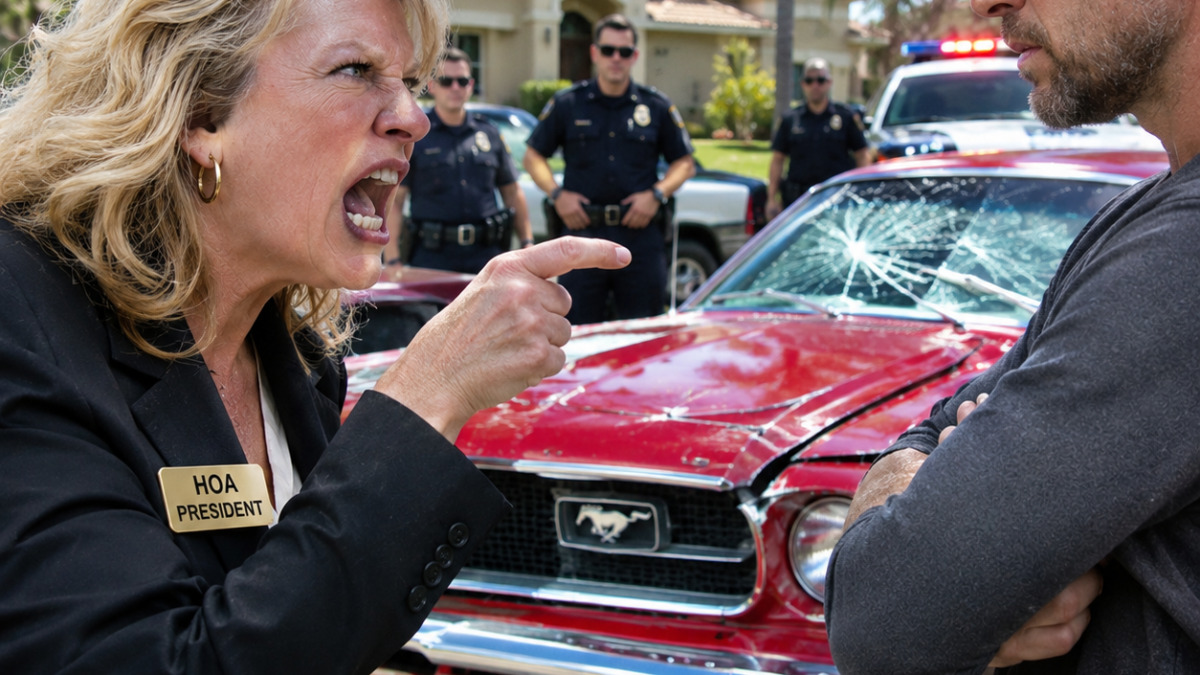
PART 2
The police cruiser entered our street four minutes later.
I know because Rachel eventually wrote down the exact time.
That was something I would learn during the weeks that followed.
When the rest of us experienced events, Rachel recorded them.
Times.
Names.
Distances.
Statements.
Who stood where.
Who spoke first.
What was said before and after.
At the time, though, I was not thinking about evidence.
I was thinking about two police officers pulling into my driveway while an HOA president had already told dispatch I was dangerous.
Both officers looked young.
Late twenties, maybe early thirties.
One was tall and lean. The other had a stockier build and a careful expression.
They stepped from the cruiser with the cautious body language police officers use when they do not know what kind of situation they are walking into.
Patricia moved before I could say anything.
“Officers.”
She hurried toward them, clutching her clipboard to her chest.
“Thank you for getting here so quickly.”
The taller officer looked past her toward me.
“Who called?”
“I did.”
Patricia pointed.
“That man became aggressive while we were performing a lawful enforcement action.”
That man.
I was standing ten feet away.
At my own house.
She did not even use my name.
“He approached my employees in a threatening manner,” she continued. “We feared for our safety.”
The officer held up one hand toward me.
“Sir, stay where you are.”
I stopped.
Patricia kept talking.
The more she spoke, the more polished the story became.
She explained that the HOA had rules.
She explained that the Mustang violated those rules.
She explained that she had authorized professional security personnel to remove the vehicle.
She explained that I became irrational.
Then one of the officers glanced at the Mustang.
The crowbar was still lying beside the front tire.
The driver’s-side door was bent.
The mirror hung by its wiring.
I thought surely he would ask about that.
He did not.
Not yet.
Instead he looked at me.
“Sir, did you approach these men?”
“I walked toward my wife’s car because they were forcing the door open.”
“Did you threaten them?”
“No.”
Patricia made an impatient sound.
“That is not what happened.”
I looked at her.
“You called the police while they were breaking into the car.”
“Sir,” the officer said, “look at me.”
I did.
“Keep your attention here.”
That was when I first understood how quickly a person could lose control of the truth.
Not the facts.
The truth.
Facts were what happened.
Truth, in a public confrontation, was what people believed happened.
And Patricia had started speaking first.
She had a title.
She had a clipboard.
She had two men in uniforms behind her.
I had an angry face and a damaged car.
Across the street, blinds were moving.
Doors opened.
Neighbors began stepping outside.
A man wearing running shorts slowed to a stop.
An older couple stood on their driveway.
Another woman came out holding her phone.
Patricia noticed the audience.
Her shoulders seemed to straighten.
“This is exactly why community standards exist,” she said loudly.
I stared at her.
Rachel was still standing near the porch.
Silent.
Watching.
The second officer finally looked toward her.
“Ma’am, are you involved?”
“I own the vehicle.”
Something passed across his face.
Recognition, maybe.
He studied her for half a second longer than normal.
Rachel noticed.
Of course she noticed.
But she said nothing else.
The first officer asked Patricia whether she wanted to make a formal complaint.
“Yes.”
She did not hesitate.
“I absolutely do.”
I felt my stomach tighten.
The officer took information from her.
Then from the two guards.
When he reached me, his tone was neutral.
Not hostile.
But distant.
Like I was already something to be managed.
I gave him my name.
I explained again that I had not threatened anyone.
I explained that the Mustang worked.
I explained that nobody had shown me an order allowing them to seize it.
He listened.
But listening and believing are not the same thing.
When I finished, he handed me a card.
“There’ll be a case number attached to the incident. You can contact the department if you want records.”
“What about the car?”
He looked at it.
“You’ll need to resolve the property issue through the HOA or civil channels.”
“They damaged it in front of you.”
“We didn’t witness the damage occur.”
I wanted to argue.
Rachel spoke for the first time in several minutes.
“Daniel.”
Just my name.
Quiet.
I looked at her.
Her eyes told me everything.
Stop.
Not because I was wrong.
Because nothing I said right then was going to help.
I took the card.
The officers returned to their vehicle.
Patricia watched them leave.
Then she turned to Rachel.
“I don’t believe we’ve been formally introduced.”
“I know who you are,” Rachel said.
Patricia smiled faintly.
“Then you understand that this community takes its standards seriously.”
Rachel’s expression did not change.
Patricia continued.
“I’ll be recommending a disciplinary hearing. Given your husband’s behavior, there may also be additional sanctions.”
“My husband’s behavior.”
“Yes.”
Rachel looked at the damaged Mustang.
Then at Patricia.
“Anything else?”
Patricia seemed disappointed.
Maybe she wanted an argument.
Maybe she wanted Rachel to threaten her.
Maybe she wanted another scene for the neighbors.
When none came, she tightened her grip on the clipboard.
“You should consider getting legal advice.”
That almost made me laugh later.
At the time, I was too angry.
Rachel only nodded.
“I’ll keep that in mind.”
Patricia turned.
The two security guards followed her toward a golf cart parked near the curb.
One of them looked back at the Mustang.
For the first time, I saw embarrassment on his face.
The other kept his head down.
Neighbors slowly disappeared into their houses.
Nobody approached us.
Nobody asked what happened.
Nobody said, “I saw them damaging your car.”
The street became quiet again.
I stood in the driveway.
The Mustang looked wounded.
There is no better word for it.
The driver’s-side mirror dangled.
The paint had been stripped in a jagged line.
The metal around the door lock was bent.
A crack ran along the frame where the crowbar had been forced in.
I remembered William polishing that same door years earlier.
He had been alive then.
He had looked at me over the roof of the car.
“Never rush old metal,” he said.
I had smiled.
“I’m not touching it.”
“That’s why I’m telling you now.”
He laughed.
Rachel walked past me.
She crouched beside the Mustang.
Her fingers hovered near the damaged paint but did not touch it.
I finally saw emotion break through.
Her jaw tightened.
Her eyes filled.
Not enough for tears to fall.
Just enough for me to know how much it hurt.
“Rachel…”
She stood.
“Don’t touch anything.”
“What?”
“Not yet.”
She pulled out her phone and began photographing the car.
Every angle.
The crowbar marks.
The lock.
The mirror.
The driveway.
The position of the tires.
Then she took pictures of the house.
The doorbell camera.
The curb.
The place where Patricia’s golf cart had been.
I watched her.
“What are you doing?”
“Preserving it.”
“Preserving what?”
“The scene.”
I stared.
Then something clicked.
“Why are you talking like this is one of your cases?”
She looked at me.
For one long second, she seemed to decide how much to say.
“Because it might become one.”
Rachel carried her laptop into the kitchen.
She sat down and created a folder.
Saturday Incident.
Inside it, she saved three files.
The first came from the doorbell camera.
We watched it together.
At 8:07 a.m., Patricia’s golf cart stopped outside our house.
At 8:08, the two guards walked onto our driveway.
At 8:09, Patricia pointed at the Mustang.
At 8:10, one guard tried the handle.
At 8:11, the crowbar appeared.
At 8:12, the damage began.
I did not step outside until 8:15.
Patricia called 911 at 8:17.
The timeline was devastating.
The second recording came from Rachel’s laptop.
She had been upstairs on a video call with a colleague when she heard the noise.
She muted the call, moved the laptop toward the window, and left the screen recording active.
The angle captured Patricia clearly.
At one point, Patricia actually gestured toward the Mustang and said something to the guards.
The audio was faint.
Rachel increased the volume.
“Get it done before he comes out.”
I felt my skin go cold.
“You heard that?”
“I heard enough.”
The third recording came from Rachel’s phone.
She had activated audio recording before stepping onto the porch.
Every word Patricia said after Rachel appeared was there.
Then Rachel opened another folder.
Ridgewood.
I stared at the name.
“What is that?”
She was silent.
“Rachel.”
She opened it.
Inside were complaints.
Emails.
Scanned letters.
Photos.
Six different families.
All from Ridgewood Estates.
One family had been fined repeatedly over an alleged driveway violation that did not appear anywhere in the HOA rules.
Another had their vehicle towed.
A retired couple had been charged more than two thousand dollars in storage fees.
Someone else had received violation notices after publicly criticizing Patricia at a board meeting.
The same names appeared again and again.
Patricia Henderson.
Two board members.
The same private security contractor.
I looked at Rachel.
“You knew?”
“I knew there had been complaints.”
“Before we moved here?”
“Yes.”
My voice rose.
“You knew this neighborhood had complaints about the HOA and you didn’t tell me?”
She closed the laptop slightly.
“I knew there were allegations.”
“That is not the same answer.”
“No. It isn’t.”
I walked toward the window.
Outside, the Mustang sat damaged in our driveway.
“We moved here three months ago.”
“I know.”
“You knew Patricia’s name.”
“Yes.”
“And you never said anything.”
Rachel looked tired suddenly.
Not defeated.
Tired.
“Daniel, six complaints do not automatically equal a prosecutable case.”
“You’re an assistant district attorney.”
“That is exactly why I couldn’t treat rumors like convictions.”
I turned.
“Were you investigating her?”
“No.”
“You had a folder.”
“I flagged complaints that had come through our office. That’s all.”
“And then we just happened to move into the neighborhood?”
“Yes.”
I searched her face.
She did not look away.
“We chose this house because we liked it,” she said. “Because you wanted the office. Because I wanted the garage. Because we talked about having a family and thought this might be somewhere we could stay.”
I sat down.
The anger drained from me, leaving confusion.
“So today…”
“Today changed things.”
She reopened the laptop.
“Before today, I had allegations without enough direct evidence. Now I have an HOA president ordering private contractors onto our property, a damaged vehicle, video recorded before any confrontation, a false account given to police, and two security employees pretending their authority is much broader than it actually is.”
I looked at the folder.
“What happens now?”
Rachel took a breath.
“We do this correctly.”
That was not the answer I wanted.
I wanted Patricia humiliated immediately.
I wanted the doorbell video online.
I wanted every neighbor who had watched me like I was dangerous to see what had really happened.
Rachel saw it on my face.
“No.”
“I didn’t say anything.”
“You were about to.”
“She posted nothing yet. We can get ahead of this.”
“No.”
“Rachel—”
“If we release evidence publicly before we preserve the official record, she will claim it is edited. She will say there is missing context. She’ll turn it into an argument.”
“So we let her lie?”
“We let her commit to the lie.”
I stared.
Rachel leaned toward me.
“There is a difference.”
That afternoon, she drove the Mustang—carefully—to a restoration specialist.
The fact that it could be driven at all destroyed Patricia’s claim that it was inoperable.
The shop owner was named Frank Dorsey.
He was in his sixties, broad-shouldered, with gray hair and a faded Marine Corps tattoo on his forearm.
When Rachel explained the Mustang had belonged to her father, Frank asked what branch.
“Army.”
“How long?”
“Twenty-five years.”
“Vietnam?”
She nodded.
Frank looked at the damage.
Then he looked at Rachel.
“I’ll document everything.”
The estimate eventually came to a little over eighteen thousand dollars.
Door frame.
Mirror assembly.
Paint.
Lock mechanism.
Body alignment.
Additional restoration work needed because force had been applied to metal that was more than half a century old.
Frank wrote a report describing the car as operational before the incident based on maintenance records and observed mechanical condition.
He also noted that the damage was consistent with forced entry.
Meanwhile, Rachel filed complaints and records requests.
Police body-camera footage.
Dispatch audio.
HOA governing documents.
Meeting minutes.
Notices supposedly sent to us.
Complaints supposedly filed against the Mustang.
“Do those complaints exist?” I asked.
“We’ll find out.”
“And if they don’t?”
Rachel looked at me.
“Then Patricia has another problem.”
She was right about one thing immediately.
Patricia did not sit still.
The first neighborhood post appeared the next morning.
COMMUNITY SAFETY NOTICE.
I opened it over coffee.
By the third paragraph my hands were shaking.
Patricia described an “incident involving a recently arrived household.”
She said HOA personnel had encountered “threatening and escalating behavior.”
She said security staff had been placed “in fear for their physical safety.”
She claimed police intervention had been necessary.
Then she posted a photograph of our Mustang.
The caption said:
“Chronic nuisance vehicle associated with ongoing compliance concerns.”
Our address appeared beneath the photograph.
She did not use my name.
She did not need to.
There were eighty comments before breakfast.
More than two hundred by noon.
I read every one.
That was a mistake.
“People like this destroy neighborhoods.”
“Why buy in an HOA if you refuse to follow rules?”
“If the guy threatened security, the board should sue.”
“Hope the police have a record now.”
One woman wrote that she had “always gotten a strange feeling” when walking past our house.
We had lived there three months.
She had never spoken to me.
I wanted to respond so badly my fingers ached.
Rachel took the phone out of my hand.
“No.”
“They’re calling me dangerous.”
“I know.”
“They’re putting our address online.”
“I know.”
“Someone just wrote that parents should tell their kids not to walk past our house.”
Her face tightened.
That one hurt her too.
Still, she shook her head.
“Do not reply.”
“How can you be this calm?”
“I’m not calm.”
“You look calm.”
“That isn’t the same thing.”
She handed my phone back.
“My father used to tell me anger is energy. You can burn yourself with it, or you can decide where it goes.”
I looked outside.
The Mustang sat beneath a temporary cover.
“I know where I want mine to go.”
Rachel almost smiled.
“I know.”
The cease-and-desist letter arrived the following day.
The HOA’s attorney accused me of harassment and intimidation.
It ordered me not to contact Patricia, any board member, or the security personnel.
I had contacted none of them.
Patricia also authorized security patrols.
Every thirty minutes, a golf cart rolled past our house.
Slowly.
Deliberately.
Sometimes the driver looked toward our windows.
Sometimes he did not.
The first day, it made me angry.
The third day, it made me uneasy.
By the fifth, I found myself checking the blinds before walking into the kitchen.
That was when I realized what Patricia was actually doing.
She was not trying to win a disagreement.
She was trying to make living there unbearable.
And it worked.
A coworker named Kevin lived two streets away.
He messaged me privately.
Everything okay?
I typed a long explanation.
Deleted it.
Typed:
Just an HOA misunderstanding. We’re handling it.
He replied:
Hope it works out.
After that, he became distant.
During a video meeting the next morning, two colleagues who also lived in Ridgewood barely acknowledged me.
I had known one of them for four years.
He used to message me jokes during project calls.
That week, nothing.
The isolation was worse than the damage to the car.
Metal could be repaired.
Reputation was different.
Once people were afraid of you, they began interpreting everything through fear.
If you kept quiet, you looked suspicious.
If you defended yourself, you looked aggressive.
If you got angry, you proved the accusation.
If you stayed calm, people wondered what you were hiding.
Patricia had built a trap where almost every reaction became evidence against me.
One evening, Rachel came home and placed her bag on the kitchen counter.
“She found out.”
“Found out what?”
“That I’m an attorney.”
I closed my eyes.
“Of course she did.”
Patricia had posted again.
This time she wrote:
“It has come to the board’s attention that a member of the household involved in last week’s confrontation is an attorney. The board will not be intimidated by individuals who attempt to use professional status to avoid community rules.”
The comments exploded.
“Typical lawyer.”
“They probably think they can sue everyone.”
“This explains the arrogance.”
I threw my phone onto the couch.
“Post the video.”
Rachel shook her head.
“Not yet.”
“When?”
“When the official evidence is complete.”
“How much more complete does it need to be?”
“Body camera.”
“We already know what happened.”
“We know. That isn’t the same as proving what the responding officers saw.”
I paced across the living room.
“She’s winning.”
Rachel looked at me.
“Is she?”
“Look online.”
“I’m not building an online argument.”
“The neighborhood believes her.”
“For now.”
“That matters.”
“Yes.”
Her voice softened.
“I know it does.”
For the first time, some of her professional armor cracked.
She came closer.
“What she’s doing to you is cruel.”
I said nothing.
“And I hate that my job trained me to see value in letting her continue.”
“Then stop.”
“I can’t.”
“Why?”
“Because every false statement she makes after receiving notice that we dispute her version helps establish intent.”
I stared at her.
“She’s digging her own grave.”
Rachel grimaced.
“I wouldn’t phrase it that way.”
“I would.”
That night, the body-camera request was approved.
And almost at the same time, Patricia posted a video.
Fifteen seconds.
No sound.
It began with me walking toward the Mustang.
My face looked furious.
Because I was furious.
There was no footage of the guards forcing the door.
No footage of Patricia ordering them forward.
No footage of the crowbar.
No context.
Just me moving quickly.
The caption said:
“Residents deserve to see the behavior our staff faced.”
I watched it three times.
Then Rachel watched it.
Something changed in her expression.
“What?”
She replayed it.
“Who recorded this?”
“One of the guards, I assume.”
“From where?”
I looked.
The angle was inside our driveway.
Rachel nodded.
“Save it.”
“For what?”
“Everything.”
The emergency HOA meeting was announced two days later.
Patricia wanted a five-thousand-dollar fine.
She also wanted the Mustang officially classified as an inoperable nuisance vehicle and removed within thirty days.
The community center was packed when Rachel and I arrived.
One hundred forty-seven residents signed in.
I counted because I needed something to do with my hands.
Patricia sat behind a long table at the front.
Four other board members sat beside her.
The two guards were there too.
Uniforms pressed.
Hair neat.
Professional.
Respectable.
They looked nothing like men who had stood in my driveway with a crowbar.
Rachel and I sat in the back row.
“You remember what we discussed?” she whispered.
“Say as little as possible.”
“Correct.”
“I hate this plan.”
“I know.”
“Just checking.”
For the first time in days, she smiled.
A tiny smile.
Then Patricia called the meeting to order.
She spoke for almost fifteen minutes.
She described the enforcement action as routine.
She described me as hostile.
She described her call to 911 as necessary.
Then the guards testified.
One claimed I “advanced rapidly.”
The other said he had prepared to defend himself.
No one mentioned the crowbar.
No one mentioned the damage.
A board member named Harold Crenshaw proposed the penalties.
Five thousand dollars.
Mandatory vehicle removal.
Potential towing fees.
Restrictions on communication with staff.
Patricia folded her hands.
“This is not punitive,” she said.
I nearly laughed.
“It is about maintaining the safety and integrity of Ridgewood Estates.”
Someone in the audience raised a hand.
“What about them?”
Heads turned.
“The Crawfords,” the man said. “Do they get to say anything?”
Patricia looked toward us.
Her smile became almost generous.
“Of course.”
Every face turned.
Rachel touched my wrist once.
I stood.
My legs felt strangely light.
I walked to the front carrying one sheet of paper.
Patricia watched me.
The room was silent.
I handed the paper to the secretary.
“This is a formal objection to the proceeding. It identifies several failures to follow the HOA’s own notice and hearing requirements. I’m requesting that it be entered into the record.”
Patricia blinked.
“That’s all?”
“Yes.”
“Mr. Crawford, you have been accused of serious misconduct. Are you saying you have no defense?”
I looked at Rachel.
Then back at Patricia.
“I said what I came to say.”
I returned to my chair.
Whispers erupted.
“He has nothing.”
“If they had evidence, they’d show it.”
“Why stay silent?”
Patricia let the whispers continue.
Then she looked directly at Rachel.
“I understand Mrs. Crawford is an attorney.”
Rachel did not react.
“One would expect a legal professional to respect rules and accountability.”
Still nothing.
“Instead, she has apparently decided to enable her husband’s behavior.”
My jaw clenched.
Rachel sat perfectly still.
Patricia continued.
“I find that especially disturbing.”
Then she delivered the line I think finally convinced Rachel that Patricia could not stop herself.
“I intend to file a complaint with the Arizona State Bar concerning Mrs. Crawford’s conduct.”
Rachel slowly lifted her eyes.
Not angry.
Not afraid.
Interested.
That was all.
The vote passed.
Seven to two.
Five-thousand-dollar fine.
Removal order approved.
Patricia looked satisfied.
The meeting ended.
As we walked toward the exit, an older man touched my arm.
“Mr. Crawford.”
I turned.
He looked about seventy.
Weathered face.
Gray hair.
His hands shook slightly.
“I know what they did to your car.”
I waited.
“They did something similar to my wife.”
Rachel stopped several feet away.
The man lowered his voice.
“She had a garden.”
“A garden?”
“She spent twelve years building it.”
He swallowed.
“After Patricia took over, they decided it attracted pests.”
His eyes moved toward the board table.
“They came while we were visiting our daughter. Tore everything out.”
I felt something heavy settle in my chest.
“I’m sorry.”
“We fought for a while.”
He shook his head.
“My wife got sick. We stopped.”
He pressed a small USB drive into my palm.
“I kept everything.”
“What’s your name?”
“Walter Morrison.”
“What’s on this?”
“Photos. Letters. Notices. Emails.”
He looked at Patricia.
“I’ve lived here twenty years.”
Then he looked back at me.
“Someone needs to stop her.”
Outside, I handed the drive to Rachel.
She turned it over in her fingers.
“That makes seven.”
“Seven?”
“Families.”
I looked back through the glass doors.
Patricia was laughing with board members.
“She thinks she won.”
Rachel slipped the USB into her pocket.
“Yes.”
There was something different in her voice now.
Not anger.
Certainty.
“And that is exactly where we need her.”
The body-camera footage arrived the next morning.
Rachel watched it twice.
Then she called someone from her office.
After that call, things changed quickly.
Because Rachel could no longer participate directly.
The conflict was too obvious.
She owned the damaged property.
She was married to the person Patricia accused.
Any official action involving Rachel would immediately create questions about bias.
So she recused herself.
Not partially.
Completely.
The evidence went to an independent prosecutor, David Brennan.
Rachel did not control his decisions.
She did not tell him what charges to bring.
She turned over the files and became a witness like everyone else.
That frustrated me at first.
“This is going to take longer.”
“Probably.”
“Patricia keeps attacking us.”
“Yes.”
“And you just hand everything over?”
“That’s the point.”
“What point?”
“If consequences come, they have to be consequences she earned. Not consequences I arranged.”
I leaned against the kitchen counter.
“You really believe she’ll try to claim this is personal.”
Rachel gave me a tired smile.
“She already has.”
The investigation lasted several weeks.
During that time, Walter introduced investigators to other families.
A couple named Marissa and Joel had paid nearly three thousand dollars after their SUV was towed.
A single mother named Erin had received escalating fines after challenging Patricia over a drainage issue.
An elderly widower had been charged for modifications supposedly made to his house before he even bought it.
Different disputes.
Same pattern.
Pressure.
Fear.
Private enforcement.
Unclear authority.
Then a demand for money.
And always, Patricia at the center.
The investigators subpoenaed records.
That was when cracks opened inside the board.
One member hired his own lawyer.
Another resigned.
A third suddenly remembered that he had “expressed concerns” about Patricia’s methods.
Rachel read that statement at our kitchen table.
“He expressed concerns?”
“Apparently.”
“When?”
“That is a very good question.”
“You sound like a prosecutor again.”
“I’m trying not to.”
“You’re failing.”
She smiled.
It felt good to see that smile.
For weeks our house had felt like a bunker.
Then came Tuesday.
The press conference.
The Maricopa County District Attorney’s Office had called reporters.
Rachel told me I could attend.
She did not tell me exactly what Brennan planned to announce.
“I genuinely don’t know everything,” she said.
“That must be painful for you.”
“You have no idea.”
I sat in the back.
Local television crews entered first.
Then print reporters.
A legal blogger.
A photographer.
Patricia arrived with her attorney.
That surprised me.
She looked confident.
Perfectly dressed.
Hair immaculate.
She smiled at someone near the door.
For a moment, I wondered if we had misunderstood everything.
That is how powerful confidence can be.
Even after you have seen the evidence, confidence makes you doubt your own memory.
Then David Brennan walked to the podium.
“Good morning.”
The room settled.
“This office has completed a preliminary investigation into allegations involving the Ridgewood Estates Homeowners Association.”
Patricia’s smile remained.
Brennan continued.
“The investigation concerns possible fraud, unlawful property interference, harassment, false reporting, and misconduct associated with private enforcement activity.”
A reporter stopped typing.
Patricia whispered to her lawyer.
Brennan turned toward a screen.
“The investigation began after several complaints from residents showed similar patterns. For some time, those complaints lacked enough independent evidence to establish what occurred.”
He clicked a remote.
“That changed last month.”
The first footage appeared.
Police body camera.
Patricia stood in our driveway.
Her own voice filled the room.
“This man became aggressive.”
The video showed me several feet away.
“He approached my employees in a threatening manner.”
The video showed my hands open.
“We feared for our safety.”
The camera shifted.
The Mustang was visible.
Damaged.
Brennan paused the video.
Then he played our doorbell footage.
This one began earlier.
The guards arrived.
They walked onto the driveway.
Patricia pointed.
One guard produced tools.
The other began forcing the lock.
Then came the crowbar.
A sharp sound echoed through the press room as the Mustang’s frame bent.
I had heard that sound dozens of times in my head since the incident.
Hearing it through speakers made my stomach turn.
Then Patricia’s voice.
“Hurry up. He’s going to come out soon.”
Someone in the room whispered, “Jesus.”
The video continued.
I appeared.
Only then.
Only after the damage.
Brennan let the footage run.
Nobody spoke.
He switched to the laptop recording.
A second angle.
Clearer sound.
Clearer view of Patricia.
Then Rachel’s phone audio.
Then the 911 call.
An aggressive male is threatening us.
The lie sounded uglier now.
Not because Patricia’s voice had changed.
Because the timeline had.
Brennan addressed the reporters.
“The vehicle involved is a fully operational 1967 Ford Mustang Fastback.”
A photograph appeared.
William Torres stood beside the car decades earlier.
Young.
In uniform.
Rachel inhaled sharply several seats away.
Brennan continued.
“The vehicle previously belonged to Master Sergeant William Torres, a decorated Army veteran who served in Vietnam and completed twenty-five years of military service.”
Another photograph appeared.
William older.
Rachel beside him.
Her hand on the roof of the Mustang.
“He left the vehicle to his daughter.”
The room went completely silent.
“The claim that this was an abandoned or inoperable nuisance vehicle was false.”
Then Walter’s files appeared.
Photographs.
Letters.
Invoices.
Tow records.
Violation notices.
Seven families.
Three years.
Brennan did not need drama.
The pattern created its own.
Finally he returned to the podium.
“This office has authorized charges against Patricia Henderson relating to filing a false police report, harassment, and conspiracy connected to fraudulent enforcement activity.”
The room erupted.
He raised his voice slightly.
“Two contracted security employees also face charges related to trespass and destruction of property. Their representations of authority are under separate review. Several members of the Ridgewood Estates board remain under investigation.”
Patricia’s face changed.
Not gradually.
Instantly.
Her attorney leaned toward her.
She ignored him.
“This is a setup.”
Every camera turned.
Her lawyer whispered urgently.
Patricia stood.
“That woman planned this.”
She pointed directly at Rachel.
“This is revenge.”
Brennan waited.
“She moved into my community and waited for me to make a mistake.”
Rachel did not move.
Patricia’s lawyer grabbed her arm.
“Patricia.”
“No.”
She pulled away.
“She used her position.”
Brennan spoke calmly.
“For clarity, Assistant District Attorney Crawford recused herself from this matter before any charging decision was made.”
“I don’t care!”
Patricia’s voice cracked.
“She orchestrated it.”
“The investigation was conducted independently.”
“She wants to destroy me.”
I almost stood.
Rachel glanced toward me.
One look.
Stay seated.
So I did.
Patricia turned toward the reporters.
“I will sue this office.”
Her attorney closed his eyes.
“I will sue the Crawfords. I will sue the police. I will sue every person involved in this.”
Cameras captured everything.
The same woman who had spent weeks presenting herself as the calm guardian of community order was now shouting threats into a room full of journalists.
Brennan did not argue with her.
He simply waited.
When Patricia finally stopped, he said:
“The defendants will be arraigned next week.”
That was it.
No insult.
No victory speech.
No revenge.
Just consequences.
Outside, I found Rachel near the parking lot.
Patricia was being guided into a car by her attorney.
I stood beside my wife.
“How do you feel?”
Rachel watched the car leave.
“Sad.”
That surprised me.
“Sad?”
“She could have stopped.”
“When?”
“Anytime.”
Rachel looked at me.
“The first day. After the car. After the police came. After she saw the video existed. After the board meeting.”
She looked back toward the road.
“She had a hundred chances to tell the truth.”
I thought about the scratches on the Mustang.
“She didn’t.”
“No.”
“Do you feel sorry for her?”
Rachel considered that.
“I feel sorry for anyone who becomes so addicted to control that consequences feel like persecution.”
Three months later, Patricia entered a no-contest plea on the false-reporting and harassment charges.
Some of the more complicated fraud allegations were resolved through the agreement.
She received two years of probation.
Two hundred hours of community service.
A twenty-five-thousand-dollar fine.
She was prohibited from holding leadership or advisory positions in a homeowners association during the term of her probation.
The two guards received suspended jail sentences and restitution obligations.
Their employer terminated them.
Several HOA board members resigned.
An independent audit began.
Then came the civil case.
Seven families participated.
The settlement totaled one hundred eighty thousand dollars.
Our share was thirty-two thousand.
Enough to restore the Mustang.
Enough to cover fees.
Enough to leave money over.
I expected that check to feel better than it did.
It did not.
I held it at our kitchen table.
“This is strange.”
Rachel looked up.
“What?”
“I thought I’d feel like we won.”
“You don’t?”
“I feel like someone put a price on something that shouldn’t have happened.”
Rachel closed the folder in front of her.
“That’s because money isn’t repair.”
“Then what is?”
She thought about it.
“Sometimes nothing.”
The settlement did something money alone could not do.
It forced structural changes.
Private security could no longer conduct enforcement actions under vague claims of authority.
Property seizure required proper legal procedure.
Residents had to receive written notice.
Anonymous complaints could not automatically become penalties.
Hearings required documentation.
Meeting records had to be preserved.
A compliance monitor would review the association for two years.
Everything Patricia had relied on—confusion, secrecy, unquestioned power—was being removed.
Then Ridgewood Estates held a special election.
Turnout broke every previous record.
Every incumbent board member lost.
Walter Morrison became HOA president.
Nearly three votes to one.
Rachel and I sat near the middle of the community center when the result was announced.
Walter walked to the front.
He looked uncomfortable behind the microphone.
He cleared his throat.
“I’m not much for speeches.”
Someone laughed softly.
Walter looked around the room.
“I stayed quiet too long.”
Nobody moved.
“A lot of us did.”
His voice trembled slightly.
“We told ourselves if Patricia was bothering somebody else, that was between them and the board.”
He paused.
“We told ourselves it was safer not to get involved.”
His wife sat in the front row.
Her eyes were wet.
“But silence has a cost.”
Walter looked at me.
Then Rachel.
“And usually the person paying that cost is the one standing alone.”
The room was silent.
“I can’t undo what happened.”
He swallowed.
“But we can make sure the next person who asks a question doesn’t get treated like an enemy.”
Applause began slowly.
Then spread.
People stood.
Some cried.
I remained seated for a few seconds.
Not because I disagreed.
Because I was thinking about that first morning.
The windows.
The faces.
The people watching.
Then I stood too.
The apologies began after the election.
The older couple across the street came first.
They brought a bottle of wine.
The husband stood awkwardly on our porch.
“We owe you both an apology.”
His wife looked at Rachel.
“We saw them at the car.”
I felt my chest tighten.
“You saw them?”
She nodded.
“We saw enough.”
“Why didn’t you say anything?”
The question came out sharper than I intended.
The husband looked down.
“We were afraid.”
“Of Patricia?”
“Yes.”
His honesty stopped my anger.
He continued.
“She’d already fined us twice. We didn’t want to be next.”
Rachel listened.
Then said quietly:
“Now you know what silence costs.”
The woman nodded.
Tears filled her eyes.
“I do.”
Others came.
A man who had called me dangerous online admitted he had never spoken to me before deciding I was a threat.
Another neighbor confessed that she had doubted Patricia but did not want to become a target.
Kevin, my coworker, sent me a long message.
He apologized for avoiding me.
I read it twice before responding.
I did not tell him everything was fine.
It wasn’t.
I wrote:
I appreciate the apology.
That was enough.
Not everyone changed.
A small group insisted Patricia had been framed.
They wrote online that she had been “too strict” but not criminal.
Some claimed Rachel’s legal career had frightened the system into acting.
Evidence rarely eliminates every believer.
Some people would rather protect the story they chose than admit they chose badly.
Rachel stopped reading those posts.
Eventually I did too.
Months passed.
The Mustang went into restoration.
Frank treated the car like a patient.
He photographed every stage.
The door frame was straightened.
The mirror replaced.
The damaged paint stripped and rebuilt.
The lock repaired.
Chrome polished.
Glass replaced.
Rachel visited almost every week.
One afternoon, Frank showed her a faint line in the repaired metal.
“I can probably make this disappear completely.”
Rachel stared at it.
“No.”
Frank looked surprised.
“You sure?”
“Yes.”
“You’ll see it if you know where to look.”
“I know.”
She touched the line.
“Leave it.”
On the drive home I asked why.
“Dad used to say repaired isn’t the same as untouched.”
“So you want the scar?”
“I want the truth.”
That was Rachel.
She had spent her career believing that truth mattered most when it was uncomfortable.
The strangest request came several weeks later.
Patricia’s attorney contacted Rachel through the proper channels.
Patricia was considering making a public statement of remorse.
In exchange, she hoped Rachel might support early termination of her probation once she became eligible.
I laughed when Rachel told me.
“You’re kidding.”
“No.”
“She wants you to help her?”
“Apparently.”
“After everything?”
Rachel sat across from me.
“What do you think?”
“What do I think?”
I almost could not answer.
I remembered the first scratch.
The police officer telling me to stay calm.
Neighbors calling me dangerous.
The security cart outside our house.
The board meeting.
Patricia threatening Rachel’s career.
Part of me wanted to write the letter myself.
Not to support leniency.
To oppose it.
To describe every sleepless night.
Every whisper.
Every time I checked the window before going outside.
“She should finish every day of it,” I said.
Rachel nodded.
“I understand.”
“You don’t agree?”
“I didn’t say that.”
“What are you going to do?”
“I don’t know.”
She waited two days.
Then she wrote:
“The consequences imposed on Ms. Henderson were determined by the court based on the evidence and applicable law. I do not believe it would be appropriate for me to advocate for modification of those terms. If she fulfills her obligations, that is a matter between her and the court. I wish her no additional harm, but I will not request leniency she has not yet earned.”
She showed it to me.
“That’s it?”
“That’s it.”
“You could have said more.”
“I could have.”
“You could have buried her.”
Rachel looked at me.
“I don’t want to bury anyone.”
“After what she did?”
“Especially after what she did.”
I shook my head.
“You’re a better person than I am.”
“No.”
She reached for my hand.
“I’m just trying very hard not to let Patricia decide what kind of people we become.”
That sentence stayed with me.
Six months after the morning everything started, Frank called.
The Mustang was ready.
Rachel drove it home herself.
I waited in our driveway.
I heard the engine before I saw the car.
Low.
Steady.
Familiar.
Then the Mustang turned the corner.
Sunlight flashed across restored chrome.
Rachel pulled slowly toward the house.
For one second I saw William behind the wheel instead.
Not literally.
Memory plays strange tricks.
Then Rachel smiled through the windshield.
She parked in exactly the same place where the guards had attacked the car.
She shut off the engine.
I walked around it.
The restoration was beautiful.
Almost perfect.
Then I saw the faint line.
The scar Rachel had asked Frank to leave.
She ran one finger across it.
“Dad would complain that the paint is too shiny.”
I laughed.
“He absolutely would.”
She smiled.
Then her eyes filled.
This time she let the tears come.
“He should be here.”
I pulled her close.
“I know.”
For months, I had thought the car represented everything Patricia had done to us.
Standing there that afternoon, I realized I had been wrong.
The Mustang represented everything Patricia had failed to destroy.
Memory.
Family.
Promise.
Love.
History.
You could bend metal.
You could scrape paint.
You could lie to police.
You could turn neighbors against each other.
But some things survived because people decided they were worth repairing.
The neighborhood changed too.
Not dramatically.
The houses looked the same.
Grass still had to be trimmed.
Trash cans still had rules.
People still complained at meetings.
It was still an HOA.
But meetings were recorded now.
Residents could see documents.
Violations required evidence.
Walter answered questions without treating questions as disloyalty.
Arguments happened.
Votes split.
People disagreed.
And somehow, that messiness felt healthier than Patricia’s perfect control.
Then Rachel proposed something unexpected.
A memorial bench.
“For your father?”
She nodded.
There was a small park beside the lake.
William had never lived at Ridgewood Estates.
But Rachel wanted something there that transformed the story.
“I don’t want people to remember that Mustang because Patricia damaged it.”
“What do you want them to remember?”
“My dad.”
The board approved the request unanimously.
The plaque was simple.
**IN MEMORY OF MASTER SERGEANT WILLIAM TORRES**
**SERVICE. SACRIFICE. HOME.**
At the dedication, a representative from the local VFW attended.
Walter came.
Frank came.
Several neighbors came.
Rachel refused to give a speech.
She stood beside the bench.
Her fingers rested on the brass letters spelling her father’s name.
Then she sat.
No cameras.
No prosecutors.
No HOA lawyers.
No Patricia.
Just sunlight over the lake.
Afterward, we stayed behind.
“What were you thinking about?” I asked.
Rachel smiled.
“Driving with him.”
“How old were you?”
“Seventeen. Maybe eighteen.”
“Was he teaching you?”
“No.”
Her smile widened.
“By then I thought I already knew everything.”
“That sounds unlike you.”
She elbowed me.
“We’d drive for no reason. Windows down. He’d put on old music. Usually too loud.”
“He never seemed like a loud-music guy.”
“He was in that car.”
She looked toward the Mustang.
“He didn’t talk much.”
“Neither do you when you drive it.”
“I know.”
She stared across the lake.
“Sometimes I think that was the point. He had spent so much of his life in places where every sound meant something. An engine. A radio. A helicopter. A weapon.”
She paused.
“When he came home, maybe driving was one of the few times sound didn’t mean danger.”
I looked at the bench.
“And now?”
“Now it means he made it home.”
That Sunday, we took the Mustang out.
No destination.
Rachel drove.
I sat beside her.
The windows were down.
The Arizona afternoon was warm, but not unbearable.
We passed the community center.
The place where one hundred forty-seven people had watched Patricia call us liars.
We passed the curb where her golf cart used to stop.
We passed the houses of people who had judged us.
Some waved.
Rachel waved back.
We drove toward the lake.
Near the park, she pulled over.
She shut off the engine.
For a while we sat without speaking.
Then I asked the question I had carried for months.
“Do you ever wish we’d gone harder?”
She turned.
“What do you mean?”
“Patricia.”
Rachel looked toward the water.
“She lost the board.”
“Yes.”
“Got charged.”
“Yes.”
“Paid fines.”
“Yes.”
“Probation.”
“Yes.”
“Her name is in public court records.”
“Yes.”
“She can’t run an HOA during the sentence.”
“Yes.”
“She paid through the settlement.”
“Yes.”
“And you still think we were easy on her?”
I looked down.
“I think about those weeks.”
Rachel waited.
“I think about being called dangerous. I think about people watching our house. I think about her threatening your license.”
My hands tightened.
“Sometimes I wanted her to lose everything.”
Rachel was quiet.
Then she said:
“That’s why revenge feels good in your imagination.”
I looked at her.
“In your imagination, revenge is precise. The person who hurt you feels exactly what you felt. Nobody innocent gets hurt. You stop at exactly the right moment.”
She looked back toward the lake.
“Real revenge isn’t precise.”
I said nothing.
“It spreads.”
She pointed toward the neighborhood.
“If we had used my position improperly, Patricia would have had a legitimate argument.”
I knew she was right.
“If we had published evidence recklessly, innocent employees could have been dragged into it.”
She continued.
“If we had tried to destroy everyone who believed her, we would have destroyed half the neighborhood.”
“So what do you call what happened?”
“Consequences.”
“That’s it?”
“That’s enough.”
I stared at her.
Rachel turned fully toward me.
“Patricia wanted a war.”
Her voice was quiet.
“I refused to give her one.”
“Why?”
“Because wars destroy things you wanted to protect.”
She looked at the Mustang.
“I wanted Dad’s car protected.”
Then toward the houses.
“I wanted the people she hurt to be heard.”
Then at me.
“And I wanted us to be able to look at ourselves afterward.”
I thought about the first morning.
About how badly I had wanted to post the video.
About how badly I had wanted to humiliate Patricia.
About every time Rachel told me to wait.
“You knew all along?”
“No.”
That surprised me.
“No?”
Rachel smiled.
“I was terrified.”
“You never looked terrified.”
“I’m a prosecutor.”
“So?”
“We practice.”
I laughed.
She did too.
Then her expression softened.
“I didn’t know how it would end, Daniel.”
“But you kept saying we had evidence.”
“We did.”
“You sounded certain.”
“I was certain about the evidence.”
She looked down at her hands.
“I wasn’t certain people would care.”
That hit me harder than almost anything else she had said.
Because Rachel was right.
Evidence does not speak by itself.
People have to be willing to listen.
Walter had listened.
The other families had spoken.
Brennan had looked.
Neighbors had eventually admitted they were wrong.
A judge had imposed consequences.
A community had changed its rules.
Truth had needed people.
Not just files.
Not just video.
People.
We sat until the sun moved lower.
Then Rachel started the Mustang.
As we passed Walter’s house, he was watering his lawn.
Rachel tapped the horn twice.
Walter looked up.
He grinned.
Raised one hand.
The horn echoed down the street.
A tiny sound.
A completely ordinary sound.
And yet after everything we had been through, it felt like a declaration.
We were still here.
The Mustang was still here.
Walter was still here.
The neighborhood was still here.
Patricia had once believed power meant nobody saying no.
She had been wrong.
Power was the ability to damage someone.
Accountability was what happened when people finally refused to let damage become normal.
We pulled into our driveway.
Rachel shut off the engine.
Neither of us moved immediately.
She rested both hands on the steering wheel.
Then she smiled.
“My dad would’ve liked this ending.”
I looked at her.
“Why?”
Rachel glanced at the faint scar beside the door.
Then toward the memorial bench in the distance.
Then at our house.
“Because we fixed what could be fixed.”
She paused.
“And we didn’t pretend the rest never happened.”
I waited.
She looked at me.
“And because Patricia spent all that time trying to turn us into her enemies.”
Another small smile.
“But we won without becoming what we fought.”
I looked down the street.
There were no security carts.
No police cruisers.
No neighbors staring through windows.
Just trimmed lawns, evening light, and Walter’s sprinkler clicking somewhere in the distance.
For the first time since the morning I heard metal scraping against metal, Ridgewood Estates finally felt quiet.
Not the kind of quiet created when people are afraid to speak.
The kind that comes after the truth has already been said.
And this time, nobody could force it back into silence.








