PART 2: HOA Karen Nearly Destroyed My Private Lake Bridge for Her $200,000 Payday — One Last Truck Cost Her Everything
PART 2
The letter was four pages long, printed on expensive paper, and filled with the sort of legal language designed to make ordinary people feel powerless.
I read it at the kitchen table while Linda prepared dinner.
According to Karen’s attorneys, I had interfered with authorized community operations, behaved aggressively toward HOA representatives, and knowingly maintained a dangerous structure within an area of community interest.
They demanded immediate payment of five thousand dollars.
Failure to comply, they warned, could result in additional penalties and further legal action.
I turned to the last page.
There was Karen’s signature.
Not the signature of a county official.
Not the signature of a judge.
Just Karen Dutton, president of a homeowners association I had never joined.
Linda placed two plates on the table.
“You’re not going to eat, are you?”
“In a minute.”
“David.”
I looked up.
“You’ve been saying that for weeks.”
She sat across from me.
“This woman is taking over our lives. Even when she’s not here, we’re talking about her. When we wake up, you’re checking the driveway. When we go to bed, you’re worrying about the bridge.”
I folded the letter.
“I’m trying to protect what we have.”
“I know. But I miss my husband.”
Those words hurt more than anything Karen had done.
Linda and I had spent twenty-eight years together. We’d raised a daughter, survived financial difficulties, worked jobs we hated, and saved money when everyone around us seemed to be spending it.
When we finally bought our property, we promised each other that the hardest years were behind us.
We wanted somewhere we could grow old without constantly worrying about somebody else’s demands.
Now a woman who had never contributed a penny toward our home was making Linda afraid to answer the door.
I reached across the table and took her hand.
“I’m going to finish this.”
“Promise me you’ll be careful.”
“I promise.”
The following morning, I drove to the county records office.
I brought a notebook, a folder containing my original purchase documents, and a determination that had been growing steadily since Richard revealed Karen’s financial interest in Meadowbrook.
For almost four hours, I examined property records dating back decades.
The clerk, an older woman named Helen, eventually brought me another collection of archived documents.
“You’re looking for an easement?” she asked.
“An easement granting public access across my bridge.”
She adjusted her glasses.
“Has someone claimed there is one?”
“The HOA president.”
Helen gave me a sympathetic smile.
“You’re not the first person who’s come in here because of a homeowners association.”
Together, we examined the subdivision plats, historic deeds, boundary descriptions, and recorded agreements.
There was nothing granting Lakeview Estates access to my property.
Nothing granting Meadowbrook access.
Nothing establishing a public crossing.
The bridge was mine.
The roads approaching it were mine.
And Karen had absolutely no recorded right to use them.
I paid for certified copies.
Before leaving, I asked Helen one last question.
“If someone wanted to establish an easement across my property, could they simply vote for it at an HOA meeting?”
She laughed.
“Good heavens, no.”
I smiled.
“That’s what I thought.”
My next stop was Richard’s office.
He examined the documents carefully.
“This puts us in a strong position.”
“Then why is she still sending trucks?”
“Because she believes the cost of stopping her will discourage you from trying.”
Richard leaned back.
“People sometimes confuse having the money to fight a lawsuit with having the legal right to win one.”
“How long would a lawsuit take?”
“It depends. Months. Potentially longer.”
“And in the meantime?”
“We request emergency relief, document further violations, and make sure your property is properly secured.”
I looked through the window overlooking the parking lot.
Karen was counting on delay.
Every day her construction vehicles used my land, she saved money. Every week we spent exchanging letters, she moved closer to receiving her development bonus.
Even losing a lawsuit might be profitable if she made enough money before the judgment arrived.
“I want to know what the HOA board knows,” I said.
Richard nodded.
“That’s a good place to start.”
Over the following days, we obtained copies of Lakeview Estates meeting minutes, development correspondence, and financial disclosures that should have identified Karen’s involvement with Meadowbrook.
The more we read, the more disturbing the situation became.
Karen had repeatedly encouraged the board to support the project.
She described Meadowbrook as an opportunity to increase property values, improve neighborhood infrastructure, and attract wealthy homeowners.
She assured residents that she had negotiated favorable arrangements on their behalf.
At one meeting, she specifically referred to my bridge as an existing community transportation resource.
Nobody had challenged her.
Nobody had asked to see an easement.
And nowhere in the available disclosures did she acknowledge that she stood to personally receive approximately two hundred thousand dollars from the project.
Richard circled several paragraphs.
“Look at this.”
Karen had argued that expedited construction would benefit the entire neighborhood.
A separate document identified project completion bonuses payable to certain investors and partners.
The dates aligned perfectly.
I felt sick.
“She’s been using everybody.”
“That’s what the evidence suggests.”
“Not just me.”
“No.”
For months, I had thought of Karen as an arrogant woman who couldn’t tolerate being told no.
Now I realized arrogance was only part of the problem.
Greed was driving everything.
And behind her expensive clothes, impressive vehicle, and carefully cultivated reputation was someone willing to risk other people’s property and safety to protect her own money.
I drove home with copies of the documents on the passenger seat.
As I approached my driveway, I noticed an unfamiliar SUV parked near the entrance.
A man stood beside it, holding a camera.
He quickly lowered it when he saw me.
I stopped.
“Can I help you?”
He looked uncomfortable.
“I’m just taking some pictures.”
“Of what?”
“The road.”
“Why?”
He glanced toward Lakeview Estates.
“Community documentation.”
I got out of my truck.
“Did Karen send you?”
He didn’t answer.
“You’re standing on private property.”
He climbed into his vehicle.
“Sorry about that.”
Then he drove away.
I photographed his license plate before he disappeared.
When I told Linda, she looked genuinely frightened.
“They’re photographing our house now?”
“I don’t know exactly what they’re doing.”
“David, this is getting ridiculous.”
She walked to the living room window and pulled the curtain aside.
Across the water, the expensive houses of Lakeview Estates stood in the afternoon sunlight.
Everything looked peaceful.
That was what made it so unsettling.
Nobody looking at that neighborhood would have imagined the ugliness developing beneath its polished appearance.
I contacted Deputy Miller.
He had already documented the tractor incident and examined the damage to my bridge.
When he returned, I showed him the photographs of the unfamiliar SUV.
“Keep a record of everything,” he told me. “Don’t confront anyone unnecessarily. If someone refuses to leave your property, call us.”
“She’s not going to stop.”
“Then give us evidence we can actually use.”
That sentence stayed with me.
Evidence.
Not anger.
Not accusations.
Evidence.
I called an old friend named Marcus Webb.
Marcus was a structural engineer who had helped me design improvements to my workshop several years earlier.
He arrived the following afternoon wearing work boots and carrying an inspection bag.
We walked down to the bridge.
He stopped before reaching the entrance.
“That’s worse than you described.”
“Can it be repaired?”
“Anything can be repaired if you’re willing to spend enough money.”
He examined the damaged timbers, brackets, and deck from safe inspection points along the shoreline.
For nearly an hour, he worked without saying much.
Finally, he closed his notebook.
“David, nobody should be using this bridge until it’s properly repaired.”
“Not even me?”
“Not even you.”
I stared across the water toward my workshop.
“So they’ve cut my property in half.”
“Essentially.”
“How dangerous is it?”
Marcus looked directly at me.
“Dangerous enough that I’m recommending immediate closure. Another unauthorized heavy vehicle could have catastrophic consequences.”
I thought about the tractor and the cement mixer.
I thought about Linda standing near the bridge when Karen ordered the machine forward.
“What kind of consequences?”
“It could collapse.”
The words hung between us.
I looked at the structure I had maintained for fifteen years.
Something that had survived storms, freezing winters, and years of regular use had been compromised in a matter of weeks.
“All because she wanted a shortcut.”
Marcus shook his head.
“People see a bridge and assume it’s a road. They don’t understand what’s underneath it.”
“Karen doesn’t care what’s underneath it.”
“Then make sure nobody can claim they weren’t warned.”
Marcus prepared a written assessment explaining the damage, the safety concerns, and the immediate need to restrict access.
Richard reviewed it.
Together, we arranged for the bridge to be closed while proper repairs were planned.
At both entrances, I installed professionally printed signs.
PRIVATE PROPERTY.
BRIDGE CLOSED.
UNSAFE FOR VEHICLE ACCESS.
NO TRESPASSING.
The barriers were visible from a considerable distance.
There could be no honest confusion.
Or so I thought.
Two days later, Karen appeared at my house.
She didn’t knock.
She rang the doorbell repeatedly until I opened the door.
“What have you done to the crossing?” she demanded.
“Closed it.”
“You can’t do that.”
“It’s damaged.”
“Then fix it.”
“I’m working on that.”
“We have construction vehicles scheduled.”
“That’s not my problem.”
Her expression hardened.
“You’re interfering with a major development project.”
“Your construction vehicles damaged my bridge.”
“The association will consider reasonable contributions toward maintenance.”
I stared at her.
“Reasonable contributions?”
“Provided you cooperate.”
“You mean you’re offering to give me a portion of the money required to repair the damage you caused, as long as I allow you to continue using my property?”
She folded her arms.
“There’s no need to be unreasonable.”
“Karen, my engineer has declared that bridge unsafe.”
“Your engineer.”
“Yes.”
“Not ours.”
I almost laughed.
“You don’t have jurisdiction over my bridge.”
“We’ll see about that.”
She stepped closer.
“I suggest you think very carefully about what happens if you continue obstructing this project.”
Behind me, Linda had appeared in the hallway.
“Is that a threat?” she asked.
Karen glanced at her.
“I’m explaining reality.”
“No,” Linda replied. “You’re standing at our front door threatening my husband.”
For a moment, Karen looked surprised.
She wasn’t accustomed to Linda challenging her.
“Perhaps you should stay out of matters you don’t understand.”
Linda stepped forward.
“This is my home. I understand perfectly.”
I had never been prouder of my wife.
Karen turned away, muttering something about attorneys.
I watched her walk back to her Escalade.
Then I closed the door.
Linda’s hands were shaking.
I took them gently.
“You didn’t have to do that.”
“Yes, I did.”
She looked toward the window.
“I’m tired of being afraid of her.”
That evening, I made a decision.
Karen could continue sending letters.
She could continue pretending she had authority.
She could continue telling contractors that the bridge belonged to the community.
But I wasn’t going to let her control the story anymore.
I installed security cameras around my property.
The bridge entrances, driveway, and surrounding access areas were monitored.
The recordings would document unauthorized activity.
I made sure the system was working and retained copies of significant incidents.
Richard reviewed the notices I intended to send.
Marcus supplied his official inspection report.
Deputy Miller documented the continuing dispute.
Everything would be handled through the proper channels.
And when Karen ignored those channels, there would be a record.
My next conversation was with Tom Rodriguez, a county building inspector.
I’d known Tom for years.
He was the kind of man who could detect a poorly completed building project from across a parking lot.
I arranged to meet him in his office.
When I placed the Meadowbrook documents on his desk, he initially looked puzzled.
“What does this have to do with your bridge?”
“Look at the dates.”
He examined the development approvals.
Then the HOA meeting minutes.
Then Karen’s financial interest.
His expression changed.
“Where did you get these?”
“Public records and association documents.”
“Has your attorney reviewed them?”
“Yes.”
Tom spent several minutes reading silently.
Finally, he removed his glasses.
“If these representations were used to obtain approvals, we’ve got a problem.”
“How big?”
“I won’t know until we investigate.”
“Then investigate.”
He nodded.
“I intend to.”
For the first time in months, I felt something other than helplessness.
Karen had built her power around the assumption that nobody would compare her statements with the truth.
She could intimidate individual homeowners because they were isolated.
She could deceive contractors because they trusted her title.
She could influence development decisions because nobody knew about her financial interest.
But those separate stories were beginning to come together.
And when they did, she wouldn’t be able to control the outcome.
A few evenings later, my neighbor Bill Henderson stopped by.
Bill lived near the edge of Lakeview Estates.
He was friendly enough, although he had a habit of knowing everybody’s business.
We stood beside my driveway talking about the weather.
Eventually, he looked toward the bridge.
“Heard you’re having trouble with Karen.”
“That’s putting it mildly.”
“She says you’re blocking important construction work.”
“She also says she has an easement that doesn’t exist.”
Bill shifted uncomfortably.
“She’s pretty determined.”
“I’ve noticed.”
After a pause, he asked whether Linda and I were planning to travel anytime soon.
The question struck me as strange.
“We might be visiting our daughter,” I replied.
“Oh, that’s nice. Colorado, right?”
“That’s right.”
“How long?”
“A few days.”
He nodded.
“Well, enjoy yourselves.”
I watched him leave.
Something about the conversation bothered me.
Bill had never shown much interest in our travel plans before.
I mentioned it to Linda.
“You think Karen asked him?”
“I think it’s possible.”
Linda looked worried.
“Maybe we shouldn’t go anywhere.”
I shook my head.
“We can’t become prisoners in our own house.”
We had already postponed two trips because of the ongoing dispute.
We had canceled dinner invitations.
We had stopped enjoying evenings on the lake because every unfamiliar engine made us nervous.
I wasn’t going to give Karen another piece of our lives.
We decided to spend a few days away.
Before leaving, I checked that the bridge remained closed, confirmed that the warning signs were intact, and informed Richard of our plans.
He reminded me to contact the authorities if the security system detected unauthorized activity.
“Don’t rush back and confront anybody,” he said.
“Understood.”
“And David?”
“Yes?”
“You’ve done everything reasonably possible to communicate that the bridge is unsafe. Keep it that way.”
That was exactly what I intended.
On Thursday morning, Linda and I packed our bags.
I loaded the car while she checked the house.
The lake was perfectly still.
Across the water, my workshop stood empty.
For the first time since buying the property, I couldn’t simply drive across my own bridge to reach it.
I looked at the warning signs.
I hated seeing them there.
But they needed to remain until the bridge could be properly rebuilt.
Linda came outside.
“Ready?”
“Ready.”
We drove away.
Neither of us knew what was about to happen.
We checked into a small hotel outside town, intending to take a short break before continuing our trip.
For most of Thursday, everything remained quiet.
Linda and I had dinner together without discussing Karen.
We walked around a nearby park.
We even laughed about something unrelated to the property.
It felt wonderful.
That evening, Linda fell asleep while I sat near the window.
I checked the security recordings one final time.
Nothing.
No construction vehicles.
No unfamiliar visitors.
No activity near the bridge.
Perhaps the warning signs had finally accomplished what our letters hadn’t.
Perhaps Karen understood that continuing would expose her to consequences she couldn’t afford.
I closed my phone.
I wanted to believe that.
Friday morning proved how wrong I was.
We were having breakfast when my phone vibrated.
Motion detected.
South property entrance.
I opened the security application.
A familiar black Cadillac Escalade had stopped near the bridge.
Karen stepped out.
She stood examining the barriers and warning signs.
Then she pulled out her phone.
Linda looked over my shoulder.
“Is that her?”
“Yeah.”
“What is she doing?”
“I don’t know.”
Karen spent several minutes beside the bridge before returning to her vehicle.
She drove away.
I saved the recording.
Then I called Deputy Miller’s office and reported the activity.
A little more than an hour later, my phone vibrated again.
The second recording made my stomach turn.
Karen’s Escalade had returned.
Behind it was an enormous commercial dump truck carrying construction material.
“Oh, no,” Linda whispered.
The truck stopped near the closed entrance.
Karen got out.
The driver climbed down from his cab.
They spoke briefly.
He gestured toward the warning signs.
Karen shook her head.
He pointed toward the barriers.
She appeared irritated.
I couldn’t hear every word clearly, but I could see the driver wasn’t comfortable.
I immediately contacted emergency dispatch.
I explained that a heavy construction vehicle was approaching a privately owned bridge that had been closed because of documented structural damage.
The dispatcher confirmed that assistance was being sent.
On my screen, Karen continued arguing with the driver.
Finally, she stood beside the entrance and waved him forward.
“Don’t do it,” I said aloud.
Linda gripped the edge of the table.
The driver returned to his cab.
Karen’s assurances had apparently overcome his hesitation.
The vehicle began moving.
The warning signs were still plainly visible.
Nothing about the crossing suggested he had permission to proceed.
Then the truck disappeared partially behind the trees at the approach.
I switched camera views.
The vehicle reached the damaged bridge.
For one terrible moment, the structure seemed to hold.
Then everything changed.
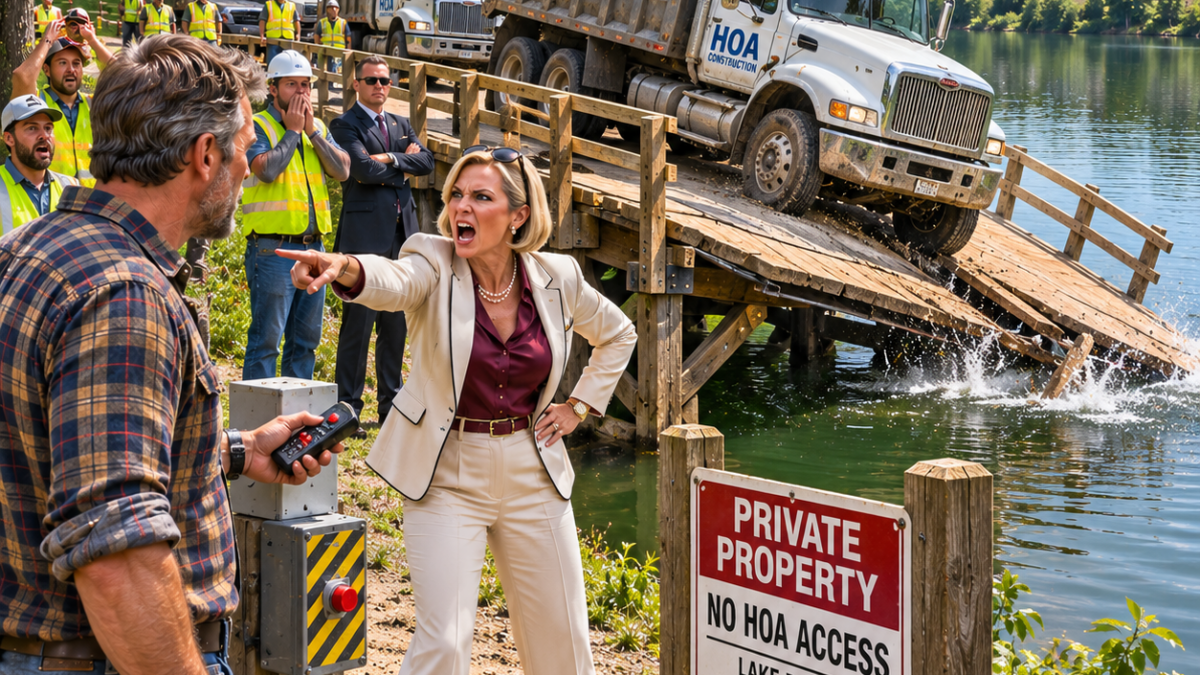
A deafening crack came through the recording.
The bridge deck shifted.
The truck tilted.
A tremendous splash erupted across the lake.
Linda screamed.
I stood so quickly that my chair fell backward.
“Oh, God.”
Water surged around the enormous vehicle.
Wooden debris scattered across the surface.
The bridge that had connected the two halves of our property for fifteen years was gone.
Part of the dump truck remained above the water.
I couldn’t see the driver.
“David!”
“I’m looking.”
My fingers shook as I switched between camera views.
Then a door opened.
A man appeared.
He climbed out and struggled toward the nearby shoreline.
“He’s out,” I said.
Linda pressed both hands over her mouth.
“Thank God.”
I relayed what I was seeing to dispatch.
The driver appeared to be moving independently, but I couldn’t determine whether he had been injured.
Emergency personnel were still needed.
I kept watching.
Karen stood near her Escalade, holding her phone.
The driver reached solid ground.
He turned toward her.
Even through the recording, his anger was obvious.
“You told me it was cleared!” he shouted.
Karen stepped backward.
“It was supposed to be fine!”
“There was a sign!”
“The owner is being difficult.”
“You told me we had permission!”
Karen shook her head.
“The association has authority over this crossing.”
“My truck is in the damn lake!”
I sat down heavily.
Linda was crying.
Not because Karen had finally been caught.
Not because we were relieved that we had evidence.
Because we had just watched a human being narrowly escape a frightening accident.
It took several minutes before I could speak normally.
“Let’s go home.”
Linda nodded.
I called Richard before leaving.
“The bridge collapsed.”
He went silent.
“Is anyone hurt?”
“The driver got out. Emergency services are responding.”
“Do you have the recordings?”
“Yes.”
“Preserve them. Don’t alter anything. I’ll meet you there.”
Then I called Marcus.
When I told him what had happened, he let out a long breath.
“I warned them.”
“I know.”
“David, make sure the authorities have my inspection report.”
“They will.”
As we drove toward Lake Harmony, Linda stared out the passenger window.
Neither of us spoke for several miles.
Finally, she turned toward me.
“She could have killed that man.”
“I know.”
“All for money.”
I tightened my grip on the steering wheel.
“I know.”
I’d spent months imagining the moment Karen would finally face consequences.
I’d imagined her being forced to apologize.
I’d imagined her losing an argument in front of the HOA board.
I’d imagined a judge telling her that she had no authority over my property.
But I had never wanted to see somebody’s truck sink into my lake.
I had never wanted a man’s family to receive a telephone call saying he had been injured.
Karen’s obsession with winning had created something far uglier than a property dispute.
When we arrived, emergency vehicles were gathered near the shoreline.
A recovery crew was assessing the submerged truck.
Deputy Miller stood near the damaged entrance with another officer.
Karen was arguing with both of them.
“This is precisely why the association demanded repairs!” she shouted.
Then she saw me.
“David!”
I walked toward the group.
She pointed at the lake.
“Look what you’ve done!”
I stopped.
“What I’ve done?”
“Your bridge collapsed!”
“Why was a construction truck on it?”
“Because the development requires access.”
“That bridge was closed.”
“You had an obligation to maintain it!”
I looked at Deputy Miller.
“Did you see the closure signs?”
He nodded.
“Yes.”
“Did you receive my earlier complaint?”
“Yes.”
“Then I’d like to know why she brought another truck onto my property.”
Karen stepped between us.
“You’re deliberately avoiding responsibility.”
The truck driver, wrapped in an emergency blanket, suddenly stood up.
“Are you the owner?” he asked.
“Yes.”
“She told me you’d approved the crossing.”
“I didn’t.”
He stared at Karen.
“She told me those signs were part of a disagreement with the association.”
I looked at him.
“I’m sorry this happened to you. But the bridge was closed because an engineer determined it wasn’t safe.”
His face changed.
“You had an engineer inspect it?”
“Yes.”
“And she knew?”
“She received written warnings.”
The driver turned toward Karen.
“You knew?”
She looked away.
“I was assured that access could continue.”
“By who?”
Karen said nothing.
The driver stepped closer.
“By who, Karen?”
Deputy Miller intervened.
“Sir, please stay here. We need to finish your statement.”
The driver sat down again.
His hands were trembling.
Karen tried to regain control.
“This is becoming unnecessarily dramatic.”
Linda stared at her.
“Unnecessarily dramatic?”
Karen looked at my wife.
“Nobody was seriously injured.”
“You don’t know that.”
“Mrs. Mitchell—”
“You sent that man across a damaged bridge!”
For months, Linda had remained polite.
She had tolerated the letters, inspections, and threats.
But standing there beside the shattered remains of our bridge, something inside her finally broke.
“He has a family!” she shouted. “Did you even think about that?”
Karen’s face tightened.
“I don’t appreciate your tone.”
Linda shook her head.
“And I don’t appreciate wondering whether my home is safe every time I hear a truck.”
Karen opened her mouth.
Nothing came out.
Deputy Miller turned toward me.
“Mr. Mitchell, do you have the recordings?”
“All of them.”
I handed him my phone.
He watched the footage.
First Karen’s initial visit.
Then her return with the dump truck.
Then her discussion with the driver.
Then the collapse.
He watched the driver’s confrontation with Karen afterward.
His expression became increasingly serious.
Karen stood several feet away, staring at him.
Finally, he looked up.
“Ms. Dutton, were you aware that this bridge had been officially closed?”
“The association disagreed with the closure.”
“That’s not what I asked.”
“We believed there was an established right of access.”
“Do you have documentation of that right?”
“My attorneys are handling it.”
“Do you have documentation?”
She didn’t answer.
At that moment, Richard’s car pulled into the driveway.
He approached carrying his briefcase.
“Deputy, I’m Richard Chen. I represent Mr. Mitchell.”
He produced the certified property records.
Then Marcus’s inspection report.
Then the written communications sent to Karen.
He placed each document into Deputy Miller’s hands.
“There is no recorded easement authorizing the association’s use of this crossing,” Richard explained. “My client repeatedly denied access. The bridge was subsequently closed because of significant structural damage.”
Karen interrupted.
“Those documents don’t account for community interests.”
Richard looked at her.
“Community interests don’t automatically create property rights.”
She pointed toward the lake.
“Then why was this bridge built?”
“For my client to access his own land.”
“That’s ridiculous.”
“No,” Richard replied. “What’s ridiculous is that we’re still discussing it after someone nearly drowned.”
Karen went pale.
Deputy Miller asked her to accompany him to the sheriff’s office for further questioning.
She immediately objected.
“I’m the president of Lakeview Estates!”
He remained calm.
“That doesn’t exempt you from an investigation.”
“You can’t treat me like a criminal!”
“Ma’am, we’re investigating a serious incident.”
She looked around.
For once, nobody was rushing to agree with her.
Nobody was defending her position.
Nobody seemed impressed by her title.
Even the truck driver turned away when she looked at him.
As she walked toward the patrol vehicle, Karen stopped and faced me.
“You’ll regret this, David.”
Richard stepped forward.
“I would strongly advise you not to threaten my client.”
She stared at him.
Then she got into the vehicle.
I watched the door close.
For the first time in months, Karen Dutton had been forced to leave my property without getting what she wanted.
But the broken bridge reminded me that the victory had come at a terrible cost.
Linda came beside me.
We stood looking at the water.
“I can’t believe it’s gone,” she whispered.
I put my arm around her.
“We’ll rebuild it.”
She nodded.
But neither of us moved.
The bridge had been there when we purchased our home.
It had been there when our daughter learned to drive.
It had been there through birthdays, family gatherings, quiet mornings, and evenings spent watching the sun disappear behind the trees.
Now pieces of it floated along the shoreline.
Karen had treated it as an obstacle between herself and a payday.
To us, it had been part of our life.
That afternoon, Marcus arrived.
He examined the remaining structure with the recovery personnel.
When he finally returned to where I was standing, his face was grim.
“We’ll have to rebuild most of it.”
“How much?”
“I need to complete an assessment.”
“More than twenty thousand?”
“David, substantially more.”
I rubbed my forehead.
“And the truck?”
“That’s a separate insurance matter.”
I looked toward the damaged shoreline.
“All she had to do was take the other road.”
Marcus shook his head.
“I’ve spent my career warning people that engineering doesn’t negotiate with arrogance.”
I almost smiled.
Almost.
Then my phone rang.
It was Tom Rodriguez.
“David, I heard about the accident.”
“Word travels fast.”
“I’m heading to Meadowbrook.”
I looked across the water.
“What are you expecting to find?”
“That’s what I’m going to determine.”
“Call me when you know.”
“I will.”
The next several hours were exhausting.
Investigators photographed the scene.
The trucking company’s representatives arrived.
The driver’s employer requested copies of the communications that had authorized the crossing.
Insurance adjusters began asking questions.
Richard advised me to preserve every document.
And through all of it, Linda remained beside me.
By evening, the truck had been recovered.
The lake was quiet again.
But my bridge was gone.
I made coffee and sat on the porch.
Linda brought out a blanket and sat next to me.
“What happens now?” she asked.
“Now everybody starts asking questions.”
“Will it be enough?”
I looked toward Lakeview Estates.
“It has to be.”
My phone rang shortly after eight.
Tom.
His voice sounded different.
“David, we’ve got a serious situation.”
“What did you find?”
“Multiple issues. Permit discrepancies, work that doesn’t match the approved plans, incomplete environmental documentation, and safety concerns that need immediate attention.”
“How serious?”
“I’ve issued a stop-work order.”
I sat forward.
“The whole project?”
“The affected construction operations will remain suspended until the problems are addressed.”
I looked at Linda.
She understood from my expression that something important had happened.
“Tom, what about Karen?”
“Her name appears throughout the supporting correspondence. We’re reviewing how certain representations were made and whether they were accurate.”
“About community support?”
“Among other things.”
“And her financial interest?”
“That information is being forwarded to the appropriate investigators.”
I thanked him and ended the call.
Linda waited.
“What happened?”
“Meadowbrook has been shut down.”
Her eyes widened.
“Because of the bridge?”
“Because the bridge made people start looking.”
We sat quietly.
Karen had risked everything to keep Meadowbrook moving.
She had ignored our objections because delays threatened her anticipated two-hundred-thousand-dollar payout.
Now the development she had tried so desperately to accelerate had been suspended.
And nobody could tell her when construction would resume.
The next morning, I received a call from Bill Henderson.
“David?”
“Morning, Bill.”
“I need to talk to you.”
He sounded nervous.
“Go ahead.”
“It’s about Karen.”
I set down my coffee.
“What about her?”
“She asked me to keep track of when you were home.”
I wasn’t surprised.
But hearing him admit it still bothered me.
“How long?”
“A few weeks.”
“Why?”
“She said it was community security.”
“Did you believe her?”
He hesitated.
“At first.”
“And later?”
“Later, I didn’t know what to think.”
I waited.
“David, I’m sorry. I told her you and Linda were planning to leave town.”
I closed my eyes.
“Did she ask other people to watch us?”
“Yes.”
“Who?”
“I don’t know everyone. But she’s been asking people to report visitors and take pictures of your property.”
The unfamiliar SUV suddenly made sense.
“So she was collecting information about my movements?”
“That’s what it looks like.”
I felt a fresh wave of anger.
Bill continued.
“There’s something else. People are starting to talk.”
“About what?”
“Things she’s done to them.”
He explained that several homeowners had contacted one another after the bridge incident.
Some had received fines for violations they couldn’t identify in the association rules.
Others claimed they had been threatened when they questioned expenditures.
A retired couple had been warned that challenging the board could create problems when they tried to sell their home.
One homeowner believed Karen had selectively enforced architectural restrictions against people who opposed her.
“Why didn’t anybody say anything?” I asked.
Bill sighed.
“Because she made it expensive to disagree with her.”
I thought about my own legal bills.
My damaged bridge.
The sleepless nights.
Linda’s fear.
I understood.
Not everybody had the resources to hire Richard.
Not everybody had a friend like Marcus.
Some people simply paid the fines because paying seemed easier than fighting.
Karen knew that.
And she had built her authority around it.
“Bill, I need you to write down exactly what happened.”
“I will.”
“And don’t exaggerate anything.”
“I won’t.”
“Just tell the truth.”
“David?”
“Yeah?”
“I’m really sorry.”
I looked at Linda, who was washing dishes inside.
“Then help make it right.”
By Saturday afternoon, my phone hadn’t stopped ringing.
A woman named Ellen called first.
She was a retired elementary school teacher who lived in Lakeview Estates.
Karen had fined her repeatedly over a flower bed near her front walkway.
“I showed her the original approval,” Ellen told me. “She said it didn’t count anymore.”
“Did she explain why?”
“No.”
“Did you challenge it?”
“I tried. Then she threatened additional penalties.”
Ellen had eventually paid because she was living on a fixed income and couldn’t afford legal representation.
Next came a man named Robert.
He had questioned an association landscaping contract during a meeting.
Within two weeks, he received three separate violation notices.
“I can’t prove they were connected,” he admitted.
“But you kept the letters?”
“Every one.”
“Send copies to Richard.”
Another homeowner, Susan, described being publicly humiliated during a board meeting when she questioned a proposed assessment.
Karen had accused her of undermining neighborhood unity.
“After that, nobody wanted to sit beside me,” Susan said.
Her voice broke.
“I’ve lived there twelve years, David. I felt like a stranger in my own neighborhood.”
I knew exactly how she felt.
By evening, eleven homeowners had contacted me.
Eleven different households.
Eleven different stories.
Some involved relatively small amounts of money.
Some involved harassment.
Others raised questions about how Karen had administered association funds.
Richard asked me to direct everyone to him or the appropriate investigators.
“We need to keep the evidence organized,” he said.
“There’s more every hour.”
“Then we document more every hour.”
I was surprised by how quickly the atmosphere around Lakeview Estates changed.
People who previously avoided looking at my property began waving again.
One neighbor stopped beside my driveway simply to apologize.
“I thought you were the problem,” he admitted.
“Karen told us you were refusing to cooperate with a legitimate road agreement.”
“There was never an agreement.”
“I know that now.”
He looked toward the damaged bridge.
“I’m sorry we believed her.”
I didn’t blame him entirely.
Karen’s greatest skill wasn’t shouting.
It was making unreasonable demands sound official.
She spoke confidently.
She carried documents.
She mentioned attorneys.
And she understood that most people would assume someone in a leadership position knew what she was talking about.
The problem was that nobody had made her prove it.
Until now.
On Sunday morning, Meadowbrook Development released a statement distancing itself from Karen.
According to the company, she had acted in a capacity that did not authorize improper representations concerning private property access.
The statement emphasized cooperation with county officials.
It also announced an internal review.
Richard forwarded it to me.
“That’s corporate damage control,” I said.
“Absolutely.”
“She’s losing her allies.”
“They’re protecting themselves.”
I read the statement again.
For months, Karen had presented herself as the indispensable connection between the HOA and the development company.
Now the company was publicly questioning her conduct.
The same people whose profits she had tried to protect were no longer willing to stand beside her.
That afternoon, Lakeview Estates called an emergency board meeting.
Karen was not invited to participate in the deliberations.
The residents who attended described the atmosphere as explosive.
Homeowners arrived carrying violation notices, financial statements, correspondence, and printed copies of the development documents.
The remaining board members faced questions they should have asked months earlier.
Why had Karen claimed authority over my property?
Why had the association supported Meadowbrook so aggressively?
Had any board member known about her financial interest?
Had HOA funds been used to support activities benefiting the development?
Who had approved the legal threats sent to me?
One board member reportedly admitted that Karen had presented the bridge issue as a settled matter.
Another said he had never seen the alleged easement.
An elderly homeowner stood and asked the simplest question of the evening.
“If none of us owns that bridge, why were we paying attorneys to threaten the man who does?”
Nobody could give her a satisfactory answer.
The board voted unanimously to remove Karen from the presidency.
It also authorized an independent audit.
Richard called shortly afterward.
“She’s out.”
I leaned back in my chair.
“Officially?”
“Effective immediately.”
Linda looked at me.
I covered the phone.
“They removed her.”
She closed her eyes.
For several seconds, she didn’t say anything.
Then she whispered, “Finally.”
Richard continued.
“The board wants to meet with us. They’re prepared to formally acknowledge that they have no authority over your property.”
“That’s a good start.”
“They also want to discuss resolving the outstanding claims.”
“What claims?”
“Your damages. Their legal correspondence. The purported fine. Everything.”
I looked toward the empty space where my bridge had stood.
“Tell them I’ll meet.”
The following morning, I woke before sunrise.
For the first time in weeks, I didn’t immediately check the driveway cameras.
I made coffee and stepped onto the porch.
Mist floated above Lake Harmony.
A pair of ducks moved along the shoreline.
Across the lake, Karen’s house stood among the polished homes of Lakeview Estates.
A little after seven, her Escalade pulled into the driveway.
She stepped out.
From a distance, she looked like an ordinary woman returning home.
No clipboard.
No contractors.
No group of followers.
Just Karen.
She stood beside her vehicle for a long time.
Then she looked across the lake.
Toward my property.
I couldn’t know what she was thinking.
But for the first time since I’d met her, her authority existed only in the past.
My phone rang.
Richard.
“Her attorney contacted me.”
“What does she want?”
“To settle the civil claims.”
I took another sip of coffee.
“What’s she offering?”
“An acknowledgment of responsibility, payment of covered property damages, reimbursement of reasonable legal expenses, and a written apology. We’re also discussing enforceable restrictions on future contact and entry.”
I stared at the water.
“What about the criminal investigation?”
“Separate matter. We don’t control that.”
“And the development investigation?”
“Also separate.”
“Good.”
Richard paused.
“We could potentially pursue additional damages. Given the documented pattern of conduct, it’s worth considering.”
I knew what he meant.
For months, I had imagined Karen receiving a punishment large enough to make her understand how much suffering she’d caused.
I had imagined forcing her to spend every dollar she’d hoped to earn from Meadowbrook.
I had imagined her sitting in a courtroom while every false claim she had made was read aloud.
But now, faced with the possibility of a long civil battle, I thought about Linda.
I thought about our postponed trips.
Our quiet dinners interrupted by telephone calls.
The way she pulled the curtains closed when unfamiliar vehicles passed.
I didn’t want another year of our lives to belong to Karen Dutton.
“I want the bridge rebuilt,” I said.
“Of course.”
“I want every legitimate expense covered.”
“Understood.”
“And I want an acknowledgment that she had no authority over my property.”
“We can negotiate that.”
“There’s one more thing.”
“What?”
“I don’t want the truth buried in a confidential agreement.”
Richard was quiet for a moment.
“You want the acknowledgment to be public?”
“Yes. People need to know they don’t have to obey her just because she sounds official.”
“I’ll raise it with their attorney.”
When I told Linda about the proposed settlement, she asked whether I wanted more money.
I shook my head.
“I want our life back.”
She smiled.
“That’s what I want too.”
Two days later, we attended the meeting with the Lakeview Estates board.
The association had arranged for us to meet inside its clubhouse.
I’d driven past the building countless times but had never entered it.
The lobby smelled of furniture polish.
Framed photographs displayed neighborhood celebrations, holiday gatherings, and community improvement projects.
In several pictures, Karen stood prominently in the center.
Her smile looked completely different from the expression I’d grown accustomed to seeing on my property.
We were escorted into a conference room.
Four board members sat around a polished wooden table.
Margaret Chen, a retired accountant who had agreed to serve as interim president, rose when we entered.
“Mr. and Mrs. Mitchell, thank you for coming.”
Linda nodded.
Richard took a seat beside us.
Margaret placed her hands on the table.
“I don’t think there’s any point in pretending this situation was acceptable.”
Nobody spoke.
“We owe you an apology.”
I waited.
She continued.
“Our former president repeatedly represented that the association possessed access rights affecting your property. We have been unable to substantiate those claims.”
“Because they don’t exist,” I said.
Margaret nodded.
“That’s correct.”
She handed Richard a document.
“The board has formally adopted a resolution acknowledging that your property is not subject to Lakeview Estates restrictions and that the association claims no right to use your bridge.”
Richard examined it.
“What about the purported violations and fines?”
“They have been withdrawn in their entirety.”
Linda looked at Margaret.
“Why did it take a truck falling into a lake for somebody to do this?”
The room went quiet.
One board member lowered his eyes.
Margaret answered carefully.
“Because we trusted somebody we should have questioned.”
Linda’s voice remained calm.
“You sent attorneys after my husband.”
“Yes.”
“You threatened our home.”
“I’m very sorry.”
“We’ve been afraid for months.”
Margaret looked genuinely ashamed.
“I understand that an apology doesn’t erase that.”
Linda nodded.
“No. It doesn’t.”
For several moments, nobody spoke.
Then Margaret slid another document across the table.
“We are initiating reforms to ensure no president can act with this degree of independence again. Financial disclosures, independent reviews of major expenditures, and clearer procedures for homeowner complaints.”
Richard read through the resolution.
I looked around at the board members.
“How many people paid fines because they were afraid of being sued?”
Margaret sighed.
“We’re trying to determine that.”
“Then refund them if the fines were improper.”
“We intend to.”
“And stop treating homeowners like they’re employees who need permission to live.”
One board member nodded.
“You’re right.”
I hadn’t expected that.
For months, Karen’s answer to every disagreement had been another assertion of authority.
Hearing someone simply acknowledge that a mistake had been made felt strangely unfamiliar.
The meeting lasted nearly two hours.
By the time it ended, the board had committed to a formal acknowledgment of my property rights, cooperation with the ongoing investigations, and an examination of Karen’s previous enforcement actions.
As we prepared to leave, Margaret stopped Linda.
“Mrs. Mitchell?”
Linda turned.
“I’m sorry you were made to feel unsafe in your own home.”
Linda studied her for a moment.
“Make sure nobody else has to feel that way.”
Margaret nodded.
“I will.”
Outside, I helped Linda into the car.
She sat quietly while I started the engine.
“Are you okay?”
She looked at me.
“I think that’s the first time somebody from that association has spoken to us like human beings.”
I reached for her hand.
“I think you’re right.”
Over the following weeks, the situation surrounding Karen continued to deteriorate.
Meadowbrook remained under a stop-work order while county officials reviewed its construction and permit issues.
The development company brought in additional consultants.
Investors began asking uncomfortable questions.
Contractors wanted assurances that outstanding invoices would be paid.
Karen’s projected profit became increasingly uncertain.
Then the company formally terminated its relationship with her.
Richard sent me the relevant announcement.
I read it while sitting beside the lake.
Two hundred thousand dollars.
That was what Karen had expected to receive.
For that amount, she had decided my property rights didn’t matter.
She had invented authority.
Ignored professional warnings.
Threatened my family.
And endangered a construction worker.
Now she wouldn’t receive the money she’d spent months trying to protect.
Instead, she faced legal expenses, settlement obligations, and continuing investigations.
There was an irony in that I couldn’t ignore.
The long route to Meadowbrook had never been particularly difficult.
It merely required additional driving.
Fifteen minutes instead of three.
Karen had decided those twelve minutes were worth invading my property.
By the time the investigation was over, her obsession with saving twelve minutes had cost the development months.
Perhaps longer.
Sometimes greed is astonishingly inefficient.
The independent HOA audit revealed further problems.
Margaret contacted Richard when the preliminary findings became available.
Several expenditures appeared to lack proper authorization.
Some reimbursements involved questionable personal expenses.
Records were incomplete.
Certain legal costs appeared to have been incurred without adequate board oversight.
Karen had operated in an environment where nobody consistently checked her work.
The auditors referred suspicious transactions for further examination.
Residents began receiving notices about corrections to previous fines and enforcement decisions.
Ellen, the retired schoolteacher, called me when she received confirmation that her disputed fines would be refunded.
“I didn’t think I’d ever see that money again,” she said.
“I’m glad they’re making it right.”
“Do you know what I’m going to do with it?”
“What?”
“Buy flowers.”
I laughed.
“Sounds dangerous.”
She laughed too.
“Margaret said I can plant whatever was originally approved.”
For Ellen, the refund wasn’t merely money.
It was permission to enjoy something she had once loved without worrying about another threatening letter.
Robert received confirmation that several disputed violations were being reversed.
Susan attended another association meeting and spoke without being interrupted.
Bill volunteered to assist with the association’s efforts to improve transparency.
Slowly, Lakeview Estates began changing.
And that was when I realized Karen’s downfall mattered far beyond my forty acres.
I hadn’t originally intended to become involved in the affairs of an HOA.
I wanted no part of its elections, meetings, landscaping debates, or financial statements.
I simply wanted its president to leave my bridge alone.
Yet by defending my property, I had helped expose a pattern of behavior that many people had accepted because they believed resistance was pointless.
Once they understood that Karen’s authority had limits, they began discovering their own voices.
That was something no settlement could adequately measure.
The reconstruction of my bridge began several weeks later.
Marcus arrived with finalized plans.
He spread them across the same kitchen table where Linda and I had once examined Karen’s violation notices.
“This time we’re doing it properly from the ground up.”
I studied the drawings.
“It looks substantial.”
“It is.”
“How long will it last?”
“With appropriate inspections and maintenance, a very long time.”
Linda leaned over the plans.
“Can we have somewhere to stand and watch the water?”
Marcus smiled.
“I thought you’d ask.”
He pointed toward a section of the design.
“We’ve included a comfortable pedestrian area.”
Linda’s face brightened.
“That’s perfect.”
I looked at Marcus.
“Thank you.”
He shrugged.
“You deserve something better after everything that’s happened.”
Construction began on a Monday morning.
The damaged remnants of the old bridge were carefully removed.
The shoreline was cleaned.
New structural components arrived.
For days, I stood watching the workers.
Unlike the trucks Karen had sent across my old bridge, every vehicle involved in the reconstruction followed an approved access plan.
Every contractor understood where they were permitted to go.
Every significant stage was inspected.
Nobody claimed that convenience justified ignoring safety.
It was extraordinary how simple things became when people respected boundaries.
One afternoon, I found Linda standing near the shoreline.
She was holding an old piece of wood salvaged from the original bridge.
“What are you doing?” I asked.
She turned it over.
“Do you remember this?”
I recognized the weathered railing.
Years earlier, our daughter had accidentally dropped her bicycle against it, leaving a small crescent-shaped mark.
I’d teased her about damaging my bridge.
She had been embarrassed.
Linda smiled.
“We should keep it.”
I nodded.
“Let’s put it in the workshop.”
She ran her hand over the wood.
“I thought I’d be happier seeing everything replaced.”
“You’re not?”
“I am. But I miss the old one.”
I understood.
The new bridge would be stronger.
It would be safer.
It would probably require less maintenance.
But the old bridge had carried years of memories.
Replacing something didn’t mean pretending it had never mattered.
I took the piece of wood from her.
“We’ll keep it.”
She smiled and slipped her arm through mine.
For the first time in a long while, we stood beside the lake without talking about Karen.
Meanwhile, the legal proceedings continued.
Richard kept me informed without involving me in every unnecessary detail.
The civil settlement was eventually finalized.
It provided compensation for the bridge reconstruction, associated property damage, and my legal expenses.
It also included an acknowledgment of wrongdoing and restrictions designed to prevent Karen from repeating her conduct toward us.
Most importantly, the acknowledgment and apology were not buried behind a confidentiality provision.
The truth would remain accessible.
Karen admitted that she had entered my property without authorization.
She acknowledged that the association possessed no established authority over my bridge.
She apologized for the damage and harassment that had resulted from her actions.
Richard handed me the signed documents.
“Congratulations.”
I looked at Karen’s signature.
It was the same elaborate signature that had appeared on the letters demanding that I pay her five thousand dollars.
Now it appeared beneath an acknowledgment that she had been wrong.
There was something deeply satisfying about that.
Not because I wanted to humiliate her.
But because she could no longer rewrite what had happened.
“Is it over?” I asked.
“The civil matter is resolved.”
“And everything else?”
“The authorities are handling their investigations.”
I nodded.
Richard closed his briefcase.
“You did well, David.”
“I had help.”
“That doesn’t change anything.”
He smiled.
“You knew when to stand your ground.”
When I returned home, Linda was preparing dinner.
I placed the documents beside her.
“It’s finished.”
She dried her hands.
“Really?”
“Really.”
She read the first page.
Then the second.
When she reached Karen’s acknowledgment, she stopped.
For a long time, she simply stared at it.
Finally, tears filled her eyes.
“David.”
I put my arms around her.
She pressed her face against my shoulder.
“I was so tired,” she whispered.
“I know.”
“I hated feeling afraid here.”
“I know.”
We stood together in the kitchen.
There was no dramatic music.
No cheering crowd.
No courtroom applause.
Just my wife crying because the nightmare that had invaded our home was finally ending.
That was the moment I understood what winning actually felt like.
It wasn’t watching Karen lose her position.
It wasn’t discovering that her investment had failed.
It wasn’t seeing her name appear in an investigation.
It was holding Linda in our own kitchen and knowing that tomorrow morning we could wake up without wondering what threat would arrive in the mail.
Months passed.
The criminal proceedings eventually resulted in Karen pleading guilty to criminal trespassing and filing false documents under an agreement that included probation and community service.
Additional financial matters uncovered during the HOA audit were referred through the appropriate legal processes.
The dump truck driver’s insurance claims were handled separately.
He recovered from the incident and chose to move forward with his life.
I was grateful for that.
I occasionally thought about him standing beside the lake, soaked and shaking, realizing that someone he had trusted had misrepresented the safety and authorization of the crossing.
He had been another person caught inside Karen’s ambition.
I hoped he never had to experience anything like it again.
Meadowbrook remained substantially behind schedule.
The development company faced mounting expenses as it worked to address regulatory concerns and resume lawful construction.
Karen’s anticipated two-hundred-thousand-dollar profit disappeared.
Her connection with the company was terminated.
Her position in Lakeview Estates was gone.
And her reputation, once carefully protected through influence and intimidation, had been damaged by her own decisions.
Within weeks, a real estate sign appeared outside her house.
Neighbors said she intended to move away.
I didn’t investigate.
For the first time since our dispute began, what Karen did with her life was no longer my concern.
I encountered her twice afterward.
The first time was at the grocery store.
Linda and I were choosing vegetables when I noticed Karen near the opposite end of the aisle.
She saw me.
For a brief moment, our eyes met.
Then she turned her cart around and disappeared.
Linda hadn’t noticed.
I didn’t mention it.
The second time, Karen drove past the entrance to my property.
She didn’t slow down.
She didn’t stop.
She didn’t look toward the lake.
She simply continued driving.
I watched her vehicle disappear and went back to what I had been doing.
There was nothing left to say.
Three months after the collapse, our new bridge was completed.
It stood solidly across the narrow stretch of Lake Harmony, supported by professionally designed structural components and finished with beautiful wooden decking.
Marcus had done remarkable work.
At both entrances stood unmistakable signs identifying the bridge as private property.
Access restrictions were clear.
The design included the pedestrian space Linda had requested.
On the morning of the final inspection, I stood beside Marcus as the appropriate checks were completed.
He looked at me afterward.
“Well?”
I smiled.
“It’s beautiful.”
He nodded.
“And built to last.”
I stepped onto the bridge.
For months, reaching this part of my property had required inconvenient arrangements.
Now I could walk across again.
Halfway over, I stopped.
The water beneath me reflected the blue morning sky.
I could hear birds in the trees.
Across the lake, the houses of Lakeview Estates looked exactly as they had before.
But something about the neighborhood had changed.
The people who lived there no longer treated Karen’s opinions as unquestionable commands.
Margaret had introduced transparent financial procedures.
Board decisions were better documented.
Homeowners could challenge enforcement actions without immediately facing threats.
Improper fines were being reversed and refunded.
Bill had become a regular visitor.
Sometimes he helped me with small projects around the workshop.
Sometimes we simply stood talking beside the lake.
One afternoon, he brought over a toolbox.
“I thought you might need a hand.”
I glanced at him.
“You still trying to make up for telling Karen when I was leaving town?”
He looked embarrassed.
“Maybe a little.”
I laughed.
“Bill, you’ve apologized enough.”
“I know.”
“Then stop apologizing and help me move this workbench.”
He smiled.
“Deal.”
It took time for me to trust him completely again.
But I eventually understood that Bill hadn’t set out to harm me.
He had been manipulated by someone who understood how to disguise personal ambition as community responsibility.
When he realized what had happened, he came forward.
That mattered.
Not everyone who makes a mistake deserves to spend the rest of their life being defined by it.
The difference between Bill and Karen was that Bill accepted responsibility.
Karen fought responsibility until she had no other choice.
A few days after the bridge opened, our daughter came home from Colorado.
She stepped out of her car and hugged Linda.
Then she hugged me.
“Mom told me everything,” she said.
I looked at Linda.
“Everything?”
Our daughter smiled.
“Pretty much.”
We walked down toward the bridge together.
She stopped halfway across.
“Wow, Dad.”
“You like it?”
“It’s incredible.”
Linda pointed toward the workshop.
“We saved something from the old bridge.”
Later, I showed our daughter the piece of railing with the crescent-shaped bicycle mark.
She immediately recognized it.
“Oh, my God. You kept that?”
“Your mother wanted to.”
She laughed.
“I thought you were going to ground me forever when I did that.”
“You nearly broke my heart.”
“It was a scratch!”
“On my bridge.”
Linda rolled her eyes.
Our daughter took the piece of wood and examined it.
Then she looked at me.
“I’m glad you didn’t let that woman take this place from you.”
I put my hand on her shoulder.
“Nobody was going to take it.”
She smiled.
“I know.”
That evening, we cooked dinner together.
We sat on the back porch as the sun disappeared over Lake Harmony.
For once, there were no conversations about legal threats, permits, trespassing, or construction vehicles.
We talked about our daughter’s job.
Her friends.
Her plans.
Ordinary family things.
The things that had always mattered.
At one point, Linda caught my eye across the table.
She smiled.
And I knew she was thinking exactly what I was.
We had our home back.
Later that summer, Margaret organized a small neighborhood gathering.
Although I wasn’t a member of Lakeview Estates, she personally invited Linda and me.
I initially declined.
I had no desire to become involved with the HOA.
But Linda suggested we go.
“Things have changed,” she said.
“Hopefully.”
“And some of those people helped us.”
She was right.
We attended.
The gathering was held on a common lawn near the clubhouse.
Children ran through the grass.
Families shared food.
Neighbors gathered around folding tables.
Ellen, the retired schoolteacher, approached us carrying a small arrangement of flowers.
“These are for you.”
Linda smiled.
“They’re beautiful.”
“From my flower bed.”
I laughed.
“Legally approved flowers?”
“Absolutely.”
She hugged Linda.
Then she turned toward me.
“Thank you, David.”
“You don’t have to thank me.”
“Yes, I do.”
She looked around at the gathering.
“You have no idea how different things feel now.”
Margaret joined us shortly afterward.
She explained that the board had adopted additional financial disclosure requirements and procedures to prevent conflicts of interest.
The association was no longer pursuing claims involving property beyond its jurisdiction.
Residents were being encouraged to participate rather than simply accept decisions handed down from the president.
“We still have disagreements,” Margaret admitted.
“Every neighborhood does,” I replied.
“But disagreements shouldn’t make people afraid.”
She nodded.
“Exactly.”
As Linda and I walked home, I thought about everything that had happened.
Karen had once claimed she represented the interests of the entire community.
In reality, the community had suffered under her leadership.
She had used its name to advance her personal financial interests.
She had used its resources to threaten people.
And she had convinced residents that supporting her meant protecting their homes.
Now the neighborhood was beginning to understand the difference between leadership and control.
The difference between rules and intimidation.
The difference between authority and entitlement.
That transformation was worth more than anything I could have demanded in a lawsuit.
One Saturday evening, Linda and I sat on the new bridge watching the sunset.
The sky was painted in shades of orange and gold.
A light breeze moved across the lake.
Linda leaned against my shoulder.
“Do you ever think about what would’ve happened if you had just given her what she wanted?”
“Sometimes.”
“What do you think?”
I watched the water.
“She would’ve kept sending trucks.”
“And after Meadowbrook?”
“Probably another project. Or another excuse.”
Linda nodded.
“She never would’ve stopped.”
“No.”
She was quiet for a while.
“Do you hate her?”
The question surprised me.
Months earlier, I might have answered differently.
I’d been furious when I discovered the damaged beams.
I’d been furious when the violation notices arrived.
I’d been furious when I learned that she had encouraged neighbors to monitor our movements.
But sitting beside Linda on our rebuilt bridge, I realized the anger had faded.
“No,” I said.
“Really?”
“Really.”
Linda looked at me.
“Why not?”
“Because hating her would mean she’s still taking something from me.”
She smiled.
“That’s a good answer.”
I continued looking across the water.
Karen had already taken enough.
She had taken months of peace.
She had destroyed something I loved.
She had frightened my wife.
I wasn’t going to give her another year by carrying hatred around with me.
Her consequences belonged to her.
My future belonged to me.
Marcus stopped by later that evening.
He carried a small cooler and wore the same old work boots he’d worn during his first inspection.
“Anybody interested in celebrating?”
I grinned.
“You’re a little late.”
“Good construction deserves a long celebration.”
We stood on the bridge together.
He examined the finished railings.
“Still looks good.”
“It should. You designed it.”
He laughed.
Linda brought out three chairs, and we sat overlooking the lake.
After a while, Marcus became serious.
“You know, David, I’m glad you listened when I told you to close the old bridge.”
I nodded.
“So am I.”
“Things could’ve ended much worse.”
“I know.”
We fell silent.
Nobody needed to explain what he meant.
Then Marcus looked toward Lakeview Estates.
“People like Karen think confidence is the same thing as competence.”
Linda laughed.
“She certainly had confidence.”
“Too much,” Marcus replied.
I raised my drink.
“Here’s to people who know the difference.”
We touched our drinks together.
The evening passed quietly.
The following morning, I woke early and walked down to the bridge alone.
Mist floated above the water.
The world was silent except for birds calling from the trees.
I ran my hand along the new railing.
The wood was smooth.
The structure felt solid beneath my feet.
I remembered standing in nearly the same spot months earlier while Karen’s tractor rolled away.
I remembered the sound of the timbers cracking.
Her dismissive expression.
Linda asking how much it would cost to repair the damage.
At the time, twenty thousand dollars had seemed like an enormous problem.
But money had never been the worst part.
The worst part was realizing someone believed she could walk onto my land, destroy something I owned, and then punish me for objecting.
Karen had wanted me to accept that my rights were negotiable.
That my home was subject to her approval.
That resisting her authority would cost more than surrendering to it.
She had been wrong.
I continued walking until I reached the opposite shore.
My workshop stood exactly where it had always stood.
I unlocked the door.
Inside, the familiar smell of wood and machinery greeted me.
On a shelf near my workbench rested the salvaged piece of railing Linda had insisted on keeping.
I picked it up.
The little crescent-shaped mark was still there.
It reminded me of our daughter.
It reminded me of the old bridge.
And it reminded me that a home wasn’t merely a collection of buildings, fences, and roads.
It was the history a family created inside those boundaries.
That was what Karen had never understood.
To her, my bridge had been a shortcut.
To me, it was part of fifteen years of memories.
To her, my land had been an obstacle to a construction schedule.
To Linda and me, it was the place we’d spent decades working toward.
No HOA vote could change that.
No threatening letter could erase it.
No amount of money could make it belong to somebody else.
I placed the old railing back on the shelf.
Then I opened the workshop doors and let the morning sunlight pour inside.
Across the water, Linda stepped onto the porch.
She waved.
I waved back.
A few minutes later, she started walking across the bridge toward me.
No construction trucks interrupted her.
No woman with a clipboard demanded access.
No unfamiliar vehicle waited beside our driveway.
Just Linda, smiling as she crossed the water.
When she reached me, she handed me a cup of coffee.
“Beautiful morning.”
“It is.”
She looked back toward the house.
“Want to go fishing later?”
I smiled.
“Absolutely.”
We stood together watching the lake.
Karen Dutton had believed her money and title made her untouchable.
She thought a nonexistent easement, threatening letters, and expensive attorneys would eventually force me to surrender.
Instead, her actions cost her the HOA presidency, her development partnership, her anticipated two-hundred-thousand-dollar payday, and the reputation she had spent years building.
She was required to compensate us for the damage.
Her false claims became part of the public record.
And the neighbors she had intimidated finally found the courage to stand up for themselves.
I hadn’t needed to become someone like her to defeat her.
I had needed patience, evidence, professional help, and the courage to refuse demands that never should have been made.
The bridge she destroyed was replaced with something stronger.
So was my relationship with the surrounding community.
And the peace she had tried to steal from my family finally returned.
Looking at Linda that morning, I realized I had received something far more valuable than revenge.
I had received the freedom to stop fighting.
Karen had lost almost everything because she couldn’t respect a simple boundary.
I had kept everything that mattered because I refused to abandon mine.
And every time I walked across that beautiful new bridge, I remembered the lesson she had taught me at her own expense.
Sometimes the most satisfying revenge isn’t destroying the person who tried to destroy you.
It’s rebuilding what they broke, reclaiming the happiness they tried to steal, and living so peacefully that they no longer matter.
My bridge.
My land.
My family.
My home.
And nobody was ever going to take them away from me again.








