PART 2: HOA Karen Locked Me Out of My Family Ranch—So I Used a 48-Year-Old Lease to Lock Her Out of Her Own Clubhouse Forever
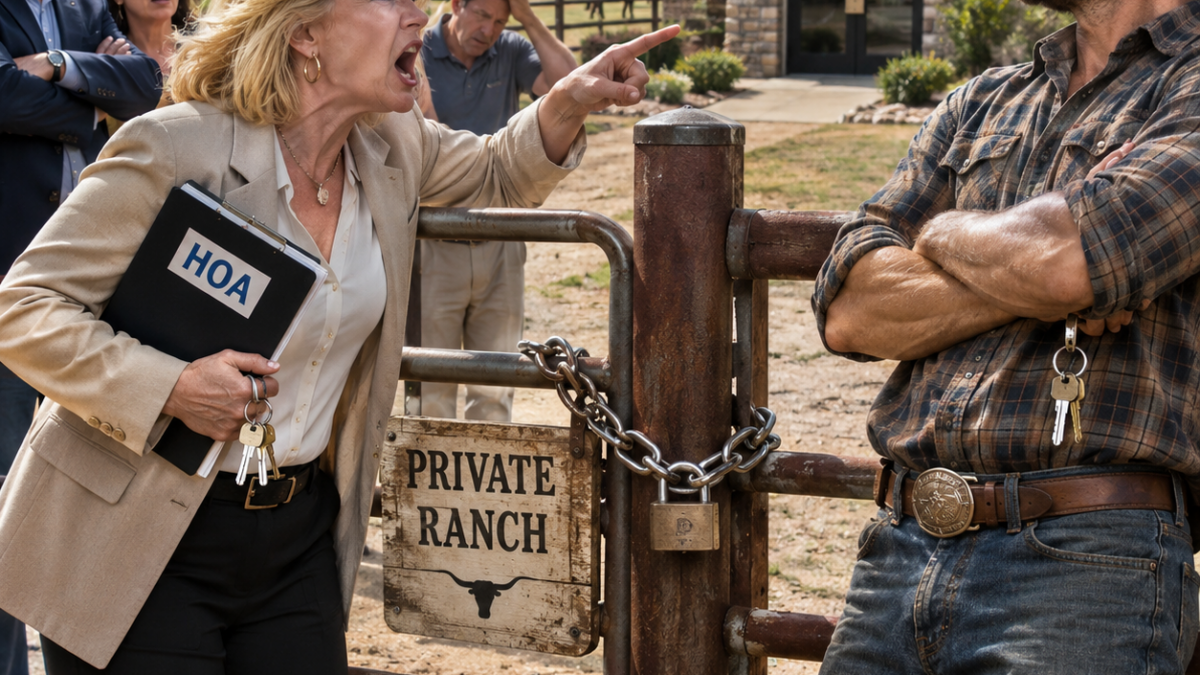
PART 2
I stood there for another minute after Maeve hung up.
Cold fog from the Big Hole bottoms was beginning to thin, and beyond the new gate I could see the same road I had traveled since I was twelve years old.
Nothing about the road had changed.
Same cottonwoods.
Same ditch.
Same fence line.
Same mountains beyond it.
Only the gate was different.
And yet Madison had somehow convinced herself that one new piece of steel could rewrite forty-eight years of recorded property rights.
Bryson arrived from the ranch side about twenty minutes later.
He got out of his Dodge, walked to the electronic gate, and stared at it.
“That wasn’t here yesterday.”
“No.”
“Did you call her?”
“Yes.”
“What’d she say?”
“Fourteen business days.”
He looked at me.
“For cattle feed?”
“That’s apparently the schedule.”
Bryson’s jaw moved.
My son is not an explosive man.
That comes from Lally.
He can go an entire branding day with a broken hydraulic line, three loose calves, two inexperienced volunteers, and one bull making bad decisions without saying anything stronger than, “Well, that’s inconvenient.”
But I saw anger in him then.
“I can hook a chain to it.”
“No.”
“Dad.”
“No.”
“She locked us out of our own easement.”
“I know.”
“We’ve got cattle waiting.”
“I know.”
He kicked gravel.
“Maeve told you not to touch it?”
“She did.”
“Of course she did.”
Bryson looked at the gate again.
“She’s going to enjoy this.”
“Who?”
“Maeve.”
I almost smiled.
“Not as much as you think.”
Bryson did smile.
“More than she admits.”
## **FEEDING THE HARD WAY**
The back route into the pasture was still technically available.
Technically is a dangerous word on a ranch.
It means something is possible if you are willing to make your life significantly worse.
The old timber bridge over Coyote Creek could not support the loaded hay trailer.
So we left the heavy load behind.
Bryson drove around fifteen miles to reach the far side by pickup.
I used an old Massey Ferguson and a smaller cart.
Twelve square bales.
Multiple trips.
Three and a half hours to perform work that normally took less than one.
The cattle heard the tractor before they saw me.
They started toward the hill slowly.
Two hundred seventy cow-calf pairs spread across wet spring grass.
Animals don’t understand easements.
They don’t understand HOA presidents.
They don’t understand electronic access control.
They understand routine.
Sound.
Feed.
The tractor engine told them breakfast was coming.
I cut the strings on the first bale and forked alfalfa into a long line so the dominant cows couldn’t push the younger calves away.
Bryson joined me.
Neither of us talked.
The work was enough.
By eleven, the cattle settled.
We sat on the tailgate eating breakfast burritos Lally had wrapped in foil before daylight.
Bryson stared toward the ridge.
“You remember Grandpa talking about that clubhouse lease?”
“All the time.”
“I mean the actual terms.”
“Some.”
“He always said they didn’t own the clubhouse ground.”
“They don’t.”
“You think Madison knows?”
“She should.”
“That’s not what I asked.”
I looked at him.
“No.”
Bryson nodded.
“That’s what I figured.”
He finished his burrito.
Then said:
“Maeve definitely knows.”
## **MY DAUGHTER COMES HOME**
Maeve arrived at 6:57 that evening.
Not seven.
6:57.
That is the sort of person my daughter became.
She pulled up in a dark Volvo carrying a roller bag, laptop case, and steel thermos.
Lally met her on the porch.
Maeve hugged her.
Then me.
Then she said:
“Show me everything.”
No dinner first.
No settling in.
No conversation about Helena.
Straight to the kitchen table.
I brought the safe folder.
Original 1976 easement.
Ground lease.
Sale documents.
Tax records.
Correspondence.
The HOA management-company agreement.
Then Maeve noticed the framed dollar bills along the hallway.
She looked at thirty-three frames.
Then at me.
“You actually kept every one.”
“Your grandfather told me to.”
“I know.”
She walked closer.
“Five years are missing.”
I looked at her.
“What?”
She pointed.
The sequence ended.
2019.
Nothing after.
I had noticed, of course.
But somewhere between drought, COVID disruptions, cattle prices, Lally’s retirement, Bryson taking more responsibility, and Maeve building her career, the missing annual dollars had become an oddity rather than a warning.
“One dollar,” I said.
Maeve turned.
“It’s not about the dollar.”
I heard my father in her voice.
She carried the lease back to the table.
Lally poured coffee.
For four hours, Maeve read.
Not skimmed.
Read.
Every clause.
Every amendment.
Every cross-reference.
Every county filing she could pull electronically.
At some point Bryson arrived.
He sat quietly near the stove.
At midnight, Maeve turned her laptop around.
There were forty pages on the screen.
“Dad.”
“Yes?”
“We can get the gate opened quickly.”
“How quickly?”
“Emergency injunction. Maybe a week or two.”
“Good.”
“That’s the small case.”
Bryson leaned forward.
“What’s the big one?”
Maeve tapped the original ground lease.
“This.”
## **THE CLAUSE MY FATHER FOUGHT FOR**
The eight acres beneath the clubhouse had never been sold.
Cain Ranch still owned them.
The HOA occupied them under the ninety-nine-year lease Dad signed in 1976.
That lease contained six categories of material breach.
Maeve had found four.
Four.
The first was almost embarrassing.
Rent.
One dollar annually.
Due January first.
Failure to pay for two consecutive years qualified as material breach.
The HOA had not paid 2020.
Or 2021.
Or 2022.
Or 2023.
Or 2024.
Five consecutive years.
Bryson stared toward the hallway.
“So Grandpa’s dollar really mattered.”
Maeve nodded.
“Legally? Very much.”
The second breach was construction.
In 2022, Madison’s board had built a six-hundred-square-foot covered addition onto the clubhouse.
Outdoor kitchen.
Stone pizza oven.
Expanded patio.
Cost: roughly $146,000.
Nice project.
One problem.
The ground lease required written permission from the landowner before structural alterations.
Nobody had asked me.
I hadn’t even known the extension existed.
“How did you find that?” I asked.
“Building permit.”
“You pulled the permit?”
“Two years ago.”
I stared.
“Two years?”
Maeve took off her glasses.
“Dad, I’ve been watching this.”
Lally smiled.
“You knew.”
“I knew Madison was escalating.”
“How much did you know?”
Maeve hesitated.
Then opened a separate file.
The title read:
**CAIN RANCH SCENARIOS**
Bryson laughed.
“You made a file called Cain Ranch Scenarios?”
“I’m an attorney.”
“That does not answer the question.”
“It answers all questions.”
Maeve turned back to me.
“I started it after one of Madison’s county complaints crossed my desk in 2022.”
“You never told me.”
“I didn’t want to make you paranoid.”
“You made a forty-page contingency plan.”
“I wanted to be prepared.”
Lally touched my arm.
“Like your father.”
I couldn’t argue.
The third lease breach was worse.
The clubhouse extension and outdoor kitchen altered stormwater drainage.
Runoff from the expanded hardscape entered the clubhouse pond.
The pond overflowed toward a wetland on my adjoining pasture.
State environmental sampling had documented elevated contamination.
Nobody had connected the violation to the lease.
Maeve had.
The fourth breach silenced the table.
Madison had filed an affidavit with Beaverhead County claiming the HOA was the fee owner of the eight-acre clubhouse parcel.
She had signed it.
Under oath.
The HOA was not the owner.
Cain Ranch was.
The document had been used to support a property-tax classification request.
I read her signature.
Once.
Twice.
Then looked at Maeve.
“She signed this?”
“Yes.”
“Knowing the lease existed?”
“She signed as board president.”
Bryson said quietly:
“That’s not just HOA nonsense anymore.”
“No,” Maeve replied.
“It isn’t.”
## **WHAT WE COULD DO**
Maeve laid it out without emotion.
First, enforce the access easement.
Emergency court order.
Second, serve formal notice that the clubhouse lease was in material breach.
Ninety days.
Third, refer the false ownership affidavit to the appropriate authorities.
Fourth, preserve all evidence relating to environmental violations and construction alterations.
Then she said something that made the whole room quiet.
“If the breaches aren’t cured in a legally sufficient way, the ground lease can be revoked.”
I looked toward the dark hallway where Dad’s framed dollars hung.
“What happens to the clubhouse?”
“The HOA loses its right to occupy the eight acres.”
Bryson whistled softly.
Maeve continued.
“You would own the ground free of their leasehold rights, subject to whatever court orders are entered regarding improvements.”
“And Madison?”
“The false affidavit is a separate problem.”
“How separate?”
“Potentially criminal.”
Lally sat beside me.
Her hand rested on my shoulder.
I thought about that morning.
5:47.
Madison telling me to apply as a guest.
On land my family had used before her grandparents were born.
I thought about Dad arguing for that revocation clause in 1976.
The developer’s lawyer had wanted it removed.
Dad had refused.
**Then we don’t have a deal.**
Nearly half a century later, that sentence sat at our kitchen table.
I looked at Maeve.
“Do it.”
She remained still.
“All of it?”
“All of it.”
Bryson looked at me.
I added:
“But clean.”
Maeve nodded.
“That was the only way I was going to do it.”
“No tricks.”
“No.”
“No threatening residents.”
“No.”
“No punishing people who had nothing to do with Madison.”
“No.”
“Just the documents.”
Maeve closed the laptop.
“Just the documents.”
## **COURT**
The emergency motion was filed immediately.
A hearing followed the next Tuesday.
Beaverhead County District Court occupied a building that looked like Montana believed law should come with oak benches, brass railings, and enough history to make everybody behave better than they otherwise might.
Judge Eleanor Whitcomb presided.
Sixty-eight.
Twenty-one years on the bench.
Raised on a ranch herself.
Madison attended with counsel.
She wore a cream jacket.
Hair perfect.
Expression calm.
The first question from Judge Whitcomb went to her attorney.
“Is instrument 1976-1841 an express recorded access easement?”
The attorney hesitated.
“Yes, Your Honor.”
“Perpetual?”
“Yes.”
“For the benefit of Cain Ranch and successors?”
“Yes.”
“Has the easement been released?”
“No.”
“Extinguished?”
“No.”
“Abandoned?”
“No.”
The judge removed her glasses.
“Then on what basis did your client install a locked gate preventing the beneficiary from using it?”
The lawyer started talking about security.
Resident privacy.
Modern community standards.
Technological access controls.
Judge Whitcomb listened.
Then asked again.
“What legal basis?”
Silence.
Finally:
“None that would defeat the recorded easement, Your Honor.”
Judge Whitcomb nodded.
“Then we are done with that issue.”
The order required the HOA to provide immediate access.
The gate had to remain open during designated agricultural delivery hours.
Failure to comply would mean contempt and daily financial sanctions.
Simple.
Clean.
Exactly what Maeve predicted.
Outside the courthouse, I expected relief.
Instead Maeve said:
“Get ready.”
“For what?”
“She’s going to violate it.”
“That confident?”
“Dad, people like Madison don’t lose authority gracefully.”
“You sound like Grandpa.”
“I’ll take that as a compliment.”
## **MADISON MAKES THE WORST DECISION OF HER LIFE**
The order reached Madison before four that afternoon.
At 4:15, her newly hired gate manager, Roy Tilden, arrived at the eastern entrance.
He manually chained the gate shut.
Padlock.
Overriding the electronic system.
Judge’s order or no judge’s order.
I wasn’t there.
Bryson’s camera was.
So was the HOA’s own security system.
Sheriff Vince Hardesty received the information.
By 4:48, Roy Tilden was in custody on civil contempt.
That sounds harsh until you understand what happened afterward.
Roy had been told the order was being appealed.
He had been told he could lock the gate.
He had asked questions.
Madison had instructed him to claim he had never seen the court order if anyone confronted him.
Roy was twenty-nine years old.
New job.
No legal training.
He knew enough to be scared.
At 4:03, before he locked the gate, he texted his wife:
**Babe, Madison is asking me to do something I think is illegal. If I get arrested today, call my mom and tell her I am sorry.**
His wife saved the text.
Roy gave a recorded statement that evening.
Thirty-eight minutes.
By the time the sheriff finished, Madison’s problem had moved from property litigation to deliberate defiance of a judge.
Maeve called me around ten.
“Dad?”
“Yes?”
“She told him to lie.”
I sat at the kitchen table.
Lally was reading beside me.
“What happens now?”
“Contempt exposure.”
“Anything else?”
“Depends what investigators find.”
I looked toward the hallway.
“Small gate.”
Maeve was quiet.
Then said:
“Very large consequences.”
## **HER OWN BOARD ABANDONS HER**
The local newspaper had the story by morning.
HOA President Accused of Defying Ranch Access Order.
Residents started calling lawyers.
Not the HOA lawyer.
Their own.
That distinction matters.
Within a day, three board members contacted Maeve asking what they should do.
Her advice was simple.
Hold an emergency meeting.
Remove Madison from authority.
Preserve records.
Do not destroy emails.
Do not alter minutes.
Do not communicate privately about the investigation.
The board met Thursday.
Vote:
Six to one.
Madison lost.
The one vote to keep Madison as president came from Madison.
That detail became a favorite around Beaverhead County.
But losing the presidency did not repair the lease.
On May 18, Maeve formally served the ninety-day revocation notice.
Fourteen pages.
Five missed rent payments.
Unauthorized structural alterations.
Environmental violations.
False ownership affidavit.
Interference with ranch operations.
The clock started.
Ninety days.
## **QUINCY’S NOTEBOOK**
The new acting HOA president was Quincy Lockhart.
Retired veterinarian.
He had supervised Lally for years at the large-animal practice.
He came to my porch carrying a six-pack.
“Peace offering?”
“I thought we were already at peace.”
“Then lubrication for negotiation.”
I let him in.
We sat outside.
Quincy looked older than I remembered.
“I’m sorry.”
“You didn’t install the gate.”
“I sat on the board.”
“You voted against her.”
“Not loudly enough.”
That answer I understood.
He handed me a notebook.
“What is this?”
“My notes.”
Inside were dates.
Payments.
Board discussions.
Transfers.
Three years of irregular payments to an LLC called Cartwright Steel Consulting.
Madison’s company.
Total:
$34,400.
“What were these for?”
Quincy shook his head.
“That’s the problem.”
I handed the notebook to Maeve the next morning.
She did not smile.
She never smiled when evidence got worse.
She simply opened another folder.
## **THE CLUBHOUSE CLOSES**
The summer was strange.
The clubhouse pond was drained under environmental direction.
The tennis courts closed.
Then came the moment people later described as my revenge.
It didn’t feel like revenge while it happened.
A deputy placed a heavy padlock on the clubhouse.
Court order posted.
Evidence seal near the keyhole.
Residents stood at a distance.
Some angry.
Mostly not at me.
At Madison.
For nearly fifty years, the clubhouse had been the social center of Big Hole River Estates.
Weddings.
Christmas parties.
Retirement dinners.
Tennis tournaments.
Summer barbecues.
Now nobody could enter.
The building was sitting on Cain dirt under a lease in default.
And the man Madison had treated like an outsider still owned the ground beneath every chair, every locker, every tennis net, every boardroom argument she had ever presided over.
Lally and I drove past one evening.
She looked at the padlock.
Then at me.
“Feel good?”
“No.”
“Liar.”
I laughed.
“All right. A little.”
She smiled.
Then her expression softened.
“Your father would have hated this.”
“The closure?”
“The reason it became necessary.”
That was true.
Dad had charged a dollar because he wanted cooperation.
Not leverage.
The clause was protection.
Not a weapon.
Madison had turned protection into necessity.
## **THE LETTERS**
Something unexpected happened during the ninety days.
People apologized.
Not one.
Dozens.
Notes appeared in our mailbox.
Some unsigned.
Some handwritten.
Some typed.
One said:
**Mr. Cain, we were told for years that your ranch was interfering with our community. I’m ashamed I never asked whether our community was interfering with your ranch.**
Another:
**My children learned to skate on the clubhouse pond. I’m angry that it is closed, but I understand why.**
Another:
**Please do not punish all seventy homeowners for what one board president did.**
That one stayed with me.
I had never intended to.
By August, Lally had collected eighty-three notes in a wooden box.
One was four pages long.
Written by a retired federal judge living in Lot 33.
Her final sentence read:
**Your father’s revocation clause is the cleanest piece of property protection drafting I have encountered in forty-one years of legal work; he protected his descendants nearly half a century before they knew they needed protecting.**
I framed that letter.
Of course I did.
It went above the dollar bills.
## **THE NEW DEAL**
Quincy asked the question everybody was eventually going to ask.
“Can we keep the clubhouse?”
“Yes.”
He blinked.
“That easy?”
“No.”
“What do you want?”
“Fair terms.”
Maeve handled the drafting.
The old lease charged one dollar.
The new lease would charge market rent.
Twenty-eight thousand dollars per year.
The material-breach protections remained.
Environmental obligations became clearer.
Structural alterations required written approval.
No false ownership claims.
No pretending leased land belonged to the association.
Then Maeve added one clause I had not requested.
A personal exclusion.
Madison Cartwright Steel could never set foot on the leased eight acres again for the duration of the lease or any renewals.
No clubhouse.
No pond.
No tennis pavilion.
No parking lot.
No HOA office located there.
If she entered, she could be treated as a trespasser.
I read the clause.
“Maeve.”
“Yes?”
“Necessary?”
She looked at me.
“She filed a false affidavit claiming she owned the parcel.”
“I know.”
“She defied the injunction.”
“I know.”
“She directed an employee to lie.”
“I know.”
“She used the clubhouse as the center of the conduct that breached the lease.”
I sighed.
Maeve continued.
“She locked you out of your legal access because she believed the gate belonged to her.”
Then she tapped the clause.
“This makes sure she never again confuses permission with ownership.”
I looked toward Lally.
My wife shrugged.
“She locked you out first.”
That ended the discussion.
## **THE HOA VOTES**
The new board voted on the replacement lease in August.
Six to zero.
One abstention.
The abstention came from Brody Steel, Madison’s husband, who had joined the board during the transition.
He never argued with the personal exclusion.
That told me something.
Nine days later, Brody filed for divorce.
I never asked why.
Some things don’t require ranch gossip to become obvious.
By the end of August, he had moved out.
Madison remained in Lot 47 temporarily.
But the clubhouse she once controlled was now the one place in her own neighborhood she could not legally enter.
That was the irony people loved.
The woman who installed a keypad to keep me out of my ranch had created circumstances that resulted in her being permanently barred from the heart of her own HOA.
I didn’t design that irony.
I just signed the lease.
## **THE COURTHOUSE SIGNING**
The replacement lease was signed September fifth.
We planned a small courthouse ceremony.
It did not remain small.
Residents came.
Ranch hands came.
County officials came.
A reporter.
Then another reporter.
Stockgrowers Association representatives.
Old ranch families.
People I hadn’t seen since high school.
Lally wore her Sunday cardigan.
Bryson had on a clean shirt.
Maeve carried the final document in a leather folder.
Quincy signed for the HOA.
Maeve signed for me as attorney.
The county clerk prepared the recording.
Sheriff Vince Hardesty stood near the back.
I had known Vince most of my life.
We went to high school together.
He attended Maeve’s graduation.
Bryson’s wedding.
Branding suppers.
Funerals.
The kind of friendship Montana builds by keeping people within a few valleys of one another for forty years.
At 10:18, the courthouse door opened.
Madison walked in.
Attorney beside her.
People went quiet.
She wore dark slacks and a tailored coat.
Same posture.
Same certainty.
She approached the clerk.
“I object to this proceeding.”
Sheriff Hardesty stood.
“Mrs. Steel.”
She looked at him.
“I have standing.”
“You may have counsel address any legal issue through proper filing.”
“This lease directly affects my community.”
Vince remained polite.
“The lease contains an exclusion provision concerning you personally.”
Her eyes shifted toward Maeve.
Maeve didn’t move.
Madison said:
“That isn’t effective yet.”
Vince nodded.
“Correct.”
She smiled slightly.
Then he continued.
“It becomes effective upon execution.”
Her smile disappeared.
“And execution is about to occur.”
Madison turned toward me.
“This is vindictive.”
I looked at her.
“No.”
“You’re banning me from a building I helped improve.”
“You built improvements on land you didn’t own without permission.”
“I was HOA president.”
“That was never a deed.”
She shook her head.
“This entire county treats you like some kind of victim.”
I thought about the cattle waiting behind her gate months earlier.
The tractor cart.
The extra hours.
Dad’s lease.
Roy’s text to his wife.
Then I said:
“You could’ve opened the gate.”
That was all.
Sheriff Hardesty gently escorted her from the courthouse.
She did not return.
At 10:31, the lease was signed.
## **1881**
The following Monday, Quincy unlocked the clubhouse.
Fifteen residents watched.
A few clapped.
The pond still needed restoration.
Environmental work remained.
The outdoor kitchen required modifications.
But the building reopened.
The electronic eastern gate remained too.
We didn’t remove it.
Maeve recommended keeping it with proper controls.
So Bryson and I chose the new code.
1881.
The year Erastus Cain filed the homestead.
Every resident received the code.
Every ranch employee had it.
The gate opened automatically during agricultural hours.
4:00 a.m.
10:00 p.m.
Emergency services had unrestricted override.
Nobody had to apply for fourteen-day guest access to reach land they had a legal right to reach.
The first morning I used it, I stopped the truck before entering.
Typed:
1.
8.
8.
1.
Green light.
Gate opened.
Bryson sat beside me.
“You going to cry?”
“No.”
“You look like you might.”
“Drive.”
“You’re driving.”
“Then be quiet.”
He laughed.
We went through.
## **THE CRIMINAL CASE**
Madison’s legal problems continued after the lease dispute.
False ownership affidavit.
Financial transfers involving her consulting LLC.
Contempt arising from the gate incident.
The investigation produced enough evidence that charges followed.
She eventually took a plea.
State custody.
Restitution to the HOA.
Restitution to me for documented ranch losses and damages.
Restrictions against serving on Montana community-association boards.
The personal exclusion from the clubhouse parcel remained.
Roy, the gate manager, received a far lighter outcome.
That mattered to me.
He had followed a terrible instruction.
He had also documented his concern before doing it.
He cooperated.
He came to my ranch one Sunday carrying a handwritten apology.
Lally answered the door.
He stood on the porch.
Hat in hand.
“Mr. Cain?”
“Augustus.”
He read from notebook paper.
His hands shook.
Halfway through, his voice broke.
“I knew it felt wrong, and I did it anyway.”
I didn’t interrupt.
When he finished, he wiped his face.
“I’m sorry.”
I looked at him.
“Did you learn something?”
“Yes, sir.”
“What?”
He took a breath.
“That somebody giving you an order doesn’t make the order right.”
That was enough.
Lally said:
“You eaten?”
He looked confused.
“No, ma’am.”
“Then come inside.”
We ate lunch.
Two hours.
Roy eventually found work at a guest ranch up the valley.
From what I hear, he became careful about instructions.
That’s a useful quality.
## **MADISON’S SENTENCING**
Maeve and I attended sentencing.
Madison read a prepared statement.
It used the phrase **unintended consequences** several times.
I don’t remember hearing the word **sorry**.
Maeve had warned me.
“White-collar plea statements avoid clean admissions whenever possible.”
“I don’t need an apology.”
“You sure?”
“No.”
She looked at me.
Then smiled.
“At least you’re honest.”
The judge accepted the plea.
Deputies led Madison away.
I felt almost nothing.
That surprised me.
For months I had imagined that moment as some kind of ending.
It wasn’t.
The real ending was already happening elsewhere.
Gate working.
Cattle moving.
Clubhouse reopened.
Neighbors talking again.
Madison’s punishment belonged to the justice system.
My life belonged back at the ranch.
Maeve squeezed my hand.
We drove home through the Big Hole River Canyon at sunset.
Neither of us talked.
We didn’t need to.
## **THE FIRST $28,000 CHECK**
January second.
Quincy Lockhart drove to our ranch carrying an envelope.
Lally saw him through the kitchen window.
“Your rent is here.”
I laughed.
Quincy came inside.
Set the check on the table.
$28,000.
Annual ground rent.
Not one dollar anymore.
Market rate.
Fair.
Documented.
I picked it up.
Quincy said:
“You going to frame that too?”
“Absolutely.”
“Of course you are.”
I ordered a larger frame.
Mahogany.
The first thirty-three dollar bills remained in their cheap little frames.
Then came five empty years.
Then the large frame.
Twenty-eight thousand dollars.
Visitors always noticed.
“What happened there?”
Lally eventually developed her own version.
She would point toward the big frame and say:
“The old cowboy turned out to own everything.”
Technically inaccurate.
Emotionally perfect.
## **WHAT WE DID WITH THE MONEY**
I didn’t use the lease income to buy another truck.
Or expand the house.
Or punish the HOA.
We created the **Tully Cain Memorial Beaverhead County 4-H Scholarship Fund.**
Dad had spent his life believing kids should learn animal responsibility before they learned how expensive equipment could become.
The fund paid registration and equipment costs for local high-school students entering beef, sheep, and hog projects.
First year:
Twenty-three students.
Second:
Thirty-one.
Bryson started running Saturday calf-fitting clinics.
Where?
The clubhouse.
The same clubhouse Madison had once controlled.
The same clubhouse her actions caused to be padlocked.
The same clubhouse sitting on Cain land.
Once a month through winter, kids arrived carrying brushes, halters, notebooks, and varying levels of confidence.
Bryson taught them the way Dad taught us.
Slowly.
Hand on the animal.
Pay attention before giving an instruction.
Don’t fight livestock.
Understand it.
Lally handled registration.
Maeve drove from Helena whenever she could.
Quincy’s daughter eventually administered the fund.
Something built for a luxury subdivision became a place where ranch kids learned.
That felt right.
## **THE BARBECUE**
Relations between Cain Ranch and Big Hole River Estates changed.
Not overnight.
But steadily.
The next fall, the HOA proposed a joint barbecue.
I laughed when Quincy asked.
“On whose property?”
He stared at me.
“Seriously?”
“I had to.”
“You’re becoming unbearable.”
“Age.”
We hosted it at the clubhouse.
Two hundred forty-six people showed up.
Residents.
Ranch hands.
Families.
4-H kids.
County people.
We grilled a steer Bryson and I had raised.
Ran out of meat before seven.
Nobody complained.
Children ran near the pond.
Older residents sat on the west porch watching sunset.
For years, Madison had treated Cain Ranch as something embarrassing beyond the development boundary.
That night there was no boundary socially.
Only legally.
And legal boundaries are healthiest when everybody understands them.
## **THE PLAQUE**
In 2025, the new HOA president came to my porch.
Phyllis Lockhart.
Quincy’s daughter.
Retired teacher.
She carried a drawing.
“We want to put something inside the clubhouse.”
“What?”
She showed me.
A bronze plaque.
Simple wording:
**BUILT 1977**
**LEASED FROM THE CAIN FAMILY**
**IN GRATITUDE FOR FOUR GENERATIONS OF NEIGHBORING**
I read it twice.
Then handed it back.
“Well?”
I looked toward the pasture because suddenly looking at Phyllis felt difficult.
“Fine.”
Lally came outside.
“What?”
Phyllis showed her.
Lally cried immediately.
That gave me permission to admit my eyes were wet too.
The plaque went up in March.
Residents attended.
Ranch hands attended.
Quincy spoke.
Phyllis spoke.
I said a few words.
Then Bryson walked to the lectern.
I hadn’t known he planned to.
Maeve hadn’t either.
He looked at the plaque.
Then at the room.
“On behalf of the fifth generation—thank you.”
That was all.
The applause lasted a long time.
## **THE PADLOCK**
I kept the heavy brass padlock that had sealed the clubhouse during the revocation period.
It hangs in my office.
Key taped behind it.
Not because I need either.
It is a souvenir.
People ask:
“Is that the lock?”
“Yes.”
“The one that locked the HOA out?”
“Yes.”
Then they usually laugh.
But I don’t think of it as revenge anymore.
I think of Dad.
The dollar.
The lease.
The revocation clause.
That lock existed because a man in 1976 spent forty minutes refusing to let a developer remove one paragraph from a contract.
People underestimate careful people.
They mistake patience for weakness.
Documentation for paranoia.
Conditions for technicalities.
Until suddenly one paragraph written by a dead rancher becomes stronger than every angry email, every HOA vote, every electronic keypad, and every polished attorney Madison could hire.
## **MAVIS**
Mavis got old.
Really old.
Fifteen.
For an Australian shepherd, she had earned retirement twice.
She was still deaf.
Still slept most of the day.
One of Madison’s old complaints claimed Mavis had threatened HOA children.
I sometimes imagined showing that complaint to visitors while Mavis lay unconscious at their feet.
She spent evenings beside my chair on the porch.
I watched the eastern road.
Gate opened.
Resident waved.
Ranch hand waved.
Gate closed.
Simple.
The simplicity itself became satisfying.
After everything, access returned to what it had always been.
Not a favor.
Not a negotiation.
A recorded right.
## **CYRUS**
Bryson eventually gave me a grandson.
Cyrus.
At four, he started riding in front of me on a small chestnut mare named Lou.
He wanted to know every cow.
Every horse.
Every gate.
Children believe land has always existed exactly as they see it.
One Saturday, we rode toward the eastern entrance.
He pointed.
“Grandpa, why does the gate say 1881?”
“Because that’s when your great-great-great-grandfather came here.”
“Did he build the gate?”
“No.”
“Did he know the number?”
I laughed.
“He knew the year.”
Cyrus thought about that.
“Is this our road?”
“We have the right to use it.”
“Forever?”
That word stopped me.
Forever.
Perpetual.
The same concept my father protected.
“As long as we take care of what was left to us.”
He nodded.
Satisfied.
Four-year-olds understand inheritance better than adults sometimes.
You don’t own the past.
You carry it.
## **WHAT MADISON NEVER UNDERSTOOD**
Madison believed possession looked like control.
A keypad.
A gate.
A board title.
A vote.
A clubhouse.
A logo on a polo shirt.
But property law is full of invisible things stronger than visible ones.
Easements.
Leases.
Recorded instruments.
Restrictions.
Reversion rights.
Obligations.
A road can look like it belongs to one community while legally serving another property forever.
A clubhouse can look like the HOA owns it while standing on leased ground.
A woman can hold the keys to every door and still not own the dirt underneath her shoes.
Madison never understood the difference between control and ownership.
Until ownership answered.
## **THE THING I ALMOST DID WRONG**
There was a moment during the first week when I wanted to lock every resident out.
Not legally.
Emotionally.
I wanted them to understand what it felt like.
My cattle waiting.
Hay delayed.
Forty-eight years interrupted by a woman who told me I was a guest.
Then I read the apology notes.
Talked to Quincy.
Thought about families who had never voted for Madison.
Older residents who had lived there since the eighties.
People who simply wanted to attend a Christmas dinner or let their grandchildren use the pond.
Dad had never written the revocation clause because he wanted to hurt seventy families.
He wrote it because he wanted one future board to remember limits.
That distinction guided everything afterward.
The lease was revoked.
Then replaced.
The clubhouse reopened.
Residents stayed.
Only the terms changed.
Fair rent.
Clear rules.
Accountability.
And one person permanently excluded because she had demonstrated she could not respect the boundary.
That felt more just than destroying the whole community.
## **THE HALLWAY**
Our hallway became a museum nobody planned.
Thirty-three framed dollar bills.
Judge Brooksley’s letter.
The first $28,000 check.
A photograph of Dad.
A copy of the 1976 easement.
Eventually, Maeve gave me a framed copy of the new lease too.
Lally hates clutter.
But she has never asked me to remove any of it.
Sometimes I catch her standing there.
Reading.
One evening she said:
“Your father would have laughed.”
“At what?”
“The dollar.”
“He was serious about the dollar.”
“I know.”
She touched the frame.
“That’s why he would’ve laughed.”
Then she looked at me.
“He knew somebody would forget.”
“Apparently.”
“Augustus?”
“Yes?”
“Don’t ever throw those away.”
“I won’t.”
## **MAEVE**
The person I was proudest of throughout the whole mess was Maeve.
Not because she won.
Because she never confused winning with revenge.
At every stage, she asked:
What does the document allow?
What remedy is proportional?
Who actually caused the harm?
Which residents are innocent?
What evidence is admissible?
What outcome protects the ranch long-term?
Not:
How do we humiliate Madison?
I asked her once, months later:
“Were you angry?”
“Of course.”
“You didn’t look angry.”
“I bill anger at a higher rate.”
I laughed.
Then she became serious.
“Dad, Grandpa Tully wrote a good lease because he assumed someday somebody would be difficult.”
“He ever tell you that?”
“No.”
“Then how do you know?”
“Because good contracts are letters to difficult people who haven’t been born yet.”
I sat with that.
She was right.
## **LALLY’S VERSION**
Lally tells the story better than I do.
Shorter.
Somebody asks:
“Wasn’t there an HOA lady who locked Augustus out?”
Lally says:
“Yes.”
“What happened?”
“She put a gate on his easement.”
“And?”
“We checked the paperwork.”
“And?”
“She discovered the clubhouse was on our land.”
“And then?”
Lally smiles.
“And the old cowboy turned out to own everything.”
That usually gets a laugh.
I always correct her.
“Not everything.”
She ignores me.
Forty-plus years of marriage gives a woman certain privileges.
## **THE HOUSE MADISON LEFT**
Madison eventually sold Lot 47.
Moved out of Montana.
The new owners were a retired couple from Boise.
Their first weekend, they drove to the ranch carrying a casserole.
I opened the door.
The woman said:
“We’re the people who bought Madison Steel’s house.”
“I’m sorry.”
Her husband laughed.
“We brought food.”
“That improves things.”
They started apologizing.
I stopped them.
“You didn’t install the gate.”
“No.”
“You didn’t file the affidavit.”
“No.”
“You don’t owe me anything.”
The woman held out the casserole.
“Can we still give you this?”
“Absolutely.”
They became good neighbors.
That mattered.
Places should not inherit the guilt of people who left them.
## **THE CLEAN WETLAND**
Environmental restoration took time.
The clubhouse pond was cleaned.
Drainage corrected.
The wetland downstream recovered.
Grasses returned.
Birds returned.
Water testing normalized.
Lally and I walked the wetland one spring evening.
She pointed toward new growth.
“Looks better.”
“Yeah.”
“Think Madison ever understood what she did?”
“No.”
“You sure?”
I thought.
“Maybe.”
We walked farther.
Then I said:
“But understanding after consequences isn’t the same as understanding before.”
Lally nodded.
“That’s why people should read things.”
Again.
My wife’s entire legal philosophy.
Read things.
## **THE FIRST DOLLAR**
One night I removed the first framed bill from 1992.
Not the first lease payment ever.
The first I had framed after Dad died.
One dollar.
Ordinary bill.
Cheap frame.
I opened the back.
Behind the dollar I had written something decades earlier and forgotten.
**Dad said keep the receipts.**
I sat down.
That sentence hit me harder than the courthouse victory.
Dad didn’t know Madison.
Didn’t know electronic gates.
HOA management companies.
Online building permits.
Environmental databases.
He didn’t know Maeve would become a lawyer.
He simply knew human beings.
He knew agreements fade when memories do.
So he taught me to keep receipts.
And because I did, thirty-three dollars became evidence of a pattern.
The missing five became evidence of breach.
Sometimes what saves you doesn’t look important when you first put it away.
## **THE BARBECUE YEARS LATER**
At the annual fall barbecue a few years later, I stood near the clubhouse grill watching Cyrus chase another boy around the pond.
Bryson was cutting meat.
Maeve had driven over from Helena.
Lally sat with Phyllis.
Quincy had grown slower but still told the same stories too loudly.
A ranch hand approached.
“You ever think this wouldn’t exist if Madison hadn’t started the fight?”
I looked around.
4-H families.
Residents.
Ranchers.
Kids.
The plaque by the door.
“Probably would’ve existed differently.”
“Better?”
“Maybe worse.”
He nodded.
Funny thing about conflict.
It reveals things.
Bad things.
But sometimes it forces people to repair relationships they hadn’t realized were already deteriorating.
Before Madison, ranch and subdivision coexisted.
After Madison, we became actual neighbors.
I would not thank her for that.
But I could recognize it.
## **THE EASTERN GATE**
The eastern gate is still black powder-coated steel.
Still electronic.
I used to hate looking at it.
Now I don’t.
The number 1881 glows faintly on the keypad when I punch it in before dawn.
Green light.
Gate slides.
Sometimes I stop halfway through.
Not enough to block traffic.
Just enough to remember.
The first morning:
Red light.
Madison telling me to apply as a guest.
Fourteen business days.
Hay waiting.
Cattle waiting.
Then I look ahead.
Road open.
Ranch beyond.
And I understand something Dad probably knew all along.
A right you never have to defend can start feeling ordinary.
Defending it reminds you why somebody protected it in the first place.
## **WHY I DIDN’T TEAR DOWN THE GATE**
People ask why I didn’t destroy it that first day.
Because I could have.
A tractor and chain would have made quick work of it.
Maybe.
But then the story becomes:
Angry rancher damages HOA property.
Not:
HOA knowingly interferes with recorded access.
The difference is everything.
Maeve knew that immediately.
“Don’t touch the gate.”
Six words.
Best legal advice I ever got.
By leaving the gate intact, I let Madison own her decision completely.
Her installation.
Her refusal.
Her court violation.
Her instructions to Roy.
Every escalation remained hers.
That is one reason patience feels so unsatisfying in the beginning.
You are letting somebody continue.
But sometimes continuing is exactly how they prove the case you need.
## **THE LAST TIME I SPOKE MADISON’S NAME AT HOME**
Years after it ended, Lally and I were having coffee.
A neighbor mentioned Madison had moved again.
Somewhere in Florida.
Lally told me.
I said:
“Hope she likes it.”
That was all.
Lally looked at me.
“You don’t want to know where?”
“No.”
“You’ve changed.”
“Age.”
“No.”
She stirred her coffee.
“You finally stopped fighting her.”
“I stopped fighting her years ago.”
“No.”
She looked toward the hallway.
“You stopped carrying her.”
That was different.
She was right.
For a while, even after Madison left, I carried her.
In the gate.
In the clubhouse.
In every retelling.
Then somewhere between scholarship kids and Cyrus learning cattle names, she became smaller.
A chapter.
Nothing more.
That is a better victory than hate.
## **A LETTER TO DAD**
I never wrote this letter.
But if I did, it would say:
Dad,
You were right about the dollar.
You were right about the clause.
You were right to refuse when the developer’s lawyer wanted it removed.
I know you hated selling the 240 acres.
I know you probably thought the clubhouse lease was just a compromise that let you hold onto one small piece of ground.
You couldn’t have known what would happen forty-eight years later.
A woman you never met tried to lock your ranch out.
Your granddaughter opened the agreement you wrote.
Your paragraph was still there.
It worked.
The ranch is open.
The cattle are fine.
The clubhouse still stands.
The neighbors are better neighbors now.
We used the rent to help 4-H kids.
Your great-great-grandson rides the eastern road with me.
The gate code is 1881.
And your dollar bills are still on the wall.
I kept the receipts.
Augustus.
## **THE REAL REVENGE**
People love the headline.
She locked me out of my ranch.
I locked her out of her clubhouse.
It sounds like revenge.
There was some of that feeling.
I am not holy enough to pretend otherwise.
When Madison stood outside that courthouse and learned she could no longer enter the clubhouse parcel, part of me remembered 5:47 a.m.
**Apply for guest access.**
Yes.
There was satisfaction.
But the most satisfying part wasn’t Madison being excluded.
It was everybody else being welcomed back under better rules.
That is the difference.
Revenge would have been closing the clubhouse forever.
Revenge would have been terminating the lease and refusing every negotiation.
Revenge would have been using leverage to punish seventy families.
We didn’t.
We charged fair rent.
We repaired the environmental problems.
We restored access.
We funded kids.
We built a relationship.
Madison lost access because of what she did.
Everyone else kept theirs because they were not her.
That is justice I can live with.
## **THE FIFTH GENERATION**
One cold Saturday, Cyrus rode Lou beside me toward the eastern road.
He was older now.
Old enough to work the reins.
Not old enough that I stopped keeping my hand close.
We reached the gate.
He leaned forward.
“Can I do it?”
“Do what?”
“The code.”
I nodded.
He pressed:
1.
8.
8.
1.
The light turned green.
Gate opened.
His face lit up.
“I did it.”
“You did.”
He looked toward the ranch road.
“Grandpa?”
“Yeah?”
“Will that always work?”
I thought about Dad.
Maeve.
The lease.
The injunction.
Madison.
The framed dollars.
The courthouse.
The plaque.
Then I said:
“It’ll work as long as somebody remembers why it’s there.”
He nodded seriously.
Then kicked Lou gently forward.
We rode through.
## **THE END**
I am an old enough rancher now to understand that land never really belongs to one generation.
Documents might say your name.
Tax bills might come to your mailbox.
Fence posts might follow lines surveyed under your deed.
But if you are lucky, you are only the person responsible for carrying that land safely between the people who came before and the people coming next.
Erastus carried it.
Ainsworth carried it.
Tully carried it.
I carried it.
Bryson and Maeve are carrying it now.
Cyrus will get his chance.
Madison thought a four-digit keypad had defeated four generations.
That was her mistake.
The gate was new.
The record was old.
Much older.
Older than her HOA.
Older than the clubhouse.
Older than every house in Big Hole River Estates.
One morning she stood behind that gate with coffee in her hand and told me I was not a verified resident.
She was correct about one thing.
I wasn’t a resident.
I was the ranch owner whose family held the recorded easement running through the development.
I was the landlord beneath the clubhouse she believed belonged to her association.
I was the successor to the man who had written a revocation clause into a ninety-nine-year lease because he understood that people forget promises once the person they made them to is dead.
And I was the father of a woman smart enough to read every page before touching a single lock.
That last part mattered most.
Today the clubhouse is open.
Children walk through its doors carrying 4-H paperwork.
Families gather around the pond.
Residents play tennis.
Ranchers eat barbecue on the west porch.
A bronze plaque near the entrance reminds everybody whose land the building stands on.
Not arrogantly.
Not threateningly.
Just accurately.
Madison cannot enter.
That is permanent.
Not because I needed her humiliated.
Because the final agreement needed one boundary she could never reinterpret.
The old brass padlock from the summer the clubhouse closed hangs inside my office.
Behind it is the key.
Across the hall are thirty-three framed one-dollar bills.
Then the large mahogany frame holding the first $28,000 rent check.
Visitors notice the contrast.
They ask what happened.
Sometimes I tell the long version.
Sometimes Lally beats me to it.
Her version is better.
She points at the dollar bills.
Points at the big check.
Then toward the padlock.
And says:
“Madison locked the old cowboy out of his ranch.”
People wait.
Lally smiles.
“And then she found out the old cowboy owned the ground under her clubhouse.”
That usually gets a laugh.
I laugh too.
Then I look through the window toward the eastern road.
Somewhere beyond the trees, the gate opens.
Green light.
1881.
A ranch truck rolls through.
A resident waves.
Nobody stops anybody.
Nobody has to prove who belongs.
The agreement does the talking now.
My father used to say a man should keep every receipt, every dollar, and every signature his neighbors give him, because someday somebody will deny ever giving any of them.
I thought he was being overly careful.
It took me nearly half a century to understand him.
Careful work does not always protect the person who performs it.
Sometimes it waits.
Quietly.
Inside a safe.
Inside a courthouse.
Inside a cheap frame hanging in a ranch hallway.
Waiting for the next generation.
Then one morning, someone installs a gate.
Someone says you no longer belong.
Someone assumes you will be too angry, too tired, too intimidated, or too ignorant to check the paperwork.
And that is when the old documents wake up.
Madison thought she was locking one rancher out.
Instead, she reminded four generations of Cains exactly why Tully Cain refused to remove six paragraphs from a lease in 1976.
She got her gate.
I kept my ranch.
The neighborhood kept its clubhouse.
The kids got scholarships.
And the one person who tried to turn permission into ownership became the only person who could never walk through those clubhouse doors again.
I don’t call that revenge anymore.
I call it remembering what belonged to whom.
And making sure nobody ever forgets again.








