PART 2: HOA Karen Locked Me Behind My Own Gate and Charged $700 to Leave—She Didn’t See the Sheriff Coming
PART 2
I looked past Bridget toward the two guards.
The taller one had introduced himself earlier as Curtis Bell.
He was maybe thirty-five, broad-shouldered, professional-looking, and already uncomfortable.
The other guard avoided eye contact entirely.
I turned back to Bridget.
“Let me make sure I understand this.”
She took a sip of coffee.
“You need to pay seven hundred dollars every time the gate opens for commercial access.”
“What about me?”
“What about you?”
“If I drive out right now.”
“That depends on the purpose of your trip.”
I actually smiled.
“Try again.”
She lowered her coffee.
“You can leave by paying the access fee.”
I stared at her.
“My truck is sitting on my property.”
“Yes.”
“The gate is sitting on my property.”
“That is disputed.”
“It wasn’t disputed until you arrived.”
“The HOA has authority over neighborhood access.”
“I don’t live in your neighborhood.”
“You use a route adjacent to it.”
“That still doesn’t make you my landlord.”
She opened her binder.
“I expected resistance.”
“Good. Then this won’t surprise you.”
I held out my hand.
“Show me whatever document gives you authority to lock my gate.”
That seemed to please her.
She turned several pages and produced one sheet.
At the top:
**COUNTY EMERGENCY TRAFFIC CONTROL AUTHORIZATION**
A red circular seal sat in the corner.
At a glance, it looked official.
At a second glance, it looked wrong.
My father had taught me to read paperwork.
Farmers deal with more county documents than people realize.
Permits.
Water access.
Tax maps.
Agricultural exemptions.
Road agreements.
Equipment registrations.
The spacing on Bridget’s form was strange.
The language was vague.
There was no obvious county department listed.
And the red seal looked more like a graphic someone had downloaded than something a government office actually used.
I didn’t accuse her.
I pulled out my phone.
“Hold it still.”
She smiled.
“You’re taking a picture?”
“Front and back.”
“Be my guest.”
She actually seemed amused.
Maybe she thought I was documenting my own defeat.
I photographed everything.
Then I turned on video.
“Bridget, I want you to explain the fee again.”
Her eyes narrowed slightly.
“For what purpose?”
“Clarity.”
“I’ve been very clear.”
“Then say it one more time.”
She looked straight into the camera.
“Seven hundred dollars each time a commercial vehicle requires this gate to open.”
“No exceptions?”
“No exceptions.”
“And if I refuse?”
“Five-thousand-dollar obstruction penalty.”
“For refusing to pay you?”
“For interfering with HOA security operations.”
“And right now, can I drive my own truck through this gate without paying?”
She smiled.
“Not through this gate.”
That sentence may have been the most valuable thing she said all week.
I lowered the phone.
Behind the seat of my pickup sat bolt cutters.
I could have broken her lock.
The steel control box wasn’t impressive.
Give me five minutes with a wrench and cutter and I could have removed half of what she installed.
But I saw the story she wanted.
Angry farmer destroys HOA safety equipment.
Aggressive landowner threatens guards.
Dangerous man obstructs community-security program.
I wasn’t giving her that.
I put my phone away.
Bridget’s smile widened.
“Finally being sensible?”
“No.”
I pulled out another phone contact.
“I’m calling my attorney.”
She laughed.
“Call whoever you want.”
“I will.”
“Even the sheriff can’t override my board.”
That sentence made me stop dialing.
I looked at her.
“Say that again.”
She leaned closer.
“You heard me.”
I called Quincy Slate.
Quincy had once helped Dad with a boundary dispute.
He was forty-four now, a real-estate litigator with the emotional warmth of a filing cabinet and the useful habit of remembering everything.
He answered.
“Landon?”
“I have an HOA president charging me seven hundred dollars to open Dad’s gate.”
Silence.
Then:
“Please tell me you haven’t hit anyone.”
“No.”
“Broken anything?”
“No.”
“Threatened anybody?”
“No.”
“Good. Stay boring.”
“She has a county authorization.”
“Send me a photo.”
I did.
Another pause.
“Where did she get this?”
“She says the county.”
“That’s not what I asked.”
“I don’t know.”
“Go to the recorder’s office.”
“I have trucks scheduled Friday.”
“Then move.”
I also called Franklin.
“Save everything.”
“Everything what?”
“Texts. Dispatch. Delivery schedules. Any communication connected to the gate.”
“You think this is serious?”
“I think it’s going to become serious.”
Because my regular entrance was blocked, I took an old tractor path around the back side of the orchard.
It was barely wide enough for my pickup.
There was no chance a loaded semi could use it.
By nine o’clock, I was inside the county land-records office.
Mavis Ellery had worked there twenty years.
I laid Dad’s deed and boundary sketch in front of her.
She adjusted her glasses.
“What are we proving today?”
“That my gate is still my gate.”
“That seems like an unusual question.”
“You should see the booth.”
“What booth?”
“Long story.”
She typed the parcel number.
Then disappeared into records storage.
Twenty minutes later, she returned with a thick folder dated 1998.
“Your father liked paper.”
“Dad trusted paper more than people.”
“Smart man.”
She opened the file.
The first recorded document showed the access lane.
Twenty-two feet wide.
County road to Greaves property.
Recorded before Briarstone Heights existed.
Second document:
Boundary.
Dad’s gate sat entirely inside our parcel.
Third:
No HOA easement.
No HOA maintenance right.
No association control.
Nothing.
Mavis looked up.
“Unless there’s something newer, I don’t see how they have authority.”
“There’s this.”
I showed her Bridget’s county paper.
She zoomed in on the number.
Typed it.
Nothing.
Tried another database.
Nothing.
She stared at the seal.
Then sat straighter.
“That isn’t ours.”
“You’re sure?”
“The border is wrong.”
She pointed.
“And county traffic-control documents don’t use this language.”
My stomach tightened.
“So it’s fake.”
“I’m not officially saying that until the issuing office confirms.”
“But.”
“But I would protect that photo.”
She forwarded it to the proper office.
Then looked at me seriously.
“Landon.”
“Yeah?”
“A fake county seal isn’t a land dispute.”
I understood.
That afternoon, I hired Nora Halbert.
Licensed surveyor.
She arrived the following morning with GPS equipment and a stack of monument records.
She walked the boundary slowly.
Found original iron pins.
Checked coordinates.
Measured twice.
Then she stopped beside the glass booth.
“Well.”
“What?”
“You’re going to enjoy this.”
“How much?”
She pointed toward the concrete pad.
“About four feet.”
“Four feet what?”
“Four feet of this foundation is inside your parcel.”
I stared.
“She actually built part of the booth on my land.”
“Yes.”
Nora spray-marked the boundary.
Bright orange.
Right past the booth.
Quincy came to the house that night.
He spread everything across my kitchen table.
Deed.
Survey.
Photo of Bridget’s authorization.
Video of her demanding money.
“Civil side is strong,” he said.
“Meaning?”
“We can seek emergency relief ordering them to restore access and remove the encroachment.”
“And sheriff?”
“Different standard.”
“She forged a county permit.”
“If it is confirmed forged, that’s different.”
“I have video of her demanding money.”
“That helps.”
“She locked me in.”
“That helps.”
“She built on my land.”
“That helps your civil case.”
I leaned back.
“So what hurts her?”
Quincy looked at me.
“Patience.”
“I hate patience.”
“Most clients do.”
My phone rang.
Franklin.
“Something you should know.”
“What?”
“Remember the fertilizer delivery yesterday?”
“Yeah.”
“They paid the seven hundred.”
I stood.
“What?”
“Driver thought you had approved it.”
“Did he keep the receipt?”
“Yes.”
“Send it.”
The receipt arrived.
I opened it.
The merchant wasn’t Briarstone Heights HOA.
It read:
**KESSICK ACCESS MANAGEMENT LLC**
I stared at the screen.
“Quincy.”
He looked up.
I handed him the phone.
He read it once.
Then again.
“Well.”
“What?”
“That just became interesting.”
“She’s collecting the money personally?”
“Maybe.”
“What is Kessick Access Management?”
“I intend to find out.”
The next morning, I sat in Sheriff Elias Quade’s office.
Elias was fifty-four with gray hair at the temples and a reputation for being impossible to rush.
I gave him everything.
He read everything.
That took a while.
Finally, he leaned back.
“A disagreement about a gate is civil.”
My jaw tightened.
“You think this is a disagreement?”
“I think ownership disputes usually belong in civil court.”
“She installed a payment booth on my land.”
“That strengthens your civil complaint.”
“She’s collecting money.”
“I see that.”
“She says the county authorized it.”
Elias tapped the photographed authorization.
“That part interests me.”
I waited.
He continued.
“If this document is genuine, we have one situation.”
“And if it isn’t?”
He looked at me.
“Then somebody may be using government authority they don’t have to obtain money.”
That was different.
He assigned a deputy.
Asked me not to touch the booth.
Not to confront Bridget unnecessarily.
And wait.
Two days later, the county sent written confirmation.
No emergency traffic authorization had been issued.
No county program allowed an HOA to charge a private landowner $700 to access his property.
No county office had authorized Bridget to use its seal.
The fertilizer driver gave a statement.
He said the guard told him payment was mandatory under county emergency rules.
What began as trespassing was becoming fraud.
Bridget sensed trouble.
People like her always do.
Her response was not retreat.
It was propaganda.
Briarstone Heights residents received a notice describing me as an “uncooperative commercial agricultural operator.”
Apparently that was me.
The notice claimed heavy trucks from my farm created safety hazards for neighborhood residents.
It accused me of refusing reasonable security measures.
Then I received a letter ordering me to stop filming the booth.
Quincy laughed when he read it.
“Can she do that?”
“No.”
“Good.”
He drafted a response stating that I was not an HOA member, owed the HOA no money, and would treat further false demands as harassment.
I drove to the gate that afternoon with a formal notice demanding the booth be removed.
Bridget was waiting.
Curtis stood beside her.
Another guard stood on the other side.
I stepped out.
“This is for the board.”
Bridget didn’t take it.
“Leave.”
“I’m delivering legal notice.”
“You’re trespassing on HOA-controlled property.”
I looked down.
Nora’s orange boundary mark sat inches from Curtis’s boots.
I pointed.
“Curtis.”
He looked down.
“That’s the property line.”
He looked at Bridget.
I continued.
“You’re standing on my land.”
Bridget snapped, “Private surveyors mean nothing until approved by the board.”
I almost laughed.
“You think your HOA approves county property boundaries?”
“It approves what is relevant to community operations.”
“That wasn’t English.”
Curtis stepped backward.
Not dramatically.
Just enough to move onto the other side of Nora’s line.
Bridget noticed.
“Curtis.”
He looked at her.
“Ma’am?”
“Remove him.”
Curtis didn’t move.
I handed the envelope toward him.
“You can give this to your employer.”
He took it.
Bridget’s face hardened.
Something had changed.
Curtis had been hired to protect residents.
Not impersonate government.
Not lock farmers inside their own land.
Not collect tolls for Bridget’s private company.
He was beginning to understand that.
That week, another witness surfaced.
A repair technician had paid $700 to deliver replacement parts to my sorting machine.
Same booth.
Same explanation.
Same receipt.
Kessick Access Management LLC.
Sheriff Elias called that evening.
“Don’t pay her.”
“I wasn’t planning to.”
“Don’t touch the booth.”
“I know.”
“We’re looking at something larger.”
“What did you find?”
Pause.
“Someone is using the county’s name to collect money.”
The next person to contact me was Della Forsyth.
Treasurer of Briarstone Heights.
Fifty-seven years old.
Careful voice.
She asked me to meet at a roadside diner outside the neighborhood.
When I arrived, she was stirring coffee.
Not drinking it.
“You’re Landon?”
“Yes.”
“I’ve seen your name more in the last week than the previous ten years.”
“I’ve had that kind of week.”
She almost smiled.
Then became serious.
“I didn’t know about the seven-hundred-dollar fee.”
“You’re the treasurer.”
“That’s why I’m here.”
She opened a folder.
“No board vote.”
“No authorization?”
“None.”
“No budget item?”
“None.”
“Where is the money?”
“That’s the other problem.”
She lowered her voice.
“The HOA hasn’t received it.”
I slid the receipt toward her.
Kessick Access Management LLC.
Della stared.
Her face changed.
“You recognize it?”
“No.”
“That’s Bridget’s name.”
“I know.”
She looked toward the window.
“There’s something else.”
Of course there was.
“There’s a development project.”
“What project?”
“The event center.”
Briarstone Heights wanted to expand its clubhouse into a commercial venue.
Weddings.
Conferences.
Private events.
An outside investor was considering a deal worth around $1.8 million involving land behind my farm.
“What does that have to do with my gate?”
“The investor needs commercial access.”
I stopped.
Della continued.
“Catering trucks. Buses. Service vehicles.”
I pictured the map.
“The easiest route.”
She nodded.
“Your lane.”
I sat back.
“That’s why she wants the gate.”
Della hesitated.
“She has already presented it as HOA-managed access.”
My anger returned.
“To the investor?”
“Yes.”
“Without asking me?”
“Yes.”
I laughed once.
Not because it was funny.
“She’s selling access she doesn’t own.”
“Essentially.”
The next day, Della gave Quincy project documents.
Buried in the paperwork was another reason for Bridget’s obsession.
If the $1.8 million project closed, a brokerage firm would receive a $180,000 commission.
Quincy traced the company.
Same address as Kessick Access Management.
Connected to Bridget.
He laid the documents across my kitchen table.
“She doesn’t care about seven hundred dollars.”
“She’s collecting it.”
“Yes, but seven hundred isn’t the prize.”
“The commission.”
“And control.”
I stared at him.
He tapped the receipts.
“Think about what these create.”
“A paper trail.”
“Exactly.”
Every driver pays.
Every gate opening recorded.
Every receipt issued.
Every sign says HOA control.
Every guard repeats county authority.
Over time, Bridget could hand the investor a stack of documents and say:
See?
We operate this gate.
Commercial drivers already pay us.
The access route is established.
Nobody objects.
It wouldn’t legally make the road hers.
But it could muddy the record enough to delay me for years.
And investors don’t always need truth.
Sometimes they only need enough paper to convince themselves there won’t be a problem until after closing.
“If I pay,” I said.
Quincy nodded.
“She gets another receipt.”
“If I stay quiet.”
“She gets another week of uncontested operation.”
“If I let this continue through harvest.”
“She can claim a pattern.”
I looked toward the orchard.
“So I can’t give her anything.”
“No.”
That evening, Curtis called me.
“Can we talk?”
“About?”
“Bridget.”
We met in a hardware-store parking lot.
He stayed beside his truck.
“She ordered new uniforms.”
“What kind?”
He showed me a photo.
Black jackets.
Across the back:
**COUNTY ACCESS ENFORCEMENT**
I stared at him.
“You’re kidding.”
“I refused.”
“Good.”
“My company has no contract with the county.”
“No.”
“She told me to issue them Friday.”
“Why Friday?”
“Your trucks.”
I looked at him.
Curtis continued.
“I’m done.”
“Then talk to Sheriff Elias.”
“I thought I should tell you first.”
“No.”
He frowned.
“No?”
“The sheriff first.”
I pointed at his phone.
“Texts. Orders. Everything.”
He nodded.
“I still have the message telling me to remove your padlock.”
I went very still.
“She ordered that directly?”
“Yes.”
“Go to Elias.”
“I will.”
“Today.”
He did.
Della found another document that night.
A draft site plan.
Investor logo.
My gate circled in red.
Underneath, handwritten and underlined twice:
**ACCESS CONTROL MUST BE SECURED BEFORE FINAL CLOSING.**
Everything was clear now.
Bridget had four days to make her fiction look real.
And Friday was coming.
Thursday morning, the pecan buyer confirmed our delivery window.
Three trucks.
Six a.m. departure.
Two-hundred-mile trip.
Miss the window, risk penalties.
Thirty-six hours left.
Then Bridget sent me a new letter.
**PREPAYMENT REQUIRED: $2,100**
Three trucks.
$700 each.
No payment, no access.
I drove to the booth.
She stepped outside.
“You received the invoice?”
“It’s not an invoice.”
“It’s a mandatory fee notice.”
“You’re demanding twenty-one hundred dollars to let my crop leave my farm.”
“Yes.”
“On a gate I own.”
“Still disputed.”
“The county already said your authorization is fake.”
Her expression sharpened.
“It did no such thing.”
“I have the letter.”
“Your interpretation is irrelevant.”
I looked at her.
“That paper doesn’t make my gate yours.”
She held the fake authorization beside her face.
“The board has authority.”
“Then show me a board vote.”
Silence.
“Della says there wasn’t one.”
That landed.
For the first time, real anger flashed in Bridget’s eyes.
“You’ve been speaking to our treasurer?”
“I speak to whoever I want.”
“She violated confidentiality.”
“So there was no vote.”
“You need to stop interfering.”
“With what?”
She said nothing.
“The $1.8 million project?”
Her expression froze.
That was all I needed.
I smiled slightly.
“Now we understand each other.”
That evening, I attended the HOA meeting.
Quincy came with me.
I carried documents.
Survey.
County confirmation.
Receipts.
I waited for public comment.
Then stood.
“My name is Landon Greaves. I own the orchard east of Briarstone Heights.”
Bridget interrupted immediately.
“Everyone knows who you are.”
“Good. Saves time.”
A few people smiled.
I held up Nora’s survey.
“This shows the gate Bridget has been charging people to use sits entirely on my land.”
She interrupted.
“That survey is contested.”
I held up the county letter.
“This says the emergency authorization she has been displaying was never issued by the county.”
Murmurs.
Bridget stood.
“This is a gross mischaracterization—”
I held up two receipts.
“And these show that money collected at the booth is not going into the Briarstone Heights HOA account.”
The room changed.
Bridget’s face reddened.
“This meeting is not a courtroom.”
“No. But I imagine a courtroom will care.”
“Mr. Greaves—”
Della stood.
Her hands trembled.
“Bridget.”
Bridget turned.
Della continued.
“Where is the money?”
Silence.
“You told the board the access charges supported security.”
Bridget’s voice sharpened.
“Della, this is confidential.”
“No.”
Della looked around.
“I’m treasurer. I have reviewed our accounts. There are no deposits.”
A board member raised his hand.
“Was there a vote?”
Bridget looked at him.
“A vote on what?”
“The fee.”
Another board member spoke.
“I don’t remember one.”
Neither did anyone else.
Not a single hand went up.
Bridget turned on Della.
“You leaked proprietary development information to an outsider.”
Della’s face hardened.
“You’re collecting money using the HOA’s name, and the HOA isn’t receiving it.”
The room exploded.
Questions.
Accusations.
Residents talking over each other.
Bridget hammered her hand on the table.
“Order!”
Nobody listened.
For the first time, I saw what happened when her title stopped controlling the room.
She looked smaller.
Not harmless.
More dangerous.
But smaller.
After the meeting, she followed me outside.
“You have no idea what you’re doing.”
I turned.
“I’m trying to harvest pecans.”
“You’re sabotaging this community’s future.”
“My gate isn’t your future.”
“That event center would increase every homeowner’s value.”
“Then build an access road you own.”
“You’re standing in the way of millions of dollars because of a rusty gate.”
I stepped closer.
“No.”
I spoke quietly.
“A project worth millions of dollars shouldn’t need to steal one farmer’s gate to survive.”
She had no answer.
Instead, she leaned toward me.
“Friday morning.”
I waited.
“You will either pay me.”
Her eyes narrowed.
“Or stay behind that gate.”
The next morning, I found a steel locking bar bolted across the outside.
Installed during the night.
I photographed everything.
Sent it to Quincy.
Sent it to Elias.
Curtis called less than an hour later.
“She hired a contractor.”
“When?”
“After midnight.”
“You knew?”
“I found out this morning.”
“Will you tell Elias?”
“Already did.”
The pieces were no longer scattered.
Fake county document.
Private money collection.
Unauthorized lock.
Encroachment.
Threats.
Commercial scheme.
Attempt to create false control of my gate.
That night, Bridget texted me.
**Friday. 6:00 a.m. $700 per truck. Bring your card.**
I read it twice.
Forwarded it to Sheriff Elias.
My phone rang.
“This time,” he said, “we need her at the booth.”
I didn’t ask what that meant.
The next day, investigators collected statements.
Fertilizer driver.
Repair technician.
Other suppliers.
Everyone said the same thing.
They were told the fee was mandatory.
They were told county rules required it.
Merchant records showed seven payments.
Seven hundred each.
$4,900.
Every dollar went to Kessick Access Management LLC.
Not the HOA.
Not the county.
Bridget.
Curtis turned over texts.
Nora submitted her signed survey.
The county certified the seal was unauthorized.
Then, late Thursday afternoon, a judge signed two warrants.
One for Bridget’s arrest.
One for the booth.
Sheriff Elias called me.
“Listen carefully.”
“I’m listening.”
“Do not provoke her.”
“I won’t.”
“Do not touch the booth.”
“I won’t.”
“Do not pay her.”
“That part I like.”
“You don’t need to pay anything for this case.”
“What do you need?”
“Show up.”
“With the trucks?”
“Yes.”
“When?”
“Your normal schedule.”
I looked toward the orchard.
“So six.”
“Six.”
That night, I walked the pecan rows.
The harvest was loaded.
Three trucks waited.
The orchard smelled like dry leaves and diesel.
At the end of the lane, Bridget’s amber booth light blinked in the darkness.
I stopped beside Dad’s gate.
I remembered the summer he built it.
He welded after dinner.
Old country music playing from a radio.
I held metal pieces and complained about mosquitoes.
At one point I asked why the posts had to be so deep.
Dad said, “Because if you’re going to build something that matters, build it so the next man doesn’t have to fix your laziness.”
I laughed at him then.
That gate was still standing.
Dad wasn’t.
I rested my hand on one iron panel.
“She’s trying to lock me inside your farm,” I whispered.
The sentence hurt more spoken aloud.
Then I saw the booth.
Glass.
Card machine.
Camera.
Fake authority.
I thought about tearing it apart.
Not that night.
Not anymore.
I wanted Bridget to answer for it.
Not just lose it.
At 4:58 the next morning, my phone lit up.
Text from Elias.
Five words.
**Bring the trucks. We’re in position.**
I stood in my bedroom reading it.
Then pulled on my jacket.
At 5:45, Franklin fired up the lead truck.
The engines echoed through the orchard.
I climbed into my pickup.
“Ready?” I asked over the radio.
Franklin answered.
“Been ready all week.”
“Keep distance.”
“Got it.”
The first truck rolled behind me.
Then the second.
Then the third.
Loaded with pecans.
Loaded with a year of work.
Loaded with $126,000 worth of reasons Bridget could hurt me if she kept that gate shut.
At 6:12 a.m., my headlights swept across Dad’s iron gate.
The steel locking bar still covered it.
The booth glowed amber.
And Bridget stood inside wearing a red coat.
Card machine in her hand.
Smiling.
She stepped out.
Looked down the line.
Counted deliberately.
“One.”
She pointed.
“Two.”
Then the third.
“Three trucks.”
She looked at me.
“Seven hundred dollars each.”
I opened my door.
Cold air hit my face.
“That’s twenty-one hundred dollars,” she said.
“I can multiply.”
“Then this should be simple.”
Franklin and the other drivers climbed down.
Bridget liked the audience.
I could tell.
She stood straighter.
“Card.”
I kept my hands at my sides.
“I don’t recognize your fee.”
“You received notice.”
“I owe you nothing.”
“Then your trucks stay.”
“I’m asking you to open my gate.”
“You know the terms.”
I made my voice slow and clear.
“Bridget.”
“What?”
“Are you personally refusing to open my gate unless I pay you?”
She didn’t hesitate.
“Yes.”
I looked at her.
“That’s exactly what I’m saying.”
Perfect.
I could almost hear Quincy somewhere saying:
Stay boring.
I continued.
“The gate is on my property.”
“Not relevant.”
“The county confirmed your document wasn’t issued.”
She laughed.
“You really think some clerk overrides the HOA?”
Franklin shifted behind me.
Bridget slapped her folder against the booth counter.
“No truck passes without payment.”
She turned to the guard.
“Keep it locked.”
The guard didn’t move.
“Did you hear me?”
“Yes, ma’am.”
“Then do your job.”
He looked down the lane.
I did too.
Darkness.
Truck lights.
Then a car door closed somewhere behind the semis.
Bridget didn’t notice immediately.
She stepped close to me.
“Give me your card.”
“No.”
“Then enjoy explaining to your buyer why you missed delivery.”
That was cruel.
And intentional.
She knew exactly what Friday meant.
She had researched enough to understand my harvest.
She wanted fear.
I didn’t give it to her.
Another car door closed.
Bridget turned.
Sheriff Elias walked up the lane between the trucks.
Two deputies followed.
Badge visible.
Bridget’s entire personality changed.
It was remarkable.
Her voice softened.
Her shoulders relaxed.
Suddenly she was reasonable.
“Sheriff.”
“Ms. Kessick.”
“I’m glad you’re here. Mr. Greaves has been causing another disturbance.”
Elias stopped beside the booth.
“I understand you’re operating a fee collection here.”
“This is a lawful community-security program.”
“County authorized?”
“Yes.”
“Can I see the authorization?”
She smiled.
“Of course.”
Bridget reached into her folder.
Pulled out the fake document.
And handed it directly to the sheriff investigating her for forging it.
I almost admired the confidence.
Elias studied the page.
Slowly.
Then looked at her.
“This authorization was never issued by this county.”
The smile stayed on her face.
One second.
Two.
Too long.
Then:
“That’s incorrect.”
“No.”
“Our legal counsel—”
“The issuing department confirmed it.”
Bridget’s eyes moved toward me.
“This farmer has manipulated the situation.”
Elias ignored the accusation.
“Did you create this document?”
“I was provided authorization.”
“By whom?”
“The board.”
“The board isn’t a county agency.”
She lifted her chin.
“I am the duly elected president of Briarstone Heights.”
“I’m aware.”
“You have no authority to interfere in internal HOA operations.”
Elias’s voice remained calm.
“This investigation is not about your HOA rules.”
“Then why are you here?”
“It concerns alleged use of forged government authority and the collection of money through false representations.”
Bridget pointed at me.
“He should be arrested.”
I almost laughed.
“For what?” Elias asked.
“Harassment. Obstruction. Trespass.”
Elias reached inside his jacket.
Bridget’s voice rose.
“He has been threatening our community for days.”
Elias removed a folded document.
He never looked at me.
“Ms. Kessick.”
She stopped.
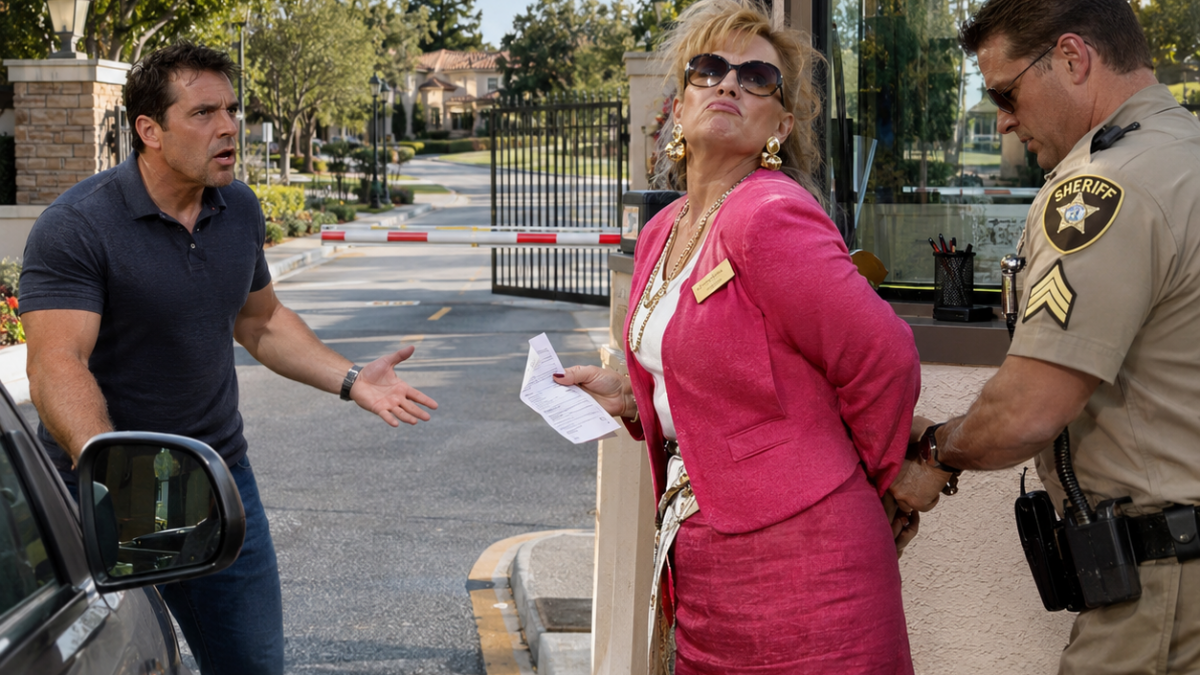
“I have a warrant for your arrest.”
Silence.
Complete.
The trucks still idled.
Diesel engines hummed.
The booth’s amber light flashed.
Bridget’s hand froze around the card machine.
“What?”
Elias repeated it.
“Your arrest.”
“That’s absurd.”
“The warrant was signed by a judge.”
“Based on his lies?”
“Turn around.”
She laughed.
A sharp, disbelieving sound.
“You cannot arrest the president of an HOA in front of residents over an access disagreement.”
“This is not an access disagreement.”
“It absolutely is.”
“Set the card machine down.”
She held it tighter.
“Sheriff, if you continue this, Briarstone Heights will sue the county.”
“Set it down.”
“Do you know how many attorneys our community has?”
“Ms. Kessick.”
His voice changed slightly.
Not louder.
Final.
“Put the card machine down.”
Bridget looked past him.
At me.
I expected anger.
What I saw was disbelief.
She had spent the whole week convinced I was trapped.
That was what power had done to her.
She couldn’t imagine a world where somebody said no and the world agreed with them.
She searched my face.
Maybe she expected triumph.
I gave her nothing.
The deputy stepped forward.
Bridget finally placed the machine on the counter.
Another deputy guided her arms behind her.
The handcuffs clicked.
Right in front of the booth she had built to charge me money for using my father’s gate.
Bridget started talking.
Then shouting.
“This was staged!”
Nobody answered.
“Landon paid you!”
I said nothing.
“This is corruption!”
Elias read the required information.
She talked over him.
The deputies executed the search warrant.
Inside the booth they found blank notices bearing the same fake county seal.
A laminated script.
It instructed guards what to tell drivers.
**Mandatory county emergency access fee.**
A ledger listed vehicles.
Dates.
Amounts.
Payment status.
They seized the card machine.
Electronic records.
Paper receipts.
Bridget watched.
Her face went pale.
Elias held up one receipt.
“Kessick Access Management.”
“It was a security vendor.”
“Your company?”
“It provided administrative services.”
“Why were drivers told they were paying a county-required fee?”
Silence.
“Why did the HOA treasurer not know about it?”
“That’s internal accounting.”
“Why did the money go to your private company?”
Bridget looked at me.
“You did this.”
Finally, I answered.
“No.”
“You did.”
“You built the booth.”
Her jaw trembled.
“You forged the paper.”
“That’s not proven.”
“You charged the money.”
She lunged half a step toward me before the deputy stopped her.
“You ruined a $1.8 million project!”
There it was.
Everyone heard it.
Elias looked at her.
I did too.
“What project?” one of the drivers asked.
Bridget realized what she had said.
Too late.
She shut her mouth.
A few residents had gathered by the county road.
Della arrived.
She stood behind the yellow tape.
Bridget saw her.
“You.”
Della crossed her arms.
“The board is meeting today.”
“You have no authority.”
“We’re reviewing everything.”
“You leaked confidential information.”
“We’re reviewing every contract, every payment, every project.”
Bridget shouted toward the residents.
“This man is going to cost all of you money!”
Nobody defended her.
Not one person.
She had used “the community” like a shield all week.
Now the actual community stood there watching her get placed in a patrol car.
Once the booth was secured as evidence and the locking hardware documented, Elias walked over.
“You have a locksmith?”
“Yes.”
Oscar Brindle had been waiting down the road.
Quincy arranged it in advance.
Licensed.
Documented.
Owner permission.
No improvisation.
Oscar came up.
Looked at the locking bar.
Then the electronic box.
“You want it gone?”
“With the sheriff’s blessing.”
Elias nodded.
Oscar smiled.
“My favorite kind of job.”
It took less than ten minutes.
Bridget’s steel bar came off.
Then her electronic lock.
Then the control unit.
Oscar installed a heavy brass lock.
I reached into my jacket.
Dad’s old key.
The one that had opened the gate for years before Bridget appeared.
Oscar had keyed the new lock to match it.
I pushed the key in.
Turned.
**Click.**
I stood there with my hand on the lock.
For a moment, the lane disappeared.
The sheriff disappeared.
The booth disappeared.
I was seventeen again.
Dad beside me.
Torch in his hand.
Country music playing.
“Lift that side.”
“I am.”
“No, you’re pretending.”
“I’m lifting.”
“You complain more than the gate weighs.”
I could hear him.
I pulled the gate.
It swung open.
No card reader.
No invoice.
No $700.
Just my gate opening onto my road.
Franklin climbed into his truck.
Engine roared.
He leaned out the window.
“See you at the plant!”
The first truck rolled through.
I stood beside the gate.
The second passed.
Then the third.
On the opposite side of the road, Bridget sat in the back of the sheriff’s vehicle.
She watched the trucks pass.
The exact trucks she said would not move unless I paid.
I didn’t wave.
I didn’t smile at her.
I didn’t say anything.
I checked the hinges.
That was all.
The last truck cleared.
My phone rang.
Franklin.
“We’re moving.”
“Good.”
“We’ll make the delivery.”
I let out a breath I felt like I had been holding for a week.
“Call me when you arrive.”
“You sound emotional.”
“Drive the truck, Franklin.”
He laughed.
“Yes, sir.”
I closed Dad’s gate behind them.
Locked it.
Then looked at Bridget’s booth.
Yellow evidence tape crossed the door.
Della walked over.
“The board called an emergency meeting.”
“I figured.”
“We’re suspending the venue project.”
“Good.”
“And Bridget.”
I looked toward the patrol car.
“She looks pretty suspended.”
Della almost smiled.
Then became serious.
“I’m sorry.”
“You didn’t build the booth.”
“I sat on a board that let her become this powerful.”
“That’s different.”
“Not different enough.”
In the weeks after Bridget’s arrest, everything came apart quickly.
The HOA hired an independent auditor.
No resolution authorizing the $700 fee existed.
No lawful board approval.
No contract.
No financial entry.
No county authorization.
The investor behind the $1.8 million event-center deal suspended the project.
Then withdrew.
Without confirmed commercial access, the proposal no longer made financial sense.
The $180,000 commission Bridget had expected?
Gone.
Never paid.
The special HOA meeting was ugly.
Sixty-seven homeowners voted.
Fifty-four voted to remove Bridget as president.
She lost her title.
Her office.
Her authority.
The board issued a formal statement acknowledging that Briarstone Heights had no right to control or charge fees at my gate.
Every notice Bridget had sent me was rescinded.
Quincy negotiated the civil side.
Damage to the gate.
Obstruction of access.
Unauthorized installation.
Legal costs.
Settlement:
$38,000.
And one condition mattered more to me.
The booth had to go.
Completely.
Not moved three feet.
Not abandoned.
Not renamed.
Removed.
Three months later, a crane arrived.
I stood beside the orchard while workers lifted the glass booth off its foundation.
It looked smaller hanging from cables.
Funny how symbols of authority do that once nobody believes in them.
They pulled out the steel post.
Removed the camera.
Removed the card reader.
Broke the concrete pad.
Including the four feet Bridget had poured onto my land.
They hauled everything away.
I hired someone to repaint Dad’s iron gate.
But I refused to replace it.
Quincy asked why.
“Because it’s old.”
“That’s why I’m keeping it.”
“Sentimental?”
“No.”
“Yes.”
“Shut up.”
He smiled.
We reattached Dad’s bronze nameplate.
GREAVES.
The year he built it.
I ran my thumb over the letters.
Then I mounted one small sign beside it.
**PRIVATE PROPERTY — NO HOA ACCESS FEES**
Franklin laughed for five minutes the first time he saw it.
“Subtle.”
“I considered something longer.”
“Like?”
“No.”
“Probably smart.”
Harvest money arrived.
We had made the deadline.
The buyer accepted the load.
No penalties.
No rejection.
No $126,000 disaster.
That mattered.
Because all the drama around Bridget made it easy for people to forget what I had actually been fighting for.
Not revenge.
Harvest.
Business.
Land.
Continuity.
My father built an orchard.
I wanted to keep it alive.
That was all.
Bridget’s criminal case continued through the legal process.
Quincy reminded me not to talk like conviction was guaranteed.
“She gets her day in court.”
“I know.”
“Charges aren’t conviction.”
“I know.”
“But?”
“But I’ve seen the receipts.”
“So has everyone else.”
I never attended every hearing.
I didn’t need to.
My life was at the orchard.
For a week, Bridget had forced me to live inside her drama.
After the gate reopened, I wanted out.
Spring came.
Then summer.
The pecan trees leafed out.
I repaired irrigation valves.
Replaced a bearing on the sorter.
Complained about fuel prices.
Normal things.
Beautiful things.
One afternoon, Della visited.
She brought a folder.
“What’s that?”
“Updated HOA policies.”
“I’m still not joining.”
She laughed.
“I know.”
She showed me the changes.
Financial transparency.
Two-signature requirements.
Outside review for major contracts.
Clear conflict-of-interest disclosures.
No president could unilaterally approve projects over certain thresholds.
“That should’ve existed before.”
“Yes.”
“Will it stop another Bridget?”
Della thought.
“No rule stops every bad person.”
“Then what’s the point?”
“It makes bad behavior harder to hide.”
Fair answer.
She looked toward my gate.
“Residents still talk about it.”
“The booth?”
“The whole thing.”
“I’m sure they do.”
“Some are embarrassed.”
“They should be.”
She nodded.
“I was.”
I looked at her.
“You did something.”
“Eventually.”
“That matters.”
She smiled.
“So does the sign.”
I looked toward my small NO HOA ACCESS FEES sign.
“Franklin likes it.”
“Everyone likes it.”
“That worries me.”
Another time, I ran into Curtis at the hardware store.
He approached carefully.
“Landon.”
“Curtis.”
He looked different without the security uniform.
“You doing okay?”
“Better.”
“I wanted to say something.”
I waited.
“I should’ve refused sooner.”
“You did refuse.”
“Eventually.”
“You also turned over the texts.”
He nodded.
“Bridget almost had my company put COUNTY ACCESS ENFORCEMENT on our jackets.”
“I remember.”
“I keep thinking what would’ve happened if we wore them.”
“Probably nothing good.”
“No.”
He looked uncomfortable.
“I’m sorry about the lock.”
“You didn’t install the second bar.”
“I removed the first padlock.”
“On her order.”
“Still did it.”
I considered that.
“Then don’t do it again.”
He looked up.
“That’s it?”
“What do you want me to do?”
“I don’t know.”
“Neither do I.”
I held out my hand.
He shook it.
That was enough.
People imagine revenge as a moment.
A villain falls.
Hero smiles.
Music plays.
Real life is less clean.
Bridget’s arrest didn’t repair Dad’s nameplate.
It didn’t refund drivers immediately.
It didn’t make residents forget what they believed about me.
It didn’t undo the week of stress.
But there was satisfaction in watching systems work once enough evidence existed.
There was satisfaction in knowing I had not destroyed the booth myself.
If I had ripped it out the first morning, Bridget would have had photographs of me standing beside broken equipment.
Instead, the sheriff carried it away under a warrant.
If I had screamed threats at her, she would have shown residents an angry farmer.
Instead, they heard her admit she would keep my trucks trapped unless I paid.
If I had handed her the $700, she would have had another receipt supporting her fake story.
Instead, investigators had her demanding money on camera.
That became the lesson I kept.
Restraint doesn’t feel powerful while you’re practicing it.
It feels like losing.
Until the evidence catches up.
One evening after everything settled down, I drove the orchard rows at sunset.
The trees cast long shadows across the ground.
I stopped at the gate.
No glass booth.
No amber light.
No security guards.
No Bridget.
Just iron.
The same iron Dad had welded.
I climbed out.
Pulled his key from my pocket.
Opened the lock.
That sound.
Click.
Simple.
I pushed the gate open.
A breeze moved through the orchard.
For years, I had used that gate without thinking about it.
That’s what ownership is supposed to feel like.
Ordinary.
You shouldn’t need a lawyer to walk through your own gate.
You shouldn’t need a surveyor.
A sheriff.
A court order.
A stack of receipts.
But when someone tries to turn the ordinary into a privilege they control, suddenly the simplest things matter.
A deed matters.
A boundary pin matters.
A receipt matters.
A recording matters.
A nameplate matters.
A key matters.
Dad understood that better than I did.
Maybe that’s why he kept every document.
After he died, I used to laugh at the fireproof box.
He saved everything.
Old surveys.
Receipts from 1998.
Copies of filings nobody had looked at in decades.
I once asked him why.
“What if you need it?”
“For what?”
“You don’t know until you need it.”
That was Dad.
Annoyingly right years in advance.
Without his records, Bridget’s nonsense might still have collapsed.
But it would have taken longer.
More money.
More arguments.
Instead, I walked into the county office with paper older than Briarstone Heights itself.
My father had defended my gate from a woman he never met.
He did it by being careful twenty-five years earlier.
That thought got to me.
I stood beside the gate longer than I meant to.
Then I noticed Dad’s bronze plate.
One bolt still carried a tiny scratch from where someone had tried to pry it off.
I could have replaced the plate.
I didn’t.
I left the scratch.
People sometimes remove every scar after a fight.
I like keeping one.
Not because I enjoy remembering Bridget.
Because it reminds me what she tried to erase.
The Greaves name.
The year.
Ownership.
History.
She thought if she removed the old padlock, covered the gate with her sign, built a booth, and repeated “HOA authority” often enough, reality would bend.
It didn’t.
She thought a title made her powerful.
It didn’t.
She thought a red seal made a lie official.
It didn’t.
She thought drivers paying $700 made the gate hers.
It didn’t.
She thought money could turn my father’s road into part of her $1.8 million project.
It didn’t.
A woman can build a booth.
Print a form.
Hire guards.
Wear a blazer.
Call herself president.
Say “authority” fifty times.
None of that moves a property line.
None of that changes a deed.
None of that turns somebody else’s gate into yours.
Months later, Franklin stopped his truck outside the gate.
I walked over.
“What?”
He pointed at the sign.
“I still think you should change it.”
“To what?”
“Seven hundred dollars to enter. Free to leave.”
I laughed.
“Get off my road.”
“Your road?”
“My road.”
“Need to see paperwork.”
I gave him a look.
He laughed so hard he had to lean against the truck.
That felt good.
Normal jokes.
Normal work.
No cameras.
No lawyers.
No sheriff.
Eventually, that is what winning became.
Not watching Bridget leave in handcuffs.
Not watching her booth hauled away.
Not hearing the HOA remove her.
It was not thinking about her every morning.
It was harvest arriving again.
It was Franklin driving through without stopping.
It was suppliers coming in.
It was customers calling about pecans instead of asking about the “HOA gate scandal.”
It was being bored.
I had never understood how valuable boredom was.
The criminal investigation continued.
Refund claims were processed.
The HOA dealt with its own insurance and internal mess.
I heard updates occasionally.
I didn’t chase them.
Quincy handled what required me.
One day he came to the orchard.
No appointment.
He found me repairing a hydraulic line.
“You have grease on your face.”
“I’m working.”
“You own soap.”
“What do you want?”
“To tell you the remaining civil paperwork is finished.”
“Good.”
He handed me a folder.
I wiped my hand before touching it.
“Anything I need to do?”
“Sign page six.”
“That’s it?”
“That’s it.”
I stared at him.
“No hearing?”
“No.”
“No demand letter?”
“No.”
“No Bridget?”
“No.”
I signed.
Quincy looked toward the gate.
“Kind of miss the booth.”
I stared at him.
“For professional reasons.”
“You can build one at your house.”
“Seven hundred per visit?”
“I’d pay seven hundred not to visit you.”
He smiled.
“You’ve become funnier since the case ended.”
“I sleep now.”
That was true.
During that week, every sound at night woke me.
Truck engine?
Was somebody at the gate?
Metal noise?
Were they installing something else?
Phone buzz?
Another threat?
Afterward, it took time for my body to understand the fight was over.
People talk about protecting property like it’s just legal ownership.
There’s another part.
Safety.
The expectation that when you go to sleep, nobody is changing the lock outside.
Bridget stole that for a while.
But she didn’t keep it.
Another harvest came.
Same Friday schedule.
Three trucks again.
Not exactly the same value, but close.
I woke before dawn.
Coffee.
Jacket.
Walked outside.
At 5:55, Franklin rolled toward the gate.
I drove ahead.
Stopped.
Unlocked Dad’s brass lock.
Opened the iron panels.
No booth.
No card reader.
Franklin slowed beside me.
He rolled down the window.
“How much?”
I thought.
“Seven hundred.”
He slapped the steering wheel.
“I knew it!”
“Cash only.”
“You’ve become Bridget.”
“Keep driving.”
He laughed and rolled through.
Second truck.
Third.
I stood there until all of them reached the county road.
Then I closed the gate.
No sheriff hiding down the lane.
No arrest warrant.
No confrontation.
Just work.
That morning affected me more than the arrest.
Because nothing happened.
That was the victory.
The gate worked.
The road worked.
The harvest moved.
My life no longer required permission from Bridget Kessick.
Later that afternoon, I sat under one of the oldest pecan trees with Dad’s fireproof box beside me.
I had taken it from the house because I wanted to reorganize the papers.
For years, I made fun of how Dad filed things.
He had folders labeled with dates.
Survey copies.
Gate construction receipts.
County correspondence.
One yellowed receipt caught my attention.
Steel purchase.
1998.
Six hundred and some pounds.
I remembered the day he unloaded it.
Mom had stood on the porch and asked:
“What are you building, a prison?”
Dad said:
“A gate.”
She looked at the steel.
“For elephants?”
I laughed remembering it.
Near the receipt was an old photograph.
Dad standing beside the unfinished gate.
Welding helmet lifted.
Younger than I was now.
That shocked me.
Parents stay old in your memories until suddenly you realize there was a time when they were younger than you.
I stared at the picture.
“Your gate caused some trouble,” I said.
Then corrected myself.
“No.”
I smiled.
“Her booth caused trouble.”
Wind moved through the trees.
I put the photo back.
People asked me later whether I felt sorry for Bridget.
Complicated question.
I felt sorry for the people around her.
Residents who trusted her.
Employees she bullied.
Della.
Curtis.
Drivers who paid.
Maybe even Bridget herself in the abstract sense that a person has to become pretty lost to look at somebody else’s gate and think:
I can just take that.
But sympathy and accountability are not opposites.
You can understand why someone became what they became and still let consequences arrive.
I never wanted prison.
I never wanted financial ruin.
I wanted my gate.
She chose everything after that.
She chose the fake document.
She chose the fee.
She chose her private company.
She chose to lie to drivers.
She chose to remove my lock.
She chose to build on my land.
She chose the $180,000 commission.
She chose the threat.
She chose to stand at the booth Friday morning and demand money again.
By the time the sheriff arrived, I wasn’t ruining her life.
I was simply refusing to help her hide what she had done.
That distinction matters.
Revenge feels best in stories when the villain suffers.
But what satisfied me wasn’t her suffering.
It was symmetry.
She used a fake county seal.
The real county investigated her.
She used a private booth to collect money.
The booth became evidence.
She used receipts to prove control.
The receipts proved where the money went.
She locked my gate.
Her booth ended up locked behind evidence tape.
She told me the sheriff couldn’t override her board.
The sheriff arrived with a judge’s warrant.
She told me my trucks wouldn’t move.
They rolled past while she sat in a patrol car.
I didn’t have to invent revenge.
Her choices built it.
All I had to do was not destroy the evidence before it could speak.
One evening, Della called.
“We approved the final removal work.”
“What removal work?”
“The last underground conduit from the booth.”
“I thought everything was gone.”
“Apparently the camera power line extended farther than expected.”
“When?”
“Tomorrow.”
“Fine.”
I watched the crew remove it.
When they finished, the ground looked ordinary.
Grass would eventually cover the scar.
The lane returned to what it had always been.
Mine.
Before leaving, one worker asked about the bronze plate.
“That original?”
“Yeah.”
“Old.”
“Careful.”
“I didn’t mean bad.”
I smiled.
“My dad built it.”
“Good work.”
“Yeah.”
He looked at the gate.
“Still straight.”
“That was the problem.”
He didn’t understand.
I didn’t explain.
Dad had built it straight.
Dad filed the right papers.
Dad set the posts deep.
Dad recorded the access.
Dad kept copies.
Bridget encountered something she couldn’t intimidate.
Work done properly by someone who never expected to be thanked for it.
That became the emotional center of the whole thing for me.
Not Bridget.
Dad.
For a week, I thought I was fighting an HOA president.
By the end, I realized I was defending something my father had prepared me to defend decades earlier.
Not the metal.
The principle.
You take care of what’s yours.
You respect what belongs to someone else.
Simple.
Bridget made it complicated because simple rules didn’t produce enough money.
A year after the booth came down, Briarstone Heights finally built another access route for commercial traffic.
Through land it actually owned.
Imagine that.
They spent money.
Got permits.
Built the proper road.
No farmer trapped.
No forged seal.
No sheriff.
No arrests.
The event-center concept returned in a smaller form under different leadership.
I didn’t oppose it.
Some residents were surprised.
“You don’t care?”
“If it stays off my land.”
“It does.”
“Then build whatever you want.”
One man laughed.
“After everything?”
I looked at him.
“I never hated your neighborhood.”
“But the project—”
“I hated someone stealing my access.”
Different thing.
That mattered too.
Conflict can make you stupid if you let it spread.
Bridget was not every resident.
The HOA was not every homeowner.
The event center wasn’t automatically evil.
A commercial project wasn’t automatically theft.
The problem was one person believing her goal made other people’s rights optional.
Once that stopped, I had no reason to spend the rest of my life fighting everybody.
I had pecans to grow.
One fall afternoon, I found a small envelope tucked into my mailbox.
No return address.
Inside was a photocopy of an old Briarstone Heights newsletter.
Bridget’s photograph on the front.
PRESIDENT’S MESSAGE.
Underneath, someone had written in pen:
**Gate still yours?**
I laughed.
Then threw it away.
No evidence folder.
No photograph.
No lawyer.
Some things finally become trash again.
That was freedom.
I drove down to the gate.
Stopped.
Got out.
The bronze plate caught afternoon sunlight.
GREAVES.
I touched the scratch where someone had tried to pry it loose.
Then put my key in the lock.
Click.
Opened.
Closed.
Locked.
Done.
No debate.
No fee.
No approval.
No board.
That was the life my father intended when he built it.
And that was the life I got back.
People around Cedar Vale eventually shortened the story.
That always happens.
“You’re the farmer with the HOA toll booth.”
“Yeah.”
“You got the president arrested.”
“No.”
“The sheriff arrested her.”
“You set her up.”
“No.”
“She tried to collect money.”
“But you planned the Friday confrontation.”
“The sheriff planned the arrest.”
“You knew.”
“Yes.”
“So you got revenge.”
I always thought about that word.
Revenge.
Maybe.
But I never damaged Bridget’s property.
Never threatened her.
Never lied.
Never forged a paper.
Never blocked her home.
Never took her money.
I asked her to leave my gate alone.
She refused.
Then I documented what happened.
If consequences feel like revenge to the person who caused them, that doesn’t make them unjust.
The best moment was never the handcuffs.
It was the first quiet evening after the booth disappeared.
I drove home from the back field.
Sun almost gone.
Dust behind the truck.
I reached the gate.
No lights.
No glass box.
No voice asking for a card.
I climbed out.
Unlocked it.
The hinges groaned.
Dad’s hinges.
Still working.
I drove through.
Closed the gate behind me.
For some reason, I stood there with my hand resting on the iron.
I remembered Dad tightening one of those hinges while I complained that the gate was too heavy.
He looked at me and said:
“That’s the point.”
I had forgotten that conversation until then.
Maybe he meant the gate should be strong.
Maybe he meant strong things take work.
I don’t know.
He wasn’t there for me to ask.
But that night, I finally understood something.
Bridget thought Dad’s gate was heavy because it was old iron.
She was wrong.
It was heavy because it carried a history she never bothered to understand.
My father built it.
My family maintained it.
County records protected it.
My harvest depended on it.
My livelihood moved through it.
And I had the right to open it without paying a stranger seven hundred dollars.
She tried to turn that right into a privilege.
Then tried to sell that privilege to investors.
And when I refused, she threatened to trap me behind my own gate until my harvest rotted.
That was why I fought.
Not because I hated HOAs.
Not because I wanted attention.
Not because I enjoyed lawsuits.
I fought because surrendering would have turned her lie into paperwork.
One payment.
Then another.
Then another.
Soon she would hold twenty receipts and say:
Look.
We’ve always controlled this access.
Maybe she would still lose eventually.
But “eventually” is expensive.
Eventually can bankrupt a farm.
Eventually can cost a harvest.
Eventually can turn a simple property line into a five-year lawsuit.
Dad taught me to fix problems while they were still small.
Bridget made the problem huge.
But I refused to make it permanent.
Today, the booth is gone.
The concrete pad is gone.
The electronic lock is gone.
The fake county notices are gone.
Bridget is no longer HOA president.
Her $180,000 commission never happened.
The $1.8 million deal that relied on my gate collapsed.
Drivers who paid fees pursued refunds.
The HOA compensated me for damage, obstruction, and legal costs.
The orchard survived.
The harvest made delivery.
And Dad’s gate is still standing.
Sometimes Franklin still jokes about it.
Sometimes neighbors slow down to look at the little sign.
**PRIVATE PROPERTY — NO HOA ACCESS FEES**
I don’t mind.
Maybe it will remind somebody of something useful.
A title doesn’t make another person’s land yours.
A board vote cannot rewrite a deed.
A fake seal does not create government power.
And money collected under a lie leaves a trail.
But the biggest lesson is the one I didn’t understand until the end.
You don’t always win by hitting back harder.
Sometimes you win by refusing to give your opponent the mistake they need from you.
I could have cut Bridget’s lock.
I didn’t.
I could have ripped down her booth.
I didn’t.
I could have screamed at the guards.
I didn’t.
I could have paid the $700 and fought later.
I didn’t.
I took pictures.
Saved receipts.
Called the county.
Called a surveyor.
Called my attorney.
Called the sheriff.
And then I let Bridget keep talking.
She was so sure nobody could stop her that she documented her own case better than I ever could.
Every receipt.
Every text.
Every threat.
Every fake notice.
Every payment.
Even her final demand:
**Friday, 6:00 a.m. $700 per truck. Bring your card.**
She thought that message proved control.
Instead, it helped prove intent.
That is the strange thing about arrogance.
It often writes its own evidence.
Late one afternoon, years after Dad died and long after Bridget’s booth disappeared, I drove back from the far end of the orchard.
The pecan trees were turning gold.
I reached the lane.
Stopped in front of the gate.
Got out.
Pulled Dad’s old key from my pocket.
For a second, I just looked at it.
Worn brass.
Nothing special.
Probably worth two dollars.
But it had opened that gate in my father’s hand.
Then mine.
Bridget had tried to replace it with a card machine.
Seven hundred dollars.
Every time.
I pushed the key into the lock.
Turned.
Click.
The gate opened.
No sheriff.
No attorney.
No HOA president.
No audience.
Just me.
I drove through.
Then stopped on the other side.
I got out one final time and closed the heavy iron panels.
As they came together, the evening light flashed across Dad’s bronze plate.
GREAVES.
Still there.
I locked the gate.
Put the key back in my pocket.
And looked down the lane toward the orchard.
Bridget Kessick once told me that by Friday morning I would either pay her or stay trapped behind my own gate.
She was wrong.
Friday morning came.
I didn’t pay.
My trucks left.
My harvest survived.
And she was the one who couldn’t walk away.
I didn’t need to destroy her.
I only needed to keep my hands off her lies long enough for the truth to open the gate.
And once it did, there wasn’t a booth, a title, a fake county seal, or a $700 fee in the world strong enough to close it again.








