PART 2: HOA Karen Kept Using My Private Driveway Like It Was Hers — Then She Called 911 When I Finally Drew the Line
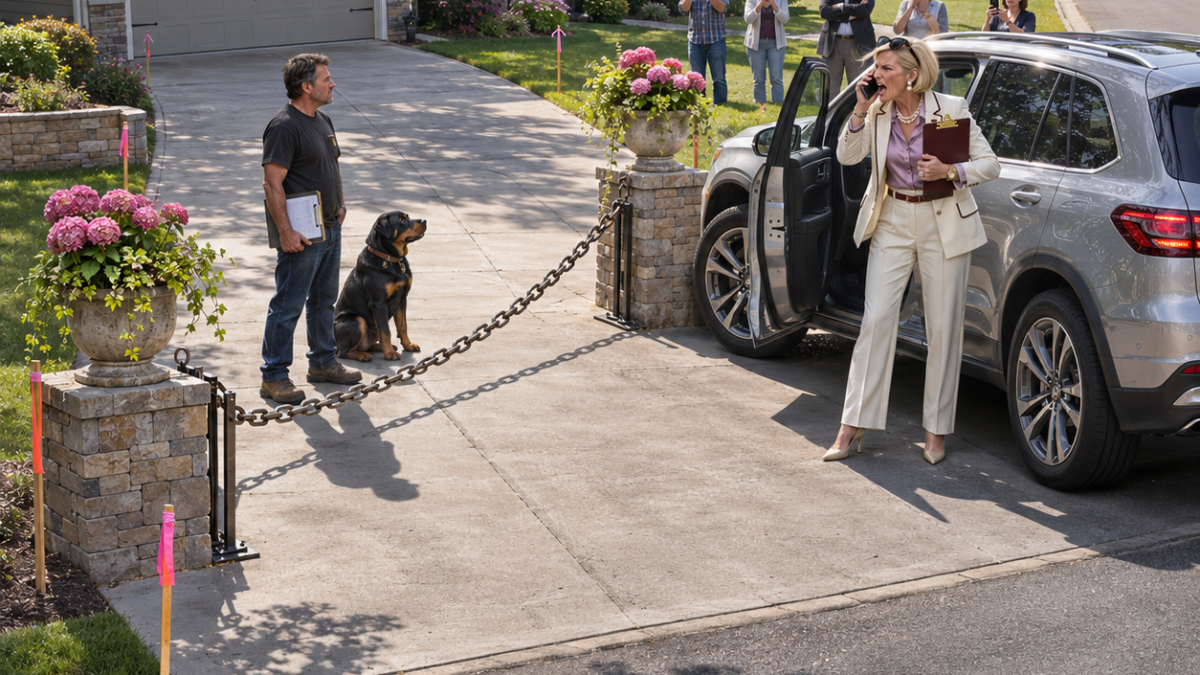
The morning I finally stopped letting Caroline Briggs use my private driveway as her personal HOA parking space, she stood behind the wheel of her silver SUV screaming into 911 that I had trapped her with a dangerous Rottweiler, even though Diesel was sitting calmly beside me and the only thing blocking her was the boundary she had ignored for months.
By then she had already cost me a major client, buried me under retaliatory violation notices, told the HOA board that my own concrete was a “community visual asset,” and convinced herself that being president of Cedar Ridge Estates somehow gave her the right to park wherever she pleased, inspect whatever she wanted, and punish anyone who refused to cooperate.
What Caroline didn’t know was that I had finally stopped arguing with her, started saving everything she did, and made one decision about my property that would force everyone—from the HOA board to the police—to decide whether her title actually meant what she claimed it did.
My name is Mark Reynolds, and I had lived in Cedar Ridge Estates for eight years before Caroline moved in.
Until then, I barely thought about the HOA.
I kept my grass cut, stored the trash bins properly, paid my dues, and minded my business. I owned my house outright, including the driveway, and after years of working for myself as a contractor, that small patch of concrete meant more to me than it probably should have.
It was mine.
Caroline treated that word like a suggestion.
The first time she parked there, I assumed it was an accident.
I walked outside and tapped on her window.
“Hey, Caroline. This is my driveway.”
She barely looked up.
“I’ll only be a minute.”
I waited for her to move.
She didn’t.
Twenty minutes later, she returned carrying HOA folders and acted as if nothing unusual had happened.
That became a pattern.
Sometimes her SUV blocked me from pulling in.
Sometimes it blocked me from leaving.
Every time I objected, she gave me the same little dismissive wave.
“Relax, Mark.”
Or:
“Community business.”
Or my personal favorite:
“Driveways are visual community assets.”
I showed her the CC&Rs stating that individual driveways were privately owned.
She shrugged.
Then the citations began.
Trash bin left out too long.
Garden lighting allegedly too warm.
A decorative planter supposedly outside the approved color palette.
Every notice appeared shortly after I complained about her parking.
I documented everything.
Photos.
Dates.
Emails.
Security footage.
Then came the Tuesday that ended my patience.
I had a presentation with a potential client worth more money than any contract I’d landed that year. Ten minutes before I was supposed to leave, I stepped outside and found Caroline’s SUV parked diagonally across the driveway.
My car couldn’t move.
I called her.
Voicemail.
Texted.
Nothing.
Knocked on her door.
No answer.
She finally returned holding a latte.
“Caroline, move your car.”
She looked at her watch.
“Oh, relax. You weren’t leaving.”
“I have a client meeting.”
“How was I supposed to know?”
“You weren’t supposed to park here.”
Her expression hardened.
“I’m the HOA president, Mark. I’m allowed temporary access while conducting community tasks.”
“What task?”
She waved me off.
I missed the meeting.
The client hired somebody else.
That evening, I sat in my living room staring at the email telling me they had decided to move forward with another contractor.
I had tried politeness.
Complaints.
Rules.
Documentation.
Nothing mattered because Caroline believed every boundary was negotiable if she was the person crossing it.
That was when I found Diesel.
He was a rescue Rottweiler—huge, calm, trained, and returned twice by people who had underestimated how much responsibility came with a working breed.
At the shelter, he walked over, sniffed my hand, sat beside me, and leaned against my leg.
The volunteer smiled.
“He likes you.”
“I like him too.”
I adopted him that afternoon.
Two days later, Caroline’s silver SUV appeared again.
Diesel was beside me on the porch.
He watched the vehicle turn toward my driveway.
Then he stood.
Caroline rolled forward.
Diesel walked calmly to the edge of my property and stopped.
No barking.
No growling.
No lunging.
Just one hundred pounds of very clear information.
Caroline slammed on the brakes.
Her window dropped.
“MOVE THAT DOG.”
I rested one hand on the porch rail.
“No.”
Her face twisted.
“Excuse me?”
“He’s on my property.”
“I need this driveway.”
“No, Caroline. You want it.”
She reached for her phone.
“I’m calling the police.”
I looked down at Diesel.
Then back at her.
“Go ahead.”
She dialed 911.
And when I heard the version of the story she started telling the dispatcher, I knew all those months of saving evidence had just become very important.
PART 2
Caroline’s voice carried all the way from the street.
“Yes, I need officers immediately. There is an aggressive dog blocking me from performing official HOA duties.”
Diesel looked up at me.
His expression was so calm it was almost insulting.
I scratched behind his ear.
“Apparently you’re a public emergency.”
His tail hit the porch once.
Caroline kept going.
“The homeowner has deliberately positioned the animal to threaten me.”
That was when I took out my phone and started recording my side of the scene too.
Not because I wanted a viral video.
Because I had learned something dealing with Caroline.
Memory was never enough.
If there wasn’t a photograph, timestamp, email, or recording, she would rewrite the event until she became the reasonable one.
So I filmed.
Her SUV stopped at the curb.
Diesel sitting beside me.
My PRIVATE DRIVEWAY — NO UNAUTHORIZED PARKING sign clearly visible.
The entire width of the concrete.
Nothing hidden.
Nothing ambiguous.
When Caroline hung up, she pointed at Diesel.
“You trained him to do this.”
“To sit?”
“To intimidate me.”
“He lives here.”
“I have community business.”
“That doesn’t turn my driveway into your parking lot.”
She slapped one hand against the steering wheel.
“You are unbelievably difficult.”
I almost laughed.
For months, I had been the one asking her to stop using property she didn’t own.
Now I was difficult because I had stopped making it easy.
The first cruiser arrived seven minutes later.
Second one followed.
No sirens.
Just lights.
Two officers stepped out.
Officer Daniel Ross was tall, maybe forty, with a tired expression that suggested he had already dealt with three arguments more important than this one that morning.
His partner, Officer Maya Collins, was younger and much more cautious around Diesel.
Fair enough.
A hundred-pound Rottweiler earns respect whether he asks for it or not.
“Sir,” Ross called.
“Morning.”
“Can you secure the dog while we talk?”
“Absolutely.”
That mattered to me.
I clipped Diesel’s leash on and gave him the sit command.
He sat against my leg.
No resistance.
No drama.
Caroline hurried toward the officers.
“That’s him.”
Ross looked confused.
“That’s the homeowner?”
“The dog.”
“Oh.”
“He came at me.”
I said:
“No, he didn’t.”
Caroline spun around.
“Yes, he did.”
Officer Collins raised a hand.
“One person at a time.”
Caroline inhaled sharply.
Then launched into her version.
I had trained Diesel to block HOA officials.
I had deliberately created a dangerous situation.
She had been performing “community operations.”
She had lawful HOA access.
Diesel had approached her vehicle.
She felt threatened.
Ross listened.
Then turned to me.
“Mr. Reynolds?”
“Mark is fine.”
“What happened?”
“She attempted to pull into my driveway. Diesel walked to the edge of the property and stood there.”
“Barked?”
“No.”
“Growled?”
“No.”
“Lunged at the vehicle?”
“No.”
“Was he leashed?”
“Not at that moment. He was inside my property line. But I have video.”
Caroline interrupted.
“That doesn’t matter. This breed is inherently intimidating.”
Collins glanced at Diesel.
He yawned.
I had to look away.
Ross said:
“Let’s see the video.”
I handed him my phone.
First camera angle showed Caroline’s SUV slowing.
Diesel walking from the porch.
Stopping well inside the property.
Second angle showed the driveway entrance.
No chase.
No lunge.
No bark.
Caroline stayed inside the SUV the entire time.
Ross watched it twice.
Then handed my phone to Collins.
She watched.
Looked at Diesel.
Then at Caroline.
“Ma’am, where was the attack?”
Caroline’s mouth opened.
“He advanced.”
“He walked.”
“Toward me.”
“He lives there.”
“You don’t understand.”
Ross stepped in.
“Was there physical contact?”
“No.”
“Did the dog enter the street?”
“No.”
“Did the dog jump on your vehicle?”
“No.”
“Did he attempt to bite you?”
“That’s not the point.”
Ross exhaled.
“That is very much the point.”
Caroline’s face reddened.
I stayed quiet.
I had spent too many months trying to win arguments with her.
This time, I didn’t need to.
The camera was doing it.
Ross looked toward my driveway.
“Mr. Reynolds, this is private property?”
“Yes.”
I pulled up the property survey I had saved digitally.
Caroline laughed.
“He doesn’t need to show you that. The HOA has access authority.”
Ross turned.
“Do you have documentation of that access?”
“The HOA president is permitted to enter shared community areas while conducting business.”
“Is his driveway a shared area?”
She hesitated.
“It is a visual community asset.”
Officer Collins looked at Ross.
Ross looked at Collins.
That exchange alone nearly made the previous three months worth it.
He asked again:
“Is the driveway legally common property?”
Caroline’s voice dropped.
“Not technically.”
There it was.
Not technically.
Otherwise known as no.
Ross said:
“Then you cannot park there without permission.”
“I’m the HOA president.”
“That doesn’t change ownership.”
Her entire posture changed.
It was subtle at first.
Shoulders tightening.
Chin lifting.
Hands closing.
“You’re taking his side.”
“No, ma’am.”
“Yes, you are.”
“We’re explaining the law.”
“He’s weaponizing an animal against me.”
Collins said:
“The dog stayed on his property.”
“He stepped forward.”
“Standing on private property is not a crime.”
Caroline pointed toward Diesel.
“That animal is dangerous.”
“Do you have evidence of aggressive behavior?”
“He’s a Rottweiler.”
“That’s not evidence.”
I could see the exact moment Caroline realized the officers were not going to validate her.
And with Caroline, failure was never just failure.
It was betrayal.
She started pacing.
“So that’s it?”
Ross nodded.
“Unless there’s something else we need to know.”
“There is plenty you need to know.”
She pointed toward me.
“This man has been harassing an HOA officer for weeks.”
I finally spoke.
“She has parked in my driveway seventeen documented times.”
Caroline spun around.
“Seventeen?”
“Yes.”
“You’ve been counting?”
“After the fifth one.”
Ross looked at me.
“You have those records?”
“Yes.”
“How many times did you ask her to stop?”
“Every time.”
Caroline interrupted.
“That’s not accurate.”
I opened my documentation folder on my phone.
Emails.
Screenshots.
Photos.
One message from Caroline herself:
STOP BEING SO TERRITORIAL. I’M USING THE DRIVEWAY TEMPORARILY FOR COMMUNITY PURPOSES.
Officer Collins read it.
Then looked up.
“You wrote this?”
Caroline folded her arms.
“It’s out of context.”
“What’s the context?”
No answer.
Ross nodded toward her SUV.
“Ma’am, I recommend you leave.”
Caroline stared.
“You’re ordering the HOA president out of her own neighborhood?”
“No.”
Ross remained calm.
“I’m telling you not to enter Mr. Reynolds’s private driveway without permission.”
Her voice rose.
“You don’t have the authority to interpret HOA rules.”
“And the HOA doesn’t have authority to overrule private property law.”
That landed.
Hard.
For a few seconds, nobody moved.
Then Caroline said:
“I want your badge numbers.”
Ross gave his.
Collins gave hers.
Caroline typed them into her phone.
Then she pointed at me.
“This isn’t over.”
I looked at her.
“It should be.”
Ross’s radio crackled.
He began walking toward the cruiser.
Collins followed.
I thought that was the end of the morning.
It wasn’t.
Caroline waited until both officers reached their vehicles.
Then she turned around and marched straight toward my driveway.
Not drove.
Walked.
Diesel stood.
I shortened his leash.
“Caroline.”
She kept coming.
“Stay off the property.”
“This neighborhood does not belong to you.”
“My driveway does.”
“As president, I have inspection authority.”
“No.”
She crossed the sidewalk.
Diesel stepped in front of me.
Not pulling.
Not barking.
Just placing his body between us.
Caroline froze.
“Get him away from me.”
“You’re entering his home.”
“Move him.”
“Back up.”
She stepped forward.
Diesel matched one step.
Her face changed.
“See!”
She shouted toward the cruisers.
“He’s doing it again!”
Ross turned around.
Collins was already moving.
“Ma’am!” Ross called.
“Step back.”
Caroline ignored him.
“You trained that animal to threaten me.”
“No.”
“You planned this.”
“Go home.”
“Don’t tell me what to do.”
“Then listen to the police.”
Ross reached us.
“Mrs. Briggs, step away from the property.”
She pointed at me.
“Arrest him.”
“For what?”
“Harassment.”
“He has not committed a crime.”
“He’s using that dog.”
“Ma’am.”
Ross’s tone changed.
Not angry.
Final.
“You need to leave.”
Caroline’s hands shook.
I had never seen her like that.
She had always been polished.
Sharp.
Controlled.
Even when rude.
Now control was slipping.
“You people don’t understand.”
Ross said:
“We understand the situation.”
“No, you don’t.”
“We’ve reviewed the video.”
“It’s manipulated.”
I stared at her.
“You watched it happen.”
She ignored me.
Then Ross took out a citation booklet.
“Mrs. Briggs, there’s another issue.”
Her eyes narrowed.
“What?”
“You called 911 reporting an active animal attack.”
“I felt threatened.”
“You told dispatch the dog was attacking you.”
“He was.”
“No physical attack occurred.”
Her face went white.
Ross continued:
“Because emergency resources were dispatched based on false or substantially exaggerated information, I’m issuing a citation.”
She stared at the paper.
“You’re fining me?”
“Yes.”
“I’m the HOA president.”
Ross didn’t blink.
“That is not an exemption.”
He wrote.
Caroline looked at me.
That was the moment everything tipped.
Not because of the amount.
It wasn’t enormous.
Because somebody had finally put an official consequence in her hand.
A piece of paper she hadn’t written.
A rule she couldn’t reinterpret.
Ross handed it over.
She stared.
Then crumpled it.
“This is harassment.”
“No, ma’am.”
“You’re taking his side.”
“We’re taking the side supported by the evidence.”
She threw the citation toward her SUV.
Collins said:
“Do not litter.”
I looked down.
I bit the inside of my cheek so hard it hurt.
Caroline noticed.
“You think this is funny?”
“No.”
“You’re enjoying this.”
“I wanted my driveway back.”
“You’re trying to destroy me.”
That sentence surprised me.
Not anger.
Fear.
For one second I saw something underneath Caroline’s behavior.
She believed losing control was the same thing as being destroyed.
I said:
“Go home.”
Her face tightened again.
Then she turned.
For a moment I thought she would.
Instead, she stepped toward me.
Ross moved immediately.
“Ma’am, stop.”
She jerked her arm away.
“Don’t touch me.”
“Nobody touched you.”
“Stay away from me.”
“Then step away from the property.”
She took another step.
Collins reached out.
Caroline slapped her hand away.
Not a punch.
Not some dramatic attack.
A frantic swat.
But it was enough.
Ross grabbed Caroline’s wrist.
“Stop.”
She twisted.
“Let go of me!”
“Stop resisting.”
“I know my rights.”
“Then stop making this worse.”
She pulled again.
Collins controlled the other arm.
Seconds later, Caroline was turned toward the cruiser.
Handcuffs clicked.
The neighborhood came alive.
Doors opened.
Blinds moved.
People stepped onto porches.
Someone whispered:
“Finally.”
I didn’t feel victorious.
Mostly I felt tired.
Caroline screamed the entire way to the cruiser.
“This is illegal!”
“I’ll sue!”
“I’ll have your badges!”
“I’ll have his dog destroyed!”
That last one hit me.
Diesel pressed against my leg.
I put my hand on his head.
Ross heard her too.
He stopped before putting her in the car.
“Mrs. Briggs.”
She looked at him.
“If you make threats regarding the animal, they will be documented.”
“He threatened me first.”
“The dog did not threaten you.”
Caroline looked toward me.
“This isn’t over.”
I answered quietly.
“Yes, it is.”
At the time, I believed that.
I was wrong.
The arrest ended the driveway confrontation.
It did not end Caroline Briggs.
The next morning, Cedar Ridge looked like a neighborhood pretending not to gossip.
Mrs. Green watered one plant for fifteen straight minutes.
Sam and Lena—the young couple two doors down—stood at their mailbox long after the mail had been collected.
Mr. Henderson retrieved his newspaper at seven even though he usually didn’t emerge until noon.
Diesel and I started our walk.
Mrs. Green called:
“Morning, Mark.”
“Morning.”
“Beautiful day.”
“Sure is.”
Pause.
“How’s Diesel?”
“Fine.”
Pause.
“And… everything else?”
I smiled.
“Fine.”
She looked disappointed.
Not because she wanted bad news.
Because she wanted details.
I saved her from herself.
“She was arrested.”
Mrs. Green nearly sprayed her own shoes.
“I heard.”
Of course she did.
“Police reviewed the footage.”
“I heard.”
“Diesel did nothing wrong.”
“I knew he wouldn’t.”
Diesel sniffed a shrub.
Mrs. Green lowered her voice.
“Between us?”
“Yes?”
“People are relieved.”
That bothered me.
“Relieved she was arrested?”
“No.”
Mrs. Green shook her head.
“Relieved somebody finally said no.”
That stayed with me.
At the end of the cul-de-sac, an HOA golf cart approached.
My shoulders tightened automatically.
Then I saw Jim Carter driving.
Jim had been on the board longer than Caroline.
Mid-sixties.
Retired insurance adjuster.
Crooked glasses.
Permanent expression of a man who had spent years attending meetings he regretted.
He stopped beside us.
“Mark.”
“Jim.”
“Mind if I walk?”
“Sure.”
He climbed out.
Diesel sniffed him.
Jim froze.
“He friendly?”
“Usually.”
“That answer could be stronger.”
“He’s friendly.”
“Thank you.”
We walked.
Jim took off his cap.
“I owe you an apology.”
“For what?”
“The board.”
“You weren’t parking in my driveway.”
“No.”
“You didn’t issue the citations.”
“No.”
“Then why apologize?”
“Because we let her.”
That was more honest than I expected.
He continued.
“Caroline has been making unilateral decisions for months.”
“I noticed.”
“She writes violation notices without review.”
“I noticed.”
“She uses the president title to pressure contractors.”
“I noticed.”
“She told administrative staff not to bring small complaints to the board.”
I stopped.
“What?”
Jim looked embarrassed.
“She said routine enforcement was executive authority.”
“So nobody knew how many citations she issued?”
“We knew some.”
“How many?”
He hesitated.
“Not enough.”
I resumed walking.
“Why didn’t you stop her?”
“That’s the question everyone is asking themselves.”
“No, Jim. I’m asking you.”
He looked down.
“Because confrontation with Caroline is exhausting.”
I almost laughed.
“That’s your answer?”
“It’s not a good one.”
“No.”
“But it’s true.”
He rubbed his forehead.
“She turns every disagreement into war. People got tired.”
“So she learned aggression worked.”
Jim stopped.
That hit him.
“Yes.”
He nodded slowly.
“I suppose she did.”
He explained that the board would hold an emergency meeting that evening.
Caroline’s arrest gave them authority to suspend her pending review.
They wanted my records.
“Photos?”
“All of them.”
“Emails?”
“Yes.”
“Video?”
“Yes.”
“Police report?”
“When available.”
I looked down at Diesel.
He looked up.
Jim said:
“We need your statement too.”
“I’m not joining the HOA crusade.”
“We’re not asking you to.”
“I want peace.”
“I know.”
“Then remove her and leave me out of the politics.”
Jim sighed.
“If it were only the driveway, maybe.”
“What does that mean?”
He looked around.
“Other people are talking now.”
That was when I realized the driveway had never been only my problem.
It was simply where Caroline finally pushed someone who had enough documentation to push back.
That night I opened the folder on my computer.
HOA NONSENSE.
Thirty-seven photos.
Seventeen parking incidents.
Nine emails.
Six citations.
Three short videos.
One voicemail where Caroline said:
“Being overly territorial is contrary to community spirit.”
I printed everything.
Diesel slept beside the desk.
At midnight I sat there looking at the stack.
I didn’t feel excited.
I felt angry.
Not the hot anger I had felt when I missed the client presentation.
A slower kind.
Because for the first time I understood that Caroline’s behavior wasn’t random pettiness.
It was a system.
Push.
Dismiss.
Punish.
Make the target seem unreasonable.
Repeat until they stop resisting.
I had spent weeks wondering whether I was overreacting.
That may have been her most effective weapon.
Not fines.
Doubt.
I reached down.
Diesel opened one eye.
“Tomorrow we stop doubting.”
His tail thumped.
The emergency meeting filled the clubhouse.
Half Cedar Ridge showed up.
When I walked in, conversations dropped.
Not completely.
Just enough.
Mrs. Green patted the chair beside her.
“Sit.”
I sat.
“Did you bring everything?”
I held up the folder.
She smiled.
“Good.”
At the front sat Jim, Linda Alvarez from landscaping, and Stewart Pike, the treasurer.
Caroline’s chair was empty.
Jim called the meeting to order.
“We are here regarding allegations of misconduct by President Caroline Briggs.”
Someone shouted:
“Allegations?”
Another voice:
“She got arrested.”
Jim raised both hands.
“Please.”
Then he asked me to speak.
I walked to the table.
Set the folder down.
Told the story.
No insults.
No “Karen.”
No exaggeration.
First parking incident.
Email.
Second.
Third.
Complaint.
Retaliatory citation.
Client meeting.
Seventeenth parking incident.
Diesel.
911 call.
Police footage.
Arrest.
When I finished, nobody spoke.
Then Mrs. Green stood.
“She fined me for leaving my garden hose out.”
Another neighbor raised his hand.
“She threatened to tow my daughter’s car while it was legally parked.”
A woman near the wall said:
“She told me my Christmas wreath was seasonally inconsistent.”
The room laughed.
She didn’t.
“I’m serious.”
That stopped the laughter.
Another man said:
“She told me my porch cushions were incompatible with the architectural identity of Cedar Ridge.”
Stewart looked at Jim.
Jim looked sick.
Then Sam stood.
“She sent us a warning because our moving boxes were visible through our garage for one afternoon.”
Lena added:
“We had lived there three days.”
One after another.
Stories.
Small by themselves.
Absurd.
Annoying.
But together?
A pattern.
Jim asked:
“How many people here received a violation from Caroline that was never formally reviewed by the board?”
Hands rose.
Twenty-three.
Stewart whispered:
“Jesus.”
Jim said:
“We will audit every one.”
Then he called for a suspension vote.
Three board members eligible.
Three yes votes.
Caroline Briggs was suspended.
Applause erupted.
I didn’t join.
Mrs. Green noticed.
“You okay?”
“Yeah.”
“You don’t look happy.”
“I don’t want a war.”
She smiled sadly.
“Sometimes ending one feels like starting one.”
She was right.
Caroline disappeared for two days.
The third morning, her silver SUV rolled slowly down the street.
Diesel was beside me.
He noticed before I did.
The vehicle stopped across from my house.
Window lowered.
Caroline wore dark sunglasses.
“You think you won.”
I kept drinking coffee.
“I’m not competing with you.”
“You humiliated me.”
“You called the police.”
“You manipulated them.”
“They watched the camera.”
“You manipulated the board.”
“They read your emails.”
“You got everyone against me.”
I set down the cup.
“Caroline, listen to what you’re saying.”
She leaned through the window.
“You brought that dog here to terrorize me.”
“I adopted Diesel because I wanted a dog.”
That wasn’t entirely true.
I had adopted him partly because I wanted a visible deterrent.
The realization made me uncomfortable.
So I corrected myself.
“And because I wanted people to stop walking onto my property like they owned it.”
“There.”
She pointed at me.
“You admit it.”
“I admit I wanted a boundary respected.”
Her jaw tightened.
“I’m working on something.”
“What?”
“You’ll find out.”
She drove away.
That sentence bothered me all day.
I called Jim.
He sighed.
“She showed up at the HOA office this morning.”
“She’s suspended.”
“I know.”
“Did she?”
“No.”
“What happened?”
“She demanded records. Said the suspension was illegal.”
“Did you give them to her?”
“No.”
“She’ll come back.”
“She threatened litigation.”
“That sounds like Caroline.”
Jim hesitated.
“She also accused you of staging the dog incident.”
“I know.”
“She calls it a dog trap.”
“What is a dog trap?”
“No idea.”
I looked through the window at Diesel sleeping in a patch of sun.
“I don’t think she’s done.”
“Neither do I.”
Saturday brought a dark sedan.
It passed my house slowly.
Then again.
Third time, Diesel stood at the window.
I photographed the plate.
Temporary tag.
Nothing obviously illegal.
I sent it to Jim.
He didn’t recognize it.
That night, I heard footsteps near the side yard.
Diesel heard them first.
His head snapped up.
Low growl.
Not his normal alert sound.
Different.
I checked the cameras.
A figure moved near the property line.
Hood.
Dark clothing.
Camera.
My stomach tightened.
I turned on the exterior lights.
Caroline froze.
Not some hired investigator.
Not a stranger.
Caroline.
I opened the door.
Diesel stayed inside with me.
“Caroline.”
She looked caught for half a second.
Then defiant.
“What are you doing?”
“Documenting.”
“At eleven at night?”
“Your violations.”
“You’re suspended.”
“Temporarily.”
“Get off my property.”
“I’m standing in the setback.”
“You crossed the marker.”
She raised her camera.
“You installed surveillance equipment without approval.”
“My cameras are compliant.”
“We’ll see.”
“We?”
“When I’m reinstated.”
I stared at her.
“Caroline, go home.”
“You think you can steal my position?”
“I don’t want your position.”
“You turned them against me.”
“You did that.”
She stepped closer.
Diesel came to the doorway.
Still inside.
Caroline saw him.
Backed up.
“That animal.”
“He’s in my house.”
“You use him like a threat.”
“No.”
Her voice cracked.
“You ruined everything.”
That was the first time I heard desperation without anger covering it.
I softened slightly.
“Caroline.”
“No.”
“Go home tonight.”
“I’ll get this fixed.”
“There’s nothing to fix between us except you staying off my property.”
“I will be reinstated.”
“Then be reinstated.”
I shrugged.
“It still won’t make the driveway yours.”
For a second she looked like I had slapped her.
Because I had reduced everything she was fighting for to the original fact.
The driveway was not hers.
Never had been.
Never would be.
She turned and walked away.
I saved the footage.
Sent it to Jim.
Then filed a non-emergency trespass report.
I didn’t want her arrested.
I wanted a record.
The next morning, Jim arrived at 7:30.
He looked ten years older.
“She was at the office again.”
“I know.”
“How?”
“She told me.”
“She broke into the records cabinet.”
My stomach tightened.
“What?”
“Not forced entry. She still had an old office key.”
“What did she take?”
“Copies of violation files.”
“Mine?”
“Yours. Several others.”
“Why?”
“She says she’s preparing an appeal.”
“Jim.”
“I know.”
“You need to change the locks.”
“Already done.”
“Disable her access.”
“Done.”
“Recover every file.”
“We’re trying.”
He sat at my kitchen table.
Diesel approached.
Sniffed.
Then lay beside him.
Jim finally relaxed.
“Good dog.”
“Best board member in Cedar Ridge.”
Jim laughed weakly.
Then became serious.
“Mark, the board wants to pursue permanent removal.”
“Good.”
“The county management office is also reviewing our procedures.”
“Why?”
“Because several fines may have been issued outside the authority defined in our governing documents.”
“How many?”
“Possibly dozens.”
I leaned back.
“Caroline signed them?”
“Yes.”
“She collected them?”
“The HOA collected them.”
“So the HOA may have to refund people.”
“Yes.”
“How much?”
“We don’t know yet.”
That explained why Stewart looked sick at the meeting.
This was no longer embarrassing.
It was financial.
And financial consequences make boards brave very quickly.
Over the next week, the audit expanded.
Forty-one Caroline-issued citations lacked full documentation.
Seventeen had procedural problems.
Nine appeared to be retaliation following disputes.
Five involved rules that did not exist in the recorded bylaws.
My trash-bin violation was one.
The “community harmony” driveway letter?
Not official board policy.
Caroline had written it herself.
Jim called me.
“You’re going to love this.”
“I’m trying not to enjoy anything.”
“Well, try harder.”
He emailed me a PDF.
HOA POLICY — TEMPORARY USE OF RESIDENTIAL ACCESS AREAS.
Signed:
CAROLINE BRIGGS, PRESIDENT.
Date:
Three weeks after she first parked in my driveway.
I stared.
She hadn’t relied on a rule.
She created one after I objected.
Not voted.
Not approved.
Not filed.
Just written.
I called Jim.
“This is fake.”
“Unofficial.”
“Fake.”
“Counsel prefers unofficial.”
“I prefer fake.”
“So does Stewart, privately.”
“Why did no one catch this?”
“Because she sent it as a presidential guidance memo.”
“Does president mean dictator in your bylaws?”
“No.”
“Good.”
That memo became the centerpiece of the permanent removal hearing.
Caroline attended with an attorney.
That changed the tone.
No screaming.
No clipboard.
No reflective vest.
She sat quietly while counsel spoke.
Her attorney argued the board had tolerated broad executive enforcement for years.
Jim replied:
“Not fabrication of rules.”
The attorney said:
“President Briggs believed the driveway-use guidance was consistent with community practice.”
I raised my hand.
Jim recognized me.
I stood.
“Was using my driveway community practice?”
Caroline’s attorney looked at me.
“No direct questioning.”
“Fine.”
I looked at Jim.
“Ask her when it became community practice.”
Jim did.
Caroline answered:
“When operational needs required it.”
“Before or after Mark asked you to stop?”
Silence.
Her attorney leaned over.
Whispered.
Caroline said:
“I don’t recall.”
Jim displayed the date.
First written complaint from me:
March 4.
Her guidance memo:
March 26.
The room changed.
People understood.
She hadn’t enforced policy.
She had manufactured authority after resistance.
The permanent-removal vote passed.
Caroline Briggs was removed as HOA president.
Then barred under the association’s new rules from holding office pending legal review.
The board voided improper citations.
Refunds went out.
Mine totaled $350.
Mrs. Green got $600.
A retired couple named the Millers received almost $1,200.
When Mr. Miller saw the check, he cried.
That surprised me.
He explained later:
“It wasn’t the money.”
“What was it?”
“For two years I thought maybe I really was the difficult neighbor.”
There it was again.
Doubt.
Caroline’s real damage.
Not grass.
Not driveways.
Making reasonable people question whether they had the right to say no.
For a few days, Caroline vanished.
Then she came back harder.
At 9:17 one evening, my motion alert sounded.
She stood at the edge of the driveway with a tape measure.
I watched through the camera.
She measured pavement width.
Walkway.
Fence setback.
Security sign.
Then crouched with her phone camera near the driveway edge.
I stepped outside.
“Caroline.”
She jumped.
“What are you doing?”
“Documenting.”
“You have no HOA authority.”
“There are still county codes.”
“You’re not county enforcement.”
“I can report violations.”
“Anyone can.”
“I know what you’re hiding.”
That sentence chilled me more than the others.
“What am I hiding?”
“You manipulated this whole neighborhood.”
“No.”
“You brought in that dog.”
“Yes.”
“You installed cameras.”
“Yes.”
“You collected evidence against me.”
“Because you kept coming onto my property.”
“You made everyone hate me.”
“No, Caroline.”
Diesel stepped onto the porch.
She backed up.
“This is exactly what I mean.”
“He hasn’t moved toward you.”
“He’s staring.”
“He has eyes.”
“Call him off.”
“He’s standing beside me.”
Her hands trembled.
“You ruined everything.”
I took a breath.
“Did Caroline Briggs exist before she became HOA president?”
Her face changed.
“What?”
“Did you?”
“Don’t patronize me.”
“I’m serious.”
“This community needed me.”
“Maybe it did.”
That surprised her.
I continued.
“But if losing a volunteer title feels like losing your entire identity, something went wrong long before Diesel.”
Her mouth opened.
No words.
Then headlights appeared.
A police cruiser rounded the corner.
Routine patrol.
Caroline stepped into the street and waved frantically.
The cruiser stopped.
Officer Collins.
Same officer from the original incident.
Her expression when she recognized Caroline said everything.
Caroline pounded on the window.
“Arrest him.”
Collins stepped out.
“Mrs. Briggs.”
“He’s recording me illegally.”
“You’re standing in public view.”
“He’s stalking me.”
“I’m inside my house,” I said.
Caroline pointed.
“See? He’s listening.”
Collins looked toward me.
“Mark, stay there.”
“Happy to.”
Caroline said:
“That dog is threatening me.”
Diesel stood beside the porch rail.
Leashed.
Collins looked at him.
Then Caroline.
“Ma’am, step away from Mr. Reynolds’s property.”
“I’m investigating code violations.”
“You’re not an enforcement officer.”
“I have rights.”
“Yes.”
“Then arrest him.”
“No.”
Caroline’s voice climbed.
“You people keep protecting him.”
Collins held up a hand.
“Lower your voice.”
“No!”
“Mrs. Briggs.”
“No!”
She shoved Collins.
Not hard enough to knock her down.
Hard enough to cross the line.
Collins caught Caroline’s wrist.
“Do not touch me.”
Caroline jerked away.
Her other hand came up.
Collins stepped back.
“Hands down.”
“You’re corrupt.”
“Hands down.”
“This entire department is corrupt.”
Second cruiser arrived.
Officer Ross stepped out.
He saw Caroline.
Closed his eyes for half a second.
Then approached.
“Mrs. Briggs.”
“Don’t you start.”
“Turn around.”
“What?”
“You’re being detained.”
“No.”
“Turn around.”
“I haven’t done anything.”
Collins said:
“You shoved me.”
“You grabbed me.”
“After you shoved me.”
Caroline looked at me.
“This is your fault!”
I said nothing.
That infuriated her more.
“Say something!”
I still said nothing.
Ross stepped behind her.
“Hands behind your back.”
“No.”
“Mrs. Briggs.”
“I said no.”
She pulled away.
Two seconds later, handcuffs.
She screamed.
Neighbors came outside.
Again.
Same street.
Same cruisers.
Same tragedy repeating because Caroline still believed the ending could change if she simply pushed harder.
As they walked her toward the cruiser, she looked at me.
“Why are you doing this?”
This time she wasn’t shouting.
She sounded confused.
I answered.
“I’m not.”
Her face crumpled.
“You are.”
“No.”
I shook my head.
“You keep walking toward the line, Caroline.”
She looked toward Diesel.
Then the driveway.
Then me.
“And every time somebody tells you to stop, you decide the line is the enemy.”
She lowered her head.
Ross put her in the car.
The door closed.
That arrest changed the county’s involvement.
Police reports showed repeated incidents.
Trespass complaints.
911 misuse.
Harassment allegations.
Unauthorized HOA enforcement.
The county didn’t “take over” the HOA, but officials reviewing community-association compliance started asking questions.
More importantly, the association’s own attorney advised the board that continued failure to correct Caroline’s actions could expose Cedar Ridge to civil liability.
That sentence did what months of neighbor complaints hadn’t.
Everyone moved.
Policies rewritten.
Single-person citation authority eliminated.
All violations required documented rule references.
Appeals handled by a three-member panel.
Board members prohibited from entering private property without consent except emergencies allowed by law.
No invented “executive guidance” changing property rights.
Driveways explicitly listed as private-use property unless the recorded deed said otherwise.
Jim read that one aloud at the next meeting.
The room applauded.
I didn’t.
He looked at me.
“You could at least smile.”
“I’m considering it.”
Mrs. Green whispered:
“He’s dramatic now.”
I heard her.
“I learned from Caroline.”
That got the laugh.
The board publicly apologized.
Jim shook my hand.
“We failed you.”
“You fixed it.”
“Late.”
“Still counts.”
He looked down at Diesel beside me.
“And him.”
Diesel sniffed Jim’s shoe.
Jim smiled.
“He can attend meetings anytime.”
“No.”
“Why?”
“He has standards.”
Six weeks passed.
No Caroline.
No SUV.
No fake citations.
No midnight photography.
I started sleeping better.
That sounds small.
It wasn’t.
For months, every engine outside made me look through the window.
Every motion alert tightened my chest.
Every email from the HOA made my stomach drop.
Then one morning I heard a car slow near the driveway.
I didn’t get up.
That was progress.
Diesel did.
He walked to the window.
Looked.
Then returned to his bed.
No threat.
I trusted him.
I went back to coffee.
The missed client contract still bothered me.
I had lost real money because of Caroline.
Documentation could restore fines.
It couldn’t restore that opportunity.
Then the client called.
His name was Andrew.
“Mark?”
“Yeah.”
“This might be strange.”
“Okay.”
“We’ve been reconsidering contractors for phase two.”
I sat straighter.
“The first contractor didn’t work out?”
“Let’s say availability became an issue.”
“I see.”
“We remembered your proposal.”
“I also remember arriving late.”
He laughed.
“I saw the reason.”
“What?”
“The neighborhood video.”
I closed my eyes.
“Of course.”
“Your HOA president?”
“Former.”
“Good.”
Pause.
“Still interested?”
I looked out at my driveway.
Diesel was asleep in the sun.
“Yes.”
That contract ended up being bigger than the first.
I didn’t believe the universe had rewarded me.
I don’t think life works that neatly.
But it felt good.
The first payment arrived the same week Cedar Ridge mailed the refund checks.
For the first time in months, something entering my mailbox wasn’t a threat.
Caroline’s criminal case took longer.
Her lawyer negotiated the charges arising from the police incidents.
I wasn’t involved except as a witness to portions.
She received probation, fines, mandatory counseling and anger-management requirements, and court orders limiting contact with officers and with me outside necessary legal communication.
The exact sentence mattered less to me than the no-contact provision.
I finally had a legal boundary she could not redefine with an HOA memo.
Then something unexpected happened.
Diesel got sick.
Nothing dramatic at first.
He stopped finishing breakfast.
Then seemed tired.
I took him to the vet.
Blood work.
More tests.
Waiting.
Those two days scared me more than Caroline ever had.
Sitting alone in the kitchen, I realized how much Diesel had become part of my life.
I adopted him because I wanted a deterrent.
That truth embarrassed me now.
Somewhere along the way, he stopped being the big dog at the driveway.
He became the weight beside my chair while I worked.
The head nudging my hand when I stared at screens too long.
The warm body sleeping outside my bedroom.
The reason I walked every morning instead of drinking a second cup of coffee and answering emails.
The vet finally called.
Minor infection.
Treatable.
Medication.
Rest.
I sat in my truck outside the clinic and laughed from relief.
When I brought him home, Mrs. Green saw us.
“Everything okay?”
“He’s fine.”
She touched her chest.
“Thank goodness.”
Then Sam came over.
Then Lena.
Then Jim.
I realized half the neighborhood had become attached to the dog Caroline once called a threat.
Diesel recovered quickly.
Two weeks later, the HOA held a community cookout.
Jim invited us.
I almost didn’t go.
Then I looked at Diesel.
“Want to attend politics?”
His tail moved.
“Bad judgment.”
We went.
Kids asked to pet him.
I made them approach one at a time.
Diesel accepted attention with the patience of a retired king.
One boy hugged his neck.
I gently corrected him.
“Don’t hug dogs you don’t know like that.”
“Why?”
“Because respecting boundaries works both ways.”
The words came out before I thought about them.
Jim heard.
“So now you’re giving HOA speeches.”
“Go away.”
He laughed.
Months later, Caroline’s house went on the market.
I saw the sign during a walk.
I felt nothing.
That surprised me.
I expected satisfaction.
Instead, I wondered where she would go.
Whether she would find another board.
Another title.
Another driveway to police.
A week before she moved, she knocked on my door.
Middle of the afternoon.
No clipboard.
No camera.
No sunglasses.
Diesel stood beside me when I opened it.
Caroline stayed on the sidewalk.
That mattered.
“What do you want?”
“To talk.”
“Okay.”
She glanced at Diesel.
“Is he safe?”
“Yes.”
She almost smiled.
“Of course.”
I waited.
“I’m moving Friday.”
“I saw.”
“Somewhere without an HOA.”
“That’s probably healthy.”
She looked irritated.
Then caught herself.
Old habit.
“I came to say…”
She stopped.
I didn’t help.
After everything, she could finish her own sentence.
“I came to say I’m sorry.”
I studied her.
“For what?”
Her face tightened.
Maybe she expected an easier path.
Finally:
“Using your driveway.”
“Okay.”
“The citations.”
“Okay.”
“Calling the police.”
“Okay.”
“The photos.”
“Okay.”
“The rest.”
“What rest?”
She exhaled sharply.
“Do I have to list everything?”
“If you want the apology to mean something.”
For a second, old Caroline appeared.
Chin high.
Eyes hard.
Then it faded.
She looked down.
“I liked being president.”
“I know.”
“Too much.”
“I know that too.”
“People needed things from me.”
I said nothing.
“That felt good.”
Still nothing.
“When people stopped needing me and started challenging me, it felt like disrespect.”
She looked toward the clubhouse.
“I kept thinking if I gave up one thing, everyone would stop listening.”
“And?”
“They did.”
“No.”
She looked at me.
“They stopped obeying.”
Her eyes narrowed slightly.
I continued.
“That’s different.”
She was quiet.
Then nodded.
“Yes.”
That surprised me.
She looked at Diesel.
“I really thought you adopted him because of me.”
“I partly did.”
Her eyebrows lifted.
I continued before she could use it.
“That wasn’t fair to him.”
“What do you mean?”
“He’s not a security system.”
Diesel leaned against my leg.
“He’s a dog.”
She looked at him differently.
“He never tried to bite me.”
“No.”
“Never lunged.”
“No.”
“I said he did.”
“Yes.”
She winced.
“I’m sorry for that too.”
I nodded.
“I appreciate you saying it.”
“Do you forgive me?”
That was harder.
“I don’t know.”
She looked disappointed.
“But I don’t spend much time angry anymore.”
Her shoulders relaxed.
“Maybe that’s enough.”
“Maybe.”
She turned to leave.
Then stopped.
“Mark?”
“Yeah?”
“Why didn’t you just tow my SUV?”
I laughed.
After months of chaos, that question was absurdly normal.
“I thought about it.”
“Why didn’t you?”
“Because I kept thinking you’d eventually listen.”
She gave a sad smile.
“That was your mistake.”
“Probably.”
She walked away.
Friday morning, the silver SUV left Cedar Ridge for the last time.
I watched from the porch.
Not because I needed to see Caroline go.
Because Diesel wanted his morning walk.
The SUV slowed near my driveway.
For one second, I wondered.
Then Caroline kept driving.
No stop.
No wave.
No final threat.
Just gone.
I looked at the concrete.
Empty.
Exactly the way it had been before all of this started.
But I wasn’t the same.
Neither was Cedar Ridge.
Jim became interim president.
He hated the title.
That made him ideal.
Meetings became shorter.
Fines became rarer.
The rule about “warm-toned decorative lighting” mysteriously disappeared.
Mrs. Green put out a garden gnome wearing sunglasses.
Nobody cited her.
A teenager parked slightly crooked one afternoon.
Civilization survived.
The Millers hung two hummingbird feeders.
Then four.
Jim walked past them and pretended not to count.
Sam and Lena painted their front door a shade half a tone outside the old palette.
No emergency session was called.
The neighborhood began looking less perfect.
And more alive.
One Saturday, I noticed my trash bin sitting out nearly three hours after collection.
I was working in the garage and forgot.
At four, Jim walked by.
He looked at the bin.
Then at me.
I froze.
He took out his phone.
For half a second, I thought he was about to photograph it.
Instead, he checked the time.
“Scandalous.”
“Get off my property.”
“Community harmony, Mark.”
I threw a shop rag at him.
He laughed all the way home.
Diesel grew into the neighborhood.
People stopped seeing him as Caroline had described him.
Dangerous.
Threatening.
Weapon.
They saw the real animal.
Calm.
Protective.
Ridiculously afraid of the vacuum cleaner.
Obsessed with peanut butter.
Gentle with children when supervised.
Certain that every delivery driver was personally responsible for the collapse of society until I told him otherwise.
He still sat near the edge of the driveway some mornings.
Not because I trained him to.
He liked the sun there.
One afternoon, a moving van pulled into Caroline’s old house.
New family.
A couple named Eric and Maya.
Seven-year-old daughter.
Small terrier.
They came over that evening.
Eric extended his hand.
“Hey, we’re new.”
“Mark.”
“This Diesel?”
I looked at him.
“How do you know?”
“The neighbors told us.”
Of course they did.
Maya smiled.
“They said he runs security.”
“He runs naps.”
Their daughter stood behind them staring at him.
“Can I pet him?”
I crouched.
“Let him smell your hand first.”
She did.
Diesel sniffed.
Then sat.
She touched his shoulder gently.
His tail thumped.
Maya looked toward my driveway.
“We heard some crazy story about the old owner.”
I laughed.
“Which version?”
“Something about parking.”
“That’s the short version.”
Eric glanced toward the house they had just bought.
“Should we be worried?”
“No.”
“About the HOA?”
“Not anymore.”
He smiled.
“Good.”
As they walked home, I watched their daughter stop twice to wave at Diesel.
He watched her.
Then lay down in the driveway.
That evening I opened the old folder on my laptop.
HOA NONSENSE.
Hundreds of megabytes now.
Videos.
Photos.
Reports.
Court documents.
Board records.
For months I had kept duplicates everywhere.
Cloud.
External drive.
Printed binder.
Evidence.
Protection.
I hovered over the folder.
Couldn’t delete it.
Not yet.
Instead I renamed it.
CAROLINE BRIGGS — CLOSED.
That felt good enough.
A year passed.
Cedar Ridge held elections.
Jim refused to run for president.
Everyone nominated him anyway.
He threatened to move.
Eventually Linda Alvarez accepted.
Her first promise:
“I will never inspect anyone’s driveway.”
She won unanimously.
At her first meeting, she introduced a homeowner bill of rights.
Plain language.
Property boundaries.
Appeal procedures.
Board limitations.
No retaliation.
Clear complaint process.
Residents got time to speak before penalties.
I sat in the back.
Diesel wasn’t allowed inside the clubhouse, so he waited with Sam outside.
Afterward, Linda approached.
“What did you think?”
“Boring.”
She smiled.
“Perfect.”
“Exactly.”
She handed me a sheet.
“We added something because of you.”
I read:
PRIVATE ACCESS AREAS MAY NOT BE USED BY BOARD MEMBERS WITHOUT EXPRESS OWNER PERMISSION EXCEPT AS AUTHORIZED BY LAW DURING A GENUINE EMERGENCY.
I looked at her.
“You wrote a driveway amendment.”
“We call it the Reynolds Rule.”
“No.”
“Too late.”
“Absolutely not.”
Jim appeared behind her.
“I wanted Diesel Rule.”
“Also no.”
Mrs. Green called from across the room:
“I voted for Diesel Rule.”
I looked at all of them.
“You people are impossible.”
For the first time in a long time, impossible felt affectionate.
The next spring, Diesel and I were walking when a silver SUV turned into Cedar Ridge.
My body reacted before my brain.
Shoulders tight.
Heart slightly faster.
Diesel looked up.
The SUV approached.
Slowed.
Turned into Eric and Maya’s driveway.
Delivery from a furniture store.
I stood there.
Then laughed.
Diesel looked at me.
“You remember too?”
He sneezed.
I took that as yes.
We continued walking.
It took longer than I expected to stop watching the street.
Longer to stop checking the camera every time a motion alert sounded.
Longer to stop treating every HOA email like the opening move in a battle.
That was the part no one tells you about prolonged conflict.
Winning does not immediately convince your nervous system the fight is over.
Sometimes your life becomes peaceful before you do.
Diesel helped.
Routine helped.
Neighbors helped.
Normal problems helped.
A broken sprinkler.
A fence board blown loose.
A client who changed specifications at the last second.
Things worth being mildly annoyed about.
Normal life.
Two years after Caroline left, I got a letter.
No HOA letterhead.
Just my name.
Return address from another town.
Caroline.
I considered throwing it away.
Opened it instead.
Mark,
I debated whether sending this would be another form of intrusion.
If it is, I apologize.
I am not writing to ask for forgiveness.
I wanted to tell you I have been volunteering with an animal rescue.
That made me sit down.
I kept reading.
The first dog they gave me to walk was a large Rottweiler mix.
I almost refused.
Then I thought about Diesel.
The dog’s name is Bruno.
He is frightening if all you see is his size.
He is ridiculous if you know him.
Apparently he is afraid of umbrellas.
I laughed.
Caroline continued.
I think I understood Diesel the same way I understood authority.
I saw what I feared instead of what was actually in front of me.
I blamed him for standing at a boundary I wanted to cross.
It has taken me a long time to understand how much that sentence says about me.
I am sorry.
Caroline.
I read the letter twice.
Then placed it on the kitchen counter.
Diesel was older now.
Gray beginning around his muzzle.
He walked over and nudged my hand.
“You hear that?”
He looked at me.
“She likes Rottweilers.”
His tail moved.
“Don’t get smug.”
Too late.
I wrote back three sentences.
Caroline,
I received your letter.
Diesel is doing well.
I hope Bruno is too.
Mark.
That was enough.
We never became friends.
That wasn’t necessary.
Some relationships are repaired.
Others simply stop being wounds.
Years after the first driveway incident, I still lived in the same house.
Same concrete.
Same cedar fence.
Same porch.
Different dog, in some ways.
Diesel slowed with age.
His driveway patrols became naps in the sun.
One summer evening, I sat beside him near the garage.
He rested his head on my shoe.
A car slowed in front of the house.
The driver rolled down the window.
It was a woman I didn’t recognize.
“Excuse me?”
“Yes?”
“We’re visiting the Hendersons. Is it okay if we park along the curb here?”
I looked at the street.
Perfectly legal.
“Yes.”
“Thanks.”
She parked.
That was all.
She asked.
I answered.
No title.
No power.
No invented authority.
No war.
The simplicity almost made me laugh.
Diesel opened one eye.
I scratched his head.
“You know, buddy, this entire thing could’ve been that easy.”
His eye closed again.
A few minutes later, I carried my coffee inside.
The driveway stayed empty.
Not because someone was guarding it.
Not because cameras watched it.
Not because the HOA had passed a rule.
Because everyone finally understood the one thing Caroline had fought harder than anyone should ever fight to avoid understanding.
It wasn’t theirs.
I stopped at the door and looked back.
Diesel remained in the last patch of evening sun, gray muzzle on his paws, completely relaxed.
For months, I had thought he was the reason Caroline stopped taking my driveway.
He wasn’t.
He had never been a weapon.
He had never been revenge.
He had simply stood where he belonged and refused to be moved by someone who didn’t.
Eventually, I learned to do the same.
[END OF STORY]








