PART 2: HOA Karen Kept Turning My Private Pool Into Her Personal Club — So I Let Her Walk Into One Last Mistake
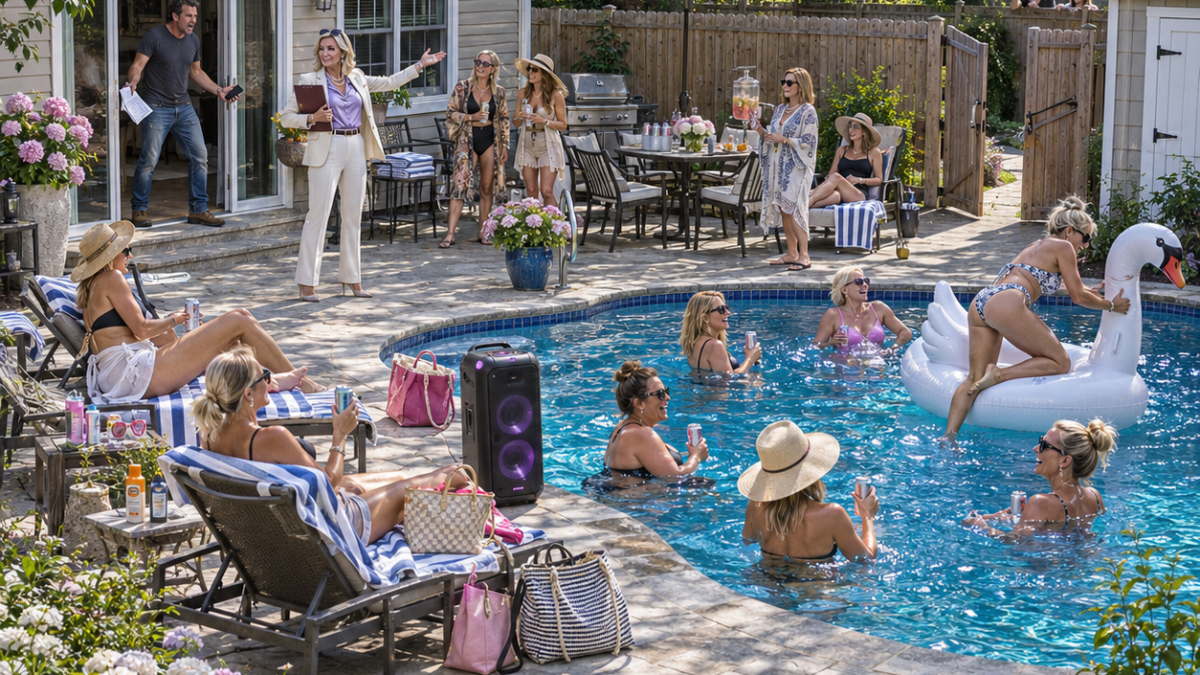
PART 2
I stared at the screen until the image blurred.
The meeting around me kept moving. Somebody was discussing delivery schedules. A project manager was asking me whether a contractor could finish by Friday. My boss said my name twice before I realized everyone at the table was waiting for an answer.
“Sorry,” I said, locking my phone. “Yes. Friday works.”
It absolutely did not work.
Nothing about that moment worked.
For the next forty minutes I sat in a conference room pretending to care about vendor delays while a stranger lounged beside the pool I had spent twenty years working toward.
By the time I got home, Karen was gone.
She had left an empty sparkling-water can on the patio table.
I picked it up and stood there holding it.
That little aluminum can bothered me more than it should have. It was evidence that she had been comfortable enough to sit there, drink, take pictures, and leave trash behind.
She wasn’t sneaking onto my property.
She was using it.
The following day, she came back.
Thursday she brought two friends.
At 12:42, all three walked through my side gate carrying towels and food.
At 12:49, one of them unfolded the same white inflatable swan.
At 1:03, Karen looked directly into the pool camera, raised both hands, and waved.
I saved the footage.
Friday morning I called the HOA.
Paul wasn’t available.
“Can I leave a message?”
His assistant hesitated.
“Is this about Karen and the pool?”
I stopped.
“How do you know about that?”
Another pause.
“She mentioned there was some confusion.”
“Confusion?”
“She said the previous owner allowed residents to use it.”
“That isn’t what happened.”
“Well, I’m just telling you what she said.”
“Is she telling people my private pool is an HOA amenity?”
“I don’t know exactly what she’s telling people.”
“That sounded very much like a yes.”
The assistant went quiet.
I drove to the HOA office that afternoon with screenshots, copies of my deed, and the recorded plat.
Paul was gone.
His assistant listened while I laid everything across the counter.
The longer I spoke, the less comfortable she looked.
When I played the clip of Karen waving at my camera, her expression changed.
“I’ll make a note for the board.”
“When does the board meet?”
“Three weeks.”
“She’s trespassing now.”
“I understand.”
“No. You understand that I’m upset. I’m asking whether the HOA understands that one of its board members is entering private property after being told not to.”
“I can’t answer for the board.”
I gathered my papers.
“Then don’t bother making a note.”
That evening, I sat at my kitchen table with every closing document spread around me.
Nothing supported Karen’s claim.
There was no recorded easement.
No shared-use provision.
No HOA right of access to my pool.
The declaration specifically listed the clubhouse pool as a common amenity.
Mine was just mine.
I checked anyway.
Twice.
That was the part Karen had already taken from me—the ability to trust something obvious.
A sane person looks at a fenced pool behind his house and knows it belongs to him.
I was sitting there at midnight reading legal descriptions because one woman had spoken with enough confidence to make facts feel negotiable.
I finally closed the binder.
“No more.”
The next morning, I replaced the gate hardware with a heavier locking system and mounted a bright sign beside it:
PRIVATE PROPERTY
NO TRESPASSING
POOL NOT AN HOA AMENITY
It was ugly.
I loved it.
For several days, the backyard stayed quiet.
I started sleeping normally again.
Then, Wednesday afternoon, my phone buzzed.
Karen was back.
This time I watched her enter.
She stopped outside the gate, removed a key from a pink keychain, inserted it into the lock, and opened it.
I nearly dropped the phone.
The replacement cylinder I had installed was the same manufacturer as the old one. Somehow, she had a working key.
Maybe the previous owner had duplicated more than one. Maybe Karen had access to several old keys. I didn’t know yet.
What I knew was that she hadn’t hesitated.
She walked to my lounge chair and sat down.
Then she waved at the camera again.
That night I enlarged the frame until I could see the pink tag hanging from her keychain.
K.P.
Karen Pemberton.
I called the previous homeowner.
His name was Arthur Bell. He was seventy-four and had moved to Arizona after his wife died.
He sounded confused when I asked about Karen.
“Karen Pemberton?”
“Yes.”
“Oh. She used to help with the pool.”
My grip tightened around the phone.
“Help how?”
“My wife got sick about four years ago. We traveled for treatments. Karen offered to check the water and let the pool company in.”
“Did you give her a key?”
Arthur went silent.
“I suppose I did.”
“Did you ever ask for it back?”
“I thought she returned it.”
“She didn’t.”
He sounded genuinely horrified.
“Tom, I am so sorry.”
“It isn’t your fault. I just needed to know.”
“There was never any community agreement. You know that, right?”
“Yes.”
“I mean it. Nobody had permission to swim there. Karen was supposed to open the gate for the service people when we were away.”
That changed something.
Until then, part of me had wondered whether Karen had convinced herself there was some historic right attached to the house.
There wasn’t.
She had been trusted with a key for one specific purpose and had gradually transformed that favor into ownership inside her own head.
The next day, I called my friend Ray, a locksmith I’d known through work for years.
“I need every exterior lock changed.”
“You lose your keys?”
“Worse.”
“Ex-wife?”
“HOA board member.”
There was a silence.
Then Ray laughed.
“I’ll bring the good stuff.”
He arrived Saturday morning.
By lunch, Karen’s old keys were useless.
Ray replaced the gate cylinder with a different system, reinforced the strike plate, adjusted the hinges, and looked at my filed latch.
“Somebody did this deliberately.”
“I know.”
“You report it?”
“To the HOA.”
Ray stared at me.
“The HOA isn’t law enforcement.”
“I know that too.”
He tested the gate.
“Now they’ll need to climb.”
“That’s reassuring.”
“It wasn’t meant to be.”
Three days later Karen appeared outside the gate.
She inserted one key.
Then another.
Then a third.
None worked.
I watched from my phone while she became visibly angrier.
Finally, she grabbed the bars with both hands and shook them.
Then she noticed the camera.
She stepped closer.
“You can’t lock me out forever.”
The microphone caught every word.
I saved that clip separately.
For a week, she stayed out.
Then I started finding things.
A damp towel draped over the back fence.
Footprints in the flower bed near a low section where an old tree leaned toward the property line.
My mailbox hanging open.
One morning, a pool chair had been moved six feet.
I reinforced the weak section of fencing and added another camera.
I also filed a nonemergency police report.
The officer who took the report was polite but careful.
“You have video of her entering?”
“Multiple times.”
“Have you clearly told her she isn’t allowed?”
“Yes.”
“Any threats?”
I played the clip.
You can’t lock me out forever.
He wrote something down.
“Keep the footage. If she comes back, call us while she’s there.”
It wasn’t the dramatic solution I wanted, but it was at least a record.
That Sunday, two coworkers came over for a barbecue.
Mike had spent weeks accusing me of exaggerating.
“Nobody does this,” he said as he stood at my grill. “Nobody just walks into somebody else’s pool.”
“You haven’t met Karen.”
“I’ve met difficult neighbors.”
“No. You’ve met amateurs.”
He laughed.
Twenty minutes later, his expression changed.
“Tom.”
I was cutting onions.
“What?”
He pointed through the kitchen window.
Karen was walking across my lawn.
She had apparently gotten over the back fence.
Mike stared at me.
“You weren’t exaggerating.”
“Nope.”
I walked outside.
“Karen.”
She turned.
No embarrassment.
No attempt to hide.
She was carrying a small pool-testing strip container.
“Oh, hi.”
“What are you doing?”
“Checking your water.”
“No, you’re not.”
“HOA maintenance.”
I looked at Mike, who had followed me outside.
Then back at Karen.
“This is not HOA property.”
“That’s your opinion.”
“It is literally on the recorded plat.”
She shrugged.
“You’re creating a lot of hostility over something everyone enjoyed before you moved here.”
“Everyone?”
“Neighbors.”
“Name them.”
Her jaw tightened.
“I don’t need to justify myself to you.”
“You’re standing in my backyard.”
“And I’ve been managing access around here longer than you’ve lived here.”
“Karen, listen carefully. You do not have permission to enter this property. Not through the gate. Not over the fence. Not for maintenance. Not to swim. Not to inspect anything. If you come back, I’m filing a trespass complaint.”
She laughed.
“You really think people are going to believe you over me?”
Mike shifted beside me.
Karen noticed him.
For the first time, a trace of uncertainty crossed her face.
“This neighborhood runs on relationships,” she said.
“Then yours are about to become very expensive.”
Her eyes narrowed.
She stepped closer.
“You don’t understand how things work here.”
“I think I’m starting to.”
“You’ll regret making this personal.”
“You climbed into my backyard. You made it personal.”
For several seconds neither of us moved.
Then she turned around, walked to the fence, and stopped.
Mike pointed toward the side gate.
“You can leave through there.”
Karen looked back at us.
I opened it from inside.
She walked out without another word.
Mike waited until she was gone.
“That woman is insane.”
“No.”
I looked at the closed gate.
“I think she knows exactly what she’s doing.”
That distinction mattered.
If Karen had simply been confused, another explanation might have solved the problem.
But confusion disappears when confronted with a deed, a lock, a sign, cameras, a police report, and the owner standing three feet away saying no.
Karen wasn’t confused.
She believed consequences were for other people.
Monday morning I returned to the HOA office.
This time Paul was there.
I dropped a USB drive onto his desk.
“Watch it.”
His expression tightened.
“Tom—”
“Watch it.”
He plugged it in.
Karen appeared on his monitor.
First the old key.
Then the repeated visits.
Then her climbing into the yard.
Finally, the confrontation.
You don’t understand how things work here.
Paul leaned back.
He rubbed both hands over his face.
“Well?”
He didn’t answer immediately.
“She’s on the budget committee.”
“What does that have to do with my pool?”
“She has influence.”
“So?”
“If I formally sanction her, she can force a board fight.”
I stared at him.
“You’re telling me you’re knowingly allowing a board member to trespass because you’re afraid she’ll make your job difficult.”
“That isn’t what I said.”
“It is exactly what you said.”
“Tom, I can send her a warning.”
“You already should have.”
“I’ll do it today.”
“And if she ignores it?”
“We’ll address it at the next board meeting.”
“When?”
“Two and a half weeks.”
I laughed once.
Not because anything was funny.
“Paul, she’s been in my backyard more times this month than some of my friends.”
“I understand your frustration.”
“You keep saying that.”
“Because I do.”
“No. If you understood, you’d stop her.”
His face hardened.
“I’m trying to preserve stability in this community.”
“Whose stability?”
He didn’t answer.
I stood.
“Send your letter.”
“Tom—”
“And send me a copy.”
He did.
Karen received a written notice telling her that the HOA had no documented access right to my lot and advising her not to enter without my permission.
I thought that might finally end it.
Instead, she taped a copy of the warning letter to my mailbox.
Across the top, in red marker, she’d written:
RIDICULOUS.
That was when my anger changed.
Until then, I had wanted her stopped.
Now I wanted her exposed.
Not hurt.
Not frightened.
Exposed.
There is a difference.
I went through every recording I had.
One detail kept appearing.
Sunscreen.
Karen never entered the pool without coating herself in it.
Same expensive bottle.
Same ritual.
Arms, shoulders, face.
I knew someone who might appreciate the absurdity.
Mason Alder had been my roommate in graduate school before our lives split in different directions. He stayed in academia and eventually became a chemistry professor. I went into industrial operations, where most of my scientific training got replaced by schedules, budgets, contractors, and people lying about why something wasn’t finished.
We hadn’t spoken in almost two years.
He answered on the fourth ring.
“Tom Harding.”
“Mason.”
“You need money or an alibi?”
“Neither.”
“Then this is serious.”
“I have an HOA problem.”
He started laughing.
“I’m hanging up.”
“I’m serious.”
That only made him laugh harder.
I told him everything.
The key.
The pool.
The cameras.
Paul.
The warning letter.
The fence.
When I finished, Mason went quiet.
“You’ve called the police?”
“Filed a report.”
“Good.”
“I need something else.”
“That sentence worries me.”
“I want something visible.”
“What does that mean?”
“I want her next trespass to prove itself.”
“No.”
“I haven’t even explained.”
“You called a chemist after saying the phrase next trespass. That’s enough explanation.”
“I don’t want to hurt her.”
“Good, because I’m not helping you hurt anybody.”
“I want the opposite. Harmless. Temporary. Something theatrical.”
Mason sighed.
“Tom.”
“She keeps coating herself in the same sunscreen.”
Another pause.
“You’ve noticed the brand?”
“I have video.”
“You are becoming a very strange man.”
“I was normal before the HOA.”
He laughed despite himself.
Then his voice became serious again.
“There are cosmetic and demonstration tracers that can create visible temporary color around certain oily products. I’m not giving you some homemade formula, and we’re not putting experimental chemicals into a swimming pool.”
“Agreed.”
“If anything happens, it has to be commercially approved for the use, non-toxic, reversible, and documented.”
“Agreed.”
“And if I tell you the idea is unsafe, you drop it.”
“Agreed.”
“You say that very quickly.”
“Because I mean it.”
Mason came over three days later.
He brought documentation, sample material, and the expression of a man who deeply regretted maintaining friendships from graduate school.
We worked in my garage.
Mostly, Mason worked.
I watched.
He refused to tell me anything I didn’t need to know about the chemistry, which was fine with me. The point wasn’t to become capable of reproducing it.
The point was to know that what we were considering wasn’t dangerous.
The tracer he ultimately selected was used for controlled cosmetic demonstrations. In the tiny test he performed, it became dramatically visible when it contacted the oily residue left by the sunscreen while remaining temporary and washable.
The test cloth turned green.
Bright green.
I stared at it.
Mason stared at me.
Then I started laughing.
He didn’t.
“I’m serious about the safety rules.”
“I know.”
“This isn’t poison.”
“I know.”
“It isn’t acid, bleach, or anything remotely like that.”
“I know.”
“If police ask, you tell them exactly what it is.”
“I will.”
“You keep the safety sheet.”
“I will.”
“And if anybody unexpected is there—especially a child—you do nothing.”
“Absolutely.”
Mason looked at the green cloth again.
“I cannot believe I’m involved in this.”
“You’re involved because you love science.”
“I’m involved because apparently I make terrible choices in friends.”
We ran additional tests.
Not recipes.
Not experiments on people.
Just enough to establish that the material was what its documentation said it was: temporary, washable, and not expected to cause injury under the intended conditions.
I took photographs of the product label and documentation.
Mason made me retain the original packaging.
“You know what you’re actually building here?” he asked.
“A trap?”
“Evidence.”
That word stayed with me.
Evidence.
The color didn’t matter nearly as much as the camera.
If Karen obeyed the trespass warning, nothing happened.
If she stayed outside my fence, nothing happened.
If she respected one simple boundary, the entire plan died quietly.
The only way anything occurred was if she entered my property again.
That was the part I could live with.
I called Jim Alvarez, a retired teacher who lived two houses down.
Jim had been friendly since I moved in. More importantly, he disliked Karen for reasons he had never fully explained.
I told him the broad version.
“I need a witness.”
“To what?”
“If Karen comes into my yard again.”
“She will.”
“You sound confident.”
Jim snorted.
“That woman once measured my mailbox because she thought it was three-quarters of an inch too tall.”
“Was it?”
“That’s not the point.”
I told him I was arranging a harmless visual demonstration and that everything would remain on camera.
He was silent for a while.
“You sure it can’t hurt anybody?”
“Yes.”
“And police can inspect whatever you’re using?”
“Yes.”
“Then I’ll watch.”
Saturday arrived hot and clear.
I cleaned the pool that morning.
It was almost absurd.
For weeks, I had hated looking at it.
The pool had been the reason I bought the house, and Karen had transformed it into the part of the property I dreaded most.
Every chair looked contaminated by memory.
Every splash made me glance toward the fence.
I wanted it back.
Before noon, I checked every camera.
One faced the gate.
Another covered the pool.
A third captured most of the deck.
The fourth covered the section of fence Karen had previously climbed.
Jim had a view from his property.
Then I waited.
Noon passed.
Then one.
At 1:14, my phone vibrated.
Jim.
MOVEMENT.
I opened the camera feed.
Karen appeared at the side of my property.
Wide-brimmed hat.
Large sunglasses.
Beach bag.
For a second, she stood beside the NO TRESPASSING sign.
The camera captured both her face and the sign in the same frame.
I remember thinking that if this ended up in front of a judge, I couldn’t have staged a cleaner image.
She looked at the gate.
Locked.
Then she walked around the side.
A minute later, the rear camera caught her climbing through the same area she had used before.
Two friends followed.
One carried the pink flamingo.
My pulse hammered against my ribs.
I didn’t go outside.
That was important.
I wasn’t going to create a confrontation that Karen could reinterpret.
The cameras would do the talking.
She spread her towel across my lounge chair.
One friend opened a cooler.
The other inflated the flamingo.
Then Karen looked toward the camera.
She smiled.
And waved.
My hands stopped shaking.
That gesture removed the last bit of doubt.
She knew.
She knew she was being recorded.
She knew she had been warned.
She knew she had no permission.
And she had come anyway because she believed the recording itself proved how untouchable she was.
Karen removed her hat.
Then the sunscreen came out.
She coated her shoulders and arms.
A few minutes later, she stepped into the pool.
At first, nothing happened.
I wondered if Mason and I had been completely wrong.
Then Karen rubbed one forearm.
A faint green mark appeared.
She frowned.
She rubbed again.
The mark spread.
One of her friends laughed.
“What did you get on yourself?”
“I don’t know.”
Karen splashed water over her arm.
More green appeared where sunscreen residue had mixed with the tracer.
Her friend stopped laughing.
“What is that?”
Karen looked down.
The surface around her had picked up streaks of color.
Not the whole pool.
Nothing remotely like some radioactive movie scene.
Just enough vivid green around the sunscreen-coated areas to be unmistakable.
Then Karen screamed.
“What the hell?”
Her second friend scrambled out.
Karen rubbed at her shoulder.
The color smeared.
“Oh my God!”
She climbed onto the deck, grabbed a white towel, and wiped her arm.
The towel came away green.
That was when panic became rage.
She looked directly toward my house.
“TOM!”
I remained inside.
She grabbed her phone.
Within seconds, she was recording herself.
“He put chemicals in the pool!”
I watched through the camera.
Her friend said, “Whose pool is this?”
Karen shot her a look.
That tiny exchange became one of my favorite pieces of footage later.
Karen kept filming.
“Call the police! I’m being poisoned!”
I stepped onto the patio.
“Karen.”
She spun around.
“What did you do to me?”
“You’re trespassing.”
“What did you put in this water?”
“A commercially labeled, non-toxic cosmetic tracer.”
“You poisoned me!”
“No.”
“Look at my skin!”
“It washes off.”
“You attacked me!”
“You entered a locked, posted backyard after being told repeatedly not to.”
Her phone was inches from my face.
“You planned this.”
“Yes.”
Her eyes widened.
She hadn’t expected me to admit it.
“I planned to document the next time you trespassed.”
“You’re insane.”
“Maybe. But you’re still in my yard.”
Neighbors had begun appearing.
Jim stood near his driveway holding his phone.
Someone across the street was looking over a fence.
Karen’s friends had wrapped themselves in towels.
One of them whispered, “Karen, you said he was okay with us being here.”
Karen snapped around.
“Shut up.”
That sentence mattered too.
Sirens arrived several minutes later.
Two officers entered through the front.
One was Officer Ruiz, who had taken my earlier report.
He looked from me to Karen to the green-streaked towel.
His face remained professionally blank, but I could almost hear the question forming.
What now?
Karen reached him first.
“He poisoned us!”
Ruiz held up one hand.
“Ma’am, give me a second.”
“He put chemicals in his pool knowing we were coming.”
Ruiz looked at me.
“Mr. Harding?”
“I have the product documentation inside.”
“You admit you put something in the water?”
“Yes. A non-toxic cosmetic tracer. The labeled container and safety information are on my kitchen table.”
Karen almost seemed disappointed that I wasn’t lying.
Ruiz turned back to her.
“How did you enter the property?”
She blinked.
“What?”
“The gate is locked.”
“That doesn’t matter.”
“It matters to me.”
“I’m an HOA board member.”
Ruiz looked toward the NO TRESPASSING sign.
“Does the HOA own this lot?”
“No, but—”
“Do you have permission from Mr. Harding to be here?”
“He can’t just—”
“Ma’am. Yes or no?”
Karen’s friend answered before she could.
“No.”
Karen glared at her.
Ruiz’s partner walked to the rear fence and photographed the area where they had entered.
Then Ruiz asked to see my footage.
We watched it on my tablet.
Karen approaching the locked gate.
Karen standing beside the sign.
Karen walking around the fence.
Karen climbing in.
Karen’s friends following.
Karen waving at the camera.
Karen applying sunscreen.
Karen entering the pool.
The color appearing.
Ruiz watched the entire sequence without saying much.
Finally, he looked at Karen.
“You were previously warned not to enter?”
“I don’t recognize the HOA’s authority to take away established access.”
“That isn’t what I asked.”
She crossed her arms.
“My attorney will handle this.”
“That’s your right.”
Then he looked at me.
“We’re going to need the product container and the recordings.”
“I expected that.”
Karen laughed bitterly.
“Of course you did.”
“Yes.”
That answer seemed to make her angrier than anything else.
The officers photographed everything.
The warning sign.
The gate.
The fence.
The tracer packaging.
The towels.
They took statements from Jim and Karen’s two friends.
One friend, a brunette named Linda, looked miserable.
“I thought this was allowed,” she told Ruiz.
“Who told you?”
She looked at Karen.
Karen said, “Don’t answer that.”
Ruiz immediately turned.
“Ma’am, don’t instruct witnesses.”
“I wasn’t.”
“I heard you.”
The balance of power shifted almost visibly.
Karen had spent weeks operating in a world where the loudest version of events became the official one.
That afternoon, nobody cared how loudly she spoke.
They cared about timestamps.
Signs.
Property records.
Camera angles.
Previous warnings.
She could argue with me.
She couldn’t argue with 1:14:32 p.m.
She couldn’t negotiate with video.
By the time the officers left, Karen had stopped filming.
She stood at the edge of my driveway with green streaks still visible on her arms.
“You’re going to regret this.”
Ruiz heard her.
He turned.
“Ms. Pemberton.”
She looked at him.
“I strongly recommend you stop making statements that can be interpreted as threats.”
For once, Karen said nothing.
I went inside.
My kitchen looked exactly as it had that morning.
Coffee mug in the sink.
Mail on the counter.
A dish towel hanging crooked from the oven.
Ordinary things.
I sat at the table and suddenly felt exhausted.
I had imagined the moment for days.
In my head, I had expected satisfaction.
Instead I felt relief mixed with embarrassment.
I had reached the point where reclaiming my swimming pool required security cameras, police reports, a retired teacher acting as a witness, and a chemistry professor insisting I maintain product documentation.
That wasn’t victory.
Not yet.
My phone buzzed.
Jim.
YOU OKAY?
I typed:
YEAH.
Then another message appeared.
NEIGHBORHOOD GROUP IS EXPLODING.
I opened it.
Someone had already uploaded a short clip.
Karen climbing out of my pool with green streaks on her arms.
Another neighbor had posted the wider security-camera angle showing the NO TRESPASSING sign.
Comments multiplied faster than I could read them.
At first, people were confused.
Then someone asked the obvious question.
Why was Karen in Tom’s private pool?
Another person responded:
She told us it was community access.
Someone else:
It has never been community property.
Then Rita Coleman, a woman I’d met twice, wrote:
Karen has been telling people she controls access to several private lots. She did the same thing with the walking path behind my house.
That comment changed the conversation.
The pool stopped being the whole story.
Neighbors began comparing experiences.
Unauthorized notices.
Selective fines.
Keys Karen wasn’t supposed to have.
Contractors she had supposedly hired.
HOA expenditures nobody remembered approving.
I closed the app.
This was exactly what I had wanted—attention on her behavior.
Yet watching it spread made me uneasy.
Public humiliation has momentum.
Once released, it doesn’t belong to anyone.
By dinner, people were making jokes about Karen turning green.
I didn’t share them.
I didn’t need to.
The useful part wasn’t her color.
It was what everybody could see before the color appeared.
She had climbed into a posted, locked backyard.
On camera.
After written notice.
That was enough.
Two days later, Officer Ruiz called.
“The material came back consistent with the documentation you provided. We don’t have evidence anyone was exposed to a harmful substance.”
I leaned against my desk.
“Okay.”
“Ms. Pemberton wants charges.”
“Against me?”
“Yes.”
“For what?”
“She described it as a chemical assault.”
“And?”
“The report will reflect her complaint. It will also reflect that the substance was non-harmful and that she entered private property after being warned not to.”
“So what happens?”
“That’s up to the prosecutor. But separately, we have a stronger trespassing case now.”
I closed my eyes.
For weeks, I had imagined hearing those words.
They weren’t exciting.
They were simply calming.
“Thank you.”
“Mr. Harding?”
“Yeah?”
“Don’t escalate anything else.”
“I won’t.”
“I’m serious.”
“So am I.”
I meant it.
The plan had done what it needed to do.
Now I wanted paperwork.
Karen wanted theater.
The next evening, she provided plenty.
She started a live broadcast from her driveway.
I didn’t watch it live.
Jim sent me the recording.
Karen stood in front of her house describing me as dangerous, unstable, and obsessed with revenge.
Then she made a mistake.
She said, “I had every right to use that pool. I had used it for years before he came here.”
There it was.
An admission.
Not misunderstanding.
Not accidental entry.
Repeated use.
Jim called me.
“Did you hear that?”
“Yep.”
“She just admitted it.”
“Yep.”
“You sound disappointed.”
“I think I’ve reached my lifetime limit for Karen Pemberton.”
“You moved here two months ago.”
“Exactly.”
The HOA scheduled an emergency meeting for Thursday.
Paul called me personally.
“I’d like you to attend.”
“I’ve attended enough conversations where nobody listened.”
“This one will be different.”
“Why?”
He hesitated.
“Because people are asking questions.”
There was fear in his voice.
Not fear for me.
Fear for the board.
I went.
The clubhouse meeting room was packed.
Usually, according to Jim, an HOA meeting attracted twelve homeowners and three people who came only to complain about landscaping.
That night, nearly every chair was occupied.
Karen sat at the board table beside Paul.
She looked different without the sun hat.
Smaller somehow.
Still angry.
Still composed.
But not in control.
Paul opened the meeting.
“We’re here to address concerns regarding property access, board conduct, and community policies.”
Karen leaned toward her microphone.
“We’re here because a resident deliberately placed a chemical agent in water to target me.”
Murmurs spread through the room.
Paul stiffened.
“Karen, you’ll have time.”
“I should have time now. I was attacked.”
A man near the back called out, “Why were you in his pool?”
Someone else said, “Answer that.”
Karen’s face tightened.
“I had longstanding access.”
I raised my hand.
Paul nodded.
“Tom.”
I stood.
“Can the board identify any recorded easement, covenant, license, or HOA rule that grants Karen access to my pool?”
Paul stared at the papers in front of him.
“No.”
Karen interrupted.
“The previous owner—”
“The previous owner gave you a key to let maintenance workers in while his wife was receiving medical treatment.”
Her head snapped toward me.
I continued.
“I spoke to him.”
The room went quiet.
“Arthur Bell confirmed there was never any community access agreement. He believed you returned the key.”
Karen’s mouth opened.
Nothing came out.
I placed a signed email from Arthur on the table.
Paul read it.
Then passed it to the board member beside him.
Karen whispered, “This is ridiculous.”
Rita stood.
“No, what’s ridiculous is you telling me last year that the strip behind my fence belonged to the HOA.”
Karen looked at her.
“What does that have to do with this?”
“Maybe nothing. Maybe everything.”
Another homeowner stood.
Then another.
Within twenty minutes, the meeting stopped being about my pool.
People had stories.
Most were small.
That’s how patterns often hide.
A disputed landscaping charge.
A contractor appearing without authorization.
A gate code being shared.
An HOA social event that cost far more than expected.
A maintenance invoice nobody remembered voting on.
One man named Gary held up a folder.
“I asked for copies of the clubhouse renovation invoices six months ago.”
Paul looked uneasy.
“Gary—”
“You told me they weren’t ready.”
“They were being reconciled.”
“Are they ready now?”
Karen said, “This has nothing to do with Tom’s situation.”
Gary looked directly at her.
“You’re the treasurer.”
The room changed.
I hadn’t known that.
I knew Karen sat on the budget committee.
I hadn’t understood that she also controlled much of the board’s financial reporting.
Paul called for order.
Nobody listened.
Finally, a board member named Denise spoke.
“I move that we commission an independent review of access records and discretionary spending for the previous three fiscal years.”
Karen turned toward her.
“Absolutely not.”
Denise looked back.
“Why?”
“Because you’re reacting emotionally to internet gossip.”
“No,” Denise said. “I’m reacting to homeowners asking questions we should be able to answer.”
Karen pushed back from the table.
“This board has functioned perfectly well for fifteen years.”
Jim whispered beside me.
“That’s the sentence people say right before an audit.”
He was right.
The motion passed.
Four to one.
Karen was the one.
Afterward, she cornered me outside.
“You did this.”
“I asked you to stay out of my pool.”
“Don’t pretend this is about a pool anymore.”
“It wasn’t my decision to audit you.”
“You humiliated me.”
“You climbed a fence in front of a camera.”
Her face reddened.
“You think these people are your friends now?”
“No.”
“They’ll turn on you too.”
“Maybe.”
“You don’t belong here.”
That hit harder than I expected.
Not because I believed her.
Because I’d spent two decades working toward a home where I could finally stop feeling temporary.
Apartments.
Transfers.
Rental houses.
Long commutes.
A divorce that had forced me to start saving almost from zero again.
That backyard was supposed to be proof that I had finally reached something permanent.
Karen had sensed exactly where to press.
I looked at her.
“You keep confusing being here longer with owning more.”
She stepped closer.
“This community existed before you.”
“And my property still belongs to me.”
I walked away.
Three days later, I received a letter from Karen’s attorney.
CEASE AND DESIST.
It demanded that I stop distributing footage, stop making defamatory statements, preserve evidence, and prepare for potential civil litigation.
I called an attorney of my own.
Her name was Rebecca Sloan.
She read Karen’s letter.
Then she read my documents.
Then she watched approximately twenty minutes of security footage.
Finally, she took off her glasses.
“Do you enjoy collecting evidence?”
“I enjoy being left alone.”
“You may have chosen the wrong neighborhood.”
“So I’ve discovered.”
She tapped the stack of documents.
“The good news is you’ve preserved this unusually well.”
“What about the dye?”
“The fact that it was non-harmful does not magically make every legal question disappear. Don’t get casual about that.”
“I haven’t.”
“Good. But her trespass is also extremely well documented, including prior notice.”
“What should I do?”
“Nothing dramatic.”
“That’ll be refreshing.”
“Save everything. Do not contact her. Do not discuss her finances publicly. Do not answer social-media accusations. Let the HOA conduct its audit.”
“And the police?”
“Cooperate.”
That became my life.
Work.
Home.
Save evidence.
Ignore Karen.
For a few days, she disappeared.
Then one morning I found a ceramic flowerpot shattered beside my front steps.
The camera covering the driveway had been turned slightly the previous night.
Not enough to prove who did it.
Enough to make me uncomfortable.
I sent the footage to Rebecca.
She replied with two words.
Save it.
An anonymous number texted later:
YOU STARTED SOMETHING YOU CAN’T FINISH.
I saved that too.
I didn’t sleep well that night.
For all the jokes and neighborhood gossip, this was the part nobody saw.
I checked doors twice.
I watched headlights through the blinds.
A branch scraping the fence made me sit up at 2:00 a.m.
Karen had invaded more than my backyard.
She had gotten inside my routines.
Inside the quiet.
The next morning, Jim appeared with two coffees.
“You look terrible.”
“Thanks.”
“Compliment.”
He sat beside me on the deck.
The pool was calm.
“Ever wish you’d just ignored her?”
I thought about it.
“Yes.”
He seemed surprised.
“Really?”
“Of course. I wish I had bought the house and never learned her name.”
“That’s not what I meant.”
“I know.”
I took a sip of coffee.
“No, I don’t regret stopping her. But I’m tired of winning arguments I never wanted to have.”
Jim nodded.
“That makes sense.”
For a while, we sat silently.
Then he pointed at the water.
“Still a nice pool.”
I laughed.
“That’s the most expensive compliment I’ve ever received.”
The HOA audit began the following week.
At first, nothing happened publicly.
Then Paul called me.
His voice sounded wrong.
Not defensive.
Not polished.
Just exhausted.
“Tom, can I ask you something?”
“Sure.”
“Did Arthur Bell ever mention paying Karen directly for pool maintenance?”
“No.”
“Any reimbursement through the HOA?”
“No.”
He exhaled.
“Okay.”
“Why?”
“I can’t discuss it yet.”
“Then why did you call?”
Another silence.
“Because I owe you an apology.”
I sat down.
That was unexpected.
“For what?”
“When you first came to me, I knew Karen had a history of overstepping.”
“You knew?”
“I knew she was aggressive about access and enforcement.”
“And you told me to pick my battles.”
“I was trying to avoid another fight.”
“You avoided it by giving it to me.”
“I know.”
The words were quiet.
Not enough to erase what had happened.
But real.
“What’s going on, Paul?”
“I can’t tell you yet.”
“Then tell the auditors.”
“I already did.”
Two days later, Denise knocked on my door.
She was carrying a binder.
“I can’t give you details from the audit,” she said, “but I need a copy of every communication you had with Paul and Karen involving maintenance.”
“Why?”
“We’re trying to establish a pattern.”
“What kind?”
She hesitated.
“Karen has been approving vendors.”
“As treasurer?”
“Sometimes without proper authorization.”
I thought of the pool-maintenance worker she had sent to my house.
The young guy with the skimmer.
I had nearly forgotten him.
I found the camera footage.
There he was.
He had entered my yard and told me Karen had hired him because she was the owner.
Denise watched it twice.
“Can you identify the company?”
His shirt had a logo.
BLUECREST POOL & LANDSCAPE.
Denise wrote it down.
“What is it?”
“I can’t say yet.”
“Denise.”
She looked at me.
“That company has billed the HOA.”
“For what?”
“That’s what we’re trying to determine.”
The next morning, Rebecca called.
“Do not post anything.”
“I haven’t.”
“Good.”
“Why?”
“Because whatever this is, it’s no longer neighborhood drama.”
That afternoon, the HOA sent an email announcing that several board members had temporarily surrendered financial authority pending review.
Karen immediately posted that she was the victim of a politically motivated attack.
Then residents started receiving copies of old financial reports.
Someone had requested them under the association’s records policy.
One expense kept appearing.
Community landscape consulting.
Another:
Pool and recreational maintenance.
Another:
Special access services.
The amounts weren’t huge individually.
A few hundred.
A thousand.
Two thousand.
But they appeared again and again.
Companies changed names.
Addresses repeated.
Descriptions were vague.
Gary, the homeowner who had challenged Karen at the meeting, showed me a spreadsheet he’d created.
“You see this?”
He pointed to an address.
“Bluecrest.”
Then another vendor.
“Same mailing address.”
A third.
Same again.
My stomach tightened.
“How much?”
“Across what I’ve found? Around thirty thousand.”
“That’s impossible.”
“No. What’s impossible is that nobody checked.”
The full number ended up being almost twice that.
Roughly sixty thousand dollars in unsupported, misdirected, or suspicious expenditures across several years.
Some might have had legitimate explanations.
Others absolutely did not.
The independent accountant turned the findings over to the association’s attorney.
The association’s attorney contacted the county.
And suddenly Karen’s battle over my pool looked incredibly small.
Paul resigned.
His email cited health and family concerns.
Nobody believed that was the entire reason.
Denise became interim president.
Karen was suspended from all board responsibilities pending investigation.
Her social-media activity changed overnight.
No more green jokes.
No more livestreams from the driveway.
No more accusations about me.
Silence.
Then, early one morning, two officers knocked on my door.
Officer Ruiz was one of them.
I opened it.
“Please tell me nobody is swimming.”
He almost smiled.
“No.”
“Good.”
“What happened?”
“Ms. Pemberton filed a formal criminal complaint concerning the pool incident. A detective needs a full recorded interview.”
“I already gave everything.”
“I know. This is procedural.”
My stomach tightened anyway.
At the station, a detective named Harris sat across from me.
He had Mason’s documentation, the laboratory analysis of the tracer material, and copies of the videos.
“Did you put this substance in your pool because you expected Ms. Pemberton to enter?”
“Yes.”
“Did you intend to injure her?”
“No.”
“Did you believe the product could injure her?”
“No. I specifically selected something documented as non-toxic and temporary.”
“Why?”
“To make her trespassing visible.”
Harris looked at me.
“You understand why that sounds strange.”
“Detective, the entire story is strange.”
He almost smiled.
“Fair.”
We went through everything.
I didn’t minimize.
I didn’t pretend the tracer appeared by accident.
I explained Mason’s role.
The product documentation.
The safety testing.
The cameras.
Karen’s prior entries.
The warning letter.
The police report.
The NO TRESPASSING sign.
The locked gate.
Her climbing the fence.
Harris watched the footage again.
Then he froze the frame where Karen stood beside the sign.
“That’s fairly clear.”
“Yes.”
He moved forward.
Karen climbing the fence.
Karen waving at the camera.
Karen telling her friends they had access.
Then the color.
Harris shut the laptop.
“The substance was tested. We have no evidence it was toxic or caused injury.”
I waited.
“The prosecutor will make any final charging decision, but I’m not seeing evidence that supports the assault allegation as she described it.”
I let out a breath.
“What happens to her?”
“Different question.”
He tapped another folder.
“Her trespassing is documented. Multiple incidents.”
“And the HOA money?”
He looked at me carefully.
“I can’t discuss another investigation.”
That answer told me enough.
When I left the station, Karen was outside.
I don’t know why.
Maybe her attorney had brought her.
Maybe she’d been interviewed too.
She stood beside a white SUV.
For a second, neither of us spoke.
Then she walked toward me.
“You ruined my life.”
I stopped.
“No.”
“You started this.”
“I told you to stay out of my pool.”
“You think this is funny?”
“No.”
Her voice broke slightly.
That surprised me more than the anger.
“You have everybody treating me like a criminal.”
I looked at her.
“Karen, I didn’t make those transactions.”
Her face changed.
“You don’t know anything about that.”
“Then explain them to the auditors.”
“I don’t owe you an explanation.”
“No. You don’t.”
I walked past her.
She called after me.
“You think you won?”
I stopped.
Turned.
“I wanted a quiet backyard.”
That was all I said.
Months passed before the legal pieces settled.
Karen’s chemical-assault complaint went nowhere.
The trespass case did.
So did the financial investigation.
The final outcome was less dramatic than the neighborhood rumors predicted and far more serious than Karen had expected.
Her attorney negotiated.
Some allegations were resolved without trial.
Others became civil restitution issues involving the association.
She received probation tied to the criminal matters that survived review and was ordered to repay money connected to the HOA investigation.
My own property dispute ended with an enforceable no-contact and stay-away order, along with $8,500 covering documented damage, security costs, and portions of my legal expenses.
I didn’t feel victorious when Rebecca called.
“You’re done,” she said.
“Done?”
“As far as the property case goes. She can’t come onto your lot or contact you directly.”
I sat at my kitchen table.
The same table where months earlier I had spread out the deed because Karen had made me question whether my own pool belonged to me.
“What do I have to do?”
“Nothing.”
That word sounded beautiful.
Nothing.
No camera footage to review.
No HOA meeting.
No attorney letter.
No argument.
No plan.
Nothing.
The association elected a new board.
Denise stayed on as president.
One of her first actions was requiring a complete inventory of every HOA key, gate code, vendor account, and access credential.
The board also adopted a rule that should never have needed to exist:
No board member could enter an owner’s private lot without explicit permission except in a genuine emergency authorized under the governing documents.
Jim read the notice at my kitchen counter.
“They made a Tom rule.”
“They made a common-sense rule.”
“Named after you spiritually.”
“I don’t want any rules named after me.”
“You also didn’t want a green trespasser.”
“Life is full of disappointments.”
Paul moved away the following spring.
Before he left, he stopped by.
He stood awkwardly on my porch with his hands in his jacket pockets.
“I should’ve stopped this at the beginning.”
“Yes.”
He looked surprised by how quickly I answered.
I wasn’t trying to punish him.
I just didn’t want to make his apology easier by pretending it wasn’t true.
He nodded.
“I was afraid of her.”
“I know.”
“She knew things about everybody. Who was behind on dues. Who had violations. Who wanted board approval. She’d been there so long that fighting her felt harder than tolerating her.”
“And every time you tolerated her, somebody else paid for it.”
“I know.”
We stood there for a moment.
Finally, he said, “I’m sorry.”
“Thank you.”
That was enough.
Not forgiveness exactly.
Closure.
Karen’s house went on the market several weeks later.
The FOR SALE sign appeared one Thursday morning.
By Saturday, everyone knew.
Nobody organized a farewell.
Nobody publicly celebrated either.
The neighborhood seemed exhausted by her.
She moved out quietly.
The strangest moment came the day before the moving truck arrived.
I was cleaning leaves from the pool when I heard a vehicle slow outside.
Karen’s white SUV.
It stopped.
I straightened.
She remained behind the wheel.
The stay-away order meant she couldn’t approach, and she didn’t.
For several seconds she looked toward my house.
Then toward the backyard fence.
I couldn’t read her expression from that distance.
Anger, maybe.
Regret.
Embarrassment.
Possibly nothing.
Then she drove away.
That was the last time I saw her.
The new owners were a couple named Mark and Elena with two children.
They introduced themselves one Saturday.
Mark looked toward my backyard.
“So you’re the pool guy.”
I closed my eyes.
“Please tell me that story isn’t still circulating.”
Elena laughed.
“Only a little.”
Mark raised both hands.
“For the record, we have no interest in your pool.”
“Best neighbors I’ve ever had.”
“We’ve known you twelve seconds.”
“Strong start.”
They turned out to be exactly what I had wanted from neighbors.
Friendly.
Private.
Normal.
Their kids occasionally kicked a soccer ball into my yard.
They knocked before retrieving it.
The first time it happened, their eight-year-old son stood on my porch holding his hands behind his back.
“Mr. Harding, can I get my ball?”
I almost laughed.
“Of course.”
He waited for me to open the gate.
A child understood in five seconds what Karen had spent months pretending not to understand.
Permission.
By late summer, the pool felt like mine again.
Not legally.
It had always been mine legally.
Emotionally.
That took longer.
For months, even after Karen left, I would hear a splash from somewhere in the neighborhood and glance toward the window.
Sometimes my phone vibrated and my stomach tightened before I remembered the backyard motion alerts were no longer set to scream at every bird.
I gradually stopped checking.
One evening, Mason visited.
He stood on the deck holding a beer and staring at the perfectly blue water.
“No green?”
“Retired.”
“Shame.”
“You almost had a nervous breakdown during that plan.”
“I was worried about you.”
“Same thing.”
He sat in the chair Karen used to claim.
I noticed that and smiled.
“What?” he asked.
“Nothing.”
“You’re doing that weird sentimental thing.”
“I was just thinking this chair used to make me angry.”
“It’s furniture.”
“Exactly.”
Jim came over later.
Then Mark and Elena.
For the first time since I bought the house, I had people around the pool because I had invited them.
That difference was everything.
Nobody assumed.
Nobody demanded.
Nobody brought up Section Nine.
Nobody told me my property belonged to the community.
At sunset, Jim raised his drink.
“To Tom’s pool.”
I groaned.
“No speeches.”
“That was the whole speech.”
“Acceptable.”
Mason pointed toward the water.
“Still think buying a house was a good idea?”
I considered everything.
The lawyers.
The cameras.
The HOA meetings.
The police interviews.
The green towel I still kept sealed in an evidence bag in the garage because Rebecca had told me never to throw anything away.
Then I looked around.
My friends were laughing.
The gate was closed.
Not barricaded.
Not guarded.
Just closed.
“Yes,” I said.
“I do.”
Later, after everyone left, I stayed outside.
The neighborhood had gone quiet.
Somewhere beyond the fence, a sprinkler clicked.
A dog barked once and stopped.
The pool surface reflected the last orange light of the evening.
Months earlier, I had stood in that same place staring at ripples left by strangers and wondering how my dream home had become a place where I felt exposed.
Now there was one glass on the table.
Mine.
One towel over the chair.
Mine.
And one set of wet footprints along the deck from the swim I had taken before dinner.
Also mine.
I walked to the side gate.
For a long time, that gate had represented everything that had gone wrong.
The filed latch.
Karen’s key.
The threats.
The cameras.
The warnings.
I unlocked it.
Opened it.
Then closed it again.
The latch clicked cleanly into place.
I didn’t pull on it twice.
I didn’t check the camera.
I simply walked back toward the pool.
The evening light turned the water gold for a few seconds before the sun disappeared behind the houses.
Then it became blue again.
Exactly the way I remembered it from the first day I saw the house.
And for the first time since I moved in, there was nobody in my backyard who hadn’t been invited.
[END OF STORY]








