PART 2: HOA Karen Kept Stealing My Solar Power for Her Tesla—Then I “Changed the Voltage” and Ended Her 10-Year Reign
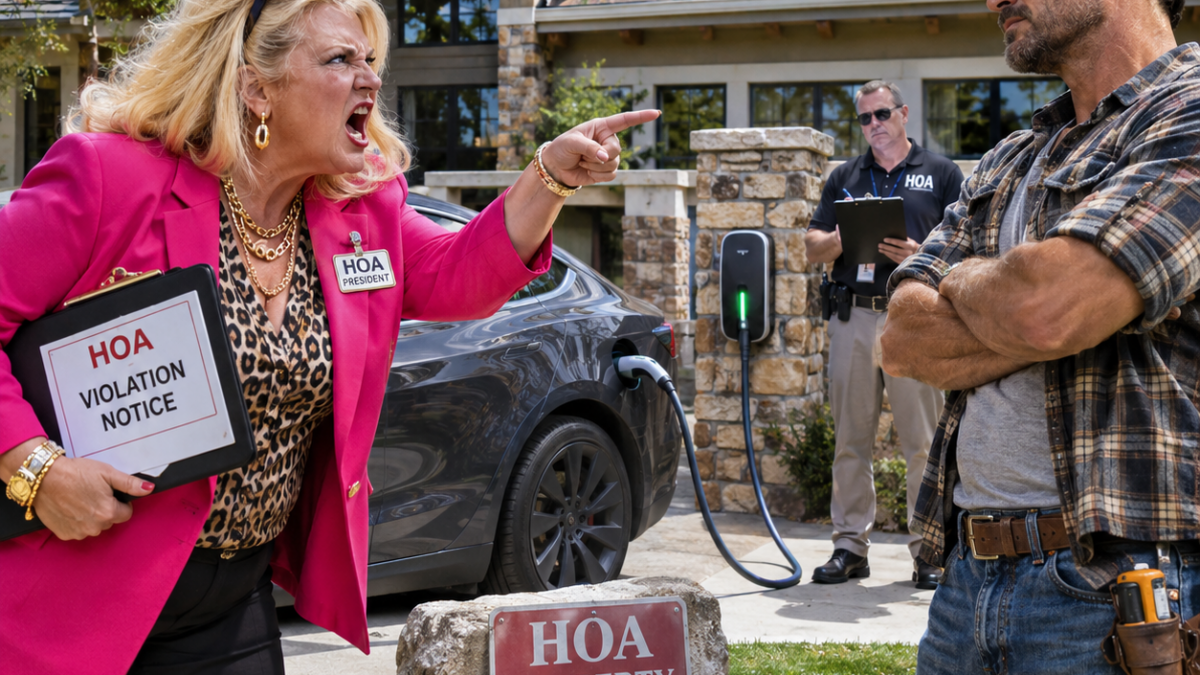
PART 2
I did not sleep much that night.
Every time I closed my eyes, I saw the green charging indicator pulsing in the darkness.
Not because it was dramatic.
Because it was casual.
That bothered me more than anything.
Someone sneaking onto your property once might be desperate.
Someone doing it repeatedly and leaving a charging cable stretched across your patio is comfortable.
Melissa was comfortable.
By six in the morning, I was making coffee.
By seven, I had downloaded twelve months of utility statements.
I started with January.
Normal.
February.
Normal.
March.
Normal.
Then April.
Three hundred twenty dollars.
May.
Five hundred forty.
June.
Eight hundred forty-seven dollars and sixteen cents.
I stared at the dates.
Melissa had bought the Tesla in March.
I remembered the neighborhood post.
She had uploaded a photograph of herself standing beside it with one hand on the hood.
Her caption had been something about “investing in a cleaner future.”
At the time, I had liked the post.
Now I opened Excel.
Old habits.
Month.
Solar production.
Total grid consumption.
Expected household consumption.
Excess load.
Estimated cost.
I compared everything against the previous year.
The numbers were ugly.
Roughly twenty-eight hundred kilowatt-hours of additional usage over three months.
Enough energy to charge a Tesla Model Y dozens of times.
Depending on charging conditions and rates, the financial loss was already well over a thousand dollars.
I saved the spreadsheet.
**Ramirez Theft Analysis V1.**
Then I sat back.
I could have gone next door right then.
Instead, I searched utility theft laws and complaint procedures.
Not because I wanted Melissa arrested.
Because I wanted to understand the stakes before I moved.
That distinction matters.
People think knowledge makes you aggressive.
Usually it makes you calmer.
You stop imagining.
You start measuring.
Around noon, I walked to the neighborhood mailboxes.
Dave Collins from number fifteen was there.
Dave was a general contractor in his late forties with weathered hands and the permanent squint of a man who spent too much time looking into Arizona sunlight.
He looked at me.
“You look terrible.”
“Thanks.”
“Bad night?”
“You could say that.”
Normally, I would have kept quiet.
But Melissa’s greatest advantage was that every problem involving her seemed isolated.
One homeowner had a fine.
Another had a complaint.
Someone else got pressured at a board meeting.
Nobody compared notes.
So I told Dave.
The bill.
The cable.
The Tesla.
Midnight.
His expression changed.
He glanced toward Melissa’s house.
Then lowered his voice.
“You know the Jenkins family?”
“No.”
“Number nineteen. Moved last fall.”
“I remember the moving truck.”
“They had solar.”
I waited.
“About eighteen months ago their electric bills went crazy.”
Something cold moved through me.
“How crazy?”
“Couple hundred extra some months.”
“What happened?”
“They had technicians out.”
“Find anything?”
“No.”
Dave looked toward me.
“Melissa told them their inverter was probably bad.”
“Melissa told them?”
“She was always involved.”
“Why?”
“Because they complained.”
He shrugged.
“Then suddenly they started getting HOA notices.”
“For what?”
“Grass.”
“Paint.”
“Guest parking.”
“One week it was a garden hose visible from the street.”
I stared.
“They sold?”
Dave nodded.
“Said work relocation.”
“Was it?”
He gave me a look.
“No.”
I felt my stomach tighten.
“What are you saying?”
“I’m saying Melissa knows how to make people tired.”
That sentence stayed with me.
Not scared.
Not defeated.
Tired.
There are people who win by exhausting everyone around them.
Every complaint costs time.
Every letter creates stress.
Every hearing burns another evening.
Eventually, normal people decide peace is worth more than winning.
Melissa had apparently understood that for years.
“Why didn’t anyone report her?”
Dave laughed without humor.
“With what proof?”
I said nothing.
He continued.
“She’s HOA president.”
“She controls meetings.”
“She controls violation notices.”
“She’s friends with half the board.”
“If you complain without evidence, you look like the problem.”
He looked directly at me.
“That’s how she stays.”
I thought about the photographs on my phone.
“I have evidence.”
Dave nodded.
“Then don’t waste it.”
That afternoon, I ordered two pieces of equipment.
A smart energy monitor for the outdoor circuit.
And a weatherproof security camera with infrared night vision and cloud backup.
I wanted measurements.
Not guesses.
Two days later, both were installed.
The energy monitor would alert me if the 240-volt outlet suddenly started drawing more than one kilowatt.
The camera was pointed entirely at my backyard and my electrical equipment.
Then I waited.
Saturday night.
11:47 p.m.
My phone buzzed.
Power draw:
**7.2 kW.**
I opened the camera feed.
Melissa appeared at the edge of the yard.
Bathrobe.
Slippers.
Charging cable in her hands.
She stepped through a gap in my fence that I had never noticed.
Walked directly to the outlet.
Plugged in.
No hesitation.
No looking around.
No nervousness.
She had done this before.
A lot.
The entire process took less than ninety seconds.
I saved the video.
The next morning at 6:32, the monitor alerted again.
Power draw dropped to zero.
Camera:
Melissa returned.
Unplugged.
Took the cable.
Went home.
Before I normally woke up.
That told me something else.
She knew my routine.
Not approximately.
Precisely.
That Sunday, I drafted a formal written notice.
Short.
Factual.
No insults.
No threats.
I identified the conduct:
Unauthorized use of the 240-volt outlet on my property.
I demanded that it stop immediately.
I stated that continued use would result in complaints to the utility company, law enforcement, and any appropriate civil action.
I attached a meter screenshot.
And one still image.
Melissa holding the charging cable.
I sent the letter by certified mail.
Return receipt requested.
Then I delivered a courtesy copy.
Four hours later, my doorbell rang.
Melissa stood on my porch.
The letter was crushed in her fist.
Her face was red.
“What the hell is this?”
I stayed behind the threshold.
“A notice.”
“You’re threatening me.”
“No.”
“I’m telling you to stop using my electricity.”
Her eyes widened.
“You have solar panels.”
“Yes.”
“That electricity comes from the sun.”
“Yes.”
Her voice rose.
“It’s free.”
“No.”
“It is.”
“The system cost eighteen thousand dollars.”
“That’s your choice.”
“And the electricity is credited through my account.”
She stepped closer.
“We live in a community.”
I almost smiled.
“That doesn’t make my electrical panel communal.”
Melissa pointed at my chest.
“I have spent ten years making this neighborhood what it is.”
“I know.”
“I have protected your property values.”
“I didn’t ask you to pay for my Tesla.”
Her expression changed.
For half a second, surprise.
Then anger.
“You have no idea who you’re dealing with.”
That line.
Almost every person who thinks they are untouchable eventually says some version of it.
She lowered her voice.
“I can make your life here extremely difficult.”
I looked at the doorbell camera above her.
“Anything else?”
“You’ll regret this.”
She turned.
Walked away.
Slamming her own door hard enough for me to hear it across the street.
I closed mine.
Then checked the recording.
Perfect audio.
Perfect video.
I watched it once.
Melissa never said:
I did not use your electricity.
She never said:
That is not me in the photograph.
She never said:
Your meter is wrong.
Her defense was entitlement.
Solar energy comes from the sun.
Community resource.
I saved the footage.
Updated my evidence log.
**June 23 — Notice received. Behavior acknowledged. Threat made. Recording preserved.**
Then I waited.
One day.
Nothing.
Two days.
Nothing.
Three.
Nothing.
I began to wonder whether she had finally stopped.
Then June 27.
2:17 a.m.
Alert.
7.2 kilowatts.
I opened the camera.
Melissa crossed through the fence.
This time she wore black.
Dark pants.
Long sleeves.
Black baseball cap.
She stayed near the shadows.
Looked around.
Then plugged in the Tesla.
I actually sat up in bed and stared.
She knew she had been warned.
She knew I had photographed her.
She knew I had evidence.
And her solution was not to stop.
It was to dress differently.
Unfortunately for her, my camera had infrared night vision.
Her face was clearer at 2:17 in the morning than it had been at midnight.
I saved everything.
**June 27 — Unauthorized use resumed four days after formal notice. Subject attempted concealment.**
At 9:43 that morning, Melissa retaliated.
Official HOA email.
**VIOLATION — CC&R SECTION 7.3**
According to her, my security camera was illegal because it “monitored neighboring property and common areas.”
Fine:
One hundred dollars per day if not removed within seven days.
I downloaded the entire CC&R document.
Eighty-three pages.
Section 7.3 did exist.
It just did not say what Melissa claimed.
The restriction concerned surveillance directed toward designated common areas.
Pool.
Community center.
Shared facilities.
My camera was mounted on my home.
Pointed at my yard.
Focused on my electrical outlet.
Melissa appeared on it because she entered my yard.
I laughed.
Not because it was funny.
Because the strategy was obvious now.
She wanted the camera gone.
She could not make me remove it legally.
So she invented a violation and hoped the HOA letterhead would scare me.
I forwarded the notice to Dave.
His response came two minutes later.
**Complete nonsense.**
Then:
**She’s scared.**
I thought about that.
Scared people retreat.
Melissa escalated.
Maybe Dave was right.
For someone like Melissa, losing control probably felt like fear.
That afternoon, I called Arizona Public Service and requested a formal investigation of suspected unauthorized consumption.
I sent documentation.
Meter logs.
Utility history.
Dates.
I asked for written findings.
Then I waited again.
The APS report arrived July 1.
I opened it beside my coffee.
Estimated unexplained usage associated with the outlet:
Approximately twenty-eight hundred kilowatt-hours.
Estimated value:
**$1,412.**
The report noted that the pattern was consistent with unauthorized third-party consumption.
I added it to the folder.
At that point, my evidence package contained:
Utility bills.
Solar production data.
Smart-meter records.
Video.
Photographs.
Certified notice.
Melissa’s signed receipt.
Doorbell recording.
False HOA violation.
APS findings.
A pattern is powerful.
A documented pattern is devastating.
That weekend, I flew to San Diego for a two-day work conference.
Before leaving, I checked the camera system.
Continuous cloud backup.
Motion alerts.
I even told Dave I would be gone.
“Keep an eye out?”
“Absolutely.”
Saturday passed quietly.
Sunday evening I flew home.
Pulled into the driveway around seven.
Walked around back.
Stopped.
The outlet had changed.
Someone had installed a heavy-duty lockbox around it.
Not my lockbox.
Not my key.
For several seconds, I simply stared.
Then I opened the camera history.
Saturday.
3:27 p.m.
Melissa entered my yard.
Behind her came a man in work clothes carrying a toolbox.
They walked directly to the outlet.
He removed my existing weather cover.
Installed the lockbox.
Melissa stood nearby watching.
When he finished, she handed him cash.
They left.
Twelve minutes.
All on camera.
I felt anger then.
Real anger.
Stealing power was one thing.
Entering my property while I was gone and modifying my electrical equipment was something else.
I wanted to cross the street.
Instead, I called a locksmith.
He arrived within an hour.
Removed the unauthorized box.
Installed a secure cover with a combination only I knew.
Cost:
$183.
Receipt saved.
Photos saved.
Video duplicated to multiple locations.
The next morning, Melissa confronted me near the mailboxes.
“You called APS?”
“Yes.”
“You filed a complaint?”
“Yes.”
“What the hell do you think you’re doing?”
“Protecting my property.”
“You’re trying to destroy this community.”
I almost laughed.
“How?”
“I’ve spent ten years—”
“I know.”
She stepped closer.
“Ten years!”
“And I have spent the last several weeks paying to charge your car.”
Her face tightened.
“You cannot prove—”
She stopped.
I watched realization reach her.
“The camera,” I said.
Melissa went pale.
“It recorded you at two in the morning.”
She said nothing.
“It recorded you after the certified warning.”
Still nothing.
“And it recorded you bringing a man onto my property to alter my outlet while I was in San Diego.”
Her mouth opened.
Closed.
“I have everything.”
For the first time, Melissa Ramirez had no speech.
No HOA authority.
No environmental explanation.
No threat.
Just silence.
“The annual meeting is in two weeks,” I said.
Her eyes locked on mine.
“I’ll be there.”
Then I walked home.
I watched her through my window afterward.
She stayed on the sidewalk for a long time.
Motionless.
I thought about the Jenkins family.
About eight hundred dollars wasted on technicians.
About violation notices appearing after they complained.
About selling their home because peace became more valuable than resistance.
Melissa had done that.
Maybe not all of it could be proven.
But now I understood how.
Make the victim doubt themselves.
Then make everyone else doubt them too.
The annual meeting was scheduled for July 15.
Forty-three residents attended.
Largest turnout in five years.
I had requested projector access earlier that day.
Melissa sat at the front.
Blazer.
Pearls.
Perfect hair.
Three board members beside her.
She still looked like the person in charge.
Budget.
Landscaping.
Pool-house repainting.
Routine business.
Then 8:32 p.m.
“Open forum.”
Melissa looked around.
“Any resident in good standing may address the board.”
I raised my hand.
Her smile flickered.
“Number twenty-three.”
I stood.
Laptop under my arm.
“My name is already in the record.”
I connected the projector.
“I’m presenting documentation regarding unauthorized use of private property by a member of this association.”
People shifted.
Melissa folded her arms.
First slide.
My power bills.
January through June.
Bar graph.
“January through March.”
Normal.
“April.”
Spike.
“May.”
Higher.
“June.”
$847.16.
“Three hundred percent increase while my solar system operated normally.”
Next.
Camera image.
Melissa.
Cable.
My backyard.
11:47 p.m.
A murmur.
“This is June twenty-second.”
Next slide.
2:17 a.m.
Melissa dressed in black.
“This occurred four days after she received written notice instructing her to stop.”
Someone whispered:
“Oh my God.”
Next.
APS report.
Twenty-eight hundred kilowatt-hours.
$1,412.
“Third-party utility investigation.”
I did not say theft.
I did not need to.
Next slide.
Lockbox.
Melissa.
Worker.
Toolbox.
“While I was out of state, the same individual entered my property and hired someone to modify my electrical outlet.”
The room erupted into whispers.
Melissa stood.
“That’s enough.”
I stopped.
“This is slander.”
Dave rose from row three.
“Point of order.”
Melissa glared.
“You’re not recognized.”
Dave held up a copy of the bylaws.
“Section 4.2.”
A resident addressing the open forum had the right to complete the allotted presentation without board interruption.
Melissa looked toward the other board members.
Nobody defended her.
She sat.
I continued.
“I am not asking anyone here to accept my opinion.”
I looked toward the audience.
“I’m asking you to look at documentation.”
Certified mail.
Signed receipt.
Doorbell conversation.
False camera violation.
Locksmith receipt.
APS report.
Then I said:
“I have not yet filed a police report.”
The room became quieter.
“My preference was to give this association the opportunity to address the conduct internally before I decide what additional action is appropriate.”
That was when Mrs. Patterson stood.
Number twenty-two.
I knew her only slightly.
She looked at Melissa.
“Last year my power bill went up almost two hundred dollars a month.”
Melissa stared.
“Three months.”
Mrs. Patterson continued.
“I paid an HVAC company four hundred dollars because I thought my air conditioner was failing.”
She pointed toward the screen.
“They found nothing.”
Her voice trembled.
“Was that you too?”
Melissa shot to her feet.
“This is ridiculous.”
Nobody spoke.
Then she made the mistake that ended everything.
“Solar energy is natural.”
I stared.
“It comes from the sun.”
A few people looked at each other.
Melissa continued.
“We are supposed to be a sustainable community.”
Her voice became louder.
“I was reducing collective energy consumption.”
Dave blinked.
Mrs. Patterson looked stunned.
Melissa spread her hands.
“You people are acting like I stole something.”
No one moved.
“The energy was being produced anyway.”
That sentence landed harder than anything in my presentation.
Because it was an admission.
Not legal language.
Not a confession in the formal sense.
But socially?
Everyone understood.
Melissa genuinely believed my solar electricity was hers to use because she approved of what she was using it for.
Dave stood.
“I move to remove Melissa Ramirez as HOA president effective immediately.”
Another resident rose.
“Second.”
Melissa looked toward the board.
“You cannot do this.”
Dave continued.
“Second motion: independent review of utility complaints and HOA enforcement actions during her tenure.”
“Second.”
The vote began.
Thirty-four for removal.
Three against.
Six abstained.
Ten years ended before nine o’clock.
Melissa stood at the board table.
Her hands shook as she collected her purse.
No one helped.
No one shouted at her.
That almost made it more powerful.
She walked past me.
We looked at each other.
I expected hate.
Instead, she looked confused.
Like someone who had lived inside her own version of reality so long that the outside world felt unfair.
Then she left.
I did not feel victorious.
I expected to.
Instead, I felt relief.
The kind you feel after carrying something heavy and finally setting it down.
The meeting continued.
Interim officers.
Review committee.
Past violations.
Audit discussion.
I barely listened.
Outside, Dave waited near my car.
“Hell of a presentation.”
“You saved me from getting cut off.”
“That part about communal solar energy…”
He shook his head.
“She actually believes it.”
“I know.”
“That’s insane.”
“Maybe.”
I looked back at the community center.
“Or maybe that’s how she justified everything.”
Dave raised an eyebrow.
“Meaning?”
“Nobody wakes up and thinks they’re the villain.”
He nodded slowly.
“Fair.”
Two weeks later, a letter arrived from a Phoenix law firm.
I expected a lawsuit.
Instead:
Settlement offer.
Melissa would pay $1,800.
That covered the stolen electricity.
Locksmith cost.
Additional inconvenience.
In exchange, I would not pursue a separate civil claim relating to the documented losses.
The agreement said it was not an admission of liability.
Lawyers love that sentence.
I signed.
The check arrived.
$1,800.
I deposited it.
The amount mattered less than the fact that she finally had to pay for something she had spent months calling free.
Other neighbors began looking at their records.
Mrs. Patterson contacted APS.
The Hendersons did too.
Another family discovered unexplained spikes.
Not every spike could be traced to Melissa.
That was important.
Suspicion is not proof.
The new board made that clear.
But suddenly people were comparing experiences.
That was something Melissa had spent years preventing.
Isolation had protected her.
Information destroyed that protection.
The Arizona Attorney General’s Office opened a preliminary review after receiving evidence related to the utility complaints.
Whether that would become a larger prosecution was uncertain.
Melissa hired an attorney.
Dave estimated the legal cost alone would exceed anything she had saved charging her Tesla.
That irony did not bother me.
The social consequences were immediate.
Her white Tesla disappeared into the garage.
The GRN QUEEN plate was no longer displayed proudly in the driveway.
The small HOA PRESIDENT sign came off her house.
Neighborhood posts stopped carrying her name.
No reminders.
No criticism.
No “friendly notices.”
Silence.
I saw her once near the mailboxes.
Our eyes met through her windshield.
She looked away.
Garage door opened.
Tesla disappeared.
Door closed.
That was our new relationship.
Thirty feet apart.
No conversation.
I could live with that.
At the end of July, Sycamore Ridge held a special election.
Tom Rodriguez from number thirty-one became president.
Retired accountant.
Quiet.
Almost painfully methodical.
Dave thought the result was hilarious because Melissa had once fined Tom two hundred dollars for leaving his trash bins curbside four hours too long.
Tom’s first proposed rule change:
No violation notice could be issued unilaterally by the HOA president.
Three board members required.
Documented reason.
Appeal procedure.
The amendment passed unanimously.
Second action:
Independent financial audit covering five years.
When Dave told me, I said:
“You think they’ll find something?”
He shrugged.
“Maybe.”
“Then why are you smiling?”
“Because someone’s looking.”
That was the real change.
For ten years, Melissa had been the person asking questions.
Now people were asking questions about her decisions.
Transparency sounds boring until you have lived under someone who hates it.
The audit process took months.
Some issues were mundane.
Some decisions were poorly documented.
A few enforcement expenses deserved further review.
Not every rumor became evidence.
That mattered to me.
I did not want Sycamore Ridge to replace Melissa’s arbitrary accusations with a new era of arbitrary accusations against Melissa.
Truth had to work both ways.
The Jenkins family contacted Dave after hearing what happened.
Then they called me.
I spoke with Mrs. Jenkins.
“I wish we’d had cameras.”
Her voice broke.
“We thought we were losing our minds.”
“You weren’t.”
“We spent so much money.”
“I know.”
“She kept telling us the solar system was defective.”
“I know.”
“We moved because of her.”
I did not know what to say.
Finally:
“I’m sorry.”
Mrs. Jenkins laughed sadly.
“You didn’t do it.”
“No.”
“But I wish somebody had compared notes sooner.”
“So do I.”
That conversation stayed with me longer than the HOA meeting.
Because victories do not rewind damage.
Melissa losing office did not give the Jenkins family their old home back.
The $1,800 did not repay months of stress.
Evidence can stop something.
It cannot always undo it.
Three months later, Phoenix finally began cooling.
Not cold.
Arizona rarely gives you cold politely.
But mornings dropped into tolerable temperatures.
My September utility bill arrived.
**$93.42.**
I pinned it to the refrigerator.
Not because ninety-three dollars was exciting.
Because it was normal.
Normal felt valuable.
People later asked about the phrase I used when describing everything:
“I changed the voltage.”
Some assumed I had physically altered the outlet.
That I increased voltage.
Rigged something.
Damaged the Tesla charger.
Set a trap.
I did none of that.
I would never do that.
Electricity is not something you weaponize because you are angry at a neighbor.
“Changing the voltage” meant something else.
It meant changing mine.
The emotional voltage.
When I first saw Melissa’s cable in my outlet, I wanted maximum output.
Anger.
Confrontation.
Heat.
I wanted to pound on her door at midnight.
Demand repayment.
Call her a thief.
Give her something to react to.
That was exactly what Melissa knew how to handle.
Angry homeowner?
She could call him unstable.
Argument at midnight?
Harassment.
Raised voice?
Threat.
Neighborhood dispute?
Personal vendetta.
She had ten years of practice turning emotion into evidence against other people.
So I changed the voltage.
Heat became light.
I stopped trying to overpower her.
I started recording her.
Instead of yelling:
Spreadsheet.
Instead of threats:
Certified mail.
Instead of assumptions:
Meter logs.
Instead of revenge:
Camera footage.
Instead of sabotage:
APS investigation.
Every time Melissa escalated, she strengthened the record.
That was the voltage change.
Not 240 volts to something higher.
Reaction to documentation.
Emotion to evidence.
Noise to proof.
One evening, Dave came over with beer.
We sat on the patio.
Football.
Work.
A new restaurant.
Normal conversation.
Then he said:
“You know Melissa listed her house?”
I looked at him.
“No.”
“Quiet listing.”
“When?”
“Last week.”
“Price?”
“About twenty grand under market.”
I sat back.
“She wants out fast.”
“Apparently.”
I thought about it.
The neighborhood had not attacked her.
Nobody picketed her driveway.
Nobody vandalized her Tesla.
Nobody sent threatening letters.
People simply knew.
For someone who had built her life around being respected and obeyed, that was enough.
Dave looked at me.
“You feel bad?”
I considered the question seriously.
“No.”
“Nothing?”
“I don’t want anything bad to happen to her.”
“That wasn’t my question.”
I smiled.
“No.”
He nodded.
“You ended her life here.”
“No.”
I looked toward the fence.
“She did.”
“I documented it.”
Dave lifted his bottle.
“Data analyst.”
“Occupational hazard.”
A few weeks later, a moving truck appeared.
Melissa’s Tesla left first.
Then furniture.
Boxes.
A realtor.
No dramatic farewell.
No neighborhood confrontation.
She simply moved.
The house sold.
A young couple bought it.
They had a baby.
They drove a hybrid SUV.
The first week they moved in, the husband knocked on my door.
“Hey.”
“Hey.”
“I’m Brian.”
“Daniel.”
“We share the back fence.”
“I noticed.”
He laughed.
“The previous owner mentioned some disagreement about an electrical outlet.”
I stared at him.
“What exactly did she say?”
“That there was a misunderstanding.”
“Of course.”
Brian smiled awkwardly.
“I just wanted to say we have our own charger.”
I laughed harder than I had in months.
“Good start.”
He pointed toward the fence.
“There’s also a gap.”
“I know.”
“Want me to repair my side?”
“I’ll repair mine too.”
We did it together that Saturday.
New boards.
No opening.
No charging cable.
No cameras needed to prove who belonged where.
That fence became oddly important to me.
Not because I wanted to wall people out.
Because boundaries make good neighbors possible.
Melissa treated every boundary as a challenge.
Rules were real when she enforced them against other people.
Flexible when they applied to her.
Property lines mattered when someone’s bougainvillea crossed six inches.
Not when she wanted access to my power.
Surveillance rules mattered when a camera recorded her.
Not when she watched everyone else.
That inconsistency was the core of the problem.
The electricity was just where I finally caught it.
Tom Rodriguez stayed HOA president for two years.
Then he stepped down voluntarily.
That alone made Dave say Sycamore Ridge had officially entered a new age.
“Imagine,” he joked, “a president willingly giving up power.”
The bylaws remained stricter.
Board votes documented.
Violations reviewed.
Appeals heard.
No single person controlled enforcement.
The audit recommendations became policy.
Residents actually attended meetings now.
Not hundreds.
But enough.
Questions were considered healthy.
That was more important than any punishment Melissa could have received.
One Thursday evening, I attended a meeting.
I rarely did.
Tom was discussing landscaping.
Very boring.
Exactly what HOA meetings should be.
At the end, Mrs. Patterson approached.
“My bills are normal now.”
“Good.”
“I never proved what happened.”
“I know.”
She nodded.
“But I stopped thinking I imagined it.”
I looked at her.
“That matters.”
“It does.”
She smiled.
Then left.
I drove home thinking about the Jenkins family again.
That was the damage I would remember.
Not the money.
Not the Tesla.
Not Melissa screaming on my porch.
The people who had doubted themselves.
Manipulation works best when the victim keeps asking:
Am I overreacting?
Am I the problem?
Did that really happen?
Documentation answers those questions.
Yes, it happened.
No, you did not invent it.
Here is the timestamp.
Here is the meter reading.
Here is the video.
Here is the letter.
Evidence does something emotionally powerful.
It gives reality back to the person who lived it.
My evidence folder still exists.
I do not open it often.
The files are backed up.
APS report.
Utility bills.
Footage.
Certified receipt.
HOA emails.
Locksmith invoice.
Settlement.
Sometimes I think about deleting everything.
Then I remember the Jenkins family.
I keep it.
Not as revenge.
As history.
The 240-volt outlet still sits beside my pool equipment.
Combination cover.
Nothing fancy.
The camera still watches my yard.
Mostly it records birds.
A neighborhood cat.
Occasionally Brian taking too long to retrieve a ball his kid kicked over the fence.
He always texts first.
That small courtesy makes me smile.
One summer evening, almost a year after Melissa moved, I sat outside while the panels finished another brutal Phoenix day of production.
The monitoring app showed everything normal.
Generation.
Consumption.
Grid export.
Nothing dramatic.
The bill that month was ninety-one dollars.
I thought about the first one.
$847.16.
That bill had felt like disaster.
Now it looked almost like a gift.
Without it, I might never have checked.
Without checking, Melissa might have continued.
Maybe moved to another outlet after mine.
Maybe another neighbor.
Maybe someone else would have been driven out.
Sometimes consequences begin with a number that refuses to make sense.
I went inside and opened the drawer where I kept Dad’s old tools.
Not because he had anything to do with this story.
He had died years before.
But one thing he used to say came back to me.
“When something electrical keeps tripping, don’t keep resetting the breaker.”
“Find the fault.”
Melissa had spent ten years convincing everyone else they were the fault.
The Jenkins family.
Mrs. Patterson.
The Hendersons.
Any homeowner who questioned her.
Then one night, the numbers pointed somewhere else.
To her.
She could manipulate people.
She could not negotiate with a kilowatt-hour.
That still makes me smile.
I do not hate Melissa.
I know that disappoints people who want revenge stories to end with hatred.
I do not.
Hate requires maintenance.
Like a pool.
Or a yard.
Or an HOA bureaucracy.
I have better things to maintain.
What I feel is disappointment.
That a woman could spend fifty-two years on earth and still confuse access with permission.
Leadership with ownership.
Environmental language with moral immunity.
That she could enforce tiny boundaries against everyone else while refusing to recognize mine.
But her choices are not mine to carry.
The consequences followed her.
Not because I sabotaged her car.
Not because I changed actual voltage.
Not because I screamed louder.
Because I stopped playing the game where she controlled the story.
That is what people like Melissa fear most.
A record they cannot rewrite.
A witness they cannot exhaust.
Numbers they cannot intimidate.
Video they cannot talk over.
The last time I thought seriously about her was almost eighteen months after the first bill.
Dave and I were at the mailboxes.
He said someone had heard Melissa was living in Scottsdale.
Different neighborhood.
No HOA role.
“Think she learned anything?” he asked.
I shrugged.
“Hope so.”
“That’s generous.”
“No.”
I closed my mailbox.
“It’s practical.”
“How?”
“If she learned something, somebody else doesn’t have to deal with her.”
Dave nodded.
“Fair.”
We started walking.
Then he laughed.
“You know what still gets me?”
“What?”
“Free energy from the sun.”
I laughed too.
We had heard that line repeated so many times it had become neighborhood folklore.
“Maybe we should put it on a T-shirt.”
“HOA fundraiser.”
“No.”
“Solar awareness?”
“Absolutely not.”
We separated at the corner.
I walked home.
Brian’s kid was drawing with chalk on the sidewalk.
Someone was grilling.
A dog barked.
Normal neighborhood sounds.
That was what all the drama had been about in the end.
Normal life.
The right to live in your home without wondering whether someone would sneak into your yard at two in the morning.
The right to generate electricity without subsidizing someone else’s Tesla.
The right to install a camera on your property without being threatened because it captured inconvenient truth.
The right to say:
This is mine.
That is yours.
And still remain neighbors.
Boundaries are not hostility.
They are instructions for coexistence.
Melissa never understood that.
Maybe she does now.
I do.
That night, I checked my monitoring app before bed.
Not because I was afraid.
Habit.
Production:
Normal.
Consumption:
Normal.
Outlet:
Zero draw.
Camera:
Nothing moving.
I put my phone down.
Then stopped.
A year earlier, I could not sleep without checking the camera repeatedly.
Now I almost forgot it was there.
That is what closure actually looked like.
Not fireworks.
Not handcuffs.
Not Melissa standing ruined in front of a crowd.
Silence.
Peace.
A ninety-something-dollar electric bill.
A locked outlet.
A repaired fence.
An HOA meeting boring enough that nobody wanted to attend.
My house still mine.
My solar system working exactly the way I paid for it to work.
And no green charging light pulsing in the darkness.
People sometimes ask whether I regret not doing something more dramatic.
Something that would have “taught Melissa a lesson.”
No.
The lesson was expensive enough.
She repaid the money.
Lost the office she had controlled for ten years.
Paid lawyers.
Faced investigations.
Lost the trust of neighbors.
Eventually left the community.
Anything I added beyond that would have stopped being accountability and started becoming revenge for my own entertainment.
I did not need that.
The best ending was not Melissa suffering.
The best ending was me no longer caring whether she did.
I walked through my backyard one last time before bed.
The outlet cover was locked.
The fence was solid.
Moonlight reflected faintly from the solar panels above the roofline.
I remembered that first night.
Cable.
Tesla.
GRN QUEEN.
The green charging light.
The feeling that someone had stolen something from me and somehow believed she had the right.
I smiled.
Not because I had beaten her.
Because she had been wrong about one important thing.
She thought the only kind of power that mattered was the kind she could take.
HOA power.
Social power.
Electrical power.
The ability to make other people tired enough to surrender.
But there was another kind.
The quiet power of refusing to react on someone else’s terms.
The power to document.
To wait.
To know where the boundary was and hold it without crossing theirs.
That was the voltage I changed.
Not the electricity.
My response.
I turned off the patio light.
Went inside.
And slept until morning without checking the camera once.
My next bill was ninety-three dollars.
Exactly where it belonged.








