PART 2: HOA Karen Kept Stealing My Packages—So I Made Sure the Next One Marked Her for Everyone to See
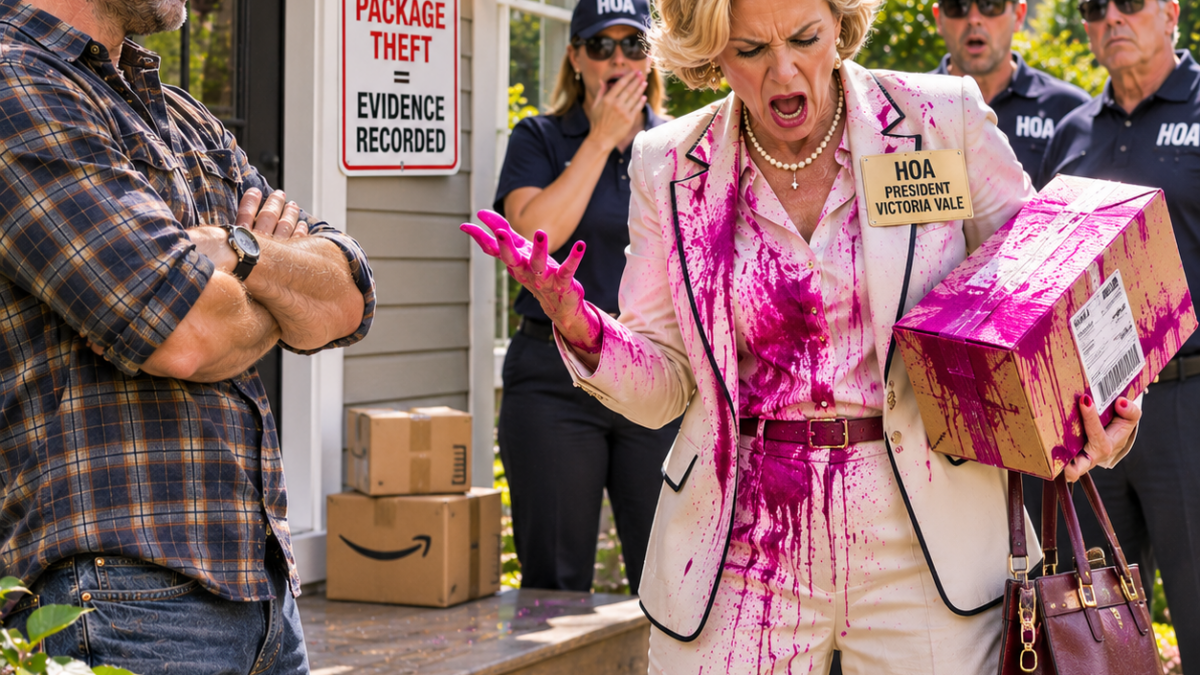
The fourth time a package vanished from my porch, I opened my doorbell footage expecting another delivery mistake and instead watched the president of my HOA walk straight up my steps, glance toward the street, tuck my box beneath her arm, and leave with the relaxed smile of someone who believed nobody in the neighborhood had the courage to stop her.
By then she had already taken my daughter’s birthday gift, a prescription refill, and a set of tools I needed for work, while the police called the evidence “inconclusive” and the HOA responded to my complaints by measuring my grass and fining me over the finish on my mailbox.
What Sophia Wilson didn’t know was that I had stopped trying to convince people she was stealing and started waiting for the day she would give me proof nobody could explain away.
My name is John Davis, and six months earlier I had moved into Maplewood Estates because I wanted the kind of life that looked boring from the outside.
After a divorce that had dragged on longer than either of us expected, I needed somewhere quiet where my daughter, Emily, could visit without every room reminding both of us what had fallen apart.
Maplewood looked perfect.
Trimmed lawns.
White fences.
Friendly neighbors waving from driveways.
A little lake behind the clubhouse.
The houses were close enough to feel communal but far enough apart to give everyone some breathing room.
For the first few weeks, I thought I had finally landed somewhere ordinary.
Then Emily’s scarf disappeared.
It was a hand-knit blue scarf I had ordered for her birthday because blue had been her favorite color since she was five.
Tracking showed delivered.
The photograph showed the box sitting beside my front door.
When I came home, it was gone.
I blamed the carrier.
The replacement disappeared too.
Then a prescription package vanished.
That one scared me.
I installed a doorbell camera the next afternoon.
The following morning, my phone buzzed while I was at work.
Motion detected.
I opened the video.
Sophia Wilson walked into frame.
Everybody in Maplewood knew Sophia.
Blonde hair.
Pink or lavender blazer.
Perfect nails.
White SUV.
And always a clipboard or phone in her hand, as though the neighborhood were a company she personally owned.
She had been HOA president for twelve years.
Sophia stopped at the bottom of my porch.
Looked left.
Looked right.
Then climbed the steps.
She read the shipping label.
Bent down.
Picked up my box.
And walked away.
I watched the video four times.
The fifth time I stopped feeling shocked.
I started feeling angry.
My neighbor George lived across the street.
He was a retired cop with a bad knee and a vegetable garden he cared about more than most people care about their families.
I showed him the footage.
He watched silently.
“That’s Sophia.”
“I know.”
“You going to confront her?”
“I’m going to the police.”
George leaned back.
“Do that first.”
“You sound worried.”
“I’ve lived here nine years.”
“What does that mean?”
“It means Sophia remembers people who challenge her.”
I laughed.
“She’s stealing packages.”
“I didn’t say don’t challenge her.”
He looked toward her house.
“I said understand who you’re challenging.”
I filed the report.
The officer was polite but cautious.
Sophia claimed she had been collecting misdelivered packages as part of an unofficial neighborhood safety effort.
There was no footage of her opening the box.
No recovered property.
No admission.
The officer told me they needed stronger evidence.
The next morning, a bright yellow HOA violation notice appeared on my door.
My mailbox finish was supposedly noncompliant.
Two days later came another.
Grass exceeding approved height.
Then one for leaving my trash bin visible too long after pickup.
Every notice carried Sophia’s signature.
I attended the next HOA meeting and played the footage.
Sophia watched herself taking my package without blinking.
Then she folded her hands.
“Mr. Davis, I was safeguarding a potentially misdelivered parcel.”
“It had my name and address on it.”
“Delivery services make mistakes.”
“Did you return it?”
“I don’t recall that specific package.”
“Did you take my daughter’s gift?”
Her smile tightened.
“If you continue accusing me publicly without proof, this becomes harassment.”
Around the room, people looked down.
Nobody defended me.
But nobody looked surprised either.
That bothered me more.
After the meeting, an elderly neighbor named Mrs. Chen touched my arm.
Her voice was barely above a whisper.
“She took something from me too.”
I turned.
“My granddaughter’s birthday present.”
“Did you report it?”
Mrs. Chen looked toward the clubhouse door.
“No.”
“Why?”
Her answer told me everything I needed to know about Maplewood.
“Because I still have to live here.”
That night, I sat alone on my porch beneath the camera, staring at the empty place where another package had disappeared.
And for the first time, I understood that Sophia wasn’t protected by the HOA rules.
She was protected by everyone’s fear of what happened when someone told her no.
PART 2
I didn’t sleep much that night.
Not because I was afraid Sophia would steal something else.
I had already redirected my medication to the pharmacy and started sending important deliveries to a pickup counter near work.
What kept me awake was Mrs. Chen’s sentence.
Because I still have to live here.
I had heard variations of that sentence my whole life.
People said it about bad bosses.
Bad landlords.
Bad relatives.
Bad neighbors.
It was the language of people who had calculated the cost of resistance and decided silence was cheaper.
The problem was that silence compounds.
One person stays quiet.
Then another.
Eventually the bully stops needing threats because everybody already knows what might happen.
At six the next morning, I made coffee and opened a spreadsheet.
Dates.
Tracking numbers.
Estimated value.
Delivery confirmation.
Camera timestamps.
HOA notices issued afterward.
I entered everything.
Then I went back through my doorbell footage and saved original files instead of clips.
Sophia taking the scarf replacement.
Sophia taking my prescription box.
Sophia removing a shipment containing specialty tools.
Four separate dates.
Same basic routine.
Approach.
Look around.
Read label.
Take box.
Leave.
I created backups.
One on my computer.
One on an external drive.
One in cloud storage.
Then I called George.
“You awake?”
“I’m seventy-one. I’ve been awake since five.”
“I’m making a list.”
“Of?”
“Missing packages.”
“You becoming Batman?”
“No.”
“Disappointing.”
“I want names.”
George became serious.
“I know three.”
“People who lost packages?”
“People who complained privately.”
“Will they talk?”
“Maybe.”
“Ask.”
By noon, I had six names.
Mrs. Chen.
A young couple named Eric and Dana Miller.
A widower named Henry Wallace.
Rita Gomez from the corner house.
And George himself.
“You lost packages too?”
“Two.”
“You never mentioned that.”
“I thought they were random.”
“What was inside?”
“One was a battery charger.”
“And the other?”
He hesitated.
“Christmas present for my granddaughter.”
“Why didn’t you report it?”
“I did.”
“And?”
“Nothing.”
I stared at him.
“You were a cop.”
“Which is why I know the difference between suspicion and evidence.”
“So you let it go.”
“I didn’t like it.”
“That wasn’t my question.”
George sighed.
“Yes.”
That irritated me.
Not because he was wrong.
Because if a retired police officer had decided Sophia was too much trouble, Mrs. Chen never had a chance.
The next evening, George and I walked to Mrs. Chen’s house.
She opened the door wearing a lavender cardigan and slippers.
Her living room smelled faintly of tea and furniture polish.
She brought out a shoebox filled with receipts.
At ninety-one, Mrs. Chen kept everything.
The missing gift had been a collector’s doll her granddaughter had wanted for nearly a year.
“One hundred twenty-eight dollars,” she said.
“Did tracking show delivered?”
“Yes.”
“Do you still have the message you sent Sophia?”
Mrs. Chen nodded.
Her phone was old.
The screen had a crack near the corner.
She found the text.
Mrs. Chen:
Sophia, I noticed you walking near my porch yesterday. Did you happen to see a delivery for my granddaughter?
Sophia:
I conduct neighborhood checks regularly. If a package was misplaced, please contact the courier. We are all responsible for maintaining community security.
I read it twice.
No denial.
No admission.
Just the kind of answer designed to sound official without saying anything.
“You were afraid she’d retaliate?”
Mrs. Chen looked embarrassed.
“She controls the architectural committee.”
“So?”
“My son wants to install a ramp next year.”
That made my stomach tighten.
“You thought she’d block it.”
“I didn’t know.”
George looked at me.
We both knew uncertainty was enough.
The following morning I went back to the police station with the larger file.
A different officer reviewed it.
He was younger, maybe mid-thirties, and more interested than the first.
“You have multiple victims now?”
“Potential victims.”
“And all suspect the same person?”
“Yes.”
He watched Sophia take my package.
“Still difficult without recovered property.”
“What would make it undeniable?”
“Possession.”
“She can say she was safeguarding it.”
“Yes.”
“Opening it?”
“That changes things.”
“Keeping contents?”
“Certainly.”
I nodded.
He looked at me.
“Don’t do anything stupid.”
“I didn’t say I was doing anything.”
“You asked that question like a man planning something.”
I almost smiled.
“Occupational hazard.”
“What do you do?”
“Mechanical systems. Project coordination. I build things.”
“That does not make me feel better.”
He gave me his card.
Officer Kevin Barnes.
“Keep documenting. If you can get direct proof that she takes something and treats it as her own, call us.”
I left with the same frustration as before.
Sophia had found a perfect gap.
She could take a package.
If confronted, she claimed community protection.
If the item vanished, she denied knowing what happened afterward.
Each theft looked isolated.
Each victim looked uncertain.
And her title gave her explanation just enough legitimacy to create doubt.
That afternoon, another HOA notice appeared.
HOSE VISIBLE FROM STREET.
I did not own a hose long enough to be visible from the street.
I took a photograph.
Added it to the folder.
Then I appealed.
Sophia denied the appeal the next morning.
Reason:
Photographic evidence provided by enforcement officer.
I requested the photograph.
Nothing arrived.
I requested it again.
No response.
At the next HOA meeting, I stood during homeowner comments.
“I want the evidence supporting my violation.”
Sophia did not look up.
“Which violation?”
“The hose.”
“You have several.”
A few people shifted uncomfortably.
“The hose.”
She flipped through a folder.
“Visual obstruction.”
“That isn’t what the notice says.”
“The wording is standardized.”
“Show me the photograph.”
She smiled.
“Enforcement evidence is internal.”
“Then how do I appeal?”
“You already did.”
“You denied it.”
“Yes.”
“Based on evidence I’m not allowed to see.”
Her smile thinned.
“Mr. Davis, this meeting is not for debating administrative procedure.”
“Then what is it for?”
“Community business.”
“This is community business.”
Several people looked down.
Sophia saw them.
Her voice became sweeter.
“John, I understand you’re frustrated about your delivery issues, but bringing that anger into unrelated HOA matters isn’t productive.”
There it was.
The story she wanted.
I was angry.
She was reasonable.
I was obsessed.
She was managing.
I looked directly at her.
“This isn’t unrelated.”
Her expression hardened.
“You’re accusing an elected officer of theft without proof.”
“I have video.”
“You have video of me handling packages.”
“From my porch.”
“For safety.”
“Then where are they?”
She paused.
“Again, you need to speak with the courier.”
Someone in the back whispered, “Wow.”
Sophia heard it.
Her eyes moved toward the voice.
Nobody admitted it.
She leaned toward her microphone.
“If this defamatory campaign continues, the association will consider formal action.”
I laughed.
That was a mistake.
Her face changed immediately.
Not much.
But enough.
She hated being laughed at.
The next morning, I received three new violation notices.
One for my porch light.
One for my recycling bin.
And one for an “unapproved visual surveillance device.”
The doorbell camera.
That confirmed something for me.
Sophia was not simply defending herself.
She was trying to remove the thing recording her.
I called George.
“I’ve got an idea.”
“How illegal?”
“Hopefully not.”
“That is not reassuring.”
“I want a decoy package.”
Silence.
Then:
“No explosives.”
“Obviously.”
“No glass.”
“Yes, Dad.”
“No chemicals that burn.”
“I said decoy package.”
“You sounded disappointed.”
“I want something that marks whoever opens it.”
George became quiet.
“Dye?”
“Maybe.”
“I’ve seen security marker systems.”
“So have I.”
“You know homemade traps are a terrible idea.”
“I do.”
“Seriously, John.”
“I’m not building anything dangerous.”
“You promise?”
“Yes.”
I meant it.
The last thing I wanted was to become the criminal in my own story.
I spent several days researching commercially manufactured tamper-evident security products designed to mark stolen property or identify unauthorized handling.
No homemade pressure devices.
No explosive charges.
No irritating chemicals.
No hidden hazards.
I found a security supplier that sold non-toxic forensic marking products for controlled theft-deterrence demonstrations and loss-prevention training.
The color was vivid violet.
It transferred easily when unauthorized packaging was opened.
It was skin-safe under intended use, but stubborn enough that it did not disappear with one hand washing.
Perfect.
Not because it would hurt.
Because it would create possession evidence.
If Sophia took the box and opened it, the result would be visible.
I called the supplier and explained what I wanted.
The representative gave me the most important advice of the entire story.
“Do not improvise.”
“I won’t.”
“Do not modify the product.”
“I won’t.”
“Use the tamper-evident packaging as designed.”
“Understood.”
“And make sure anything you do complies with local law.”
“I have an attorney.”
“Talk to them.”
I did.
Rebecca Shaw had handled my divorce paperwork and several business contracts.
She listened silently while I described the package thefts.
Then she said:
“You want to leave a package on your porch that contains a lawful non-hazardous marking product, and if someone steals it and opens it, they get marked?”
“That’s the concept.”
“Is it designed for that purpose?”
“Yes.”
“Any projectile?”
“No.”
“Any irritant?”
“No.”
“Any explosive?”
“No.”
“Anything that could reasonably injure someone?”
“Not according to the manufacturer.”
“Then send me the documentation.”
I did.
She called back an hour later.
“I’m not blessing your revenge fantasy.”
“I didn’t ask you to.”
“I know you.”
“You handled my divorce.”
“Exactly.”
“But?”
“But the safer version of what you’re describing is far better than constructing some homemade booby trap.”
“Agreed.”
“Keep everything on your property.”
“Yes.”
“Do not target a specific person with anything harmful.”
“Yes.”
“Preserve the original packaging and safety information.”
“Yes.”
“Call the police if it happens.”
“Yes.”
“And John?”
“What?”
“Try enjoying a hobby.”
“I had one.”
“What?”
“Getting packages delivered.”
She hung up on me.
I ordered the product.
While waiting, I did something else.
I started sending ordinary inexpensive decoy deliveries to myself.
Candles.
A paperback.
Cheap kitchen towels.
Nothing worth stealing.
For three days, Sophia did nothing.
Then on Tuesday, a small candle box disappeared.
Camera footage showed her taking it.
I never saw the candle again.
Wednesday, a package containing a five-dollar phone cable vanished.
Sophia again.
Thursday, she ignored a small envelope but took a medium-sized box.
Pattern.
She wanted packages that looked valuable.
I began to understand her behavior.
The theft was not desperation.
Sophia lived in one of the largest houses in Maplewood.
Her white SUV cost more than my first car and my current one combined.
This was about entitlement.
The feeling of being able to take something.
Maybe curiosity.
Maybe control.
Maybe the thrill of knowing people were too afraid to challenge her.
George came over Friday night.
I showed him the marking package.
He read the safety sheet.
“Boring.”
“That’s good.”
“I expected mad scientist equipment.”
“No.”
“Smoke?”
“No.”
“Confetti?”
“No.”
“Tiny speaker yelling ‘thief’?”
“No.”
He sighed.
“You’ve lost your artistic vision.”
“I’m trying not to get sued.”
“Responsible. Disgusting.”
I placed the marker package inside an ordinary cardboard shipping box.
The outer label showed my name.
My address.
Nothing deceptive.
Nothing indicating it belonged anywhere else.
Inside was inexpensive merchandise and the manufacturer’s tamper marker.
If nobody stole it, nothing happened.
If the package stayed on my porch, nothing happened.
If a courier handled it, nothing happened.
Only someone who took it away and opened the protected inner package would end up marked.
I wrote the time on my log.
Photographed everything.
Saved the product sheet.
Then I went to bed.
I slept terribly.
Not from guilt.
From uncertainty.
What if she didn’t take it?
What if she took it and dumped it?
What if she opened it wearing gloves?
What if she somehow turned it into another HOA violation?
At seven thirty the next morning, I placed the package beside the front door.
Luxury spa products.
That part was George’s idea.
“It has to be something she’d want.”
“You’re stereotyping.”
“You’ve seen her bathroom?”
“No.”
“Then I’m imagining.”
I hated that the label made me laugh.
I went inside.
At ten twelve, the doorbell camera detected motion.
Delivery driver.
Not relevant.
At ten forty-three, a dog walker.
At ten fifty-seven, Sophia’s SUV moved down the street.
I sat straighter.
She parked near her house.
Walked toward mine.
Pink blazer.
Dark sunglasses.
Phone in hand.
Same routine.
She slowed near the porch.
Looked left.
Looked right.
Climbed the steps.
She picked up the box.
Read the label.
A small smile appeared.
Then she tucked it beneath her arm and walked away.
I did nothing.
No confrontation.
No shout from the window.
No dramatic chase.
I downloaded the footage.
Saved it.
Texted George.
She took it.
His reply came instantly.
Of course she did.
Twenty-three minutes passed.
Then my phone rang.
George.
I answered.
He did not say hello.
“John.”
“What?”
“Look outside.”
I walked to the window.
At first, I saw nothing.
Then Sophia’s front door opened.
She came running outside.
And I almost forgot how angry I was.
Her right hand was violet.
So was the side of her face.
Bright purple streaked the front of her pale pink blazer and ran along one side of her blonde hair.
She was shouting into her phone.
I could not hear the words from inside my house.
George opened his front door.
Sophia spun toward him.
“Stop filming!”
He held up both hands.
“I’m on my porch.”
“You know what he did!”
George looked toward my house.
I stepped outside.
Sophia saw me.
The sound that came out of her was part scream, part accusation.
“You!”
I stayed on my porch.
She marched toward the street.
“What did you put in that box?”
“My box?”
“You know exactly what I mean.”
“Did you take something from my porch?”
Her face twisted.
“You attacked me!”
“With what?”
“This!”
She held up her purple hand.
Several doors opened.
Maplewood had excellent hearing when scandal was involved.
I raised my voice only enough to be clear.
“Sophia, why were you opening a package addressed to me?”
“I was checking it!”
“Inside your house?”
“It looked suspicious.”
“You took it from my porch.”
“For community safety.”
“What was suspicious about luxury spa products?”
That got a laugh.
Sophia looked around.
Her humiliation deepened.
“Call the police,” she snapped at George.
George held up his phone.
“I already did.”
That surprised both of us.
“Why?”
He looked at me.
“Because you finally have possession evidence.”
Sophia froze.
Then her eyes widened.
“You set me up.”
“No.”
“You deliberately left that package there.”
“On my porch.”
“You knew I’d take it.”
“I hoped you wouldn’t.”
That was true.
Some part of me really had hoped she would see the camera, see my name, and finally decide not to do it.
She had been given every opportunity.
She took the box anyway.
Sophia moved toward me.
“You’ll pay for this.”
I stepped backward.
“Stay off my property.”
“I’m going to ruin you.”
“Stay off the porch.”
Neighbors were watching now.
Mrs. Chen stood near her mailbox, hand over her mouth.
Eric Miller had his phone raised.
George remained in his doorway.
Sophia suddenly realized something.
Everyone could see the color.
It wasn’t just embarrassing.
It connected her physically to the stolen package.
She tried to wipe her hand on a tissue.
The violet smeared.
She looked at the stain.
Then at me.
“You’re sick.”
“No.”
“You wanted this.”
“I wanted my packages to stop disappearing.”
“You could have talked to me.”
George actually laughed.
I stared at her.
“I did.”
She opened her mouth.
“You called me a liar in front of the board.”
“I showed video.”
“You tried to destroy my reputation.”
“No.”
“You’ve been harassing me for weeks.”
“You’ve issued eleven HOA violations since I reported you.”
“Because you violate rules!”
Sirens approached.
Sophia looked toward the entrance.
For one second, panic replaced rage.
Then she straightened.
The HOA president returned.
Shoulders back.
Chin high.
Narrative ready.
Officer Barnes stepped out of the first cruiser.
He recognized me.
Then saw Sophia.
Then the purple.
He blinked.
“What happened?”
Sophia rushed toward him.
“He attacked me with a chemical device.”
Barnes looked at me.
“Mr. Davis?”
I held up my phone.
“Doorbell footage first.”
Sophia interrupted.
“He built a trap.”
Barnes raised one hand.
“Ma’am, I’ll speak with you in a moment.”
“She could be poisoned,” another officer said.
Sophia seized the opening.
“Yes. Exactly.”
Barnes looked at her.
“Do you need medical attention?”
She hesitated.
“I don’t know.”
“Burning?”
“No.”
“Difficulty breathing?”
“No.”
“Dizziness?”
“No.”
“Pain?”
“No, but—”
“Do you want EMS?”
She looked at the neighbors.
“No.”
Barnes turned toward me.
I gave him the manufacturer documentation.
“Commercial non-toxic tamper-evident marker. Used as supplied. Nothing explosive. Nothing corrosive.”
He read it.
His partner watched the security video.
Sophia approached my porch.
Took the box.
Walked home.
The officer rewound.
Watched again.
Then looked at Sophia.
“Was that package addressed to you?”
“No, but—”
“Did Mr. Davis ask you to move it?”
“No.”
“Did the delivery company ask you to take it?”
“No.”
“Did you open it?”
Sophia crossed her arms.
“I was inspecting it.”
“Where?”
“My home.”
“Why?”
“It was suspicious.”
Barnes spoke.
“What made it suspicious?”
Sophia stared at him.
“The packaging.”
I almost admired the commitment.
Barnes looked at the ordinary cardboard box now sitting inside an evidence bag.
“What about the packaging?”
“The wording.”
“Luxury spa products?”
Silence.
Someone behind me laughed.
Barnes turned.
“Please.”
The neighbor stopped.
He faced Sophia again.
“Where are the other packages?”
Her expression changed.
“What other packages?”
“The ones Mr. Davis reported missing.”
“I don’t know.”
“Mrs. Chen’s?”
Sophia looked toward her.
Mrs. Chen stepped forward.
“My granddaughter’s doll.”
Sophia’s voice sharpened.
“I never took your doll.”
Mrs. Chen flinched.
I saw it.
Barnes did too.
He softened his tone.
“Mrs. Chen, have you filed a report?”
“No.”
“Would you like to?”
She looked at Sophia.
Then at me.
For the first time, she did not lower her eyes.
“Yes.”
Something changed on the street right there.
One person spoke.
Then another.
Dana Miller said two deliveries had disappeared.
Henry Wallace had lost a replacement credit card.
George mentioned his granddaughter’s gift.
Barnes looked around.
“How many of you have doorbell cameras?”
Three hands went up.
“Save everything.”
Sophia stepped forward.
“This is mob behavior.”
“No,” George said.
She turned.
He continued.
“This is what happens when everyone finally compares notes.”
Sophia’s face hardened.
“You’ve always hated me.”
“I voted for you twice.”
That shut her up.
Barnes took a formal statement from me.
The package went into evidence.
Sophia was photographed.
Not because purple skin was criminal.
Because it documented contact with the stolen package.
Her husband arrived halfway through.
Robert Wilson.
Attorney.
Dark suit.
Perfect posture.
Expression like a man arriving to clean up a disaster he had expected eventually.
He looked at Sophia.
Then the officers.
Then me.
“What exactly happened?”
Barnes answered before Sophia could.
“We’re investigating repeated package theft.”
Robert’s jaw tightened.
“Sophia?”
She pointed at me.
“He rigged a chemical attack.”
Robert looked at her stained hand.
Then at the evidence bag.
“Did you take his package?”
“I was safeguarding it.”
Robert closed his eyes.
Only for a second.
But everybody saw.
That was the first crack.
He spoke quietly.
“Stop talking.”
Sophia stared at him.
“What?”
“Stop talking until we discuss this privately.”
“I’m the victim.”
“Sophia.”
She looked betrayed.
Barnes gave Robert his card.
“We may need to contact you.”
Robert nodded.
Then turned to Sophia.
“Inside.”
She resisted.
He repeated it.
“Sophia. Inside.”
She walked home.
Purple hand clenched.
Pink blazer ruined.
For the first time since I had moved to Maplewood, her front door closed without her getting the last word.
The story spread before sunset.
I did not post the video.
I didn’t need to.
Several neighbors had recorded the police conversation from public areas.
Someone uploaded a still image of Sophia holding up her violet hand.
Caption:
MAPLEWOOD SECURITY COMMITTEE HAS NEW UNIFORM.
I didn’t laugh.
George did.
A lot.
By evening, the neighborhood group was chaos.
Some people defended her.
Most didn’t.
Then old complaints began resurfacing.
A package missing from Oak Lane.
Medication from Pine Court.
A Christmas toy.
A laptop accessory.
An expensive bottle of perfume.
Someone posted:
She always says she’s “safeguarding” deliveries. Has anyone ever gotten one back?
No one replied yes.
The question stayed there.
Ten minutes later, Sophia posted an official HOA statement.
Residents are advised that a dangerous tampered package was discovered today. The HOA is investigating malicious chemical use and targeted harassment against community leadership.
I screenshot it.
Then replied with only one sentence.
Was the package on HOA property when you discovered it?
George sent me fifteen laughing emojis.
Sophia deleted the entire thread.
Too late.
Screenshots were everywhere.
The next morning, Robert’s law office sent a formal letter.
Notice of intended civil action.
Assault.
Emotional distress.
Property damage.
Defamation.
I forwarded it to Rebecca.
She called.
“You’re popular.”
“I prefer boring.”
“You’re not getting boring.”
“What do you think?”
“I think her husband is doing what lawyers do when their spouse comes home purple.”
“That sounds like a specialized practice.”
“It should be.”
“Am I in trouble?”
“Potentially anyone can sue anyone.”
“That’s comforting.”
“But your evidence is strong, and the product documentation helps.”
“What about the package?”
“She took property addressed to you from your porch.”
“Yes.”
“And opened it inside her residence.”
“Yes.”
“And the marker operated only because she opened the protected package?”
“Yes.”
“Good.”
“Good?”
“Good for your factual position. Stop talking publicly.”
“I already did.”
“No jokes.”
“George handles those.”
“No encouraging George.”
“That seems unconstitutional.”
“John.”
“Fine.”
Police executed a search warrant at Sophia’s house four days later.
Not because of the dye.
Because additional footage had surfaced.
Eric Miller’s camera showed Sophia carrying a distinctive package from his porch toward her SUV.
Dana had the delivery photograph.
Tracking number.
Receipt.
Another resident had a video from six months earlier.
The pattern was enough for investigators to seek more.
I watched from behind my window when officers arrived.
I did not go outside.
I did not want a front-row seat.
George did.
Of course.
He texted me.
They’re bringing out boxes.
I ignored him.
Then another message.
John.
You need to see this.
I opened the curtain.
An officer carried a large storage container toward the cruiser.
Then another.
A third.
Some boxes were opened.
Some sealed.
I could see shipping labels.
Different names.
Different addresses.
Mrs. Chen stood on her lawn.
When one officer brought out a small toy box with a shipping sticker still attached, her hand flew to her mouth.
I walked over.
“You okay?”
She pointed.
“That’s it.”
“What?”
“The doll.”
The officer heard.
He stopped.
“Ma’am?”
Mrs. Chen stepped closer but did not touch it.
“My granddaughter’s present.”
He checked the label.
Her name.
Her address.
Mrs. Chen began crying.
Not loudly.
She just covered her face.
I put an arm around her shoulders.
Sophia appeared in the doorway behind the officers.
Her skin was mostly clean now, but violet still clung faintly around her fingers and hairline.
She saw Mrs. Chen.
Then the doll.
For the first time since this started, Sophia looked ashamed.
Maybe only for a second.
Then Robert stepped beside her.
His face had gone gray.
The officers recovered more than thirty packages and package contents.
Some still sealed.
Some opened.
Gift cards.
Electronics.
Clothing.
Household items.
Medication that should never have been taken.
A necklace still inside its velvet box.
My tools.
Emily’s scarf.
The scarf was still folded.
Blue yarn.
Birthday card included.
I stared at it when Officer Barnes showed me.
“You recognize this?”
“Yes.”
I swallowed.
“My daughter’s.”
Barnes nodded.
“We’ll process it and return it.”
That moment hit harder than seeing Sophia turn purple.
I had spent weeks thinking this was about catching her.
It wasn’t.
Holding that scarf again meant remembering the reason I had bought it.
Emily’s birthday.
Her first visit to Maplewood after the divorce.
A gift I wanted to give my daughter because I was still learning how to make my new house feel like hers too.
Sophia had taken it without knowing any of that.
That is the strange thing about theft.
The thief sees an object.
The owner carries the story attached to it.
The police recovered Mrs. Chen’s doll.
George’s battery charger.
Several gifts.
Two medications.
A replacement credit card.
Dozens of opened shipping boxes.
Sophia’s explanation began collapsing under physical evidence.
She claimed she had stored the packages for safe return.
Barnes asked why so many were opened.
She said she was trying to identify owners.
The names were printed on the labels.
She said some packaging had been damaged.
Many had not.
Then investigators found something worse.
A notebook.
Dates.
Addresses.
Items.
Short comments.
Davis—watch.
Chen—easy porch.
Miller—camera angle weak.
Wallace—usually away AM.
That changed everything.
This was not accidental.
Not community safety.
Not misdelivery.
It was organized.
Sophia had mapped people’s routines.
The same way I had mapped hers.
Except she had done it to steal.
Robert left the house before the search ended.
He carried one suitcase.
George watched from his porch.
“That marriage just packed itself.”
“Don’t.”
“I’m not joking.”
He wasn’t.
Robert stopped beside my driveway.
He looked exhausted.
“John.”
I stayed where I was.
“What?”
“I didn’t know.”
I looked toward the police cars.
“You’re her husband.”
“That doesn’t mean I knew.”
“You sent me a legal threat.”
“Because she told me you’d planted a hazardous device intending to injure her.”
“You didn’t ask why she had my package.”
He closed his eyes.
“I know.”
“You didn’t ask?”
“I did.”
“And?”
“She said she was collecting it for investigation.”
“You believed that?”
Robert looked ashamed.
“I wanted to.”
That answer was more honest than I expected.
“I spent years wanting to believe the version of Sophia that made my life easier.”
I said nothing.
“She told me complaints came from unstable residents.”
“Convenient.”
“She told me people hated her because leadership is unpopular.”
“Also convenient.”
“She said she was protecting Maplewood.”
I looked toward Mrs. Chen, still standing near the recovered doll.
“Was she?”
Robert followed my gaze.
His face changed.
“No.”
He rubbed his forehead.
“I should have asked more questions.”
“Yes.”
He nodded.
“No argument.”
Then he walked to his car.
That was the last time I saw him living in Sophia’s house.
The HOA called an emergency meeting that night.
For once, Sophia was not at the head table.
She did not attend.
Robert did not attend.
The room was packed.
People stood along the walls.
Mrs. Langford, the vice president, sat in Sophia’s chair.
She looked terrified.
Not of the crowd.
Of responsibility.
She tapped the gavel.
“I think we all know why we’re here.”
George muttered beside me.
“Purple emergency.”
I elbowed him.
Mrs. Langford continued.
“Based on the active criminal investigation and recovered resident property, I move that Sophia Wilson be immediately suspended from all HOA authority pending final board action.”
Seconded.
Vote.
Unanimous.
Someone clapped.
Mrs. Langford raised her hand.
“Please. This isn’t a celebration.”
I respected her immediately.
She looked around.
“This is a failure.”
The room became quiet.
“A failure of leadership.”
Silence.
“A failure of oversight.”
More silence.
“And a failure of neighbors to trust one another enough to speak.”
Mrs. Chen stood.
Her voice shook.
“Some of us were afraid.”
Mrs. Langford nodded.
“I know.”
“No,” Mrs. Chen said.
Everyone looked at her.
“You don’t.”
She walked slowly toward the front.
“I am ninety-one years old.”
The room stayed silent.
“I survived a war when I was a child. I crossed an ocean. I buried my husband. I raised three children. I should not have been afraid of a woman with a clipboard.”
Sophia’s empty chair seemed to grow heavier.
Mrs. Chen continued.
“But I was.”
Her eyes filled.
“Because she could make small things difficult.”
She held up a stack of HOA notices.
“My ramp.”
That was the heart of it.
Sophia didn’t control people by threatening catastrophe.
She controlled them by threatening inconvenience.
A denied ramp.
A delayed permit.
A repeated fine.
A landscaping complaint.
A hearing.
A letter.
A thousand little pressures.
Enough to make resistance exhausting.
Mrs. Chen looked around.
“I am ashamed I stayed quiet.”
I stood.
“You shouldn’t be.”
She looked at me.
“No?”
“No.”
“Why?”
“Because the shame belongs to the person who used your fear.”
Her lips trembled.
Then George stood.
“I stayed quiet too.”
Others followed.
Eric.
Dana.
Henry.
Rita.
Within ten minutes, half the room had admitted some version of the same thing.
They had seen something.
Suspected something.
Complained privately.
Then stopped because Sophia retaliated.
Mrs. Langford looked pale.
“How many violations did she issue personally?”
The secretary opened a laptop.
“Hundreds.”
“Without board review?”
“Most.”
The treasurer, Ethan Brooks, looked up.
“That shouldn’t be possible.”
Mrs. Langford turned toward him.
“What do you mean?”
“Anything involving escalating fines should have two signatures.”
The secretary frowned.
“Most only have Sophia’s.”
Ethan’s expression changed.
“Then we have another problem.”
The room groaned.
He opened the financial system.
That investigation began almost accidentally.
What started with enforcement records led to vendor payments.
Vendor payments led to reimbursements.
Reimbursements led to accounts.
And over the following two weeks, Maplewood discovered Sophia’s abuse of authority extended beyond stolen packages.
The number eventually approached fifty-seven thousand dollars in unsupported or suspicious HOA expenditures.
Not all of it was proven stolen.
Some was simply undocumented.
Some involved inflated invoices.
Some went to companies nobody could verify.
Several reimbursement checks had been signed by Sophia and deposited into accounts linked to vendors with personal connections to her family.
One address matched a mailbox rental.
Another vendor had dissolved years earlier.
Ethan called me after the preliminary review.
“You need to come see this.”
“I’m not on the board.”
“No, but you started this.”
“I reported package theft.”
“And now I’m looking at a security-services invoice for nine thousand dollars.”
“For what?”
“No idea.”
“Maybe security.”
“There’s no contract.”
“Report?”
“No.”
“Equipment?”
“No.”
“Vendor?”
“Disconnected number.”
I sighed.
“Call an auditor.”
“We already did.”
“Good.”
He paused.
“John?”
“Yes?”
“I’m sorry.”
“For?”
“We all thought you were causing trouble.”
“That was Sophia’s story.”
“I believed it.”
“Why?”
“Because believing the president was easier than believing the president was stealing Amazon boxes.”
That was fair.
I couldn’t argue with it.
The audit deepened.
Local news found the criminal case.
The headline was ridiculous.
HOA PRESIDENT CAUGHT “PURPLE-HANDED” IN PACKAGE THEFT INVESTIGATION.
George bought three copies of the newspaper.
I told him not to frame one.
He framed one.
The internet became worse.
Memes.
Videos.
Purple filters.
T-shirts.
I stopped looking.
Emily called after one clip reached her college friends.
“Dad.”
“Hi.”
“Why are you famous?”
“I’m not.”
“Someone sent me a video of a purple woman screaming your name.”
“That is a complicated sentence.”
“Is that the person who stole my scarf?”
I became quiet.
“Yes.”
“They found it?”
“Yes.”
“Can I have it?”
“As soon as evidence releases it.”
She was silent.
Then:
“Are you okay?”
I laughed softly.
“I’m the parent. I’m supposed to ask you that.”
“Divorce rules changed things.”
That hurt a little because it was true.
“I’m okay.”
“Were you scared?”
“No.”
“Dad.”
I looked out at the porch.
“Yes.”
“Of her?”
“Not physically.”
“Then what?”
“That this place wouldn’t become home.”
Emily understood.
“That’s why you wanted Maplewood.”
“Yes.”
“Still want to live there?”
I looked toward Mrs. Chen’s house.
George watering tomatoes.
Kids riding bikes farther down.
Sophia’s curtains closed.
“Yes.”
“Then stay.”
“You sure?”
“Dad, if every awful person got to decide where everyone else lived, the world would be empty.”
I smiled.
“When did you become smart?”
“Mom.”
“Of course.”
The criminal case moved forward.
Sophia’s attorney tried to make the marking package the center of everything.
They argued I had intended humiliation.
That I had targeted her.
That the violet staining caused emotional distress.
Rebecca was prepared.
“Did you put the package on Mrs. Wilson’s property?” she asked me.
“No.”
“Did you give it to her?”
“No.”
“Did you invite her to take it?”
“No.”
“Did you tell her it belonged to her?”
“No.”
“Was it addressed to you?”
“Yes.”
“Was the marking product commercial?”
“Yes.”
“Manufacturer documentation?”
“Yes.”
“Harmful substance?”
“No.”
“Did you alter it?”
“No.”
“Did it activate while the package remained on your porch?”
“No.”
“What had to happen?”
“It had to be removed and opened.”
Rebecca nodded.
“That is enough.”
The police ultimately declined to pursue any charge against me related to the marker.
Sophia’s civil claim did not disappear immediately.
But it weakened.
Especially after investigators photographed thirty-plus stolen deliveries inside her house.
The HOA case got worse.
The independent audit confirmed more than fifty thousand dollars in questionable expenses requiring explanation.
County investigators opened a financial inquiry.
Sophia resigned before the HOA could formally remove her.
Mrs. Langford read the resignation letter at another packed meeting.
Dear Board Members,
Due to the hostile environment created by defamatory accusations and personal harassment, I am resigning effective immediately.
George whispered:
“Not because of the thirty packages?”
I almost laughed.
Mrs. Langford kept reading.
Sophia claimed she had served Maplewood faithfully.
She blamed internal politics.
She blamed social media.
She blamed me.
She did not mention Mrs. Chen.
She did not mention the notebook.
She did not mention the recovered medication.
When the letter ended, nobody applauded.
Mrs. Langford folded it.
Then Mrs. Chen raised her hand.
“Yes?”
“I would like to run for president.”
The entire room turned.
George’s mouth fell open.
Mrs. Chen stood slowly.
“I am old.”
Someone laughed.
She smiled.
“I am also tired of being afraid.”
No one laughed after that.
She won.
Not unanimously.
Maplewood was still Maplewood.
But by a huge margin.
Her first speech was ten words.
“No stealing. No bullying. No nonsense. Let us go home.”
Best HOA meeting I ever attended.
George became neighborhood safety coordinator.
He objected.
Mrs. Chen ignored him.
“I am retired.”
“So am I.”
“You were police.”
“That was twenty years ago.”
“You still know where the phone is.”
That was apparently the qualification.
Secure package lockers were installed near the clubhouse.
Participation voluntary.
The HOA paid for them from legitimately approved funds after an actual vote.
No one could remove a delivery except the recipient.
Mrs. Chen personally checked the vendor contract three times.
“Never again,” she told me.
The financial investigation lasted longer.
Reality moves slower than internet justice.
Months passed.
Sophia avoided the neighborhood.
Her white SUV remained in the garage.
Robert filed for separation.
I heard through George.
I did not ask for details.
Then came the court case.
Sophia eventually entered pleas related to multiple theft offenses and financial misconduct counts that prosecutors could prove.
The dramatic rumors online were exaggerated.
No twenty-year prison sentence.
No federal agents dragging her out in chains.
Real consequences were quieter.
Probation.
Restitution.
Community service.
Financial penalties.
Formal removal from positions of trust.
Conditions requiring compliance and repayment.
Some charges were reduced under the agreement.
Others were dismissed.
The judge did not perform for reporters.
He spoke calmly.
“Mrs. Wilson, this case is not about an embarrassing video.”
Sophia sat at the defense table.
No purple remained on her skin.
Her hair was darker.
She looked smaller.
The judge continued.
“It is not about a neighborhood feud.”
Silence.
“It is about repeated decisions to take property that was not yours and to misuse authority entrusted to you.”
Sophia stared down.
“You occupied a position of trust.”
Her attorney placed a hand near her notes.
“You used that trust to make challenge more difficult for your neighbors.”
Mrs. Chen sat behind me.
Her hands folded over her cane.
The judge continued.
“You have said you wanted order.”
Sophia nodded.
“Order without fairness is not leadership.”
Nobody moved.
“You confused access with entitlement and responsibility with ownership.”
Sophia’s face tightened.
The sentence was imposed.
Restitution to victims.
HOA repayment.
Probation.
Community service.
Restrictions.
When court adjourned, I stood.
I expected to leave without speaking to Sophia.
Then I heard her voice.
“John.”
I turned.
She stood near the defense table.
Her attorney remained a few feet away.
Sophia walked toward me.
No blazer.
No pearls.
Plain gray suit.
Her hands looked normal.
I noticed that first.
Maybe because for months I had imagined them purple.
“I wanted to say something.”
I waited.
She glanced toward Mrs. Chen.
Then back at me.
“I’m sorry.”
I did not answer immediately.
“For what?”
Her eyes filled.
Maybe she had expected me to accept the general version.
I needed the specific one.
“For taking your packages.”
I nodded.
“And?”
She swallowed.
“For retaliating against you.”
I kept waiting.
“For doing it to other people.”
Mrs. Chen stood behind me.
Sophia’s eyes shifted toward her.
She looked like she wanted to speak.
Mrs. Chen walked closer.
Sophia whispered:
“I’m sorry about the doll.”
Mrs. Chen stared at her.
“My granddaughter forgot about that doll.”
Sophia’s shoulders loosened slightly.
Then Mrs. Chen continued.
“But I didn’t.”
The relief vanished.
“You made me feel small in my own home.”
Sophia looked down.
“That was worse than the present.”
“I know.”
“No.”
Mrs. Chen’s voice remained calm.
“You know now.”
Sophia’s lips trembled.
“Yes.”
Mrs. Chen nodded once.
Not forgiveness.
Acknowledgment.
Then she walked away.
Sophia looked at me.
“You hate me.”
“No.”
That surprised her.
“You should.”
“I was angry.”
“Were?”
“Mostly.”
“How?”
I thought about Emily.
My house.
The first months after the divorce.
“How what?”
“How are you not still angry?”
“I got my life back.”
She looked confused.
I continued.
“My daughter got her scarf.”
“John…”
“My medication was replaced.”
“That isn’t what I mean.”
“I know.”
I looked toward the courthouse doors.
“Being angry forever would mean you still get to take something.”
She stared at me.
That landed harder than anything cruel I could have said.
Sophia whispered:
“You planned that package because you wanted everyone to see me.”
“I planned it because nobody believed us.”
“You wanted me marked.”
“I wanted evidence you couldn’t redefine.”
She nodded.
“Fair.”
Then she smiled bitterly.
“I was purple for nine days.”
I almost laughed.
“George claims twelve.”
“George is a liar.”
“On that point, possibly.”
A tiny laugh escaped her.
Then disappeared.
“Robert left.”
“I heard.”
“He said I loved control more than I loved anyone.”
I did not know what to say.
Sophia looked toward the hallway.
“I kept telling myself the HOA needed me.”
“Maybe it did once.”
She looked back.
“You think so?”
“Probably.”
She had expected judgment.
I gave her honesty.
“You got things done.”
“I did.”
“You organized events. Negotiated contracts. Helped people.”
Her eyes filled.
“Then what happened?”
“You stopped noticing when helping became deciding.”
She wiped her cheek.
“I thought if I let people ignore small rules, everything would fall apart.”
“Why?”
She was quiet for a long time.
Then she told me about her mother.
Not a dramatic tragedy.
Something smaller.
Her mother had lived in a neighborhood where houses slowly deteriorated.
One neighbor abandoned a property.
Another stopped maintaining theirs.
Property values fell.
Sophia’s parents lost money when they moved.
Her mother blamed “people who didn’t care.”
Sophia absorbed the lesson.
Order protected you.
Rules protected your investment.
People who ignored rules hurt everyone.
Reasonable enough.
Until it became absolute.
“I thought Maplewood was safe because I was strict,” she said.
“Maybe strict helped sometimes.”
Her eyes lifted.
“But?”
“But eventually the neighborhood wasn’t safe from you.”
She closed her eyes.
“I know.”
That was the first time I believed she did.
The Wilson house went on the market one week after sentencing.
No neighborhood celebration.
Mrs. Chen made that clear.
“We are not becoming cruel because someone else was cruel.”
George looked disappointed.
“I already bought purple balloons.”
Mrs. Chen stared at him.
“You will return them.”
“Yes, ma’am.”
Sophia moved out quietly.
I happened to be on my porch when the movers came.
She carried boxes to her SUV.
Not the white one.
That had apparently been sold.
A smaller gray crossover.
At one point, she stopped at the curb.
We looked at each other.
She raised one hand.
A simple wave.
I returned it.
That was all.
No final insult.
No triumph.
No dramatic goodbye.
She drove away.
Maplewood changed afterward.
Not into paradise.
People still argued.
One family wanted to paint their front door bright orange.
Three neighbors complained.
Mrs. Chen said:
“Is the paint attacking anyone?”
“No.”
“Then I do not care.”
The door stayed orange.
George tried to create a neighborhood patrol schedule.
Mrs. Chen canceled it.
“What do I coordinate then?”
“Barbecue.”
“That’s not security.”
“Hungry people commit crimes.”
He had no answer.
The package lockers worked.
Theft reports dropped to almost zero.
My porch camera remained.
But gradually I stopped checking it obsessively.
At first, every motion alert made my stomach tighten.
Delivery.
Dog walker.
Kid retrieving a ball.
George leaving tomatoes.
Normal things.
Then one Saturday, Emily visited.
I had finally gotten her scarf back from evidence.
I placed it in a plain gift bag.
No shipping box.
She opened it at the kitchen table.
Her hands stopped.
“Oh.”
“You remember?”
She touched the blue yarn.
“I thought this was gone.”
“So did I.”
She wrapped it around her neck.
Even though it was August.
“How do I look?”
“Overheated.”
“Dad.”
“Beautiful.”
She smiled.
Then her expression changed.
“You bought this before the divorce was final.”
“Yes.”
“For my birthday.”
“Yes.”
“Why didn’t you just tell me?”
“I was embarrassed.”
“Because someone stole it?”
“Because the first birthday after everything changed was supposed to feel normal.”
Emily looked down at the scarf.
“I didn’t need normal.”
“I know that now.”
“What did you think I needed?”
I laughed softly.
“A perfect weekend. Nice house. Gift. Pancakes. Proof I was okay.”
She looked at me.
“Were you?”
“No.”
Her eyes softened.
“Me neither.”
That was the conversation we should have had months earlier.
Maybe years.
The package theft had become this ridiculous neighborhood story everyone told.
Purple Sophia.
The HOA queen.
The dye.
The memes.
But holding that scarf reopened the real story beneath it.
I had moved to Maplewood because my old life broke apart.
I wanted control too.
Not like Sophia.
But I wanted the new house to prove something.
That I could rebuild quickly.
That divorce had not damaged me.
That Emily would see a neat porch, good neighborhood, stable father, and believe nothing important had been lost.
Sophia stole the scarf.
But I had already been hiding things from myself.
Emily sat beside me.
“You know what’s funny?”
“What?”
“I would have liked the replacement scarf too.”
“I know.”
“You ordered two?”
“Yes.”
“What happened to the second one?”
“Sophia took that too.”
Emily burst out laughing.
For several seconds she could not breathe.
“She stole two scarves?”
“Yes.”
“What did she need with two blue scarves?”
“That remains one of history’s mysteries.”
“Did police find the second one?”
“No.”
Emily laughed harder.
I finally joined her.
That sound—the two of us laughing in the kitchen—felt more satisfying than watching Sophia’s downfall ever had.
Because that was what home was supposed to sound like.
Not victory.
Life.
The new family that bought Sophia’s house moved in during October.
Michael and Rachel Torres.
Two children.
A golden retriever named Biscuit.
The first package delivered to their porch sat there for almost four hours.
I noticed.
Of course I noticed.
Old habits.
At five fifteen, Michael pulled into the driveway.
Picked up the box.
Went inside.
Nothing happened.
I laughed at myself.
George saw me from his porch.
“You monitoring packages again?”
“No.”
“You’re literally staring at their package.”
“I’m appreciating normal logistics.”
“That sounds like a disorder.”
“Go water your tomatoes.”
He walked over instead.
“You ever miss the drama?”
“No.”
“Not even a little?”
“No.”
He thought about it.
“I do.”
“I know.”
“Mrs. Chen won’t let me investigate anything.”
“She’s wise.”
“I reported a suspicious vehicle.”
“It was a pizza delivery.”
“The driver circled twice.”
“Wrong address.”
“Suspiciously.”
I shook my head.
“You’re becoming Sophia.”
George looked horrified.
“Take that back.”
“Stop investigating pizza.”
“Fine.”
Maplewood’s HOA meetings became potlucks.
Not officially.
People just started bringing food.
Mrs. Chen hated Robert’s Rules of Order.
She said life was too short for parliamentary procedure.
Ethan kept her from violating actual requirements.
She kept Ethan from turning every meeting into accounting class.
It worked.
One evening, six months after Sophia moved, Mrs. Chen asked me to stay after a meeting.
Everyone else left.
She sat at the long table.
The recovered doll rested beside her handbag.
“You brought it?”
“My granddaughter is too old now.”
“That’s sad.”
“No.”
She touched the box.
“She asked me to donate it.”
“To who?”
“The children’s hospital.”
I smiled.
“That’s good.”
Mrs. Chen looked at me.
“I wanted you to see it before I give it away.”
“Why?”
“Because you think you started this for yourself.”
“I did.”
“No.”
“I definitely did.”
“You started angry for yourself.”
“Correct.”
“But you kept going after you learned about us.”
I sat.
“That wasn’t heroic.”
“I didn’t say heroic.”
“Good.”
“You were stubborn.”
“That I’ll accept.”
She smiled.
Then she slid something across the table.
An old photograph.
Sophia.
Younger.
Maybe early forties.
Standing beside Mrs. Chen at a Maplewood holiday party.
Both laughing.
I stared at it.
“You were friends?”
“Yes.”
That surprised me more than anything.
“What happened?”
Mrs. Chen looked at the photograph.
“She helped me after my husband got sick.”
“Sophia?”
“She organized meals. Drove me to appointments. Took care of my garden.”
I couldn’t reconcile it.
“She was kind?”
Mrs. Chen looked at me.
“People are not one thing.”
That sentence stayed with me.
“She became president a year later,” Mrs. Chen continued.
“At first, she was good.”
“What changed?”
“People praised her.”
“That’s all?”
“Praise can be dangerous when it lands on fear.”
I waited.
“She was always afraid of disorder. When people thanked her for fixing things, she learned control made her feel safe.”
Mrs. Chen looked at the picture.
“Then every disagreement became danger.”
I thought about the court hallway.
Sophia talking about her mother’s old neighborhood.
“She wasn’t always like this.”
“No.”
“Does that make you forgive her?”
Mrs. Chen considered it.
“I don’t know.”
“That sounds honest.”
“I am old enough to know forgiveness is sometimes slower than anger.”
She put the picture back in her purse.
“The doll goes tomorrow.”
“Your granddaughter okay with it?”
“She said another child should have something good from a bad story.”
That almost broke me.
The following morning, I helped Mrs. Chen deliver the doll to the hospital donation office.
We did not tell anyone the whole story.
No news cameras.
No Facebook post.
No purple jokes.
Just a box handed across a counter.
When we walked out, Mrs. Chen took my arm.
“Better ending.”
“What?”
“Than keeping it.”
She was right.
Life kept moving.
My business improved.
My relationship with Emily improved more.
She started visiting without scheduling everything days ahead.
Sometimes she showed up with laundry.
Sometimes heartbreak.
Sometimes friends.
My house became messy.
Shoes by the door.
Coffee cups.
Blankets on the couch.
Evidence of people.
Exactly the sort of visual disorder Sophia probably would have hated.
I loved it.
One year after the package incident, a small envelope arrived in my mailbox.
No return address.
Handwritten.
I recognized the initials before opening it.
S.W.
Inside was one page.
John,
I don’t know whether sending this is selfish.
Probably.
That sounded like Sophia.
I kept reading.
She had moved two counties away.
Worked part-time for a nonprofit thrift store.
The irony was not lost on her.
She sorted donated items.
She was not allowed to take anything without it being formally logged and purchased.
She wrote:
Apparently the universe has a sense of humor.
I smiled.
Then the tone changed.
She had completed most of her community service.
She spent some of it helping at a food pantry.
One responsibility was packing deliveries for elderly residents.
I had to label boxes with names and addresses and then watch volunteers carry them away.
Every time I wrote someone’s name, I thought about your porch.
I stopped.
The next paragraph:
I told myself I took packages because I was curious, because I thought people wasted money, because I was “checking” deliveries, because sometimes boxes were misdelivered.
Those were excuses.
The truth is uglier.
I liked taking something while knowing the owner couldn’t stop me.
That sentence was brutally honest.
I read it twice.
Power had become a habit.
She continued.
When I became HOA president, everyone called me when there was a problem.
Then eventually I started creating problems because solving them made me feel necessary.
I don’t expect forgiveness.
I only wanted you to know I finally understand why that purple stain bothered me so much.
It wasn’t because people laughed.
It was because for the first time, everyone could see what I had done before I could explain it away.
There it was.
Exactly.
That was why the marker mattered.
Not revenge.
Visibility.
Her final line said:
You were right. Some stains do not wash away quickly. I hope some lessons don’t either.
—Sophia
I sat on my porch with the letter.
George walked over.
“What’s that?”
“Nothing.”
“Looks like something.”
“It’s from Sophia.”
His eyes widened.
“Purple Queen lives.”
“George.”
“What?”
“Don’t.”
He sat beside me.
“Apology?”
“Something like it.”
“She want money?”
“No.”
“Lawsuit?”
“No.”
“Threat?”
“No.”
He looked disappointed.
“What does she want?”
“I think she wanted me to know she understands.”
George leaned back.
“Do you believe her?”
“I don’t know.”
“Going to respond?”
I looked down the street.
Mrs. Chen’s house.
The package lockers near the clubhouse.
Michael’s kids riding bicycles.
“No.”
“Why?”
“Because not every apology needs a conversation.”
George nodded.
“That’s unexpectedly mature.”
“Thank you.”
“Disappointing, but mature.”
I kept the letter.
Not with the police evidence.
That folder eventually went into storage.
I kept Sophia’s letter in my desk.
Beside Emily’s birthday card.
Different reasons.
Both reminders.
Two years passed.
Mrs. Chen stepped down as HOA president voluntarily.
She was ninety-three.
Her resignation speech:
“I am tired. Elect someone younger. Not George.”
George shouted from the back.
“Discrimination!”
Everyone laughed.
Ethan became president.
Boring.
Careful.
Competent.
Exactly what Maplewood needed.
George remained safety coordinator under protest.
His primary accomplishment was organizing a neighborhood barbecue.
Mrs. Chen called that appropriate use of his skills.
At the barbecue, someone placed a purple-frosted cake on the table.
I stared at it.
“Who did this?”
Nobody admitted it.
George’s face was too innocent.
I pointed.
“You.”
“No proof.”
“Your frosting is on your thumb.”
He looked down.
Purple.
The entire table erupted.
I laughed too.
That was when I knew enough time had passed.
The color could be funny now.
Not cruel.
Not a weapon.
Just a ridiculous piece of history.
Later, Emily arrived wearing the recovered blue scarf.
In July.
I stared.
“Why?”
“Tradition.”
“You’re sweating.”
“I’m committed.”
George pointed.
“That the famous scarf?”
“Yes.”
Emily looked at him.
“You’re the retired cop who encouraged my father?”
“I prefer strategic adviser.”
“You sound guilty.”
“Your father is a grown man.”
“Debatable.”
They liked each other immediately.
At sunset, I sat near the edge of the lawn watching everyone.
For years after the divorce, I had believed peace meant eliminating chaos.
No arguments.
No surprises.
No losses.
Sophia believed something similar, only she turned it outward and tried to force order onto everyone else.
I finally understood why her story bothered me so deeply.
I had recognized something smaller in myself.
Not theft.
Not bullying.
The need to control what came next.
I moved into Maplewood wanting life to behave.
Then Sophia stole my packages and proved how impossible that was.
The strange gift of the whole miserable experience was learning that peace is not control.
Peace is trust.
Knowing something can go wrong and you will still be okay.
Knowing your daughter can grow up and leave.
Knowing a marriage can end and you still have a life.
Knowing your package can sit on a porch without someone deciding fear is the only reason not to steal it.
Three years after the incident, Mrs. Chen died peacefully in her sleep.
Ninety-four.
Her son called me.
“She left something for you.”
At the memorial, he handed me an envelope.
Inside was a photograph of the doll at the children’s hospital.
A little girl held it.
On the back, Mrs. Chen had written:
Bad stories can still deliver good things.
I had to sit down.
George found me outside.
“You okay?”
“No.”
“Good no or bad no?”
“Both.”
He sat beside me.
I showed him the picture.
He read the note.
For once, George had nothing funny to say.
“That woman was something.”
“Yes.”
We sat quietly.
Her death affected Maplewood more than Sophia’s scandal ever had.
People brought flowers.
Food.
Photos.
Stories.
Mrs. Chen had lived there thirty-two years.
Long before Sophia.
Long before me.
At the memorial meeting, Ethan announced the package-locker program would be named after her.
THE CHEN COMMUNITY DELIVERY STATION.
George whispered:
“Better than Purple Box Central.”
I almost punched him.
Then laughed through tears.
A few months later, I received one final letter from Sophia.
She had heard about Mrs. Chen.
I don’t know how.
The letter was shorter.
John,
I learned about Mrs. Chen.
I am sorry.
She was kind to me once, before I gave her reasons not to be.
Please tell her family that I remember what she did for me when my mother was sick.
I never thanked her properly.
There are more things I failed to return than packages.
—Sophia
That line stayed with me.
There are more things I failed to return than packages.
Trust.
Respect.
Kindness.
Time.
Years later, I would think that was the most important sentence Sophia ever wrote.
I sent the letter to Mrs. Chen’s son.
He replied:
Thank you. Mom would have appreciated knowing she remembered.
That was enough.
Maplewood eventually stopped telling the story to newcomers.
Mostly.
George never completely stopped.
Anytime a delivery truck arrived while guests were around, he would point toward me and say:
“Don’t touch his packages.”
I would respond:
“Don’t listen to him.”
He would nod solemnly.
“You’ll turn purple.”
New neighbors assumed we were insane.
They were not entirely wrong.
My doorbell camera eventually broke.
I ordered a replacement.
When the delivery notification came, I was at work.
The box sat on the porch for four hours.
I checked the camera feed once.
Then caught myself.
I closed the app.
At five thirty, I came home.
The package was still there.
Ordinary brown cardboard.
My name on the label.
No drama.
I carried it inside.
Opened it.
Installed the new camera.
Then I realized something.
For the first time since Sophia, I had left a package on my porch all afternoon without feeling the need to watch it.
That was peace.
Not the dye.
Not the arrest.
Not the trial.
Not the HOA vote.
Just the ability to stop checking.
Emily visited that weekend.
She stood in the doorway holding another cardboard box.
“This came for you.”
“You stole my package?”
She stared at me.
“Seriously?”
I laughed.
“Sorry.”
“I’m leaving.”
“No, you’re not.”
She handed it over.
“Open it.”
Inside was a framed photograph.
The two of us.
From the previous summer barbecue.
Emily wearing the blue scarf.
Me laughing.
George in the background holding a plate.
Mrs. Chen sitting beneath a shade tent.
Alive.
Smiling.
Under the photograph, Emily had engraved:
HOME IS WHAT STAYS AFTER THE CHAOS.
I stared at it.
“You like it?”
I could not answer immediately.
She hugged me.
I held on longer than usual.
“That’s a yes,” she said.
“Yeah.”
I hung the photograph beside the front door.
Near the exact place where the first package had disappeared.
Years passed.
The purple story faded into Maplewood folklore.
The HOA changed presidents several times.
Nobody stayed more than two terms.
Package theft remained rare.
The Chen lockers became normal infrastructure.
Kids who had been small when Sophia was president grew old enough to drive.
George finally admitted his knee hurt too much to be safety coordinator.
He appointed himself unofficial barbecue commissioner instead.
Ethan said no such position existed.
George said that was exactly what made it powerful.
And me?
I stayed.
That mattered.
The man who moved into Maplewood after a divorce had imagined the house as temporary proof that he could start over.
Eventually it stopped being proof.
It became home.
No performance.
No statement.
Just home.
One autumn evening, I sat on the porch with coffee while leaves blew across the sidewalk.
A delivery van stopped.
The driver carried a small package toward my steps.
He scanned it.
Set it down.
Then noticed me.
“John Davis?”
“That’s me.”
He smiled.
“You the purple package guy?”
I closed my eyes.
“George talked to you.”
“I deliver his place too.”
“Of course.”
The driver laughed.
“People at the depot still tell that story.”
“Please don’t.”
“Hey, whatever happened to that woman?”
I looked down the street.
Sophia’s old house now belonged to another family.
Kids’ bikes leaned against the garage.
A dog slept on the porch.
“I don’t really know.”
That was true.
I had not heard from Sophia in almost two years.
“Probably for the best,” he said.
“Probably.”
He walked away.
I picked up the box.
Before going inside, I looked at the label.
Just ordinary household supplies.
Nothing valuable.
Nothing dramatic.
I remembered the first missing scarf.
The prescription.
The tools.
The camera footage.
Sophia’s purple hand.
Mrs. Chen holding the recovered doll.
Court.
Letters.
Emily laughing in a blue scarf.
All of it had started with cardboard.
Such a small thing.
A package on a porch.
A person deciding she could take it.
And a neighborhood deciding, one by one, that it was easier not to object.
I understood now that Sophia’s real power had never come from the HOA title.
It came from every moment someone decided resistance cost too much.
The day that changed was not the day the dye marked her.
It was the day Mrs. Chen stood in the street and said yes when the officer asked if she wanted to file a report.
That was the true turning point.
One frightened woman spoke.
Then another person.
Then another.
The color only made people look.
Courage made them talk.
I carried the package inside.
Emily’s photograph caught the evening light.
HOME IS WHAT STAYS AFTER THE CHAOS.
I closed the front door.
No stolen delivery.
No violation notice.
No phone vibrating with another complaint.
Just the ordinary click of the lock.
Outside, Maplewood continued doing what healthy neighborhoods do.
Children yelled.
Dogs barked.
Somebody’s lawn was too long.
A trash can was still visible even though collection had ended hours earlier.
George’s grill smoked three houses down.
Nobody measured anything.
Nobody panicked.
Nobody stole anything.
And somewhere inside a drawer in my desk sat Sophia’s old letter, the one where she finally admitted that the purple stain had bothered her because everyone could see the truth before she could explain it away.
I rarely read it anymore.
I didn’t need to.
Some stains fade.
Some evidence gets archived.
Some anger disappears.
But the lessons worth keeping don’t need to stay visible forever.
They become part of the way you live.
Part of the way you recognize fear.
Part of the way you say no.
Part of the way you listen when a ninety-one-year-old woman tells you she is afraid.
Part of the way you teach your daughter that losing something does not mean losing everything.
I turned off the porch light and looked through the window one last time.
The empty step where packages used to disappear was washed in moonlight.
For years, I thought the best part of the story was the moment Sophia opened the wrong package and discovered there were finally consequences she couldn’t talk her way around.
It wasn’t.
The best part came much later.
It was realizing I could leave an ordinary box on my porch, walk away, and trust that when I came back, it would still be there.
No trap.
No dye.
No camera feed open on my phone.
Just trust.
And after everything Maplewood had been through, that felt like the brightest mark any of us could have left behind.
[END OF STORY]
:::








