PART 2: HOA Karen Kept Stealing My Packages — So I Left One Decoy Box She Couldn’t Explain Away
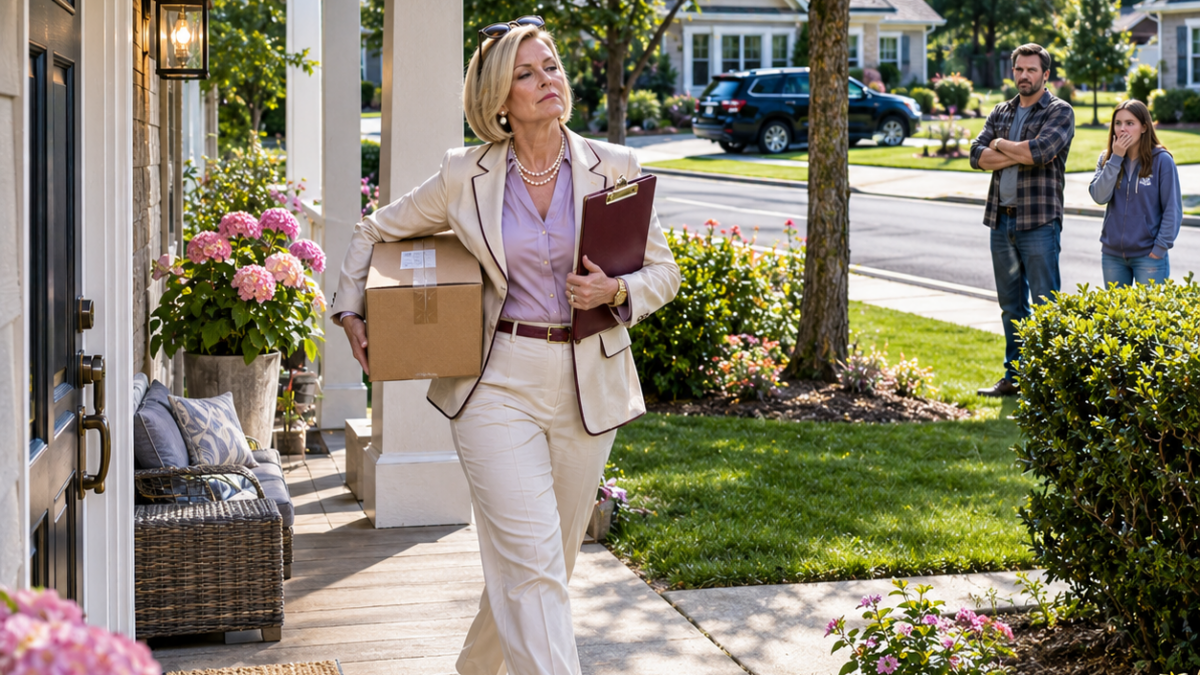
The fourth time a package disappeared from my porch, I opened my doorbell footage expecting another delivery mistake and instead watched the president of my HOA walk straight up my steps, glance both ways, tuck my box under her arm, and stroll home as calmly as if she had just collected something that belonged to her.
She had already taken my daughter’s birthday gift, a prescription I genuinely needed, and a set of tools I used for work, yet every time I complained she hid behind her title, retaliated with violation notices, and insisted she was merely “protecting misdelivered property” for the community.
By the time the police told me they still needed clearer proof of what she intended to do with the packages, I stopped asking how to make Sophia Wilson admit the truth and started wondering what kind of evidence she could accidentally carry home with her.
My name is John Davis, and I moved into Maplewood Estates six months after my divorce because I wanted boring.
That sounds pathetic until you’ve spent two years watching your marriage come apart in slow motion.
My daughter Emily was fifteen and lived with me every other week. I wanted a place where she could leave a backpack on the kitchen floor, complain about homework, and sleep without hearing her parents argue through a wall.
Maplewood looked perfect.
Neat lawns. Quiet streets. White fences. Maples arching over sidewalks.
Then I met Sophia Wilson.
Sophia was the HOA president, and she carried herself like Maplewood existed because she personally allowed it to.
Her favorite uniform was a pink blazer, immaculate white SUV, gold-framed sunglasses, and a clipboard tucked beneath one arm.
The first missing package was a knitted scarf Emily had picked online for her birthday.
The delivery photo showed it on my porch.
When I came home, it was gone.
“Maybe the driver took it to the wrong house,” Emily said.
I reordered it.
The replacement vanished too.
Then my prescription disappeared.
That was when I installed a doorbell camera.
The next morning, my phone buzzed at work.
Motion detected.
I opened the recording.
Sophia came into view.
She walked up my steps without hesitation, picked up a medium-sized box, looked toward the street, then carried it away.
I replayed the clip eight times.
That evening I showed it to George Miller, my neighbor across the street.
George had spent twenty-three years as a police officer before a bad knee forced him into retirement. He watched without speaking.
Finally, he rubbed his jaw.
“That’s Sophia.”
“I know.”
“You reported it?”
“Tomorrow.”
He handed my phone back.
“Be ready.”
“For what?”
“Retaliation.”
I thought he was exaggerating.
He wasn’t.
The police took my report but told me one video might not establish what happened after she removed the package. Sophia claimed she collected misdelivered items as part of an informal HOA safety effort.
The very next day, a yellow violation notice appeared on my door.
MAILBOX FINISH NOT APPROVED.
Two days later:
GRASS EXCEEDS FIVE-INCH LIMIT.
Then:
TRASH RECEPTACLE VISIBLE AFTER COLLECTION PERIOD.
Sophia’s signature curled across the bottom of every page.
When I confronted her at the next HOA meeting, she didn’t even blink.
“You took my packages.”
She smiled at me across the polished conference table.
“I secured unattended property.”
“From my porch?”
“You’re making a serious accusation, Mr. Davis.”
“I have video.”
“And I have an obligation to protect this neighborhood.”
A few board members shifted in their chairs.
Nobody challenged her.
That bothered me almost as much as the theft.
Then ninety-year-old Mrs. Chen stopped me outside.
Her hands trembled as she showed me a message on her phone.
“My granddaughter’s birthday gift disappeared too,” she whispered. “I saw Sophia near my porch.”
“Why didn’t you report it?”
Mrs. Chen looked toward the clubhouse windows.
“I was afraid she’d make trouble.”
That night I went home and created a folder.
Videos.
Delivery receipts.
Dates.
Missing items.
Neighbors’ statements.
By the end of the week, I had four recordings of Sophia taking packages from my porch.
I carried everything to the police.
The officer studied the clips and sighed.
“I believe something’s wrong, Mr. Davis. But she keeps claiming she’s safeguarding deliveries, and we haven’t recovered your property.”
“So what do you need?”
“Something that makes her explanation impossible.”
I walked out of the station with those words stuck in my head.
Something impossible to explain.
That evening George found me sitting alone on my porch.
“You look dangerous,” he said.
“I’m thinking.”
“That’s what I meant.”
I told him what the officer had said.
George leaned against the railing and stared toward Sophia’s house.
Then he said quietly, “If you’re going to prove somebody has dirty hands, John, make sure the proof stays on them long enough for everybody to see it.”
I turned toward him.
And for the first time all month, I knew exactly what I needed to do.
PART 2
I didn’t build anything that night.
That matters.
Anger makes bad plans look clever.
After George left, I sat at my kitchen table until almost midnight with the police report beside me and Sophia’s latest HOA violation notice underneath it.
The two documents could not have been more different.
One was an official acknowledgment that somebody had repeatedly taken property from my porch.
The other informed me that my garden hose had remained visible for thirty-eight minutes after I finished watering.
Sophia’s world was upside down.
Stealing medication was a misunderstanding.
A green hose beside a hydrangea was a crisis.
Emily came downstairs around eleven wearing sweatpants and one of my old college shirts.
“You’re still up?”
“Couldn’t sleep.”
She opened the refrigerator.
“Is this about package lady?”
I looked at her.
“Package lady?”
“That’s what I call her.”
“You probably shouldn’t.”
“Why? HOA dictator sounds meaner.”
I almost laughed.
She poured milk into a glass.
Then she noticed the papers spread across the table.
“Dad.”
“What?”
“Don’t do anything stupid.”
That landed harder than I expected.
“I’m not.”
“You get that face.”
“What face?”
“The one you got when Mom’s lawyer sent that letter.”
I leaned back.
Divorce teaches children too much about their parents.
“I’m not looking for trouble.”
Emily rested her hip against the counter.
“You’ve said her name at dinner four nights this week.”
I looked down at the paperwork.
She was right.
Sophia had already taken enough.
Packages.
Time.
Peace.
I wasn’t going to let her take every conversation with my daughter too.
I stacked the documents.
“Tomorrow we’re ordering pizza.”
Emily narrowed her eyes.
“That doesn’t answer anything.”
“Extra pepperoni.”
“Dad.”
“I promise I’m not doing anything dangerous.”
She studied me.
Finally, she nodded.
“Good.”
Then she pointed toward the yellow HOA notice.
“But if you want revenge for the hose violation, I support you emotionally.”
That made me laugh.
After she went upstairs, I opened my laptop.
Not to search for ways to hurt Sophia.
To search for lawful theft deterrence.
There were tracking tags.
Lockboxes.
Package safes.
Decoy cameras.
Tamper alarms.
Glitter devices.
Marking powders used in loss-prevention work.
UV security dyes.
Some options were harmless.
Others were exactly the kind of thing that could turn a stupid neighborhood dispute into an injury lawsuit.
I knew enough to know I needed advice before I did anything.
So the next morning I called Brian Keller.
Brian had been my college roommate at Purdue.
We had studied mechanical engineering together before life sent us in different directions. I ended up designing industrial systems. Brian went into commercial security technology.
We hadn’t spoken in almost four years.
He answered with, “Who died?”
“Nice to hear your voice too.”
“John Davis doesn’t call socially. Last time you called, your garage door had tried to murder you.”
“It was a torsion spring.”
“It was hubris.”
I smiled.
“I have a theft problem.”
“Car?”
“Packages.”
“Kids?”
“HOA president.”
Silence.
Then:
“Okay. That’s better.”
I told him everything.
When I finished, Brian whistled.
“She’s on video?”
“Four times.”
“Police?”
“Report filed. She claims she’s protecting misdelivered parcels.”
“And nobody has recovered your stuff?”
“No.”
“What do you want from me?”
“A way to mark the next package without hurting anybody.”
Brian’s joking disappeared.
“Non-toxic?”
“Absolutely.”
“No pressurized nonsense. No irritants. No explosives. No anything that could injure someone.”
“Agreed.”
“And talk to a lawyer first.”
“I was already planning to.”
“Good. Because booby traps are how clever people become defendants.”
That sentence stayed with me.
Brian recommended something far simpler than the elaborate revenge fantasies floating around the internet.
A commercially available forensic marking dye used in property-protection applications.
Non-toxic.
No chemical burn.
No blast.
No projectile.
No smell intended to sicken anyone.
If somebody opened a tamper-sealed interior pouch, the marker would transfer onto their hands and whatever they touched. Under ordinary light, it was a vivid purple-blue. Under UV, it was even more obvious.
It could remain visible for days despite repeated washing.
More important, the specific batch could be documented.
“Don’t modify the product,” Brian warned. “Use it exactly as intended.”
“I hear you.”
“And put nothing valuable inside.”
“Obviously.”
“And don’t mail it.”
“I’m putting it on my own porch.”
“Still call your lawyer.”
I did.
Her name was Laura Bennett.
Laura had handled the property side of my divorce and had the unique ability to sound irritated even when giving good news.
She listened quietly.
Then said, “I hate this.”
“So that’s a no?”
“I hate that I understand why you want to do it.”
“That’s not the same answer.”
“What exactly are you proposing?”
I explained.
“No explosion?”
“No.”
“No mechanism designed to strike her?”
“No.”
“No irritant?”
“No.”
“Nothing toxic?”
“No.”
“Just a commercially sold tamper marker inside a decoy package?”
“Yes.”
“Camera running?”
“Multiple.”
“Tracking tag?”
“I can add one.”
Laura sighed.
“I would still prefer you use a locked delivery box.”
“So would Sophia.”
“What does that mean?”
“She’d stop stealing from me. She’d keep stealing from Mrs. Chen.”
Laura went silent.
That was the real problem.
I didn’t just want my packages protected anymore.
Sophia had turned elderly residents, parents, and people who feared HOA retaliation into easy targets.
“What does the police report say?” Laura asked.
“They need stronger evidence of possession and intent.”
“Then give them evidence, not revenge.”
I wrote those words down.
Evidence, not revenge.
“Can I use the marker?”
“If it’s exactly as you described and lawful where you live, keep everything non-hazardous and document what you did. But understand something, John.”
“What?”
“If you start enjoying the humiliation more than the proof, stop.”
I didn’t answer immediately.
“John.”
“I heard you.”
“Good.”
The package arrived two days later.
Ironically, I was home when the delivery driver brought it.
I laughed when I signed.
“What?”
“Nothing.”
Inside were sealed forensic marking pouches, disposable gloves, documentation cards, and a small UV flashlight.
No secret chemistry.
No homemade concoction.
Nothing I had to mix.
That actually made the plan feel more serious.
Less like revenge.
More like a controlled test.
Brian called that evening on video.
I showed him the materials.
“Good.”
“You sound disappointed.”
“I was hoping you’d build a robot.”
“Emily would move out.”
“Fair.”
I prepared a plain cardboard decoy box.
Inside, I placed a cheap candle set, a folded towel, and the sealed marker pouch positioned according to its instructions so that anyone opening the inner gift wrap would get dye on their hands.
I added a tracking tag beneath the cardboard insert.
Then I placed a small note inside.
PROPERTY OF JOHN DAVIS.
DELIVERED TO 214 MAPLEWOOD DRIVE.
NOT HOA PROPERTY.
There could be no misunderstanding.
I photographed the contents.
Photographed the seal.
Photographed the box open.
Photographed it closed.
Recorded the tracking serial number.
Then I emailed the documentation to Laura before putting anything outside.
She replied:
YOU ARE THE MOST EXHAUSTING CLIENT I HAVE.
I wrote:
THANK YOU.
The first morning, nothing happened.
Sophia drove past twice.
She never approached.
The box sat there until sunset.
I carried it inside.
The second day, I tried again.
Nothing.
On the third day, rain started at ten, so I brought it inside.
By Thursday, I began to wonder whether Sophia had stopped.
Part of me hoped she had.
A larger part didn’t trust it.
At 10:37 Friday morning, George texted.
Queen moving.
I looked through the front window.
Sophia’s white SUV rolled slowly down the street.
She stopped near the corner.
Not in front of my house.
Near the corner.
Then she got out with her phone against her ear.
Pink blazer.
Sunglasses.
Perfect hair.
The uniform.
She walked toward my property without looking directly at my door.
Almost casually.
My pulse climbed.
I was behind the living-room curtain, but I didn’t need to watch.
The doorbell camera was recording.
The porch camera was recording.
The driveway camera was recording.
Sophia reached the steps.
Stopped.
Looked at the package.
Then toward my windows.
She picked it up.
For one second, she turned it in her hands and read the shipping label.
My name was printed clearly.
JOHN DAVIS.
My address.
No mistake.
She tucked it beneath her arm.
And walked away.
I exhaled.
The tracker moved.
214 Maplewood Drive.
Sidewalk.
Street.
Then three houses east.
Sophia’s house.
It stopped.
I didn’t celebrate.
Not yet.
I called George.
“She took it.”
“I know.”
“You watching?”
“From my kitchen.”
“Don’t confront her.”
“I’m old, not stupid.”
“Those are separate conditions.”
“Go to hell.”
I called the non-emergency line.
“My name is John Davis. I have an open package-theft report. The same subject has just removed another package from my porch. I have video and a tracker showing it inside her residence.”
The dispatcher took the report.
“Do not approach the property.”
“I won’t.”
“An officer will contact you.”
Then I waited.
Five minutes.
Ten.
Fifteen.
At minute eighteen, George texted:
YOU NEED TO LOOK OUTSIDE.
I stepped to the front window.
Sophia’s front door flew open.
She stumbled onto her driveway.
At first I couldn’t understand what I was seeing.
Then sunlight hit her hands.
Purple.
Deep, unmistakable purple-blue.
A streak crossed her jaw.
Another marked the side of her neck.
Her pink blazer had two broad smears down the front where she had apparently tried wiping her hands.
She stared at her palms.
Then screamed.
Not pain.
Rage.
“What the hell!”
George came onto his porch.
I stepped outside mine.
Sophia saw me immediately.
“You!”
I stayed beside my front door.
She marched halfway down her driveway before stopping.
Her hands were held away from her body.
“What did you put in that box?”
“My box?”
“You know exactly what I mean!”
“Which box?”
Her eyes widened.
George coughed into his fist.
Sophia pointed at me with a purple finger.
“You poisoned me!”
My smile disappeared.
“No.”
“You put chemicals in a package!”
“A non-toxic theft marker.”
“You assaulted me!”
“You opened property addressed to me inside your house.”
Her mouth closed.
Only for a second.
Then she pivoted.
“It was misdelivered.”
I pointed toward my porch.
“You took it from the address on the label.”
“I was safeguarding it.”
“Inside your house?”
“Until I could determine its owner.”
“My name was on it.”
“You set me up!”
I heard an engine behind me.
A police cruiser turned onto Maplewood Drive.
Then another.
Sophia looked toward them.
For the first time, I saw uncertainty.
She had always been comfortable around systems.
Police.
HOA rules.
Lawyers.
Paperwork.
Systems were where Sophia hid.
But now she was standing in her driveway with purple hands, a package tracker inside her home, and three cameras recording the moment she took property clearly labeled with my name.
Officer Ramirez stepped out of the first cruiser.
I recognized him from my earlier report.
His eyes went immediately to Sophia.
Then her hands.
Then me.
“Mr. Davis?”
“Yes.”
Sophia rushed toward him.
“He attacked me!”
Ramirez held up one palm.
“Everybody stay where you are.”
“This man planted some kind of chemical device!”
“Ma’am, are you injured?”
“I’m stained!”
“That wasn’t my question.”
Sophia looked at her hands.
“No, but—”
“Any burning?”
“No.”
“Trouble breathing?”
“No.”
“Eye exposure?”
“No.”
“No.”
Ramirez nodded toward another officer.
“Let’s separate everyone.”
Officer Stevens came to my porch.
“Start from the beginning.”
I handed him a folder.
He blinked.
“You prepared paperwork?”
“You told me last time you needed better evidence.”
He almost smiled.
Inside were photographs of the box before placement.
Product documentation.
Receipt.
Tracking number.
Camera timestamps.
My prior case number.
Laura’s contact information.
Officer Stevens flipped through it.
“This is a commercial marking product?”
“Yes.”
“No irritant?”
“No.”
“No explosive?”
“No.”
“You followed the manufacturer instructions?”
“Yes.”
“And you placed the package on your porch?”
“Yes.”
“Addressed to you?”
“Yes.”
“Did you tell Mrs. Wilson to take it?”
“No.”
“Did you contact her?”
“No.”
“Did anyone lure her onto the property?”
“No.”
He looked toward Sophia.
She was talking rapidly to Ramirez.
Then Stevens asked the question that mattered.
“Where is the package now?”
I opened the tracking app.
I held out my phone.
Sophia Wilson’s address appeared on the screen.
He stared at it.
Then called Ramirez over.
Ramirez looked.
His posture changed.
“Sophia,” he called.
She stopped talking.
“Where’s Mr. Davis’s package?”
“I told you. I secured it.”
“Where?”
“Inside.”
“Did you open it?”
Her purple hands answered before she did.
Sophia crossed her arms.
“It looked suspicious.”
“So you opened a package addressed to him?”
“It was unattended.”
Ramirez stared at her.
“On his porch.”
“Yes, but—”
“Mrs. Wilson, I need you to stop adding words after yes.”
George turned his head to hide a smile.
Sophia noticed.
“Why is he here? He’s part of this!”
George raised both hands.
“I’ve been in my house all morning.”
“You’re recording me!”
“I’m standing on my property.”
“You people have been conspiring against me!”
More doors opened.
Mrs. Chen appeared at the end of her walkway.
Frank Henderson from the corner came outside.
A young mother named Lauren stood behind her screen door.
Sophia looked around.
The audience she always claimed to lead was assembling without her permission.
Ramirez asked, “Can we retrieve the package?”
Sophia hesitated.
“My husband is an attorney.”
“That’s fine.”
“I want him here.”
“You can call him.”
“I do not consent to a search.”
Ramirez nodded.
“That is your right.”
She looked triumphant for half a second.
Then he continued.
“We can preserve the information we have and seek whatever legal process is appropriate. Mr. Davis has video of you removing the package and a tracking signal showing it at this address.”
Her triumph vanished.
“And,” Stevens added, “you’re currently wearing the same marking dye documented inside his package.”
Sophia looked at her hands.
I almost felt the moment when she realized the stain was not merely embarrassing.
It connected her to the inside of the box.
She had spent weeks saying she merely relocated packages.
Now she had opened one.
The evidence wasn’t just on my camera anymore.
It was on her skin.
Her phone rang.
She answered immediately.
“Robert.”
Her husband.
The attorney.
She walked several yards away.
Even from my porch, I could hear pieces.
“No, I didn’t steal—”
“He rigged—”
“Purple—”
“No, I’m not joking!”
Ramirez rubbed his forehead.
Stevens looked at me.
“How long is that supposed to stay?”
“The manufacturer says visible staining can last several days depending on exposure and washing.”
He nodded.
“Useful.”
“Apparently.”
Sophia returned.
“My husband says I am not speaking further.”
“Okay.”
“He also says Mr. Davis has committed assault.”
Ramirez remained neutral.
“Your husband can contact the department.”
“He will.”
“Good.”
She pointed at me.
“He’s dangerous.”
Mrs. Chen spoke from the sidewalk.
“No, Sophia.”
Everyone turned.
Mrs. Chen was tiny, maybe five feet tall in orthopedic shoes and a pale lavender cardigan.
Her voice shook.
But she kept walking.
“You took mine too.”
Sophia stared at her.
“What?”
“My granddaughter’s birthday gift.”
“That was misdelivered.”
“No.”
Mrs. Chen came closer.
“It was on my porch.”
Sophia’s voice hardened.
“You don’t understand what happened.”
“I understand my granddaughter cried.”
The street became silent.
Mrs. Chen held up her phone.
“I messaged you.”
Sophia glanced at Ramirez.
“You told me to file a report.”
Mrs. Chen’s hand trembled.
“So I did yesterday.”
That was new.
I looked at her.
She gave me the smallest nod.
Then Lauren opened her front door.
“My packages disappeared too.”
Another neighbor spoke.
“Mine.”
George crossed his arms.
Ramirez looked from one homeowner to another.
“How many people are we talking about?”
Nobody knew.
That answer was worse than a number.
By noon, detectives were involved.
Not because of purple dye.
Because multiple residents were now making formal theft complaints.
The dye had not solved the case.
It had broken the fear.
That distinction mattered.
Sophia’s husband Robert arrived in a black SUV at 12:18.
Tailored suit.
Expensive watch.
Jaw clenched tightly enough to crack a tooth.
He walked directly toward the officers.
“I’m Robert Wilson. I represent my wife.”
Ramirez nodded.
“Sir.”
“I want the individual responsible for chemically attacking her arrested.”
Stevens said, “We’re investigating all allegations.”
Robert looked toward me.
“You.”
I remained on my porch.
He walked to the property line but didn’t cross it.
“You think this is funny?”
“No.”
“You deliberately engineered a device to injure my wife.”
“It didn’t injure her.”
“You don’t get to decide that.”
“Neither do you.”
His face reddened.
“You’re going to regret this.”
Officer Ramirez stepped between us.
“Mr. Wilson.”
Robert looked at him.
“Do not threaten witnesses in front of police.”
“I’m not threatening anyone.”
“Then choose your wording carefully.”
Robert’s posture changed immediately.
Lawyers understand that sentence.
He lowered his voice.
“We will pursue every legal remedy available.”
“Do that,” I said.
Then I went inside.
I didn’t need the last word.
At least that’s what I told myself.
The truth was, part of me felt satisfaction.
A lot of it.
I stood in the kitchen looking through the window as Sophia tried wiping her fingers with a towel.
Purple spread across the fabric.
She looked furious.
Humiliated.
Exposed.
And for one ugly moment, I enjoyed it more than I should have.
Laura’s warning returned.
If you start enjoying the humiliation more than the proof, stop.
I stepped away from the window.
Emily came downstairs.
She had been in her room through most of it.
“Is that her?”
“Yeah.”
“She’s purple.”
“Some.”
Emily stared.
“You did that?”
“The package did.”
“Dad.”
“I used a legal, non-toxic theft marker.”
She folded her arms.
“You sound like a brochure.”
I sighed.
“Yes. I set up the decoy.”
She walked to the window.
Sophia was still outside with police.
“Did it hurt her?”
“No.”
“You sure?”
“Yes.”
Emily looked at me.
“Then I’m glad she got caught.”
I nodded.
She didn’t smile.
“But?”
“But don’t become weird about it.”
“What does that mean?”
“Don’t become one of those dads who talks about beating the HOA for the next ten years.”
Despite myself, I smiled.
“I’ll try.”
“I’m serious.”
“So am I.”
She looked toward Sophia again.
“She stole my scarf.”
“I know.”
“And your medicine.”
“I know.”
“And Mrs. Chen’s present.”
“Looks that way.”
Emily’s voice softened.
“I’m glad everybody knows now.”
That was the part I could live with.
Not purple hands.
Truth.
By evening, Sophia’s house looked like a bunker.
Blinds closed.
Garage shut.
White SUV inside.
Police had left after documenting statements and arranging the next investigative steps.
No dramatic arrest.
No handcuffs.
No cheering.
Real investigations rarely moved at internet speed.
But Maplewood did.
The neighborhood group exploded.
Someone posted:
DOES ANYONE ELSE HAVE MISSING PACKAGES?
Within an hour, there were twenty-seven comments.
By midnight, forty-three.
Not all were thefts.
Some were delivery mistakes.
Some people had no evidence.
But at least eleven residents described incidents similar to mine.
Sophia responded at 12:14 a.m.
RESIDENTS ARE REMINDED THAT SPREADING UNVERIFIED ACCUSATIONS AGAINST HOA OFFICERS MAY CONSTITUTE HARASSMENT AND DEFAMATION.
George replied:
You’re not supposed to type with evidence on your hands.
I called him immediately.
“Delete that.”
“What?”
“The comment.”
“It’s funny.”
“It’s also stupid.”
He sighed.
“You’ve become boring.”
“Delete it.”
He did.
Twenty minutes later, another post appeared.
Not from George.
From Mrs. Chen.
It contained a photograph of the receipt for her granddaughter’s missing doll.
Then the message she had sent Sophia.
Then Sophia’s response telling her to report lost deliveries.
Mrs. Chen wrote only:
I was afraid to say this before. I am not afraid now.
No joke could compete with that.
By morning, the conversation had changed.
This wasn’t a neighborhood laughing at a woman with purple hands anymore.
It was a neighborhood asking how long everybody had been silent.
The HOA board called an emergency meeting for that evening.
Sophia tried to cancel it.
The vice president, Margaret Langford, overruled her under the bylaws.
That was the first sign Sophia’s political power had cracked.
The second came at 4:30 when Walter Greaves, the board treasurer, knocked on my door.
He was sixty-something, quiet, always dressed like he had just left a bank.
“Mr. Davis.”
“John.”
“John.”
He looked nervous.
“Can we talk?”
“Sure.”
We sat on the porch.
Walter placed a folder between us.
“I need to ask something.”
“Okay.”
“Have police asked about HOA finances?”
“No.”
He stared at the folder.
“Why?”
Walter rubbed his hands together.
“Because I’ve been trying to reconcile our discretionary account.”
I felt my attention sharpen.
“What does that have to do with packages?”
“Maybe nothing.”
“Walter.”
He looked toward Sophia’s house.
“For two years, Sophia insisted certain emergency and community-security expenses needed to remain confidential.”
“What expenses?”
“That’s the problem.”
He opened the folder.
Copies of checks.
Invoices.
Vendor payments.
Several were written to companies I didn’t recognize.
EverGreen Compliance Services.
Maplewood Community Logistics.
Wilson Residential Consulting.
My eyes stopped on the last one.
“Wilson?”
“She says unrelated.”
“Is it?”
“I checked the mailing address this morning.”
He pushed over a printout.
Sophia’s home address.
I stared at him.
“How much?”
“Not sure yet.”
“How much do you suspect?”
“More than fifty thousand.”
My stomach tightened.
“Have you told police?”
“Not yet.”
“Why are you telling me?”
“Because I was scared.”
There it was again.
Fear.
Not dramatic fear.
Administrative fear.
The kind created by someone who knows which committee you sit on, which architectural request you’re waiting for, which rule can suddenly become very important.
Walter looked ashamed.
“She made every disagreement personal. If I questioned an invoice, she’d accuse me of undermining the board. If I pushed, she’d say we were exposing the HOA to liability.”
“And you stopped pushing.”
“Yes.”
“Don’t give me that folder.”
He blinked.
“Why?”
“Take it to investigators yourself.”
“I thought you might—”
“No.”
I pushed it back.
“This cannot become me against Sophia.”
Walter stared at me.
“You understand?”
After a moment, he nodded.
“You’re right.”
“I know.”
He almost smiled.
Then he gathered the folder.
At the bottom of the steps, he paused.
“John?”
“Yeah?”
“Thank you.”
“For what?”
“Not enjoying this as much as I expected you would.”
I didn’t tell him I was working on that part.
The clubhouse was packed before the meeting started.
People lined the walls.
Two local reporters stood outside because somebody had tipped off the press.
I hated that.
Sophia would use publicity to claim persecution.
Then again, the story had already escaped Maplewood.
A photograph of her stained hands had spread online by afternoon.
I had not posted it.
I didn’t know who had.
When I entered, Sophia sat at the head table.
Oversized sunglasses.
Silk scarf wrapped high around her neck.
Long sleeves despite the warm evening.
Purple stains still colored her fingers.
Robert sat beside her.
His briefcase was open.
Margaret Langford sat three seats away.
She gave me a small nod.
George had saved a seat.
“You’re late.”
“I’m early.”
“You’re late to the execution.”
“Don’t call it that.”
He looked at me.
“You’re no fun.”
Mrs. Chen sat on his other side.
She clutched the same worn receipt folder.
I touched her shoulder.
“You okay?”
“No.”
Her honesty surprised me.
“But I’m here.”
That was enough.
Margaret called the meeting to order.
Sophia immediately reached for the microphone.
“I will begin by addressing the malicious attack committed against me yesterday.”
Murmurs.
Margaret said, “Sophia, the agenda first.”
“I am president.”
“We agreed—”
“I said I will address it.”
Robert leaned toward Margaret.
“My wife has a right to respond to public accusations.”
Margaret looked tired.
“This is not a courtroom, Robert.”
“Then stop treating her like a defendant.”
Someone in the crowd said, “Maybe stop stealing.”
Laughter erupted.
Sophia slammed the gavel.
Purple fingerprints marked the handle.
The room noticed.
Laughter grew louder.
Sophia’s face twisted.
“Enough!”
Silence.
Her breathing was fast.
“For twelve years I have served this neighborhood without compensation.”
Walter looked down.
Sophia continued.
“I kept property values high. I fought irresponsible homeowners. I created safety standards when none existed.”
Her eyes found me.
“And now one vindictive resident has deliberately created a dangerous device in order to publicly humiliate me.”
I stood.
Margaret raised a hand.
“John, you’ll have time.”
“I only want to correct one thing.”
Sophia smiled bitterly.
“Of course you do.”
“The marking product was non-toxic and commercially manufactured. Police have the documentation.”
Robert jumped in.
“That conclusion is disputed.”
“Fine.”
I sat back down.
Sophia seemed disappointed I hadn’t argued.
She continued.
“The package in question was unattended and suspicious.”
Mrs. Chen stood.
Sophia stopped.
Mrs. Chen’s voice trembled badly enough that George reached toward her arm.
She waved him off.
“Sophia.”
Sophia’s expression changed.
“Mrs. Chen, please sit down.”
“No.”
Nobody in Maplewood had ever heard Mrs. Chen say that word so firmly.
“No.”
She held up the receipt.
“My granddaughter turned eight last October.”
Sophia looked away.
“I bought her a doll.”
“This isn’t relevant.”
“She wanted it for six months.”
“Mrs. Chen—”
“The package was on my porch.”
The room became completely still.
“I saw you take it.”
Sophia’s mouth tightened.
“You told me you were moving packages because there had been theft reports.”
“I was.”
“You said you would return it.”
“I’m sure I did.”
“You didn’t.”
Mrs. Chen opened her folder.
“I asked you three times.”
She pulled out printed messages.
“I saved them because my grandson taught me how.”
A few people smiled.
She handed copies toward Margaret.
“I was afraid.”
That sentence changed the room.
Not the theft.
Fear.
Everyone understood fear.
Mrs. Chen turned toward the residents.
“I am ninety years old.”
A few people laughed softly when she added:
“I have survived one husband, two hip surgeries, four children, and fifty-seven years of teaching middle school.”
More laughter.
Mrs. Chen’s eyes filled.
“And I let this woman make me afraid to ask where a doll went.”
Sophia looked down.
“I am ashamed of that.”
“No,” George said quietly.
Mrs. Chen turned toward him.
“You shouldn’t be.”
Then another resident stood.
Lauren.
“My baby monitor disappeared.”
Another.
“A pair of headphones.”
Another.
“My son’s baseball glove.”
Another.
“Medication.”
That one hit hard.
Sophia held up both hands.
“I did not steal medication!”
The room exploded.
Margaret hit the gavel.
“Please!”
Sophia stood.
“This is mob behavior.”
Walter rose slowly.
“No.”
Everyone quieted.
Walter had barely spoken in public meetings for years.
He carried the folder from my porch.
Sophia saw it.
Something changed in her face.
“Walter.”
He walked toward the front table.
“What is that?”
He placed the folder down.
“Financial reconciliation.”
Sophia’s voice became quiet.
“Not tonight.”
Walter looked at her.
“Why?”
“We are discussing Mr. Davis.”
“No.”
Walter shook his head.
“We’re discussing trust.”
Robert stood.
“Anything involving association accounts should be reviewed privately with counsel.”
Walter’s expression hardened.
“I have tried.”
Robert stopped.
Walter opened the folder.
“Over the last thirty-six months, fifty-seven thousand four hundred and eighty dollars in HOA funds were paid through discretionary or emergency categories without complete supporting documentation.”
The room went dead silent.
Sophia’s remaining color seemed to disappear beneath the stains.
“That is irresponsible,” she said.
Walter continued.
“Several vendors appear not to exist.”
“Careful.”
“One lists your home address.”
Robert snapped his briefcase shut.
“This meeting ends now.”
Margaret turned toward him.
“No, it doesn’t.”
“You are exposing this association to enormous liability.”
Margaret looked at Sophia.
“I think that happened before tonight.”
Applause.
Sophia stood so quickly her chair scraped backward.
“You ungrateful people.”
The words came out before she could stop them.
Everybody heard.
Sophia looked around.
Twelve years of practiced political language vanished.
No community.
No service.
No standards.
Ungrateful people.
George whispered, “There she is.”
Sophia pointed toward Walter.
“I approved emergency expenditures because you were too weak to act.”
Then Margaret.
“You couldn’t organize a bake sale without me.”
Then the crowd.
“Half of you begged me to enforce these rules!”
Nobody answered.
Her finger finally reached me.
“And you.”
I met her eyes.
“You came here after a divorce, angry at the world, and decided to make me your enemy.”
That hit closer than I expected.
She knew about the divorce.
Probably from HOA records.
Maybe gossip.
I felt my face heat.
George shifted beside me.
Emily’s warning echoed in my head.
Don’t become weird about it.
I stood slowly.
“My marriage has nothing to do with what you took.”
Sophia smiled.
“It has everything to do with this. You needed someone to punish.”
A few people looked toward me.
For the first time that evening, Sophia had landed a blow.
Because there was enough truth inside it to hurt.
I had been angry after the divorce.
Humiliated.
Lonely.
I had wanted control.
Maplewood had looked like a place where nothing unexpected could happen.
Then Sophia started taking things from my porch, and the fight gave my anger somewhere to go.
I could deny that.
Or I could own it.
“You’re right about one thing.”
The room became silent.
Sophia looked surprised.
“I was angry when I moved here.”
George looked at me.
“So angry I mistook quiet for happiness.”
I glanced toward Mrs. Chen.
“Maybe part of why I fought so hard is because I was tired of feeling like things were being taken from me.”
Sophia’s smile returned.
Then I finished.
“But none of that put your hands on Mrs. Chen’s package.”
Her smile died.
“None of it put you on my porch.”
I pointed toward Walter’s folder.
“And it sure as hell didn’t write those checks.”
Applause broke out.
I didn’t raise my voice.
Didn’t need to.
Margaret waited until the room settled.
Then she made the motion.
“Pending independent investigation, I move that Sophia Wilson be immediately removed from all executive authority and permanently barred from handling association finances.”
Second.
Vote.
Every board member except Sophia raised a hand.
Even Walter.
Even the secretary who had spent years agreeing with her.
Sophia stared.
“No.”
Margaret looked at her.
“The motion carries.”
“No.”
“Sophia.”
“You can’t.”
“You’re removed.”
“I am the HOA!”
Someone in the back answered.
“Not anymore.”
That sentence moved through the room like electricity.
Sophia grabbed the gavel.
Her stained hand tightened around it.
Then, slowly, she released it.
Purple marks remained on the polished wood.
She looked at them.
So did everyone else.
Robert touched her arm.
“We’re leaving.”
Sophia didn’t move.
“Robert.”
“Now.”
He gathered the papers.
She finally stood.
At the door, Sophia turned toward me.
The room waited.
I expected another threat.
Instead, she said:
“This isn’t over.”
Then she left.
George leaned back.
“They always say that.”
He was right.
It wasn’t over.
Not even close.
The next morning, a black SUV stopped in front of my house.
A process server walked up the steps.
“John Davis?”
“That depends.”
He didn’t smile.
“You’ve been served.”
The complaint alleged assault, intentional infliction of emotional distress, property damage, harassment, defamation, and something called “reckless deployment of chemical substances.”
Laura read the lawsuit that afternoon.
Then she removed her glasses.
“Robert wrote this.”
“You can tell?”
“It’s dramatic enough.”
“Do they have a case?”
“They have allegations.”
“That sounds like lawyer language.”
“It is.”
She tapped the complaint.
“They’re betting you’ll panic.”
“I’m not panicking.”
“You built a dossier for a package.”
“Exactly.”
She stared at me.
“You understand that is not universally comforting.”
“What happens now?”
“We answer.”
“And the dye?”
“We document that it was non-toxic, commercially manufactured, used according to its instructions, and placed inside your own decoy package after repeated documented thefts.”
“Will that win?”
“No lawyer who promises you a result should remain your lawyer.”
I nodded.
“Anything else?”
“Yes.”
She leaned forward.
“Stop talking publicly.”
“I haven’t posted anything.”
“Keep not posting.”
“George?”
“Control George.”
“Nobody controls George.”
“Sedate him.”
“I’m not sure that’s legal.”
“Pity.”
The lawsuit sobered me.
Until then, the story had felt almost clean.
Thief steals.
Dye exposes thief.
Neighbors speak.
Power collapses.
Real life is never that neat.
Sophia’s attorneys requested my security footage.
My communications with Brian.
My purchase records.
Messages with George.
Everything.
That included one text I regretted.
The night before the decoy package, I had written to George:
Tomorrow she finally gets what she deserves.
Laura stared at it.
“That’s bad.”
“I know.”
“Not fatal.”
“I know.”
“It sounds like revenge.”
“I was angry.”
“You were.”
She folded her arms.
“Remember what I told you?”
“Yes.”
“Evidence, not revenge.”
“I remember.”
“But?”
“But I wanted both.”
There.
Saying it aloud felt worse.
Laura nodded.
“Good.”
“Good?”
“Truth is easier to defend than pretending you were a saint.”
That became our strategy.
I didn’t claim I felt nothing.
I didn’t claim I had no satisfaction watching Sophia get caught.
I claimed exactly what happened.
She repeatedly removed my packages.
Police said stronger evidence was needed.
I used a non-harmful marking product in my own decoy property.
I documented everything.
She voluntarily entered my porch, took the clearly labeled package, carried it into her home, and opened it.
Was I angry?
Yes.
Did I hope she would be exposed?
Absolutely.
Did I intend to physically injure her?
No.
That was the truth.
Meanwhile, the criminal investigation widened.
Detectives obtained legal authority to recover property connected to the theft complaints.
I learned about the results from Officer Ramirez two days later.
He called me.
“You sitting down?”
“Should I be?”
“Probably.”
I sat.
“They recovered packages.”
“How many?”
“More than yours.”
“How many?”
“John.”
“Tell me.”
“Sixteen items directly matching active complaints. Some opened. Some still sealed.”
I closed my eyes.
Emily’s scarf?
I almost asked.
Instead:
“What about medication?”
“Can’t discuss every item yet.”
“Understood.”
“There’s more.”
I waited.
“Mrs. Chen’s doll was still in a closet.”
For some reason, that broke something in me.
Not my tools.
Not my prescription.
A child’s doll.
Sitting in a closet for months while a ninety-year-old woman blamed herself for being afraid.
“Can she get it back?”
“Eventually.”
“Good.”
Ramirez continued.
“Financial investigators are now coordinating with the HOA audit.”
“So Walter was right.”
“Looks that way.”
“How much?”
“Can’t tell you.”
“More than fifty?”
Silence.
“Okay.”
“You didn’t hear anything.”
“I heard nothing.”
When I hung up, Emily was in the doorway.
“What?”
“They found Mrs. Chen’s doll.”
Her face changed.
“No way.”
“Yeah.”
“Can we tell her?”
“Police probably will.”
Emily grabbed her shoes.
“Come on.”
“Where?”
“Her house.”
“Why?”
“Because she shouldn’t be alone when they call.”
My daughter was smarter than me.
Mrs. Chen cried when we told her only that investigators had located property connected to her report.
She insisted on making tea.
Her hands shook so badly Emily took the kettle.
“I feel foolish,” Mrs. Chen said.
“For what?”
“Being frightened.”
Emily turned from the stove.
“You’re not foolish.”
Mrs. Chen smiled at her.
“When I was your age, I thought old people were brave.”
Emily shrugged.
“My dad’s old and he’s scared of dentists.”
“I am not old.”
Mrs. Chen laughed.
The sound softened the entire room.
Then she looked at me.
“John.”
“Yes?”
“You must not let this make you cruel.”
I stared at her.
Apparently everybody in my life had received the same instruction manual.
“I’m trying.”
“Good.”
She patted my hand.
“Winning can spoil people too.”
That stayed with me.
Sophia lost the civil lawsuit faster than I expected.
Not because of the dye.
Because of discovery.
Her own messages were worse than mine.
The first came from a group text with two HOA allies.
Davis keeps ordering expensive-looking packages. If he cannot follow community security procedure, we may need to hold them.
Another:
He is getting suspicious. Let him complain. Robert says video alone doesn’t prove intent.
Laura read that message twice.
Then smiled.
“That’s very helpful.”
The third was worse.
A message sent after my prescription disappeared:
He’s dramatic. It was probably nothing important.
I stared at it for a long time.
Nothing important.
I had spent two days getting an emergency refill.
Sophia didn’t know what was inside the package.
That was the point.
She didn’t care.
Her attorney requested settlement discussions three days later.
Laura called me.
“They’ll dismiss if you waive claims.”
“What claims?”
“Your counterclaim for replacement costs and legal fees.”
“I want restitution for the stolen property.”
“That is being handled separately.”
“What about Mrs. Chen?”
“Separate victim.”
I thought.
“I want dismissal with prejudice.”
“Obviously.”
“And a written statement that the package marker was not found to have caused physical injury.”
Laura smiled.
“That is weirdly specific.”
“I’m tired of the chemical attack story.”
“I’ll ask.”
The agreement was signed the following week.
Sophia’s assault lawsuit disappeared.
The criminal and financial matters remained.
Local media finally picked up the story after court filings became public.
The headline wasn’t nearly as funny as George wanted.
FORMER HOA PRESIDENT INVESTIGATED IN PACKAGE THEFT, FUND MISUSE CASE.
He complained.
“They missed the purple.”
“Journalism survives.”
“Barely.”
The internet did not show restraint.
Somebody posted the first purple photograph.
Then another.
Memes spread.
Purple President.
Sticky Fingers Sophia.
Operation Violet.
I hated some of them.
Not because Sophia didn’t deserve consequences.
Because humiliation turns people into cartoons.
And cartoons are easy to hate.
Real people are harder.
I had spent months furious at Sophia.
But I had seen her face at the board meeting when the vote passed.
For one second, she hadn’t looked evil.
She had looked terrified.
Power had been her identity for twelve years.
Without it, she didn’t know who she was.
That didn’t excuse stealing.
It simply reminded me not to become the kind of person who needed her suffering for entertainment.
George disagreed.
“She took sixteen packages.”
“I know.”
“She stole from Mrs. Chen.”
“I know.”
“She harassed you with fines.”
“I know.”
“She allegedly stole HOA money.”
“I know.”
“And you feel sorry for her?”
“No.”
He stared at me.
“What do you feel?”
I looked toward Sophia’s dark house.
“I’m trying not to need her destroyed.”
George considered that.
Then nodded.
“That’s probably healthier.”
“Don’t sound disappointed.”
“I wanted matching purple T-shirts.”
“You can still buy one.”
“Already did.”
He lifted his sweatshirt.
Underneath:
KEEP YOUR HANDS OFF MY PACKAGES.
I laughed despite myself.
The independent HOA audit finished three weeks later.
Fifty-seven thousand dollars was unaccounted for.
Not all of it had gone directly into Sophia’s pocket.
The truth was messier.
Some expenditures were legitimate but undocumented.
Some were inflated.
Some went to vendors connected to her family.
Several reimbursement checks had been deposited into an account she controlled.
There were fake invoices.
Duplicate payments.
Cash withdrawals.
Nothing like a movie villain with offshore accounts.
Just years of small entitlement adding up.
Five hundred here.
Twelve hundred there.
A landscaping reimbursement.
A community-security expense.
A “resident engagement” purchase.
Each one probably easy to rationalize in isolation.
Together they became tens of thousands.
Robert, her husband, was not charged.
But investigators found he had written letters threatening residents with litigation when they challenged HOA decisions.
His law firm did not appreciate appearing in news stories connected to that.
He took an indefinite leave.
Then came Sophia’s arrest.
She surrendered voluntarily.
No raid.
No dramatic scene.
A photograph appeared on local news of her entering the courthouse in a gray coat, gloves covering her hands even though most of the dye had finally faded.
The charges included theft-related offenses, fraud connected to HOA funds, and obstruction tied to false explanations she had provided during the investigation.
George texted:
PURPLE RAIN FINALLY ENDS.
I didn’t answer.
Emily found me sitting on the porch.
“You okay?”
“Yeah.”
“You don’t look happy.”
“I’m not sure I’m supposed to be.”
“She got arrested.”
“I know.”
“You wanted that.”
“I wanted it to stop.”
Emily sat beside me.
“There’s a difference?”
“Big one.”
She pulled her knees toward her chest.
“Mom says you’re obsessed with justice.”
I looked at her.
“When did you talk to Mom about this?”
“Yesterday.”
“What exactly did she say?”
Emily smiled.
“She said you’ve always needed the world to make sense.”
That sounded like my ex-wife.
“And?”
“And sometimes it doesn’t.”
We sat quietly.
Then Emily rested her head briefly against my shoulder.
“Can we order pizza?”
“Extra pepperoni?”
“Obviously.”
Life was teaching me something.
The beginning of revenge is simple.
Someone hurts you.
You want them to feel what you felt.
But if you’re lucky, somewhere in the middle, revenge becomes accountability.
You stop asking how much suffering is enough.
You start asking what needs to change so it doesn’t happen again.
Maplewood started changing before Sophia’s case was resolved.
Margaret Langford became interim HOA chair.
Her first meeting lasted forty-three minutes.
That alone was revolutionary.
She suspended discretionary fines.
Created an appeals panel.
Required two signatures for expenditures over one thousand dollars.
Published monthly financial reports.
Then she announced package lockers for every block.
Mrs. Chen raised her hand.
Margaret smiled.
“Yes?”
“Can they be purple?”
The clubhouse exploded.
Even I laughed.
Margaret covered her face.
“I walked into that.”
George became volunteer community-safety coordinator after promising in writing that he would not “conduct vigilante operations.”
He complained about the wording.
“You were a cop.”
“That’s why it’s insulting.”
“What do you actually do?”
“Check streetlights and organize neighborhood watch.”
“So nothing dangerous.”
“Last week I confronted a raccoon.”
“Did you win?”
“Pending investigation.”
Mrs. Chen eventually agreed to serve on the board.
Not president.
At first.
Three months later, Margaret stepped down for family reasons.
The board nominated Mrs. Chen.
She refused.
The residents nominated her again.
She refused again.
Emily attended the third meeting with me.
When Mrs. Chen refused a third time, Emily whispered:
“She’s totally becoming president.”
She was right.
Mrs. Chen accepted under one condition.
“No one calls me queen.”
George said, “Your Majesty?”
She threatened to hit him with her purse.
The vote was unanimous.
The neighborhood that Sophia had ruled through fear chose a ninety-year-old retired teacher whose first instinct in every disagreement was to ask:
“Has everyone had a chance to speak?”
That changed Maplewood more than any rule.
Sophia’s case moved slowly.
Months passed.
Then came the plea agreement.
She admitted to multiple theft-related counts and financial misconduct.
The final restitution figure included HOA funds and property belonging to residents.
She avoided jail but received probation, community service, financial restrictions, and mandatory restitution.
Some neighbors were furious.
George wanted prison.
Frank wanted “at least one night in a cell with fluorescent lighting.”
Mrs. Chen surprised everyone.
“I am satisfied.”
George looked at her.
“She stole from you.”
“Yes.”
“She stole from everybody.”
“Yes.”
“So why aren’t you angry?”
Mrs. Chen folded her hands.
“Who said I am not angry?”
That silenced him.
She continued.
“Punishment is not measured by how pleased it makes us.”
I wrote that down mentally too.
Sophia’s sentencing hearing took place on a gray Monday morning.
I almost didn’t go.
Laura said I had no obligation.
Emily had school.
George wanted to come but had a doctor’s appointment.
Mrs. Chen went.
So did Walter.
I drove her.
The courtroom was smaller than television makes courtrooms look.
Beige walls.
Fluorescent lights.
Old wood benches.
The judge reviewed the plea.
Then he looked at Sophia.
She appeared different.
Her hair was darker.
No pink blazer.
No oversized sunglasses.
No scarf.
The purple dye was long gone except, maybe, for the faintest discoloration near one cuticle.
Or maybe I imagined it.
The judge spoke quietly.
“Mrs. Wilson, you held a position of trust.”
Sophia looked down.
“You used that position to intimidate residents who questioned you.”
He reviewed the package thefts.
The financial violations.
The retaliation.
Then he said something that changed the tone of the room.
“This is not a story about a prank.”
Nobody moved.
“It is not a story about internet ridicule.”
He looked toward the gallery.
“It is certainly not a story about purple dye.”
A few people shifted.
“This is about trust.”
Sophia closed her eyes.
“You repeatedly convinced yourself that your authority gave you rights over other people’s property, money, and choices.”
Her lawyer rested one hand on the table.
The judge continued.
“You did not begin with one enormous crime. You crossed small lines until lines stopped mattering.”
That sentence hit me.
Because it wasn’t only true about Sophia.
It was true about almost every abuse of power I had ever witnessed.
Rarely does somebody wake up and decide to become a tyrant.
They test a boundary.
Nothing happens.
Then another.
People stay quiet.
The boundary moves.
Eventually, the person forgets it was ever there.
The judge asked Sophia whether she wanted to speak.
She stood.
Her voice was barely audible.
“I thought I was helping.”
No one laughed.
“I know that sounds ridiculous now.”
She looked toward Mrs. Chen.
“I told myself people were careless.”
Mrs. Chen’s expression remained calm.
“I told myself packages left outside looked bad. That if I moved them, I was keeping the neighborhood secure.”
Sophia swallowed.
“Then I started keeping things.”
A murmur moved through the courtroom.
Her lawyer touched her elbow.
Sophia continued.
“Sometimes I told myself I forgot.”
She looked toward me.
“Sometimes I knew exactly what I was doing.”
That was the first full admission I had ever heard.
No HOA authority.
No misdelivery.
No security committee.
“I liked that people were afraid to question me.”
Robert sat behind his attorney table.
His face was unreadable.
Sophia’s hands trembled.
“When John confronted me, I didn’t stop because stopping would mean admitting he was right.”
She laughed once.
A broken sound.
“So I fined him.”
I almost smiled.
“Then I kept taking things because every time I got away with it, I felt…”
She struggled.
“Untouchable.”
There it was.
The truth.
The judge nodded.
“And now?”
Sophia looked at her hands.
“Now I feel stupid.”
Someone behind me laughed softly.
The judge didn’t.
“Feeling foolish is not accountability.”
Sophia nodded.
“I know.”
The sentence followed the plea agreement.
Probation.
Restitution.
One hundred hours of community service.
Restrictions involving HOA or fiduciary positions.
Additional conditions related to financial reporting.
No dramatic punishment.
No prison door slamming.
Just consequences.
When court adjourned, Mrs. Chen took my arm.
“Take me for lunch.”
“That’s your reaction?”
“I skipped breakfast.”
We started toward the door.
“John.”
I turned.
Sophia stood behind me.
Her lawyer and Robert had moved several feet away.
For a second, neither of us spoke.
She looked tired.
“Can I say something?”
“You just did.”
The old Sophia flashed across her face.
Annoyance.
Then, unexpectedly, she smiled.
Barely.
“I deserved that.”
Mrs. Chen squeezed my arm.
“I’ll wait outside.”
She walked away.
Sophia looked at me.
“I’m sorry.”
There was no audience close enough to hear.
No camera.
No board.
No leverage.
“I know sorry doesn’t return anything.”
“No.”
“I know it doesn’t erase what I did.”
“No.”
She nodded.
“I hated you.”
“I know.”
“I blamed you for all of this.”
“I know that too.”
Her eyes filled.
“The worst part is you didn’t even ruin me.”
I stayed quiet.
“I kept waiting for evidence that you had planned all of it. The police. The board. Walter. The reporters.”
She looked toward the courtroom doors.
“But every road came back to something I did.”
I thought of the decoy box.
“I did plan one part.”
“The dye.”
“Yes.”
She looked at her fingers.
For the first time, we both laughed.
Not much.
But enough.
“You know,” she said, “that stuff stayed under my nails for nine days.”
“I’m sorry.”
“No, you’re not.”
“Maybe forty percent.”
She shook her head.
Then became serious.
“Your daughter’s scarf was recovered.”
“I know.”
“I never opened it.”
“Why did you take it?”
Sophia stared at the floor.
“I don’t know.”
“That’s not true.”
She took a slow breath.
“I saw the delivery truck.”
I waited.
“And?”
“You had just challenged a landscaping fine.”
The answer was worse than greed.
“You took my daughter’s birthday gift because I argued about a fine?”
“I told myself I was checking whether you were running a business from the house.”
“That makes no sense.”
“I know.”
She looked at me.
“It made sense when I needed it to.”
That might have been the most truthful thing she ever said.
Sophia started to leave.
I stopped her.
“Mrs. Chen’s doll.”
She closed her eyes.
“I know.”
“She cried for weeks.”
“I know.”
“Have you apologized to her?”
“Not yet.”
“Do that before you apologize to me again.”
Sophia nodded.
Then walked outside.
I found Mrs. Chen sitting on the courthouse bench.
“Did she apologize?”
“Yes.”
“Good.”
“You’re not curious?”
“No.”
“She wants to apologize to you.”
Mrs. Chen looked toward the glass doors.
“Then she knows where I live.”
That afternoon, we ate soup and sandwiches at a diner.
Mrs. Chen complained the soup needed salt.
I pointed at her blood-pressure medication.
She told me to mind my business.
Normal life.
A week later, Sophia’s house went on the market.
Robert had already moved to an apartment closer to his law office.
Rumors said they were separating.
I didn’t know whether that was true.
I didn’t ask.
The house sold quickly.
On moving day, I watched from my porch as boxes came out.
Sophia stayed mostly inside.
Near sunset, she emerged carrying one small cardboard carton.
She looked toward my house.
Our eyes met.
For a second, I remembered her carrying my first package exactly the same way.
Box under one arm.
Confident stride.
Except now the box actually belonged to her.
She walked toward me.
I stood.
She stopped at the sidewalk.
“I’m allowed to approach, right?”
“Yes.”
She held out an envelope.
“What’s this?”
“Not a lawsuit.”
“That narrows it down.”
She almost laughed.
“Open it later.”
Then she looked at the house.
“I’m moving to stay near my sister.”
“Good luck.”
“My community service starts next month.”
“Where?”
“A food bank.”
That felt appropriate.
“They already told me I’m not allowed to reorganize anything.”
I laughed.
Sophia smiled.
“Goodbye, John.”
“Goodbye, Sophia.”
She started walking away.
Then stopped.
“Your daughter.”
“What about her?”
“I’m sorry.”
I nodded.
“I’ll tell her.”
“Please do.”
That was the last time I saw Sophia Wilson in person.
The envelope stayed on my kitchen table until after dinner.
Emily was home.
“You’re not opening it?”
“I was waiting for you.”
“That’s ominous.”
I handed it to her.
Inside was a handwritten letter.
And a gift card to the same clothing company where I had ordered her scarf.
Emily read the card.
Then the letter.
Her expression changed.
“What?”
“She says she knows replacing it doesn’t fix it.”
“That sounds accurate.”
“She says she hopes I buy something stupid and expensive with this.”
I laughed.
“That also sounds accurate.”
Emily read farther.
Then folded the letter.
“You forgive her?”
I leaned against the counter.
“I don’t know.”
“You always say that.”
“Because forgiveness isn’t a light switch.”
“Mom forgave you.”
I looked at her.
“For what?”
Emily smiled.
“Apparently lots of things.”
“Your mother talks too much.”
“She says the same about you.”
I took the letter.
“What do you think?”
Emily shrugged.
“I think she did something bad.”
“Several things.”
“And got consequences.”
“Yeah.”
“And apologized.”
“Yeah.”
“So now she gets to decide who she is next.”
I stared at my fifteen-year-old daughter.
“When did you become eighty?”
“Living between you and Mom aged me.”
Fair.
Six weeks later, a young family moved into Sophia’s house.
Ben and Rachel Morgan.
Two children.
Golden retriever named Murphy.
Murphy barked every time the delivery truck came by.
The first afternoon they arrived, Rachel crossed the street.
“Hi.”
“John.”
“We’re Rachel and Ben.”
“Welcome.”
She glanced toward my porch camera.
Then smiled awkwardly.
“We heard a story.”
I sighed.
“Of course you did.”
“Were you really the purple package guy?”
From across the street George shouted:
“YES.”
I looked at him.
“Go inside.”
Rachel laughed.
“So it’s true?”
“Mostly.”
She held up her hands.
“We promise not to steal anything.”
“Strong start.”
Their oldest daughter, maybe seven, ran over carrying sidewalk chalk.
“Mom, can I draw here?”
Rachel looked at the sidewalk.
“Sure.”
The girl dropped to her knees and began drawing a huge purple sun.
George nearly collapsed laughing.
I had to turn away.
Maplewood healed in small ways.
Not grand speeches.
Not news stories.
Ordinary things.
People left packages on porches without checking cameras every ten minutes.
The new lockers went in near the mail clusters.
Residents who wanted direct porch delivery could keep it.
Those who wanted secure storage had that option.
Choice.
Something Sophia never understood.
HOA meetings changed too.
Mrs. Chen presided from the same chair Sophia once used.
But she never sat at the head of the long table.
She moved the chairs into a semicircle.
The first time I saw it, I asked why.
“So people stop thinking government must sit above them.”
“This is an HOA.”
“Same principle.”
George became community-safety coordinator.
His main accomplishment was a neighborhood text network for suspicious activity.
His second was Friday barbecue night.
His third was banning himself from using the phrase “tactical perimeter” after he described setting up tables around a grill.
Walter remained treasurer.
He published every expense online.
Including $37.84 for copier paper.
“Little excessive,” I told him.
He looked offended.
“Transparency.”
“You uploaded the receipt.”
“Transparency.”
“You uploaded a photograph of yourself holding the receipt.”
“Accountability.”
I gave up.
The recovered packages were eventually returned.
My tools came back scratched but usable.
My prescription had expired.
Insurance covered the replacement.
Emily’s scarf was still sealed.
I gave it to her three months late.
She opened the box at the kitchen table.
“You know I already have another scarf.”
“I know.”
“This one has a criminal history.”
“I know.”
She wrapped it around her neck.
“How do I look?”
“Like evidence.”
She laughed.
Mrs. Chen’s doll came back too.
Her granddaughter visited that weekend.
Mrs. Chen invited Emily and me over.
The little girl carried the doll everywhere.
At one point, I found Mrs. Chen standing alone in the kitchen watching her play.
“You okay?”
“Yes.”
She wiped one eye.
“I should have fought harder.”
“No.”
“I knew.”
“You were scared.”
“I’m old enough to know better.”
I shook my head.
“Fear doesn’t check birthdays.”
She smiled.
“That sounded wise.”
“Don’t spread it around.”
Then she looked toward the living room.
“You know the strangest part?”
“What?”
“I don’t care about the doll anymore.”
I understood.
“It was never the doll.”
“No.”
“It was being told what you saw didn’t happen.”
Mrs. Chen nodded.
That was exactly it.
Sophia’s greatest theft had not been merchandise.
It was certainty.
She made people doubt whether they had the right to object.
Whether the rules were really what they thought.
Whether a president could somehow make wrong behavior legitimate.
Whether speaking up would cost more than staying silent.
Once that certainty returned, Maplewood changed almost overnight.
A year after the first package disappeared, the neighborhood held a fall festival.
No dress code.
No approved pumpkin sizes.
No rule about where lawn chairs could sit.
George grilled burgers.
Walter ran a donation table.
Mrs. Chen judged the children’s costume contest and deliberately gave every kid a ribbon.
“You understand judging implies choosing?” I asked.
“I chose all of them.”
“That’s not judging.”
“Ninety-one.”
“What?”
“My age. Argue with me.”
I didn’t.
Emily brought two friends.
At some point, she disappeared toward the lake with them.
I watched longer than necessary.
George noticed.
“She’s fifteen.”
“I know.”
“Let her breathe.”
“I am.”
“You’re staring.”
“I’m observing.”
“Same thing Sophia used to say.”
I turned slowly.
“Take that back.”
He laughed so hard he almost dropped a hamburger.
Later that evening, I sat on my porch.
The festival lights glowed down the street.
My phone buzzed.
Unknown number.
For one second, old instincts returned.
Sophia?
A threat?
A lawyer?
I opened the message.
It was a photograph.
Sophia stood behind a table at a food bank.
Plain blue apron.
Hair pulled back.
No blazer.
No clipboard.
Stacks of canned vegetables behind her.
The message read:
They let me inventory soup now. Nobody has complained yet.
I stared.
Then another message:
Before you ask, I do not take any home.
I laughed.
Emily stepped outside.
“What?”
I showed her.
“No way.”
“Apparently.”
“Are you two friends?”
“No.”
“You text.”
“Occasionally.”
“That’s how friendship starts.”
“Go away.”
She smiled.
“Tell purple lady I said hi.”
I typed:
Emily says hello.
A minute later:
Tell her I still owe her a birthday gift.
I replied:
You already paid for one.
Sophia:
Fair.
That was all.
No philosophy.
No grand redemption speech.
Just soup cans.
Sometimes that’s enough.
Months later, another letter came.
Handwritten.
You were right. Some stains don’t fade quickly. But apparently people can change faster than I expected if they finally stop defending what they did.
I’m not asking you to forget.
I don’t think forgetting would help either of us.
My sister says I still arrange her pantry like an HOA compliance inspection.
We’re working on it.
S.W.
I kept the note.
Not because Sophia and I were friends.
Because it reminded me how close I had come to misunderstanding my own victory.
For months I thought the satisfying part would be seeing her embarrassed.
Purple hands.
Ruined blazer.
Everyone laughing.
And yes, in that first moment, it felt good.
I won’t lie.
But that feeling disappeared quickly.
The part that lasted was Mrs. Chen standing at a microphone without trembling.
Walter bringing financial records to investigators instead of hiding them.
Margaret changing board procedures.
Emily reminding me I didn’t need to build my identity around a fight.
Packages staying where delivery drivers left them.
Those things mattered.
Sophia’s humiliation was temporary.
The neighborhood’s courage wasn’t.
One Saturday morning, almost eighteen months after everything started, a delivery van stopped in front of my house.
I was trimming a hedge.
The driver climbed out carrying a medium-sized cardboard box.
“You John Davis?”
“Depends who’s asking.”
He looked at the label.
“Guy with a package.”
“Then yes.”
He walked toward me.
Then stopped.
“Wait.”
“What?”
His eyes widened.
“You’re the purple package guy.”
I closed my eyes.
Not again.
“My coworkers talk about you.”
“That is deeply unfortunate.”
He laughed.
“They say package theft around here dropped to basically zero.”
“Secure lockers helped.”
“Still.”
He handed me the box.
“Nice work.”
I looked at the label.
Emily Davis.
“Actually, this one’s my daughter’s.”
He pointed toward the porch.
“Want me to put it somewhere hidden?”
I thought about it.
“No.”
I carried it to the steps.
Placed it beside the door.
Plain cardboard.
No tracking experiment.
No forensic marker.
No hidden camera beyond the ordinary doorbell system everybody seemed to own now.
Just a package.
The driver left.
I went back to trimming.
Ten minutes passed.
Twenty.
A white SUV turned into the street.
My body tensed before my brain caught up.
Not Sophia’s.
Ben Morgan.
He waved.
I waved back.
The package stayed exactly where I left it.
At noon, Emily arrived.
She had her learner’s permit and was driving her mother’s car.
That sentence alone had aged me ten years.
She walked onto the porch.
Saw the box.
Picked it up.
No fear.
No suspicion.
No checking the street.
“Mine?”
“Apparently.”
She opened the front door.
Then paused.
“Dad.”
“What?”
“You staring at the package?”
“No.”
“You are.”
“I’m trimming.”
“The same branch for five minutes?”
I looked at the hedge.
It was nearly bald.
“Go inside.”
She laughed.
Later, she opened the package at the kitchen table.
College brochures.
A sweatshirt from one of the universities she wanted to visit.
I stared at the logo.
“You’re not going that far away.”
“I haven’t even applied.”
“Good.”
“Dad.”
“Thirty-mile radius.”
“Dad.”
“Forty.”
She threw the sweatshirt at me.
I caught it.
For a moment, I remembered the scarf.
The first package.
The divorce.
Moving into Maplewood convinced I had failed at keeping my family together.
Maybe that was why Sophia’s stealing had felt so personal from the beginning.
I had bought that house to prove I could still protect something.
A home.
My daughter.
A little peace.
Then packages started disappearing from my front steps, and it felt like another reminder that I couldn’t control anything.
What I eventually learned was that protecting something did not mean controlling every outcome.
That had been Sophia’s mistake.
Maybe mine too, in a smaller way.
Control is seductive when life has made you feel powerless.
Sophia controlled neighbors because she needed to feel important.
I obsessed over catching her because I needed to feel that the world could still be made fair if I worked hard enough.
The healthier answer lived somewhere in between.
Set boundaries.
Document truth.
Use systems when they work.
Challenge them when they don’t.
Then know when to stop fighting.
That evening, George came over with two beers.
We sat on the porch.
He noticed Emily’s package box flattened beside the recycling bin.
“No dye?”
“No.”
“No tracker?”
“No.”
“No dramatic revenge mechanism?”
“Nothing.”
He shook his head.
“You’ve gotten soft.”
“I’ve gotten tired.”
“Same thing after fifty.”
“You’re sixty-seven.”
“Exactly.”
The streetlights came on.
Rachel Morgan called her kids inside.
Murphy barked at a squirrel.
Mrs. Chen’s porch light glowed at the end of the block.
A delivery van passed without stopping.
George raised his beer.
“To boring.”
I clinked mine against his.
“To boring.”
We sat quietly.
After a while, he said, “You know, I told you that first night you needed proof that wouldn’t wash off.”
“I remember.”
“Turns out I was right.”
I smiled.
“You’re going to make this about yourself?”
“Absolutely.”
“The dye washed off.”
“Eventually.”
He looked toward Maplewood.
“But everybody remembered what it showed.”
That was true.
The purple disappeared.
Sophia’s reputation changed.
The memes faded.
News moved on.
Even the criminal case eventually became an old story people mentioned only when new residents asked why the HOA had so many transparency rules.
But something stayed.
Not fear.
The opposite.
People spoke sooner.
When Walter questioned a budget item, nobody called him disloyal.
When a homeowner appealed a fine, the board listened.
When Mrs. Chen made a mistake, she admitted it.
When George proposed installing a six-foot “neighborhood watch command tower,” everyone told him to shut up.
Healthy government.
That fall, Mrs. Chen invited Sophia to attend one HOA meeting by video.
The proposal nearly caused a riot.
George stared at her.
“You’ve finally lost it.”
Mrs. Chen folded her hands.
“She asked.”
“Why?”
“To apologize.”
I had not known.
Neither had most people.
The room was packed that evening.
Not because residents wanted reconciliation.
Because curiosity remains one of humanity’s strongest forces.
A large screen stood at the front.
At seven, Sophia appeared.
She was sitting in what looked like her sister’s dining room.
No makeup beyond normal.
No expensive blazer.
No performance.
Mrs. Chen opened the meeting.
“Sophia asked to speak. Nobody is required to forgive her. Nobody is required to respond.”
Then she looked toward the screen.
“Go ahead.”
Sophia swallowed.
“Hello.”
Silence.
George crossed his arms.
Walter looked down.
Sophia continued.
“I have rehearsed this about twenty times.”
Someone muttered, “Sounds like her.”
A few people laughed.
Sophia actually smiled.
“That’s fair.”
Then she spoke.
Not long.
No excuses.
She named people.
Mrs. Chen.
Walter.
Lauren.
Frank.
Me.
She apologized for packages.
Fines.
Retaliation.
Financial dishonesty.
She admitted she had spent years convincing herself fear was respect.
Then she said:
“I used to tell people I built Maplewood.”
Her voice cracked.
“I didn’t.”
Nobody moved.
“You did.”
She looked toward Mrs. Chen.
“All of you.”
Mrs. Chen nodded once.
Sophia continued.
“I thought being needed meant being obeyed.”
She looked directly toward the camera.
“And when John refused to obey me, I treated him like an enemy.”
George glanced at me.
I kept watching.
“The package trap was humiliating.”
A few smiles appeared.
“I hated him for it.”
More smiles.
Sophia shook her head.
“But the color eventually washed off.”
Then she held up both clean hands.
“The reason I’m speaking tonight is that the part underneath didn’t.”
The room became very quiet.
“I had to decide whether I was going to spend the rest of my life proving everyone else was cruel to me or admit I had become cruel first.”
Nobody applauded.
That made the moment better.
Applause would have turned it into theater.
Instead, people listened.
When she finished, Mrs. Chen asked if anyone wanted to speak.
Walter raised his hand.
“I appreciate the apology.”
Sophia nodded.
Lauren said the same.
Frank said:
“I’m not ready.”
Sophia answered:
“I understand.”
Then Mrs. Chen looked at me.
I shook my head.
Not yet.
That was allowed.
Forgiveness given under social pressure isn’t forgiveness.
The meeting ended.
People left quietly.
George and I walked home.
“You should’ve said something.”
“Why?”
“I don’t know.”
“Exactly.”
He thought about that.
“You forgive her?”
“I think so.”
“Then why not tell her?”
“Because forgiveness doesn’t always need an audience.”
George nodded.
“That sounded annoyingly mature.”
“I’ve been practicing.”
Three weeks later, I called Sophia.
She answered cautiously.
“John?”
“Yeah.”
“Everything okay?”
“Fine.”
Silence.
Then:
“I saw the meeting.”
“I assumed.”
“I wanted to say something.”
“Okay.”
“I accept your apology.”
Nothing came through the line.
Then I heard her breathe.
“Thank you.”
“That doesn’t mean we’re friends.”
“I assumed.”
“It doesn’t mean I think the dye was a mistake.”
She laughed.
Actually laughed.
“I definitely assumed that.”
“And if you ever steal another package—”
“John.”
“Just establishing expectations.”
She laughed harder.
Then quieted.
“I’m glad Emily got her scarf.”
“Me too.”
“How is she?”
“Looking at colleges.”
“Ouch.”
“Exactly.”
Sophia hesitated.
“I don’t have children.”
I hadn’t known.
“Robert and I talked about it years ago. Never happened.”
Her voice grew distant.
“Maybe that’s part of why I turned Maplewood into my entire life.”
Maybe.
Not every wound explains wrongdoing.
But wounds explain people.
We spoke for another five minutes.
Nothing profound.
Weather.
Her food-bank work.
Mrs. Chen.
Then we said goodbye.
I never needed another apology.
Two years after the first theft, Emily left for college.
Not within forty miles.
Not even close.
I helped load her car.
Three boxes.
Two suitcases.
A lamp.
Too many shoes.
And the old knitted scarf Sophia had once taken.
“You’re taking that?”
Emily wrapped it around her neck despite the August heat.
“Evidence.”
I laughed.
At the driveway, she hugged me.
“You’ll be okay?”
“I’m your father.”
“That was not an answer.”
“I’ll be fine.”
“You have George.”
“Unfortunately.”
“And Mrs. Chen.”
“Bossiest woman alive.”
“And package cameras.”
“I’m deleting half of them.”
Her eyes widened.
“Growth.”
“Don’t get excited.”
She got into the car.
Then rolled down the window.
“Dad.”
“Yeah?”
“Don’t start any wars while I’m gone.”
“I never start them.”
She gave me a look.
“Sure.”
Then she drove away.
I stood in the driveway until her car disappeared.
The house felt painfully quiet that night.
Not peaceful.
Quiet.
I finally understood the difference.
I sat on the porch.
Around eight, a delivery truck stopped.
The driver carried a small box toward me.
“John Davis?”
“That’s me.”
He handed it over.
I looked at the label.
From Emily.
She had mailed something before leaving.
Of course she had.
Inside was a framed photograph.
The two of us on the porch at Maplewood.
Before the package drama.
Before purple dye.
Before any of it.
On the back, she had written:
HOME WAS NEVER THE HOUSE.
IT WAS US.
DON’T FORGET THAT NOW THAT I’M GONE.
I sat there for a long time.
Then George appeared.
He noticed my face.
“What happened?”
I handed him the photograph.
He read it.
“Damn kids.”
“Yeah.”
“Always making us emotional.”
“Yeah.”
He sat beside me.
Neither of us spoke for several minutes.
Across Maplewood, porch lights came on one by one.
Some white.
Some yellow.
One aggressively blue light Frank had installed specifically because the old HOA guidelines would have hated it.
A delivery box sat outside Rachel Morgan’s house.
Nobody touched it.
Mrs. Chen walked slowly down the sidewalk with her cane.
George waved.
She waved back.
Everything was ordinary.
That was the ending I never knew I wanted.
Not Sophia ruined.
Not me celebrated.
Not purple hands on the internet forever.
A boring street where people trusted one another enough to leave a cardboard box beside a door.
I set Emily’s photograph on the porch table.
Then I looked at my own front steps.
The place where the first scarf vanished.
Where I had once stood refreshing camera footage, furious that somebody could take what was mine and smile while doing it.
Nothing was there now.
No trap.
No evidence folder.
No violation notice.
Just the marks left by years of shoes crossing the concrete.
Mine.
Emily’s.
George’s.
Mrs. Chen’s.
Neighbors coming over for coffee.
People returning things instead of taking them.
I thought about Sophia’s purple hands.
The color had disappeared years ago.
But George had been right.
Some proof doesn’t need to stay visible to remain permanent.
The lesson had stained all of us in a different way.
Walter checked the books.
Mrs. Chen listened before ruling.
Neighbors spoke before fear could settle in.
I learned to stop confusing control with safety.
And Sophia, somewhere in another state, stocked canned soup at a food pantry and apparently still had to resist reorganizing shelves without permission.
I smiled.
Then I carried Emily’s photograph inside.
A package remained on Rachel’s porch across the street beneath the warm glow of her light.
Nobody watched it.
Nobody needed to.
And for the first time since I came to Maplewood searching for a fresh start, I understood that the best thing I had won wasn’t revenge, reputation, or even justice.
It was the ability to look away from a package on a porch and trust that when morning came, it would still be there.
[END OF STORY]








