PART 2: HOA Karen Kept Stealing My Mail—So I Turned My Mailbox Into the One Thing She Couldn’t Touch
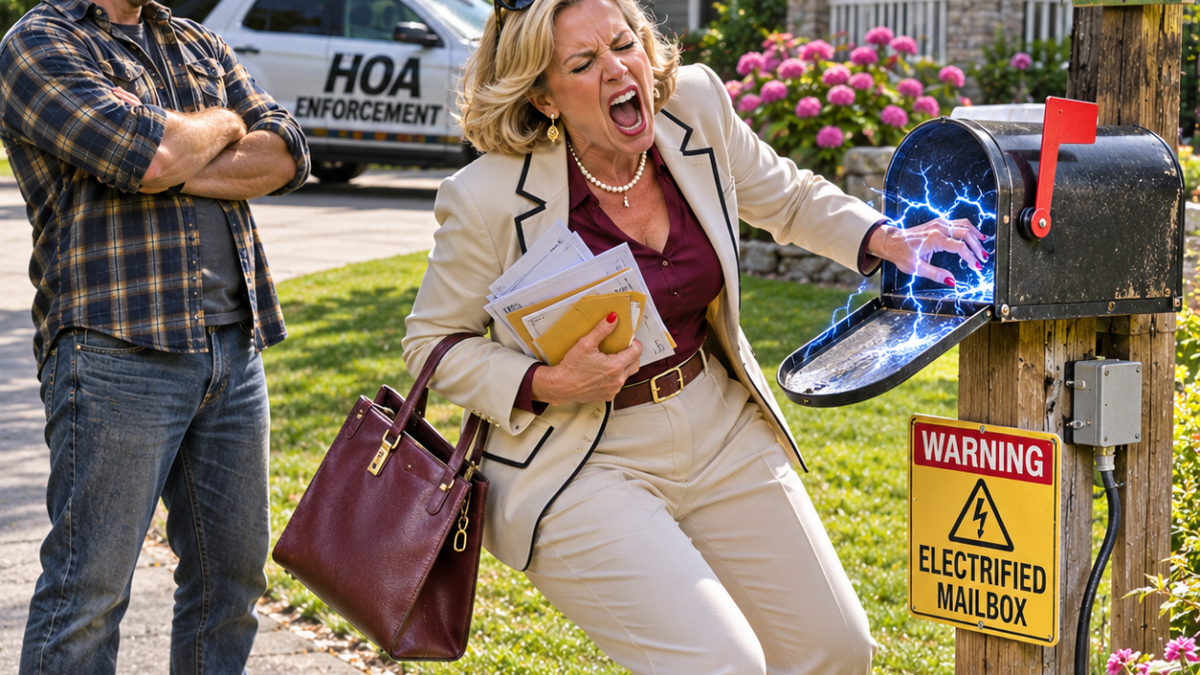
The first time an important envelope vanished from my mailbox, I blamed the postal service, but by the time a fifty-thousand-dollar client contract disappeared and cost me the biggest job of my year, I knew someone on Maple Creek Lane was deliberately reaching into that metal box and deciding which parts of my life I was allowed to receive.
What I didn’t expect was to discover our HOA president, Scarlett Taylor—the same woman who lectured neighbors about rules, integrity, and community standards—walking up to my mailbox in broad daylight, sorting through my private letters, and slipping selected envelopes beneath the clipboard she carried like a badge of office.
And when I finally confronted her with video proof, the fear that flashed across her face lasted only a second before she smiled again, because whatever she was taking from me was connected to something much bigger than nosiness.
My name is Daniel White, and eight months earlier Maple Creek Lane had seemed like the safest place I had ever lived.
I worked from home as a freelance marketing consultant. After years of apartments, noisy neighbors, and coffee-shop meetings, I had finally bought a two-story colonial with a maple tree out front, a narrow porch, and an old-fashioned black mailbox beside the curb.
For the first few months, life was almost painfully normal.
Then my mail started disappearing.
First it was junk.
Then a bank statement.
Then my insurance renewal.
I called the post office after my tax documents never arrived.
A tired-sounding employee checked the tracking history.
“Our carrier scanned your mail as delivered.”
“To my address?”
“Yes, sir. 127 Maple Creek Lane.”
I stared through my office window at the mailbox.
“Then somebody is taking it.”
Things became expensive fast.
A credit-card statement vanished and I missed a payment.
An insurance notice disappeared.
Then one of my largest clients called.
“Daniel, are you backing out?”
“Backing out of what?”
“The contract. We mailed the originals almost two weeks ago.”
My stomach dropped.
I had been waiting for that contract.
The project was worth nearly fifty thousand dollars.
By the time we figured out what had happened, their deadline had passed and they had hired another firm.
That night I sat at my desk looking toward the curb with a kind of anger I couldn’t shake.
The following morning, my neighbor Helen stopped while I was collecting the mail that had actually survived.
Helen was a retired teacher in her seventies who seemed to know every dog, divorce, repair bill, and argument within three streets.
“Still losing things?” she asked.
I looked at her.
“How did you know?”
She hesitated.
Then she lowered her voice.
“I’ve seen Scarlett checking mailboxes.”
“Scarlett Taylor?”
Helen nodded.
Our HOA president.
Scarlett was in her mid-fifties, always perfectly dressed, usually in a pastel blazer with pearl earrings and a clipboard tucked against her ribs. Her white Mercedes looked freshly detailed even during pollen season.
She treated the HOA bylaws as if they were federal law.
A garbage can left out too long became a formal warning.
A fence painted the wrong shade of beige became a neighborhood emergency.
But touching someone’s mail was different.
“Why would she be checking mine?”
Helen’s eyes moved toward Scarlett’s street.
“She says she watches for misdelivered mail.”
“That’s not an HOA responsibility.”
“I know.”
I installed a small security camera on my own property with a clear view of the mailbox.
For three days, nothing happened.
On Wednesday afternoon, the motion alert appeared.
I opened the recording.
Scarlett’s Mercedes stopped fifty feet away.
She stepped out carrying her clipboard.
She looked up the street.
Then down it.
Then she walked directly to my mailbox.
My hand tightened around the mouse.
Scarlett opened the door.
She sorted through everything.
Not quickly.
Carefully.
She left two advertising flyers.
She left a grocery coupon.
Then she pulled out three envelopes, checked the return addresses, tucked them beneath her clipboard, closed my mailbox, and walked away.
I replayed the clip twice.
The next day, she did it again.
This time she took a letter from my bank.
On Friday, she removed an envelope carrying the logo of one of my clients.
I printed the clearest still images and walked to her house.
Scarlett opened the door smiling.
“Daniel. What a surprise.”
I held up the photographs.
Her eyes dropped to them.
The smile disappeared.
Only for a second.
Then it came back.
“I think,” I said, “you should explain why you keep stealing my mail.”
Scarlett studied the photograph of her own hand inside my mailbox.
Then she looked up at me and said something I never expected.
“You really should have left this alone.”
PART 2
For a few seconds, I thought I had misunderstood her.
I had expected denial.
Maybe indignation.
Possibly some ridiculous explanation about a misdelivered envelope.
I had not expected a warning.
“What does that mean?”
Scarlett’s smile remained fixed, but her eyes had changed.
“You’re upset. I understand.”
“No, you don’t.”
“I think I do.”
“You’ve been taking private mail out of my mailbox.”
“I’ve been correcting delivery problems.”
“You live two blocks away.”
“That doesn’t change the fact that our carrier occasionally makes mistakes.”
I held up the photographs.
“Then why do you leave the grocery ads and take the envelopes from my bank?”
The front door opened wider behind her.
A man stepped into view.
Brad Taylor.
Scarlett’s husband.
I knew him mostly by reputation. He was a retired attorney who still dressed like every casual conversation might suddenly require closing arguments. Golf shirt tucked in. Expensive watch. Permanent expression of someone who believed the next person speaking was probably mistaken.
“What’s going on?” he asked.
Scarlett answered before I could.
“Daniel is accusing me of stealing his mail.”
Brad stared at me.
“Are you?”
“I’m showing her video stills of her taking my mail.”
His posture changed immediately.
“You recorded my wife?”
“I recorded my mailbox.”
“Without her permission?”
“She was on my property.”
Scarlett gave him a small glance.
Not fear.
Instruction.
Brad stepped closer.
“You need to be careful, Daniel.”
I almost laughed.
“Your wife is taking my mail, and I need to be careful?”
“You’re making a serious accusation against the president of the homeowners association.”
“I’m making an accusation against the woman in these pictures.”
Brad looked at them.
His jaw tightened.
He knew.
Maybe he didn’t know everything, but he knew enough.
Scarlett crossed her arms.
“There’s obviously no point discussing this while you’re emotional.”
“I’m not emotional.”
“You came to my house carrying photographs.”
“Of you stealing my mail.”
“You keep using that word.”
“What word would you prefer?”
She leaned toward me.
“Misunderstanding.”
I stared at her.
A breeze moved through the perfectly trimmed shrubs lining their porch.
Somewhere nearby, a lawn mower started.
Everything around us looked painfully normal.
“You took a client contract worth fifty thousand dollars.”
Her expression changed.
Just slightly.
There.
That was what I had been looking for.
Not guilt.
Recognition.
“You don’t know that,” she said.
“I know it was mailed. I know the carrier marked it delivered. I know you were taking envelopes with my clients’ logos.”
“That proves nothing.”
“It proves enough for me to file a report.”
Brad stepped forward.
“Be extremely careful about defaming my wife.”
I looked at him.
“If the truth damages someone’s reputation, that isn’t defamation.”
That landed.
Brad’s face darkened.
Scarlett reached for the door.
“Leave my property.”
“Gladly.”
Before she closed it, I said, “Stay out of my mailbox.”
Her eyes narrowed.
Then the door slammed.
The next morning, I received an HOA violation notice.
The subject line read:
UNAUTHORIZED SURVEILLANCE EQUIPMENT.
I actually laughed.
The letter claimed the small camera near my mailbox was visible from a common area and potentially violated Maple Creek’s “aesthetic harmony provisions.”
A hundred-dollar fine would be assessed if I failed to remove it within seven days.
I read the notice again.
Then I checked the sender.
Office of the HOA President.
Scarlett Taylor.
Of course.
I called Helen.
“You’re going to love this.”
“I doubt that.”
“She fined me for the camera.”
There was silence.
Then Helen said, “That woman really does wake up every morning and choose escalation.”
“You’ve noticed.”
“Daniel, don’t underestimate her.”
“I’m not.”
“No. I mean it.”
Her voice had lost its usual humor.
“Why?”
Helen hesitated.
“Because you’re not the first person she’s punished after being challenged.”
I sat down.
“What happened?”
“A few years ago, the Millers argued with her over a fence.”
“I remember the name.”
“They moved.”
“That doesn’t mean Scarlett forced them out.”
“No. But after they challenged her, every little thing became a violation. Their lawn. Their shed. Their son’s basketball hoop. Parking. Trash cans. They spent more time fighting the HOA than enjoying their home.”
“What does that have to do with mail?”
“I don’t know.”
The way she said it told me she had been wondering the same thing.
I filed a report with the local police department that afternoon.
Officer Luis Ramirez met me at a desk near the back of the station.
He was maybe forty, tired eyes, calm voice.
I gave him copies of the footage.
He watched one clip.
Then another.
Then he leaned closer to the screen.
“That’s your mailbox?”
“Yes.”
“Your address?”
“Yes.”
“And that’s the HOA president?”
“Yes.”
He sighed.
“That complicates your neighborhood.”
“It already was complicated.”
He watched Scarlett remove another envelope.
“Do you know what happened to the letters afterward?”
“No.”
“Any recovered?”
“No.”
“That’s the difficulty.”
“She’s on video taking them.”
“She is.”
“So arrest her.”
Ramirez looked at me.
“I’m not saying nothing happened. I’m telling you mail theft can involve federal jurisdiction, and proving what happened to specific items matters.”
“She has them.”
“Maybe.”
“What else would she be doing?”
“I agree it looks bad.”
“It looks like theft because it is theft.”
He slid the drive back toward me.
“Contact the Postal Inspection Service. Keep every original video. Keep records of missing mail. If she comes onto your property again, don’t get physical. Call us.”
I left angry.
But not at Ramirez.
He had at least taken me seriously.
The problem was that Scarlett had been taking my mail for weeks, perhaps months, while every system around me moved at the speed of forms, referrals, jurisdiction, and procedure.
Scarlett moved much faster.
By the time I got home, another HOA notice was waiting.
FAILURE TO MAINTAIN APPROVED MAILBOX APPEARANCE.
Apparently, the small camera mount had altered the “visual character” of my curbside area.
Another fine.
Another hundred dollars.
I stood beside the mailbox holding that notice and felt something inside me settle.
Not explode.
Settle.
There is a kind of anger that makes you shout.
Then there is another kind.
The colder kind.
The kind that makes you start making folders.
I made three.
One for missing mail.
One for HOA retaliation.
One for video evidence.
Then I called every client and financial institution I dealt with regularly and switched important correspondence to secure electronic delivery wherever possible.
I rented a post-office box for sensitive documents.
And I installed a locked, professionally secured mailbox system that met postal requirements while preserving delivery access.
The physical access problem should have ended there.
Scarlett found another way.
Three days later, I watched her stand near my mailbox taking photographs.
She did not touch it.
She photographed the lock.
She photographed the camera.
She photographed the warning label.
Then she walked away.
That evening, I received another notice.
UNAPPROVED MAILBOX MODIFICATION.
I forwarded it to my attorney.
He replied with six words.
Stop paying the fines. Preserve everything.
I smiled.
For the first time, I had somebody speaking Scarlett’s language.
Documents.
The next HOA meeting was packed.
Normally, maybe ten people attended.
That night there were thirty-seven.
Scarlett sat at the center table beneath the Maple Creek logo.
Brad sat behind her despite not being a board member.
I brought printed photographs.
Video timestamps.
Postal delivery records.
Missing-payment notices.
The lost client contract emails.
The HOA fines Scarlett had issued after I confronted her.
When resident comments began, I walked to the microphone.
Scarlett smiled.
“Mr. White.”
“Scarlett.”
“Please address the board formally.”
“All right. Madam President.”
She seemed pleased.
That lasted about five seconds.
I turned toward the residents.
“For the last several months, my mail has been disappearing.”
Scarlett interrupted.
“This issue has already been referred to appropriate authorities.”
I looked at her.
“I’m not finished.”
She tapped her pen.
“You have three minutes.”
I held up the first photograph.
“Here is Scarlett removing mail from my mailbox.”
The room changed.
Not loudly.
Chairs shifted.
Someone whispered.
Scarlett’s face remained perfectly still.
I held up the second.
“Here is Scarlett doing it again.”
Then the third.
“And again.”
Brad leaned toward her.
She ignored him.
I placed copies of the HOA notices beside the photographs.
“After I confronted her, she began issuing fines against the camera that recorded her.”
A man near the back said, “Seriously?”
Scarlett raised her voice.
“The board will maintain order.”
Helen stood.
“Order would have been nice when she was taking his mail.”
Scarlett’s eyes narrowed.
“Helen, you are out of order.”
Helen smiled.
“I’m seventy-four. I’ve been out of order since 1998.”
A few people laughed.
Scarlett struck the gavel.
“This is not a comedy club.”
“No,” I said. “It’s supposed to be an HOA meeting.”
She looked at me.
I continued.
“I want every fine connected to my security equipment suspended pending legal review.”
“That equipment violates our standards.”
“The camera recorded you taking my mail.”
“The alleged contents of your recordings are irrelevant to architectural compliance.”
That sentence hurt her more than she realized.
Because several people heard exactly what she had just done.
She had not denied the recordings.
She had separated them from the fines.
The board treasurer, a quiet man named Paul Jenkins, leaned toward his microphone.
“Scarlett, have you actually reviewed the footage?”
Her head turned.
“This is not about that.”
“It seems pretty relevant.”
“We are discussing Mr. White’s violations.”
Paul looked at me.
“Can you send the recordings to the full board?”
“I already did.”
Scarlett’s head snapped toward him.
Paul frowned.
“I didn’t receive them.”
Neither had the vice president.
Neither had the secretary.
Only Scarlett’s office email had acknowledged them.
Now I understood something else.
She had controlled the flow of information.
At least inside the HOA.
Paul looked irritated.
“Send them directly to me.”
Scarlett tapped the gavel again.
“This discussion is over.”
“No,” Helen said.
Everyone looked at her.
She was holding an envelope.
“I think it’s just starting.”
Helen walked to the front.
“This was delivered to me yesterday.”
Scarlett stared at it.
“What does that have to do with anything?”
Helen placed the envelope on the table.
“It was opened before I received it.”
The room went quiet.
Scarlett’s face changed.
Just a flicker.
Helen saw it too.
“My daughter mailed this from Seattle,” she said. “There was a gift card inside.”
Scarlett looked bored.
“Mail gets damaged.”
“The gift card is missing.”
Scarlett leaned back.
“You need to contact the postal service.”
“I did.”
Helen looked directly at her.
“And then Daniel told me what he had recorded.”
Something shifted in the room.
A woman named Teresa Alvarez raised her hand.
“My son’s college acceptance packet never arrived.”
Another man spoke.
“I had two insurance checks disappear last year.”
Mrs. Peterson, who lived near the entrance, said softly, “Birthday cards.”
Scarlett struck the gavel.
“This meeting is adjourned.”
Paul reached over and put his hand on the gavel.
“No.”
Scarlett froze.
Paul looked at the other board members.
“I move that we suspend all enforcement actions against Mr. White concerning his mailbox and security equipment until this is reviewed.”
The vice president seconded.
Scarlett stared at them.
“You can’t do this.”
Paul looked almost confused.
“We just did.”
The vote passed four to one.
Scarlett was the one.
She stood.
“This board is allowing itself to be manipulated by a man with a personal grievance.”
I gathered my papers.
“You could end the grievance right now.”
She glared at me.
“How?”
“Tell us why you were taking the mail.”
She said nothing.
Brad stood behind her.
“Scarlett.”
Her eyes moved toward him.
For the first time, he did not look like her ally.
He looked worried.
Very worried.
They left together.
That night, my phone rang.
Unknown number.
I almost ignored it.
“Mr. White?”
“Yes.”
“My name is Andrew Rogers. I’m with the United States Postal Inspection Service.”
I sat up.
Officer Ramirez had forwarded my information.
Rogers asked me to send the original video files, not edited copies, along with a list of missing items.
“Do you believe Mrs. Taylor has been taking your mail for financial gain?”
“I don’t know.”
“Identity theft?”
“I don’t know.”
“Personal retaliation?”
“That’s what I’m starting to think.”
“Why?”
I told him about the client contract.
The bank correspondence.
The HOA fines.
The other residents’ missing letters.
He became quieter.
“How many residents?”
“At least five who spoke tonight.”
“Can you give me their names?”
“Yes.”
He paused.
“Don’t confront Mrs. Taylor again.”
“She already knows I have the videos.”
“I understand. Just document. Let us do the next part.”
That should have relieved me.
Instead, I felt uneasy.
Because Scarlett knew something too.
She knew the circle was tightening.
People do strange things when they feel control slipping away.
The following morning, I found Brad standing outside my house.
He looked exhausted.
No perfect golf shirt.
No confident posture.
Just jeans, an old sweater, and shadows beneath his eyes.
“I need to talk to you.”
I stayed on the porch.
“About?”
“My wife.”
“That narrows it down.”
He looked toward the street.
“Can we do this somewhere private?”
“Here is private enough.”
He exhaled.
“You need to stop pushing this.”
There it was.
Not an apology.
Not an explanation.
Another warning.
“Why?”
“Because Scarlett doesn’t handle public humiliation well.”
“That sounds like Scarlett’s problem.”
“You don’t understand.”
“Then explain it.”
He stared at me.
For a moment, I thought he might.
Instead, he said, “She believes you’re trying to destroy her.”
“I want her to stop taking my mail.”
“It’s gone beyond that.”
“Because she made it go beyond that.”
Brad rubbed his forehead.
“I know.”
That answer surprised me.
“You know?”
He looked toward Scarlett’s street.
“I know what she’s like.”
“That isn’t the same as knowing what she’s done.”
His mouth tightened.
“I’m asking you as a neighbor.”
“No.”
“You haven’t heard what I’m asking.”
“Yes, I have. You’re asking me to make this easier for her.”
He did not deny it.
I stepped down one stair.
“Brad, my business lost fifty thousand dollars.”
“I know.”
“My financial mail disappeared.”
“I know.”
“Other residents are missing cards, checks, legal documents.”
“I know.”
I stopped.
The words hung between us.
“You know.”
He closed his eyes.
That was the moment I realized Brad knew more than he had admitted.
“How much do you know?”
“Not what you think.”
“What do I think?”
He looked at me.
“I have to go.”
I moved to the bottom of the steps.
“Brad.”
He turned.
“If federal investigators find out you knew something and hid it, whatever loyalty you think you’re showing her may become your problem too.”
His face went pale.
He walked away.
Two hours later, Inspector Rogers called.
“Mr. White, did Brad Taylor contact you today?”
I stood.
“How did you know?”
“He contacted us too.”
“What did he say?”
“I can’t discuss details.”
“Is Scarlett stealing mail from other people?”
A pause.
“Yes.”
That single word hit harder than I expected.
“How many?”
“We don’t know yet.”
“Why?”
“That’s what we’re working on.”
For the next week, Maple Creek existed under a strange pressure.
Scarlett stopped attending social events.
Her Mercedes rarely moved.
The HOA vice president temporarily handled meetings.
Residents began comparing years of unexplained missing mail.
The stories multiplied.
A pension check.
A replacement credit card.
A wedding invitation.
Medical paperwork.
A birthday card from a daughter who had later died.
Most could not prove Scarlett had taken them.
But the pattern was impossible to ignore.
Then she came back to my mailbox.
It happened at 3:14 on a Monday afternoon.
I was working when the security alert appeared.
Scarlett stood at the curb.
She wore a pale blue blazer.
Pearls.
Sunglasses.
Clipboard.
The costume was back.
Only her face looked different.
Tighter.
She saw the locked mailbox.
Then she saw the warning sign beside the security system.
She stood there for nearly a minute.
I watched from inside.
My newer security setup included a professionally installed anti-tamper alert designed to make unauthorized handling immediately obvious. It had an audible warning, visible notice, and a startling static-style deterrent that had been tested for safety; I had made sure the system was documented because the last thing I wanted was to become the person on the wrong side of the law.
Scarlett read the warning.
She looked directly toward my house.
Then she reached for the mailbox anyway.
The alarm chirped.
She stopped.
Looked around.
Reached again.
There was a sharp snap.
Scarlett jumped backward with a scream.
Her clipboard hit the pavement.
Her sunglasses flew from her head.
She stared at the mailbox.
Then at her hand.
Then at my house.
I was already walking outside.
“You!”
Her voice echoed down the street.
“What?”
“You electrocuted me!”
“You ignored the warning.”
“You built a weapon!”
“It’s a security deterrent.”
“You attacked me!”
“I’m standing thirty feet away.”
Neighbors began coming outside.
Scarlett noticed them.
That made everything worse.
Humiliation took over where surprise had been.
She marched toward me.
“You’re finished.”
“Scarlett, step off my property.”
“You think this is funny?”
“No.”
“You could have killed me!”
“No.”
“How would you know?”
“Because unlike you, I had the system professionally reviewed.”
Her face changed.
“You what?”
“I have documentation.”
She looked toward the mailbox.
Then at the warning.
Then back at me.
That was when Helen called from her porch.
“Scarlett?”
Scarlett spun around.
Helen lifted her cane and pointed toward the mailbox.
“Still checking for misdelivered letters?”
Someone laughed.
Scarlett went red.
“I was conducting an HOA inspection.”
Paul Jenkins had walked outside too.
“No, you weren’t.”
Scarlett looked at him.
“I’m still president.”
“Not for mailbox inspections, you aren’t.”
“I have authority to inspect exterior structures.”
“From the street.”
She opened her mouth.
Paul continued.
“And definitely not by opening anyone’s mail receptacle.”
The neighborhood had never spoken to Scarlett like that before.
Not collectively.
Not openly.
She looked around and realized it.
That was the moment the balance changed.
Scarlett was still standing there when the police arrived.
She had called them herself.
Officer Ramirez stepped from the first cruiser.
He recognized me.
Then he recognized Scarlett.
His expression said he already regretted the afternoon.
Scarlett rushed toward him.
“This man set an electrical trap!”
Ramirez looked at me.
“Daniel?”
I handed him the documentation from the security installer.
“The warning is visible. The system alerts on unauthorized handling. It’s designed to startle, not injure.”
Scarlett waved her hand.
“He shocked me!”
Ramirez looked at the mailbox.
Then at the sign.
Then at Scarlett.
“Why were you touching it?”
Her mouth opened.
“I was inspecting it.”
“For the HOA?”
“Yes.”
Paul said from the sidewalk, “She had no authorization.”
Scarlett snapped around.
“Stay out of this.”
Ramirez’s voice hardened.
“Mrs. Taylor.”
She turned back.
“You’ve already been warned about Mr. White’s mailbox.”
“This is different.”
“How?”
“He modified it.”
“After you repeatedly accessed it.”
She stared at him.
“Are you taking his side?”
“I’m taking statements.”
“I want him arrested.”
Ramirez exhaled.
“Do you need medical attention?”
Scarlett hesitated.
“No.”
“Any injury?”
“My hand hurts.”
“Do you want an ambulance?”
“No.”
“Then we’re going to document this and forward it to the appropriate investigators.”
The word investigators drained the anger from her face.
“What investigators?”
Ramirez did not answer.
He didn’t need to.
Scarlett knew.
That evening, Inspector Rogers called again.
“We saw today’s report.”
“She came back.”
“Yes.”
“After reading the warning.”
“Yes.”
He paused.
“That helps establish something.”
“What?”
“Knowledge.”
I knew better than to ask for more.
But he added one thing.
“We may be in your neighborhood soon.”
Two days later, two unmarked sedans entered Maple Creek Lane.
I knew who they were before the doors opened.
Postal Inspection Service.
Rogers stepped out wearing a dark jacket with gold lettering.
Another inspector joined him.
They came to my house first.
We spent almost an hour reviewing original video files.
Rogers asked questions about every missing item I could remember.
The client contract.
Bank letters.
Insurance notices.
Tax documents.
Then they walked to Helen’s house.
Then Mrs. Peterson’s.
Then the Jenkins home.
By noon, half the street knew federal inspectors were interviewing residents.
Scarlett knew too.
Her Mercedes left the neighborhood around twelve thirty.
Rogers watched it go.
He made a call.
I did not ask.
At four that afternoon, Scarlett returned.
She drove slower than usual.
Her face looked rigid behind the windshield.
Brad was in the passenger seat.
At five fifteen, a sheriff’s cruiser arrived.
At five twenty, the inspectors walked to Scarlett’s front door.
The entire street went still.
I stayed on my porch.
I had imagined revenge during the worst weeks.
I had imagined Scarlett embarrassed.
Fined.
Removed from the HOA.
Forced to repay me.
I had never imagined federal agents on her porch.
Scarlett opened the door.
Even from across the street, I could see the change in her posture when Rogers showed her the warrant.
She looked at Brad.
Brad stepped backward.
Scarlett said something sharply.
Rogers answered.
She shook her head.
Brad said something.
She turned on him.
The argument lasted maybe twenty seconds.
Then Scarlett stepped aside.
The inspectors entered.
What happened next changed the neighborhood.
The first box carried from Scarlett’s house contained envelopes.
The second contained more.
Then a plastic storage bin.
Then another.
Neighbors moved closer to the curb.
Mrs. Peterson covered her mouth.
Helen whispered, “Oh my God.”
Rogers came outside carrying a sealed evidence bag.
Inside was an envelope.
My name was visible through the clear plastic.
Daniel White.
I walked down my driveway.
“Is that mine?”
Rogers stopped.
“Yes.”
“What is it?”
“I can’t open evidence here.”
The return address was enough.
Harrison Creative Group.
My lost client contract.
The one worth fifty thousand dollars.
My chest tightened.
Scarlett stepped through her front door behind another inspector.
She saw what Rogers was holding.
Then she saw me.
For a second, all the arrogance disappeared.
She looked afraid.
Not embarrassed.
Afraid.
I walked no closer.
“Why?”
Her expression hardened instantly.
“You did this.”
“No.”
“You turned everyone against me.”
“Why did you take my contract?”
She looked away.
“Scarlett.”
Rogers raised a hand.
“Mr. White.”
I stopped.
Scarlett stared at me.
“You think you’re innocent?”
“I didn’t steal your mail.”
“You were helping them remove me.”
“Who?”
“The board.”
That was the first real clue.
Paul stepped closer from his yard.
“What are you talking about?”
Scarlett’s eyes flickered toward him.
Rogers noticed.
So did I.
The inspectors brought out another box.
Inside were folders labeled with residents’ names.
Peterson.
Alvarez.
Jenkins.
Miller.
White.
Helen made a sound beside me.
“They’re files.”
Rogers’s partner carried a laptop bag toward the sedan.
Brad stood in the doorway staring at the boxes.
He looked physically ill.
Scarlett turned on him.
“You told them where everything was.”
Brad’s face crumpled.
“I told you to stop.”
“You betrayed me.”
“I begged you, Scarlett.”
“You told them.”
“I told them enough to keep myself out of prison.”
The street went silent.
Scarlett’s head turned slowly toward him.
I had never seen hatred arrive on someone’s face so clearly.
“You coward.”
Brad laughed once.
It sounded broken.
“I’ve been a coward for years.”
That sentence ended their marriage more completely than any divorce filing could.
Rogers stepped toward Scarlett.
“Mrs. Taylor, we need you to come with us.”
“You’re arresting me?”
“We’ll explain your status privately.”
“I am president of this homeowners association.”
Paul said quietly, “Not anymore.”
She turned.
He held up his phone.
“The board held an emergency vote.”
“You can’t.”
“We did.”
“I wasn’t present.”
“That was the point.”
Scarlett looked around at the residents.
No one defended her.
Not one person.
Mrs. Peterson was crying.
Scarlett saw her.
“What are you looking at?”
Mrs. Peterson stepped into the street.
“My husband’s card.”
Scarlett froze.
“You took it.”
“I don’t know what you’re talking about.”
“My husband died two years ago.”
Mrs. Peterson’s voice broke.
“He mailed me a birthday card from the hospital the week before he died. It never came.”
Scarlett looked away.
Rogers’s partner had stopped beside one of the evidence boxes.
He checked a label.
Then another.
He reached inside carefully.
“Mrs. Peterson?”
She stepped forward.
He held up a sealed envelope.
Her knees almost gave out.
I caught her elbow.
The handwriting on the front was shaky.
To My Forever Girl.
Mrs. Peterson covered her mouth.
“No.”
The inspector’s voice softened.
“We’ll need to process it before it can be returned.”
She nodded rapidly.
“That’s his handwriting.”
Scarlett closed her eyes.
For the first time, the anger around the street disappeared.
What replaced it was worse.
Disgust.
This was no longer about HOA rules.
No longer about my contract.
No longer about fines.
Scarlett had taken pieces of people’s lives and stored them like trophies.
Rogers later told me they found mail stretching back nearly four years.
Birthday cards.
Checks.
Bank statements.
Legal notices.
Medical correspondence.
HOA-related letters.
Complaints addressed to board members.
Election materials.
Not all of it had been opened.
Some items appeared to have been taken simply to inconvenience people.
Others had notes attached.
Names.
Dates.
Short comments.
“Difficult.”
“Against board.”
“Watch.”
“Fine pending.”
“Targeted.”
My folder was thicker than most.
Inside were copies of emails I had sent to the HOA.
Client names.
Printed notes about my property.
And the missing contract.
That discovery explained why Scarlett’s fear had been immediate when I confronted her.
She was not randomly stealing mail.
She was collecting leverage.
She used missing paperwork to create problems and then used those problems to strengthen her authority.
Someone missed a payment?
Scarlett could call them irresponsible.
Someone failed to respond to an HOA notice?
Scarlett could push a fine.
Someone challenged her?
Important mail suddenly became unreliable.
It was petty.
Systematic.
Cruel.
And because each individual incident looked small, nobody had connected them.
Until my camera did.
Brad gave a formal statement.
He admitted he had suspected Scarlett was taking mail for years.
He claimed he did not understand the extent of it.
Whether that was true, I never knew.
But he had seen envelopes in her office.
He had asked questions.
She had told him they were misdelivered.
Later, he discovered folders.
When he challenged her, she threatened to involve him by claiming he had helped.
So he did what frightened people often do.
Nothing.
Until federal investigators contacted him.
The morning after the search, Brad came to my house carrying a cardboard box.
“I found this in my car.”
I did not invite him inside.
“What is it?”
“Stuff she moved before the warrant.”
My stomach tightened.
“You need to call Rogers.”
“I already did. He told me not to open it.”
“Then why bring it here?”
“Because your name is on top.”
I stared at him.
“Take it back to your car.”
He almost smiled.
“Still cautious.”
“Especially now.”
He nodded.
“Fair.”
He sat on my porch step instead.
“I owe you an apology.”
“That’s a long list.”
“I know.”
He rubbed his hands together.
“When you came to the house with those photos, I knew she had been taking mail.”
I said nothing.
“I didn’t know she took your contract.”
“But you knew she was taking things.”
“Yes.”
“And you threatened me.”
“Yes.”
“Why?”
He looked toward his house.
“Because protecting her was easier than admitting what my life had become.”
“That doesn’t make much sense.”
“It does when you’ve spent twenty-six years making excuses for someone.”
His voice dropped.
“At first, Scarlett was just intense. Organized. She cared about everything. School boards, fundraisers, neighborhood committees. People loved her because she got things done.”
“What changed?”
“She stopped understanding the difference between helping and controlling.”
That sounded familiar.
“She’d take over projects. Then committees. Then decisions. If someone disagreed, she remembered it forever.”
“And you?”
“I kept telling myself she was difficult, not dangerous.”
He looked at me.
“That distinction got thinner every year.”
“Why the mail?”
Brad shook his head.
“I think it started with HOA notices. People claimed they never got them. She started checking boxes, supposedly to make sure things were delivered.”
“And then?”
“Then she realized how much you can learn from an envelope without opening it.”
Banks.
Law firms.
Doctors.
Clients.
Government agencies.
Everything private announced itself in a return address.
“She began tracking who owed money, who had legal trouble, who was refinancing, who complained.”
“That’s insane.”
“I know.”
“Did she read them?”
“Sometimes.”
“Did you see her?”
Brad nodded.
The honesty made me angrier than another lie would have.
“You should have stopped her.”
“I know.”
“Mrs. Peterson spent two years thinking her husband forgot her birthday before he died.”
Brad’s face collapsed.
“I know.”
“You don’t get to keep saying that.”
He looked down.
“You’re right.”
For once, nobody argued.
Scarlett’s federal case moved slowly.
Real cases usually do.
There was no dramatic trial the following week.
No instant sentence.
No judge delivering a perfect speech for neighborhood entertainment.
There were interviews.
Evidence reviews.
Attorneys.
Hearings.
Months.
The HOA removed Scarlett as president permanently.
Paul Jenkins became acting president but refused to run for the position.
“I’ve seen what it does to people,” he joked.
Helen did run.
At seventy-four.
She won with almost eighty percent of the vote.
Her victory speech lasted fourteen seconds.
“I promise not to open your mail, inspect your garbage, or measure your grass with a ruler. Meeting adjourned.”
It was the loudest applause Maple Creek had ever produced.
Her first official act was reviewing every fine issued under Scarlett’s presidency.
Some were legitimate.
Most were petty.
Dozens were canceled.
Refunds were issued where possible.
The HOA created a rule requiring two board members to approve major enforcement actions.
No president could unilaterally issue retaliatory fines.
Board emails were archived and visible to all directors.
Term limits were introduced.
Residents could appeal violations before an independent committee.
The changes sounded boring.
That was why I loved them.
Meanwhile, recovered mail began coming back.
The Postal Inspection Service processed the items carefully.
Every few days, someone on Maple Creek received an envelope they had assumed was gone forever.
Some brought anger.
Some brought laughter.
Some reopened pain.
Teresa Alvarez received the original acceptance letter from the university her son had eventually attended anyway after checking the online portal.
Paul received an old insurance refund check that could no longer be deposited but proved he had spent months arguing with the company for no reason.
Helen received three birthday cards and an unopened letter from her sister.
Then Mrs. Peterson got her husband’s card.
She came to my porch carrying it in both hands.
The envelope had been placed inside a protective sleeve by the inspectors.
“Daniel?”
I stood.
She could barely speak.
“Do you want coffee?”
She shook her head.
“Sit?”
Another shake.
Then she handed me the card.
“I can’t open it.”
I looked at her.
“You waited two years.”
“That’s why.”
Her eyes filled.
“What if I open it and then it’s over?”
I understood.
As long as the card remained sealed, her husband still had one more thing left to say.
I handed it back.
“You don’t have to open it today.”
She looked down at his handwriting.
“He was in the hospital when he sent this.”
“I know.”
“He knew.”
I didn’t ask what she meant.
She continued.
“He knew he wasn’t coming home.”
We sat on the porch steps.
Eventually she opened it.
Inside was a simple store-bought birthday card.
Nothing expensive.
Nothing dramatic.
His handwritten message covered half the inside.
She read silently.
Then she started crying.
I looked away toward the street to give her privacy.
After a while, she handed it to me.
I read only the last line because that was where her finger rested.
Even if I’m gone, remember the world is still kind.
I swallowed.
Mrs. Peterson laughed through her tears.
“He always had terrible timing.”
“No,” I said. “Maybe this one was just late.”
She held the card against her chest.
“You brought this back to me.”
“No.”
“You started it.”
“I wanted my contract.”
“And you found my husband.”
That broke something open in me.
For months, I had thought of the situation as a fight.
Me against Scarlett.
Victim against bully.
Homeowner against HOA president.
But sitting beside Mrs. Peterson, I understood the damage had never been limited to money.
Scarlett had stolen moments.
Apologies.
Opportunities.
Good news.
Bad news people deserved to receive honestly.
Connections.
She had decided that her need for control mattered more than everyone else’s right to live their lives without her hand inside them.
That was the real theft.
My lost contract suddenly felt smaller.
Still painful.
Still wrong.
But smaller.
Two months later, Harrison Creative Group called me.
The client whose contract Scarlett had taken.
Their director, Megan, sounded uncomfortable.
“We heard what happened.”
“I figured somebody eventually would.”
“It was in the local news.”
“Not my favorite publicity campaign.”
She laughed softly.
Then grew serious.
“We owe you an apology.”
“You didn’t steal the letter.”
“No, but we assumed you were unreliable.”
“From your perspective, I disappeared.”
“We should have called earlier.”
“You did call.”
“After the deadline.”
I leaned back.
“What are you saying?”
“We have another project.”
The new contract was not worth fifty thousand dollars.
It was worth seventy-two.
I stared at the figure when it arrived electronically.
Megan said, “Thought we’d avoid the postal service this time.”
“That would be wise.”
I accepted.
For the first time, something Scarlett had taken from me came back larger.
Not because karma had magically balanced a ledger.
Because somebody learned the truth and gave me another chance.
That mattered more.
Scarlett’s case eventually ended in a plea agreement.
I attended one hearing.
Not all of them.
I had stopped needing to watch her lose.
The woman who entered the courtroom looked nothing like the HOA president who had once stood behind a folding table and treated everyone like defendants.
No pastel blazer.
No clipboard.
No pearls.
She wore a plain beige suit.
Her hair was pulled back.
Brad sat on the opposite side of the courtroom with his own attorney.
They had filed for divorce.
When Scarlett saw me, her expression tightened.
Then she looked away.
The prosecutor described patterns of mail theft, obstruction, misuse of private correspondence, and retaliation.
Scarlett’s attorney emphasized that she had no prior criminal history.
He described years of volunteer service.
Community involvement.
Stress.
Compulsive behavior.
A need for control that had spiraled.
The judge listened.
Then he asked Scarlett whether she wished to speak.
She stood.
For a moment, nothing came out.
Then she said, “I believed I was protecting the community.”
The judge waited.
Scarlett continued.
“I know that sounds ridiculous now.”
Nobody laughed.
“I thought people were careless. I thought rules mattered more to me because I was the one willing to enforce them.”
Her hands trembled.
“Eventually I started believing that if someone opposed me, they were opposing what was right.”
The courtroom stayed silent.
“I told myself I was checking mail because deliveries were unreliable.”
She swallowed.
“That wasn’t true.”
Mrs. Peterson sat two rows behind me.
I heard her breathe in sharply.
Scarlett looked toward the floor.
“I wanted information.”
There it was.
The simplest explanation.
“I wanted to know what people were doing before they could surprise me.”
The judge asked, “Why?”
Scarlett’s voice became smaller.
“Because I hated being surprised.”
Her attorney shifted.
She kept going.
“My father lost our house when I was a teenager. He hid bills from my mother. People came to the door. We didn’t know what was happening until it was already gone.”
I had never heard that before.
Neither had Brad, judging from his face.
Scarlett wiped her cheek.
“I think somewhere along the way I convinced myself that knowing everything meant nothing bad could happen.”
The judge looked at her for a long time.
“Mrs. Taylor, understanding why you developed a need for control does not excuse violating the privacy and property of your neighbors.”
“I know.”
“You caused substantial harm.”
“I know.”
“You interfered with financial documents, personal correspondence, legal notices, and sentimental mail.”
Scarlett nodded.
The sentence included incarceration, supervised release, restitution, and restrictions tied to the offenses.
Not the theatrical decades people around Maple Creek had predicted.
Not a slap on the wrist either.
Real consequences.
When the hearing ended, reporters waited outside.
One approached me.
“Mr. White, do you feel vindicated?”
Cameras turned.
I hated the question.
Vindicated suggested I had spent months waiting for this moment.
I looked toward the courthouse doors.
“I just wanted my mail back.”
That was the quote they used.
Brad caught up with me near the parking lot.
“She blamed you for a long time.”
“I know.”
“She probably still does.”
“That’s her choice.”
He nodded.
“She also talks about you more than anybody else.”
“Lucky me.”
A weak smile.
Then he extended his hand.
I looked at it.
Finally, I shook it.
“I should have stopped her.”
“Yes.”
“I know that doesn’t fix anything.”
“No.”
“But I am sorry.”
This time, I believed him.
“Take care of yourself, Brad.”
He walked away.
The Taylor house went on the market two weeks later.
The roses Scarlett had obsessed over grew wild.
The new owners tore half of them out and planted sunflowers.
Nobody filed a complaint.
Maple Creek slowly became a neighborhood instead of a jurisdiction.
Kids left bicycles on lawns.
Trash cans occasionally stayed out overnight.
Nobody died.
Helen introduced something called the “common sense rule.”
It was not actually a bylaw.
It was one sentence she repeated whenever someone wanted the HOA to regulate something stupid.
“Does this problem require a board meeting, or do two adults need to talk?”
Most problems disappeared after that.
I kept my security camera.
I kept the locked mailbox.
The electrical anti-tamper component was removed after the investigation ended because I no longer needed it, and I preferred not to spend the rest of my life explaining neighborhood folklore to delivery workers.
Marcus visited the weekend I dismantled it.
He looked at the mailbox.
“You’re retiring the legend?”
“I’m retiring the headache.”
“That thing changed Maple Creek.”
“The cameras changed Maple Creek.”
“The documentation changed Maple Creek.”
“The federal warrant changed Maple Creek.”
He looked offended.
“Let the mailbox have its moment.”
I laughed.
“All right. The mailbox helped.”
“Thank you.”
He handed me a small metal plaque.
I read it.
RESPECT BOUNDARIES.
“That’s surprisingly tasteful.”
“I had another version.”
“What did it say?”
“CURRENT RESIDENT: ACCOUNTABILITY.”
I stared at him.
“That’s terrible.”
“I know.”
I mounted the tasteful one.
Months passed.
The story faded.
Reporters disappeared.
The neighborhood social group went back to lost dogs, garage sales, recommendations for roofers, and arguments about whether a suspicious coyote had been seen near the drainage pond.
Normal problems.
Wonderful problems.
Then one afternoon, Inspector Rogers called.
“We’re closing out the remaining property releases.”
“Okay.”
“We have something that belongs to you.”
I drove to his office.
He placed an evidence sleeve on the desk.
Inside was an envelope I had forgotten existed.
My mother’s handwriting was on the front.
I stopped breathing for a second.
She had died three years earlier.
“What is that?”
“Recovered from Taylor’s files.”
I sat down.
My mother lived in Florida during her final years.
She preferred letters to email because, as she always said, “If I’m going to tell you something important, you should be able to hold it.”
I remembered her mentioning a letter.
I also remembered telling her it never arrived.
She had joked that the postal service must have hated her handwriting.
I never thought about it again.
Until now.
“Was it opened?”
Rogers looked at the sleeve.
“Yes.”
Anger rose instantly.
Scarlett had read it.
Whatever my mother had written to me, Scarlett had opened it and kept it.
“Can I take it?”
He nodded.
“It’s been released.”
I sat in my truck for twenty minutes before opening it.
My mother’s handwriting looked exactly the way I remembered.
Large.
Slanted.
Blue ink.
Daniel,
You sounded tired on the phone last Sunday, and because you always say you’re fine when you’re not fine, I thought I’d write instead of asking again.
I laughed.
That was her.
The letter was mostly ordinary.
She told me about a neighbor’s terrible new dog.
A restaurant she liked.
A nurse who wore too much perfume.
Then, halfway down the second page, the words changed.
She wrote about my work.
How I had spent years chasing clients and deadlines.
How proud she was that I had finally bought a home.
Then came a line I had to read several times.
I hope the house becomes somewhere you protect your peace instead of another place where you prove how much you can endure.
I put the page down.
The parking lot blurred.
My mother had written that before Scarlett.
Before the missing contracts.
Before the fines.
Before the mailbox camera.
Before any of it.
And somehow, after everything, those words had finally arrived exactly when they made sense.
I cried in my truck.
Not dramatically.
Quietly.
The kind of crying that leaves you staring at your hands afterward.
When I got home, I sat on the porch until dark.
Helen walked by.
She saw my face.
“You okay?”
I held up the letter.
“They found one from my mother.”
Helen stopped.
“Oh, Daniel.”
“She died three years ago.”
She sat beside me.
I handed her the letter.
She did not read it.
She just held it.
“She kept this?”
“Yes.”
Helen closed her eyes.
“I’m sorry.”
“So am I.”
We sat quietly.
Eventually she asked, “What did your mother say?”
I smiled.
“She told me to protect my peace.”
Helen looked toward the mailbox.
“Smart woman.”
“Annoyingly.”
“The good ones usually are.”
I framed the letter.
Not the whole thing.
Just one photocopied sentence beneath a photograph of my mother laughing on a beach.
Protect your peace.
That became more important to me than the footage of Scarlett getting shocked.
More important than the court records.
More important than the local headlines.
Because revenge is loud while it is happening.
Peace is what you notice after the noise disappears.
A year after Scarlett’s arrest, Maple Creek held its annual block party.
Under Scarlett, the event had been organized like a military operation.
Approved tablecloth colors.
Assigned food categories.
Noise restrictions.
A printed schedule.
Helen organized it with a message in the neighborhood group:
Saturday. Five-ish. Bring something edible.
It was perfect.
Marcus came.
Mrs. Peterson brought a pie.
Paul grilled burgers.
Kids ran through sprinklers.
Someone placed a sheet cake on a folding table.
The cake looked like a mailbox.
A frosting lightning bolt ran across the side.
In red icing, someone had written:
SPECIAL DELIVERY: BOUNDARIES.
I stared at Helen.
“Did you do this?”
She looked offended.
“I’m a retired English teacher. That punctuation is terrible.”
Mrs. Peterson laughed.
For the first time, I noticed the card from her husband sitting in a small frame on her porch table across the street.
She kept it there during good weather.
Not hidden.
Not locked away.
Visible.
A memory returned.
The day she opened it.
You brought him back to me.
At the time, I had not known what to say.
Now I did.
Scarlett had taken the card.
Federal inspectors recovered it.
But Mrs. Peterson was the one who had chosen to open it.
That distinction mattered.
Other people can steal time from us.
They can delay things.
Damage things.
Complicate things.
But eventually, if we are lucky, we still get to decide what we do with what comes back.
Later that evening, after most people had gone home, I walked to the mailbox.
The street was quiet.
The old black box looked completely ordinary again.
No warning system.
No electrical deterrent.
Just a lock, a camera, and the little plaque Marcus had given me.
RESPECT BOUNDARIES.
I opened it.
There were three envelopes.
A utility bill.
A flyer.
A handwritten card.
The handwriting belonged to Scarlett.
I stood there for a long time.
No return address.
No explanation.
Just my name.
Daniel White.
I carried it inside.
I considered throwing it away unopened.
There would have been poetry in that.
Scarlett stole my letters.
I could refuse hers.
But that would still mean she was controlling the decision.
So I opened it.
Daniel,
I don’t expect an answer.
That was the first line.
I kept reading.
She wrote from the federal facility where she was serving her sentence.
There were no excuses in the first paragraph.
That surprised me.
She said she had spent months angry at me.
Then Brad.
Then the board.
Then the inspectors.
Then the neighbors who testified.
Then eventually herself.
She wrote:
The worst part is that everyone thinks the mailbox shock was the moment I was caught. It wasn’t. I was caught the first time you showed me those photographs and I knew you had proof. Everything after that was me trying to outrun something I already knew.
I sat down.
The next paragraph was harder.
She mentioned my mother’s letter.
I had never told anyone outside the investigation that they had recovered it.
Scarlett wrote:
I remember your mother’s envelope because I opened it. I wish I could tell you there was some reason. There wasn’t. By then I had convinced myself that knowing things about residents made me prepared. Really, it made me powerful, and I liked that feeling more than I admitted.
My jaw tightened.
Then:
I read the line about protecting your peace. I remember thinking she sounded naive.
I stopped reading.
For nearly a minute, anger filled the room again.
Fresh.
Sharp.
Three years of distance disappeared.
Scarlett had read my mother’s words before I did.
She had judged them.
Stored them.
Denied them to me.
I almost tore the letter in half.
Instead, I kept reading.
I understand now that she was right.
I hated that sentence.
Part of me wanted Scarlett to remain simple.
A villain.
A thief.
A woman in pearls who stole mail and got what she deserved.
Simple people are easier to hate.
But real people rarely stay simple.
She wrote that prison had stripped away the roles she used to hide inside.
No HOA title.
No clipboard.
No Brad fixing problems.
No neighbors afraid to challenge her.
She was simply Scarlett Taylor, a woman who had made a long series of choices and now had time to sit with them.
Near the end, she wrote:
I stole your mail long before I understood I was also stealing pieces of your life. I cannot give those moments back. I am sorry.
Then one final line.
Your mother was right about peace. I hope I never take yours again.
I folded the letter.
I did not forgive Scarlett that night.
Forgiveness is not a switch.
It is definitely not an electrical switch.
I did something simpler.
I put her letter into the same storage box as the evidence.
Then I went outside.
The air was cool.
Maple leaves moved in the dark.
Somewhere down the street, Helen laughed at something on television.
Mrs. Peterson’s porch light was still on.
The neighborhood felt alive.
Not perfect.
Alive.
I walked to the mailbox and rested one hand on the metal door.
Nothing happened.
No alarm.
No jolt.
No scream.
It was just a mailbox again.
That made me happier than I expected.
Another year passed.
Then another.
Scarlett completed her sentence and moved somewhere outside the state.
Brad sold the house.
A young couple named Ryan and Claire bought it.
They had twin daughters who decorated the driveway with chalk drawings every weekend.
The first time one of the girls drew a giant purple dragon across the sidewalk, Claire asked Helen whether the HOA had any rules against sidewalk chalk.
Helen looked horrified.
“Don’t give us ideas.”
That became Maple Creek’s unofficial philosophy.
The HOA still existed.
We still had rules.
We still had meetings.
But the rules stopped being weapons.
There is a difference between order and control.
Scarlett never understood it until too late.
I almost didn’t either.
The Harrison contract led to more work.
My business grew.
Eventually I stopped taking every client who called because I no longer needed to prove that being busy meant being successful.
My mother would have liked that.
I kept her letter framed beside my desk.
Whenever I caught myself working past midnight for no good reason, I saw those words.
Protect your peace.
Sometimes I listened.
Sometimes I didn’t.
I’m still human.
Mrs. Peterson became like family.
Every year on her birthday, she placed her husband’s recovered card beside the cake.
The protective sleeve grew scratched.
The paper inside never changed.
One afternoon she asked me to help move some furniture.
Afterward, she handed me a small wooden box.
“What’s this?”
“For you.”
“I’m not taking your stuff.”
“You haven’t even opened it.”
Inside was an old brass letter opener.
Her husband’s initials were engraved on the handle.
I looked at her.
“No.”
“Yes.”
“Mrs. Peterson—”
“Daniel.”
She used the voice grandmothers use when negotiations are over.
“He opened every birthday card I ever sent him with that thing.”
“I can’t take it.”
“You can.”
“Why?”
She smiled.
“Because you seem to attract important mail.”
I laughed.
Then she touched my arm.
“And because some letters deserve to be opened.”
I still have that letter opener.
It sits beside my mother’s photograph.
The security footage sits on an encrypted drive in a drawer.
I rarely watch it.
For a while, neighbors thought the clip of Scarlett jumping away from the mailbox was the funniest thing that had ever happened.
Someone put dramatic music behind it.
Someone made a GIF.
Someone printed a coffee mug.
I hated the mug.
Marcus bought three.
Eventually the joke faded.
That was good.
Because the electrical snap was never the important part.
It was just the moment everyone finally looked.
The real story had been happening quietly for years.
An envelope disappearing.
A complaint going unanswered.
A fine appearing after an argument.
A neighbor deciding it was easier to stay silent.
A husband choosing not to ask another question.
A board letting one woman act like authority because confronting her seemed exhausting.
That was how Scarlett built power.
Not all at once.
One unchallenged boundary at a time.
And that was how Maple Creek took the power back.
One person spoke.
Then another.
Then another.
Helen.
Mrs. Peterson.
Paul.
Brad, eventually.
Me.
No single one of us brought Scarlett down.
She brought herself down.
We simply stopped holding the ladder steady.
Five years after the first envelope disappeared, I replaced the old mailbox.
Rust had finally begun eating through the bottom.
Marcus came over to help.
We pulled the post out of the ground on a Saturday morning.
He looked at the battered black box lying in the grass.
“You keeping it?”
“What would I do with it?”
“Museum.”
“No.”
“Local historical society?”
“No.”
“Smithsonian?”
“Definitely no.”
He picked it up.
“This thing ended a dictatorship.”
“It held coupons.”
“And justice.”
“It mostly held coupons.”
Helen walked over.
“What are you two arguing about?”
“Daniel wants to throw away a historical artifact.”
Helen looked at the mailbox.
“Throw it away.”
“Thank you.”
Marcus looked betrayed.
“You people have no respect for history.”
Mrs. Peterson appeared behind Helen.
“Keep the plaque.”
That made sense.
I unscrewed the small metal plate.
RESPECT BOUNDARIES.
The old mailbox went to recycling.
The plaque went onto the new one.
No electrical system.
No hidden surprises.
Just a strong lock.
A camera.
A name.
Daniel White.
The first letter delivered to the new mailbox arrived two days later.
It was from my largest client.
A renewal contract.
Electronically signed already, naturally.
They had mailed me a printed copy because Megan thought I would appreciate the joke.
Across the envelope she had written:
PLEASE CONFIRM SAFE DELIVERY.
I laughed so loudly Helen heard me from her garden.
“Good mail?”
I held up the envelope.
“The best kind.”
That evening I sat on my porch with coffee.
Kids rode bicycles down Maple Creek Lane.
Ryan’s daughters covered the sidewalk with another dragon.
Paul walked his dog.
Mrs. Peterson waved from her porch.
The sun dropped behind the maple trees.
My new mailbox stood by the curb, completely ordinary.
Years earlier, I had stared at the old one feeling powerless because someone kept reaching into my life and taking things I could not replace.
A contract.
Money.
Privacy.
My mother’s words.
My peace.
I thought revenge would make me whole.
For a little while, watching Scarlett face consequences did feel satisfying.
But satisfaction is not the same as peace.
Peace came later.
It came when I stopped checking the camera every hour.
When the neighborhood learned to laugh again.
When Mrs. Peterson opened her husband’s card.
When Helen made the HOA boring.
When Brad finally said he should have stopped Scarlett.
When my mother’s letter reached me years late and somehow still arrived in time.
And even, eventually, when Scarlett wrote one honest sentence without blaming anyone else.
The porch light came on automatically as darkness settled.
I finished my coffee.
Then I walked down to the curb and checked the mailbox one last time before going inside.
Empty.
Exactly the way it should have been.
I closed the door.
The little plaque caught the porch light.
RESPECT BOUNDARIES.
I ran my thumb across the words.
There was no current running through the metal.
No warning beep.
No hidden surprise waiting for the wrong hand.
It didn’t need one anymore.
The neighborhood had finally learned what the sign meant.
So had I.
I turned toward the house.
Behind me, the mailbox stood quietly beneath the maple tree, holding nothing that night and taking nothing from anyone.
And after everything we had been through, I couldn’t imagine a better ending.
[END OF STORY]
:::








