PART 2: HOA Karen Kept Stealing My Electricity for Her Tesla—Then Her Midnight Charging Scheme Went Up in Smoke
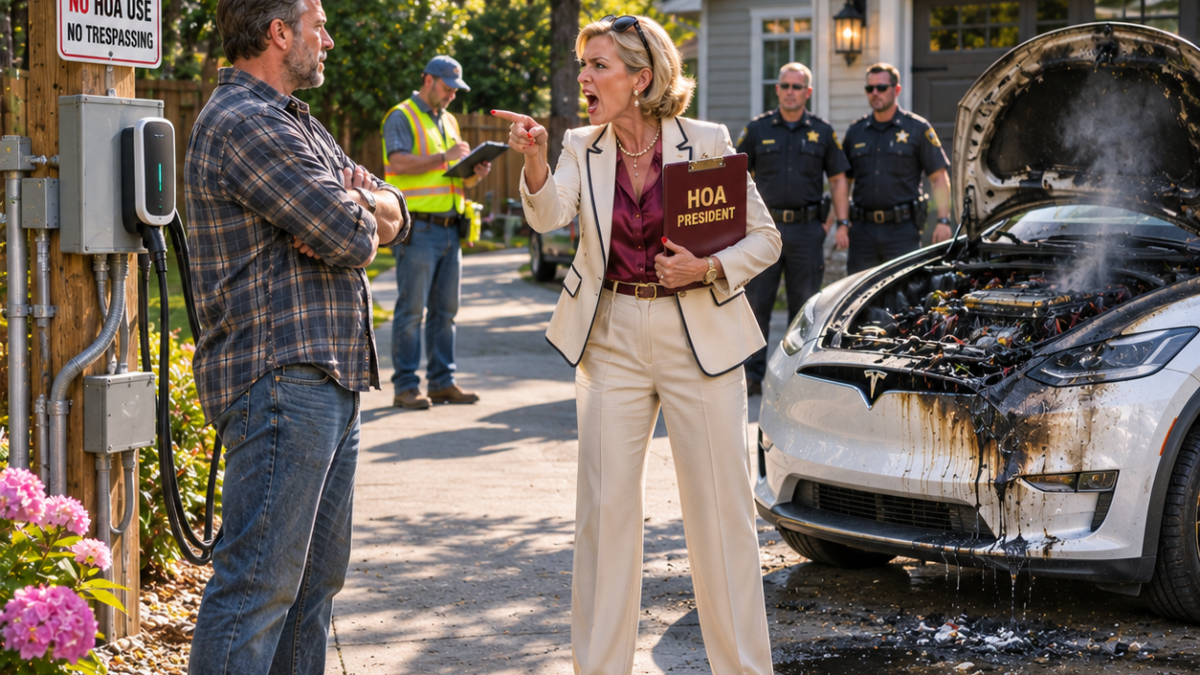
At 1:47 in the morning, I watched my HOA’s loudest self-appointed “sustainability expert” slip through my side gate in a silk robe, drag a charging cable across my lawn, and plug her Tesla into the outlet on my garage as casually as if she had paid my electric bill herself.
By then, my monthly power cost had more than doubled, the HOA had dismissed my complaints as a “neighborly misunderstanding,” and the woman stealing from me was still lecturing everyone else about responsibility, waste, and community values.
What bothered me most was not the money or even the trespassing—it was the calm little smile on her face when the charging light turned green, because that smile told me she believed there was absolutely nothing I could do about it.
Maplewood Estates had always been quiet: tree-lined streets, trimmed hedges, kids on bikes after dinner. After thirty years as an electrical engineer, that was exactly what I wanted.
Karen Whitmore arrived three years later and treated quiet like a management problem.
She was not actually on the HOA board, though you would never know that from the clipboard. Karen called herself Maplewood’s “sustainability liaison,” a title I later learned existed nowhere in our bylaws. She posted lectures about lawn chemicals, recycling, gas-powered tools, exterior lighting, and “shared environmental responsibility.”
The HOA president, Bill McKenzie, usually gave in to her because arguing with Karen was exhausting.
I mostly ignored her.
Then my electric bill hit $392.
I lived alone. I barely ran the air conditioner that month, and I had spent enough of my life around power systems to know when a number did not make sense. I checked my breakers, appliances, workshop equipment, and solar battery system.
Everything inside the house looked normal.
My smart meter history did not.
Almost every night, a heavy load appeared shortly before two in the morning and stayed there for hours.
So I stayed awake.
At 1:40, I turned off the kitchen lights, poured coffee, and sat near the garage window. Seven minutes later, a white Tesla rolled down the street and stopped beside my property.
Karen got out wearing slippers and carrying a portable charging cable.
Then she opened my side gate, crossed my yard, lifted the weather cover on my outdoor outlet, and plugged in.
The green light on her charger came on.
My phone showed the meter spike almost immediately.
The next morning, I caught her watering plants beside her driveway.
“Karen. Why were you in my yard last night?”
Her expression changed for half a second, then smoothed itself out.
“I don’t know what you mean.”
“I watched you charge your Tesla from my garage.”
She gave a small laugh. “Oh, that.”
I waited.
“You have excess capacity,” she said. “You barely use that outlet.”
“That doesn’t make it yours.”
“You’re being dramatic. We’re supposed to support sustainable transportation.”
“By stealing electricity?”
Her mouth tightened. “It’s a few dollars.”
“My bill doubled.”
“That sounds like a problem with your house.”
She turned the hose back toward her flower bed, ending the conversation as if she had just ruled on a case.
That afternoon I emailed Bill and attached screenshots of the meter history.
His reply came two hours later.
Please resolve minor utility disputes amicably between neighbors.
I called him.
“Bill, she’s entering my property at night.”
He sighed. “I understand you’re frustrated.”
“No. I’m telling you she’s trespassing.”
“We don’t want to escalate this.”
That sentence changed the way I approached the problem.
I stopped trying to persuade anyone.
I installed a security camera under the garage eave, aimed only at my side yard and outlet. I saved the meter logs. I started a folder with dates, screenshots, bills, and every message I had sent the HOA.
For four nights, Karen came back.
Same car. Same robe. Same cable.
Same time.
On the fifth night, I left the camera running, set a motion alert on my phone, and sat in the dark with the folder on the kitchen table.
At 1:46, my phone vibrated.
I opened the live feed and saw Karen crossing the lawn again.
At 1:47, she reached for the outlet.
This time, before her fingers touched the cover, I switched on the porch light and opened my back door.
PART 2
Karen froze.
For maybe three seconds, neither of us moved.
The cable hung from her right hand. Her left hand was still resting on the outlet cover. The porch light threw a sharp shadow behind her, stretching it across my lawn toward the gate she had opened without permission.
“Put it down,” I said.
She straightened slowly.
“What are you doing awake?”
Of all the things she could have said, that was what came out.
I almost laughed.
“I live here.”
“I know that.”
“Then why are you surprised to find me standing in my own backyard?”
Karen glanced toward the camera under the garage eave.
I watched the exact moment she noticed it.
Her face tightened.
“Are you recording me?”
“Yes.”
“You can’t do that.”
“It’s my yard.”
“You need consent.”
“Not to record my own property.”
She looked at the cable, then at me.
Her voice changed. Softer now. Reasonable. Almost offended.
“I think this has gotten completely out of proportion.”
“You’ve been coming here for weeks.”
“I already explained the situation.”
“No. You invented a phrase called community energy sharing and hoped I wouldn’t check.”
“You have solar.”
“That does not make my house a public charging station.”
She crossed her arms.
“This neighborhood is supposed to encourage responsible energy use.”
“I am encouraging responsible energy use. Starting tonight, you’re responsible for paying for your own.”
Her jaw clenched.
For a moment, I thought she might plug in anyway just to prove I couldn’t stop her.
Instead, she picked up the cable.
“You’re making a mistake.”
“Get off my property.”
“You’re going to regret treating me like a criminal.”
“If you don’t want to be treated like one, stop sneaking into my yard at two in the morning.”
That finally cracked the calm expression.
“You have no idea how much influence I have around here.”
I looked past her toward her white Tesla.
“Apparently not enough influence to get a charger installed at your own house.”
She stared at me, furious, then turned and marched across the lawn.
At the gate she stopped.
“This isn’t over.”
I closed the gate behind her.
“No,” I said. “It isn’t.”
I barely slept afterward.
Not because I was afraid of Karen, exactly. I was afraid of what people like her could do once embarrassment became more important than common sense.
By eight the next morning, I knew I had been right.
There was an email from Bill.
URGENT COMMUNITY CONCERN.
According to him, Karen had reported that I had “aggressively confronted” her during what she described as an inspection of “shared sustainability infrastructure.”
I read that sentence three times.
Then I opened the HOA bylaws.
There was no shared sustainability infrastructure.
There was no energy-sharing program.
There was no sustainability liaison.
Karen had taken three words people liked—community, environment, sustainability—and built herself a fake office out of them.
I printed the email and added it to my folder.
Then I called the non-emergency police number.
The officer who took the report did not sound particularly excited about stolen electricity, but he paid attention when I explained the repeated nighttime entries.
“You have video?”
“Several nights.”
“Signs?”
“Private property sign on the gate.”
“Did you tell her not to return?”
“Last night. On camera.”
“All right. Keep the footage. Don’t confront her physically. If she comes back, call us.”
That was good enough for me.
Next I contacted the utility company and reported the unauthorized use.
They could see the same strange nighttime pattern I could.
The representative stopped me halfway through my explanation.
“You’re saying a vehicle is being charged from an exterior circuit connected to your meter without permission?”
“Yes.”
“Repeatedly?”
“Yes.”
She gave me a case number.
For the first time since the whole thing started, somebody had used the correct word.
Unauthorized.
That afternoon, Linda Parker leaned over the fence separating our backyards.
Linda lived two houses down and knew everything that happened in Maplewood about fifteen minutes before everyone else.
“I heard you threatened Karen with electrocution.”
I stared at her.
“Excuse me?”
She grinned.
“That’s her version.”
“Of course it is.”
“She says you’re anti-environment.”
“I own solar panels.”
“I know.”
“She knows.”
“I know.”
We stood there in silence for a second.
Then Linda lowered her voice.
“People are tired of her.”
That surprised me more than I expected.
Linda told me about violation notices Karen had drafted without board authorization. A mother on Cedar Lane had been accused of “irresponsible waste behavior” because her son threw a plastic bottle into the wrong bin. An elderly man named Arthur had been photographed using a gas-powered leaf blower.
Mrs. Park had once found Karen opening recycling containers at the curb.
Tom, the landscaper, had lost three jobs after Karen told homeowners his equipment was environmentally irresponsible.
“No one says anything,” Linda told me, “because Bill always says it’s easier to keep her happy.”
“That’s the problem.”
“I know.”
“No. I mean that is literally the problem. Every time she pushes a boundary and nobody pushes back, she learns the boundary wasn’t real.”
Linda studied me.
“So what are you going to do?”
“Document everything.”
She smiled.
“Oh, she is going to hate you.”
“I think she already does.”
The next HOA meeting was three days later.
I brought the folder.
Karen brought a binder.
Naturally.
About twenty-five homeowners sat in folding chairs inside the clubhouse. Normally those meetings attracted maybe eight people and one sleeping retiree. This time, word had spread.
Bill sat at the front rubbing his forehead before the meeting even started.
Karen sat beside him despite not being a board member.
That told me plenty.
When my turn came, I placed three photographs on the table.
Karen entering my gate.
Karen holding her charging cable.
Karen plugging her Tesla into my house.
Then I placed copies of the utility graphs beside them.
Bill stared at the pages.
Karen stared at me.
“This is misleading,” she said.
I looked at her.
“Which part?”
“You’re framing normal community cooperation as theft.”
“Where is the policy?”
“What?”
“The policy authorizing you to use my electricity.”
She flipped open her binder.
“We have always encouraged sustainable practices.”
“That is not what I asked.”
Bill shifted in his chair.
“Maybe we can keep the tone civil.”
I turned toward him.
“I have been civil for six weeks.”
Karen jumped in.
“He’s obsessed with money.”
That got a reaction from the room.
Not a big one.
A few murmurs.
She continued.
“We’re talking about an insignificant amount of electricity in exchange for supporting clean transportation.”
Linda raised her hand.
Bill sighed. “Linda?”
“If it’s insignificant, Karen can reimburse him.”
Karen turned around.
“That’s not the point.”
Linda smiled.
“Exactly.”
Several people laughed.
Karen’s face reddened.
I slid my newest power bill across the table.
“This is not theoretical. My bill increased by more than two hundred dollars during the period she was repeatedly charging from my property.”
“That could be anything,” Karen said.
I handed Bill the utility case number.
“It could. That’s why the utility company is reviewing it.”
For the first time, Karen stopped talking.
Only for a second.
Then she turned toward Bill.
“This is harassment.”
I actually looked behind me, wondering if there was another conversation happening somewhere.
“You entered my property.”
“I was participating in a community initiative.”
“Name it.”
She opened her mouth.
Nothing came out.
“Show me the board vote authorizing it.”
Silence.
“Show me the budget.”
Nothing.
“Show me one sentence in the bylaws saying private residential outlets are available for community vehicle charging.”
Bill finally raised a hand.
“All right.”
Karen turned on him.
“You know what we discussed.”
Bill’s eyes dropped.
That interested me.
“What did you discuss?”
Neither answered.
I leaned forward.
“Bill?”
He exhaled.
“Karen had proposed some ideas.”
“Proposed.”
“Yes.”
“Were they approved?”
“No.”
Karen snapped her binder closed.
“That is a technicality.”
“No,” I said. “That is the difference between an idea and permission.”
The board refused to take action against me.
That should have been the end.
Instead, it humiliated Karen in front of the only audience that mattered to her.
And humiliation turned out to be gasoline.
The next morning, she posted a six-paragraph message in the neighborhood group accusing unnamed residents of “weaponizing private property against collective environmental progress.”
Nobody had to guess who she meant.
Someone replied, “Does collective progress come with a charging cable?”
The post disappeared within an hour.
That afternoon I had a licensed electrician inspect the exterior circuit.
I could have handled the work myself. I had spent my career around electrical systems. But I wanted something more valuable than pride.
I wanted paperwork.
He inspected the circuit, replaced the weathered cover with a secure lockable enclosure, added modern protection, and documented everything.
I also added a clearly visible sign:
PRIVATE OUTLET — NO AUTHORIZED VEHICLE CHARGING.
The setup was designed to shut down safely if anything abnormal happened. No tricks. No hidden danger. No revenge device.
What I wanted was simple.
If Karen came back, I wanted proof that she knowingly ignored a direct warning.
She lasted four days.
At 1:32 on a Thursday afternoon, my motion alert went off while I was in my kitchen.
I opened the camera feed.
There she was.
Not at night this time.
Broad daylight.
Karen stood beside my garage wearing white pants, a green blouse, oversized sunglasses, and the expression of a woman arriving for an inspection she had appointed herself to conduct.
She photographed the warning sign.
Then she photographed the outlet.
Then she photographed my camera.
Finally she walked directly toward the enclosure.
I went outside.
“You were told not to come back here.”
Karen didn’t turn around.
“I’m documenting a safety concern.”
“From outside the gate.”
“The HOA has a duty to investigate potentially dangerous modifications.”
“You’re not the HOA.”
She spun around.
“You keep saying that like it matters.”
“It matters a lot.”
“I have spoken with several board members.”
“Wonderful. Invite them over after they call me.”
She pointed toward the enclosure.
“You altered the power source after I used it.”
“Yes.”
“Why?”
“To stop you from using it.”
Her smile returned.
There it was.
That tiny expression I had seen the first night.
The smile of someone who had just found a sentence she thought she could twist.
“So you admit you modified it specifically because of me.”
“I secured my private property specifically because you repeatedly trespassed and stole electricity.”
Her smile vanished.
“You’re going to be liable for anything that happens.”
“If you stay out of my yard, nothing will happen.”
I stepped toward the gate and held it open.
“Leave.”
She did.
But before she walked away, she took one more photograph.
That evening, Linda called.
“You need to see what she posted.”
Karen had uploaded the photo of my outlet and written that I had created an “unsafe anti-EV electrical obstacle” in violation of Maplewood’s environmental values.
The comments did not go the way she expected.
One neighbor asked why she had been close enough to photograph an outlet on private property.
Another asked what environmental bylaw I had violated.
A third posted a screenshot from the HOA rules showing that exterior electrical systems were homeowner responsibility.
Karen deleted the post.
Again.
By then, I was beginning to understand something about her.
She did not need to win an argument.
She needed to control the definition of what the argument was.
When I called it trespassing, she called it sustainability.
When I called it theft, she called it sharing.
When I secured my outlet, she called it an environmental hazard.
As long as she controlled the language, she could pretend she controlled reality.
So I stopped arguing about language.
I kept collecting facts.
The utility company confirmed the repeated nighttime draw matched the dates on my camera footage. The officer handling my report added the new daytime incident. My electrician emailed his inspection report.
I saved everything.
And then, two nights later, Karen made the decision that destroyed her own story.
My phone buzzed at 1:51 a.m.
I woke immediately.
Motion detected.
I opened the feed.
Karen’s Tesla sat beside the curb.
She was standing at my garage.
And she was not carrying the same charging cable.
This one was heavier, bundled with an adapter and another piece of equipment I had never seen her use before.
I pulled on jeans, grabbed my phone, and headed downstairs.
By the time I reached the kitchen, she was already at the outlet enclosure.
I called the non-emergency number.
Then I started recording.
Karen struggled with the secured cover.
She pulled at it.
Stopped.
Looked toward my house.
Then tried again.
I opened the back door.
“Karen.”
She jerked upright.
“What?”
“What are you doing?”
“Testing something.”
“At two in the morning?”
“My charger failed after using your outlet.”
“Then stop using my outlet.”
“You damaged my equipment.”
“I didn’t touch your equipment.”
“You altered this.”
“My electrician did.”
Her face changed.
That was not the answer she expected.
“You hired someone?”
“Yes.”
“Who?”
“A licensed electrician.”
She looked at the outlet.
Then at the camera.
Then back at me.
For one brief moment, I thought common sense might finally arrive.
Instead, she said, “Good.”
“Good?”
“Then there’ll be someone else to sue.”
I laughed once.
Not because it was funny.
Because I had run out of other reactions.
“You need to leave.”
She ignored me and returned to her equipment.
“Karen.”
“I’m proving your outlet is unsafe.”
“By connecting your car to it after being told repeatedly not to?”
She shoved the connector into place.
The charging indicator flashed.
Then the circuit protection did exactly what it was supposed to do.
It shut off.
Karen stared at the cable.
The car displayed a charging error.
She pulled the connector free.
“See?”
“See what?”
“You sabotaged it.”
“It shut down.”
“Exactly.”
“That’s what protection is supposed to do when something isn’t right.”
She muttered something, adjusted her equipment, and tried again.
I stepped forward.
“Stop.”
“Don’t touch me.”
“I’m not touching you. I’m telling you to disconnect your equipment and leave.”
She tried a third time.
The system shut down again.
Then I smelled something.
Hot insulation.
My stomach dropped.
“Karen, disconnect it.”
She looked at me.
For the first time that night, I saw uncertainty.
A thin curl of smoke rose near her charging equipment.
She yanked the connector.
There was a sharp pop.
Karen screamed.
The car horn sounded.
Lights flashed.
A small burst of flame appeared near the cable connection, vanished, then flared again.
I ran to the emergency cutoff.
The house circuit was already dead.
“Get away from the car!”
Karen stumbled backward.
I called 911.
The flame stayed small, but smoke thickened around the charging port.
Within minutes, half the street was awake.
Porch lights came on.
Dogs barked.
Neighbors appeared in robes and pajamas.
Karen stood in my yard shaking, pointing at me.
“You did this!”
“Back away from the car.”
“You did this!”
A fire engine arrived first.
Then a police cruiser.
Firefighters secured the area while an officer separated Karen and me.
She spoke so quickly I could hear fragments from twenty feet away.
“Deliberate—engineer—trap—he admitted—revenge—”
The officer finally raised his hand.
“Ma’am. Stop.”
She stopped.
He walked over to me.
“Your side.”
I handed him my phone.
“Start with the video.”
The recording showed everything.
Her entering.
Her arguing.
My warnings.
The repeated attempts.
My telling her to stop.
The smoke.
The moment the system cut power.
The firefighter inspecting my garage later gave the officer a simple preliminary answer.
The household circuit protection had operated.
The visible damage appeared concentrated around Karen’s charging equipment and the vehicle connection.
That did not prove what had caused the failure.
But it did prove something equally important.
My house had not been secretly pumping uncontrolled power into her car.
Karen heard him say it.
Her face changed.
“What are you saying?”
“I’m saying we need the equipment examined before anybody determines a cause.”
“He designed this!”
The firefighter looked at the secured enclosure.
“Who installed it?”
“A licensed electrician,” I said.
Karen closed her eyes.
Just for a second.
It was almost beautiful.
The next morning, her Tesla sat in the driveway under a cover.
The charging area was blackened.
It was not the dramatic inferno she later described at the HOA meeting. Nobody had been injured. The fire had been contained quickly.
But the repair estimate was ugly.
And Karen wanted somebody else to pay it.
By noon, I received an email ordering me to an emergency HOA meeting.
I walked into the clubhouse carrying the same folder I had brought before.
Only now it was twice as thick.
Karen sat in front with her arms crossed.
Bill looked exhausted.
The room was packed.
“Mr. Johnson,” Bill began, “Mrs. Whitmore alleges that an electrical modification on your property damaged her vehicle.”
“I know.”
“She believes it was intentional.”
“I know.”
Karen leaned forward.
“He built a trap.”
I looked at her.
“You came onto my property after midnight after being told not to.”
“You altered the outlet.”
“I secured it.”
“You knew I might use it.”
“That is an extraordinary defense.”
Someone in the back laughed.
Karen turned.
“This isn’t funny. My car nearly caught fire.”
I nodded.
“You’re right. That part isn’t funny.”
I pulled out the electrician’s inspection.
“This was completed before the incident.”
Then the utility report.
“This documents unauthorized nighttime draws.”
Then the police report.
“This documents that I explicitly told Karen not to return.”
Then still photographs from the video.
“This shows her returning anyway.”
Finally, I played the recording.
The room went quiet when my voice came through the speakers.
Karen, disconnect it.
Then again.
Stop.
Then her voice.
I’m proving your outlet is unsafe.
The room stayed silent after the video ended.
Bill looked at Karen.
“You went back specifically to test his outlet?”
“I was gathering evidence.”
“At two in the morning?”
“He had created a dangerous condition.”
“On his private property,” Linda said from the back.
Karen snapped around.
“Stay out of this.”
Linda raised both hands.
“Gladly. I stay out of other people’s yards all the time. It’s surprisingly easy.”
The room broke into laughter.
Karen slammed her palm on the table.
“This man intentionally created a situation designed to harm my Tesla.”
I shook my head.
“No. I created a situation designed to stop unauthorized use. Your equipment failed after you ignored repeated warnings.”
Bill looked toward another board member.
She whispered something to him.
He sighed.
“Karen, the board cannot find a violation by Mr. Johnson based on the information we have.”
Her mouth opened.
Bill kept going.
“We can, however, find multiple violations involving unauthorized entry onto private property.”
“You’re joking.”
“No.”
“I was acting on behalf of this community.”
“No,” I said.
She pointed at me.
“You shut up.”
Bill’s voice hardened.
“Karen.”
She turned toward him.
Something changed in Bill that night.
Maybe he was finally tired enough to stop being afraid of conflict.
“You do not speak for the board.”
Her face went still.
“We’ve let that line become blurred,” he continued. “That was a mistake.”
“You asked for my help.”
“Sometimes.”
“You relied on me.”
“Sometimes.”
“I built the sustainability program.”
Bill looked down at the papers in front of him.
“There is no board-authorized sustainability program.”
Karen went pale.
That sentence landed harder than anything I could have said.
Because it took away the thing she valued most.
Authority.
The board fined her for repeated property violations and suspended her access to HOA committees and volunteer enforcement activities for six months.
She stormed out before the meeting ended.
The next day, the service center examining her car issued its report.
The charging-system damage was consistent with a problem involving the external charging connection and equipment she had used. They could not identify my household circuit as the cause, and the vehicle manufacturer would not cover damage attributed to an outside charging setup or non-warrantable connection issue.
Karen’s repair estimate exceeded fourteen thousand dollars.
Three days later, she appeared on my porch holding the report.
“You’re paying this.”
“No.”
“You caused it.”
“No.”
“You changed the outlet because of me.”
“I secured my property because of you.”
“You knew something would happen.”
“I knew the power would shut off if the connection was abnormal. I did not know you would keep reconnecting equipment after it shut down.”
“You’re hiding behind technicalities.”
“No. I’m standing behind my front door while you demand money for damage that happened while you were trespassing.”
Her eyes filled with tears.
That stopped me.
I had never seen Karen cry.
For a second, the anger drained out of her face and left something smaller underneath.
Fear.
“That car is not cheap,” she whispered.
“I know.”
“I can’t just absorb fourteen thousand dollars.”
I almost said, Then why did you keep doing it?
But I didn’t.
She already knew.
I softened my voice.
“Karen, this could have ended differently. Somebody could have been hurt.”
“You think I don’t know that?”
“Then stop.”
She looked at me.
“Stop what?”
“Trying to make every mistake somebody else’s responsibility.”
The tears disappeared almost instantly.
The armor came back.
“You’re going to regret saying that.”
She walked away.
One week later, a civil complaint arrived.
Karen was suing me for the vehicle repair, emotional distress, and related costs.
I read the papers at my kitchen table with a cup of coffee going cold beside me.
A strange thing happened.
I was not angry.
I was relieved.
For weeks, everything had happened in Karen’s favorite environment: gossip, HOA politics, private accusations, invented titles, social pressure.
Court was different.
Court loved documents.
I had documents.
My attorney looked through the folder and smiled for the first time about twenty minutes into our meeting.
“You kept all of this?”
“All of it.”
“Videos?”
“Yes.”
“Original files?”
“Yes.”
“Utility records?”
“Yes.”
“Inspection?”
“Yes.”
“Police report?”
“Yes.”
He closed the folder.
“Good.”
Karen’s filing painted a very different story.
According to her, she had been participating in an established neighborhood sustainability practice when I became hostile toward electric vehicles, modified my electrical system specifically to damage her Tesla, and created a hazardous condition that caused a fire.
Her attorney also argued that she had a reasonable belief she was authorized to use the outlet.
That was the part that interested me.
“Authorized by whom?” I asked my lawyer.
“Exactly.”
Two weeks before the hearing, we requested whatever documentation supported that claim.
Karen produced emails.
Most were ordinary conversations about recycling initiatives and possible community solar projects.
One message from Bill said, “Karen, feel free to explore ideas and report back.”
She highlighted that sentence.
My attorney stared at it.
“That’s her authorization?”
“Apparently.”
“To enter your property?”
“Apparently.”
He shook his head.
“This is going to be a long afternoon for her.”
It was.
The judge watched part of the security footage.
Then another part.
Then he read the electrician’s report.
Then the police report.
Finally, he looked at Karen.
“Mrs. Whitmore, were you told not to enter the defendant’s property?”
She shifted in her chair.
“There was a disagreement about community access.”
“That was not my question.”
“Yes.”
“Were you told not to use the outlet?”
“Yes, but—”
“Did you return afterward?”
“I believed—”
“Yes or no?”
“Yes.”
“Did you return after midnight on the night your vehicle was damaged?”
“Yes.”
“Did the defendant tell you to disconnect?”
She looked at her attorney.
He stared down at his notes.
“Yes.”
“More than once?”
Her jaw tightened.
“Yes.”
The judge leaned back.
“Then I am having difficulty understanding the theory that the defendant is responsible for your decision to continue using equipment on property you had been expressly told not to enter.”
Karen’s attorney tried to rescue the case.
He argued that my modifications might still have contributed to the damage.
My attorney answered with the independent inspection and fire department observations.
No expert evidence showed that my electrical system caused the failure.
No evidence showed deliberate sabotage.
The available evidence showed exactly the opposite: the circuit shut down.
The judge dismissed Karen’s claim.
She was ordered to cover the allowable court costs.
Outside the courthouse, I expected to feel triumphant.
Instead, I felt tired.
Linda had come with two neighbors and was waiting near the steps carrying coffee.
“Well?” she asked.
“Dismissed.”
She grinned.
“I knew it.”
She handed me the cup.
“To private outlets.”
I laughed.
“To people finally leaving them alone.”
For about three weeks, Maplewood became peaceful.
Karen kept her blinds closed.
Her Tesla disappeared for repairs.
There were no sustainability lectures.
No violation photographs.
No recycling audits.
Then the letters started.
The first appeared on my porch without a stamp.
ENJOY YOUR LITTLE VICTORY.
The second accused me of illegal electrical modifications.
The third said the county would “soon discover the truth.”
I recognized the formatting immediately.
Karen used the same narrow font on every neighborhood memo she had ever written.
Two days later, a county electrical inspector arrived.
“We received a complaint about unsafe exterior wiring.”
“Of course you did.”
He smiled politely.
“I’m guessing there’s a story.”
“A long one.”
He inspected everything.
Because I had used a licensed electrician and kept the paperwork, the process was almost boring.
Twenty minutes later, he signed the report.
“No violation.”
“That’s it?”
“That’s it.”
He started walking toward his truck, then turned.
“For what it’s worth, your protection did what it was supposed to do.”
“I know.”
He nodded toward Karen’s house.
“Somebody over there disagree?”
“Strongly.”
He laughed and left.
That should have satisfied me.
Instead, it bothered me.
Karen had spent months pretending she represented authority she did not possess. She had used HOA language, HOA stationery, HOA meetings, and Bill’s reluctance to challenge her as a substitute for actual power.
I wanted to know how far it went.
So I requested HOA records available to homeowners.
The first stack was boring.
Landscaping contracts.
Insurance notices.
Roof proposals.
Pool maintenance.
Then I found a line item I had never heard of.
Community Sustainability Fund.
I called Bill.
“What is this?”
He was quiet.
“What?”
“The sustainability fund.”
Another pause.
“Karen’s project.”
“Approved when?”
“I’m not sure it was formally approved.”
That phrase again.
Not formally approved.
“What did it do?”
“She collected voluntary donations for green improvements.”
“What improvements?”
“We talked about solar panels.”
“Were any purchased?”
“No.”
“Charging stations?”
“No.”
“Energy audits?”
“No.”
“Then where is the money?”
Silence.
“Bill?”
“I’ll have to ask the treasurer.”
That answer changed the entire case.
I called Linda.
“Did Karen ever ask you for money?”
“Twenty dollars.”
“For what?”
“Community solar.”
“When?”
“Last year.”
“How did you pay?”
“Electronic transfer.”
“To the HOA?”
Linda became quiet.
“No.”
“To Karen?”
Another pause.
“Yes.”
Within a day, three other residents showed me receipts.
Ten dollars.
Twenty-five.
Fifty.
All labeled with words like GREEN FUND, COMMUNITY SOLAR, or SUSTAINABILITY PROJECT.
All sent to an account controlled by Karen.
I did not accuse her of embezzlement.
Not yet.
I sent everything to Bill and requested a formal accounting.
He called me less than an hour later.
His voice sounded different.
No exhaustion.
No diplomacy.
Just alarm.
“We have a problem.”
“How big?”
“I don’t know yet.”
The treasurer had records of announcements about the fund, but no board resolution authorizing it and no HOA-controlled account associated with it.
Residents had been told they were supporting community projects.
The HOA had never received the money.
Bill called an emergency board meeting.
Karen arrived ten minutes late.
She walked into a room so silent I could hear the door latch behind her.
There were no jokes.
No whispered comments.
No smug smiles from me.
This was different.
Bill had a stack of printed transactions in front of him.
“Sit down, Karen.”
She looked at the chair.
“I prefer to stand.”
“Fine.”
He held up a page.
“Did you create something called the Community Sustainability Fund?”
“Yes.”
“Under HOA authority?”
“I was developing it.”
“That’s not what I asked.”
Karen looked around the room.
Several residents were holding copies of payment receipts.
“Yes.”
Bill leaned forward.
“Show me the authorization.”
“We discussed it.”
“Show me the vote.”
“You know how difficult it is to get anything done through this board.”
“Show me the account records.”
Her face changed.
“There are administrative complications.”
Linda made a small sound behind me.
Karen snapped.
“Do you have something to say?”
Linda held up her receipt.
“Where did my money go?”
Karen stared at it.
“It was being held.”
“Where?”
“For future projects.”
“Where?”
Karen looked at Bill.
He slid another document across the table.
“We requested records after residents complained.”
She did not touch the paper.
Bill continued.
“The account receiving these funds appears to be personally controlled by you.”
“I was acting as custodian.”
“Without authorization.”
“I intended to transfer everything once the program was formalized.”
“How much is left?”
Silence.
Bill’s expression hardened.
“How much is left, Karen?”
“I don’t have that number in front of me.”
The treasurer spoke for the first time.
“I do.”
Karen turned.
The woman pushed a page across the table.
Based on resident receipts and the records they had collected, nearly nine thousand dollars had moved through the so-called sustainability fund.
A large portion was gone.
Karen’s breathing changed.
“It was used for program development.”
“What development?” Bill asked.
“Research.”
“What research?”
She hesitated.
That hesitation destroyed her.
Because one resident had already provided a payment trail showing expenses associated with charging equipment.
Another record pointed to landscaping at Karen’s own home.
There were charges connected to a wellness retreat in Arizona.
Karen’s eyes filled with panic.
“That retreat included environmental workshops.”
Linda stared at her.
“You used our solar money to go to a resort?”
“That is not what happened.”
“Then tell us what happened.”
“I was building a program.”
“You bought charging equipment.”
“For testing.”
“You renovated your garden.”
“It was a native plant demonstration.”
“You went to Arizona.”
“For research.”
Linda leaned back.
“Research with massages?”
People laughed.
Karen did not.
She turned to me.
“This is you.”
I shook my head.
“No.”
“You went looking for this.”
“Yes.”
“You wanted to destroy me.”
“No.”
“Liar.”
I stood.
“You keep saying I did things to you. I didn’t plug your car into my house. I didn’t make you come back after you were warned. I didn’t make you file false complaints. And I didn’t tell residents to send money to your personal account.”
She stepped closer.
“You think you’re better than me?”
“No.”
“Then stop acting like it.”
“I think I’m responsible for what I do.”
Her face twitched.
“So are you.”
For once, she had no answer.
Bill announced that the board was immediately suspending every volunteer role Karen had claimed or been informally allowed to perform. She was barred from representing the HOA, issuing notices, conducting inspections, or organizing financial programs.
The records would be forwarded for independent review.
Karen’s voice rose.
“You can’t erase everything I’ve done for this community.”
Bill looked at her for a long moment.
“No,” he said quietly. “That’s the problem.”
She left without slamming the door.
That frightened me more than the shouting ever had.
A week later, the audit confirmed the basic facts.
Karen had collected thousands of dollars under the banner of an HOA sustainability initiative that had never been formally created. Some money had been spent on expenses that benefited her personally.
Residents demanded repayment.
The HOA demanded that she stop using its name.
County authorities reviewed the records.
In the end, Karen agreed to restitution and cooperation rather than continue fighting every allegation. The exact legal details stayed mostly private, but within a few months the residents who had contributed received their money back.
Her reputation did not recover.
A FOR SALE sign appeared in her yard that spring.
I stood on my porch the morning the moving truck arrived.
Linda walked over carrying two cups of coffee.
“Think she’ll actually leave?”
“There are boxes going into a truck.”
“With Karen, I need stronger evidence.”
I laughed.
Across the street, Karen stepped out carrying a small cardboard box.
She saw us.
For a second, I expected one final speech.
Instead, she walked toward me.
Linda quietly moved away.
Karen stopped at the bottom of my steps.
“You happy?”
I thought about the question.
“Relieved.”
“That’s not the same thing.”
“No.”
She glanced toward the side of my garage.
“The outlet still there?”
“Yes.”
“Still dangerous?”
“It was never dangerous.”
Her mouth tightened.
“I lost a lot because of you.”
I shook my head.
“No, Karen.”
She looked at me.
“You lost a lot in front of me. That’s different.”
For several seconds, neither of us spoke.
The old Karen would have argued.
This Karen just looked tired.
“I really did want Maplewood to be better,” she said.
“I believe you.”
That surprised her.
“You do?”
“Yes.”
“Then why did everyone turn against me?”
“Because wanting something good doesn’t give you permission to treat people badly.”
Her eyes dropped.
The moving truck driver called her name.
She turned.
Then stopped.
“I hate that you were right about some of it.”
“Some?”
A faint smile touched her mouth.
“There. That. That’s why people find you annoying.”
I smiled.
“Safe trip, Karen.”
She walked away.
The white Tesla was not on the moving truck.
I never asked what happened to it.
Bill resigned from the HOA presidency a few weeks later.
“I’ve had enough community leadership to last three lifetimes,” he told me.
Linda ended up on the new board, along with several homeowners who had spent years avoiding meetings because Karen dominated them.
One of their first changes was simple.
No unofficial titles.
No unauthorized notices.
No resident-run collection of HOA funds.
Every committee required a written purpose, board approval, and public accounting.
It was less exciting than Karen’s version of environmental revolution.
That was exactly why it worked.
The new board eventually revived one of her old ideas.
Solar-powered lighting along the walking trail.
Only this time there was a budget.
Bids.
Receipts.
A vote.
Actual electricians.
They asked me to help review the technical plan.
I agreed on one condition.
“I’m not joining the board.”
Linda laughed.
“Nobody asked you.”
“Good.”
“We just need someone who knows electricity.”
“That I can do.”
The installation took two months.
On the evening we switched the lights on, families gathered along the trail with lemonade and paper cups. Kids ran under the new lamps. Neighbors who had barely spoken during the worst of the conflict stood around talking like people who had suddenly remembered they actually liked living near one another.
Somebody shouted, “Make sure nobody plugs a Tesla into them.”
Everyone laughed.
Including me.
Months passed.
The famous outlet stayed locked.
My power bills returned to normal.
The police case became paperwork in a drawer.
The court documents went into a folder in my garage.
Eventually, even the story stopped coming up at every neighborhood gathering.
Then one afternoon, I was cleaning shelves when I found the folder.
Utility graphs.
Camera stills.
HOA emails.
The electrician’s report.
A photograph printed from the night Karen’s charging equipment smoked beside her car.
I flipped through it slowly.
For months, that folder had felt like armor.
Now it felt heavy.
I put it into a storage box and wrote two words on the lid.
LESSONS LEARNED.
About a month later, I found an envelope in my mailbox.
No stamp.
No return address.
Just my name.
I recognized Karen’s handwriting before I opened it.
The first line surprised me.
You were right.
I stood beside the mailbox reading the rest.
She had moved to Arizona.
She said she was volunteering with an established environmental organization there, one with actual directors, budgets, rules, and enough people around her to tell her no.
The letter was not a full apology.
Karen was still Karen.
She defended some of her intentions. She blamed stress for some of her choices. She wrote that Maplewood had never appreciated how much work she had tried to do.
Then, near the end, she wrote something simpler.
I thought caring more gave me the right to decide more. It didn’t.
I read that line twice.
Then I folded the letter and put it inside the box with the old evidence.
Spring came early that year.
Maplewood’s trees turned green.
The walking trail lights clicked on every evening without controversy.
People paid their own electric bills.
Nobody inspected anyone else’s recycling after dark.
It was remarkably peaceful.
Then, one afternoon, a package appeared on my porch.
Inside was a small solar desk lamp.
There was a card.
Mr. Johnson,
From one power enthusiast to another.
Consider this peace, not penance.
—K.W.
I laughed so hard Linda heard me from two houses away.
“What happened?”
I carried the lamp outside.
She read the note.
“No.”
“Yes.”
“She sent you that?”
“She did.”
Linda shook her head.
“You keeping it?”
I looked down at the little lamp.
“Absolutely.”
I placed it on the desk in my workshop beside the window.
During the day, it collected sunlight.
At night, it gave off a quiet glow.
No stolen electricity.
No midnight cables.
No arguments.
Just enough light to see the workbench.
Sometimes, when I’m in the garage late, I look at that lamp and then toward the locked outlet outside.
I remember the night I first saw Karen crossing my yard at 1:47 in the morning, so certain that my silence meant permission.
I remember the smoke beside her car, the courtroom, the HOA meetings, the folder thick with evidence, and the moment she finally stood on my porch without a clipboard or an invented title.
But mostly, I remember what Maplewood sounded like after she left.
Nothing.
No shouting.
No late-night motion alerts.
No phone vibrating beside my bed.
Just a quiet street, a dim workshop, and one little solar lamp glowing on my desk entirely on power it had collected for itself.
A week later, the independent audit confirmed what the room had already begun to suspect.
Karen had collected thousands of dollars from Maplewood residents under the name of a sustainability program that had never been approved by the HOA board. Some of the payments were small—ten dollars here, twenty-five there—but when they were added together, the total was close to nine thousand dollars.
What bothered people most was not even the amount.
It was the trust.
Mrs. Park had given fifty dollars because Karen told her the money would help install solar lighting near the playground.
Arthur, the retired schoolteacher at the end of Cedar Lane, had donated thirty because he thought the fund would eventually pay for an electric charging station at the clubhouse.
Linda had handed over twenty because Karen told her, with absolute confidence, that the board had already approved the project.
None of those things had happened.
The money had gone into an account Karen controlled.
Some of it was still there.
A lot of it was not.
The auditor did not accuse her of stealing every dollar. There were legitimate purchases mixed into the records—educational materials, a few environmental pamphlets, some inexpensive equipment she claimed had been intended for demonstrations.
But there were also expenses nobody could reasonably connect to an HOA project.
Personal charging equipment.
Landscaping at her house.
A hotel charge.
A spa payment.
Several restaurant bills from the Arizona trip she had described as “environmental research.”
When Bill showed me the audit summary, he looked older than he had the night before Karen’s Tesla smoked beside my garage.
“I should have stopped this,” he said.
We were sitting at a folding table in the empty clubhouse. The fluorescent lights above us buzzed softly.
“You didn’t take the money.”
“No. But I let her act like she had authority she didn’t have.”
I looked at him.
“That’s not the same thing.”
“It doesn’t feel very different right now.”
For years, Bill’s solution to Karen had been simple.
Give her just enough room to keep her quiet.
Let her organize something.
Let her send an email.
Let her sit near the front of meetings.
Let her call herself a liaison because correcting her would create an argument.
Each decision had seemed small.
Together, they had built a throne.
“I kept thinking she was annoying but useful,” Bill said. “She volunteered for everything nobody else wanted to do.”
“And eventually she forgot she was volunteering.”
He rubbed both hands over his face.
“No. Eventually we forgot too.”
The board hired an attorney.
Residents who had contributed money were contacted individually.
Karen received a formal demand to provide complete records and repay any funds that could not be properly accounted for.
For the first time since I had known her, she stopped arguing publicly.
Her blinds stayed closed.
Her mailbox filled before she came outside to collect anything.
The pale green blazer disappeared.
So did the clipboard.
When she walked her dog, she did it early in the morning and kept her eyes on the pavement.
Nobody celebrated that part.
Not really.
The jokes stopped once people understood how serious the situation had become.
It is easy to laugh when the neighborhood bully loses an argument.
It feels different when you watch someone’s entire identity collapse.
Karen had built her life in Maplewood around being needed.
She wanted to be the person who knew the regulations, who found the violations, who organized the projects, who told everyone else where they were failing.
Once that role disappeared, there was not much left between her and the consequences.
About two weeks after the audit, I saw her standing beside the community mailbox.
I almost walked past.
Then she spoke.
“Are you satisfied?”
Her voice was quieter than I had ever heard it.
I stopped.
“No.”
She gave me a bitter smile.
“Don’t lie.”
“I’m not.”
“You got exactly what you wanted.”
“What do you think I wanted?”
“For everyone to turn against me.”
I looked at her for a moment.
“That started long before I checked the HOA records.”
She tightened her grip on the mail in her hands.
“You could have left it alone.”
“So could you.”
Her eyes sharpened.
There was the old Karen.
Just for a second.
“You always have an answer.”
“No. I just stopped letting you supply all of them.”
She glanced toward my house.
“The car situation wasn’t enough?”
“You sued me.”
“And I lost.”
“You reported my electrical system.”
“And apparently I was wrong.”
“You sent people onto my property in the middle of the night for months before any of that happened.”
“I know what I did.”
That stopped me.
Not because the words were dramatic.
Because Karen Whitmore had just said them without adding a justification.
I know what I did.
She looked down at the envelopes in her hand.
“I thought if the program succeeded, nobody would care about the details.”
“What details?”
“The account. The approvals. Some of the expenses.”
“You mean the rules.”
She almost smiled.
“Coming from you, that’s funny.”
“Why?”
“You hate HOA rules.”
“I hate stupid rules. I hate fake rules more.”
She looked away.
For several seconds we stood beside the mailboxes while a sprinkler clicked rhythmically across a lawn behind us.
Then she said, “I am going to repay them.”
“That’s good.”
“I didn’t steal all of it.”
“I never said you did.”
“Everyone thinks I did.”
“Then show them the records.”
Her expression hardened again.
“You make everything sound easy.”
“No. I make it sound like the next thing you have to do.”
She looked at me with something close to resentment.
Maybe even hatred.
But beneath it was exhaustion.
“I used to think people respected me here.”
I could have hurt her then.
The sentence practically invited it.
I could have said they feared you.
I could have said they tolerated you.
I could have listed every neighbor she had embarrassed.
Instead, I said, “Some probably did.”
She looked surprised.
“Then what happened?”
“You started believing respect meant nobody could tell you no.”
The sprinkler clicked again.
Karen stared past me toward Maplewood’s entrance.
When she finally walked away, she did not say another word.
The financial dispute took several months to resolve.
County authorities reviewed the audit and the residents’ complaints. Lawyers became involved. Karen eventually agreed to repay the disputed money and cooperate rather than keep fighting over every transaction.
The details were mostly handled privately after that.
What mattered to the neighborhood was simple.
People got their money back.
Mrs. Park received her fifty dollars.
Arthur got his thirty.
Linda deposited her twenty-dollar reimbursement and immediately announced that she was spending it on something “deeply unsustainable.”
“What?” I asked.
“Steak.”
I laughed.
“With a plastic straw?”
“Two plastic straws.”
The humor came back slowly.
So did normal life.
Karen’s influence disappeared almost overnight.
The HOA removed her access to official mailing lists.
Residents were notified that only elected board members or formally appointed committees could issue notices.
Any future fundraising had to go through HOA-controlled accounts.
Every committee had to have a written purpose, a budget, and published meeting notes.
The changes were not glamorous.
That was the point.
Real governance turned out to be incredibly boring.
And after Karen, boring felt wonderful.
Then one Saturday morning in early spring, Linda knocked on my door.
She did not say anything.
She simply pointed across the street.
A white-and-red FOR SALE sign stood in Karen’s front yard.
I stared at it.
Linda took a sip from her coffee.
“Well.”
“You sound disappointed.”
“I expected fireworks.”
“You got a sign.”
“That woman fought a fourteen-thousand-dollar Tesla repair, an HOA suspension, a lawsuit, an audit, and county investigators.”
Linda nodded toward the sign.
“And she was defeated by a real-estate agent.”
The house sold faster than I expected.
Maplewood was still a good neighborhood, despite everything.
Maybe because of everything.
A young couple with two children made an offer within three weeks.
The moving truck arrived on a cool Tuesday morning.
I was standing on my porch when Linda appeared carrying two cups of coffee.
She handed me one without asking.
“Think she’ll actually leave?”
“There’s a moving truck.”
“With Karen, I want DNA confirmation.”
Workers moved boxes from the house.
Furniture came next.
A couch.
Dining chairs.
Several framed prints.
Then the famous burgundy clipboard appeared in the hands of one of the movers.
Linda nudged me.
“There it is.”
“What?”
“The weapon.”
I laughed into my coffee.
A few minutes later Karen walked out carrying a cardboard box.
She looked smaller somehow.
Not physically.
Just without the uniform she had built around herself.
No blazer.
No pearls.
No sunglasses pushed onto her head.
She wore jeans, sneakers, and a plain gray sweater.
She noticed us.
Linda immediately became fascinated by something at the bottom of her coffee cup.
Karen crossed the street.
I set my mug on the porch railing.
She stopped at the bottom step.
“You happy?”
I thought about it.
There had been a time when I would have said yes immediately.
After the stolen electricity.
After the lies.
After the fire.
After the lawsuit.
After the anonymous complaints.
After the fake fund.
I had imagined plenty of versions of this moment.
In most of them, I won.
Karen lost.
That was supposed to feel good.
Reality was quieter.
“Relieved,” I said.
She nodded slowly.
“That’s not the same thing.”
“No.”
Her eyes moved toward the side of my garage.
“The outlet still there?”
“Yes.”
“Still dangerous?”
“It was never dangerous.”
A faint smile appeared, but it had no humor in it.
“You’re never going to let that go.”
“You’re the one who asked.”
She sighed.
“I lost a lot because of you.”
I shook my head.
“No, Karen.”
Her expression hardened.
“Yes, I did.”
“You lost a lot in front of me. That’s different.”
She stared at me.
The old Karen would have exploded.
She would have pointed.
Threatened.
Quoted a regulation that did not exist.
This Karen simply looked tired.
“I really did want Maplewood to be better,” she said.
“I know.”
Her eyebrows lifted.
“You believe that?”
“Yes.”
“After everything?”
“Yes.”
She looked genuinely confused.
I leaned against the porch railing.
“The problem wasn’t that you wanted solar lights or recycling programs or electric chargers.”
“Then what was the problem?”
“You decided wanting something good made anything you did to get it acceptable.”
Her eyes dropped.
I continued.
“You stopped asking people. You started telling them. Then telling became ordering. And when people resisted, you treated resistance like proof they were bad people.”
Karen looked toward the houses around us.
For years, she had inspected those lawns like they belonged to her.
Now curtains moved quietly in windows.
People knew she was leaving.
Nobody came outside to watch.
Maybe that was the cruelest part.
Maplewood no longer revolved around her.
She had become just another person moving away.
“I hate that you were right about some of it,” she said.
“Some?”
Her mouth twitched.
“There. That.”
“What?”
“That thing you do.”
“What thing?”
“You cannot receive even half a compliment without trying to negotiate for the other half.”
I laughed.
And unexpectedly, so did she.
It lasted maybe two seconds.
But it was the first time I had heard Karen Whitmore laugh without somebody else being the target.
The moving truck driver called her name.
Karen turned.
Then she looked back at me.
“I don’t expect you to forgive me.”
“I’m not sure forgiveness is something either of us needs to negotiate on a sidewalk.”
“That sounds annoyingly mature.”
“I’m practicing.”
She nodded.
Then she surprised me.
“I’m sorry about the electricity.”
Not the lawsuit.
Not the accusations.
Not the HOA fund.
Just the electricity.
The first thing.
Maybe that was where she needed to begin.
I nodded once.
“Thank you.”
She walked back across the street.
I watched her climb into a dark SUV parked behind the moving truck.
The Tesla was not there.
I never asked what eventually happened to it.
Linda stepped beside me again.
“That was disappointingly civilized.”
“I can chase her down if you want.”
“No. Ruins the ending.”
The moving truck pulled away first.
Karen’s SUV followed.
At the entrance to Maplewood, her brake lights came on.
For one strange second, I wondered if she might turn around.
She didn’t.
The SUV disappeared around the corner.
Linda raised her coffee.
“Think she’ll terrorize another HOA?”
“I hope Arizona has strong bylaws.”
“You think she’s going to Arizona?”
“She mentioned it once.”
Linda considered that.
“Arizona has plenty of sunlight.”
“Perfect for her.”
“Why?”
“Unlimited sustainability.”
Linda groaned.
“That was terrible.”
“I’m retired. I’m allowed.”
Bill resigned as HOA president about three weeks later.
Unlike Karen, he did not leave Maplewood.
He just stepped down.
He stopped by my house one afternoon with a six-pack and sat with me on the porch.
“I’ve had enough community leadership for three lifetimes,” he said.
“You lasted longer than I would have.”
“That’s because you’re smart.”
“No. Because I would have quit the first time somebody complained about a wind chime.”
Bill laughed.
Then his expression became serious.
“I owe you an apology.”
“For what?”
“For not listening the first time.”
I looked at him.
“You were trying to keep the peace.”
“Yeah.”
He peeled at the label on his bottle.
“Turns out keeping the peace and avoiding conflict aren’t the same thing.”
That sentence stayed with me.
Linda ran for the board later that spring.
She claimed she had no interest in power.
Nobody believed her.
She won anyway.
The new board was almost aggressively ordinary.
A retired accountant handled the budget.
A young mother from Cedar Lane managed community events.
Arthur volunteered to review landscaping proposals because, as he put it, “I have been retired for twelve years and desperately need problems that are not medical.”
I agreed to act as a technical consultant when they needed electrical advice.
Only after making one condition clear.
“I am not joining the HOA board.”
Linda looked offended.
“Nobody invited you.”
“Good.”
“We just want free electrical advice.”
“That sounds more honest.”
Their first major project was one Karen had talked about for years.
Solar-powered lighting along the walking trail.
This time, nobody passed around a private payment link.
There was a proposal.
Then bids.
Then a vote.
Then a budget posted online.
Residents could see exactly what equipment was being purchased and exactly what it cost.
It was boring.
Transparent.
Slow.
And it worked.
The installation took nearly two months.
On the evening we switched the lights on, families gathered near the trail carrying paper cups of lemonade.
Kids ran along the path with glow sticks.
Arthur brought folding chairs even though nobody had asked him to.
Bill stood near the back, enjoying the unusual experience of attending an HOA event he was not responsible for.
Linda handed me the switch.
“You do it.”
“Why?”
“You’re the electricity guy.”
“I’m going to regret that nickname.”
“Too late.”
I flipped the switch.
One by one, the lights along the trail came on.
Warm amber pools spread across the pavement.
People applauded.
A teenager near the back shouted, “Make sure nobody plugs a Tesla into them.”
The entire crowd laughed.
I did too.
Not because Karen had lost.
Because we had reached the point where the story could be funny without being angry.
That mattered.
Life settled down after that.
My electric bill returned to normal.
The security camera stopped sending alerts at two in the morning.
I still checked it occasionally out of habit.
For months, every buzz from my phone made some part of me expect to see Karen crossing the lawn again with a charging cable.
Eventually that feeling faded.
The outlet remained locked.
I considered removing it altogether.
Instead, I kept it.
Maybe I was sentimental.
Maybe stubborn.
Maybe both.
One afternoon, while cleaning the workshop, I found the old evidence folder.
It had become thick enough to bend the drawer.
I carried it to the workbench.
Inside were the utility graphs that had started everything.
Night after night.
The same spike.
1:47 a.m.
I found the first still image from the security camera.
Karen in her robe.
Cable in hand.
Walking across my yard like she belonged there.
Behind it was the HOA email calling the theft a “minor misunderstanding.”
Then the police report.
The electrician’s inspection.
The court papers.
The anonymous letters.
The county inspection.
The sustainability fund records.
Months of anger reduced to paper.
I sat there longer than I expected.
For most of that year, the folder had felt like protection.
Whenever Karen changed her story, I had proof.
Whenever the HOA hesitated, I had proof.
Whenever I doubted myself, I had proof.
Now it felt like something else.
Weight.
I found an empty storage box and placed the folder inside.
On the lid, I wrote:
LESSONS LEARNED.
Then I put it on the top shelf.
A month later, an envelope appeared in my mailbox.
No stamp.
No return address.
My name was handwritten across the front.
I recognized Karen’s handwriting immediately.
My first reaction surprised me.
I laughed.
Not because it was funny.
Because apparently my life had reached the point where mail from Karen Whitmore qualified as a genre.
I carried the envelope inside but left it unopened on the kitchen counter for almost an hour.
Eventually curiosity won.
The first sentence was only three words.
You were right.
I read it again.
Then I checked the signature to make sure Linda had not created an elaborate prank.
It was Karen.
She had moved to Arizona.
She was volunteering with a legitimate environmental organization that worked on community conservation projects.
The way she described it made me smile.
They had directors.
Committees.
Budgets.
Written authority.
And, as Karen reluctantly admitted, “several people who are very comfortable telling me no.”
The letter was not a perfect apology.
That would not have sounded like her.
She defended some of her intentions.
She complained that Maplewood residents had never appreciated how much unpaid work she had done.
She insisted the sustainability fund had originally been meant for legitimate projects.
Then, halfway down the page, the tone changed.
I thought caring more gave me the right to decide more.
It didn’t.
I sat down.
The kitchen was completely silent.
She continued.
I kept telling myself that people resisted me because they were lazy or selfish or afraid of change. It was easier than admitting they might simply not trust the way I treated them.
Then came another line.
I also understand now that your electricity was never mine to take, no matter how I justified it.
That one made me smile.
I folded the letter carefully.
I did not frame it.
I did not show it around.
I did not send it to Linda.
Instead, I carried it into the garage, pulled down the box marked LESSONS LEARNED, and placed the envelope inside.
That felt like the correct place.
Spring came early the following year.
Maplewood’s trees turned green almost overnight.
The walking trail lights clicked on every evening.
People complained about normal things again.
Dog waste.
Parking.
Kids leaving bicycles near the clubhouse.
It was wonderful.
Then one afternoon a package appeared on my porch.
Inside was a small solar-powered desk lamp.
There was a card.
Mr. Johnson,
From one power enthusiast to another.
Consider this peace, not penance.
—K.W.
I laughed loud enough that Linda heard me from down the street.
She walked over.
“What?”
I handed her the card.
She read it.
Then read it again.
“No.”
“Yes.”
“She sent you a solar lamp?”
“She did.”
“That woman has a sense of humor?”
“Apparently Arizona changed her.”
Linda picked up the lamp.
“You keeping this?”
I looked at it.
“Absolutely.”
“You’re brave.”
“It doesn’t plug into anything.”
“Good point.”
I put the lamp on my workbench beside the window.
During the day, it absorbed sunlight.
At night, it gave off a soft glow.
Just enough to illuminate the tools and the old soldering station.
I found myself using it more than I expected.
Sometimes I would be working late, look toward that quiet little light, and remember the first night Karen crossed my yard.
Back then, I thought the fight was about electricity.
Then I thought it was about money.
Then property.
Then the HOA.
Then the lawsuit.
For a while, I even thought it was about winning.
It wasn’t.
The real thing I had lost before I ever noticed the missing electricity was the certainty that my boundaries meant something.
Karen did not begin by stealing hundreds of dollars.
She began by assuming.
Assuming she could enter.
Assuming she could use.
Assuming nobody would challenge her.
And every time nobody challenged her, the next step became easier.
The same thing had happened to the whole neighborhood.
One fake title.
One unofficial notice.
One unauthorized inspection.
One “voluntary” fund.
Nobody had decided to give Karen control.
They had surrendered it an inch at a time because arguing seemed harder.
That was the part I remembered most.
Not the sparks.
Not the court victory.
Not even the look on Karen’s face when Bill told her she did not speak for the HOA.
I remembered how quiet Maplewood became when everyone finally stopped being afraid of saying one simple word.
No.
Years later, that outlet is still on the side of my garage.
The new cover is clean.
The lock is still there.
Above it hangs a small metal plaque Linda gave me for Christmas.
PRIVATE POWER.
She wanted the second line to read:
KAREN TESTED.
ENGINEER APPROVED.
I refused.
Mostly because I did not want future homeowners asking questions.
The solar lamp still sits on my workbench too.
Every so often Karen sends a holiday card.
Nothing dramatic.
No long letters.
Last Christmas, hers showed a desert landscape covered in evening sunlight.
Inside she had written:
Still paying for my own power.
I laughed for five solid minutes.
Then I put the card beside the lamp.
Some nights, I sit on my porch with coffee after the neighborhood has gone dark.
The trail lights glow softly beyond the trees.
A garage door closes somewhere down the street.
A dog barks once.
Then everything becomes still.
No charging cable sliding across my lawn.
No motion alert vibrating beside my bed.
No voice telling me that something I owned belonged to the community simply because she wanted it.
Just quiet.
The kind of quiet I moved to Maplewood hoping to find in the first place.
And when I finally go inside, I pass through the garage before turning off the lights.
The little solar lamp is usually still glowing on the workbench.
It never asks for anything.
It never takes anything that does not belong to it.
It spends the day collecting exactly what it needs, then gives back a little light when darkness comes.
Across the room, through the garage window, I can see the locked outlet on the wall.
For a long time, that outlet reminded me of anger.
Then it reminded me of victory.
Now it reminds me of something simpler.
The night Karen first crossed my yard, she believed my silence was permission.
It wasn’t.
And once I finally made that clear, the entire neighborhood seemed to remember the difference too.
[END OF STORY]








