PART 2: HOA Karen Hosted Her Luxury Gala on My Farm Without Permission—So I Turned On the Manure Sprayers
PART 2
The screaming started almost immediately.
Not one scream.
Dozens.
The first sprinkler rotated with the slow, deliberate rhythm of agricultural equipment.
**Chug—chug—chug—chug.**
Each impact sent another broad fan of dark fertilizer across the field.
People scattered.
A man in a white linen jacket abandoned an entire plate of shrimp.
Two women ran toward the parking area holding their dresses above their knees.
Someone slipped beside the dance floor and landed in the wet grass.
The quartet stopped halfway through a measure.
One violinist simply picked up his instrument and ran.
I watched from the barn.
I wasn’t laughing.
Not yet.
Mostly because I knew what was coming next.
Karen.
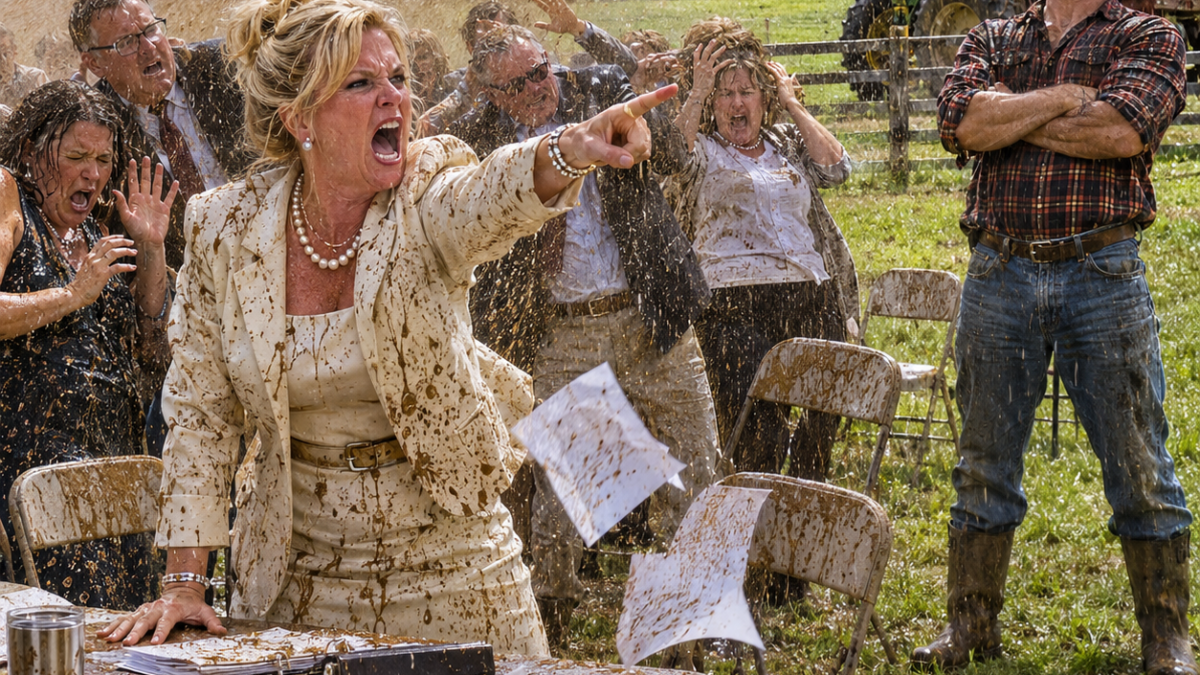
She stood directly in the center of the field, soaked from shoulders to shoes.
Her carefully styled hair had collapsed against her head.
Brown liquid streaked the front of her suit.
For several seconds, she looked incapable of understanding what had happened.
Then she saw me.
I had stepped outside the barn carrying my clipboard.
Her face transformed.
“You!”
Her scream carried almost as far as the sprinklers.
“You did this!”
I remained outside the active irrigation zone.
“This is my scheduled fertilizer application.”
“You ruined everything!”
Another sprinkler rotated.
Karen ducked too late.
The spray caught her across the back.
She shrieked.
“You monster!”
I looked toward the emptying tables.
“I warned the board not to hold this event here.”
“You knew we were coming!”
“Yes.”
“And you turned these on anyway!”
“Yes.”
She stared at me as if I had confessed to murder.
Then she fumbled for her phone.
“I am calling the police!”
“Good.”
That stopped her.
I held up the clipboard.
“I already spoke with them this morning.”
Her mouth opened.
Closed.
Opened again.
“What?”
“I notified the sheriff’s department of the application schedule.”
Her eyes widened.
“You planned this.”
“I planned to fertilize my pasture.”
“You planned to humiliate me.”
“I sent you a certified letter telling you not to bring people onto my property.”
Another wave of guests rushed past her.
Several were openly yelling at Karen now.
One woman held up the ruined hem of an expensive dress.
“You said this field belonged to the association!”
Karen spun.
“It does!”
“No, it doesn’t,” I said.
The woman looked at me.
Then at one of the NO TRESPASSING signs visible beside the tent.
Her expression changed.
“You knew?”
Karen pointed at me.
“He’s been harassing this community for a year!”
The woman looked at her wet dress.
Then at the pasture.
“Karen, you told us this was the gala lawn.”
“It is.”
“It belongs to him?”
Karen didn’t answer.
That was the problem with Karen.
She preferred declarations over answers.
A deputy arrived about fifteen minutes later.
By then, most of the guests had retreated to HOA common property.
The north pasture was almost empty except for abandoned chairs, overturned glasses, wet table linens, and Karen.
The sprinklers continued working.
Exactly as designed.
Deputy Miller parked near my driveway and approached me first.
“Evening.”
“Deputy.”
“You Jack Sterling?”
“Yes, sir.”
He glanced toward the pasture.
Then inhaled.
His face tightened.
“That’s… strong.”
“Fish emulsion and compost tea.”
“Right.”
I handed him the clipboard.
“Property plat. Deed. Right-to-farm ordinance. Irrigation schedule. And the dispatch record from this morning.”
He began reading.
Karen stomped toward us.
Her shoes squished audibly with every step.
“Officer!”
Deputy Miller looked up.
“Ma’am, give me one moment.”
“You need to arrest him.”
He looked back at the papers.
“For what?”
“Assault!”
I almost laughed.
Karen pointed at me.
“He deliberately sprayed hundreds of innocent people with sewage!”
“Organic fertilizer,” I said.
“Shut up!”
The deputy raised a hand.
“Ma’am.”
She turned.
“What?”
“Your name?”
“You know who I am.”
“I actually don’t.”
That seemed to offend her more than anything else.
“I am Karen Miller. President of the Willow Creek Estates Homeowners Association.”
“Okay, Ms. Miller.”
He glanced toward the field.
“This event was organized by you?”
“Yes.”
“On that property?”
“Yes.”
“Did Mr. Sterling authorize you to use his land?”
Her expression hardened.
“This is a complicated community-access issue.”
The deputy waited.
“Did he authorize you?”
Karen crossed her arms.
“The field is visually contiguous with our common space.”
“That isn’t what I asked.”
She stared at him.
He repeated the question.
“Did he give you permission?”
“No.”
The deputy nodded.
“And did you receive written notice telling you not to hold the event here?”
Karen looked at me.
I said nothing.
The deputy lifted the certified letter from my clipboard.
“This appears to have been delivered to the association.”
Karen’s face reddened.
“He has been unreasonable from the beginning.”
The deputy looked around.
A NO TRESPASSING sign stood perhaps twenty feet away.
Another farther down.
Another near the access path.
“You walked past those?”
Karen didn’t answer.
The deputy sighed.
“Ms. Miller, he’s operating a farm.”
“He lives next to a residential community.”
“Yes.”
“He can’t just do anything he wants.”
“No, ma’am. But he can conduct lawful agricultural activity on agricultural land he owns.”
“He sprayed people.”
“People who were on his farm without permission.”
“He knew we were there.”
“He told you not to be.”
Karen’s voice rose.
“This event cost thousands of dollars!”
Deputy Miller’s patience finally hardened.
“Then you should have held it somewhere you had permission to be.”
Karen fell silent.
He opened his citation book.
Her face changed immediately.
“What are you doing?”
“Citing you for trespass.”
“This is outrageous.”
“Possibly other issues will be reviewed later.”
“You can’t cite me. I’m the HOA president.”
That sentence hung there.
Deputy Miller slowly looked up.
Then back down at the ticket book.
“Ma’am, HOA president isn’t a law-enforcement exemption.”
For the first time that evening, somebody laughed openly.
George Albright.
He was standing across the street.
Hands in his pockets.
Grinning.
Karen glared at him.
George gave her a small wave.
Deputy Miller finished writing.
Karen took the citation with trembling fingers.
And that was the beginning of the end.
But to understand why almost no one came to Karen’s defense after the gala, you have to understand what she had done before that night.
The pasture wasn’t our first battle.
Not even close.
My farm had been in my family since 1928.
Twenty acres.
Good soil.
Old barn.
Irrigation pond.
Equipment shed.
Two small fields.
One larger north pasture.
My grandfather worked that land almost until he died.
When I was a boy, summers meant helping him repair fences and loading produce before sunrise.
He taught me to drive an old tractor before I was legally old enough to drive a car.
Then I left.
Army.
Twenty years as a combat engineer.
Different dirt.
Different machinery.
Different purpose.
After retirement, I inherited the farm.
Coming back felt like stepping into an old photograph.
The barn still smelled the same.
The oak desk in my grandfather’s office was still scratched in the same places.
His pipe rack still sat on the wall even though nobody had smoked in the room for years.
But the land around us had changed.
A developer had purchased roughly a hundred acres surrounding much of the farm.
Willow Creek Estates appeared.
Large houses.
Curving streets.
Decorative ponds.
Clubhouse.
Pool.
Walking paths.
The farm became an island.
At first, I didn’t mind.
Most neighbors were friendly.
Kids liked watching the tractors.
Parents bought vegetables from the roadside stand.
Some thought living beside an actual farm added charm.
I thought maybe we could coexist.
Then Karen discovered me.
Our first interaction was a letter.
My barn was apparently the wrong color.
I stood beside the mailbox reading the notice.
**UNAPPROVED OUTBUILDING.**
The barn had been built in the 1940s.
The HOA had been created decades later.
Yet Karen’s Architectural Review Committee objected to its faded red paint.
Approved colors apparently included:
Sandstone.
Warm taupe.
Natural linen.
Muted sage.
Not barn red.
I turned the paper over and wrote:
**My property is not and has never been part of Willow Creek Estates HOA.**
Then mailed it back.
Simple.
Accurate.
Mistake.
Two weeks later, Karen sent a certified letter.
This time she claimed any property “visually contiguous” with Willow Creek common areas could be subject to aesthetic controls.
I read that phrase three times.
Visually contiguous.
It was legal-sounding nonsense.
She threatened daily fines.
Then liens.
That’s when I stopped laughing.
I pulled the deed.
County plat.
Survey.
Development records.
The farm existed as a separate parcel.
No HOA covenant.
No annexation.
No membership.
No dues.
No jurisdiction.
I called Daniel Mercer.
We’d served together.
After the Army, he went to law school and worked primarily in real estate.
He read Karen’s letter.
Then called me.
“Jack.”
“Yeah?”
“Who wrote this?”
“HOA president.”
“Did an attorney review it?”
“I hope not.”
“This is garbage.”
“I know.”
“You want me to respond?”
“Yes.”
“How polite?”
“Professionally lethal.”
He laughed.
“My favorite.”
Daniel wrote a letter that made mine look friendly.
He attached the deed.
Survey.
Plat.
Relevant state law.
He stated that Willow Creek had zero authority over Sterling Farm.
Any attempt to record a fraudulent lien would trigger immediate litigation.
Board members could potentially face personal exposure if they knowingly participated.
I emailed copies to the entire board.
Then certified-mailed the packet.
The fines stopped.
The harassment didn’t.
Karen changed tactics.
First came the soccer-field incident.
I found children running across freshly seeded alfalfa.
I wasn’t angry at them.
They were kids.
I drove over and asked them to return to the HOA common area.
Two mothers apologized.
Then Karen arrived.
“Oh, don’t be ridiculous,” she said.
“It’s just grass.”
“It’s alfalfa.”
She rolled her eyes.
“This would make a wonderful recreational field.”
“It makes a wonderful agricultural field.”
“The children need open space.”
“Then use HOA property.”
Karen turned toward the mothers.
“See what I mean? He hoards twenty acres while our children have nowhere to play.”
One woman looked uncomfortable.
I kept my voice steady.
“This is working farmland. There are tractors, ditches, irrigation equipment, fertilizer, and agricultural treatments.”
Karen seized on one word.
“Treatments?”
“Yes.”
“What are you spraying near our children?”
That tone told me exactly where she was going.
“Everything I use is licensed and compliant.”
“Pesticides?”
“Mostly organic applications.”
“I think the health department might be interested.”
“Call them.”
She blinked.
I continued.
“I’m fully licensed.”
Then I looked at the mothers.
“Please keep the children off the field. I don’t want anyone injured.”
They nodded.
Karen didn’t.
The next morning I installed NO TRESPASSING signs every twenty feet along the development boundary.
That worked for casual trespassing.
It enraged Karen.
She began sending new violation notices.
Farm truck in driveway.
Tractor noise.
Equipment visibility.
Then my favorite:
**UNAPPROVED LANDSCAPING.**
The offending landscaping?
Rows of kale.
Spinach.
Tomatoes.
Karen suggested replacing them with boxwood shrubs.
I placed the letter beside a basket of vegetables.
Took a photograph.
Printed it.
Mailed it to her with four words.
**These are not ornamental.**
Daniel called when he heard.
“You’re enjoying this too much.”
“No.”
“Yes, you are.”
“Only slightly.”
“Careful.”
“I am.”
“No, Jack. People like her escalate when ridicule stops working.”
He was right.
I started documenting everything.
Binder.
Dates.
Photographs.
Certified-mail receipts.
Emails.
Notices.
Maps.
My responses.
Karen’s responses.
I wasn’t planning revenge.
I was building a record.
During that period, I noticed something else.
Karen bullied her own residents too.
Mr. Henderson, an elderly homeowner, had been ordered to remove a flagpole.
A family received a $200 fine over the color of a children’s slide.
Trash cans.
Grass length.
Christmas decorations.
Garden ornaments.
Mailboxes.
The rules themselves weren’t always unreasonable.
Karen’s use of them was.
Selective.
Punitive.
Personal.
At the hardware store one afternoon, an older man approached.
“You’re Sterling?”
“Depends.”
He smiled.
“George Albright.”
I recognized him from Willow Creek.
He extended a hand.
“I was a real-estate attorney for forty years.”
“That sounds dangerous.”
“Mostly boring.”
We shook.
He lowered his voice.
“Karen’s wrong.”
“About which issue?”
George laughed.
“That’s the problem.”
He told me residents were tired.
But afraid.
Karen knew the bylaws.
Controlled the board.
Controlled meeting agendas.
People feared fines.
He’d reviewed the HOA documents.
“There are recall provisions.”
I looked at him.
“Why hasn’t anyone used them?”
“Fear.”
“Of Karen?”
“Of becoming her next project.”
He handed me a card.
“If you ever want to move from defense to offense, call me.”
I kept the card.
A few weeks later, Karen escalated again.
I woke Saturday morning to hammering.
She and several residents were installing a large sign thirty feet inside my farm.
**FUTURE HOME OF THE WILLOW CREEK COMMUNITY GARDEN**
I stood on the porch drinking coffee.
Honestly, I almost admired the audacity.
Then I walked down.
“Morning.”
Karen smiled brightly.
“Good morning, Jack.”
“What are you doing?”
“Something positive.”
She gestured at my fallow plot.
“This neglected area will finally serve the community.”
The residents with her looked uneasy.
“Karen.”
“Yes?”
“You have sixty seconds to remove that sign and leave.”
Her smile vanished.
“This is why people dislike you.”
“Fifty-five seconds.”
She turned toward the others.
“See? Hostile.”
I pointed toward the barn camera.
“You’re currently trespassing. I’ve documented every person here.”
Someone behind Karen spoke.
“Wait. This is actually his parcel?”
“Yes.”
Karen snapped:
“Don’t be ridiculous.”
The man stepped backward.
“I thought this was common space.”
“It should be.”
I pulled out my phone.
“Forty seconds.”
The crowd dissolved quickly.
Nobody wanted a criminal trespass citation over tomatoes.
Karen remained.
“This isn’t over.”
“I know.”
“You’ve made a powerful enemy.”
I looked around my farm.
“No.”
She narrowed her eyes.
“You’ve made yourself a legal problem.”
She ripped the sign from the ground and dragged it away.
That evening, I called George.
“Tell me about the recall.”
We met at my grandfather’s dining table.
George reviewed my binder.
He smiled like a man reading a winning case.
“My God.”
“What?”
“This is beautiful.”
“It’s harassment.”
“Documented harassment.”
He tapped the certified receipts.
“Bullies hate documentation.”
To force a recall meeting, we needed twenty-five percent of homeowners.
Simple enough mathematically.
Hard socially.
People complained privately.
Signing publicly was different.
So we formed a small group.
Willow Creek Homeowners for Fair Governance.
George.
The Hendersons.
The Garcias.
Sarah Thompson, one of the mothers from the soccer incident.
Several others.
No screaming campaign.
We talked.
That was enough.
The stories accumulated.
A fine because garbage cans remained out two hours after collection.
A violation over holiday lights.
A threat regarding wind chimes.
Lawn measurements.
Basketball hoops.
Karen had made nearly everyone miserable at least once.
Our support grew.
Then I saw the gala announcement.
Third Annual Willow Creek Summer Solstice Gala.
Live music.
Catering.
Silent auction.
Community beautification fundraiser.
The promotional photograph showed sunset over green pasture.
My pasture.
The event map confirmed it.
Main tent:
Inside Sterling Farm.
Dining:
Inside Sterling Farm.
Stage:
Inside Sterling Farm.
They planned to park on HOA land.
Then walk guests across my boundary.
I called George.
“She scheduled the gala on my field.”
Silence.
Then:
“You’re joking.”
“No.”
“Does she have permission?”
“No.”
“Did she ask?”
“No.”
George laughed.
Not because it was funny.
Because it was unbelievable.
“What are you thinking?”
“Irrigation.”
He went silent again.
“What exactly does that mean?”
“The field is scheduled for organic feeding.”
“Jack.”
“Yes?”
“What are you putting through the system?”
“Fish emulsion.”
George started laughing.
“Compost tea.”
He laughed harder.
“Seaweed concentrate.”
I heard him put the phone down.
“George?”
He came back.
“I am attempting to behave like a responsible retired attorney.”
“You’re failing.”
“Spectacularly.”
Then his voice became serious.
“Document everything.”
“I will.”
“Warn them.”
“I will.”
“Explicitly.”
“Certified mail.”
“And don’t change the schedule just for the party.”
“I won’t.”
That mattered.
This couldn’t be a booby trap.
I wasn’t creating something dangerous.
I wasn’t altering machinery to hurt people.
I was performing normal agricultural work on my own field during a documented window.
Karen was choosing to put people there.
The certified warning went out a week before the gala.
No permission.
Private agricultural land.
No event authorization.
Any vendors or guests entering would be trespassing.
Plat enclosed.
Again.
The letter was delivered.
Signed.
Ignored.
I bought a drone.
Practiced using it.
Installed additional cameras.
Then on the gala morning, I called the sheriff’s office.
Non-emergency line.
“My name is Jack Sterling.”
“Yes, sir?”
“I own Sterling Farm, parcel number—”
I gave it.
“I’ll be doing an organic fertilizer application through the irrigation system tonight between seven and nine.”
“Any restricted chemical?”
“No. Organic fish emulsion, seaweed fertilizer, compost tea.”
“Any road impact?”
“No.”
“Neighbor notification required?”
“Not legally, but I’m notifying you because I anticipate a possible trespass dispute.”
The dispatcher paused.
“Want to explain?”
I did.
She sighed.
“I’ll note the call.”
“Thank you.”
At noon, vendors arrived.
My cameras caught everything.
Catering van.
Rental truck.
Tent crew.
Nobody contacted me.
One vendor looked directly at a NO TRESPASSING sign.
Then followed Karen’s instructions anyway.
I launched the drone.
Wide shot.
Clear property boundaries.
The tent was unmistakably on my parcel.
By late afternoon, decorations were complete.
I almost called the sheriff and stopped everything then.
Almost.
But George had made an important point.
Karen’s power survived because every fight happened privately.
She would tell residents one version.
Me another.
If I stopped the setup before guests arrived, she would simply say the angry farmer sabotaged a harmless event.
This time, everyone needed to understand what she had done.
So I waited.
Not for humiliation.
For witnesses.
At seven, the first guests arrived.
Most genuinely had no idea.
That’s important.
Karen had told them the field was being used under a community arrangement.
They believed her.
I didn’t blame them.
At 7:30, the pasture was crowded.
At 7:52, Karen gave her speech.
At 7:54, I activated irrigation.
Chaos.
Then the sheriff arrived.
And Karen received the trespass citation.
By midnight, videos were everywhere.
Someone had filmed Karen screaming while fertilizer dripped from her hair.
Another guest recorded Deputy Miller asking whether she had permission.
The answer:
No.
That clip spread through Willow Creek faster than any newsletter Karen had ever written.
The next morning, my phone rang at 6:12.
George.
“Have you seen the neighborhood forum?”
“No.”
“Don’t.”
“Why?”
“Because you’ll enjoy it too much.”
“What happened?”
“They’re calling it Manuregate.”
I groaned.
“That’s terrible.”
“Someone else suggested Gala of Gall.”
“Worse.”
“A teenager made a remix of Karen yelling ‘You monster’ over sprinkler noises.”
“George.”
“I’m reporting facts.”
“Anything useful?”
“Yes.”
His voice changed.
“People want the recall.”
That afternoon, a local blogger published an account.
He had attended the gala.
The article was funny.
But beneath the jokes, it documented something serious.
The HOA president had knowingly organized an expensive event on land she did not own.
She had ignored no-trespassing signs.
Ignored certified warnings.
Misled attendees.
Then blamed the landowner when ordinary agricultural activity resumed.
Local media picked it up.
I declined television interviews.
George handled questions better.
Karen gave one statement.
She claimed I had “weaponized agricultural equipment against innocent families.”
That lasted until reporters obtained my certified warning and the sheriff dispatch log.
Then the story changed.
People weren’t asking:
Why did Jack spray the party?
They were asking:
Why was the party on Jack’s farm?
Caterers sent damage claims.
Rental companies complained about ruined linens and equipment.
Some guests demanded refunds.
The HOA insurer investigated.
That produced another disaster for Karen.
The insurer learned the gala occurred on property the HOA did not own.
No written land-use agreement.
No permission.
Prior written warning.
Clear trespass signage.
The carrier questioned coverage.
Legal exposure multiplied.
Suddenly residents understood that Karen hadn’t merely embarrassed them.
She had risked their HOA money.
Dues.
Reserves.
Potential special assessments.
People became furious.
Our recall petition no longer needed persuasion.
We placed a table near the subdivision entrance on public property.
Within three hours, enough signatures.
By evening, we had far more than required.
The emergency meeting took place one week later.
Standing room only.
Karen sat at the front.
No pink suit.
Dark blazer.
Pale face.
She still tried.
“I have served this community faithfully for years.”
Nobody reacted.
“I have protected property values.”
A man shouted:
“You walked us onto private property!”
She ignored him.
“Mr. Sterling has conducted a campaign of hostility—”
Another resident:
“He sent you a letter!”
“He intentionally destroyed our event.”
Mrs. Thompson stood.
“No, Karen.”
Everyone turned.
Sarah Thompson was one of the mothers who had once allowed her children onto my pasture.
She looked nervous.
But kept speaking.
“You told us the field was basically community space.”
Karen shook her head.
“I said it was under dispute.”
“No.”
Sarah’s voice strengthened.
“You told us he was just refusing to share it.”
Karen tried to interrupt.
Sarah continued.
“You made us think he was some angry old farmer who hated children.”
The room fell quiet.
Sarah looked at me briefly.
Then back at Karen.
“He wasn’t.”
Karen stared.
“He warned us. You didn’t.”
George took the floor.
He carried copies of my documentation.
Not the whole binder.
Enough.
He began with the barn notice.
Read the date.
Then my response.
Then Karen’s certified letter.
Then Daniel’s legal warning.
He moved to the soccer incident.
The no-trespassing signs.
The farm vehicle violation.
Noise violation.
Vegetable landscaping notice.
Community garden attempt.
Then the gala.
Each step built the pattern.
Karen objected repeatedly.
George ignored her.
Finally he held up the certified gala warning.
“This was delivered seven days before the event.”
He looked at Karen.
“Did you show it to the residents buying tickets?”
Silence.
“Did you show it to vendors?”
Nothing.
“Did you show it to the board?”
A board member beside her suddenly looked at Karen.
“What letter?”
The room erupted.
That moment ended her.
The board hadn’t known.
Karen had concealed the warning.
She had committed the association to an unauthorized event while withholding the landowner’s explicit objection.
George let the room settle.
Then opened public comments.
Mr. Henderson stood first.
Flagpole.
Another family.
Playset.
Another.
Trash bins.
Another.
Grass.
Another.
Christmas decorations.
Dozens of stories.
Karen’s rule had seemed powerful because everyone thought everyone else accepted it.
Now they discovered almost everyone resented it.
The vote came.
Removal of Karen Miller as HOA president.
Nearly unanimous.
Karen sat motionless.
The secretary read the tally.
She did not argue.
Did not scream.
She picked up her purse.
Walked toward the door.
Stopped beside me.
For one second, I expected another insult.
Instead she said:
“You’re happy now.”
I looked at her.
“No.”
“You won.”
“That wasn’t the goal.”
“Don’t lie.”
“I wanted you to stay off my farm.”
Her eyes filled with anger.
Then exhaustion.
“You humiliated me.”
“You organized the gala.”
“You knew what would happen.”
“I knew I was fertilizing.”
She laughed bitterly.
“You’re proud of yourself.”
I thought about the ruined clothes.
The embarrassed guests.
The vendors.
The spectacle.
“No.”
That surprised her.
I continued.
“I wish you’d listened the first time.”
She stared at me.
Then walked out.
Two months later, her house went up for sale.
I didn’t celebrate.
George did enough celebrating for both of us.
He was elected HOA president despite repeatedly claiming retirement meant never attending meetings again.
His first official act was a resolution apologizing to me.
I attended the meeting.
He read it.
“Willow Creek Estates formally recognizes that Sterling Farm is independent private agricultural property and has never been subject to association jurisdiction.”
Applause.
I hated that.
Not the resolution.
The applause.
I stood.
“Thank you.”
George grinned.
“That’s all?”
“What else do you want?”
“Speech.”
“No.”
“War story?”
“No.”
“Sprinkler demonstration?”
The room laughed.
“Definitely no.”
The second major act was a bylaw review.
Ambiguous rules removed.
Enforcement procedures clarified.
Appeals improved.
Board authority restricted.
Financial transparency increased.
Then came the boundary.
George approached me one afternoon.
“We’d like to install a fence.”
I raised an eyebrow.
“On whose property?”
He laughed.
“HOA side.”
“Good answer.”
“Wood. Simple. Attractive.”
“Why?”
“Clear boundary.”
“We have survey markers.”
“And signs.”
“Yes.”
“Residents want something that feels less hostile.”
I thought about that.
The NO TRESPASSING signs had been necessary.
But they were ugly.
And they represented a period when I felt I needed to defend every foot of ground.
“What are you proposing?”
He showed me plans.
Wooden fence.
Set entirely on HOA property.
One pedestrian viewing area where children could safely watch farm work from the community side.
A small plaque.
**STERLING FARM — PRIVATE WORKING AGRICULTURAL PROPERTY. PLEASE ENJOY THE VIEW FROM THE COMMUNITY SIDE.**
I liked it.
The HOA paid.
When the fence went up, I removed most of my signs.
Not all.
It’s still a farm.
But the boundary no longer felt like a battlefield.
Children came to watch the tractor.
They stayed behind the fence.
Sometimes I stopped.
Let them see pumpkins.
Showed them irrigation equipment.
One boy asked:
“Is that the manure cannon?”
His mother nearly died of embarrassment.
I laughed.
“Sprinkler.”
“My dad says you blasted the mean lady.”
His mother covered her face.
“Ethan.”
“What?”
I crouched.
“It wasn’t manure.”
“What was it?”
“Organic fertilizer.”
He nodded solemnly.
“Manure.”
Close enough.
The farm returned to normal.
Spring planting.
Summer harvest.
Fall pumpkins.
Winter repairs.
Life organized around weather instead of HOA meetings.
That’s what I wanted.
One evening, nearly a year after the gala, Mrs. Thompson came by.
She stayed on the other side of the fence.
“Jack?”
I walked over.
“Everything okay?”
“Yes.”
She held a bag.
“My kids made something.”
Inside were cookies.
Poorly shaped tractors.
One looked more like a dinosaur.
“These are great.”
She laughed.
“They tried.”
Her expression became serious.
“I wanted to apologize.”
“You already did.”
“Not really.”
“You didn’t organize the gala.”
“No.”
She looked toward the pasture.
“But I believed Karen.”
“That wasn’t a crime.”
“I let my kids run on your field.”
“They survived.”
“I was rude to you.”
“Briefly.”
She smiled.
Then shook her head.
“What bothers me is how easy it was.”
“What?”
“To believe the story.”
I waited.
“She said you were selfish. Anti-community. Angry because development came near your land.”
“She said a lot.”
“We barely knew you.”
She looked embarrassed.
“And because she was president, we assumed she knew more.”
That mattered.
Authority creates credibility even when it shouldn’t.
“Now you know.”
“Yes.”
She looked toward the children standing farther back.
“They like living next to the farm.”
“I like having decent neighbors.”
“Even HOA neighbors?”
“Some.”
She laughed.
Then left.
Later that evening, I sat in my grandfather’s office.
The HOA binder remained on the shelf.
Thick.
Ugly.
Years of paper.
I considered throwing it away.
Didn’t.
Not because I wanted to remember Karen.
Because documentation mattered.
The farm had survived three generations because my grandfather kept records.
Seed purchases.
Equipment repairs.
Land deeds.
Water rights.
Taxes.
Contracts.
Not exciting.
But real life is held together by boring documents more often than dramatic speeches.
Karen loved paperwork because she thought it created authority.
I loved paperwork because it proved reality.
There’s a difference.
The neighborhood changed under George.
Meetings became shorter.
Not much shorter.
George was still a lawyer.
But people spoke.
Board minutes were published.
Residents challenged decisions without fear.
Fines became rare.
Warnings came first.
The HOA remained an HOA.
It didn’t disappear.
It simply stopped pretending the board owned people’s lives.
One afternoon, George drove onto my farm.
He had permission.
Important distinction.
He brought a folder.
“What’s this?”
“Insurance stuff.”
“I don’t want HOA insurance stuff.”
“You’ll like this.”
“No.”
He handed it over anyway.
The gala claims had finally resolved.
Some vendors were compensated under negotiated settlements.
Some claims fell outside coverage because of Karen’s unauthorized conduct.
The association had paid substantial costs.
Not catastrophic.
But painful.
George looked serious.
“People learned.”
“Expensive lesson.”
“Yes.”
“Special assessment?”
“No.”
“Good.”
“We cut some planned beautification spending.”
I smiled.
“No beige flowers?”
“Tragic.”
He looked toward the north pasture.
“You know what everyone calls that field now?”
“I don’t want to know.”
“Karen’s Splash Zone.”
“George.”
“Gala Gulch.”
“Stop.”
“The Fertilizer Ballroom.”
I walked away.
He followed laughing.
Six months later, Karen’s house sold.
A young family moved in.
They came to the farm stand their first weekend.
The husband looked familiar only because I’d seen the moving truck.
“Are you Jack?”
“Yes.”
He smiled.
“We bought the Miller house.”
“Welcome.”
His wife elbowed him.
“Don’t.”
“What?”
She looked embarrassed.
“He wants to ask about the sprinklers.”
I laughed.
The husband grinned.
“Legendary.”
“Mostly irrigation.”
“So it happened?”
“Yes.”
“Exactly like people say?”
“No.”
His face fell.
“Stories improve.”
I handed them tomatoes.
“Welcome to Willow Creek.”
They became good neighbors.
That’s another thing Karen taught me unintentionally.
People aren’t houses.
The person living in Karen’s old home didn’t inherit Karen’s mistakes.
I didn’t want the property turned into a permanent monument to resentment.
A house is just a house.
People deserve fresh starts.
So do neighborhoods.
The following summer, George suggested a community event.
I stared at him.
“No.”
He laughed.
“On HOA land.”
“Still no.”
“Barbecue.”
“No formal tents.”
“Correct.”
“No catered gala.”
“Correct.”
“No string quartet.”
“We can’t afford one after last year.”
“Good.”
I agreed to supply corn.
The event was simple.
Grills.
Folding chairs.
Children.
Music from somebody’s Bluetooth speaker.
Nobody wore formal clothes.
Nobody paid hundreds of dollars.
Nobody trespassed.
People walked to the farm fence and waved.
I brought crates of sweet corn over.
Legally.
Through the gate.
George stood near the grill.
“See?”
“What?”
“Community.”
I looked around.
He was right.
Karen had used that word constantly.
Community.
But she meant conformity.
Access.
Control.
If something existed beside the subdivision, she believed the subdivision deserved it.
My field.
My view.
My crops.
My barn.
Community isn’t taking what belongs to your neighbor because many people want it.
Community is respecting the boundary and still finding ways to live beside each other.
George understood that.
Eventually, so did everyone else.
Mr. Henderson got his flagpole back.
The new board approved it retroactively.
At the meeting, he stood.
“I don’t want permission.”
George frowned.
“What?”
“I want the fine refunded.”
People laughed.
George nodded.
“Fair.”
Refunded.
The Garcia family’s playset stayed.
Trash-can enforcement became reasonable.
Holiday decoration rules were simplified.
One resident proposed eliminating every covenant.
George rejected that.
“Rules aren’t the problem.”
He looked toward me.
“Abuse is.”
I agreed.
Even farms have rules.
Don’t leave gates open.
Don’t drive across planted rows.
Don’t enter fields during application windows.
Don’t touch machinery.
Boundaries make cooperation possible.
Karen never understood that.
To her, boundaries were insults.
That’s why my farm became her obsession.
My land sat directly beside her kingdom but outside her control.
She couldn’t tolerate that.
I often wondered whether the gala was really about the view.
Probably not.
It was about proving I couldn’t stop her.
The field was symbolic.
If she could bring two hundred people onto my property and I did nothing, she’d establish something more important than physical access.
Dominance.
That’s why the certified warning mattered.
That’s why the sheriff call mattered.
And that’s why, despite the ridiculousness of the fertilizer, the ending was never really about revenge.
I didn’t destroy her career.
I didn’t force residents to remove her.
I didn’t make her lie about the land.
I documented.
Warned.
Waited.
She made the decisions.
That’s what made the outcome satisfying.
One autumn afternoon, I was spreading compost in the north pasture when George appeared at the fence.
“Safe to come in?”
“Do you have permission?”
“I hate you.”
“Permission granted.”
He came through the gate.
We walked across the field.
The grass was thick.
Healthier than it had ever been.
“You know,” he said, “Karen actually accomplished one positive thing.”
“I’ve heard this argument before.”
“She united the neighborhood.”
“Against her.”
“Still united.”
He kicked the grass.
“And fertilized the pasture.”
“I fertilized the pasture.”
“With excellent media coverage.”
I laughed.
He became serious.
“You ever regret it?”
“The gala?”
“Yes.”
I thought carefully.
“I regret that innocent guests got caught in it.”
“You warned the organizer.”
“They didn’t know.”
“No.”
“That part bothers me.”
George nodded.
“But if you’d simply shut the party down?”
“She would’ve made herself the victim.”
“Probably.”
“She would’ve told everyone I ruined the gala.”
“She did anyway.”
“Yes.”
“But nobody believed her.”
I looked across the field.
“Because they saw the truth.”
We stood quietly.
Then George said:
“That’s why it worked.”
“What?”
“The whole ridiculous thing.”
He pointed toward the sprinkler heads.
“Everyone experienced the consequence of believing her.”
That was true.
Not pleasant.
But true.
Still, if I had to do it again, I might handle some pieces differently.
Age does that.
Turns victory into analysis.
You stop asking whether you won.
Start asking what it cost.
The residents paid some cost.
Embarrassment.
Ruined clothes.
Insurance expenses.
Lost event deposits.
But Willow Creek changed.
Not because people were sprayed.
Because they finally asked the question they’d avoided.
Why did we trust Karen more than the man who owned the land?
That question unlocked everything else.
Years passed.
My organic vegetable business grew.
The farm stand became popular.
Willow Creek residents were some of my best customers.
Children who once ran through my seedlings grew old enough to work summer shifts harvesting pumpkins.
One of them, Sarah Thompson’s oldest son, Jake, worked for me at sixteen.
First morning, I handed him gloves.
He looked toward the pasture.
“My mom says I’m not allowed near the sprinkler controls.”
“Smart woman.”
“Were you really in the Army?”
“Yes.”
“Combat engineer?”
“Yes.”
“Did you blow stuff up?”
“Sometimes.”
“Was the sprinkler thing better?”
I stared at him.
“Get to work.”
He grinned.
Teenagers.
At eighteen, Jake left for college.
Before going, he stopped by.
“Thanks.”
“For what?”
“Job.”
“You earned your pay.”
“Yeah, but…”
He looked toward Willow Creek.
“My mom says things used to be different here.”
“They were.”
“She says people were scared all the time.”
“Some were.”
“Hard to imagine.”
That might have been the best compliment the neighborhood could receive.
Hard to imagine.
A generation growing up without understanding why adults once feared HOA envelopes.
Good.
Let bad systems become difficult to imagine.
My grandfather’s barn remained red.
The paint faded.
I repainted it.
Red again.
No application.
No HOA review.
No problem.
One Saturday, George came by while I was painting.
“Wrong color.”
I handed him the brush.
“Fix it.”
He left.
Coward.
Eventually George stepped down as president.
Everyone begged him to stay.
He refused.
“I spent forty years practicing law. I’ve suffered enough.”
The new president was Sarah Thompson.
The same woman who once believed Karen when she called me selfish.
Life has a sense of humor.
Sarah was excellent.
Her first call to me as president:
“Jack?”
“Yes?”
“I need to ask something officially.”
“That sounds dangerous.”
“The kids want to organize a farm education day.”
“On HOA property?”
“Yes.”
“With a visit here?”
“If you agree.”
I smiled.
“See how easy that was?”
“What?”
“Asking.”
She laughed.
“Permission?”
“Granted.”
The farm education day became annual.
Children visited in small supervised groups.
I showed them irrigation.
Soil.
Composting.
Crop rotation.
Tractor safety.
And, inevitably, fertilizer.
Every year someone asked whether it was the same stuff from “the incident.”
I said yes.
The kids loved that.
Teachers hated it.
One year, a little girl raised her hand.
“Why did the lady have her party here if it wasn’t her farm?”
Good question.
I thought before answering.
“Because sometimes adults convince themselves wanting something gives them a right to it.”
She frowned.
“That doesn’t make sense.”
“No.”
“Did she know it wasn’t hers?”
“Yes.”
“Then why?”
Another good question.
“Because she thought no one would stop her.”
The girl nodded as if that explained everything.
Maybe it did.
My grandfather used to say land remembers how it’s treated.
Not literally.
He wasn’t mystical.
He meant soil records behavior.
Compact it.
You see it.
Overgraze it.
You see it.
Neglect drainage.
You see it.
Take care of it.
You see that too.
Communities remember the same way.
Willow Creek carried Karen’s habits for years after she left.
People apologized too much.
Asked permission unnecessarily.
Expected punishment.
Then slowly, healthier habits replaced them.
Conversations.
Transparency.
Respect.
The north pasture recovered fastest.
Grass doesn’t hold grudges.
Neither should people forever.
One spring morning, I opened the old HOA binder.
Dust along the top.
I flipped through.
Barn notice.
Lien threat.
Truck violation.
Tractor noise.
Vegetable landscaping.
Community garden photographs.
Gala warning.
Sheriff report.
Recall documents.
I reached the final page.
A photograph somebody had mailed me anonymously.
Karen during the gala.
Drenched.
Furious.
Finger pointed toward me.
For years, I kept that photograph because it represented victory.
That morning it looked different.
It looked sad.
Not because Karen deserved sympathy for the consequences.
Because power had reduced her to that.
A grown woman standing in a field screaming because someone else owned it.
I removed the photograph.
Tore it once.
Then again.
Dropped it in the trash.
Kept the documents.
Facts matter.
Humiliation doesn’t need preservation.
Sarah Thompson later told me Karen had written a letter to the HOA.
Years after moving away.
She didn’t show it to me.
I didn’t ask.
Apparently it contained an apology.
Not perfect.
But something.
Good.
People can change.
Consequences should teach when possible.
Punishment without learning is just waste.
I hope Karen learned.
I hope wherever she went, she stopped measuring lawns.
I hope she attends neighborhood meetings as a resident instead of a monarch.
I hope she learned one sentence.
**Not yours.**
Sometimes that’s enough.
The farm will probably outlive me.
That’s comforting.
My grandfather’s name is still on old documents.
Mine will eventually become another old name.
Someone else will paint the barn.
Repair irrigation.
Plant tomatoes.
Maybe they’ll keep the organic operation.
Maybe not.
But the boundary will remain.
Not because a fence is hostile.
Because good neighbors know where one person’s rights end and another’s begin.
Years after the gala, the north pasture looks almost exactly as it did before.
Better, actually.
Thick grass.
Healthy soil.
Sprinklers still rotate.
The same zone-four control still works.
Sometimes I stand in the barn when irrigation comes on.
**Chug—chug—chug.**
Brown fertilizer arcs across the evening light.
No screaming.
No tuxedos.
No pink pantsuits.
Just agriculture.
Exactly what the system was always meant for.
Occasionally a new neighbor asks about the story.
I keep it short.
“The old HOA president held a party here without permission.”
“What happened?”
“I fertilized.”
They usually think I’m joking.
George’s version is worse.
According to him, I filled the tank with twenty thousand gallons of pure manure and waited in the barn like a Bond villain.
False.
Mostly.
He also claims Karen slid fifty feet through mud.
Definitely false.
Stories grow.
I don’t mind.
The important facts survive.
The farm wasn’t HOA property.
Karen knew.
I warned her.
She ignored it.
The event proceeded.
The scheduled irrigation proceeded.
The sheriff confirmed my rights.
Residents removed her from power.
The HOA changed.
Everything after that is storytelling.
One evening, I sat on the porch watching sunset over the north pasture.
The sky was orange.
Exactly like gala night.
George had retired from HOA politics completely and moved a few streets over to a smaller home, but he still walked past sometimes.
That evening he stopped.
“Thinking about your finest hour?”
“No.”
“Manuregate?”
“Stop calling it that.”
“It’s historically accepted terminology.”
“By you.”
“That’s how history starts.”
I laughed.
He leaned against the fence.
“Know what I remember?”
“What?”
“Not the sprinklers.”
I looked at him.
“Then what?”
“The meeting.”
“Recall?”
“Yeah.”
“Why?”
“People standing up.”
I nodded.
He continued.
“That’s when it really ended.”
He was right.
Karen’s power didn’t disappear when the fertilizer hit her suit.
It disappeared when people stopped being afraid to speak.
The sprinklers only cracked the illusion.
The residents broke it.
That’s the part of the story I understand better now.
When one person controls a group through fear, everyone believes everyone else is obedient.
The moment people start comparing experiences, the illusion weakens.
George spoke.
Henderson spoke.
Sarah spoke.
The Garcias spoke.
Others followed.
The HOA didn’t become healthy because Karen left.
Karen left because the HOA became healthy enough to reject her.
There’s a difference.
George nodded toward the pasture.
“You turning those on tonight?”
“Eight.”
He checked his watch.
“I’m leaving.”
“Coward.”
“Experienced.”
He walked home.
At eight, the pump started.
Sprinklers rose.
Liquid fertilizer crossed the field.
The sun caught each arc.
For a moment, the spray looked almost golden.
I thought about Karen standing there years earlier.
“You ruined everything.”
She was wrong.
The gala was ruined.
Her authority was ruined.
But everything?
No.
The farm remained.
Willow Creek improved.
Neighbors learned respect.
Children learned where the boundary was.
The HOA became transparent.
The barn stayed red.
The vegetables stayed vegetables.
The pasture stayed agricultural land.
And people on both sides of the fence became something we’d never really been during Karen’s reign.
Neighbors.
That’s what made the ending satisfying.
Not seeing Karen soaked.
Not the citation.
Not the recall vote.
Not the newspaper jokes.
The wave.
That’s what I remember now.
I’ll be driving the tractor.
Someone from Willow Creek will walk past.
They stay on their side.
I stay on mine.
They lift a hand.
I lift mine.
No paperwork.
No argument.
No threat.
Just mutual respect.
It took us an absurd amount of conflict to learn something my grandfather would’ve explained in one sentence:
**Good fences don’t create bad neighbors. Bad neighbors are the ones who refuse to respect the fence.**
Karen held her gala on my farm because she believed authority meant she could erase boundaries.
She learned otherwise.
So did everyone else.
My twenty acres never became a soccer field.
Never became an HOA park.
Never became a community garden.
And never became the official Willow Creek event lawn.
It’s still a farm.
My farm.
And on warm summer evenings, when zone four starts watering the north pasture, the grass still gets exactly what it needs.
Fish emulsion.
Seaweed.
Compost tea.
All legal.
All organic.
Still smells terrible.
And every time the wind carries that familiar odor toward Willow Creek, somebody inevitably closes a window.
Then, usually, I hear laughter.
That’s how I know we’ve finally become a real community.
Karen invited nearly two hundred people onto my farm after I had warned her—in writing—that not one of them had permission to be there.
She stood beneath a white event tent, raised a glass of wine, and thanked the neighborhood for helping her “reclaim” the beautiful open space I supposedly refused to share.
What happened a few minutes later would destroy her gala, expose years of HOA bullying, and finally teach her that a working farm does not stop being private property just because someone in a pink pantsuit decides otherwise.
By six-thirty that evening, my north pasture looked like something out of a luxury wedding magazine.
White tents stood in neat rows across the grass. Linen-covered tables surrounded a temporary dance floor. String lights hung between poles driven directly into my soil. Caterers carried trays of appetizers between tables while a quartet tuned their instruments beside a decorative stack of hay bales somebody had brought in for “rustic atmosphere.”
The irony almost hurt.
They had brought fake farm decorations onto a real farm they were trespassing on.
I stood inside my barn watching everything through the live feed from a drone hovering several hundred feet above the field.
Every guest was inside my property line.
Every tent was inside my property line.
Every catering table.
Every chair.
Every decoration.
And they had all walked past signs that clearly read:
PRIVATE PROPERTY — NO TRESPASSING
Karen Miller didn’t care.
She moved through the crowd like a queen inspecting her court, wearing an expensive flowing pink pantsuit and directing vendors with sharp little gestures.
I’d dealt with her for almost a year by then.
She had tried to regulate the color of my barn even though my farm had existed decades before Willow Creek Estates.
She had threatened me with fines over my truck.
She had complained about tractor noise.
She had called rows of vegetables “unapproved landscaping.”
She had encouraged children to use my pasture as a soccer field because, in her words, twenty acres was “too much land for one person to keep to himself.”
At one point, she had even planted a large professionally printed sign thirty feet inside my property announcing:
FUTURE HOME OF THE WILLOW CREEK COMMUNITY GARDEN
I had given her sixty seconds to remove it.
She did.
But Karen never treated defeat as a reason to stop.
She treated it as an insult.
And every insult required escalation.
The Summer Solstice Gala was her biggest escalation yet.
A week earlier, I had sent a certified letter to Karen and every HOA board member.
The language was simple.
Sterling Farm was private agricultural land.
The HOA had no ownership interest in it.
No permission had been granted for the gala.
Any organizer, vendor, employee, or guest entering the property would be trespassing.
I attached my deed and a certified plat map.
The delivery receipt came back signed.
Karen knew.
That morning, I also called the sheriff’s non-emergency line.
I told dispatch that between seven and nine that evening, I would be conducting a scheduled organic fertilizer application through the irrigation system on my north pasture.
Nothing unusual.
I was a licensed farmer.
The mixture was legal.
The field needed feeding.
The only unusual part was that Karen had decided to host a formal dinner directly on top of it.
At 7:52 p.m., she stepped onto a small stage.
The guests turned toward her.
I watched on the drone monitor.
Karen tapped the microphone.
“Welcome, everyone!”
Applause rolled across my pasture.
“Isn’t this just the perfect setting?”
More applause.
She smiled.
“This is what community is all about. Taking beautiful spaces and creating something everyone can enjoy.”
My jaw tightened.
She raised her wine glass.
“To Willow Creek!”
That was enough.
I reached for the irrigation panel.
The heavy pump started with a deep mechanical rumble.
Pressure built through the underground lines.
Then I flipped the switch for zone four.
For several seconds, nothing happened.
Karen continued smiling.
Then the first agricultural sprinkler rose from the grass.
A second followed.
Then a third.
The nearest sprinkler rotated.
A broad brown arc of fish emulsion, liquid seaweed, and compost tea lifted into the golden evening sunlight.
It looked almost beautiful.
Until it landed directly across the front of Karen’s pink suit.
— END OF FACEBOOK OPENING / STOP HERE FOR PART 1 —
The first scream came from a woman standing near the dance floor.
Then another.
Within seconds, nearly two hundred people were trying to figure out why the elegant summer gala suddenly smelled like low tide mixed with a compost pile.
The sprinklers rotated steadily.
Chug. Chug. Chug.
Every few seconds another broad stream crossed the field.
A man in a white linen jacket abandoned his wine and ran.
Two women lifted their dresses and headed for the parking lot.
One of the violinists grabbed his instrument and sprinted without even putting it back in the case.
Karen remained frozen in the center of it all.
Her hair, which had been styled into a rigid helmet only minutes earlier, now hung flat against her head.
Brown fertilizer dripped from her jacket.
Then she saw me standing near the barn.
“You!”
I stayed outside the spray zone.
“You did this!”
“It’s my scheduled fertilizer application.”
“You ruined everything!”
Another sprinkler turned.
Karen ducked.
Too late.
The spray caught her across the shoulders.
“You monster!”
I held up my clipboard.
“I warned the HOA not to hold this event here.”
“You knew we were coming!”
“Yes.”
“And you turned these on anyway?”
“Yes.”
She fumbled for her phone.
“I am calling the police!”
“Good.”
She stopped.
I showed her the timestamped dispatch record.
“I already spoke to them this morning.”
Her face changed.
“What?”
“I notified the sheriff’s department about the fertilizer application.”
“You planned this.”
“I planned to fertilize my field.”
“You planned to humiliate me!”
“No, Karen. I planned to use my farm.”
Behind her, a woman in a ruined cream dress shouted:
“Karen, you said the HOA had permission!”
Karen spun around.
“We do!”
The woman pointed toward the NO TRESPASSING signs.
“Then why are those there?”
Karen didn’t answer.
That silence did more damage than anything I could have said.
The sheriff’s deputy arrived about fifteen minutes later.
By then, most guests had retreated onto HOA property.
Deputy Miller stepped from his cruiser, took one breath, and visibly regretted it.
“That smell normal?”
“Fish emulsion and compost tea.”
He nodded slowly.
“Strong stuff.”
“Good for the soil.”
I handed him my paperwork.
Deed.
Plat.
Agricultural zoning records.
Right-to-farm ordinance.
Certified letter.
Dispatch notification.
He began reading.
Karen stomped toward us.
Her shoes squished with every step.
“Officer, arrest him!”
Deputy Miller looked up.
“For what?”
“Assault!”
I said nothing.
Karen pointed at the field.
“He deliberately sprayed my guests with sewage!”
“Organic fertilizer,” I corrected.
“Shut up!”
Deputy Miller raised one hand.
“Ma’am.”
She turned toward him.
“What?”
“Your name?”
Karen stared as if he’d insulted her.
“I am Karen Miller, president of Willow Creek Estates.”
“Okay.”
His lack of reaction irritated her.
“This was our annual charity gala.”
He looked at the field.
“On his property?”
Karen folded her arms.
“It is adjacent to our community grounds.”
“That isn’t what I asked.”
She tightened her jaw.
Deputy Miller pointed toward my plat.
“Did Mr. Sterling give the HOA permission to use this property?”
Karen said nothing.
“Ma’am?”
“No.”
The deputy nodded.
“Did you receive notice telling you not to enter?”
“This is complicated.”
“It isn’t.”
He held up the certified letter.
“This was delivered to your HOA.”
Karen glared at me.
“He has been hostile from the beginning.”
Deputy Miller looked toward a no-trespassing sign ten feet away.
“Did you and your guests walk past signs like that?”
Karen’s face turned red.
“He cannot treat an entire community this way!”
Deputy Miller’s voice became firmer.
“Ms. Miller, he’s operating a farm on land he owns. He notified our office this morning that he would be applying fertilizer. You organized an event on that land without permission.”
“He knew we were there!”
“He specifically told you not to be.”
That was the first moment Karen seemed to understand that the badge in front of her was not impressed by the letters HOA.
Deputy Miller pulled out his citation book.
Her eyes widened.
“What are you doing?”
“Citing you for trespass.”
“You can’t cite me.”
He paused.
“Why not?”
“I’m the HOA president.”
George Albright was standing nearby.
He laughed so loudly I heard him from across the road.
Deputy Miller looked back down at the ticket book.
“Ma’am, HOA president is not an exemption under property law.”
He finished writing.
Karen accepted the citation with a trembling hand.
The woman who had spent nearly a year sending me violation notices had finally received one of her own.
And unlike hers, this one actually had legal authority behind it.
The next morning, Willow Creek exploded.
Someone had recorded Karen screaming while fertilizer dripped from her hair.
Another guest recorded Deputy Miller asking whether she had permission.
The clip ended with Karen saying:
“No.”
That single word spread through the neighborhood faster than any rumor.
By breakfast, residents were asking why they’d been told the pasture belonged to the community.
By lunch, vendors were demanding reimbursement.
By dinner, the HOA’s insurance carrier had started asking questions.
And Karen’s biggest problem wasn’t the ruined gala.
It was the paper trail.
That had always been her weakness.
She loved documents when she thought they gave her power.
She hated them when they proved she didn’t have any.
My farm had been in my family since 1928.
Twenty acres of dark, productive soil.
My grandfather worked it most of his life.
When I was a boy, I spent summers repairing fences and loading vegetables before sunrise.
Then I left for the Army.
Twenty years as a combat engineer taught me to appreciate maps, boundaries, documentation, and preparation.
When I came home and inherited the farm, I wanted nothing more complicated than crops, tractors, and quiet evenings.
Willow Creek Estates had other plans.
The development surrounded much of the farm.
At first, the residents were friendly.
Then Karen sent me a notice claiming my old red barn violated HOA color rules.
I responded that my land wasn’t part of the HOA.
She answered by claiming any property “visually contiguous” with Willow Creek could be forced to follow aesthetic standards.
My attorney called that sentence “beautifully constructed nonsense.”
We sent Karen my deed.
Survey.
Plat.
State law.
A warning that any attempt to place a lien on my property would be fraudulent.
The fines stopped.
Karen simply found new ways to harass me.
When children ran through freshly planted alfalfa, I politely asked them to leave.
Karen accused me of hoarding land that should be used as a soccer field.
When I explained that it was active farmland, she threatened to call the health department over agricultural treatments.
So I installed private-property signs.
She responded with more notices.
My farm truck.
Tractor noise.
Vegetables.
She actually suggested I replace kale and tomatoes with boxwoods because they were more aesthetically appropriate.
That was when George Albright approached me at the hardware store.
He had spent forty years practicing real-estate law.
“Karen’s breaking half her own rules,” he told me.
“Then why doesn’t anyone stop her?”
“Fear.”
He explained that residents complained privately but rarely challenged her publicly.
She knew the covenants.
Controlled meetings.
Controlled the board.
Nobody wanted to become her next target.
Then Karen entered my farm one Saturday and installed a sign declaring part of it the future Willow Creek community garden.
I ordered everyone off.
Most residents left immediately when they realized the field was actually mine.
Karen stayed until I started dialing the sheriff.
Before leaving, she told me:
“You’ve made a powerful enemy.”
That night I called George.
“Let’s talk about the recall.”
We began quietly organizing.
Mr. Henderson had been fined over a flagpole.
The Garcias over a children’s playset.
Other residents had stories about garbage cans, grass height, decorations, garden hoses, basketball hoops, and wind chimes.
Karen’s power depended on everybody believing their own problem was isolated.
The moment people compared stories, the pattern became impossible to ignore.
Then came the gala announcement.
The promotional map showed my north pasture as the official venue.
I stared at it for almost a minute before calling George.
“She put the gala on my field.”
“Did she ask?”
“No.”
“Of course she didn’t.”
I told him about my irrigation schedule.
When I explained what was in the tank, he became quiet.
Then started laughing.
“George.”
“I apologize.”
“Very professional.”
“I practiced law for forty years. I’ve earned this.”
But then he became serious.
“You warn her first.”
“I will.”
“In writing.”
“Certified.”
“And you notify law enforcement before the application.”
“Already planning to.”
He nodded.
“Then let her decide.”
That was exactly what happened.
Karen received every warning.
She chose the field anyway.
Now the insurance company wanted to know why.
Their lawyers discovered there had been no land-use agreement.
No permission.
No easement.
No emergency.
No misunderstanding.
There was simply a president who had decided that because she wanted access to my property, the HOA deserved it.
The carrier questioned whether claims related to the event would be covered at all.
That terrified residents.
Suddenly the gala wasn’t funny.
Their HOA could face vendor claims, guest claims, refund demands, and legal expenses because one woman refused to respect a property line.
George called me.
“Recall petition is ready.”
“You think people will sign?”
“They’re asking where the table is.”
We set up on public property near the subdivision entrance.
The bylaws required twenty-five percent of homeowners to force a special recall meeting.
We reached that number in less than three hours.
By the end of the day, support was overwhelming.
The emergency meeting was held the following week.
Karen stood at the front.
She looked smaller.
Not physically.
The authority was gone.
She tried anyway.
“Mr. Sterling has conducted a campaign of hostility against this community.”
Someone shouted:
“He owns the field!”
Karen continued.
“He intentionally destroyed a charity event.”
Another resident yelled:
“You told us we had permission!”
Her voice became sharper.
“I acted in the best interests of Willow Creek.”
Sarah Thompson stood.
She was one of the mothers from the first soccer incident.
“No, Karen.”
The room quieted.
“You told us Jack was selfish.”
Karen stared.
“You said he was hoarding open space.”
“That farm impacts everyone’s quality of life.”
Sarah shook her head.
“He told us the truth. You didn’t.”
Karen tried to interrupt.
Sarah kept going.
“You made us think the field was basically part of the neighborhood. It wasn’t.”
George took the microphone next.
He laid out the timeline.
Barn violation.
Legal response.
Trespassing incidents.
Farm notices.
Community garden attempt.
Finally, the gala warning.
He held up the certified receipt.
“This letter was delivered one week before the event.”
Then he looked at the board.
“Did every director receive it?”
One board member frowned.
“What letter?”
The room erupted.
George waited for silence.
“You didn’t know?”
The director shook his head.
Karen looked trapped.
George turned toward her.
“Did you withhold Mr. Sterling’s warning from your own board?”
Karen refused to answer.
That refusal ended her presidency more effectively than any speech.
Then residents began telling their stories.
Mr. Henderson.
The flagpole.
The Garcias.
The playset.
Another homeowner fined because a trash can was visible for two hours.
Another threatened over Christmas decorations.
Another over a basketball hoop.
Another over wind chimes.
Years of anger came out in twenty minutes.
The recall vote was nearly unanimous.
Karen sat completely still when the result was announced.
No screaming.
No threats.
She picked up her purse.
As she passed me, she stopped.
“You’re happy now.”
“No.”
“You won.”
“I wanted you to stay off my farm.”
“You humiliated me.”
“You organized the gala.”
She stared at me.
“You knew exactly what would happen.”
“I knew exactly what was scheduled to happen to my field.”
Her eyes filled with anger.
Then something closer to exhaustion.
She walked out.
I never saw her at another board meeting.
Two months later, a FOR SALE sign appeared outside her house.
George became the new HOA president.
His first official act was to pass a resolution acknowledging that Sterling Farm was independent private agricultural property and had never been subject to HOA authority.
His second was to review the rules Karen had weaponized.
Vague provisions disappeared.
Appeals became more transparent.
Fines required clearer justification.
Board records became easier for residents to inspect.
The culture changed quickly.
People stopped whispering about the HOA.
They started attending meetings.
They asked questions.
Nobody was punished for disagreeing.
Then George called me.
“We want to build a fence.”
I laughed.
“On whose land?”
“HOA land.”
“Good.”
He showed me the design.
A sturdy wooden boundary fence.
Simple.
Respectful.
A small viewing area where children could watch farm equipment from the safe side.
Beside the main path, the HOA installed a plaque:
STERLING FARM — PRIVATE WORKING AGRICULTURAL PROPERTY. PLEASE ENJOY THE VIEW FROM THE COMMUNITY SIDE.
I removed most of my NO TRESPASSING signs.
The boundary was still clear.
It just no longer looked like a battlefield.
A year later, the neighborhood held a barbecue.
On HOA land.
George made a point of telling me that three times.
I supplied sweet corn.
Children played.
Parents talked.
Nobody crossed the fence without asking.
At one point, a little boy pointed toward the north pasture.
“Is that where you sprayed the mean lady?”
His mother turned red.
“Ethan!”
I laughed.
“It’s where I irrigate.”
“With manure?”
“Organic fertilizer.”
He nodded solemnly.
“Manure.”
Close enough.
Years later, people still tell exaggerated versions of what happened.
According to George, I waited in the barn like a movie villain while twenty thousand gallons of manure rained from the sky.
Not true.
Mostly.
The reality was simpler.
Karen held an event on land she didn’t own.
I warned her.
She ignored me.
I continued farming.
The sheriff confirmed that property lines mattered more than HOA titles.
And residents finally stopped being afraid.
That was the real victory.
Not Karen dripping fertilizer.
Not the citation.
Not the viral videos.
The real victory came afterward.
Mr. Henderson got his flagpole back.
The Garcias kept their playset.
Kids left bicycles outside without their parents panicking.
Board meetings became boring.
My barn stayed red.
My vegetables stayed vegetables.
My field stayed a field.
And Willow Creek became a neighborhood instead of Karen’s private kingdom.
Sometimes, when I’m on the tractor, people walk along the path beside the new fence.
They don’t cross.
They wave.
I wave back.
That’s all I wanted from the beginning.
Respect.
Not fear.
Not victory.
Not control.
One evening, George stopped beside the pasture while I was checking irrigation equipment.
“You know Karen did one good thing.”
I stared at him.
“This should be interesting.”
“She got everybody talking.”
“Against her.”
“Still counts.”
I thought about it.
He was right.
Before Karen came after my farm, I barely knew anyone inside Willow Creek.
They were houses beyond my fence.
I was the farmer beyond theirs.
Her abuse gave us a reason to compare stories.
Stories became evidence.
Evidence became courage.
Courage became action.
I looked across the pasture.
The grass was thick and green.
The same sprinklers still rose every evening during feeding periods.
“Turning those on tonight?” George asked.
“Eight o’clock.”
He checked his watch.
“I’m leaving.”
“Coward.”
“Experienced.”
He walked away laughing.
At eight, the pump started.
The sprinkler heads rose.
A broad arc of organic fertilizer crossed the field.
No tents.
No screaming.
No ruined pink suit.
Just farming.
The sun caught the spray and turned it gold for a few seconds.
I thought about Karen telling me I had ruined everything.
She was wrong.
Her gala was ruined.
Her authority ended.
But everything else survived.
The farm survived.
The neighborhood improved.
The neighbors learned to respect the boundary.
The HOA learned the limits of its power.
And people on both sides of that fence finally learned how to live beside one another.
My twenty acres never became a soccer field.
They never became an HOA park.
They never became a community garden.
And they never became Willow Creek’s private event venue.
They’re still Sterling Farm.
My grandfather’s land.
My responsibility.
And every summer evening, when zone four starts feeding the north pasture, the grass gets exactly what it needs.
Fish emulsion.
Seaweed.
Compost tea.
All organic.
All legal.
And still unbelievably foul-smelling.
Sometimes the wind carries that smell toward Willow Creek.
Windows close.
Someone usually laughs.
And I smile.
Because the field is still mine.
The neighborhood is finally peaceful.
And nobody needs a clipboard to understand where the boundary is anymore.








