PART 2: HOA KAREN Hit Me With 60 Violations—Then the Judge Asked One Question and She Went Pale
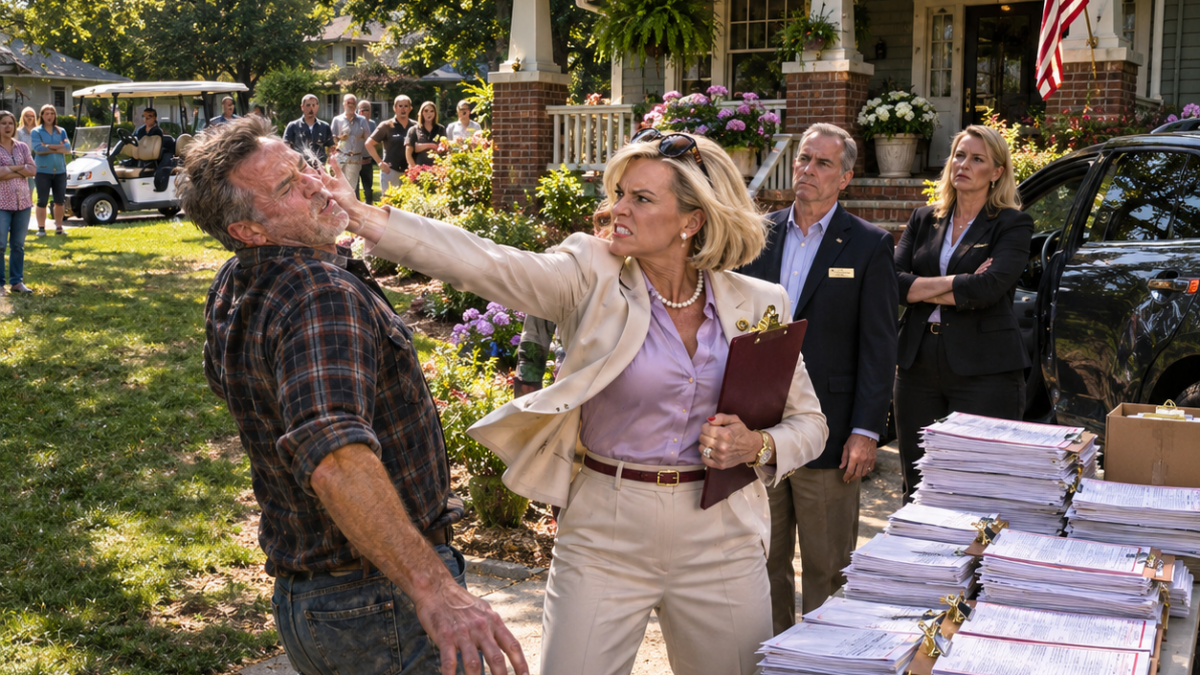
PART 2
The second envelope arrived five days later.
Garden hose visible from the street.
The third came after that.
Holiday wreath displayed beyond the approved seasonal period.
Then a parking notice because the rear bumper of my truck sat six inches farther toward the sidewalk than Colleen believed appropriate.
Every letter looked reasonable at first glance.
That was what made them effective.
No profanity.
No screaming.
No handwritten threats.
Professional letterhead.
Section numbers.
Polite phrases.
**Friendly reminder.**
**For the benefit of all residents.**
**In the interest of preserving community character.**
I came to hate the phrase community character.
It could mean almost anything depending on who was holding the clipboard.
For the first couple months, I complied.
Not because Colleen intimidated me.
Because I had spent my career around specifications.
If a rule existed, I generally followed it.
Move the hose?
Fine.
Wreath?
Take it down.
Truck six inches too far forward?
I moved it back.
Then I started noticing something.
Nobody else seemed to live under the same microscope.
The Hendersons left garbage cans beside their garage for days.
No letter.
A basketball hoop three houses down leaned over the sidewalk.
No letter.
Colleen’s own side gate had peeling paint.
No letter.
But if my garden hose remained visible until eight in the morning, I got an envelope.
I began answering everything in writing.
Notice twelve concerned my trash cans.
My collection had been delayed.
The cans remained visible for eleven minutes beyond the period Colleen cited.
I responded:
**The containers were returned to the garage at 7:02 a.m. Please see timestamped photograph attached.**
Notice fourteen involved the wreath.
I quoted the governing document back to her.
It referred to seasonal decorations.
It did not define an exact removal date for the wreath I had displayed.
Notice seventeen said my lawn exceeded four inches.
I measured six locations.
Photographed each.
Three and a half inches at the tallest point.
I did not write angry replies.
I didn’t call her names.
I created a manila folder.
**HOA CORRESPONDENCE.**
Then I kept filling it.
My daughter Brianna called one evening.
She lived in Charlotte and worked in commercial real estate law.
She had inherited Nadine’s ability to hear what I wasn’t saying.
“You sound tired.”
“I’m fine.”
“Dad.”
“It’s nuisance paperwork.”
“How much?”
“Twenty-three violations.”
Silence.
“In how long?”
“Four months.”
“Twenty-three?”
“Some are repeats.”
“That’s not better.”
I leaned back in my office chair.
“Nadine would tell me not to let it get under my skin.”
“Mom would have brought that woman a casserole and interrogated her over dessert.”
That made me laugh.
Then Brianna said:
“Are other people being cited at the same rate?”
“I don’t know.”
“Find out.”
That was the first time somebody pushed me away from defending individual notices and toward looking at the pattern.
Before I did, Colleen changed tactics.
The neighborhood cookout happened on the third Saturday in June.
I did not know about it.
Every house on Ridgecrest Lane received a flyer.
Mine didn’t.
I found out because I smelled charcoal.
I was sitting on the porch eating leftover meatloaf when laughter drifted from the common green.
I walked to the sidewalk.
Tables.
Coolers.
Children.
Music.
Neighbors I waved to every week.
No invitation.
I almost went anyway.
Then I saw Colleen.
Red plastic cup.
Center of a small group.
Her voice carried just far enough.
“I’m sure he’s perfectly nice.”
Pause.
“But some people just aren’t used to this kind of community.”
She didn’t say my name.
Didn’t need to.
Garrett Price stood twelve feet away.
Retired electrician.
Sixty-one.
My next-door neighbor.
Closest thing I had to a friend in Briarcliff.
He looked down at his baked beans.
Then pretended to check his phone.
I went home.
That part hurt more than I expected.
I’m a Black man who had spent decades working on job sites, military installations, government projects, and private developments.
I knew the difference between ordinary rudeness and language designed to say something without saying it.
**Some people aren’t used to this kind of community.**
Colleen always left herself room to deny what everyone understood.
That night, I sat beneath the magnolia.
Leaves moved under the porch light.
“Nadine,” I said quietly, “you would have hated this woman.”
Then I corrected myself.
“No. You would’ve invited her to coffee.”
I went inside.
Opened the folder.
Added a new page.
**June 19 — community cookout. No invitation delivered to my property. Heard C. Whitfield make remarks concerning “some people” and “this kind of community.” Witnesses present.**
No conclusion.
Just facts.
The next morning I wrote the HOA board.
Formal request for a meeting.
Selective enforcement.
Harassment concerns.
Pattern of disproportionate citations.
I sent it through the association’s normal channel.
That was my mistake.
The letter never reached the full board.
I didn’t know that.
Garrett Price did.
Several days later, he had been loading groceries into his truck outside Food Lion.
He saw Dawn Prescott, the HOA secretary, hand an envelope to Colleen.
Colleen opened it.
Read it.
Folded it.
Dropped it into her purse.
No board meeting followed.
No acknowledgment.
Nothing.
Garrett didn’t tell me.
Not yet.
Colleen created the Briarcliff Beautification Committee instead.
Three retirees.
Matching visors.
Shared reporting sheet.
Their stated purpose was neighborhood appearance.
In practice, they became Colleen’s eyes.
A flowerpot six inches from where she preferred it.
Report.
A newspaper visible near my porch step.
Report.
My workshop door open on a Saturday.
Report.
Ninety percent of the complaints they generated seemed to land at my house.
The other ten percent went to enough neighbors to make the process look normal.
Then came Facebook.
Colleen posted:
**COMMUNITY STANDARDS UPDATE**
She wrote about certain residents accumulating repeated violations.
People who refused to respect the rules.
Residents whose behavior threatened “the character of our community.”
Forty-two likes.
Clapping emojis.
Not one comment asking who she meant or why the violations existed.
Brianna called.
“You saw the post?”
“Yes.”
“Screenshot?”
“Yes.”
“Good.”
“You sound like a lawyer.”
“I am a lawyer.”
“Unfortunately.”
“Dad.”
“What?”
“Stop laughing this off.”
I went quiet.
She continued.
“I know you hate making things bigger than they are.”
“Usually a good quality.”
“Not if someone is counting on it.”
That stayed with me.
Then Caldwell County Code Enforcement arrived.
White truck.
Inspector carrying a clipboard.
“Mr. Vance?”
“Yes.”
“We received a complaint that you’re operating an unlicensed commercial surveying business from a residential property.”
I almost admired the creativity.
“My consulting practice?”
“Yes.”
“Come in.”
I gave him coffee.
Then my valid home-occupation documentation.
Business registration.
Permit.
Everything current.
He reviewed it.
Looked almost relieved.
“Everything appears in order.”
“Can you tell me who filed the complaint?”
He hesitated.
“It’s in the record.”
I requested it later.
Colleen Whitfield.
Of course.
The inspector left.
The case closed.
But the damage wasn’t entirely administrative.
The woman across the road had watched from behind her curtain.
A delivery driver later asked whether everything was okay in the neighborhood.
Small things.
That was Colleen’s real talent.
She could make suspicion hang in the air without ever needing a formal finding.
I stopped sleeping properly.
Not dramatic insomnia.
Worse.
Quiet insomnia.
Two in the morning.
Eyes open.
Listening.
Thinking about the mailbox.
Wondering whether another envelope waited.
Checking the security light.
Checking the front window.
At my next physical, my blood pressure had climbed.
Doctor said:
“Reduce stress.”
I laughed.
He didn’t.
I went home.
Opened the HOA folder.
Then remembered Brianna’s question.
Were other residents being cited like this?
I formally requested the enforcement history I was entitled to inspect through the association’s records process.
Colleen delayed.
Then sent incomplete material.
I asked again.
Eventually, I got enough.
I built a spreadsheet.
Homeowner.
Address.
Violation type.
Date.
Fine.
Repeat notice.
I color-coded it.
Old habit.
Patterns become easier to see when numbers stop pretending to be stories.
The result was ugly.
I had received roughly four times as many violations as the next-highest household.
That family had built an unapproved deck.
I had left out a hose.
The difference was so extreme I checked the data twice.
Then I checked Colleen.
County GIS.
Her parcel.
A storage shed sat behind her house.
I compared it against the architectural records available to me.
No approval.
Then county permit records.
Nothing obvious there either.
I called Brianna.
“I found something.”
“What?”
“Colleen’s shed.”
“Dad.”
“What?”
“Do not march over there.”
“I wasn’t going to.”
“You were absolutely thinking about it.”
“I was thinking about asking whether community character applied to storage buildings.”
“Don’t.”
So I didn’t.
I filed a code complaint.
Polite.
By the book.
Nothing more.
The county notice reached Colleen Friday.
Saturday morning, she came to my house.
No clipboard.
No linen blazer.
No smile.
I was drinking coffee.
She walked onto my lawn.
“You filed a complaint against me.”
“Yes.”
“You had no right.”
“It’s the same county process you used against me.”
“That is completely different.”
“How?”
“I am the president of this association.”
I waited.
She stepped closer.
“I protect this neighborhood.”
I still said nothing.
“You are a troublemaker. You have been since you came here.”
“I’ve owned this house five years.”
“Exactly.”
She was angry enough not to hear herself anymore.
“Every year this street changes. People come in and think they can do whatever they want.”
“What people?”
“Don’t.”
“Don’t what?”
“Twist my words.”
“I asked a question.”
She pointed at me.
“This used to be a safe neighborhood.”
The Hendersons were washing their car across the road.
The hose stopped moving.
I looked at Colleen.
“Before what?”
Her mouth opened.
Closed.
For three seconds, nobody moved.
Then she said:
“You know exactly what I mean.”
“No, ma’am.”
My voice stayed calm.
“I’d like you to say it.”
She stepped closer.
“I don’t have to explain myself to you.”
“You’re standing on my property.”
That stopped her.
She looked down.
Then back at me.
“I will call the police.”
“For what?”
“You are harassing me.”
“You came to my house.”
Her jaw tightened.
Then she turned.
Heels punching into the grass.
Walked away.
I thought that might finally be the moment somebody else spoke up.
Garrett Price crossed the road.
I waited.
He rubbed the back of his neck.
“You know, Sterling…”
“What?”
“Might be easier to just go along.”
I stared at him.
“Go along with what?”
“Whatever she wants.”
“Why?”
“She’s connected.”
I don’t know why that hurt more than Colleen.
Maybe because I expected nothing from her.
Garrett was supposed to be my friend.
“I see.”
“I’m not saying she’s right.”
“No.”
“Just saying… you live here too.”
“So does she.”
He looked down.
Then walked back across the road.
I went inside.
Closed the door.
Sat at my kitchen table.
For the first time in that entire year, my eyes filled.
Not because I was afraid of fines.
Because I was tired of being asked to make myself smaller so somebody else could remain comfortable.
I picked up Nadine’s photograph.
Savannah.
Anniversary trip.
She was sitting beside the river laughing because a bird had tried to steal part of her sandwich.
I held the frame.
“She almost said it.”
My voice cracked.
“She almost said people like me.”
I called Brianna.
She listened.
Then said:
“Dad.”
“Yeah?”
“I want you to get a full boundary review.”
I almost laughed.
“Baby, I am a surveyor.”
“Then act like one.”
That quieted me.
“Pull the original Briarcliff plat.”
“I’ve seen it.”
“Pull it again.”
“Why?”
“Because you’ve spent a year treating the HOA’s authority as a fact.”
I said nothing.
Brianna continued.
“What if it isn’t?”
The question sounded absurd.
Then suddenly it didn’t.
That week I requested mediation.
I wanted a record showing I had tried to resolve things before litigation.
The board declined.
Three to two.
Colleen and Dawn opposed it.
Another member later said they were told mediation would “reward noncompliance.”
Fine.
I had tried.
That night, I opened my filing cabinet.
Deed.
Closing package.
Title policy.
Old survey.
I spread everything across the dining table.
The kitchen light hummed.
Rain tapped softly against the windows.
Nadine had chosen that light fixture.
Hated fluorescent bulbs.
Said they made everybody look guilty.
I started with the deed.
Metes and bounds.
Bearings.
Distances.
My legal description traced the 1.2-acre property without referencing a Briarcliff lot number.
That wasn’t necessarily unusual for an older parcel.
I pulled the subdivision plat.
1998.
Briarcliff Estates.
Old tobacco acreage divided into 120 numbered lots.
I followed Ridgecrest Lane.
Lot 117.
118.
119.
120.
Then my corner parcel.
No number.
I leaned closer.
**PARCEL 0-A — EXISTING HOMESTEAD.**
I stopped breathing normally.
Zoomed.
Printed the page.
Then opened the CC&Rs.
First page.
Applicability language.
I read it once.
Then again.
**Lots 1 through 120 as shown on the recorded plat of Briarcliff Estates.**
My property wasn’t lot 121.
Wasn’t an unnumbered association parcel.
It was parcel 0-A.
Existing homestead.
Predating Briarcliff.
Excluded from the platted lots.
I sat back.
A moth tapped against the kitchen window.
The refrigerator clicked on.
For the first time in twelve months, the house felt completely silent.
I pulled my title policy.
No HOA covenant exception matching Briarcliff.
I pulled the deed again.
Nothing.
Then the old closing documents.
No mandatory HOA membership document signed by me or Nadine.
No covenant incorporation.
I checked the county tax map.
Parcel 0-A.
Separate.
My hands started shaking.
Not from fear.
From the size of the possibility.
If the documents meant what they appeared to mean, Colleen had spent a year enforcing rules on property her association did not govern.
Then another thought hit.
Five years of dues.
I had paid them.
Automatically.
Because someone at closing told us the neighborhood had an HOA.
Because we received invoices.
Because everybody around us acted as if it were true.
Nobody—including me—had gone back to the recorded plat and asked the simplest question.
Does this actually apply to my parcel?
I called Brianna.
It was after eleven.
She answered on the second ring.
“What happened?”
“My parcel is 0-A.”
Silence.
“What?”
“Existing homestead. Outside lots one through one-twenty.”
Another silence.
Then I heard her laptop open.
“Read me the deed.”
I did.
“Now the covenant applicability.”
I read that.
“Title policy?”
I told her.
She started laughing.
Not cheerful laughter.
Disbelieving.
“Dad.”
“Don’t say it yet.”
“She has been fining someone who doesn’t belong to her HOA.”
“It appears that way.”
“You paid dues?”
“Five years.”
“How much?”
“Forty-two hundred fifty dollars, roughly.”
“And fines?”
“Outstanding is around fourteen-four.”
Brianna stopped laughing.
“Call a lawyer tomorrow.”
“I have you.”
“No. I’m your daughter.”
“Unfortunately also a lawyer.”
“Dad.”
“I know.”
I looked toward the window.
The magnolia moved in rain.
“I promised Mom I wouldn’t let anyone make me leave.”
Brianna’s voice softened.
“You aren’t leaving.”
The next morning I called Nolan Crawford.
Real-estate litigator in Charlotte.
Brianna had worked with him before.
Fifty.
Quiet.
Thin glasses.
The kind of man who listened without interrupting and therefore made people uncomfortable enough to keep talking.
I drove him a banker’s box.
Sixty violations.
Five years of dues receipts.
Enforcement spreadsheet.
Facebook screenshots.
County complaint.
My complaint against Colleen.
Mediation refusal.
Deed.
Plat.
CC&Rs.
Nolan spent two hours reading.
Finally he removed his glasses.
“Mr. Vance.”
“Sterling.”
“Sterling, I’ve handled ugly HOA cases.”
I waited.
“Selective enforcement. Improper fines. Boards acting outside authority.”
He tapped the plat.
“I’ve never handled one where the association spent a year issuing sixty violations to a parcel that appears never to have been subject to the covenants at all.”
“What do we do?”
“First, confirm.”
I nodded.
“Independent survey. Certified copies from the Register of Deeds. Full title review.”
“Then?”
“If it confirms what we’re seeing, we seek a declaratory judgment on jurisdiction. We demand return of dues. We challenge the fines.”
He looked at my enforcement spreadsheet.
“And given the documented pattern and the comments you’ve described, we evaluate discrimination and harassment claims separately.”
“When do we file?”
Nolan leaned back.
“You said there’s a lien vote?”
“October fifteenth.”
He looked at the calendar.
“Then we don’t need to rush today.”
That surprised me.
“Why wait?”
“Because right now, Colleen thinks she has authority.”
“She doesn’t.”
“Probably not.”
“So?”
“So I want to see what she does after receiving one more opportunity to stop.”
I thought about it.
Nolan continued.
“We’ll send a limited dispute letter. No big reveal. Tell the association you’re contesting its authority and request suspension of enforcement pending record review.”
“And if she keeps going?”
“She makes the case clearer.”
Brianna later summarized Nolan’s advice in four words:
“Let her keep digging.”
I hated the plan.
It was smart.
I installed cameras.
Front door.
Front yard.
Side boundary.
Everything visible from my property.
I documented every envelope.
Every visit.
Every email.
Then the independent survey arrived.
A former Army Corps colleague handled it.
No connection to Caldwell County.
No connection to Briarcliff.
He confirmed the historical plat.
Parcel 0-A.
Outside the subdivision’s platted lots.
No ambiguity that suddenly converted it into lot 121.
Nolan requested certified records.
Same result.
Title review.
Same result.
My house was beside Briarcliff.
Not inside it.
That distinction was worth fourteen thousand dollars in fines and twelve months of sleep.
We still did not tell Colleen everything.
Nolan’s letter asked the HOA to suspend enforcement while our jurisdictional objection was resolved.
Colleen responded with another violation.
Then another.
Then a false police report.
Deputy Roy Collier arrived on a Monday afternoon.
Crew cut.
Forty-five.
Hands near his belt.
“Mr. Vance?”
“Yes.”
“We received a complaint from Mrs. Whitfield.”
“What kind?”
“She says you threatened her during a confrontation.”
I opened the door wider.
“Would you like to see the confrontation?”
He blinked.
“See it?”
“Camera.”
I played the recording.
Colleen entering my yard.
Accusing me.
Raising her voice.
Pointing.
Nearly saying what she meant about “people like me.”
Me asking her to leave.
No threat.
No movement toward her.
Deputy Collier watched.
Then shifted his weight.
“I don’t see a threat.”
“No.”
“She was on your property?”
“Yes.”
He put away his notebook.
“This is mostly a civil matter.”
There it was.
Civil matter.
The phrase authorities use when reality is unpleasantly complicated and nobody is bleeding.
“Will the false report be documented?”
“I’ll note what I observed.”
“Thank you.”
He left.
I forwarded the incident to Nolan.
Nolan replied:
**Saved.**
Colleen followed with a neighborhood safety email.
She didn’t name me initially.
She didn’t need to.
She warned residents that an “individual in the community” had threatened HOA leadership.
Encouraged residents to lock doors.
Report suspicious behavior.
Protect children.
The next morning, a woman who had walked past my house every day for three years crossed the street before reaching my driveway.
She pretended to check her phone.
I saw her from my workshop.
I put down my sanding block.
Sat.
That was the moment I understood what paperwork alone could do to a person.
Nobody had accused me publicly of a crime.
No court had ruled against me.
No police report substantiated anything.
Still, one carefully worded email had made a neighbor decide the sidewalk near my home was unsafe.
Brianna came down that weekend.
She found me in the workshop.
“You okay?”
“Yes.”
“Bad answer.”
I kept sanding.
She turned off the portable radio.
“Dad.”
I looked at her.
“I spent twenty years on job sites where people could say what they wanted about me.”
“That doesn’t mean this doesn’t hurt.”
“I know.”
“No, you don’t.”
She took the sanding block from my hand.
“You keep acting like documentation means you don’t have to feel anything.”
I stared at her.
Nadine used to do that.
Find the exact sentence I was trying to avoid.
Brianna sat on the workbench.
“What would Mom tell you?”
“To eat something.”
“That too.”
I smiled.
Then she looked toward the magnolia through the open door.
“She told you not to leave.”
“I know.”
“She didn’t tell you not to be angry.”
That night, I allowed myself to be angry.
I didn’t email anyone.
Didn’t post online.
Didn’t drive to Colleen’s house.
I walked.
Around the property.
Past the magnolia.
Past the workshop.
Along the old boundary that existed before Briarcliff had a name.
Then I went inside.
Slept.
The next escalation came through the board.
Colleen moved the lien vote.
Originally October fifteenth.
She pushed it to October twelfth through an emergency meeting.
Then she sent an email to every household.
This time she named me.
**Sterling Vance.**
My address.
A bullet-point history of alleged noncompliance.
Warnings about safety.
Warnings about property values.
Nolan called ten minutes after I forwarded it.
“I assume you’re upset.”
“Yes.”
“Good.”
“What kind of lawyer says that?”
“One whose opposing party keeps writing exhibits for him.”
“Can we file now?”
“Yes.”
October tenth.
Nolan filed.
The complaint sought a declaration that my parcel was not subject to Briarcliff’s recorded covenants.
Return of dues.
Invalidation of fines.
Damages tied to the larger pattern of harassment and discriminatory treatment.
We attached the certified plat.
Deed.
CC&Rs.
Survey.
Enforcement history.
We did not attach everything.
Nolan believed in leaving room for discovery.
The process server reached Colleen October eleventh.
I know because my doorbell camera saw her forty minutes later.
7:40 p.m.
Dusk.
She came fast.
Car door slammed.
Heels on concrete.
Pounded on my front door.
Not knocked.
Pounded.
I was washing dishes.
I dried my hands.
Opened the door but stayed behind the threshold.
Colleen held the lawsuit in one fist.
Pages crushed.
Mascara slightly smeared.
Her son Connor sat in the car.
Sixteen.
Hoodie.
Looking straight ahead.
“You sued me.”
“You should talk to your attorney.”
“You sued me.”
“Yes.”
“After everything I’ve done for this neighborhood?”
I didn’t answer.
“You think you can come in here and destroy what I built?”
“Please leave my property.”
Her face changed.
“You people always do this.”
The phrase landed hard.
“What people?”
“You know exactly what I mean.”
“I’d like you to explain it.”
She stepped closer.
“You move into a place like this and think money makes you equal.”
I felt my heartbeat change.
Not faster.
Heavier.
“Equal to whom?”
“Don’t play games.”
“Leave.”
“This was a safe street.”
She pointed toward the neighborhood.
“Children played outside before everything changed.”
“Before what changed, Colleen?”
Her breathing became sharp.
“You don’t belong here.”
I stayed still.
“You have never belonged here.”
“Leave my porch.”
“You could pay double the dues and you’d still drag this street down just by standing on it.”
I looked toward Connor.
He was staring at his shoes now.
Colleen kept going.
Maybe because I wasn’t giving her anything back.
No shouting.
No threat.
No excuse she could use.
“You don’t deserve this property.”
“Leave.”
“You don’t deserve to breathe the same air as people on this street.”
“Colleen.”
“What?”
“Go home.”
“Say something!”
“I just did.”
Then she slapped me.
Open hand.
Hard.
My head turned.
My cheek caught against my teeth.
Copper taste.
Left ear ringing.
For three seconds, neither of us moved.
Then I turned back.
Colleen was breathing hard.
I raised one hand.
Not a fist.
Just pointed upward.
The Ring camera’s red light was on.
Then I pointed toward the second camera beneath the garage eave.
Also recording.
“You just assaulted me on my porch.”
Her eyes followed my finger.
Color left her face.
For the first time in a year, Colleen Whitfield had nothing to say.
She backed away.
Heel caught the edge of the step.
She grabbed the rail.
Then hurried toward the car.
Connor still would not look at her.
She drove away.
I closed the door.
Sat at the kitchen table.
Touched my cheek.
Then opened Nadine’s photograph.
I didn’t feel victorious.
I felt tired.
Deeply, physically tired.
Brianna wanted me to call police immediately.
Nolan wanted the original video secured before anything else.
I did both.
The recording uploaded to cloud storage automatically.
I made copies.
The incident became part of the civil case and a separate criminal matter.
I refused to speculate about what prosecutors would do.
Nolan handled legal language.
I handled facts.
The next morning, Edith Calloway broke the neighborhood silence.
Seventy-four.
Widowed six months.
Colleen had fined her for memorial wreaths that included her husband’s name.
Edith replied to Colleen’s neighborhood email.
**I HAVE BEEN QUIET LONG ENOUGH.**
She wrote that Colleen had targeted me.
That neighbors had watched.
That she was ashamed of her own silence.
Then Garrett Price called.
“Sterling.”
“Yeah?”
“I need to talk.”
He came over.
Sat at my kitchen table.
Wouldn’t touch his coffee.
“I heard her months ago.”
“Who?”
“Colleen.”
He told me about the Food Lion parking lot.
Dawn handing over my board letter.
Colleen reading it.
Garrett also described another conversation outside the clubhouse.
Colleen saying:
“I don’t care what it takes. I want him out of this neighborhood.”
He stared into his cup.
“I should’ve told you.”
“Yes.”
He flinched.
I continued.
“You should have.”
“I was scared.”
“So was I.”
“I know.”
“No.”
I shook my head.
“You didn’t.”
He swallowed.
“Will you let me make it right?”
“You can’t undo it.”
“I know.”
“Then tell Nolan exactly what you heard.”
He did.
Signed an affidavit.
Edith did too.
Other residents followed.
Not everyone had dramatic evidence.
They didn’t need to.
One remembered Colleen laughing about how many violations I had.
Another remembered Dawn saying they were “trying to get Sterling to understand he might be happier somewhere else.”
A pattern grew.
Then came court.
October twenty-eighth.
Caldwell County Courthouse.
Courtroom 3B.
Standing room only.
I hated that.
Court should not feel like theater.
But word had spread.
HOA board members.
Neighbors.
Reporter.
Edith.
Garrett.
Dawn Prescott clutching her purse with both hands.
Brianna sat behind me.
Connor Whitfield sat alone in the back row.
Hood pulled up.
I saw him once.
Then stopped looking.
Judge Ruth Eddington entered at nine.
Reading glasses.
No wasted movement.
Everyone stood.
Then sat.
Colleen wore a navy blazer.
Her sixty-violation binder sat in front of her.
Color coded.
Tabbed.
Organized.
I remember thinking how much work she had put into that thing.
A year of photographs.
Warnings.
Notices.
Fine calculations.
She had built her case carefully.
Just against the wrong property.
Her attorney, Russell Bennett, presented first.
Professional.
Confident.
He walked the judge through the alleged violations.
Mailbox.
Decorations.
Parking.
Lawn.
Workshop.
Conduct.
Repeated noncompliance.
He referenced the $14,400 in outstanding fines.
Then requested authority for the HOA to enforce its lien remedies.
Twenty-two minutes.
Colleen sat straighter with each exhibit.
When Bennett finished, she looked almost calm.
Then Nolan stood.
He did not touch the violation binder.
“Your Honor, before we reach the merits of any alleged violation, we have a threshold issue.”
Judge Eddington looked over her glasses.
“What issue?”
“Whether Briarcliff Estates Homeowners Association has any authority over Mr. Vance’s property at all.”
Bennett’s head turned.
Colleen’s didn’t.
Not yet.
Nolan handed the clerk three certified documents.
“First, the recorded 1998 plat for Briarcliff Estates.”
Displayed.
Lots 1 through 120.
“Second, Mr. Vance’s deed.”
Parcel 0-A.
Metes and bounds.
“Third, the recorded covenants.”
He read the applicability language.
Lots 1 through 120.
Then he stopped.
No speech.
No dramatic flourish.
Judge Eddington looked at the plat.
Then the deed.
Then Bennett.
“Counsel?”
Bennett started turning pages.
Fast.
Then slower.
He leaned toward Colleen.
Whispered.
She shook her head.
He whispered again.
Her face began to change.
Nolan continued.
“Mr. Vance’s property predates the subdivision and is identified on the recorded plat as parcel 0-A, existing homestead.”
He pointed.
“It is not lot 121.”
Silence.
“It is not within the numbered lots made subject to the declaration.”
Another pause.
“There is no recorded instrument presented by the association showing later annexation of his parcel into the covenants.”
Bennett stood.
“Your Honor, the association has treated this property as part of the community for years.”
Judge Eddington looked at him.
“Treatment is not the document I’m asking about.”
He stopped.
She turned toward Colleen.
“Ms. Whitfield.”
Colleen straightened.
“Yes, Your Honor.”
“Is Mr. Vance’s parcel identified as one of the lots subject to the recorded declaration?”
Colleen looked at Bennett.
The judge repeated:
“Yes or no?”
“I—”
Her hand moved toward the sixty-violation binder.
Judge Eddington’s eyes followed.
“Not the violation record.”
Colleen stopped.
“The property.”
Silence.
Her face went pale.
Not dramatically.
Slowly.
Color leaving from the mouth first.
Then cheeks.
“We have always considered every home on Ridgecrest Lane part of Briarcliff.”
Judge Eddington said:
“That was not my question.”
Colleen swallowed.
“No.”
The clock ticked.
One.
Two.
Three.
I could hear somebody breathing behind me.
Judge Eddington looked at Nolan.
“Continue.”
Nolan moved to the independent survey.
Certified boundary confirmation.
Title documents.
Five years of dues receipts.
Then the enforcement spreadsheet.
Sixty violations issued against a nonmember parcel.
Colleen’s attorney tried to shift focus.
Voluntary payment of dues.
Implied membership.
Community reliance.
Nolan responded with the recorded documents.
Again.
Deed.
Plat.
Covenants.
No annexation.
No signed agreement binding my parcel.
The more Bennett argued, the smaller the sixty-violation binder seemed.
Then Nolan introduced the selective-enforcement records.
My violation count.
Other residents.
Colleen’s own unapproved shed.
County complaint against my lawful home business.
Mediation refusal.
The false safety email.
The message identifying me by name and address.
The affidavits.
Garrett Price.
Edith.
Then Bennett made his worst decision.
He said Colleen had acted out of legitimate concern about my allegedly aggressive behavior.
Nolan looked at me.
Then at the judge.
“Your Honor, given that representation, we need to address the October eleventh incident.”
The screen turned on.
My porch appeared.
7:40 p.m.
Colleen walking fast.
Pounding.
I hated watching it.
Still do.
There is something deeply uncomfortable about seeing yourself absorb humiliation from outside your own body.
Her voice filled the courtroom.
**You think you can sue me?**
Then:
**People like you.**
Then:
**Your money doesn’t make you equal.**
Then:
**You have never belonged here.**
I did not look at the gallery.
On-screen, I asked her to leave.
She kept going.
Then the slap.
Sharp through courtroom speakers.
Several people gasped.
Colleen stared at the table.
The recording showed me point at the camera.
Showed her looking up.
Showed her backing away.
Showed Connor sitting in the car.
When the video ended, nobody moved.
Nolan waited.
Then said:
“This is not a dispute about whether Mr. Vance left a garden hose visible.”
He paused.
“The association had no recorded authority over his property.”
Another pause.
“And when he finally challenged that authority, its president went to his home.”
He did not need to say more.
Judge Eddington looked at Colleen.
Not angry.
That was worse.
“Ms. Whitfield, did you authorize the sixty violation notices?”
“Yes.”
“Did you approve or participate in the collection of dues from Mr. Vance?”
“I believed he was a member.”
“Based on what recorded document?”
No answer.
The judge looked toward Dawn.
Then back.
“Did you review the plat before pursuing a lien?”
“I relied on association records.”
“Who maintained those records?”
“I did.”
That landed harder than shouting would have.
Bennett asked for a recess.
Judge Eddington denied it at that stage and continued through the jurisdictional issue.
The court entered declaratory relief that afternoon.
My property was not subject to the Briarcliff covenants.
The sixty violations had no enforceable effect against my parcel.
The associated fines were void.
The HOA had no basis to impose the proposed lien under those covenants.
My dues claim and broader damages issues would continue through settlement and related proceedings.
But the central question was finished.
Parcel 0-A was still parcel 0-A.
It had been the entire time.
Outside the courthouse, reporters waited.
Brianna grabbed my arm.
“Don’t say anything stupid.”
“Why does everyone assume I will?”
“Genetics.”
We walked past.
I didn’t give an interview.
Neither did Colleen.
She exited through another door.
The case did not end that afternoon.
Real cases rarely do.
The HOA had to calculate the dues I had paid over five years.
$4,250.
That amount was returned with the additional amounts agreed through resolution.
The civil claims involving harassment, defamation, emotional harm, discriminatory treatment, and the assault resolved several weeks later.
The settlement totaled $85,000 on those claims.
Colleen also became personally responsible for an additional $15,000 in punitive damages under the final resolution.
I did not become rich.
I wasn’t trying to.
The money mattered because misconduct should cost more than an apology drafted by an insurance company.
The criminal matter over the slap proceeded separately.
Colleen ultimately entered a no-contest plea on the assault case.
She received supervised probation.
Community service.
A criminal record.
The discriminatory comments and broader pattern became relevant to ongoing civil-rights review.
HUD opened an investigation into the HOA’s enforcement practices.
Dawn Prescott resigned.
Colleen resigned.
The remaining board published an apology.
Preston—who had stayed mostly invisible throughout the worst of it—did not seek another leadership role.
Deputy Collier’s handling of the earlier complaint was reviewed internally after questions arose about whether the initial reports and recorded evidence had been handled appropriately.
I wasn’t interested in destroying him either.
The point wasn’t to produce a body count.
It was to make institutions look at what had happened instead of shrugging.
Russell Bennett withdrew from Colleen’s remaining representation after the core jurisdiction problem became impossible to ignore.
People around Briarcliff told stories that he had stormed out.
He didn’t.
He was a lawyer.
He packed his files.
Had an uncomfortable conversation with his client.
Left.
Reality is usually less theatrical.
The sixty-violation binder became an exhibit.
That was the part people found satisfying.
Colleen had built it as proof of my disobedience.
Instead, it demonstrated the duration and intensity of enforcement against someone the HOA did not govern.
Every tab.
Every photograph.
Every fine calculation.
Every notice.
One year of effort.
I didn’t need to destroy the binder.
I just needed the court to understand what it actually proved.
That evening, Garrett Price came over carrying two beers.
We sat on my porch steps.
October air had turned cool.
Wood smoke drifted from somewhere down the road.
The magnolia leaves moved overhead.
Garrett opened his beer.
“I owe you something.”
“No.”
“I do.”
He stared toward the street.
“I’m sorry I didn’t say anything.”
I took a drink.
He continued.
“I kept telling myself it wasn’t my fight.”
“That’s what everybody tells themselves.”
“I saw the letter.”
“I know now.”
“I heard her say she wanted you gone.”
“I know.”
“I still said nothing.”
I looked at him.
“Why?”
“Because I wanted peace.”
I almost laughed.
Instead:
“Did you have peace?”
He thought.
“No.”
“Neither did I.”
We sat.
Finally Garrett said:
“You forgive me?”
I looked toward Nadine’s magnolia.
Forgiveness sounded too large for that moment.
“You spoke when it counted.”
He nodded.
It wasn’t full absolution.
It was enough.
That weekend, Brianna drove down.
She walked through the front door carrying a white-oak porch swing in pieces.
I stared.
“What is that?”
“Furniture.”
“I can see that.”
“You haven’t had a swing since Mom.”
“I know.”
“Exactly.”
The old porch swing had come down after Nadine died because the creak of its chains sounded too much like evenings with her.
I couldn’t stand it.
Brianna had remembered.
We assembled the new one.
White oak.
Wide enough for two.
I measured twice.
Brianna rolled her eyes.
“It’s a swing, Dad.”
“Loads still exist on swings.”
“You are exhausting.”
We hung it.
The chain creaked the first time I sat.
Same sound.
For a second, grief came back so quickly I nearly stood.
Then Brianna sat beside me.
“There she is.”
I looked through the front window.
Nadine’s framed photograph.
Still on the sideboard.
“No.”
Brianna shook her head.
“The picture.”
She got up.
Went inside.
Returned carrying it.
“Mom has been living in your linen closet for three years.”
“I wasn’t ready.”
“I know.”
We hung the photograph above the fireplace.
Nadine laughing beside the Savannah River.
Not sick.
Not in a hospital.
Not dying.
Laughing.
I stood back.
“There she is,” I said.
Brianna slipped an arm around me.
“Yeah.”
The next question was what to do with the settlement.
Pay attorney fees.
Return my finances to normal.
Repair a few things around the house.
Easy.
Then I thought about how close I had come to spending thousands just proving an organization had no authority over me.
I could afford a lawyer.
I could read a deed.
I knew what a subdivision plat looked like.
Most people don’t.
There is nothing shameful about that.
Most people do not spend their lives reading bearings and distances.
They get a violation letter.
See a logo.
See “HOA.”
Assume the sender has authority.
I had done exactly that.
For five years.
So Brianna and I created the Nadine Vance Community Land Trust.
The name made me uncomfortable.
Nadine would have made fun of me.
“Community Land Trust sounds like you’re running for office.”
I could hear her saying it.
But the mission felt right.
Free or subsidized boundary surveys.
Title reviews.
Initial legal consultations.
Priority for elderly homeowners.
First-time buyers.
People facing property disputes they did not have the money or technical knowledge to evaluate.
Nolan agreed to help with workshops.
My former survey colleagues donated hours.
The county library gave us a meeting room once a quarter.
At the first workshop, forty-three people came.
I held up a subdivision plat.
“This is not exciting.”
A woman in the front laughed.
“Good.”
I continued.
“But before you panic over a letter, find out what documents actually govern your land.”
I showed them a deed.
Then covenants.
Then an easement map.
No big speech.
No revenge story.
Just:
Read.
Verify.
Document.
One man asked:
“So if the HOA says I owe money, I shouldn’t pay?”
“No.”
He looked confused.
“I said verify. Not automatically refuse.”
Another person asked:
“Were all sixty of your violations fake?”
“No.”
That surprised the room.
I explained.
Some cited real rules.
Some described actual conditions.
That wasn’t the point.
“If an organization has no authority over your property, a perfectly written violation still doesn’t create that authority.”
Then I added:
“And if your property is legitimately inside an HOA, being angry doesn’t erase the rules you agreed to.”
Nolan smiled.
“See why we keep him?”
After the workshop, an elderly man approached.
He had been fined over a detached shed.
His first sentence was:
“My HOA is corrupt.”
We reviewed his deed.
He was in the HOA.
Reviewed the rule.
Shed clearly violated it.
He looked disappointed.
“So they’re right?”
“Yes.”
“That doesn’t seem fair.”
“You signed something saying you wouldn’t build that shed without approval.”
His wife elbowed him.
“I told you.”
He looked at her.
Then me.
“This workshop is terrible.”
We laughed.
He eventually moved the shed.
No lawsuit.
That outcome pleased me.
The trust wasn’t created to make homeowners win.
It was created to help people know where they actually stood.
Briarcliff changed too.
The new board abolished the Beautification Committee.
No more matching visors.
No more informal surveillance sheet.
Enforcement notices required specific documentation.
Residents received a clear response process.
Board correspondence went to every director rather than filtering through one person.
Meeting minutes were independently reviewed before publication.
Financial records became easier to access.
Those reforms mattered more than Colleen’s resignation.
Remove one person without changing the structure and eventually somebody else discovers the same shortcuts.
The strangest part was how quickly the neighborhood became ordinary.
A year earlier, I had checked the mailbox like it contained explosives.
Now it contained electric bills.
Grocery coupons.
Lawn service advertisements.
Junk mail.
Beautiful junk mail.
No Briarcliff logo.
One Tuesday I realized I had gone almost a month without thinking about Colleen.
That was when I understood the fight was ending emotionally.
Court rulings end legal disputes.
Peace arrives on a different schedule.
The magnolia bloomed heavily that spring.
More flowers than I remembered.
White petals.
Dark waxy leaves.
I stood beneath it one morning drinking coffee.
Nadine had been right.
It bloomed every spring.
Not for us.
Trees don’t care about symbolic promises.
That’s a human habit.
Still, I liked pretending.
Garrett Price joined me.
“Looks good.”
“She planted it.”
“I know.”
We stood quietly.
Then he said:
“You know Colleen’s house is for sale?”
I looked at him.
“No.”
“You don’t want to know?”
“No.”
He smiled.
“That might be the healthiest thing you’ve said all year.”
I genuinely didn’t care.
I heard bits anyway.
Colleen had become socially isolated.
Some residents still defended her.
Others acted as though they had never supported her.
That’s another human habit.
After power changes direction, everybody remembers themselves on the correct side.
I didn’t keep a list.
Connor worried me more.
He was sixteen when he watched his mother slap me.
He had sat in court.
Then walked out during the hearing.
I never knew what happened between him and Colleen afterward.
I did not contact him.
He was a kid.
He had enough to carry.
Sometimes justice has collateral weight even when the consequence is deserved.
I didn’t want to add more.
Edith Calloway became one of our loudest workshop volunteers.
Seventy-four became seventy-five.
Then seventy-six.
She still hung memorial wreaths.
The new HOA never objected as long as basic rules were followed.
At one workshop, she stood and said:
“I stayed quiet because I thought being old meant I couldn’t afford a fight.”
Then pointed at me.
“This man stayed quiet because he was building a file.”
Everyone laughed.
I raised a hand.
“Different kinds of quiet.”
She nodded.
“That’s exactly my point.”
Edith’s lesson became part of ours.
Silence can be strategy.
Silence can also be fear.
From outside they look identical.
The difference is whether you’re preparing to act.
The settlement money never felt like a victory jackpot.
Most of it had purpose before it reached my account.
Legal costs.
Trust funding.
Home repairs.
Savings.
I bought one unnecessary thing.
A better hand plane.
German steel.
Beautiful walnut handle.
Brianna saw it.
“Mom would’ve approved.”
“Your mother thought my tools cost twenty dollars each.”
“She knew exactly what they cost.”
I stared.
“What?”
Brianna smiled.
“She saw the credit card statements.”
That betrayal reached beyond the grave.
I laughed until my eyes watered.
My workshop became peaceful again.
Jazz.
Sawdust.
No envelopes.
I finished the walnut bookshelf I had been shaping the morning Colleen first arrived.
It took more than a year because I stopped touching it during the worst months.
When it was done, I put Nadine’s journal on the middle shelf.
Then some engineering books.
Then the Holcomb—no, wrong story. Different life. Different folder.
Mine was labeled:
**BRIARCLIFF**
Sixty violations.
I kept them.
Not on display.
Not as trophies.
In a box.
People asked why.
“Evidence?”
Case finished.
“Memory?”
Partly.
The truth was I didn’t know when to let go.
Then one afternoon, Brianna came over.
Found me reorganizing them.
“What are you doing?”
“Archiving.”
“You’ve archived these four times.”
“Different categories.”
“Dad.”
I looked at her.
She picked up the first notice.
Mailbox paint.
Read it.
Then the final one.
Stacked them together.
“Mom didn’t tell you to stay in this house so you could spend the rest of your life fighting a woman who doesn’t run anything anymore.”
I started to argue.
Couldn’t.
We scanned what needed preservation.
Kept official legal files.
Shredded duplicate notices.
Page after page.
Sixty became strips.
It felt good.
Not triumphant.
Lighter.
I kept one original.
The first.
Because of the header.
**LOTS 1 THROUGH 120.**
The answer had been sitting in Colleen’s own paperwork from the beginning.
I had simply trusted authority enough not to question whether I was one of those lots.
That lesson humbled me.
People love the version of this story where Sterling Vance is a brilliant surveyor who secretly knew the whole time.
I didn’t.
I should have checked.
I didn’t.
I paid dues for five years.
Responded to violations for months.
Tried to negotiate with an organization that had no recorded jurisdiction over my land.
Expertise does not protect you from assumptions.
Sometimes it makes assumptions more embarrassing.
I tell that part at every workshop.
A man once asked:
“Aren’t you embarrassed?”
“Yes.”
He looked surprised.
“Then why tell people?”
“Because embarrassment is cheaper than repeating the mistake.”
Years passed.
The magnolia grew.
The porch swing weathered.
The trust helped more families.
Some disputes turned serious.
One involved a retaining wall built several feet across a boundary.
Another involved an elderly widow who had paid assessments for years on a parcel excluded from a recreational district.
One case looked promising for the homeowner until the title search uncovered a recorded annexation agreement she had forgotten signing twenty years earlier.
She was disappointed.
We explained.
She paid what she genuinely owed.
No viral revenge.
Still a good outcome.
Our hundredth title review happened almost by accident.
A young Black couple moved into actual lot 84 of Briarcliff.
Marcus and Danielle Reed.
Their daughter Ava wore a yellow dress and spent most of the first meeting poking the dirt around Nadine’s magnolia with a stick.
Marcus held an HOA violation notice.
“You’re Sterling?”
“Yes.”
“Edith said you might look at this.”
“Come in.”
They sat at my dining table.
The violation involved a fence modification.
I read it.
Then the governing documents.
Then their closing paperwork.
Their property really was inside Briarcliff.
The fence rule really existed.
Marcus looked worried.
“So we’re wrong?”
“Maybe partly.”
Danielle frowned.
“What does that mean?”
“The rule requires approval. You didn’t get approval.”
Marcus looked at her.
She looked at him.
“But,” I continued, “the notice says your fence height is prohibited.”
I pulled the rule closer.
“It isn’t.”
They leaned in.
“The approval process is real. The height violation isn’t supported by what I’m reading.”
Marcus exhaled.
“So what do we do?”
“Respond to the part that’s wrong. Fix the part that’s right.”
Danielle smiled.
“That simple?”
“Usually not.”
Ava came inside.
“Mom, the tree has flowers.”
Danielle looked through the window.
“Don’t pull them.”
“I didn’t.”
I smiled.
“She’s fine.”
Ava looked at me.
“Your tree?”
“My wife’s.”
“Where is she?”
Children ask clean questions.
“She died a long time ago.”
“Oh.”
Ava thought.
“Then you’re taking care of it?”
“Yeah.”
She nodded.
“Good.”
Then ran outside.
Danielle glanced toward the magnolia.
“Beautiful tree.”
“It is.”
After they left, I sat on the porch swing.
The chains creaked.
I closed my eyes.
Years earlier, that sound had made me remove the old swing because it hurt too much.
Now it sounded like home.
I thought about Nadine’s last words.
Don’t ever let anyone make you leave that house.
For a long time, I interpreted the promise literally.
Property.
Deed.
Walls.
Stay.
But I came to understand something different.
Nadine wasn’t telling me to become trapped by a building.
She was telling me not to let fear make decisions for me.
Colleen tried.
Sixty notices.
Fourteen thousand dollars in fines.
Public shame.
Police complaints.
Threats.
A lien.
She tried to make leaving feel easier than staying.
That was her real weapon.
Not the covenants.
Exhaustion.
The same thing Garrett Price had unknowingly offered me when he said:
“Maybe it’s easier to go along.”
Sometimes it is easier.
That’s why intimidation works.
But easier and right are different measurements.
I had spent my life measuring land.
Distance.
Angles.
Elevation.
Boundaries.
Colleen taught me there are other boundaries people need to measure.
How much disrespect do you excuse because somebody has a title?
How much authority do you assume without checking?
How long do you stay silent because speaking makes everyone uncomfortable?
At what point does keeping the peace become helping the person breaking it?
Those lines aren’t on any plat.
You still need to know where they are.
One Saturday morning, I carried my coffee to the porch.
Sunlight moved through the magnolia.
The neighborhood was quiet.
Not fearful quiet.
Ordinary quiet.
Sprinkler.
Dog barking.
Garage door.
Someone mowing two houses down.
I opened the mailbox.
Electric bill.
Hardware catalog.
A postcard from Brianna.
No violation.
I smiled.
Then sat on the swing.
Nadine’s photograph was visible through the front window.
For years, I thought the courtroom was the ending.
Colleen sitting beside sixty color-coded violations.
Nolan putting the plat on the screen.
The judge asking one simple question.
**Is this property actually in the recorded covenants?**
Colleen going pale.
It was satisfying.
I won’t pretend otherwise.
But a courtroom can only tell you who had legal authority.
It cannot give you back the year you spent checking the mailbox twice a day.
It cannot erase the moment a neighbor crossed the street because an email made you sound dangerous.
It cannot unsay words about belonging.
It cannot remove a slap from memory.
Those things heal differently.
Garrett admitting he was afraid helped.
Edith speaking helped.
Brianna making me hang Nadine’s photograph helped.
The trust helped.
A little girl in a yellow dress asking whether I was taking care of the magnolia helped.
Time helped most.
That afternoon, I went into the workshop.
Finished sanding a piece of walnut.
Shavings curled from the plane.
Jazz played from the old portable radio that had survived deployments, job sites, moves, and one terrible year with an HOA president.
I ran my palm along the wood.
Smooth.
Flat.
True.
For most of my career, people hired me because boundaries mattered.
Then I came home and forgot to check my own.
Colleen counted on that.
She thought sixty violation notices could create authority through repetition.
They couldn’t.
She thought a clipboard could turn assumption into ownership.
It couldn’t.
And she thought if she made me tired enough, ashamed enough, and isolated enough, I would eventually leave and prove she had been right about who belonged on Ridgecrest Lane.
I didn’t leave.
But the reason that matters isn’t because staying made me tougher than her.
It’s because staying gave me enough time to find the truth.
My house was never inside Briarcliff Estates.
Not for one day.
Not for one fine.
Not for one dollar.
The line had been on the recorded plat since 1998.
Colleen just never imagined the man she was trying to push out would eventually read it.
I walked outside before sunset.
The magnolia was blooming.
I touched the bark the way I had the evening before court.
“Still here,” I said.
The leaves moved above me.
No answer.
I didn’t need one.
I had kept my promise.
And for the first time in years, that promise felt less like something I was defending—
and more like home.
**— END OF STORY —**








